Monthly Archives: November 2012

Ironbark experiments: E Corynodes

On the weekend, I went to a fete at Black Forest Primary School.  They had a sensational community garden, complete with a sale of silkworms, 5 for a dollar!  Who could resist?  Clearly not me (you guessed), so there are 5 silkworms in the lounge munching through mulberry leaves.  More on that later.

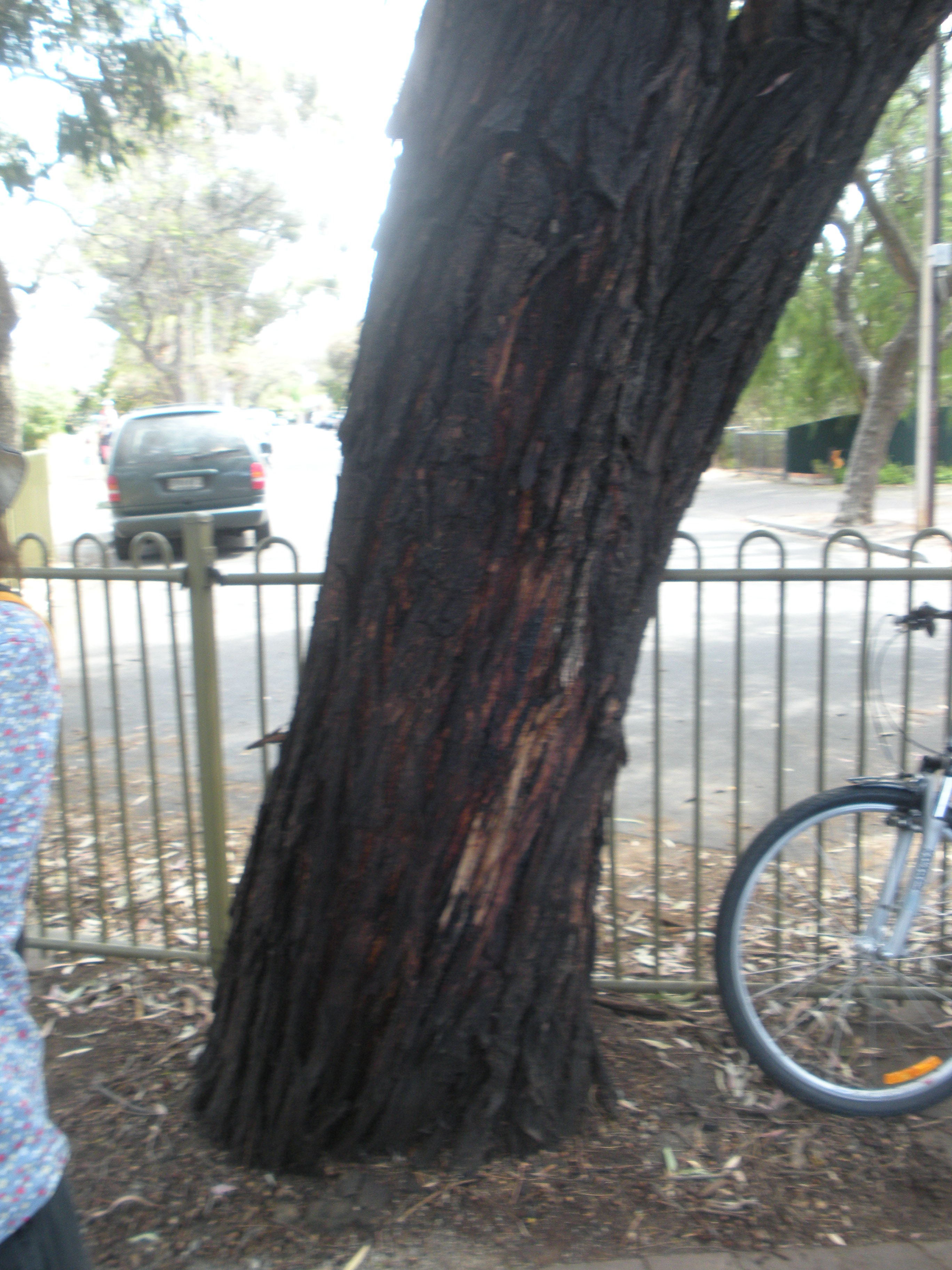
While my posse of friends and my house guests from Denmark were hitching up their bikes, I took a sample of the tree right at the dead end of Kertaweeta Ave Black Forest where we entered the school grounds, with the help of a taller friend.  Excuse the extra good photo….

This tree had smooth, pale bark in some of the finer upper branches.

I don’t know why, but I do not entirely trust the result that Euclid and I produced: E Corynodes.  Poor Euclid, depending on me.  There were no mature fruits, buds or flowers to consider, and that makes the result less dependable and the chance of detecting an error smaller. Euclid suggests E Corynodes can be confused with several other species, but look at this account of how to tell them apart!

E. fibrosa subsp. fibrosa, E. fibrosa subsp. nubila, E. melanophloia and E. rhombica … differ in having buds with stamens all fertile and irregularly flexed.  E. sideroxylon differs by having buds that hold the outer operculum into maturity and both the inner and outer operculum shed together at anthesis (no operculum scar).

So that would be obvious, then!  Based on this I wonder how I can be sure this is not E Sideroxylon, which would give orange too…  Because whatever its true name, this is the result I got.

Leave a comment

Filed under Dye Plants, Eucalypts, Natural dyeing

Eucalyptus Torquata: Leaf Prints and Modifiers

Remember my modifier experiment?  I have two jars of wonder, based on Jenny Dean’s instructions.  One contains offcuts of copper pipe from my Dad, vinegar and water.  It’s been steeping for months.  My first effort at iron water didn’t work out as I’d hoped, more like a science experiment!  This one is based on my friend’s collecton of bent nails.  He has been turning pallets into furniture, so he has removed a lot of nails.  They got left out in the rain and, bless him!  He thought of me.  Here they are, left to right:

Mystery Science Experiment, Rusty Nail Water, Copper Pipe Water.

Here are my E Torquata samples on hand spun wool and commercial wool/hemp blend:
Unmodified at the top, Iron modifier next, Copper modifier at the bottom.  I have to admit, this isn’t a deeply exciting result.

And here are my E Torquata leaf prints on recycled linen (the darker one was the side against the cast iron pipe):

Here are the prints from my ‘is it E Scoparia?’ experiment.  The answer is a tentative ‘yes!’  Recycled linen on the left, recycled silk on the right.  I included the very young, soft, green foliage you can see printed toward the bottom partly because I have been asked whether it is true you need to use young foliage to get good leaf prints.  My experience is that you don’t (though of course, you can).

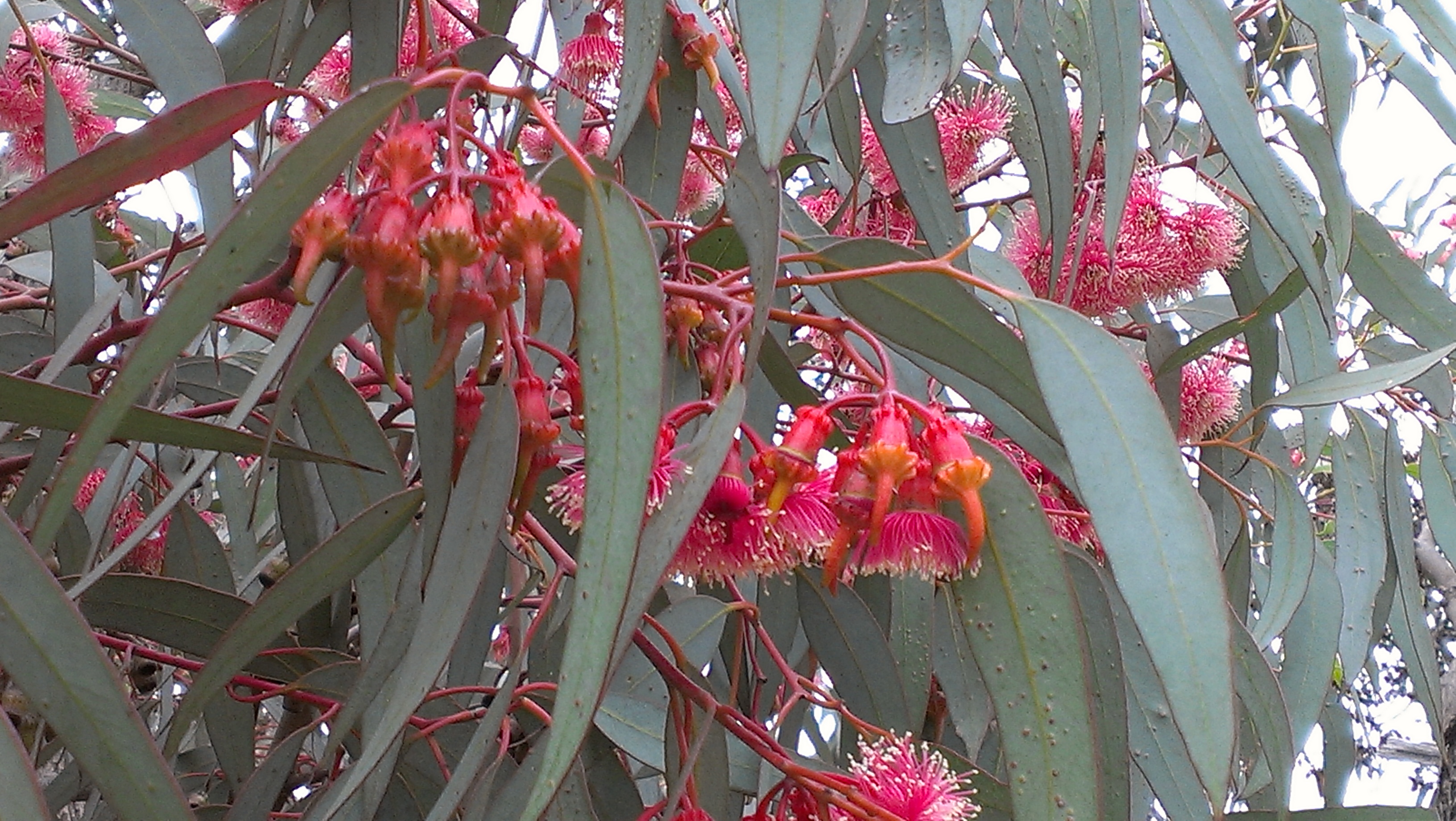
Finally… a gratuitous photo of an E Torquata flowering very pinkly in a car park in my place of work.  One of my co-workers came out of the building to see me with a pile of papers in one hand and my phone in the other, and said: ‘What are you doing, Mary?’  As you would, really.

4 Comments

Filed under Dye Plants, Eucalypts, Leaf prints, Natural dyeing

Ironbark Mystery

This week I found some E Sideroxylon trees in a park with lots of low hanging leaves… too tempting.  So I harvested some.  I brought them home and made leaf prints.  I have obtained strong oranges from these leaves in the past, so imagine my surprise when I unwrapped them and saw this:

This is on the silk-faced side of a hemp and silk blend.  It did confirm for me that the silk-faced side should be the right side.  Here, on hemp-cotton blend:
Disappointed, I considered the possible reasons.  Perhaps those pipes were not cast iron but something else?  I didn’t think so. I re-checked that I still have my cast iron pipes stored separately from my welded steel pipes… yes.  Hmmm.  But then I checked the dye pot using the same leaves, that I was cooking at the same time as the leaf prints.  And the wool was barely tan, almost no colour at all.

So, the metal content of the pipe is not the explanation.  The leaves that had been cooking for 3 hours or more were still green looking.  The dye liquor was barely tan.  I would expect the leaves to be orange and the dye liquor to be strongly coloured.

What could explain this?  I went back to my sample cards to check I really had ever had success with E Sideroxylon and there were my samples, bright orange.  There are a lot of variables in natural dyeing, and season or rainfall or soil could make a difference, but surely not this much of a difference.  The most plausible reason is that this tree was not E Sideroxylon, and that when I have had perplexing results in the past, they have also been caused by using a different species.  So, I consulted my most detailed and sophisticated Eucalypt resource, Euclid.  This is a database of Eucalypts created by the CSIRO, an Australian government-funded scientific research organisation.  Euclid is an amazing tool, but when using it to identify a Eucalypt, an accurate result depends on accurate observations of the tree in question–so user error is still possible.

When I began learning about Eucalypts, I couldn’t tell an ironbark from a stringybark (for those still in this position, please accept my assurance that the difference is quite profound once you grasp it).  I finally worked this out when I tryed dyeing with E Melanophloia and got nothing.  Almost no change in colour.  I thought it was E Cinerea, which has a great reputation as a dye plant.  Well, Melanophoia is a pale trunked ironbark and Cinerea is a stringybark.  They do both have rough, deeply furrowed bark and silver grey heart or round shaped leaves and white-cream flowers, and there the similarity ends!

So… perhaps I am about to move my understanding of Ironbarks up a few notches.  Euclid and my observations reduced the number of possibilities down to 7 (from a possible pool of over 900 Eucalypts).  The plausible candidates are: E Rhombica; E Fibrosa subsp Nubila (Blue Leaved Ironbark); E Decorticans; E Fibrosa subsp Fibrosa (Broad leaved Red Ironbark) and, of course, E Sideroxylon.  I think E Fibrosa subsp Fibrosa is my front-running candidate… it looks very much like E Sideroxylon to me on Euclid even now my suspicions are raised.

Next thrilling update whenever I reach some new insight!  Unfortunately none of these new possibilities are in my ready reference (a book), so I may be observed under trees in the neighbourhood with my laptop in hand.  Well, it won’t be the first time.

6 Comments

Filed under Dye Plants, Eucalypts, Leaf prints, Natural dyeing, Uncategorized

Eucalyptus Torquata

This is E Torquata, the Coolgardie Gum.  In my area it is a popular street tree.  It is a relatively small gum tree with a showy lovely flower and distinctive bud caps.  Being native to Western Australia, it tolerates the dry conditions that a street tree in Adelaide can expect to have to manage.

I find Coolgardie Gum easy to identify. When I was a child we lived in the goldfields in WA where this tree is from.  We lived in Kalgoorlie for a while, and this tree grew there as well as over to Coolgardie, which we used to visit.  The other town Wikipedia mentions as within its range is Widgiemooltha.  When I was a kid you could hardly call Widgiemooltha a town, but there was a dam there that someone had set goldfish free in.  We went there once and came home with 15 goldfish, all different!  It was a fantastic day out, picnic plus new pets–what more could a young person want?  We used to break the beak off the bud caps from this tree and string them to make necklaces.  They are distinctive.

This particular tree has relatively yellow flowers, but most nearby have flowers that are closer to orange.  There is a big infrastructure project happening in my suburb soon, and some of the local trees are going to go, including this one.  So I decided to harvest a little.  I have tried it as a dye plant before and I wasn’t impressed (I don’t invest time in natural dyeing with the intention of gettng tan), but I know someone who has achieved green from this tree using modifiers.  These leaves are destined for my sample pot.  I’m aiming to try them with modifiers myself.  I have some rusty-nail-iron-water and some copper-pipe-water, and I’m finally going to try them out.

I have also wrapped up some leaves sandwiched between some recylced silk and some recycled linen to see what happens.  I also put some samples in from some trees I found near a friend’s house in another part of the city just in case they are E Scoparia… the leaf shape and bark are right, the number of valve sin the fruit is right, the flower colour is right, and the bark is colouring up the way the ones in my neighbourhood are, but I trust the dye pot more than I trust my capacity to identify Eucalypts.  I’ve cooked my leaf bundles for 3 hours and I’ll unwrap in a day or two.

While I’m on the topic of Eucalypts that don’t have long to live… RIP this beautiful Corymbia Citriodora (Lemon Scented Gum).  At the community information day on the weekend I was told it would be cut down this week or next.  Right now it is in full bloom.  There are thousands of bud caps showering down and the road is covered in a dusting of yellow stamens.  Lorikeets are screeching and flying in and out of that tree all day long.  They start before I’m out of bed in the morning.

Farewell beautiful trees.

Leave a comment

Filed under Dye Plants, Eucalypts, Natural dyeing, Uncategorized