Category Archives: Natural dyeing

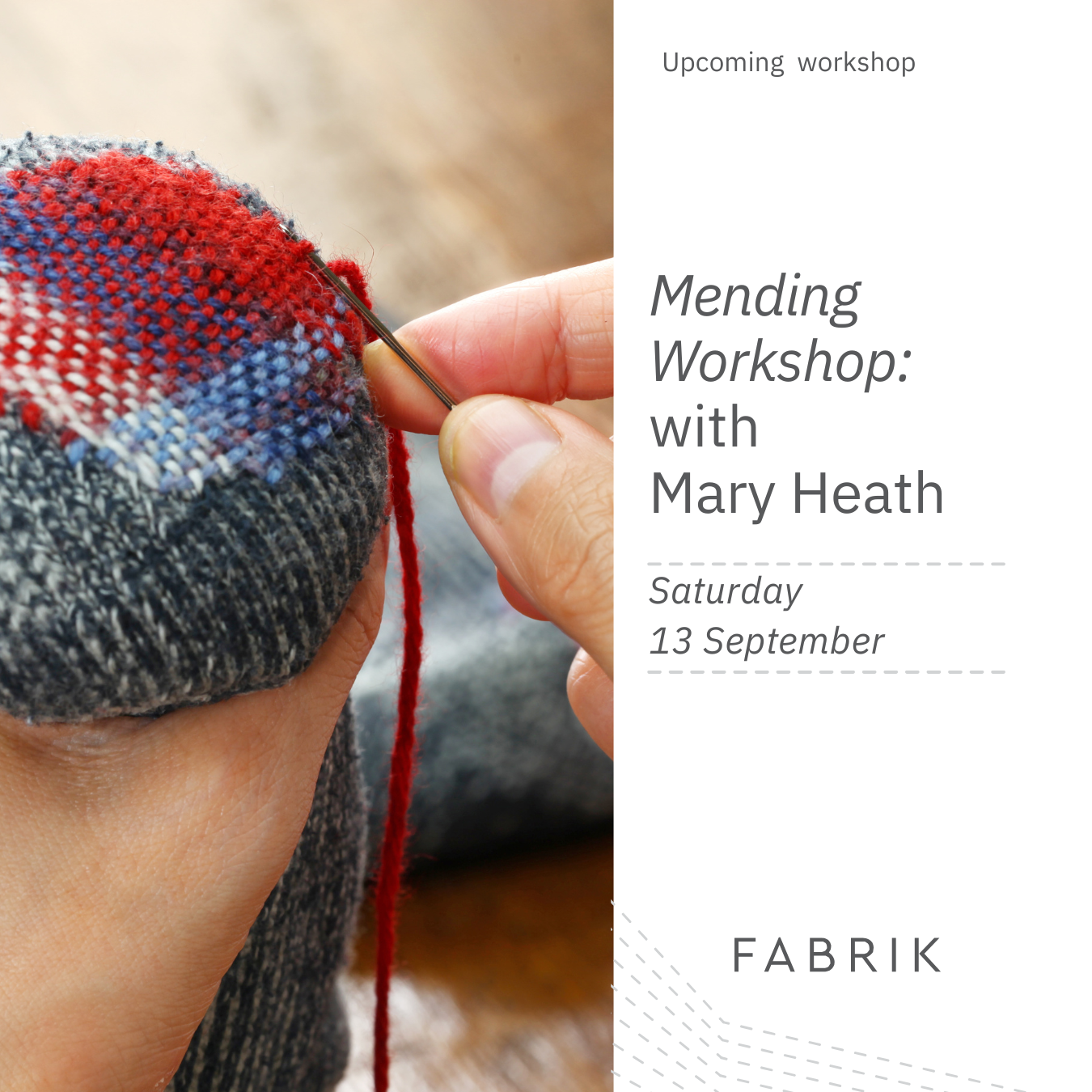
Upcoming Mending workshop

Are you looking for an opportunity to do some mending in lovely company, and an inspirational, beautiful venue? I am running a mending workshop at Fabrik, a newly renovated and glorious exhibition and workshop space in the old Lobethal woollen mills. I would be thrilled if you would like to join me there.

This workshop will focus on hand mending–so bring anything you would like to mend with you, whether that is a sock with a hole in it, a worn pair of jeans, or a beloved shirt. If you already know how to mend, enjoy the pleasure of like-minded company while you tackle your mending pile. If you are stuck on how to go about mending something–bring it along and learn how to tackle it! I will provide a selection of patching and threads for a wide variety of mending, from denim through to fine woolen knits. I’d be delighted to share what I know with you–and inevitably, you will learn a lot from the fine people you will meet at the workshop, too. You can find tickets for sale here.

Leave a comment

Filed under Natural dyeing

Waste work and unlovely mending

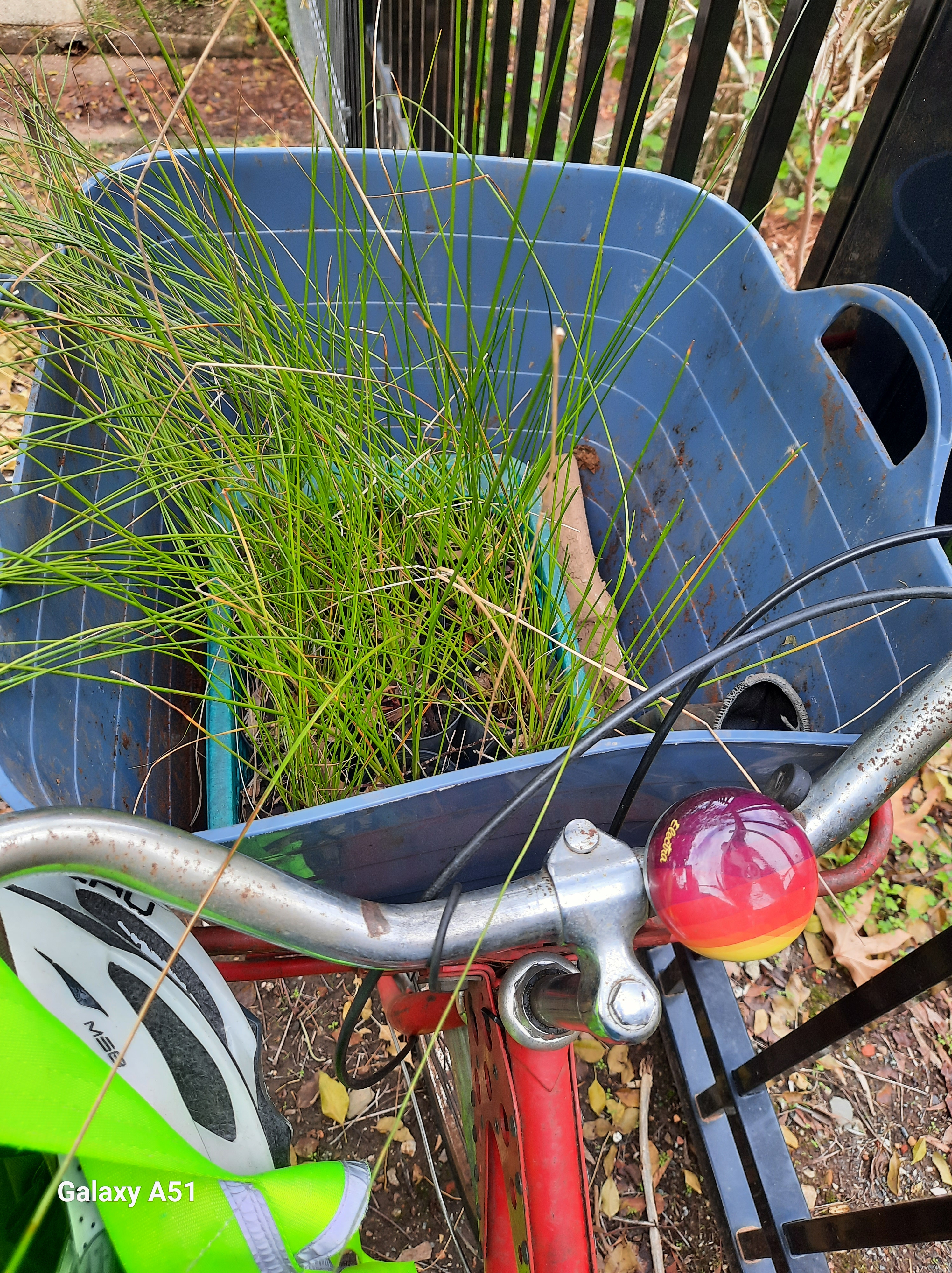
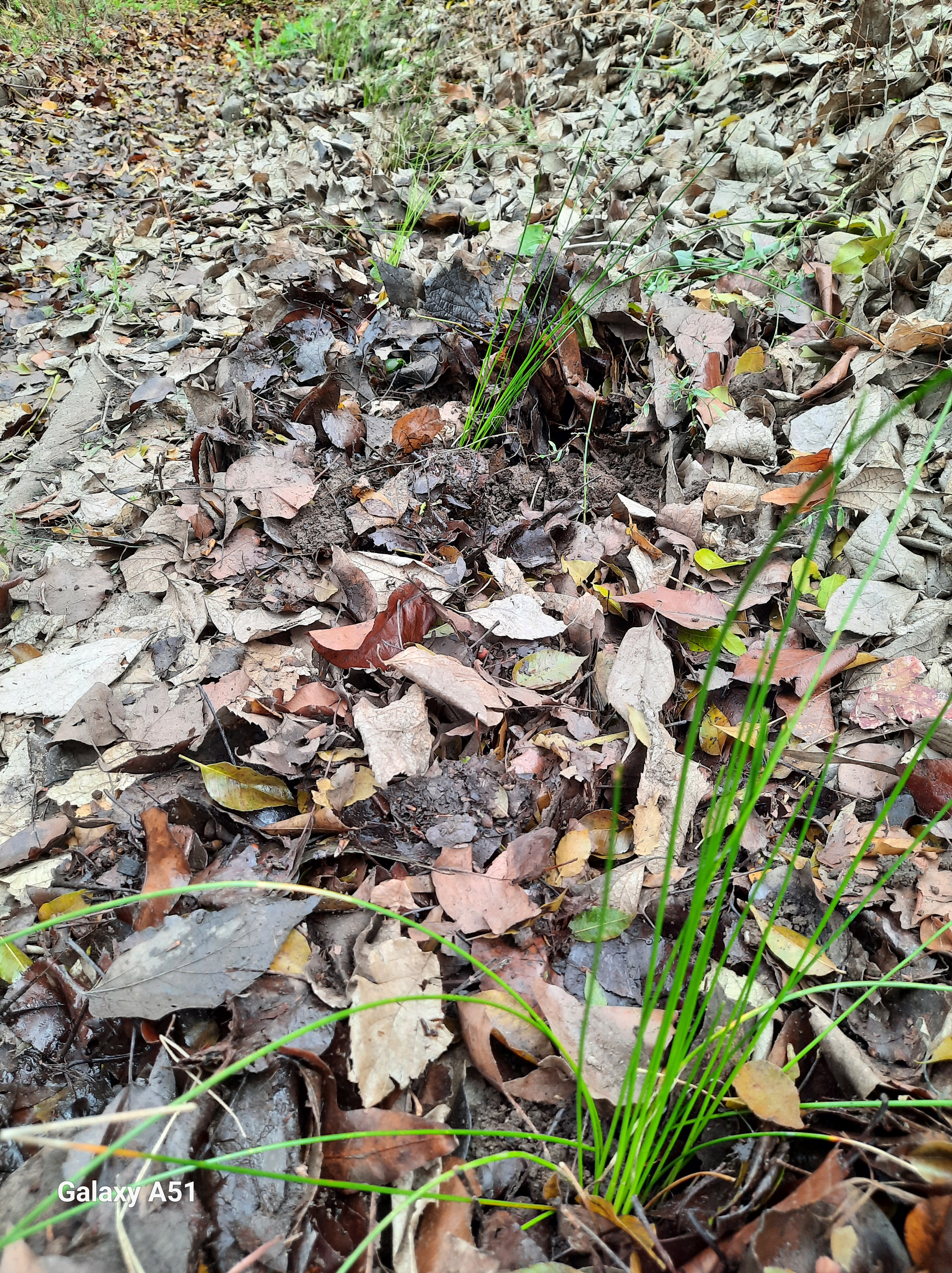
This morning I went out to guerilla garden. First of all the sedges (cyperus gymnocaulos) and the knobby club rush (ficinia nordosa); going into the banks of a culvert. The suburbs are full of these unloved places where native plants could grow and habitat could be created, bare earth could be under a blanket of beautiful plants. Yet so often, none of these things happen. This is my third planting of sedge in this spot this season–last season I thought every sedge I planted had died, but this morning I found two that had survived.

Once planted, I picked up the fallen leaves from nearby culvert, made of concrete, and piled them up around the sedges. I can’t tell you how many conversations I have with people who pass in the street, about fallen leaves. Rich, amazing bounty, regarded by so many as an inconvenience and as trash. I have literally explained to people many times why I am picking them up (because I want them) and then had to explain how I will use them (compost, mulch, weed suppression, you name it) and sometimes even how (you can lay them on bare earth and they will return to soil, but better than it was).

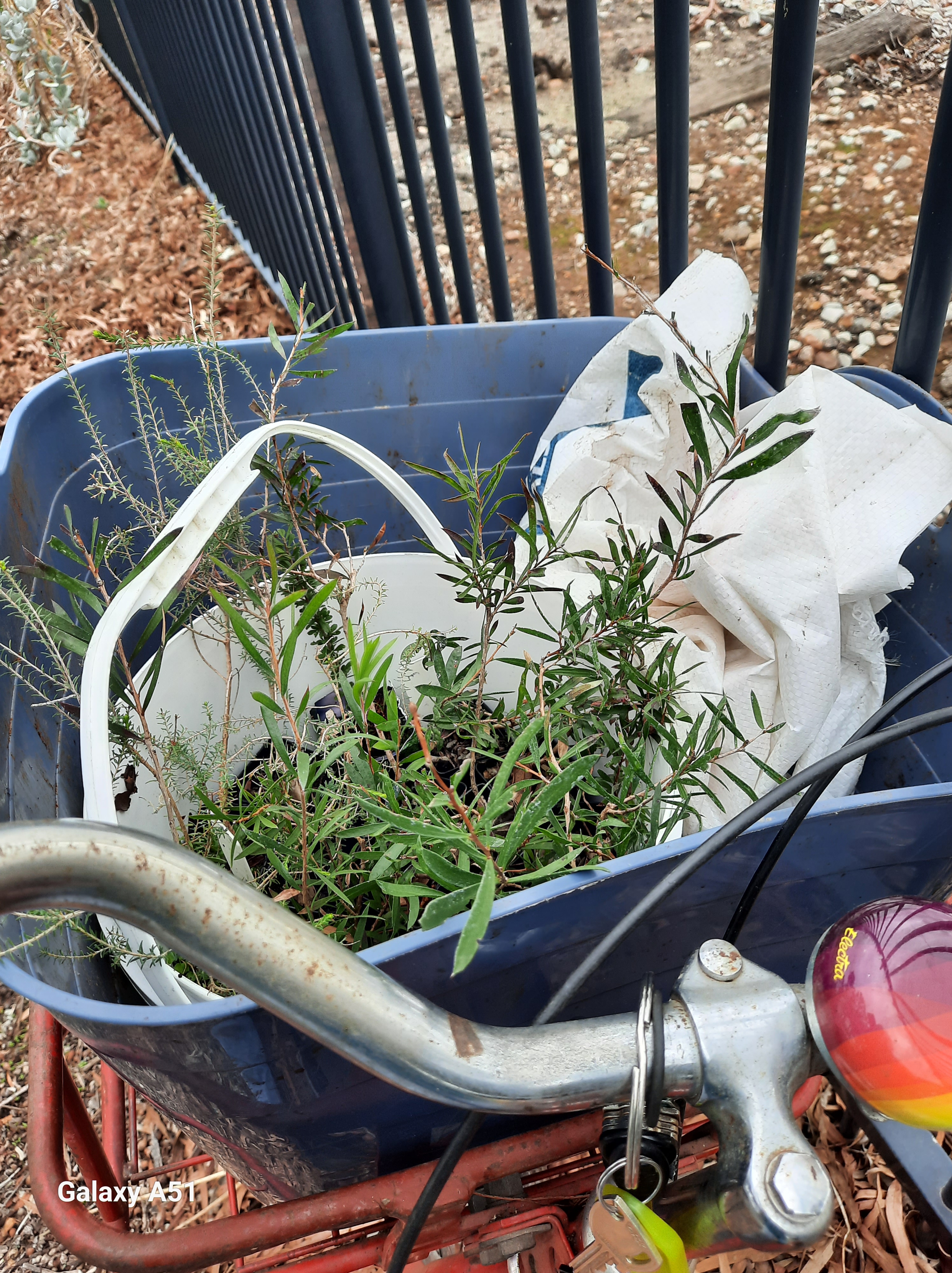
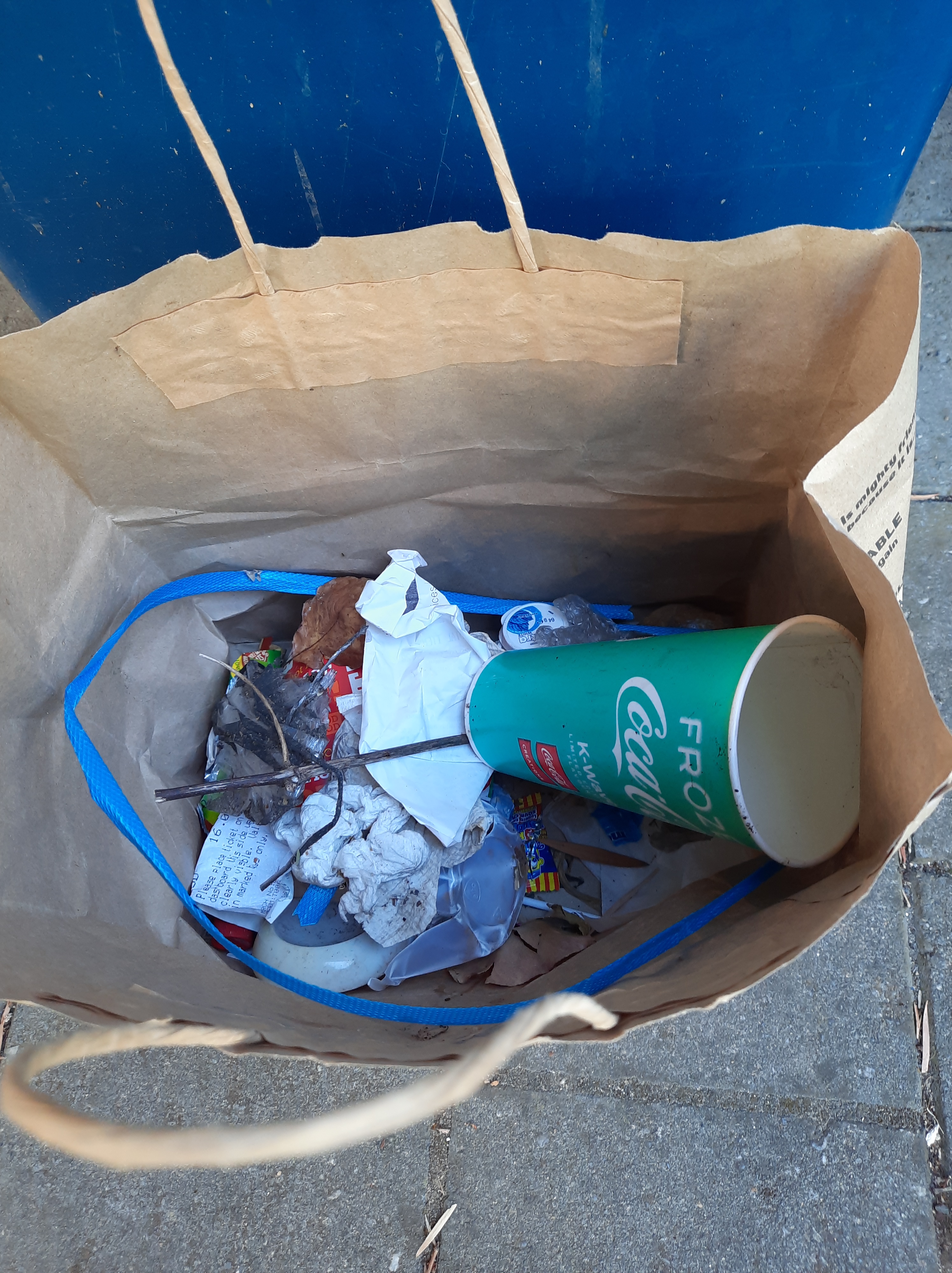
On outing 2 I finally planted the last of the bottlebrush and tea tree, alongside the public transport corridor. And picked up the litter there. I took a bag that sheep manure came home in specifically for the purpose because there seems to be nothing quite like public transport infrastructure, for rubbish. Sometimes it just blows there, I guess.

Then I went to the local cafe and collected their scraps and coffee grounds. At home, in go dead street tree leaves to bring the carbon needed for composting to go well, plus this bag of paper towel from my “work” place. I’ve just decided it doesn’t make sense for it to go to public waste systems when I could bring it home and compost it. Yes, I’m taking my own hand towel and using one I can wash and use again. Meanwhile, these went into the compost bin too. The bag will go back in my bike bag for next time.

And then I have spent part of the day re homing things other people don’t want. And that neither they not I want to go to waste. This coverlet has found a new home via local Buy Nothing, and I have several other items waiting.

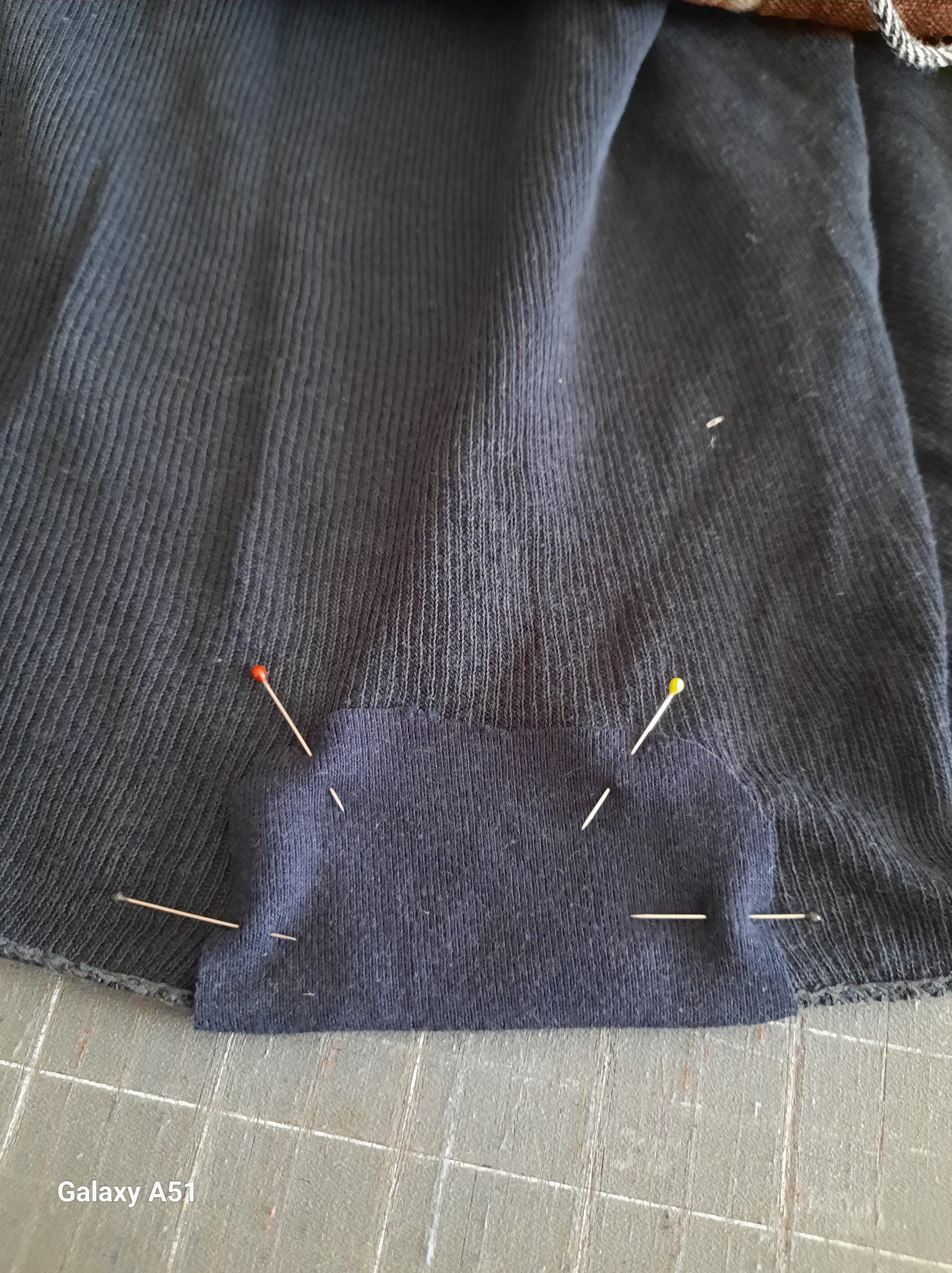
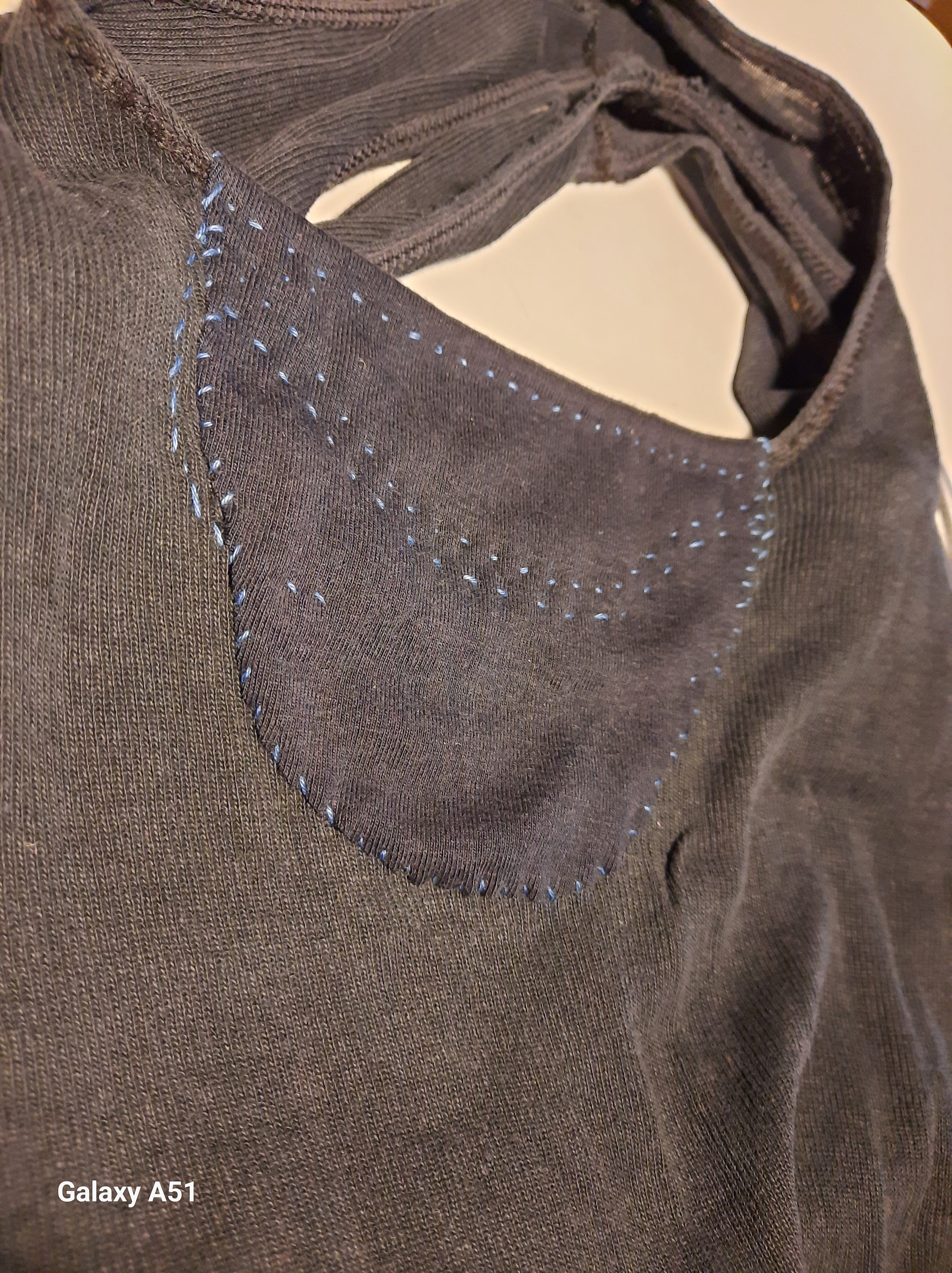
I don’t know quite what to say for myself today. Why am I posting about all this?? But it did strike me eventually that it has been a day of perfectly pleasurable waste work, which I am now capping off by mending yet another of my not-too-glorious undergarments, with part of someone else’s dead t shirt. I cut a pattern from a piece of used paper covered in text (that goes to the compost here too), and pinned it on; cut out two patches and pinned them on, folding over to reinstate some fabric where it has worn away. This garment is so worn, it seems a bit ridiculous to mend it. But I have not yet managed to let it go; and it is an old fave. So I decided to do it anyway.

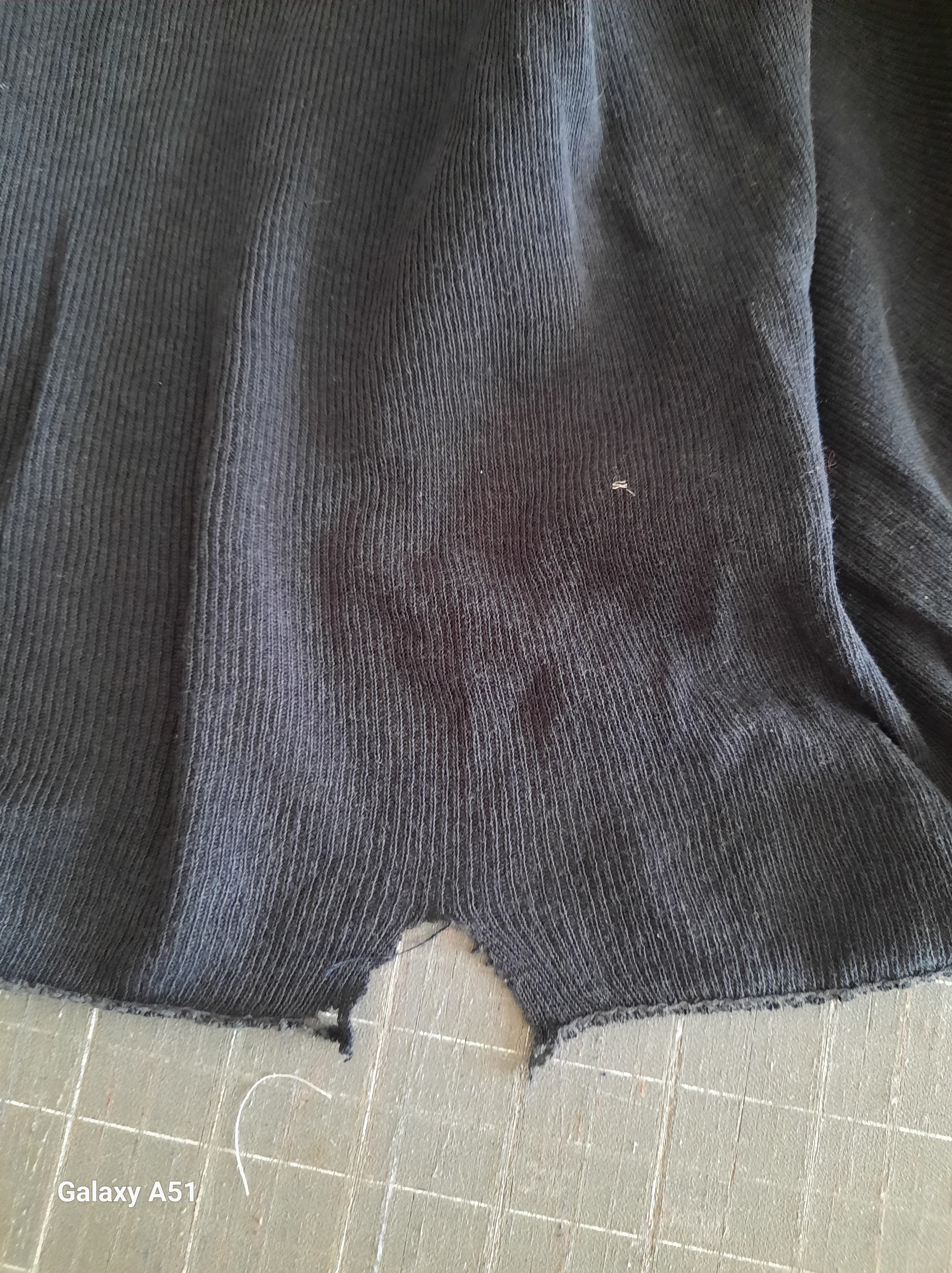
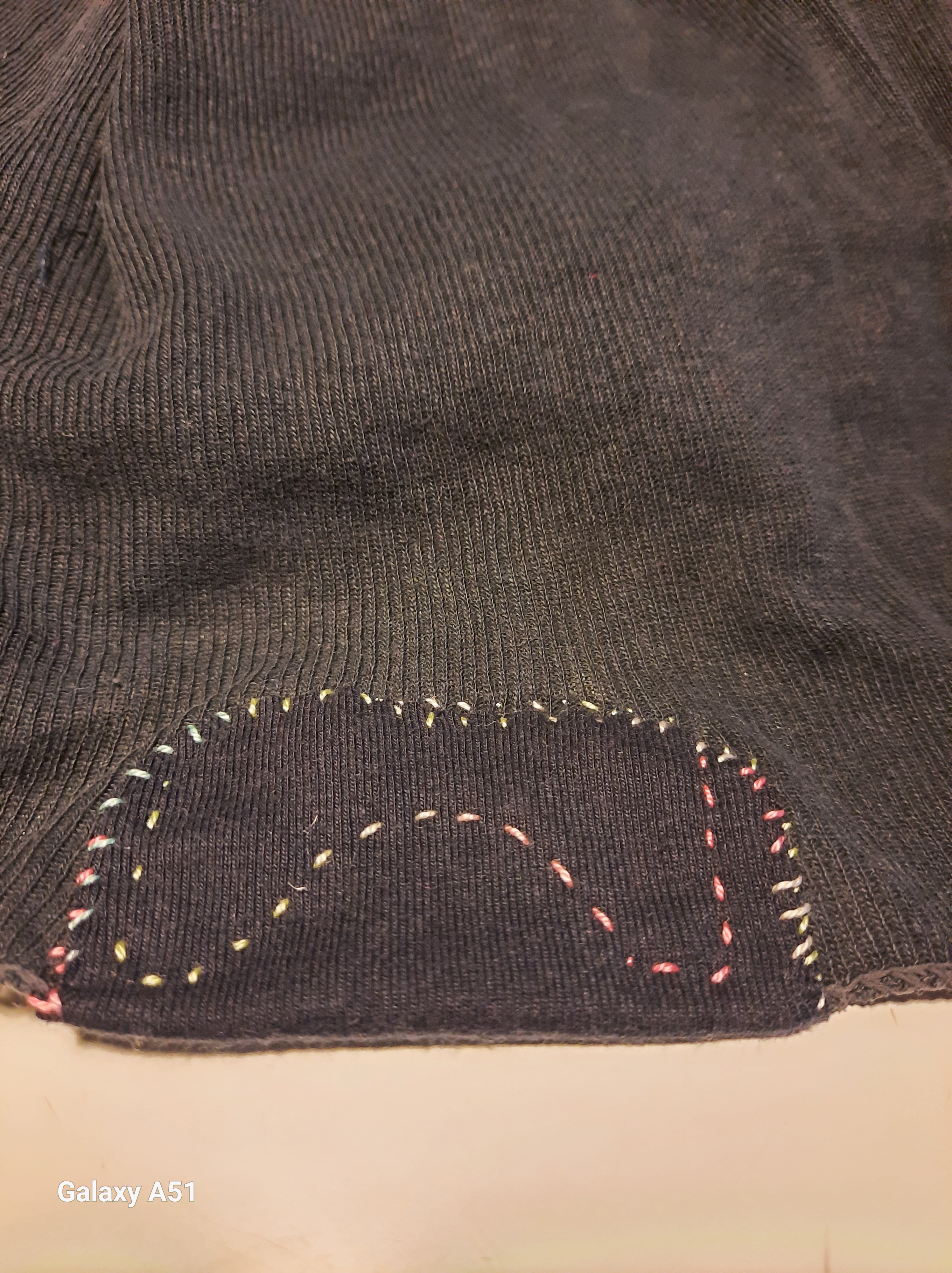
Two patches, one under each arm; and then–as I am going that far–a little patch at the hemline (*cough* this was overlocked with no hem when this garment was new–long, long ago) where I have never noticed it has come adrift.

And after a long phone call and some instructional video watching… here it is. I tried two different threads–didn’t love the first one (perle cotton) in use so switched to the blue thread (sashiko thread).

And if nothing else, I guess I will learn about how that feels to wear, and how it washes. As well as–how long before more of the garment wears right through! And that is a wrap on my waste work day.

6 Comments

Filed under Natural dyeing

Recent mending

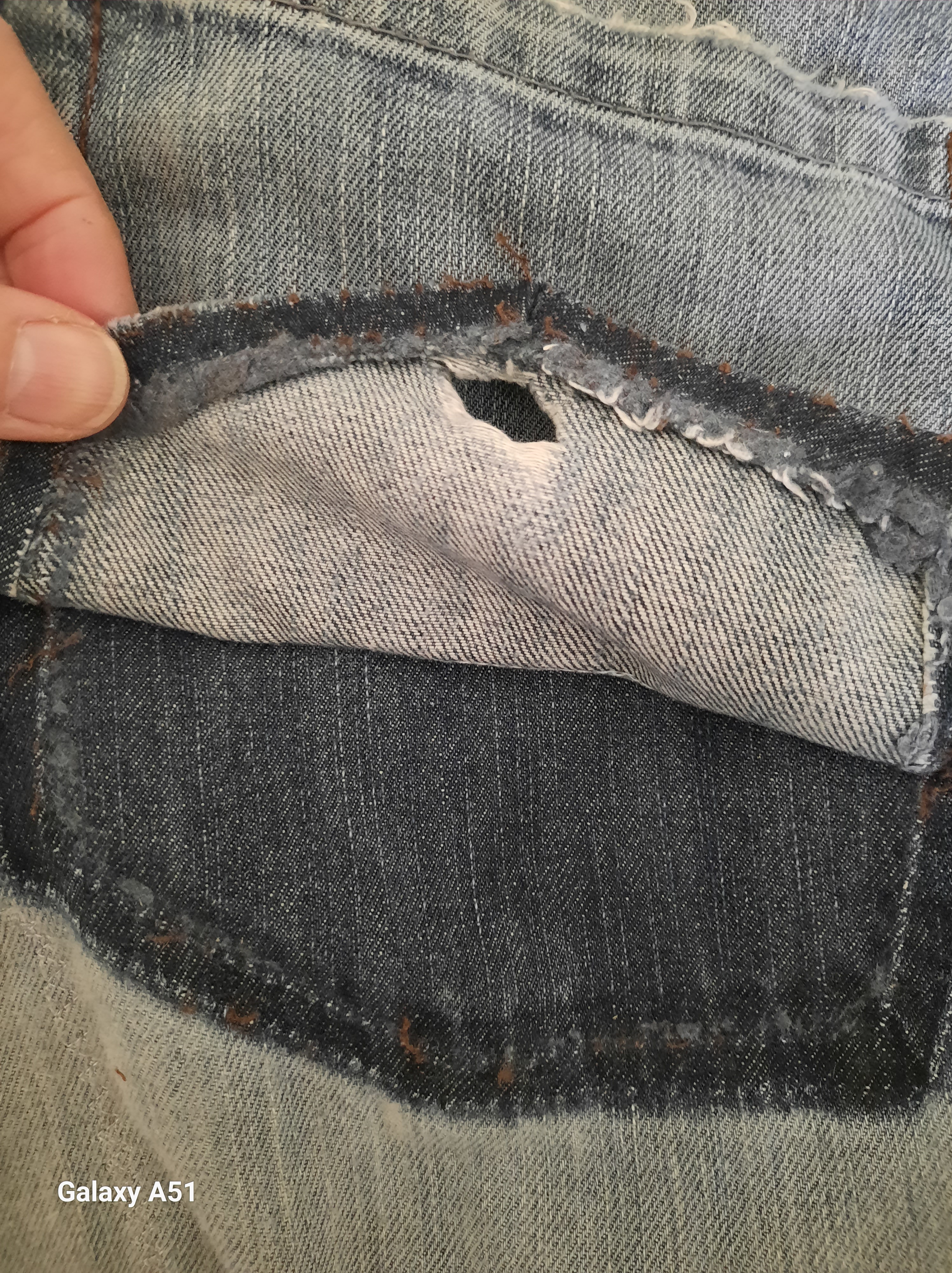
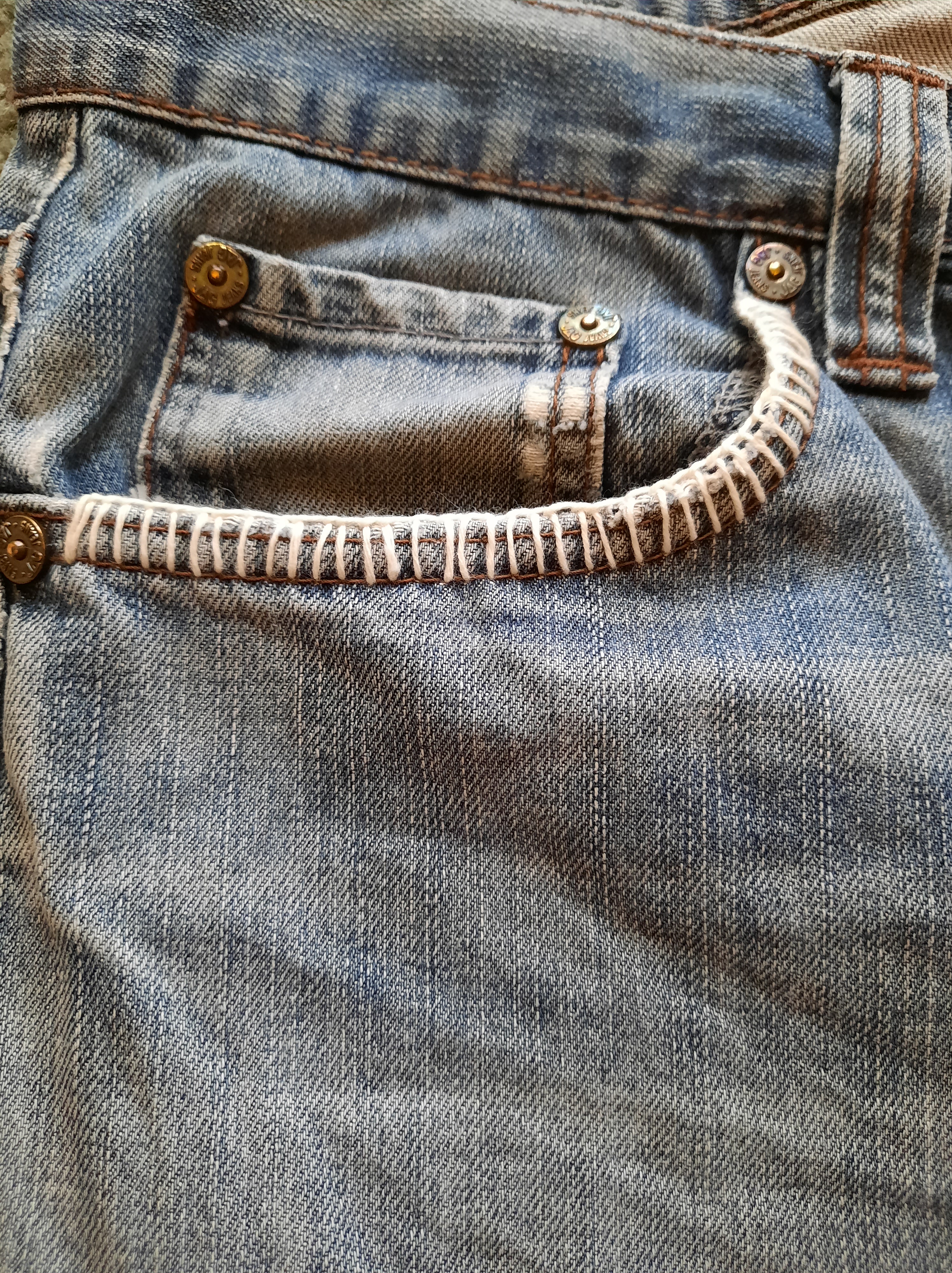
As every reader of this blog knows, I love to mend. And here comes another jeans mending moment. I have a favourite approach, namely, rip the base of the pocket out and replace.

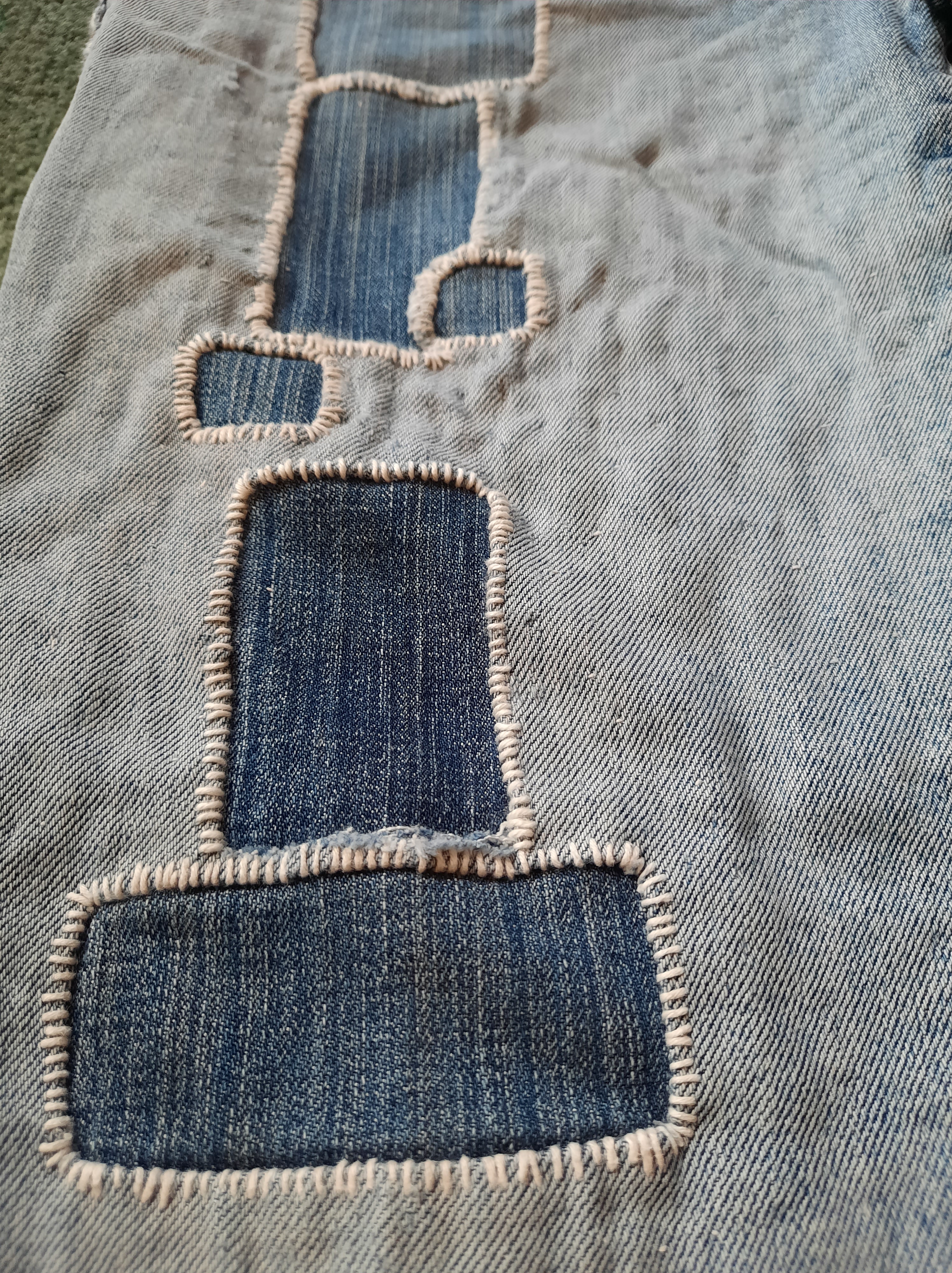
These jeans are well past the point of invisible mending. They are covered in mending. And so…

And there you have it. I did not have matching top stitching thread, but my machine comes with a triple straight stitch. So I threaded up with the best match, and once I had it firmly in position and stitched on so I could be confident–unpicking triple straight stitch is NOT a fun time for me–I triple stitched it on. I am not sure I can see where the original top stitching stops and the triple stitch begins, to be honest!

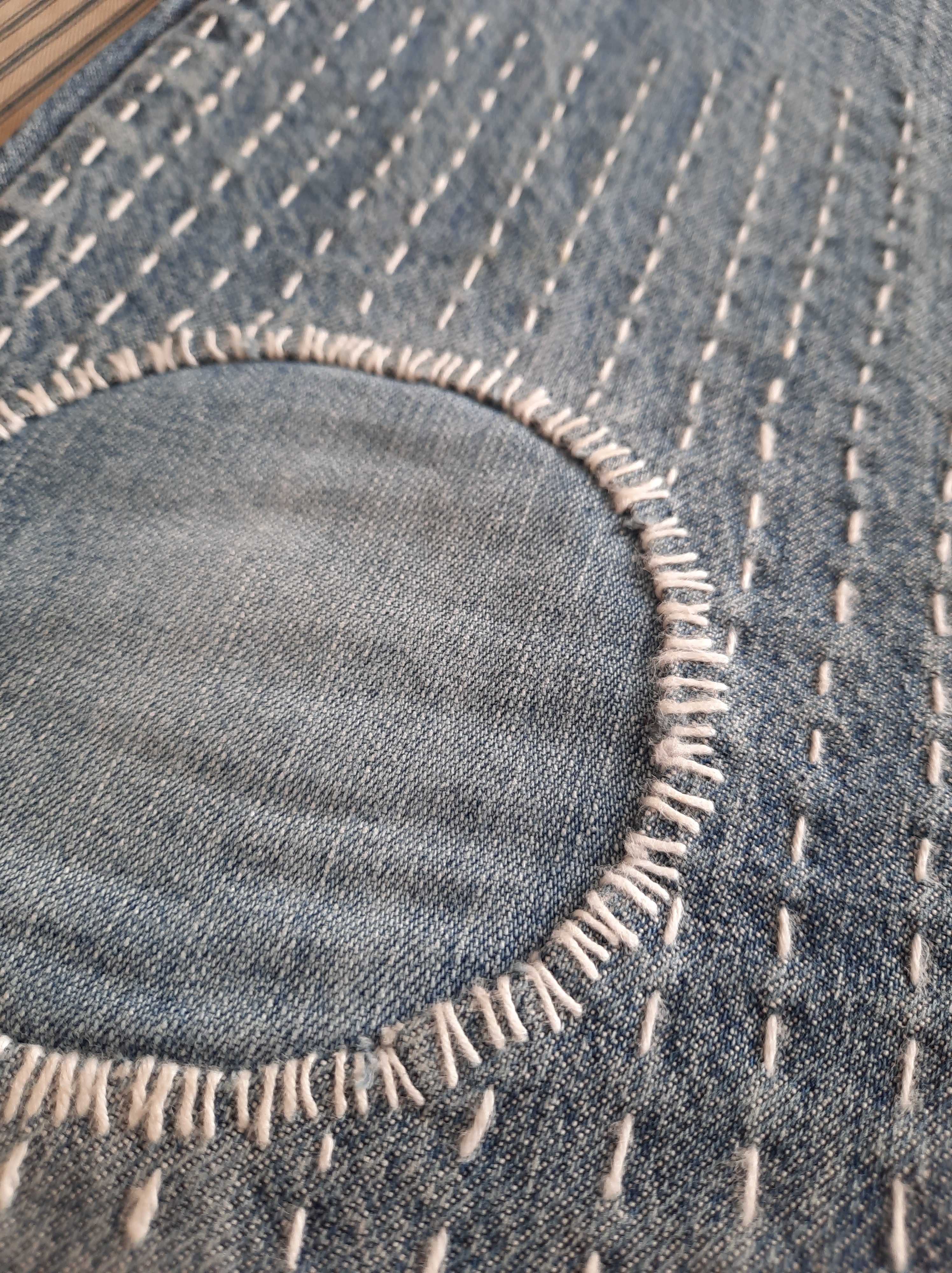
This is a subtle mend on a singlet I made for one friend, that arrived at my house with a different friend. It had worn through under the arm, so patch on the inside and slight stitches to be seen on the outside. I also mended a seam come apart with some simple hand stitches. Over a game. Perfect.

Just about invisible, hurrah!

Leave a comment

Filed under Natural dyeing

Guerilla gardening

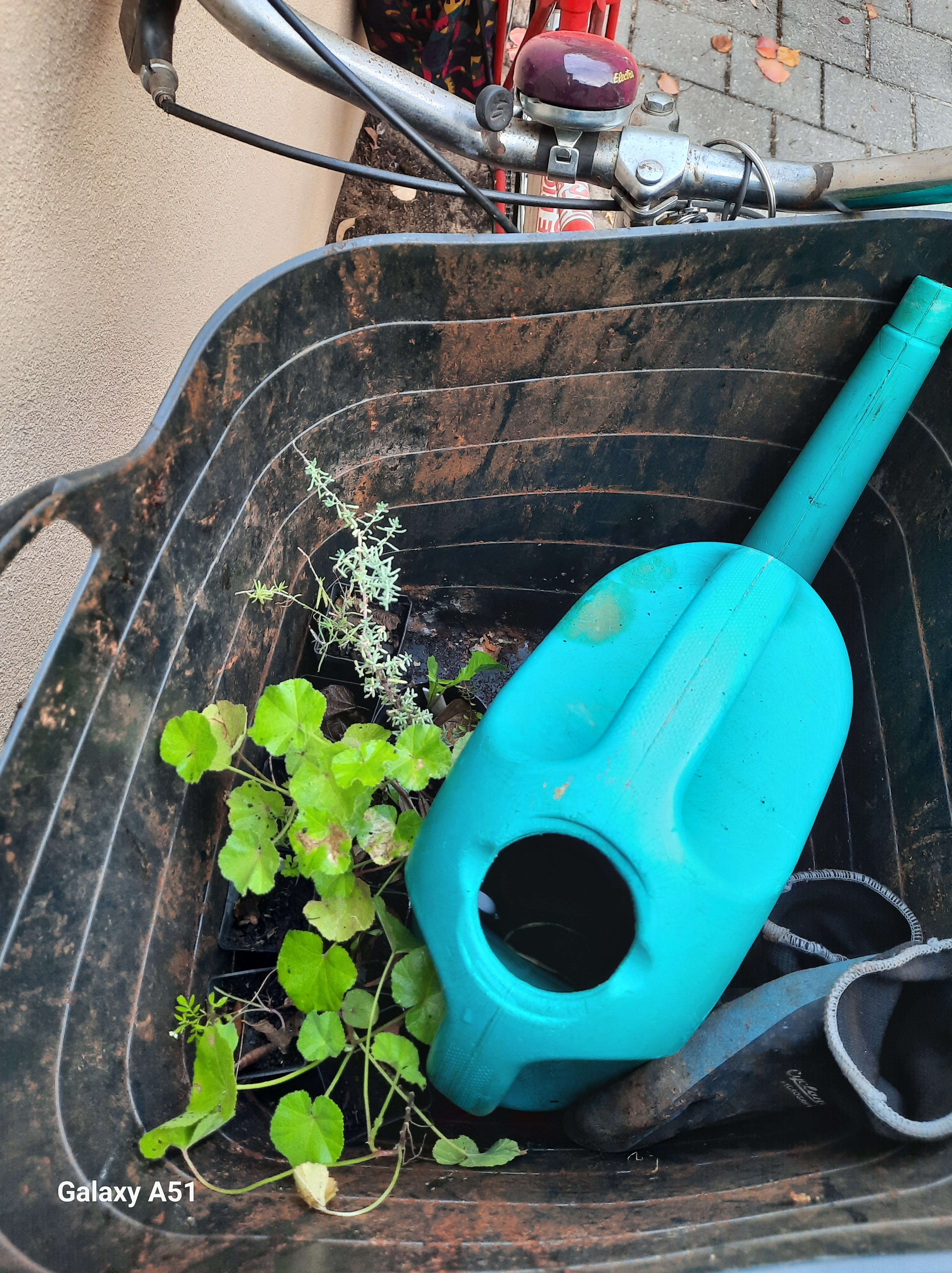
Hello dear readers, if any of you are still out there! I looked into the blogroll on this blog today and found that almost every blog I used to list has gone. In fact, blogs as they were when this one started are pretty much gone, wouldn’t you say? But my urge to guerilla garden is not gone. So here is my deadly treadly last week; bucket of compost on the back, plants, water and tools on the front. Ready to go. Honestly, friends, the bin fire of the world at the moment is so utterly devastating and makes me want to cry and rage so much–it has been hard to post. But sources of solace are important, and continuing to do what we can is also important. Now that much of what I do is organising, this might be a strange choice of post. But I’m sharing anyway on yet another heartbreaking day in the life of the world.

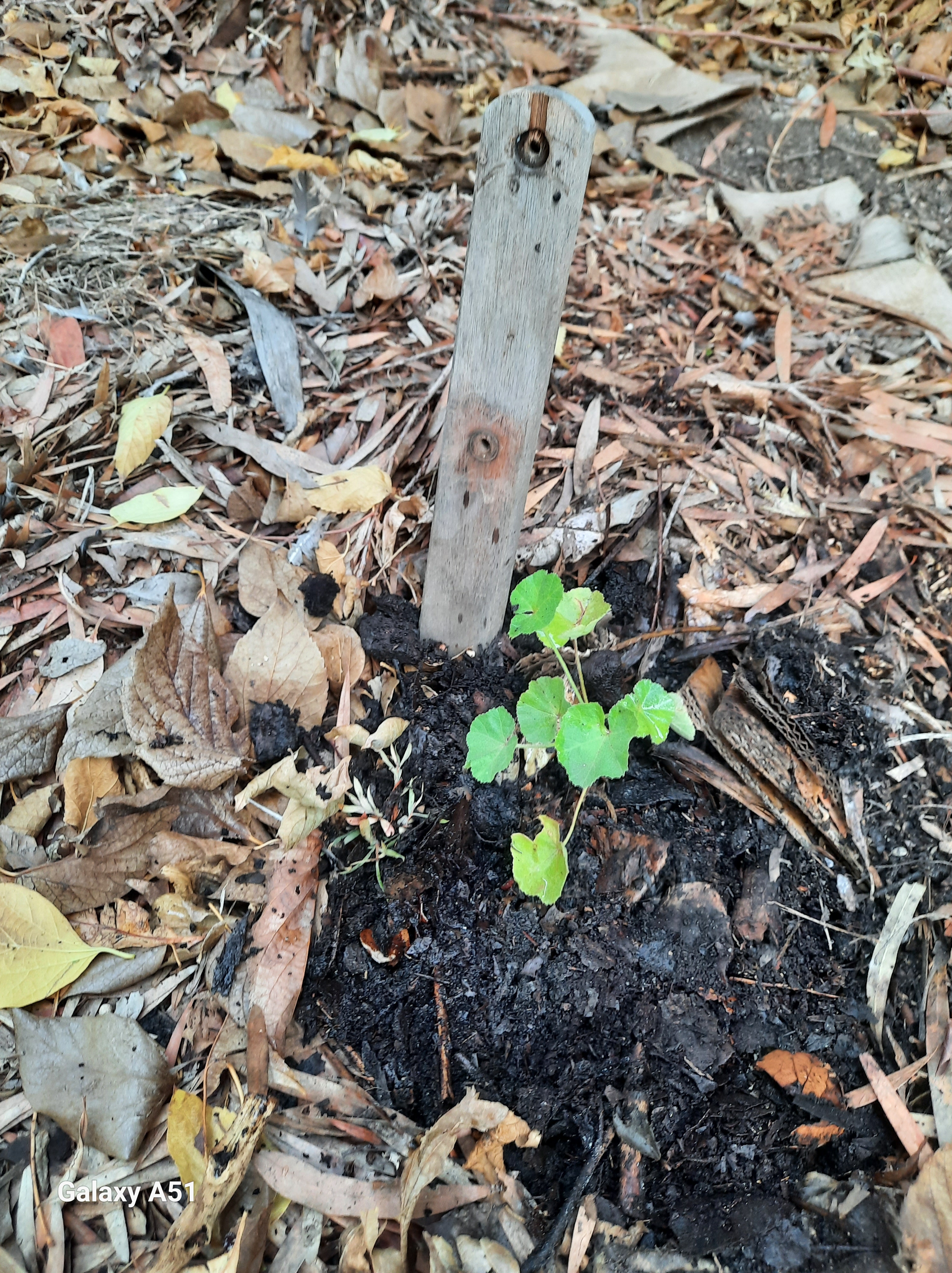
The plants are native mallow; ruby saltbush and dryland tea tree. Here is their new home. Clearly designed to be planted–nothing growing there. And not much soil. I have carted compost here with the help of my beloved, as well as adding mulch as it collects in the nearby drain, over some months. So now there is soil there.

In they go! I love the way that free mulch just lands on city streets most times of the year. There for the taking and using. I collected a wheelbarrow load yesterday and one of my neighbours was incredulous. “What are you going to do with it?!” “Compost!” I said. Honestly, I am incredulous more people don’t do it.

And here I am on site… (and I apologise for my phone advertising itself so relentlessly. If you know how to make that stop, please do tell me how it’s done!

And here is one of the plantings and its stake, made from part of a hard rubbish deck chair and given a pointed end by my beloved, who has power tools to contribute to the team. Thanks for reading, lovelies.

7 Comments

Filed under Natural dyeing

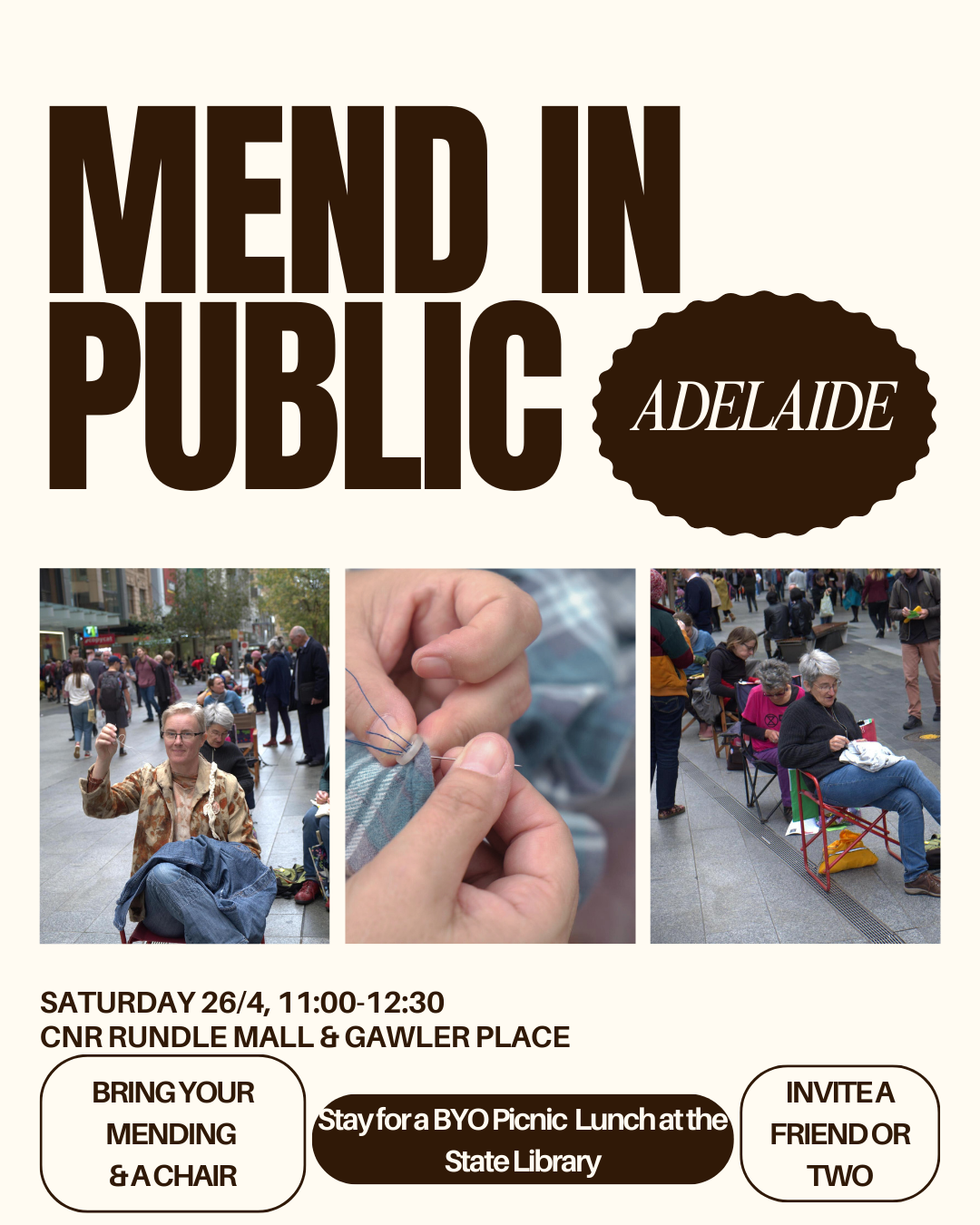
Mend in Public Day 2025 Kaurna Land

If you are local to me, please save the date and join us for Mend in Public Day. If you are not local, or simply not able to be there, lots of other options are available, including events in other parts of the world. And if, like me, you are looking out into the world and seeing so much that needs mending? Please do put down your doom scrolling and that lonely feeling that besets you when you contemplate the enormity of a broken world. Come and mend both concretely and symbolically. Come and build community with others who want to mend our collective brokenness. Come and grieve the anniversary of the Rana Plaza disaster and the violations of workers’ rights and human rights that occur in the name of fashion. Come and think about the damage the textile industries cause to the environment and the contribution they are making to the climate emergency. Come and do something practical and collective to make change, however small.

Leave a comment

Filed under Natural dyeing

On shame

I have been thinking a lot about shame recently.

In my sewing, much of which now involves mending and making from often-threadbare discarded textiles, I think a lot about the associations between poverty and mending. I was taught to mend as invisibly as possible in order to extend the life of the garment being mended, while concealing the fact that it had required mending. The shame that many people feel about wearing mended clothing and using mended textiles seems to me to come from the thought that poverty is something people should feel ashamed of, and from the idea that bodies are shameful.  Clothing that requires mending often bears the hallmarks of intense wear. It is the pattern of movement of the wearer that creates the level of abrasion that ultimately wears through the cloth.

When I first began to teach mending, people (usually women) bringing their clothes along to mend would often hesitate and apologise before bringing out their best loved jeans, worn through in the seat or between the thighs, to ask whether and how they could be mended.

Menders on social media have done some first-rate work in an effort to destigmatise mending necessitated by “chub rub” (usually used to refer to abrasion between the thighs) as well as making the “rear end mend” (mending the seat of a pair of jeans or other pants) a recognisable category of mending with its own hashtags, techniques and exemplars.

I did not realise when I began to teach mending, that I would need to speak about poverty and inequality so much. But some people who are mending from necessity, because they can’t afford more clothes, feel shame. People who can’t afford to buy high quality clothes in the first place, or who buy their clothes second hand, have more mending to do, sooner, than those who buy top quality and consequently expensive garments. Online mending accounts often show very much mended garments that were high quality to begin with, and therefore more likely to be perceived as “worth mending”, more likely able to be mended, and able to sustain a longer life as mends accumulate.

In this situation, who should feel shame? People who throw their clothes away (for whatever reason), or those who mend their clothes? Who should feel shame? Those who suffer poverty under conditions of profound inequality that are beyond their capacity to control as individuals? Or those who would visit the cruelty of shame on people who have less than they do, by blaming the individual living in poverty rather than the social context that makes poverty thinkable and an end to poverty unthinkable?

We are living in a climate and ecological emergency, where textiles are a significant global contributor to greenhouse gases and therefore the climate emergency. Textile production also contributes significantly to global pollution of air, water and land. Textile production and garment construction are highly exploited industries in which human rights and industrial rights are frequently abused across the globe. In this context, should people feel shame because they have clothes that require mending (usually because they have worn them a great deal) or should they feel shame if they are wearing their clothes very few times before disposing of them, like the average person in some studies of the subject in wealthy countries.

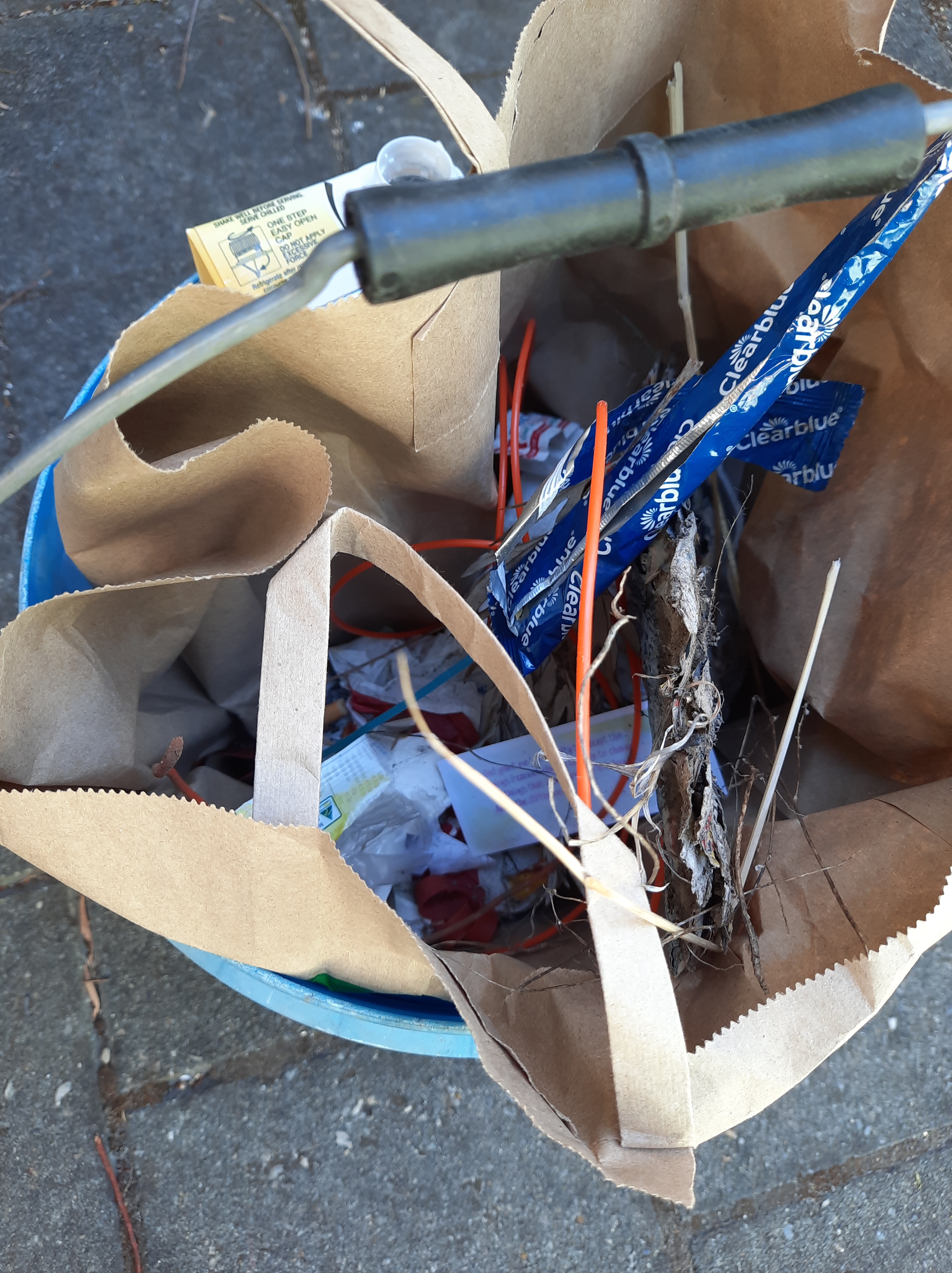
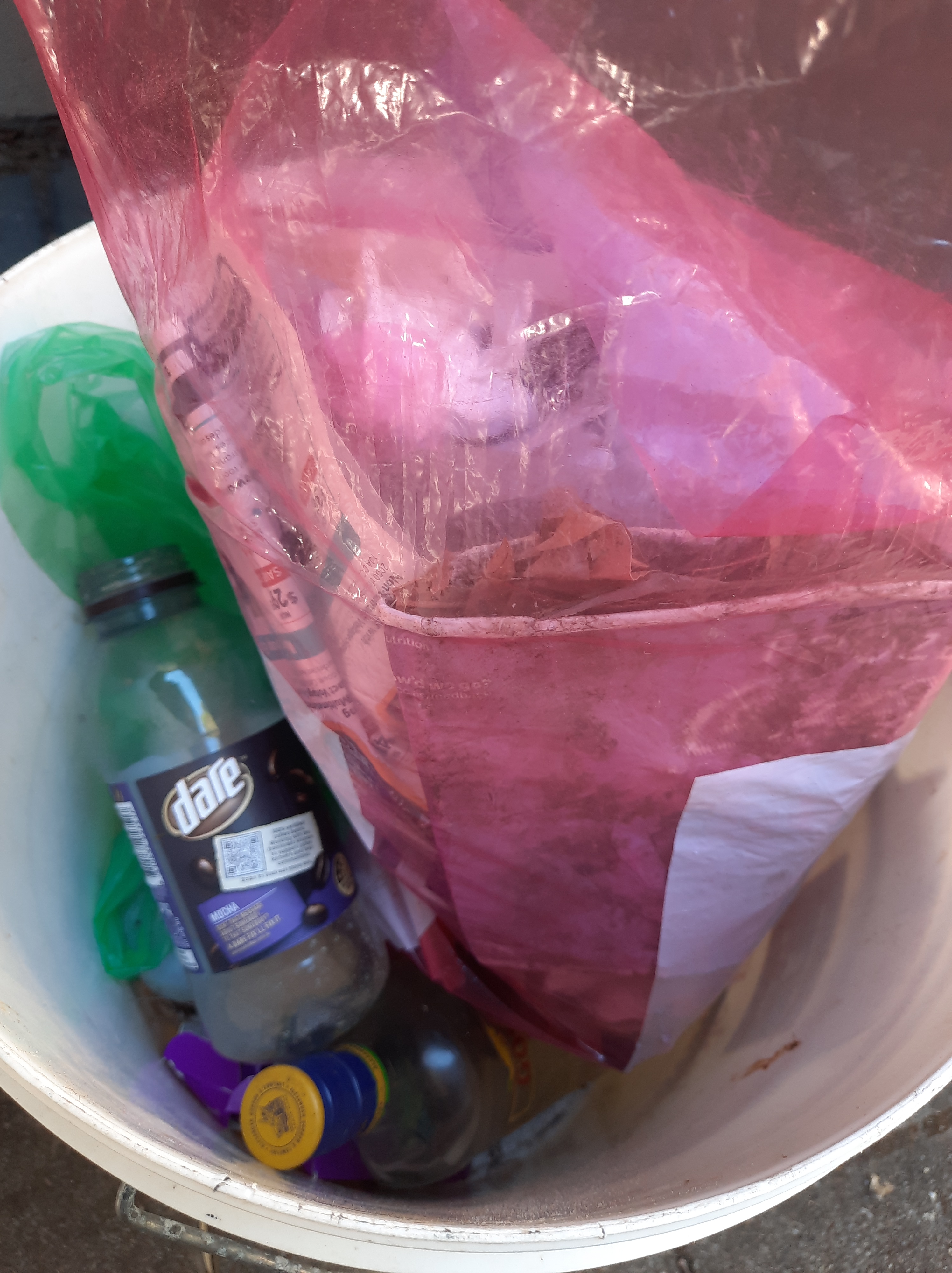
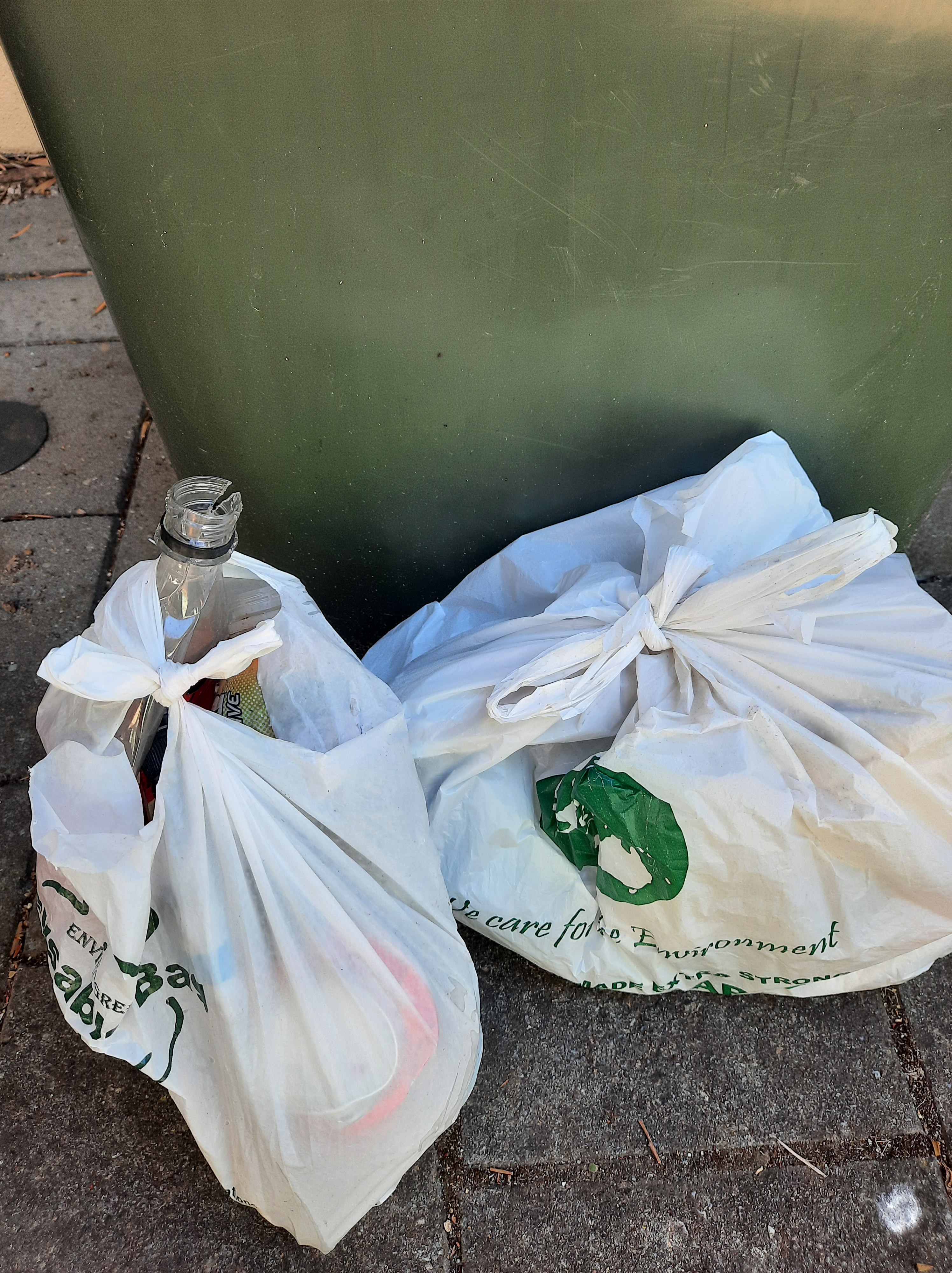
But one of the main reasons I have been thinking about shame is because I pick up litter.  I pick it up around my home. I go out with my gardening gloves and pick up what I can as I warm up for a run, then put it in a public bin as I pass. I collect recyclables covered by container deposit legislation in my state, for which a ten cent deposit can be claimed. When I have a big pile of them, I take them to my neighbour’s place and he donates the proceeds to Food Bank—which supplies food to people who need it. A service which should not need to exist, but does need to exist. When I want a walk around my neighbourhood, I take a bucket with me and my garden gloves, and I pick litter as I walk my neighbourhood. Sometimes people look away or even cross the road, because apparently I am doing something shameful. Sometimes people tell me I am doing the Council’s work for them.  As if caring for our neighbourhood has been outsourced to the local council and no one else can, or should, participate. Sometimes they thank me. It does seem that the difference turns on how I am dressed at times. Am I in my gardening clothes (and perhaps muddy with it)?  I am more likely to encounter reactions that treat me as shameful—perhaps this is about an assessment of my class location or my assumed poverty. If I am well dressed I am more likely to be congratulated.  But it does also turn on the other person, and perhaps how warm and friendly I am behaving on that particular day.

I think I am litter picking more, as the state of the world bothers me more. As genocide continues unabated in Gaza without effective international intervention, war in Ukraine continues, and wars rise in other parts of the globe. As the climate crisis deepens. As signs of fascism rise. I do what I am able to work out to address these things. But they cause me such profound concern and distress, and they are so far beyond my personal control that doing something for earth care and people care that has visible results is in some way a comfort. This may be over analysing the situation! I also like reducing the amount of waste blowing through my neighbourhood, the amount of glass being smashed, and the amount of littler entering Willa Willa, the local creek—or going out to sea through the storm water system. I like being a community carer. I like getting exercise. I appreciate knowing the neighbourhood in detail and understanding more of what goes on in it.

But the time I thought most about this question of shame, was while carrying out three days of community service after my most recent civil disobedience. I was arrested for interrupting a speech by the Minister of Mining and Energy, at a Roundtable on Oil and Gas, together with several fine people. After a lengthy time on bail, I was sentenced to three days of community service and assigned to a litter collection crew. I had to go to the depot in my area, sign on, collect my high vis vest, and get into a bus with others on community service, together with our supervisor. The van said Repay SA, just to make sure that everyone knew that people on community service were inside.  The supervisor reported being called by his supervisor, when that van was parked near businesses, services or people who objected to the presence of criminals in their vicinity, and asked to immediately move it.

So there I was, picking up litter for three days with the rest of the crew. I thought a lot about the Magistrate who sentenced me. He was very clear that he needed to communicate to me (and my co-accused) that the community denounced our crimes, and that we should feel ashamed of ourselves. I thought about this long and hard and could not find it in myself to feel ashamed.  I do not feel ashamed of my friends and comrades, either.  In all honesty, I feel proud of us all for being prepared to take this action. It was not the first thing we chose to do, to draw attention to the climate crisis and try to motivate people (but especially politicians and industry) to take action commensurate with the scale and speed of the emergency we all face. We all had done many law-abiding, quiet things as well as some law-abiding and less quiet things, by this point. But living in a society where our political leadership and the media behave as though they have never encountered climate science and we can all carry on our lives as usual? Makes me feel as though I am living in a parallel universe. I feel a moral and political imperative to take action on the reality I believe we face—having formed that belief on the basis of internationally recognised, peer reviewed science. I don’t feel ashamed of acting on that imperative. I wish that circumstances were different. But they are not, and that is why I went to the Roundtable prepared to be arrested and sentenced.

My friends laughed when I said I had been sentenced to community service.  They think that my life has been committed to community service.  Some of them think my climate activism is community service. They also found it hilarious that I had been sentenced to do something that I do willingly and often—collecting rubbish.

I thought a lot about that, too. In our high vis Repay SA vests and with our Repay SA van, members of the public mostly did not engage with us and gave us a wide berth if we encountered them. We cleaned up along road sides, in parks, and in places where homeless people had been living or in places in the parklands where people go to do things out of sight. That is not my life, such is my luck. I don’t think it should be anyone’s life. I feel shame that we live in a society where some people don’t have homes, and some live without access to running water or a toilet. Where people take illicit drugs out in public space, in filthy circumstances, hidden away where help is unlikely to come if something goes wrong. Those things shame me.

Cleaning up public spaces? That does not shame me. I think it is walking by and doing nothing when a flock of wet wipes has been released in my neighbourhood that is shameful.  Not picking them up. I think it is eating your takeaway meal, smoking your cigarettes, drinking your beverage of choice and then leaving all the litter that creates in the car park that is shameful, not me picking it up. But then, living in a society where takeaway food and drink is such a thing, and people’s life circumstances are such that there is so much eating and drinking and drugging going on by the side of roads, in car parks? That speaks to me of misery. It speaks to me of our collective failure to treasure the natural world, finite resources, and human connection, that we have this phenomenon and we do not have people eating together, in places much more pleasant and social than a car park, instead.

I am doing what I can think of, to address this. It is not a one person sized problem.  But mostly, I am picking up litter and thinking about why it is there, what it means, what might change that. I am not feeling ashamed of myself.

Spending three entire days collecting rubbish confirmed for me that we have some serious problems to address. Each day we went to a different rubbish dump or waste transfer station. That was educational and it was not reassuring. On my third day on the crew, we went to a council area where there is no hard waste collection. In my city, it is common for local councils, who have responsibility for rubbish collection and recycling, to offer a service where they will collect large items that residents want to dispose of. Some councils have a nominated day a few times a year, some require residents to book a collection for a limited number of times. In either case, people put their unwanted items out on the kerb or footpath for collection. Sometimes other people collect them before the council can. It is common to see broken furniture and old mattresses, pieces of carpet and broken toys or appliances. Our crew went to a council area where there is no such collection and instead, the Repay SA crew go out almost every week and pick up what is lying around that council area. Doors, bedding, sports equipment, kitchen supplies, pots, packaging in large quantities, discarded items from building sites. You name it.

I don’t feel ashamed of collecting this stuff!  I did feel ashamed to see it would all just go to landfill. That no effort was made to put it to reuse or save what was valuable or even recyclable (we had buckets to put container deposit cans and bottles into, but that was the limit). I feel ashamed of that council for choosing this as the way it would manage or fail to manage its residents hard rubbish. But our efforts to clean up stuff left all over their suburbs?  I’m not ashamed of that.

Yours sincerely, unashamed of taking climate action and unashamed for doing what I can to clean up for social failure and to mend all that can be mended.

17 Comments

Filed under Natural dyeing

Bags from gifted fabric

A lovely friend has given me several deposits of fabric and associated items (books, patterns, haby). She is still addressing her mother’s stash of crafting materials, years after her mother’s death. In the latest round were some lovely fabrics that I gave away to a friend or gave through the Buy Nothing group. And some interesting prints that are surely limited editions!

I thought they needed to be featured, so I made a series of bags.

Surely these are “poached egg daisy”! My beloved has claimed this one and her mother loves it and asks often where it came from. Each time, she is tickled by the idea that I made it.

And, isn’t this flower lovely?

And while we are talking bags (and other people’s stashes)–much more recently I ended up with two carloads of a friend’s stash. She can no longer do the crafts she loved for many years. In among her things were many unfinished projects. This bag was in pieces, so I finished constructing it, and it has gone to be a library bag for a child who isn’t allowed a book from the library because they didn’t bring their library bag (what a rule, sigh). Let them have books, I say! I may make more bags for this cause…

5 Comments

Filed under Natural dyeing

Silk screen printing

Friends of mine have started legal observers for protests in our city, following the excellent example of organisations like Melbourne Activist Legal Support. I’ve been training folks in police liaison for protest. So a dear friend and I had a crafternoon kitting ourselves out for visibility.

And here is our handiwork in action!

1 Comment

Filed under Natural dyeing

Worm farm covers

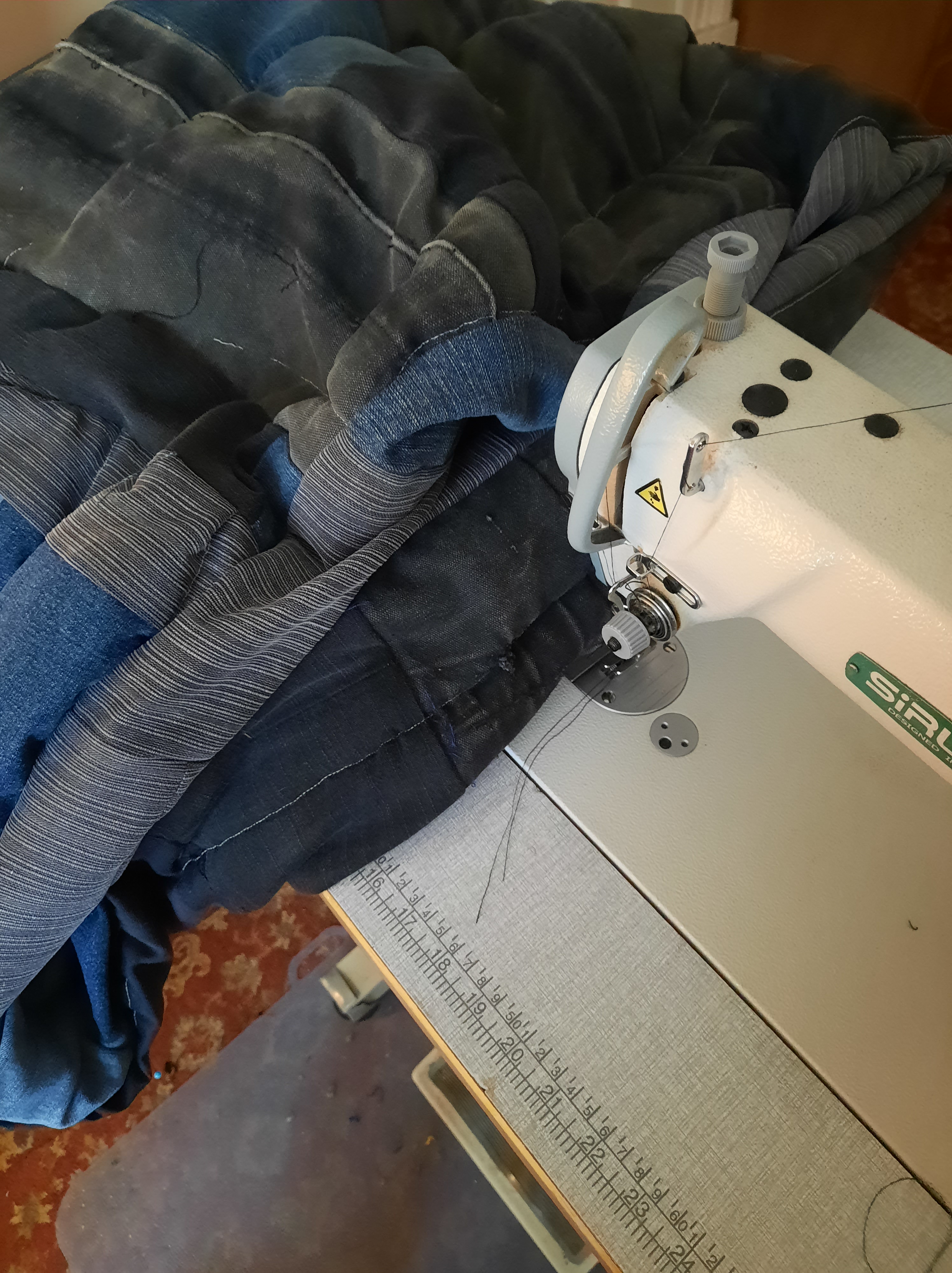
I receive a lot of other people’s worn out textiles (and their new ones, for that matter). One use I’ve found for a range of different well-worn fabrics that do not lend themselves to any kind of upcycling, is to make insulating covers for worm farms. I’ve made quite a few of them, but finally it was time for our worms to get their own. The image above is the outer layer of the cover, layered up with dead jumpers, fleecy fabrics and such. I usually then layer over them, worn out t shirts, sheets that are too thin to be made into anything else–so I can stitch them down and hold the main insulation layer in place. Technically, I guess I am constructing a quilt!

Here I am foundation piecing stretch denim onto these other layers. I turn dead jeans made from “rigid” denim into all kinds of things, but stretch denim is not so easy to put to use, and I now receive many pairs of stretch jeans that have clearly had only short lives in use before wearing through or tearing, because the quality of the denim is so often very poor. And, news flash, the the thing that makes those jeans stretch is plastic. Made from oil. Fossil fuel. I would still prefer to use them than have them go to landfill, so here I am, using them. Below is the rectangular side of the cover, with a cut-open t shirt of unknown origin holding down layers of moth-eaten wool and mohair jumpers.

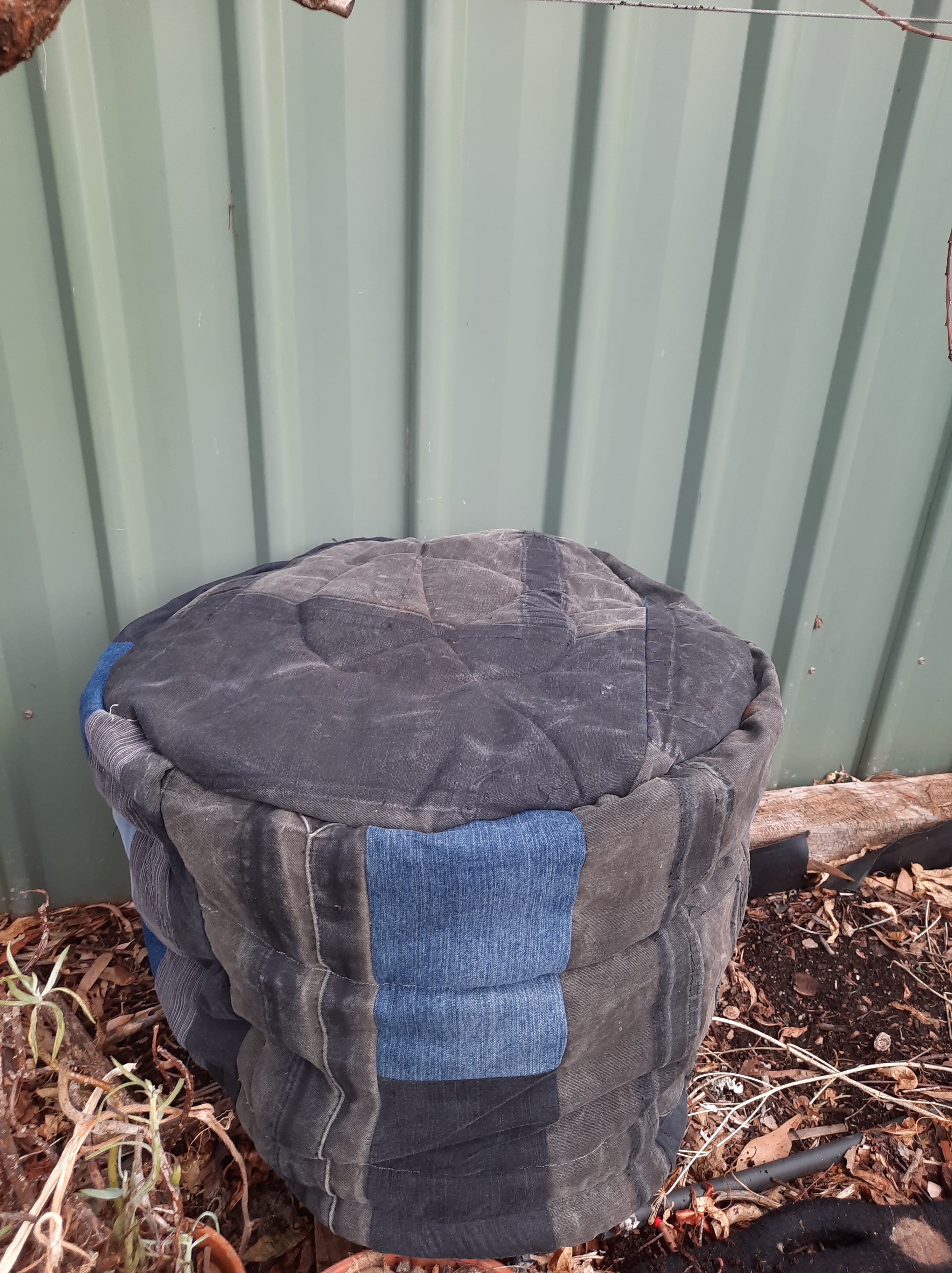
And here is the result, lined with a part-sheet that was gifted to me and still had wear in it. I’ve got to admit that these are hard to make–there are stages in the process where all the seams are thick and some serious wrestling is needed to sew them. And sometimes there are some broken needles and yet more swearing.

But–they do the job well and they keep all kinds of fabrics I can’t find other uses for, out of landfill. They always look wonky, but seriously?? They will now spend years in the sun, wind, and rain. They will be pooped on by possums, birds (and rats, probably). We have two worm farms, because someone down my street dropped by one day having never spoken to me, but having decided I was the type of person who would keep worms. Clearly, she was a good judge of character! She wanted to give me her worm farm, worms and all, and I accepted. So, I made a second cover!
Here is the top of the worm farm insulating blanket in construction, layered up in wooliness. In answer to your question, yes, it does make me sad to cut up jumpers that have sometimes been hand knit with love (and often for specific beloveds). In this case I am not privy to the details. To be honest, I think people give me things that they can’t bear to dispose of, or don’t know how to re-use, in hopes that I will find a way to use them. And the quantity of such things that come to me now motivates me to use them without being too precious. Thanks to ShamselDin Rogers (@shamseldinrogers) I now think of this as #trashsewing.

This is the tricky stage: sewing the sides to the top. Yes, I know that is a beautiful Tiwi Islands fabric in there. I don’t know what it had been used for–perhaps a curtain or a wall hanging in full sun. The printing on it is all that is holding it together, the fibres are so weak. I was so disappointed that I couldn’t use it for something lovely showcasing it, but–I couldn’t. The bright print on the right has had a long life as a pair of pants before ending up with me.

This model has an outer constructed mostly from the canvas I harvested from a duffel bag abandoned in the neighbourhood, and some more harvested from a pair of dead deck chairs I took apart for re-use. A year ago! It feels good to have these fabrics off the floor of my sewing room!

Another progress shot, where you can clearly see how lumpy, bumpy and chunky this is!

And finally, the worm farm has received the disintegrating moth eaten blanket that was covering it before (which the worms and microbes will now consume), and has a nice new covering that will keep the temperature inside a bit more to the liking of the worms through the chill of winter and the heat of summer.

2 Comments

Filed under Natural dyeing

Ntaidrin socks

I have discovered that Spin-off is available through the public library system. These are the Ntaidrin (Wheat) socks by Irene Waggener from Spin-off March 2024. More or less. Less, really, because in my feverish Covid state I reversed the colourwork. *cough*

The colourwork is closer here but I think I trusted my memory on the heel construction, and, well…

I liked this pattern so much (and it suited the small quantities of eucalyptus dyed yarn I have so many of so well) that I made three pairs. One of them I must have given away without taking a photo. Like many patterns drafted for spinners, by spinners, this one can be knit at almost any gauge. Perfect! And such a quick little knit. It has been a while since I knit much, so it was lovely to have a little breakout of knitting.

4 Comments

Filed under Natural dyeing