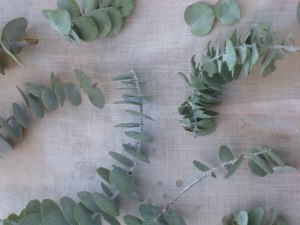
Tag Archives: E Cinerea

On obtaining reds from Eucalypts

I’ve spent a good deal of time trying to figure out how to get stronger colours, and especially red to burgundy, from Eucalypts.  I’ve had occasional, but not dependable, success.

I have had the thought that the temperature of a dye bath might affect the colour obtained from eucalypts several times.  In particular, I’ve had the thought that relatively low temperatures might be required to obtain reds. Bear with me in my ignorance about chemistry… I’ve had this idea when thinking about the way that madder turns toward brown if heated too much. The chemical constituents are not the same, but perhaps their reaction to heat could be.   I’ve had the same idea reading the inspiring Karen Casselman’s Craft of the Dyer, in which she mentions that tannin bearing plant dyes will move toward brown if overheated.  I’ve certainly obtained many oranges from boiled eucalypt dyebaths.  I had this idea about reds and temperature again reading this glorious and informative post by Dustin Kahn and her comments.  I had it when reading Ravelry and coming across very infrequent references to people achieving red from eucalypts of unknown variety, in which I’ve noticed slow cooker or crockpot methods seem to get success sometimes, suggesting low temperatures and long processing.  I’ve noticed that when I’ve achieved red or maroon shades I’ve considered temperature to be a factor sometimes.

I used to use two gas burners that would do ‘boiling hard’ or ‘blowing out’ with only luck in between, and a lot of turning on and turning off to manage my results.  Now that I have hobs that will allow relatively finely tuned temperature control, I think it is time to test this theory a bit more systematically. I’ve tried to test it before and been unable to replicate anything close to red. More recently I tested it again and felt that while keeping the pot at a simmer close to but below boiling is a good idea in order not to create felt, the lower temperatures I trued did not generate reds and sometimes were too low for good fixation. For the time being I am letting go of my temperature theory.  So what are the other factors?

It is beyond question that the variety of eucalypt will predict the range of colours that are possible.  I have best results with E Scoparia, E Cinerea, E Kingsmillii Alatissima and E Sideroxylon in the red range and of these, the best is E Scoparia bark in my own experiments.

I’ve found that sheer quantity of dyestuff to fibre is a factor in achieving any strong colour, certainly including red, but it is not a guarantee.  Dustin Kahn reported using 340g fresh E Sideroxylon leaves and stems to 10g yarn to obtain brick red (and then achieved yellow and orange on two other 10g skeins).  I am convinced that time is a factor.  Rebecca Burgess and Dustin Kahn both report heating their dyestuffs for long periods with cooling in between (which I have found changes the colour but not in a red direction necessarily). The redoubtable Ida Grae reports achieving red from E Cinerea only after 3 hours of simmering.

India Flint recommends acidity as influencing brightness of colour, but I have to admit having tried it without being confident it made a difference–hence, more experiments needed, preferably with higher acidity levels. At a recent workshop, we had two E Scoparia bark pots running.  We did a trial and put vinegar in one pot and not the other.  The no-vinegar pot gave brown on alum mordanted superwash wool and alum mordanted alpaca.  Brown surprised me, but I wouldn’t usually use alum.  We’d run out of unmordanted wool in the mix that day.  In the with-vinegar pot, grey handspun wool with no mordant came out burgundy, which was very exciting!  Polwarth locks with no mordant came out brilliant orange, and the alum mordanted skeins of alpaca and alpaca blends came out toward the red end of orange.  We cooked them on as low a heat as we could–but the no vinegar pot was bigger, so heat control was easier.

So… I am continuing to experiment with favourite species, no excessive heat (wasteful in any case), a high ratio of dyestuff to fibre and acidity.

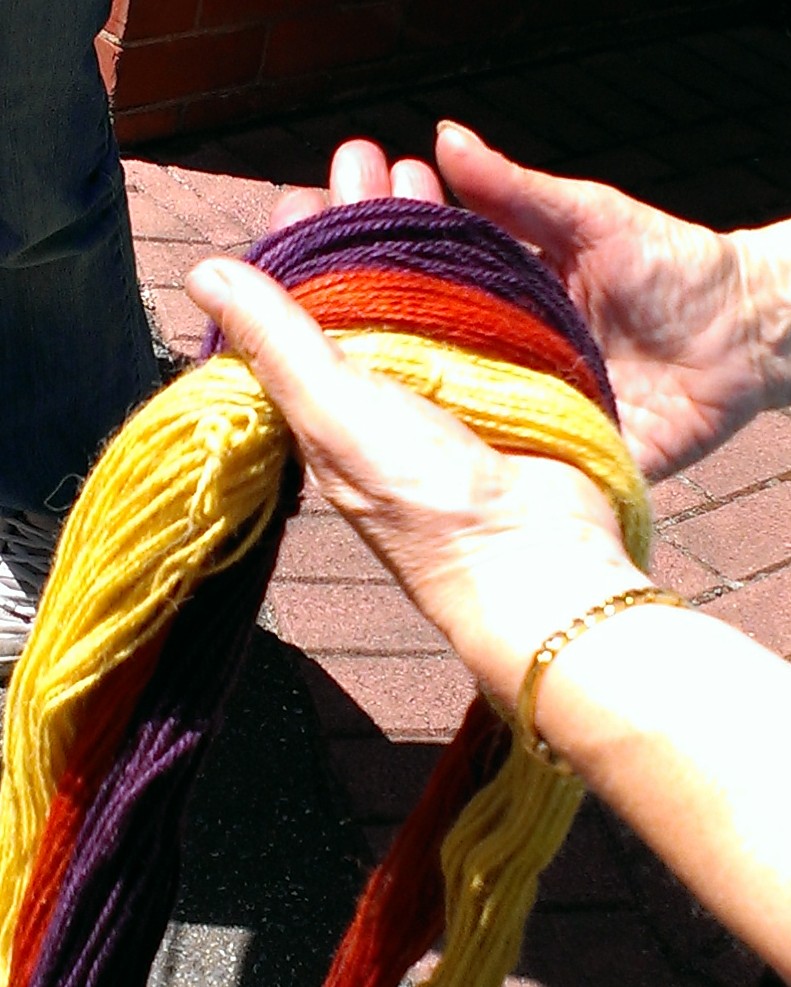
Here are the latest findings: red on alpaca!  Burgundy on the wool samples, rosy pink and orange on silk thread.  The top sample used E Scoparia (dried leaves) and The lower samples used dried E Cinerea leaves, both with white wine vinegar.

IMAG1270


18 Comments

Filed under Dye Plants, Eucalypts, Natural dyeing

Leafy pillowcases

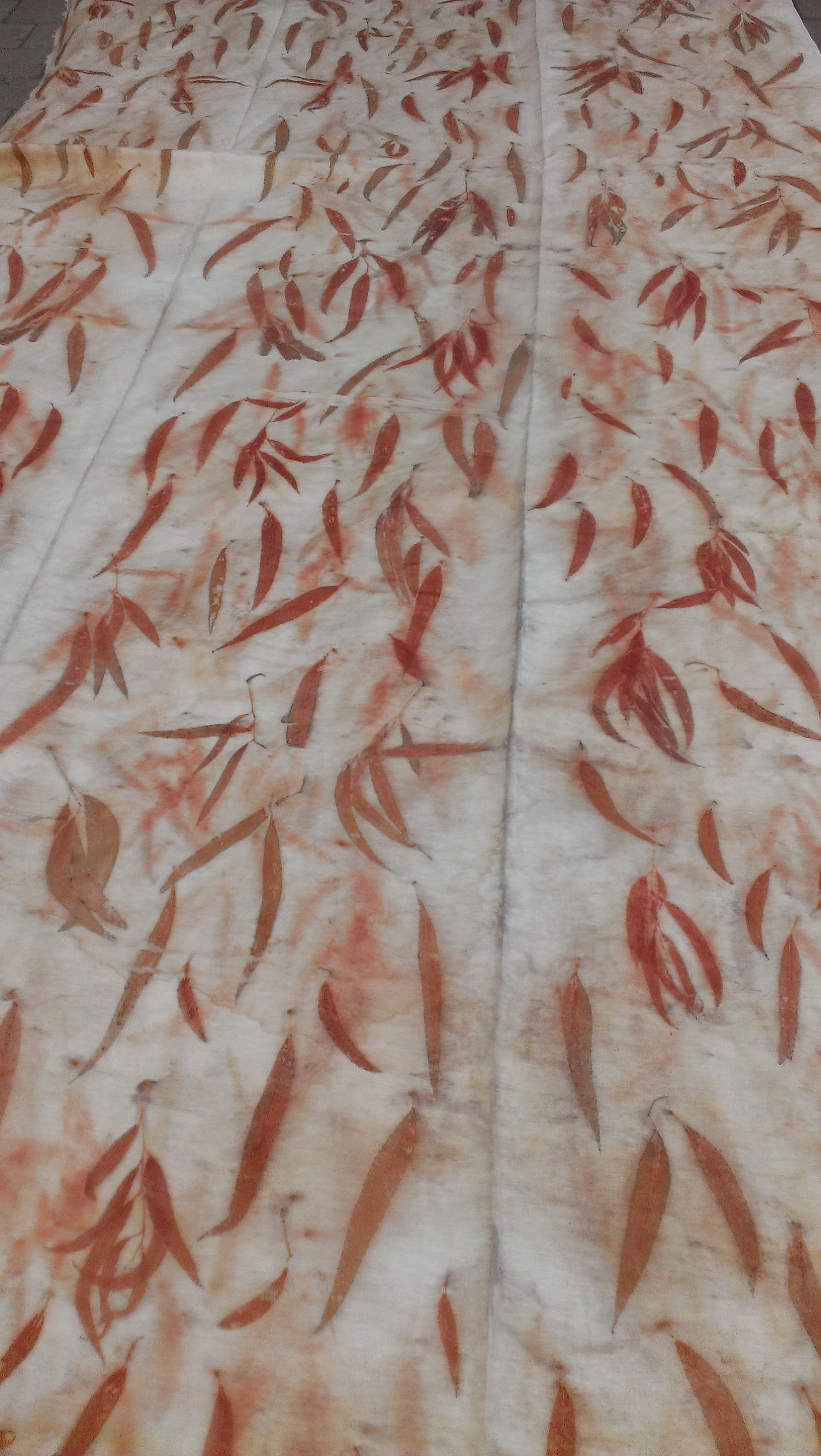
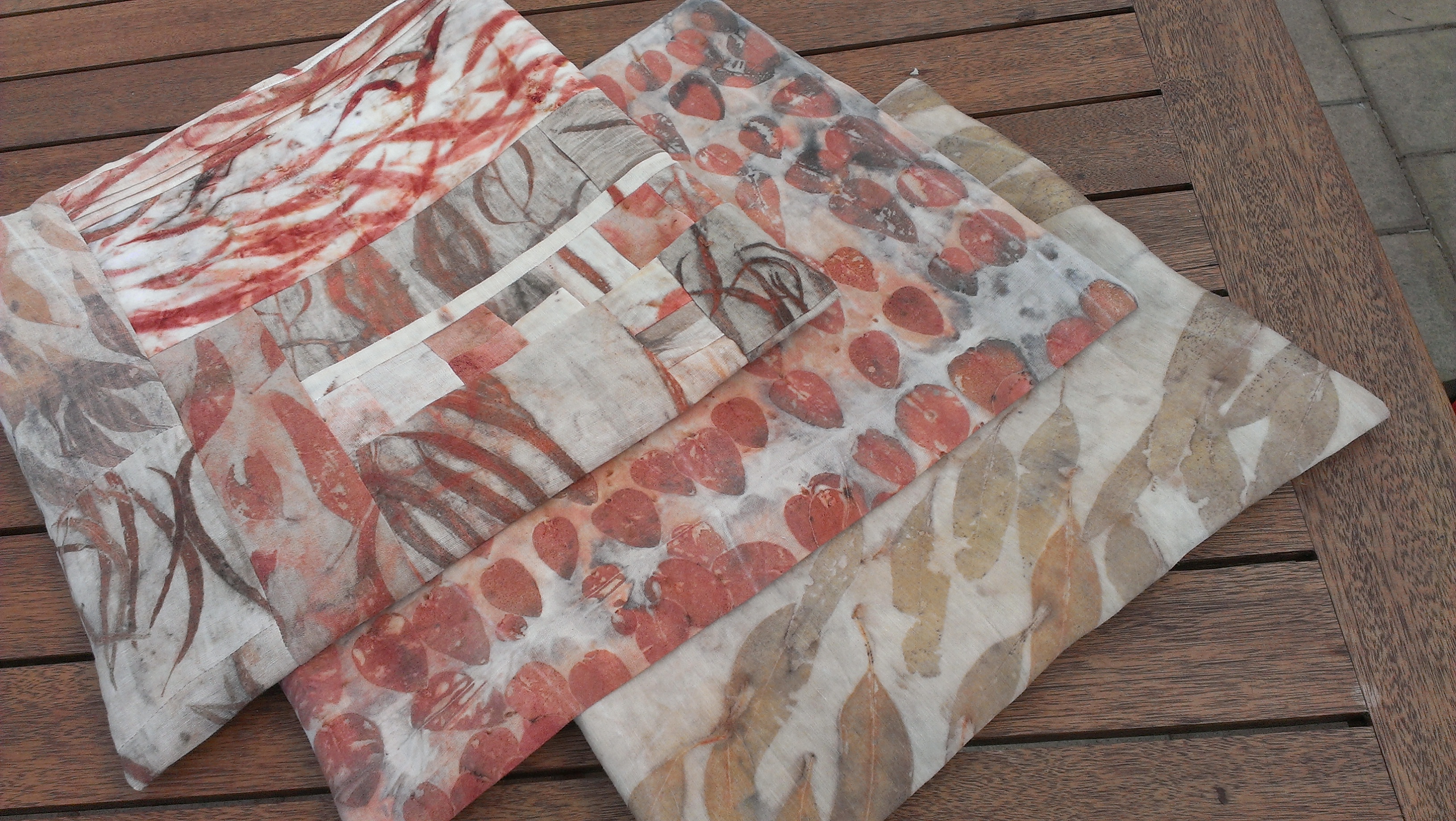
A while back I leaf printed a length of seedy silk noil.  Today I turned it into two custom fit pillowcases for a small and contoured pillow I find very comfortable. One part of the fabric I printed wth E Scoparia–but you can see faint prints of E Cinerea leaves coming through too.

IMG_0060

The other, with E Cinerea. Interestingly enough, the lingering smell of eucalypt is very faint and the smell of raw silk overwhelms it: I’ve tried this before and it will last only a few washes. The colours are muted but the leaf shapes are clear.

IMG_0064

I love a simple sewing project… I’m one of those people who can make the same thing over and over again.

1 Comment

Filed under Eucalypts, Leaf prints

Another workshop done!

The second in my little series of workshops at the Guild went really well. There was yarn, fleece and roving dyeing.  Brown, orange, almost-red and maroon from E Scoparia (bark and leaves) and E Cinerea leaves, yellow from silky oak (Grevillea Robusta) using Ida Grae’s recipe from Nature’s Colors: Dyes from Plants, and the ever-astonishing purple from red sanderswood with alum.  I again used Jenny Dean’s method from Wild Colour and still got nothing like the oranges she suggests are likely.

IMAG0896

Mysterious outcomes in natural dyeing are not all that uncommon (at least for me!), as the number of variables is so huge.  But this one is out of the box–purple!?  Since my last post on the subject, Jenny Dean has very generously been in touch with her thoughts on the matter.  She suggests this purple could be the result of alkalinity (but given I made no attempt to generate an alkaline bath, it seems unlikely it was seriously alkaline).

Or–and I agree with her that this is much more likely, even though I used 4 different jars/packs labelled “sanderswood”–perhaps the dyestuff  was never sanderswood to begin with.  The colour is very, very like the logwood results I have had, just about indistinguishable.  I am still not complaining about the result–I love purple and so did the participants.  I was hoping for purple on this occasion, as I have no more logwood–that I know to be logwood.  Perhaps there was a time in the past when a batch of “sanderswood” came to our Guild or a supplier nearby and all the different jars I’ve used ultimately can be traced back to the same mislabelled supply. This would fit with my experience of Eucalypts… it is much more likely that I have misidentified my tree than that the dye bath is giving a completely different colour.  Variation to some extent, however, is completely expected.

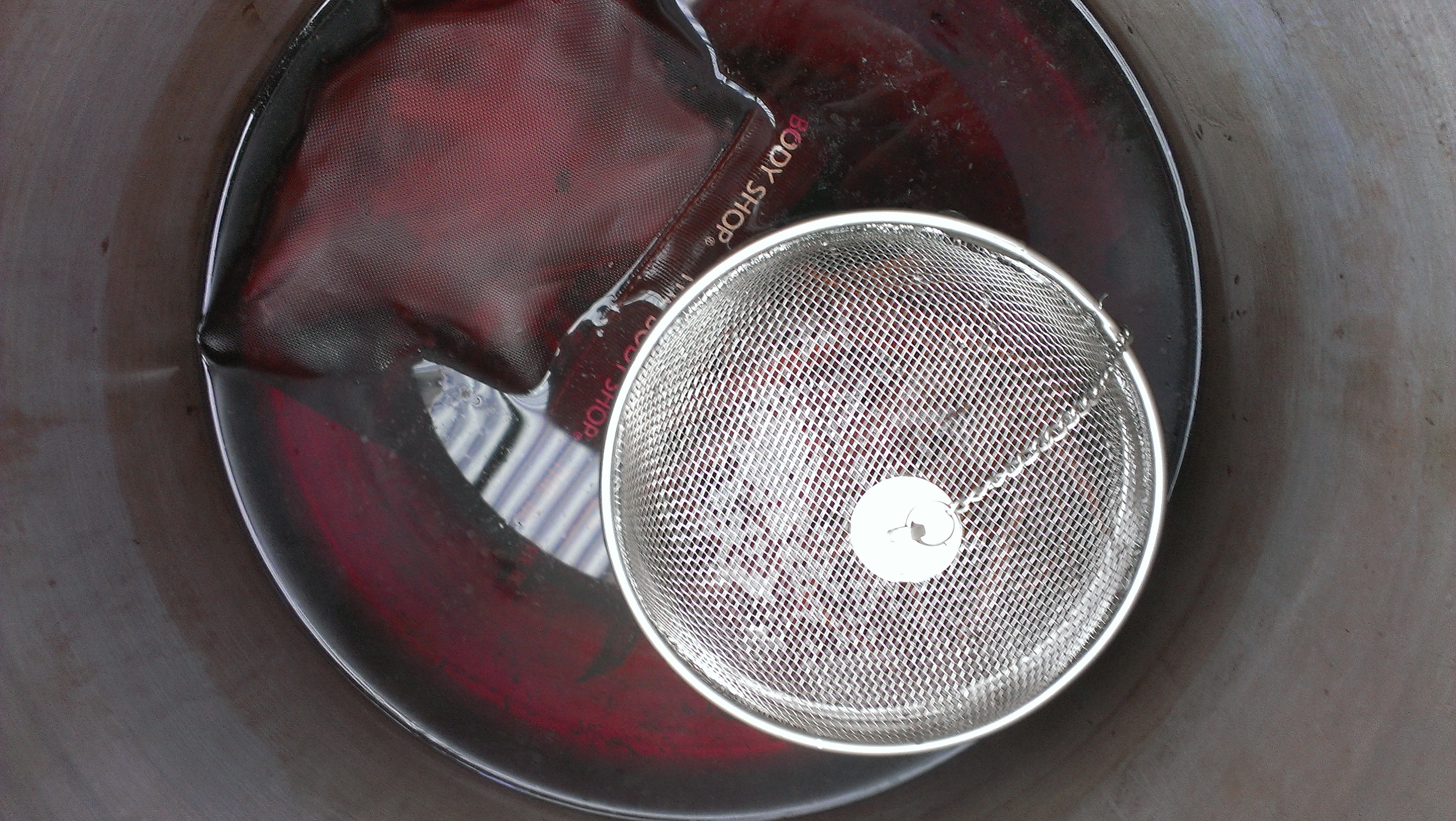
Here is the “sanderswood” just after I poured boiling water over it–Jenny says this looks like a logwood bath to her.  I bow to her much more extensive experience and wisdom, without hesitation.

IMAG0862

I have the biggest chips in a little zippered mesh pouch that must once have held toiletries.  The smallest chips/splinters are in something that looks just like a giant tea ball.  I saw it for sale in a Vietnamese grocery where I was investing in greens, seaweed and soy products and immediately saw its possibilities.  The woman who sold it to me had an eye-popping moment (evidently she hasn’t sold one to an Anglo before), and asked me what I was planning to do with it.  I love those moments in Asian groceries, because once I’ve been ask the question and given my (admittedly bizarre) response, I can ask about the ordinary use of the device or food in question.  This one is usually used to contain whole spices when making a big pot of stock or soup.  This point was helpfully illustrated by a packet of soup seasonings–star anise and cinnamon and coriander seed were some of the spices I could identify right away.

People tried out India  Flint‘s eco-print technique on cotton, wool prefelt and silk.  I hope she will get some extra book sales as a result (if you’d like to acquire her books, click on the link to her blog and look for the option to buy them postage free in the left hand sidebar).

IMAG0871

There were biscuits and icy poles and lots of chat.  I demonstrated soy mordanting and black bean dyeing.  And while we were at the Guild and using the copper, which is such a generously sized vessel by comparison with my dye pots, I leaf printed some significant lengths of fabric that I brought to the workshop bundled up and ready to go.  The copper really is copper lined, but I could detect no obvious impact on the colours.  Seedy silk noil:

IMAG0903

Wool prefelt… the degree of detail is fantastic.  This is destined for felting experimentation by a dear friend who generously assisted me at the workshop.  Her practical help, support, constant grace and good cheer made things go so smoothly.  I also decided to start some processes before participants arrived, which I didn’t do at the previous workshop.  I think that helped.  But it was a fabulous group of people too.

IMAG0913

And finally, silk/hemp blend, destined to be made into a shirt (by me, so it may take a while).  I am delighted with how it turned out, after many months of putting off the day.

IMAG0924

9 Comments

Filed under Eucalypts, Leaf prints, Natural dyeing

Hits and misses

The other day I was at an exercise class in a park.  One if the trees was helpfully labelled Lagunaria patersonia (pyramid tree).  It turns out to be native (to Australia, though not to this part of it).  So… I decided to take a sample and test its dye properties.

1953

I am here to report to you, dear reader, that this is not one of the stellar dye plants of our time.  That smudge on the right of the linen square with the questionable machine embroidery is the best I can show for a leaf print after an hour and with teh presence of iron and soy mordant.  The only fibre on my swatch showing any colour after an hour of simmering is wool + alum, a delicate shade of yellow-green.

IMAG0565

On the other hand, I made these cushion covers from leaf-printed cotton and linen.  They are for friends who invited us to a holiday house they share near Mittagong.  I hope they’ll accept these as thanks for the lovely relaxing time we had with them.

1963

They are custom fit to the cushions on the verandah of their holiday house, whose covers have seen better days.

1962

6 Comments

Filed under Dye Plants, Eucalypts, Leaf prints, Natural dyeing, Sewing, Uncategorized

Leaf prints of the week: Eucalyptus Cinerea and pecan leaves

It was another weekend with leaf prints.

Leaf prints 005

Eucalyptus Cinerea, before..

Leaf prints 001

and after:

Leaf prints 021

My test cotton sample, demonstrating that the mordanting I wrote about a little while back should work out just fine for the natural dyeing workshop I’ll be running.

Leaf prints 022

On the weekend I travelled south of the city to celebrate the lives and love of two dear friends.  They had an all-in-one birthday party and anniversary.  I gave them a teapot and teacosy dyed with silky oak leaves (grevillea Robusta) and eucalypt, and they found it suitably funny.

Dyeing 005

As we left, one of them pointed out their now-flourishing, though still relatively small,  pecan tree.  I had seen pecan eco-prints on Lotta Helleberg’s lovely blog.  I asked if I could pluck a few, and then I took them home and wrapped them in a piece of cotton twill that used to be a pair of trousers.  It was ready and waiting, mordanted in soy and ready to go!  Before… (such lovely leaves…)

Leaf prints 002

and, after:

Leaf prints 025

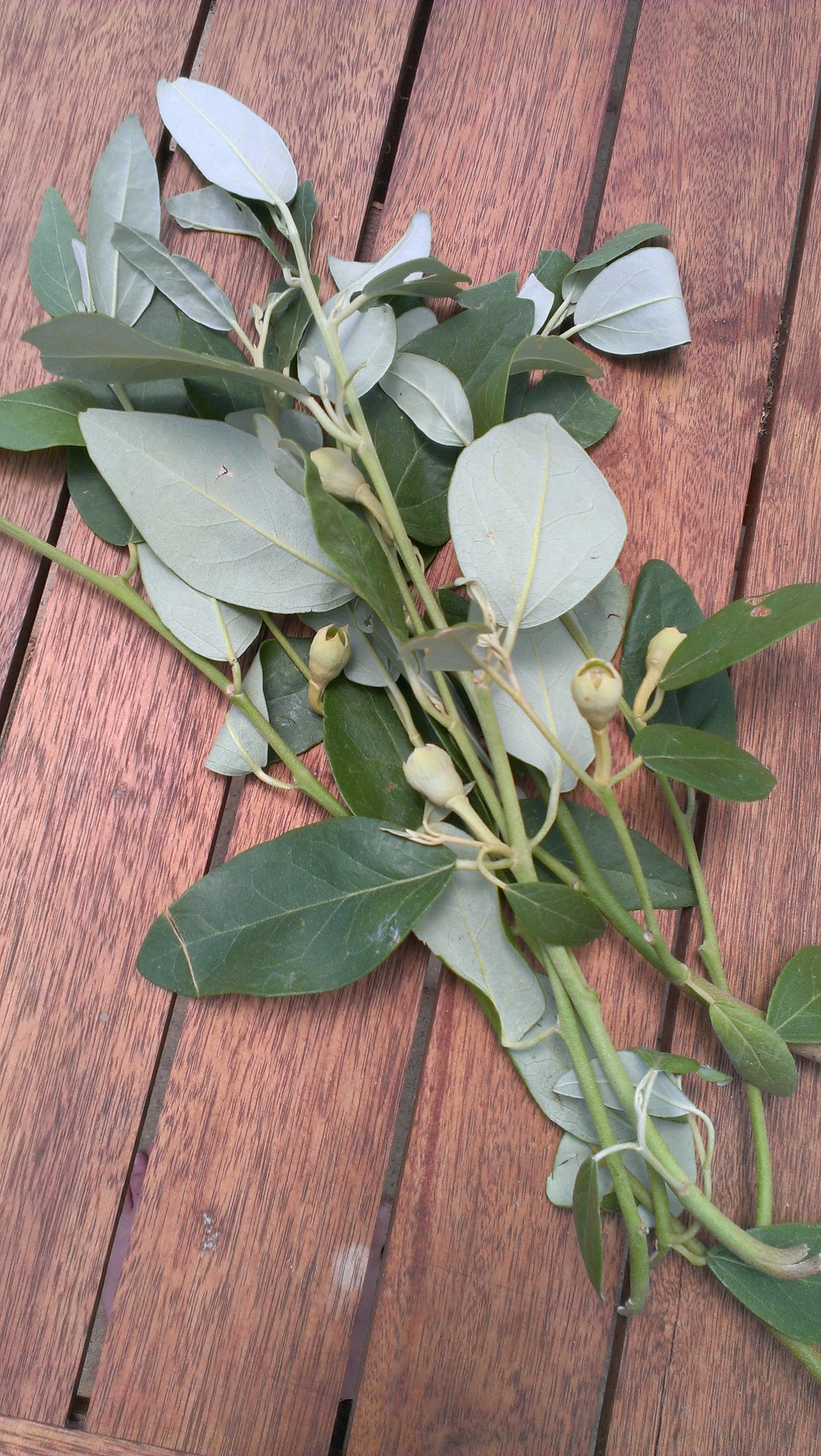
I had also saved this sample of an unidentified eucalypt a friend was growing in his backyard, but sadly it yielded a few brownish smudges.  It’s much prettier in person than as a leaf print.  I think it is Eucalyptus Kruseana (Bookleaf Mallee).

Leaf prints 003      Leaf prints 009

And I spent some time creating textured batts ready for textured yarn spinning… wool with mohair locks, while I tried a new method for washing wool.

Leaf prints 014

Good times!

1 Comment

Filed under Dye Plants, Eucalypts, Fibre preparation, Leaf prints