Tag Archives: local trees

Eucalyptus Cladocalyx Bark

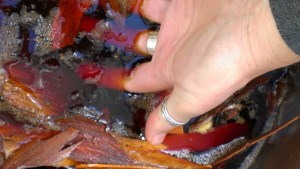
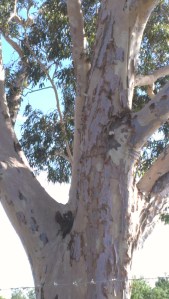
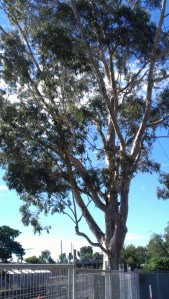
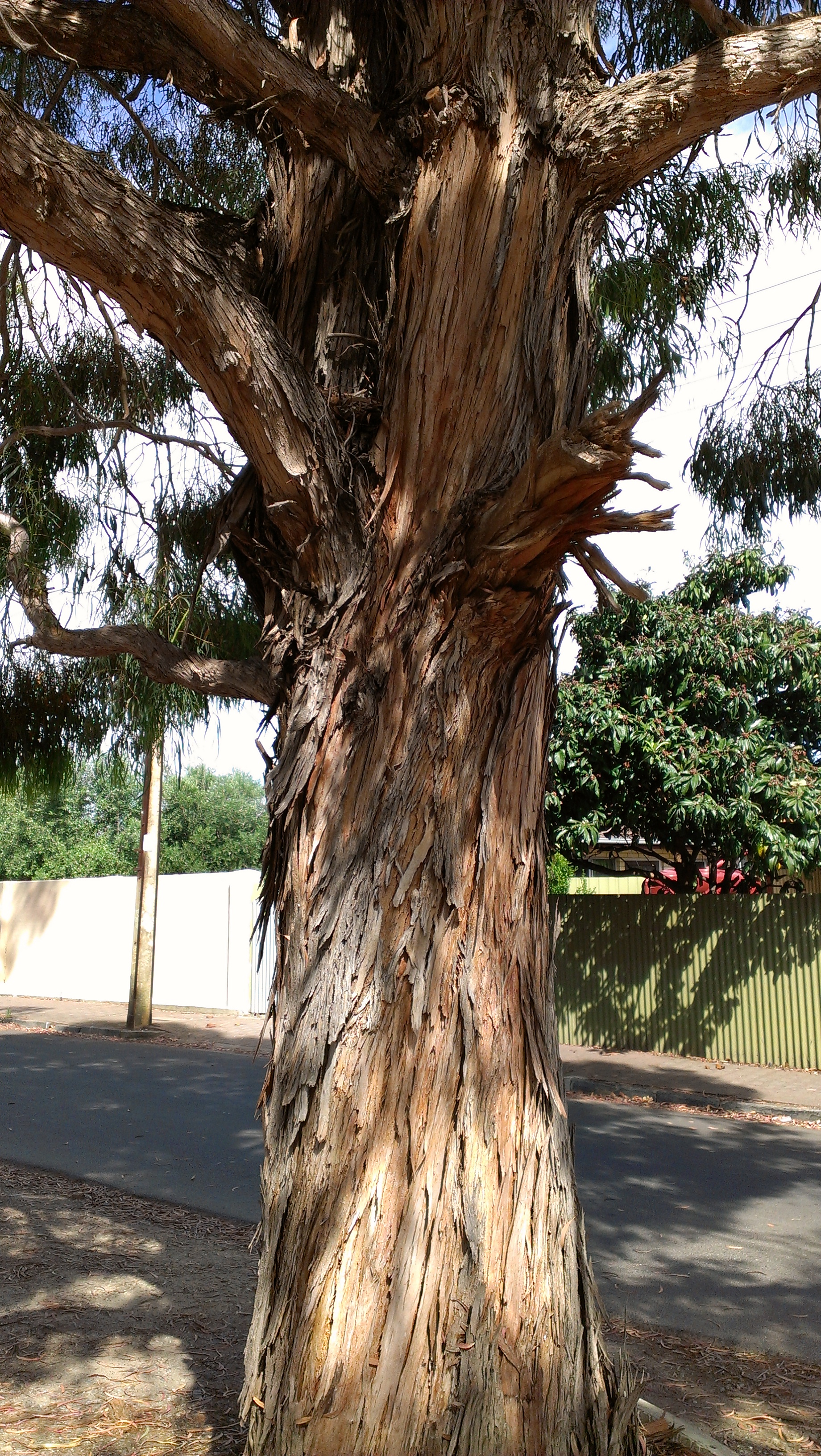
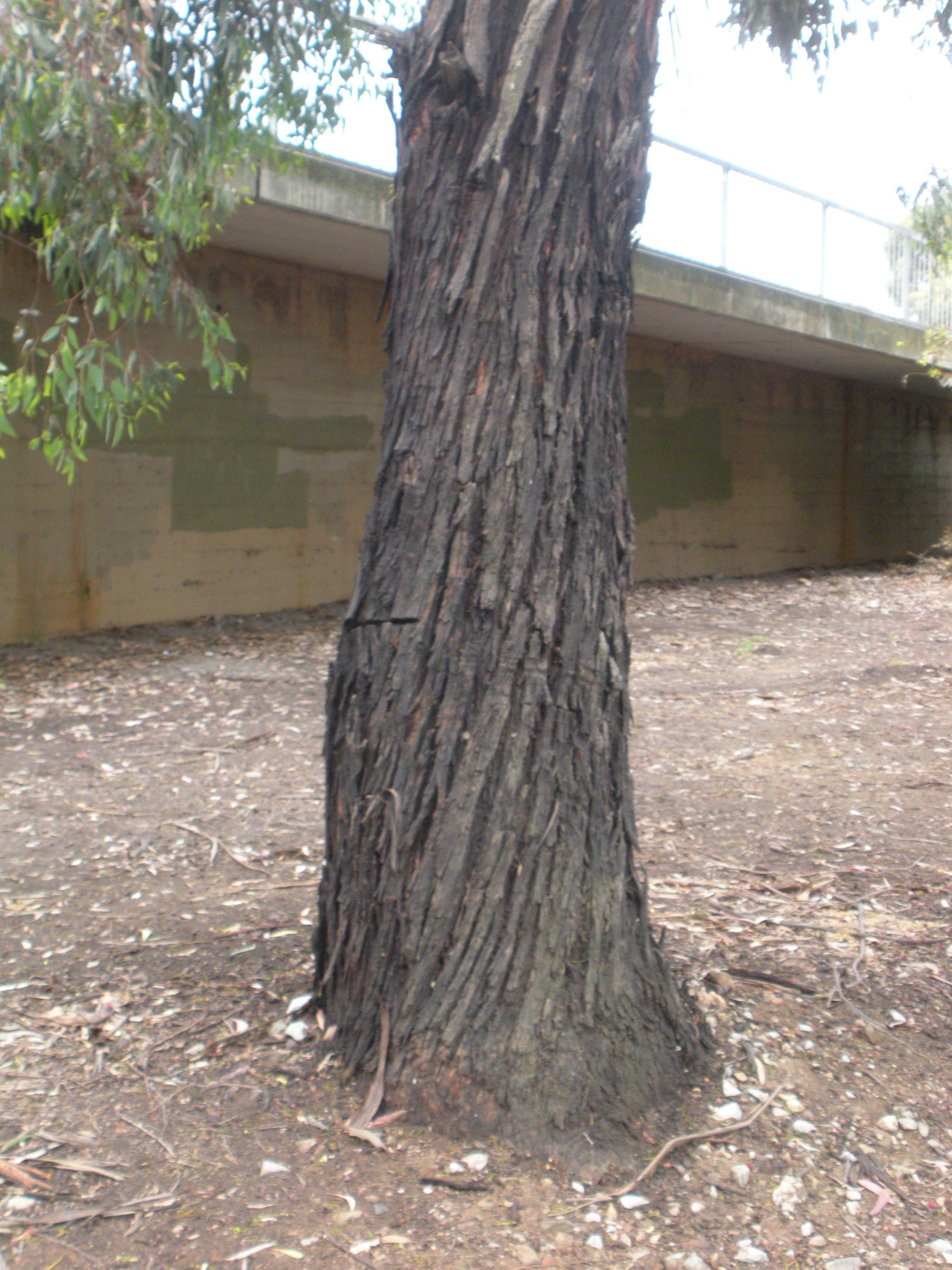
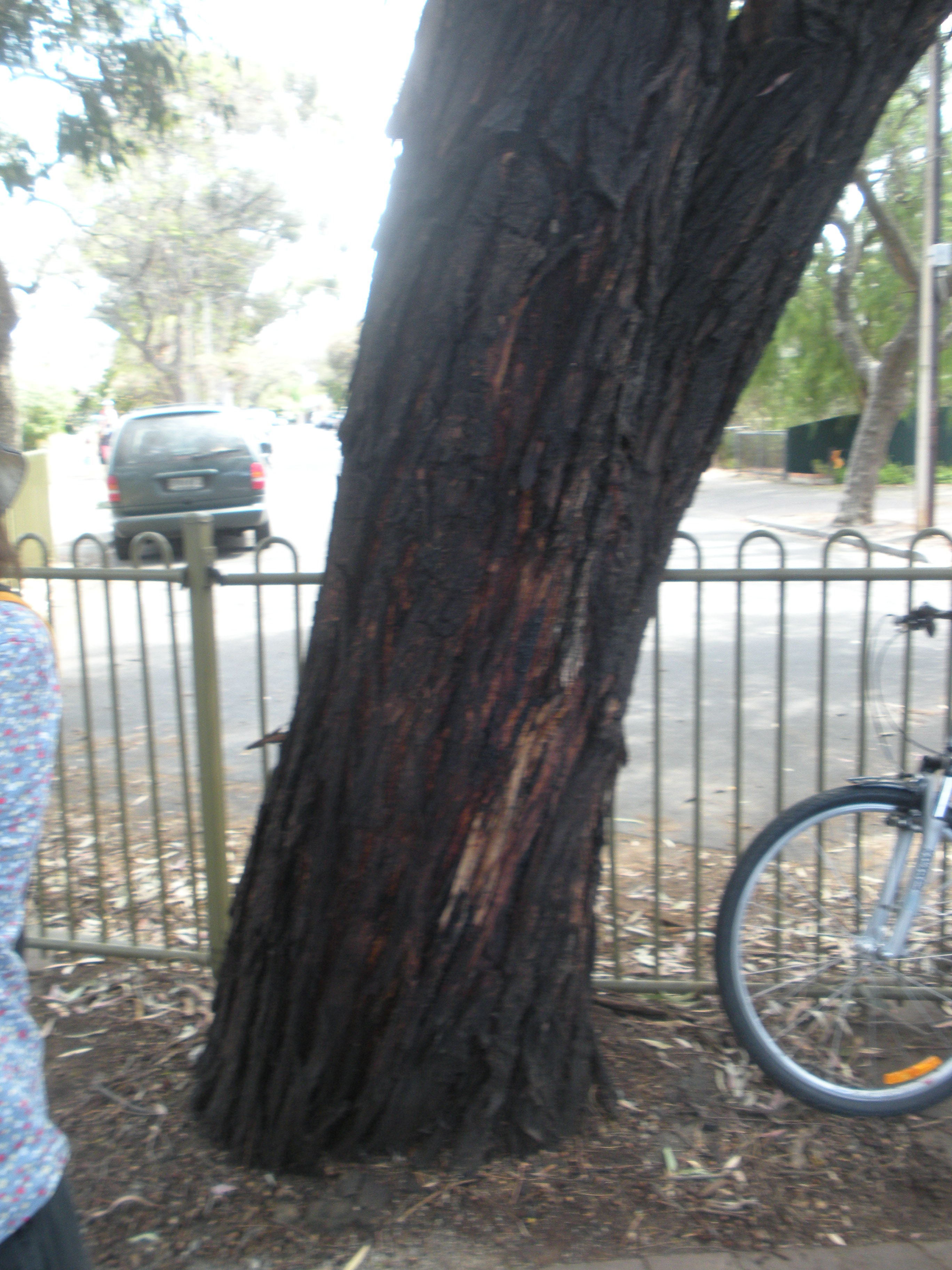
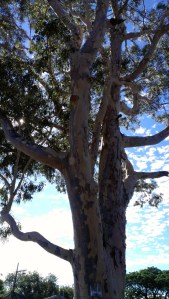
I have been reading Rebecca Burgess’ gorgeous book, Harvesting Color, which had me thinking about how to create a tannin solution.  The local solution for her is to gather acorns.  That might be possible for me in autumn, too. There are some avenues of oaks in my city, and they have tiny newly formed acorns right now.  But it seems to me that eucalypt bark would be a promising source in my own region.  I thought it seemed logical to collect bark from a species that hadn’t shown a lot of dye potential (I’m trying for mordant, not dye).   So I stopped outside the royal showgrounds where this huge E. Claodocalyx (Sugar Gum) had shed its bark recently.  We were having unseasonably cool weather as this dull photograph shows.

IMAG0317

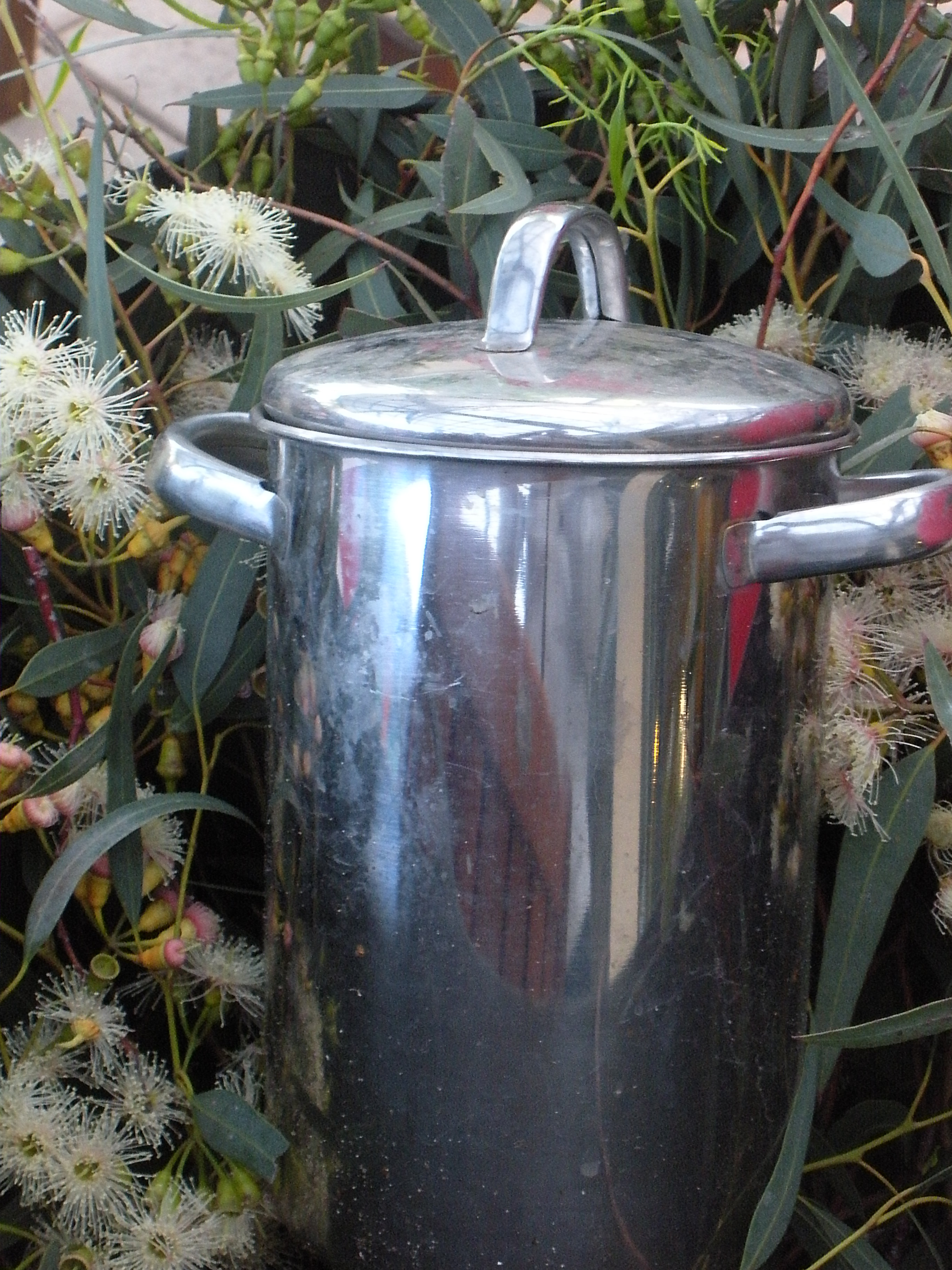
I picked up a bag full of bark and headed home to let it steep in rainwater. This will be an opportunity to consider the dye potential of the bark as well as try it as a source of tannins.  There are many of these trees around my area and this is a truly huge tree when full grown, which sheds its bark once a year, so if this is a good source of dye, I will have access to a lot of it! Here is how it looked on 15 December:
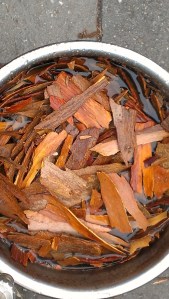
IMAG0330

And two days later:

IMAG0342

…so I put a metre of cotton cloth into it, which immediately turned golden yellow:

IMAG0347

I left the pot in a sunny spot.  The temperatures have ranged from mid-twenties celcius to 40C.  By 1 January, the pot was darker still, with the liquid seeming a ruby red shade.

IMAG0545

And here is the cotton I immersed in it  so many days ago after drying.

IMAG0547

Needless to say, I am now planning to dye wool in my bark liquor and see what happens…
Leave a comment

Filed under Dye Plants, Eucalypts, Fibre preparation, Natural dyeing, Uncategorized

Significant Tree

I love trees.  Some are especially precious to me.  Like this one.  The Department of Planning and Infrastructure says it is a Corymbia Maculata (Spotted Gum).  I have tried dyeing with Corymbia Maculata.  As a dye plant, it’s not spectacular: my samples are tan, tan and tan.  Dye potential isn’t the only or even the main value in a lovely tree from my point of view, but just one of its potential fine qualities. 

IMAG0356

We failed to save it by objecting to its removal.  A local creek is going to be put into a pipe so big a car would fit into it as part of major infrastructure works, and this tree is standing in the path that pipe is going to take beside the railway.

IMAG0352

The Minister approved its removal, and his decision is not appealable.  That fence along the railway stands where over 10 much smaller, but still appreciated, trees used to stand beside the spotted gum. Since their removal I hear there are six possums fighting in the nearest neighbours’ yard at night instead of just one. We have been given several different dates on which the Corymbia Maculata will be felled, and prepared ourselves for the day each time. It has been fenced off because tomorrow is the day.  9.30 am is the time.  My nearest and dearest is staying with a friend tonight so as not to be here when it happens.  The people who will be felling it will start to arrive at 7 am.  It will be a big job.  The chainsaws will be going all day long, if indeed they can do it in a day.

lIMAG0357

This tree must be decades old.  The whole neighbourhood will be different without it.  The flocks of native birds who have visited it when in bloom every year will no longer stop by.  Under government policy, in our hearts and those of lots of our neighbours, it is a Significant Tree.

IMAG0353

5 Comments

Filed under Eucalypts

Patterns emerge

I keep finding myself humming ‘Deck the halls with boughs of holly’ when collecting bark.  I realise it’s the first of December and there is a chance I have just been ear-wormed by a Christmas carol when passing by a shop… but I don’t think so.  I think I am actually humming ‘Tis the season for bark-collecting, tralalalala tralalala’.  Which may, of course, be even greater cause for concern!  Today I went out with my bike and visited this tree, cunningly hidden behind and beside a carob tree (whose leaves you can see).  I’ve tried dyeing with carob leaves, but nothing exciting emerged.

IMAG0287

As I went to pack my bag of bark into my bike trailer a gecko ran out!  Now that really was an occasion for celebration… a native lizard enjoying one of my favourite dye plants.  I also collected bark from a tree in Leader St.  I ran a sample dye pot some years back from leaves that had dried in the gutter beside it and got rich colour, but the council has trimmed the boughs so high I can’t reach leaves or see any buds or gumnuts.  I am using the pattern of bark shedding to identify more E Scoparia trees.  Anything that has bark that has turned dark grey and red just as it begins to shed is on my plausible candidates list if it is peeling now, which is why I visited the one in Leader St. Needless to say, there is a dye pot running now to test this theory.  After all, ’tis the season for bark collecting…

And, at Guild today I became the happy recipient of natural dyestuffs of antiquity which I might be able to use for my dyeing workshop.  Some had no labels, and this one is the most intriguing of the unidentified specimens.  I could guess many, but not this one.  Any clues?  It looks to be the husk of a small fruit.  Smaller than a hazelnut, say, but bigger than a pea.  Dark on the outside and crimson on the inside.

IMAG0286

This trove is going to take some research, but will be my first opportunity to try logwood and cochineal (let those bugs not have died in vain…) and suchlike, as well as some things I’ve never heard of, like shredded mulga bark (mulga roots are common firewood here, but I’ve never heard of this as a dyestuff) and ‘red sanderswood’. Happy times… I also received some undyed handspun yarn as part of the Guild birthday challenge, labelled ‘Goat Hair’. Perhaps it can be dyed from the new dye collection?

Leave a comment

Filed under Dye Plants, Eucalypts, Natural dyeing

Eucalyptus Acaciiformis

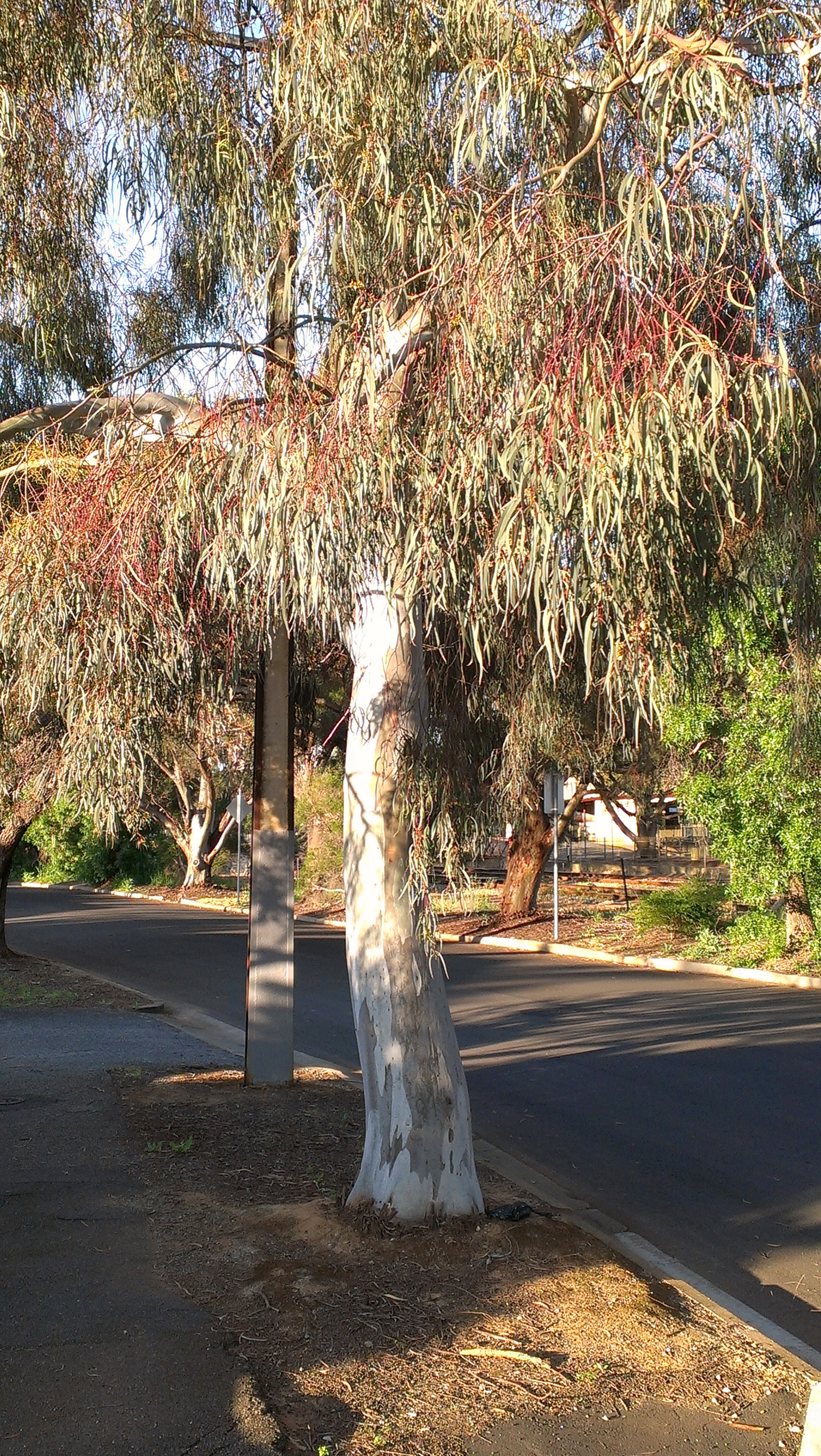
I decided to depart from my recent focus on ironbarks to try to identify this lovely tree, growing alongside the tram line.

This one is not an ironbark… it is a stringybark. Here’s a bit more detail.

All the usual reservations about my skills in eucalypt identification apply, but Euclid and I reached the conclusion this is E.Acaciiformis, wattle-leaved peppermint.

I ran a test pot last week and got a strong, bright orange… so I’m trying out a bigger pot.  I’ve been running pot after pot with the same water and fresh bark over the last few days, but for this, some fresh, clean rainwater.

I brought the pot up to below a boil, then simmered for three hours, adding my fibre after the first hour and taking out leaf material after the second to allow more room for fibre circulation in the dye bath.

This is the result on merino and silk (on the left).  The braid on the right has been dyed with E Scoparia bark.  It is quite striking to see the difference between dye take up on the wool and the silk.  All my sample cards suggest this outcome, and so do leaf prints really: I get colours I prefer on wool and cellulose fabrics rather than silk personally, though I see that other dyers love using silks.  It does seem very different to the usual expectation about how these fibres will take up dyes.

Leave a comment

Filed under Dye Plants, Eucalypts, Natural dyeing

Silkworms!

A while back, I mentionedthat I had acquired some silkworms.  Five for a dollar, to be exact!  There I was, checking out the primary school community garden during their fete and admiring the plants for sale, when I saw them.  So, they went into a strawberry punnet and came home on my bicycle.  Then began weeks of raiding local mulberry trees for stray overhanging leaves (and there were some from my friend’s front yard too).  Since it is mulberry season, I got some food from the whole adventure too, and some berry-stained fingertips. 

Eventually, they began to show signs of wanting to move to the next stage of their life cycles.  I’d sought advice from wormspit, so most of them found themseves moved to a cardboard roll (ahem) at this point:

I was quite fascinated by the way that the colour of the silk changed between the early stages of cocoon-making, when it seemed quite white, to the next day:

Now, we are waiting to see when they emerge and what happens them.  It may be that with a posse of only 5, there will not be opportunities to reproduce.  But we’ll wait and see.

5 Comments

Filed under Uncategorized

Works in progress

I’ve been puttering along on a number of different projects over the last few weeks… and lest this sounds unusual in some way, that is probably the way life goes most of the time around here!  I returned to cold dyeing roving after retrieving my last spectacular failure.  For good measure, I also dyed some local mohair locks.  I am planning toward a textured yarn spinning workshop and I’m determined to go as close as I can to a local supply of materials for the participants.

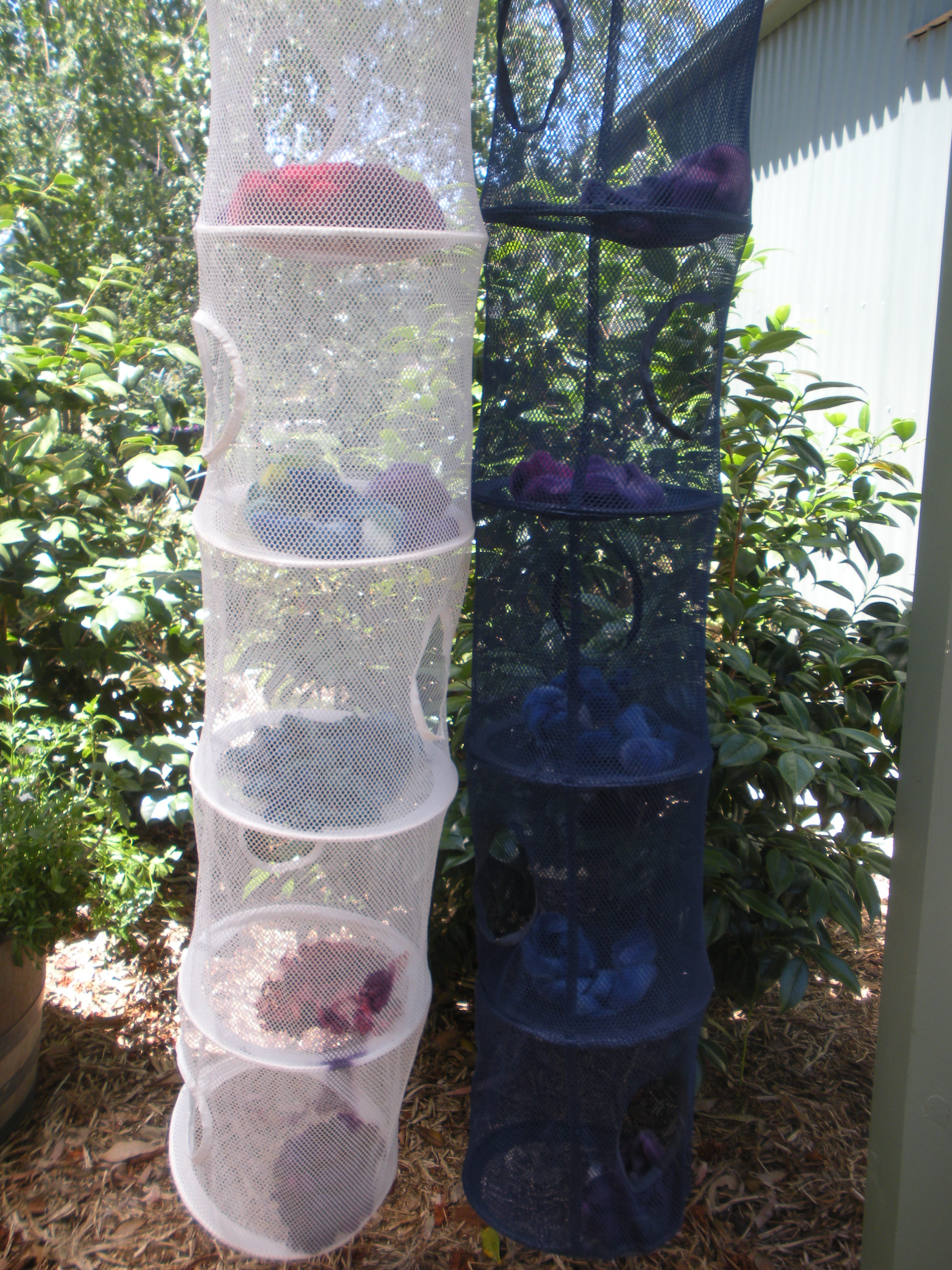
We’ve had Ikea here for long enough that the op shops of the city now turn up these fantastic wool drying apparatuses.  One came with a small supply of plastic animals.  This time, just when I thought I had found them all, a small plastic dalmatian dropped out.  Hopefully the child whose toys left home this way is not grieving and bereft!

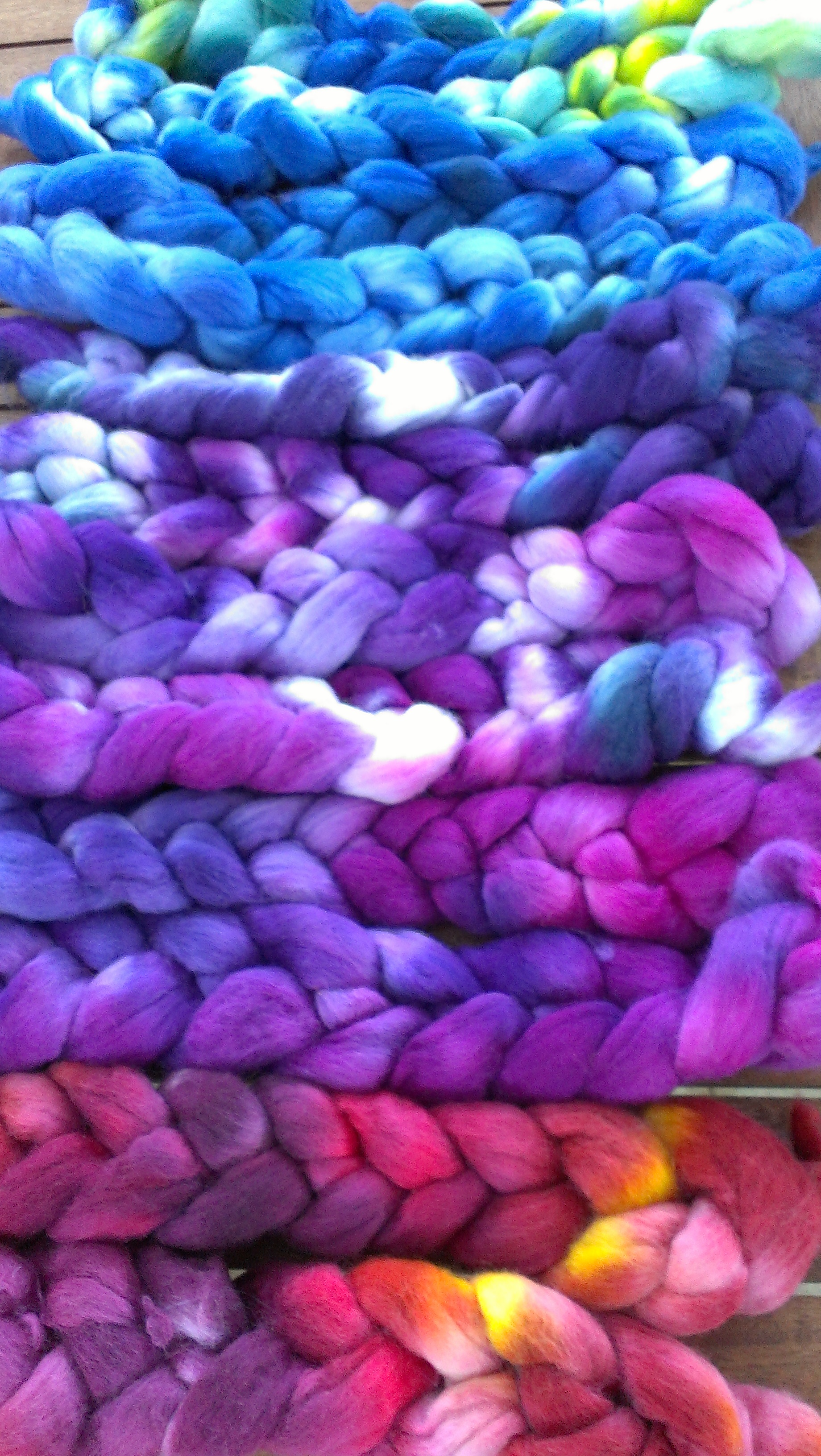
This time, the merino braids turned out better than I had hoped.  Perhaps I am slowly acquiring a better sense of colour.  Those with a red base (at the bottom of the picture) were the ones I felt most tentative about, but I like them best of all.

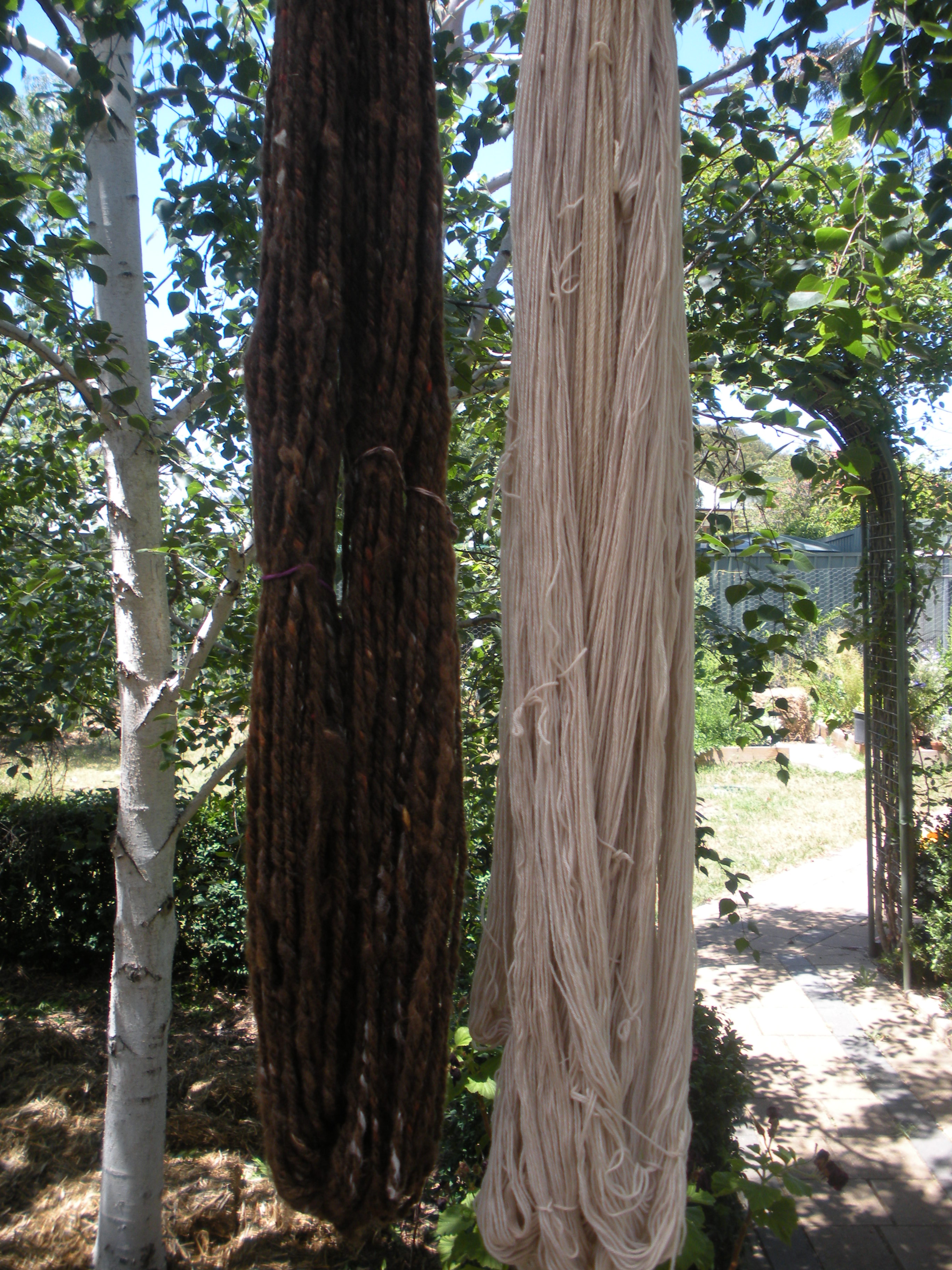
The mohair is ready to have seed heads picked out of it and to become part of some textured batts for corespinning and other good times.  Meanwhile, I have been preparing for a natural dyeing workshop focusing on eucalypts.  Again, I need to provide materials, so I’ve been laying in what I need.  It’s the season for bark collection so I have been touring the neighbourhood with my trusty bike trailer and a chook feed sack, pulling over if I’m passing in the car, or wandering out with a bucket, whichever may be appropriate to the day and location of the tree.  In short, I am keeping the E Scoparia bark that is falling to the ground from being blown away, tidied up by others or crushed on the road.  I have almost 3 sacks full so far.  Seeing the bark shedding has allowed me to run test dye pots on a few trees I had been unsure of with more confidence.  I’ve found several more specimens in the local area.  Meantime, I have been mordanting fibres (wool with alum on the right) and continuing to convert my sow’s ear fibre into slipper-suitable yarn (left) as I knit up what has already been spun. I think that particular batch of unlovely spinning may finally be over.  Two pairs of slippers are knit, one to go.

I’ve been converting milk bottles into sample cards, writing up notes and assessing the state of the Guild’s dye room.  Today, I’ve got soybeans soaking ready to mordant cotton for the workshop.  It has me wanting to dye…

10 Comments

Filed under Dye Plants, Fibre preparation, Spinning

Let the ironbark identification and dyeing experiments begin!

This tree is growing on the tram route in Goodwood.  It is clearly an ironbark, but I am less certain it is E Sideroxylon, and thus, I chose to investigate further… There are three ironbarks in a little cluster at this spot.  I think one of them is the same species and the other is so tall and branches so many metres above the ground that I may never know.

Here is the key feature of an ironbark: deeply furrowed bark which is impregnated with a sticky saplike substance (kino) which the tree produces in an effort to fend off attack by insects.

Here, more of a sense of the whole tree.  It is a very tall tree… and while the trunk might be secure from predatory borers, the leaves showed penty of signs of lerp and caterpillar attack.

The upper branches were paler, more of a cream colour, and covered in smooth bark which had begun to shed.  We had a very overcast day, but sometimes a natural dyer can’t wait!

The leaves smelled rather lovely while cooking.  I didn’t imagine when I set out on this dyeing path that cooking eucalyptus leaves smelled different, except in the obvious case of ‘lemon scented’!  They do though.  Some smell quite spicy and some smell like classic Eucalyptus oil.  E Crenulata was so overpowering it was voted out of the house for all future time.

As for identifying features, I collected plenty of leaves but could not reach any mature fruit.  Since this tree is growing among others that may not be the same species, picking fruit up from the ground sometimes just confuses the picture.  There were no visible buds or flowers–so, there are some limitations on identification.  Just the same, this tree appeared to bear fruit in pairs and threes (and not the classic 7 flower umbel of E Sideroxylon).  Tentatively, Euclid, hampered by my inadequacies in providing accurate observations, and the limitations in the data available, gives me E Tricarpa.

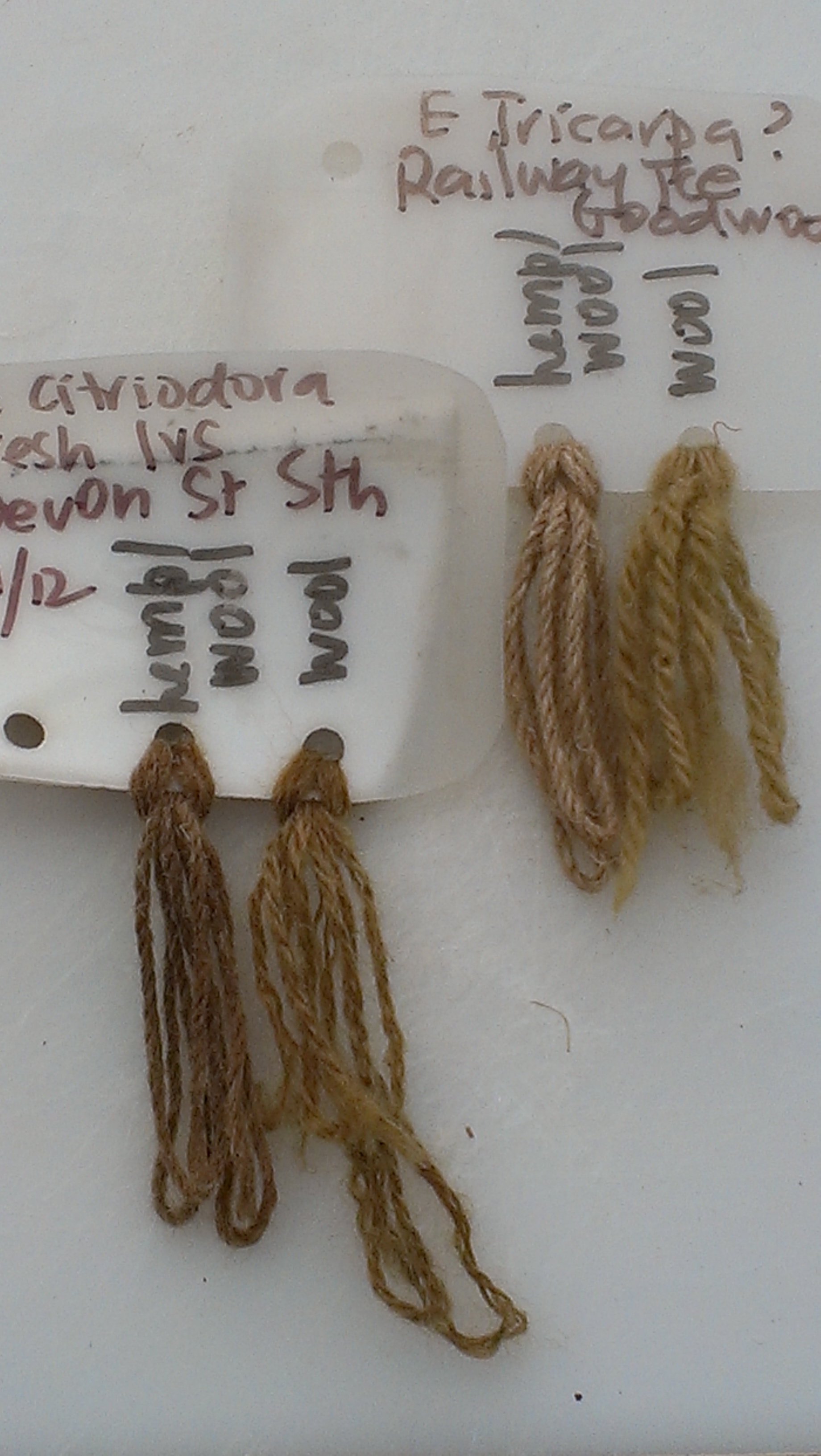
Here is the outcome of my dye sample (hemp/wool blend on the left and and wool on the right on each sample card).  E Citriodora on the left and E Tricarpa (tentatively identified) on the right… equally unexciting to my way of thinking.

Leave a comment

Filed under Dye Plants, Eucalypts, Natural dyeing, Uncategorized

Ironbark experiments: E Corynodes

On the weekend, I went to a fete at Black Forest Primary School.  They had a sensational community garden, complete with a sale of silkworms, 5 for a dollar!  Who could resist?  Clearly not me (you guessed), so there are 5 silkworms in the lounge munching through mulberry leaves.  More on that later.

While my posse of friends and my house guests from Denmark were hitching up their bikes, I took a sample of the tree right at the dead end of Kertaweeta Ave Black Forest where we entered the school grounds, with the help of a taller friend.  Excuse the extra good photo….

This tree had smooth, pale bark in some of the finer upper branches.

I don’t know why, but I do not entirely trust the result that Euclid and I produced: E Corynodes.  Poor Euclid, depending on me.  There were no mature fruits, buds or flowers to consider, and that makes the result less dependable and the chance of detecting an error smaller. Euclid suggests E Corynodes can be confused with several other species, but look at this account of how to tell them apart!

E. fibrosa subsp. fibrosa, E. fibrosa subsp. nubila, E. melanophloia and E. rhombica … differ in having buds with stamens all fertile and irregularly flexed.  E. sideroxylon differs by having buds that hold the outer operculum into maturity and both the inner and outer operculum shed together at anthesis (no operculum scar).

So that would be obvious, then!  Based on this I wonder how I can be sure this is not E Sideroxylon, which would give orange too…  Because whatever its true name, this is the result I got.

Leave a comment

Filed under Dye Plants, Eucalypts, Natural dyeing

Eucalyptus Torquata

This is E Torquata, the Coolgardie Gum.  In my area it is a popular street tree.  It is a relatively small gum tree with a showy lovely flower and distinctive bud caps.  Being native to Western Australia, it tolerates the dry conditions that a street tree in Adelaide can expect to have to manage.

I find Coolgardie Gum easy to identify. When I was a child we lived in the goldfields in WA where this tree is from.  We lived in Kalgoorlie for a while, and this tree grew there as well as over to Coolgardie, which we used to visit.  The other town Wikipedia mentions as within its range is Widgiemooltha.  When I was a kid you could hardly call Widgiemooltha a town, but there was a dam there that someone had set goldfish free in.  We went there once and came home with 15 goldfish, all different!  It was a fantastic day out, picnic plus new pets–what more could a young person want?  We used to break the beak off the bud caps from this tree and string them to make necklaces.  They are distinctive.

This particular tree has relatively yellow flowers, but most nearby have flowers that are closer to orange.  There is a big infrastructure project happening in my suburb soon, and some of the local trees are going to go, including this one.  So I decided to harvest a little.  I have tried it as a dye plant before and I wasn’t impressed (I don’t invest time in natural dyeing with the intention of gettng tan), but I know someone who has achieved green from this tree using modifiers.  These leaves are destined for my sample pot.  I’m aiming to try them with modifiers myself.  I have some rusty-nail-iron-water and some copper-pipe-water, and I’m finally going to try them out.

I have also wrapped up some leaves sandwiched between some recylced silk and some recycled linen to see what happens.  I also put some samples in from some trees I found near a friend’s house in another part of the city just in case they are E Scoparia… the leaf shape and bark are right, the number of valve sin the fruit is right, the flower colour is right, and the bark is colouring up the way the ones in my neighbourhood are, but I trust the dye pot more than I trust my capacity to identify Eucalypts.  I’ve cooked my leaf bundles for 3 hours and I’ll unwrap in a day or two.

While I’m on the topic of Eucalypts that don’t have long to live… RIP this beautiful Corymbia Citriodora (Lemon Scented Gum).  At the community information day on the weekend I was told it would be cut down this week or next.  Right now it is in full bloom.  There are thousands of bud caps showering down and the road is covered in a dusting of yellow stamens.  Lorikeets are screeching and flying in and out of that tree all day long.  They start before I’m out of bed in the morning.

Farewell beautiful trees.

Leave a comment

Filed under Dye Plants, Eucalypts, Natural dyeing, Uncategorized

Introducing Eucalyptus Scoparia

Finally today a friend from my Guild has been able to tell me the name of some of my favourite dye Eucalypts.  Here is one example: Eucalyptus Scoparia (Wallangarra White Gum).

I love these trees, and they are fabulous dye plants. I feel lucky to have several in my neighbourhood! If you’ve been following this blog you’ve met three of the four I have foundnearby: (October 4; September 5; August 22 2012).  Here’s a bag I made with E Scoparia leaf prints on cotton, using a sea water and soy mordant and cast iron:

And this is a corespun yarn.  I carded merino dyed with E Scoparia bark with dyed mohair locks and dyed silk and corespun it over a crossbred wool core.

Thanks to E Scoparia, and thanks to Helen for organising an identification for me!

8 Comments

Filed under Dye Plants, Eucalypts, Leaf prints, Spinning, Uncategorized