Tag Archives: neighbourhood dyeplants

Angophora Costata subsp Costata bark dyepot

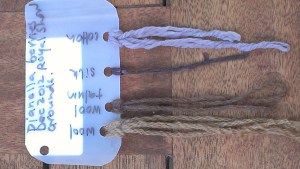
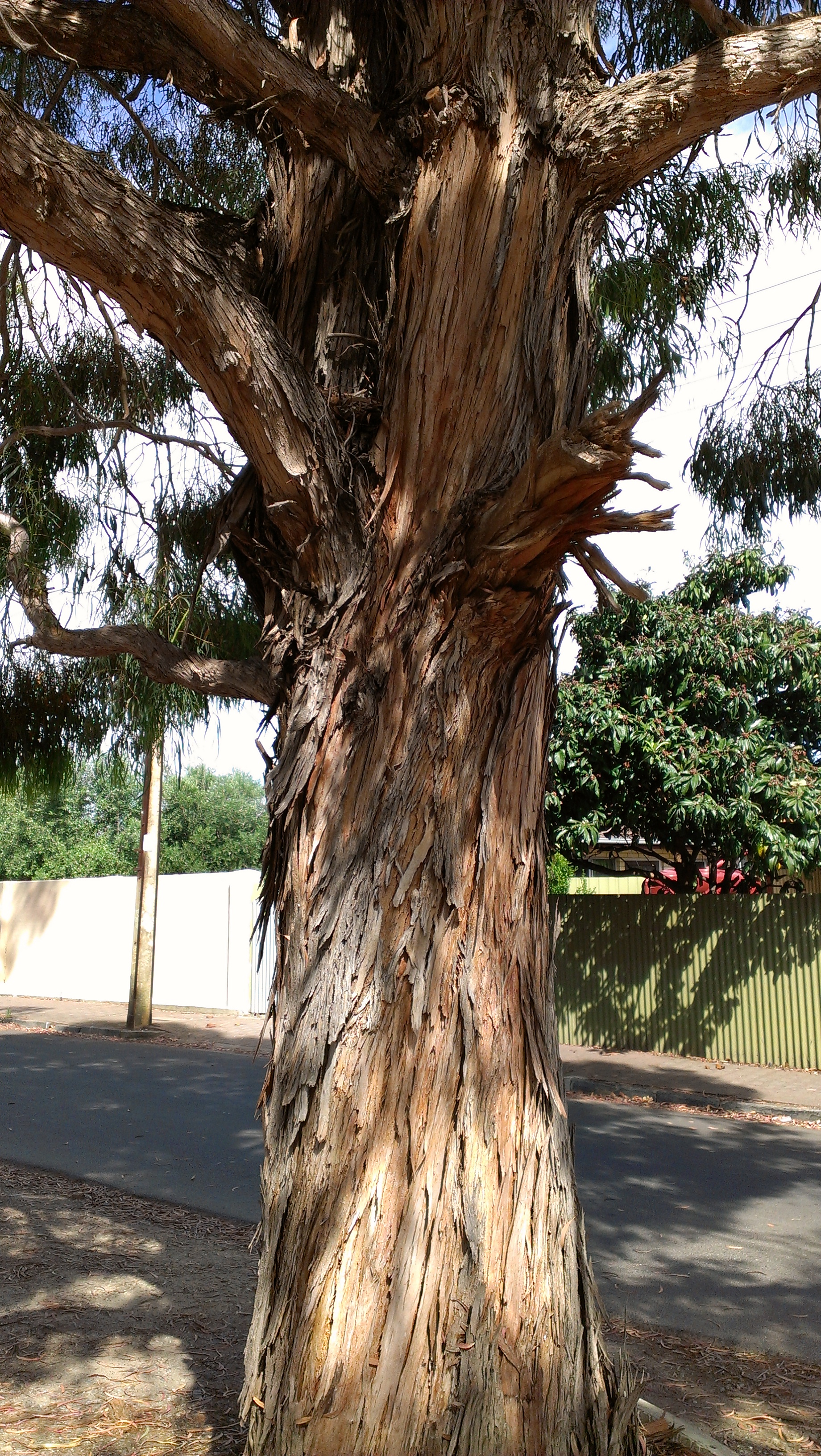
Our lovely friend has an Angophora Costata subsp Costata (Sydney Red Gum) in her backyard.  When the bark is newly shed, these trees have a stunning rust-orange coloured trunk.  There were many to be seen and admired in and around Sydney when we were there in December.  The other day she came around with… a bag of fallen bark for me!  Here is my sample card and swatch before:

IMAG0665

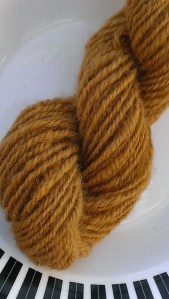
And, after.  You could call it cinnamon, I suppose–the alum mordanted, superwash sample is really quite brown.  Or on the other hand, you could just call it tan, again.

IMAG0701

1 Comment

Filed under Dye Plants, Eucalypts, Natural dyeing, Uncategorized

Eucalyptus Saligna Bark Dyepot

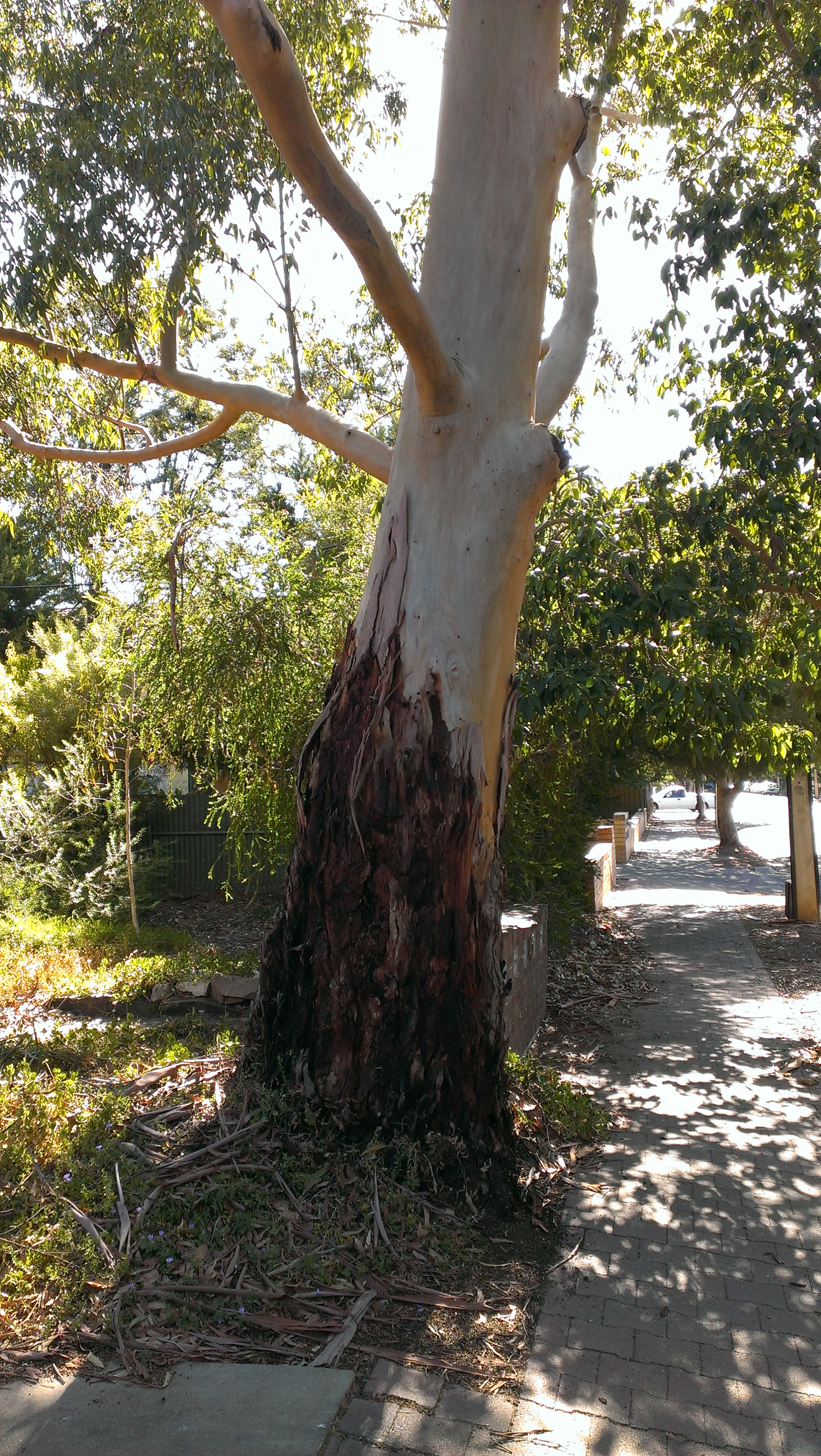
Continuing the recent bark theme… and since it is the season of bark shedding for so many local trees, I bring you a Eucalyptus Saligna (Sydney blue gum) bark dyepot.  I collected the bark in December and had a very funny conversation with a passerby who had lots of ideas about what I might be doing with that bark.  This tree has a rough base but has shed all the bark above it in strips now.

IMAG0572

It is a huge tree!  It is outside a block of townhouses, where some trees were removed a while back but this one was saved by some local friends.

IMAG0574

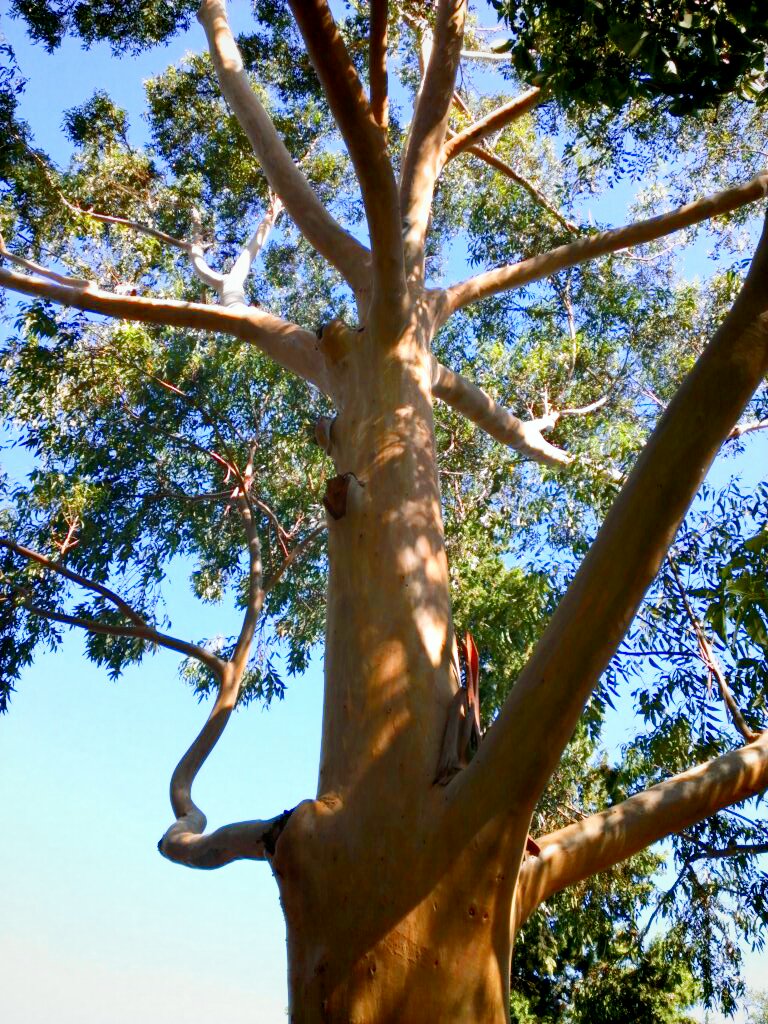
What a beauty.

IMG_0031

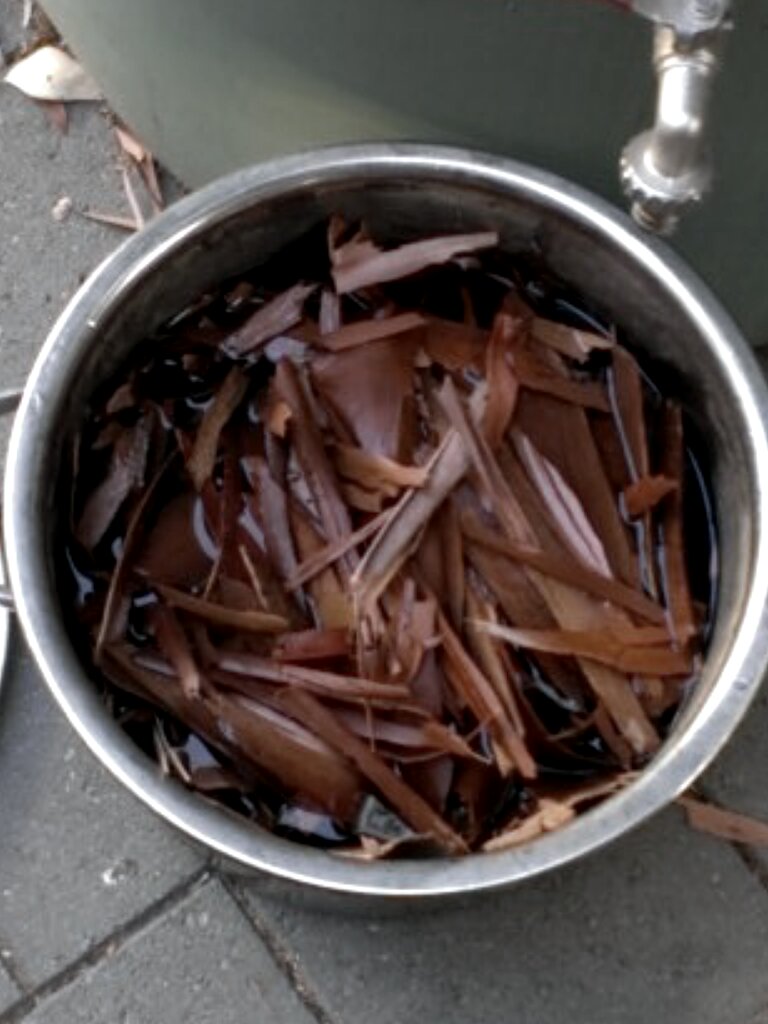
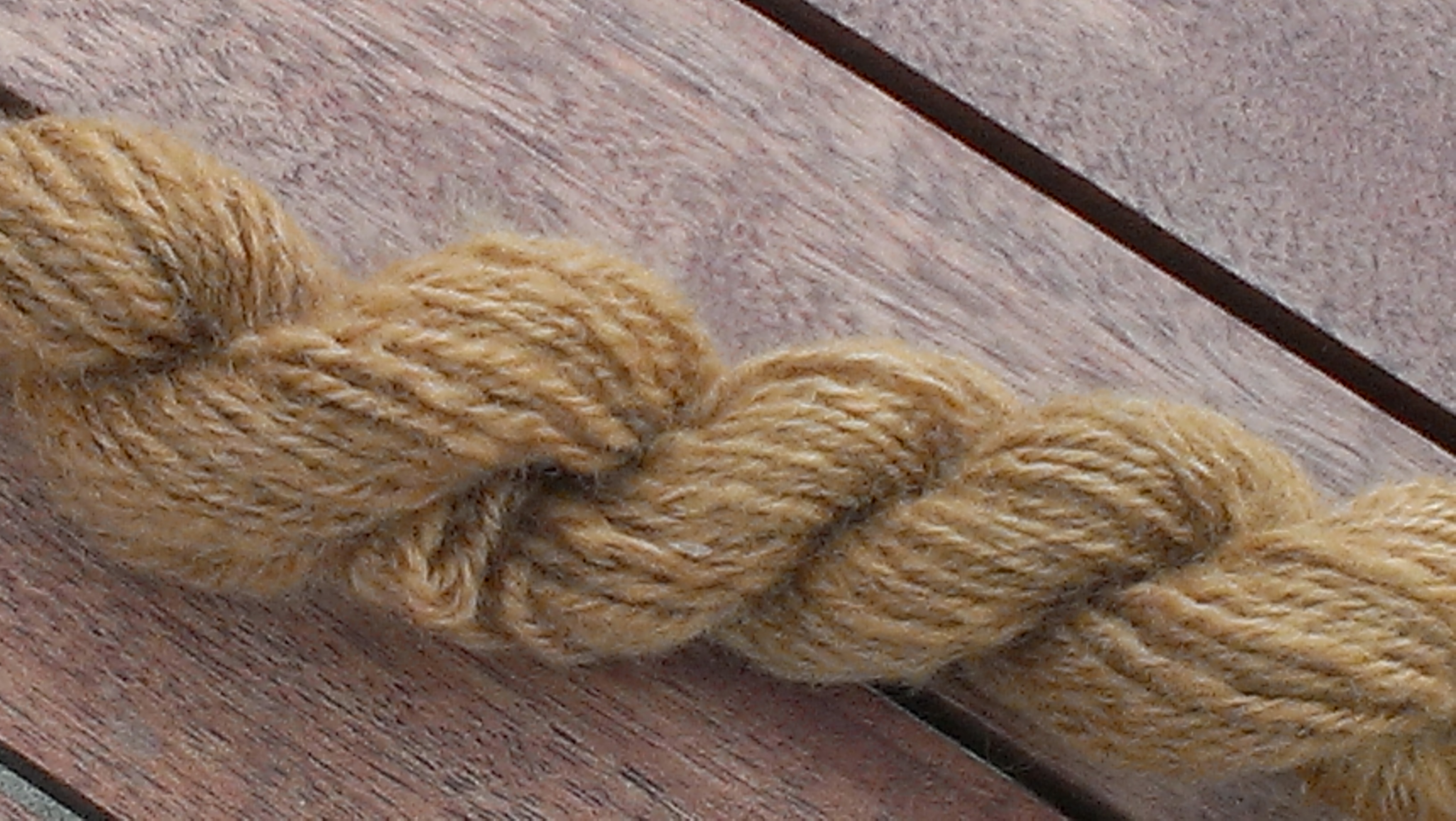
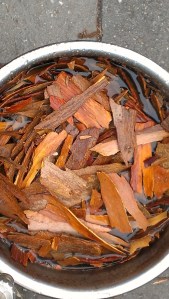
Enjoy the tree, because as I write I’ve looked into the dye pot where my handspun wool is heating and this is a case of tan again, I believe.  Here is the bark after I added rainwater for a few days of soaking. 

IMG_0033

And here, my friends, is my dyed wool.

IMAG0584

And against a background of E Scoparia-dyed merino:

IMAG0583

4 Comments

Filed under Dye Plants, Eucalypts, Natural dyeing, Uncategorized

More Eucalyptus Cladocalyx Bark Outcomes

Given the level of colour in my E Cladocalyx bark tannin bath (see previous post), I couldn’t resist trying to dye some wool.  This is handspun finn cross wool, cooked for about 90 minutes in a solution of E Cladocalyx bark, which had been soaked in a sunny spot for 14 days prior to dyeing. The commercial superwash, alum mordanted strand of wool on my test card is a much darker shade of brown.

IMAG0557

Leave a comment

Filed under Dye Plants, Eucalypts, Natural dyeing

Eucalyptus Cladocalyx Bark

I have been reading Rebecca Burgess’ gorgeous book, Harvesting Color, which had me thinking about how to create a tannin solution.  The local solution for her is to gather acorns.  That might be possible for me in autumn, too. There are some avenues of oaks in my city, and they have tiny newly formed acorns right now.  But it seems to me that eucalypt bark would be a promising source in my own region.  I thought it seemed logical to collect bark from a species that hadn’t shown a lot of dye potential (I’m trying for mordant, not dye).   So I stopped outside the royal showgrounds where this huge E. Claodocalyx (Sugar Gum) had shed its bark recently.  We were having unseasonably cool weather as this dull photograph shows.

IMAG0317

I picked up a bag full of bark and headed home to let it steep in rainwater. This will be an opportunity to consider the dye potential of the bark as well as try it as a source of tannins.  There are many of these trees around my area and this is a truly huge tree when full grown, which sheds its bark once a year, so if this is a good source of dye, I will have access to a lot of it! Here is how it looked on 15 December:

IMAG0330

And two days later:

IMAG0342

…so I put a metre of cotton cloth into it, which immediately turned golden yellow:

IMAG0347

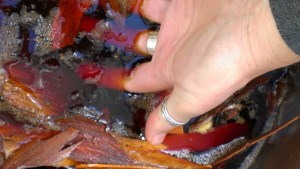
I left the pot in a sunny spot.  The temperatures have ranged from mid-twenties celcius to 40C.  By 1 January, the pot was darker still, with the liquid seeming a ruby red shade.

IMAG0545

And here is the cotton I immersed in it  so many days ago after drying.

IMAG0547

Needless to say, I am now planning to dye wool in my bark liquor and see what happens…

Leave a comment

Filed under Dye Plants, Eucalypts, Fibre preparation, Natural dyeing, Uncategorized

Dianella fruit

IMAG0321

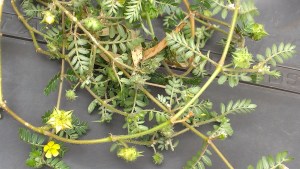
Yesterday I came through the royal showgrounds with my secateurs.  On the way out, I spotted these fruits.  I think this is one of the dianellas, probably Dianella Revoluta. It’s a  common native, drought hardy inclusion in public plantings in my area.  There were so many that on the way back, I took just a couple of stems from each plant and put them in my panniers.  While I was there I saw some caltrop, so I removed that while I was there.

IMAG0323

It’s one of the enemies of cyclists, as you might guess from these immature fruits… which when ripe will be the stuff of many punctures.  I pull this out any time I have the chance.

IMAG0325

I followed Jenny Dean’s suggestions about processing berries…

IMAG0328

And, as might have been expected, the result was nothing like the fruits I started with.  I would rate the unmordanted wool pale tan, wool with alum dark tan, the silk is grey-brown and the cotton is pale grey.  Not too exciting, is my conclusion!IMAG0340

15 Comments

Filed under Dye Plants, Natural dyeing, Uncategorized

Patterns emerge

I keep finding myself humming ‘Deck the halls with boughs of holly’ when collecting bark.  I realise it’s the first of December and there is a chance I have just been ear-wormed by a Christmas carol when passing by a shop… but I don’t think so.  I think I am actually humming ‘Tis the season for bark-collecting, tralalalala tralalala’.  Which may, of course, be even greater cause for concern!  Today I went out with my bike and visited this tree, cunningly hidden behind and beside a carob tree (whose leaves you can see).  I’ve tried dyeing with carob leaves, but nothing exciting emerged.

IMAG0287

As I went to pack my bag of bark into my bike trailer a gecko ran out!  Now that really was an occasion for celebration… a native lizard enjoying one of my favourite dye plants.  I also collected bark from a tree in Leader St.  I ran a sample dye pot some years back from leaves that had dried in the gutter beside it and got rich colour, but the council has trimmed the boughs so high I can’t reach leaves or see any buds or gumnuts.  I am using the pattern of bark shedding to identify more E Scoparia trees.  Anything that has bark that has turned dark grey and red just as it begins to shed is on my plausible candidates list if it is peeling now, which is why I visited the one in Leader St. Needless to say, there is a dye pot running now to test this theory.  After all, ’tis the season for bark collecting…

And, at Guild today I became the happy recipient of natural dyestuffs of antiquity which I might be able to use for my dyeing workshop.  Some had no labels, and this one is the most intriguing of the unidentified specimens.  I could guess many, but not this one.  Any clues?  It looks to be the husk of a small fruit.  Smaller than a hazelnut, say, but bigger than a pea.  Dark on the outside and crimson on the inside.

IMAG0286

This trove is going to take some research, but will be my first opportunity to try logwood and cochineal (let those bugs not have died in vain…) and suchlike, as well as some things I’ve never heard of, like shredded mulga bark (mulga roots are common firewood here, but I’ve never heard of this as a dyestuff) and ‘red sanderswood’. Happy times… I also received some undyed handspun yarn as part of the Guild birthday challenge, labelled ‘Goat Hair’. Perhaps it can be dyed from the new dye collection?

Leave a comment

Filed under Dye Plants, Eucalypts, Natural dyeing

Eucalyptus Acaciiformis

I decided to depart from my recent focus on ironbarks to try to identify this lovely tree, growing alongside the tram line.

This one is not an ironbark… it is a stringybark. Here’s a bit more detail.

All the usual reservations about my skills in eucalypt identification apply, but Euclid and I reached the conclusion this is E.Acaciiformis, wattle-leaved peppermint.

I ran a test pot last week and got a strong, bright orange… so I’m trying out a bigger pot.  I’ve been running pot after pot with the same water and fresh bark over the last few days, but for this, some fresh, clean rainwater.

I brought the pot up to below a boil, then simmered for three hours, adding my fibre after the first hour and taking out leaf material after the second to allow more room for fibre circulation in the dye bath.

This is the result on merino and silk (on the left).  The braid on the right has been dyed with E Scoparia bark.  It is quite striking to see the difference between dye take up on the wool and the silk.  All my sample cards suggest this outcome, and so do leaf prints really: I get colours I prefer on wool and cellulose fabrics rather than silk personally, though I see that other dyers love using silks.  It does seem very different to the usual expectation about how these fibres will take up dyes.

Leave a comment

Filed under Dye Plants, Eucalypts, Natural dyeing

Works in progress

I’ve been puttering along on a number of different projects over the last few weeks… and lest this sounds unusual in some way, that is probably the way life goes most of the time around here!  I returned to cold dyeing roving after retrieving my last spectacular failure.  For good measure, I also dyed some local mohair locks.  I am planning toward a textured yarn spinning workshop and I’m determined to go as close as I can to a local supply of materials for the participants.

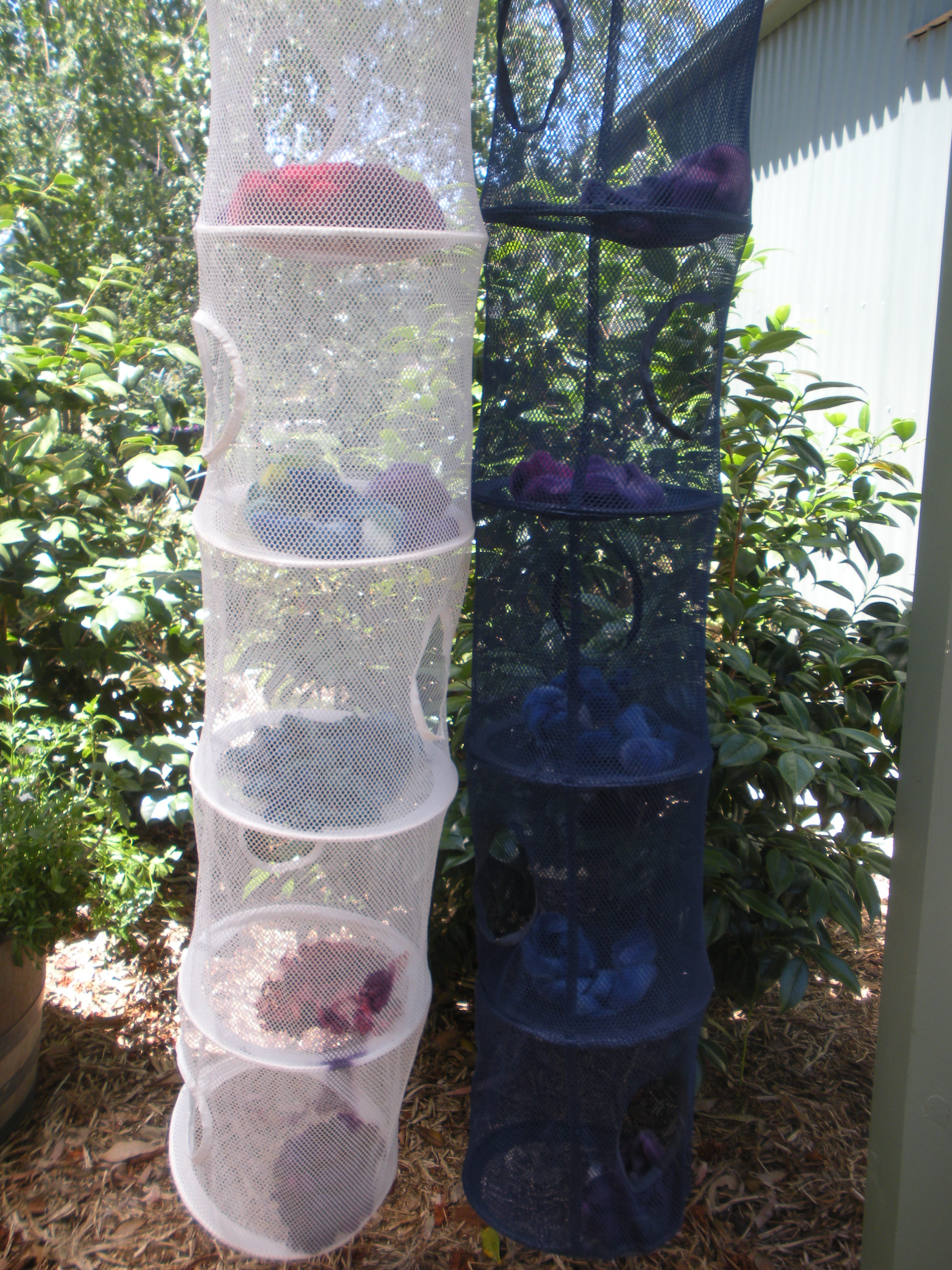
We’ve had Ikea here for long enough that the op shops of the city now turn up these fantastic wool drying apparatuses.  One came with a small supply of plastic animals.  This time, just when I thought I had found them all, a small plastic dalmatian dropped out.  Hopefully the child whose toys left home this way is not grieving and bereft!

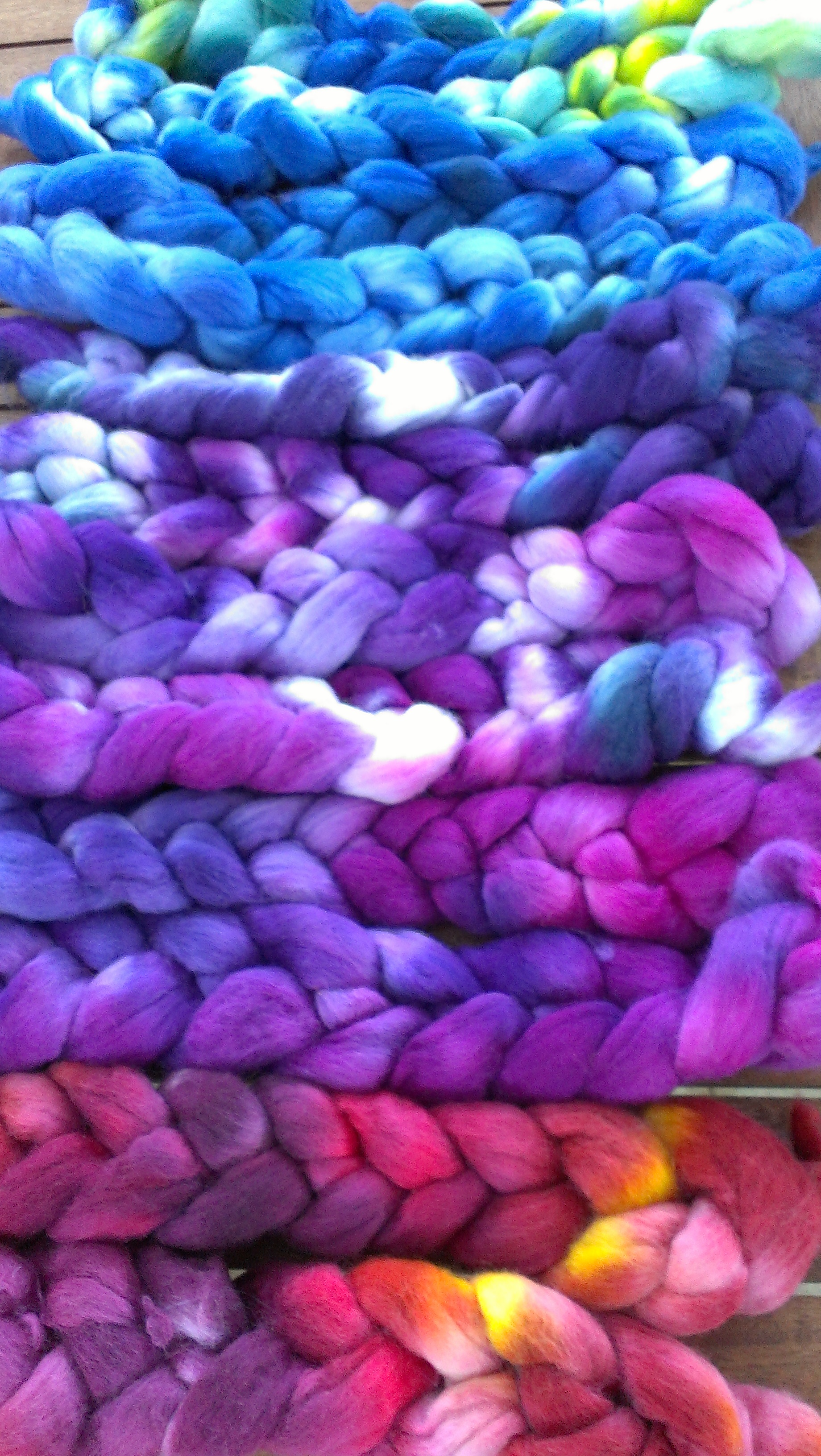
This time, the merino braids turned out better than I had hoped.  Perhaps I am slowly acquiring a better sense of colour.  Those with a red base (at the bottom of the picture) were the ones I felt most tentative about, but I like them best of all.

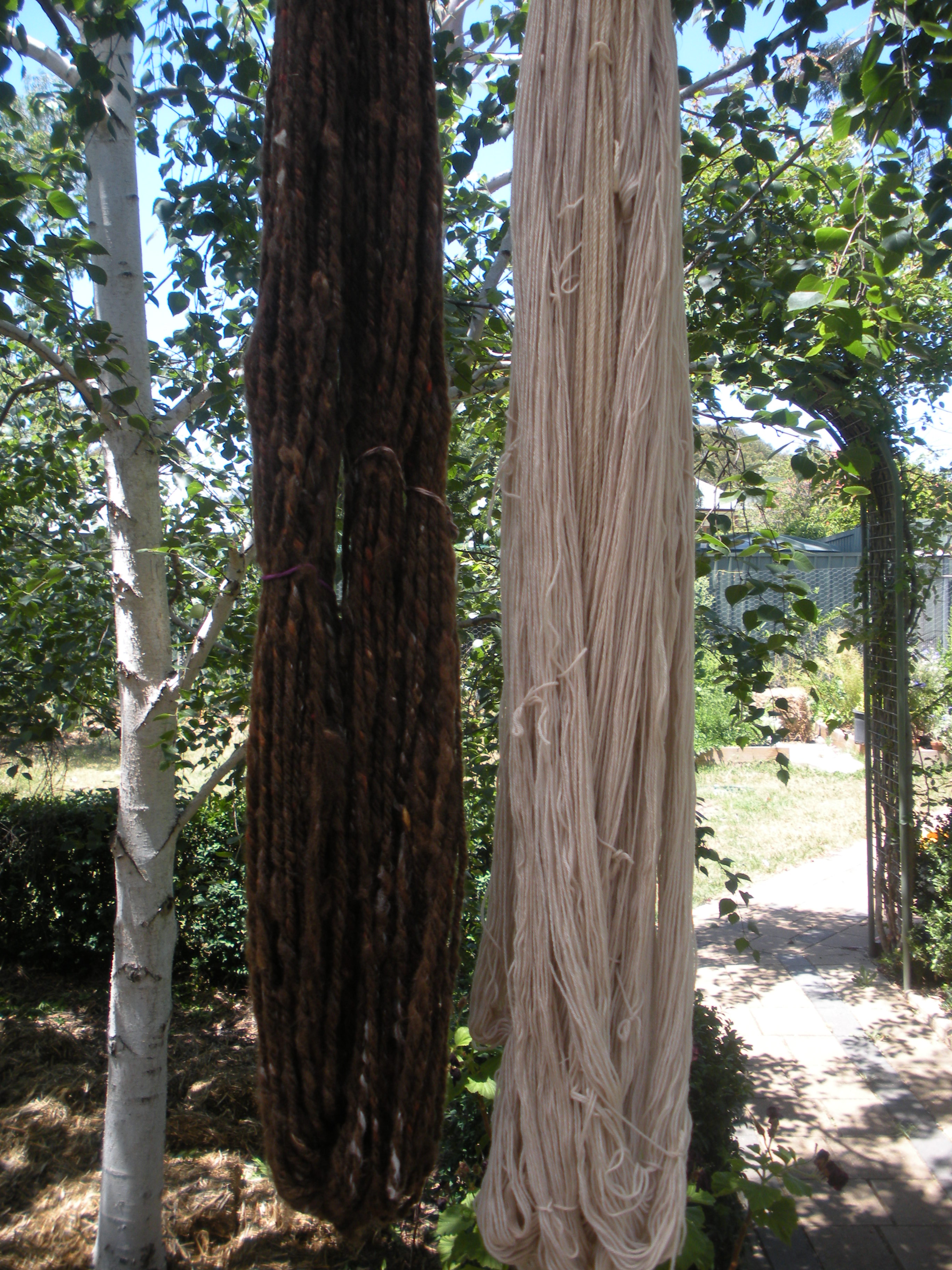
The mohair is ready to have seed heads picked out of it and to become part of some textured batts for corespinning and other good times.  Meanwhile, I have been preparing for a natural dyeing workshop focusing on eucalypts.  Again, I need to provide materials, so I’ve been laying in what I need.  It’s the season for bark collection so I have been touring the neighbourhood with my trusty bike trailer and a chook feed sack, pulling over if I’m passing in the car, or wandering out with a bucket, whichever may be appropriate to the day and location of the tree.  In short, I am keeping the E Scoparia bark that is falling to the ground from being blown away, tidied up by others or crushed on the road.  I have almost 3 sacks full so far.  Seeing the bark shedding has allowed me to run test dye pots on a few trees I had been unsure of with more confidence.  I’ve found several more specimens in the local area.  Meantime, I have been mordanting fibres (wool with alum on the right) and continuing to convert my sow’s ear fibre into slipper-suitable yarn (left) as I knit up what has already been spun. I think that particular batch of unlovely spinning may finally be over.  Two pairs of slippers are knit, one to go.

I’ve been converting milk bottles into sample cards, writing up notes and assessing the state of the Guild’s dye room.  Today, I’ve got soybeans soaking ready to mordant cotton for the workshop.  It has me wanting to dye…

10 Comments

Filed under Dye Plants, Fibre preparation, Spinning

Ironbark identification saga continues

I’ve been working my Eucalypt identification skills overtime and discovered that there are at least 3 dark-barked (by which I mean their trunk bark is brown to grey to black) types of ironbark growing as street trees in my area.  The main two seem to be E Tricarpa and E Sideroxylon, but it appears I also have E Corynodes.  One of the reasons I’m feeling some confidence is because of the results I have had from the dye pot:

In order of appearance:

E Citriodora–not an ironbark, just for comparison!–(Goodwood); E Tricarpa (Goodwood); E Tricarpa (Black Forest)

E Corynodes (Black Forest); E Sideroxylon (Goodwood); E Sideroxylon (a different tree, in Goodwood)

I would have to say that the dye results are more consistent than my perception of the appearance of the trees! One happy outcome of paying more attention is that I have observed that at this time of year E Tricarpa (and some E Sideroxylons) have tiny buds in formation among the fresh young leaves, and this enables a confident identification as between them. E Tricarpa has buds grouped in threes and E Sideroxylon has buds grouped in sevens.  Sometimes fruits are so high in the tree I can’t tell, and sometimes the sample I am able to reach has umbels where some fruits have broken off but I can’t be confident how many.  So this discovery is a help to the person trying confidently to tell them apart–me, for instance.

E Tricarpa (see those tiny buds-in-formation?):

E Sideroxylon:

I need to go a little further afield to consider other variations on the theme, but for now I think I will consider wider-leafed ironbarks to be types I don’t know well, rather than assuming they are E Sideroxylon with a better supply of water and nutrients.  You know what they say about assumptions!

6 Comments

Filed under Dye Plants, Eucalypts, Natural dyeing

Let the ironbark identification and dyeing experiments begin!

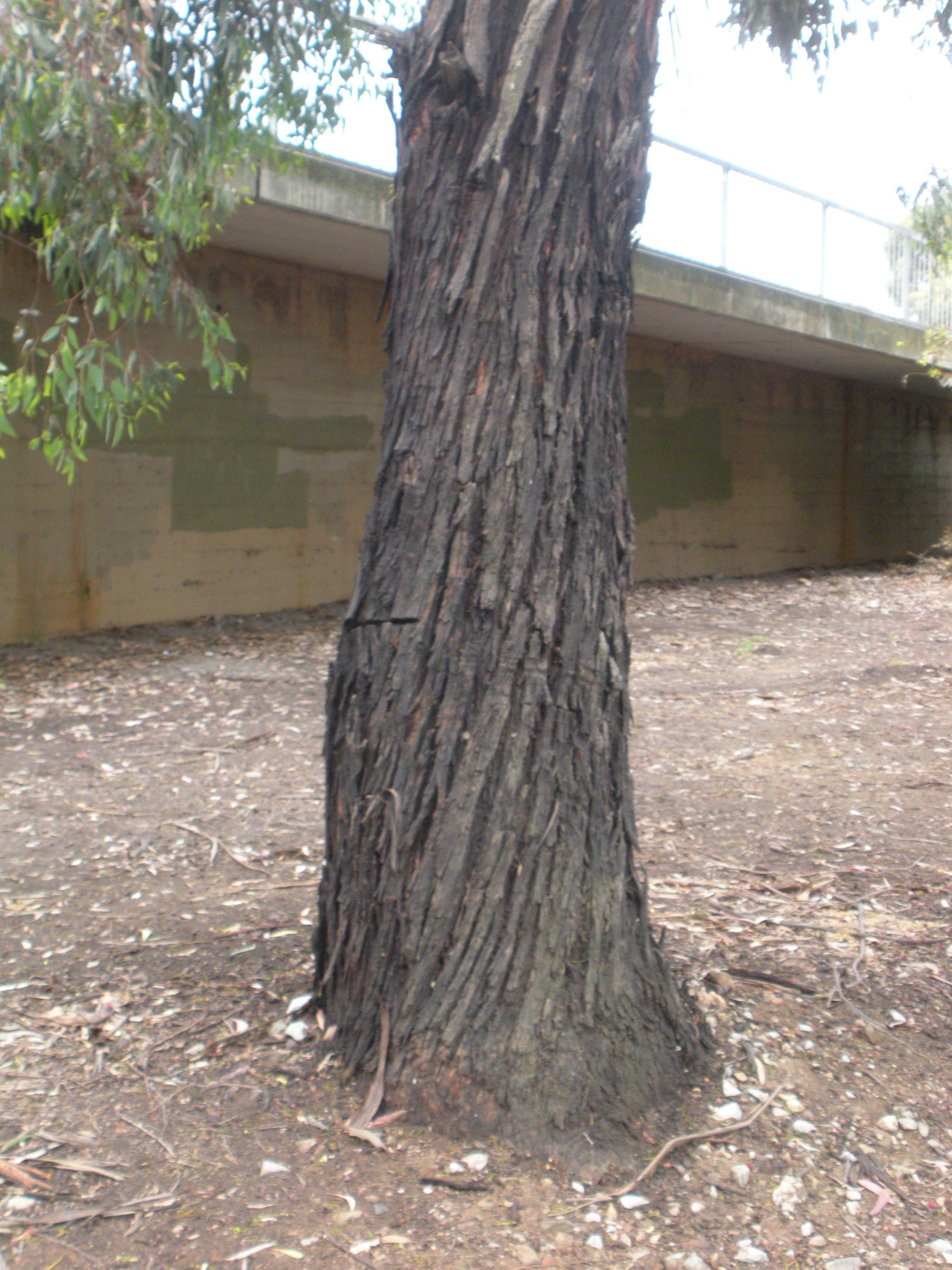
This tree is growing on the tram route in Goodwood.  It is clearly an ironbark, but I am less certain it is E Sideroxylon, and thus, I chose to investigate further… There are three ironbarks in a little cluster at this spot.  I think one of them is the same species and the other is so tall and branches so many metres above the ground that I may never know.

Here is the key feature of an ironbark: deeply furrowed bark which is impregnated with a sticky saplike substance (kino) which the tree produces in an effort to fend off attack by insects.

Here, more of a sense of the whole tree.  It is a very tall tree… and while the trunk might be secure from predatory borers, the leaves showed penty of signs of lerp and caterpillar attack.

The upper branches were paler, more of a cream colour, and covered in smooth bark which had begun to shed.  We had a very overcast day, but sometimes a natural dyer can’t wait!

The leaves smelled rather lovely while cooking.  I didn’t imagine when I set out on this dyeing path that cooking eucalyptus leaves smelled different, except in the obvious case of ‘lemon scented’!  They do though.  Some smell quite spicy and some smell like classic Eucalyptus oil.  E Crenulata was so overpowering it was voted out of the house for all future time.

As for identifying features, I collected plenty of leaves but could not reach any mature fruit.  Since this tree is growing among others that may not be the same species, picking fruit up from the ground sometimes just confuses the picture.  There were no visible buds or flowers–so, there are some limitations on identification.  Just the same, this tree appeared to bear fruit in pairs and threes (and not the classic 7 flower umbel of E Sideroxylon).  Tentatively, Euclid, hampered by my inadequacies in providing accurate observations, and the limitations in the data available, gives me E Tricarpa.

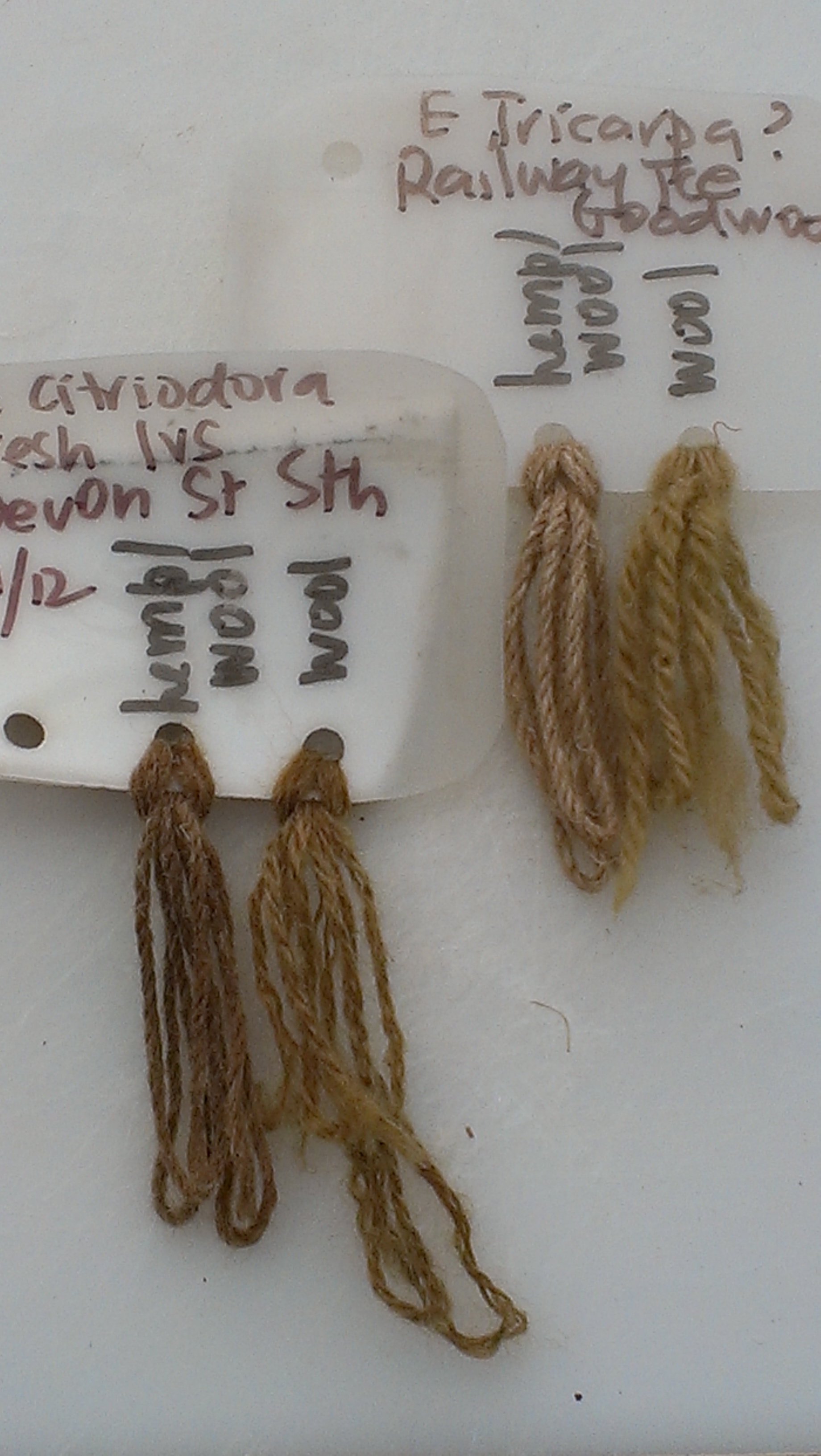
Here is the outcome of my dye sample (hemp/wool blend on the left and and wool on the right on each sample card).  E Citriodora on the left and E Tricarpa (tentatively identified) on the right… equally unexciting to my way of thinking.
Leave a comment

Filed under Dye Plants, Eucalypts, Natural dyeing, Uncategorized