Tag Archives: orange again

Alas, poor Malcolm the Corriedale

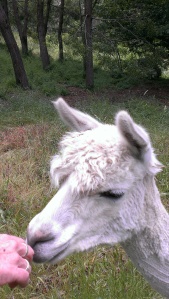
We had a glorious visit to our friends in the hills on the weekend. There were recently shorn alpacas.  In black…

IMAG2929

In white…

IMAG2926

And in cinnamon.  But like the sheep, the brown alpacas were too shy for photos.  There was a woodlot of blackwood trees, and some stumps with very impressive fungi growing on them:

IMAG2932

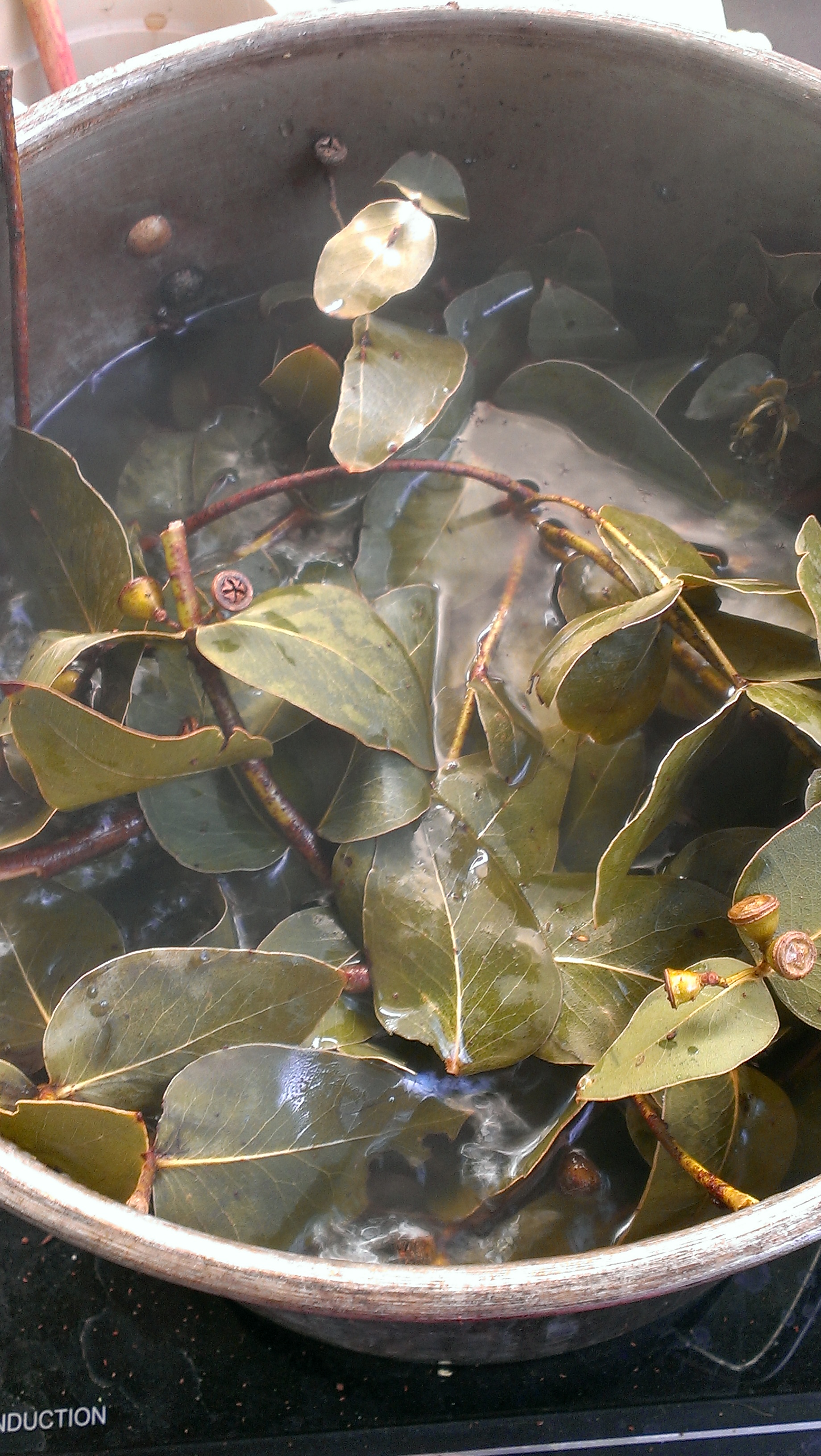
There was a wealth of eucalypts and a knowledgeable community member who knew what many of them were. I brought home E Nicholii leaves (I have not had the chance to greet a fully grown specimen before, let alone a row of them), E Cinerea leaves and some massive juvenile E Globulus leaves.

IMAG2935

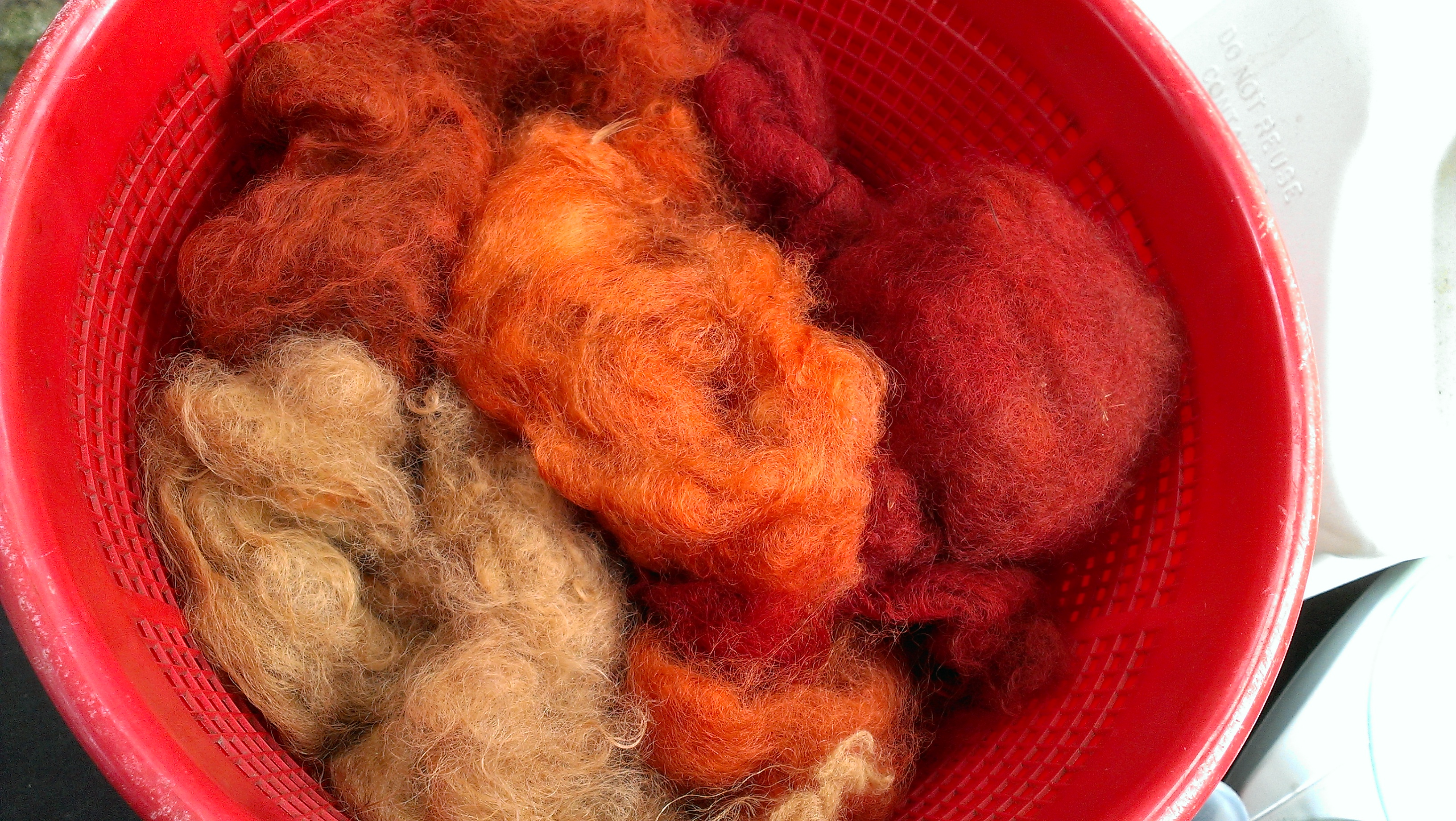
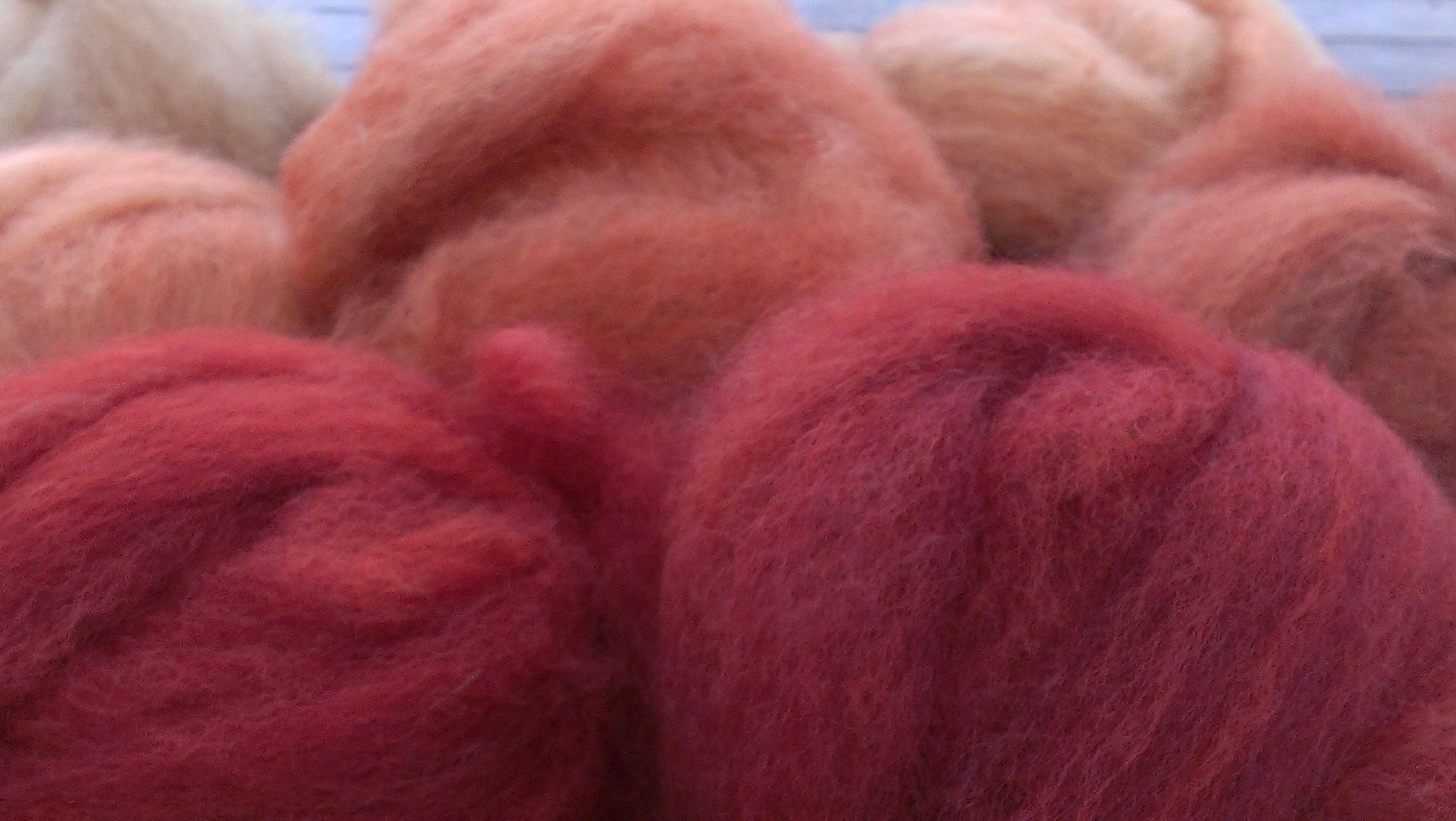
There was fine company, cake and scones and home grown cherries.  Not only that, but koala sightings and visits with rescue joeys (baby kangaroos whose mothers have been killed on the road, being raised by hand with tender loving care).  Such awesomeness!  I took lots of handspun yarn and left quite a bit behind where creative minds were whirling with plans and fingers were itching to get knitting… but there was bad news too.  I got to meet with the people who hand raised the corriedale whose fleece I have been working with most recently, from a lamb.  And sadly, poor Malcolm had recently and unexpectedly died, just before the shearer was due to visit.  We paused on Malcolm’s grave.  So it was special to have taken yarns made from Malcolm’s fleece to share… and I still have some, plus fleece that I dyed with eucalypts last week (it is E Scoparia bark peeling season) …

IMAG2936


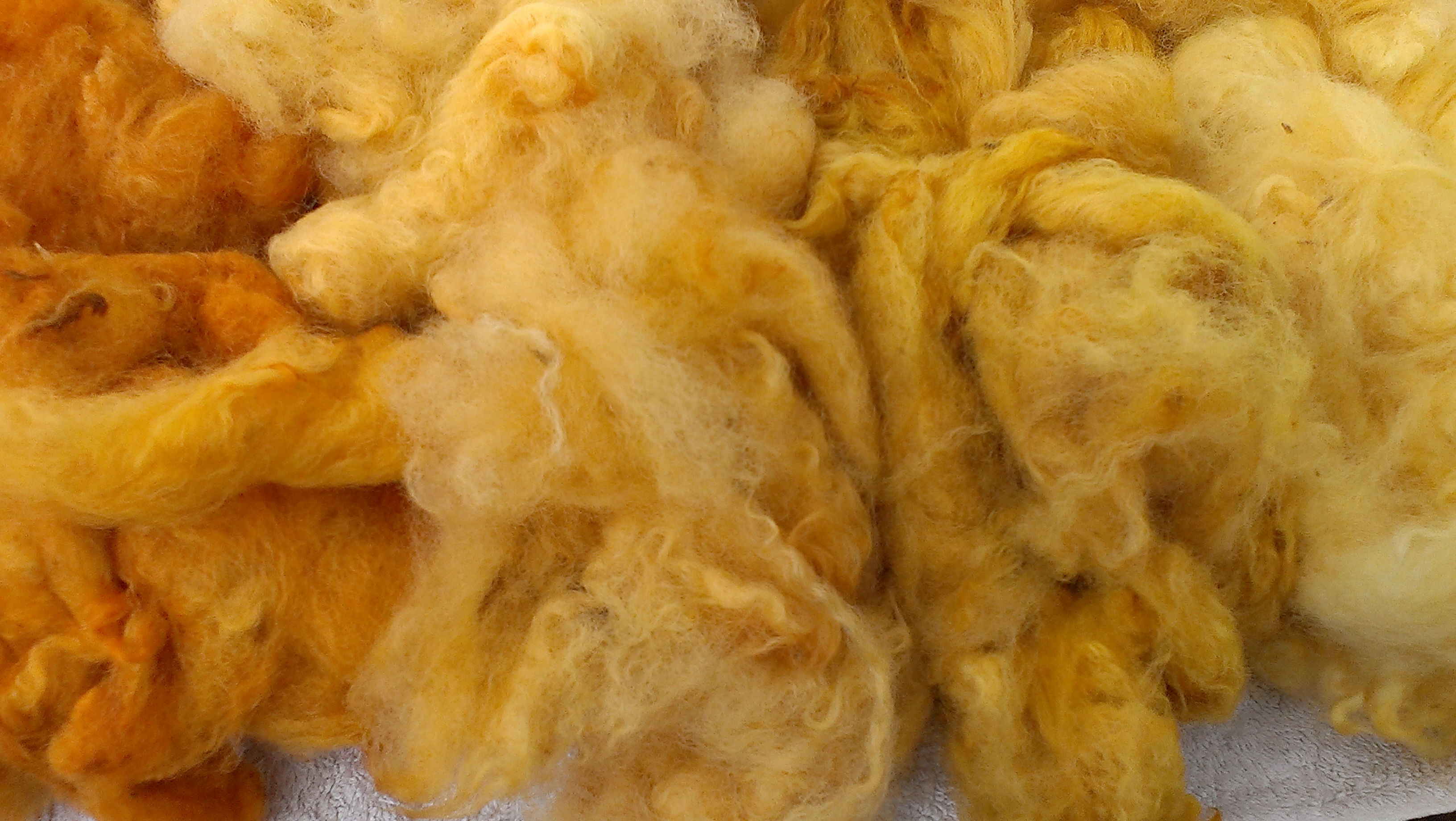
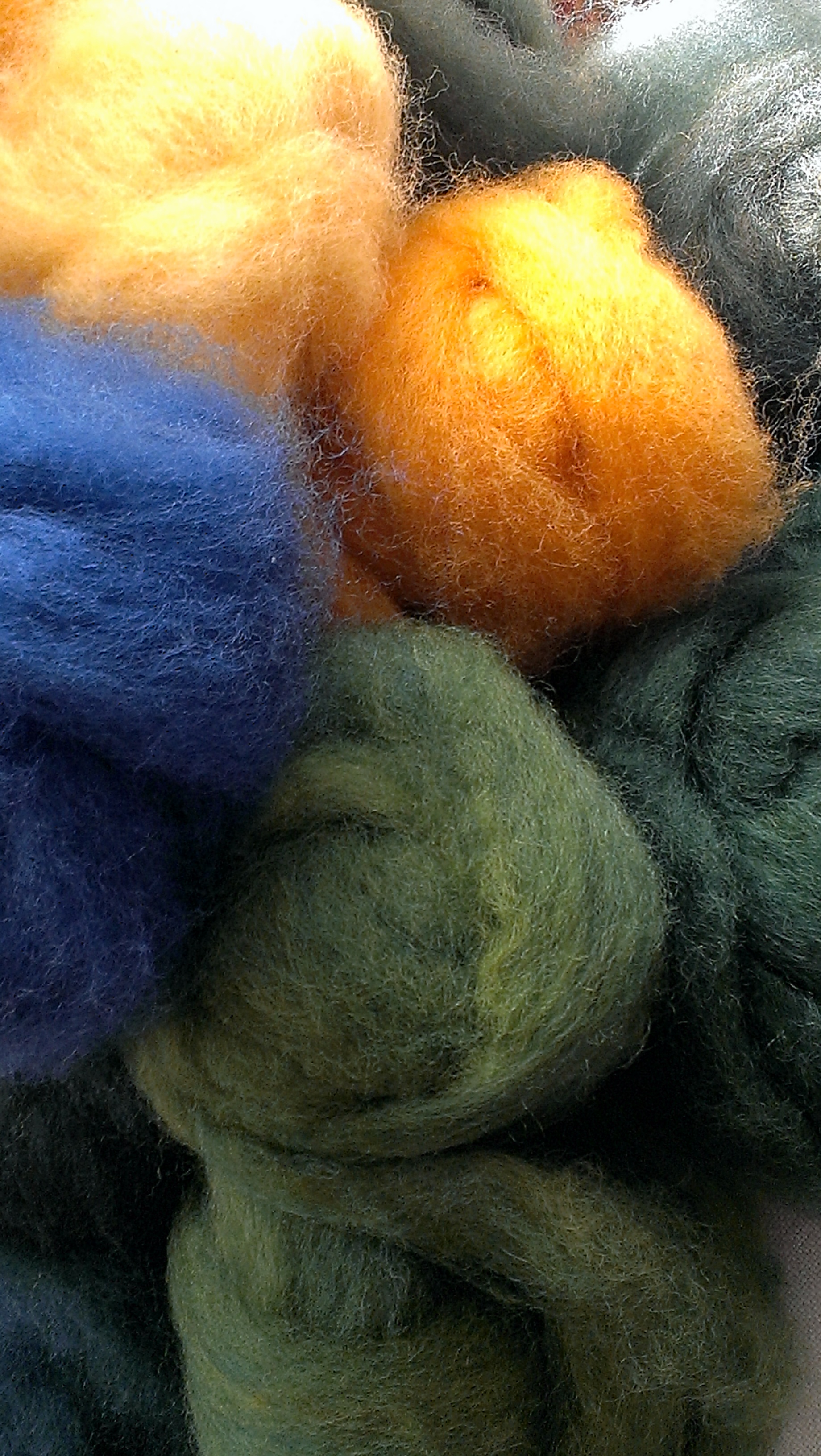
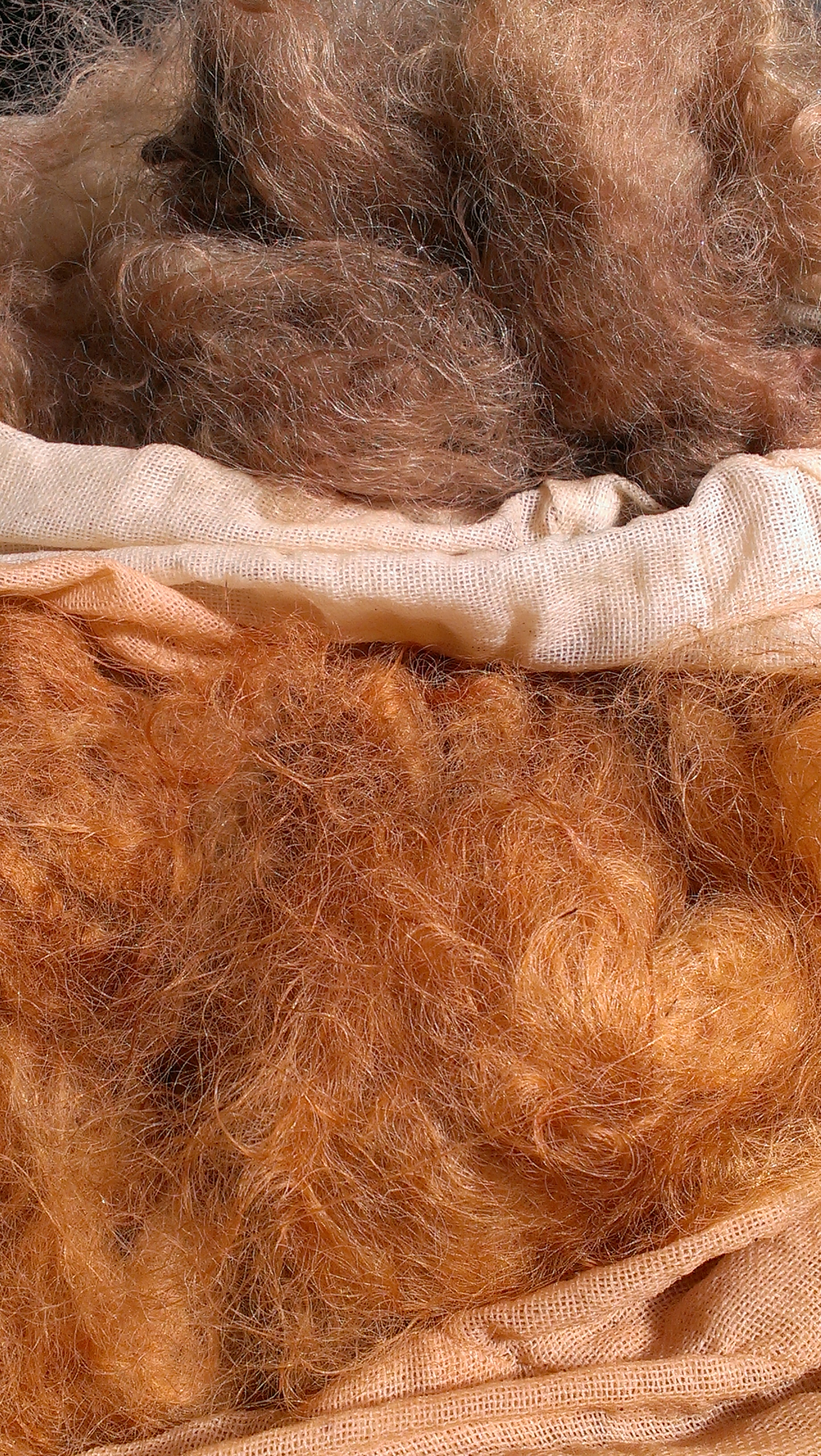
And fleece that is prepared and ready to spin, from my recent coreopsis–osage orange–indigo dyeing season.  So… although I never did get to meet Malcolm, it’s conceivable I’ve spent more hours with my hands in his fleece than anyone…
IMAG2939

And I now have 5 alpaca fleeces and one from Lentil the sheep to think about and share around, such is the generosity of our friends!
7 Comments

Filed under Dye Plants, Eucalypts, Fibre preparation, Natural dyeing, Spinning

Eucalyptus dyed gradient yarns

Some time ago I blogged about dyeing with windfall eucalyptus leaves. I had been dyeing over white corriedale and had quite a range of colours in the range of ochre and caramel through flame orange and… opinions differ about whether that really is red. Here it is, wet from dyeing and ready to be rinsed:

IMAG2316

I divided my fleece up into colour groupings, carded it and pulled a roving straight from the carder drum with a diz.  What a great technique.  You can find it on YouTube, but it was watching a friend from the Guild demonstrate it that really convinced me to try it out.  This Youtube video has an explanation of the same simple homemade diz my friend has made, so maybe she was inspired by that video.  Here are my rovings.  Creating these made me feel like I have learned a few things about fleece preparation.

IMAG2392

Then I created bumps of roving with segments of each colour, lined up to create a gradient from ochre through to reddish. Then, there was spinning and plying and skeining and washing–spinning being a craft of many stages–and now…

wpid-IMAG2742.jpg

I am so happy with this yarn! I can’t wait to share it with the friends whose sheep this wool came from.  Coincidentally, the week I finished this yarn, they invited me to their place for shearing time.

wpid-IMAG2750.jpg

16 Comments

Filed under Eucalypts, Fibre preparation, Natural dyeing, Spinning

Silkworms: 7 week update + more wild textured spinning

Well, here are the late bloomers. Yes, only 5 left.

IMAG2607

Everyone else is in here now in another form…

IMAG2608

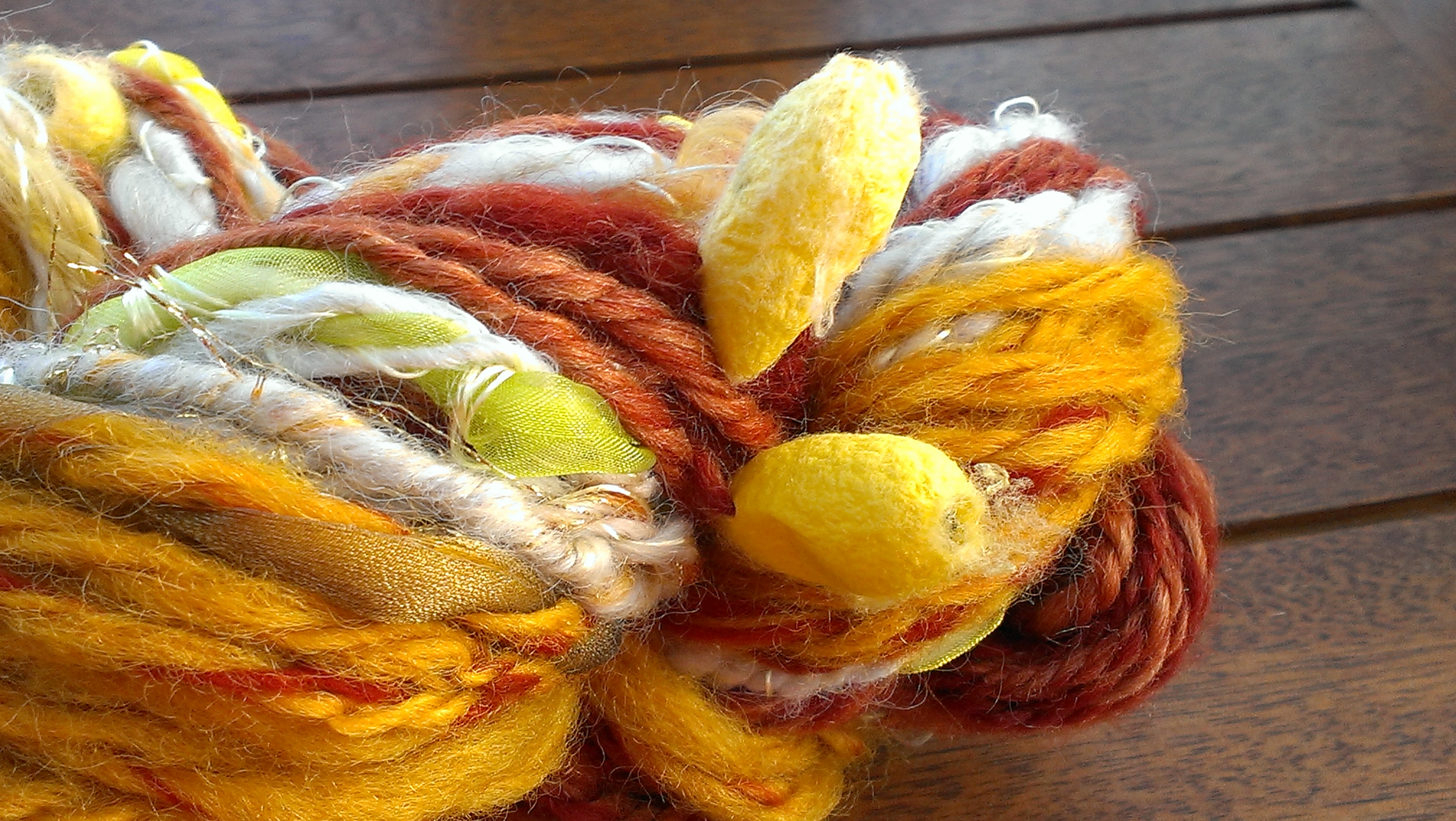
And meanwhile I decided to try a spinning challenge set up on Ravelry… a yarn generator based on a date system.  What genius on the part of its originator! Sounded like fun to me… I put in the date for my birthday and that meant creating a yarn that incorporated autowrapping (see that rayon thread over the white section?), metallic elements (there are strange and peculiar glitter pompoms from the op shop as well as sparkly gold fibre and gold recycled ribbon)…

IMAG2609

Yellow is required too, so there is some of the coreopsis dyed corriedale, some yellow preloved ribbon (there has to be fabric spinning too), and last year’s silk cocoons…

IMAG2610

Then there is chain plying and the ever present eucalyptus dyed merino… and one mighty strange yarn overall!

IMAG2611

4 Comments

Filed under Fibre preparation, Spinning

Eucalyptus dyes over grey corriedale: The spinning finale

I have a bit of a tendency to go a long way toward the completion of a big project and then pause near the end.  Sometimes for a little while, sometimes for a long while.  So here, finally, is the very last of the grey corriedale I dyed months ago and planned to spin during the Tour de Fleece. I loved the two ply yarn I created during the Tour a good bit less than my initial chain plied skein, even though it is what I need if I ever knit that cardigan I dream of.

I found the label for this fleece on the weekend and I started out with 3.5 kg of fleece.  I made a true three ply yarn (three singles plied together) from most of the last part…

IMAG2559

And chain plied the rest (one single plied on itself in a chain).  I think the long pause on this was caused by the way my heart sank when I stopped chain plying it in the first place.  I love the distinct colours in the last little leftover skein!   IMAG2562

I also spun up a little batt of alpaca dyed in eucalyptus.

IMAG2382


Three ply wins again!

IMAG2563

Leave a comment

Filed under Eucalypts, Fibre preparation, Natural dyeing, Spinning

Yellows from coreopsis flowers and osage orange

I have decided to branch out from the eucalyptus based palette of ochre–caramel–tan–orange–red–maroon I have been so focused on for the last while and plan toward an indigo vat.  Don’t you love these bold statements?

I still love the eucalypt colours: here, a small quantity of alpaca passing through various stages of preparation.  Picked, dyed locks;

IMAG2377

Partially carded batt;

IMAG2379

and, finally, yarn–pictured in the dyer’s chamomile patch.

IMAG2428

I have decided to try for yellow–green–blue transitions, which will necessarily begin with yellow.  I had coreopsis flowers my mother saved me one summer, as she deadheaded her plants. This collection of flower heads speak to me of her love and her fine qualities as a gardener and a person who loves to share.  I had reservations about the colour I would get from them, as some had gone mouldy.  Her -plants are just so prolific–the stack of wilted heads had trapped enough moisture to create mould.

IMAG2370

I also had a little remaining quantity of osage orange shavings of antiquity, gifted to me from the Guild.

IMAG2371

I prepared them both for the dyebath, but have to say my tea ball was not a good enough receptacle to retain the osage orange.  I not only sieved the dye vat before adding wool (thank goodness I remembered to do this as I tackled it one night when the amount of sawdust in the vat was not as obvious as in the clear light of day) but also placed the whole tea ball in another fine cloth bag before running an exhaust bath.

IMAG2372

Even after the first bath of each dye, there was a lot of colour left, so I ran an exhaust bath and dyed a total of about 800g of white corriedale.  I was especially impressed with the amount of colour and the wonderful smell of the coreopsis bath.  I need not have worried about the mould.  Here is the coreopsis bath between dyeings.

IMAG2383

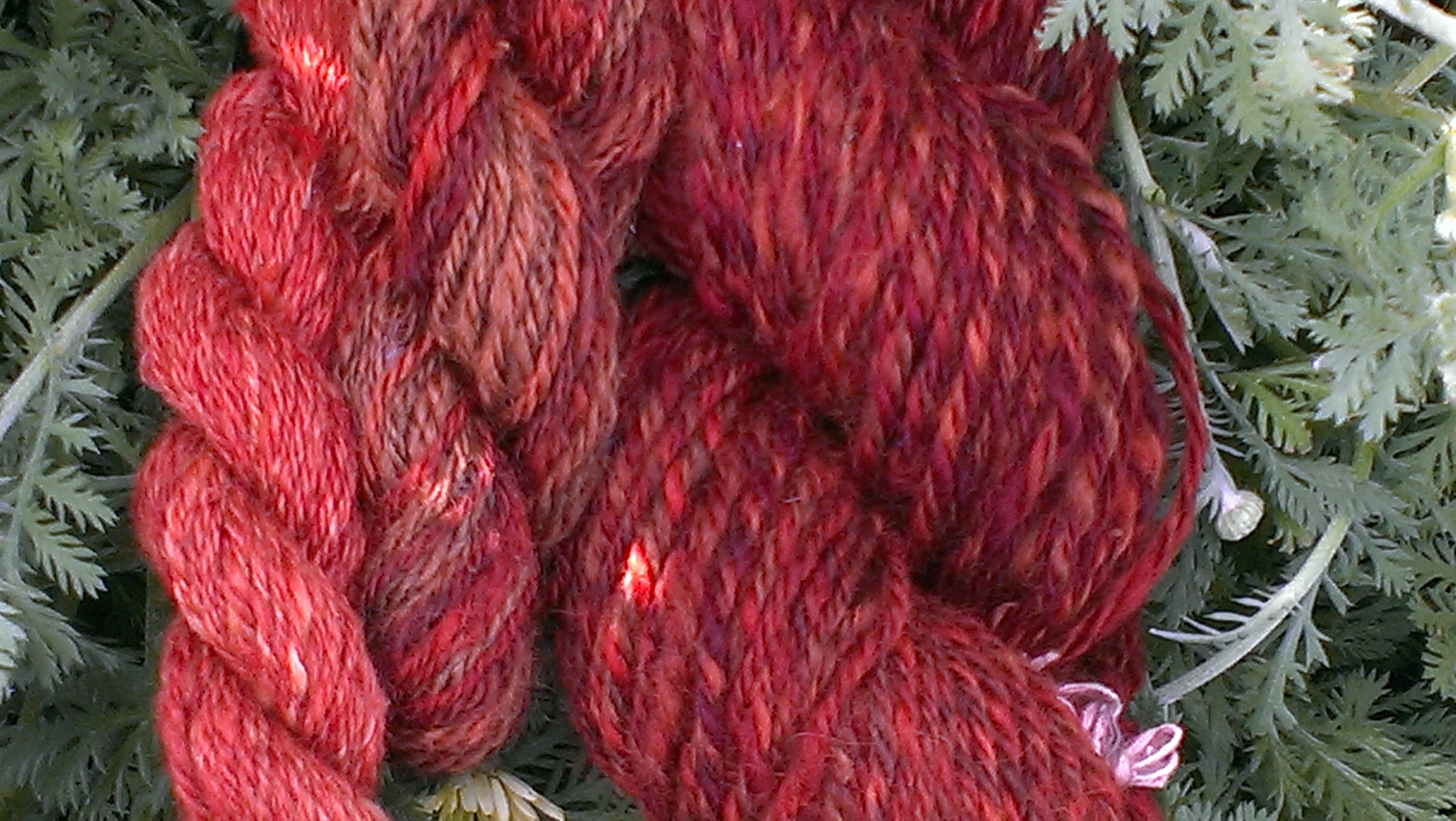
The resulting yellows are lovely.  On the left, coreopsis bath 1, then coreopsis bath 2, osage orange bath 1 and osage orange bath 2.  The coreopsis yellows are quite buttery and golden and the osage orange colours are a little more lemony.  And, there is further evidence that grass seeds and other vegetable matter take dyes quite well!  Now, to build up my courage for the indigo stage and some greens and blues.

IMAG2453

10 Comments

Filed under Dye Plants, Eucalypts, Fibre preparation, Natural dyeing

Just in time for summer!

Sometimes people ask me how I manage to fit so many things in… but I am not sure they are really keeping track of how long a project might take me from start to finish!  Many craft projects at my place involve large numbers of tiny steps.  Sometimes it is the nature of the crafts involved and sometimes it’s the only way I can figure out to make things happen.  So projects progress slowly at times, as whim, interest, the right weather, or the availability of time permit.  Today I can report that a couple of items reached the out spout.

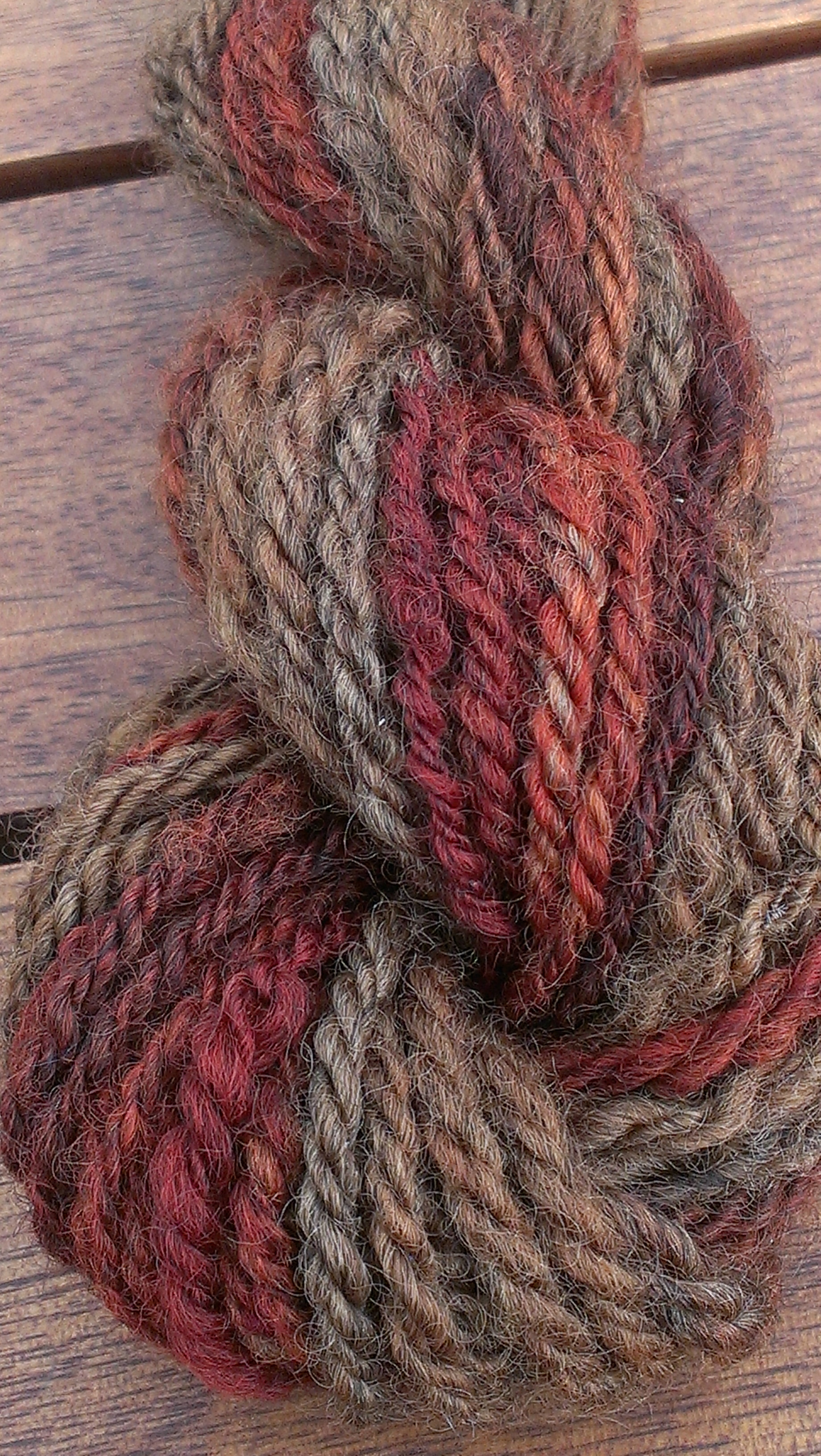
The eucalyptus dyed grey corriedale which started here and continued here has finally come to an end, with every last bit now converted to yarn.  The middle skein is chain-plied (and to be honest, I really do prefer this yarn over the one I have created for my cardigan) and the one at the bottom is a true 3 ply.  Some of this yarn is destined to become a cardigan, but it will not be for winter 2013, which is over now for us here in Australia.

IMAG2430

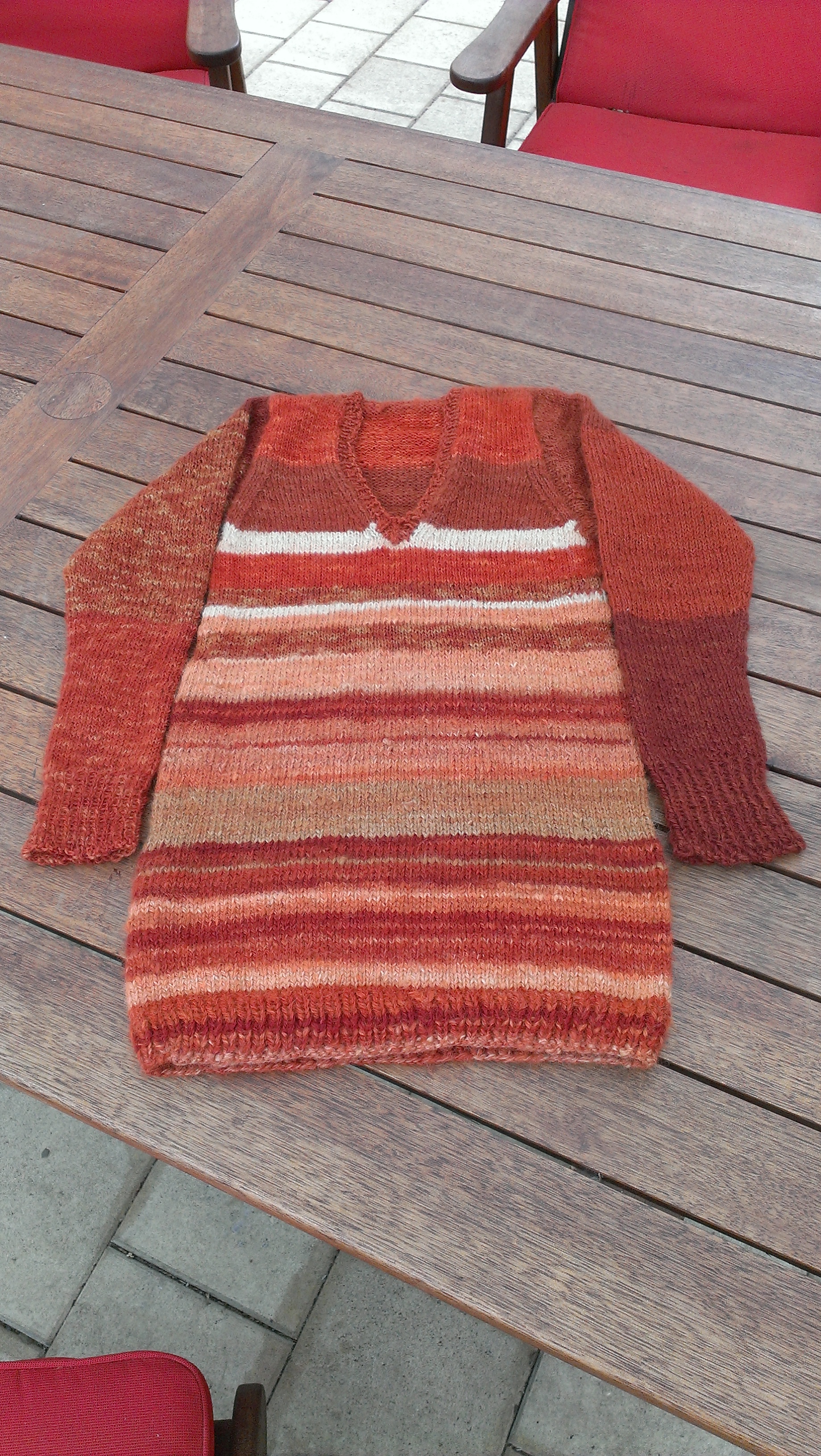
I have also finally finished making a jumper for my fairy godson. He is a tall and slender individual (just in case you’re wondering if the proportions are right), and if he’s lucky there will be one or two days cold enough to wear this jumper before winter 2014.  I hope it will still fit him then!  It was slowed down by misjudgment of the amount of yarn needed, and thus several stages of dyeing and spinning as knitting progressed, breaking all the rules of good handspun-handknit practise.  It is 3 ply eucalyptus dyed alpaca in 4ply/fingering weight.

IMAG2456

Here it is, tied up with handmade string crafted from the leaves of our daylily.  When it was raining this morning I decided to steam press it and just take it over on my way to work in hopes it might be cold enough to wear it, and was lucky enough to catch my friends at home.  It never fails to gladden my heart to give a gift that is really warmly welcomed… but it is an additional exquisite pleasure to find the handmade string to be just about as exciting as the jumper to its recipient.  It fills life with pleasure to find folk who feel just as intrigued by string from the backyard as  you do, and just as curious about how it could be made.

IMAG2460 (1)

Someone who works in the same hallway as me exclaimed over my looking happy at work on a Monday, just as I walked in this morning… and may not have understood if I’d said it was all about late but welcome presents and homemade string and love.  Sometimes you have to be there.

8 Comments

Filed under Eucalypts, Knitting, Natural dyeing, Neighbourhood pleasures, Spinning

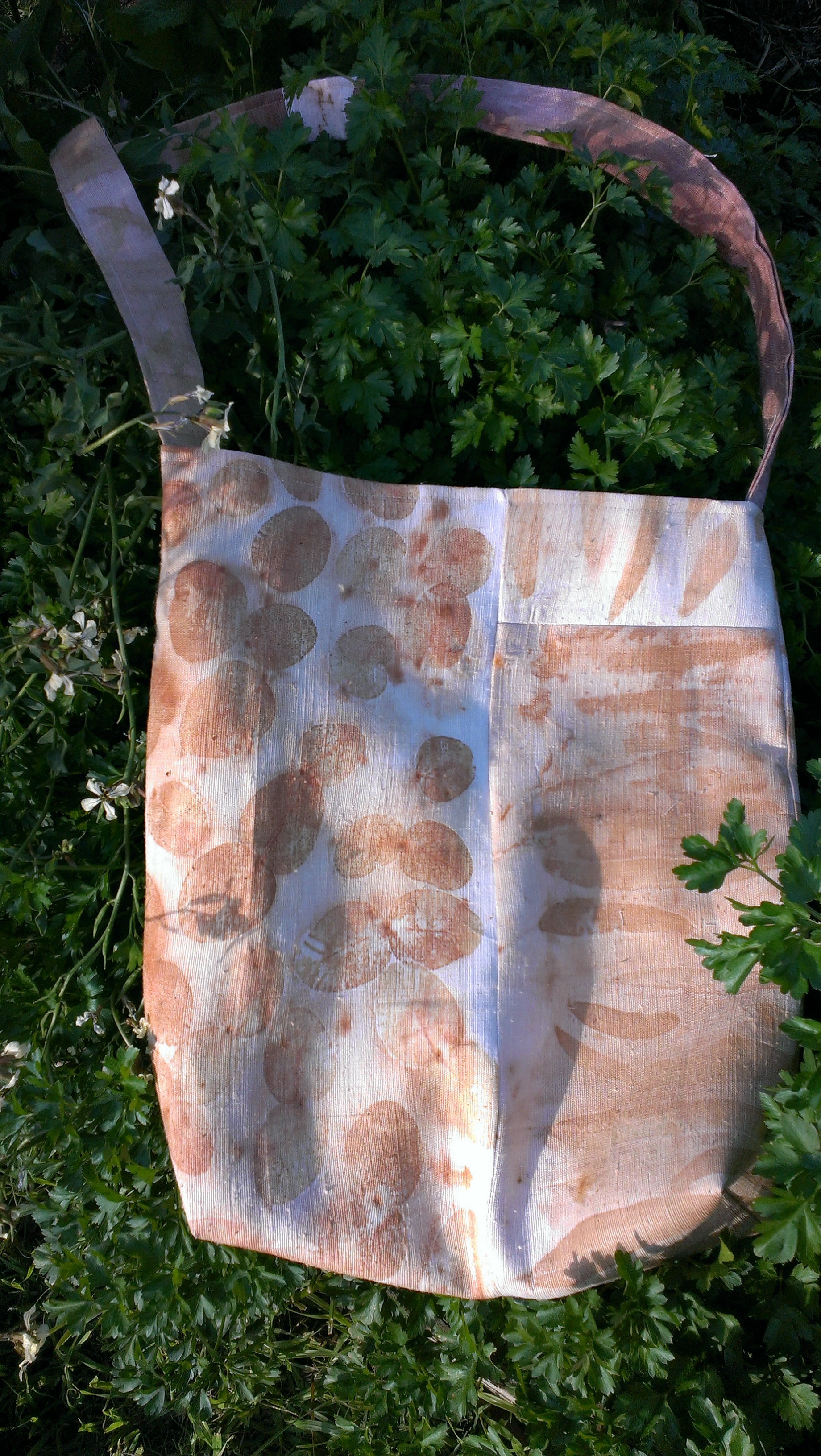
Leaf print bags

IMAG2211

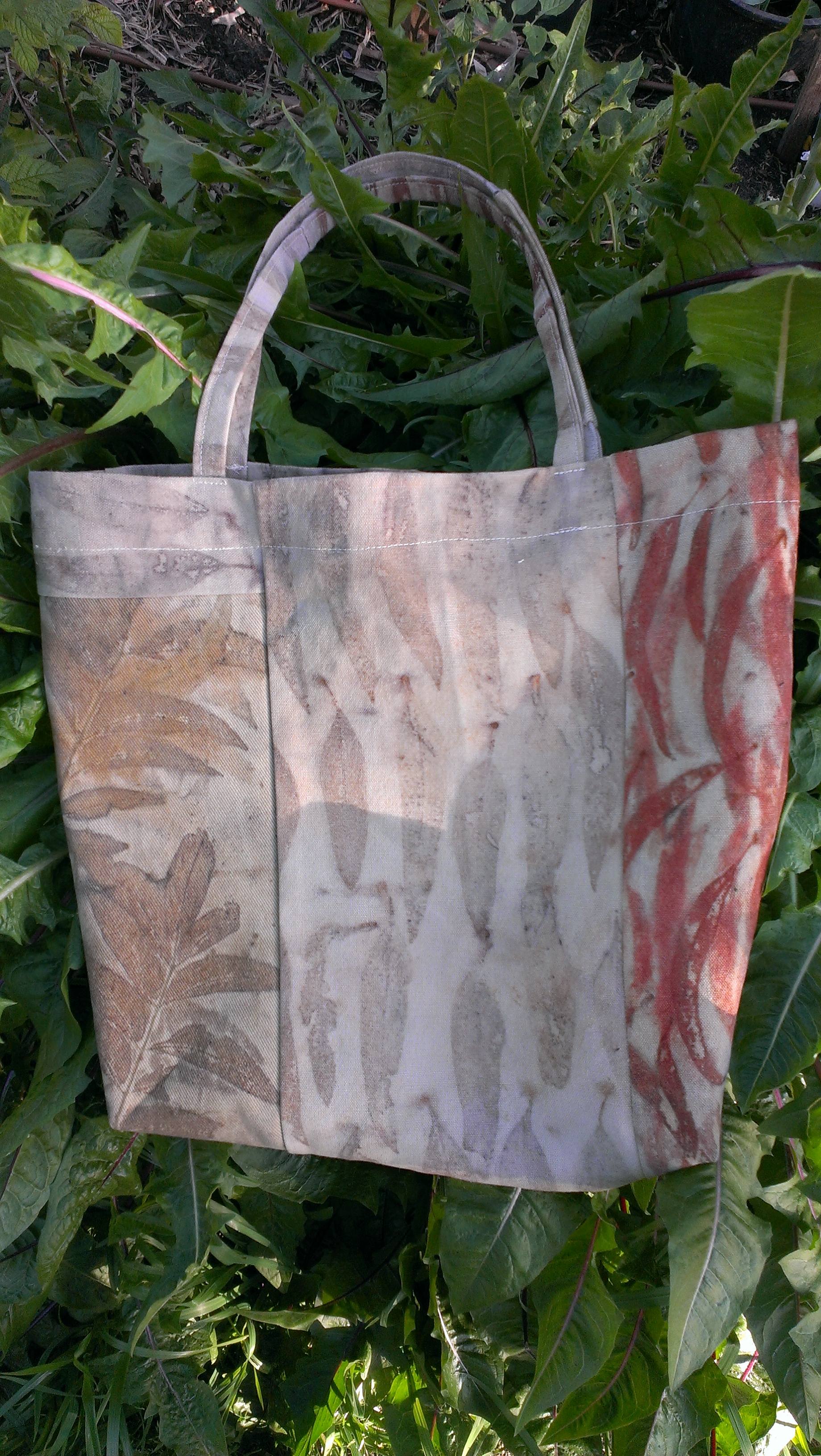
The bag making has been continuing.  This is a simple, unlined bag made from recycled heavyweight garment fabrics–parts of an old pair of hemp shorts and some recycled men’s cotton twill trousers.  Last year I went to a huge Red Cross sale where entire secondhand garments were $1 or $2.  I acquired all kinds of stained and/or worn pale coloured garments which I have been transforming.

IMAG2202

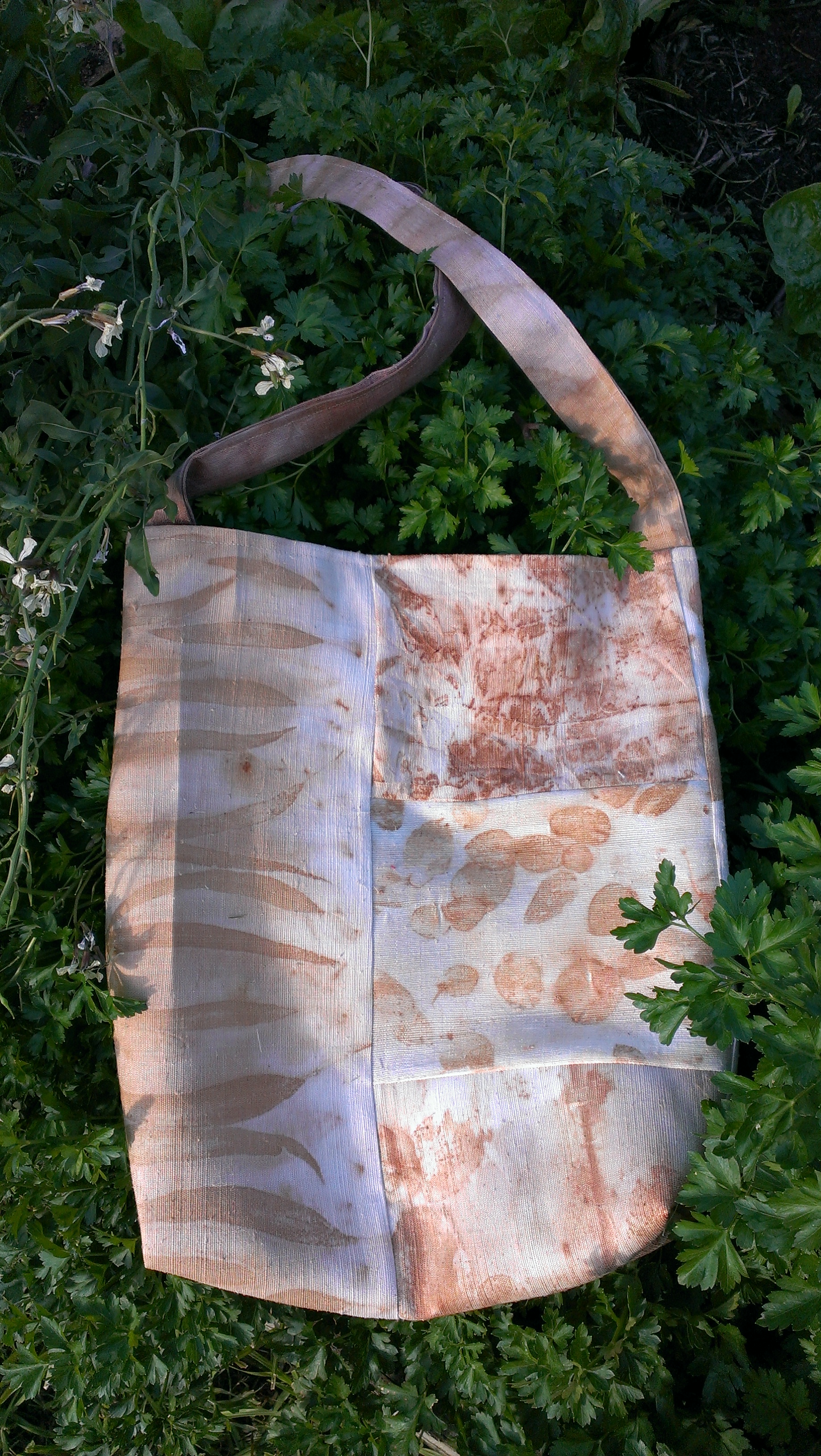
This, on the other hand, is a lined bag made of silk.  When I first bought and read India Flint’s Eco-Colour, I was immediately inspired and keen to try out her ideas and techniques, but finding silk and wool fabrics was quite a challenge.  I had been dyeing sheep fleece and woolen yarns.  I started out eco-printing with some fine gauzy silk and that was exciting enough to keep me going, though I was less than clear about how I could use it.  Then I found a length of Thai silk clearly purchased in Thailand and brought home to Australia which had somehow found its way to an op shop I like to comb through.  Many experiments followed, and they have been sitting rolled up in the sewing room for years now.

IMAG2201

The darker colour on some sections is red wine.  The splotchy random pattern–clearly not a leaf–on one piece really had me puzzled until I ironed it.  The smell was a giveaway.  Ah!  Onion skins!  That is what you can see on the top right of this bag.
IMAG2199

And the other side (with red wine on the strap)…

IMAG2198

I have constructed the linings from samples and less successful printing efforts on cottons…

IMAG2204

It’s very satisfying finally to put these samples to use.

4 Comments

Filed under Eucalypts, Leaf prints, Sewing

Neighbourhood windfalls 1

We’ve had gale force winds here lately.  One morning about a week ago, 40% of my city had no power when we woke up (we were happily still connected to the grid).  Needless to say, this has led to windfalls, and I was still collecting them yesterday as further gale force winds began a week later.

The first windfall was an ironbark.  Guessing from its location (a stand of three ironbarks) and the gumnuts still intact, I think it is E Tricarpa. Sadly, just as unremarkable as a dye plant, as the last time I tried!

IMAG2302IMAG2304

I have not managed to identify this tree, partly because it branches metres above ground level.  Even with so much of its canopy on the ground, I didn’t find a single bud, flower or fruit to help me identify it.  The trunk is rough and pale. The whole tree is difficult to capture in a photo, especially on such a gloomy day.  It must be at least 20 metres tall.

IMAG2335IMAG2336

It seems to be under attack from some kind of scale insect.  Every single leaf was affected. Here it is after some hours in hot water–suggestive of a beige outcome….

IMAG2309IMAG2349

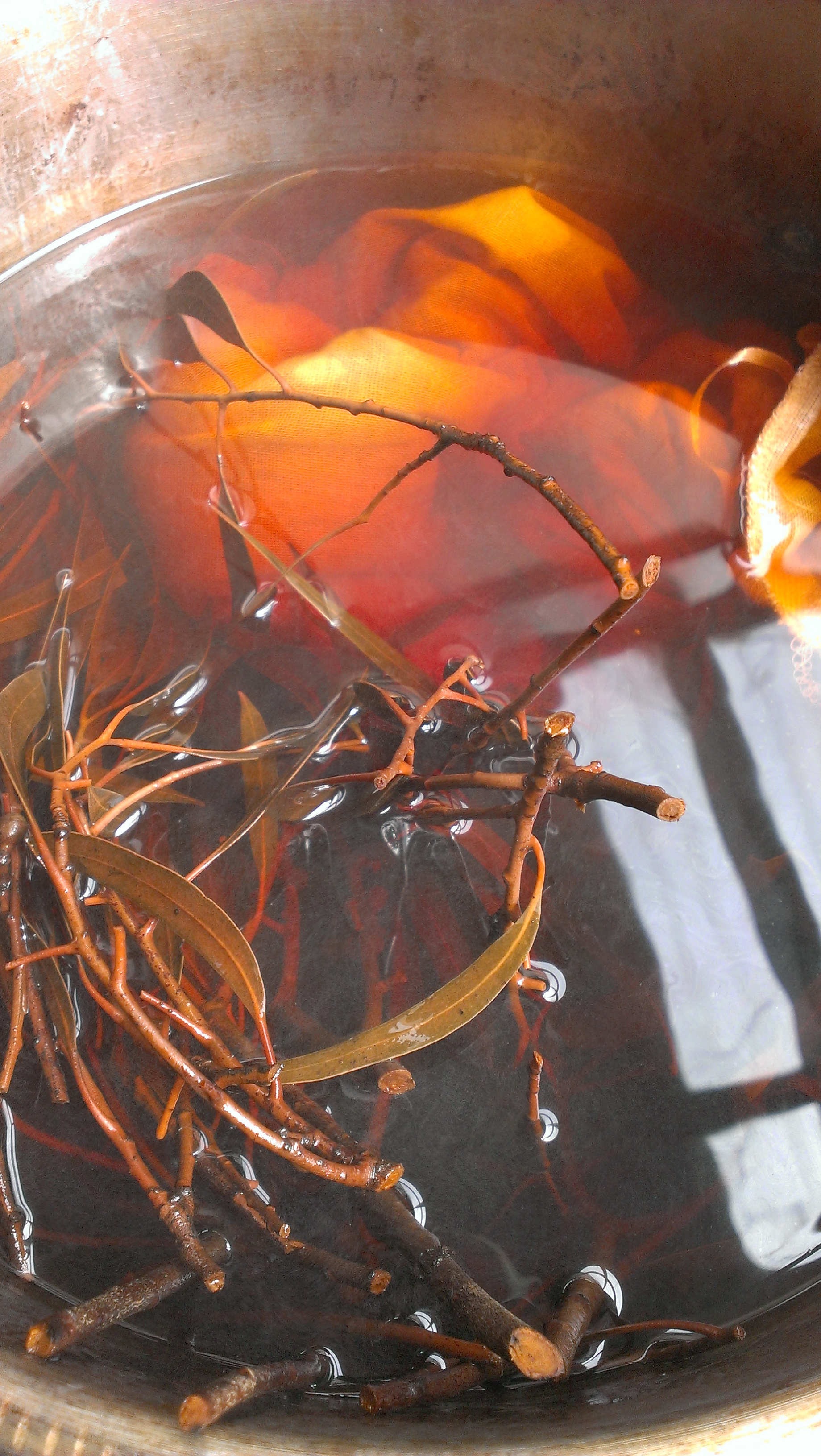
Compare my third windfall.  This is a tree that has been cut to accommodate cars parking beside it, in the car park of a recreation area.  I haven’t been sure whether it was E Scoparia, E Camaldulensis, or some other unknown eucalypt.  Both E Scoparia and E Camaldulensis have similar shaped and sized leaves, small fruit and both can have pale, smooth trunks (but this trunk looks more E Camaldulensis to my admittedly self-trained eye).  The branch that fell to the ground had an uncharacteristically large number of fruit on it for E Scoparia.  On the other hand, the clusters of seven fruit with 3 valves apiece made me think it might be E Scoparia after all.  So did the colour of the dye bath, though the leaves did not turn orange the way E Scoparia usually does.

In spite of the colour of that dye bath, the result says that this is not E Scoparia, and the 3 valves say that it isn’t E Camaldulensis either (4 valves).  Even with vinegar to help bring out whatever orange or red might be there to be had, and still damp from the dyebath… the 3 valved tree is at the top (brown-beige?) and the 20 metre tall tree is at the bottom (caramel-beige).

IMAG2350IMAG2351

Here are the results of a bath with a fallen branch from an actual E Scoparia, downed in the same windy night.  They’re the red and orange samples, with the E Tricarpa for contrast.

IMAG2316

13 Comments

Filed under Dye Plants, Eucalypts, Natural dyeing

A pair of backyard Eucalypts…

Recently I discovered that a friend who has one of the biggest E Cinerea trees I have ever seen in her back yard would like some of it removed.  I offered to cut and take away the dead and insect affected parts, to her surprise, and have now made three visits to do just that. I’ve begun some dye pots with alpaca another friend has asked me to dye.

IMAG2075

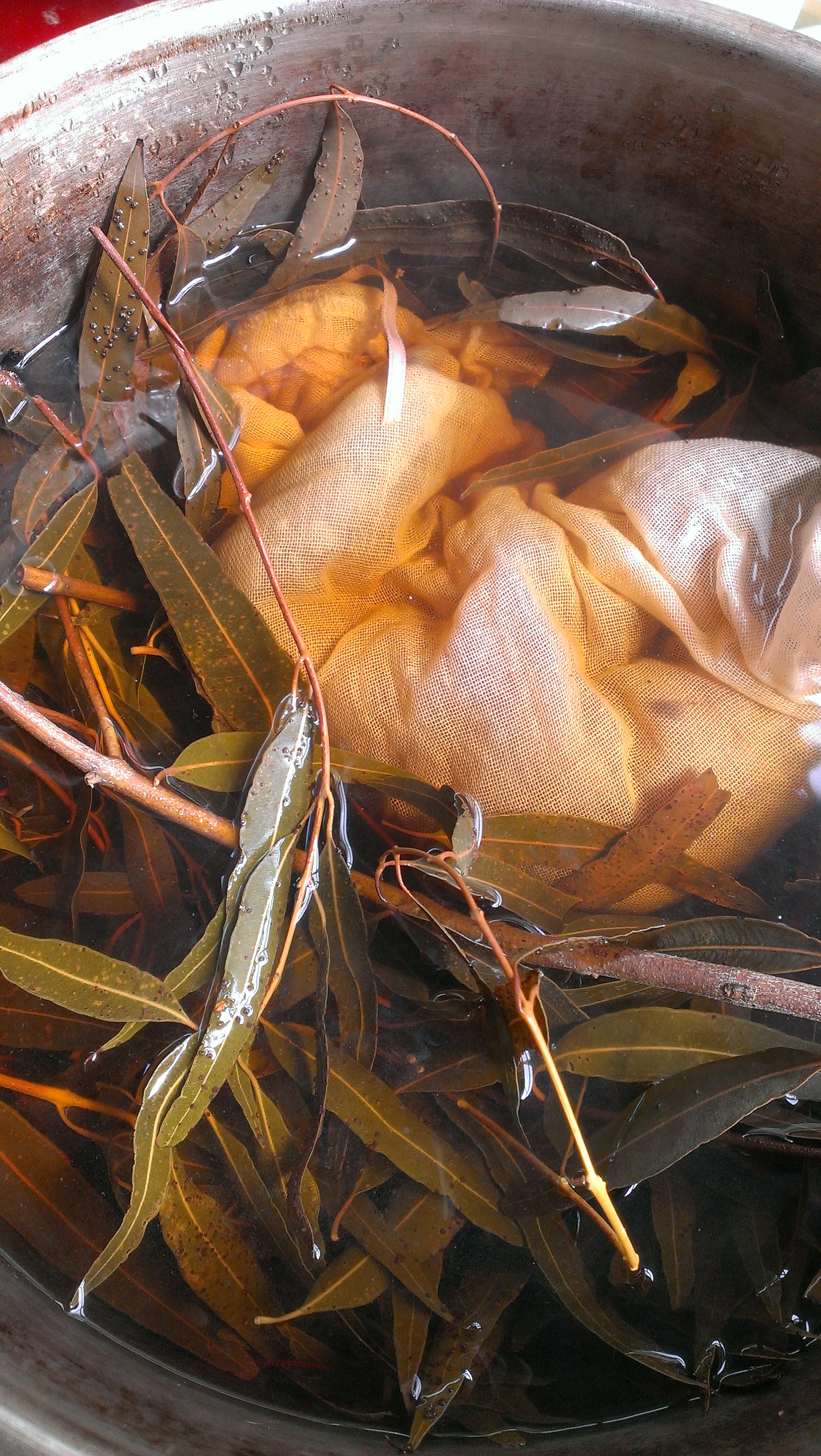
On the second visit to trim the E Cinerea, my friend’s partner spoke about the loss of a bough on their other eucalypt.  I looked closely at this second very large tree with rough, fibrous bark on the trunk and very narrow leaves and ‘Eucalyptus Nicholii’ went through my head.  Could I at last have found a fully grown specimen?  It branched so high and the ground had been so thoroughly cleared in the effort to remove all the fallen material that I couldn’t find fruit.  I did manage enough leaves for a dye pot however… and it is very promising! I heated the leaves for an hour, dropped the sample card in and went for a bike ride leaving the heat off.  When I got back:

IMAG2078

As I write I have added some alpaca fleece.  I will have to wait to make a more definitive identification… I have sometimes found that all the hours I’ve spent with books on Eucalypts have created the context for me to have a correct intuition about a particular tree.  Equally often, though–I have completely the wrong end of the stick!  But the alpaca is looking good as it sits draining…

IMAG2101

8 Comments

Filed under Dye Plants, Eucalypts, Natural dyeing

Intriguing trees…

I returned today to two trees I have sampled a little that are growing on my favourite running track.  We rode our bikes down it, so I took pictures (and some more leaves, needless to say!)

IMAG2069 IMAG2073

Into the dye pot they went, with a sample card.

IMAG2100

Since I have two burners, I also ran a pot from leaves I collected when we went planting native trees on a friend’s farm.  It looked like E Cinerea to me… but an enormous tree, growing where there is so much more water than in the city where we live.

IMAG2099

The dye pot confirms that the E Cinerea gives great colour.  And the mystery trees gave  rusty orange with some tan undertones on handspun wool with no mordant, and brown on alum mordanted superwash.  Even more intriguing, really!

2 Comments

Filed under Dye Plants, Eucalypts, Natural dyeing