Tag Archives: orange again

Another workshop done!

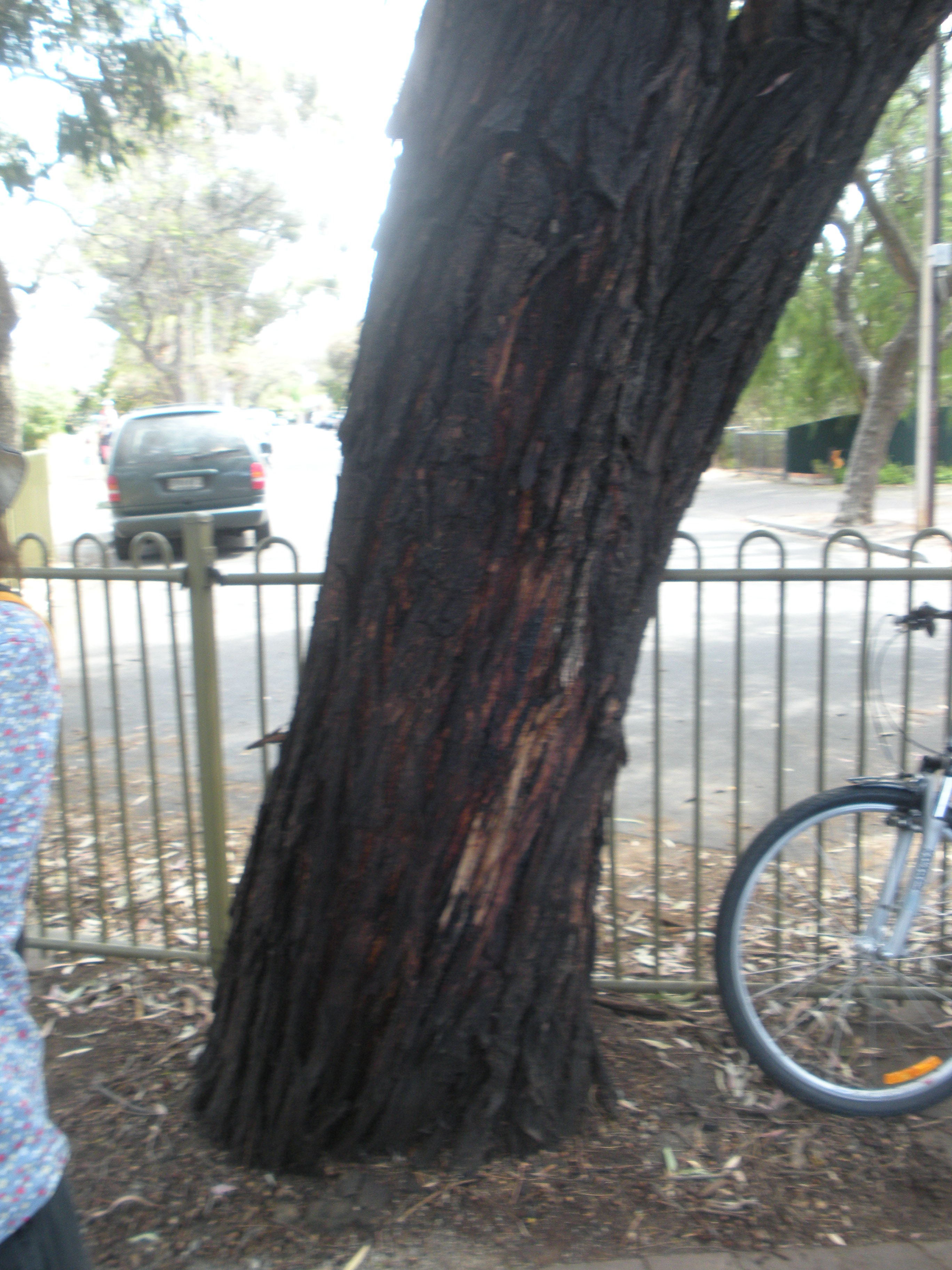
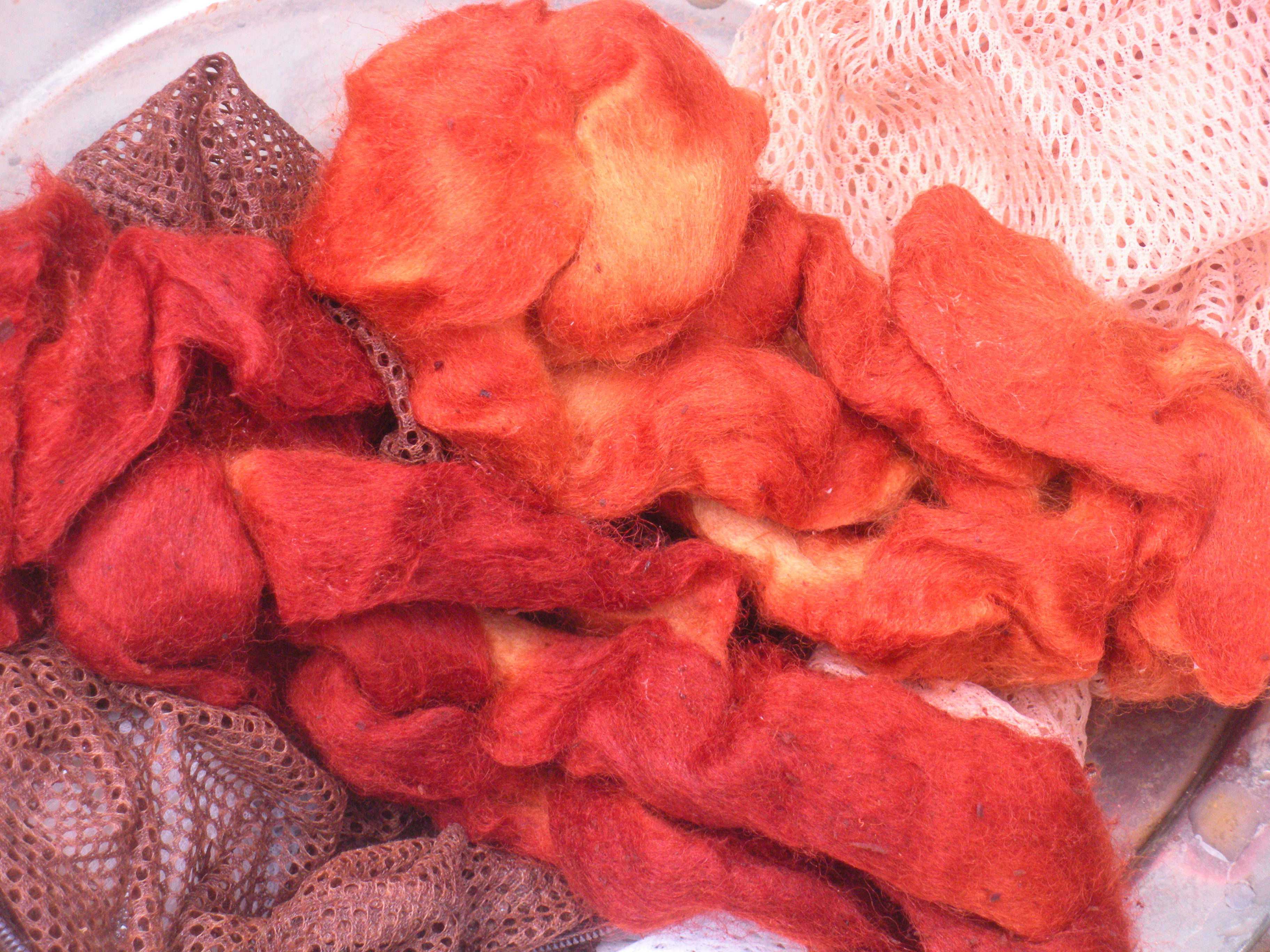
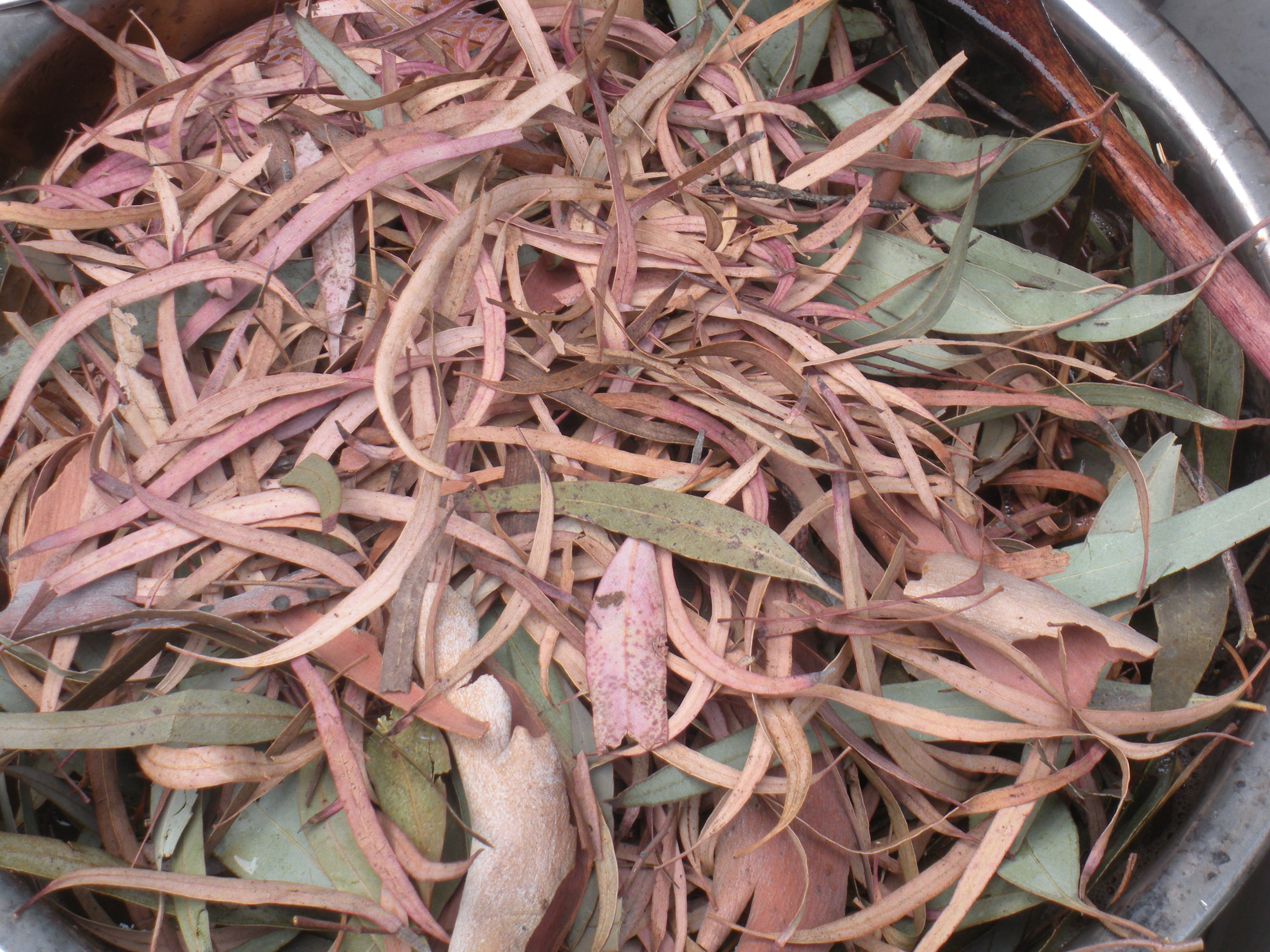
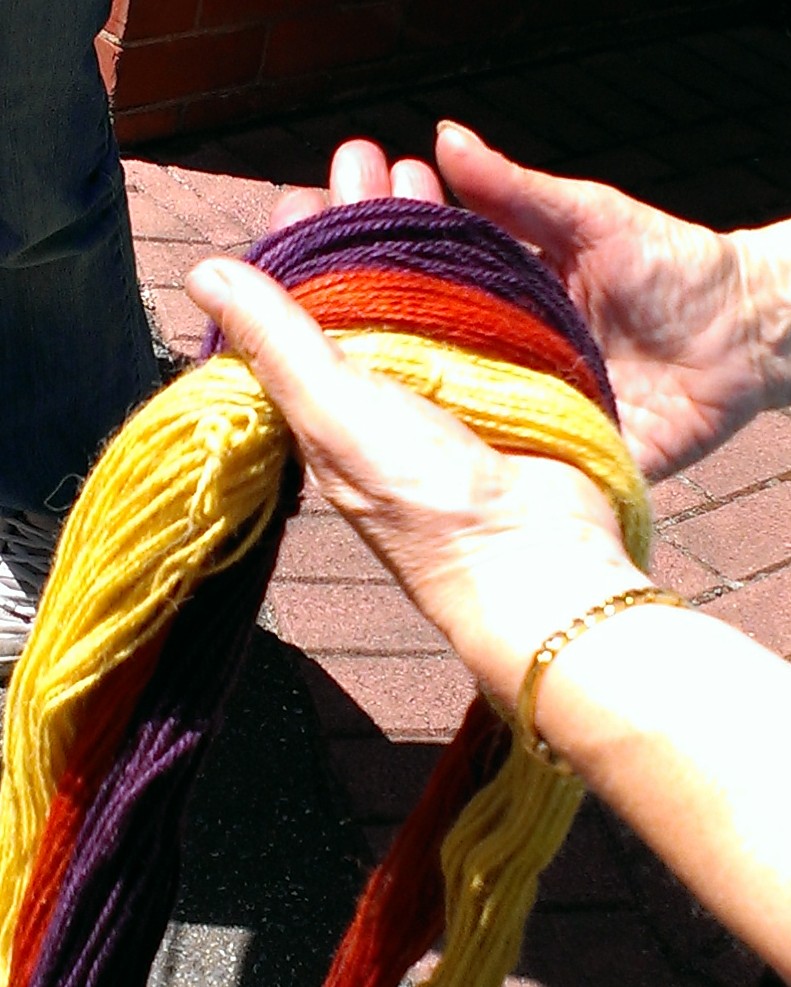
The second in my little series of workshops at the Guild went really well. There was yarn, fleece and roving dyeing.  Brown, orange, almost-red and maroon from E Scoparia (bark and leaves) and E Cinerea leaves, yellow from silky oak (Grevillea Robusta) using Ida Grae’s recipe from Nature’s Colors: Dyes from Plants, and the ever-astonishing purple from red sanderswood with alum.  I again used Jenny Dean’s method from Wild Colour and still got nothing like the oranges she suggests are likely.
IMAG0896

Mysterious outcomes in natural dyeing are not all that uncommon (at least for me!), as the number of variables is so huge.  But this one is out of the box–purple!?  Since my last post on the subject, Jenny Dean has very generously been in touch with her thoughts on the matter.  She suggests this purple could be the result of alkalinity (but given I made no attempt to generate an alkaline bath, it seems unlikely it was seriously alkaline).

Or–and I agree with her that this is much more likely, even though I used 4 different jars/packs labelled “sanderswood”–perhaps the dyestuff  was never sanderswood to begin with.  The colour is very, very like the logwood results I have had, just about indistinguishable.  I am still not complaining about the result–I love purple and so did the participants.  I was hoping for purple on this occasion, as I have no more logwood–that I know to be logwood.  Perhaps there was a time in the past when a batch of “sanderswood” came to our Guild or a supplier nearby and all the different jars I’ve used ultimately can be traced back to the same mislabelled supply. This would fit with my experience of Eucalypts… it is much more likely that I have misidentified my tree than that the dye bath is giving a completely different colour.  Variation to some extent, however, is completely expected.

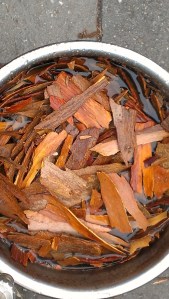
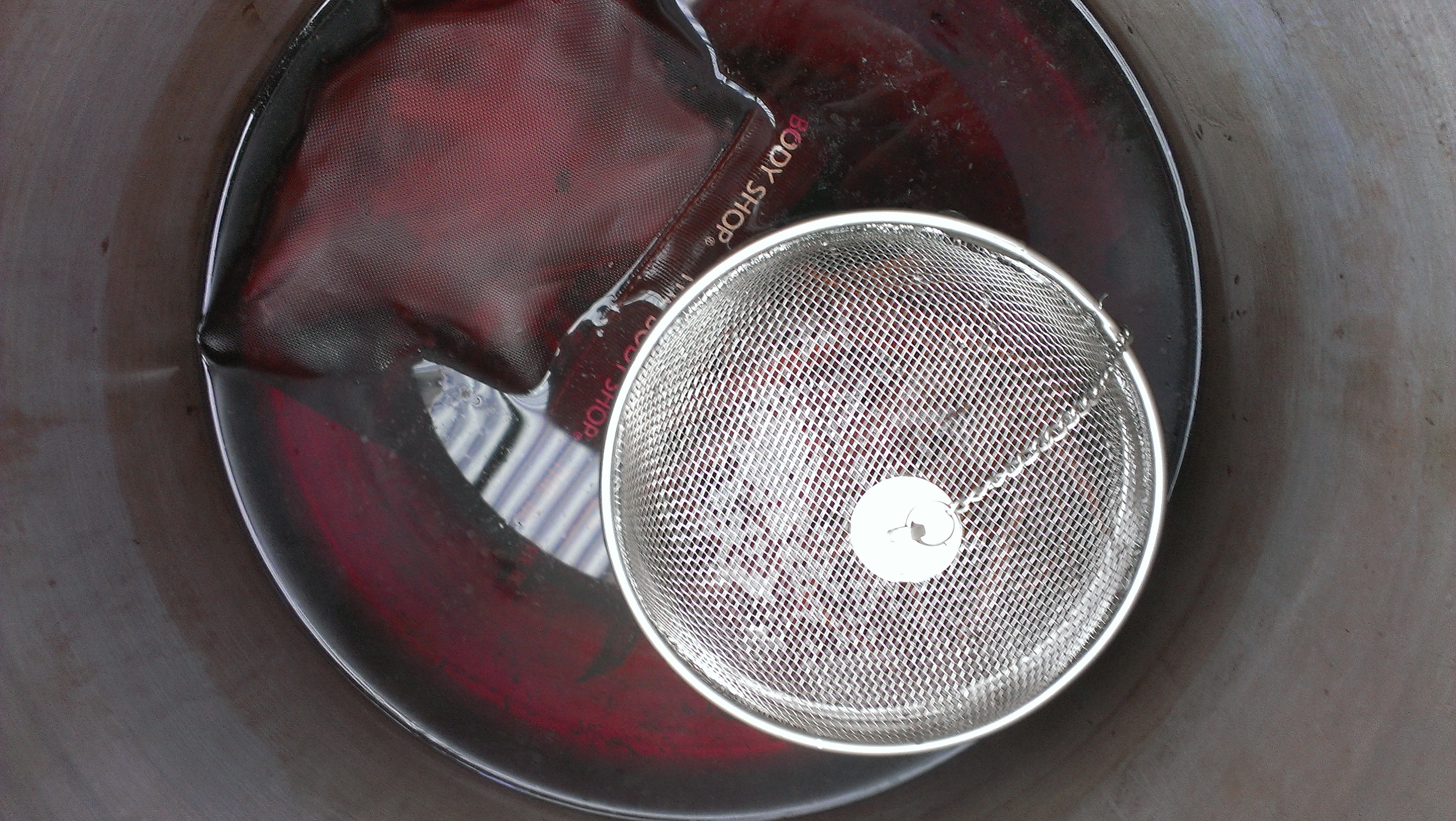
Here is the “sanderswood” just after I poured boiling water over it–Jenny says this looks like a logwood bath to her.  I bow to her much more extensive experience and wisdom, without hesitation.
IMAG0862

I have the biggest chips in a little zippered mesh pouch that must once have held toiletries.  The smallest chips/splinters are in something that looks just like a giant tea ball.  I saw it for sale in a Vietnamese grocery where I was investing in greens, seaweed and soy products and immediately saw its possibilities.  The woman who sold it to me had an eye-popping moment (evidently she hasn’t sold one to an Anglo before), and asked me what I was planning to do with it.  I love those moments in Asian groceries, because once I’ve been ask the question and given my (admittedly bizarre) response, I can ask about the ordinary use of the device or food in question.  This one is usually used to contain whole spices when making a big pot of stock or soup.  This point was helpfully illustrated by a packet of soup seasonings–star anise and cinnamon and coriander seed were some of the spices I could identify right away.

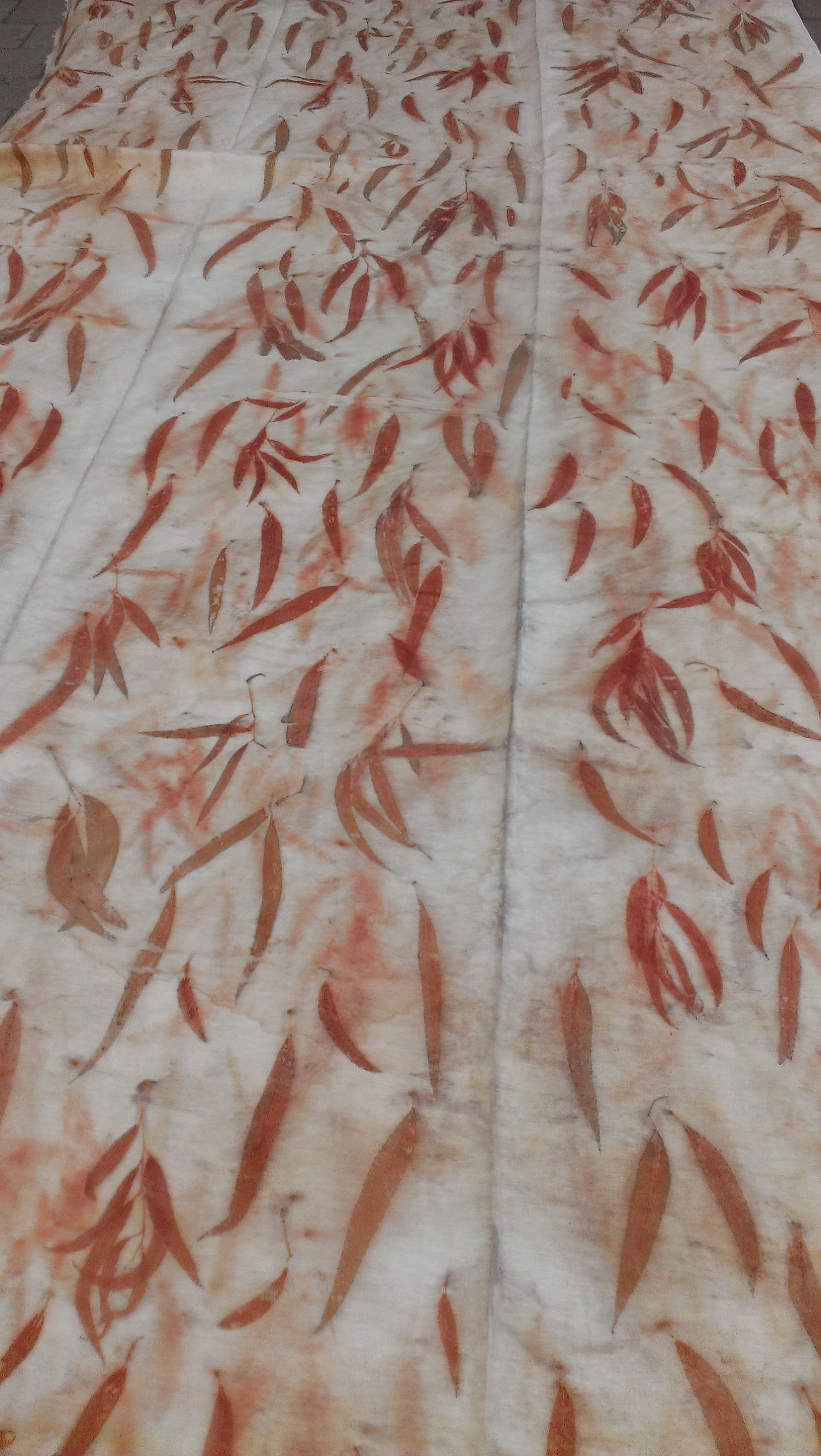
People tried out India  Flint‘s eco-print technique on cotton, wool prefelt and silk.  I hope she will get some extra book sales as a result (if you’d like to acquire her books, click on the link to her blog and look for the option to buy them postage free in the left hand sidebar).

IMAG0871

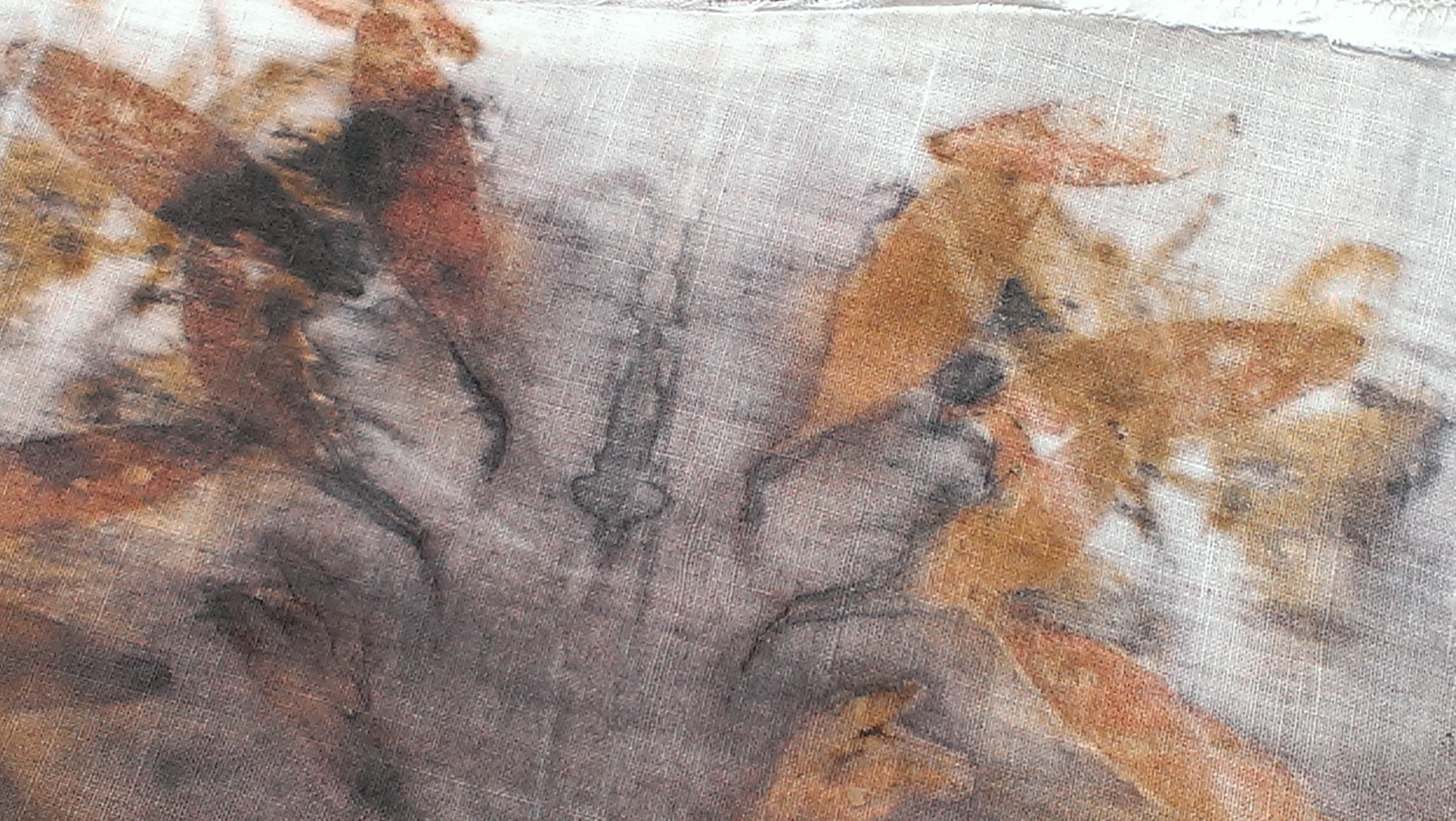
There were biscuits and icy poles and lots of chat.  I demonstrated soy mordanting and black bean dyeing.  And while we were at the Guild and using the copper, which is such a generously sized vessel by comparison with my dye pots, I leaf printed some significant lengths of fabric that I brought to the workshop bundled up and ready to go.  The copper really is copper lined, but I could detect no obvious impact on the colours.  Seedy silk noil:

IMAG0903

Wool prefelt… the degree of detail is fantastic.  This is destined for felting experimentation by a dear friend who generously assisted me at the workshop.  Her practical help, support, constant grace and good cheer made things go so smoothly.  I also decided to start some processes before participants arrived, which I didn’t do at the previous workshop.  I think that helped.  But it was a fabulous group of people too.

IMAG0913

And finally, silk/hemp blend, destined to be made into a shirt (by me, so it may take a while).  I am delighted with how it turned out, after many months of putting off the day.
IMAG0924

9 Comments

Filed under Eucalypts, Leaf prints, Natural dyeing

Eucalyptus Lehmanii bark dyepot

E Lehmanii (bushy yate) has a very distinctive arrangement of buds, flowers and fruit.  When I was a kindergardener, we used to put the long bud caps on our fingers and call them witch’s fingers and chase each other around.  I can’t pretend to have had any sophisticated critique of the concept ‘witch’ at that stage in my life!

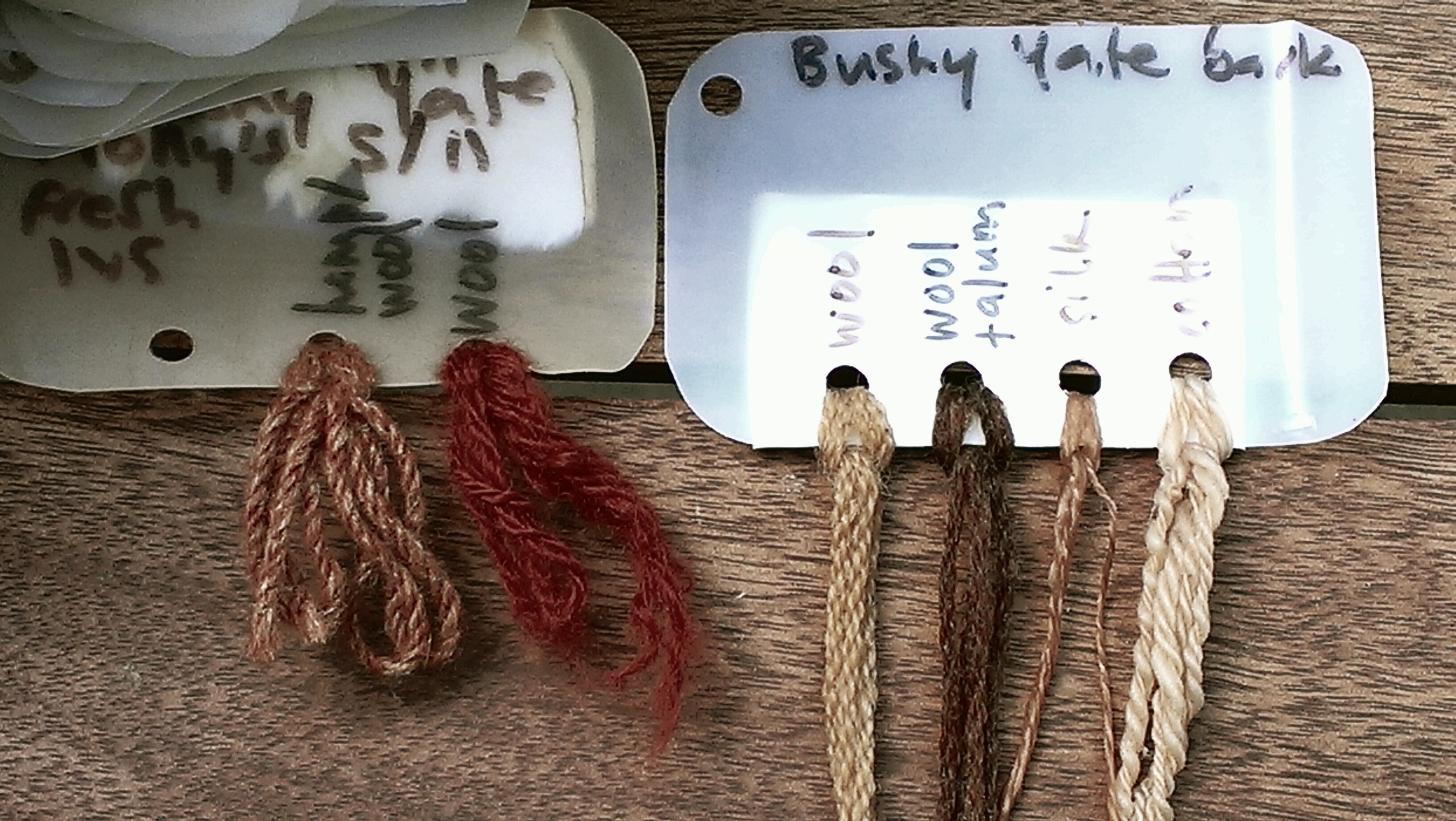
I came across some planted as street trees while I was out doing a run with friends.  On the way back to our car, I managed to collect some bark–since it had helpfully fallen.  I also collected a few leaves.  I have a sample card from a previous experiment with bushy yate leaves from a friend’s property, which gave quite a strong orange-brown.

I used iron with the leaves, and the contribution from the iron on this occasion was really quite intense.  Before…

IMAG0828

After… a result that won’t have me rushing out to collect bushy yate for leaf prints, but a result just the same.

IMAG0845

And as for the bark pot… tan, again!  I would have to rate the biggest take home message from the series of bark dye pots this summer as being that alum really makes a difference with the Eucalypt barks I’ve tried.  With leaves, I seldom see any impressive difference between alum mordanted wool and plain wool.  I dye with E Scoparia bark often and have found no point in mordanting with alum (though this experience makes me think I should try again and double check). The bark pots, however, have given various shades of tan without mordant and much stronger browns with alum, and E Lehmanii is no exception. On the left, sample card from a pot of fresh leaves.  On the right, results of the bark pot, simmered for an hour and a half.

IMAG0844_1

2 Comments

Filed under Dye Plants, Eucalypts, Fibre preparation, Leaf prints, Natural dyeing

Things I’ve done with with plant dyed yarns…

When I was preparing for the natural dyeing workshop I ran recently, I mordanted a lot of Bendigo Woollen Mills yarn as well as some handspun in small skeins–25g or less.  Having all those small skeins of different colours in alpaca and wool and mohair, activated my imagination. Eventually it led to this…

IMAG0792

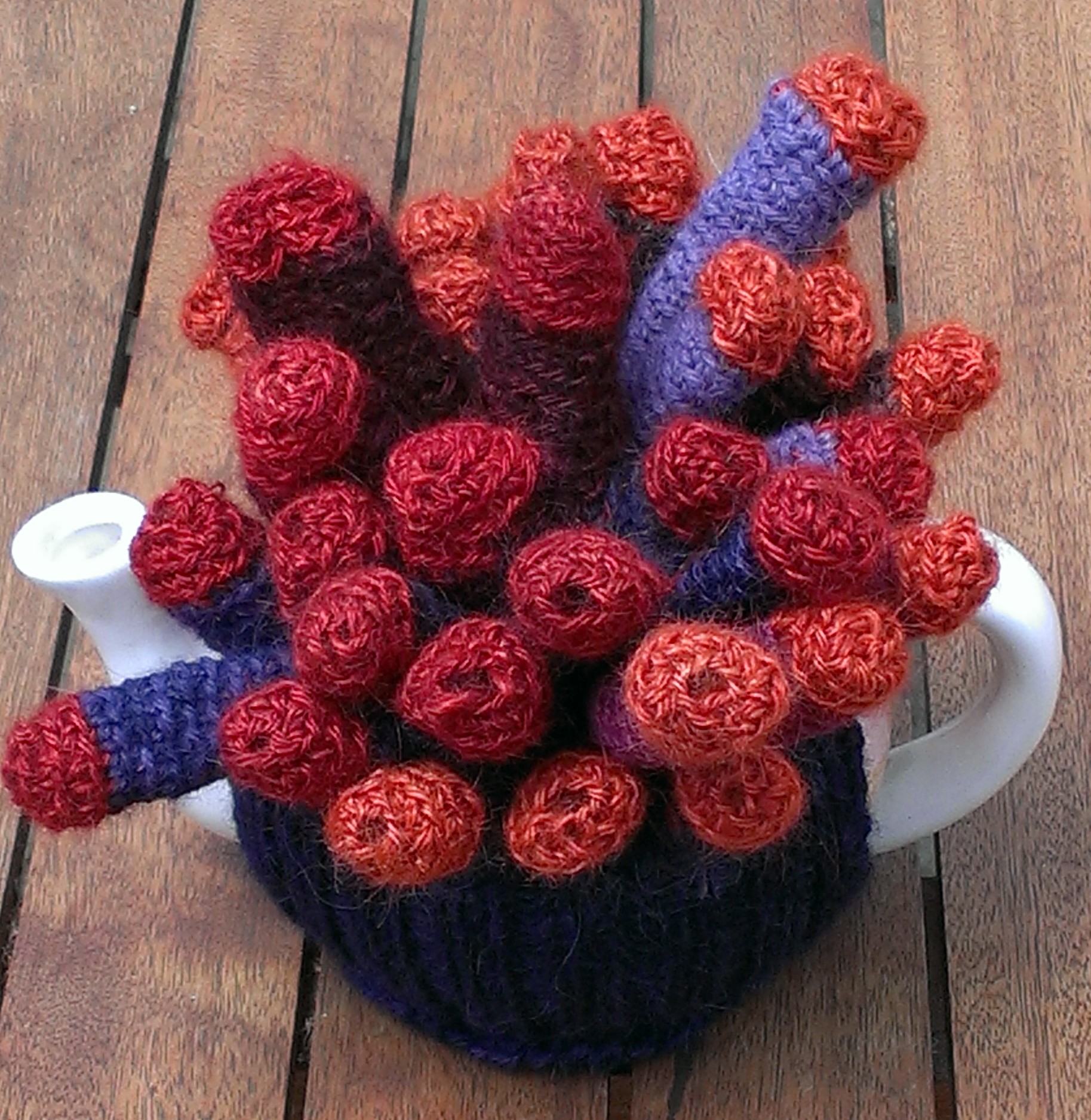
These are madder-tipped, logwood-stemmed crocheted coral thingummies, inspired by Loani Prior’s ‘coral punk’.  When I say ‘inspired by’, let me confess.  I bought her beautifully designed and entertaining book Really Wild Tea Cosies with a Christmas book voucher I was given.  So I had the pattern.  But even though only one, basic, crochet stitch was involved, my crochet skills are decidedly remedial and I don’t happen to have a crochet instructor on tap.

I turned to Maggie Righetti’s book Crocheting in Plain English (I don’t have the new revised edition, needless to say).  Apparently sometimes I just can’t believe what I am reading… or perhaps I just don’t understand on the first eight passes.  I see students I teach with the same difficulties!  By the time I had finished this tea cosy and started on the next, I’d managed to figure out that I wasn’t doing what Loani Prior must have believed was involved in the one stitch involved in her cosy.  Luckily for me crocheting badly still produces a fabric of a sort.  I also figured out that for me, improvising a knit version of the pot cover itself was going to beat freeform crocheting one as the pattern suggests with my inadequate skill set.  So that’s what I did, and Loani Prior shouldn’t be held responsible for the outcome.  I like it anyway.

IMAG0843

It has highly entertained people who watched me crocheting coral at parties (as one does) as well as those who have seen the finished object, many of whom thought immediately of a sea anemone.

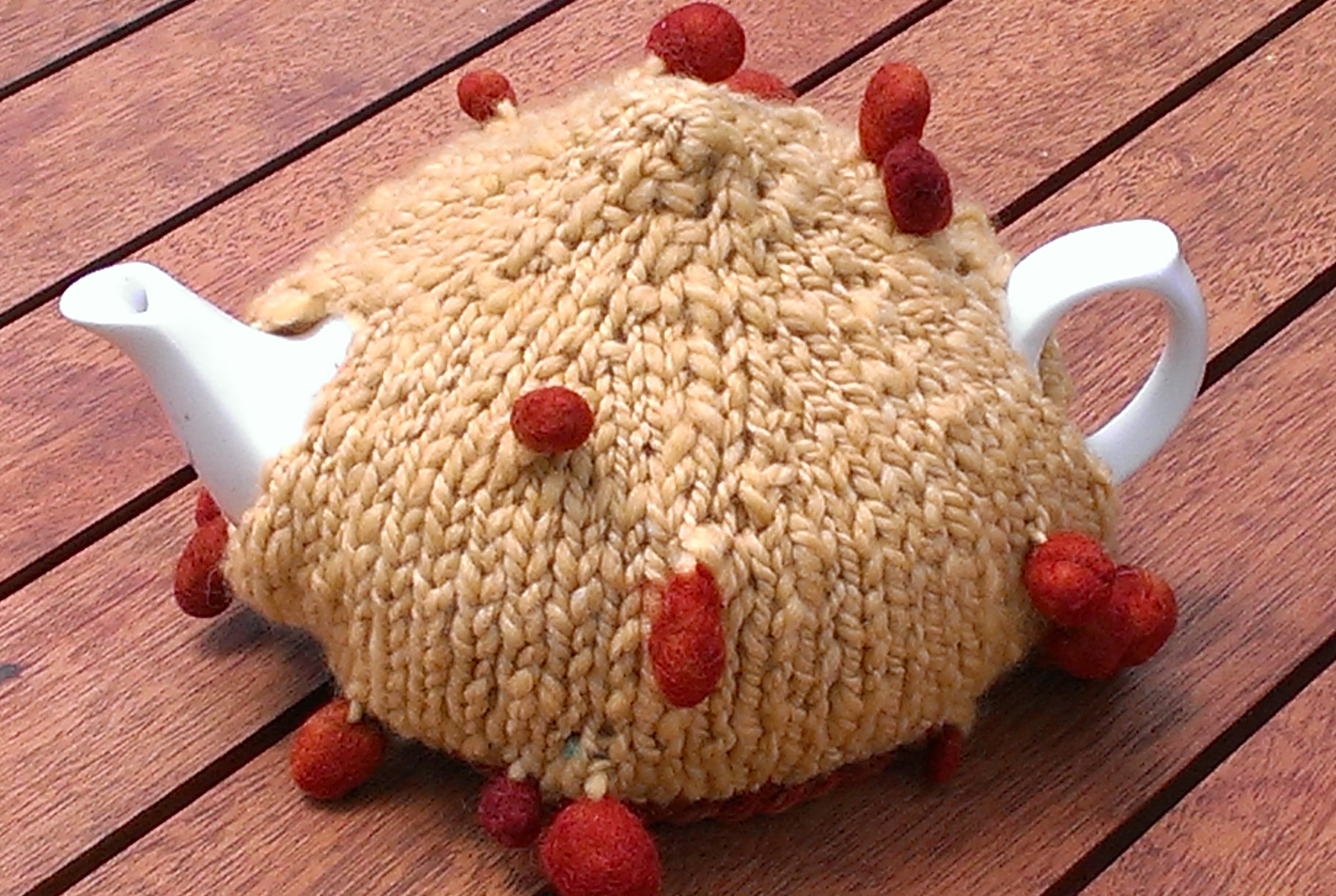
Let it be said that at present coral punk is not alone.  Here is the present plain Jane of the tea cosy selection at our place: yellow from silky oak leaves and orange from eucalyptus–with the felted blobs spun into the yarn.  Pattern improvised.  Luckily, tea pots are just not that fussy about how you clothe them.

IMAG0840

I’ve been branching out and using up some particularly strange art yarn spinning experiments.  This next one is commercially dyed mohair with silk curricula cocoons spun onto it.  Scratchy for a head, perfect for a teapot!  I was surprised how many people liked the look of the ‘hat’ emerging as I knit this at a picnic, riffing off Funhouse Fibers’ Fast and Fun Cozy.  Once again, that is to say, dispensing with the pattern when it became inconvenient.  I guess the hat admirers hadn’t felt the yarn yet.

IMAG0842

And for anyone who is wondering, I have continued to dye with the logwood exhaust from the dyeing workshop.  I ran out of yarn for a while and dyed two, 200g lengths of merino roving.  This morning I pulled out another 100g of superwash yarn.  I think it might be just about done, and I only wish I had kept a record of the weight of fibre that has been dyed with what was a small quantity of logwood in the beginning!  This weekend, the second in a series of two natural dyeing workshops. I’d better eat my crusts and get my beauty sleep in preparation.

IMAG0839

2 Comments

Filed under Crochet, Eucalypts, Knitting, Natural dyeing, Spinning, Uncategorized

After the workshop

This week I ran a natural dyeing workshop for my Guild.  It was exhausting but fun!  I tried taking a picture inside the hall and my poor old camera wanted to use the flash–pretty useless.  Between that and having a lot going on, I decided to forget taking photos.  We ran lots of dye pots: E Scoparia bark, dried E Scoparia leaves (oranges), silky oak leaves (yellow), logwood from the abandoned/donated dyestuffs of the past stash (purple), black beans (not as blue as I hoped)… we mordanted with alum and with soy, there were leaf print experiments.  We dyed silk, alpaca, wool, cotton; fleece, roving, yarn and fabric.  Phew!

I came home with cooked bark and leaves and  ground soybeans to compost, quite a bit of remaining pre-mordanted yarn, a bucket of black beans with yarn tucked into it, a bucket of homemade soymilk and the logwood bath.  Can I just quietly mention how relieved I was when I got home without having sloshed a bucket over in the car?

IMAG0786

I have run the logwood bath twice more so far.  This is the second effort: superwash wool in the foreground, alpaca/wool blend in the middle, and greeny-grey-blue black bean dyed sock yarn at the back.  I have some roving still soaking and rinsing after the third logwood bath, and I’m mordanting more fibre to go into a fourth bath right now.  I wish that logwood was a sustainable local dyestuff.  It is spectacular and straightforward, and purple is a great colour.  I loved pouring boiling water on wood chips and getting purple water; dipping fibre into what became a brownish dyebath and pulling it out purple.  But logwood isn’t local or sustainable, so I’m making the most intense use of the logwood that I have been given that I can figure out.

I hope that my forebears at the Guild who abandoned the logwood there or donated it to the Guild would be happy if they could see the excitement it provoked in the workshop.  It’s possible that the former owners of this logwood are still coming to the Guild and will let me know what they think when word gets out of what we did in the dyeroom this week.  I feel so blessed to be part of the Guild–fancy being part of an organisation that has a dye room!

6 Comments

Filed under Dye Plants, Eucalypts, Leaf prints, Natural dyeing

Finished objects completed in my holidays

There has been a lot of holiday crafting going on round here.  But this post marks return to my day job!

I made some Thai style fishing pants.  I bought a pair in 2000 as the new century began, and they have finally gone to the worms in our worm farms, the ultimate destination of natural fibres that are worn past the point of repair and reuse around here.  I traced a pattern from them and made this pair from a sarong found at the op shop.  I assume the originals were cut to maximise the use of fabric from a loom that is a standard-ish size in the region, because the sarong was the perfect amount of fabric, with almost no fabric left over to be wasted or used for other things.  Surely this is the goal of all hand weavers, as well as a decent goal for thrifty and green sewers.

I used french seams and then top-sewed them flat, so that I could use only cotton thread and ignore the polyester sucking overlocker.  When commercially sewn garments go to the worms, the overlocker thread is usually all that remains.  The worm farm offers an education in the biodegradability of garments, and I am increasingly aiming for biodegradable.  There is a cotton-polyester t shirt in one of them that has been there since my daughter left home and abandoned it.  Over 10 years ago.  Polyester will clearly survive the apocalypse, along with cockroaches.   Seriously, my everyday garments do not need to live as long as the Gobelin tapestries.

IMAG0590

I made a pair of radmila’s slippers from a new book, Knitting from the Center Out by Daniel Yuhas.  They are knit from handspun merino roving dyed with Eucalypts.  I have to say that I gave up making matching pairs a long time ago and now make siblings rather than twins… further proof lies in the next two images. OK, make that three!

IMAG0579

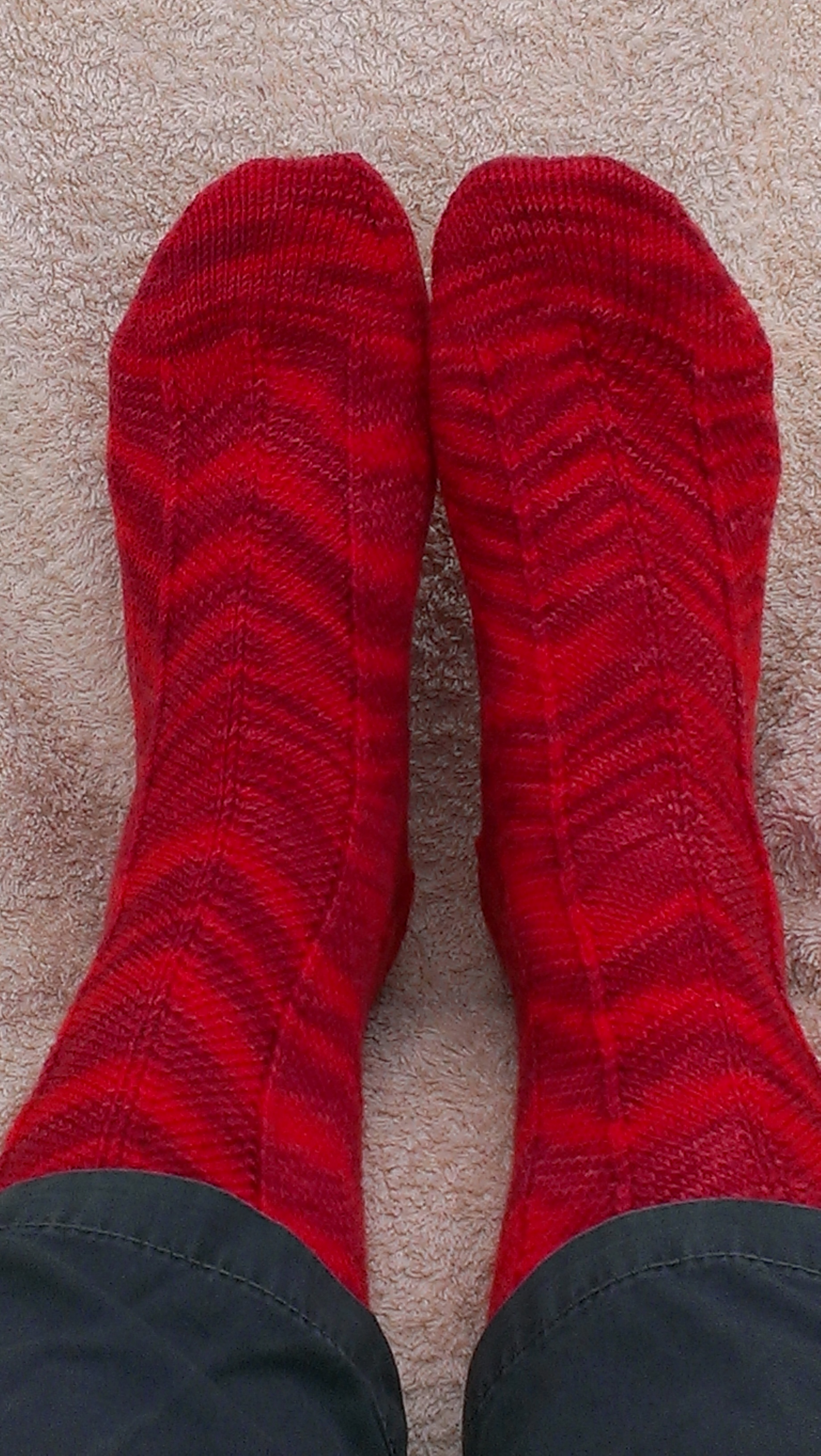
I took up knitting in order to be able to knit socks, and that is what led me to spinning and then dyeing.  Sock production has slowed down, but I finally finished a pair of Jaywalkers for a beloved friend. She is a lover of bright colours who has appreciated these as splendidly red while they were still in progress.  This yarn was dyed by a fabulous local dyer, Kathy Baschiera.

IMAG0595

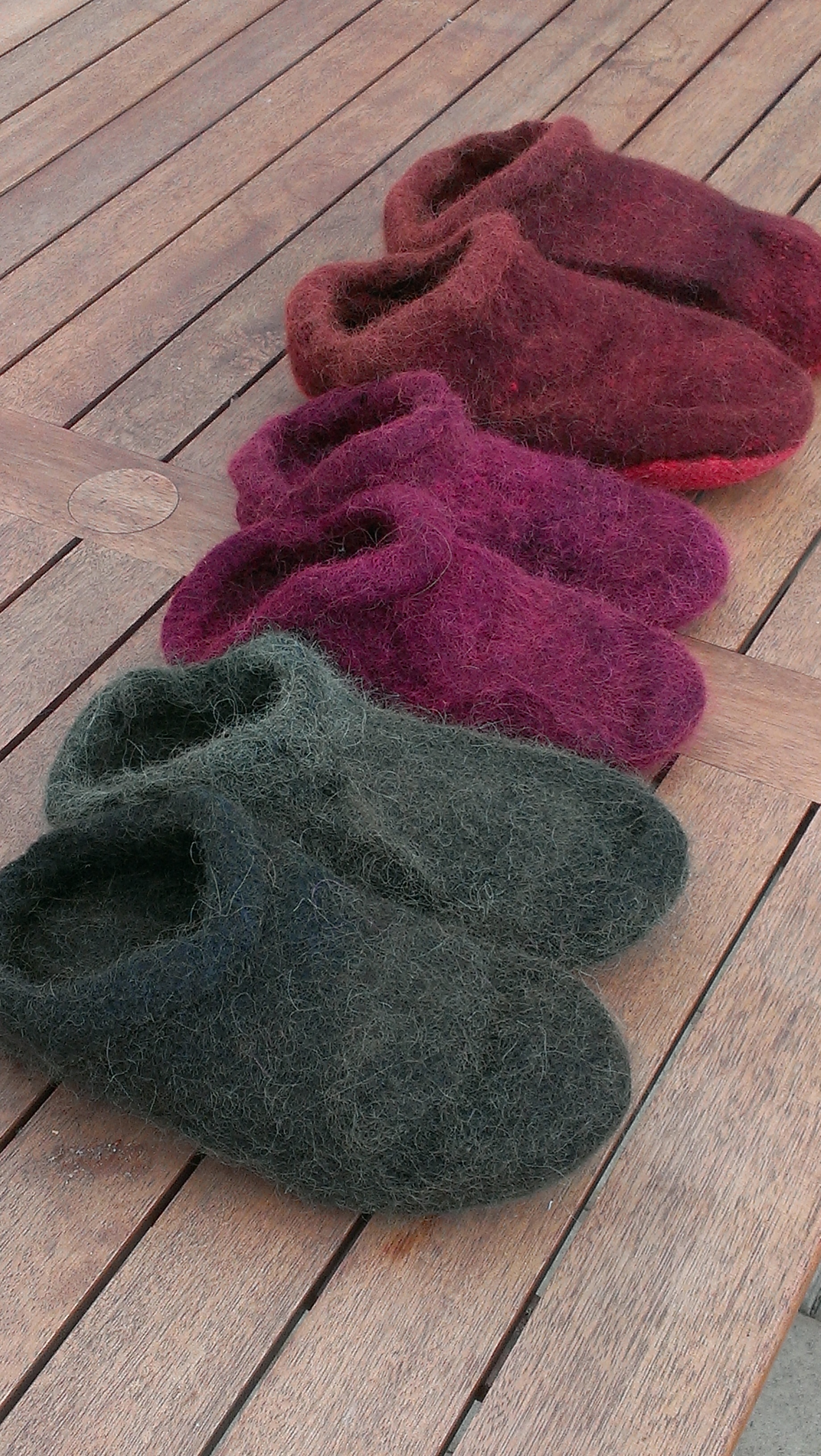
Remember the post where I was wondering whether a sow’s ear could be turned into a silk purse (actually, whether I could turn the less exciting parts of a polwarth fleece and some low quality alpaca into slippers)?  Well, the answer is yes.  These are knit using Bev Galeskas’ Felted Clogs pattern and dyed with Landscapes dyes.  I hope Bev Galeskas has made millions from her pattern.  I sure have made tens upon tens of these, though most are a shade less hairy.  Clearly I spun in a fair amount of guard hair, and it won’t felt.  Just the same, the recipient of the red pair at the back was very enthusiastic as he turned 40, and the delightful women who will be receiving a parcel today or tomorrow with the front two pairs are great mend and make-do experts who have darned their previous pairs extensively… they live in a very cold place and will enjoy warm feet and hopefully overlook the odd stray guard hair!

IMAG0588

Ah, holidays.  I hope you’ve had some to enjoy.

3 Comments

Filed under Eucalypts, Knitting, Natural dyeing, Sewing, Spinning

Eucalyptus Cladocalyx Bark

I have been reading Rebecca Burgess’ gorgeous book, Harvesting Color, which had me thinking about how to create a tannin solution.  The local solution for her is to gather acorns.  That might be possible for me in autumn, too. There are some avenues of oaks in my city, and they have tiny newly formed acorns right now.  But it seems to me that eucalypt bark would be a promising source in my own region.  I thought it seemed logical to collect bark from a species that hadn’t shown a lot of dye potential (I’m trying for mordant, not dye).   So I stopped outside the royal showgrounds where this huge E. Claodocalyx (Sugar Gum) had shed its bark recently.  We were having unseasonably cool weather as this dull photograph shows.

IMAG0317

I picked up a bag full of bark and headed home to let it steep in rainwater. This will be an opportunity to consider the dye potential of the bark as well as try it as a source of tannins.  There are many of these trees around my area and this is a truly huge tree when full grown, which sheds its bark once a year, so if this is a good source of dye, I will have access to a lot of it! Here is how it looked on 15 December:

IMAG0330

And two days later:

IMAG0342

…so I put a metre of cotton cloth into it, which immediately turned golden yellow:

IMAG0347

I left the pot in a sunny spot.  The temperatures have ranged from mid-twenties celcius to 40C.  By 1 January, the pot was darker still, with the liquid seeming a ruby red shade.

IMAG0545

And here is the cotton I immersed in it  so many days ago after drying.

IMAG0547

Needless to say, I am now planning to dye wool in my bark liquor and see what happens…

Leave a comment

Filed under Dye Plants, Eucalypts, Fibre preparation, Natural dyeing, Uncategorized

Ironbark experiments: E Corynodes

On the weekend, I went to a fete at Black Forest Primary School.  They had a sensational community garden, complete with a sale of silkworms, 5 for a dollar!  Who could resist?  Clearly not me (you guessed), so there are 5 silkworms in the lounge munching through mulberry leaves.  More on that later.

While my posse of friends and my house guests from Denmark were hitching up their bikes, I took a sample of the tree right at the dead end of Kertaweeta Ave Black Forest where we entered the school grounds, with the help of a taller friend.  Excuse the extra good photo….

This tree had smooth, pale bark in some of the finer upper branches.

I don’t know why, but I do not entirely trust the result that Euclid and I produced: E Corynodes.  Poor Euclid, depending on me.  There were no mature fruits, buds or flowers to consider, and that makes the result less dependable and the chance of detecting an error smaller. Euclid suggests E Corynodes can be confused with several other species, but look at this account of how to tell them apart!

E. fibrosa subsp. fibrosa, E. fibrosa subsp. nubila, E. melanophloia and E. rhombica … differ in having buds with stamens all fertile and irregularly flexed.  E. sideroxylon differs by having buds that hold the outer operculum into maturity and both the inner and outer operculum shed together at anthesis (no operculum scar).

So that would be obvious, then!  Based on this I wonder how I can be sure this is not E Sideroxylon, which would give orange too…  Because whatever its true name, this is the result I got.

Leave a comment

Filed under Dye Plants, Eucalypts, Natural dyeing

Dyeing with Eucalypts… the next instalment

Dyeing with Eucalypts sometimes reminds me of baking sourdough bread.  You can step away for long periods and pick up where you left off, with the process having continued while you were gone.
To reprise the last post, having cooked my bark for  a couple of hours on its own, I had added 25 g wool.  The dye pot then went through 3 cycles of heat for 10 minutes and sitting for 60 minutes before I went out to see some live music with a friend.  Kristina Olsen happened to be in our town!  I added an additional 25 g wool after 2 cycles to see what would happen.  Then yesterday I was busy and the wool sat in a cold dye pot all day.  Today, here are my two bedraggled little braids.  I’ve squeezed them out but they are still wet.

The one on the left is the colour I would expect to get (and has spent longest in the dye bath)… the one on the right is a bit pale for my taste. The dye liquor has changed colour from the initial clear deep red colour to a murky orange.  This is also dependable, even if I don’t grasp why it happens exactly!  Maybe I am just cooking that bark to sludge.

So since I’m home today I decided to run the dye pot again.  I added more rainwater and as many leaves as I could cram in.  This is a dried leaf mix. I have a big paper bag I’ve been using to stash windfalls and leftovers and such, so here are leaves from E Sideroxylon, E Cinerea, E Websteriana (not that it is a specially great dye plant but it has cute heart-shaped leaves and minnirichi bark–what’s not to like?) as well as E As-yet-to-be-accurately-identified.  I moved the pot indoors, since I’m home alone and no one else will be bothered… and I can keep the heat really low without it blowing out in the wind.  I added a further 25g wool, and now we see what happens.  I have the wool in between the residual bark at the bottom and the leaves I added, where I am hoping they’ll have the benefit of both and perhaps some contact printing.

The other reason I think natural dyeing (with Eucs especially)  is like making sourdough bread is because the number of variables is so big, I can get a dependable result up to a certain point, but the most exciting results always contain some element of mystery.  So, I can’t turn out my best loaf every time, and I have achieved burgundy from Eucs more than once, but not often and not predictably.  In my opinion, the only thing to do is to keep experimenting!

1 Comment

Filed under Eucalypts, Natural dyeing, Uncategorized