Tag Archives: think globally

After the workshop

This week I ran a natural dyeing workshop for my Guild.  It was exhausting but fun!  I tried taking a picture inside the hall and my poor old camera wanted to use the flash–pretty useless.  Between that and having a lot going on, I decided to forget taking photos.  We ran lots of dye pots: E Scoparia bark, dried E Scoparia leaves (oranges), silky oak leaves (yellow), logwood from the abandoned/donated dyestuffs of the past stash (purple), black beans (not as blue as I hoped)… we mordanted with alum and with soy, there were leaf print experiments.  We dyed silk, alpaca, wool, cotton; fleece, roving, yarn and fabric.  Phew!

I came home with cooked bark and leaves and  ground soybeans to compost, quite a bit of remaining pre-mordanted yarn, a bucket of black beans with yarn tucked into it, a bucket of homemade soymilk and the logwood bath.  Can I just quietly mention how relieved I was when I got home without having sloshed a bucket over in the car?

IMAG0786

I have run the logwood bath twice more so far.  This is the second effort: superwash wool in the foreground, alpaca/wool blend in the middle, and greeny-grey-blue black bean dyed sock yarn at the back.  I have some roving still soaking and rinsing after the third logwood bath, and I’m mordanting more fibre to go into a fourth bath right now.  I wish that logwood was a sustainable local dyestuff.  It is spectacular and straightforward, and purple is a great colour.  I loved pouring boiling water on wood chips and getting purple water; dipping fibre into what became a brownish dyebath and pulling it out purple.  But logwood isn’t local or sustainable, so I’m making the most intense use of the logwood that I have been given that I can figure out.

I hope that my forebears at the Guild who abandoned the logwood there or donated it to the Guild would be happy if they could see the excitement it provoked in the workshop.  It’s possible that the former owners of this logwood are still coming to the Guild and will let me know what they think when word gets out of what we did in the dyeroom this week.  I feel so blessed to be part of the Guild–fancy being part of an organisation that has a dye room!

6 Comments

Filed under Dye Plants, Eucalypts, Leaf prints, Natural dyeing

Finished objects completed in my holidays

There has been a lot of holiday crafting going on round here.  But this post marks return to my day job!

I made some Thai style fishing pants.  I bought a pair in 2000 as the new century began, and they have finally gone to the worms in our worm farms, the ultimate destination of natural fibres that are worn past the point of repair and reuse around here.  I traced a pattern from them and made this pair from a sarong found at the op shop.  I assume the originals were cut to maximise the use of fabric from a loom that is a standard-ish size in the region, because the sarong was the perfect amount of fabric, with almost no fabric left over to be wasted or used for other things.  Surely this is the goal of all hand weavers, as well as a decent goal for thrifty and green sewers.

I used french seams and then top-sewed them flat, so that I could use only cotton thread and ignore the polyester sucking overlocker.  When commercially sewn garments go to the worms, the overlocker thread is usually all that remains.  The worm farm offers an education in the biodegradability of garments, and I am increasingly aiming for biodegradable.  There is a cotton-polyester t shirt in one of them that has been there since my daughter left home and abandoned it.  Over 10 years ago.  Polyester will clearly survive the apocalypse, along with cockroaches.   Seriously, my everyday garments do not need to live as long as the Gobelin tapestries.

IMAG0590

I made a pair of radmila’s slippers from a new book, Knitting from the Center Out by Daniel Yuhas.  They are knit from handspun merino roving dyed with Eucalypts.  I have to say that I gave up making matching pairs a long time ago and now make siblings rather than twins… further proof lies in the next two images. OK, make that three!

IMAG0579

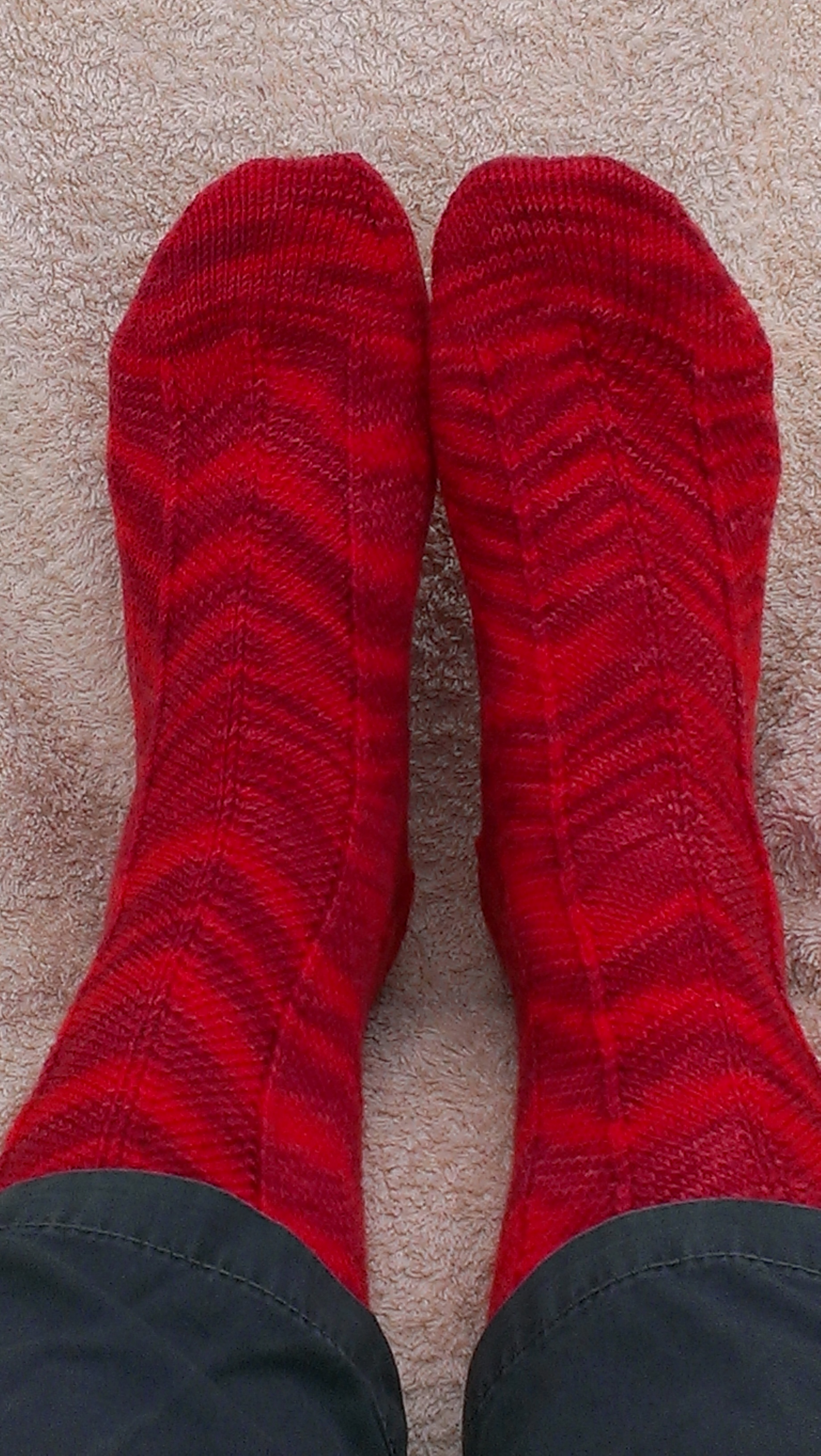
I took up knitting in order to be able to knit socks, and that is what led me to spinning and then dyeing.  Sock production has slowed down, but I finally finished a pair of Jaywalkers for a beloved friend. She is a lover of bright colours who has appreciated these as splendidly red while they were still in progress.  This yarn was dyed by a fabulous local dyer, Kathy Baschiera.

IMAG0595

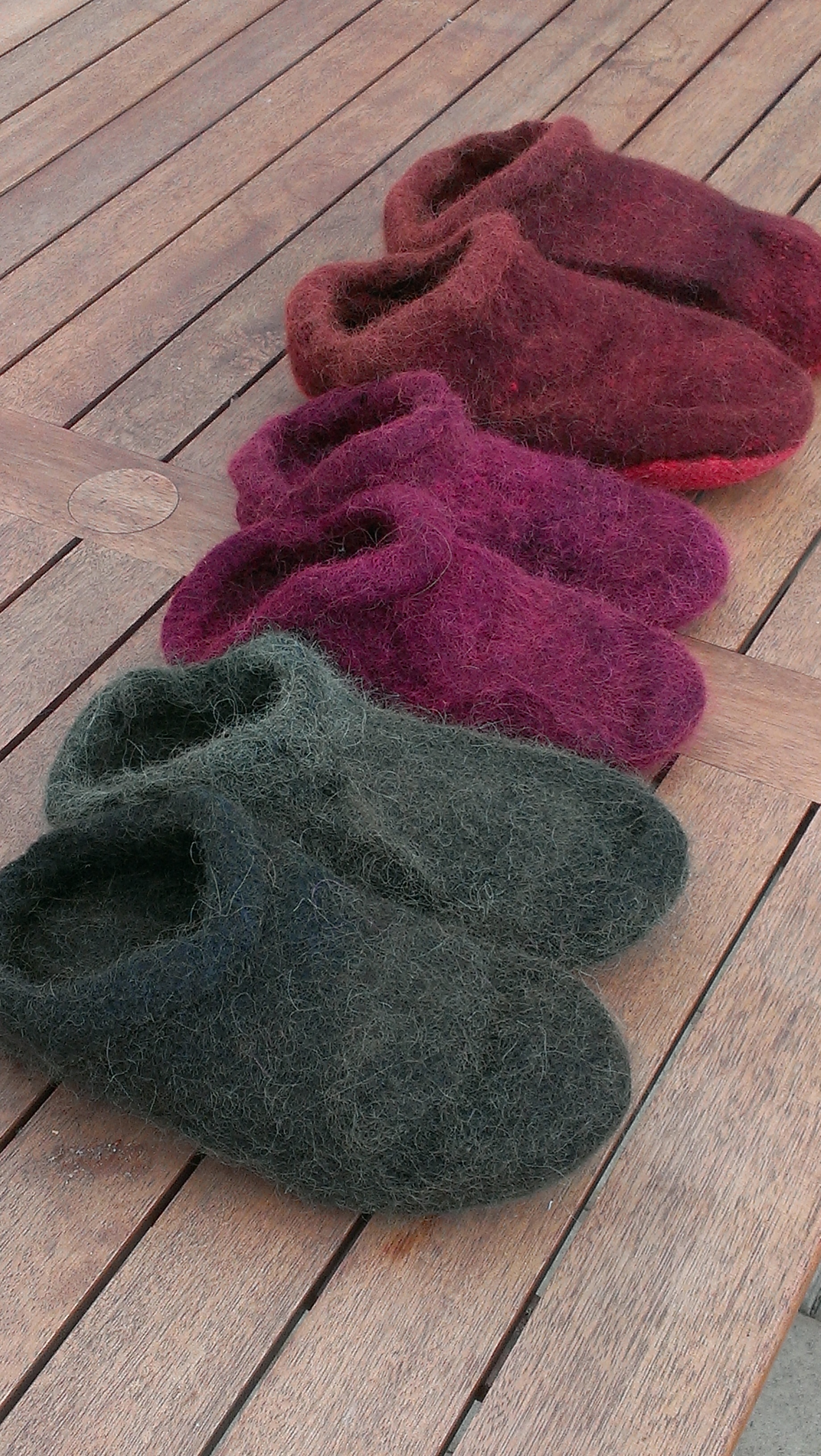
Remember the post where I was wondering whether a sow’s ear could be turned into a silk purse (actually, whether I could turn the less exciting parts of a polwarth fleece and some low quality alpaca into slippers)?  Well, the answer is yes.  These are knit using Bev Galeskas’ Felted Clogs pattern and dyed with Landscapes dyes.  I hope Bev Galeskas has made millions from her pattern.  I sure have made tens upon tens of these, though most are a shade less hairy.  Clearly I spun in a fair amount of guard hair, and it won’t felt.  Just the same, the recipient of the red pair at the back was very enthusiastic as he turned 40, and the delightful women who will be receiving a parcel today or tomorrow with the front two pairs are great mend and make-do experts who have darned their previous pairs extensively… they live in a very cold place and will enjoy warm feet and hopefully overlook the odd stray guard hair!

IMAG0588

Ah, holidays.  I hope you’ve had some to enjoy.

3 Comments

Filed under Eucalypts, Knitting, Natural dyeing, Sewing, Spinning

Hibiscus Flowers

IMAG0332

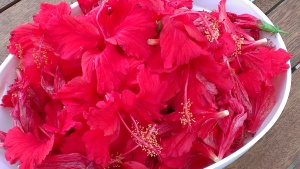
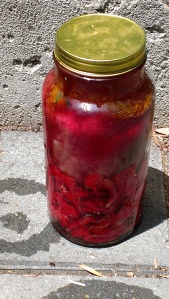
Until recently, there was a house near us that we were told would be demolished within the next week (it’s gone now).  The inhabitants moved out in a hurry, leaving the tide of unfinished business you might expect in the circumstances: the gate and doors open and unwanted stuff everywhere.  I picked all the grapefruit they’d left on the tree and gave it to a friend who loves grapefruit, saved the water lily and goldfish for another friend with a pond, with the help of friends, I put out the bins and piled their recyclables into our recycling bin and their recycling bin and a crate or two, ready for collection the next day.  I decided to harvest the flowers from their red hibiscus, which was in full bloom.   I followed the instructions Jenny Dean gives in her very fine book Wild Colour, up to a point…

IMAG0335

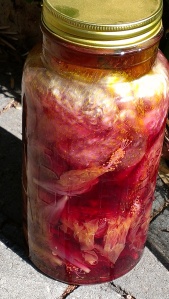
I decided to use more rather than less dyestuff, 125g flowers to 50g washed unmordanted polwarth locks to begin with.  I began as Jenny Dean suggests but decided to try solar dyeing.  You can see the wool in the top of the jar wrapped in a couple of yellow onion nets.

IMAG0337

Two days after beginning the dyebath, I picked a whole extra round of flowers, sieved out the ones that had been steeping two days, gave them to the worms in our worm farm and added a fresh lot of flowers to my dye jar.  The dye liquid was a plum colour and a little thicker than water.  I took the second round of flowers out after they gave their colour up.

IMAG0346

Well, after a good fortnight in the jar, almost no colour on the fleece.  So I returned to Jenny Dean’s instructions and heated the dye bath.  The fleece still didn’t take up colour, but my sample card gave green on alum mordanted wool.  Green???  I have dyed with hibiscus before and achieved a rose pink on unmordanted washed fleece, which I spun up three-ply and knit into socks for my mother.  Green isn’t even on Jenny Dean’s horizon.  Deep, olive green (checked against a couple of friends with decent eyesight).

So, I put a skein of alum mordanted, commercial superwash in the dye bath, heated again and my skein turned steely grey.  This picture gets the colour right despite its defects in the focus department:

IMG_0027

To me, this is quite bizarre.  I can only think that the fleece failed to take colour because it was inadequately scoured, though it didn’t feel at all greasy or sticky.  Polwarth is a high-grease breed.  But how I can explain the green and grey outcomes?  Well, I can’t–and I await your thoughts.  Dye pots which had been inadequately cleaned might mean there was some iron in the dye bath, but Jenny Dean suggests purple to pink would still be the outcome.  And after all this, the dye bath was still full of colour–red-purple colour.  Mystery!

12 Comments

Filed under Dye Plants, Natural dyeing

Significant Tree

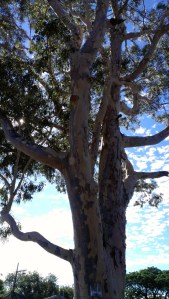
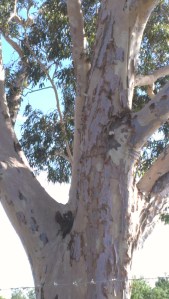
I love trees.  Some are especially precious to me.  Like this one.  The Department of Planning and Infrastructure says it is a Corymbia Maculata (Spotted Gum).  I have tried dyeing with Corymbia Maculata.  As a dye plant, it’s not spectacular: my samples are tan, tan and tan.  Dye potential isn’t the only or even the main value in a lovely tree from my point of view, but just one of its potential fine qualities. 

IMAG0356

We failed to save it by objecting to its removal.  A local creek is going to be put into a pipe so big a car would fit into it as part of major infrastructure works, and this tree is standing in the path that pipe is going to take beside the railway.

IMAG0352

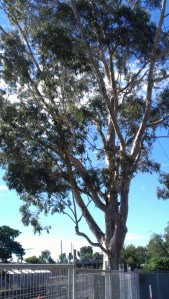
The Minister approved its removal, and his decision is not appealable.  That fence along the railway stands where over 10 much smaller, but still appreciated, trees used to stand beside the spotted gum. Since their removal I hear there are six possums fighting in the nearest neighbours’ yard at night instead of just one. We have been given several different dates on which the Corymbia Maculata will be felled, and prepared ourselves for the day each time. It has been fenced off because tomorrow is the day.  9.30 am is the time.  My nearest and dearest is staying with a friend tonight so as not to be here when it happens.  The people who will be felling it will start to arrive at 7 am.  It will be a big job.  The chainsaws will be going all day long, if indeed they can do it in a day.

lIMAG0357

This tree must be decades old.  The whole neighbourhood will be different without it.  The flocks of native birds who have visited it when in bloom every year will no longer stop by.  Under government policy, in our hearts and those of lots of our neighbours, it is a Significant Tree.

IMAG0353

5 Comments

Filed under Eucalypts

Patterns emerge

I keep finding myself humming ‘Deck the halls with boughs of holly’ when collecting bark.  I realise it’s the first of December and there is a chance I have just been ear-wormed by a Christmas carol when passing by a shop… but I don’t think so.  I think I am actually humming ‘Tis the season for bark-collecting, tralalalala tralalala’.  Which may, of course, be even greater cause for concern!  Today I went out with my bike and visited this tree, cunningly hidden behind and beside a carob tree (whose leaves you can see).  I’ve tried dyeing with carob leaves, but nothing exciting emerged.

IMAG0287

As I went to pack my bag of bark into my bike trailer a gecko ran out!  Now that really was an occasion for celebration… a native lizard enjoying one of my favourite dye plants.  I also collected bark from a tree in Leader St.  I ran a sample dye pot some years back from leaves that had dried in the gutter beside it and got rich colour, but the council has trimmed the boughs so high I can’t reach leaves or see any buds or gumnuts.  I am using the pattern of bark shedding to identify more E Scoparia trees.  Anything that has bark that has turned dark grey and red just as it begins to shed is on my plausible candidates list if it is peeling now, which is why I visited the one in Leader St. Needless to say, there is a dye pot running now to test this theory.  After all, ’tis the season for bark collecting…

And, at Guild today I became the happy recipient of natural dyestuffs of antiquity which I might be able to use for my dyeing workshop.  Some had no labels, and this one is the most intriguing of the unidentified specimens.  I could guess many, but not this one.  Any clues?  It looks to be the husk of a small fruit.  Smaller than a hazelnut, say, but bigger than a pea.  Dark on the outside and crimson on the inside.

IMAG0286

This trove is going to take some research, but will be my first opportunity to try logwood and cochineal (let those bugs not have died in vain…) and suchlike, as well as some things I’ve never heard of, like shredded mulga bark (mulga roots are common firewood here, but I’ve never heard of this as a dyestuff) and ‘red sanderswood’. Happy times… I also received some undyed handspun yarn as part of the Guild birthday challenge, labelled ‘Goat Hair’. Perhaps it can be dyed from the new dye collection?

Leave a comment

Filed under Dye Plants, Eucalypts, Natural dyeing

Soy mordanting

Ah, the humble soybean.  It gives me enormous respect for Japanese culture to see all that they have achieved with this rather unpromising bean (to say nothing of all the other skills and treasures of Japanese culture). Tempeh and tofu are very much on our menus at present, too.

I am just using it to mordant cellulose fibres ready for leaf prints, nothing as complex as tempeh, or even tofu. Usually I dip the fabric in the sea first when I’m visiting someone by the sea and then dry it and then begin with beans, but not this time. I forgot to take the cloth when I went visiting at Hove and the beans were already soaking. I measure out 3 cups of beans to every kilogram of fabric. I soak the beans overnight, grind them finely and dilute, then strain out the solids.

Then, it’s dip and dry at least three times.  So this week I made the most of hot weather: 4 dips on a single day.  These pieces of cloth are destined to be dyed by those who attend my dyeing workshop in January. It isn’t a difficult process to mordant this way, but there are a few steps to it.  I’ve decided to try mordanting in advance in the hot weather of summer.  Drying fabrics that have been through this process in winter is pretty trying and makes this a 4 day process, by the end of which the soymilk smells less pleasant. Mind you, even then, it takes about 5 minutes a day of actual effort for me!

Next, I’ll be testing one of these out to make certain sure there will be a good result on the day of the workshop. And perhaps, doing some more mordanting while the weather is perfect for it, as part of working toward taking advantage of the seasons to do the work that is most suitable to the weather and conditions.

25 Comments

Filed under Fibre preparation

Silkworms!

A while back, I mentionedthat I had acquired some silkworms.  Five for a dollar, to be exact!  There I was, checking out the primary school community garden during their fete and admiring the plants for sale, when I saw them.  So, they went into a strawberry punnet and came home on my bicycle.  Then began weeks of raiding local mulberry trees for stray overhanging leaves (and there were some from my friend’s front yard too).  Since it is mulberry season, I got some food from the whole adventure too, and some berry-stained fingertips. 

Eventually, they began to show signs of wanting to move to the next stage of their life cycles.  I’d sought advice from wormspit, so most of them found themseves moved to a cardboard roll (ahem) at this point:

I was quite fascinated by the way that the colour of the silk changed between the early stages of cocoon-making, when it seemed quite white, to the next day:

Now, we are waiting to see when they emerge and what happens them.  It may be that with a posse of only 5, there will not be opportunities to reproduce.  But we’ll wait and see.

5 Comments

Filed under Uncategorized

Works in progress

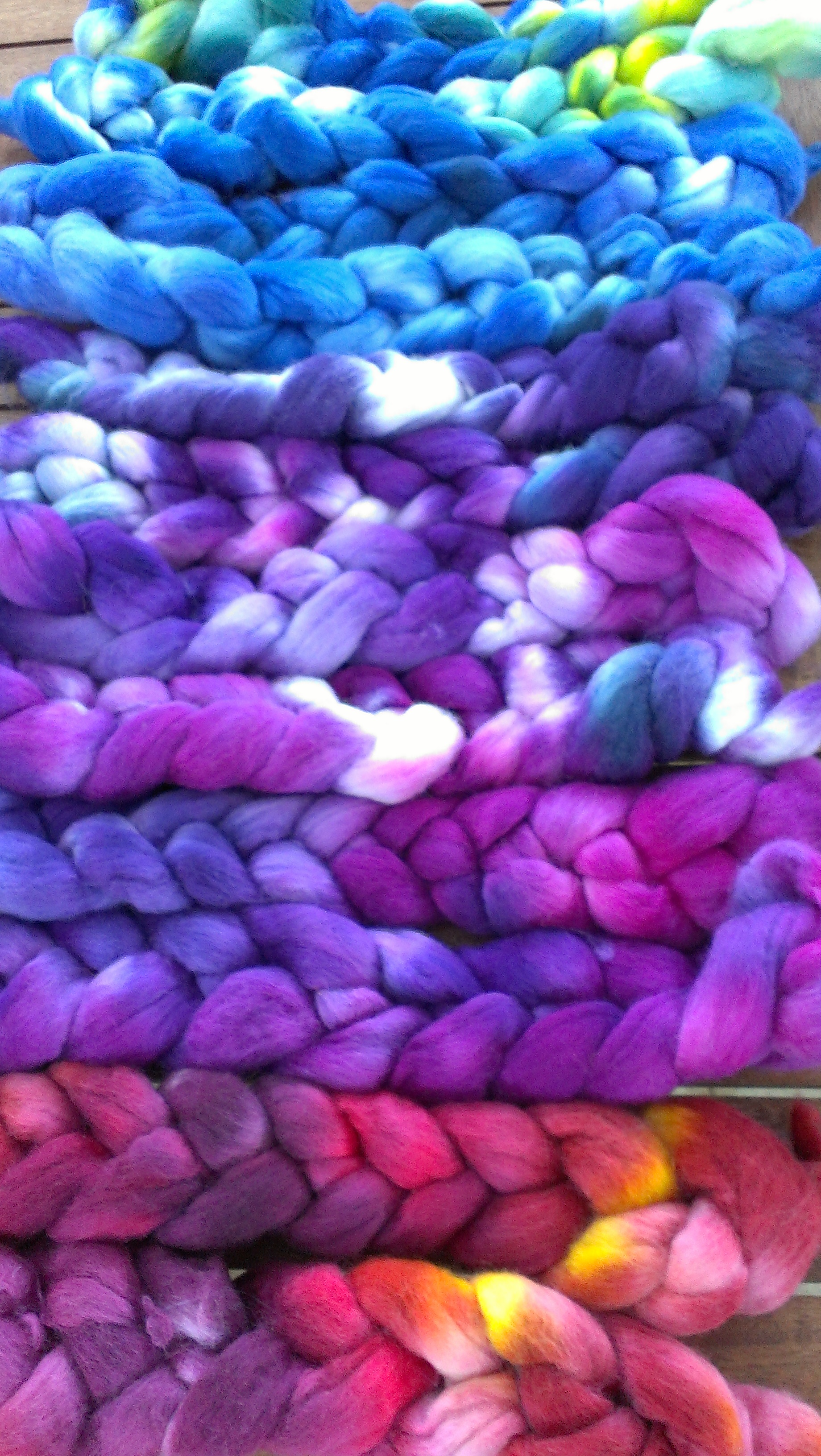
I’ve been puttering along on a number of different projects over the last few weeks… and lest this sounds unusual in some way, that is probably the way life goes most of the time around here!  I returned to cold dyeing roving after retrieving my last spectacular failure.  For good measure, I also dyed some local mohair locks.  I am planning toward a textured yarn spinning workshop and I’m determined to go as close as I can to a local supply of materials for the participants.

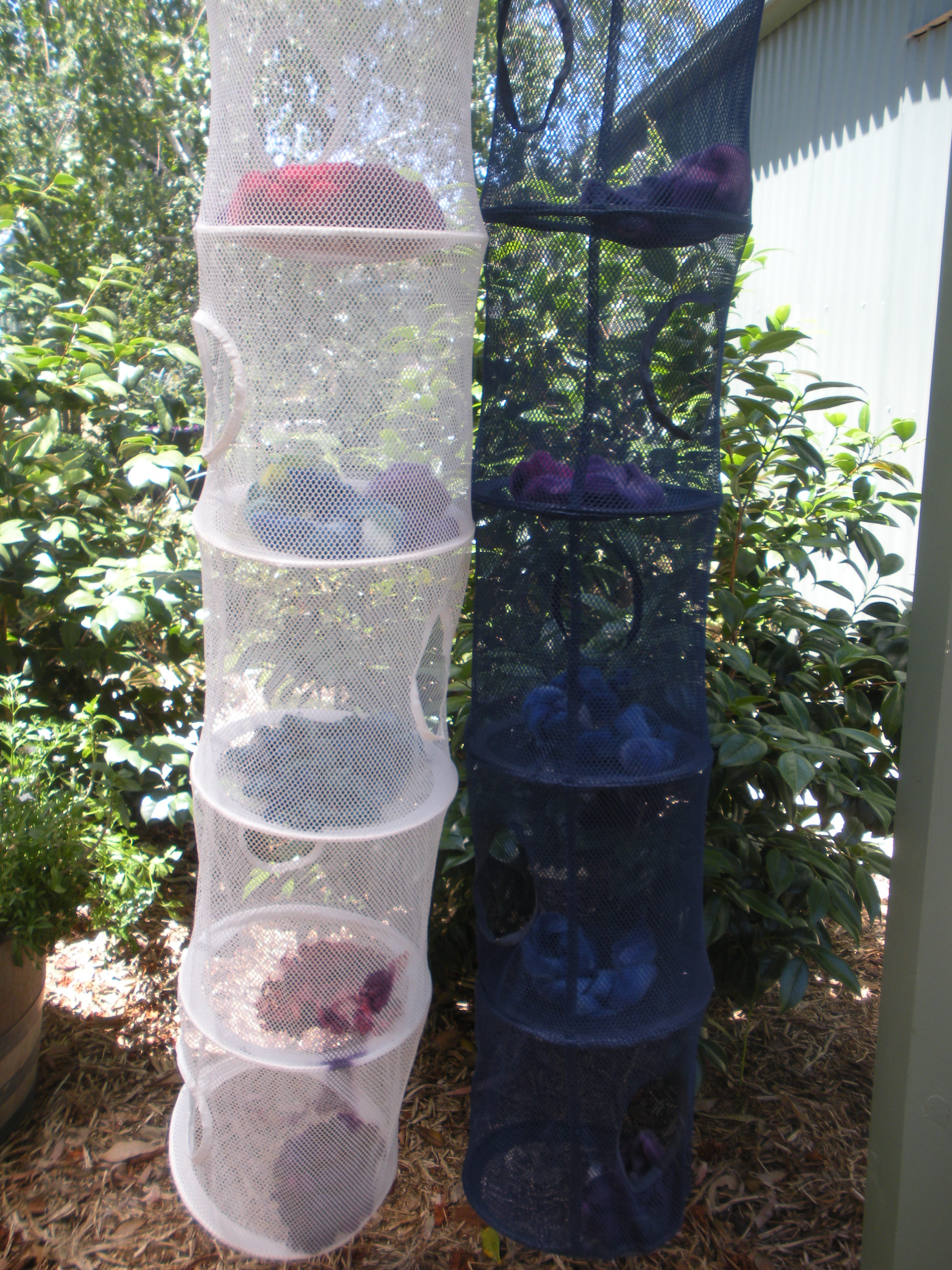
We’ve had Ikea here for long enough that the op shops of the city now turn up these fantastic wool drying apparatuses.  One came with a small supply of plastic animals.  This time, just when I thought I had found them all, a small plastic dalmatian dropped out.  Hopefully the child whose toys left home this way is not grieving and bereft!

This time, the merino braids turned out better than I had hoped.  Perhaps I am slowly acquiring a better sense of colour.  Those with a red base (at the bottom of the picture) were the ones I felt most tentative about, but I like them best of all.

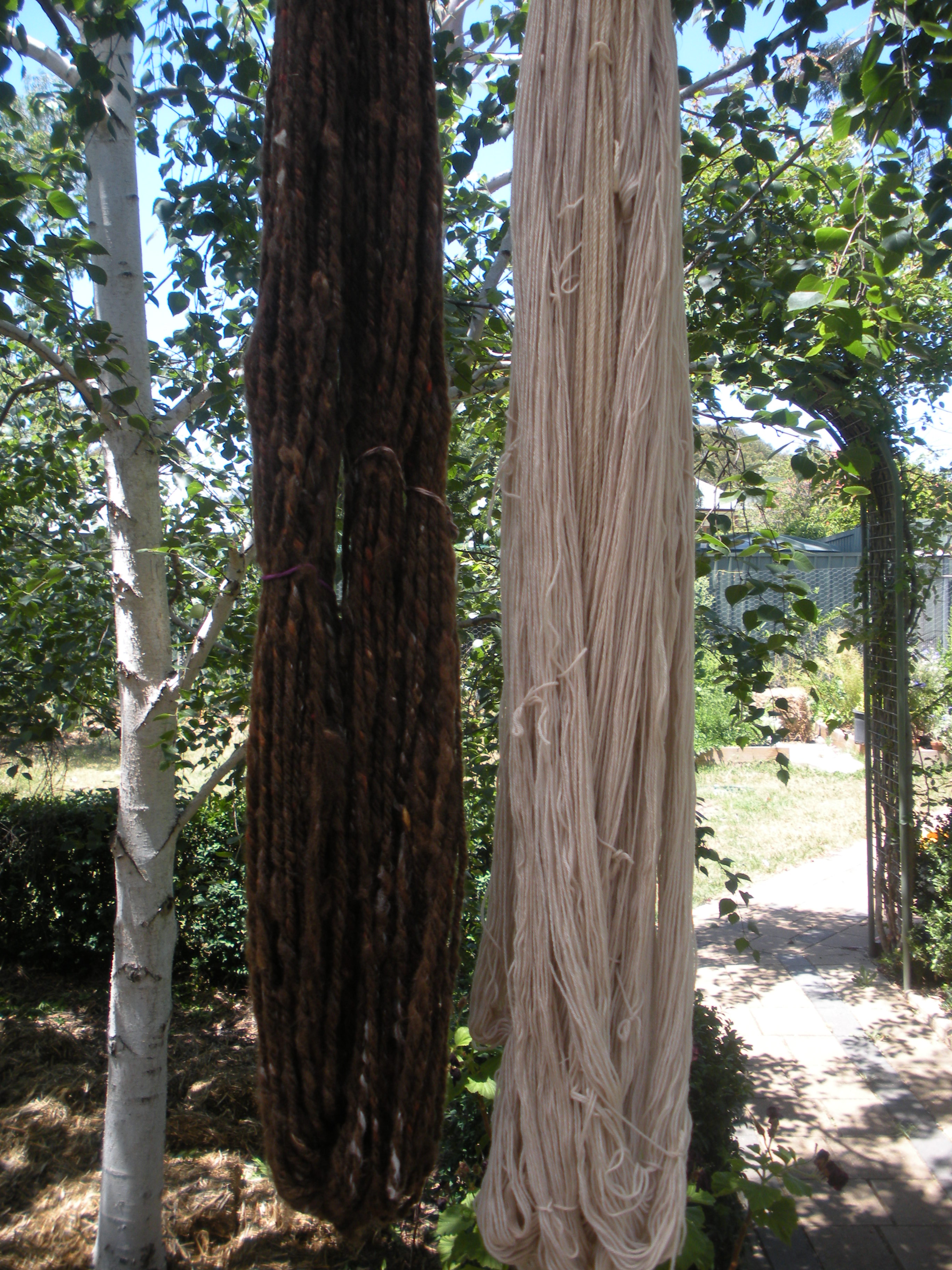
The mohair is ready to have seed heads picked out of it and to become part of some textured batts for corespinning and other good times.  Meanwhile, I have been preparing for a natural dyeing workshop focusing on eucalypts.  Again, I need to provide materials, so I’ve been laying in what I need.  It’s the season for bark collection so I have been touring the neighbourhood with my trusty bike trailer and a chook feed sack, pulling over if I’m passing in the car, or wandering out with a bucket, whichever may be appropriate to the day and location of the tree.  In short, I am keeping the E Scoparia bark that is falling to the ground from being blown away, tidied up by others or crushed on the road.  I have almost 3 sacks full so far.  Seeing the bark shedding has allowed me to run test dye pots on a few trees I had been unsure of with more confidence.  I’ve found several more specimens in the local area.  Meantime, I have been mordanting fibres (wool with alum on the right) and continuing to convert my sow’s ear fibre into slipper-suitable yarn (left) as I knit up what has already been spun. I think that particular batch of unlovely spinning may finally be over.  Two pairs of slippers are knit, one to go.

I’ve been converting milk bottles into sample cards, writing up notes and assessing the state of the Guild’s dye room.  Today, I’ve got soybeans soaking ready to mordant cotton for the workshop.  It has me wanting to dye…

10 Comments

Filed under Dye Plants, Fibre preparation, Spinning

Book review: From Sting to Spin by Gillian Edom

After my recent failed experiment in processing nettle fibres, I bought Gillian Edom’s self published book From Sting to Spin: A History of Nettle Fibre (Urtica Books, Bognor Regis, England, 2010, ISBN 978-0-9565693-0-1).

This is a slim volume which brings together the evidence for the textile uses of nettle with a strong focus on Europe and on the stinging nettle, Urtica Dioica.  Gillian Edom examines archaeological evidence from ancient times through to the second world war.  She considers Indigenous peoples’ usage of nettle fibres briefly as well as discussing the huge number of different plants which collectively make up the nettle family.  She has also gathered intriguing quotes about nettle fibres from literature, fairy tales, scientific writing and even religious works.
I found this account of the historical record very interesting.  Edom concludes that though there are many references to the use of nettle fibre in European history, very little can be conclusively demonstrated about the historical use of nettle fibre from the physical evidence alone.  It is clear that while ramie (Boehmeria Nivea) has been and continues to be produced in commercial quantities, stinging nettle has proved resistant to industrial-scale production despite numerous attempts, particularly during the straitened circumstances of the world wars in Europe.

Unfortunately for me, there is very little information in this work about how to process nettle fibres, though there are clues and some basic instructions.   There are also references to the methods of those who have tried to process nettle in the past, setting out parts of the process used in different parts of Europe at different times.  They make it clear that while some people have succeeded in making high quality yarns and fabrics from nettle and nettle blends, many attempts have produced a poor quality product.  Removing the woody parts of the plant has proved challenging for many who have attempted the task.

I was interested to discover Netl, a Dutch company which has begun using nettle fibre to produce high end fashion clothing.  Perhaps the story of nettle will continue not only in the hands of the individual craftsperson (as Edom suggests), but on an industrial scale, into the future.  As she concludes:

Anyone… may experiment and call on the experience of others and that of our ancestors, to prise the lovely fibre from the hated stinging nettle in our own back gardens (page 55).

I would have been delighted to have a little more concrete advice from others who have succeeded where I have–so far–failed.  However, Edom has inspired me to try again when the season is right.

8 Comments

Filed under Book Review

Eucalyptus Torquata: Leaf Prints and Modifiers

Remember my modifier experiment?  I have two jars of wonder, based on Jenny Dean’s instructions.  One contains offcuts of copper pipe from my Dad, vinegar and water.  It’s been steeping for months.  My first effort at iron water didn’t work out as I’d hoped, more like a science experiment!  This one is based on my friend’s collecton of bent nails.  He has been turning pallets into furniture, so he has removed a lot of nails.  They got left out in the rain and, bless him!  He thought of me.  Here they are, left to right:

Mystery Science Experiment, Rusty Nail Water, Copper Pipe Water.

Here are my E Torquata samples on hand spun wool and commercial wool/hemp blend:
Unmodified at the top, Iron modifier next, Copper modifier at the bottom.  I have to admit, this isn’t a deeply exciting result.

And here are my E Torquata leaf prints on recycled linen (the darker one was the side against the cast iron pipe):

Here are the prints from my ‘is it E Scoparia?’ experiment.  The answer is a tentative ‘yes!’  Recycled linen on the left, recycled silk on the right.  I included the very young, soft, green foliage you can see printed toward the bottom partly because I have been asked whether it is true you need to use young foliage to get good leaf prints.  My experience is that you don’t (though of course, you can).

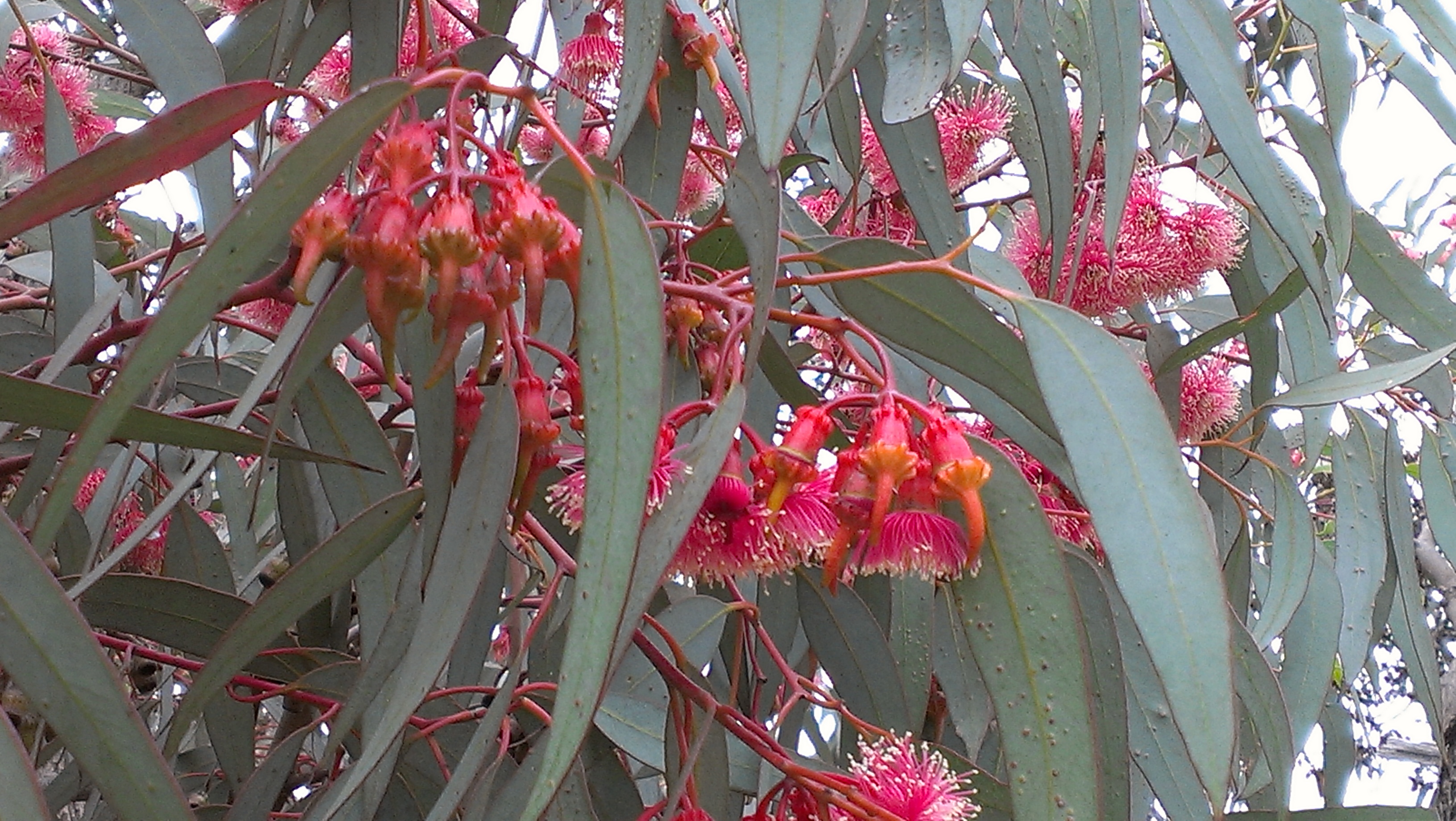
Finally… a gratuitous photo of an E Torquata flowering very pinkly in a car park in my place of work.  One of my co-workers came out of the building to see me with a pile of papers in one hand and my phone in the other, and said: ‘What are you doing, Mary?’  As you would, really.

4 Comments

Filed under Dye Plants, Eucalypts, Leaf prints, Natural dyeing