Tag Archives: user error

A pair of backyard Eucalypts…

Recently I discovered that a friend who has one of the biggest E Cinerea trees I have ever seen in her back yard would like some of it removed.  I offered to cut and take away the dead and insect affected parts, to her surprise, and have now made three visits to do just that. I’ve begun some dye pots with alpaca another friend has asked me to dye.

IMAG2075

On the second visit to trim the E Cinerea, my friend’s partner spoke about the loss of a bough on their other eucalypt.  I looked closely at this second very large tree with rough, fibrous bark on the trunk and very narrow leaves and ‘Eucalyptus Nicholii’ went through my head.  Could I at last have found a fully grown specimen?  It branched so high and the ground had been so thoroughly cleared in the effort to remove all the fallen material that I couldn’t find fruit.  I did manage enough leaves for a dye pot however… and it is very promising! I heated the leaves for an hour, dropped the sample card in and went for a bike ride leaving the heat off.  When I got back:

IMAG2078

As I write I have added some alpaca fleece.  I will have to wait to make a more definitive identification… I have sometimes found that all the hours I’ve spent with books on Eucalypts have created the context for me to have a correct intuition about a particular tree.  Equally often, though–I have completely the wrong end of the stick!  But the alpaca is looking good as it sits draining…

IMAG2101

8 Comments

Filed under Dye Plants, Eucalypts, Natural dyeing

Revelations at the drum carder

Recently I made good on my intention to properly clean and oil the drum carder.  It meant I had to find the instruction sheets.  And that was when I had the revelation that my drum carder has two speeds.

IMAG2086

Conceivably, this was a selling point when I decided to buy it–that does sound curiously familiar–and I had managed to completely forget.  I have had it on the setting which would be ideal for blending roving for some years.  That’s been good sometimes, because it really does make a great batt for artyarn spinning, and there has been quite a bit of that at my place.  However, I have struggled to make great batts from fleece, sometimes with a lack of patience, I admit.  But there has been plenty of trying and some of it has been patient.  So, I have been applying my newly oiled and cleaned carder to some Polwarth fleece on the correct setting, and wonder of wonders, it actually is better!

IMAG1884

I have also been carding some of the lower quality end of my enormous stash of Polwarth and spinning it fat, soft and three ply with YET MORE Fibertrends Clogs in mind.  The short cuts and brittle ends will never be seen again once they’ve been felted.  And I have to say the spinning is a lot of fun.

IMAG2082

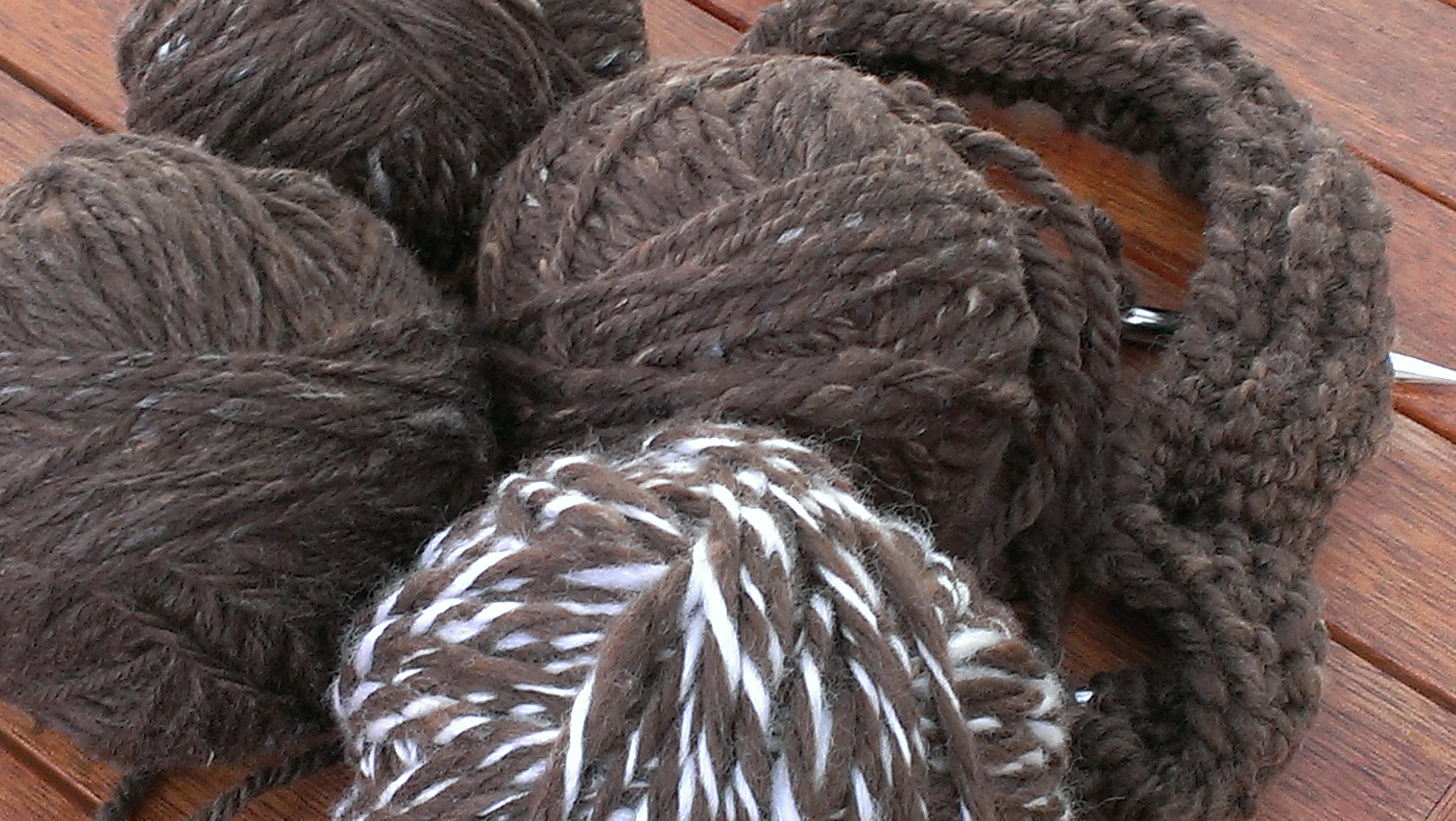
Every time I use the drum carder and pick up the doffer–a long pointed metal tool for removing the batt from the carder–I find myself earwormed with a folk song called The Doffing Mistress.  The link is to the singing of Maddy Prior and June Tabor, two of the shining stars of English folk music over some decades.  The quality of sound is no doubt better on iTunes, but this version comes with a description of the job of a doffer in the period after the industrial revolution.  I am very glad not to be a small child pulling bobbins on and off an industrial spinning machine to earn sufficient to eat…  Instead, I have been hand winding big fat balls of this yarn, since it is a bit thick for my ball winder.  Let the knitting begin!

IMAG2118

4 Comments

Filed under Fibre preparation, Knitting, Spinning

Austral Indigo 2: Hydrosulphite vat process

My second experiment with Indigofera Australis was a hydrospulphite vat. Robyn Heywood from the Victorian Handspinners and Weavers Guild has made her experiments with Indigofera Australis available online. I was delighted to be able to see the records and samples of the Victorian Handspinners and Weavers dyeing group at their Guild Rooms when I was in Melbourne last year.  It was really inspiring to see the variety of methods they had used and the range of colours they had achieved.

Robyn Heywood has trialled this method as well as the cold vinegar method and provided instructions.  So, since I still had some hydrosulphite left from my last indigo vat, I decided to try it.  Robyn Heywood soaked the leaves… apparently it is too much to expect that I would follow instructions exactly.  I blended them and left to soak for a couple of days. Here they are 18 hours later.

IMAG1614

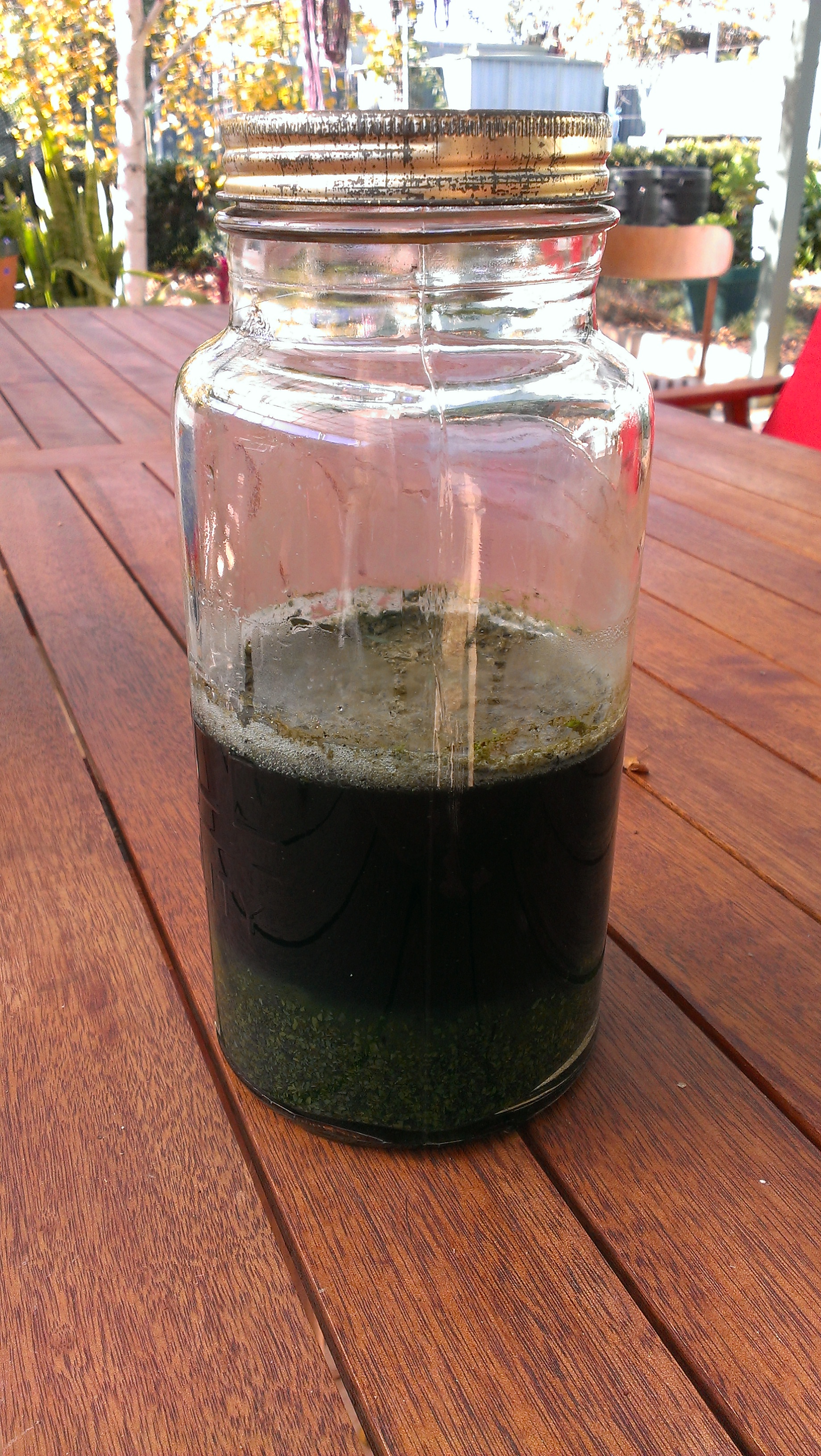
Robyn’s proposal was to leave them in a warm place.  I created one the first night by sitting my vat in a bucket of warm water, and then since the days aren’t warm right now (17C maximum)– the best I could do was a sunny spot.  48 hours later–or so–I started in on the preparation of the vat.  First, I sieved out the plant matter.  Then, added washing soda.  Now for aeration.  I went with the trusty blender method, which I was sure would introduce a lot of air.  Before:

IMAG1624

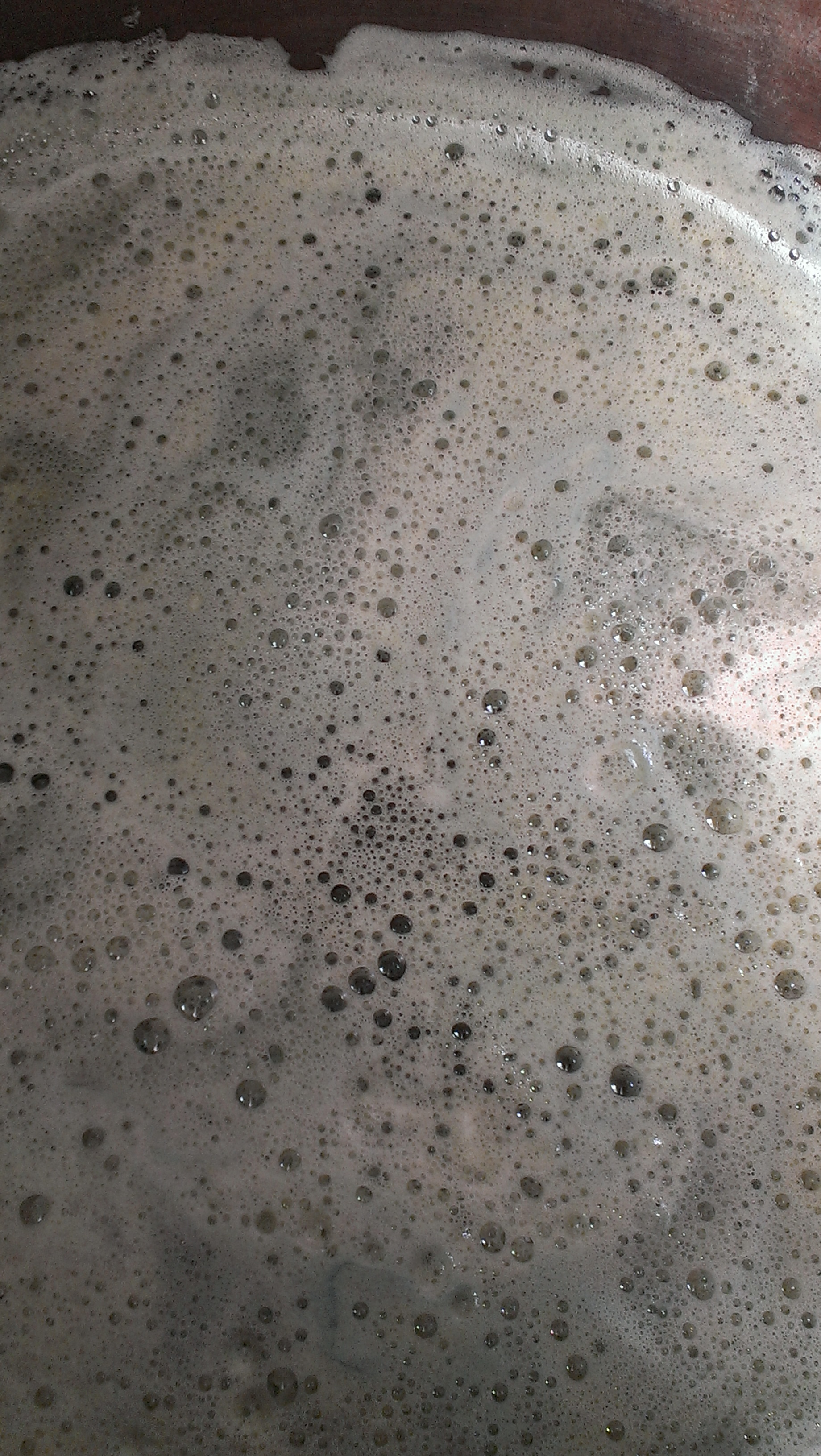
After:

IMAG1629 (1)

I watched sceptically, but indeed, the bubbles did turn from green to bluish!  I prepared a hot water bath to raise the temperature of my vat.  I put the jar into it.  I turned away, and a few minutes later there was an almighty crack as the jar came apart.  Rude words were used.  On the down side, I now had glass shards I couldn’t see in my dye;  evidence of poor judgment on my part; a  broken jar and a clean up job.  My dye bath had at least 1.5 litres of water added to it, so probably now had three times the amount of water I had decided on (that sounded like a weak vat to me!)  And it was now in a stainless steel dyepot, along with whatever contaminants it contained after being rinsed out.  On the up side, the bath got to 50C almost immediately and the bubbles were still going blue.

IMAG1632

‘Press on, how do I know what will happen?’  I thought.  ‘Don’t be wasting that precious dyestuff’, I thought.   I got out my trusty milk crate/felted blanket dyebath insulating system, filled up one hot water bottle which promptly sprung a leak; filled up another hot water bottle, sprinkled on the dye run remover, applied hot water bottle and felt blanket to vat and walked away.  ‘Que sera, sera and all that’,  I said, sighing.  Well, I need not have sighed, because the vat turned a vivid yellow.  In went some silk/cotton thread and a piece of hemp fabric.

IMAG1641

They came out bright yellow and turned green and then blue-ish almost immediately.

IMAG1649

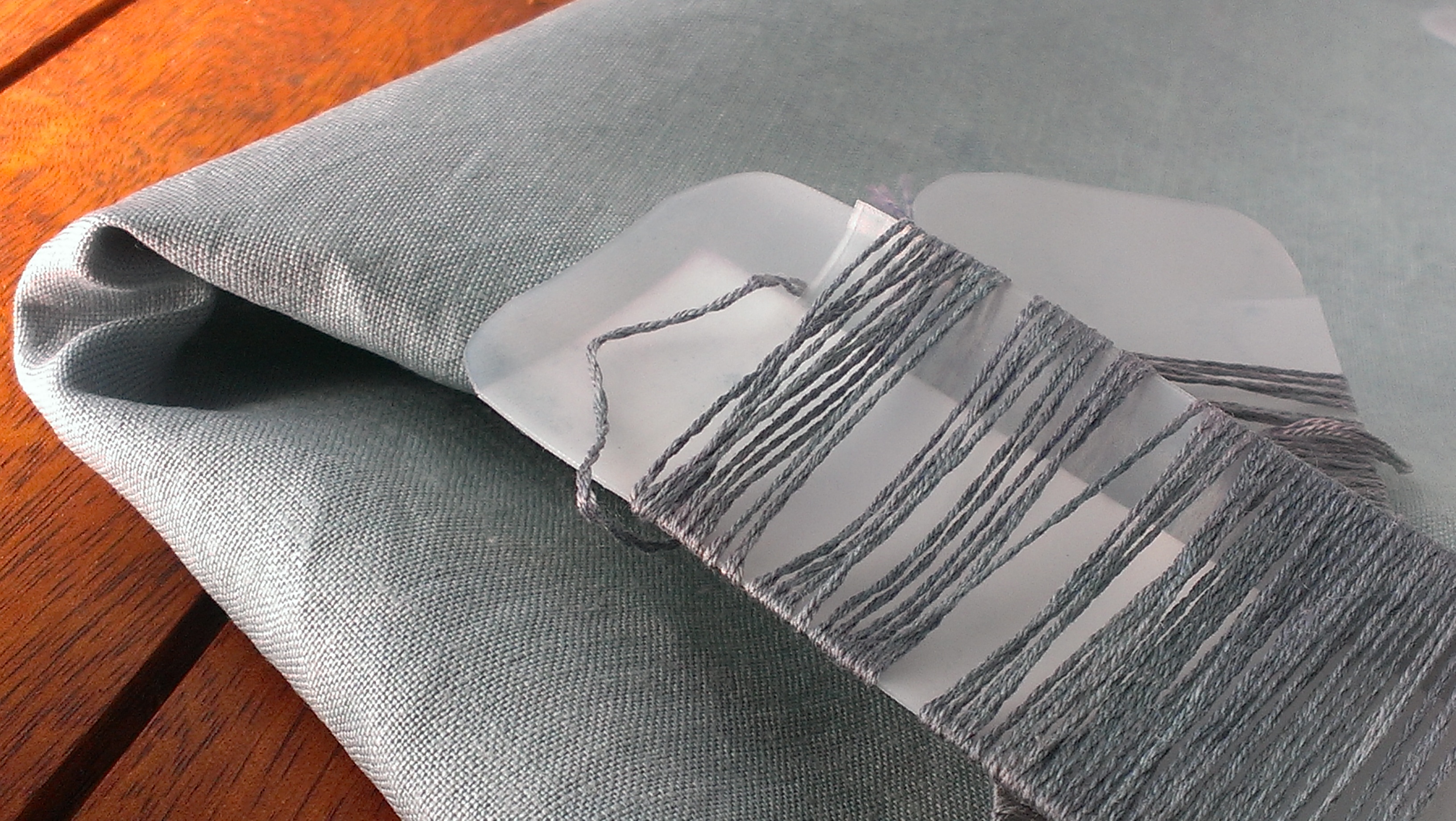
And so, to re-dipping, gleefully (and repeatedly).  Yield: several lengths of silk thread in shades of blue and grey, and a piece of pale blue fabric.  I have plans for them.  I am not sure whether this amount of leaf would always have produced a pale shade and to what extent my accidentally diluted dyebath contributed.  But, some blue resulted, and that part is excellent!

IMAG1664

6 Comments

Filed under Dye Plants, Natural dyeing

Dyeing in Katoomba–and some local-to-Katoomba eucalypt species

Just recently I had a short holiday in Katoomba (New South Wales).  I spent part of a day doing some dyeing with a group of friends who meet as a textile group.  One of my dear friends did a lovely job of organising a space to meet.  The group had a lot of great skills–with artists, a chemist, bush regenerators, plant identifiers and a librarian among them.  They had read and been inspired by Eco-ColourIndia Flint‘s fabulous book on natural dyeing in which she sets out the eco-print process.  But they had not had a great deal of success and some had formed the view that we have special trees in South Australia.  Of course, we do have special trees in SA, and so do they in NSW!  I tried to explain that it was far more likely a question of species than state boundary…

I love the stages in this process of setting up and bundling…

IMAG1508

Cooking…  we ran one pot with vinegar, one with iron and one with onion skins (the orange bundles have spent time in the onion skin bath and then been moved to a different pot).

IMAG1532

And then the big reveal!  It reminds me of that fantastic Judy Horacek cartoon… which by coincidence my friends have up at their place in Katoomba.  Please follow the link to be introduced to a wonderful Australian cartoonist–and to see the cartoon!  E Scoparia and E Cinerea on wool:

IMAG1559

With so much expertise–and because my wise and sweetheart friends who were hosting our holiday as well as dye day had been out collecting and applying plant knowledge–we were able to try out some local species.  These samples are all on silk noil scraps, and have all been in hot water for at least an hour–just to test their potential really.

IMAG1513

We couldn’t resist trying Indigofera Australis even though it didn’t seem likely a hot process would be ideal for an indigo-bearing plant.  It wasn’t, leaving almost no mark except when dipped in an iron modifier.  Here it is, before and after.  The yellowy-greenish tinge is an effect of photography indoors.  Sorry about that part.

IMAG1521IMAG1561

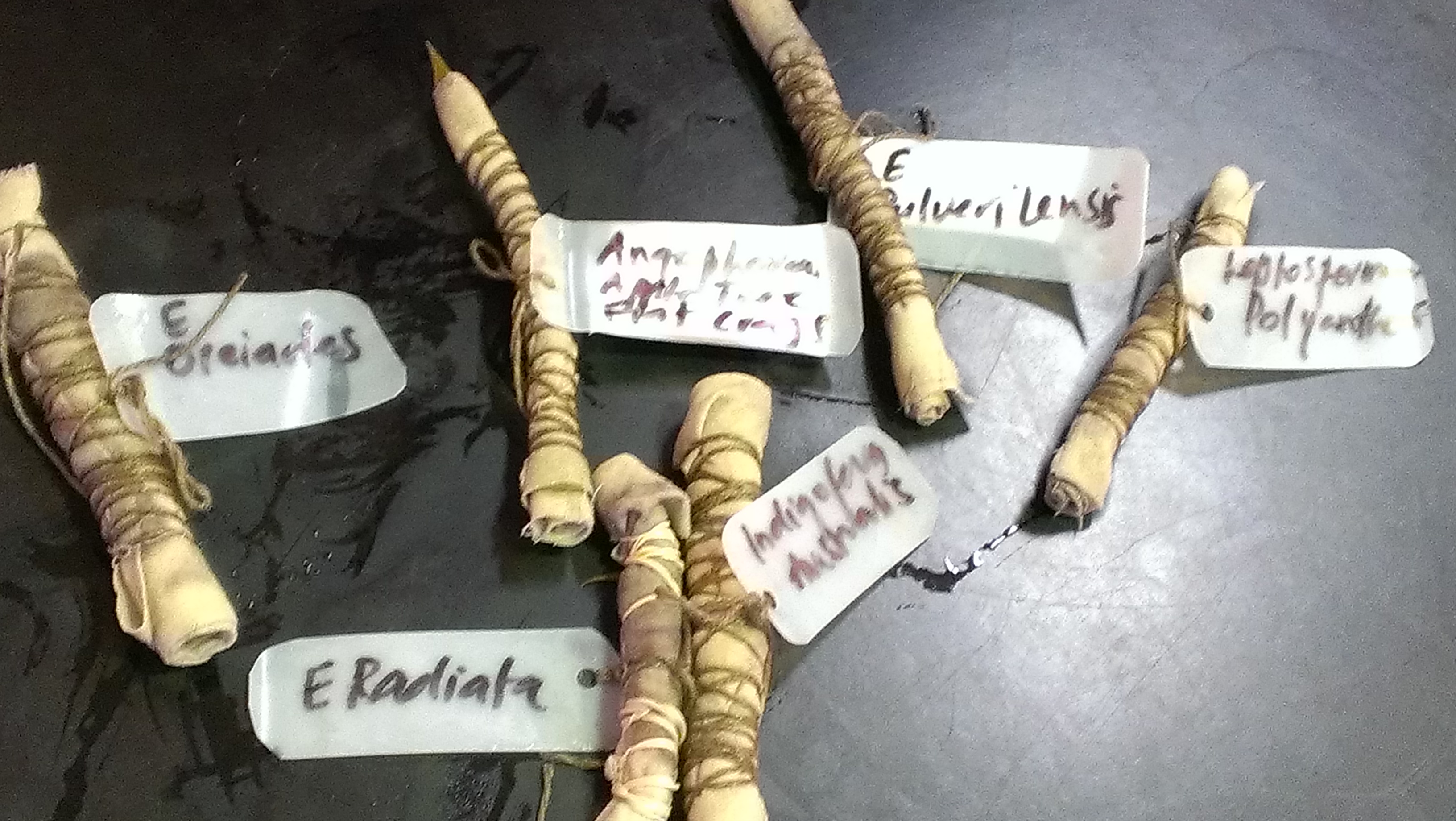
E Radiata, the Narrow-Leaved Peppermint:

IMAG1515

One of the especially beloved and tall local species is E Oreades, the Blue Mountains Ash–a truly local-to-Katoomba tree:

IMAG1517

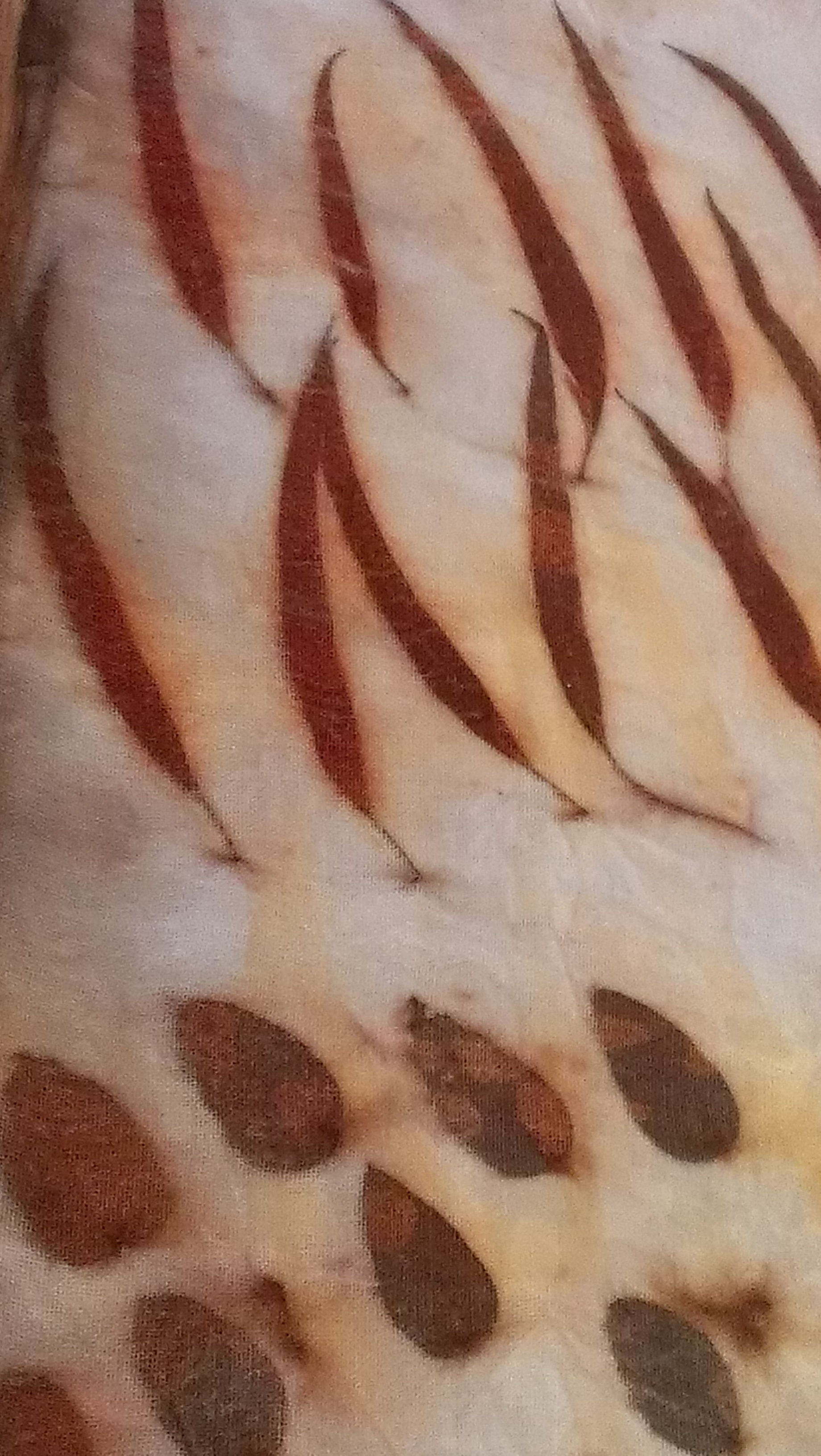
And finally, E Pulverulenta, the Silver-leaved Mountain Gum, is a vulnerable species in the local area.  As a result, people who want to make sure it lives on are planting it in towns, and this sample came from a street tree.  Dyers will now have an additional reason to support the conservation effort!

IMAG1518

A big, big thanks to my Katoomba friends, and to the textile group for having me!

7 Comments

Filed under Dye Plants, Eucalypts, Leaf prints, Natural dyeing

Another workshop done!

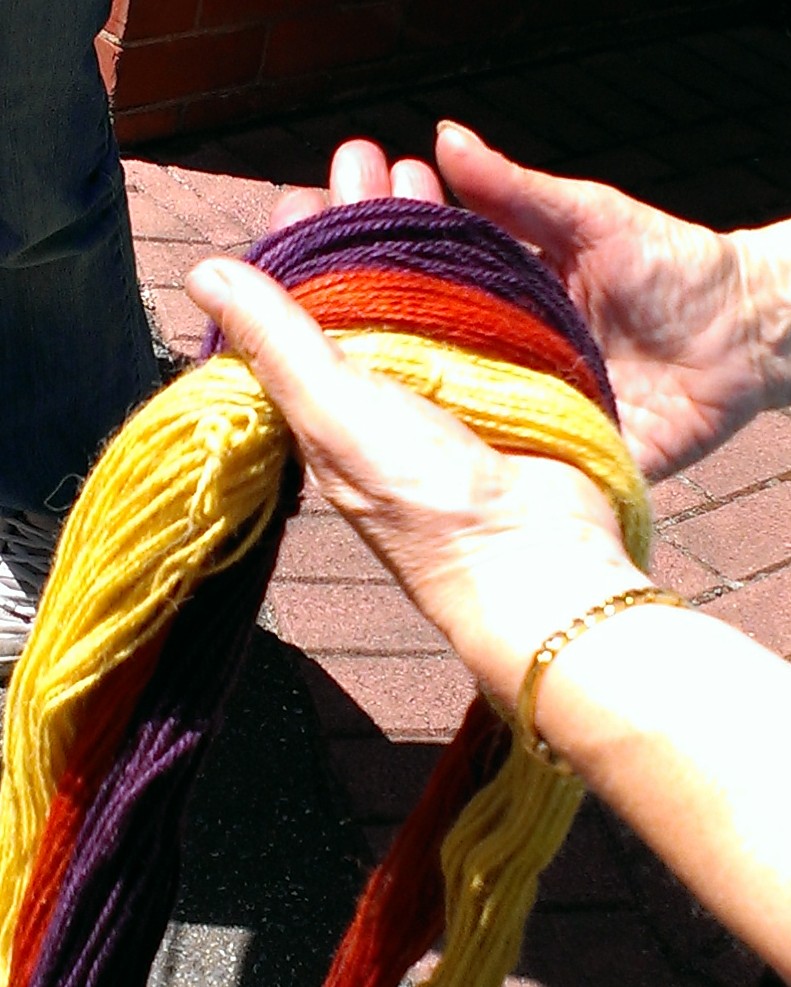
The second in my little series of workshops at the Guild went really well. There was yarn, fleece and roving dyeing.  Brown, orange, almost-red and maroon from E Scoparia (bark and leaves) and E Cinerea leaves, yellow from silky oak (Grevillea Robusta) using Ida Grae’s recipe from Nature’s Colors: Dyes from Plants, and the ever-astonishing purple from red sanderswood with alum.  I again used Jenny Dean’s method from Wild Colour and still got nothing like the oranges she suggests are likely.

IMAG0896

Mysterious outcomes in natural dyeing are not all that uncommon (at least for me!), as the number of variables is so huge.  But this one is out of the box–purple!?  Since my last post on the subject, Jenny Dean has very generously been in touch with her thoughts on the matter.  She suggests this purple could be the result of alkalinity (but given I made no attempt to generate an alkaline bath, it seems unlikely it was seriously alkaline).

Or–and I agree with her that this is much more likely, even though I used 4 different jars/packs labelled “sanderswood”–perhaps the dyestuff  was never sanderswood to begin with.  The colour is very, very like the logwood results I have had, just about indistinguishable.  I am still not complaining about the result–I love purple and so did the participants.  I was hoping for purple on this occasion, as I have no more logwood–that I know to be logwood.  Perhaps there was a time in the past when a batch of “sanderswood” came to our Guild or a supplier nearby and all the different jars I’ve used ultimately can be traced back to the same mislabelled supply. This would fit with my experience of Eucalypts… it is much more likely that I have misidentified my tree than that the dye bath is giving a completely different colour.  Variation to some extent, however, is completely expected.

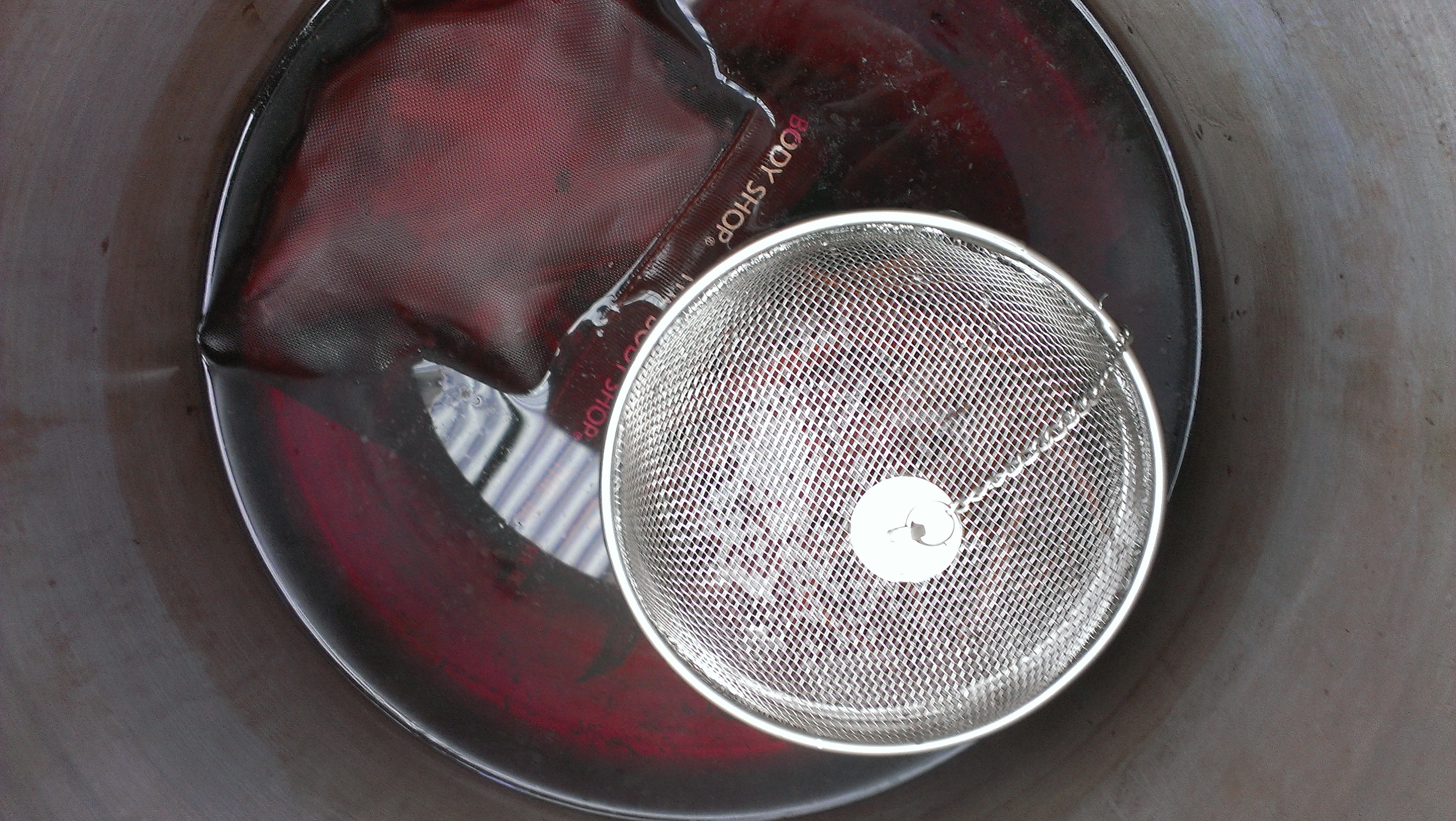
Here is the “sanderswood” just after I poured boiling water over it–Jenny says this looks like a logwood bath to her.  I bow to her much more extensive experience and wisdom, without hesitation.

IMAG0862

I have the biggest chips in a little zippered mesh pouch that must once have held toiletries.  The smallest chips/splinters are in something that looks just like a giant tea ball.  I saw it for sale in a Vietnamese grocery where I was investing in greens, seaweed and soy products and immediately saw its possibilities.  The woman who sold it to me had an eye-popping moment (evidently she hasn’t sold one to an Anglo before), and asked me what I was planning to do with it.  I love those moments in Asian groceries, because once I’ve been ask the question and given my (admittedly bizarre) response, I can ask about the ordinary use of the device or food in question.  This one is usually used to contain whole spices when making a big pot of stock or soup.  This point was helpfully illustrated by a packet of soup seasonings–star anise and cinnamon and coriander seed were some of the spices I could identify right away.

People tried out India  Flint‘s eco-print technique on cotton, wool prefelt and silk.  I hope she will get some extra book sales as a result (if you’d like to acquire her books, click on the link to her blog and look for the option to buy them postage free in the left hand sidebar).
IMAG0871

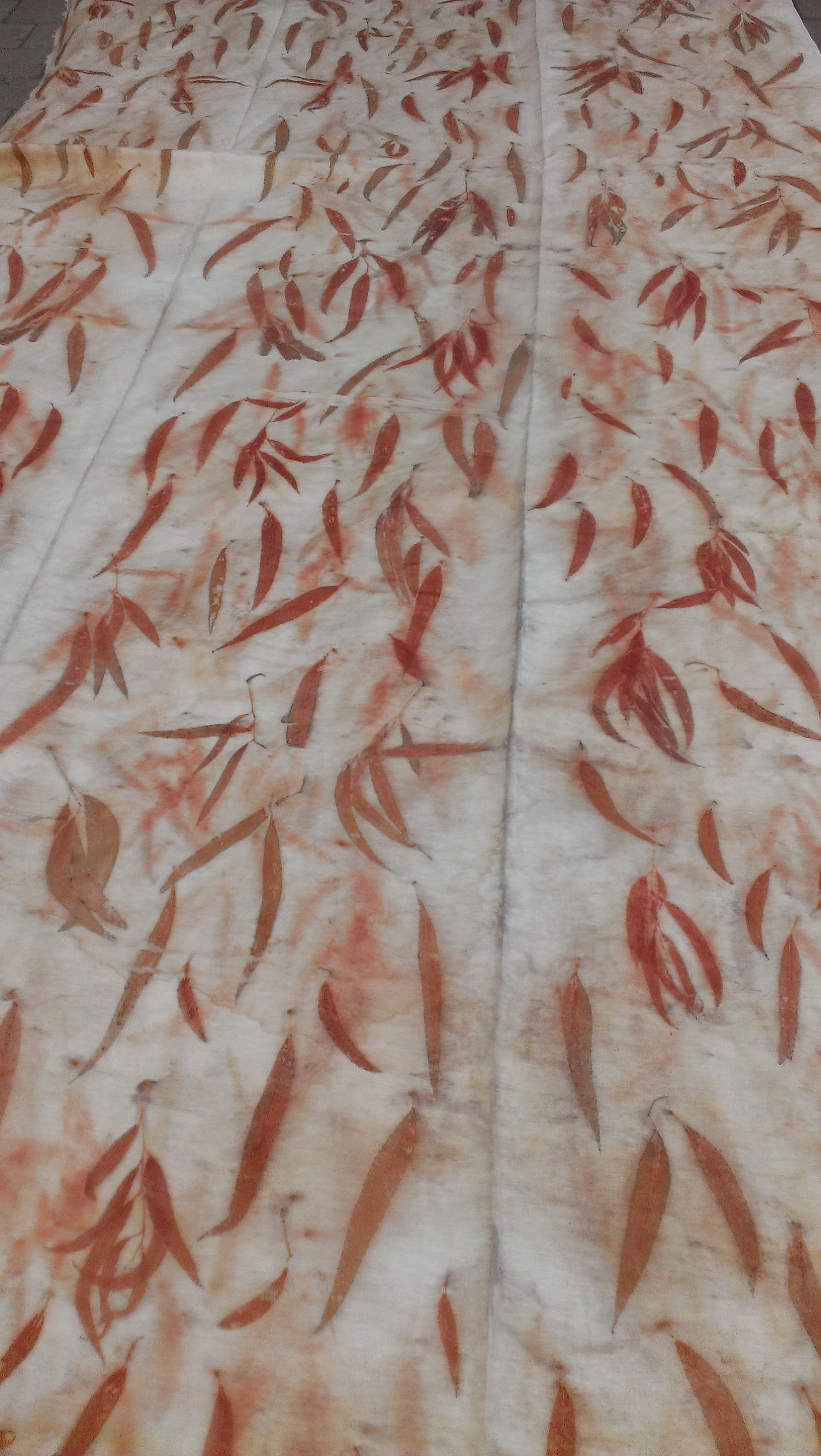
There were biscuits and icy poles and lots of chat.  I demonstrated soy mordanting and black bean dyeing.  And while we were at the Guild and using the copper, which is such a generously sized vessel by comparison with my dye pots, I leaf printed some significant lengths of fabric that I brought to the workshop bundled up and ready to go.  The copper really is copper lined, but I could detect no obvious impact on the colours.  Seedy silk noil:

IMAG0903

Wool prefelt… the degree of detail is fantastic.  This is destined for felting experimentation by a dear friend who generously assisted me at the workshop.  Her practical help, support, constant grace and good cheer made things go so smoothly.  I also decided to start some processes before participants arrived, which I didn’t do at the previous workshop.  I think that helped.  But it was a fabulous group of people too.

IMAG0913

And finally, silk/hemp blend, destined to be made into a shirt (by me, so it may take a while).  I am delighted with how it turned out, after many months of putting off the day.

IMAG0924

9 Comments

Filed under Eucalypts, Leaf prints, Natural dyeing

Things I’ve done with with plant dyed yarns…

When I was preparing for the natural dyeing workshop I ran recently, I mordanted a lot of Bendigo Woollen Mills yarn as well as some handspun in small skeins–25g or less.  Having all those small skeins of different colours in alpaca and wool and mohair, activated my imagination. Eventually it led to this…

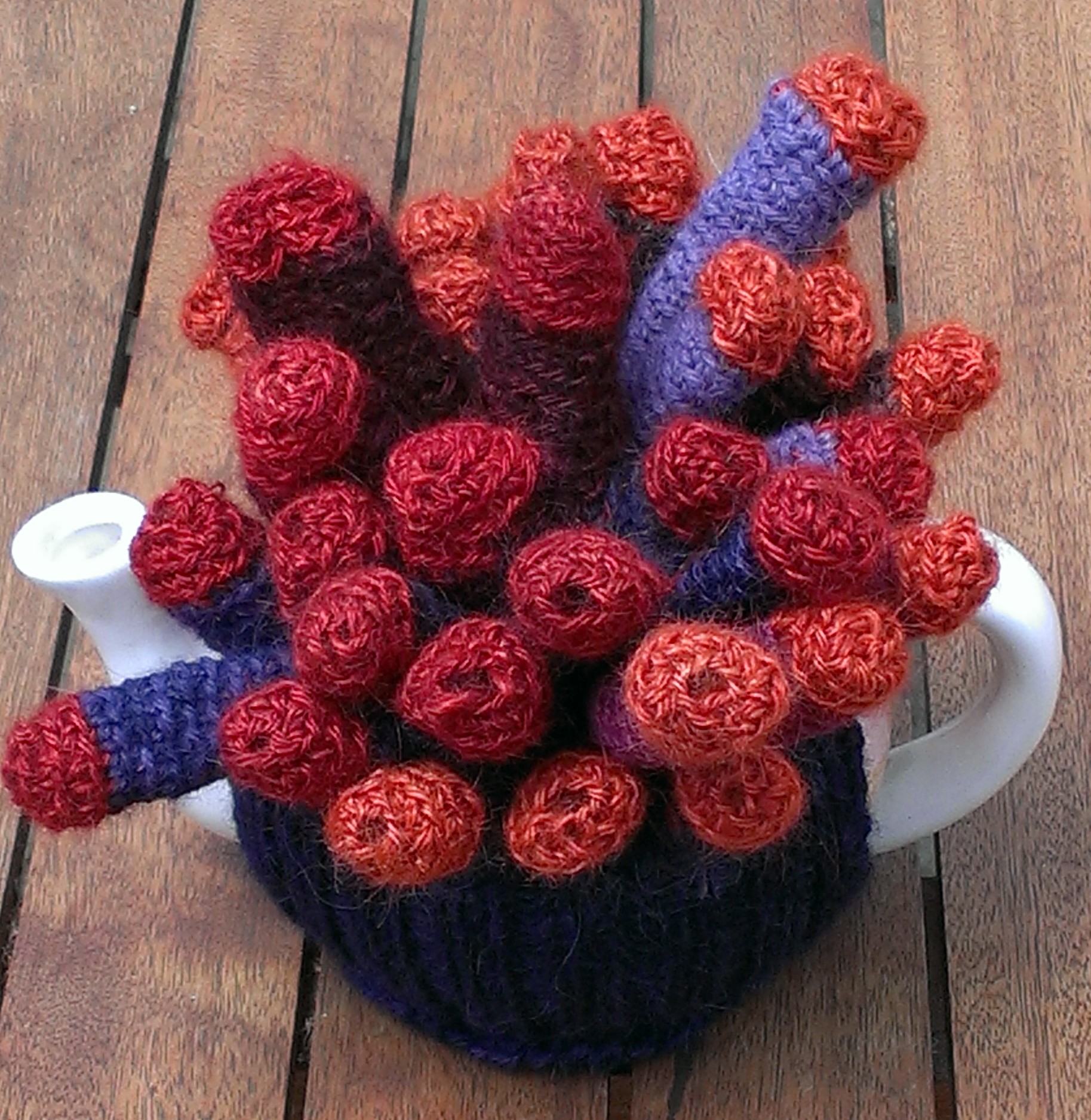
IMAG0792

These are madder-tipped, logwood-stemmed crocheted coral thingummies, inspired by Loani Prior’s ‘coral punk’.  When I say ‘inspired by’, let me confess.  I bought her beautifully designed and entertaining book Really Wild Tea Cosies with a Christmas book voucher I was given.  So I had the pattern.  But even though only one, basic, crochet stitch was involved, my crochet skills are decidedly remedial and I don’t happen to have a crochet instructor on tap.

I turned to Maggie Righetti’s book Crocheting in Plain English (I don’t have the new revised edition, needless to say).  Apparently sometimes I just can’t believe what I am reading… or perhaps I just don’t understand on the first eight passes.  I see students I teach with the same difficulties!  By the time I had finished this tea cosy and started on the next, I’d managed to figure out that I wasn’t doing what Loani Prior must have believed was involved in the one stitch involved in her cosy.  Luckily for me crocheting badly still produces a fabric of a sort.  I also figured out that for me, improvising a knit version of the pot cover itself was going to beat freeform crocheting one as the pattern suggests with my inadequate skill set.  So that’s what I did, and Loani Prior shouldn’t be held responsible for the outcome.  I like it anyway.

IMAG0843

It has highly entertained people who watched me crocheting coral at parties (as one does) as well as those who have seen the finished object, many of whom thought immediately of a sea anemone.

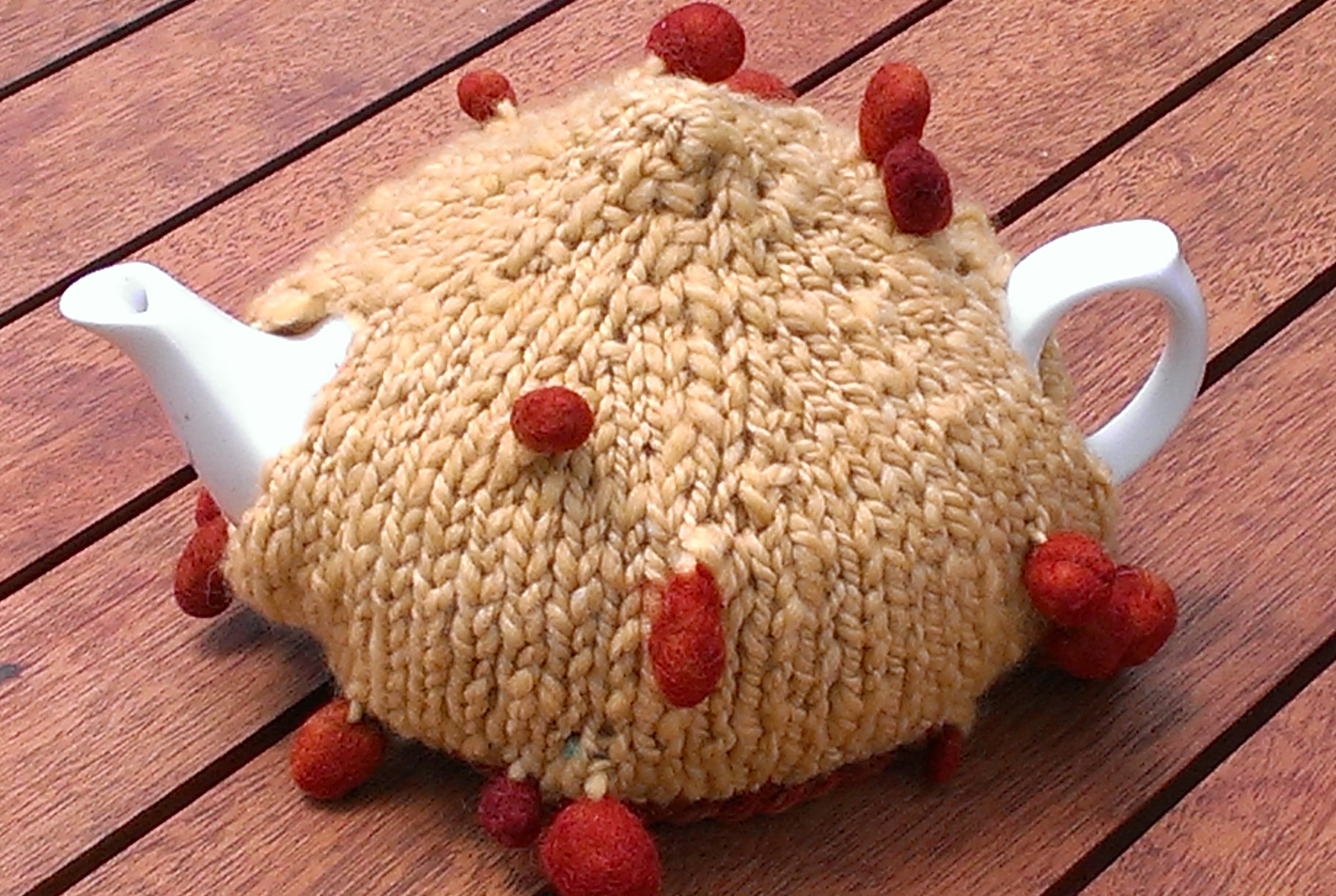
Let it be said that at present coral punk is not alone.  Here is the present plain Jane of the tea cosy selection at our place: yellow from silky oak leaves and orange from eucalyptus–with the felted blobs spun into the yarn.  Pattern improvised.  Luckily, tea pots are just not that fussy about how you clothe them.

IMAG0840

I’ve been branching out and using up some particularly strange art yarn spinning experiments.  This next one is commercially dyed mohair with silk curricula cocoons spun onto it.  Scratchy for a head, perfect for a teapot!  I was surprised how many people liked the look of the ‘hat’ emerging as I knit this at a picnic, riffing off Funhouse Fibers’ Fast and Fun Cozy.  Once again, that is to say, dispensing with the pattern when it became inconvenient.  I guess the hat admirers hadn’t felt the yarn yet.

IMAG0842

And for anyone who is wondering, I have continued to dye with the logwood exhaust from the dyeing workshop.  I ran out of yarn for a while and dyed two, 200g lengths of merino roving.  This morning I pulled out another 100g of superwash yarn.  I think it might be just about done, and I only wish I had kept a record of the weight of fibre that has been dyed with what was a small quantity of logwood in the beginning!  This weekend, the second in a series of two natural dyeing workshops. I’d better eat my crusts and get my beauty sleep in preparation.

IMAG0839

2 Comments

Filed under Crochet, Eucalypts, Knitting, Natural dyeing, Spinning, Uncategorized

Ironbark Mystery

This week I found some E Sideroxylon trees in a park with lots of low hanging leaves… too tempting.  So I harvested some.  I brought them home and made leaf prints.  I have obtained strong oranges from these leaves in the past, so imagine my surprise when I unwrapped them and saw this:

This is on the silk-faced side of a hemp and silk blend.  It did confirm for me that the silk-faced side should be the right side.  Here, on hemp-cotton blend:

Disappointed, I considered the possible reasons.  Perhaps those pipes were not cast iron but something else?  I didn’t think so. I re-checked that I still have my cast iron pipes stored separately from my welded steel pipes… yes.  Hmmm.  But then I checked the dye pot using the same leaves, that I was cooking at the same time as the leaf prints.  And the wool was barely tan, almost no colour at all.

So, the metal content of the pipe is not the explanation.  The leaves that had been cooking for 3 hours or more were still green looking.  The dye liquor was barely tan.  I would expect the leaves to be orange and the dye liquor to be strongly coloured.

What could explain this?  I went back to my sample cards to check I really had ever had success with E Sideroxylon and there were my samples, bright orange.  There are a lot of variables in natural dyeing, and season or rainfall or soil could make a difference, but surely not this much of a difference.  The most plausible reason is that this tree was not E Sideroxylon, and that when I have had perplexing results in the past, they have also been caused by using a different species.  So, I consulted my most detailed and sophisticated Eucalypt resource, Euclid.  This is a database of Eucalypts created by the CSIRO, an Australian government-funded scientific research organisation.  Euclid is an amazing tool, but when using it to identify a Eucalypt, an accurate result depends on accurate observations of the tree in question–so user error is still possible.

When I began learning about Eucalypts, I couldn’t tell an ironbark from a stringybark (for those still in this position, please accept my assurance that the difference is quite profound once you grasp it).  I finally worked this out when I tryed dyeing with E Melanophloia and got nothing.  Almost no change in colour.  I thought it was E Cinerea, which has a great reputation as a dye plant.  Well, Melanophoia is a pale trunked ironbark and Cinerea is a stringybark.  They do both have rough, deeply furrowed bark and silver grey heart or round shaped leaves and white-cream flowers, and there the similarity ends!

So… perhaps I am about to move my understanding of Ironbarks up a few notches.  Euclid and my observations reduced the number of possibilities down to 7 (from a possible pool of over 900 Eucalypts).  The plausible candidates are: E Rhombica; E Fibrosa subsp Nubila (Blue Leaved Ironbark); E Decorticans; E Fibrosa subsp Fibrosa (Broad leaved Red Ironbark) and, of course, E Sideroxylon.  I think E Fibrosa subsp Fibrosa is my front-running candidate… it looks very much like E Sideroxylon to me on Euclid even now my suspicions are raised.

Next thrilling update whenever I reach some new insight!  Unfortunately none of these new possibilities are in my ready reference (a book), so I may be observed under trees in the neighbourhood with my laptop in hand.  Well, it won’t be the first time.

6 Comments

Filed under Dye Plants, Eucalypts, Leaf prints, Natural dyeing, Uncategorized