Tag Archives: wool

Ironbark experiments: E Corynodes

On the weekend, I went to a fete at Black Forest Primary School.  They had a sensational community garden, complete with a sale of silkworms, 5 for a dollar!  Who could resist?  Clearly not me (you guessed), so there are 5 silkworms in the lounge munching through mulberry leaves.  More on that later.

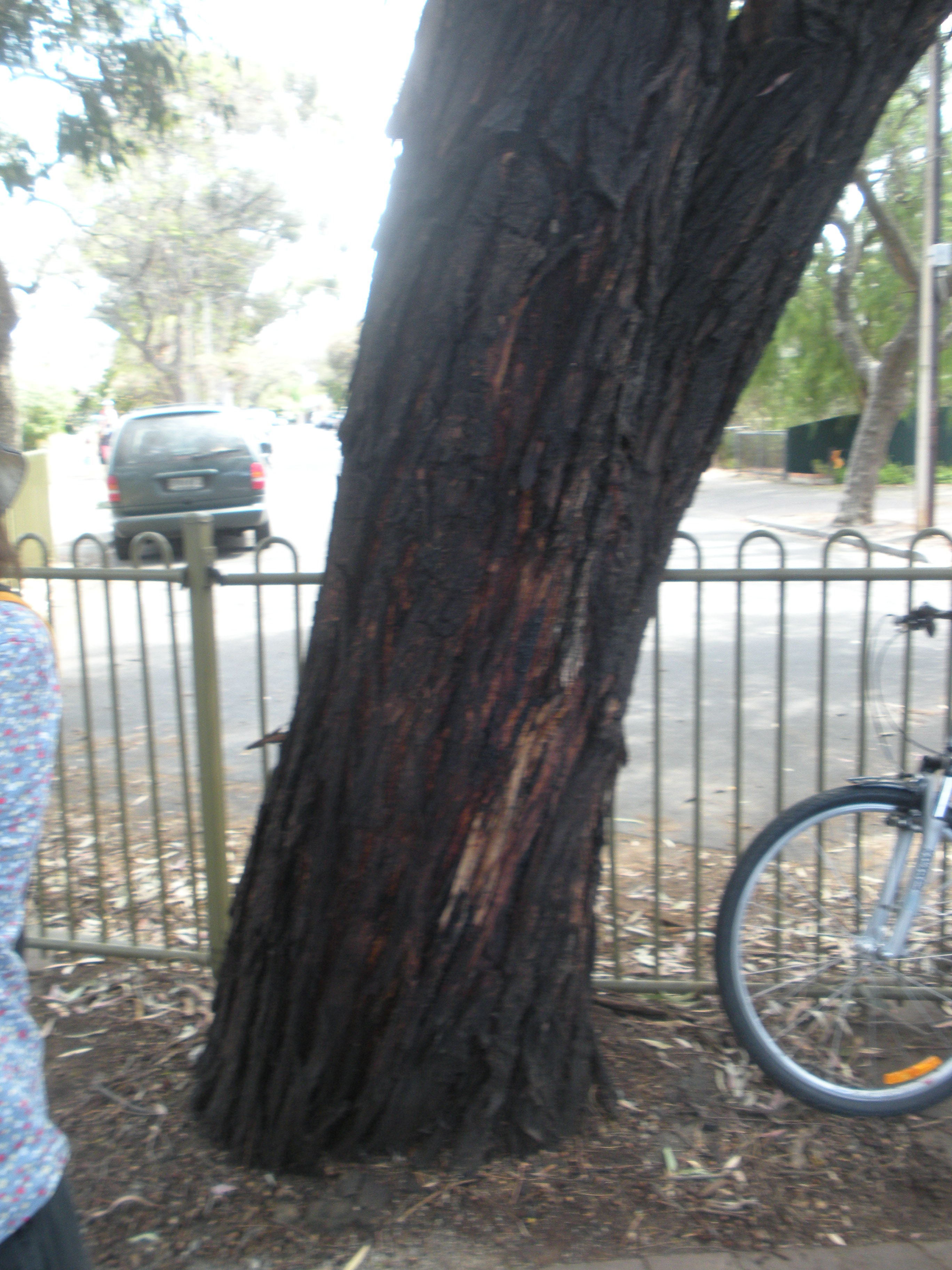
While my posse of friends and my house guests from Denmark were hitching up their bikes, I took a sample of the tree right at the dead end of Kertaweeta Ave Black Forest where we entered the school grounds, with the help of a taller friend.  Excuse the extra good photo….

This tree had smooth, pale bark in some of the finer upper branches.

I don’t know why, but I do not entirely trust the result that Euclid and I produced: E Corynodes.  Poor Euclid, depending on me.  There were no mature fruits, buds or flowers to consider, and that makes the result less dependable and the chance of detecting an error smaller. Euclid suggests E Corynodes can be confused with several other species, but look at this account of how to tell them apart!

E. fibrosa subsp. fibrosa, E. fibrosa subsp. nubila, E. melanophloia and E. rhombica … differ in having buds with stamens all fertile and irregularly flexed.  E. sideroxylon differs by having buds that hold the outer operculum into maturity and both the inner and outer operculum shed together at anthesis (no operculum scar).

So that would be obvious, then!  Based on this I wonder how I can be sure this is not E Sideroxylon, which would give orange too…  Because whatever its true name, this is the result I got.

Leave a comment

Filed under Dye Plants, Eucalypts, Natural dyeing

Eucalyptus Torquata: Leaf Prints and Modifiers

Remember my modifier experiment?  I have two jars of wonder, based on Jenny Dean’s instructions.  One contains offcuts of copper pipe from my Dad, vinegar and water.  It’s been steeping for months.  My first effort at iron water didn’t work out as I’d hoped, more like a science experiment!  This one is based on my friend’s collecton of bent nails.  He has been turning pallets into furniture, so he has removed a lot of nails.  They got left out in the rain and, bless him!  He thought of me.  Here they are, left to right:

Mystery Science Experiment, Rusty Nail Water, Copper Pipe Water.

Here are my E Torquata samples on hand spun wool and commercial wool/hemp blend:
Unmodified at the top, Iron modifier next, Copper modifier at the bottom.  I have to admit, this isn’t a deeply exciting result.

And here are my E Torquata leaf prints on recycled linen (the darker one was the side against the cast iron pipe):

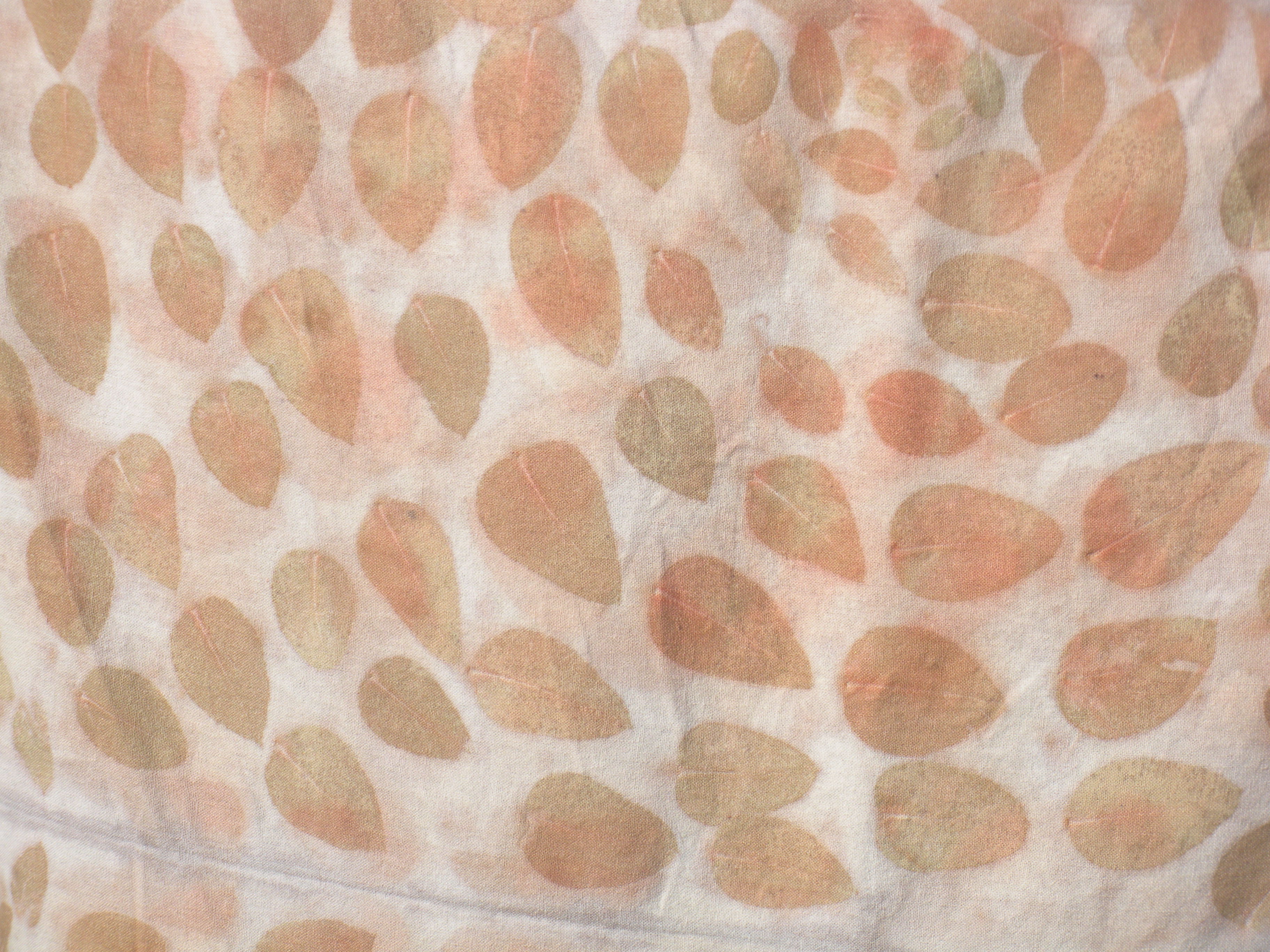
Here are the prints from my ‘is it E Scoparia?’ experiment.  The answer is a tentative ‘yes!’  Recycled linen on the left, recycled silk on the right.  I included the very young, soft, green foliage you can see printed toward the bottom partly because I have been asked whether it is true you need to use young foliage to get good leaf prints.  My experience is that you don’t (though of course, you can).

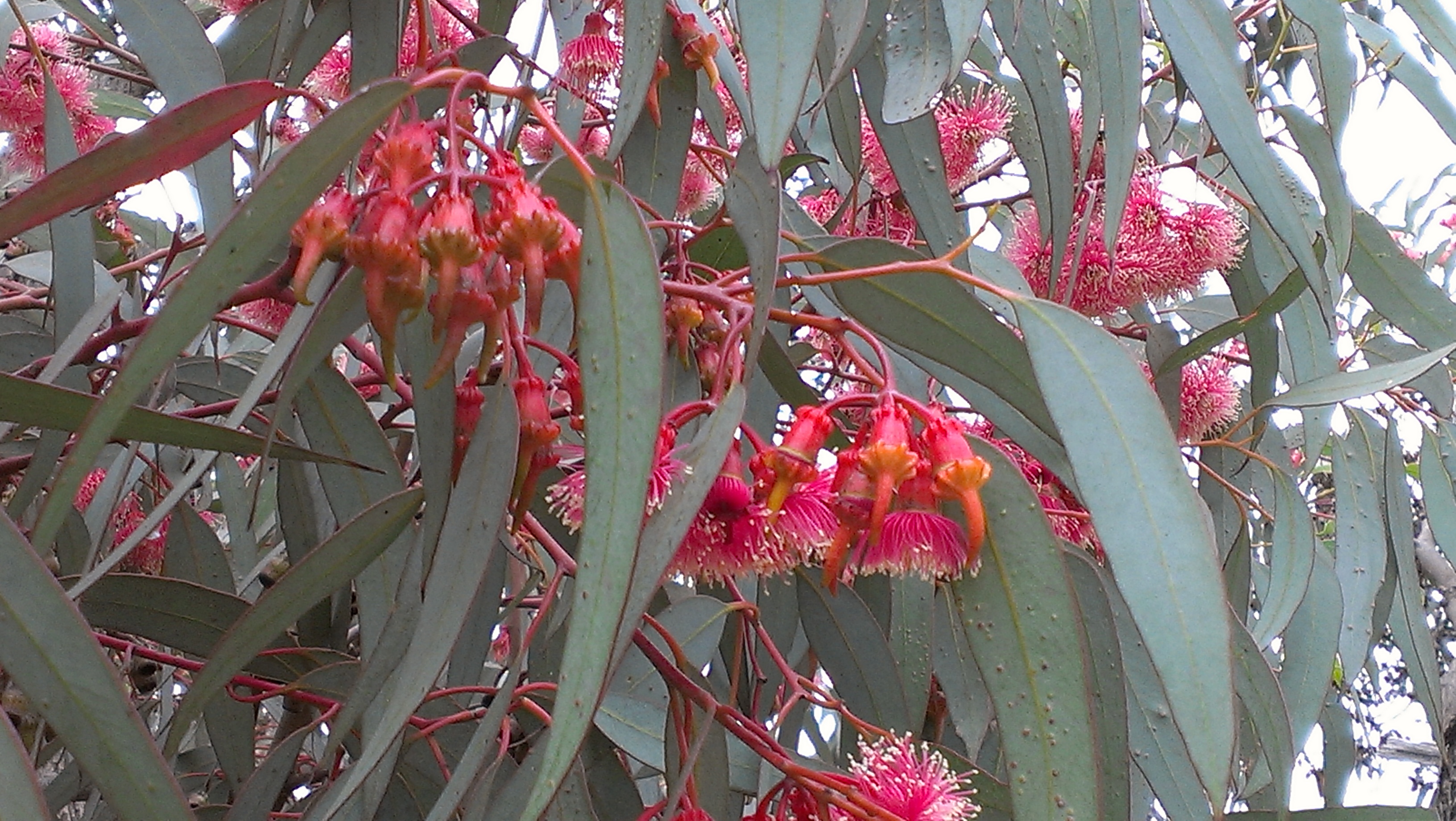
Finally… a gratuitous photo of an E Torquata flowering very pinkly in a car park in my place of work.  One of my co-workers came out of the building to see me with a pile of papers in one hand and my phone in the other, and said: ‘What are you doing, Mary?’  As you would, really.

4 Comments

Filed under Dye Plants, Eucalypts, Leaf prints, Natural dyeing

Ironbark Mystery

This week I found some E Sideroxylon trees in a park with lots of low hanging leaves… too tempting.  So I harvested some.  I brought them home and made leaf prints.  I have obtained strong oranges from these leaves in the past, so imagine my surprise when I unwrapped them and saw this:

This is on the silk-faced side of a hemp and silk blend.  It did confirm for me that the silk-faced side should be the right side.  Here, on hemp-cotton blend:

Disappointed, I considered the possible reasons.  Perhaps those pipes were not cast iron but something else?  I didn’t think so. I re-checked that I still have my cast iron pipes stored separately from my welded steel pipes… yes.  Hmmm.  But then I checked the dye pot using the same leaves, that I was cooking at the same time as the leaf prints.  And the wool was barely tan, almost no colour at all.

So, the metal content of the pipe is not the explanation.  The leaves that had been cooking for 3 hours or more were still green looking.  The dye liquor was barely tan.  I would expect the leaves to be orange and the dye liquor to be strongly coloured.

What could explain this?  I went back to my sample cards to check I really had ever had success with E Sideroxylon and there were my samples, bright orange.  There are a lot of variables in natural dyeing, and season or rainfall or soil could make a difference, but surely not this much of a difference.  The most plausible reason is that this tree was not E Sideroxylon, and that when I have had perplexing results in the past, they have also been caused by using a different species.  So, I consulted my most detailed and sophisticated Eucalypt resource, Euclid.  This is a database of Eucalypts created by the CSIRO, an Australian government-funded scientific research organisation.  Euclid is an amazing tool, but when using it to identify a Eucalypt, an accurate result depends on accurate observations of the tree in question–so user error is still possible.

When I began learning about Eucalypts, I couldn’t tell an ironbark from a stringybark (for those still in this position, please accept my assurance that the difference is quite profound once you grasp it).  I finally worked this out when I tryed dyeing with E Melanophloia and got nothing.  Almost no change in colour.  I thought it was E Cinerea, which has a great reputation as a dye plant.  Well, Melanophoia is a pale trunked ironbark and Cinerea is a stringybark.  They do both have rough, deeply furrowed bark and silver grey heart or round shaped leaves and white-cream flowers, and there the similarity ends!

So… perhaps I am about to move my understanding of Ironbarks up a few notches.  Euclid and my observations reduced the number of possibilities down to 7 (from a possible pool of over 900 Eucalypts).  The plausible candidates are: E Rhombica; E Fibrosa subsp Nubila (Blue Leaved Ironbark); E Decorticans; E Fibrosa subsp Fibrosa (Broad leaved Red Ironbark) and, of course, E Sideroxylon.  I think E Fibrosa subsp Fibrosa is my front-running candidate… it looks very much like E Sideroxylon to me on Euclid even now my suspicions are raised.

Next thrilling update whenever I reach some new insight!  Unfortunately none of these new possibilities are in my ready reference (a book), so I may be observed under trees in the neighbourhood with my laptop in hand.  Well, it won’t be the first time.

6 Comments

Filed under Dye Plants, Eucalypts, Leaf prints, Natural dyeing, Uncategorized

Dyeing merino braids

I decided to dye some roving in mixed colours.  So, I braided my merino roving, soaked it overnight, spun it dry in my washing machine until it was moist but not wet (I have to say I won’t do this again–it compacted the fibre a good deal more than I expected), and got out my Earth Palette dyes.  These dyes are made by a small business in a country town called Gladstone, in my state.  I’m pleased to see they’ve made it onto the interwebs.  The railway between Adelaide and Port Augusta used to stop in Gladstone and I had a holiday there once.  It’s not much of a tourist destination, but I was there for the fine company.

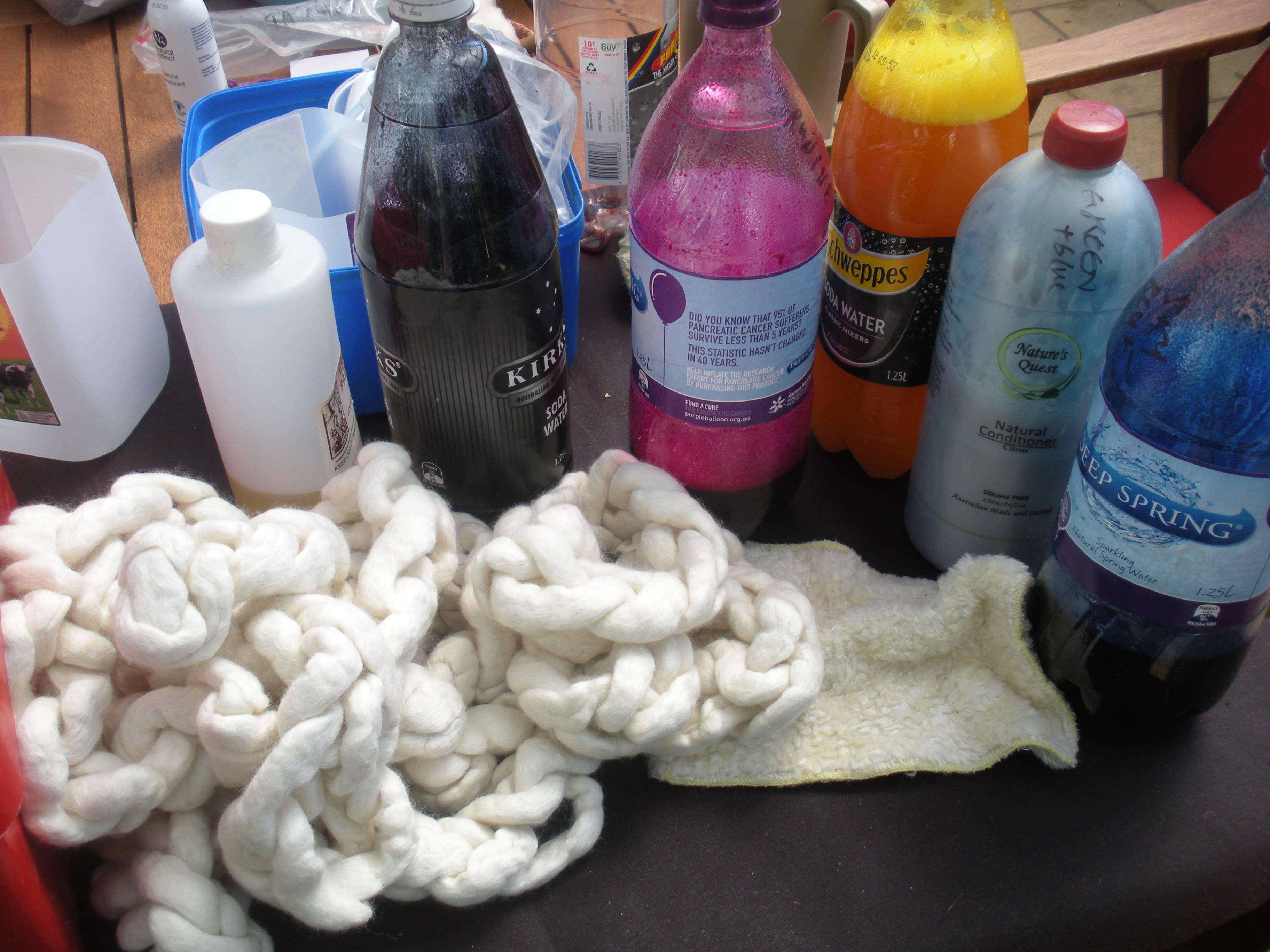
I had pre-mixed several colours and that is what you can see in the soft drink bottles.

Request Feedback

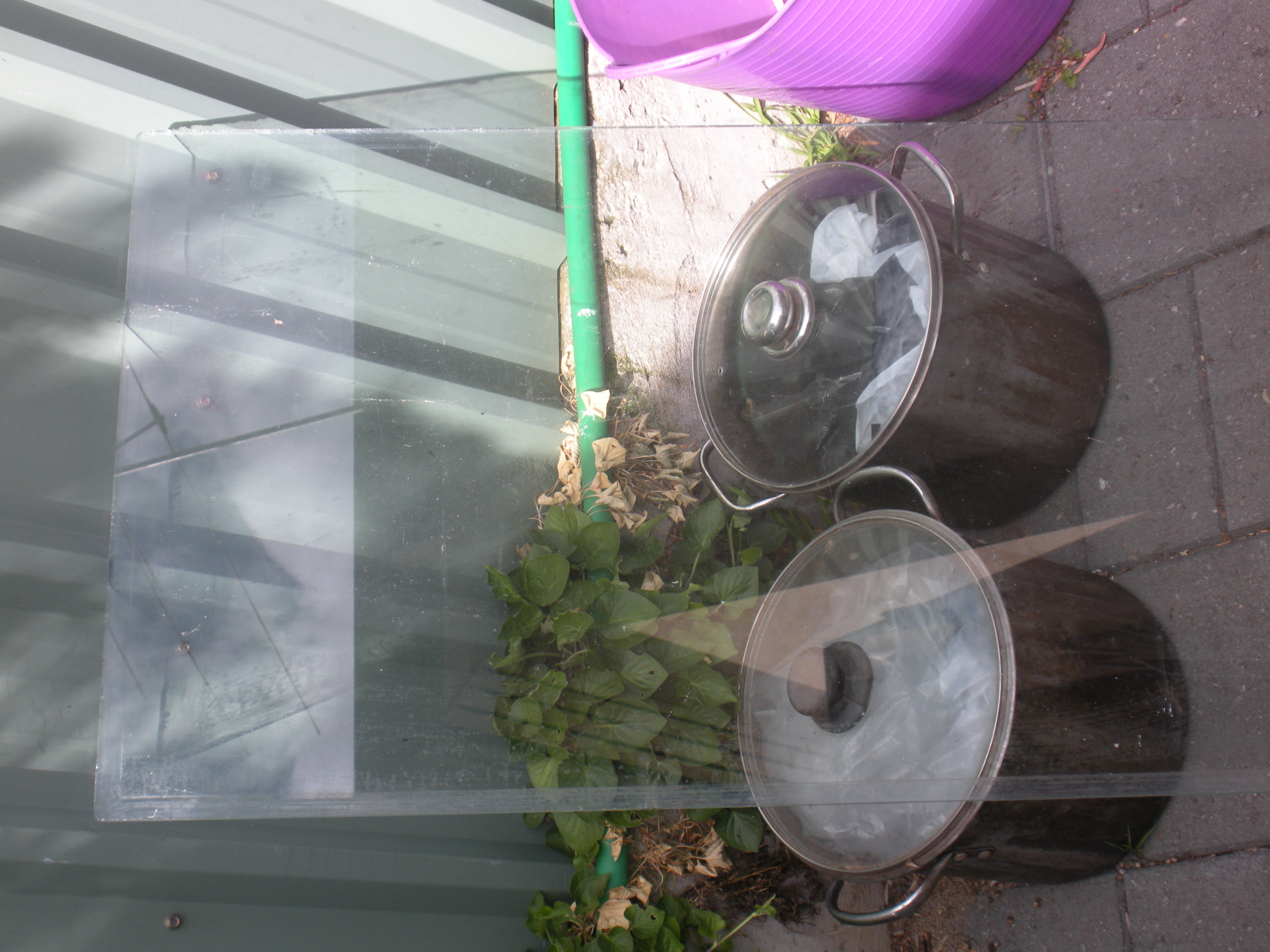
These dyes can be applied cold and fixed at room temperature–what a fantastic system.  So I applied dye, plastic bagged each plait, and set them in a warm sunny spot to fix.  I enhanced the warmth factor by putting the plastic bags in my dye pots and under a pane of glass since we’re expecting 20C maximums.  Ahhh, what a simple method.

I was really happy with the colours… but it turned out that as I feared, spin drying this merino roving, even though it was braided and bagged and cold and I’ve done this before without trouble… meant these braids needed to find adifferent use than the one I had planned.  They will never draft easily or evenly.  So I’ve been spinning them up after extensively fluffing them up.

Once again…not exactly what I planned, but sufficiently satisfying.

2 Comments

Filed under Uncategorized

Turning a sow’s ear into a silk purse. I mean, a slipper.

This week’s question is whether I can turn a sow’s ear into a silk purse slipper.

I have been the lucky recipient of a lot of free fleece since I took up spinning.  It all started with some filthy Gotland fleece straight from the sheep’s back that my Dad gave me.  He had provided the antique engine that was running the shearing plant in a demonstration of hand shearing at a local show.  Because he knew I wanted to learn to spin, he brought home a few handfuls.   He is a great enabler!  It was rough and filthy, but I spun it on my first spindle and was grateful.  Admittedly, Dad said there was a handspinner at the show and he had spoken to her about it: she advised doing me a favour and not bringing that fleece home to me, but naturally, he didn’t listen!  And I was glad.  I didn’t know anywhere I could get fleece then.

Next, I was given several bags of Dorper fleece by friends who were keeping Dorpers as meat sheep.  I didn’t understand the meaning of ‘meat sheep’ in the context of fleece at that stage.   Dorpers shed their fleece rather than needing to be shorn when they are pure bred, which might have been a clue to (lack of) spinnability for a more knowledgeable person, too!  I dyed it, I spun it, I carded it… oh my goodness. It was the beginning of my fleece preparation journey and it was a very challenging start.  Months later the woman who had lent me her carder said when she saw what I was working with, she was just overcome to think I would even try to spin that fleece!  She didn’t offer me her opinion at the time, though, and it was a long time before I decided that I could, perhaps, compost the rest as my struggles were not only about my lack of skill but also about the state of the fleece.

Needless to say I have also received fleece that has spent lengthy periods in a shed and bred an overwhelming moth population.  Happily, I had said fleece in a plastic tub with a lid.

So… I have had some personal experience of the possibility that people who give the gift of fleece don’t have the judgment necessary to decide whether what they have handed over is worth spinning.   I have to be the one to decide whether the fact that I could turn that into yarn given enough time and effort, is a sufficient reason to do it.  I think I have proved to myself that I can spin almost anything–if I could spin those fleeces as a beginner!

I went to a couple of workshops on fibre preparation (washing, combing and using hackles) at the recent Majacraft Magic camp at Lake Dewar outside Melbourne, and came home ready to tackle some of my current fibre preparation challenges.  I had reached some new conclusions about why I find getting fleece clean difficult sometimes.  1. our hot water tap doesn’t give very hot water, and can’t be adjusted.  Boiling the kettle repeatedly is boring, as well as slow, after a while! 2. I can be more slapdash than is ideal for the task. 3. Most of the fleece I currently have is Polwarth, more gifts from a couple of pet sheep in the hills.  This is a fine and greasy fleece, among the more challenging to clean.  4. I always hope to be able to wash a bigger batch of fleece than is desirable for optimal results.

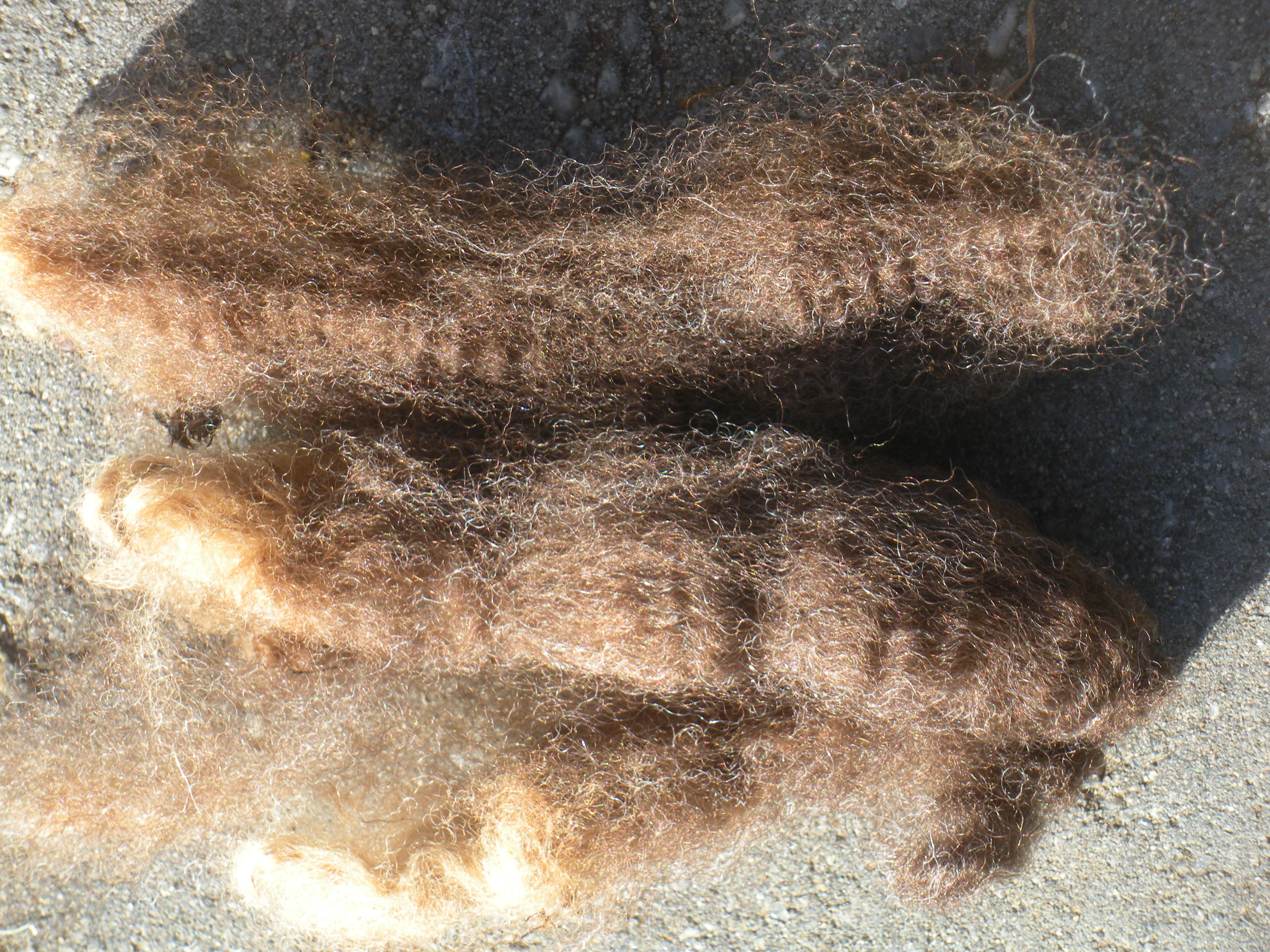
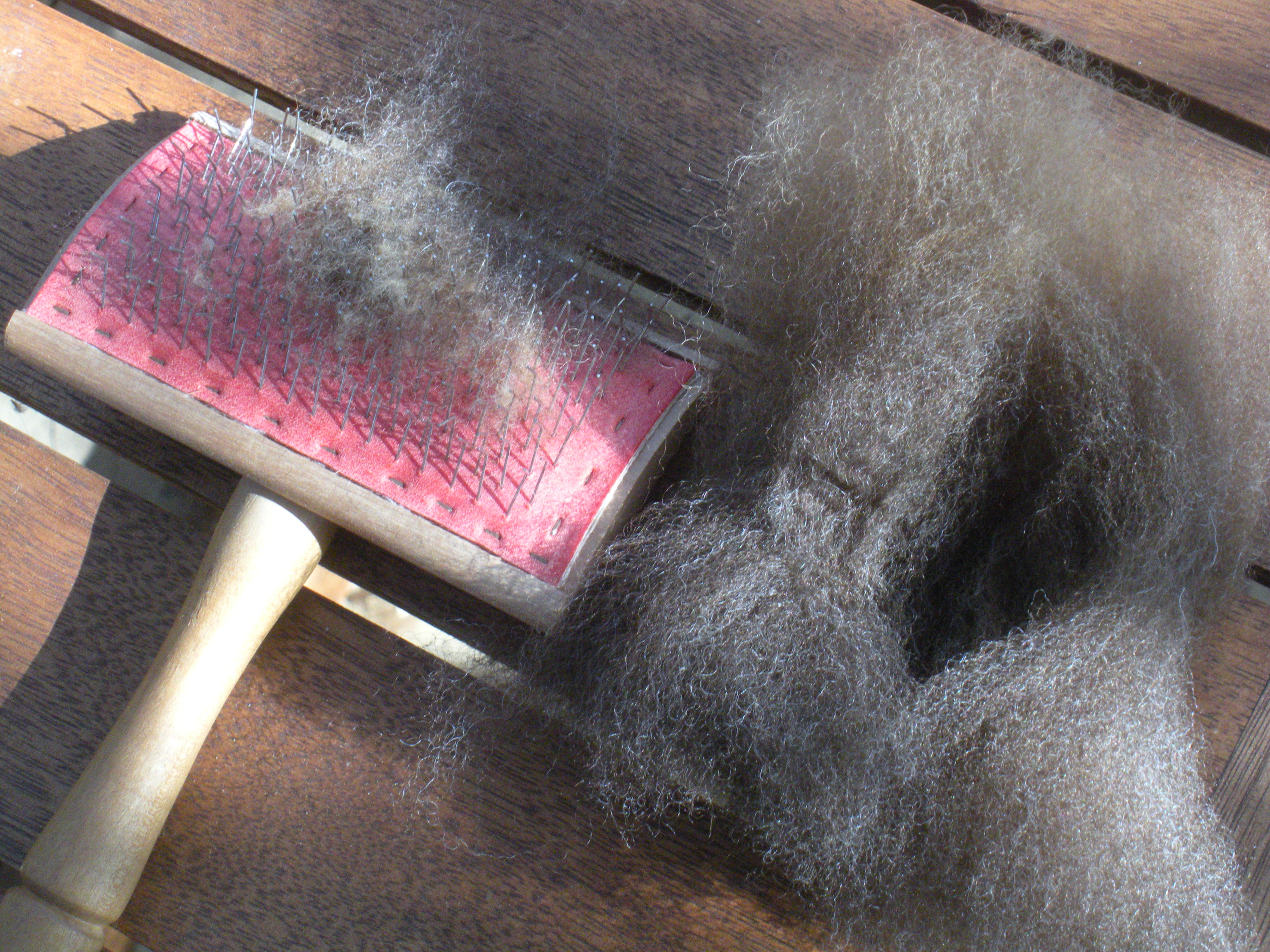
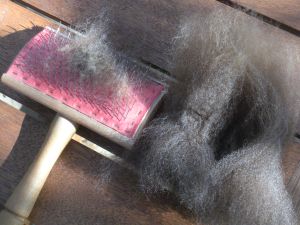
Anyway… having tried washing some more gifted alpaca fleece and some more gifted Polwarth, and using careful observation of how it behaves with flicking, combing and carding, I have decided the following.  1. The specific Polwarth fleece I am currently working on has tips that are weather damaged.  When I flick card them, they pull right off.  Is it any wonder that these paler tips appear as nepps in the batt when I card the same fleece? The other fleeces I have had from the same sheep don’t have these difficulties. The poor sheep must have had a tough year…

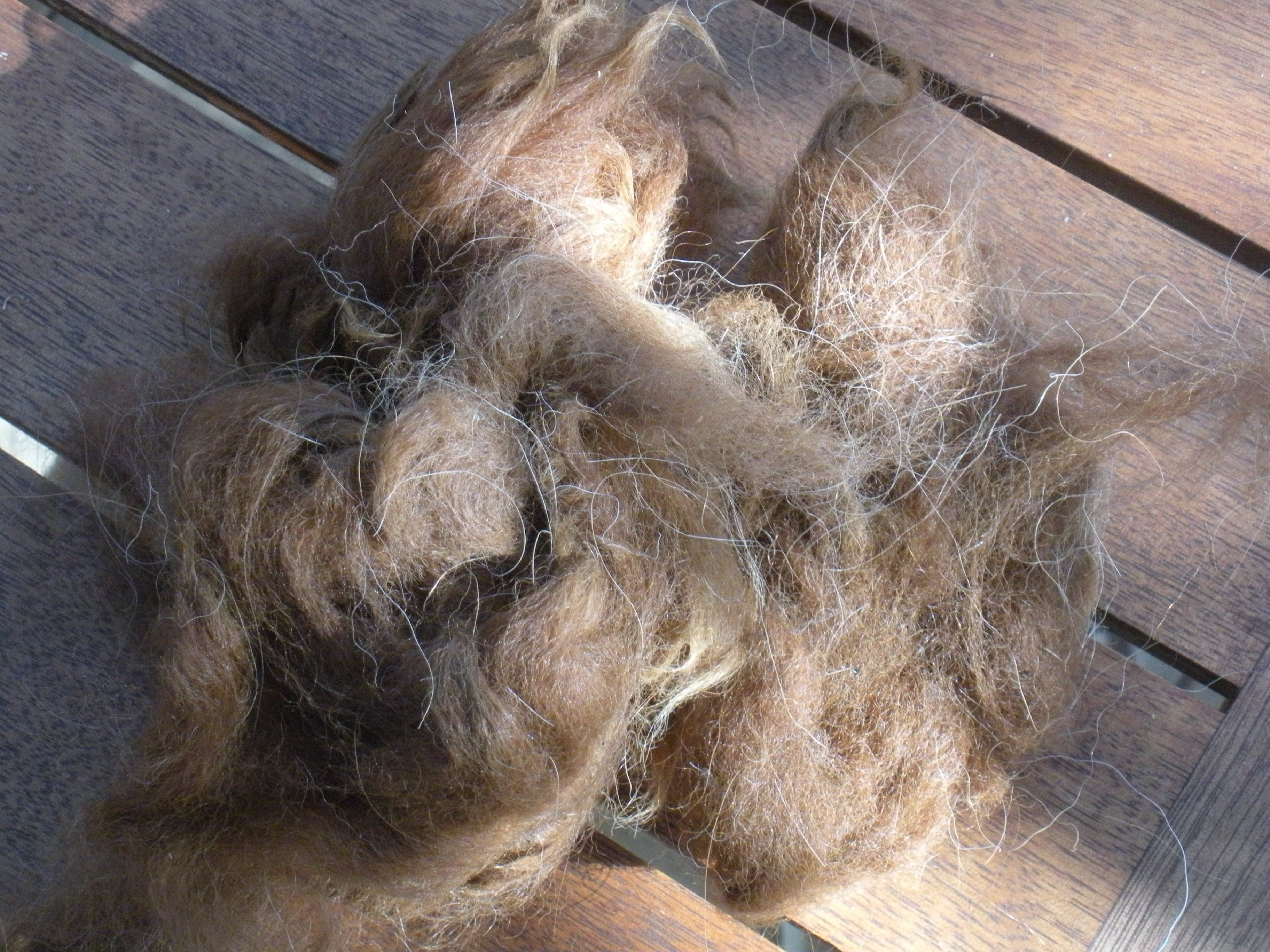
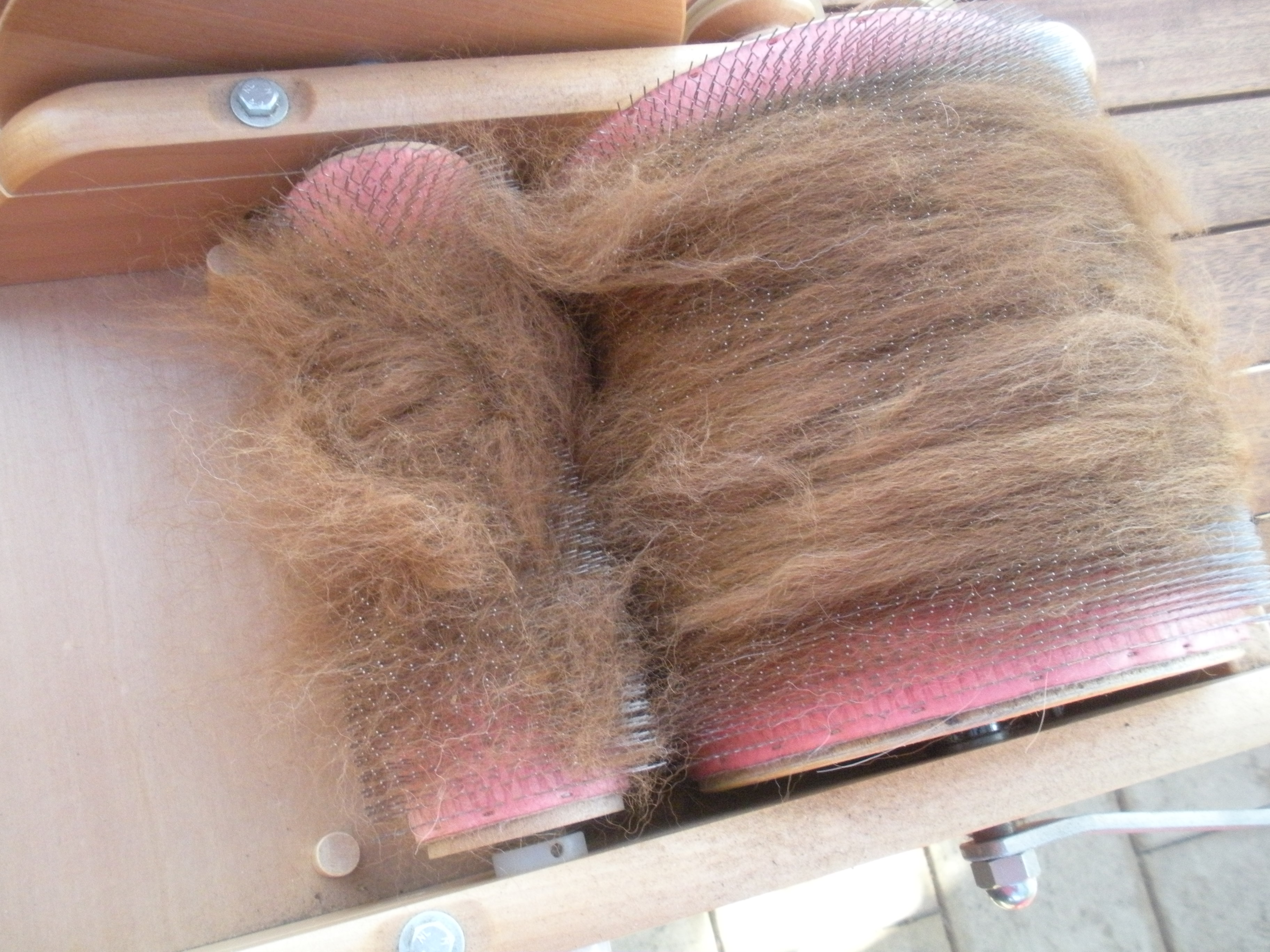
2. That same fleece has a break in it, so the longer locks are giving way under the tension involved in carding, again leading to less than optimal batts.  3. The alpaca is super short (happily, I have now worked with high quality alpaca and no longer assume this s just the way alpaca comes).  It has not really been skirted.  Most of it pulls onto the licker-in (the small drum on the drum carder) when carded. Yes, from the very start, and not only when the large drum is full.

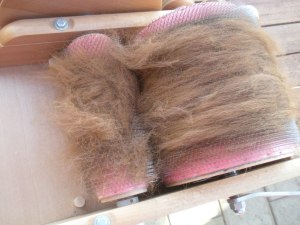
4.That alpaca has big clumps of guard hair and has been shorn without consideration to the future spinner.  Hopefully the shearer was thinking of the animal’s welfare in taking so many passes!

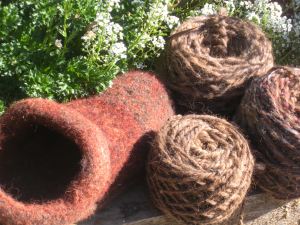
In short, these are not the highest quality fleeces possible and they would present challenges to anyone preparing them for spinning.  No matter how much time I spend I may not be able to turn these sow’s ears into the proverbial silk purses.  I have decided, instead, to attempt to turn them into felted slippers.  I am carding them together as a blend, spinning them up without too much fuss and very fat (good practice) and my ultimate plan is to knit slippers which will be felted and perhaps dyed.  Shazam!  Their less than ideal qualities will no longer be of importance.  I hope!

Here are my first few balls, and a slipper with some polwarth content and some eucalyptus dyed wool content to give me hope…
4 Comments

Filed under Fibre preparation, Knitting, Spinning, Uncategorized

Dyeing weekend outcomes

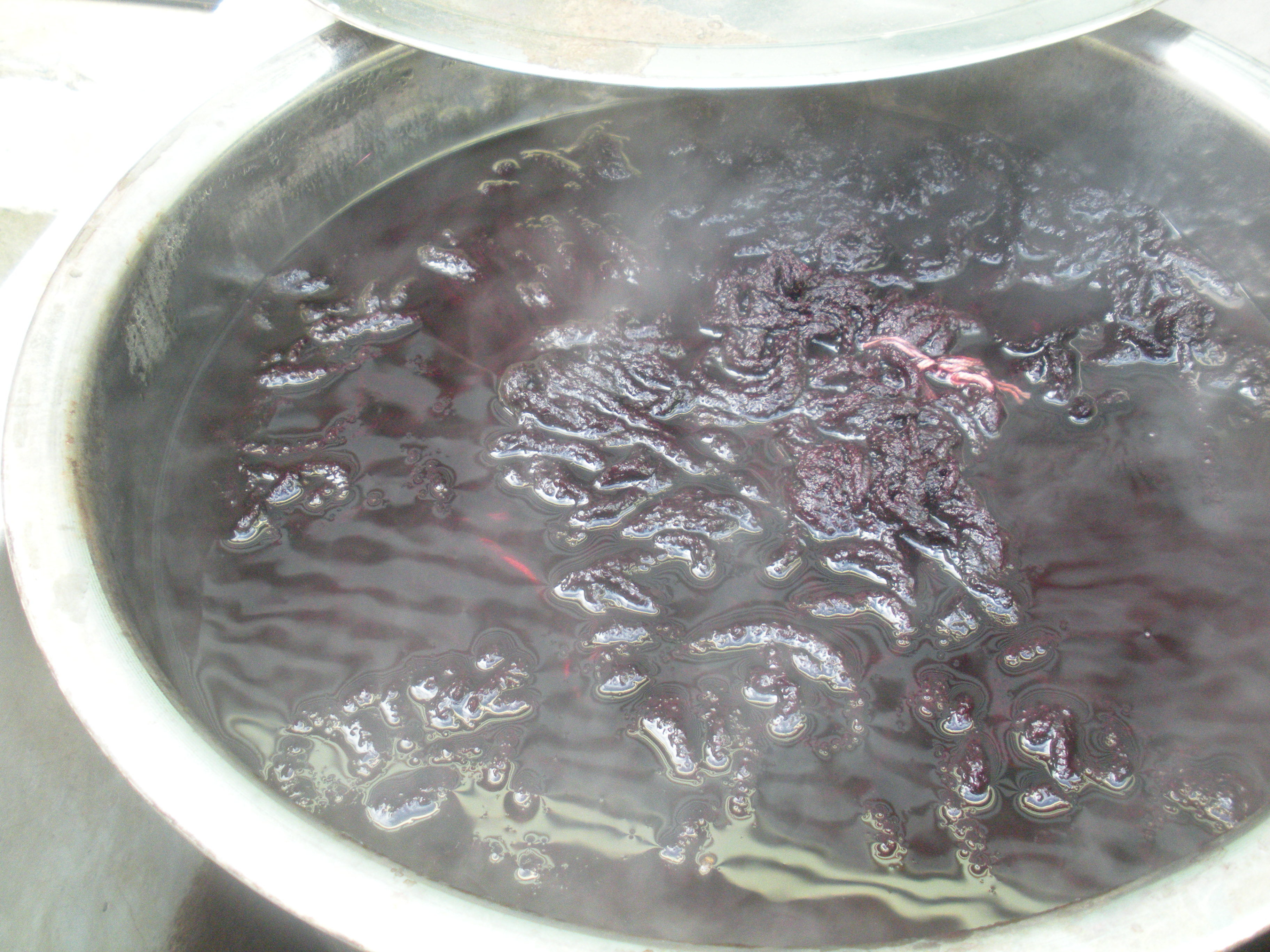
As I suggested earlier… it was once more into the dyepot for my kilogram of wool.  This time, Landscapes ‘Bloodwood’.  I am still soaking and rinsing it, but I am much happier with the outcome so far.  Here it is in the dyepot for the second time:

The silk noil printed beautifully and perhaps it will become pillowslips…

And my efforts to spin bulky, soft, squishy yarn are yielding some improvements.  This is polwarth from a pet sheep that lives in the hills, carded and spun three ply.  The sheep is mostly white with a pale brown patch or two so I can create yarns with some variegation, which I love.

Leave a comment

Filed under Eucalypts, Leaf prints, Spinning

Eucalyptus leaf print of the day

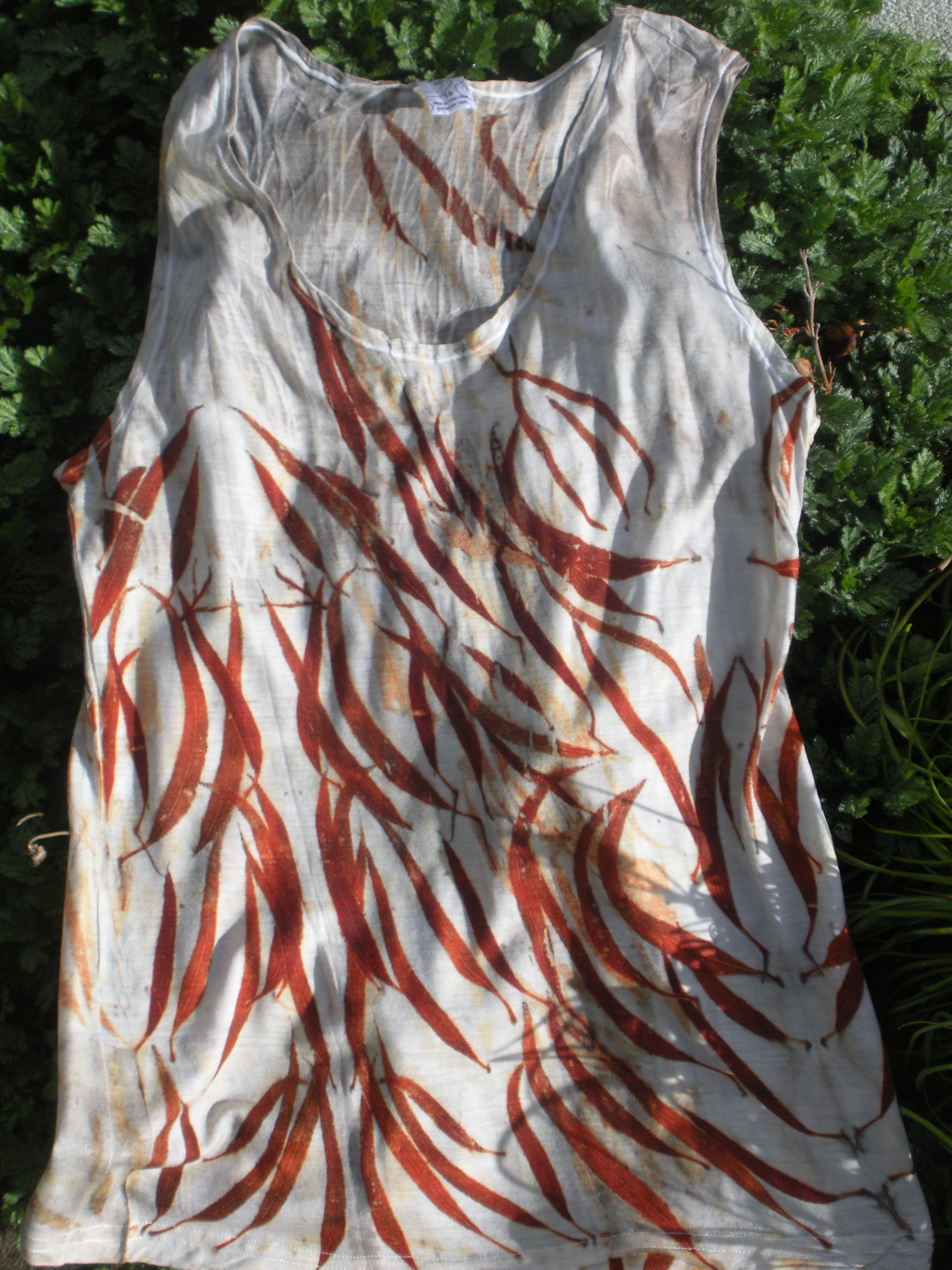
Since reading India Flint’s wonderful book Eco-Colour (2008), I have spent many an hour experimenting with her concept of the eco-print.  Flint focuses on printing on wool and silk, and I highly recommend her books and blog.  Since I do much more sewing with cotton, linen and hemp (and have made only a few special things from silk and wool)… I have experimented at length to get eucalyptus leaf prints onto cotton and linen fabrics.  More of that later.  But recently I leaf printed some woolen thermal underwear for a friend (and couldn’t wait for sun to take a picture before I handed them to her–I’m impatient that way).  But I also dyed this for myself…  Colour me happy with the result!

12 Comments

Filed under Leaf prints