Category Archives: Fibre preparation

Revelations at the drum carder

Recently I made good on my intention to properly clean and oil the drum carder.  It meant I had to find the instruction sheets.  And that was when I had the revelation that my drum carder has two speeds.

IMAG2086

Conceivably, this was a selling point when I decided to buy it–that does sound curiously familiar–and I had managed to completely forget.  I have had it on the setting which would be ideal for blending roving for some years.  That’s been good sometimes, because it really does make a great batt for artyarn spinning, and there has been quite a bit of that at my place.  However, I have struggled to make great batts from fleece, sometimes with a lack of patience, I admit.  But there has been plenty of trying and some of it has been patient.  So, I have been applying my newly oiled and cleaned carder to some Polwarth fleece on the correct setting, and wonder of wonders, it actually is better!

IMAG1884

I have also been carding some of the lower quality end of my enormous stash of Polwarth and spinning it fat, soft and three ply with YET MORE Fibertrends Clogs in mind.  The short cuts and brittle ends will never be seen again once they’ve been felted.  And I have to say the spinning is a lot of fun.

IMAG2082

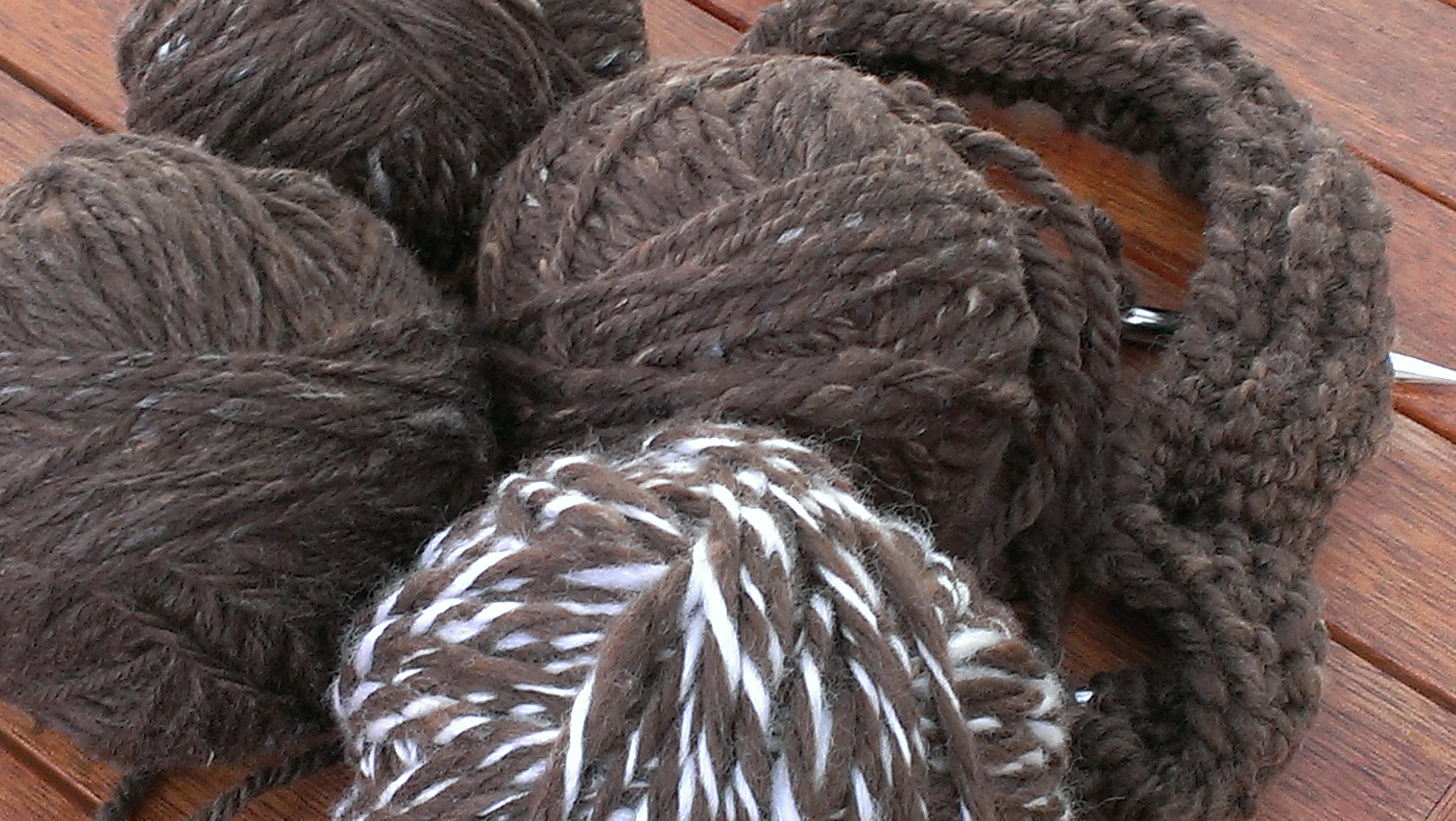
Every time I use the drum carder and pick up the doffer–a long pointed metal tool for removing the batt from the carder–I find myself earwormed with a folk song called The Doffing Mistress.  The link is to the singing of Maddy Prior and June Tabor, two of the shining stars of English folk music over some decades.  The quality of sound is no doubt better on iTunes, but this version comes with a description of the job of a doffer in the period after the industrial revolution.  I am very glad not to be a small child pulling bobbins on and off an industrial spinning machine to earn sufficient to eat…  Instead, I have been hand winding big fat balls of this yarn, since it is a bit thick for my ball winder.  Let the knitting begin!
IMAG2118

4 Comments

Filed under Fibre preparation, Knitting, Spinning

Eucalyptus colours over grey wool

I have a lot of Polwarth fleece, both brown and variegated white/tan. All of it gifted from pet sheep that live nearby.  It is a privilege and it is also a difficulty.  Washing fleece so fine and so greasy has been intimidating as well as slow.  I have spun some in the grease, and washed some twice, and tried several different washing approaches.  I have dyed and spun and spun and dyed.  Two and three ply, corespun. you name it! I spun and knit an entire cardigan from naturally brown Polwarth, too.

And then one day someone at Guild said “I hate fine fleeces!” in my hearing, and it occurred to me that I do not have to spin it for the rest of my life.  I lashed out and bought a considerable quantity (3.5 kg) of grey Corriedale (nothing to approach the stash of Polwarth, mind you) and it has been heavenly.  I love grey fleece, and this is the loveliest corriedale I’ve ever had the pleasure to spin.

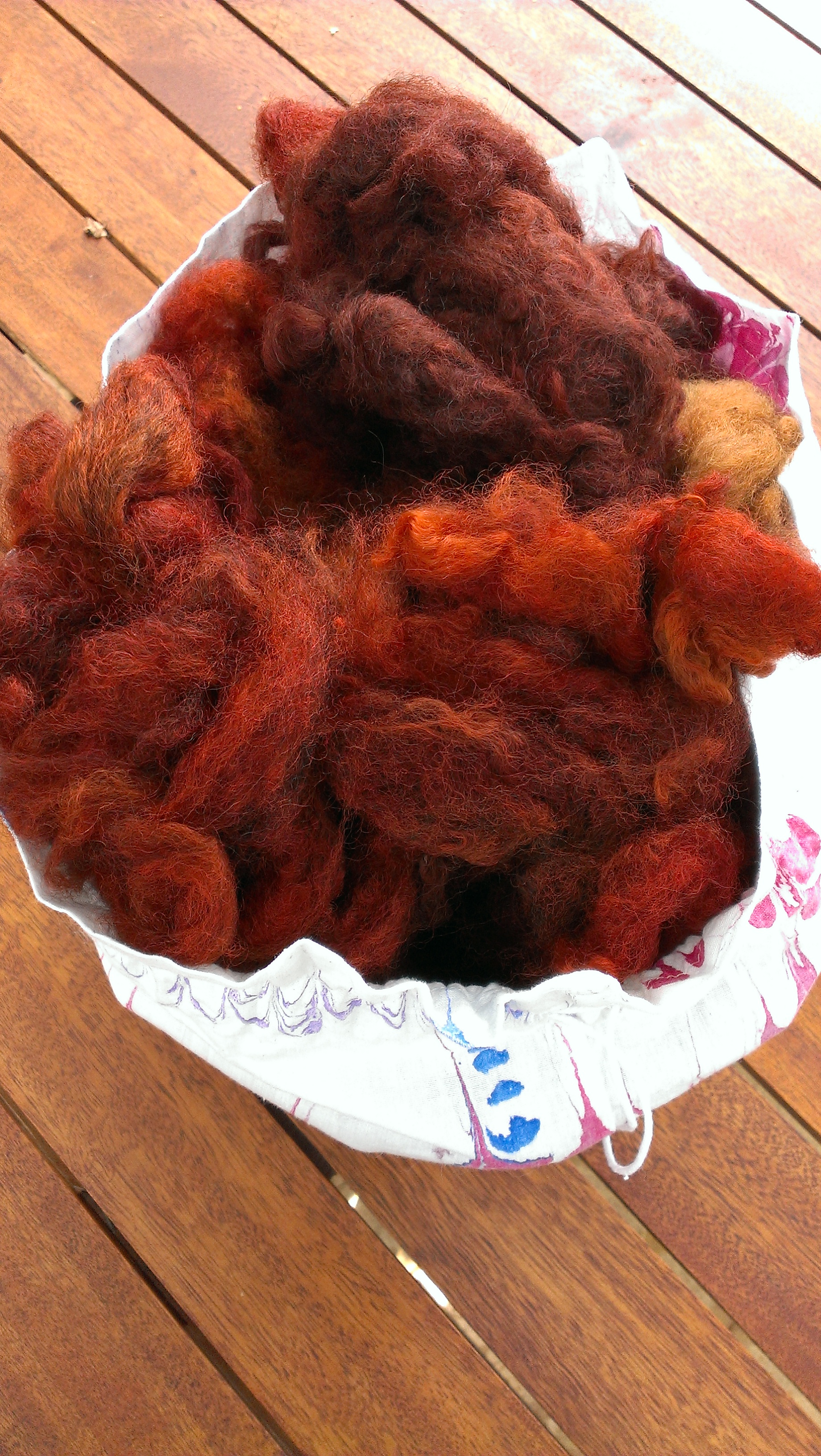
I have been dyeing it with eucalypt leaves and bark.  I have oranges of many shades from rust and brick to flame to gentle sunset.

IMAG1363

I have burgundy and plum.

IMAG1364

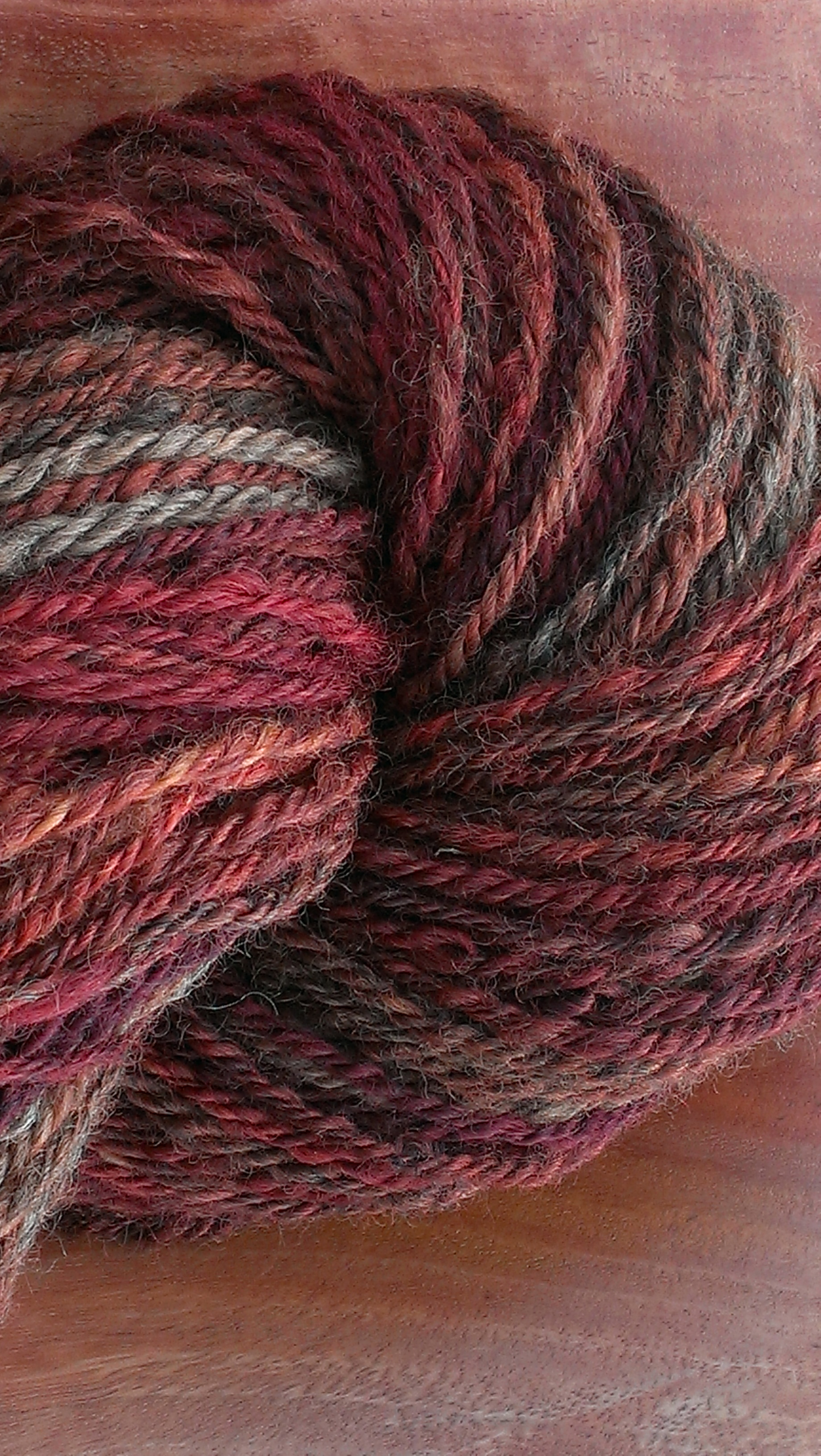
And I also have some tans and walnuts.  It appears I collected some bark that wasn’t exactly what I thought I had collected.  But to be honest, I think these are lovely additions in this context.  I’ve begun spinning yarns of many hues, chain plying to maintain the colour contrasts.  Lovely.  It’s hard to believe I can find these colours through combining bark and hot water and time with wool.

IMAG1308

Now… I have figured out that what I would really like to do with at least some of this wool is knit a particular cardigan.  And my beautful 3 ply yarn is too thick to make gauge for it!  Possibly also for the design I have in mind those colour changes will not be ideal.  So, I am about to embark on two ply yarns.  This is my Tour de Fleece project.

20 Comments

Filed under Eucalypts, Fibre preparation, Natural dyeing, Spinning

Plum Pine 3: Let the dyefastness testing begin!

Unbelievably, the plum pine is still fruiting, and I am keen to dye enough to be able to do some wash and light-fastness tests in the year before it fruits next time.  So I harvested again, picking up fallen ripe fruit from the ground until I filled the bags I had with me.  A man in white overalls who seemed to be working nearby was gripped to see me doing this and asked me all about what I was doing and why.  He was fully supportive of ‘making use of our natural resources’–as he put it–!

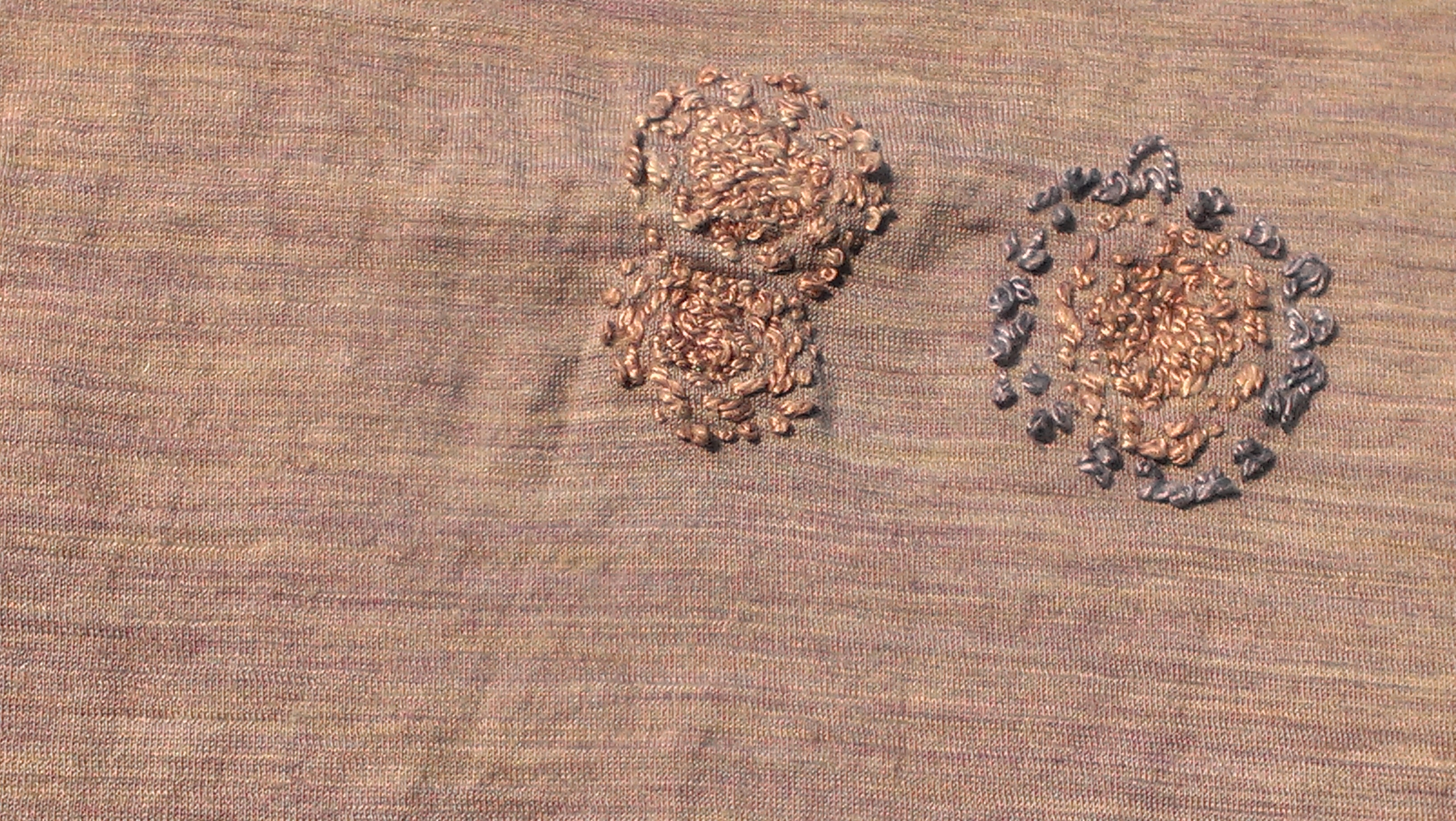
Early signs are that my silk threads dyed without alum will not be washfast. My mending has changed colour in only a couple of washes, and seems to be Ph sensitive, with pink without alum noticeably paler and purple with alum (the contrasting outermost ring on the right) turning blue in a mildly alkaline wash.

IMAG1571

Only someone accustomed to dyeing with eucalypts, which are fast on wool and silk with no mordant, would think unmordanted yarns were a good beginning place.  So, I’ve had a mordant bath on the hob.  I did not have loads of anything much ready to mordant and dye except Bendigo Woollen Mills alpaca rich, so 200g of that hit the alum and cream of tartar bath along with smaller quantities of other yarns.

After removing the seeds, I had 2650g of fruit.  I was a bit gobsmacked by the quantity!  Never one to shy away from a challenge,   I put my fruit in a pot of rainwater with a cup of vinegar and simmered for an hour.  Then, I entered some handspun wool, some commercial alpaca-wool blend and some silk thread and silk/cotton 70/30 thread, all mordanted in alum and cream of tartar.  The colour takeup on the silk was dramatic and almost immediate!  I simmered for another hour and then left overnight.  The colour change overnight was again worth the wait.

IMAG1656

Meanwhile, I’ve set up further washfastness and lightfastness tests…

Leave a comment

Filed under Dye Plants, Fibre preparation, Natural dyeing

Alpaca preparation

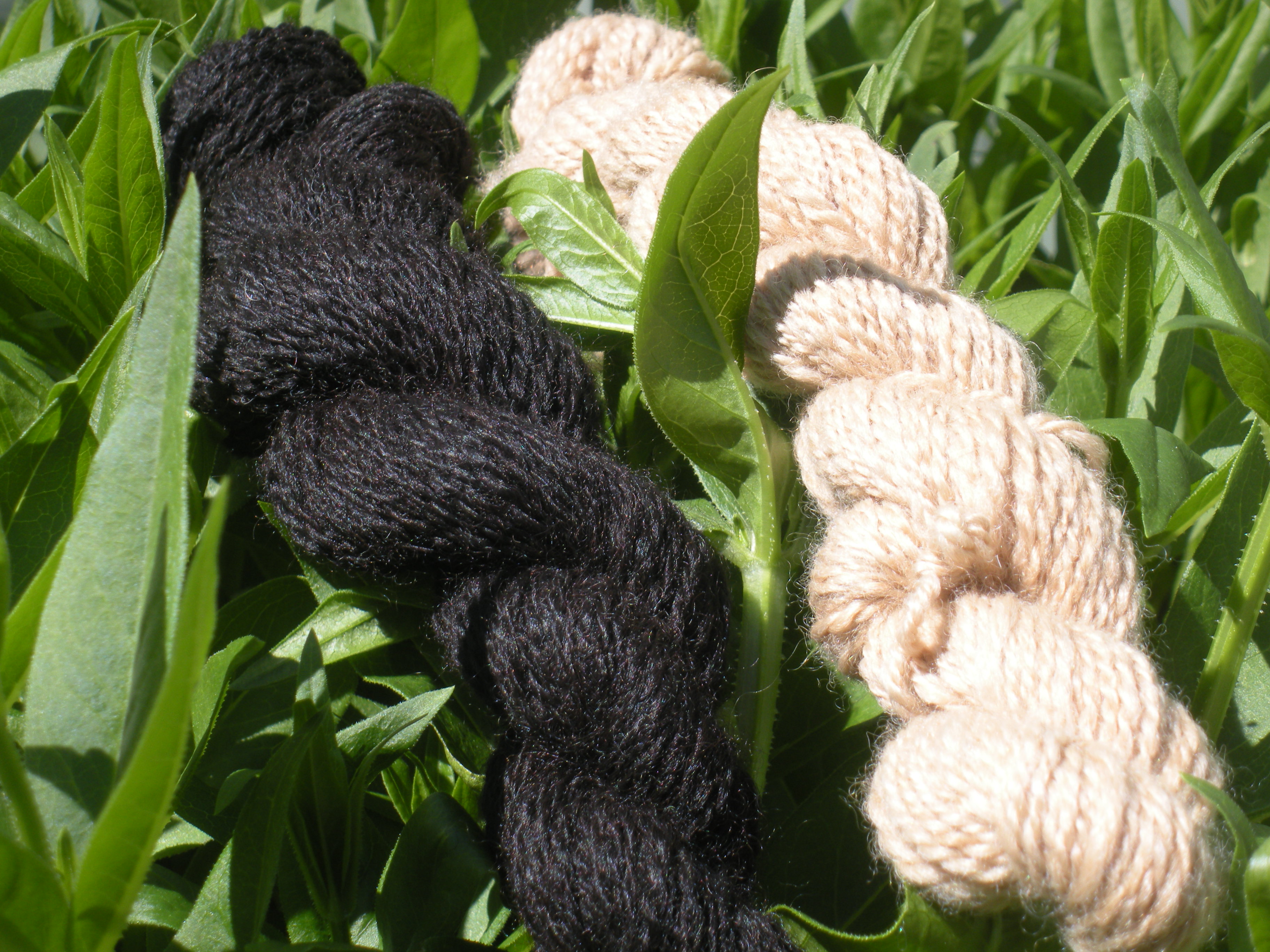
I’ve been having a lovely time spinning alpaca given to me by a generous friend.  She gave me samples of three different fleeces, white, black and what she rather fetchingly calls ‘champagne’.  I’ve been combing it and spinning it two ply and I’m very happy with the results.

I told my friend how lovely I thought the alpaca was, and she gave me more!  I have spun alpaca before, sometimes in quite a large quantity, but this has the longest staple I have ever seen, about 90 mm (these are the 90 mm matches I use to light to the dye pots–extra long.

I have to confess I have never washed alpaca, and it is always filthy, since alpacas roll and dust bathe.  My chooks dust bathe too, and watching them,  it’s no wonder that sand falls out of this fleece any time I move it! This fleece had so much dust in it that combing it was an outside activity that gave me hayfever.  I spun a lot of the white fleece rinsed and combed (that stopped the hayfever at least).  Then, I decided to brace myself and washed the rest of it.  And that led to dyeing the unspun fibre, as it turned out.  I have been working my dyepots hard experimenting toward red and…

IMAG1267

I am getting more interesting colours on silk thread (wrapped around the cards at left) than ever before.  My friends agree that the alpaca on the left, first through the dye bath, is red, then there is grey corriedale (second pass, same dye bath), more alpaca (third pass, still the same dyebath) and some still damp alpaca (fourth pass).  Three cheers for the potential to spin alpaca of many colours!

4 Comments

Filed under Dye Plants, Eucalypts, Fibre preparation, Natural dyeing, Spinning

Preparing

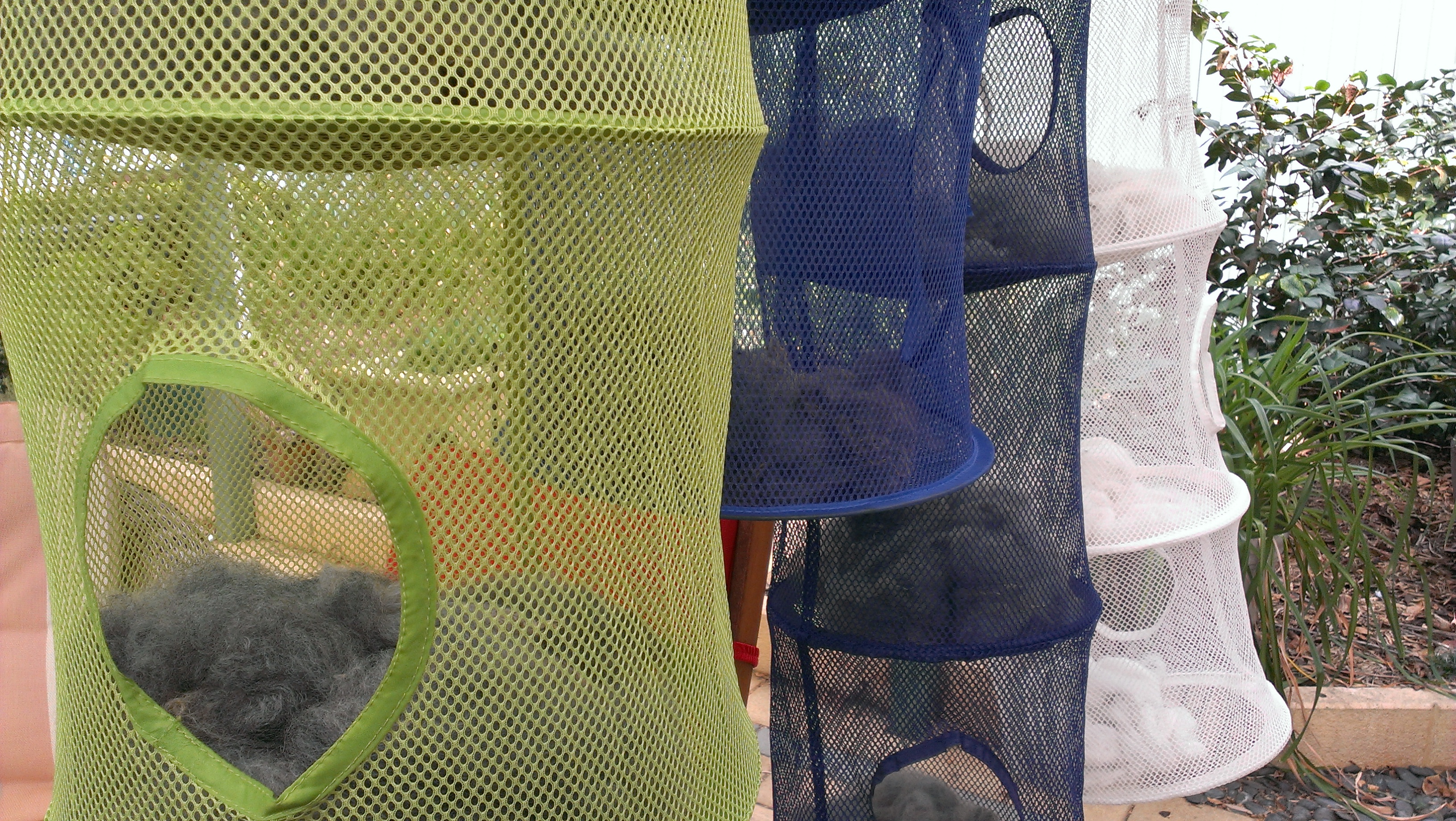
It has been a time of preparation, lately.  I’ve been on a fleece washing project.  After months of thinking I should wash while it is still warm but feeling quite unable to begin, apparently the change in the weather (toward autumn) brought on the sense that fleece washing would be possible. I have washed all that remained of over 3 kg of grey corriedale and some white alpaca for good measure.  My motley collection of drying apparatus have all been in use.  I still have a lot of high-grease polwarth and a filthy corriedale to wash.

IMAG1226

A bunch of friends got together to make passata and I was too sick to go and join in the fun.  However, my partner went along and I put the results up in these jars preparing for the winter.  The Fowlers Vacola outfit is steaming on the stove as I type.

IMG_0109

Our freezer is full of pesto from all the basil of this summer.

wpid-IMG_0133.JPG

I have some Lincoln locks sitting waiting for cold dyes to fix .  And I had better get ready to use the drum carder!

3 Comments

Filed under Fibre preparation

Spinning

I loved running workshops over summer, but it has also been a treat to return to my spinning wheel.  This skein began as grey corriedale fleece.  I dyed it in the grease with Earth Palette dyes, carded, and pulled a roving directly from the drum carder through a diz.  I have seen this technique demonstrated on YouTube, but I was only prepared to try it after someone from my Guild (who is a fabulous spinner) showed a group of us how she does it.

I like the colour, and enjoyed the process of producing roving.  Being able to dye in the grease is one of the things that has me returning to Earth Palette dyes. It improves my pleasure in scouring, and makes me content with scouring small quantities.   Does my impatience show?

IMAG0995

One of the workshops I ran over summer was on ‘fancy yarns’–artyarns to the inhabitants of the internet–and it has been good to come back to spinning the kind of yarns I prefer to knit.  I love the challenge of artyarn spinning, and the results, but I am a plain spinner in my heart, apparently.  This is relaxing spinning for me and I’m enjoying relaxing a little.  The yellow/green/blue corriedale that I dyed at the same time has already become a beanie for a dear friend’s birthday, even though there will be no call for him to wear it for some months yet!

Dyeing over a grey base has pleased me so much that I want to return to trying it with eucalypts.  I guess I’d better get over myself about scouring…

2 Comments

Filed under Fibre preparation, Knitting, Spinning

Eucalyptus Lehmanii bark dyepot

E Lehmanii (bushy yate) has a very distinctive arrangement of buds, flowers and fruit.  When I was a kindergardener, we used to put the long bud caps on our fingers and call them witch’s fingers and chase each other around.  I can’t pretend to have had any sophisticated critique of the concept ‘witch’ at that stage in my life!

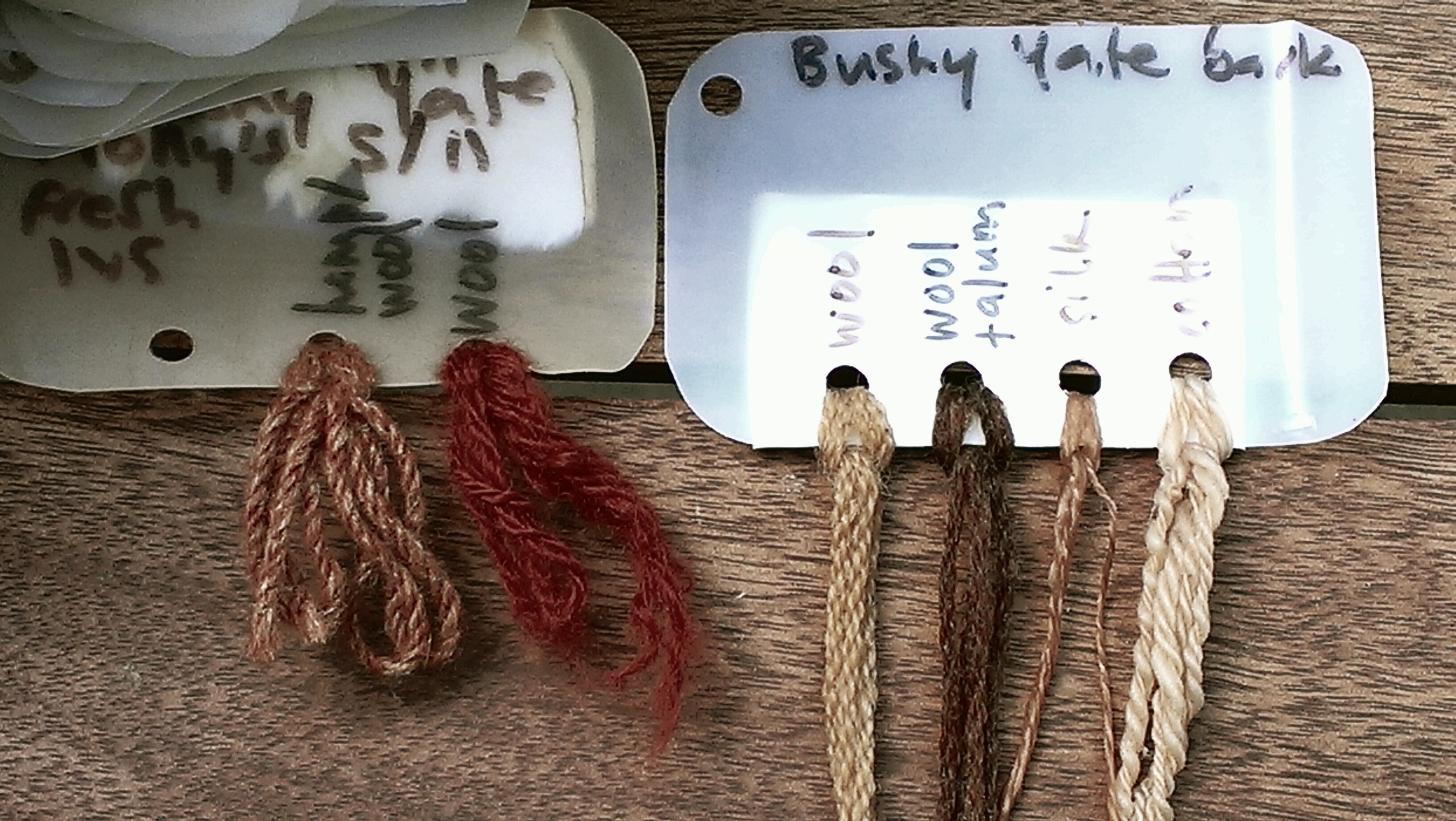
I came across some planted as street trees while I was out doing a run with friends.  On the way back to our car, I managed to collect some bark–since it had helpfully fallen.  I also collected a few leaves.  I have a sample card from a previous experiment with bushy yate leaves from a friend’s property, which gave quite a strong orange-brown.

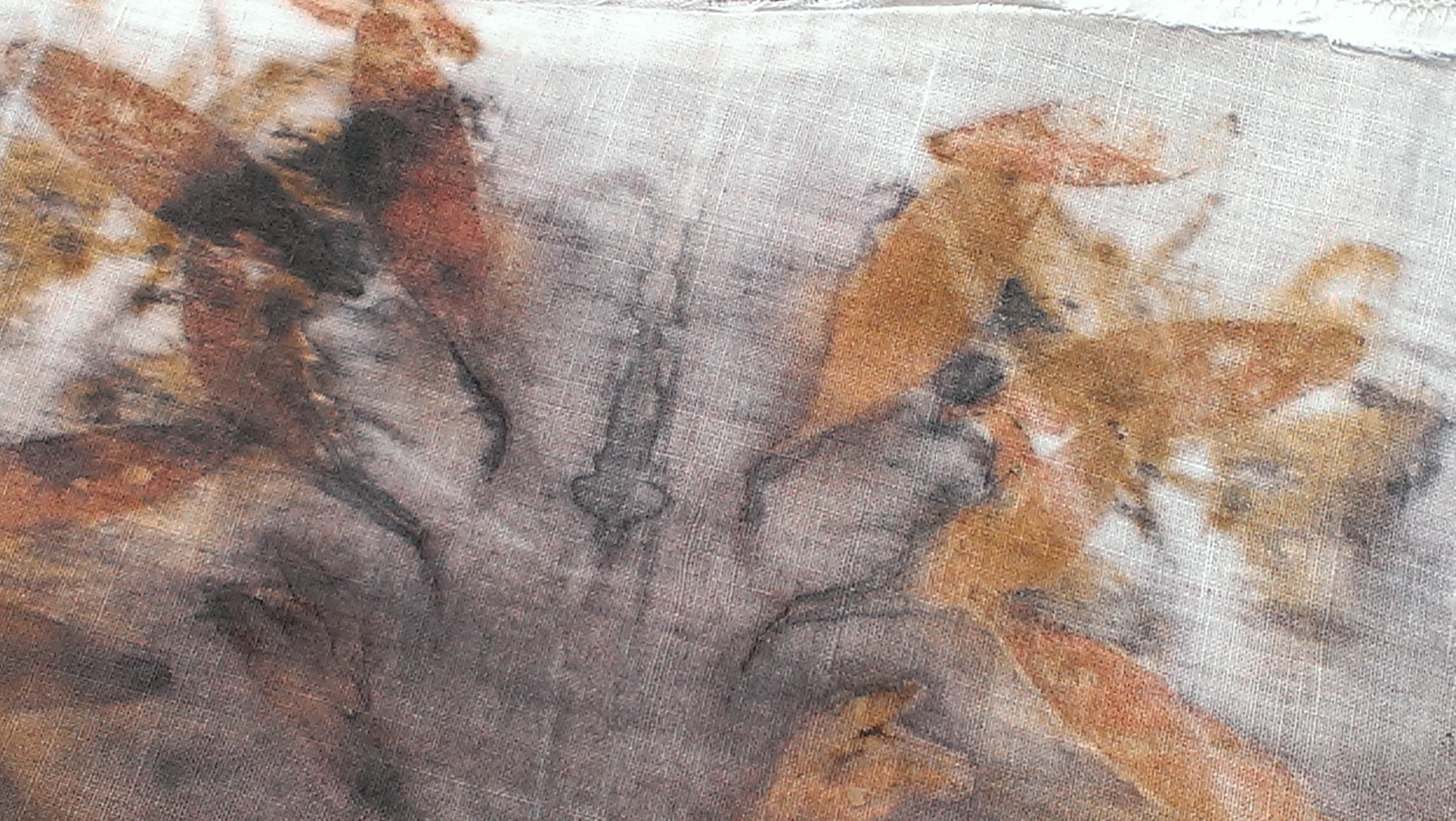
I used iron with the leaves, and the contribution from the iron on this occasion was really quite intense.  Before…

IMAG0828

After… a result that won’t have me rushing out to collect bushy yate for leaf prints, but a result just the same.

IMAG0845

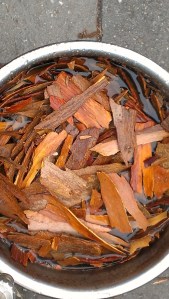
And as for the bark pot… tan, again!  I would have to rate the biggest take home message from the series of bark dye pots this summer as being that alum really makes a difference with the Eucalypt barks I’ve tried.  With leaves, I seldom see any impressive difference between alum mordanted wool and plain wool.  I dye with E Scoparia bark often and have found no point in mordanting with alum (though this experience makes me think I should try again and double check). The bark pots, however, have given various shades of tan without mordant and much stronger browns with alum, and E Lehmanii is no exception. On the left, sample card from a pot of fresh leaves.  On the right, results of the bark pot, simmered for an hour and a half.

IMAG0844_1

2 Comments

Filed under Dye Plants, Eucalypts, Fibre preparation, Leaf prints, Natural dyeing

Eucalyptus Cladocalyx Bark

I have been reading Rebecca Burgess’ gorgeous book, Harvesting Color, which had me thinking about how to create a tannin solution.  The local solution for her is to gather acorns.  That might be possible for me in autumn, too. There are some avenues of oaks in my city, and they have tiny newly formed acorns right now.  But it seems to me that eucalypt bark would be a promising source in my own region.  I thought it seemed logical to collect bark from a species that hadn’t shown a lot of dye potential (I’m trying for mordant, not dye).   So I stopped outside the royal showgrounds where this huge E. Claodocalyx (Sugar Gum) had shed its bark recently.  We were having unseasonably cool weather as this dull photograph shows.

IMAG0317

I picked up a bag full of bark and headed home to let it steep in rainwater. This will be an opportunity to consider the dye potential of the bark as well as try it as a source of tannins.  There are many of these trees around my area and this is a truly huge tree when full grown, which sheds its bark once a year, so if this is a good source of dye, I will have access to a lot of it! Here is how it looked on 15 December:

IMAG0330

And two days later:

IMAG0342

…so I put a metre of cotton cloth into it, which immediately turned golden yellow:

IMAG0347

I left the pot in a sunny spot.  The temperatures have ranged from mid-twenties celcius to 40C.  By 1 January, the pot was darker still, with the liquid seeming a ruby red shade.

IMAG0545

And here is the cotton I immersed in it  so many days ago after drying.

IMAG0547

Needless to say, I am now planning to dye wool in my bark liquor and see what happens…

Leave a comment

Filed under Dye Plants, Eucalypts, Fibre preparation, Natural dyeing, Uncategorized

Leaf prints of the week: Eucalyptus Cinerea and pecan leaves

It was another weekend with leaf prints.

Leaf prints 005

Eucalyptus Cinerea, before..

Leaf prints 001

and after:

Leaf prints 021

My test cotton sample, demonstrating that the mordanting I wrote about a little while back should work out just fine for the natural dyeing workshop I’ll be running.

Leaf prints 022

On the weekend I travelled south of the city to celebrate the lives and love of two dear friends.  They had an all-in-one birthday party and anniversary.  I gave them a teapot and teacosy dyed with silky oak leaves (grevillea Robusta) and eucalypt, and they found it suitably funny.

Dyeing 005

As we left, one of them pointed out their now-flourishing, though still relatively small,  pecan tree.  I had seen pecan eco-prints on Lotta Helleberg’s lovely blog.  I asked if I could pluck a few, and then I took them home and wrapped them in a piece of cotton twill that used to be a pair of trousers.  It was ready and waiting, mordanted in soy and ready to go!  Before… (such lovely leaves…)

Leaf prints 002

and, after:

Leaf prints 025

I had also saved this sample of an unidentified eucalypt a friend was growing in his backyard, but sadly it yielded a few brownish smudges.  It’s much prettier in person than as a leaf print.  I think it is Eucalyptus Kruseana (Bookleaf Mallee).

Leaf prints 003      Leaf prints 009

And I spent some time creating textured batts ready for textured yarn spinning… wool with mohair locks, while I tried a new method for washing wool.

Leaf prints 014

Good times!

1 Comment

Filed under Dye Plants, Eucalypts, Fibre preparation, Leaf prints

Soy mordanting

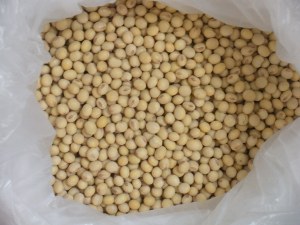
Ah, the humble soybean.  It gives me enormous respect for Japanese culture to see all that they have achieved with this rather unpromising bean (to say nothing of all the other skills and treasures of Japanese culture). Tempeh and tofu are very much on our menus at present, too.

I am just using it to mordant cellulose fibres ready for leaf prints, nothing as complex as tempeh, or even tofu. Usually I dip the fabric in the sea first when I’m visiting someone by the sea and then dry it and then begin with beans, but not this time. I forgot to take the cloth when I went visiting at Hove and the beans were already soaking. I measure out 3 cups of beans to every kilogram of fabric. I soak the beans overnight, grind them finely and dilute, then strain out the solids.

Then, it’s dip and dry at least three times.  So this week I made the most of hot weather: 4 dips on a single day.  These pieces of cloth are destined to be dyed by those who attend my dyeing workshop in January. It isn’t a difficult process to mordant this way, but there are a few steps to it.  I’ve decided to try mordanting in advance in the hot weather of summer.  Drying fabrics that have been through this process in winter is pretty trying and makes this a 4 day process, by the end of which the soymilk smells less pleasant. Mind you, even then, it takes about 5 minutes a day of actual effort for me!

Next, I’ll be testing one of these out to make certain sure there will be a good result on the day of the workshop. And perhaps, doing some more mordanting while the weather is perfect for it, as part of working toward taking advantage of the seasons to do the work that is most suitable to the weather and conditions.

25 Comments

Filed under Fibre preparation