Category Archives: Fibre preparation

Works in progress

I’ve been puttering along on a number of different projects over the last few weeks… and lest this sounds unusual in some way, that is probably the way life goes most of the time around here!  I returned to cold dyeing roving after retrieving my last spectacular failure.  For good measure, I also dyed some local mohair locks.  I am planning toward a textured yarn spinning workshop and I’m determined to go as close as I can to a local supply of materials for the participants.

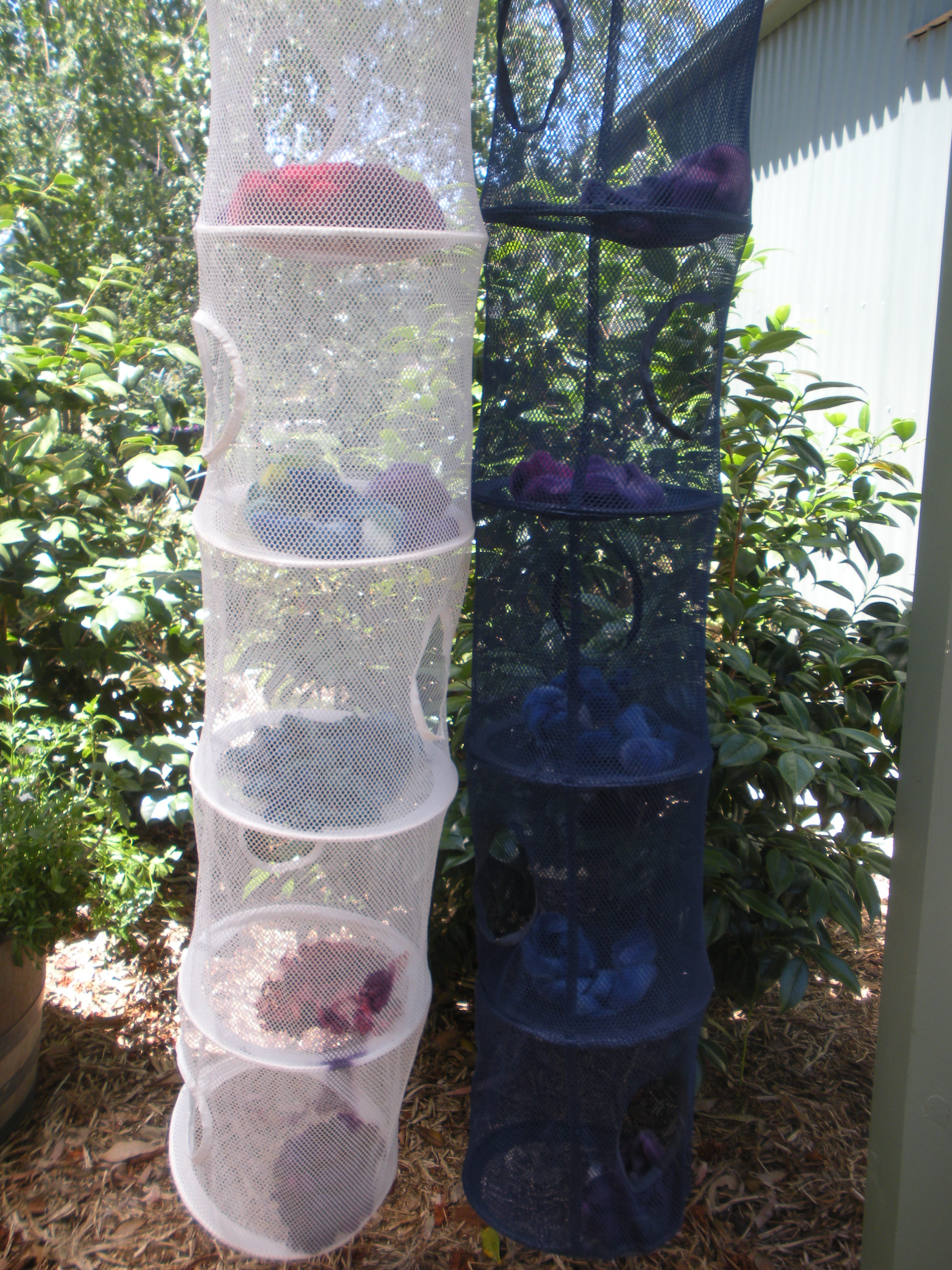
We’ve had Ikea here for long enough that the op shops of the city now turn up these fantastic wool drying apparatuses.  One came with a small supply of plastic animals.  This time, just when I thought I had found them all, a small plastic dalmatian dropped out.  Hopefully the child whose toys left home this way is not grieving and bereft!

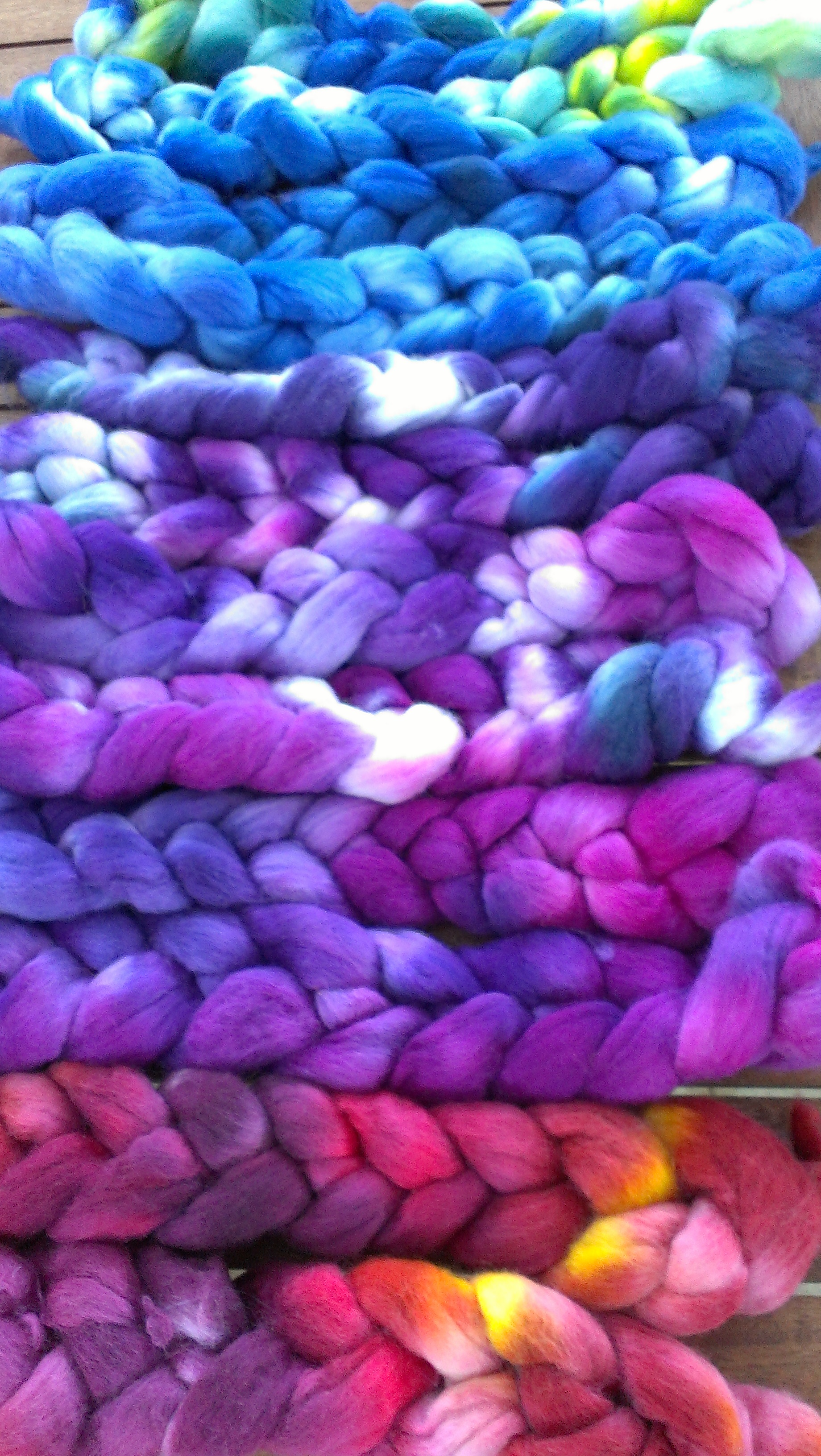
This time, the merino braids turned out better than I had hoped.  Perhaps I am slowly acquiring a better sense of colour.  Those with a red base (at the bottom of the picture) were the ones I felt most tentative about, but I like them best of all.

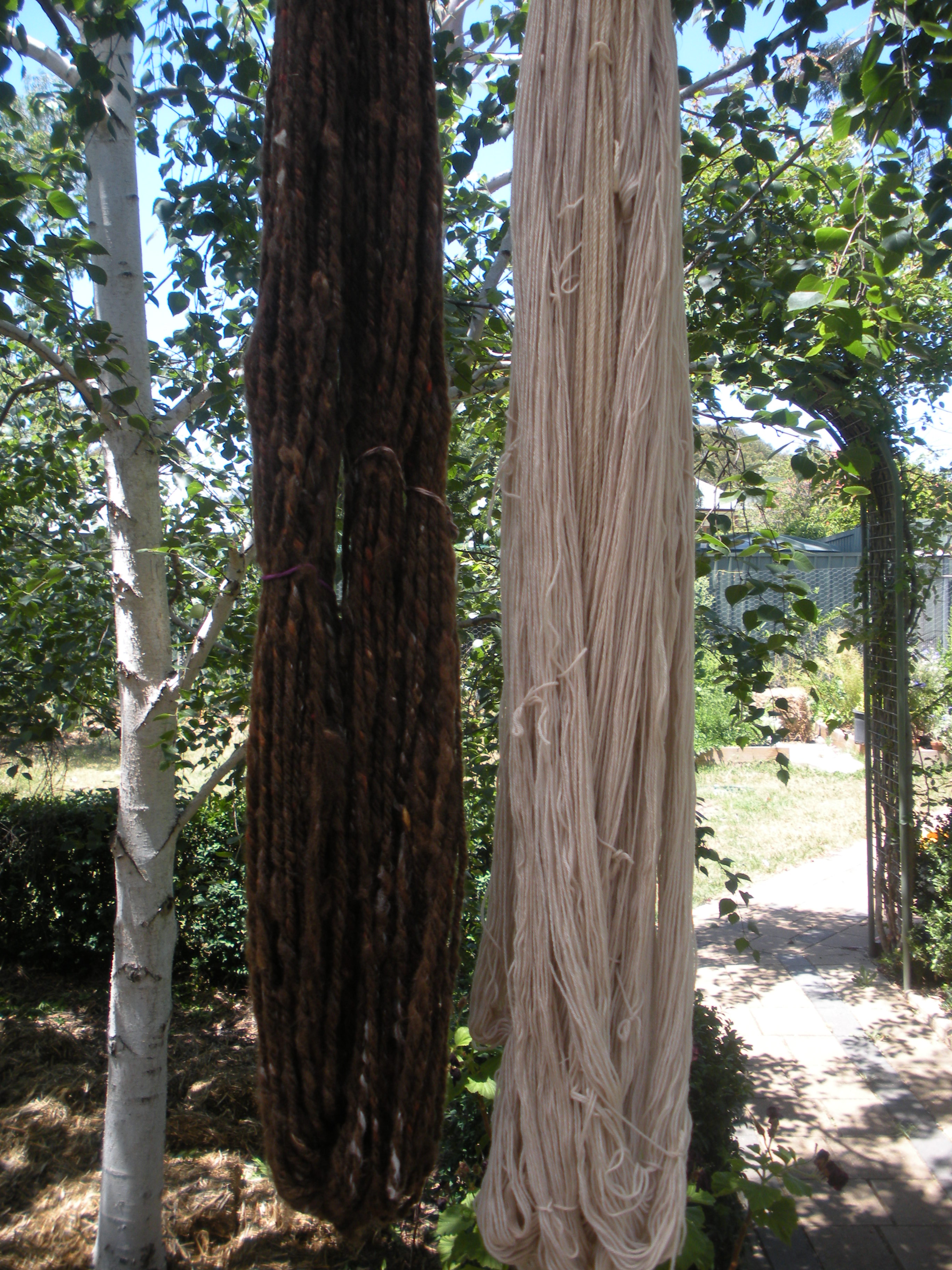
The mohair is ready to have seed heads picked out of it and to become part of some textured batts for corespinning and other good times.  Meanwhile, I have been preparing for a natural dyeing workshop focusing on eucalypts.  Again, I need to provide materials, so I’ve been laying in what I need.  It’s the season for bark collection so I have been touring the neighbourhood with my trusty bike trailer and a chook feed sack, pulling over if I’m passing in the car, or wandering out with a bucket, whichever may be appropriate to the day and location of the tree.  In short, I am keeping the E Scoparia bark that is falling to the ground from being blown away, tidied up by others or crushed on the road.  I have almost 3 sacks full so far.  Seeing the bark shedding has allowed me to run test dye pots on a few trees I had been unsure of with more confidence.  I’ve found several more specimens in the local area.  Meantime, I have been mordanting fibres (wool with alum on the right) and continuing to convert my sow’s ear fibre into slipper-suitable yarn (left) as I knit up what has already been spun. I think that particular batch of unlovely spinning may finally be over.  Two pairs of slippers are knit, one to go.

I’ve been converting milk bottles into sample cards, writing up notes and assessing the state of the Guild’s dye room.  Today, I’ve got soybeans soaking ready to mordant cotton for the workshop.  It has me wanting to dye…

10 Comments

Filed under Dye Plants, Fibre preparation, Spinning

Flax fibres 2

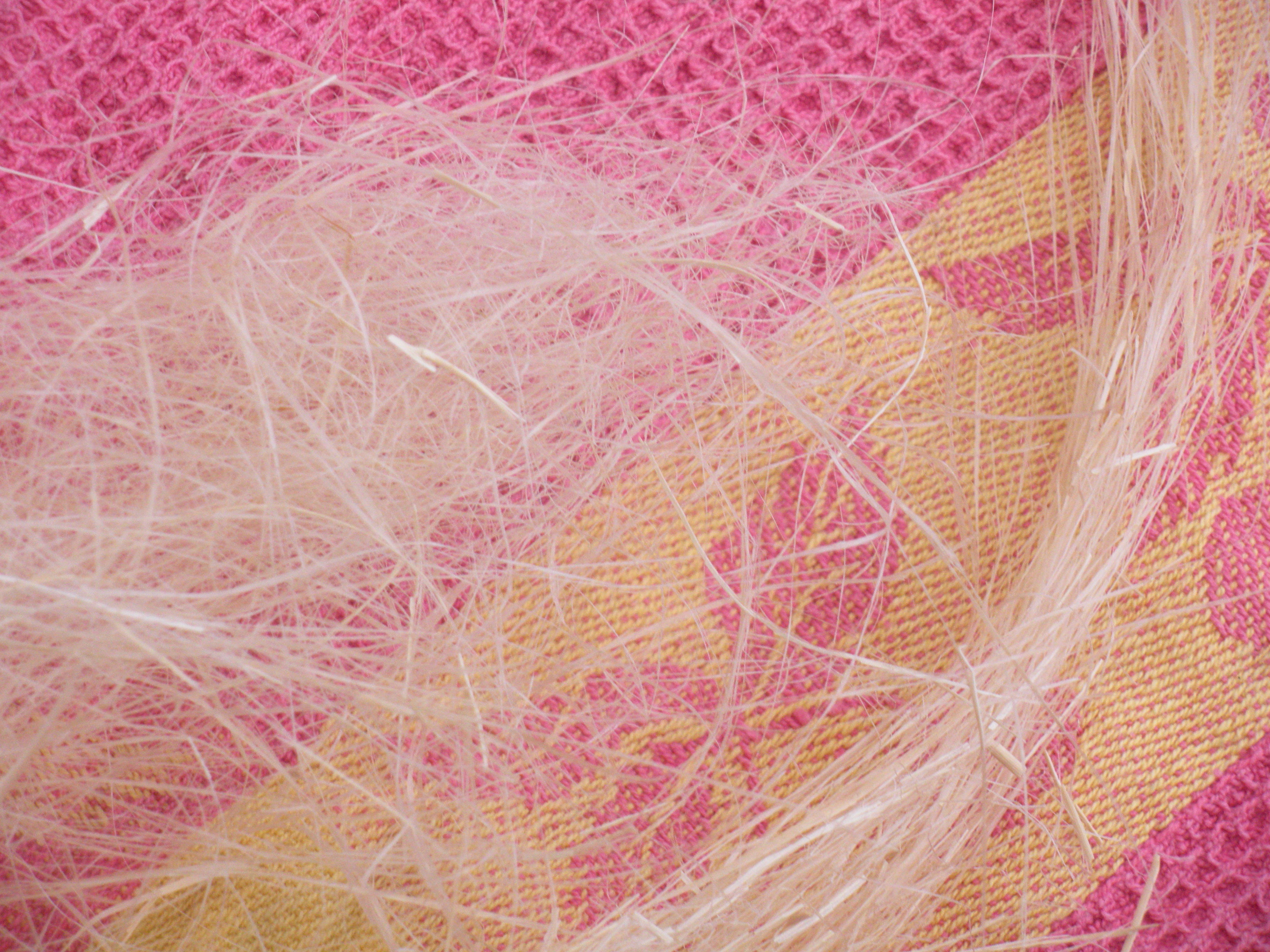
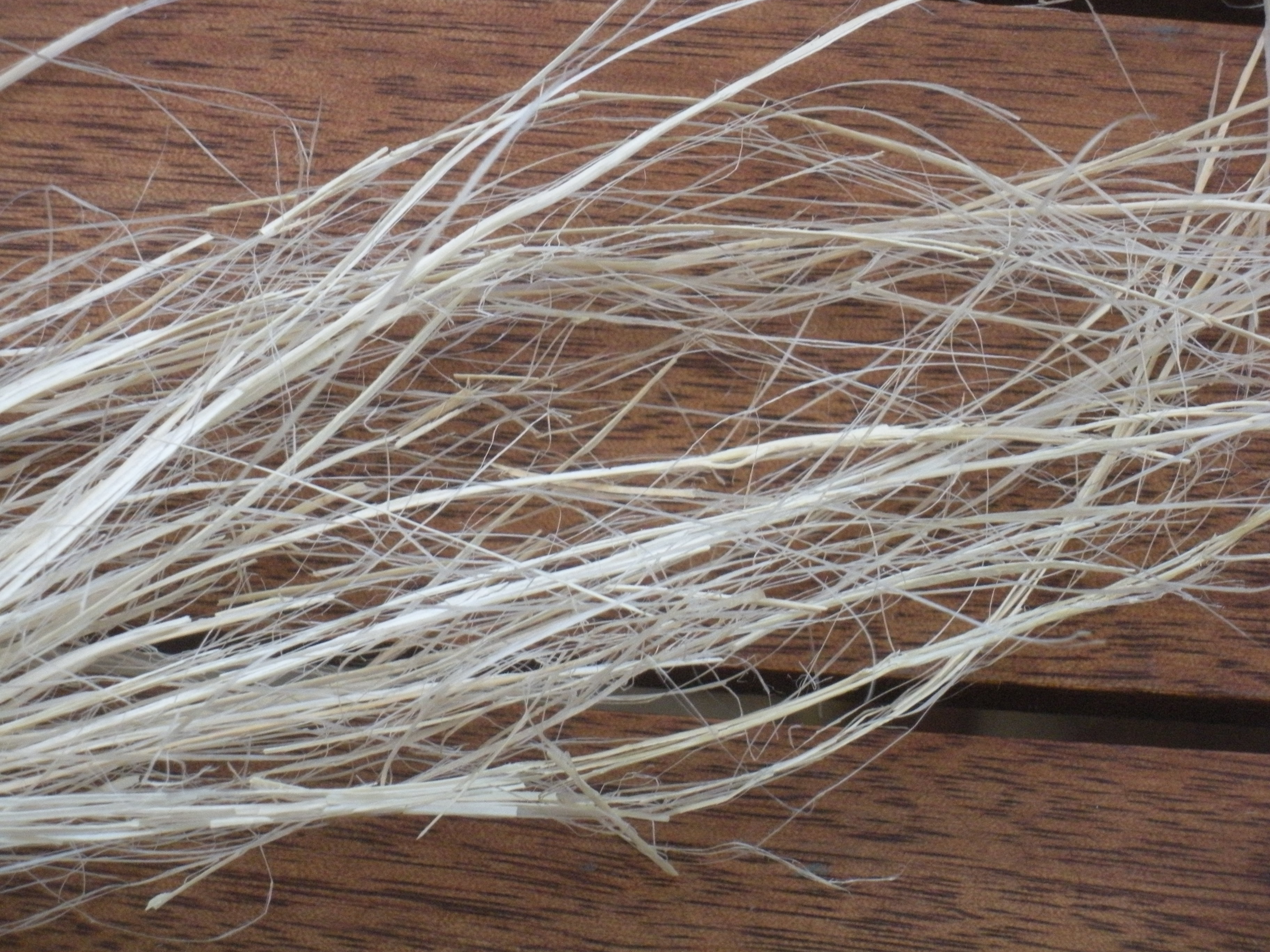
At the end of a lot of hand picking and an experiment with hand cards, with more chaff spreading around the place at every stage… I was left with this: some longer fibres and some tow, still with quite a bit of chaff attached.

I decided to try spinning despite this falling quite a way short of optimal preparation.  Yes, this is the total amount of fibre!  Yes, I have spun flax before (and it looks like yarn–do I sound defensive?).  And yes, when I found that last bit of fibre hiding in one of the many teatowels used in the process after I had taken the flax off the bobbin, I was annoyed.

Ah, the profound sense of achievement!  I think I can manage to resist boiling this string yarn in an alkaline solution and instead, I’ll go direct to vacuuming the chaff…

2 Comments

Filed under Fibre preparation, Spinning

Nettle and flax fibres 1

I have been fascinated with the idea of growing fibre for spinning for a long time, but it is not a simple matter to process bast (stem) fibres. There are amazing YouTube videos of people (in Nepal, for example) spinning fibres which must have been hand prepared with the most basic of equipment and a corresponding maximum amount of skill, time and patience.  There are also videos showing the process of linen production from start to finish, like this Irish film.  Here is a re-enactment film using decent tools but with all steps done by hand (needless to say I lack the right tools and must improvise), and another showing how this was done in Germany (with an excellent rooster crowing in the backgound).  Even with some parts of the process mechanised, the preparation of the fibres is backbreaking and dangerous work I’m glad I don’t depend on doing for my living.

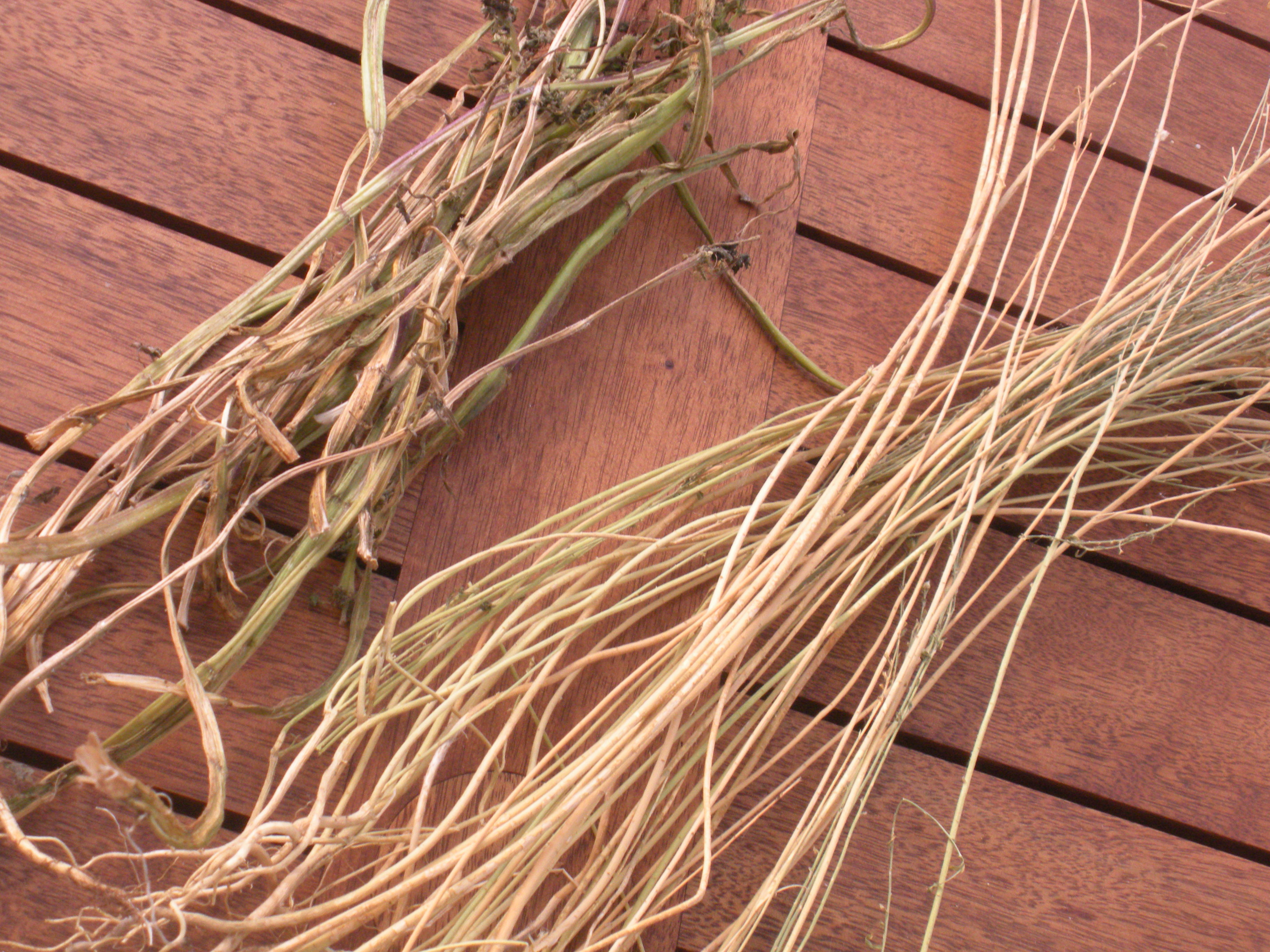
The skills and tools needed for hand preparation of bast fibres were probably known to someone in my family tree, but at a guess, this must have been many generations back.  I’ve decided to have another attempt.  I have here the total outcome of my latest nettle harvest (left) and my first flax harvest (right), dried and saved.  No, it isn’t impressive!  I have pulled them, stripped the leaves and side stems and dried them.  Next step, retting.

I put the stems into a bucket and covered them with rainwater on Labour Day.  It’s important to celebrate the achievementof the 8 hour day by doing things you love, so I was washing fibre and mucking around in the garden, visiting friends for dinner and making treats for the week to come.  And, putting these stems to soak.

The week turned out to be warm, so I changed the water several times.  Part way through the week, Through the Eye of a Needle by John-Paul Flintoff arrived in the mail from dear friends in Denmark.  They know me well!  I have already read this book and just loved it.  In fact, I set about this experiment after a long break from thinking about it because I followed a link to a YouTube video of Flintoff talking about nettle fibre.  Needless to say it falls short of being a full instructional guide on how to rett nettle fibre.  In fact, I have really struggled to find any instruction on how to decide when flax or nettle has retted long enough.  Even Alden Amos’ Big Book of Handspinning (not normally a model of concision or falling short on the challenge of offering instructions) offers no real assistance.  I am guessing that even a skilled person might struggle to describe how much decomposition of the woody parts of a stem is enough, but not too much!  The most detailed account I’ve found is online here.  So, I decided to leave the stems in the water for 5 days–based on the best advice I could find so far.

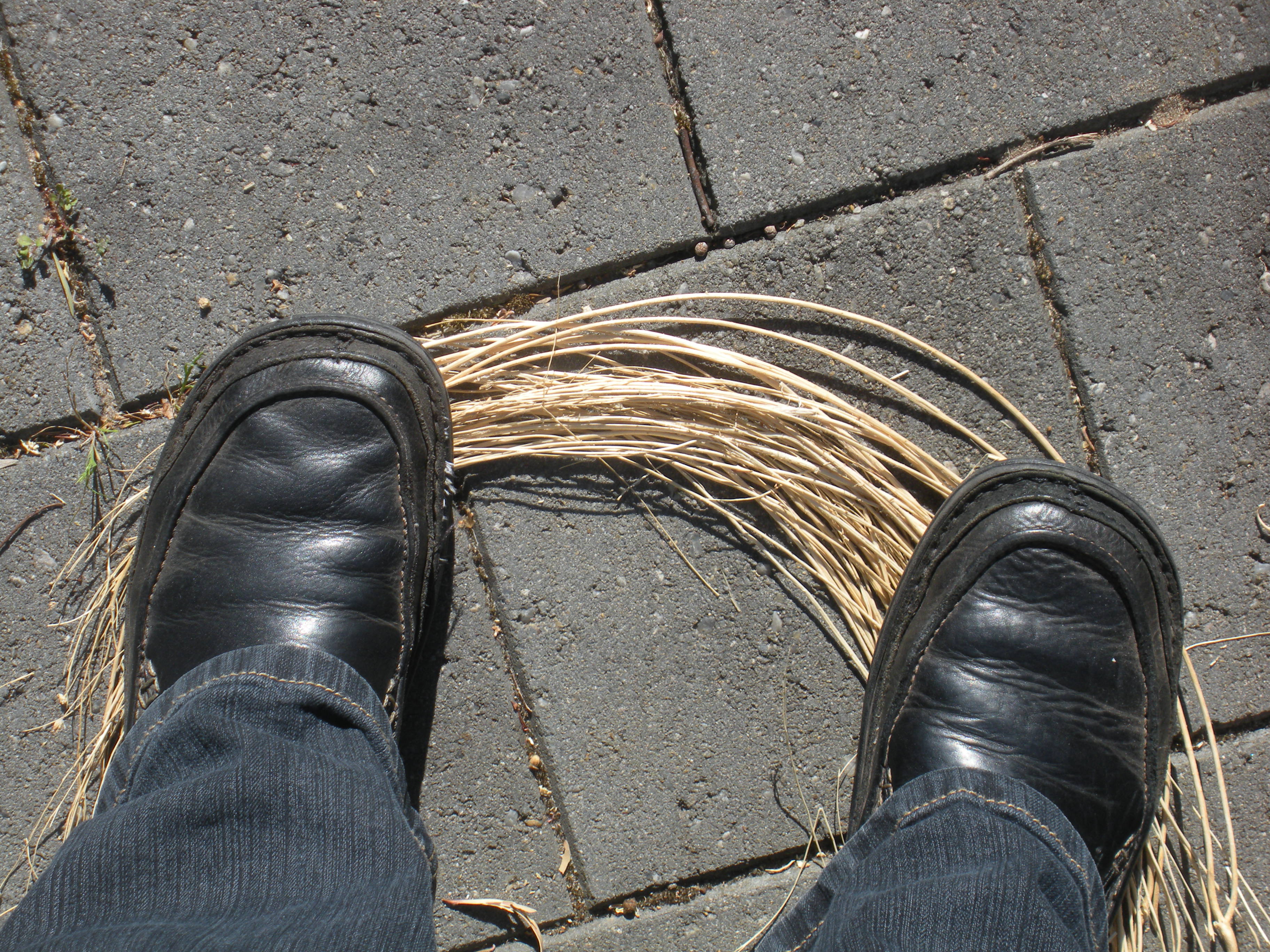
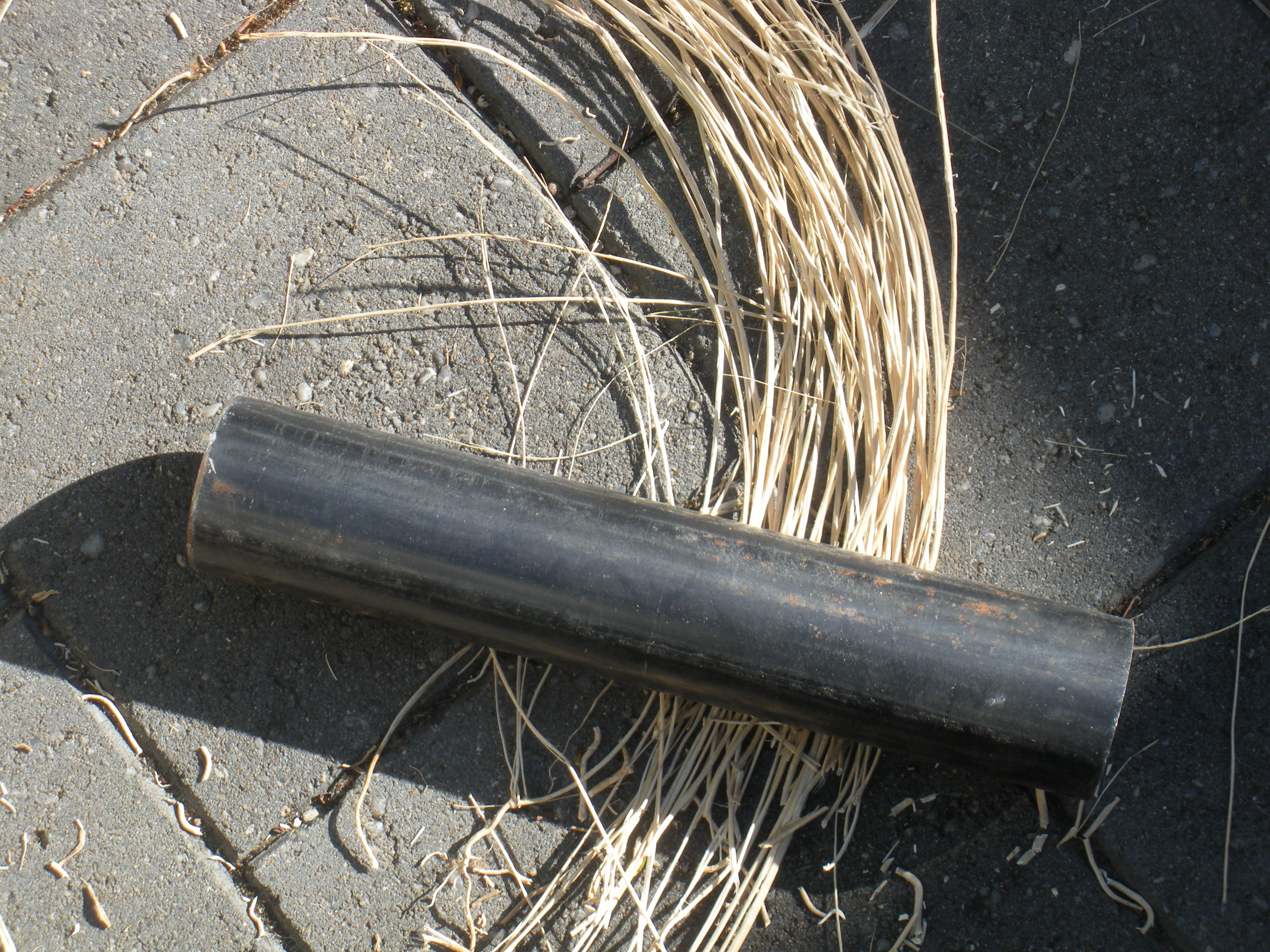
Nothing much to see at the end of the 5 day soaking.  I dried the stems and set to work figuring out how to break the woody parts enough that I could detach them from the fibrous parts (traditionally, breaking, scutching and hackling, all with speciic tools).  I tried stamping on them and rolling a metal pipe over them first.  You can see some results from the rolling…

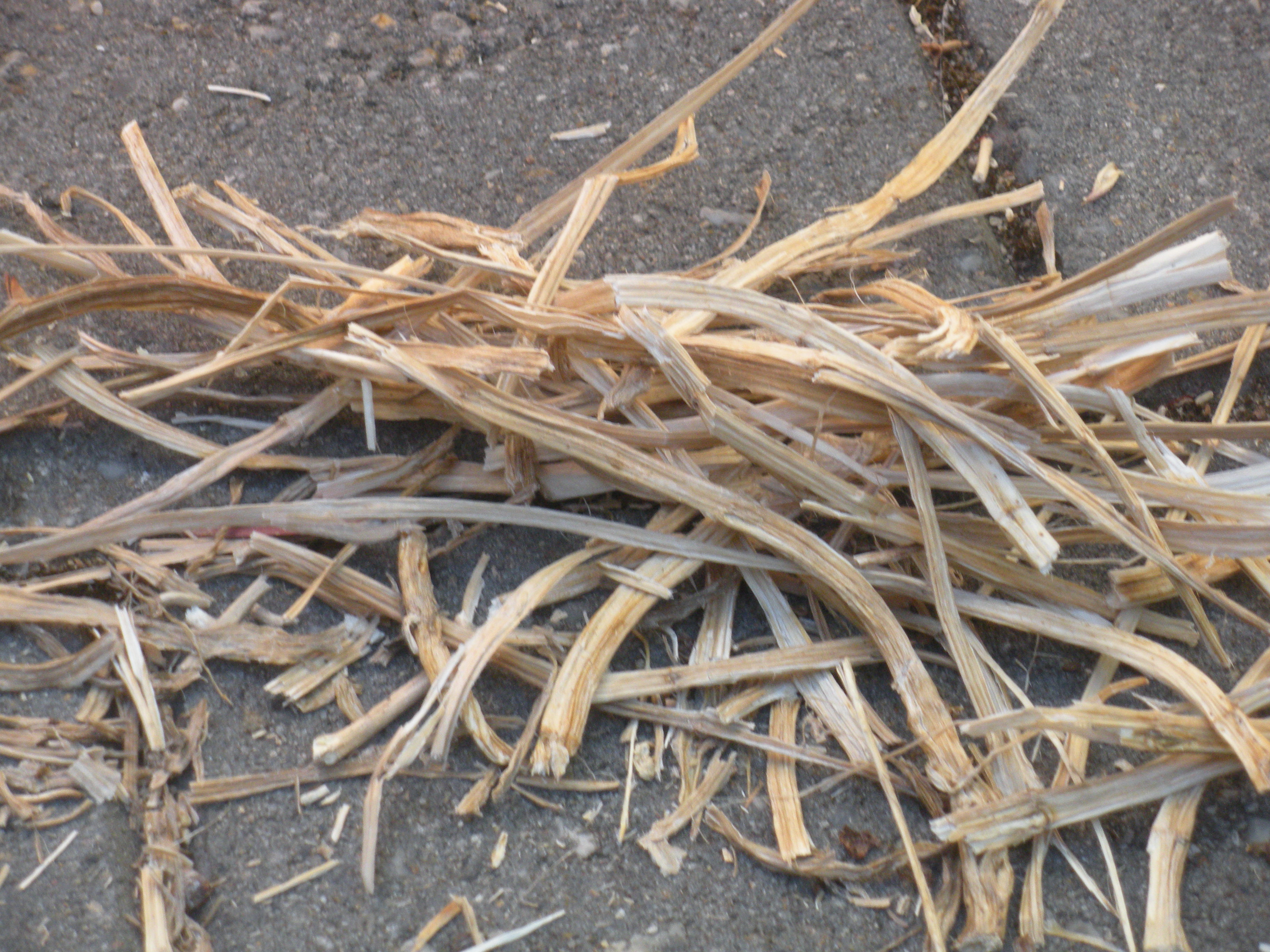
At this stage I delared the nettle unfit for further effort (shattered into pieces with little evidence of fibre).  I am not sure why.  I squashed the nettle stems as they were drying out the first time and maybe that was wrong, or maybe they were just too young.

Fibres were becoming more visible at each stage of flax bashing… and more chaff was falling away.  I would say that means it was retted long enough. I tried my wool combs.  Not great for the job, but some improvement.  I really don’t have the tools (let alone skills) for breaking, scutching and hackling, and looking at the videos in the links above suggests my flax is very poor quality and short–no great suprises there either!

Next stage, laborious hand picking, I think.

6 Comments

Filed under Fibre preparation, Spinning, Uncategorized

Turning a sow’s ear into a silk purse. I mean, a slipper.

This week’s question is whether I can turn a sow’s ear into a silk purse slipper.

I have been the lucky recipient of a lot of free fleece since I took up spinning.  It all started with some filthy Gotland fleece straight from the sheep’s back that my Dad gave me.  He had provided the antique engine that was running the shearing plant in a demonstration of hand shearing at a local show.  Because he knew I wanted to learn to spin, he brought home a few handfuls.   He is a great enabler!  It was rough and filthy, but I spun it on my first spindle and was grateful.  Admittedly, Dad said there was a handspinner at the show and he had spoken to her about it: she advised doing me a favour and not bringing that fleece home to me, but naturally, he didn’t listen!  And I was glad.  I didn’t know anywhere I could get fleece then.

Next, I was given several bags of Dorper fleece by friends who were keeping Dorpers as meat sheep.  I didn’t understand the meaning of ‘meat sheep’ in the context of fleece at that stage.   Dorpers shed their fleece rather than needing to be shorn when they are pure bred, which might have been a clue to (lack of) spinnability for a more knowledgeable person, too!  I dyed it, I spun it, I carded it… oh my goodness. It was the beginning of my fleece preparation journey and it was a very challenging start.  Months later the woman who had lent me her carder said when she saw what I was working with, she was just overcome to think I would even try to spin that fleece!  She didn’t offer me her opinion at the time, though, and it was a long time before I decided that I could, perhaps, compost the rest as my struggles were not only about my lack of skill but also about the state of the fleece.

Needless to say I have also received fleece that has spent lengthy periods in a shed and bred an overwhelming moth population.  Happily, I had said fleece in a plastic tub with a lid.

So… I have had some personal experience of the possibility that people who give the gift of fleece don’t have the judgment necessary to decide whether what they have handed over is worth spinning.   I have to be the one to decide whether the fact that I could turn that into yarn given enough time and effort, is a sufficient reason to do it.  I think I have proved to myself that I can spin almost anything–if I could spin those fleeces as a beginner!

I went to a couple of workshops on fibre preparation (washing, combing and using hackles) at the recent Majacraft Magic camp at Lake Dewar outside Melbourne, and came home ready to tackle some of my current fibre preparation challenges.  I had reached some new conclusions about why I find getting fleece clean difficult sometimes.  1. our hot water tap doesn’t give very hot water, and can’t be adjusted.  Boiling the kettle repeatedly is boring, as well as slow, after a while! 2. I can be more slapdash than is ideal for the task. 3. Most of the fleece I currently have is Polwarth, more gifts from a couple of pet sheep in the hills.  This is a fine and greasy fleece, among the more challenging to clean.  4. I always hope to be able to wash a bigger batch of fleece than is desirable for optimal results.

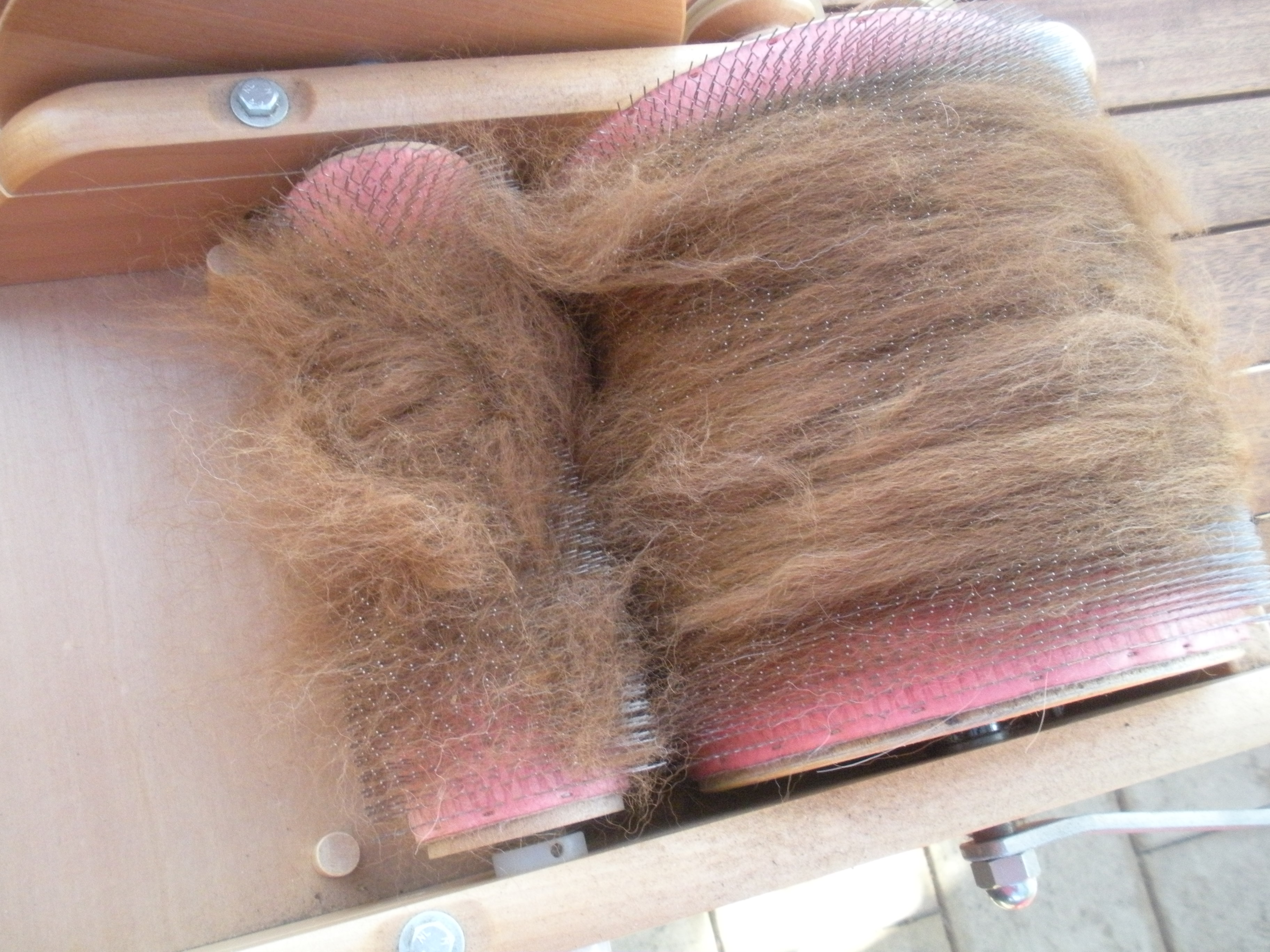
Anyway… having tried washing some more gifted alpaca fleece and some more gifted Polwarth, and using careful observation of how it behaves with flicking, combing and carding, I have decided the following.  1. The specific Polwarth fleece I am currently working on has tips that are weather damaged.  When I flick card them, they pull right off.  Is it any wonder that these paler tips appear as nepps in the batt when I card the same fleece? The other fleeces I have had from the same sheep don’t have these difficulties. The poor sheep must have had a tough year…

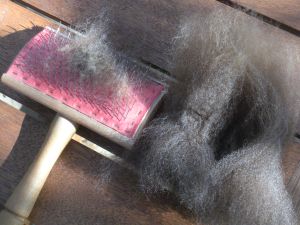
2. That same fleece has a break in it, so the longer locks are giving way under the tension involved in carding, again leading to less than optimal batts.  3. The alpaca is super short (happily, I have now worked with high quality alpaca and no longer assume this s just the way alpaca comes).  It has not really been skirted.  Most of it pulls onto the licker-in (the small drum on the drum carder) when carded. Yes, from the very start, and not only when the large drum is full.

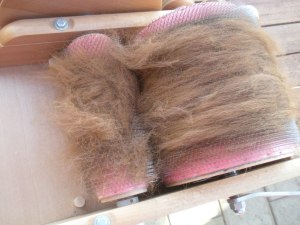
4.That alpaca has big clumps of guard hair and has been shorn without consideration to the future spinner.  Hopefully the shearer was thinking of the animal’s welfare in taking so many passes!

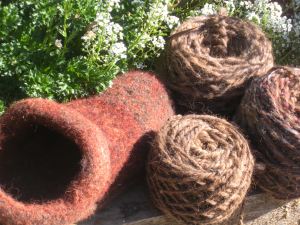
In short, these are not the highest quality fleeces possible and they would present challenges to anyone preparing them for spinning.  No matter how much time I spend I may not be able to turn these sow’s ears into the proverbial silk purses.  I have decided, instead, to attempt to turn them into felted slippers.  I am carding them together as a blend, spinning them up without too much fuss and very fat (good practice) and my ultimate plan is to knit slippers which will be felted and perhaps dyed.  Shazam!  Their less than ideal qualities will no longer be of importance.  I hope!

Here are my first few balls, and a slipper with some polwarth content and some eucalyptus dyed wool content to give me hope…
4 Comments

Filed under Fibre preparation, Knitting, Spinning, Uncategorized