Category Archives: Natural dyeing

Dyes of antiquity: Eucalyptus leaves

My friends, there is going to be a little series on dyes of antiquity here on this blog. It arises from plant dyestuffs that have been donated anonymously to my Guild, which have come to me as the person currently teaching natural dyeing at the Guild.  Needless to say, there are women at the Guild who know more about natural dyeing than I do and have decades of experience.  Some are dyes used in antiquity (cochineal, indigo, kermes).  Others are in packaging that predates metric weights  in Australia, which came in in 1977.  Certainly, safe disposal of mordants that are now regarded as toxic has had to be arranged.  So I am using the word ‘antiquity’ both literally and figuratively–but I have a trove of dyestuffs which I would usually not have come across, and some of which I would not be prepared to buy if they were available.  Some require identification.  Some require research, so I can figure out how to dye with them.  I decided to start with what I know.

2014-06-05 13.47.06

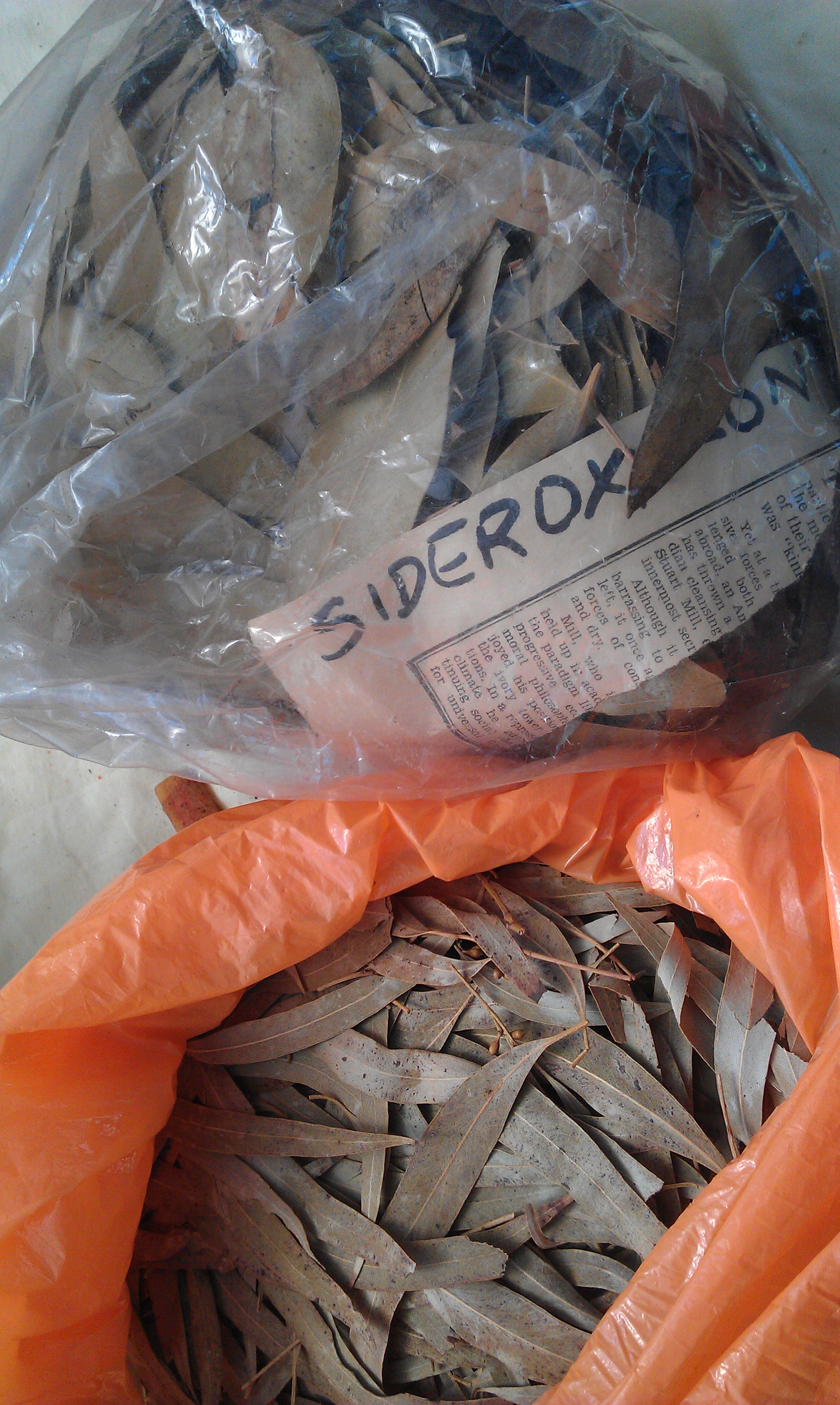
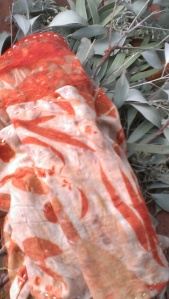
There were bags of varying sizes containing eucalypt leaves.  One was clearly E Sideroxylon leaves.  Then there was the orange bag of unidentified leaves–possibly E Nicholii (which has clearly been in widespread use at the Guild in the past).

IMAG1772

Then there was a lovingly stored and labelled small pack of E Crenulata leaves.

IMAG1773

From time to time, people online ask whether you can store Eucalyptus leaves for too long.  I don’t know.  I tend to use what I have on a rotating basis, partly because I have seen what insects can do to stored vegetable matter!  These leaves appeared to have been stored for a long time, but under good conditions.  No signs of insect damage.  They had clearly been dried prior to being bagged for storage.  They retained some green colour. They were sitting on top of a stack of newspapers dated 1991.  Was that a clue?  I don’t know!  A fellow Guild member who helped me clean out the cupboards thought they were probably older!

2014-05-31 11.57.29

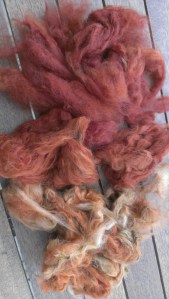
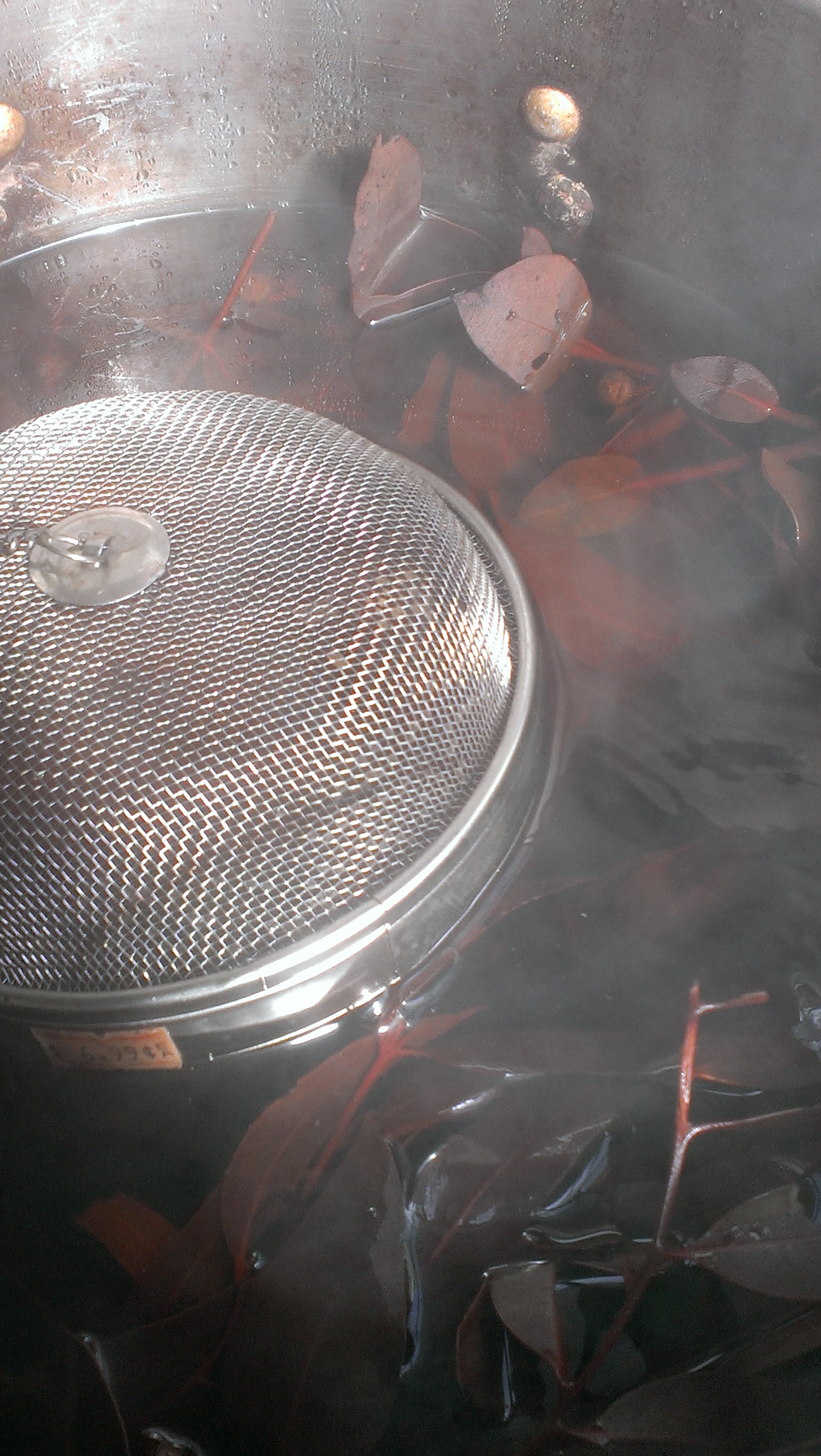
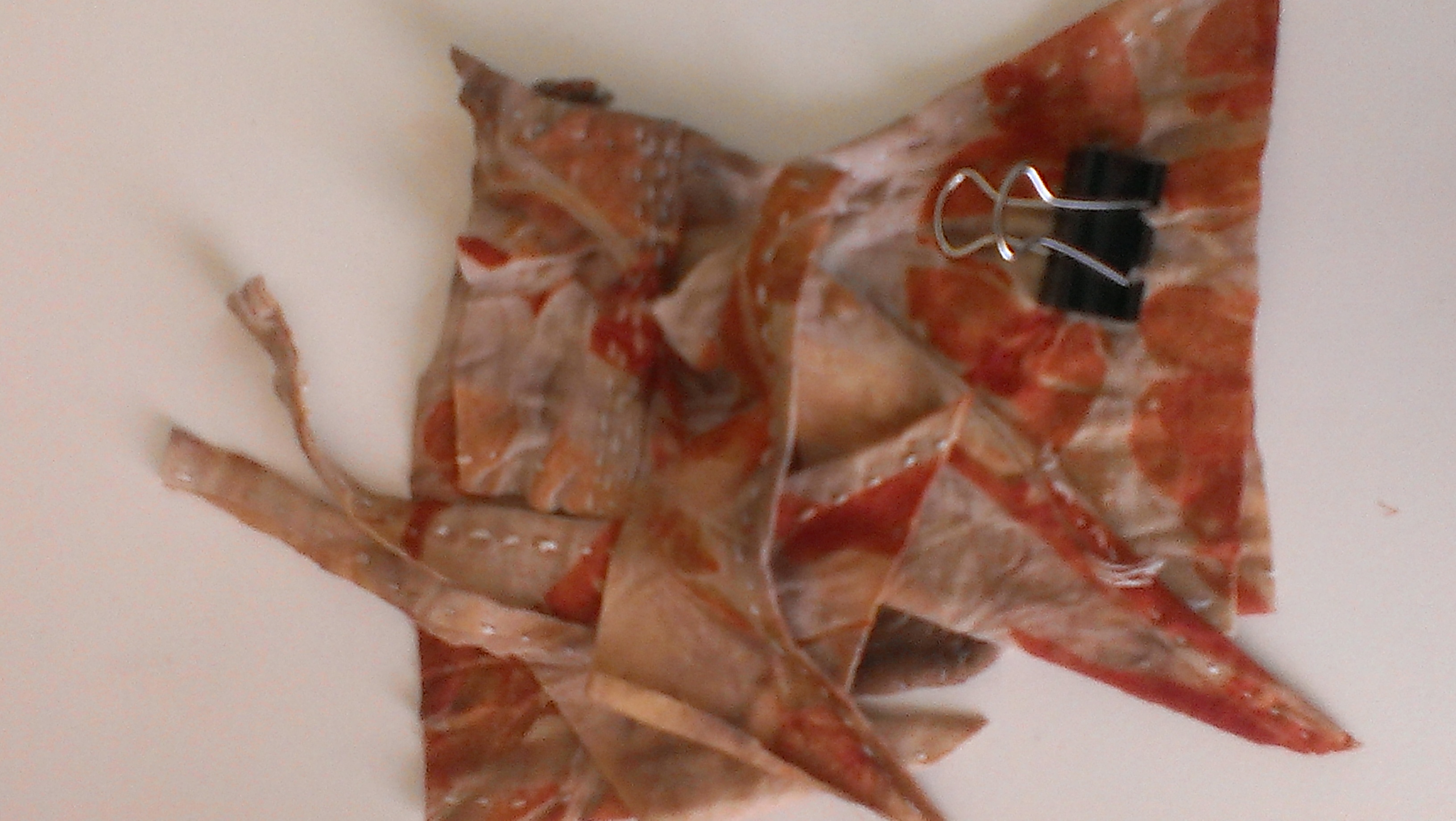
The E Sideroxylon leaves gave far more intense colour, partly because there were more of them.  And possibly because the small fine leaves were not from an exciting dye species and the second dyepot was mostly relying on the small quantity of E Crenulata.  Just the same, more of my white alpaca fleece is getting dyed, spun and ready to be knit all the time…

Meanwhile, I am preparing for a dyeing workshop at the Guild and deciding which of the dyes that have come to me are suitable for use there… I’m thinking madder, walnut, cochineal and logwood!!

4 Comments

Filed under Eucalypts, Natural dyeing

For the love of mending: Make do and mend afternoon

We had a make do and mend afternoon with friends recently.  We’re investigating actions we might take about climate change, and we’ve begun with some conversations about consumerism.  Who knows where that might lead?  I began by stitching up a torn out seam for my partner and tightening all the screws on the clothes rack so it works properly. Meanwhile a rusty frypan was rehabilitated, an electrical plug was replaced, and the endless chewing of moths on fine wool was darned in by others.

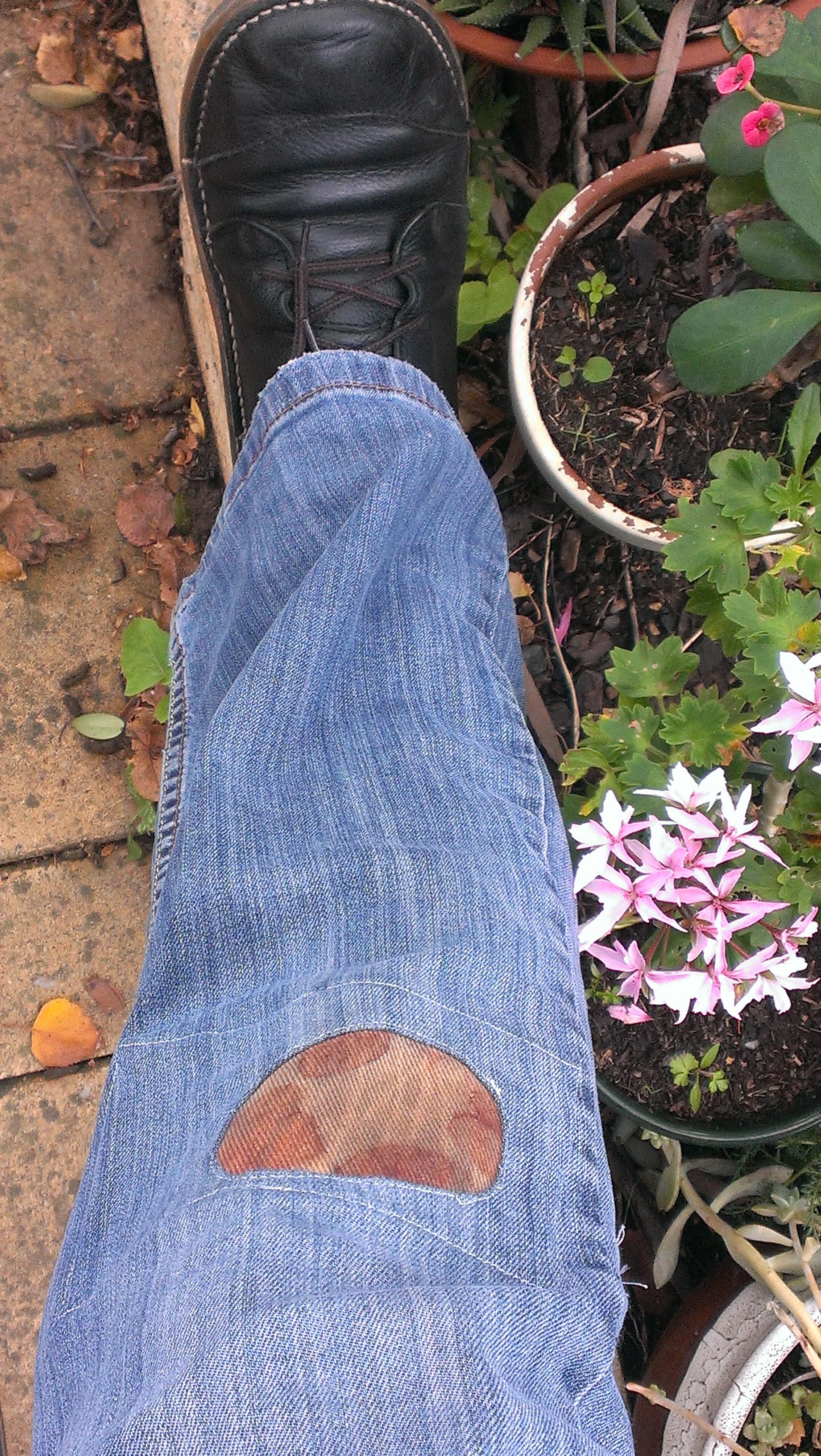
I have a wardrobe which is heavy on the bottom end.  I always have more clothes suitable for gardening and doing filthy jobs than I have clothes for best.  And my favourites are usually my gardening clothes.  Things that are no longer suitable for wearing to work or to visit my mother, unless I’ll be weeding while I’m there. My father is a bit like me.  When I knit him socks he puts them in the drawer until he has worn out a previous pair.  My current favourite jeans are well past their best, and weeks ago they went through in the knee.  I kept thinking I would turn them into a bag, but then I kept taking them out of the reuse pile and pulling them on.  So with a crowd of friends who were mending and repairing too, and a pot of pumpkin soup to keep it cheery, I patched them.  Maybe one day this patch will be part of a bag!

For those who wish they knew how to patch the knee of jeans, step one for a simple mend is to rip out whichever seam is less complicated.  Leave the flat felled, beautifully topstitched seam intact and rip the other one, if there is a choice.
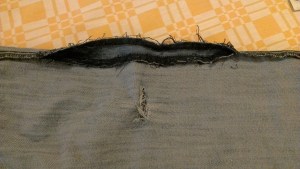
2014-05-31 11.56.28

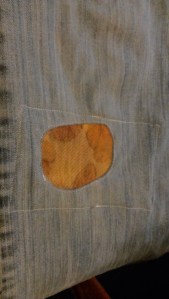
Choose a nice patch.  This one was once part of a pair of cotton twill pants and is now eco printed with E Cinerea leaves.  Trim back the hole to some solid fabric, and shape it.  My mother taught me this mend and always created a straight sided shape, like a rectangle.  I decided to try something rounded.  Put the patch on the inside, and turn the edges of the jeans under all around, attaching to the patch fabric. Tacking would be a great way to proceed, but I prefer pins.  Call me a daredevil!

2014-05-31 12.54.58

On the inside, turn the edges of the patch under, toward the wrong side of the jeans.  Stitching the first seam and then turning the second would have been a good idea, but I was having an interesting conversation and didn’t want to leave the room to use the sewing machine yet!

2014-05-31 12.55.33

Stitch around each edge.

2014-05-31 13.36.11

Apologies for the indoor pictures on a rainy day–but here is the patch, being a mend on gardening jeans, in the garden, with the sun out, however weakly!
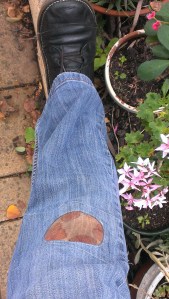
2014-06-01 12.47.08

One of my treasured friends brought some socks with him.  It’s a shame about the lighting, but never mind.

2014-05-31 12.56.32

I made these from Cleckheaton 5 ply crepe in pure wool (not the best possible choice for socks) in 2009. Here they are on my desk at work in all their glory in 2009.  Who can believe I managed to find the photo (or understand why I took it at work?)

150620091161

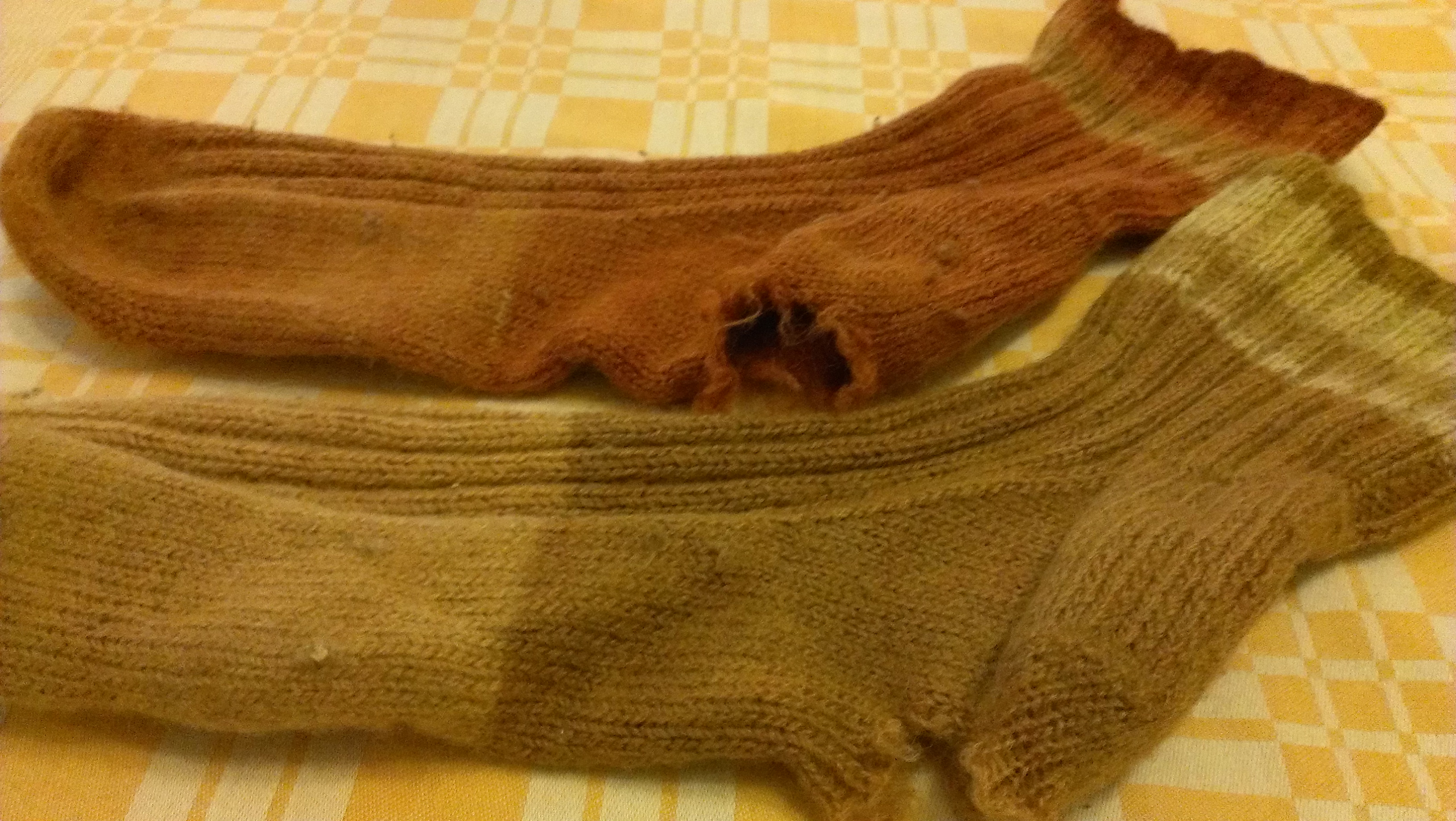
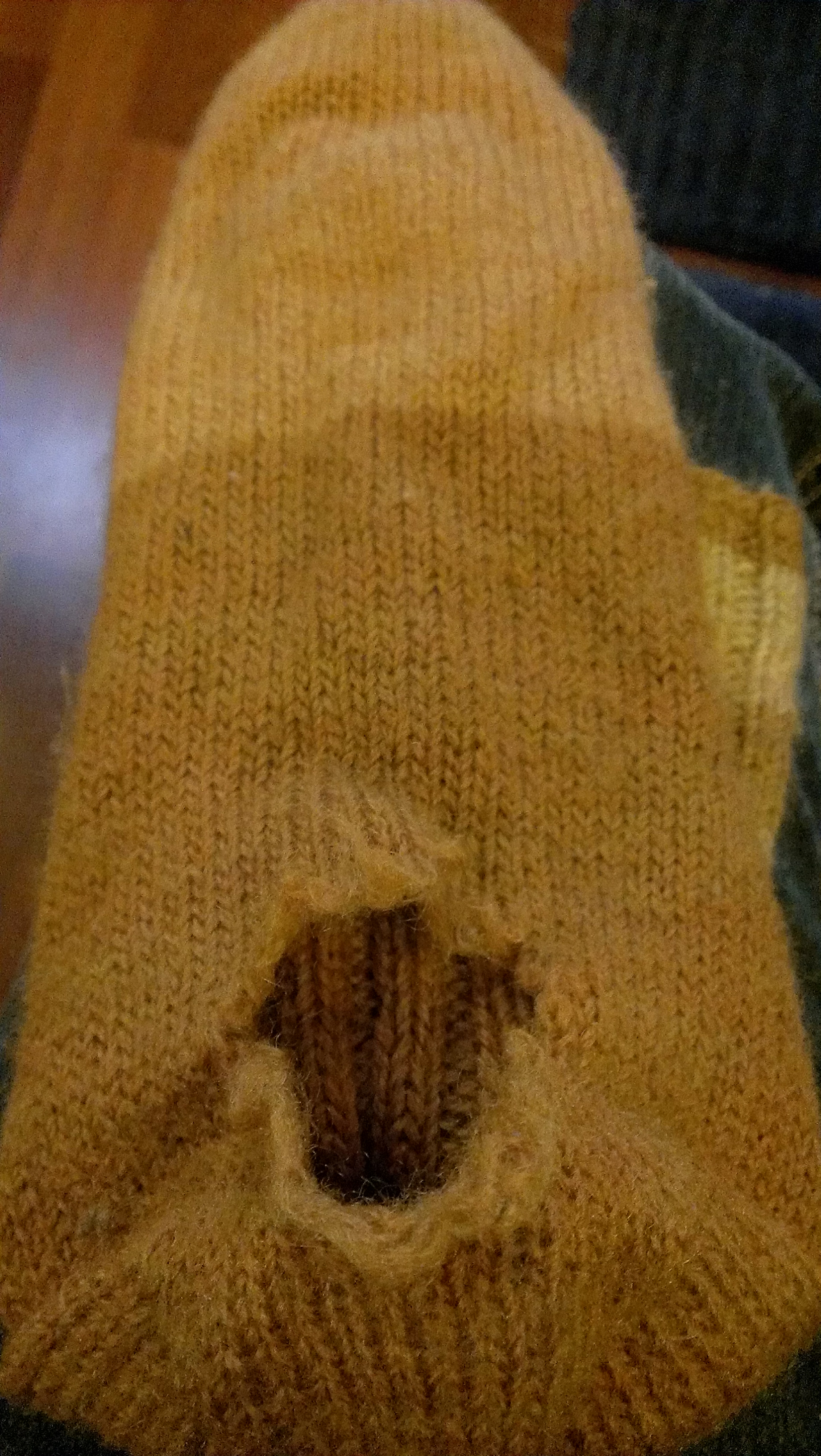
The stripes at the tops are all my samples for the previous period–a metre or two of yarn dyed with samples of local eucalypts and other plants.  The rue dyepot was the worst ever–but a triumph of neighbourhood cooperation involving a rendezvous at the local train station where my friend handed a bag of rue prunings out the door and I stood there ready receive them as he continued on his way on the train relieved of his pungent burden!  One of the socks is all in orange tones and the other tans and greens.  Rue.  The ordinary kind does not give red, my friends, take it from me (or sort me out if you know how to get red from it–seems like there is a Siberian kind that might give red–but only from the seeds–or some such).  I digress.  These socks have been worn a lot, which is very flattering, and my heart’s friend wanted to keep them, though perhaps only for in-slipper wear.  We consulted about whether it was feasible to darn these holes.  I wasn’t sure.  He can darn but has not kept up his knitting skills in a period when carpentry has been needed more at his place.
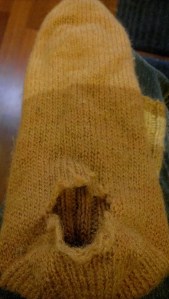
2014-05-31 14.38.03

He has the biggest feet on my knitting roster.  These holes are BIG.  I wasn’t sure about darning them.  He went off to tend to a bicycle (there were others people dealing with wood and still others entertaining children with the wheelbarrow and others still darning).  I thought it over, no doubt drawing on things I’ve seen and read, and wondered if I could just pick up and knit on a patch.  I pulled out 4 ply patonyle dyed with eucalypts.  I’ve learned a few things about getting a strong colour since I dyed these socks.  the original wool in the socks has worn thin and the 4 ply was fine for the job.  I decided on a visible mending aesthetic.

2014-05-31 14.36.46

At first, I wasn’t sure how to join on the sides on.  Then it dawned on me… pick up a further stitch and knit or purl it together with the edge stitch.  What could be simpler?

Put your sunglasses on, I must have changed the settings on the camera.

2014-05-31 14.23.12

When I got to the end of each hole, I decided to graft.

2014-05-31 14.25.19

I picked up more stitches and kitchener stitched (grafted) them together.  And in the end… the conversation was so good I mended all three of the big holes.  Comfy socks to wear when your feet are up.  Eat your hearts out!
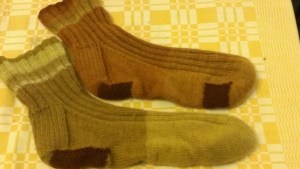
2014-05-31 16.24.11

10 Comments

Filed under Knitting, Natural dyeing, Neighbourhood pleasures, Sewing

More jars for the pantry!

I’ve been making the most of the end of season fruits and flowers to create more Stuff, steep and store jars.

IMAG1793

This jar contains pomegranate rind (and a few seeds)–somewhat dried out after contributing to more than one salad earlier in the week:

IMAG1794

Then I made another with hibiscus flowers, and since I was sorting through dyes from the Guild that day (on a large sheet to catch escapees), a few cochineals and kermes left on the sheet with dust and dirt and leaf fragments.

IMAG1790

Finally, why not try madder root, as I now have quite a bit of it in my possession?  I figure if this does not go well–though I can honestly see no reason it should fail–I can heat it and dye with it when it comes out of the jar.

IMAG1795

Before sealing…

IMAG1796

And some days after…

2014-06-02 14.10.44

Many more images of what people are doing with this process over at The Pantry.

4 Comments

Filed under Natural dyeing

A birthday gift sewing kit

One of my beloved friends–I think of her as family of choice, really–had a birthday recently.  I love to celebrate birthdays, but to be honest, I prefer to give gifts as they come gleefully to hand or come into existence and not save them up for a specific day.  Perhaps I am just impulsive, or perhaps I don’t have enough gift ideas!  Anyway, near enough to the big day I came to understand that she didn’t have a sewing bag… even though she is such a wonderful stitcher and mender, and even though she is currently spending many hours on public transport where stitching might be a good thing to be carrying.  I started out with making a bag.

IMAG1745


The main panel is a superb quality linen which was once part of a pair of suit pants.  At a  guess, they had their heyday in the early 1980s.  I have saved the jacket, but the pants were past use as a garment and long since met the dye pot, bundled with E Scoparia leaves.  My favourite combination, pretty much.  The chocolate brown ramie and linen sections were also op shop garment finds, and there is a leaf printed silk noil lining.  Naturally, I acquired some pretty pins and suchlike… And then made a needlecase.

IMAG1741


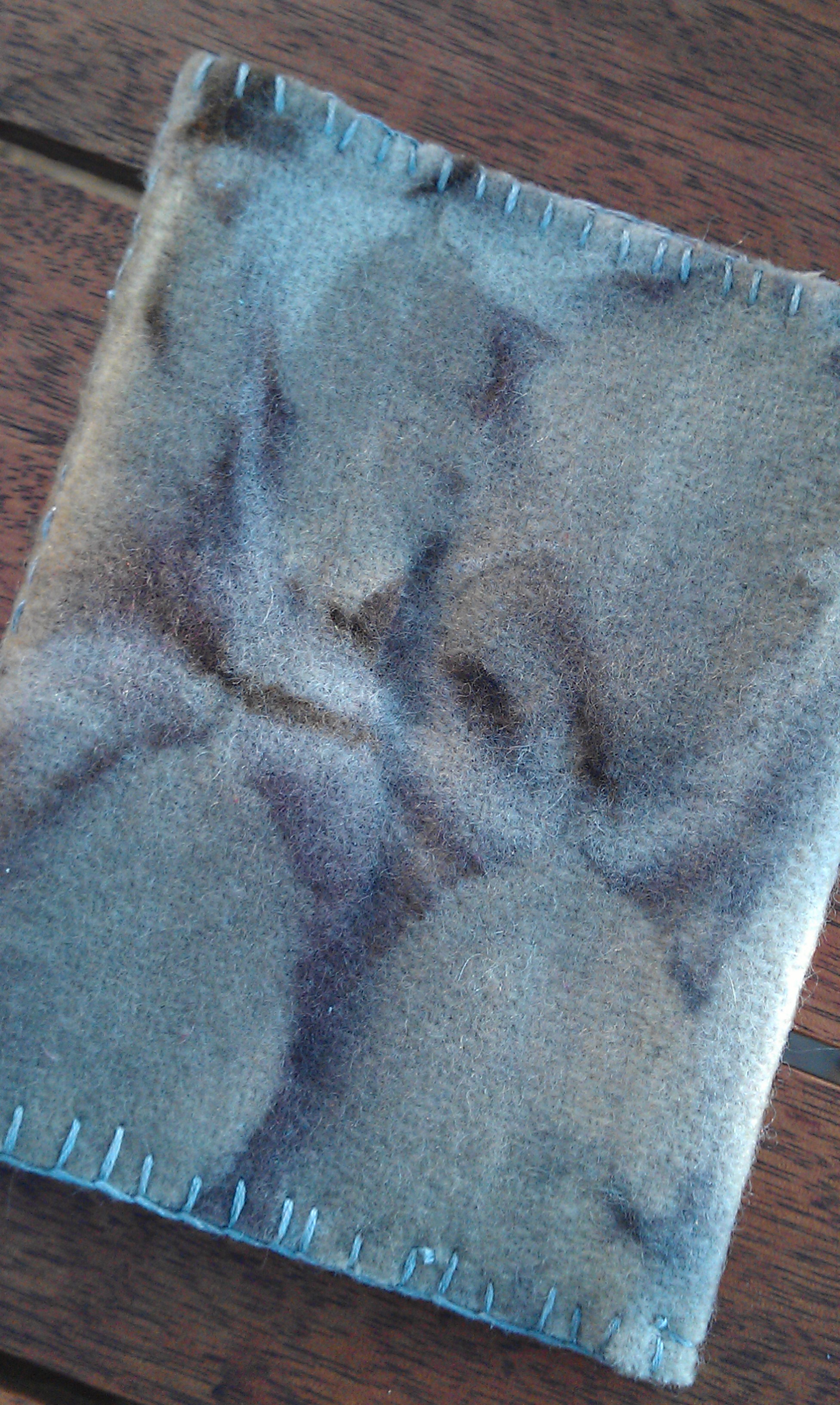
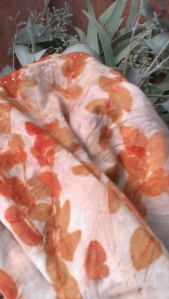
These prints are pohutukawa (Metrosideros excelsa) leaves on a strip of old woolen blanket, stitched with silk thread dyed in Austral indigo (Indigofera Australis)–but only just!  The thread colour seemed perfect for the job to me, being just to the blue side of grey.  Those pohutakawa leaves have the glorious feature of giving two completely different coloured eco-prints, one on each side of the leaf.
IMAG1742

Long ago, another friend gifted me a pile of small leather samples, perhaps from an upholsterer–each one labelled with the name of the colour.  This one met its destiny as a scabbard of the most basic kind, intended to stop these scissors finding their way out through the bag.  In the end, this gift extended the birthday season by some days… the anniversary of my friend coming into the world came and passed–and a bit later, along came this belated present.


7 Comments

Filed under Leaf prints, Natural dyeing, Sewing

Milky merino: Second effort

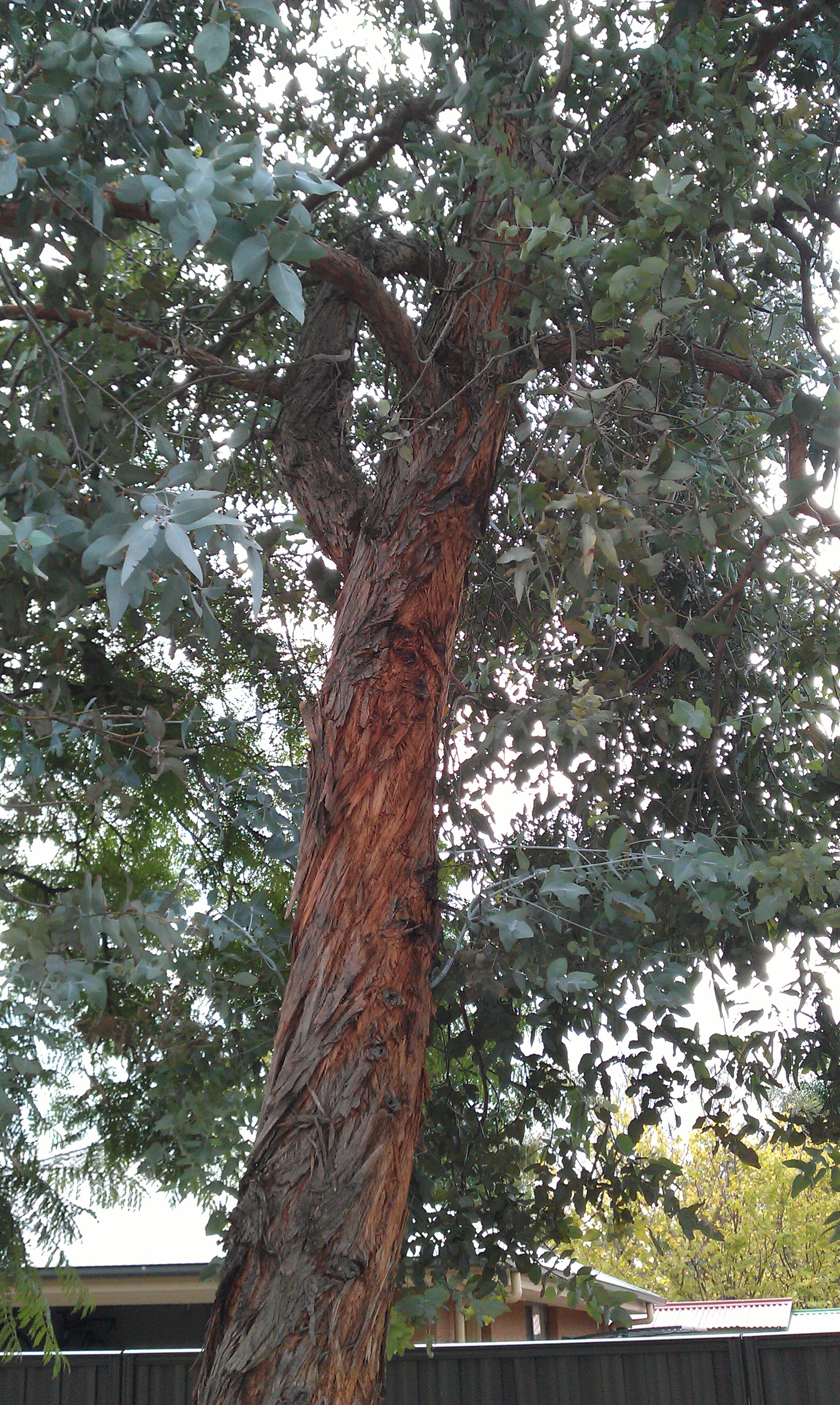
I decided to use the scraps from my milky merino to make a singlet for a small friend. One inspiration was the discovery of another E Cinerea nearby on a suburban street.  It is beautiful.

IMAG1723

It is covered in new growth, whose leaves are larger and teardop shaped rather than the rounder heart shape that is usual for mature leaves.

IMAG1722

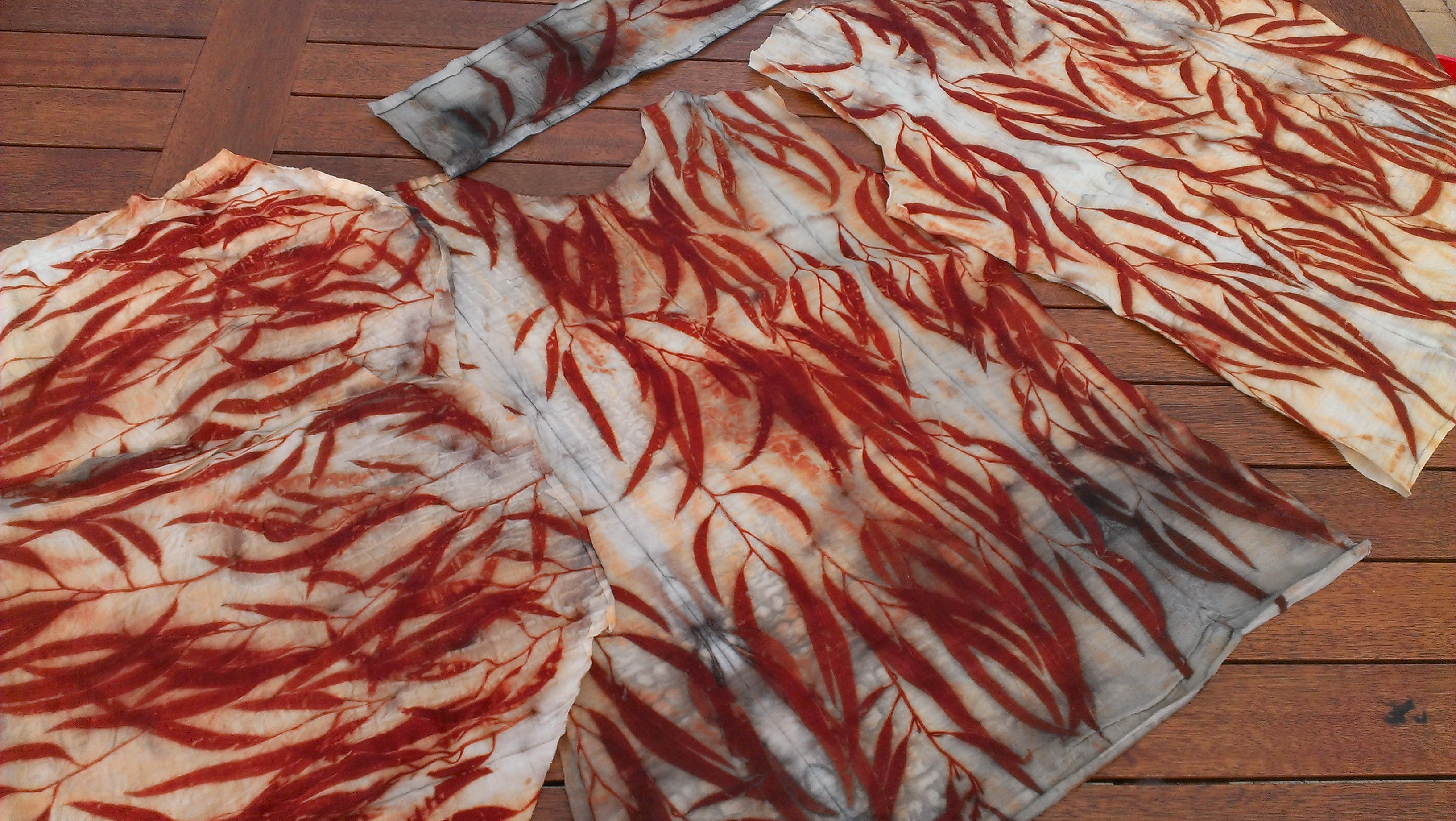
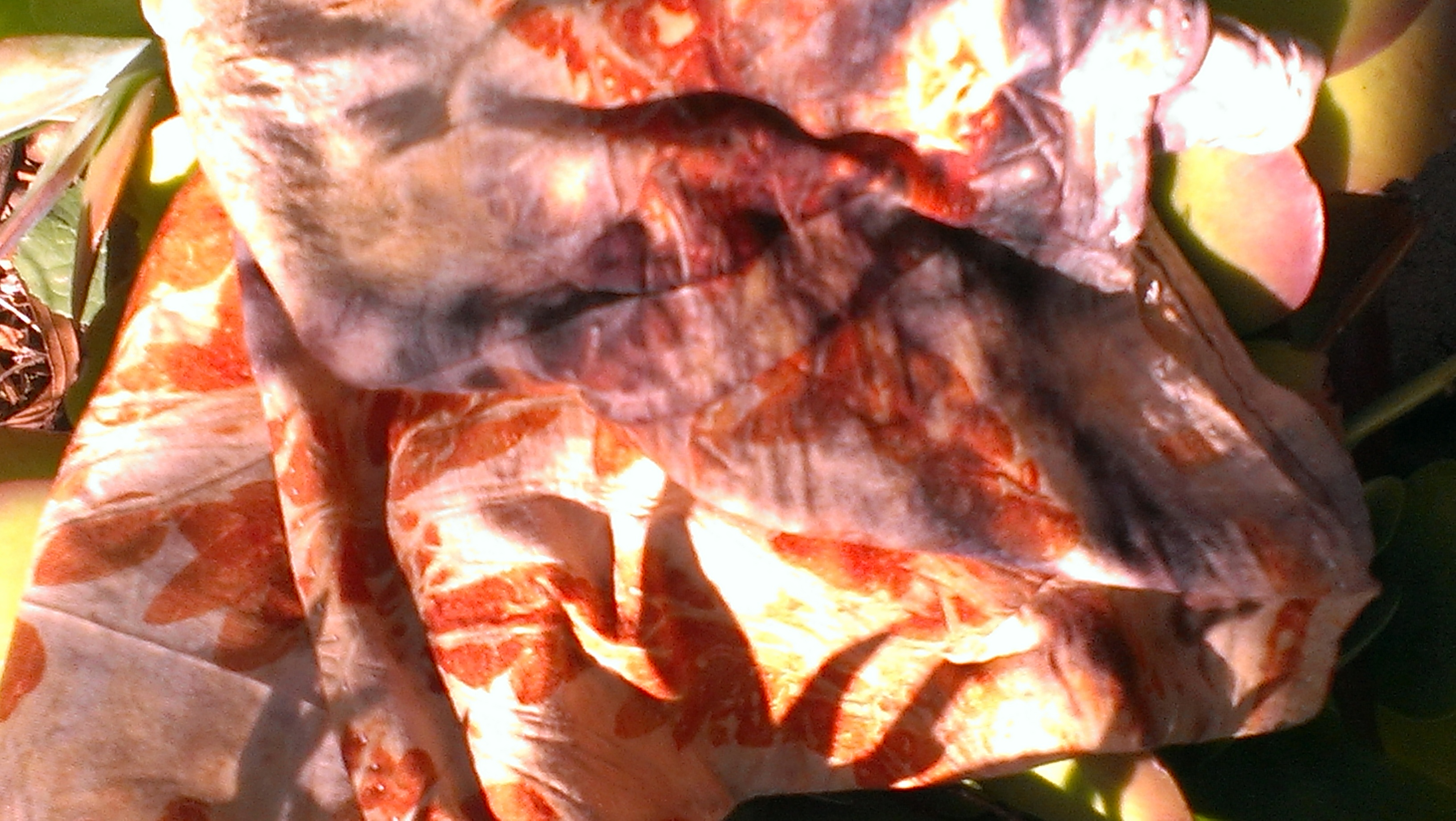
I have to say milky merino is a glorious fabric to use for eco-printing.  It takes colour in a most spectacular fashion.  I bundled up one night and unbundled a day or so later.

IMAG1731

I love the way the fabric took on a golden creamy colour where it did not absorb a direct print.

IMAG1733]

Action shot!
IMAG1735

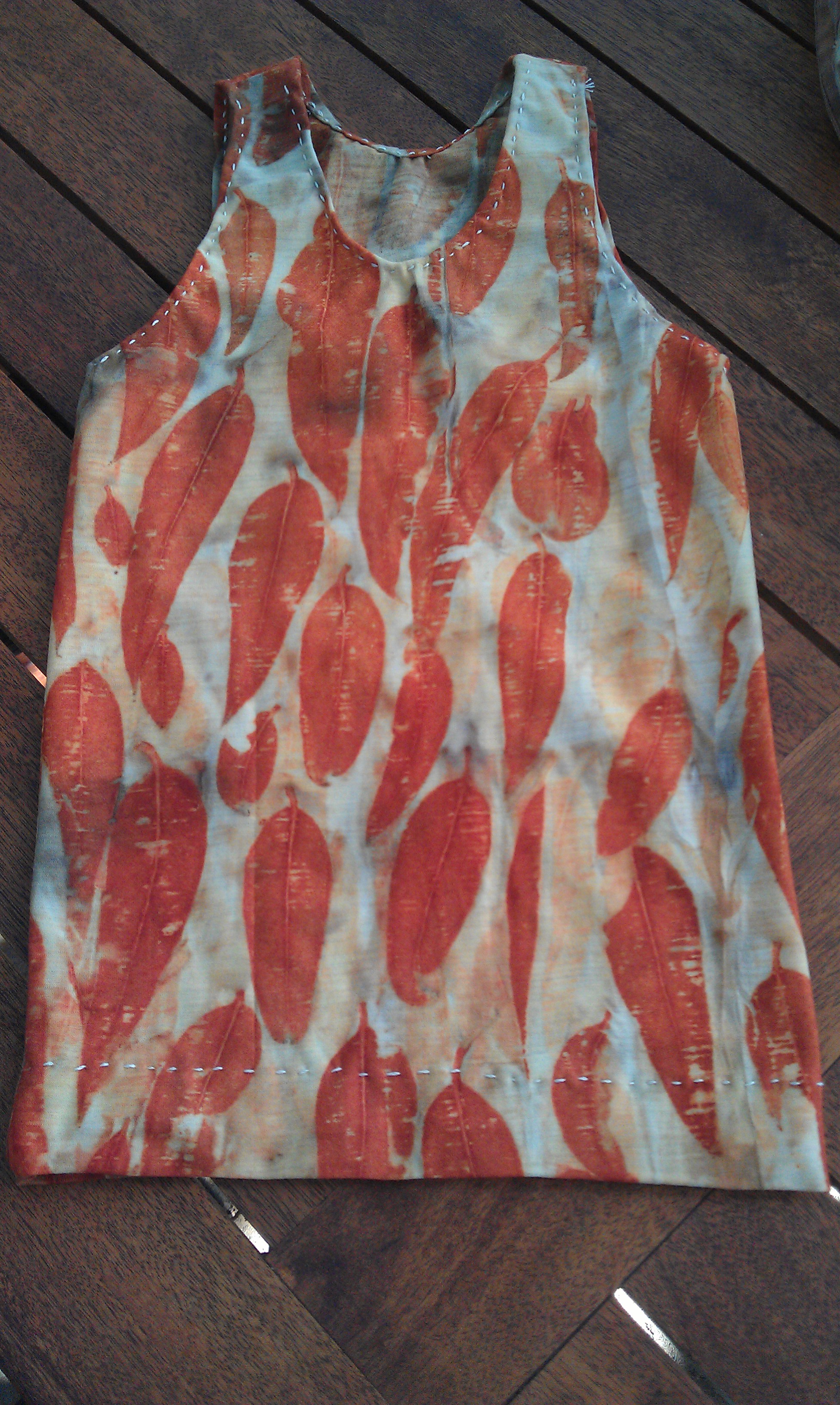
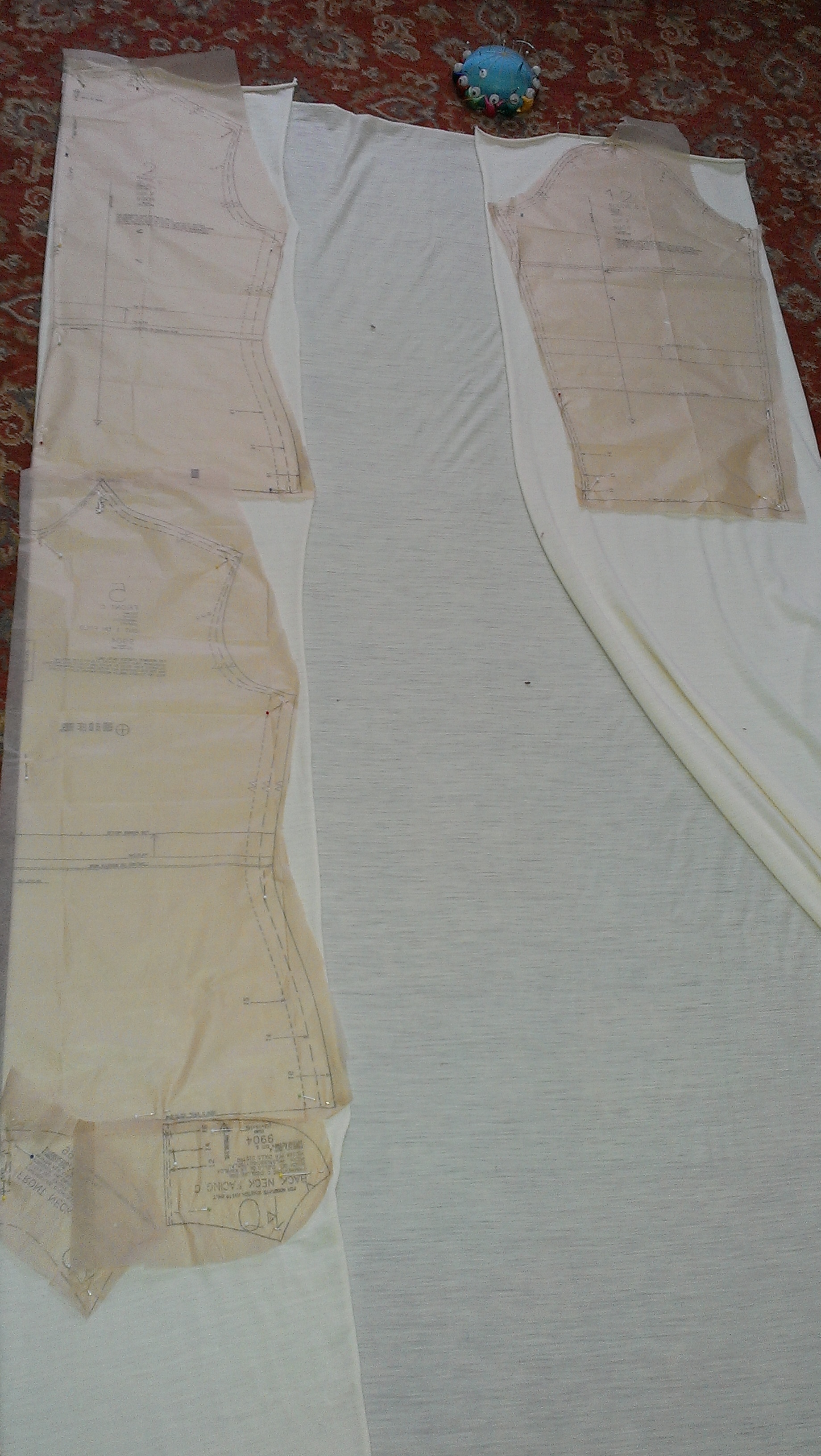
I created a pattern from an existing garment and set about cutting and sewing it from the fabric.

IMAG1753

The finished garment is sooo cute, and so tiny I need to find a different recipient for it.  I should have recognised the difference in stretch between the garment I measured up and the milky merino…!

IMAG1754


9 Comments

Filed under Dye Plants, Eucalypts, Leaf prints, Natural dyeing, Neighbourhood pleasures, Sewing

Milky Merino: First effort

Last year, I managed (with a little help from cossack design) to acquire some milky merino knit fabric. I have been thinking that if I want to make all my own clothing I will need to learn how to make turtle neck, knit, long sleeved tops for winter and T shirts for summer (though perhaps it will be years before I wear out my current collection of T shirts–and people keep giving them to me)!  I decided to try a pattern I bought some time ago.  Then I managed to trace a pattern from a garment I already have and like to wear and cut one of those from the length of fabric I had as well.

IMAG1897

I was feeling positively gleeful about the potential for two garments to emerge from this experiment.  Many other dyers–see examples here, here and here have had beautiful results dyeing this fabric.

  IMAG1903 (1)

I’m delighted with these results.

IMAG1905

I also dyed the little samples that came in the pack, neatly enclosed in my soup ball:

IMAG2270


IMAG2277

This thread has since been applied to a ‘beloved tree’ banner.

IMAG2291

That was all very well.  I sewed my garment together, only to discover that I had succeeded in shrinking the fabric… and more in one direction than the other.  In the end, I gave the garment to a smaller friend and she adjusted it to fit her.  She looks wonderful in it!  Now I am building up my nerve to sew the second turtleneck together and see who that will fit!

12 Comments

Filed under Eucalypts, Leaf prints, Natural dyeing, Sewing

Whatever became of the dress?

IMAG0041

Well, my friends, true confession time.  I sounded out a lot of people about the second skin frock, on and off line.  Their, and your, ideas were full of genius.  If I’d had ten of that frock I could have made ten different lovely garments from it.  But I didn’t!  I still could not overcome the fundamental issue—believing I’d wear it no matter how lovely it was.

IMAG0042

I turned it into a series of what India Flint calls ‘infinity scarves’, though a  little less fancy than the model we created in Melbourne.  Three of them.  Two have already gone to happy homes, in fact I saw one in use yesterday.  It had a leaf print from a white cedar (Melia azaderach var australasica) leaf, pale green, which my friend had particularly appreciated.

IMAG0043

One has been hand-pieced to manage the top part of the garment, and naturally it’s my favourite.  I’m surprised to find that the clean, shiny white of the silk and cotton thread stitches against the dyed fabric is pleasing to the eye.

IMAG0044

I’m now left with only a small pile of little scraps.  Each time I come past them, I think ‘pincushion’.  So there may still be another object to emerge from what was once a frock…

IMAG0077

5 Comments

Filed under Leaf prints, Natural dyeing, Sewing

Eucalyptus Eximia

I had the chance to sample fallen dried leaves of Eucalyptus Eximia, the yellow bloodwood.  Such spectacular bark!

2014-04-25 16.10.31-49

Needless to say, I didn’t pass up the opportunity!

2014-04-25 16.10.31-50

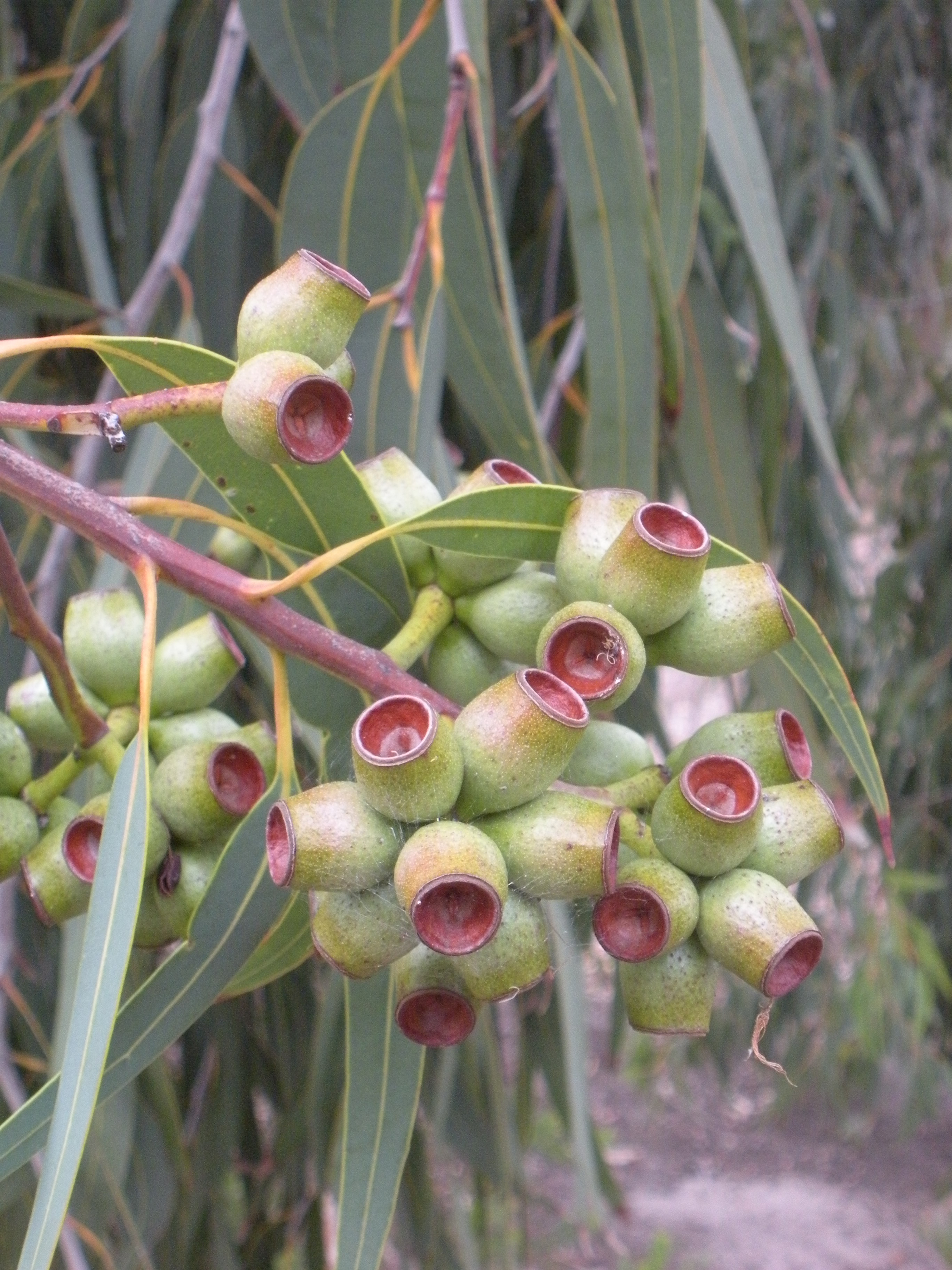
Apparently I did pass up the opportunity to take a picture of the entire tree, but here you have bark, trunk, leaves and immature fruit

2014-04-25 16.10.31-52

And the result from the dyepot…

IMAG0066

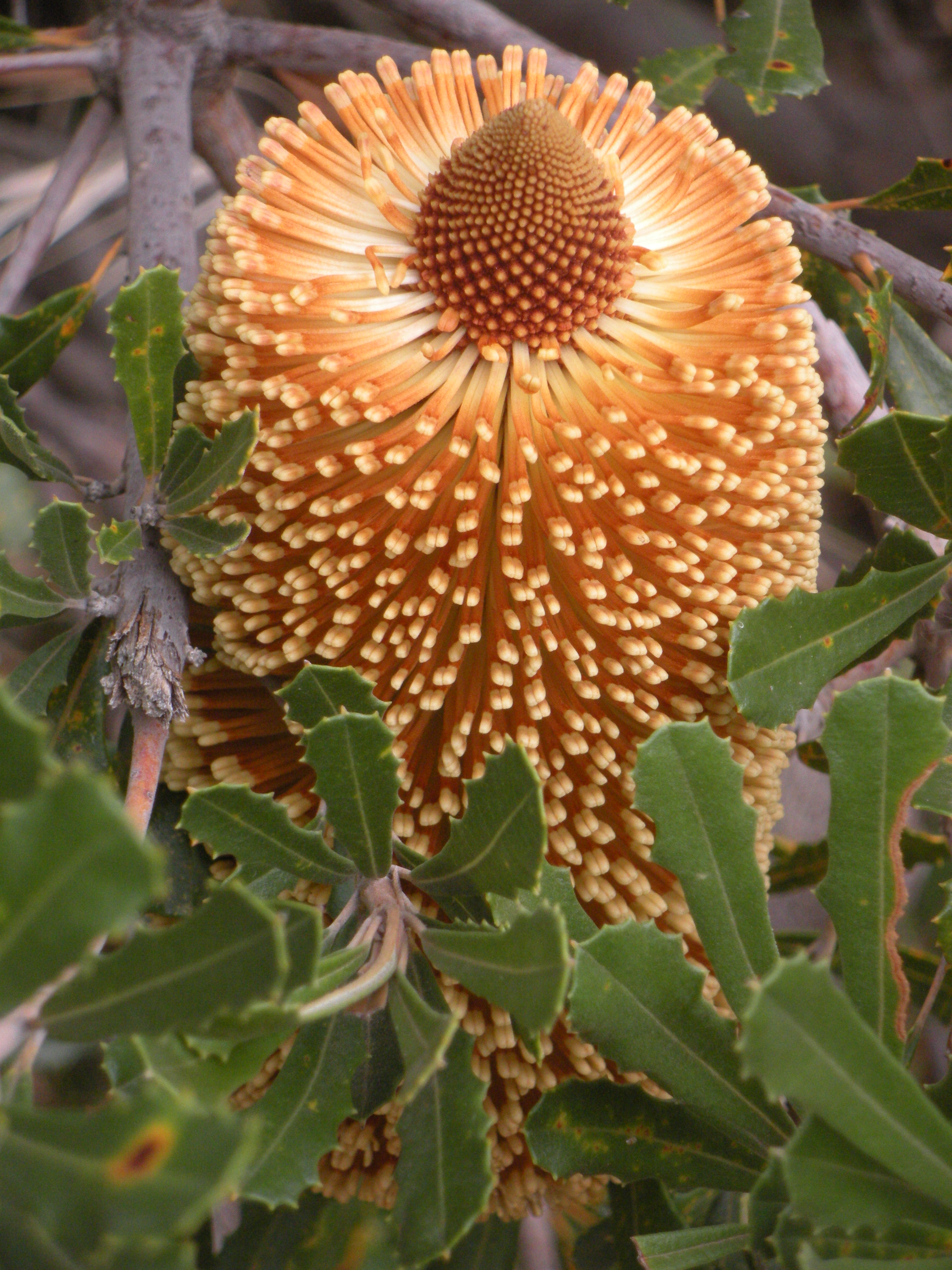
Just for your viewing pleasure–some more of the glorious native Australian plants at Wittunga Botanical Gardens–

2014-04-25 16.10.31-38

These are banksias at their splendid best.

2014-04-25 16.10.31-31

2 Comments

Filed under Dye Plants, Eucalypts, Natural dyeing

Eucalyptus Grandis

2014-04-25 16.10.31-8

These massive trees are a feature planting at Wittunga Botanical Gardens.  I am sure they are far from full grown, but they are huge!  I gathered fallen leaves from beneath them and since I was playing a game of trying to identify eucalypts as I walked up to them but before I could see their name tags–I guessed they were E Saligna.  My eucalypt handbook assures me the two are closely related, so perhaps I’m learning something…

IMAG0067

I had a significant amount of plant material relative to this tiny sample, but apparently this tree gives colour.  There were, of course, so many beautiful plants.  This one is Calistemon Rugulosus var Rugolosus:

2014-04-25 16.10.31-17

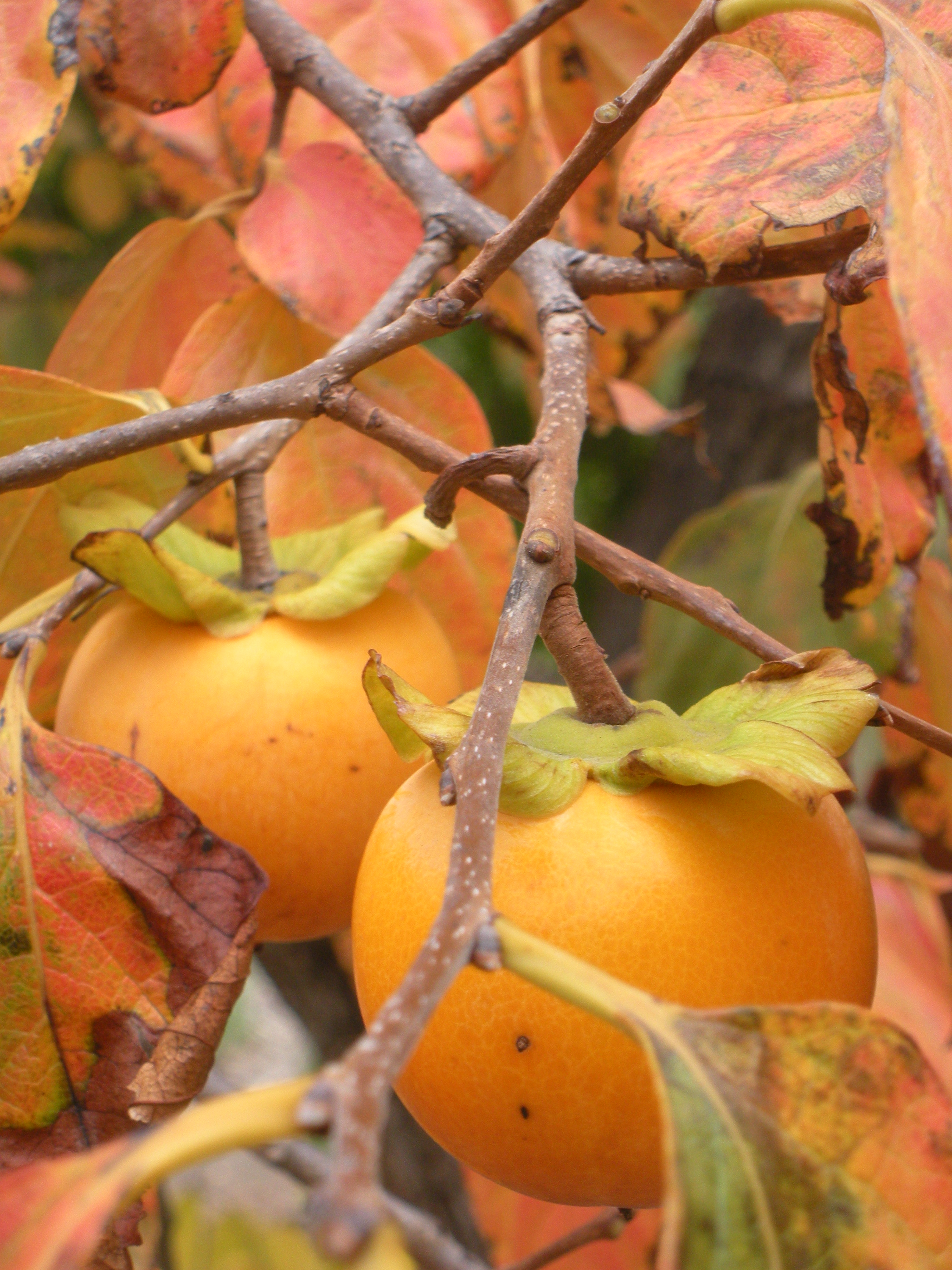
There is also a magnificent persimmon tree in the grounds.  Perhaps it pre-dates the gardens, since they are focused on Australian and South African plants. A persimmon in autumn is always a glorious sight, but this one is huge and spreading and even more magnificent than those I can see in my neighbourhood right now.

2014-04-25 16.10.31-10

And, of course, it is in fruit–those glowing orbs are just so beautiful… I’ve been investing in a couple each week at the farmer’s market and they are delectable!

2014-04-25 16.10.31-13

4 Comments

Filed under Dye Plants, Eucalypts, Natural dyeing

From old garments to new bag

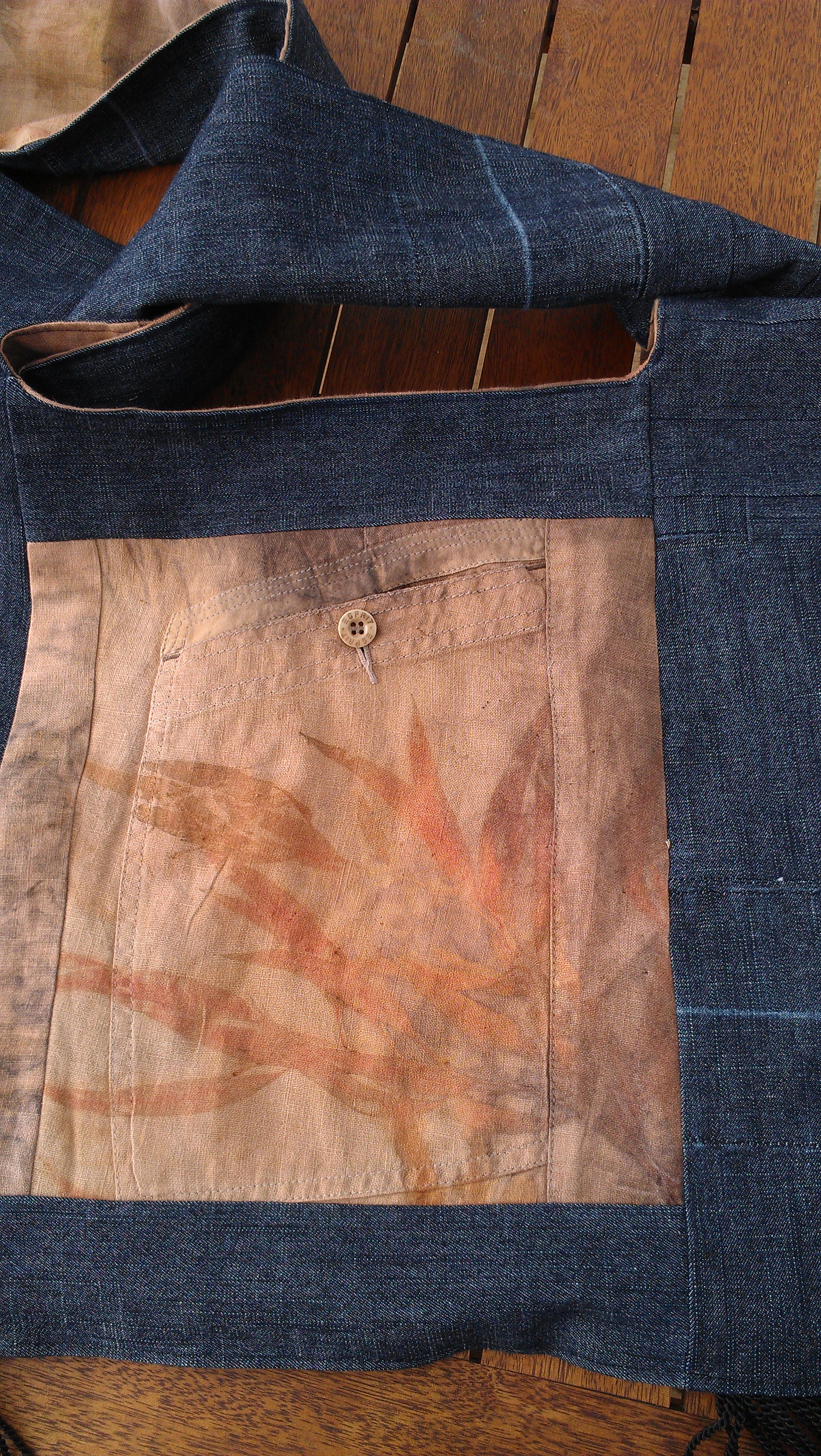
I have been making a bag from two pairs of old pants.  One, a pair of second hand jeans, and the other, a pair of linen pants styled for the 1980s that I found in an op shop.  Before I leaf-printed them, they were pale green.  At first I didn’t like the effect, but it has grown on me.

IMAG4601

As much as the print, I think what made me want to turn them into a bag was the back pockets.  They are glorious pieces of construction. I love a good pocket.  The 3/4 jeans feature unusual pockets for jeans, too.  I don’t think I ever owned jeans with a welt pocket before.

IMAG0004

I cut feature sections for the outside of the bag which included the button-down pockets.  The jeans pockets went on the inside panels.  Then I pieced the rest of the garments together to create the straps and lining.

IMAG4605

It has been a feature of my sewing career that as I’ve moved away from sewing with fabrics gleaned from all kinds of places free or as cheaply as possible out of sheer necessity–into sewing for pleasure and having the capacity to afford to buy lovely fabric…. I continue to love sewing recycled fabrics.  Shirts made from linen tablecloths and flourbags.  Quilts from recycled garments.  Bags from all manner of fabrics.  I especially love retaining beautiful seaming and details like pockets into a new application.

IMAG0027

Every time I make one of these my beloved makes the case for me/us keeping it.  It’s funny, but flattering!  I haven’t decided yet if this one stays or goes to a new home.

IMAG0029


8 Comments

Filed under Leaf prints, Natural dyeing, Sewing