Category Archives: Natural dyeing

Tour de Fleece continues…

Have I mentioned that I’m participating in the Tour de Fleece, spinning each day during the Tour de France?  Clearly this strikes a lot of people as a truly bizarre and quaint pastime. I am not an especially sports loving person, so from my point of view, this is great sport!

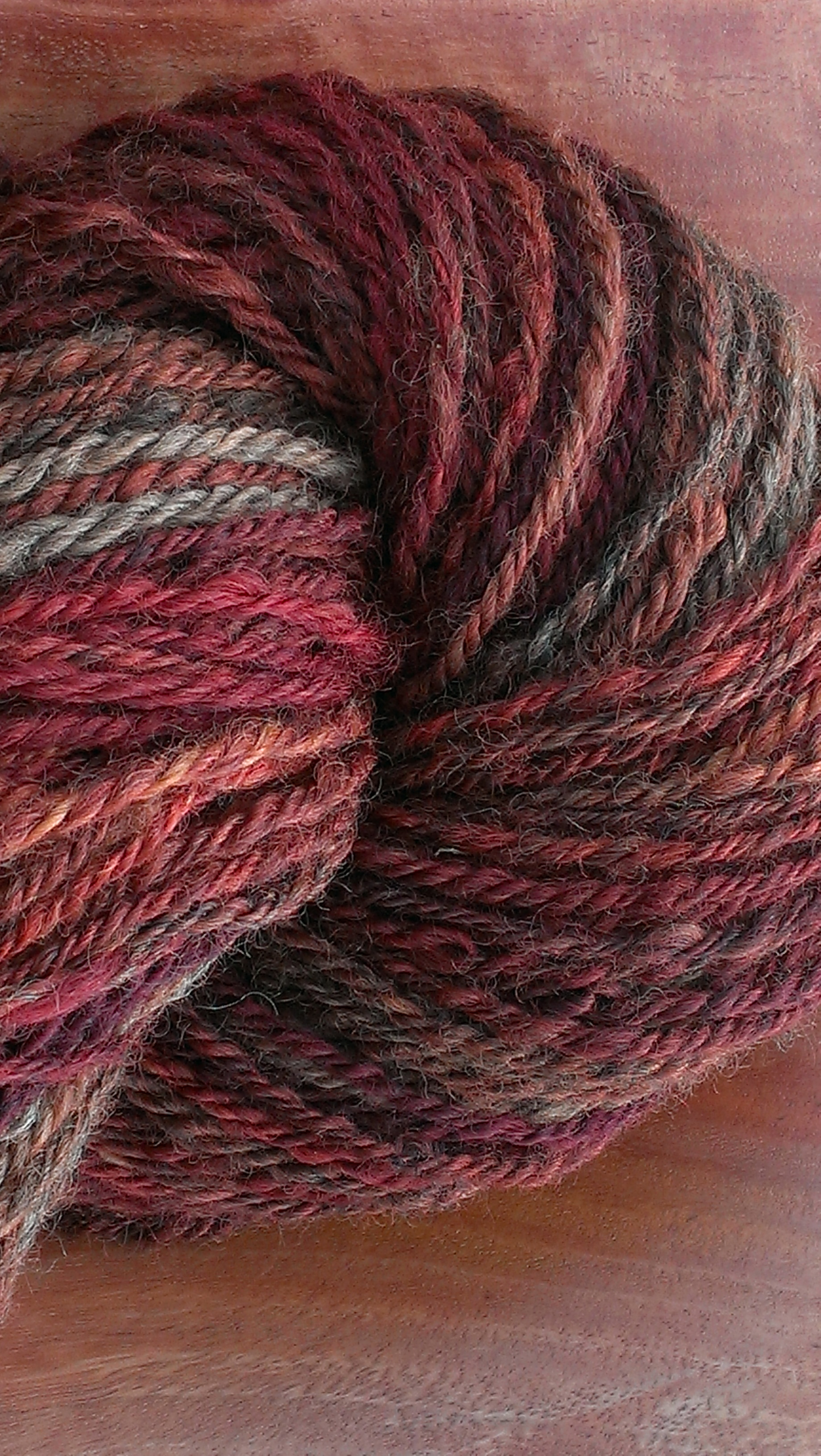
I have been spinning more of my eucalyptus dyed grey corriedale.  I loved the 3 ply yarn I made from it, but it isn’t going to make gauge for the cardigan I now have in mind and will stripe in a way that won’t work for it either.  This may be a clue that I should make the cardigan from some other fibre, of course, but I decided to try 2 ply, which raises entirely different issues about colour blending.

IMAG1776

I’m struggling to get the colours to show right in photos… but this approach clearly will even out the colour variations without making them disappear.  And perhaps it is time to try a swatch to discover how I am doing on gauge.  I have been feeling squeamish since plying… two plies of different colours is not something I would usually be aiming to achieve.  My beloved has offered the view that the yarn is lovely and will look ‘tweedy’, which sounds good to me…

5 Comments

Filed under Eucalypts, Natural dyeing, Spinning

Eucalyptus colours over grey wool

I have a lot of Polwarth fleece, both brown and variegated white/tan. All of it gifted from pet sheep that live nearby.  It is a privilege and it is also a difficulty.  Washing fleece so fine and so greasy has been intimidating as well as slow.  I have spun some in the grease, and washed some twice, and tried several different washing approaches.  I have dyed and spun and spun and dyed.  Two and three ply, corespun. you name it! I spun and knit an entire cardigan from naturally brown Polwarth, too.

And then one day someone at Guild said “I hate fine fleeces!” in my hearing, and it occurred to me that I do not have to spin it for the rest of my life.  I lashed out and bought a considerable quantity (3.5 kg) of grey Corriedale (nothing to approach the stash of Polwarth, mind you) and it has been heavenly.  I love grey fleece, and this is the loveliest corriedale I’ve ever had the pleasure to spin.

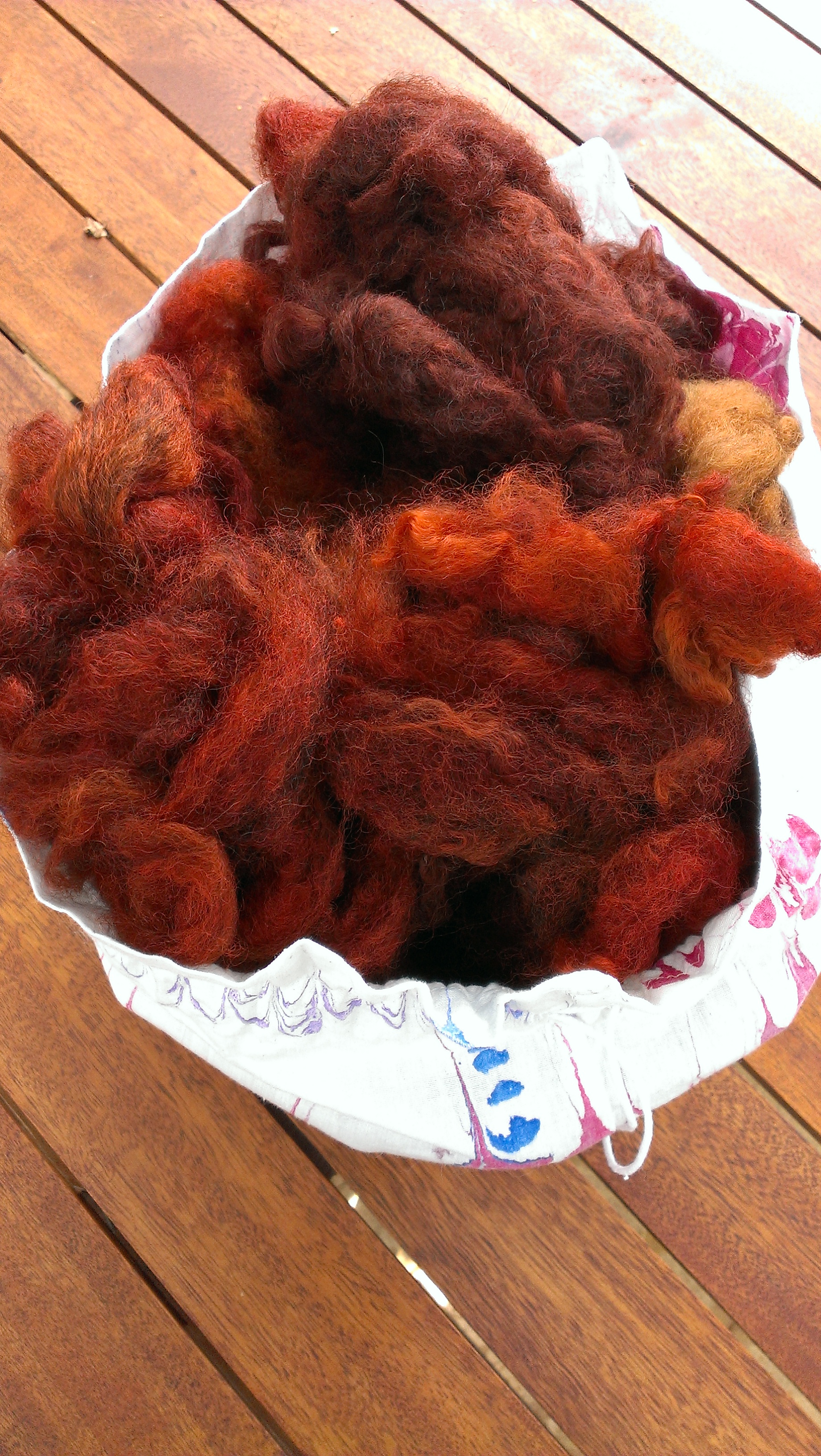
I have been dyeing it with eucalypt leaves and bark.  I have oranges of many shades from rust and brick to flame to gentle sunset.

IMAG1363

I have burgundy and plum.

IMAG1364

And I also have some tans and walnuts.  It appears I collected some bark that wasn’t exactly what I thought I had collected.  But to be honest, I think these are lovely additions in this context.  I’ve begun spinning yarns of many hues, chain plying to maintain the colour contrasts.  Lovely.  It’s hard to believe I can find these colours through combining bark and hot water and time with wool.

IMAG1308

Now… I have figured out that what I would really like to do with at least some of this wool is knit a particular cardigan.  And my beautful 3 ply yarn is too thick to make gauge for it!  Possibly also for the design I have in mind those colour changes will not be ideal.  So, I am about to embark on two ply yarns.  This is my Tour de Fleece project.

20 Comments

Filed under Eucalypts, Fibre preparation, Natural dyeing, Spinning

Austral Indigo 2: Hydrosulphite vat process

My second experiment with Indigofera Australis was a hydrospulphite vat. Robyn Heywood from the Victorian Handspinners and Weavers Guild has made her experiments with Indigofera Australis available online. I was delighted to be able to see the records and samples of the Victorian Handspinners and Weavers dyeing group at their Guild Rooms when I was in Melbourne last year.  It was really inspiring to see the variety of methods they had used and the range of colours they had achieved.

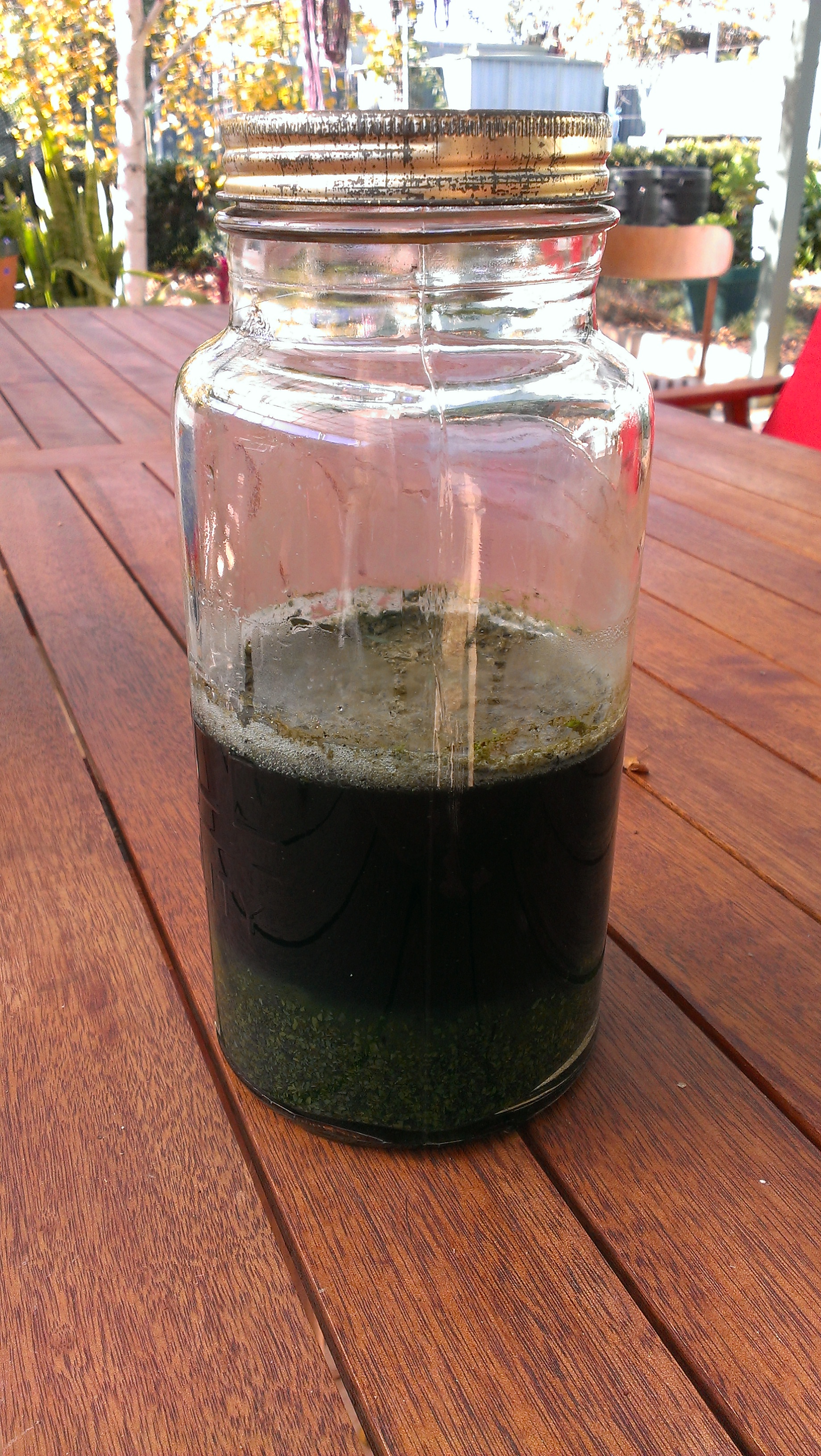
Robyn Heywood has trialled this method as well as the cold vinegar method and provided instructions.  So, since I still had some hydrosulphite left from my last indigo vat, I decided to try it.  Robyn Heywood soaked the leaves… apparently it is too much to expect that I would follow instructions exactly.  I blended them and left to soak for a couple of days. Here they are 18 hours later.
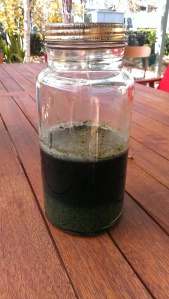
IMAG1614

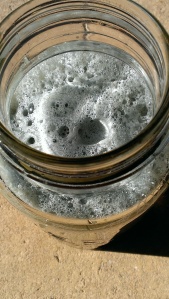
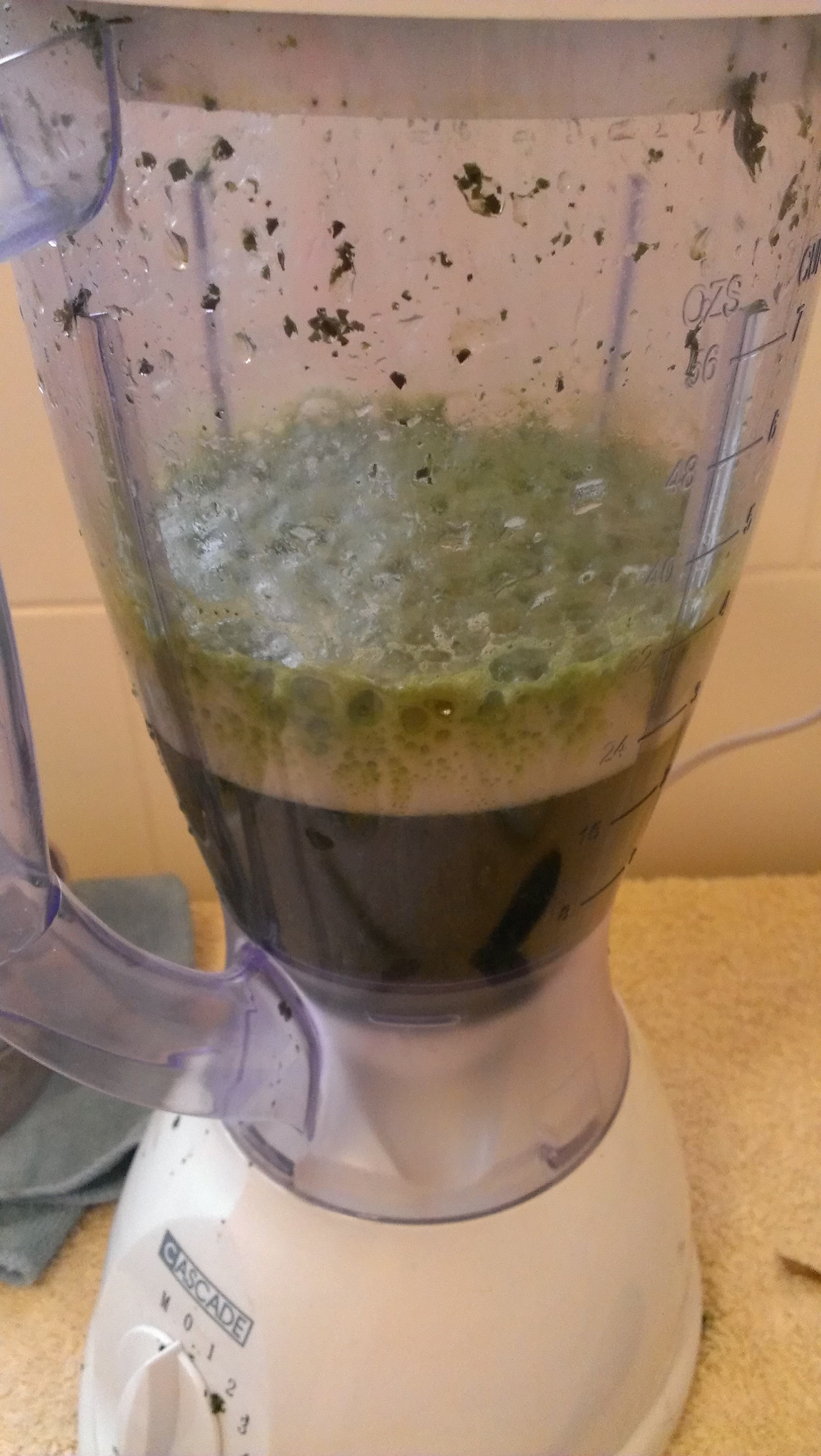
Robyn’s proposal was to leave them in a warm place.  I created one the first night by sitting my vat in a bucket of warm water, and then since the days aren’t warm right now (17C maximum)– the best I could do was a sunny spot.  48 hours later–or so–I started in on the preparation of the vat.  First, I sieved out the plant matter.  Then, added washing soda.  Now for aeration.  I went with the trusty blender method, which I was sure would introduce a lot of air.  Before:

IMAG1624

After:

IMAG1629 (1)

I watched sceptically, but indeed, the bubbles did turn from green to bluish!  I prepared a hot water bath to raise the temperature of my vat.  I put the jar into it.  I turned away, and a few minutes later there was an almighty crack as the jar came apart.  Rude words were used.  On the down side, I now had glass shards I couldn’t see in my dye;  evidence of poor judgment on my part; a  broken jar and a clean up job.  My dye bath had at least 1.5 litres of water added to it, so probably now had three times the amount of water I had decided on (that sounded like a weak vat to me!)  And it was now in a stainless steel dyepot, along with whatever contaminants it contained after being rinsed out.  On the up side, the bath got to 50C almost immediately and the bubbles were still going blue.
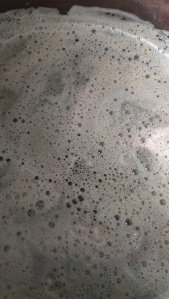
IMAG1632

‘Press on, how do I know what will happen?’  I thought.  ‘Don’t be wasting that precious dyestuff’, I thought.   I got out my trusty milk crate/felted blanket dyebath insulating system, filled up one hot water bottle which promptly sprung a leak; filled up another hot water bottle, sprinkled on the dye run remover, applied hot water bottle and felt blanket to vat and walked away.  ‘Que sera, sera and all that’,  I said, sighing.  Well, I need not have sighed, because the vat turned a vivid yellow.  In went some silk/cotton thread and a piece of hemp fabric.

IMAG1641

They came out bright yellow and turned green and then blue-ish almost immediately.
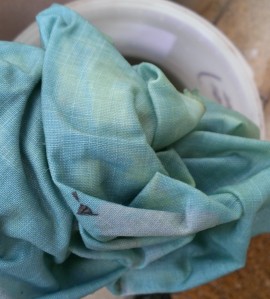
IMAG1649

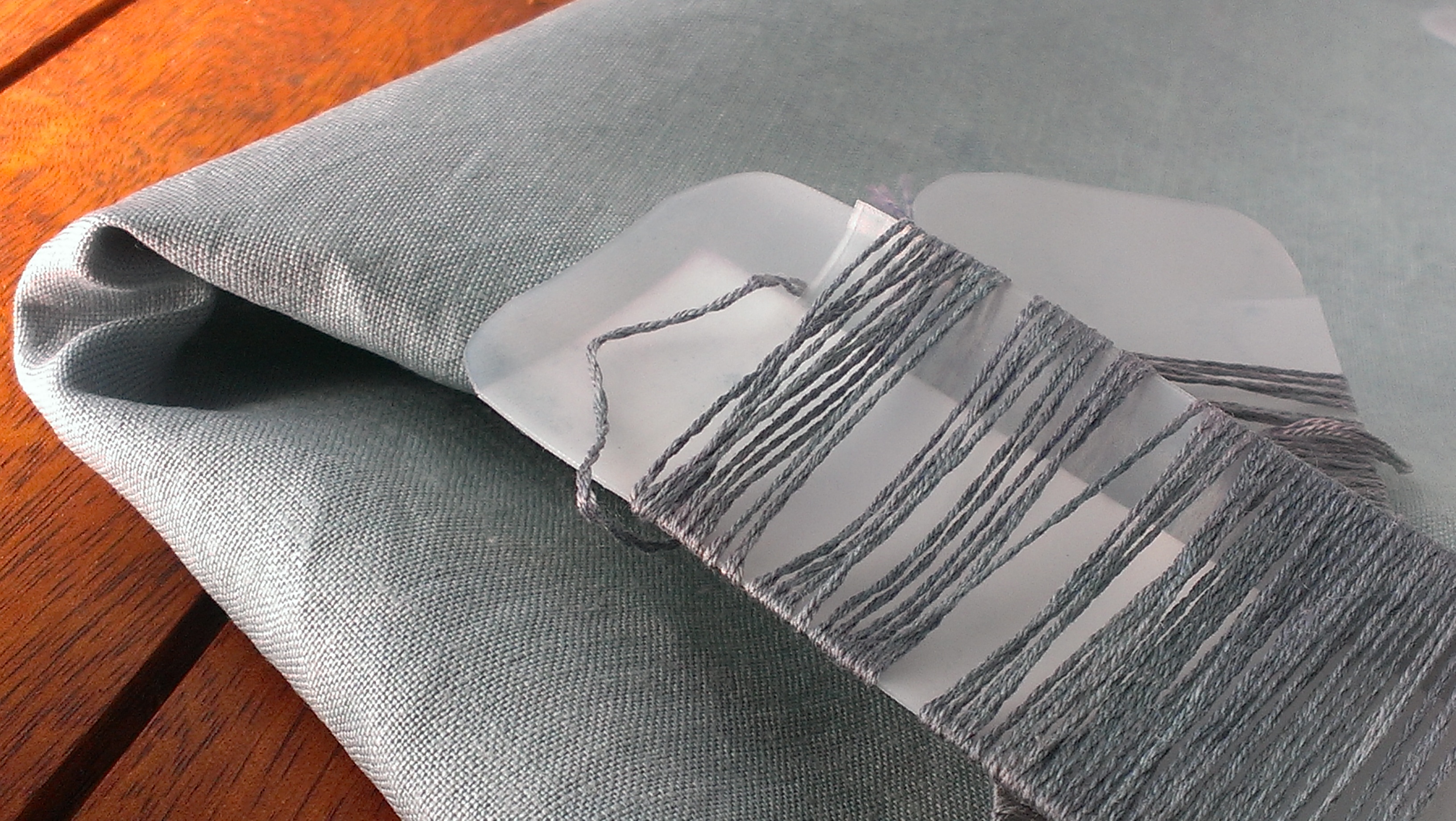
And so, to re-dipping, gleefully (and repeatedly).  Yield: several lengths of silk thread in shades of blue and grey, and a piece of pale blue fabric.  I have plans for them.  I am not sure whether this amount of leaf would always have produced a pale shade and to what extent my accidentally diluted dyebath contributed.  But, some blue resulted, and that part is excellent!

IMAG1664

6 Comments

Filed under Dye Plants, Natural dyeing

Austral Indigo 1: Cold vinegar process

My plant-knowledgeable and extremely generous Katoomba friends harvested some Indigofera Australis for me recently, and I brought it home gleefully to experiment.  They have regular access to a place where Indigofera Australis is growing plentifully and where it is native.  I had one previous opportunity to try dyeing with this plant and it was fascinating but completely unsuccessful.  So, it was exciting to have another chance.  There were 112g leaves in my parcel once I stripped them from their branches.  They had been kept cool or refrigerated in the 7-10 days since they had been picked–fresh but not really fresh.  I decided to try two different methods.

The first is a cold process suitable for protein fibres only, using vinegar.  I have found it described online as a way to process Japanese Indigo to achieve turquoise by Dorothea Fischer and in a booklet by Helen Melville.  Japanese Indigo is a prohibited import and not available in Australia (no matter my feelings on the subject of Japanese Indigo as a dyestuff, this country does not need more weeds).  It does seem logical that this method should work on other indigo bearing species, even if Austral Indigo bears a lower proportion of indigo!  However, using the leaves fresh is a key element and my leaves weren’t as fresh as possible.

Since my last effort, my Dad bought me a cheap secondhand blender (which I planned to use for papermaking).  It made pulping the leaves so easy I didn’t even try cutting them up manually…

IMAG1605

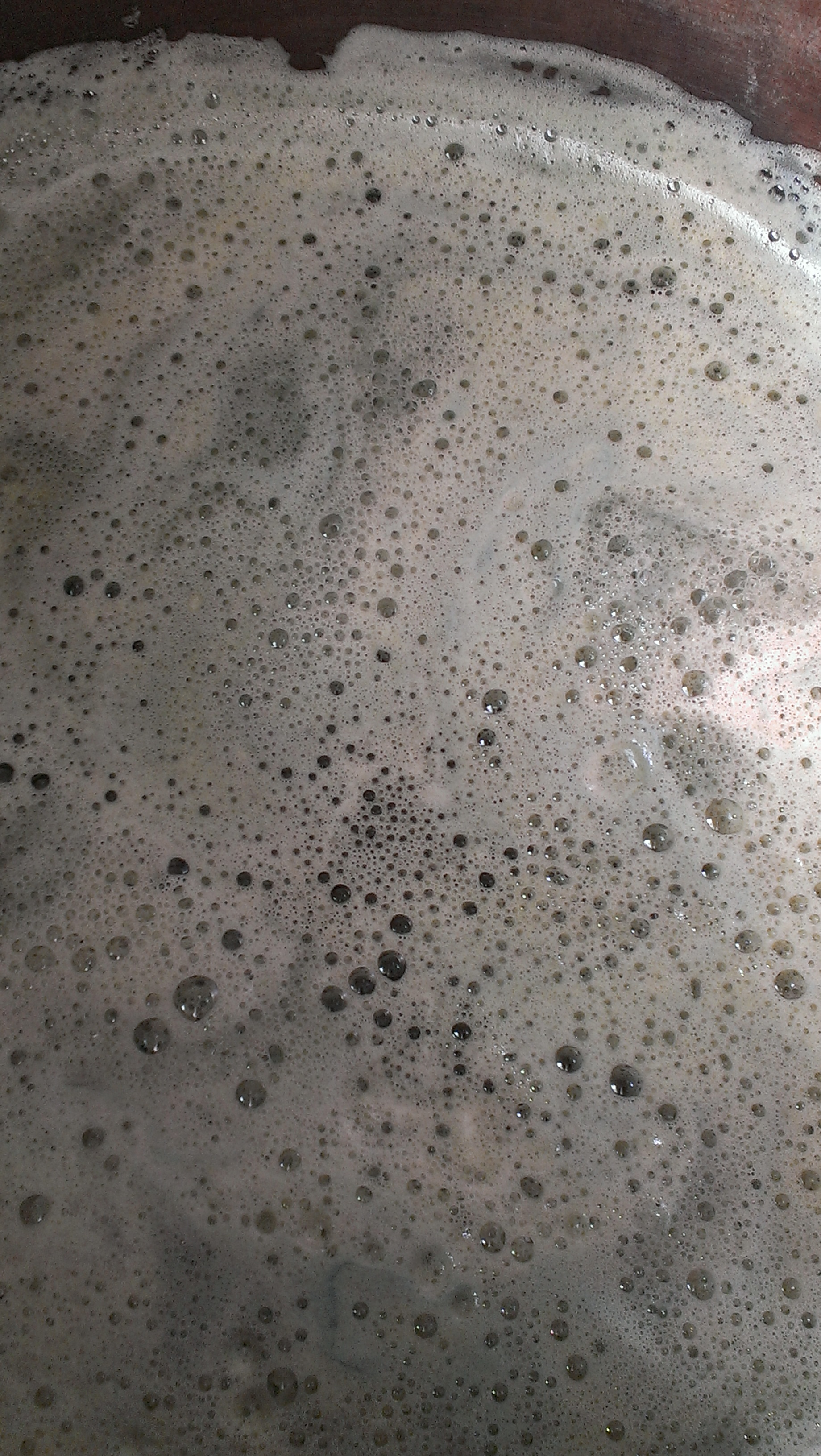
The water immediately went a vivid green, and so did the froth on top.

IMAG1606

I began with a sample card and a small quantity of silk thread, and gave them a few dips before bed time, then left them in overnight and re-dipped in the morning.  Here they are before being further re-dipped, with every fibre on my test card except cotton one shade of turquoise or another:

IMAG1617 (1)

I also tried dyeing some wool, but even after a lot of dips my little skein is barely blue.  End yield: 2 lengths of blue silk thread, three lengths of grey-green-blue silk thread and some off-white-in-the-direction-of-blue-merino.  Clearly, as I had heard, Indigofera Australis is a low yielding source of indigo.  But this method was brilliantly simple, easy and non toxic.  I will happily try it again when my plants are a little bigger.

IMAG1703

14 Comments

Filed under Dye Plants, Natural dyeing

Plum Pine 3: Let the dyefastness testing begin!

Unbelievably, the plum pine is still fruiting, and I am keen to dye enough to be able to do some wash and light-fastness tests in the year before it fruits next time.  So I harvested again, picking up fallen ripe fruit from the ground until I filled the bags I had with me.  A man in white overalls who seemed to be working nearby was gripped to see me doing this and asked me all about what I was doing and why.  He was fully supportive of ‘making use of our natural resources’–as he put it–!

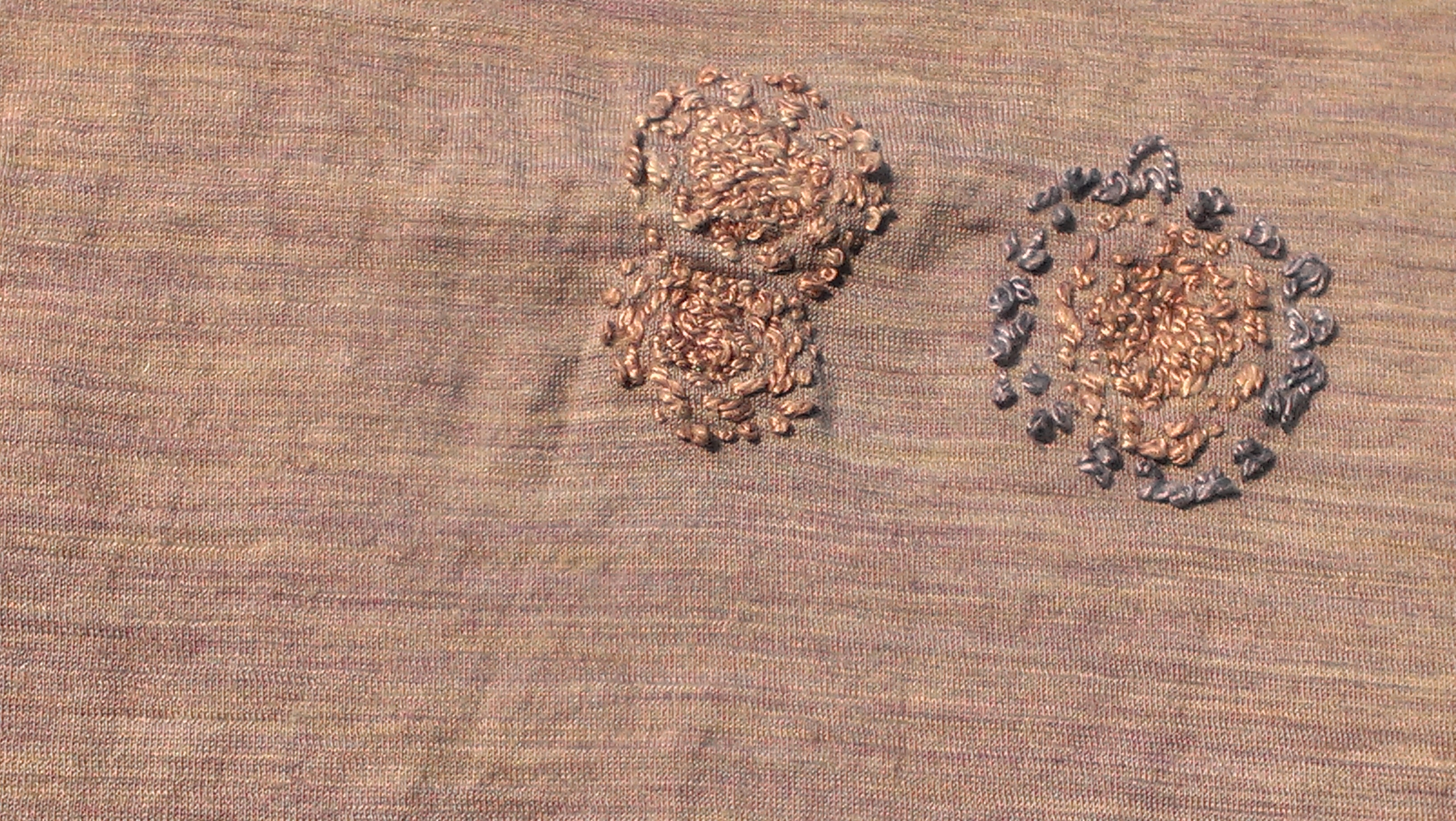
Early signs are that my silk threads dyed without alum will not be washfast. My mending has changed colour in only a couple of washes, and seems to be Ph sensitive, with pink without alum noticeably paler and purple with alum (the contrasting outermost ring on the right) turning blue in a mildly alkaline wash.

IMAG1571

Only someone accustomed to dyeing with eucalypts, which are fast on wool and silk with no mordant, would think unmordanted yarns were a good beginning place.  So, I’ve had a mordant bath on the hob.  I did not have loads of anything much ready to mordant and dye except Bendigo Woollen Mills alpaca rich, so 200g of that hit the alum and cream of tartar bath along with smaller quantities of other yarns.

After removing the seeds, I had 2650g of fruit.  I was a bit gobsmacked by the quantity!  Never one to shy away from a challenge,   I put my fruit in a pot of rainwater with a cup of vinegar and simmered for an hour.  Then, I entered some handspun wool, some commercial alpaca-wool blend and some silk thread and silk/cotton 70/30 thread, all mordanted in alum and cream of tartar.  The colour takeup on the silk was dramatic and almost immediate!  I simmered for another hour and then left overnight.  The colour change overnight was again worth the wait.

IMAG1656

Meanwhile, I’ve set up further washfastness and lightfastness tests…

Leave a comment

Filed under Dye Plants, Fibre preparation, Natural dyeing

Dyeing in Katoomba–and some local-to-Katoomba eucalypt species

Just recently I had a short holiday in Katoomba (New South Wales).  I spent part of a day doing some dyeing with a group of friends who meet as a textile group.  One of my dear friends did a lovely job of organising a space to meet.  The group had a lot of great skills–with artists, a chemist, bush regenerators, plant identifiers and a librarian among them.  They had read and been inspired by Eco-ColourIndia Flint‘s fabulous book on natural dyeing in which she sets out the eco-print process.  But they had not had a great deal of success and some had formed the view that we have special trees in South Australia.  Of course, we do have special trees in SA, and so do they in NSW!  I tried to explain that it was far more likely a question of species than state boundary…

I love the stages in this process of setting up and bundling…

IMAG1508

Cooking…  we ran one pot with vinegar, one with iron and one with onion skins (the orange bundles have spent time in the onion skin bath and then been moved to a different pot).

IMAG1532

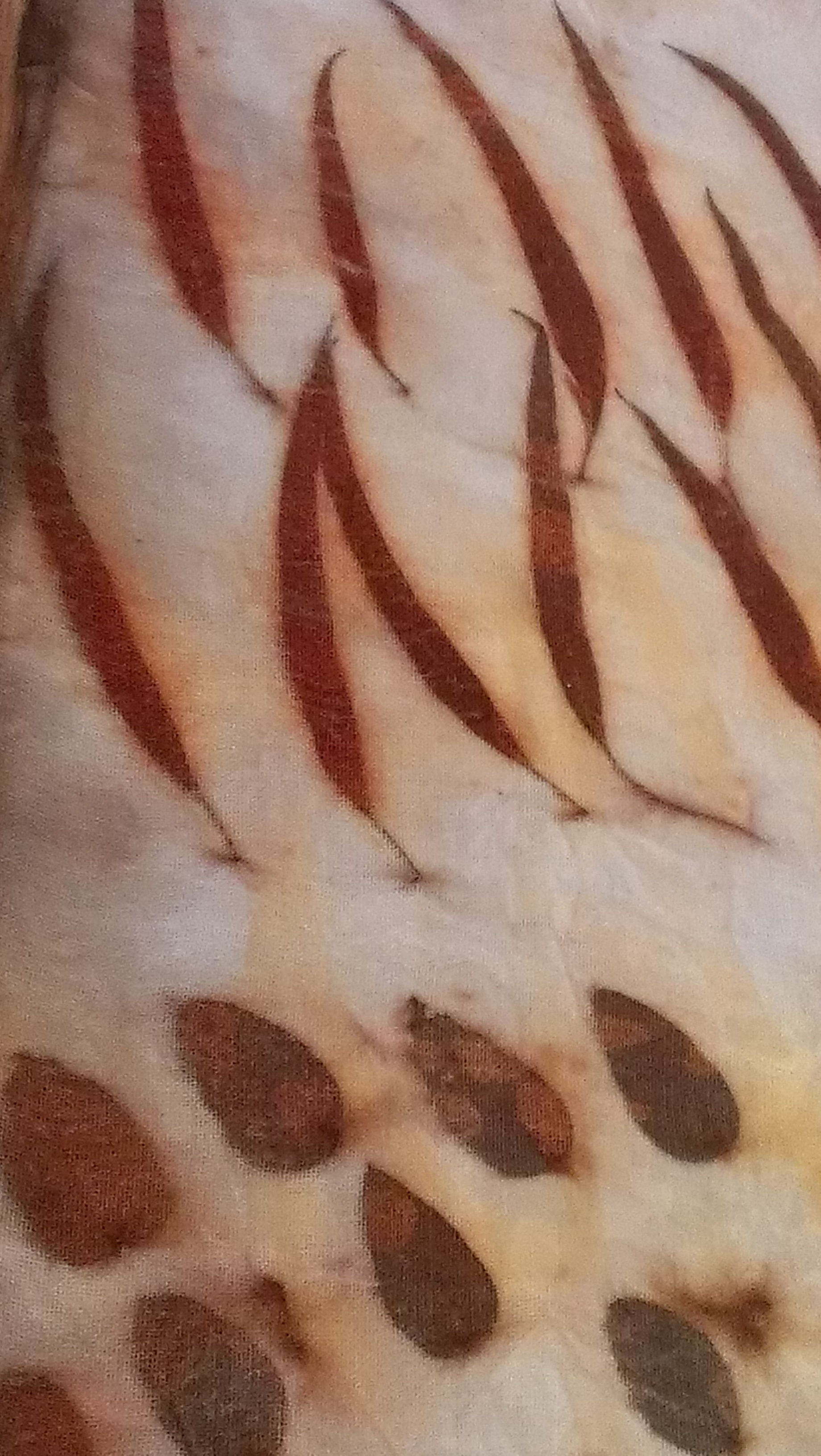
And then the big reveal!  It reminds me of that fantastic Judy Horacek cartoon… which by coincidence my friends have up at their place in Katoomba.  Please follow the link to be introduced to a wonderful Australian cartoonist–and to see the cartoon!  E Scoparia and E Cinerea on wool:

IMAG1559

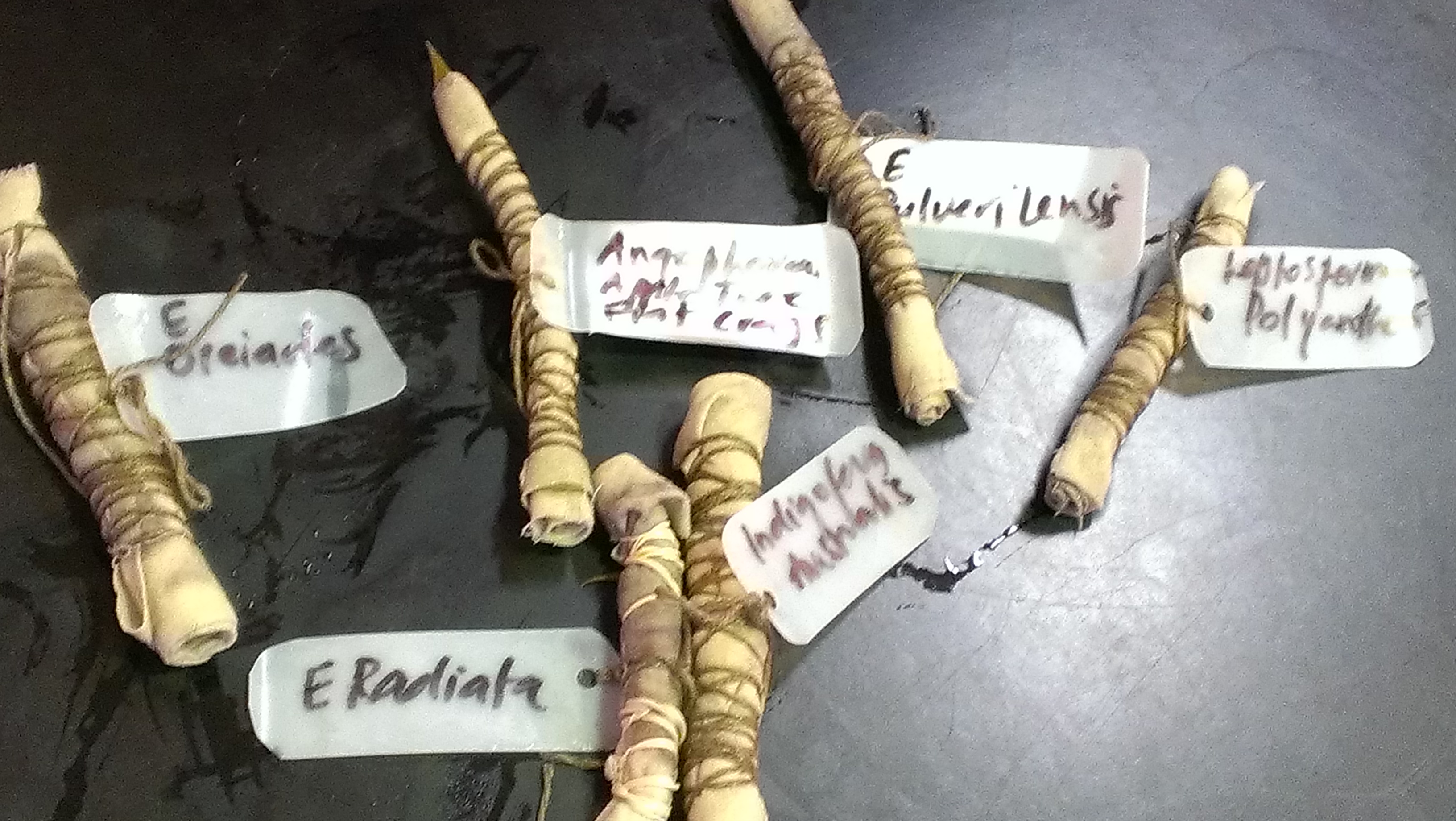
With so much expertise–and because my wise and sweetheart friends who were hosting our holiday as well as dye day had been out collecting and applying plant knowledge–we were able to try out some local species.  These samples are all on silk noil scraps, and have all been in hot water for at least an hour–just to test their potential really.

IMAG1513

We couldn’t resist trying Indigofera Australis even though it didn’t seem likely a hot process would be ideal for an indigo-bearing plant.  It wasn’t, leaving almost no mark except when dipped in an iron modifier.  Here it is, before and after.  The yellowy-greenish tinge is an effect of photography indoors.  Sorry about that part.

IMAG1521IMAG1561

E Radiata, the Narrow-Leaved Peppermint:

IMAG1515

One of the especially beloved and tall local species is E Oreades, the Blue Mountains Ash–a truly local-to-Katoomba tree:

IMAG1517

And finally, E Pulverulenta, the Silver-leaved Mountain Gum, is a vulnerable species in the local area.  As a result, people who want to make sure it lives on are planting it in towns, and this sample came from a street tree.  Dyers will now have an additional reason to support the conservation effort!

IMAG1518

A big, big thanks to my Katoomba friends, and to the textile group for having me!

7 Comments

Filed under Dye Plants, Eucalypts, Leaf prints, Natural dyeing

Saffron Milk Caps

My neighbour brought round edible fungi, including Saffron Milk Caps (Lactarius deliciosus) to share with us.  Such generosity!  These are an introduced species often found in conjunction with pine forests.  One was too large to be good eating, so into the dye pot it went, since its gills are so brilliantly orange–and even more so when cut or crushed.

IMAG1474

I could not find a reference to this fungus as a dye plant anywhere so can’t pretend to be surprised that my test cards showed almost no change at all.  Perhaps a slightly more golden shade of white/cream.  Still…  that saffron milk cap was headed for compost in any case and just had a stop in the dye bath on the way there.

Yes, we did eat them, fried in olive oil and garlic with parsley.  Reviews ranged from ‘absolutely delicious!’ to ‘I’ll stick to the usual sort but they are OK’ at our dinner table.

2 Comments

Filed under Natural dyeing

Of moths and mending

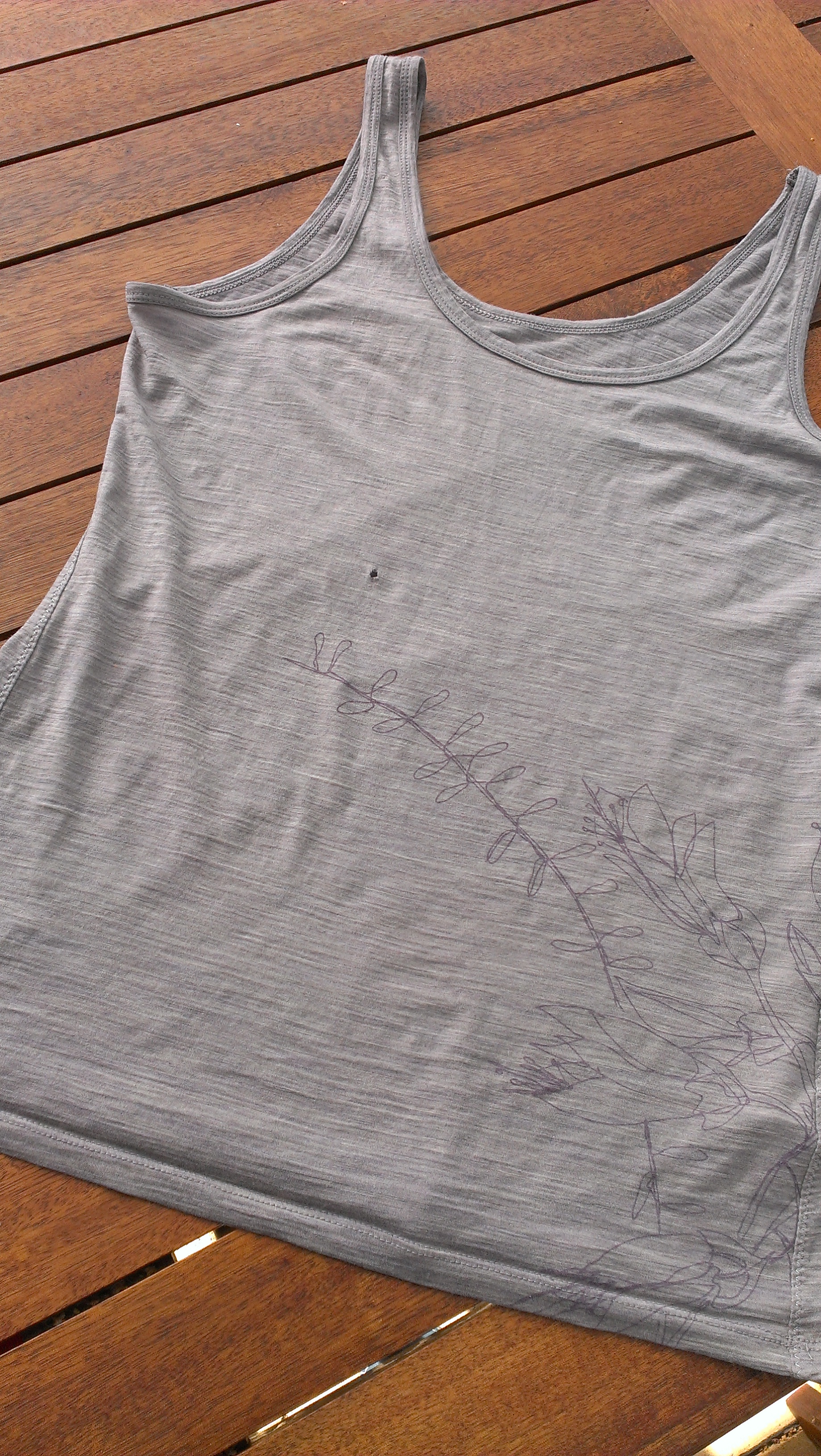
I have a serious programme of moth management due to the amount of wool that is stored at my place.  It involves ziplock bags, careful wool storage, regular washing of clothing and pheromone traps.  However, there are noticeably more moths in this house than our previous one, and it has wool carpets.  This winter when I pulled out my woolens, the jumpers were all intact but one of my fine woollen undergarments had suffered some nibbling.  There is a small hole on the front:

IMAG1464

And a small cluster of holes on the back.

IMAG1466

I thought I might just leave them.  This garment is not outerwear and surely they wouldn’t run too far.  But then I thought of mending them with silk thread and overdyeing the whole garment in eucalyptus… and just when that was tickling my fancy, I dyed silk embroidery thread with Plum Pine and got colours that seemed like they might fit… and so I spent an evening working on my mending.

IMAG1490

Since the moths gave me circles (more or less), I worked with that theme.  I’ve tried to leave a little extra thread at the outer edge of each part of the darn to accommodate stretch–which is what my Mum taught me to do when darning a sock.

IMAG1488

The silk yarn I pulled out of the plum pine and vinegar dyepot the day after darning is a deeper shade, so I’m considering further embellishment with that, or the silk I dyed the night we worked with the indigo dyepot.  But for now, I’m pleased to have mended these holes… and on the same weekend as I mended a ravelled hem, for good measure.  This will be an initial washfastness test for the plum pine on silk, too…

5 Comments

Filed under Natural dyeing, Sewing

Plum Pine 2: Mordant and Modifiers

Having had success with a test dyebath, I made a point of returning to Botanic Park to collect more fruit on weekend, en route to celebrating World Wide Knit in Public Day.  I dyed some grey corriedale locks in my test bath and they went from grey to a dull brownish shade, so I opted for superwash + alum and silk as the most likely candidates for success. I mordanted sock yarn of antiquity (picked up at a garage sale) and prepared another dyebath.  I regard sock yarn as a no risk option.  If I knit socks for a friend, I can make an open offer to re-dye at any point they fade to an unacceptable shade (and I can ask how they’re faring under normal wear and washing).

IMAG1461

The dye bath looked fantastic.

IMG_0168

I ran two baths with this fruit, because the first one produced purple on my alum mordanted skeins of sock yarn (wool-nylon).  I pulled it out of the bath after dark and in artificial light it looked quite brown. So I dropped the skeins back in the bath for the night and put test samples into an iron bath and a vinegar bath. Next morning the sock yarn was purple! The exhaust dyebath was a lighter and browner shade of mauve.  I apologise for these photos but it’s winter here and sunlight is in short supply.

IMG_0183

My tiny skeins of silk thread came out various shades of rose pink through to magenta too… and I have embarked on an embroidery project, so that was exciting.  The shades on the right are both using vinegar in the dyebath.

IMG_0178

The modifiers were interesting: the wool+alum strand was noticeably more purple with vinegar and noticeably more brown/grey with iron, which is, I think, about what should be expected.  So… a promising beginning to experiments with a new dye plant–but with no sense yet of how washfast or lightfast it might be.

IMAG1499

7 Comments

Filed under Dye Plants, Natural dyeing

Plum pine 1

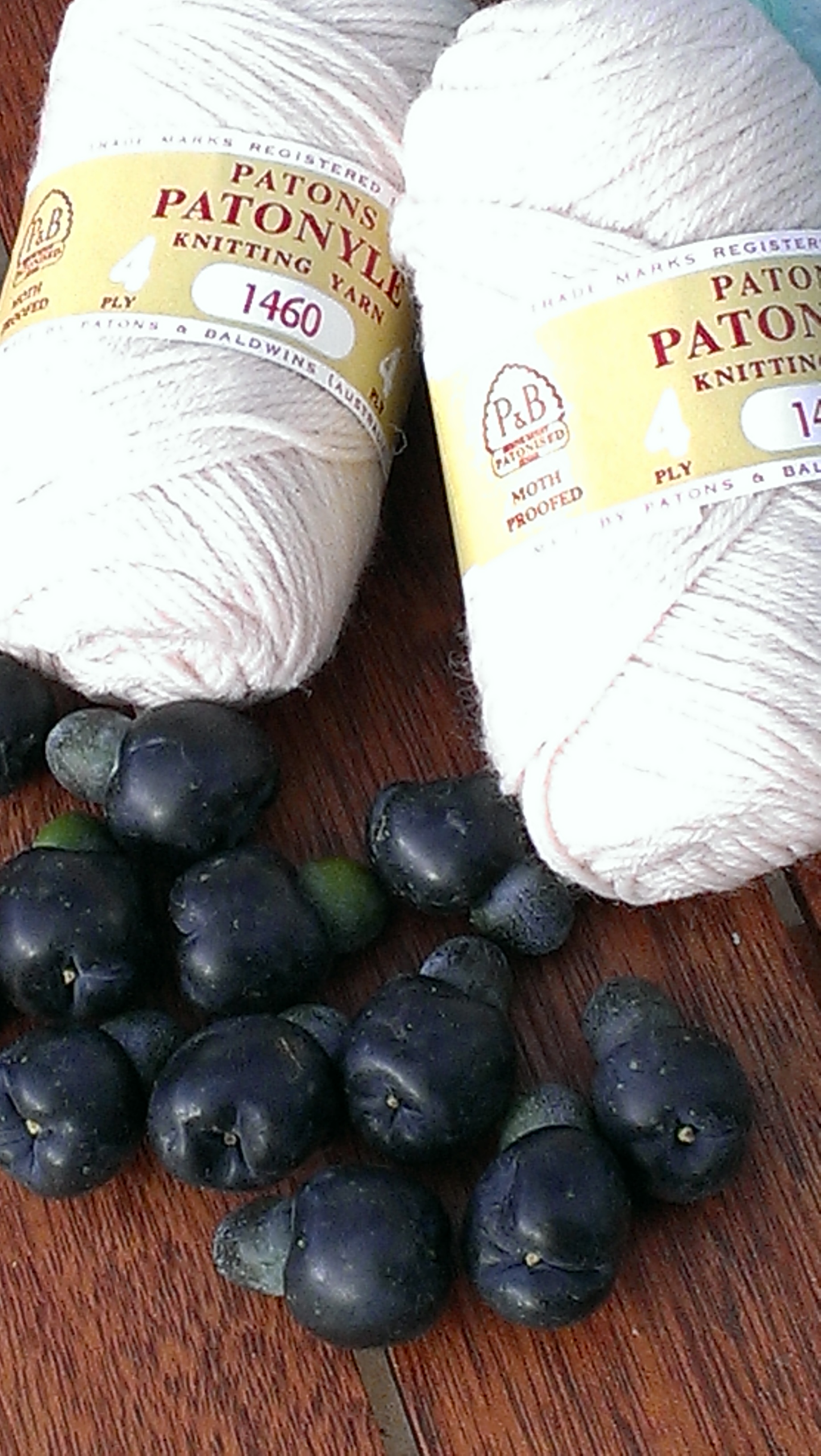
Podocarpus elatus is fruiting in Botanic Park.  I rode past recently with my beady eyes alert, looking for this tree.  I’ve investigated its qualities previously and discovered the fruit is edible.  And today, there they were, lying on the ground in plenty.  They offer plenty of weirdness by regular fruit standards, since the seed is outside the fruit.  One of the less common forms of fruit in my limited experience!  Here they are on the tree…

IMAG1412

And on the ground below.

IMAG1413

This is the tree itself.  It is native to Australia, but it is a rainforest tree.  For those who don’t know…  I am not living anywhere near a rainforest.  South Australia is generously described as having a Mediterranean climate.  Those less generous just call it a desert, and a fair amount of the state answers that description.

IMAG1414

I tried eating one of the fruits and it was just as I remembered it from last time: subtle is the most I could say about the flavour, and the word ‘mucilaginous’ came to mind immediately.  If there is a commercial application for this fruit perhaps it would be… lubricant.  Or perhaps it could be the gumbo of Australian bush food desserts.  I tried leaf prints… but nothing too exciting came of it.

IMAG1432

I twisted the seeds off the fruit and soaked the fruit overnight–pitting plums has never been so simple.  No change in the colour of the water.  I cooked them for almost an hour–water a deep plum colour by now–and then threw in a  sample card and some silk thread.  Soon after that, the alum mordanted wool looked almost blue, and the other fibres (cotton, silk, wool) looked pink.  After about an hour of heat, the alum mordanted wool was deep grey-blue, the wool was deep rose-pink and the other fibres looked paler shades of pink.

IMAG1462

Needless to say, this outcome made me think I should go back to that tree 🙂

7 Comments

Filed under Dye Plants, Leaf prints, Natural dyeing