Category Archives: Sewing

India Flint at Murray Bridge Regional Gallery

The weekend that just was, was a long weekend for us.  Adelaide Cup Day honours a horse race–a strange reason for a public holiday, but we welcome public holidays!  5 of us went together to see India Flint’s exhibition in Murray Bridge.

It was an hour long trip each way with Totally Gourdgeous sing-a-longs, word games, a ‘how many songs connected to Africa can you sing?’ game and I-spy.  I highly recommend Totally Gourdgeous.  Where else can you hear orginal Australian music on gourd instruments?  And find reviews which actually are plausible when you’ve heard the band, like:

“Joni Mitchell meets James Brown in Bob Marley’s pumpkin patch via the Muppets!”  There was a picnic under some river red gums, with climbing on old trains (which was the highlight of the day for one of us).  And there was a fabulous almond and rice banana cake. 

But… the exhibition was very much the reason for the trip.

By way of introduction… because I feel a little odd saying anything at all about this experience, but at the same time, I’d really like to share it a little… as a musician I have been fascinated to hear people speak about songs I’ve sung. Sometimes the listener has complete confidence they know what the songwriter had in mind.  As the singer, sometimes I’ve been in conversation with the songwriter about interpreting that song from when it was half-written, and know that the songwriter was quite emphatically not thinking what the listener believes s/he heard.  I believe that art succeeds when it moves people and makes them think.  But the feelings and thoughts that result from encounters with art may be only loosely connected to what the artist offered, let alone intended!

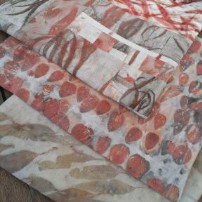
The exhibition spans two rooms in a lovely gallery–in one of them, the lighting is bright and the dominant colours are white and– it was a subject of conversation between us–orange–red? India Flint has offered a preview on her blog for those far from Murray Bridge.  The long span of fabric suspended on hooks which dominates the room is extraordinary: brilliant colours and shapes.  It is a spectacular sight hanging in space looking fragile and gauzy yet vibrant and strong.  In the same room hangs a work called ‘waterbag’.  I just loved this work but struggled to explain why.  One of my friends theorised my fascination with bags–using, giving and making–might be part of it, but even with that suggestion I’m not sure.  I was drawn to its complexity–the dyeing, the form of the bag, the vivid stitching.

In the second room was a poem about New Orleans seven years after the storm painted on the wall in mud, together with an arrangement of paper and silk boats in a range of subtle colours. We spent a lot of time looking into individual boats as well as admiring the effect of the boats from a distance and reading the poetry.  Then there was a selection of eco-bundles wrapped around various pieces of pipe suspended in the air–also spectacular.  It made my fingers itch to unwrap them!  There were a series of works on the wall… one of them a single piece of fabric in purples and greys with a spectacular repeating compound leaf eco-print on it.  The others were rich and complex: pieced, stitched/embroidered and plant dyed in a multitude of different ways, using different fibres and mostly in dark colours–greys, browns, blacks and blues.

It gave rise to a series of conversations.

One was about the extraordinary source of inspiration that India Flint and her work have been.  Her work has been so generative.  In its showing the possibilities of eco-printing as a process.  In its incitement to experiment–explicit and implicit.  In its focus on local and native plants (eucalypts for us, of course–but clearly people in other parts of the world have taken up the invitation with plants local to them).  In its deployment of mending and boro and patching and darning as skills, aesthetics and practices.  In its use of a wide variety of materials.  In its uses of stitching.  In its invocation of the natural world and the potential of sustainable dyeing practices that would respect that world.

Another conversation was about the hoary old question of art and craft.  Naturally we did not resolve it (or try to), but we spoke about the phenomenon of people like India Flint, who are gesturing at larger ideas, images and aesthetics in their chosen media.  Who carry ideas into their works and express ideas through their works.  And then, there are people, me for instance, who seldom do this and have more of their attention on the process of making and the function of the ultimate thing/s made.  This is not to say that they don’t overlap or cannot coincide. They must, they clearly do… but they are not exactly identical processes or intentions and they affect what might be understood as an interesting outcome, too.

There was a lot of interest and speculation about process–how was this done?  What could have produced this shape/colour/amazing thing of wonder?

There were a number of conversations about which works or parts of them drew attention viewed from close up and which were fascinating from further away.

It was a lovely adventure.  Thanks to India Flint for inspiring it, and so much else besides.
4 Comments

Filed under Eucalypts, Leaf prints, Natural dyeing, Sewing

Tribeca shirt

At last, the piece of lovely fabric I was speaking about toward the end of this post has become a garment.  The fabric is a silk/hemp blend from Margaret River Hempco.  The pattern is the Tribeca Shirt from the Sewing Workshop.  The leaf prints use India Flint’s techniques and Eucalyptus Scoparia leaves.

IMG_0080

I invested in this pattern because I have been making the same unisex shirt from McCall’s for years in different fabrics.  It is an oversized shirt with collar, collar stand, button bands, plackets and cuffs.  I’ve had great value from that pattern, making it for myself numerous times and for other people from time to time. Sometimes I’ve made it with collar stand and no collar, or a differently shaped collar.  I’ve made it from recycled linen tablecloths, lovely quilting fabrics and even a screenprint from an Indigenous business on the Tiwi Islands.

IMG_0074

I wanted something different and I decided on this.  It really was different.  No facings, no cuffs, the funnel neck involves no collar, and the whole shirt is designed for french seams. I had a failure of nerve prior to setting in the sleeves using french seams and had to set it aside for a couple of days!  The buttonholes are placed over a patch sewn to the reverse side.  Shaping is achieved with darts.  This is really interesting but also really efficient sewing.

IMG_0078

The level of instruction in the pattern worked well for me.  As usual, the bodies contemplated by the pattern measurements and my own body seemed to have little in common.  My pattern adjustment skills are better than they have ever been but could still use improvement–just the same, the result has me feeling really happy.  I had enough fabric leftover to cut out a second, simple shirt which is now waiting for my attention. Now all I need is the right occasion for a first outing.

IMG_0076

8 Comments

Filed under Eucalypts, Leaf prints, Sewing

Finished objects completed in my holidays

There has been a lot of holiday crafting going on round here.  But this post marks return to my day job!

I made some Thai style fishing pants.  I bought a pair in 2000 as the new century began, and they have finally gone to the worms in our worm farms, the ultimate destination of natural fibres that are worn past the point of repair and reuse around here.  I traced a pattern from them and made this pair from a sarong found at the op shop.  I assume the originals were cut to maximise the use of fabric from a loom that is a standard-ish size in the region, because the sarong was the perfect amount of fabric, with almost no fabric left over to be wasted or used for other things.  Surely this is the goal of all hand weavers, as well as a decent goal for thrifty and green sewers.

I used french seams and then top-sewed them flat, so that I could use only cotton thread and ignore the polyester sucking overlocker.  When commercially sewn garments go to the worms, the overlocker thread is usually all that remains.  The worm farm offers an education in the biodegradability of garments, and I am increasingly aiming for biodegradable.  There is a cotton-polyester t shirt in one of them that has been there since my daughter left home and abandoned it.  Over 10 years ago.  Polyester will clearly survive the apocalypse, along with cockroaches.   Seriously, my everyday garments do not need to live as long as the Gobelin tapestries.

IMAG0590

I made a pair of radmila’s slippers from a new book, Knitting from the Center Out by Daniel Yuhas.  They are knit from handspun merino roving dyed with Eucalypts.  I have to say that I gave up making matching pairs a long time ago and now make siblings rather than twins… further proof lies in the next two images. OK, make that three!

IMAG0579

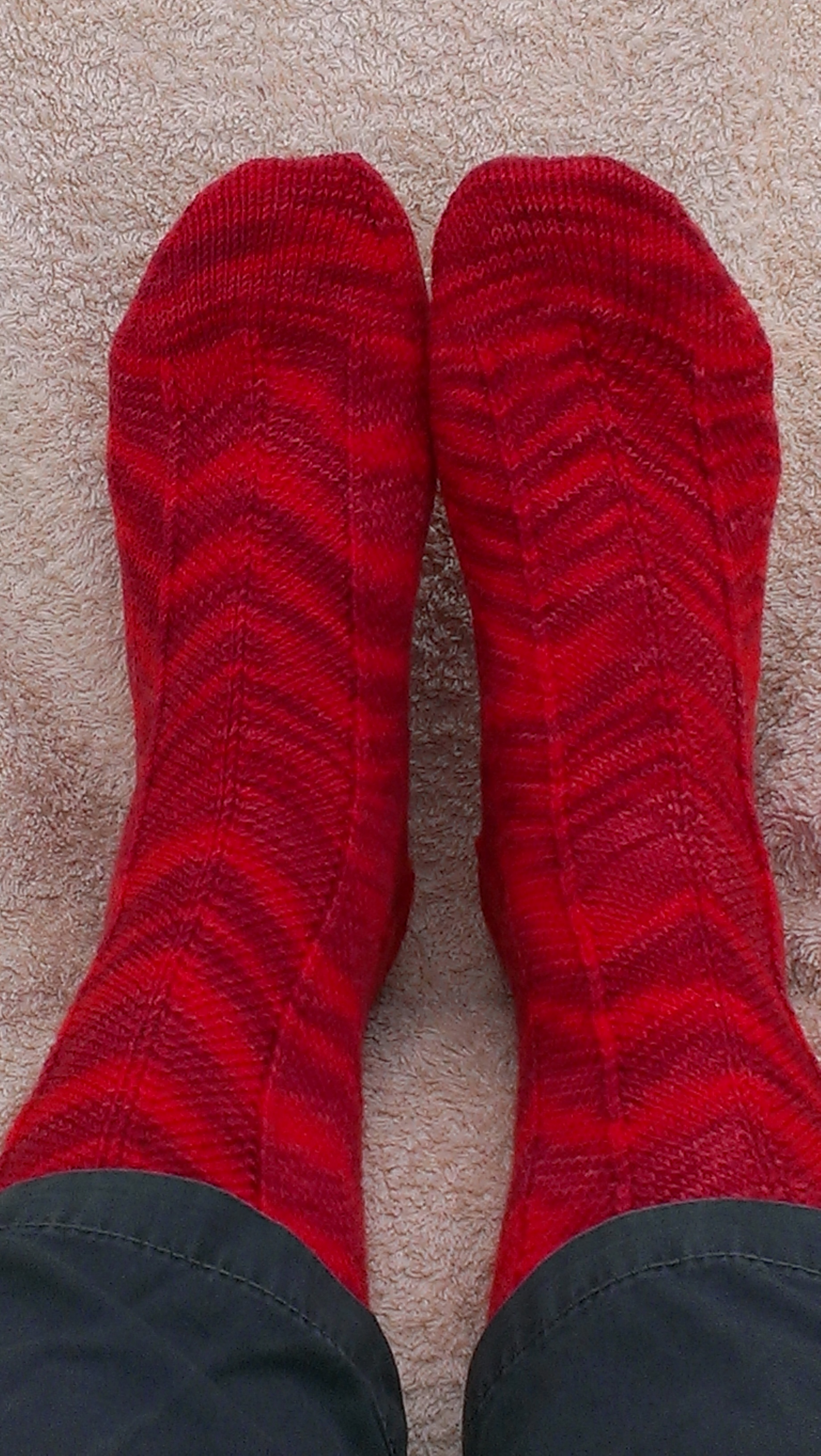
I took up knitting in order to be able to knit socks, and that is what led me to spinning and then dyeing.  Sock production has slowed down, but I finally finished a pair of Jaywalkers for a beloved friend. She is a lover of bright colours who has appreciated these as splendidly red while they were still in progress.  This yarn was dyed by a fabulous local dyer, Kathy Baschiera.

IMAG0595

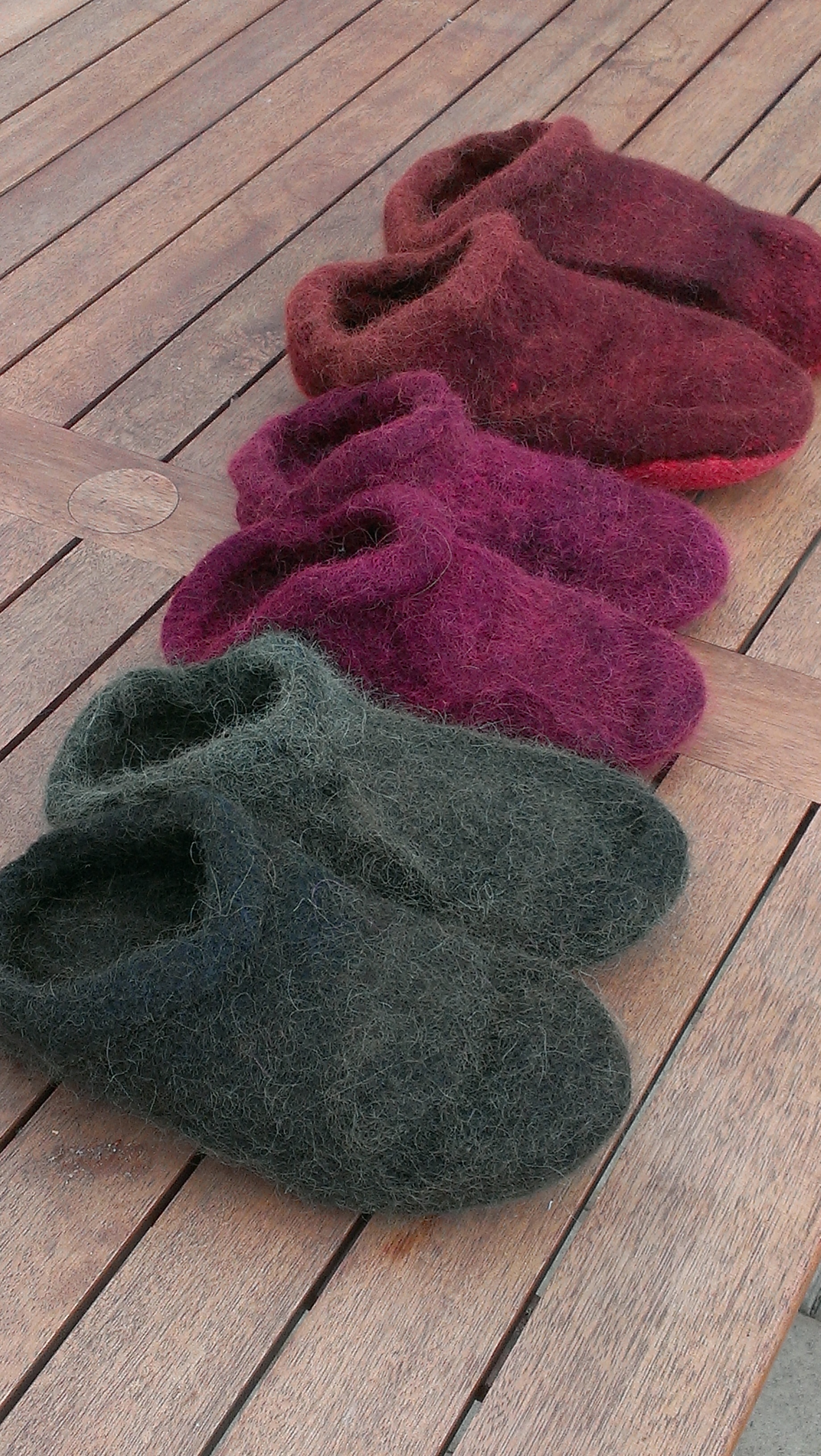
Remember the post where I was wondering whether a sow’s ear could be turned into a silk purse (actually, whether I could turn the less exciting parts of a polwarth fleece and some low quality alpaca into slippers)?  Well, the answer is yes.  These are knit using Bev Galeskas’ Felted Clogs pattern and dyed with Landscapes dyes.  I hope Bev Galeskas has made millions from her pattern.  I sure have made tens upon tens of these, though most are a shade less hairy.  Clearly I spun in a fair amount of guard hair, and it won’t felt.  Just the same, the recipient of the red pair at the back was very enthusiastic as he turned 40, and the delightful women who will be receiving a parcel today or tomorrow with the front two pairs are great mend and make-do experts who have darned their previous pairs extensively… they live in a very cold place and will enjoy warm feet and hopefully overlook the odd stray guard hair!

IMAG0588

Ah, holidays.  I hope you’ve had some to enjoy.

3 Comments

Filed under Eucalypts, Knitting, Natural dyeing, Sewing, Spinning

Hits and misses

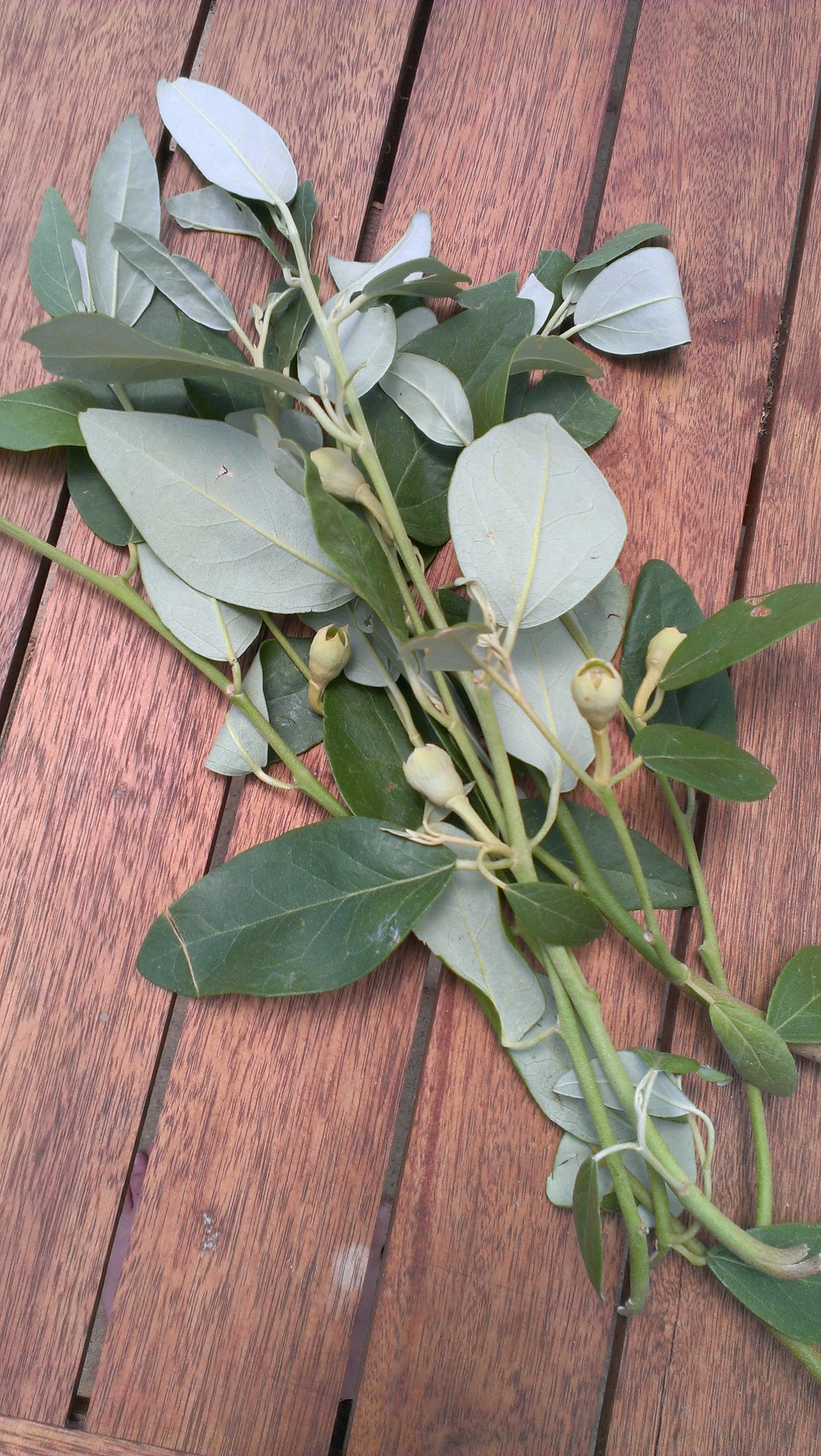
The other day I was at an exercise class in a park.  One if the trees was helpfully labelled Lagunaria patersonia (pyramid tree).  It turns out to be native (to Australia, though not to this part of it).  So… I decided to take a sample and test its dye properties.

1953

I am here to report to you, dear reader, that this is not one of the stellar dye plants of our time.  That smudge on the right of the linen square with the questionable machine embroidery is the best I can show for a leaf print after an hour and with teh presence of iron and soy mordant.  The only fibre on my swatch showing any colour after an hour of simmering is wool + alum, a delicate shade of yellow-green.

IMAG0565

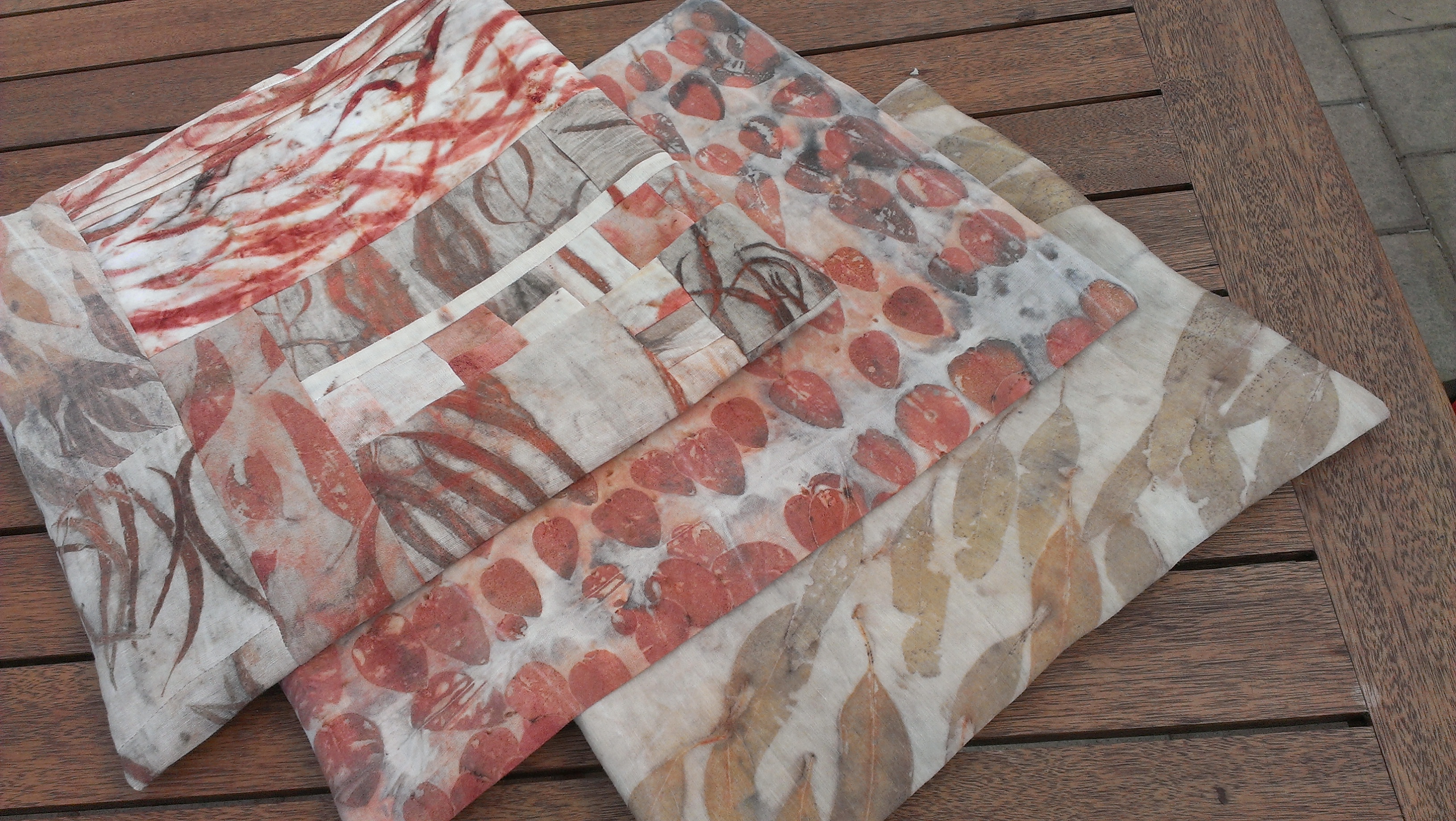
On the other hand, I made these cushion covers from leaf-printed cotton and linen.  They are for friends who invited us to a holiday house they share near Mittagong.  I hope they’ll accept these as thanks for the lovely relaxing time we had with them.

1963

They are custom fit to the cushions on the verandah of their holiday house, whose covers have seen better days.

1962

6 Comments

Filed under Dye Plants, Eucalypts, Leaf prints, Natural dyeing, Sewing, Uncategorized