Spring Guerilla Gardening begins

This week, with rain promised, I made a start on planting out the autumn propagated plants. I find that summer comes sooner and hotter all the time, so I’m trying to push these plants out into the ground so they can take hold of their new surroundings before the parching weather arrives.

IMAG1444

Myoporum parvifolium (narrow leafed “purple” variety) (above), and dianella revoluta (below).

IMAG1445

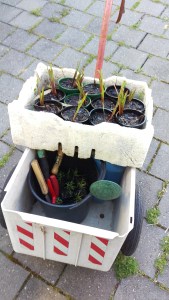
The bike trailer comes into its own yet again… as a hand cart!

IMAG1446

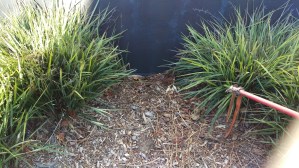
I’m filling gaps in a massed planting, most of which has gone from strength to strength.

IMAG1447

And you can barely see it, but here are some of my plants tucked into the gap… which is pretty much what I also did with the myoporum, a tough, ground hugging plant that has blanketed more and more of the patch where I keep planting it.  It looks good, it flowers, bees appreciate it, and it gives people the impression that they shouldn’t be walking into the patch where it is growing, where rubbish has been dumped, plants have been stolen, and rubbish lands–and all of these things happen less and less as plants fill the space, creating something good for insects, birds, animals and human passersby.

IMAG1448

8 Comments

Filed under Neighbourhood pleasures

Komebukuro Rice-Bags

IMAG1455

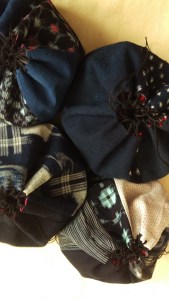
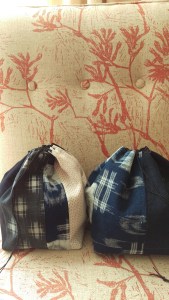
I am still in love with this traditional Japanese style of bag.  Having acquired Japanese fabric scraps in Japan, I made some more, combining recycled clothing (a red linen shirt from the op shop and a maroon sleeveless linen shirt worn very much by me since the 1990s became linings) with fabric I have dyed with indigo as well as all kinds of Japanese fabric scraps.

IMAG1458

I find this design very cunning, and in Japan, I was struck by the different styles that casings tended to take, with drawstrings travelling through casings that were quite separate from the main bag.  In the drawstring constructions I more often have encountered and created, the drawstring passes through a casing in the garment or bag itself.

IMAG1454

And there it is again.  I constantly find myself creating series, and I constantly find myself much more readily making scraps, remnants and recycled fabrics into projects rather than using untouched loveliness in my possession, as if it is too special and valuable to cut, even when it is a gift!  I’ll have to work on that, because of course I want people to use the things I gift them!

IMAG1453

8 Comments

Filed under Sewing

Fabrics in Kyoto

I think regular readers will have worked out that there were some obvious reasons I saw textiles everywhere in Japan–after all, I was seeking them out! I must admit though–and I’ve already explained that my ignorance and lack of language are a limitation–that fabric in Kyoto seemed far more accessible than at home. I was really impressed by the range of scrap fabric and recycled fabric available, and the range of places it was for sale. My friend and I bought scrap packs at a high end Shibori store.  There were packs of scrap fabrics available on street stalls during the evening street parties that came with the Gion festival.  Kimono is a big business in Kyoto and no doubt especially during the Gion festival, when people clearly go out of their way to dress up and dress traditionally, and tourists often do so as well.
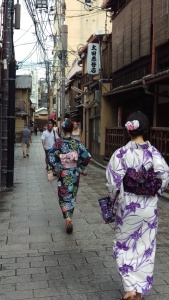
IMAG0538

This may be one reason that secondhand kimono are for sale in so many places. The amount of silk made into clothing in Japan (relative to Australia) might also account for the availability of bolt ends of kimono silk and for some of the scraps which seem to have been torn off when a hem was raised, for example. But to my ignorant eyes it also seemed there was a different kind of reverence for beautiful fabric and design. During the Gion festival when community treasures are on display, fabulous garments were among them.
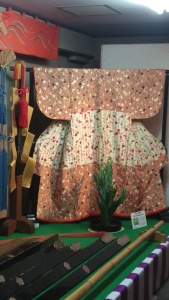
IMAG0738

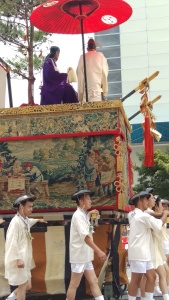
When the Gion floats were paraded through the streets, they were hung with amazing, and in some cases, ancient, tapestries and carpets, often imported (long ago and from far away).

IMAG0882

Here is another example.

IMAG0915

And another!  It was amazing! I had been watching some of the floats being assembled out on the streets (remember the temperature is 39C or above every day at this stage), visited them on display once complete and seen the Gion Bayashi musicians rehearsing in them. Then we saw them lifted, pulled or wheeled through the streets on one of the two parade days. To see them all was extraordinary–each with a complex history and a heavy freight of symbols.  How hard it must have been to be pulling them through the streets–some of them weighing tonnes and with antique wooden wheels, being kept on track by a wooden chock dextrously applied as the wheels turned, and cornering without steering by use of wet bamboo slats and brute strength.  Sweaty work even for the very committed.

IMAG0947

But wait, there’s more.  I’d researched some things prior to departure and understood Nomura Tailor was not to be missed. The main store was on the big shopping strip of Kyoto (the Rundle Mall of Kyoto for local-to-me readers). It looks small here but there were four, or perhaps five, floors!
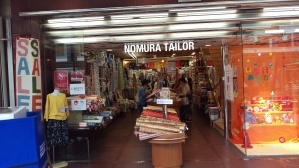
IMAG1111

I was entirely unsure whether it was acceptable to take photographs, and found myself in someone’s way no matter where I stood on any floor with a small reprieve on the top floor where haberdashery was for sale. I was utterly embarrassed!
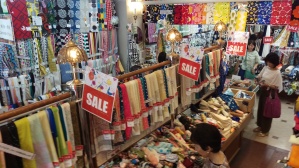
IMAG1110

Here was for sale every kind of cloth. Every colour of linen.  Lots of cute prints (I now understand a little more about the cute aesthetic in Japan, but not a whole lot)! In the image above you can see an entire display of Marimekko. I have never seen so many Liberty prints outside a Liberty store. And so on (remember, this is only what I could recognise). It was overwhelming. I try not to buy new stuff as a general rule–but I really wanted to buy here and could find no way to make a decision about where I would stop if I started. I came back on a second day to see if I had more judgment or perhaps it was less crowded.  I still could not bring myself to buy fabric, overwhelmed by how I would ask for it, not understanding how to initiate a purchase, not wanting to hold up the queue, and in general feeling all heffalump in a very organised and efficient space in which I was unable to grasp the key organisational and efficiency principles. I bought some braid, some Japanese zippers and some sashiko sampler packs. The difference between buying fixed items and negotiating yardage is profound, or at least it felt that way to me on the day!
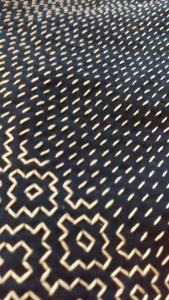
IMAG1324

The sashiko samplers turned out to be cushion covers but only the shape of the fabric and the pictures with the Japanese instructions inside allowed me to work this out.  I became ill a week or so after returning and did a lot of stitching!
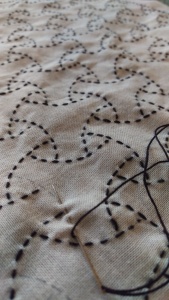
IMAG1298

None of these was the highlight for me. The highlight really was going to a shrine sale the day we left.  We went to the flea market, and it was immense.  It was not a fabric sale–pottery, tools, metal, ready to eat food, brushware, vegetables, pickles… just abut everything!  It was over 40C that day and I inhabited a fantasy that I could look around and come back to things sighted earlier.  Oops! That is one thing I do regret.  Here was every kind of fabric, new and second hand. New garments and second hand garments. Second hand sake bags.

IMAG1146_BURST002

Sacking, advertising materials on fabric (as far as I could tell). Cheap mass produced stuff. I bought what turned out to be strips from the ends of bolts (lengths?) of white silk kimono fabric. Then there were so many second hand fabrics whose origins I could only guess.

There were plant dyed clothes, and while indigo was prominent some were dyed with nettles, cedar bark or wormwood (that is what I could understand at any rate–)
IMAG0746

There was vintage clothing and fabric in every stage from well preserved to utterly disintegrating and in every stage of being mended from a patch here or there to rags stitched together–the boro tradition.  There were also many stallholders converting scraps of beautiful silk or vintage indigo dyed fabric into small items of loveliness, honouring them by transforming them.

I have read about boro and seen images, and read its history.  But while some of these items spoke of thrift and long wear, some were so ragged and so much mended that I was confronted by a sense of grief and awe for the people whose suffering and resilience created these clothes and cloths. While they now sell for a good deal of money (which does not go to anyone who used them), these items speak of the sheer poverty and difficult lives as well as speaking of the diligence, skill, love and care that must have gone into them.

In the end, I felt as though the flea market was an education in the life of everyday people through textiles. The museums I visited focused on things of high quality and amazing craft and design skill (as museums often do). Yet, this means museums often tell the stories of the wealthy and powerful, even when it is their clothing that is on show. At the flea market, the incredible effort that went into staying warm and covered for so many people who made that wealth possible was on show instead.

6 Comments

Filed under Natural dyeing, Sewing

A little more knitting in Japan

In addition to the sock, I took some fat, soft handspun to convert into beanies in Japan, in case I needed a change of knitting pace.

The beanies were a hotel knitting project. There had been floods and an earthquake before we arrived, and Kyoto sweltered through an uncharacteristic heatwave while we were there: 39C or more virtually every day. This was knitting for air conditioning!

IMAG1222

These are made from some naturally coloured Western Australian Polwarth roving Joyce left. It was sumptuous to spin and lovely to knit.

IMAG1181

These are knit from hand spun, eucalyptus dyed wool. And some more Polwarth! I can’t shake the feeling there was a third orange-brown hat but if so, I did not take a picture. But I have certainly made a head start on next winter’s beanies…

IMAG1183


Leave a comment

Filed under Knitting, Natural dyeing

Tuffsock Knitting: Frankensock edition


IMAG0018

This post is part of the Tuff Socks Naturally project, an open, collaborative project exploring more sustainable alternatives to superwash and nylon in sock yarn. You can join in on the discussion on this blog or on the blog of the fabulous Rebecca at Needle and Spindle or on instagram using the hashtag #tuffsocksnaturally.

In preparation for our trip to Japan, needless to say I did some serious knitting planning (despite knowing that it would be high summer, humid and HOT in Japan. Do I need to explain to any knitter who is reading, the need for knitting in airports, train stations, on planes, and on the Shinkansen (bullet train)? Of course not. At one point in the ten hour trip from Australia to Tokyo, a flight attendant said something like ‘now you’re really getting somewhere!’ I guess progress must have become visible… by the time I reached Kyoto one sock was complete and I was knitting the second.

IMAG1092

Here, on a bus in Kyoto (enter in the middle of the bus, exit at the front, and pay with exact change into a machine as you get off!  Compare what I do at home: enter at the front, buy a ticket from the driver as you enter if you don’t have a prepaid ticket, leave through the centre door).

IMAG1033

Then, knitting with a set meal.  In Japan, I had a lifetime highlight number of mystery meals–where I sometimes did not know what I was eating before, during or after eating it!  Delicious but mystery items abounded for me.  In this case, the small round dish on the left contained what looked like grey stem tips and buds. Terrestrial plant? Seaweed?  I have no idea. Imagine how readily I picked these up from the liquid in which they were sitting beautifully–all the more graciously when it transpired that they were surrounded by (I assume they produced) a slippery-slimy-gelatinous substance.  And they were sitting in vinegar, so slurping them down didn’t seem right either.  Another mysterious-to-me Japanese food.

IMAG0385

This meal I bought when I went to see the Master Indigo dyer’s studio. I walked ten or twenty kilometres most days and this was a twenty km day. I often had the idea that I’d just catch a bus back, but would always be curious about things I could see further up the road or wonder what was around the corner.  In this way I walked huge distances some days!  This day I eventually settled on a cosy, homely looking cafe.  The woman running it looked at me with some concern when I arrived, and indicated I should wait (she was going to get her phone).  We had a conversation about the menu (two main dishes) with google translate and mime.  Big serve or smaller?  I said big.  She let me know she thought that was the wrong choice.   I took her advice. She was right!  This plate had pickles, potato salad, seaweed and whitebait… leafy salad… and so on.

IMAG1088

Here, knitting in an okonomiyaki restaurant as the chef creates dinner in front of everyone in the restaurant–a maximum of about 12 at any one time–being charming and entertaining as well as making a fine meal.

This sock is a combination of a eucalyptus-dyed merino-silk commercial yarn leg and a handspun, logwood? sanderswood? dyed handspun Suffolk foot. It works for the one who knows–the wearer–and as a result there will be more Frankensocks!  The knitting of these socks led to all kinds of entertaining nonverbal and no-shared-language interactions as I was watched knitting at Nijo Jo Mae castle in Kyoto by a small child from China who had to ask a woman who might have been her mother a lot of questions and watch me a lot, while she used her battery operated fan.  And by a gentleman at the same spot who was highly entertained and pointed me out to a woman who might have been his wife. But there were also knowing nods from older women on buses.

I can only apologise for this gloriously random selection of photos in which the colour is pretty sad… but the socks have gone to their happy new home and these are the remaining portraits…


5 Comments

Filed under Knitting, Natural dyeing

Shibori in Kyoto

Needless to say, while I was in Japan I was seeking interesting textiles and I discovered the Kyoto Shibori Museum.

It was not a large public institution. It seemed more like the passion of a group of public spirited individuals and practitioners. On arrival I was offered a damp hand towel (which was a relief in the heat and made me a safer person if I touched anything!) I was shown a video about shibori in Japan, its history and techniques. Then I was allocated a guide who accompanied me around the exhibits and into the shop where items made by the people who run the museum are for sale, including bolts of indigo dyed shibori fabrics. My guid came from a family of shibori dyers and there were photos of his family, and some of his grandparents’ tools on display in the museum. I wish I could show you photos but–it was not clear that photographs were allowed and this was one of the early places I went in Kyoto. I was just too shy to ask, and too uncertain of whether communication had been achieved because, let it be said–my Japanese is extremely limited, and politeness Japanese style is very different to the customs I have grown up with. Sometimes I had an impression of agreement that just wasn’t borne out in action. I struggled to understand. I did not wish to offend.  But I was informed and amazed and there were many beautiful and interesting things to be seen. Also, having a guide all to my non-Japanese speaking self was deeply embarrassing to me! The museum offers shibori experiences for a fee (where you dye a small item) and with pre-booking.

IMAG0363

I also came across a high fashion shibori shop: Katayama Bunzaburo.

IMAG1013

My friend and I bought scraps of their fabrics which were for sale crushed into cellophane bags, and I bought some traditional cotton fabric woven in Japan that was inexplicably (and quite cheaply) for sale here too. But the shibori was the main feature and it was extraordinary.  Some of it was more sculptural than a dyeing effect, and there were quite a few lamps showing off the shaping that shibori can create.

There were some very beautiful, elegant garments for sale but I’m afraid between the partial English of our hosts and our scraps of Japanese; their enthusiasm for having me try things on and my efforts to mime how beautiful the garments were but honestly, not made for a  heffalump of my proportions–I quite forgot to take any photos!

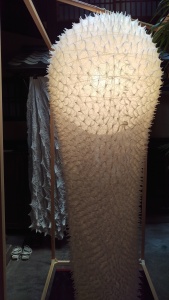
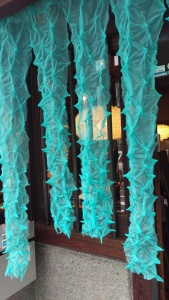
Here was shibori as scarves, wraps, jewellery. In silks and in synthetic fibres. And the people running the shop were able to show how to wear these pieces in numerous different gorgeous ways.  They were so kind and generous. Finally my friend’s 60th birthday present was found and purchased!  And, the final triumph of the shop: a display piece in their little courtyard which I think I understood was called “Jellyfish”–as tall as I am and quite awesome to behold.

IMAG1022

7 Comments

Filed under Natural dyeing

Boomerang Bags–a few more!

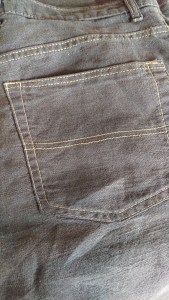
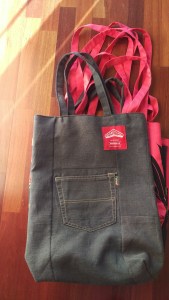
Well, I’ve had some weeks of illness in which knitting seemed too much. I know, I know!! But I managed to slowly make more Boomerang bags some days.  I finally cut up a pair of ramie jeans I must have kept for at least 15 years since they  wore right out, in case I’d learn how to make another pair… or something.  I can see why I loved these from the time I bought them second hand in, oh, the late 1980s or early 1990s– but I’ve finally let my longing to reproduce them go and taken the scissors to them.

IMAG1221

They made some nice bags…

IMAG1234

I found yet more bits and pieces to create linings from, including jeans pockets and other leftovers from the last round of bags.

This series of bags all came from a striking border print I had in stash.  Origins lost in the mists of time, but I guarantee I never imagined myself in a square dancing circle skirt made of this!

Then there was this shirt I made many years ago and had years of happy times wearing.  Now that fabulous print gets a new lease on life.

The last of one of Joyce’s fabrics, teamed with jeans that have passed the point of no return for a nice strong base.

Finally, I had quite a score of big prints on cotton canvas one day at the op shop. A black and white panel seemingly designed to hang on a wall and then these red and green prints.

And that is a wrap! But not a single use plastic wrap, haha….


3 Comments

Filed under Sewing

Tuffsock Spinning: Ryeland

This post is part of the Tuff Socks Naturally project, an open, collaborative project exploring more sustainable alternatives to superwash and nylon in sock yarn. You can join in on the discussion on this blog or on the blog of the fabulous Rebecca at Needle and Spindle or on Instagram using the hashtag #tuffsocksnaturally. It is from Rebecca that this rather beautiful fleece came to me. She gave it to me washed, with its lock formation intact in a way that I almost never manage. I am deeply grateful for this wonderful gift!

IMAG1170

There was a day I was so keen to get spinning, I pulled this fleece from its calico bag next to the drum carder and visualised carding it.  And put it back in its bag!  The care and work represented by its beautiful cleansing was just too precious. In the end I decided to flick card each lock individually and spin directly from the lock, and what a lovely experience that was.

IMAG1226

It shouldn’t be a surprise, but I think I am getting better at spinning sock yarn through practising–and with such a lovely, beautifully prepared fibre and a longer, softer lock than the Suffolk, this felt a real breeze to spin. I’m really happy with this result.

IMG_20180816_140010_816

Ultimately I decided to dye it in cochineal with some vinegar in hopes of heightening the red tones. And now, my friends, it has wandered off to be exhibited in the Royal Show!

IMAG1302_BURST002


3 Comments

Filed under Fibre preparation, Natural dyeing, Spinning

Waste and strategies to avoid it in Japan 1

I sometimes think that travel is at least as much an encounter with your own ignorance and arrogance as it is with another country and its cultures. In Australia, I have heard various things about waste and thrift in Japan from Japanese people as well as from Australians who have travelled to Japan (but weren’t born there).  I’ve heard both about minimalism and about a culture of everything needing to be new and old things being always thrown away.  I’ve read about boro and also about extravagant, amazing silken fabrics. And, as with the culture/s I live in, surely there would be diversity and contradiction? I was interested to see what I could learn about avoiding waste from being in Japan, and to see how recycling was managed there.

IMAG0669

One place where I noticed a very striking difference between Japan and Australia was public bathrooms/toilets. I am not referring to the differences in toilets between these two places, though those are considerable. For those who do not wish to hear anything more on this subject–skip the next two paragraphs!

IMG_20180713_194057_807

In an upscale public toilet (airports, big cultural institutions, department stores) Australia has toilets that while clean and even occasionally stylish, are metaphorically like an old fashioned phone. Though water saving, they often offer half or full flush, and that is all they do, like a phone that merely allows you to make or receive a phone call.  Japan has these too, but they also have the toilet equivalents of the SmartPhone. They play music, may come with a motion sensor and light up, mist water and/or play music as you approach (which made me giggle a lot). Some offer a heated seat with different heats, multiple washing/bidet options and self cleaning.  It’s also routine for Japanese public toilets to have an emergency call button (not so in Australia). Half and full flush, of course. Designed so the lid must be down to flush (which would be capable of ending gender wars on several continents if adopted worldwide–or maybe that’s an Australian thing). And that’s what I figured out without being able to decode all the options (because I couldn’t read the buttons and even our hotel had decided English speakers only needed translation of about 4-6 of about 20 options).

IMAG0287

On the other hand, in less flash places where tourists were less likely (some shrines, supermarkets, smaller or older public institutions) what my place of work calls a “natural posture” toilet, often translated in Japan as “traditional” and called by English speakers a “squat toilet” was the only option, and flush and emergency call were the only options. Much easier to figure out which to choose for the clueless such as myself. I could see from wordless queue exchanges where I was the only foreigner that I was not expected to use the traditional model (whether or not there were choices in the matter). In one museum I saw why Japanese people have reached this view when I saw a European looking woman open the door of a cubicle, startle visibly and hurry out. Also interesting, at a shrine sale where I had to watch the flow of people to even find a toilet, was a small bathroom being used by people of all genders, with gentlemen clearly expecting to use the urinal in mixed company with no evidence of embarrassment, and only the usual polite averting of eyes from people doing private things.  There was no evidence this was embarrassing to women or children, even with a fair sized queue standing by.

Well. How was that for a digression?

IMAG0441

When I go to a public toilet, I hope for a toilet and a place to wash my hands. And this was on offer everywhere we went. What I almost never saw outside of a major airport was a place to dry your hands nor anything to dry them with.  Contrast Australia where there will usually be a paper towel dispenser, electric hand dryer, or both–and in more traditional establishments, eco conscious businesses or people’s homes, a hand towel.  In Japan, none of these was common, no matter how upscale the building or how thick the traffic of tourists. I watched closely hoping to understand what was happening instead. I saw no clues at all, and clearly it was at least as impolite to stare in Japan as in any bathroom at home. Just imagine how much paper and power is being saved in this way, I thought!

IMAG0194

I did wonder if I had seen a clue out in plain view (hot as it was)–many people carried, wore or used a neck towel, at least in the heat wave we experienced.   I believe this might be the tenugui, often made of thin woven material or perhaps terry clothing on one side and plain weave on the other, narrower than an Australian hand towel and longer. People working or playing in the heat might have it draped over or wound around their heads (men and children), hanging dampened around their necks (anyone) or held in their hands. In the picture below, the men are participating in one of the major parades of the Gion festival in 39C heat and you can see these cloths in use. Sometimes I would see a woman pull one out of her handbag or bike basket and dab her face or neck at traffic lights or apply it to a sweaty child. Was this a sign that no one needed anything to dry their hands with because they had something suitable with them? I couldn’t figure it out but I never saw anyone shake their hands or dry them on their clothing either.

IMAG0981

After return to Australia, a Japanese zero waste instagram account I am following linked to some interesting sounding content, so I wandered off to their blog to find all manner of interesting applications of Japanese traditional knowledge and traditions to resolving the question of how to create less waste and use less plastic and there it was, another clue, perhaps.  The post is headed “homemade reusable wet wipes”. I am not sure this is the answer to my personal state of ignorance either, but the wet cloth in a container with a lid in this blog post, carried with you, seems to me an application of the Japanese custom of providing a wet hand towel with a meal. These tiny towels varied from room temperature to chilled, from clean individual white towels in nice restaurants to a shared, coloured cloth like a damp face washer made available to you at a food market stall where you might have been given a tasting of something that you could only eat with your hands, down to a non woven, disposable wet wipe in an individual plastic package in a downmarket eatery. It was usually available in place of the now-ubiquitous paper napkin I would find in a similar context at home. In some contexts–the reusable rather than single use item seems to me less wasteful as well as much nicer and more effective. On the other hand, the single use plastic wrapped kind may be even worse waste-wise than a compostable paper napkin, while both are offered in such a way they cannot really be refused.

IMAG0886


3 Comments

Filed under Sewing

Japan: String and yarn

Recently I had the opportunity to travel to Japan with my beloved, who had a fortnight long work commitment in Kyoto.  I took annual leave and went for the ride.

IMAG0216

If I’d had the chance to choose where to go, I might have chosen Kyoto. It is a historical wonder even in Japan.  It was not bombed and has retained ancient sites of global significance.  It is one of the textile centres of Japan from historical times into the present.  And it is beautiful.  I had less opportunity to prepare than I would have liked because of my own work commitments.  But I did what I could and since I have not been much of a traveler, I expected to wander about with my mouth open in awe.  Only my attempts to be polite prevented this, and I’m hoping to write a series of posts about this experience, in which some topics will be bigger and some will be smaller, because I was fascinated by small things no less than big ones.

IMG_20180714_132031_357

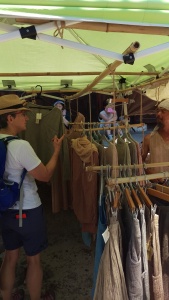
On our last day in Japan, we went the shrine sale at To-Ji Temple, which is a famous flea market and antiques market. There is a lot to say about this amazing event! But I’m going to begin with the string seller.  There is a link at the end of the post to the very interesting www site for Aoni Textiles given to me by the man in this picture.

IMAG1142

Just quietly, Kyoto was sweltering through record heat the entire time we were there.  Australians know what 39C feels like, and it was at least 39C every day we were there. We had the sad experience of sharing the hottest day Kyoto has ever had.  I hope their media is not like ours and that it was saying CLIMATE CHANGE.  Being in Kyoto did make me think that the Kyoto Protocol was negotiated in Kyoto surely at least in part because in Kyoto there is much to be lost and therefore much to be gained by concerted international climate action.  Anyway–the man in this picture is hot! And he is selling “string”.
IMAG1139

By the time we found this stall, I’d been to the Museum of Traditional Arts and Crafts with our friend (who shared one of the weeks we were there), in which string is an entirely different category to thread that would be used, for example, for weaving garments.  It seemed to encompass things I would think of as rope (for industrial use) as well as things I would think of as strapping or narrow weaving.  But of a quality unknown in most contexts where any of these things are used where I live.  This was (mostly) not string in any sense I have known it. Some of what was on sale here was extremely fine and came with example knitted lace garments. Some was robust and quite thick. Some was plied, quite a bit was singles (not plied). While I don’t doubt the complexity of translation is part of it, and so is my ignorance, I think string is treated with more respect in Japan. I have not seen such quantities of rope made from natural fibres since I was a child, and perhaps not then.

IMAG1140

Some of the fibres on sale seemed to me to be one of the lesser known silks. The cocoons (if indeed I have understood what I was looking at) in the bowl at bottom left in the image above were huge by comparison with those for regular old silkworms, and the yarns made from them were relatively thick and coarse.

IMAG1141

This might be hemp or ramie fibre (and just look at the way it comes wound, with a waist on the “ball”–something I’ve never seen before). After some time with the three of us muddling our way through conversation and speculation, the stall owner put down his fan and pulled out a guide to the fibres he was selling that confirmed some were ramie, some hemp, some banana fibre (but not as I have previously known it), some pineapple leaf fibre–and there was more I was unable to understand, and the pressure of time and heat and the enormity of the flea market. The bunches of strappy materials visible hanging from the canopy in the first image were mostly hemp which I assume was being sold for other people to spin or use for basketry and other crafts/purposes.  But perhaps this is all my imagination!

Should you wish to see more, the www site can be found here. As I write it is in Japanese, and Google translate helps a little but in a poetic rather than an entirely informative way. It is richly illustrated and there are some amazing videos.  There is also an inactive button/link that makes me think they intend to translate into English but haven’t quite got there yet.  So if, like me, you speak English but not Japanese–maybe more will be revealed in the future!


17 Comments

Filed under Fibre preparation