Tuffsock knitting: BFL/Texel/Silk

Dearest readers, there I was full of good intentions for more regular posting when I was struck down by illness!  Fret not–I am recovering, but all too slowly for a restless individual such as myself.  In the meantime, I am going to try finishing off outstanding posts and sharing them with you, now that I have a little more brain and a little less cotton wool between the ears…

This post is part of the Tuff Socks Naturally project, an open, collaborative project exploring more sustainable alternatives to superwash and nylon in sock yarn. You can join in on the discussion on this blog or on the blog of the fabulous Rebecca at Needle and Spindle or on instagram using the hashtag #tuffsocksnaturally (which you can now follow on instagram, a rather sweet feature).

IMG_20171105_140152_499

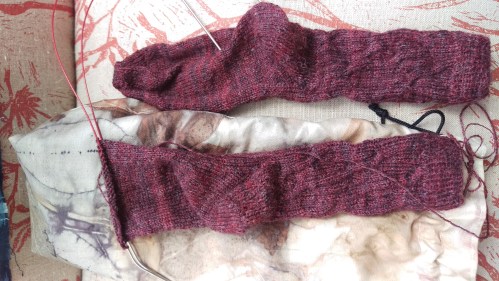
Here is a post at a mystery location (undoubtedly somewhere where waiting was leavened by knitting and idly thinking of the friend for whom these socks are destined).

IMAG0032

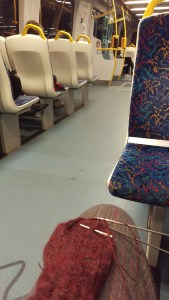
This looks more like travelling to or from a work engagement by public transport…

IMAG6714

I reached the final toe just as we were about to leave for Japan so I made a tactical decision to leave these at home and start another pair to maximise knitting relative to weight carried.

IMAG1176

Here is grafting going on, on the train. Out of focus.

IMAG1198

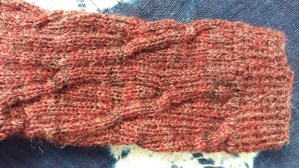
The whimsical cables have not lost their charm (for me at least).

IMAG1205

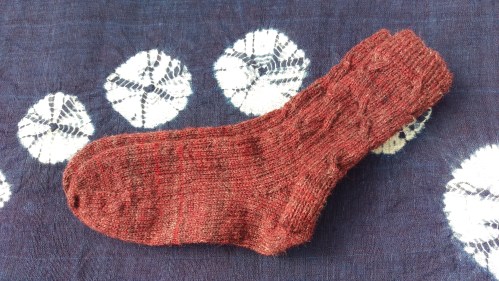
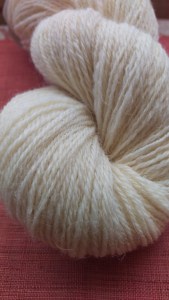
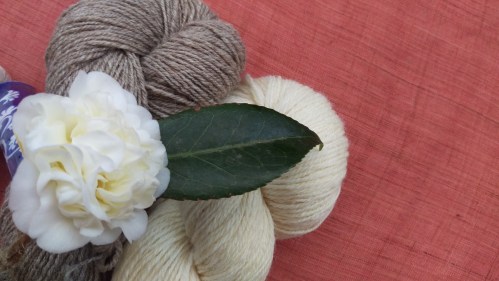
The subtle bands of colour created by the spinning are rather sweet I think–when I bought the roving I did not imagine it being so homogenised by the spinning, a sign that I was a naive spinner at the time!

IMAG1203

And for a clearer sense of the actual colour:

IMAG1206


4 Comments

Filed under Knitting

Tuffsock Knitting: Indigo dyed Suffolk

This post is part of the Tuff Socks Naturally project, an open, collaborative project exploring more sustainable alternatives to superwash and nylon in sock yarn. You can join in on the discussion on this blog or on the blog of the fabulous Rebecca at Needle and Spindle or on instagram using the hashtag #tuffsocksnaturally.

IMAG6549

You may remember this yarn.  The fibre is Suffolk, one of the traditional sock knitting Downs breeds, in this case from Kangaroo Island, off the coast of  South Australia. I dyed it in a fructose based indigo vat as flicked locks, then carded and spun it three ply with a tight twist.  

IMAG6583

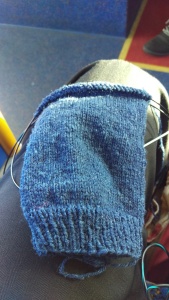
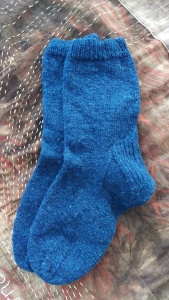
I am not sure that this yarn will work for everyone.  It is not silky soft, and the factors that make wool comfortable for one person and prickly to the next person are very individual. On the other hand it is robust, springy and feels resilient–I love that kind of springiness in  a sock personally.  So I had a conversation with a couple of friends about this issue and settled on one who was delighted at the prospect when she had the chance to hold it in her hands.  It was midwinter here so she received these socks gleefully!

IMAG6720

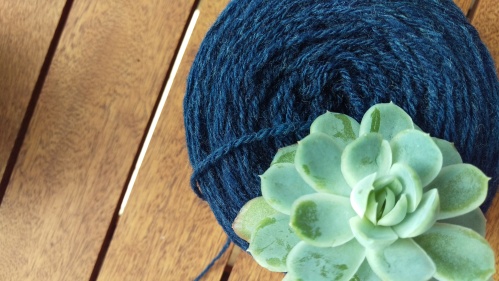
I have had trouble capturing the blue in photos.  It’s truest in the top picture of the wound ball.  I think these will be very robust and very warm socks and I’ll have to wait to see how the reviews from the recipient pan out!

12 Comments

Filed under Knitting

Guerilla Gardening Winter Edition 2: propagating

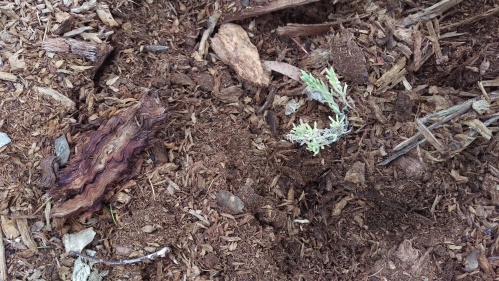
Autumn is the season for cuttings. So as the weather cooled I started out with ‘old man’ saltbush. Here it is getting dipped in honey prior to planting.

IMAG6345

I’ve planted a lot of creeping boobialla of two different kinds and it is thriving around the neighbourhood.

So now I can take cuttings from these plants to make more!

I’ve been trying out correas and rock roses and had success with last year’s trials.

I have also dug out root divisions from the dianellas around our way to grow more, and cuttings from pigface too. So I now have a couple of hundred pots which are looking promising so far… and now I need to get myself into condition to be able to plant them when spring arrives.

IMAG6638


6 Comments

Filed under Neighbourhood pleasures

Guerilla Gardening Winter Edition 1: Planting out

Once winter seemed to have set in, I put my last plantings in the ground around the neighbourhood.  Everything that was sprouted from seed in spring and summer has now been planted out.

IMAG6683

There have been some losses as the Council or its contractors have been cutting down trees which have died sue to a soil borne fungus. Undergrowth often gets taken out in the complexity of removing entire tress. But they have also been planting more trees that are a decent size when they go in.  And then (I am guessing) one of my neighbours dug out my most successful weaving sedge, undoubtedly with different ideas about how to manage water flow through the neighbourhood after the flood. Even more recently, someone decided to take out two huge thriving wattles that I liked very much, presumably as a way of dealing with the gentleman who had been storing things behind them, sorting through them and then leaving behind what he didn’t want or need. I’d picked up the discarded items a few times, but evidently not enough for someone… or there was other trouble going on from someone’s point of view!

Some things are really thriving and this year I have direct seeded saltbush into some parts of the neighbourhood where ground cover is low, while in others, saltbush is being itself and spreading itself around freely. Thank goodness.

IMAG6685

Some of last year’s sheoaks have survived a more widespread than usual weed spraying programme and their understorey of saltbush and other tough native plants is growing too.

IMAG6689

In this very challenging spot I planted some random plants given to me by various people and this hibiscus has been flowering for months.  Understorey boobialla, some eucalypts and a feijoa tree are still growing too. Life just keeps growing up.

IMAG6713

Leave a comment

Filed under Natural dyeing, Neighbourhood pleasures

Tuffsock spinning

Dear friends, it has been a long while!  I’ve been travelling and I have a lot to write about. I’ve had a big change in my paid work too, and it will mean I have more mental space and physical time for making and blogging, I hope.  In the meantime, here is an update on the state of the tuffsock spinning project.

This post is part of the Tuff Socks Naturally project, an open, collaborative project exploring more sustainable alternatives to superwash and nylon in sock yarn. You can join in on the discussion on this blog or on the blog of the fabulous Rebecca at Needle and Spindle or on instagram using the hashtag #tuffsocksnaturally.

IMAG6373

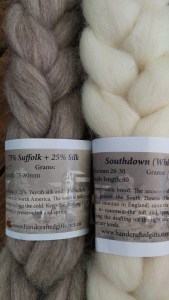
A little while back, a new vendor came to my Guild meeting.  She brought braids of many different breeds, including some that are not readily available in Australia and many that are endangered.  Well.  Buying imported wool is not a decision I am going to try to defend.  But I was so curious to try Southdown–and the Suffolk was entirely different to the local Kangaroo Island Suffolk I have been spinning.  And I can only say that after all these years spinning I still have periods in which I think ‘preparing fibre that has been grown with no thought at all for a handspinner is not worth the effort!’ and others when I think: ‘local fleece is the only fleece I should ever spin!’  If you want consistency, my friends, go and read another blog, because you’re not going to find it here!  I took these two braids home.

IMAG6611

The Suffolk and silk blend spun up like a dream and I would not have guessed this was the same breed as the local Suffolk.  Variability within breeds is only to be expected, but clearly the local sheep has been bred for meat, with its fleece being made into carpet if anything.  Perhaps the UK Suffolk is still being bred for fleece quality.  There may well be such Suffolks in Australia, if I knew where to find them. On the other hand, machine processing and the addition of silk have made the UK Suffolk less springy and bouncy than the local breed, which may mean it will be less durable at the same time as it is unequivocally finer and longer in staple.

IMAG1175

The Southdown was also lovely to spin. So now I have two new experiment yarns in the tuffsock department, ready to knit.  or perhaps to dye…

IMAG1172


7 Comments

Filed under Spinning

Workshop announcement

Dear readers, if you are local–this workshop might interest you!  It would be lovely to see you if you’re able… and Susan is a lovely host.

Make a zippered box pouch

Saturday and Sunday 25 and 26 August, 10am-4pm each day

At the Aldinga Arts Eco-Village with Mary Heath from Local and Bespoke www.localandbespoke.com

2017-06-20 13.02.30

Come along and make a zippered pouch from plant dyed, woollen fabric. We will also dye more woollen fabric and thread to take home for your next project.

What to bring:

·         Your lunch

·         Treats to share

·         plant dyed fabrics to create a pouch OR use the plant dyed, upcycled woollen blanket provided (no extra cost)

·         your sewing machine in good order or hand sewing tools – your choice (sewing machine service is not on offer at this workshop)

·         thread to sew your bag


What will be supplied:

·         coffee, tea (all sorts), cocoa and milk

·         plant dyed, upcycled woollen blanket to use for your bag

·         upcycled woollen blanket to dye for future projects

·         plant dyes

·         zippers

2017-06-25 12.44.32

When:

Saturday and Sunday 25 and 26 August, 10am-4pm each day

Where:

12 Dianella Walk, Aldinga Arts EcoVillage, Aldinga SA 5173

Fee:

$120 per person (up to 10 participants; fee due by 3 August to secure your place)

Contact:

susan1147schullerATgmailDOTcom

6 Comments

Filed under Natural dyeing, Sewing

Komebukuro bags

It all began with a visit with friends, who took us for a trip through part of Tasmania, months ago.  We went to a country market and right beside it was Wafu Works. What a place!  Full of all kinds of Japanese paper, textiles and tools. I ended up with some thread an sashiko needles, and bought a kit to make a rice bag with some gift money… Indigo dyed fabrics on the outside, a red lining and a drawstring cord.

IMAG6295

I was so intrigued.  I learned a new stitch and a cunning construction. I loved the vintage fabrics.  You know what happened next, right?  I paired the leftover fabric with some of my own indigo dyeing, and cut up a mauve linen shirt I remember buying about 16 years ago for the lining, and pieced the scraps together…

IMAG0015

In the end I made three, and I’m now itching to make more…


7 Comments

Filed under Sewing

Alchemist’s Apron

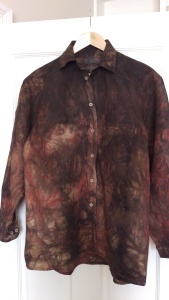
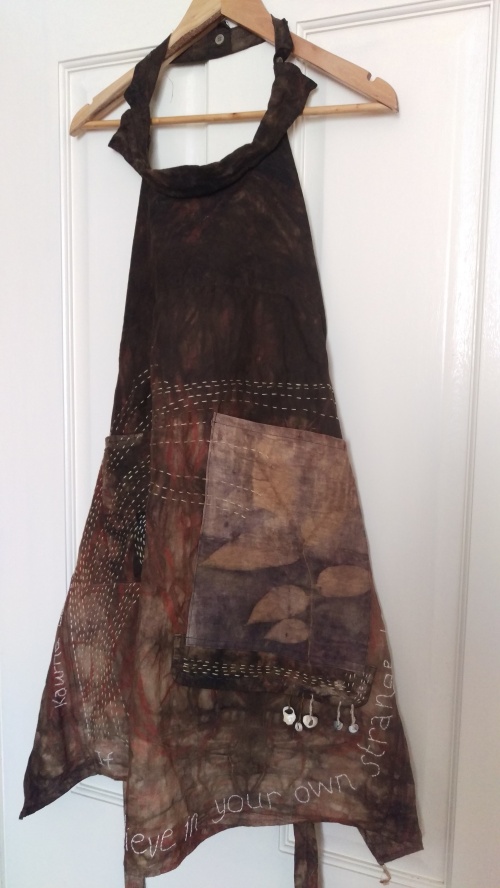
Some time back, I signed up for The Alchemist’s Apron. It’s an online class taught by India Flint in which you begin with a thrifted shirt and end up with an apron.  Along the way, there is plant dyeing and mordanting, pocket creativity and embellishment, practical tips on all things textile; not to mention wisdom and wit. The class has been accompanied by a facebook group of excitable dyers, each moving at their own pace and all creating aprons, dyes and questions aplenty.

IMAG6391

Now it has long since been clear to me that the shortage in my life is not dyestuffs, or fabric, or ideas, but time. So, I did not do everything exactly as the course proposed.  Pretty often if  I can switch steps and get the time consuming at-home step completed over the weekend so I can dawdle through the steps I can carry, pick up and put down, or do in front of the TV during the week–I will wickedly switch steps and face the consequences.  That is, when I realise I am not following the instructions!  And, although it was studying with India that gave me, or maybe gave me back, the pleasure of hand sewing, I machine sewed some steps in this process and allocated saved time to the parts I preferred to linger over.

IMAG6420

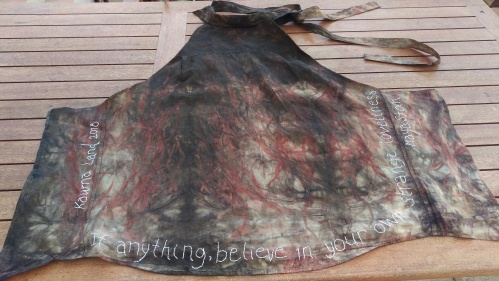
India offered strategies for embellishing manageable pieces of fabric (just as portable as knitting a sock, hooray!) as well as for embellishing the final completed object.  I’m not much of a one for embellishment but it may be that I am learning what I can enjoy and appreciate ever so slowly and with help from you, lovely readers.  I started out with the customary acknowledgement of the owners of the land where the garment was made, and then a line of poetry,  and then just kept going…

IMAG6489

India is, famously, a lover of pockets, and I am also a lover of pockets.  So I had great fun with those and learned new techniques for having things go the way I want them to–with pockets and embellishment and all.  So I have camouflaged pockets, visible pockets and secret pockets.  Open and closed pockets, large and small.

IMAG6424

I tried new threads.  And some new dyeing strategies. I understood how to do things I’d only seen, previously.  I understood why some things work instead of just knowing that they work.

And, I ended up with a rather lovely apron.  Those hanging shells happen to fall right where my hand hangs on that side and they get riffled though quite a bit in passing.  So there’s a happily ever after–which has spawned any number of further apron ideas, needless to say!

IMAG6597


22 Comments

Filed under Natural dyeing

Boomerang bags

I decided to raid my stash of pockets.  They have been cut out of garments I am turning into other things (like bags!) and here they are now, stitched to the inside of Boomerang Bags.

What bags?  I hear you asking.  These bags. Historical cotton, and upholstery fabric left for me by the charming BB volunteer organiser who collected my last lot of completed bags (she apparently does not understand the supply issue at my place is oversupply).


Oh, and I mean these bags too.

And these! I have now reached the end of the 1980s eye-bleeding fabrics from hard rubbish and moved back to whittling away the back catalogue of fabrics I have inherited, bought, thrifted, or upcycled from garments and manchester. Scraps are getting thinner in the cupboards.  My love of tablecloths shows less. The ancient pairs of trousers and jeans ran out and I have acquired some jeans through the op shop so I have sturdy fabric for places I need it (handles, for example).  In fact, I have started reorganising the supplies in the room I use to sew, and I’ve also decided to release some fabrics into the wild.  Some were needed for a friend’s school project, and he liked some fake fur scraps so much they went home with him too. I took some more to the Guild last night because… I am reaching layers of my own stash that I cannot imagine ever using and there is no obvious reason I should keep them instead of taking them to places where other people might enjoy them! And… twelve or more fully lined Boomerang bags are under construction and moving gradually to the finish line right now.


Leave a comment

Filed under Sewing

Tuffsocksnaturally dyeing: sanderswood *cough* edition

IMAG6470

This post is part of the Tuff Socks Naturally project, an open, collaborative project exploring more sustainable alternatives to superwash and nylon in sock yarn. You can join in on the discussion on this blog or on the blog of the fabulous Rebecca at Needle and Spindle or on instagram using the hashtag #tuffsocksnaturally.

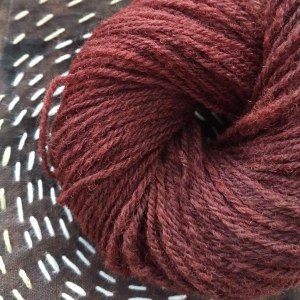
When last you saw this skein of yarn, dear readers, it was a sad excuse for pink after the failure of my betel nut dyeing experiment. At that point, I decided to take advantage of it having been mordanted in alum and dye it in something requiring an alum mordant. I still have a back catalogue of natural dyes left at my Guild. I picked out a small [sealed] pack of “sanderswood”.  The package showed its age–there was the address of a business in New Zealand/Aotearoa that must have closed long ago.  And we are talking a label created before the personal computer became an everyday item in the overdeveloped world.
IMG_20180601_075504_594

Jenny Dean gives alternate names as sanderswood, red sandalwood and Pyterocarpus Santalinus. The dye comes from the heartwood of the tree, so in ordinary circumstances I would not use it.  But this tree was cut down long ago and it is not in my power to bring it back.  I looked at the fine wood chips and gave them a good soaking before preparing the dye bath and throwing the fibres in.

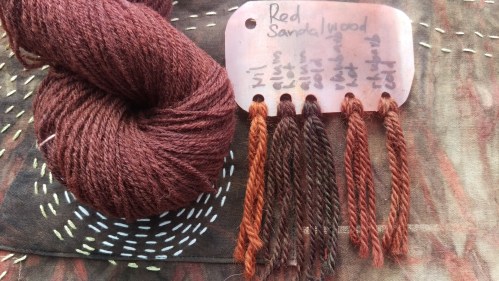
Well.  Jenny Dean did not lead me to expect this!  Perhaps I should have weighed and measured?  Perhaps the betel nut under dye (pale as it was) or the alkalinity of the betel nut bath had something to do with it (yes, I washed and neutralised but even so)?
IMAG6607

On my test card, this colour came closest to alum applied hot (which is how I mordanted the sock yarn). So evidently the betel nut dye was not entirely the source of the outcome. In passing, I mention that this is one of the more interesting outcomes for the rhubarb leaf mordant I have seen. But the mystery, as it turns out, was still unfolding.  A week passed (you know, day job).  The dye bath had the slight beginnings of mould, so I heated it again, lid on, to kill the mould, removed it, and mordanted more handspun yarn.  This time a softer, greasier fleece that I’d spun quick and thick.
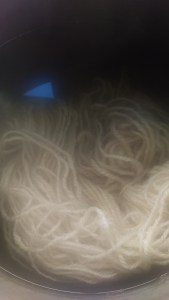
IMAG6640

In it went.  I expected the result to be uninteresting because brown.  Sorry to you lovers of brown, but this is surely what brown sheep are there for? I know.  I can’t help myself. Well, glad I bothered, because:

IMAG6642

Not only that, but eventually when that pot had steamed for over an hour with the yarn in it, I added another skein and it just kept giving.

IMAG6647

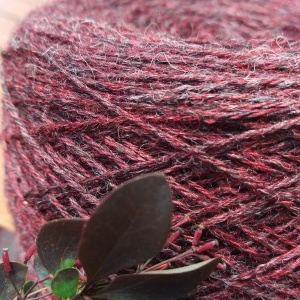
What can explain this?  Jenny Dean’s sample card shows oranges and yellow and brown for sanderswood.  I can say my pots are not clean enough to rule out modification by iron, but that does not normally create purple!  So perhaps this was really logwood?  But that doesn’t explain the deep brown.  And it is way too late to ask anyone at the Celbar gallery, Papanui Road, which sold this dyestuff, presumably by mail order.  I have found one reference to it online, in a publication dated 1978 that someone has lovingly scanned and uploaded for posterity.  Roll on, the plant dyeing mysteries! Once dried, this yarn was undeniably logwood purple–and what’s more, the tendency to give and give and give is something I have found also characterises logwood.  So on this occasion, I’m going to say this was NOT sanderswood, it was logwood. And, I see I had the same kind of result in 2013–so there may have been an entire batch mixed up somewhere in the past that came to our Guild!



5 Comments

Filed under Natural dyeing