Tag Archives: alpaca

Knitting for the beloved

My mother-out-law is a charming and delightful woman who is a fabulous seamstress.   (I say out-law because her daughter and I are not married, and not likely to be… and there is no option for our marriage in this country for us even if we were marrying types).  She clearly sewed wonderful garments her whole life and keeps telling me this latest frock will be her last and that she is giving up sewing, now, in her mid eighties.  Knitting she likes less, and has less confidence about.

So it was with some surprise that I saw her decide to knit a sleeveless vest for my father-out-law, who in the usual way of such things is a whole lot bigger than her.  All the more surprisingly, she chose 5 ply (fingering) 100% alpaca for the job, ensuring that there would be many thousands of stitches involved.  I happily cast on for her and knit the ribbing, wondering why she was doing it, especially as they live in tropical Brisbane.

I think the answer is all about love.  The love of her husband of over 50 years, and the love of the friend who can no longer knit who gave her this delectable yarn.

Over the last 3 or 4 years I have had progress updates.  At one point I turned a pesky purl that had slipped into the stocking stitch of the garment–fifty rows back–into the knit it was always destined to be.   The friend who taught me that trick has earned my undying gratitude!  At some stage I cast on the front and knit the ribbing for that.  When they visited recently it was clear that the enormity of the task was grinding her down,  with the back finished and about 1/3 of the the front done.  So I offered to finish it, with some trepidation about whether my skills would be up for the job at the level required.

IMAG2872

I chose needles a size bigger that she had been using, because she is a loose knitter and I am a tight knitter, and hoped for the best.  I knit away for some while before I realised there was an added stitch with a companion decorative hole, beginning an additional column of stitches well below the marked line where her knitting ended and mine began.  I ripped back and started from that new point.  After a while I saw that I had made a hole and a new column of stitches exactly the same way, ripped back again and continued up.  I got to the neck with some excitement and then realised it looked wrong.  On closer inspection, and with new respect for the improvements in pattern drafting I have enjoyed having taken up knitting long after this one was printed, I realised I was trying to knit a v neck using the instructions for the crew neck.  I ripped out that side of the neck and then a good 20 cm or so to get to the point where a v neck should begin… and then went again.  I cast off the upper edges too tightly for them to match the back and had to rip that out and re-knit.  Then I soaked it overnight and set it out to dry.

IMAG2875

After all that had gone wrong so far, I was immensely relieved to see all the puckering and the line where the baton passed from one knitter to another had vanished and the fabric looked great! Next, for the finishing parts… seaming, neckline and arm bands.  Instructions that go ‘pick up and knit 186 stitches evenly…’ always freak me out a bit!

Toward the end I was being cheer squad at the Moana Beach Triathlon and could not resist a Yarn Harlot shot of the vest at the beach.

IMAG3094

By the time you read this, the vest will have been reunited with the first knitter and then with the intended wearer.  I hope they both love it.  I certainly love them profoundly for making me so welcome in their family.

IMAG3167

12 Comments

Filed under Knitting

Harvest time: Eucalyptus Scoparia bark

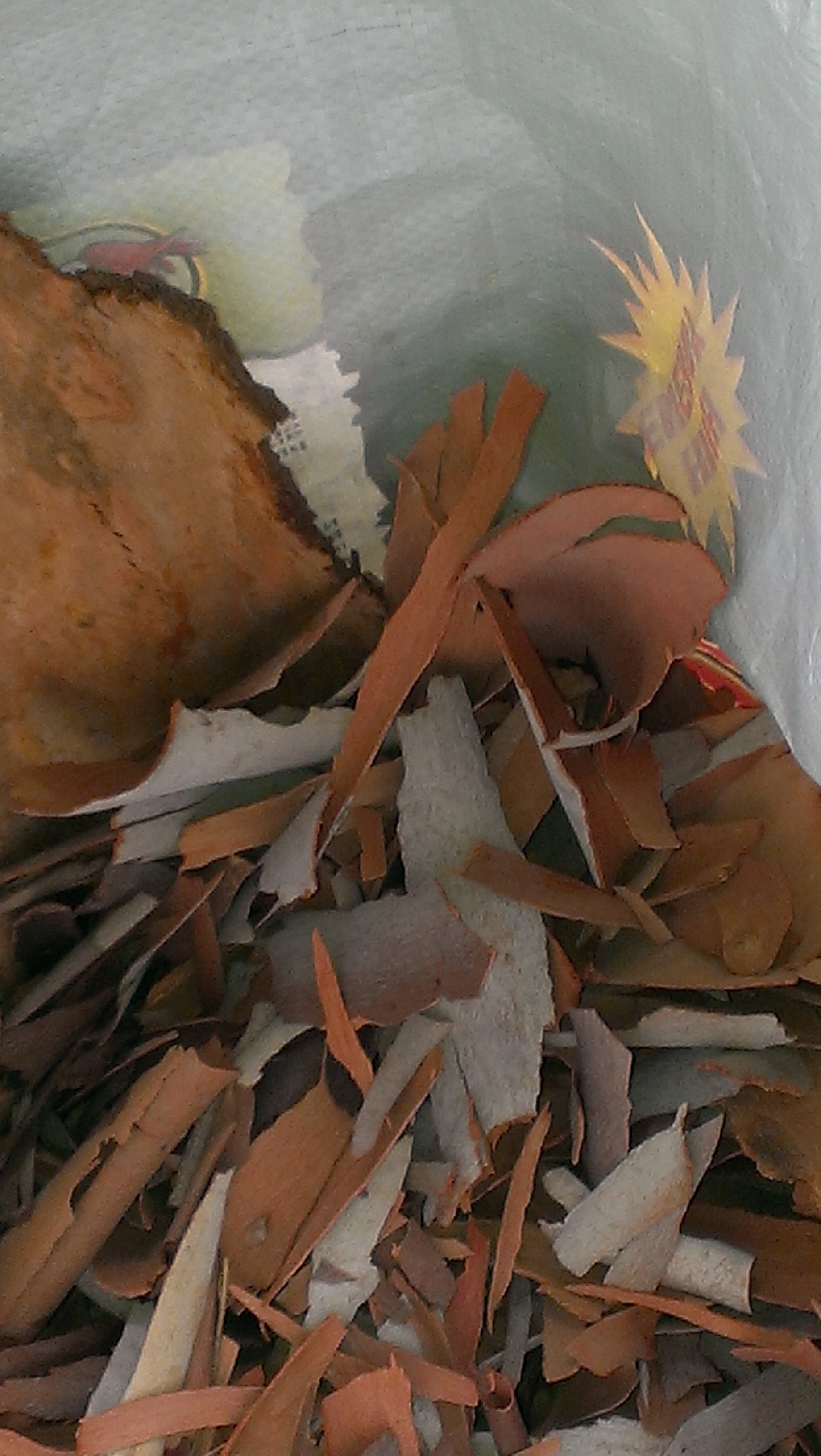
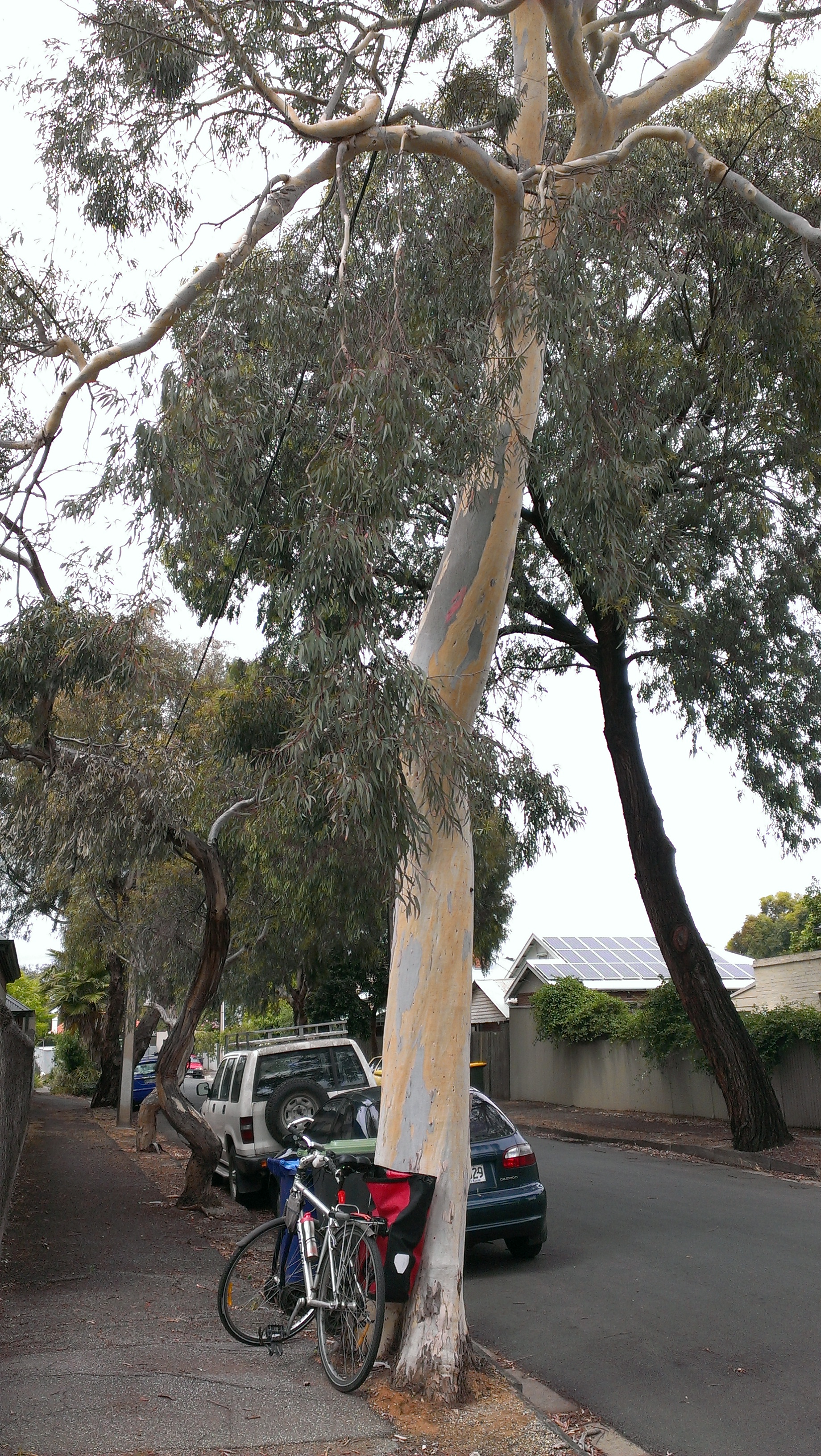
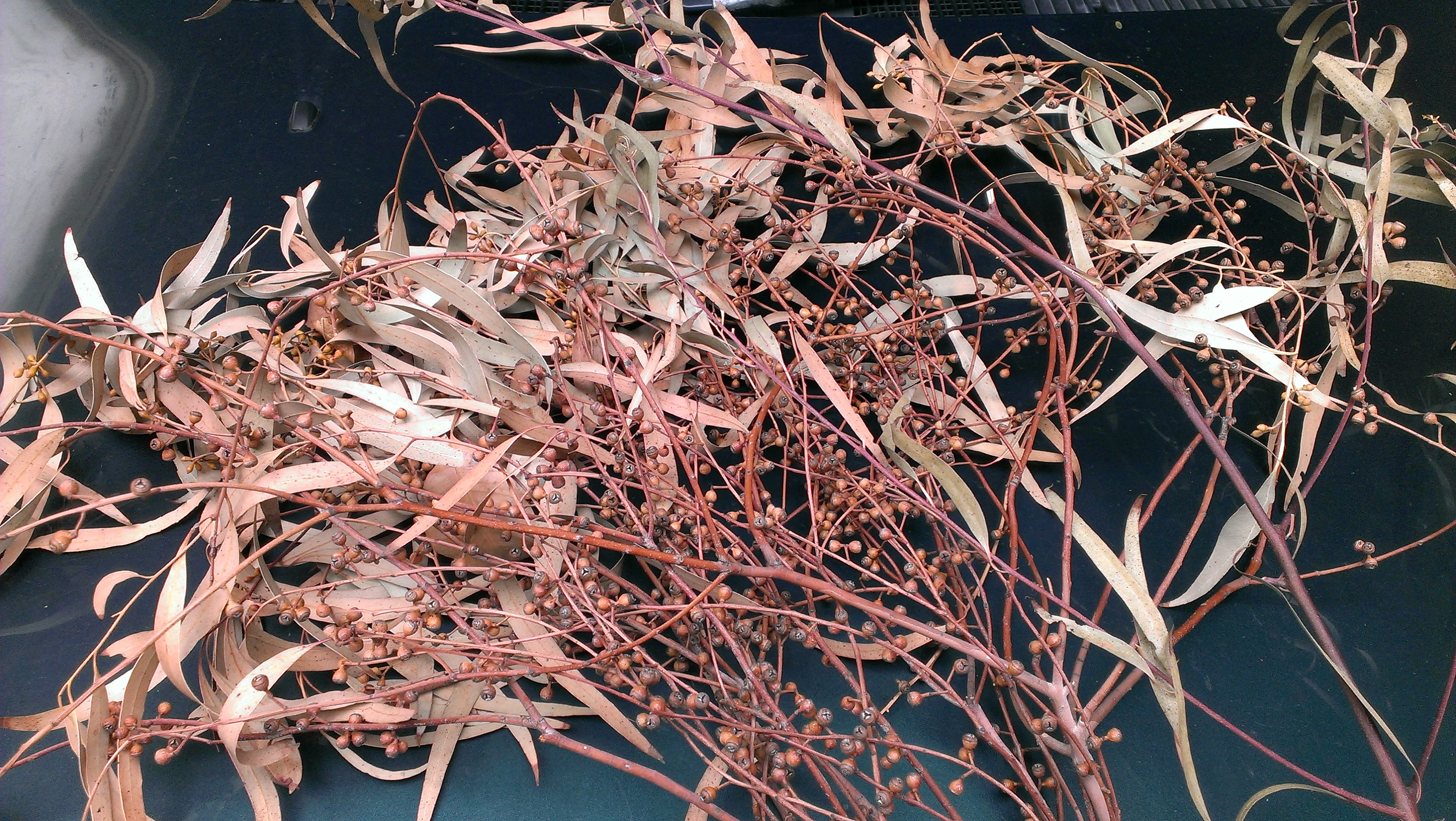
‘Tis the season for bark collecting, again!  I’ve been out on my trusty bike visiting all the E Scoparias I know and investigating others that might prove to be (or not to be) E Scoparia. I pull my bike over to pack bark into a bag, trampling on it to crush it and make space for more, and filling again before loading my panniers.  Or, go to visit friends with my big bucket in hand and pick up whatever has fallen since my last visit.  Or, head out for a run, leaving my rolled up bag under a tree and pick it up to fill on my cool-down walk on the way back.  This E Scoparia, tucked in behind the foliage of a carob tree, is peeling lavishly.

IMAG2991

At home, I stash the bark in a chook feed sack, offering more opportunities for trampling which let me stack a lot of bark into one bag and get it into a form that will go into the dyepot with minimal fuss.

IMAG2841

This week, I found a new E Scoparia (at least, that was my hope).  I collected a bag full of bark and it is now soaking so I can test whether I have that right, in consultation with the dyepot. A friend who appreciates natural dyeing lives in this street–so I’ll look forward to telling her if she has a great dye tree at the end of her street! Blackett St:

IMAG3022

I also collected bark from this enormous specimen.  Last year I collected a lot of bark from this tree and then found I had one bag of bark that gave brown and not red to orange as expected.  I suspect that means this is not an E Scoparia.  Checking it out again today it is bigger than any other tree I believe to be E Scoparia and it has many more fruits visible and clinging to the stem.  My initial sense is that the bark smells different, too. The leaves give fantastic colour (at least they did before someone took a chainsaw to all the lower branches), but I am running a trial bark pot before the tree sheds the main part of its bark.  It is soaking alongside the other one as I write. Laught Ave:

IMAG3024

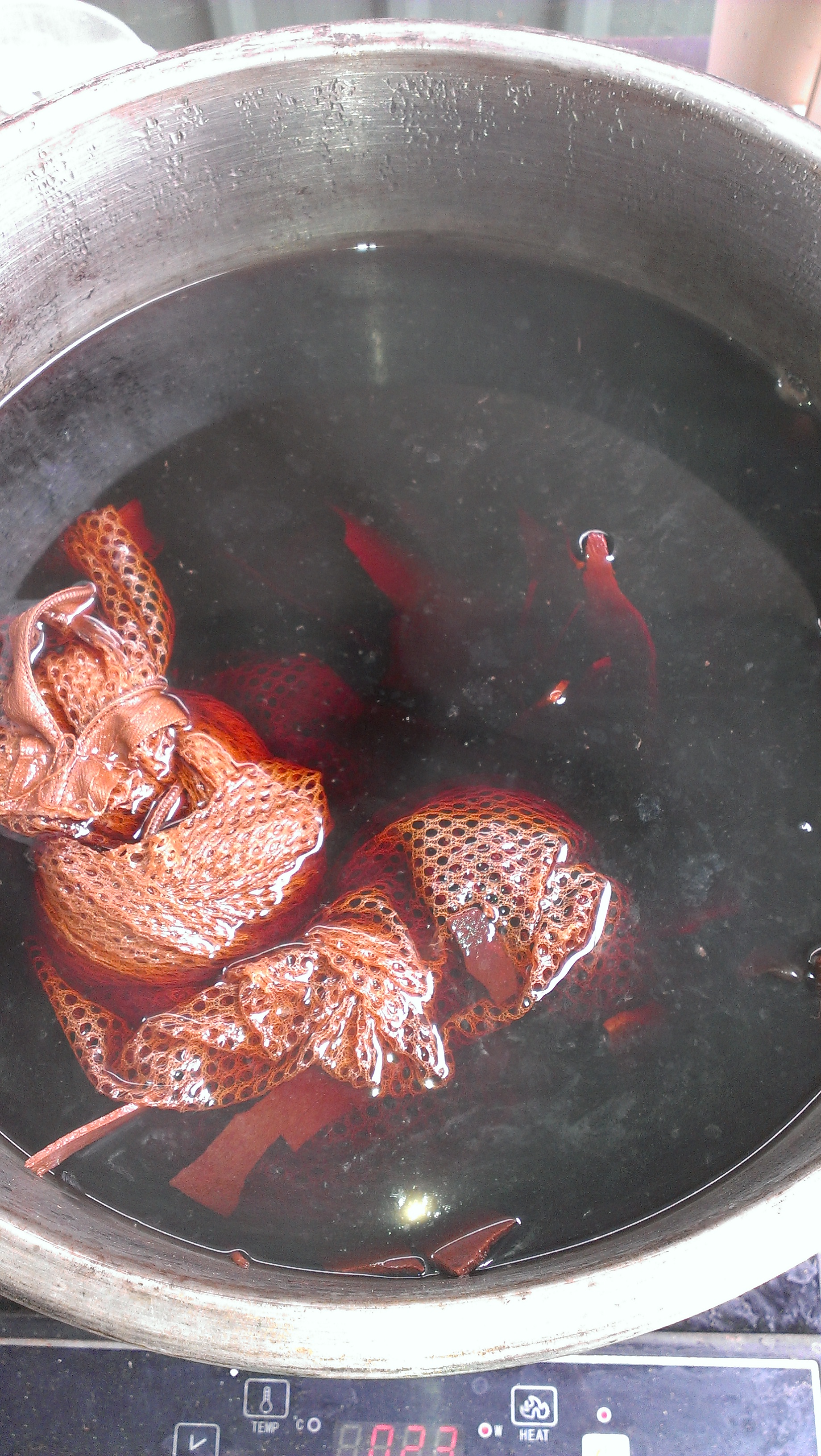
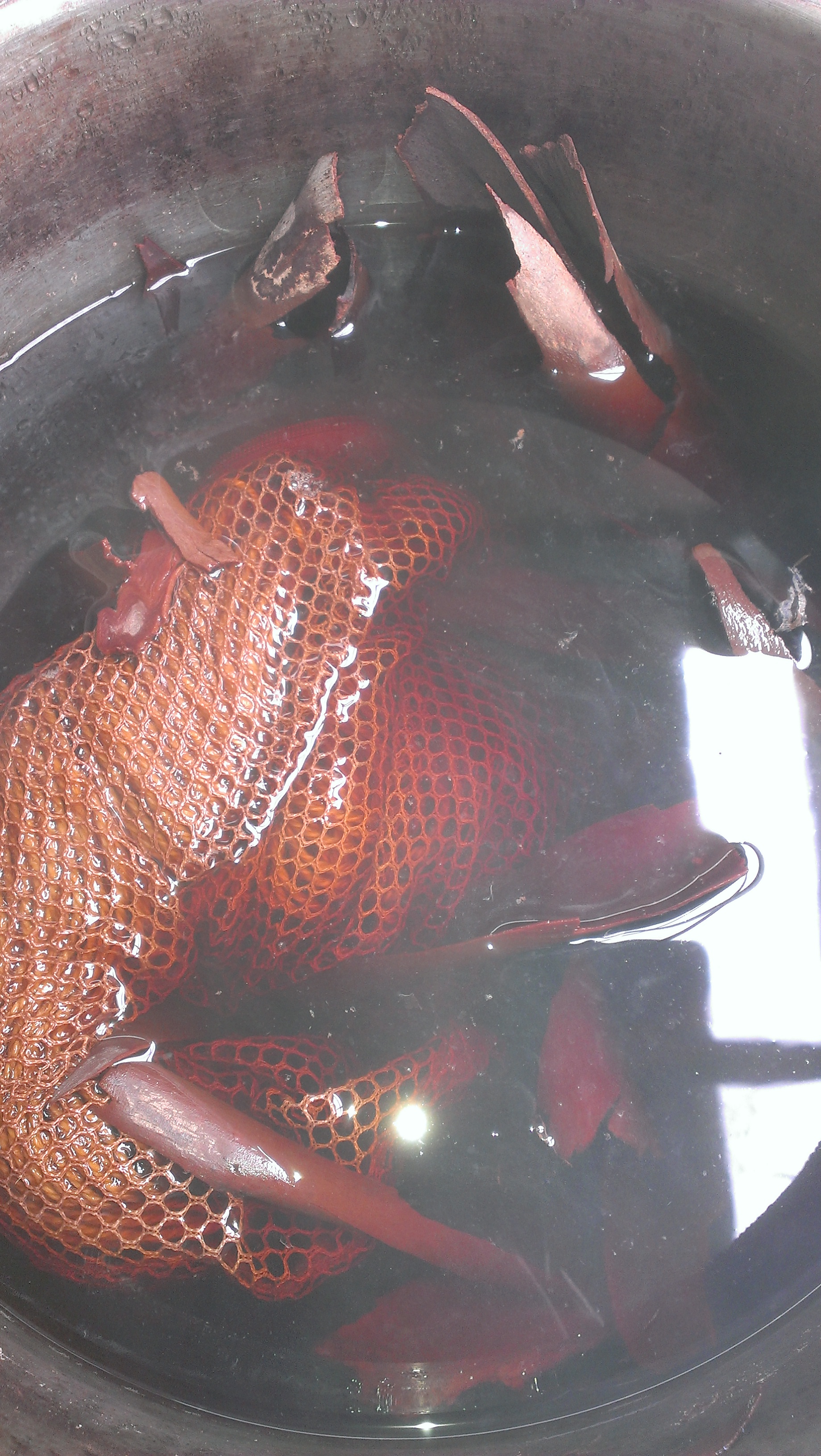
Next day, here are the dye baths, three hours in, presented in the same order as the trees from which the bark came. They look remarkably similar but smell quite different:

IMAG3027 IMAG3029

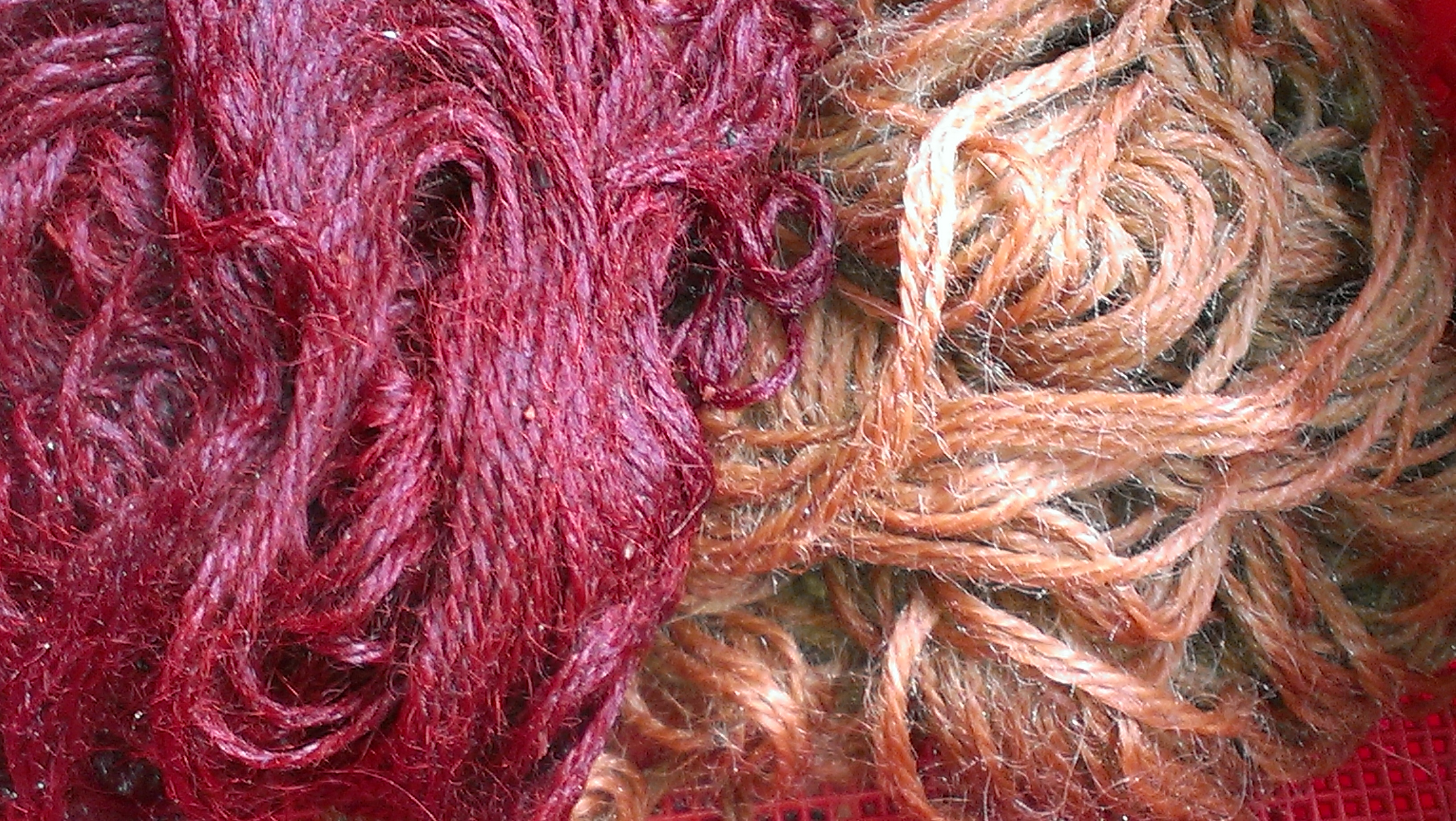
Here are the (still wet) yarns that came from those dyepots, in the same order again.  Clearly, the second tree is not E Scoparia–or–for some reason its context means it doesn’t give the same colour.

IMAG3031

As I have had great results from the leaves of that second tree, I pulled the bark out, put some fallen leaves in, and re-dyed the tan skein…!

IMAG3030

10 Comments

Filed under Dye Plants, Eucalypts, Natural dyeing, Neighbourhood pleasures

Alas, poor Malcolm the Corriedale

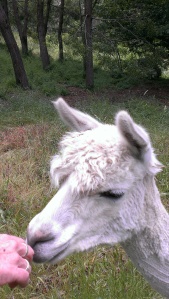
We had a glorious visit to our friends in the hills on the weekend. There were recently shorn alpacas.  In black…

IMAG2929

In white…

IMAG2926

And in cinnamon.  But like the sheep, the brown alpacas were too shy for photos.  There was a woodlot of blackwood trees, and some stumps with very impressive fungi growing on them:

IMAG2932

There was a wealth of eucalypts and a knowledgeable community member who knew what many of them were. I brought home E Nicholii leaves (I have not had the chance to greet a fully grown specimen before, let alone a row of them), E Cinerea leaves and some massive juvenile E Globulus leaves.

IMAG2935

There was fine company, cake and scones and home grown cherries.  Not only that, but koala sightings and visits with rescue joeys (baby kangaroos whose mothers have been killed on the road, being raised by hand with tender loving care).  Such awesomeness!  I took lots of handspun yarn and left quite a bit behind where creative minds were whirling with plans and fingers were itching to get knitting… but there was bad news too.  I got to meet with the people who hand raised the corriedale whose fleece I have been working with most recently, from a lamb.  And sadly, poor Malcolm had recently and unexpectedly died, just before the shearer was due to visit.  We paused on Malcolm’s grave.  So it was special to have taken yarns made from Malcolm’s fleece to share… and I still have some, plus fleece that I dyed with eucalypts last week (it is E Scoparia bark peeling season) …

IMAG2936


And fleece that is prepared and ready to spin, from my recent coreopsis–osage orange–indigo dyeing season.  So… although I never did get to meet Malcolm, it’s conceivable I’ve spent more hours with my hands in his fleece than anyone…

IMAG2939

And I now have 5 alpaca fleeces and one from Lentil the sheep to think about and share around, such is the generosity of our friends!

7 Comments

Filed under Dye Plants, Eucalypts, Fibre preparation, Natural dyeing, Spinning

Eucalyptus dyes over grey corriedale: The spinning finale

I have a bit of a tendency to go a long way toward the completion of a big project and then pause near the end.  Sometimes for a little while, sometimes for a long while.  So here, finally, is the very last of the grey corriedale I dyed months ago and planned to spin during the Tour de Fleece. I loved the two ply yarn I created during the Tour a good bit less than my initial chain plied skein, even though it is what I need if I ever knit that cardigan I dream of.

I found the label for this fleece on the weekend and I started out with 3.5 kg of fleece.  I made a true three ply yarn (three singles plied together) from most of the last part…

IMAG2559

And chain plied the rest (one single plied on itself in a chain).  I think the long pause on this was caused by the way my heart sank when I stopped chain plying it in the first place.  I love the distinct colours in the last little leftover skein!   IMAG2562

I also spun up a little batt of alpaca dyed in eucalyptus.

IMAG2382


Three ply wins again!

IMAG2563

Leave a comment

Filed under Eucalypts, Fibre preparation, Natural dyeing, Spinning

Yellows from coreopsis flowers and osage orange

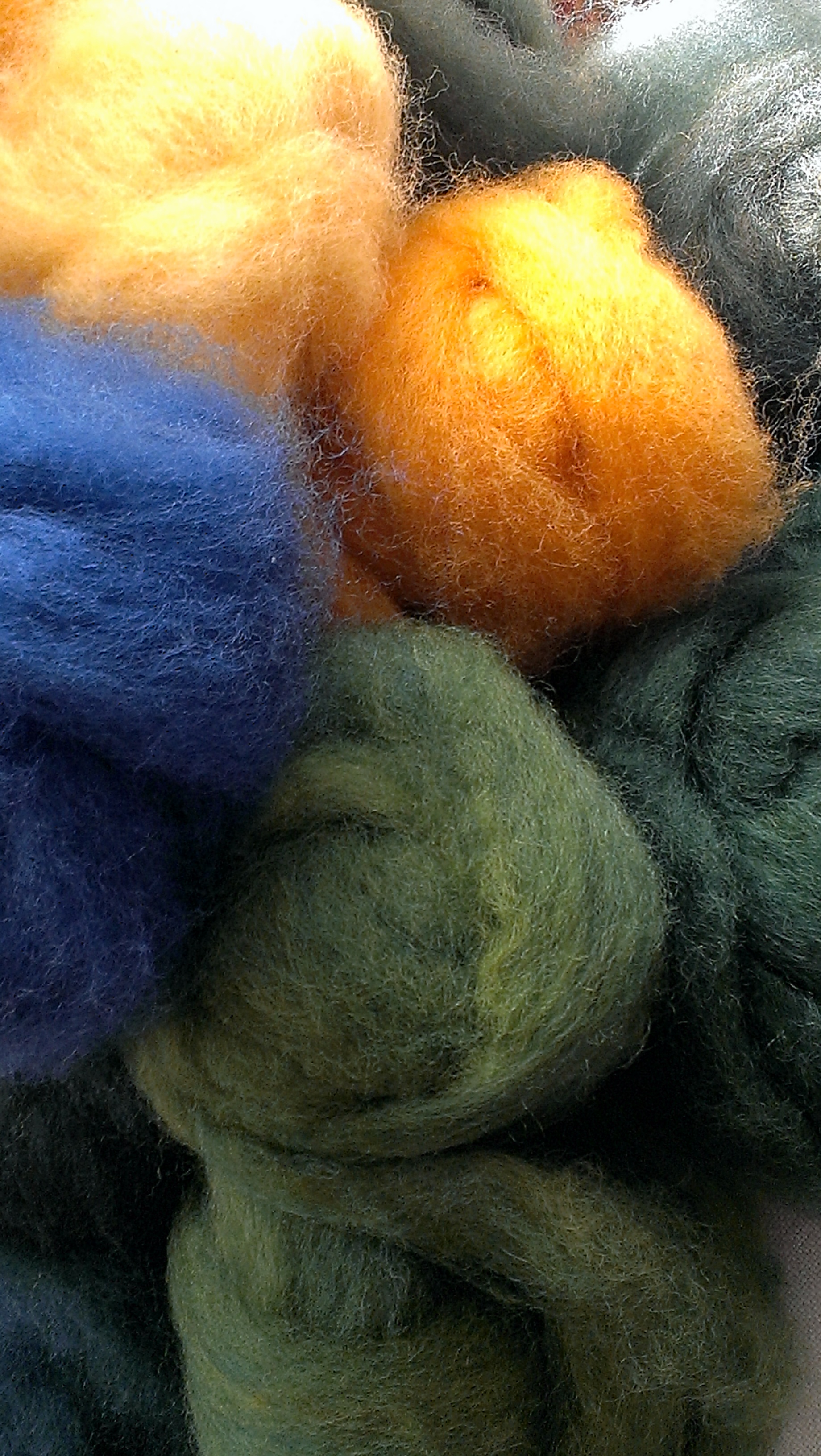
I have decided to branch out from the eucalyptus based palette of ochre–caramel–tan–orange–red–maroon I have been so focused on for the last while and plan toward an indigo vat.  Don’t you love these bold statements?

I still love the eucalypt colours: here, a small quantity of alpaca passing through various stages of preparation.  Picked, dyed locks;

IMAG2377

Partially carded batt;

IMAG2379

and, finally, yarn–pictured in the dyer’s chamomile patch.

IMAG2428

I have decided to try for yellow–green–blue transitions, which will necessarily begin with yellow.  I had coreopsis flowers my mother saved me one summer, as she deadheaded her plants. This collection of flower heads speak to me of her love and her fine qualities as a gardener and a person who loves to share.  I had reservations about the colour I would get from them, as some had gone mouldy.  Her -plants are just so prolific–the stack of wilted heads had trapped enough moisture to create mould.

IMAG2370

I also had a little remaining quantity of osage orange shavings of antiquity, gifted to me from the Guild.

IMAG2371

I prepared them both for the dyebath, but have to say my tea ball was not a good enough receptacle to retain the osage orange.  I not only sieved the dye vat before adding wool (thank goodness I remembered to do this as I tackled it one night when the amount of sawdust in the vat was not as obvious as in the clear light of day) but also placed the whole tea ball in another fine cloth bag before running an exhaust bath.

IMAG2372

Even after the first bath of each dye, there was a lot of colour left, so I ran an exhaust bath and dyed a total of about 800g of white corriedale.  I was especially impressed with the amount of colour and the wonderful smell of the coreopsis bath.  I need not have worried about the mould.  Here is the coreopsis bath between dyeings.

IMAG2383

The resulting yellows are lovely.  On the left, coreopsis bath 1, then coreopsis bath 2, osage orange bath 1 and osage orange bath 2.  The coreopsis yellows are quite buttery and golden and the osage orange colours are a little more lemony.  And, there is further evidence that grass seeds and other vegetable matter take dyes quite well!  Now, to build up my courage for the indigo stage and some greens and blues.

IMAG2453

10 Comments

Filed under Dye Plants, Eucalypts, Fibre preparation, Natural dyeing

Just in time for summer!

Sometimes people ask me how I manage to fit so many things in… but I am not sure they are really keeping track of how long a project might take me from start to finish!  Many craft projects at my place involve large numbers of tiny steps.  Sometimes it is the nature of the crafts involved and sometimes it’s the only way I can figure out to make things happen.  So projects progress slowly at times, as whim, interest, the right weather, or the availability of time permit.  Today I can report that a couple of items reached the out spout.

The eucalyptus dyed grey corriedale which started here and continued here has finally come to an end, with every last bit now converted to yarn.  The middle skein is chain-plied (and to be honest, I really do prefer this yarn over the one I have created for my cardigan) and the one at the bottom is a true 3 ply.  Some of this yarn is destined to become a cardigan, but it will not be for winter 2013, which is over now for us here in Australia.

IMAG2430

I have also finally finished making a jumper for my fairy godson. He is a tall and slender individual (just in case you’re wondering if the proportions are right), and if he’s lucky there will be one or two days cold enough to wear this jumper before winter 2014.  I hope it will still fit him then!  It was slowed down by misjudgment of the amount of yarn needed, and thus several stages of dyeing and spinning as knitting progressed, breaking all the rules of good handspun-handknit practise.  It is 3 ply eucalyptus dyed alpaca in 4ply/fingering weight.

IMAG2456

Here it is, tied up with handmade string crafted from the leaves of our daylily.  When it was raining this morning I decided to steam press it and just take it over on my way to work in hopes it might be cold enough to wear it, and was lucky enough to catch my friends at home.  It never fails to gladden my heart to give a gift that is really warmly welcomed… but it is an additional exquisite pleasure to find the handmade string to be just about as exciting as the jumper to its recipient.  It fills life with pleasure to find folk who feel just as intrigued by string from the backyard as  you do, and just as curious about how it could be made.

IMAG2460 (1)

Someone who works in the same hallway as me exclaimed over my looking happy at work on a Monday, just as I walked in this morning… and may not have understood if I’d said it was all about late but welcome presents and homemade string and love.  Sometimes you have to be there.

8 Comments

Filed under Eucalypts, Knitting, Natural dyeing, Neighbourhood pleasures, Spinning

A pair of backyard Eucalypts…

Recently I discovered that a friend who has one of the biggest E Cinerea trees I have ever seen in her back yard would like some of it removed.  I offered to cut and take away the dead and insect affected parts, to her surprise, and have now made three visits to do just that. I’ve begun some dye pots with alpaca another friend has asked me to dye.

IMAG2075

On the second visit to trim the E Cinerea, my friend’s partner spoke about the loss of a bough on their other eucalypt.  I looked closely at this second very large tree with rough, fibrous bark on the trunk and very narrow leaves and ‘Eucalyptus Nicholii’ went through my head.  Could I at last have found a fully grown specimen?  It branched so high and the ground had been so thoroughly cleared in the effort to remove all the fallen material that I couldn’t find fruit.  I did manage enough leaves for a dye pot however… and it is very promising! I heated the leaves for an hour, dropped the sample card in and went for a bike ride leaving the heat off.  When I got back:

IMAG2078

As I write I have added some alpaca fleece.  I will have to wait to make a more definitive identification… I have sometimes found that all the hours I’ve spent with books on Eucalypts have created the context for me to have a correct intuition about a particular tree.  Equally often, though–I have completely the wrong end of the stick!  But the alpaca is looking good as it sits draining…

IMAG2101

8 Comments

Filed under Dye Plants, Eucalypts, Natural dyeing

Sharing

Do you remember these red slippers?  I knit them with a friend in mind, but it has been a long while since she let me know she’d worn through the last pair.  I have knit dozens and dozens of these Fibertrends clogs and sometimes I can’t face knocking out another pair!

IMAG1906

Today I took them to the farmers’ market where my friends run a stall selling their locally grown fruit, vegetables, nuts, herbs, wine and vinegar.  They are an extraordinary couple whose Food Forest is a wonder and a delight as well as a place of education and inspiration in our local area.  When she saw the slippers, her face lit up!  And an exchange of gifts immediately began.  I love this part of crafting–being part of a gift- and joy-economy instead of one that’s all about dollars.  All this, after a delivery of locally grown greens and delicious tempeh had already been left on our doorstep by our nearest and dearest!

IMAG2065

2 Comments

Filed under Knitting

Plum Pine 4: Washfastness

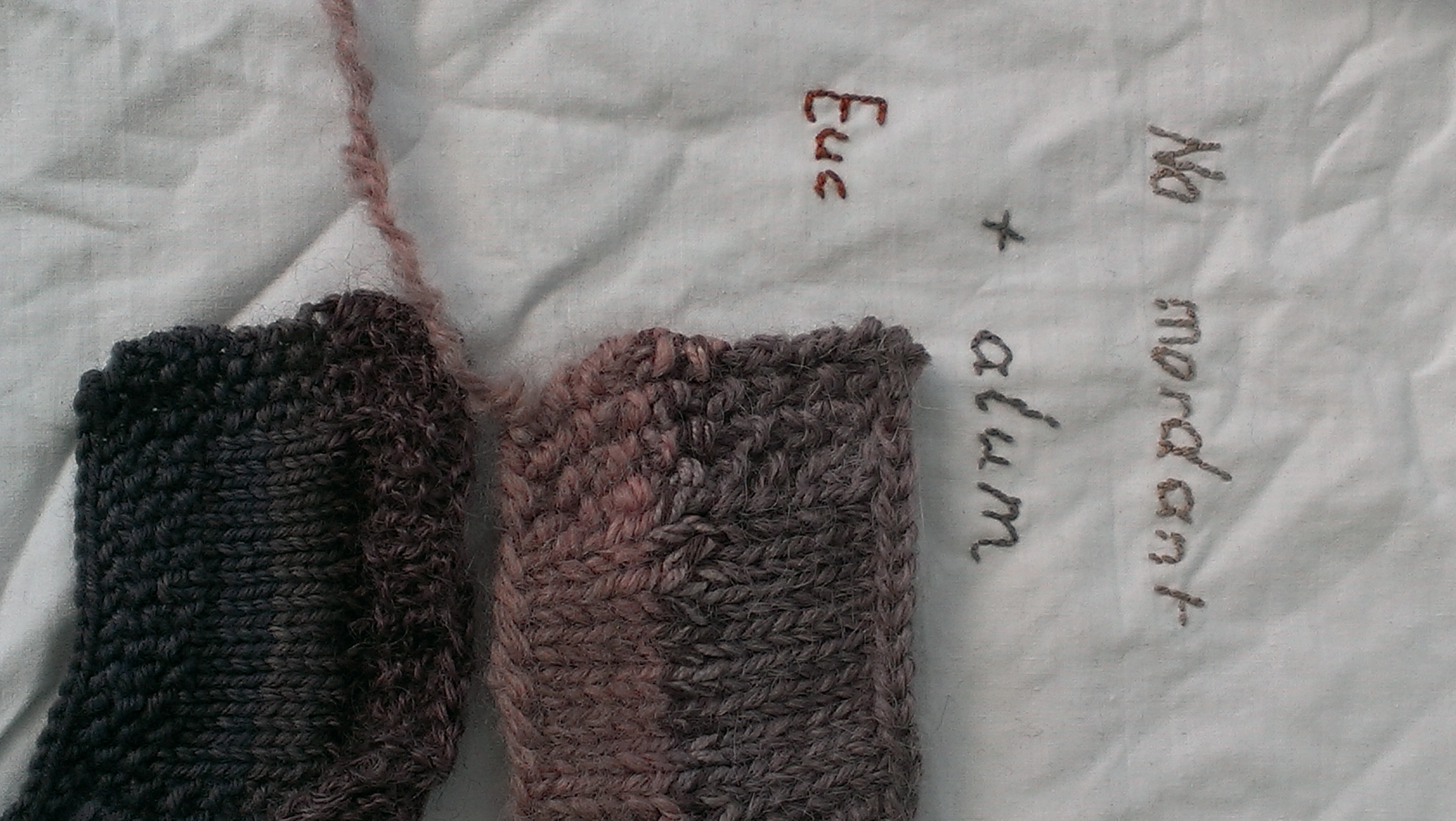
I decided the obvious way to test for washfastness was to wash.  So I embroidered with the plum pine fruit–no mordant–silk thread, and with the plum pine fruit-with alum and cream of tartar on a piece of cotton… and added a little eucalyptus dyed silk thread for good measure.  Not the best example of embroidery ever seen, but it will do the job.  The two upper examples were purple (like the thread on the cards) when they went into a normal wash–30C with eco-detergent.  One wash later, the no-alum sample is grey and the with-alum sample is green-grey.  Eucalyptus shows its true colours yet again.

IMAG1655

Yesterday I tried washing my sample cards at 40C with eco-balls (we have laundry variety here, as you will shortly understand) and they were still purple when they came out of the wash.  Interesting… this made me wonder if part of what is going on here about Ph.  Detergent would be more alkaline than eco-balls.

After 4 more washes:

IMAG1892

You might remember that I did some darning with my early silk samples.  They have not fared well either–but the mending is still doing the job!  The pink is still pink, but much faded after what I would guess as being about 8-10 washes.  The purple is blue, and paler.

IMAG1894

I knit some test samples from my yarns.  They fared better, washed with other woollens, cold with soapnuts rather than detergent (if anything, a slightly acidic wash).  The sample on the right has two shades of plum pine with alum and CoT on BWM alpaca rich, with a band of cotton used to tie the skeins in between because this yarn took so much colour during the dyeing I was curious.  The sample on the left has two shades of plum pine on patonyle (wool and nylon superwash sock yarn and a sample of handspun Wensleydale).  One has gone from purple to grey and the other from purple to blue.  Blue?  Before:

IMAG1661

After, with unwashed BWM Alpaca Rich in the background for comparison.

IMAG1893

Well then.  Not what you’d call really excellent washfastness. And some new mysteries to ponder, as usual.

3 Comments

Filed under Dye Plants, Dyefastness, Natural dyeing

Steeked!

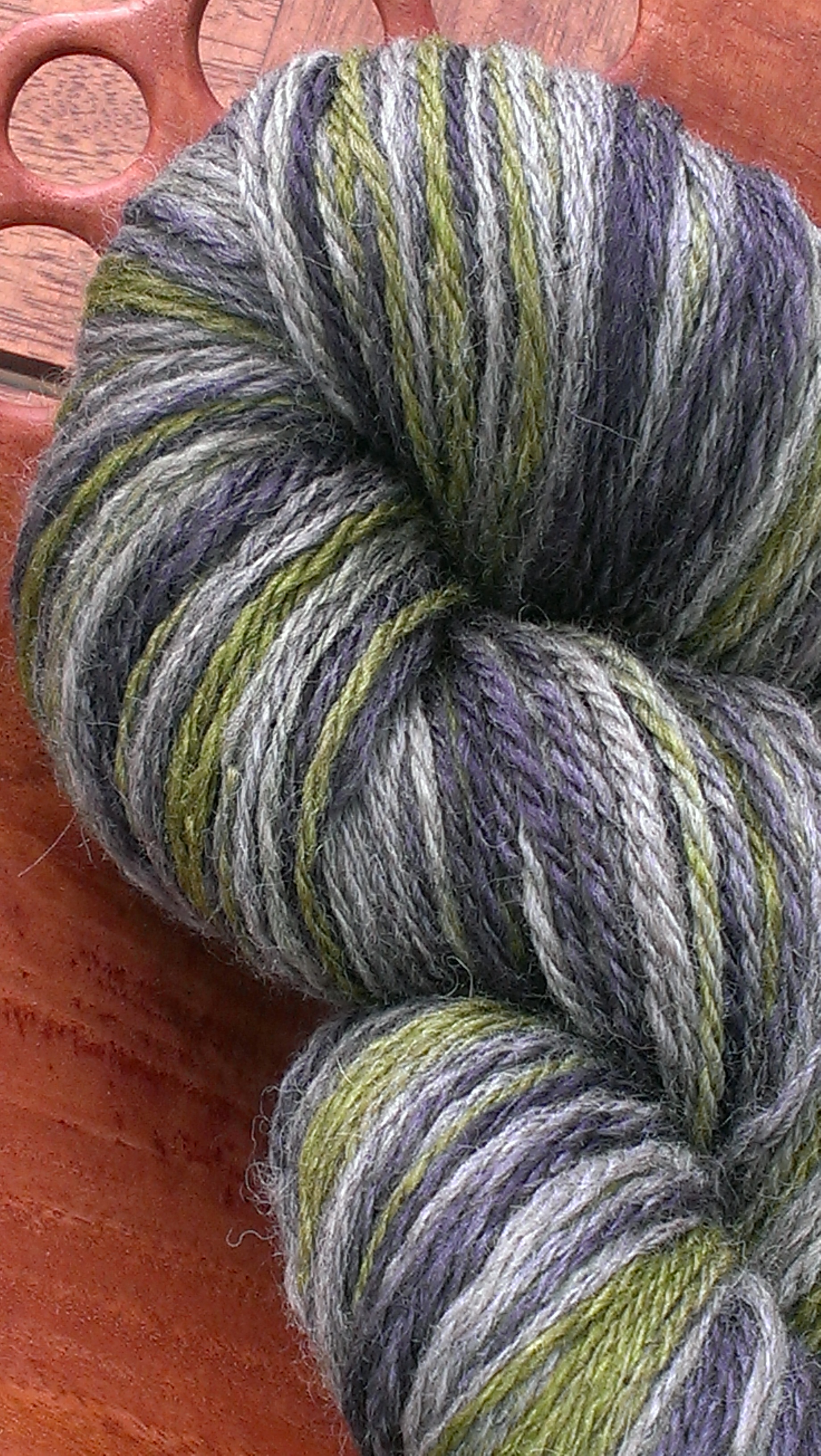
Perhaps you remember this yarn, spun and chain plied from a beautiful blend by The Thylacine.

IMAG1220

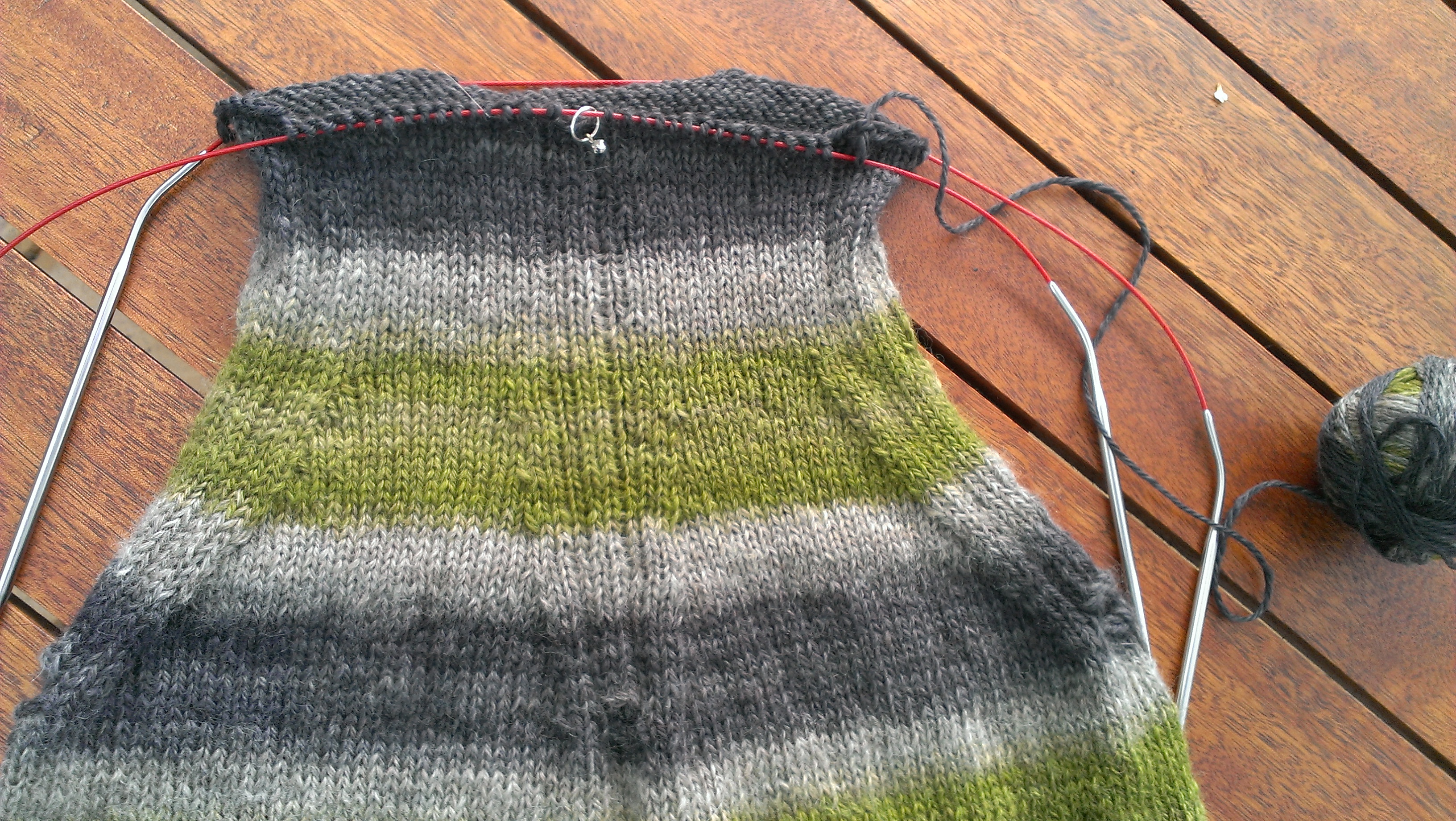
I decided on a vest for my fairy godson, an appreciator of handmade items if ever there was one.  He is a not-so-small six year old person growing ever taller and thus, growing out of last winter’s woolies. I designed (I  do realise this is a very plain garment!) the vest based on measurements from one he already has that is a generous fit.  100% handspun alpaca for the band at the bottom, in seed stitch.  When I reached the place where I wanted the neck and armscyes to begin, I cast off a few stitches, then cast them on again on the next round (leaving a slot) to create a steek bridge.

IMAG1349

Here is the upper part a bit closer up.  I have decreased just the way I would have done knitting this garment by any other method, but kept knitting in the round, making sure those stripes are maintained with wonderful simplicity. Knitting in the round feels normal to me, since I took up knitting in order to knit socks.  I much prefer knitting in the round to knitting flat.

IMAG1350

Then came the day of truth, when I stitched through the knitting all the way from one end of the steek bridge to the other and cut, yes, CUT! the neckline and armholes prior to grafting the shoulders together and picking up the edgings.

IMAG1351

Wonderfully simple if you can hold your nerve.  I am so happy with the finished result, I’m on tenterhooks waiting for the intended wearer to return from holidays soon for the handover.  I sure hope he likes it.  I have yarn left over from 100g of fibre. Amazing!

IMAG1371

PS–yes, it fits!

4 Comments

Filed under Knitting, Spinning