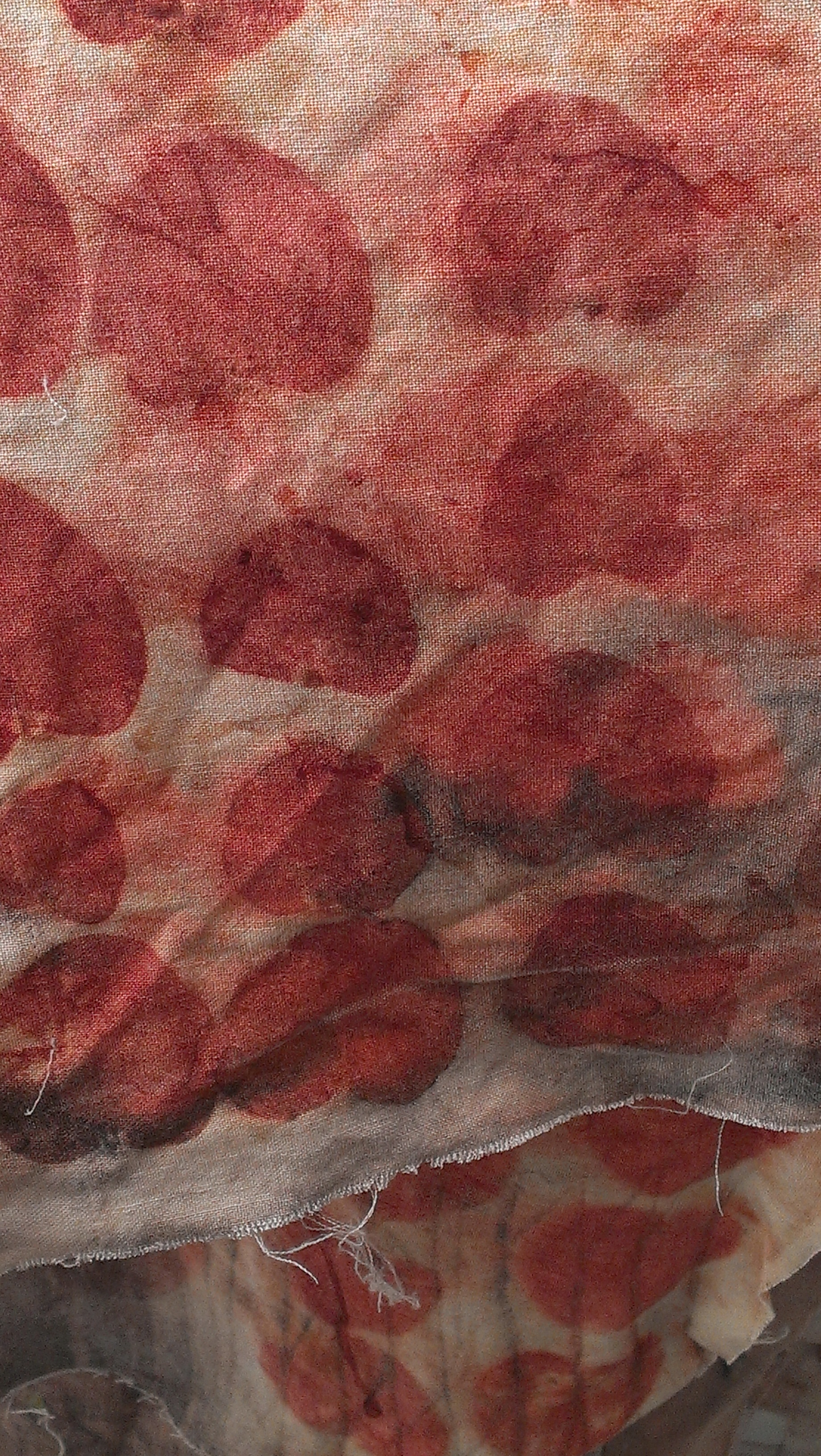
Tag Archives: E Nicholii

Dyes of antiquity: Eucalyptus leaves

My friends, there is going to be a little series on dyes of antiquity here on this blog. It arises from plant dyestuffs that have been donated anonymously to my Guild, which have come to me as the person currently teaching natural dyeing at the Guild.  Needless to say, there are women at the Guild who know more about natural dyeing than I do and have decades of experience.  Some are dyes used in antiquity (cochineal, indigo, kermes).  Others are in packaging that predates metric weights  in Australia, which came in in 1977.  Certainly, safe disposal of mordants that are now regarded as toxic has had to be arranged.  So I am using the word ‘antiquity’ both literally and figuratively–but I have a trove of dyestuffs which I would usually not have come across, and some of which I would not be prepared to buy if they were available.  Some require identification.  Some require research, so I can figure out how to dye with them.  I decided to start with what I know.

2014-06-05 13.47.06

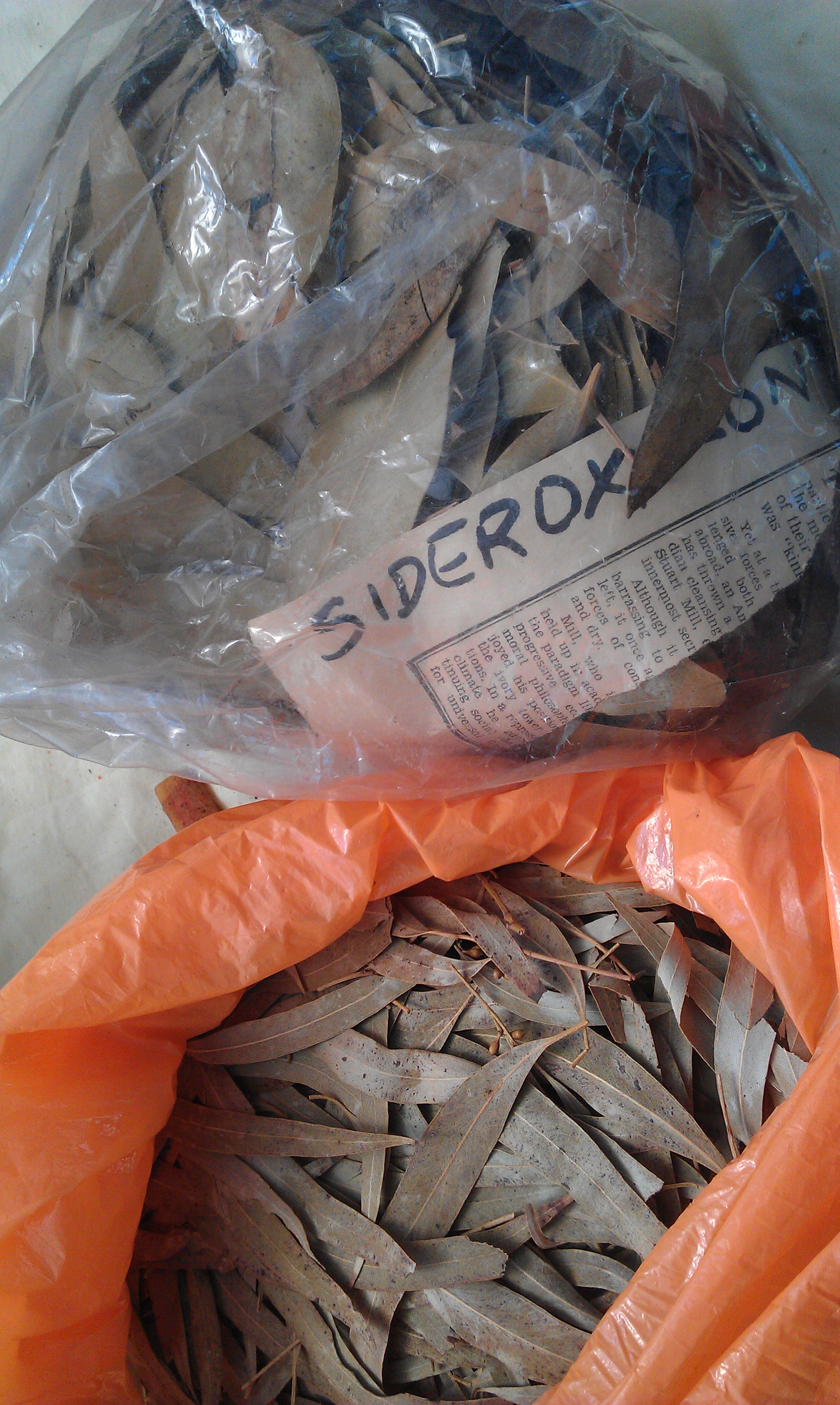
There were bags of varying sizes containing eucalypt leaves.  One was clearly E Sideroxylon leaves.  Then there was the orange bag of unidentified leaves–possibly E Nicholii (which has clearly been in widespread use at the Guild in the past).
IMAG1772

Then there was a lovingly stored and labelled small pack of E Crenulata leaves.

IMAG1773

From time to time, people online ask whether you can store Eucalyptus leaves for too long.  I don’t know.  I tend to use what I have on a rotating basis, partly because I have seen what insects can do to stored vegetable matter!  These leaves appeared to have been stored for a long time, but under good conditions.  No signs of insect damage.  They had clearly been dried prior to being bagged for storage.  They retained some green colour. They were sitting on top of a stack of newspapers dated 1991.  Was that a clue?  I don’t know!  A fellow Guild member who helped me clean out the cupboards thought they were probably older!
2014-05-31 11.57.29

The E Sideroxylon leaves gave far more intense colour, partly because there were more of them.  And possibly because the small fine leaves were not from an exciting dye species and the second dyepot was mostly relying on the small quantity of E Crenulata.  Just the same, more of my white alpaca fleece is getting dyed, spun and ready to be knit all the time…

Meanwhile, I am preparing for a dyeing workshop at the Guild and deciding which of the dyes that have come to me are suitable for use there… I’m thinking madder, walnut, cochineal and logwood!!

4 Comments

Filed under Eucalypts, Natural dyeing

Eucalyptus Nicholii?

Remember this bundle of leaves and my excitement about finally meeting E Nicholii, fully grown? The straight, narrow leaves below were supposed to be E Nicholii.

IMAG2935

Well.  E Nicholii is a well- and long-recognised dye eucalypt, described by Jean Carman and the Victorian Handspinners and Weavers Guild in their classic books, and prized by dyers I have spoken to who were using it in the 1970s and 1980s to obtain reds and oranges.  So I was rather surprised to find this result from the best of several attempts:

IMAG2980

I did get a roughly orange smudge on some of my fabrics from the ‘E Nicholii’. In the same pot, cooked for the same length of time and on fabric mordanted in the same batch, E Cinerea produced vibrant colour:

IMAG3020

In the past, using trees I was entirely confident were E Nicholii (albeit small specimens) I have got something more like this:

IMAG3015

These are blocks from a quilt I have been working on…

IMAG3016

My own E Nicholii is a tiny specimen, surrounded by a personalised fence to prevent certain marauders with a tendency to dig up anything promising with no thought for the future.

IMAG3006

The marauders came past to check what was happening as I took a photo of the tree.

IMAG3005

How to explain this eco-printing result?  I didn’t identify these trees myself but relied on someone else who was clearly knowledgeable, which is not to say any of us are above error.  If I had identified them myself, I would say without hesitation that the dye pot is more reliable than my identification skills.  But there are so many variables: these trees were mature while I have tried only young trees–all I have been able to find and identify with confidence.  They were in relative shade and growing in a relatively cool spot…    I just don’t know!

10 Comments

Filed under Dye Plants, Eucalypts, Leaf prints

A pair of backyard Eucalypts…

Recently I discovered that a friend who has one of the biggest E Cinerea trees I have ever seen in her back yard would like some of it removed.  I offered to cut and take away the dead and insect affected parts, to her surprise, and have now made three visits to do just that. I’ve begun some dye pots with alpaca another friend has asked me to dye.

IMAG2075

On the second visit to trim the E Cinerea, my friend’s partner spoke about the loss of a bough on their other eucalypt.  I looked closely at this second very large tree with rough, fibrous bark on the trunk and very narrow leaves and ‘Eucalyptus Nicholii’ went through my head.  Could I at last have found a fully grown specimen?  It branched so high and the ground had been so thoroughly cleared in the effort to remove all the fallen material that I couldn’t find fruit.  I did manage enough leaves for a dye pot however… and it is very promising! I heated the leaves for an hour, dropped the sample card in and went for a bike ride leaving the heat off.  When I got back:

IMAG2078

As I write I have added some alpaca fleece.  I will have to wait to make a more definitive identification… I have sometimes found that all the hours I’ve spent with books on Eucalypts have created the context for me to have a correct intuition about a particular tree.  Equally often, though–I have completely the wrong end of the stick!  But the alpaca is looking good as it sits draining…

IMAG2101

8 Comments

Filed under Dye Plants, Eucalypts, Natural dyeing

Eucalyptus Nicholii

I finally found E Nicholii, growing in Botanic Park. My beady eyes have been searching the suburbs of my city for this tree as I ride past, to no avail until now.

IMAG1407

This is such a finely-leaved tree!  Perhaps I have failed to identify it if I have seen one fully grown, mistaking it for another kind of tree altogether.  I had one growing in a pot but it suffered too much through summer. It is also the only tree I have ever seen as the subject of a public notice at Guild, where I once saw a hand lettered note asking if anyone could supply E Nicholii leaves for a dyer. My friend’s godmother–another dyer–who lives in NSW, recommended E Nicholii as her favourite dye plant.  These are some of the reasons I was trying to grow it in a pot.  I have given that up and we have a tiny specimen growing in the corner of the back yard.  And now–the reason why people are so keen!  I think this print is sensational.

IMAG1428

See that big black splodge?  I have wondered why I get one of these once in a while (and needless to say I have had a few theories).  Just recently the penny dropped.  Or should I say, the washer dropped–because that is what actually happened.  One of my dye pots has a glass lid with a knob screwed into the centre of it. All these eucalypt dye baths have eaten away at the metal of the screw and washers.  One washer recently fell off altogether, as the hole in it simply had been made too large for it to stay in position.  So… there has been an inadvertent contribution of iron to some of my dye baths, and some unintended black smudges where iron water drips down onto my bundles from above–since this lid is convex, I have preferred it when I have large bundles in the pot.  Aha!  Another mystery solved.  This may explain some of my surprise dye bath outcomes, too…

3 Comments

Filed under Dye Plants, Eucalypts, Leaf prints