Tag Archives: eucalyptus

More Eucalyptus Cladocalyx Bark Outcomes

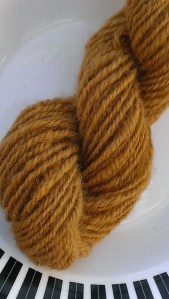
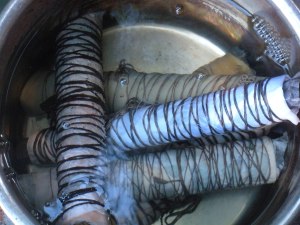
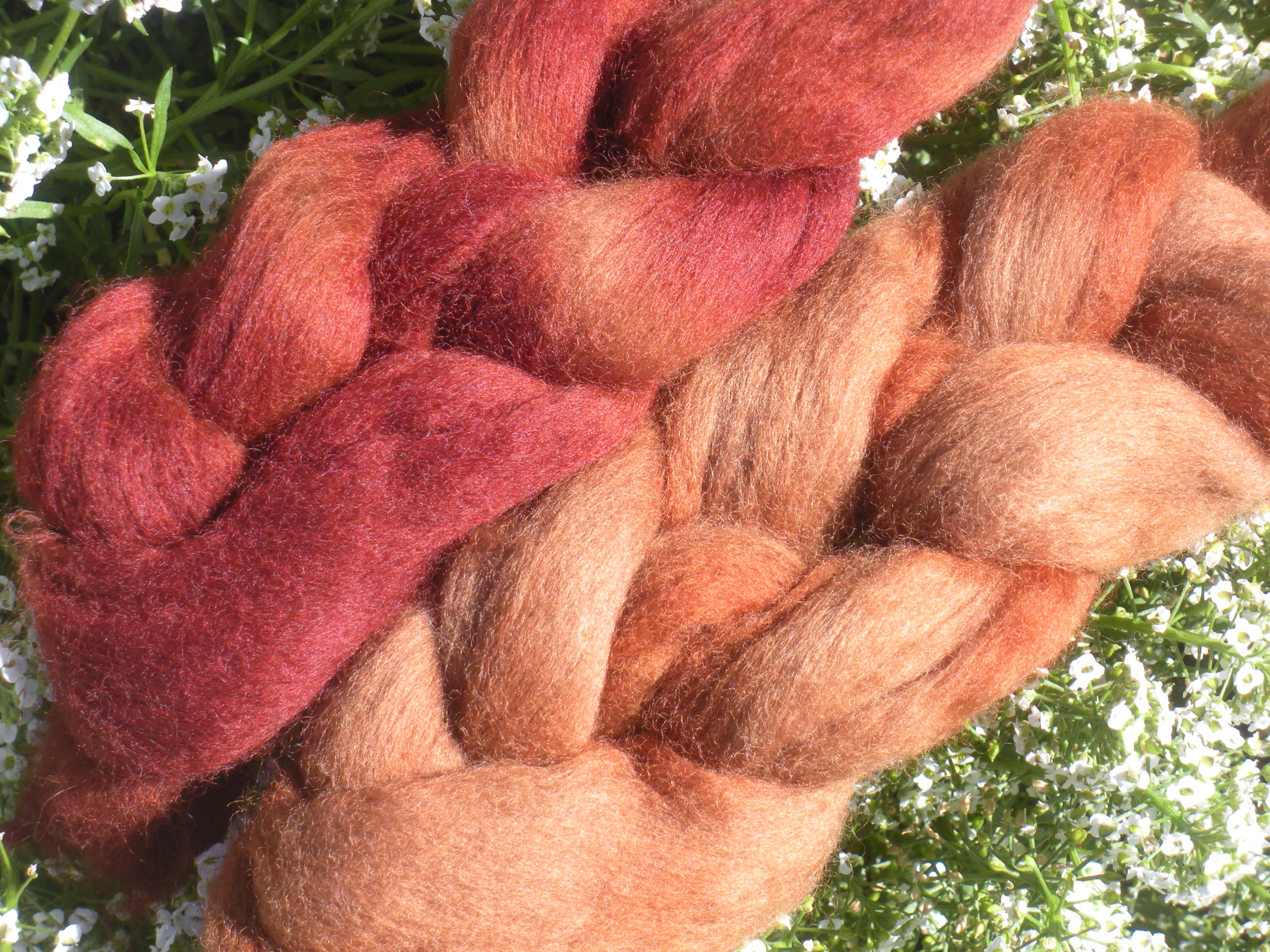
Given the level of colour in my E Cladocalyx bark tannin bath (see previous post), I couldn’t resist trying to dye some wool.  This is handspun finn cross wool, cooked for about 90 minutes in a solution of E Cladocalyx bark, which had been soaked in a sunny spot for 14 days prior to dyeing. The commercial superwash, alum mordanted strand of wool on my test card is a much darker shade of brown.

IMAG0557

Leave a comment

Filed under Dye Plants, Eucalypts, Natural dyeing

Eucalyptus Cladocalyx Bark

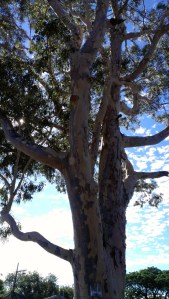
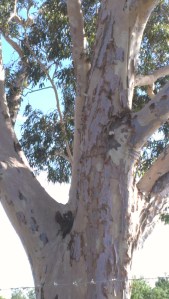
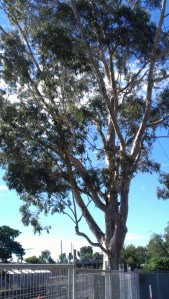
I have been reading Rebecca Burgess’ gorgeous book, Harvesting Color, which had me thinking about how to create a tannin solution.  The local solution for her is to gather acorns.  That might be possible for me in autumn, too. There are some avenues of oaks in my city, and they have tiny newly formed acorns right now.  But it seems to me that eucalypt bark would be a promising source in my own region.  I thought it seemed logical to collect bark from a species that hadn’t shown a lot of dye potential (I’m trying for mordant, not dye).   So I stopped outside the royal showgrounds where this huge E. Claodocalyx (Sugar Gum) had shed its bark recently.  We were having unseasonably cool weather as this dull photograph shows.

IMAG0317

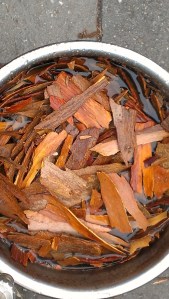
I picked up a bag full of bark and headed home to let it steep in rainwater. This will be an opportunity to consider the dye potential of the bark as well as try it as a source of tannins.  There are many of these trees around my area and this is a truly huge tree when full grown, which sheds its bark once a year, so if this is a good source of dye, I will have access to a lot of it! Here is how it looked on 15 December:

IMAG0330

And two days later:

IMAG0342

…so I put a metre of cotton cloth into it, which immediately turned golden yellow:

IMAG0347

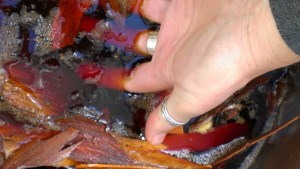
I left the pot in a sunny spot.  The temperatures have ranged from mid-twenties celcius to 40C.  By 1 January, the pot was darker still, with the liquid seeming a ruby red shade.

IMAG0545

And here is the cotton I immersed in it  so many days ago after drying.

IMAG0547

Needless to say, I am now planning to dye wool in my bark liquor and see what happens…

Leave a comment

Filed under Dye Plants, Eucalypts, Fibre preparation, Natural dyeing, Uncategorized

Significant Tree

I love trees.  Some are especially precious to me.  Like this one.  The Department of Planning and Infrastructure says it is a Corymbia Maculata (Spotted Gum).  I have tried dyeing with Corymbia Maculata.  As a dye plant, it’s not spectacular: my samples are tan, tan and tan.  Dye potential isn’t the only or even the main value in a lovely tree from my point of view, but just one of its potential fine qualities. 

IMAG0356

We failed to save it by objecting to its removal.  A local creek is going to be put into a pipe so big a car would fit into it as part of major infrastructure works, and this tree is standing in the path that pipe is going to take beside the railway.

IMAG0352

The Minister approved its removal, and his decision is not appealable.  That fence along the railway stands where over 10 much smaller, but still appreciated, trees used to stand beside the spotted gum. Since their removal I hear there are six possums fighting in the nearest neighbours’ yard at night instead of just one. We have been given several different dates on which the Corymbia Maculata will be felled, and prepared ourselves for the day each time. It has been fenced off because tomorrow is the day.  9.30 am is the time.  My nearest and dearest is staying with a friend tonight so as not to be here when it happens.  The people who will be felling it will start to arrive at 7 am.  It will be a big job.  The chainsaws will be going all day long, if indeed they can do it in a day.

lIMAG0357

This tree must be decades old.  The whole neighbourhood will be different without it.  The flocks of native birds who have visited it when in bloom every year will no longer stop by.  Under government policy, in our hearts and those of lots of our neighbours, it is a Significant Tree.

IMAG0353

5 Comments

Filed under Eucalypts

Leaf prints of the week: Eucalyptus Cinerea and pecan leaves

It was another weekend with leaf prints.

Leaf prints 005

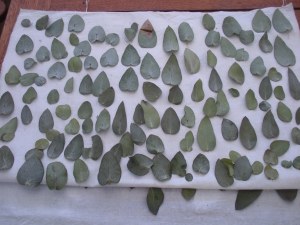
Eucalyptus Cinerea, before..

Leaf prints 001

and after:

Leaf prints 021

My test cotton sample, demonstrating that the mordanting I wrote about a little while back should work out just fine for the natural dyeing workshop I’ll be running.

Leaf prints 022

On the weekend I travelled south of the city to celebrate the lives and love of two dear friends.  They had an all-in-one birthday party and anniversary.  I gave them a teapot and teacosy dyed with silky oak leaves (grevillea Robusta) and eucalypt, and they found it suitably funny.

Dyeing 005

As we left, one of them pointed out their now-flourishing, though still relatively small,  pecan tree.  I had seen pecan eco-prints on Lotta Helleberg’s lovely blog.  I asked if I could pluck a few, and then I took them home and wrapped them in a piece of cotton twill that used to be a pair of trousers.  It was ready and waiting, mordanted in soy and ready to go!  Before… (such lovely leaves…)

Leaf prints 002

and, after:

Leaf prints 025

I had also saved this sample of an unidentified eucalypt a friend was growing in his backyard, but sadly it yielded a few brownish smudges.  It’s much prettier in person than as a leaf print.  I think it is Eucalyptus Kruseana (Bookleaf Mallee).

Leaf prints 003      Leaf prints 009

And I spent some time creating textured batts ready for textured yarn spinning… wool with mohair locks, while I tried a new method for washing wool.

Leaf prints 014

Good times!

1 Comment

Filed under Dye Plants, Eucalypts, Fibre preparation, Leaf prints

Eucalyptus Torquata: Leaf Prints and Modifiers

Remember my modifier experiment?  I have two jars of wonder, based on Jenny Dean’s instructions.  One contains offcuts of copper pipe from my Dad, vinegar and water.  It’s been steeping for months.  My first effort at iron water didn’t work out as I’d hoped, more like a science experiment!  This one is based on my friend’s collecton of bent nails.  He has been turning pallets into furniture, so he has removed a lot of nails.  They got left out in the rain and, bless him!  He thought of me.  Here they are, left to right:

Mystery Science Experiment, Rusty Nail Water, Copper Pipe Water.

Here are my E Torquata samples on hand spun wool and commercial wool/hemp blend:
Unmodified at the top, Iron modifier next, Copper modifier at the bottom.  I have to admit, this isn’t a deeply exciting result.

And here are my E Torquata leaf prints on recycled linen (the darker one was the side against the cast iron pipe):
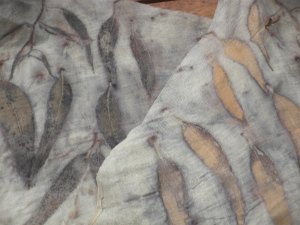
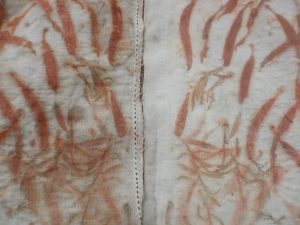
Here are the prints from my ‘is it E Scoparia?’ experiment.  The answer is a tentative ‘yes!’  Recycled linen on the left, recycled silk on the right.  I included the very young, soft, green foliage you can see printed toward the bottom partly because I have been asked whether it is true you need to use young foliage to get good leaf prints.  My experience is that you don’t (though of course, you can).
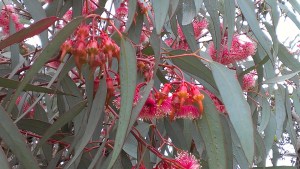
Finally… a gratuitous photo of an E Torquata flowering very pinkly in a car park in my place of work.  One of my co-workers came out of the building to see me with a pile of papers in one hand and my phone in the other, and said: ‘What are you doing, Mary?’  As you would, really.
4 Comments

Filed under Dye Plants, Eucalypts, Leaf prints, Natural dyeing

Introducing Eucalyptus Scoparia

Finally today a friend from my Guild has been able to tell me the name of some of my favourite dye Eucalypts.  Here is one example: Eucalyptus Scoparia (Wallangarra White Gum).

I love these trees, and they are fabulous dye plants. I feel lucky to have several in my neighbourhood! If you’ve been following this blog you’ve met three of the four I have foundnearby: (October 4; September 5; August 22 2012).  Here’s a bag I made with E Scoparia leaf prints on cotton, using a sea water and soy mordant and cast iron:

And this is a corespun yarn.  I carded merino dyed with E Scoparia bark with dyed mohair locks and dyed silk and corespun it over a crossbred wool core.

Thanks to E Scoparia, and thanks to Helen for organising an identification for me!

8 Comments

Filed under Dye Plants, Eucalypts, Leaf prints, Spinning, Uncategorized

Eucalyptus Sideroxylon dye pot

I went into the city to hear a presentation the other week, and on the way back there were so many opportunities to harvest that I couldn’t help but pull my bike over and pick some E Sideroxylon (Red Ironbark) leaves.  Yes, I did get a few looks… but I am reasonably impervious!

I picked a little on the main road out of the city beside the parklands, and a little more as I turned off onto my bike path.  As I exited the bike path, there was a big branch lying underneath a nice specimen near the tram line.  I have dyed from that specific tree before and the leaves were already dry.  I went back for more later.  So here is what I could get home on my bike rack, with my drum carder beside it for scale:

And here are some of the flowers.  There is one of these trees in full bloom next door to my house and there are lorikeets and honeyeaters feasting on these flowers in next door’s back yard calling to each other all day long at the moment.  I love it.

I decided to continue with the dye bath from earlier that week (the one in the post from September 18) rather than using fresh water.  The wool I dyed in the previous incarnation of the dye bath was not a really impressive colour, so it has returned to the pot and I’ve added a little more.  When I strained out the leaves and bark from the last pot, the water was a deep wine red.  This is unusual and I wonder if it is a result of leaving iron pipe in that bath–but if it is, I can’t figure out why the wool in that dye bath was still orange and tan.  The mystery continues…

5 Comments

Filed under Eucalypts, Natural dyeing, Uncategorized

Neighbourhood dye plant for this week

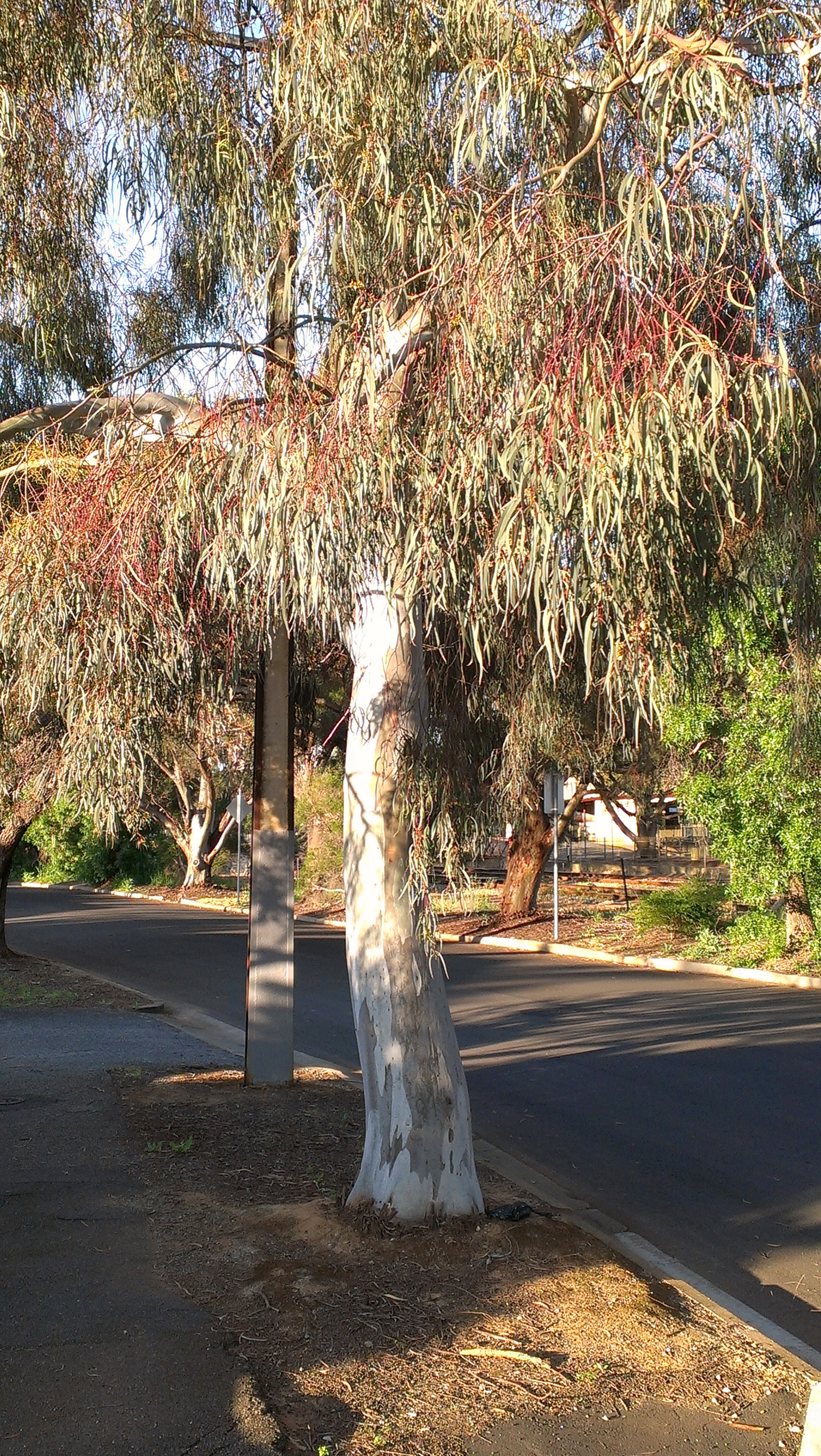
This is another of my favourite dye plants, and another Eucalypt that is as-yet-identified.  It has very fine leaves and a lovely weeping habit. I’ve used it to create tablecloths with leaf prints cascading across them.

For much of the year the trunk is white to grey, and then as it enters the period of the year when it sheds its bark, pinks and reds begin to appear. It looks like I’ll be visiting again soon to collect bark.

When I visited today there were several generations of fruit as well as white flowers on the tree. I had a very funny visit to this tree last year.  I pulled over on my bike and was harvesting when people pulled up in the driveway next to it.  I greeted them, since there was no way to pretend this wasn’t happening.  They were glad I was trimming the tree and explained that they thought the council should be pruning it more diligently.  I offered to come back and prevent it hanging over the footpath and they were enthusiastic, so I came back with a friend, secateurs, a chook food sack and a milk crate a few days later.  Very funny!  There was I being selective and taking little… until we went back and took a sackful of leaves, which have lasted through the winter.

Leave a comment

Filed under Dye Plants, Eucalypts, Leaf prints

Off to the Royal Show

This week the Royal Show started.  The neighbourhood is full of cheerful people and cars.  One strand of my bunting is gone… it looks for all the world as if someone decided to souvenir the best part!  It has been completely removed.  So I’d better make some more.

I spent some hours on my Guild’s stall, selling things made by members and showing people what spinning looks like.  I took my spindle and some roving dyed with eucalyptus bark, but in the end when I was demonstrating I was on the Guild’s wheel spinning greasy fleece from a bag of locks.  It was interesting to see how many people had some idea what was being done and wanted to show their children.  It is always obvious that people from some parts of the world are much closer to a tradition of spinning in their country of origin than many Anglo-Australians.  I had a great conversation about spinning in India with a couple of people who were surprised I knew what a Charka was… and I am in awe of anyone who can draft with one hand!  Last year, someone took my picture drop spindling because he thought there was no way his mother in Iran would ever believe a white woman in Australia could do this, without a picture.  I heard lots of stories of mothers and grandmothers who were/are spinners, and we joined up a few new members, too.

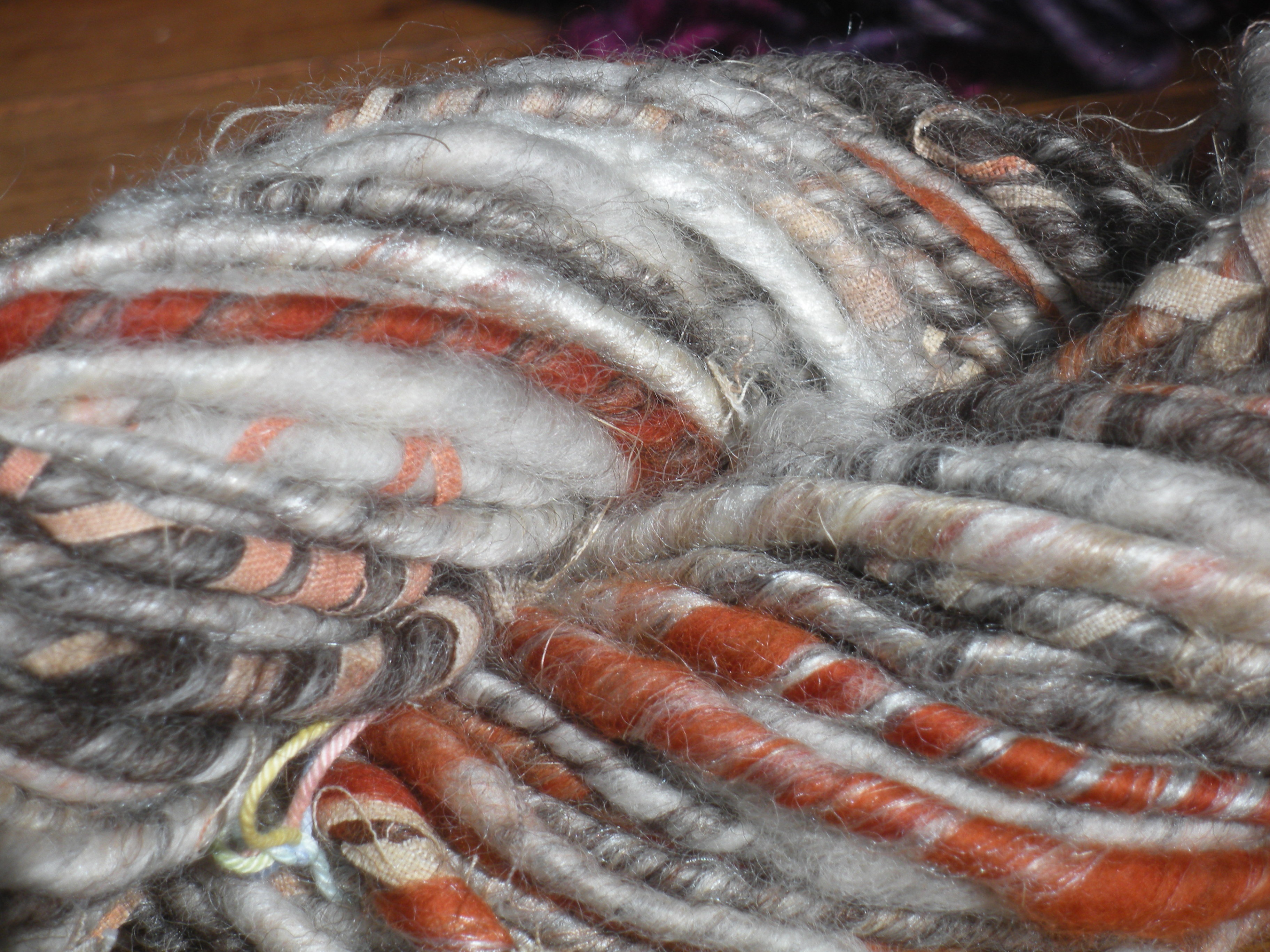
And, I decided to begin on my tea cosy project.  I have spun a lot of art yarn in the last year and some of it is very bulky.  I think tea cosies would be perfect and I’ve already knit one, which went home with a visitor who thought it was too cute!  That is the kind of home knitting should go to…  I have four teapots I’ve bought second hand.  I decided to start with the smallest one and work up!  This tea cosy bears some relationship to the Fun and Fast tea cozy by Funhouse Fibers, but I’ll have to claim responsibility for its defects as, while I’ve used the central concept… I haven’t exactly followed the pattern… there just wasn’t enough yarn in my smallest skein, and this teapot is a tiddler.  The yarn is corespun, and contains merino I dyed with Earth Palette dyes, tencel and mohair locks.
2 Comments

Filed under Eucalypts, Knitting, Natural dyeing, Spinning

Small beginnings

It’s a cold, windy and wet night tonight.  So I’ve tucked myself in at home and I’m finally starting up a blog where I’m hoping to tell some stories about my passion for making… it is certainly a night for staying warm.  A night for slippers and shawl and spinning wheel, I think!

In posts to come, I’ll be talking about growing and dyeing with plants, spinning yarn, sewing, knitting and other slow ways of bringing into being things that are hand made, useful, lovely and one-of-a-kind.

I love to source what I can locally and to reuse when I can.  Today I’ve been preparing hand spun yarns, including some dyed with Eucalyptus leaves and bark, because I’ve decided to enter the local show.  Last year I was sad to see how few spinning entries there were.  So, I’ve entered several categories where I hope to show people who come to look that spinning isn’t a dying craft!

Here is one of my entries: corespun natural fibres on a simulplied core (using techniques learned from the work of the wonderful Jacey Boggs).  The orange fibre is eucalypt dyed merino and the pale pink is finely shredded eucalypt printed linen fabric.

Leave a comment

Filed under Spinning