Tag Archives: eucalyptus

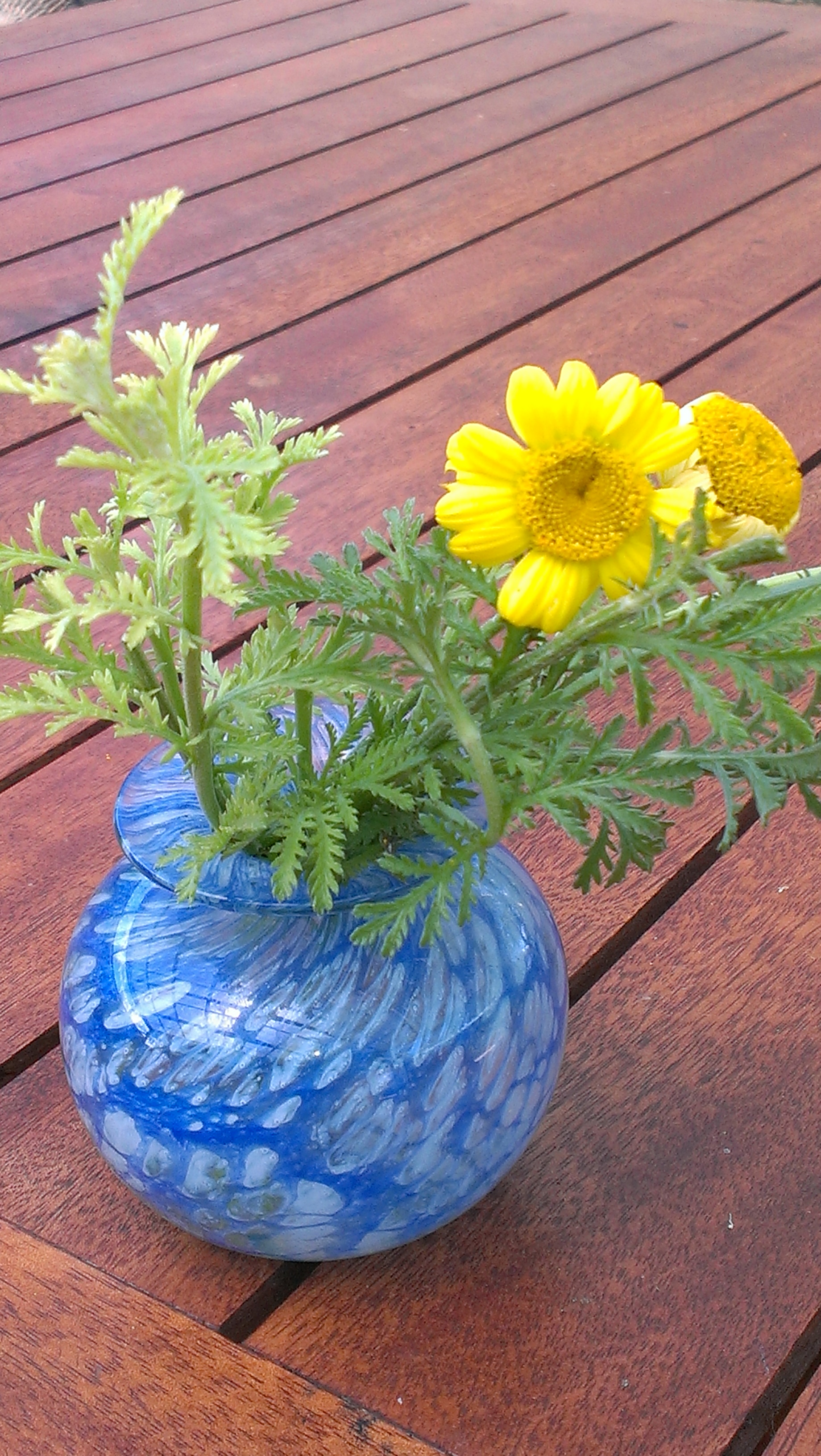
Harvesting the neighbourhood: Dyer’s Chamomile

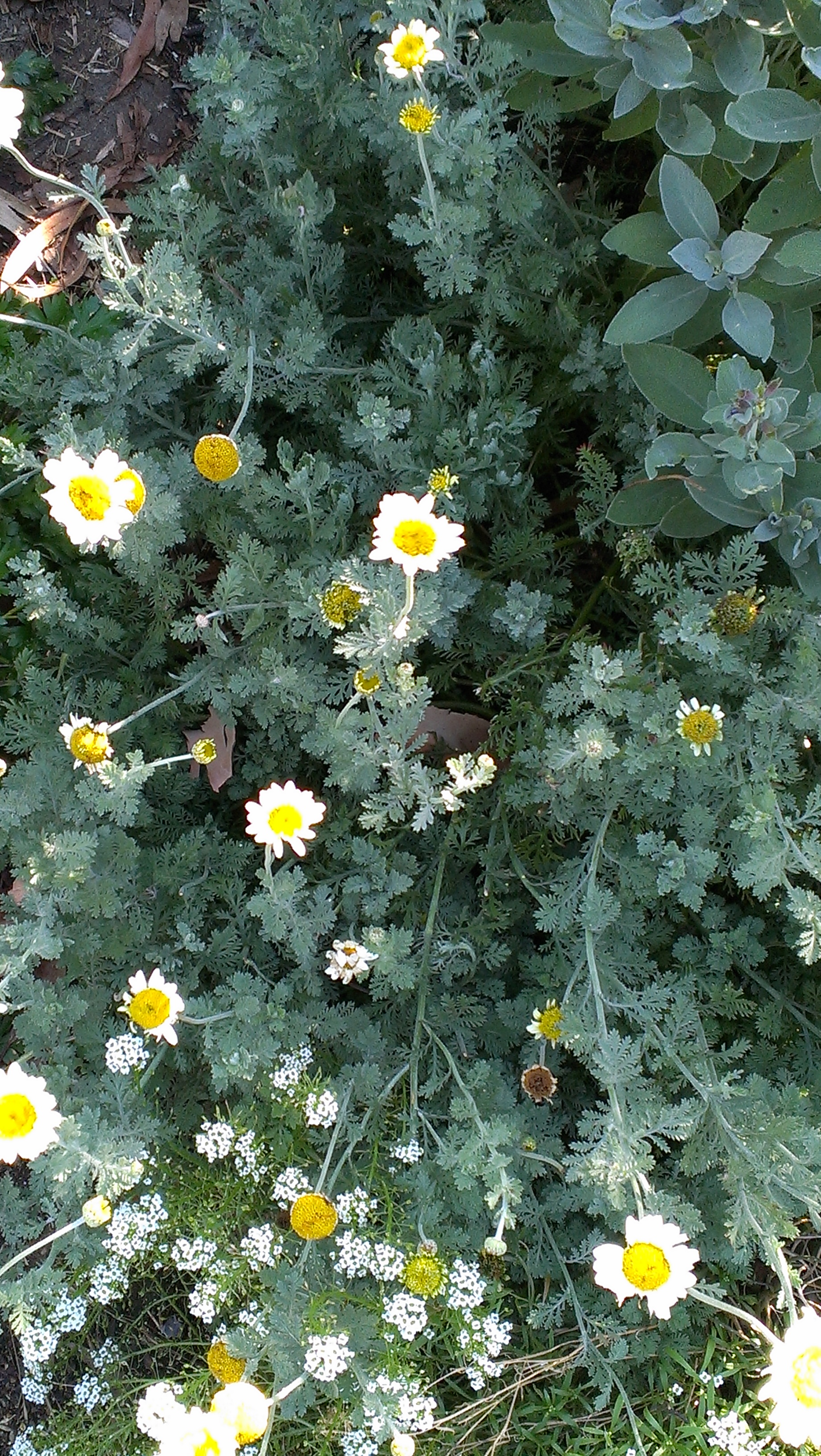
This summer, I have been collecting dyer’s chamomile for the first time.  I have some in the garden, gifted to me by a fellow Guild member who was keen to have some of my madder (this wish granted, needless to say)! It has white petals.

IMAG3008

But recently I found some with vivid yellow petals in the parklands beside the river Torrens.

IMAG3026 (2)

Our exercise class were astonished when I said I was planning to harvest while we were out on a DIY exercise session (our instructor was off doing the Busselton Ironman–she is our hero).  They offered to shield me from passersby who might intervene.  I think they underestimated how scared most people seem to be when they see someone doing something so inexplicable (to them)! I let them know I’d only be taking the dead flowers and we all relaxed again.  The patch is so big I really want to go back with more time… and it is flowering so generously, I am sure I have weeks in which to organise a return visit.

IMAG2998

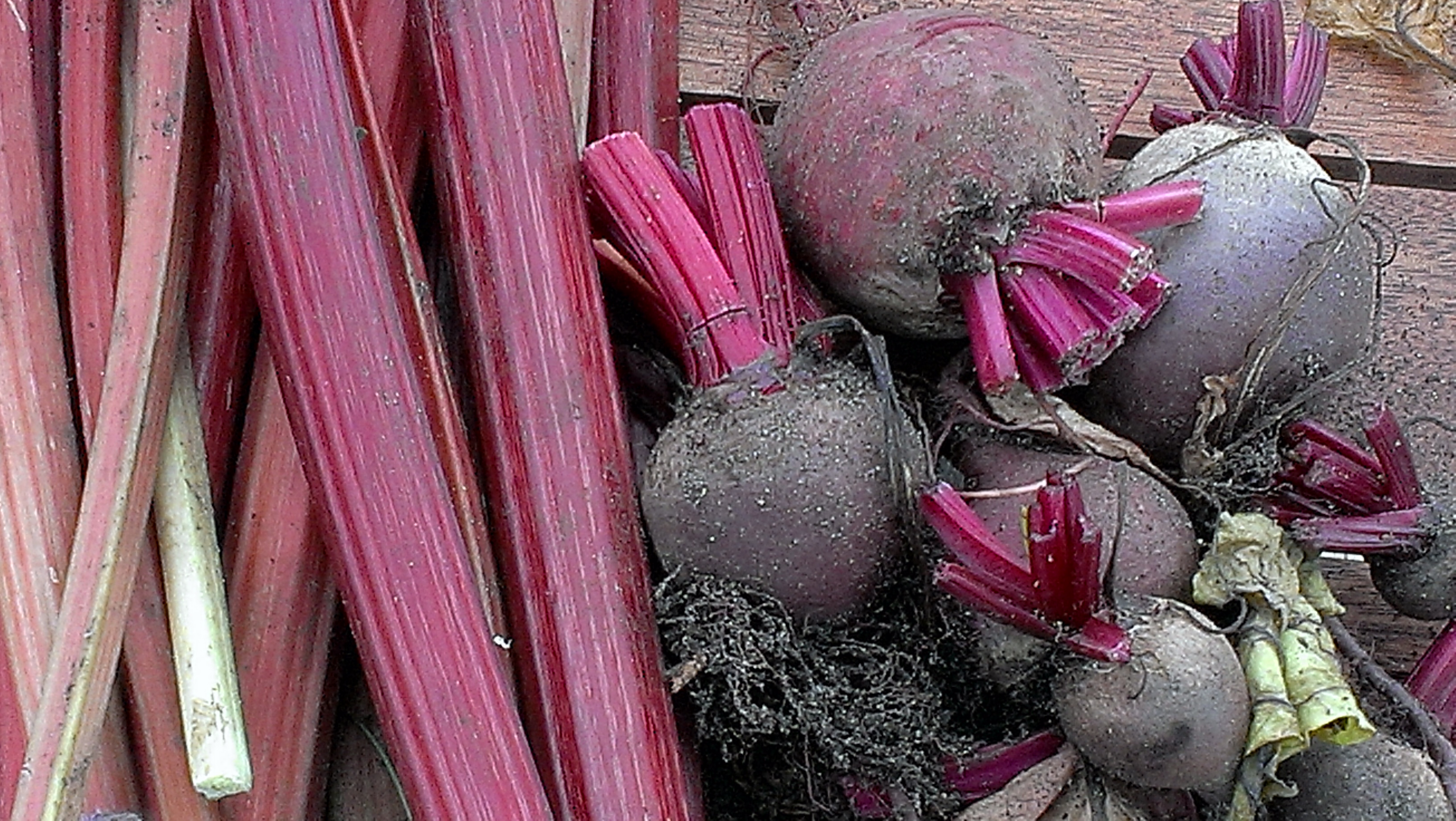
Meanwhile, we’ve been harvesting at home, too.

IMAG3035

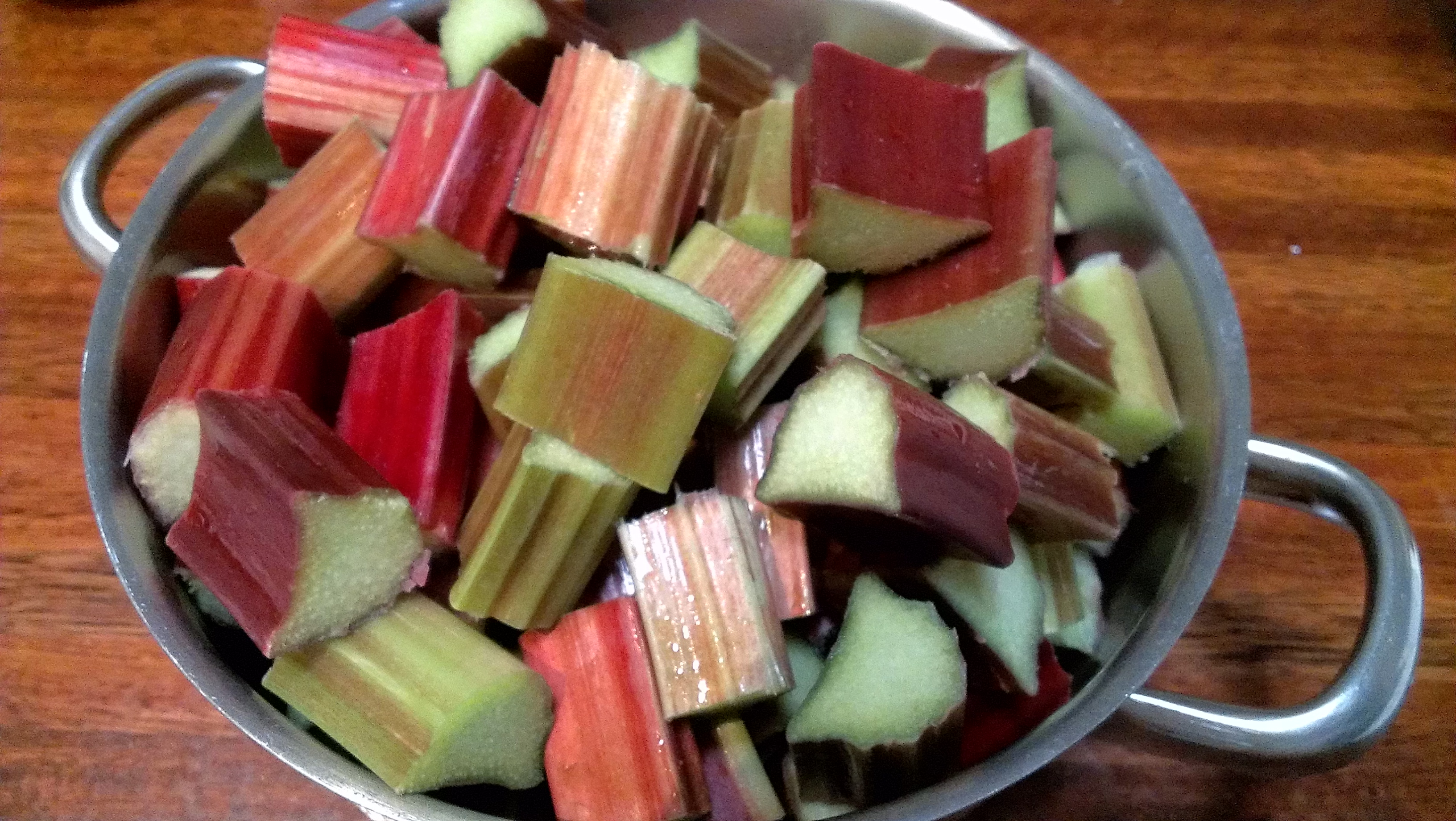
I keep thinking I’ll make rhubarb leaf mordant, and then not getting round to it!

IMAG3021

Leave a comment

Filed under Dye Plants, Eucalypts, Neighbourhood pleasures

Eucalyptus Nicholii?

Remember this bundle of leaves and my excitement about finally meeting E Nicholii, fully grown? The straight, narrow leaves below were supposed to be E Nicholii.

IMAG2935

Well.  E Nicholii is a well- and long-recognised dye eucalypt, described by Jean Carman and the Victorian Handspinners and Weavers Guild in their classic books, and prized by dyers I have spoken to who were using it in the 1970s and 1980s to obtain reds and oranges.  So I was rather surprised to find this result from the best of several attempts:

IMAG2980

I did get a roughly orange smudge on some of my fabrics from the ‘E Nicholii’. In the same pot, cooked for the same length of time and on fabric mordanted in the same batch, E Cinerea produced vibrant colour:

IMAG3020

In the past, using trees I was entirely confident were E Nicholii (albeit small specimens) I have got something more like this:

IMAG3015

These are blocks from a quilt I have been working on…

IMAG3016

My own E Nicholii is a tiny specimen, surrounded by a personalised fence to prevent certain marauders with a tendency to dig up anything promising with no thought for the future.

IMAG3006

The marauders came past to check what was happening as I took a photo of the tree.

IMAG3005

How to explain this eco-printing result?  I didn’t identify these trees myself but relied on someone else who was clearly knowledgeable, which is not to say any of us are above error.  If I had identified them myself, I would say without hesitation that the dye pot is more reliable than my identification skills.  But there are so many variables: these trees were mature while I have tried only young trees–all I have been able to find and identify with confidence.  They were in relative shade and growing in a relatively cool spot…    I just don’t know!

10 Comments

Filed under Dye Plants, Eucalypts, Leaf prints

Alas, poor Malcolm the Corriedale

We had a glorious visit to our friends in the hills on the weekend. There were recently shorn alpacas.  In black…

IMAG2929

In white…

IMAG2926

And in cinnamon.  But like the sheep, the brown alpacas were too shy for photos.  There was a woodlot of blackwood trees, and some stumps with very impressive fungi growing on them:

IMAG2932

There was a wealth of eucalypts and a knowledgeable community member who knew what many of them were. I brought home E Nicholii leaves (I have not had the chance to greet a fully grown specimen before, let alone a row of them), E Cinerea leaves and some massive juvenile E Globulus leaves.

IMAG2935

There was fine company, cake and scones and home grown cherries.  Not only that, but koala sightings and visits with rescue joeys (baby kangaroos whose mothers have been killed on the road, being raised by hand with tender loving care).  Such awesomeness!  I took lots of handspun yarn and left quite a bit behind where creative minds were whirling with plans and fingers were itching to get knitting… but there was bad news too.  I got to meet with the people who hand raised the corriedale whose fleece I have been working with most recently, from a lamb.  And sadly, poor Malcolm had recently and unexpectedly died, just before the shearer was due to visit.  We paused on Malcolm’s grave.  So it was special to have taken yarns made from Malcolm’s fleece to share… and I still have some, plus fleece that I dyed with eucalypts last week (it is E Scoparia bark peeling season) …

IMAG2936


And fleece that is prepared and ready to spin, from my recent coreopsis–osage orange–indigo dyeing season.  So… although I never did get to meet Malcolm, it’s conceivable I’ve spent more hours with my hands in his fleece than anyone…

IMAG2939

And I now have 5 alpaca fleeces and one from Lentil the sheep to think about and share around, such is the generosity of our friends!

7 Comments

Filed under Dye Plants, Eucalypts, Fibre preparation, Natural dyeing, Spinning

An appreciation of Eucalyptus Cladocalyx, the Sugar Gum

Sometimes I travel in and out of the city through the parklands.  My favourite part of the route (when travelling on bike or on foot)  is this pathway lined with sugar gums.  They are yet to reach their full height but they are still impressive, majestic and beautiful trees.

IMAG2786

The City of Adelaide is famously circled by parks.  In our harsh summers, the parklands become dry and brown well before summer reaches its height. You can see in this image that the crisping of the parklands has begun already. The trees branch too high for me to be able to photograph the canopy, but this branch had fallen and dried.

IMAG2788

Friends have spent months of the last year trying to save an avenue of sugar gums  that are twice this size, at least, and much older.  Our campaign to save them succeeded, but the sugar gums are growing along a railway line that is being electrified and a few days ago they were scheduled to be ‘pruned’ in a way that will render them lopsided amputees.  I am glad the railway is being electrified (it is diesel powered now, polluting and unsustainable).  Its impact on local trees is less welcome.  I haven’t been able to bear to go and look yet.  It was a huge achievement to save those trees and I am hoping the pruning has not been too brutal.  And that this avenue of trees in the parklands will stand tall for decades, or even better, centuries to come.

Oh, and have I mentioned the silk moths?

IMAG2758

4 Comments

Filed under Eucalypts, Neighbourhood pleasures

Downsides of upcycling

Quite some time ago, I made a quilt.  It was a project I decided on when I began to experiment with India Flint’s eco-printing technique on cotton and linen.  Her book Eco-Colour (see the left hand sidebar of her blog if you’re following the link–her books are there) mostly focused on wool and silk, but offered some guidance about cotton and linen.  I followed that guidance as best I could and at first I could achieve only pinkish smudges.  I had become pretty decent at dyeing wool by this stage, but only some of these skills proved transferable.
IMG_5240

Leaf printing or eco-printing was clearly a whole other skill. I teach for a living and observe the process of learning almost daily both in those I teach and in myself.  It is very rarely possible to read instructions and then successfully and immediately carry out a process someone else (that would be India Flint) has spent years figuring out and becoming exquisitely good at.  Nor can the outcomes of a process with so many variables always be confidently predicted by a novice (that would be me). Indeed, just plain carrying out instructions accurately is not always possible on the first attempt.

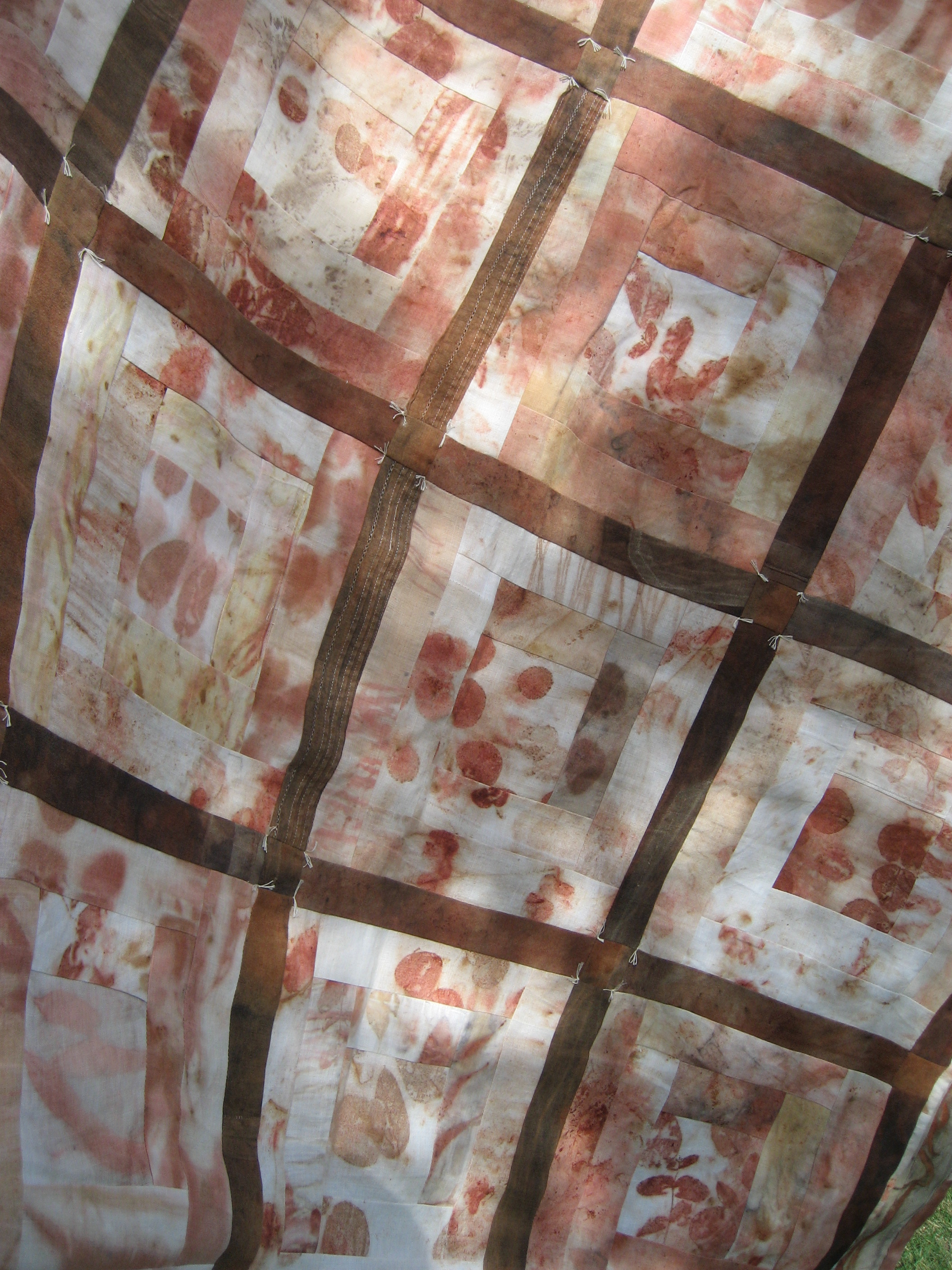
The amount of fabric wastage that might be involved in learning and practising made me think I would have to give up and just admire the work of others.  India Flint, for instance. This was the point at which I thought of the quilt.  If I made a log cabin style quilt, I could frame whatever leaf-ish smudges were my then best efforts, and the smudgy parts could simply be borders.  Standards are not always high round here.
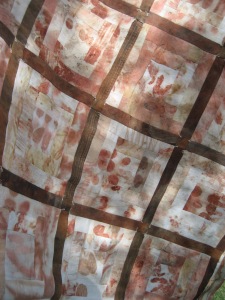
IMG_6440

By the time I came to halfway through the back of the quilt, I had been experimenting for about a year and I had some breakthroughs–in understanding the process, in refining my skills at using it, in mordanting, in identifying eucalypts, even growing a few.
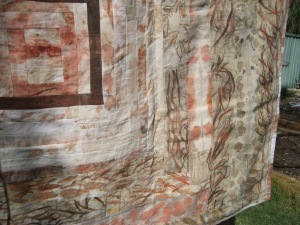
IMG_6446

I made this entire quilt from recyled/upcycled linen garments from op shops and garage sales, most of them having gone there because they were stained beyond rescue.  Needless to say, I couldn’t bear to waste a scrap.  So even the tiny leftovers of the log cabin quilt were turned into other things.  Including bags–which won’t surprise regular readers!
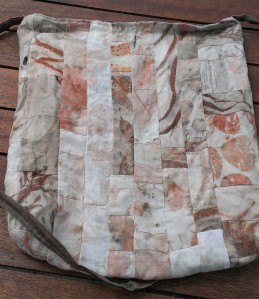
IMAG2740

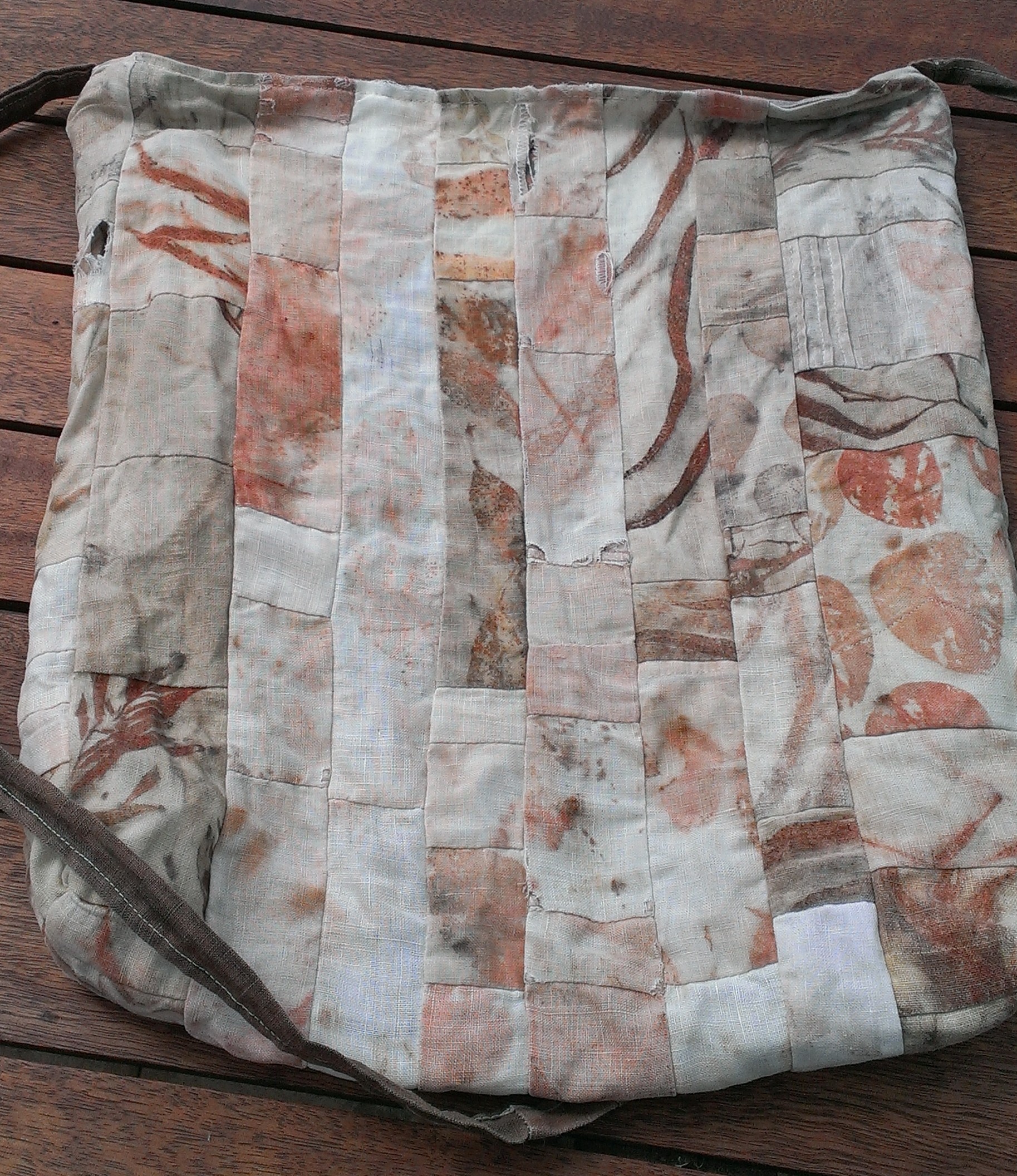
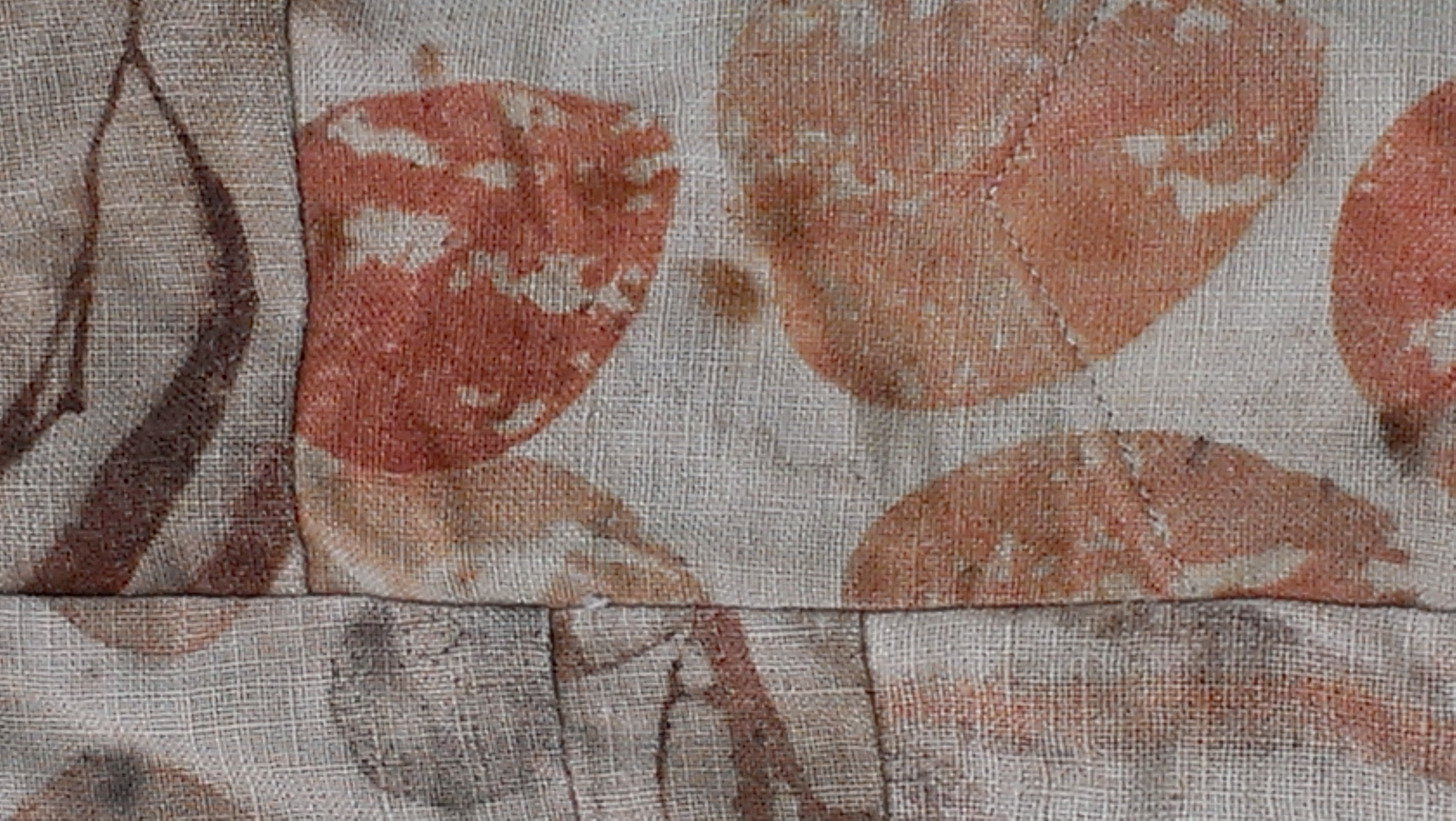
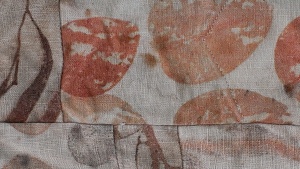
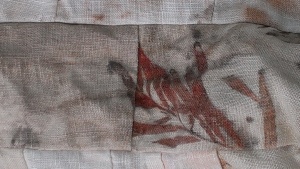
This bag has had a lot of use, because I like it so much.  Which is to say it has been treated roughly, stuffed full, rammed into other bags and rubbed against all manner of things.  And although parts of it are still glorious… including what must have been virtually my first really exciting E Cinerea, E Scoparia and E Nicholii prints:
IMAG2754 IMAG2753

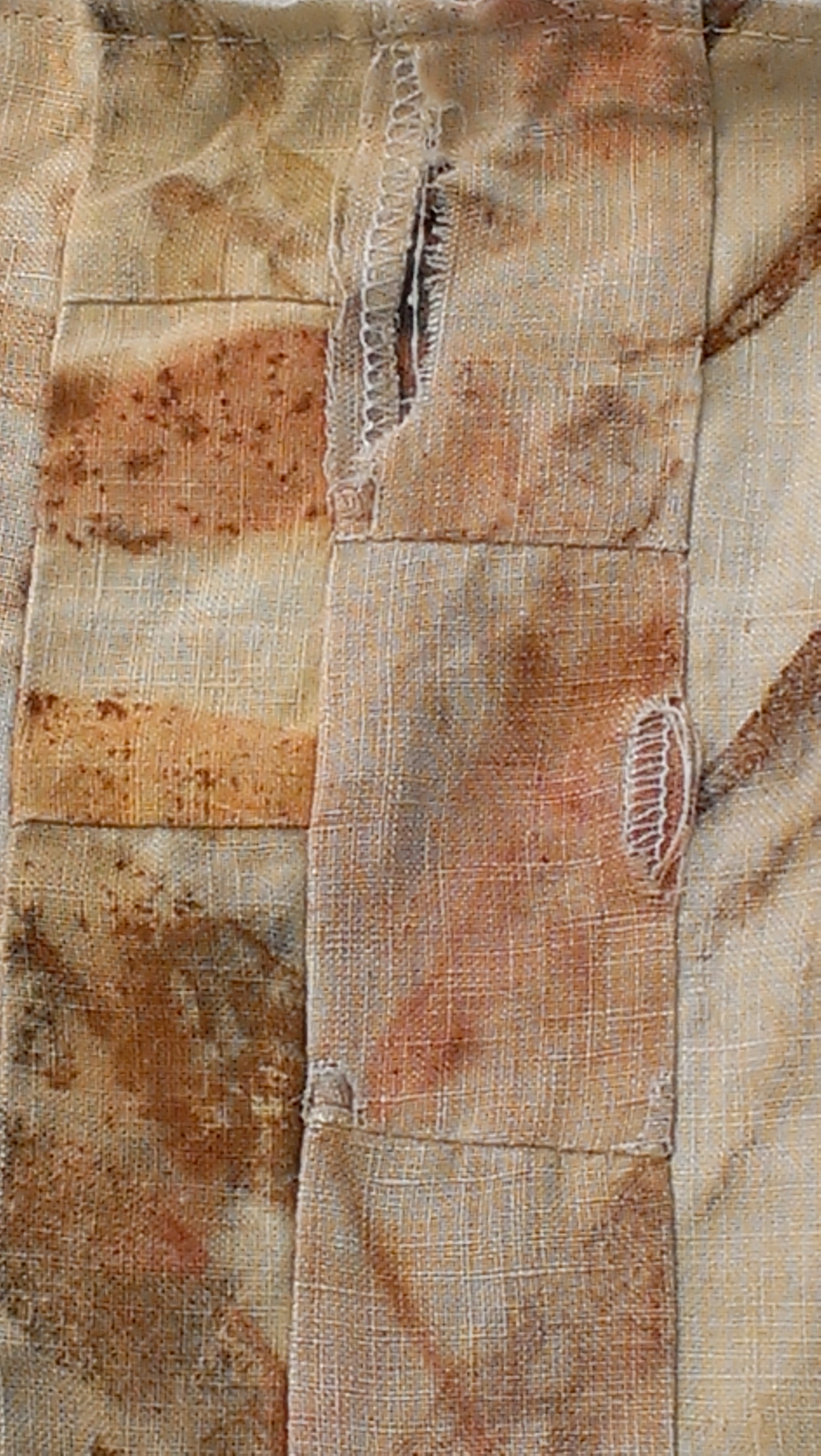
There are also some points of real wear.

IMAG2752

I often think that a well made, long lasting garment or bag is highly desirable. But a thing that will stand the test of time is only a good thing when the item remains one you (or someone else) want to keep using.   I own things that I wish would reach the end of their useful lives because I’m tired of them even though they don’t need replacement, or because a better version exists 20 years later.  I have things I wish I had never acquired or that don’t have the capacity to biodegrade.  I now think about the benefits of things that can break down and won’t last forever to burden coming generations.

This bag, though, has had a short life as a bag because of the hard life some parts of it had as clothing, and it certainly will biodegrade.  I polled some of my near and dear and they thought the bag should continue even if it required lots and lots of mends… So here it is, reworked considerably.

IMG_0215

And the other side…

IMG_0212

Ready for more years of hard use, I hope! For those who are wondering, the quilt is doing fine so far and I remain happy to use it.

18 Comments

Filed under Leaf prints, Natural dyeing, Sewing

Eucalyptus dyed gradient yarns

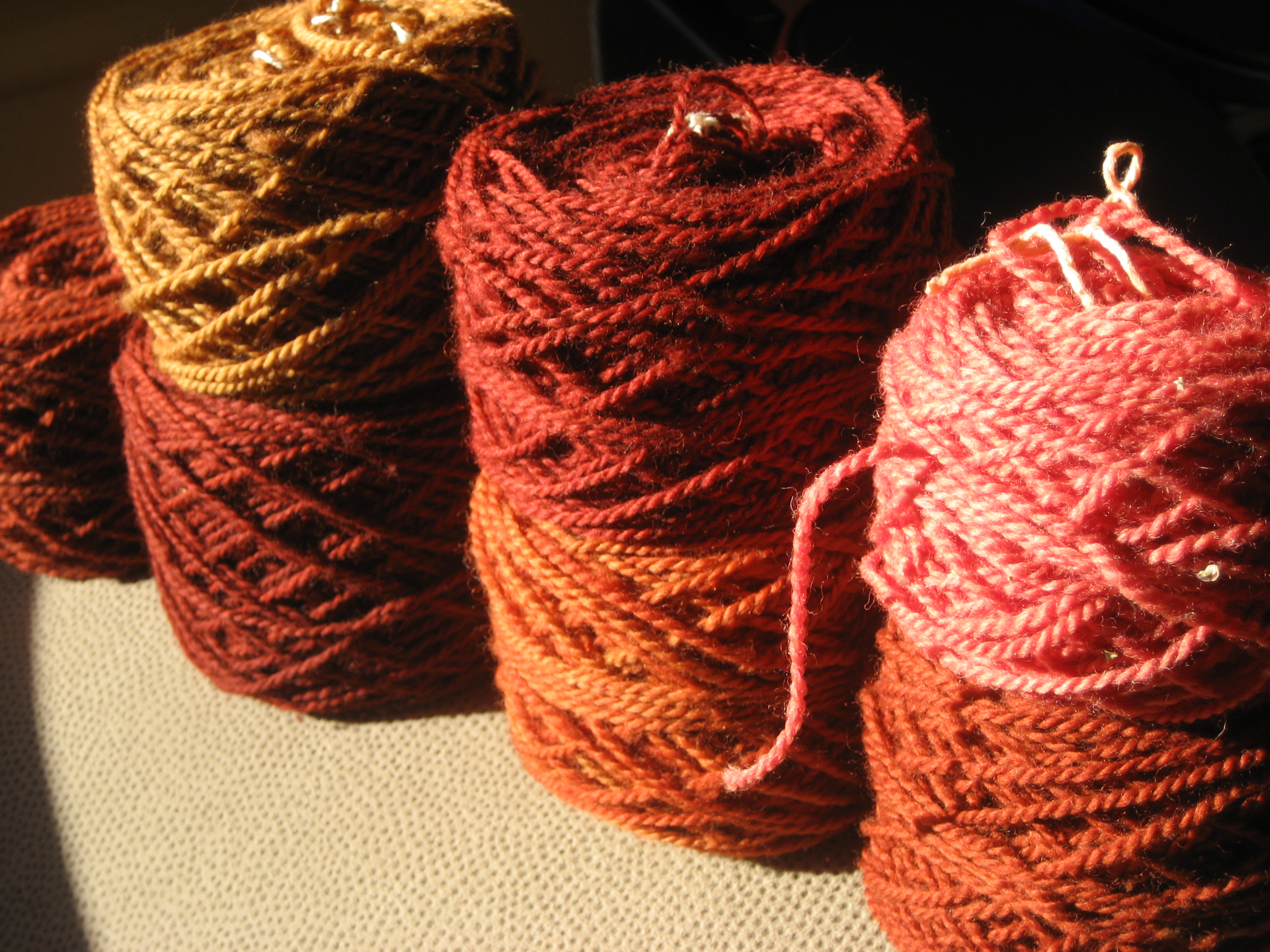
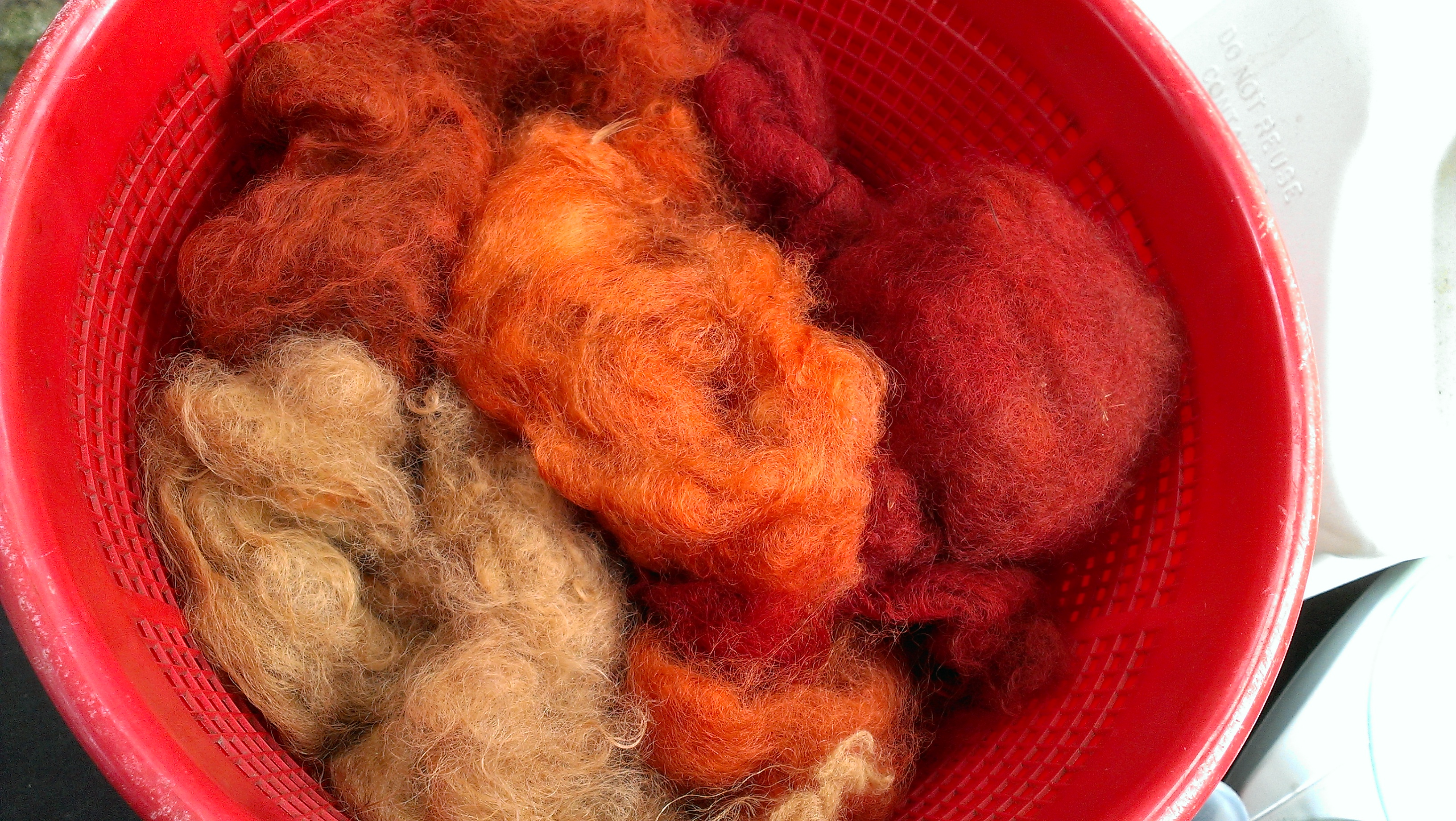
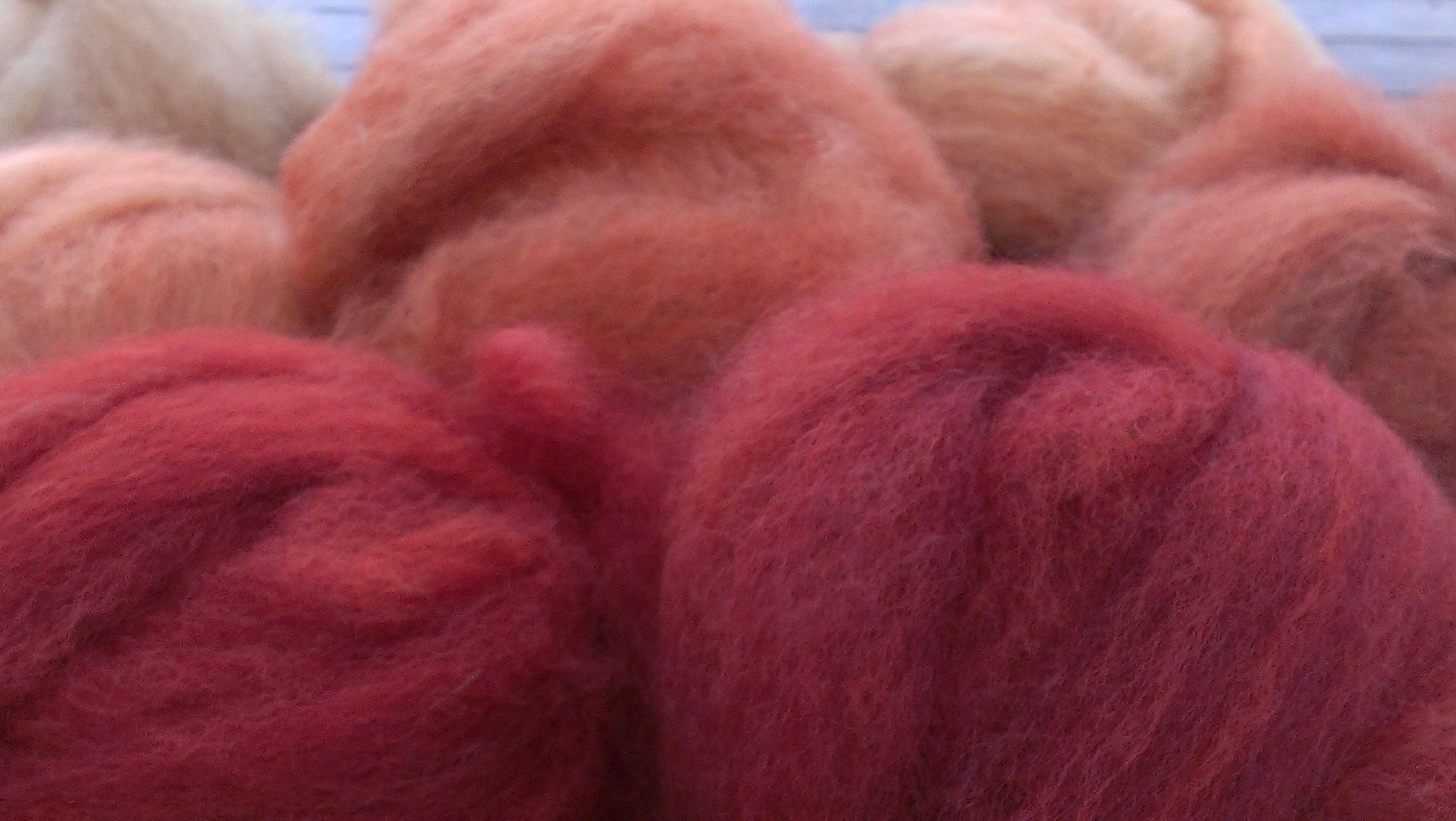
Some time ago I blogged about dyeing with windfall eucalyptus leaves. I had been dyeing over white corriedale and had quite a range of colours in the range of ochre and caramel through flame orange and… opinions differ about whether that really is red. Here it is, wet from dyeing and ready to be rinsed:

IMAG2316

I divided my fleece up into colour groupings, carded it and pulled a roving straight from the carder drum with a diz.  What a great technique.  You can find it on YouTube, but it was watching a friend from the Guild demonstrate it that really convinced me to try it out.  This Youtube video has an explanation of the same simple homemade diz my friend has made, so maybe she was inspired by that video.  Here are my rovings.  Creating these made me feel like I have learned a few things about fleece preparation.

IMAG2392

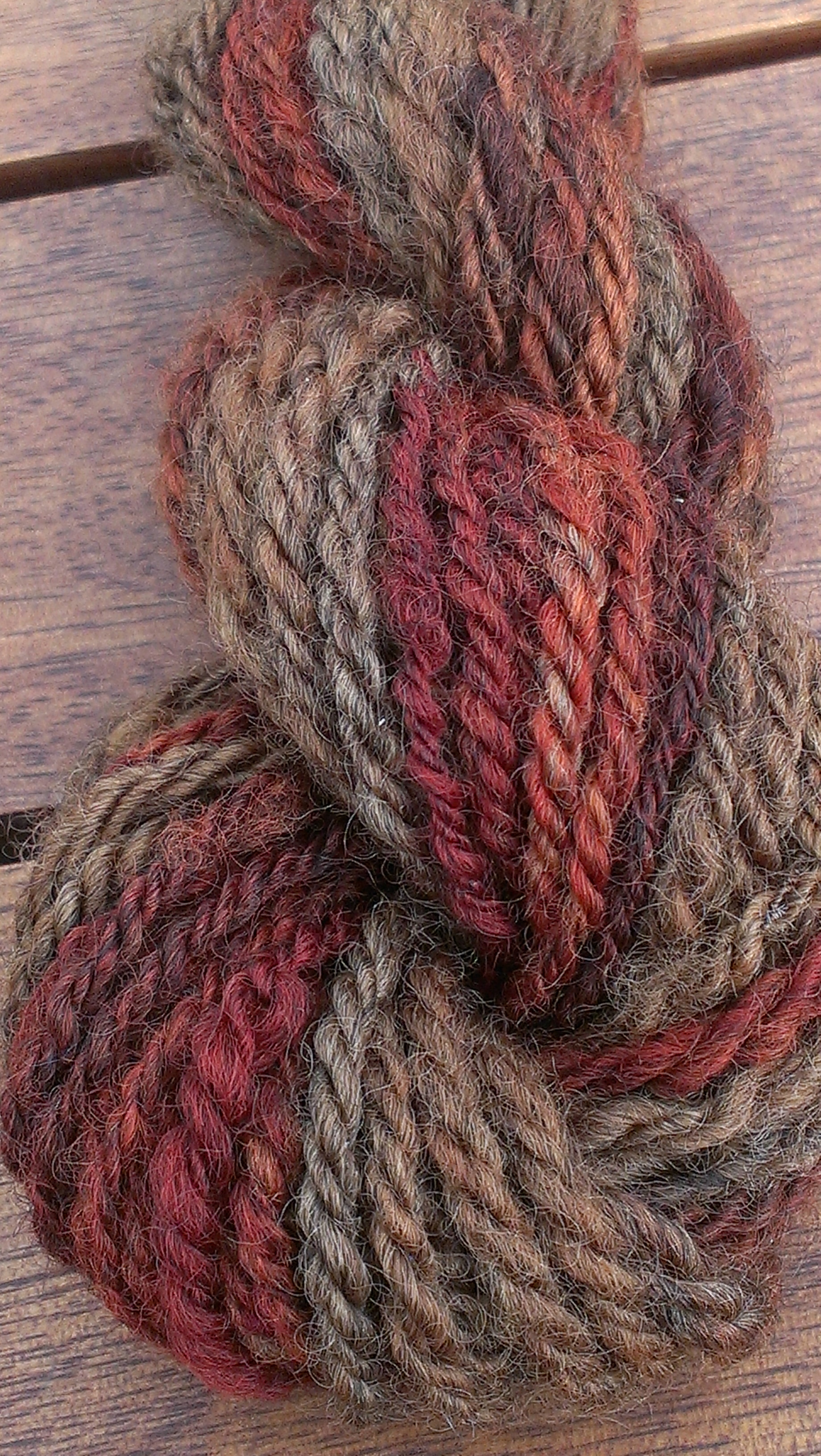
Then I created bumps of roving with segments of each colour, lined up to create a gradient from ochre through to reddish. Then, there was spinning and plying and skeining and washing–spinning being a craft of many stages–and now…

wpid-IMAG2742.jpg

I am so happy with this yarn! I can’t wait to share it with the friends whose sheep this wool came from.  Coincidentally, the week I finished this yarn, they invited me to their place for shearing time.

wpid-IMAG2750.jpg

16 Comments

Filed under Eucalypts, Fibre preparation, Natural dyeing, Spinning

Textured spinning and trash batts

I went on a weekend away with members of my Guild recently and had a fabulous time chatting, spinning and eating way more than made any sense.  I took some little packs I made up beforehand, each designed to create a skein of yarn. This first one began as Finn cross locks I bought pre-dyed and perhaps a little felted, with curly tips.  Perfect for this technique, I thought.

IMAG2260

Here they are as a lockspun yarn, with the teased-out, butt ends of the locks corespun around a crossbred grey wool core that can no longer be seen, and the curly tips on display.

IMAG2427

This batt of unloved green fleece that I was given includes some orange silk noil and some pre-dyed mohair locks.

IMAG2261

Here it is corespun over that same grey crossbred core.  I learned these two techniques from the fine writing and DVDs of Jacey Boggs.

IMAG2557

The trash batt experiments continue!  This is eucalyptus dyed carder waste (and nepps pulled out as I was spinning) carded with white and tan Polwarth locks.

IMAG2389

I used it for my first attempt at a  new textured spinning technique–a friend gave me a copy of The Wheel that contained this technique and you can also see it here.  It originates with Steph Gorin, who demonstrates here.  (The video also includes advertising for Ashford.)

IMAG2546

Here is the outcome of a batt made with the flick carding waste from the blue lockspun yarn above, and a eucalyptus dyed carder waste and polwarth batt.

IMAG2579

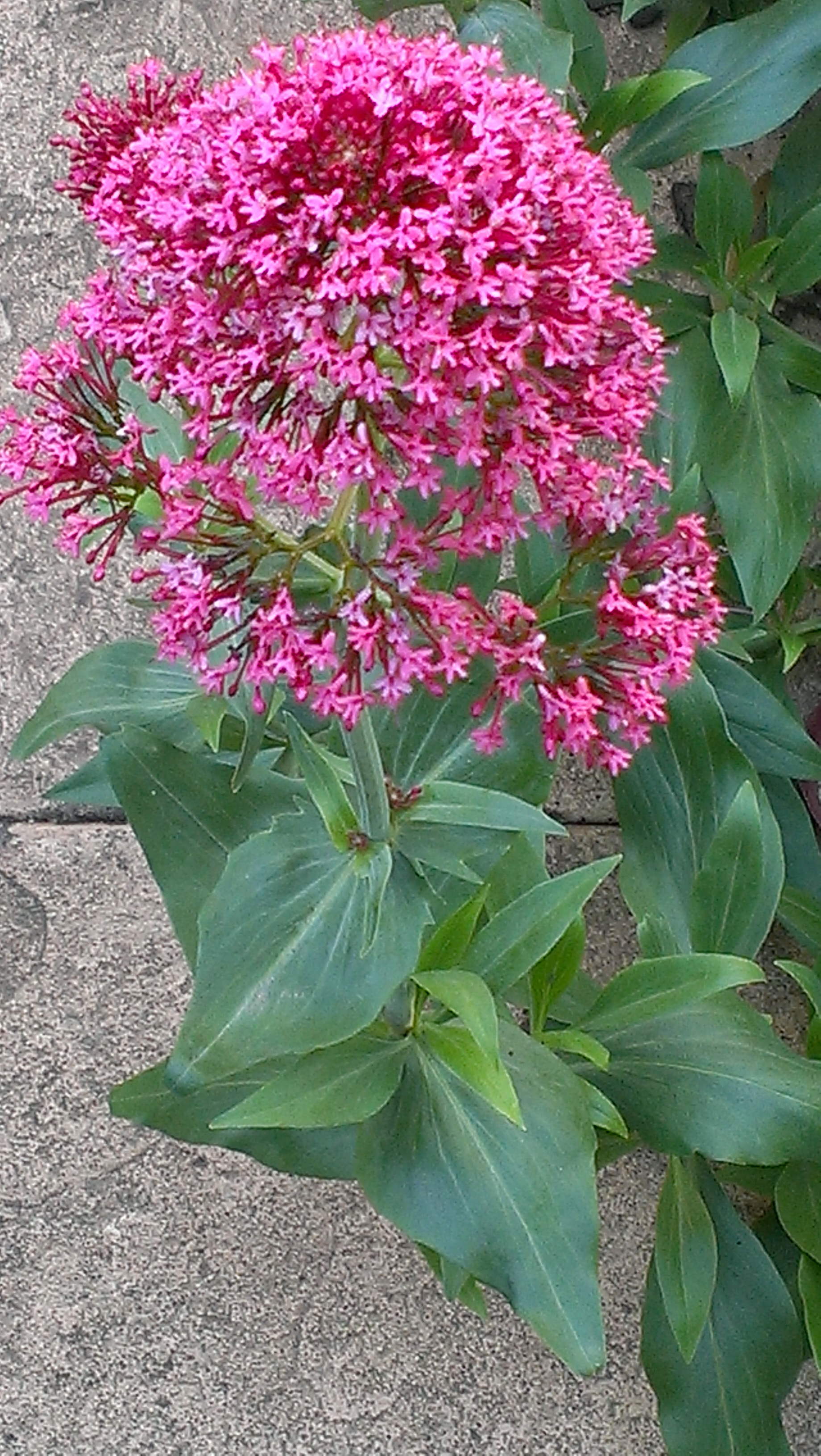
Finally, a gratuitous picture of what appears to me to be valerian in flower in my garden.  Which is gorgeous apart from the fact that I bought it because it was soapwort.  It doesn’t look like any soapwort I have ever seen now it is in flower, which makes me glad it wasn’t big enough to harvest until now!

IMAG2584

6 Comments

Filed under Fibre preparation, Natural dyeing, Spinning

Eucalyptus dyes over grey corriedale: The spinning finale

I have a bit of a tendency to go a long way toward the completion of a big project and then pause near the end.  Sometimes for a little while, sometimes for a long while.  So here, finally, is the very last of the grey corriedale I dyed months ago and planned to spin during the Tour de Fleece. I loved the two ply yarn I created during the Tour a good bit less than my initial chain plied skein, even though it is what I need if I ever knit that cardigan I dream of.

I found the label for this fleece on the weekend and I started out with 3.5 kg of fleece.  I made a true three ply yarn (three singles plied together) from most of the last part…

IMAG2559

And chain plied the rest (one single plied on itself in a chain).  I think the long pause on this was caused by the way my heart sank when I stopped chain plying it in the first place.  I love the distinct colours in the last little leftover skein!   IMAG2562

I also spun up a little batt of alpaca dyed in eucalyptus.

IMAG2382


Three ply wins again!

IMAG2563

Leave a comment

Filed under Eucalypts, Fibre preparation, Natural dyeing, Spinning

Just in time for summer!

Sometimes people ask me how I manage to fit so many things in… but I am not sure they are really keeping track of how long a project might take me from start to finish!  Many craft projects at my place involve large numbers of tiny steps.  Sometimes it is the nature of the crafts involved and sometimes it’s the only way I can figure out to make things happen.  So projects progress slowly at times, as whim, interest, the right weather, or the availability of time permit.  Today I can report that a couple of items reached the out spout.

The eucalyptus dyed grey corriedale which started here and continued here has finally come to an end, with every last bit now converted to yarn.  The middle skein is chain-plied (and to be honest, I really do prefer this yarn over the one I have created for my cardigan) and the one at the bottom is a true 3 ply.  Some of this yarn is destined to become a cardigan, but it will not be for winter 2013, which is over now for us here in Australia.

IMAG2430

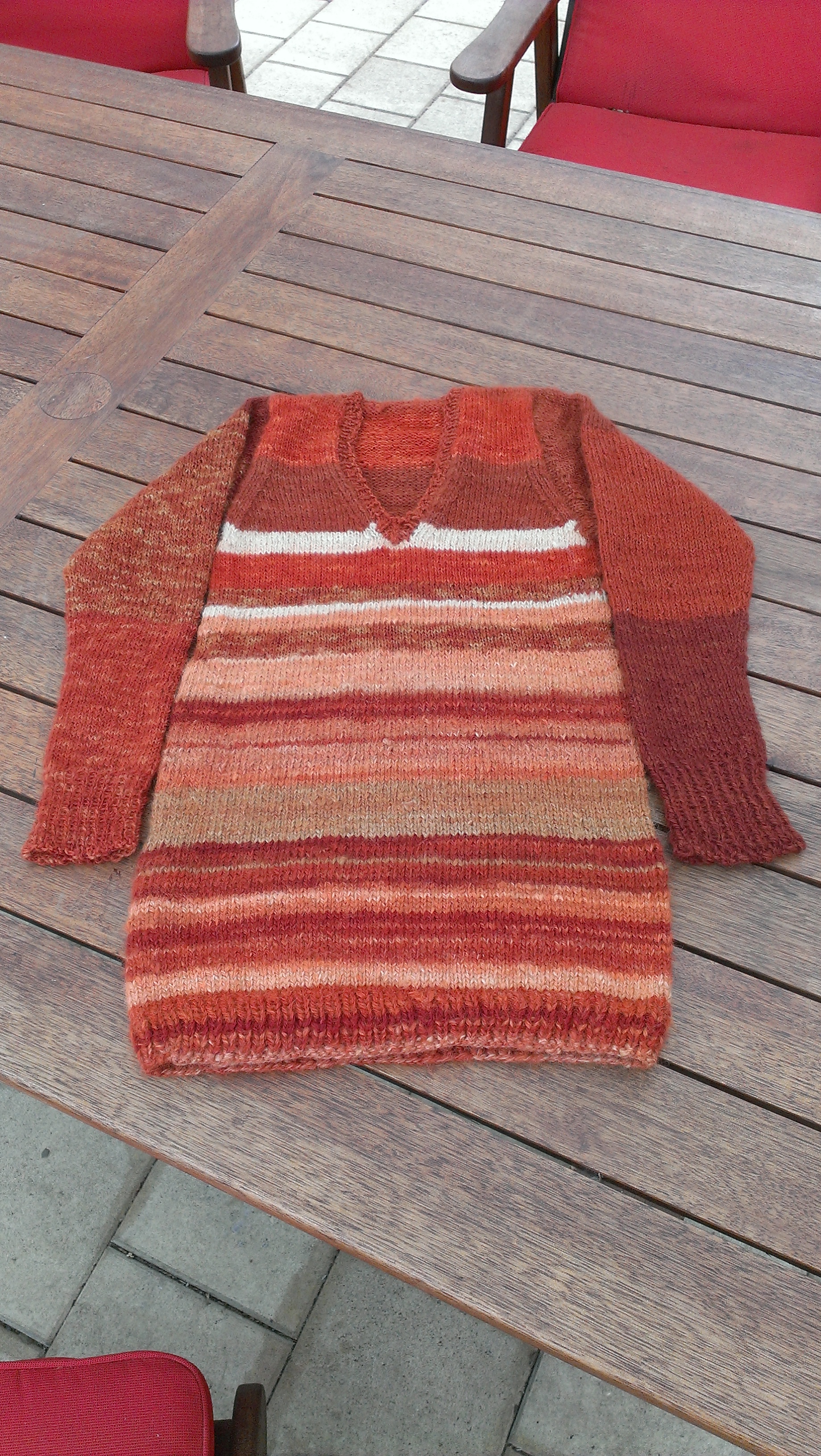
I have also finally finished making a jumper for my fairy godson. He is a tall and slender individual (just in case you’re wondering if the proportions are right), and if he’s lucky there will be one or two days cold enough to wear this jumper before winter 2014.  I hope it will still fit him then!  It was slowed down by misjudgment of the amount of yarn needed, and thus several stages of dyeing and spinning as knitting progressed, breaking all the rules of good handspun-handknit practise.  It is 3 ply eucalyptus dyed alpaca in 4ply/fingering weight.

IMAG2456

Here it is, tied up with handmade string crafted from the leaves of our daylily.  When it was raining this morning I decided to steam press it and just take it over on my way to work in hopes it might be cold enough to wear it, and was lucky enough to catch my friends at home.  It never fails to gladden my heart to give a gift that is really warmly welcomed… but it is an additional exquisite pleasure to find the handmade string to be just about as exciting as the jumper to its recipient.  It fills life with pleasure to find folk who feel just as intrigued by string from the backyard as  you do, and just as curious about how it could be made.

IMAG2460 (1)

Someone who works in the same hallway as me exclaimed over my looking happy at work on a Monday, just as I walked in this morning… and may not have understood if I’d said it was all about late but welcome presents and homemade string and love.  Sometimes you have to be there.

8 Comments

Filed under Eucalypts, Knitting, Natural dyeing, Neighbourhood pleasures, Spinning

Leaf print bags

IMAG2211

The bag making has been continuing.  This is a simple, unlined bag made from recycled heavyweight garment fabrics–parts of an old pair of hemp shorts and some recycled men’s cotton twill trousers.  Last year I went to a huge Red Cross sale where entire secondhand garments were $1 or $2.  I acquired all kinds of stained and/or worn pale coloured garments which I have been transforming.

IMAG2202

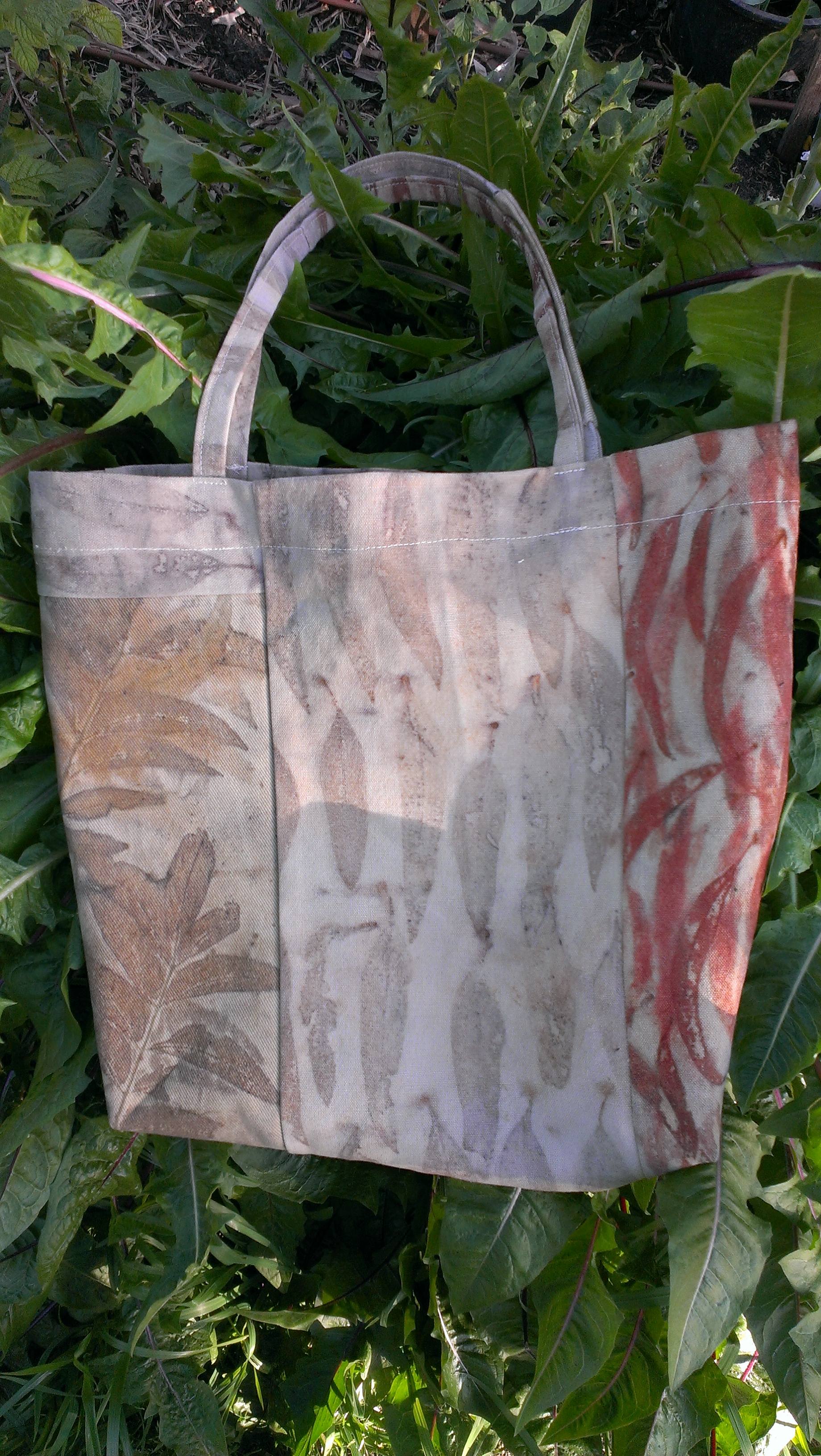
This, on the other hand, is a lined bag made of silk.  When I first bought and read India Flint’s Eco-Colour, I was immediately inspired and keen to try out her ideas and techniques, but finding silk and wool fabrics was quite a challenge.  I had been dyeing sheep fleece and woolen yarns.  I started out eco-printing with some fine gauzy silk and that was exciting enough to keep me going, though I was less than clear about how I could use it.  Then I found a length of Thai silk clearly purchased in Thailand and brought home to Australia which had somehow found its way to an op shop I like to comb through.  Many experiments followed, and they have been sitting rolled up in the sewing room for years now.
IMAG2201

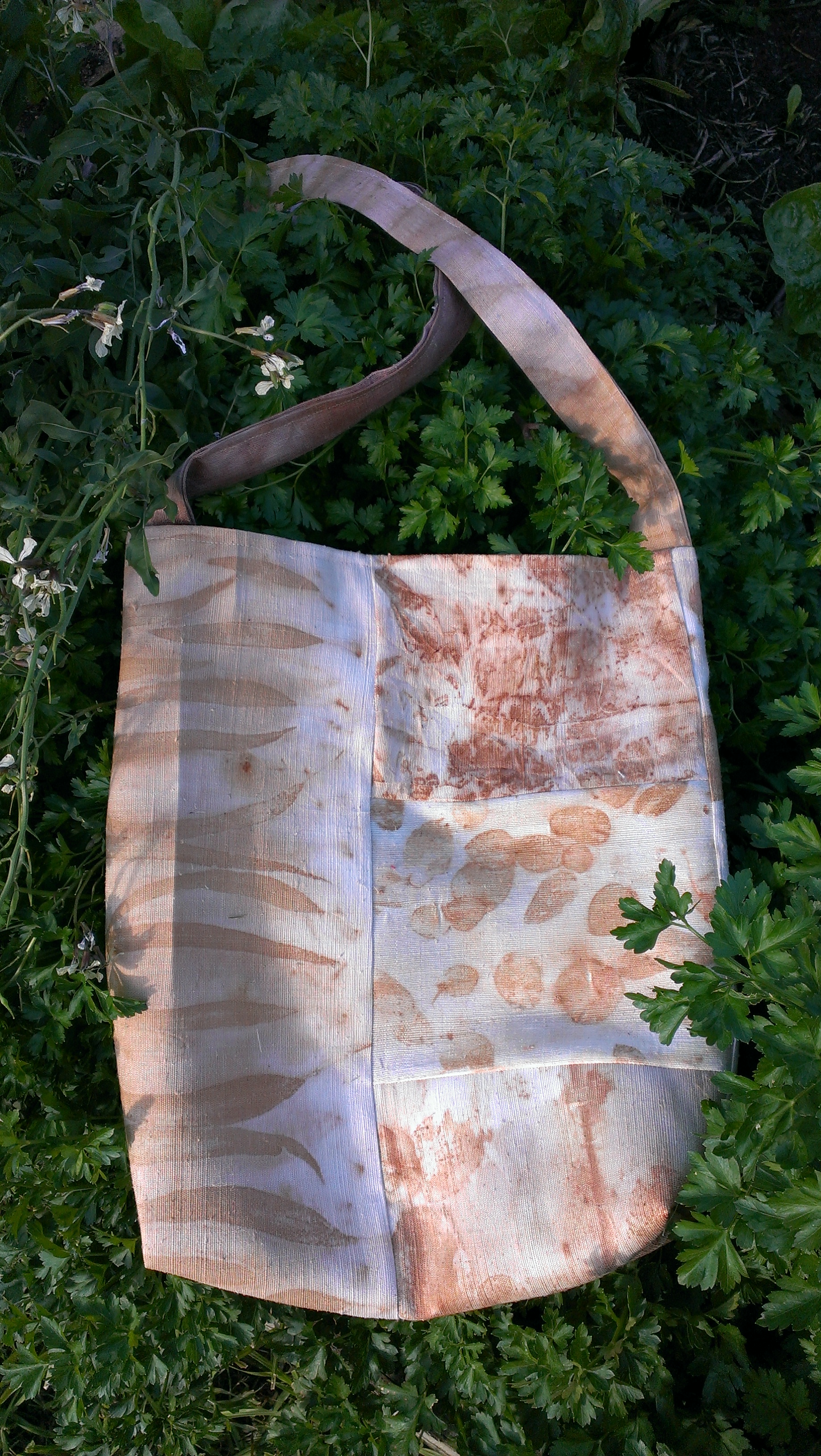
The darker colour on some sections is red wine.  The splotchy random pattern–clearly not a leaf–on one piece really had me puzzled until I ironed it.  The smell was a giveaway.  Ah!  Onion skins!  That is what you can see on the top right of this bag.

IMAG2199

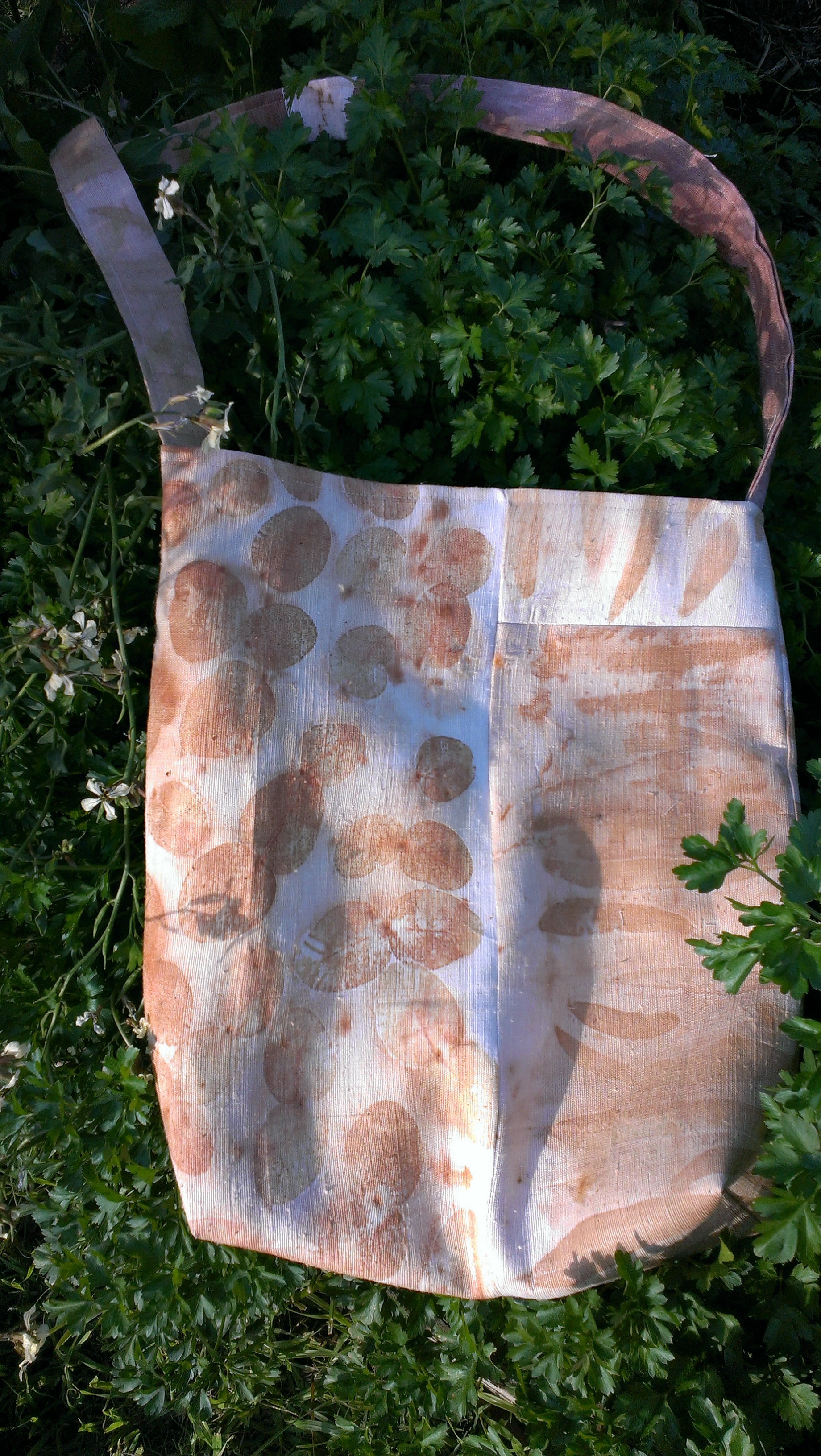
And the other side (with red wine on the strap)…

IMAG2198

I have constructed the linings from samples and less successful printing efforts on cottons…

IMAG2204

It’s very satisfying finally to put these samples to use.

4 Comments

Filed under Eucalypts, Leaf prints, Sewing