Tag Archives: gifts

An invitation, a week 2 silkworm update and some random happenings

Let me begin with some dignity, because it won’t last. Soon we’ll be back to silkworms and other silly stuff.  Anne Harris of Annie’s Workroom would like to invite you to her exhibition.  It’s in Brisbane, Queensland–I am sorry to report this means I won’t be able to see it.

Invite Back & Front

Expressions of Love: Lovingly Interrupted brings together established contemporary artist Kim Schoenberger’s collection of treasured memories assembled from the humble teabag. And introduces emerging artist Anne Harris’s work of naturally dyed, painted and stitched images exploring the emotions of love. Official Opening 14th September 3.30pm. Closes 28th September: Gallery 159, 159 Payne Road, The Gap, Brisbane.  There is a special bus to make it easy for sunshine coast people to attend. Please call  Anne 0433 162 847 for more information or visit her on the web.

And now… for the silkworm update of the week.  OMG, as they say in the classics, the silkworms are still hatching!  I have been struggling to figure out a cross-national item to give a sense of scale (US coins don’t work for me).  Here is my trial object.  Let me know how I’m doing!

IMAG0983

Here is a close up of silk worms in several stages of growth–with more hatching every single day two weeks after they started!  They were all laid as eggs within a couple of days of one another, I hasten to add. What more can I say? There is still just one mulberry tree with leaves on it in the neighbourhood.

IMAG0984

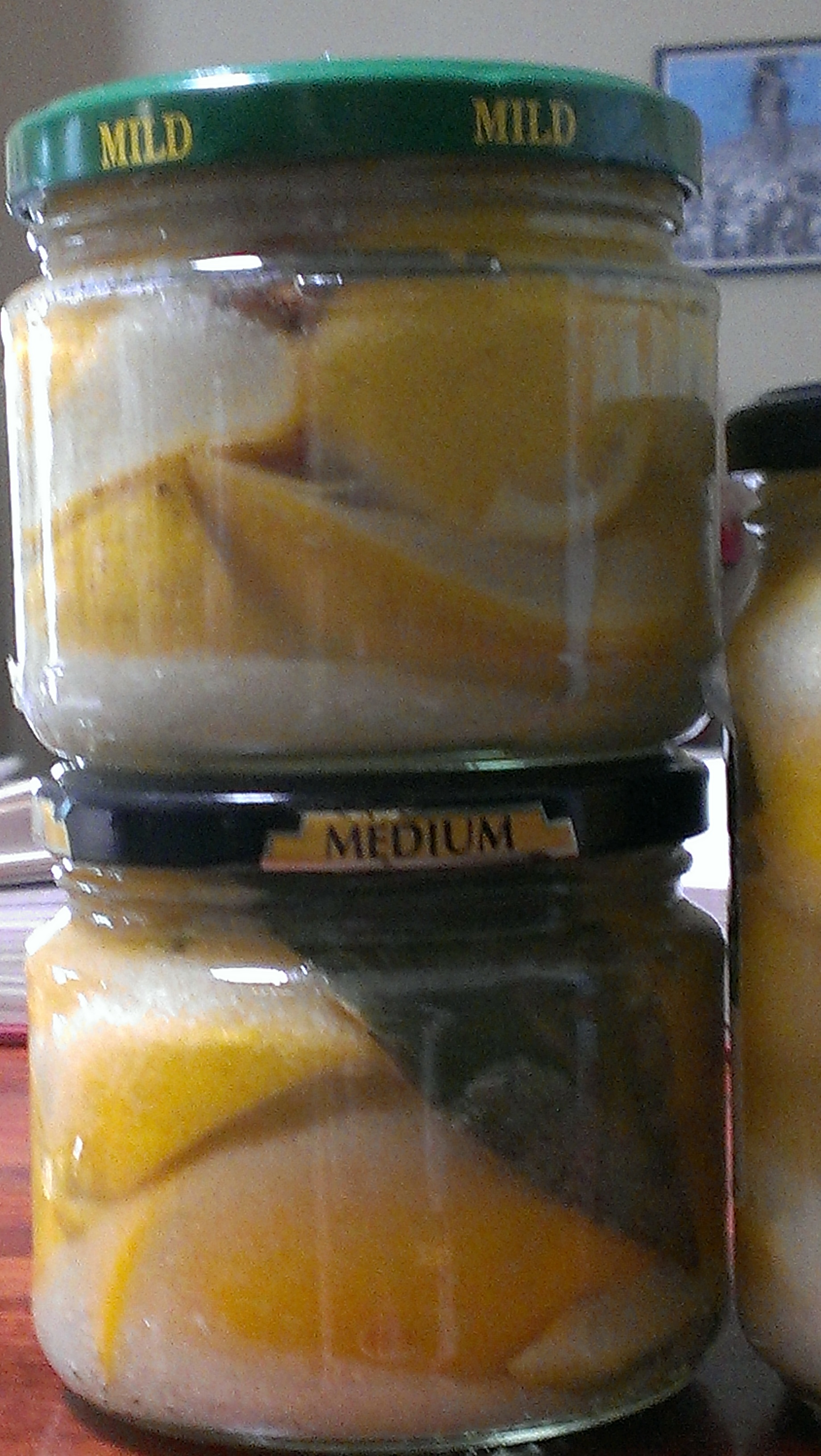
On the weekend, there was lemon preserving (the salty kind)… inspired in part by an anonymous donation of a bag of Meyer lemons left on our porch.  Three cheers for the grower and the tree!

IMAG0946

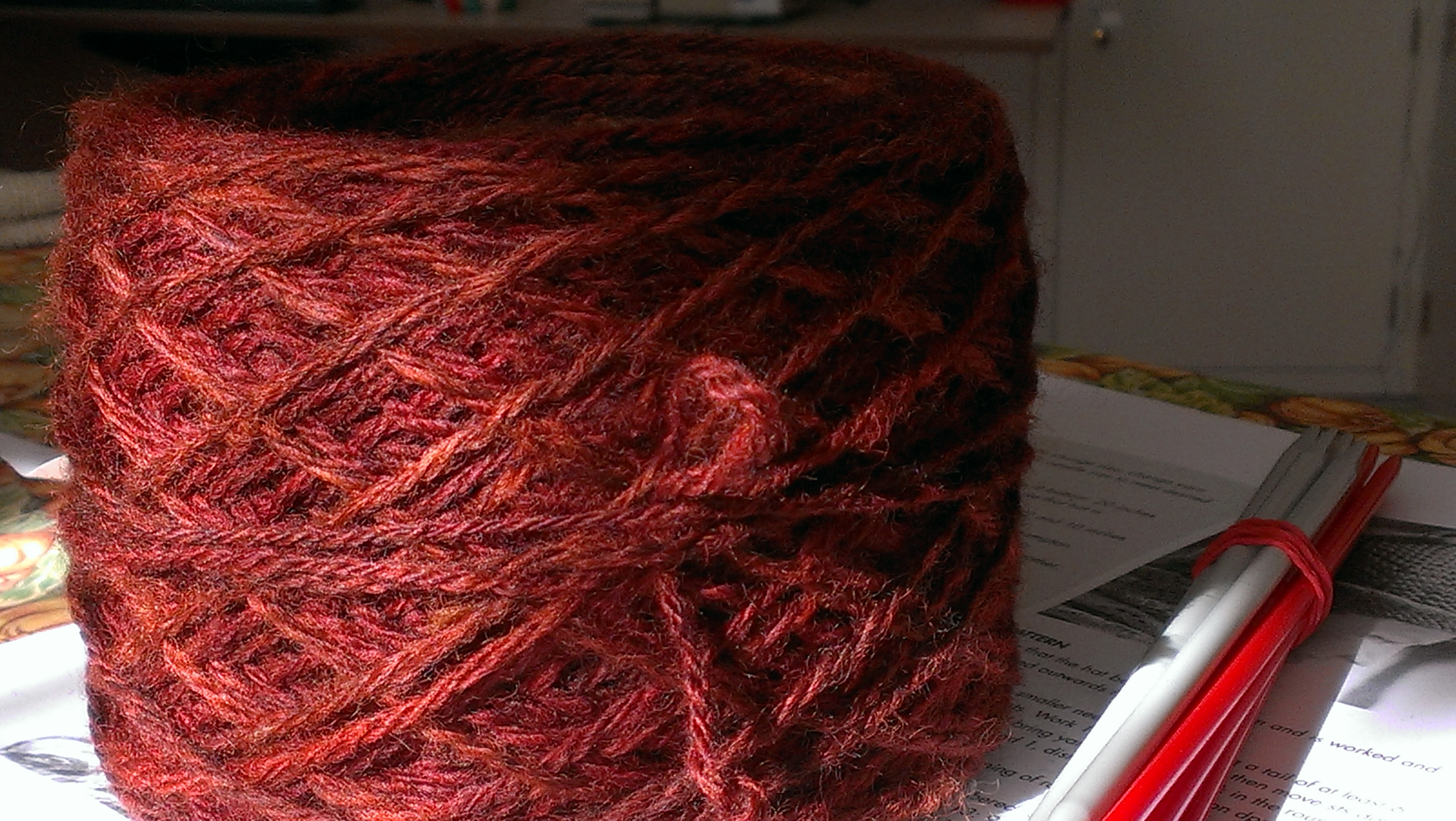
I had the urge to cast on, a lot.

IMAG0957

I also had the urge to dye and since it was warm and sunny, took advantage by mordanting fabric for future leaf prints.  I had the realisation some time ago that I had somehow managed not to find a section on mordanting cellulose fabrics, with quite specific instructions, in Eco-Colour.  I had always wished there was a section like that in there.  Happily India Flint has indeed put it in her gorgeous book and if only I had paid more attention… Anyway, since I can’t change the past, I have been waiting for sunny weather to dip and dry and dip and dry on a principle somewhat different to the one I have been experimenting with–and now the sunshine is here I got to it!  Good dyeing times are coming…

IMAG0942


12 Comments

Filed under Fibre preparation, Knitting, Natural dyeing, Neighbourhood pleasures

Scogger!

Do you read those articles that come out every once in a while announcing the words that have been added to the dictionary since the last edition (like this and this?) and perhaps lamenting those that have gone into disuse?  I do.  I have a long standing love affair with dictionaries that began when I was a primary school child.  I had the insight that I could never get in trouble for reading the dictionary under the desk during classes while I was still in primary school.  I must have been regularly bored, or gripped by the dictionary, because I read it a lot.  Strange events followed, like the time I used ‘annular’ in a sentence, in a primary school story.  At the time we lived in the middle of Western Australia, where this was evidently unexpected.  I had a teacher who was capable of raising just one eyebrow, a skill I wistfully hoped to master and practiced a lot, without much success.  ‘Annular’ caused those expressive eyebrows to rise much higher than usual!

2014-08-28 17.16.12

I digress, but I am sure you had noticed.  I believe it was in Richard Rutt’s history of hand knitting that I found the word ‘scogger’. One of the happy moments of my young adult life was coming into possession of a Shorter Oxford dictionary, and ‘scogger’ is in it, right beside ‘scofflaw’.  It is defined in the OED as ‘A footless stocking, or a knitted article of similar form, worn either as a gaiter or as a sleeve to protect the arm; also the foot of a stocking worn over the boot to prevent slipping on ice’ and attributed to a northern dialect.  The examples listed go back to 1615: ‘R. Brathwait Strappado 130:   Fute-sare I was, for Bille shoon had neane..Nor hose-legs (wele I wate) but skoggers aud, That hardly hap’t poore Billes legs fra caud.’


Anyone who is wondering–especially anyone who has a native language other than English–should understand the meaning of this statement is not self evident me either.  At a guess: ‘I was footsore, for I (Bill) had no shoes… Nor leg warmers, but only old scoggers, that hardly kept my (Bill’s) poor legs from the cold.’  ‘Wele I wate’ has me puzzled even after some digging around. ‘Wele’ could mean ‘we will’ or  ‘choose’ according to OED or ‘weal’ according to one online source.  ‘Wate’ could mean ‘wait’ or ‘what’.  So this phrase might mean ‘while I wait’ and require context… or might mean something completely different!  The wonders of the internet make the whole poem available!  This makes it clear Bill is describing his rise from poverty and wretched, inadequate, hand-me-down clothing to rather finer garb.

2014-08-28 17.17.28

This scogger is for a friend who has a plastic elbow joint.  She feels the cold in it rather badly, though unlike poor Bille in the example from the OED, she certainly does have shoes!  This scogger is destined to warm her elbow on chilly mornings when she is tending to the hens and donkeys and on cold evenings when she’s checking on them again.  That’s me modelling it (ah, the challenges of taking a photo of my own arm!), and I admit, she is a different shape–but she’s tried it on and declared it suitable. It’s made of dependable sock yarn and shirring elastic, knit into the ends to ensure snug fit, as requested.  It comes complete with a heel an elbow for maximum movement, and needless to say, since I knit it in meetings, on buses and in queues, quite a few folk have been introduced to the scogger: both the word and the article.

7 Comments

Filed under Natural dyeing

Dyes of antiquity: Carmine cochineal

2014-06-14 14.20.01

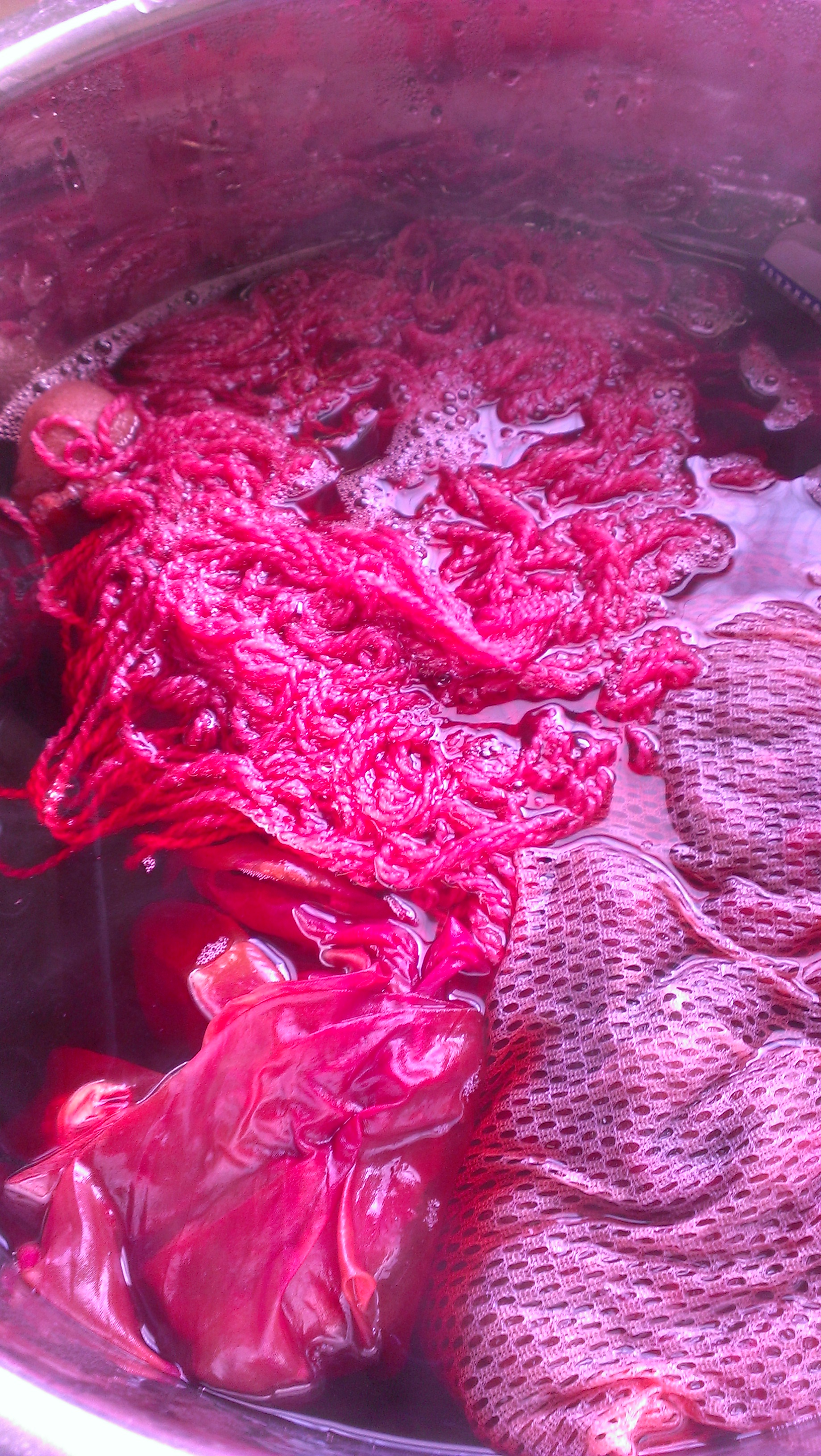
Cochineal is another of the dyes I received from the Guild and used at the workshop a while back.  In fact, there was a choice of cochineals.  In what I realise now was my ignorance, I chose ‘carmine cochineal’ because it was ground up and I was unsure how I could adequately grind the whole dried insects I also have.  As you can see, after an initial period of being dull ornage, the dye bath was an impressively shocking pink.  It turns out that ‘carmine cochineal’ is not a shade of cochineal but a preparation of cochineal boiled with ammonia or sodium carbonate.  I borrowed Frederick Gerber’s Cochineal and the Insect Dyes 1978 from, the Guild and found that the deeper red colour I had in mind when I saw the term ‘carmine’ could only be obtained from this preparation with the application of a tin mordant which I am not prepared to use.  the colours we achieved with alum were well within the range indicated by the included colour chart of wool samples (those were the days!)

2014-07-20 16.00.18

The colour range on this card (with madder beneath for comparison) is impressive even without tin. 

2014-07-21 14.33.21

We dyed organic wool. I dyed silk paj and twined string (the orange string was dyed with madder). 

2014-07-04 12.52.33

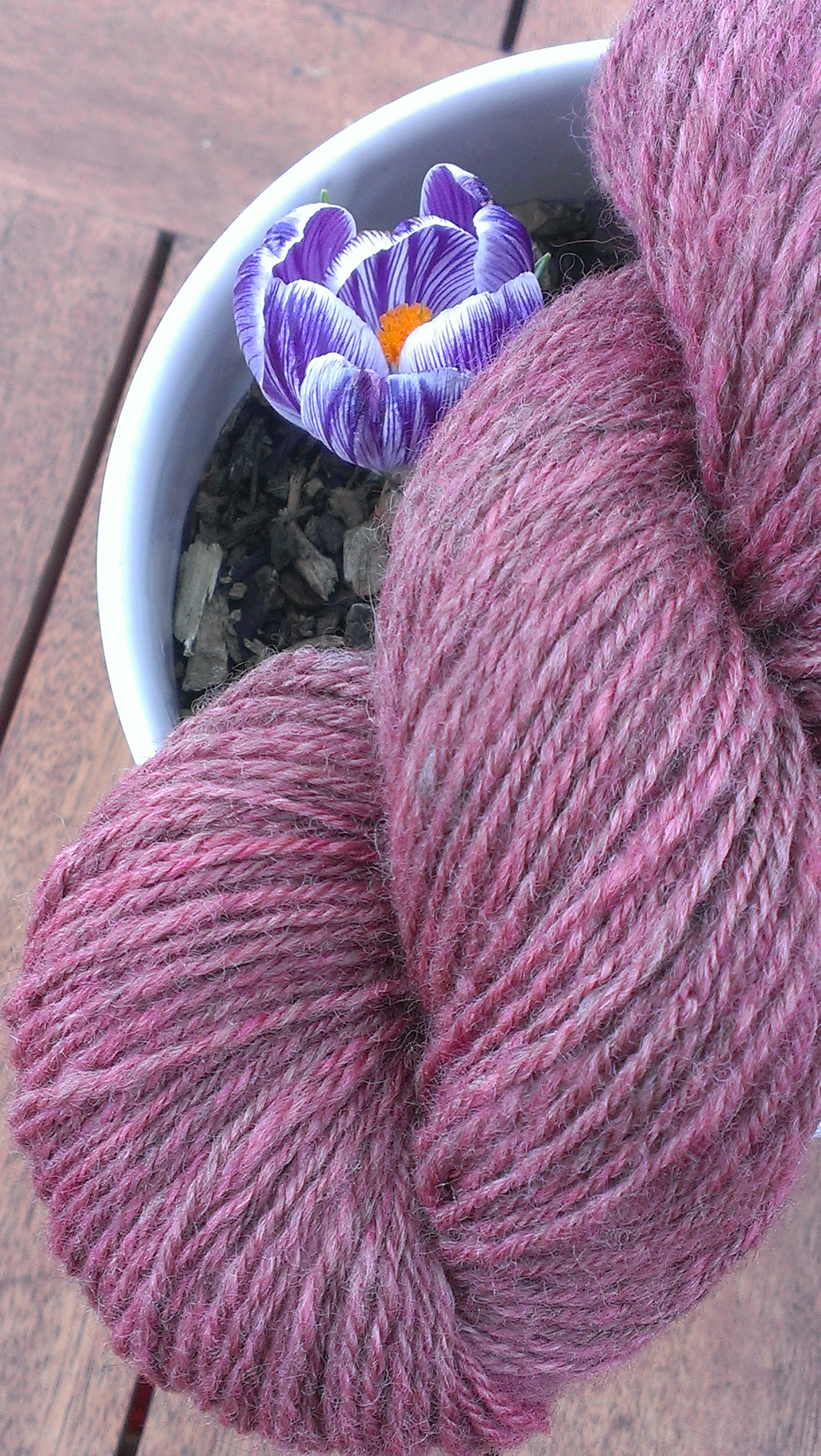
I brought the vat home with me and dyed a lot more fibre in an attempt to exhaust it.  Here is grey corriedale mordanted with alum and overdyed with carmine cochineal.

2014-07-30 11.27.48

And spun–three plied.  This is my first ever crocus flower, by the way!

2014-08-23 11.57.30

The magenta silk embroidery thread had maximum time in the bath, since I fished it out when removing the dyestuff (in its recycled stocking) prior to disposing of the bath!

2014-07-30 11.23.55


12 Comments

Filed under Natural dyeing, Spinning

Socks for active toes

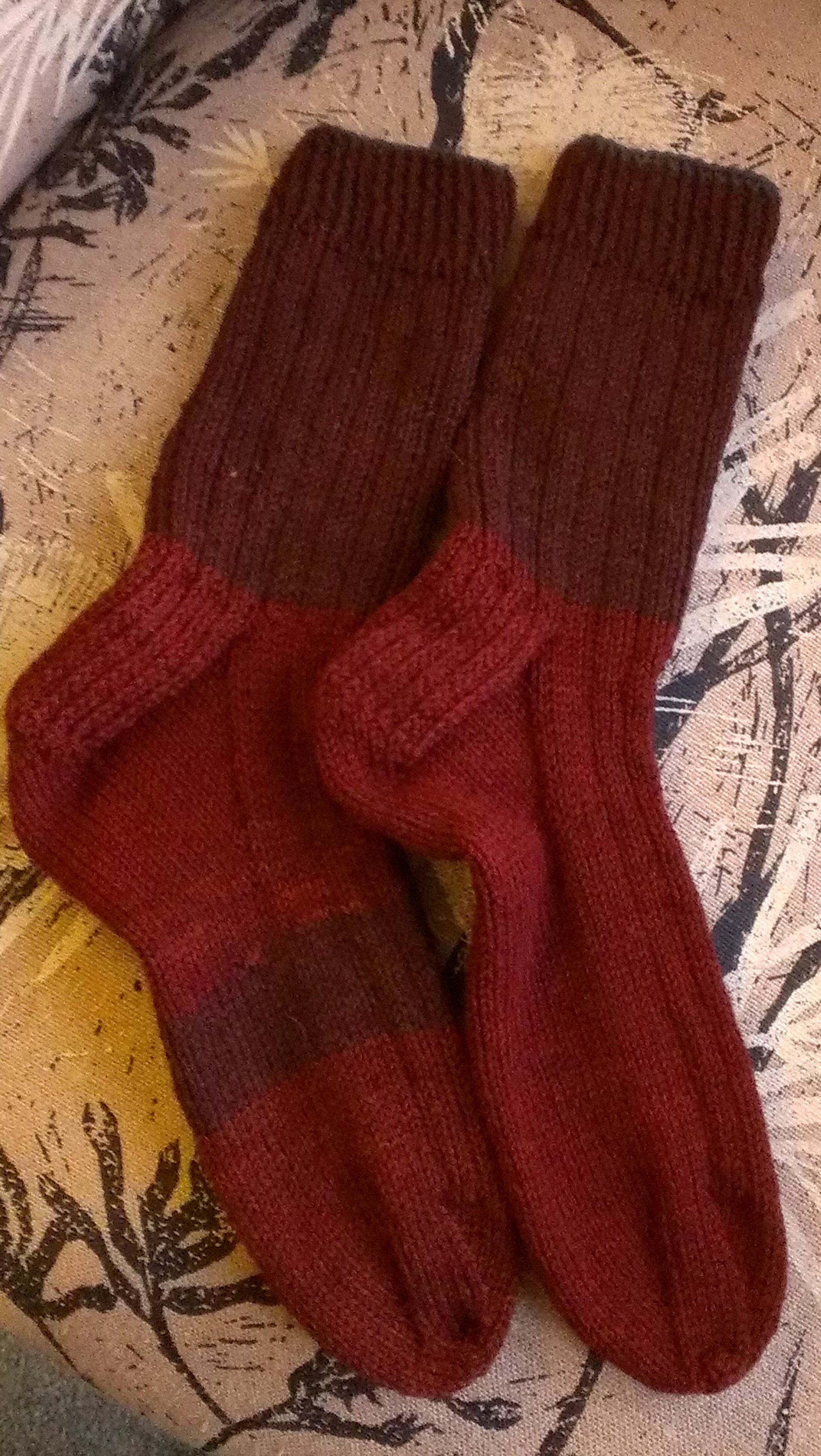
Last weekend I finished these socks–eucalyptus-dyed patonyle with a subtle indigo blue stripe at the cuff (I mention its subtlety since it is invisible in the image above).  We went to visit the intended recipient yesterday and I could wait no longer for the right moment to take a picture in daylight.

2014-08-16 16.14.27

There was less than a metre of yarn left when I finished these.  I handed them over and they were whipped onto enthusiastic feet in no time at all.  This was he closest to a still image I was likely to get.

2014-08-16 16.23.50

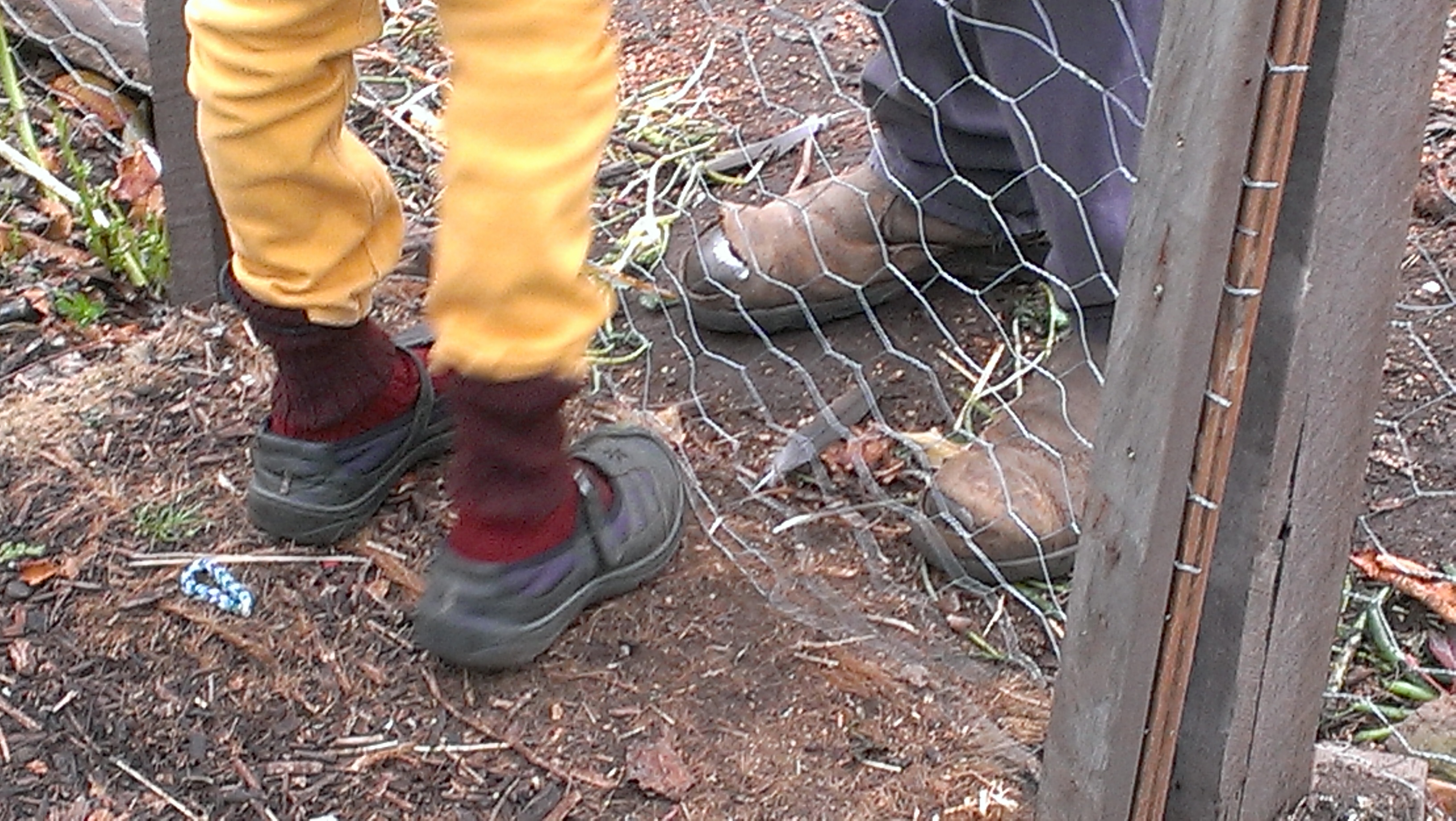
Pretty soon they were out into the chook yard with someone else’s shoes over them…

2014-08-16 16.25.12

Happily these fast-growing feet are the same size as those of an adult in the family–so in case they are outgrown they will still be of use.

2014-08-16 16.25.29

Then, up into the mandarin tree in weatherproof pants because of impending rain..

2014-08-16 16.33.13

And pretty soon my pocket full of socks had become a pocket full of flowers and beautiful leaves and we were heading home after some guitar playing, hot chocolate (or carob or dandelion, depending), chat and plans for a future shared meal and off into the evening with enough mandarins for marmalade and more.  Friends are such wonder and delight!

1 Comment

Filed under Knitting, Natural dyeing

Turning a sow’s ear into a silk purse. I mean, a slipper.

This week’s question is whether I can turn a sow’s ear into a silk purse slipper.

I have been the lucky recipient of a lot of free fleece since I took up spinning.  It all started with some filthy Gotland fleece straight from the sheep’s back that my Dad gave me.  He had provided the antique engine that was running the shearing plant in a demonstration of hand shearing at a local show.  Because he knew I wanted to learn to spin, he brought home a few handfuls.   He is a great enabler!  It was rough and filthy, but I spun it on my first spindle and was grateful.  Admittedly, Dad said there was a handspinner at the show and he had spoken to her about it: she advised doing me a favour and not bringing that fleece home to me, but naturally, he didn’t listen!  And I was glad.  I didn’t know anywhere I could get fleece then.

Next, I was given several bags of Dorper fleece by friends who were keeping Dorpers as meat sheep.  I didn’t understand the meaning of ‘meat sheep’ in the context of fleece at that stage.   Dorpers shed their fleece rather than needing to be shorn when they are pure bred, which might have been a clue to (lack of) spinnability for a more knowledgeable person, too!  I dyed it, I spun it, I carded it… oh my goodness. It was the beginning of my fleece preparation journey and it was a very challenging start.  Months later the woman who had lent me her carder said when she saw what I was working with, she was just overcome to think I would even try to spin that fleece!  She didn’t offer me her opinion at the time, though, and it was a long time before I decided that I could, perhaps, compost the rest as my struggles were not only about my lack of skill but also about the state of the fleece.

Needless to say I have also received fleece that has spent lengthy periods in a shed and bred an overwhelming moth population.  Happily, I had said fleece in a plastic tub with a lid.

So… I have had some personal experience of the possibility that people who give the gift of fleece don’t have the judgment necessary to decide whether what they have handed over is worth spinning.   I have to be the one to decide whether the fact that I could turn that into yarn given enough time and effort, is a sufficient reason to do it.  I think I have proved to myself that I can spin almost anything–if I could spin those fleeces as a beginner!

I went to a couple of workshops on fibre preparation (washing, combing and using hackles) at the recent Majacraft Magic camp at Lake Dewar outside Melbourne, and came home ready to tackle some of my current fibre preparation challenges.  I had reached some new conclusions about why I find getting fleece clean difficult sometimes.  1. our hot water tap doesn’t give very hot water, and can’t be adjusted.  Boiling the kettle repeatedly is boring, as well as slow, after a while! 2. I can be more slapdash than is ideal for the task. 3. Most of the fleece I currently have is Polwarth, more gifts from a couple of pet sheep in the hills.  This is a fine and greasy fleece, among the more challenging to clean.  4. I always hope to be able to wash a bigger batch of fleece than is desirable for optimal results.

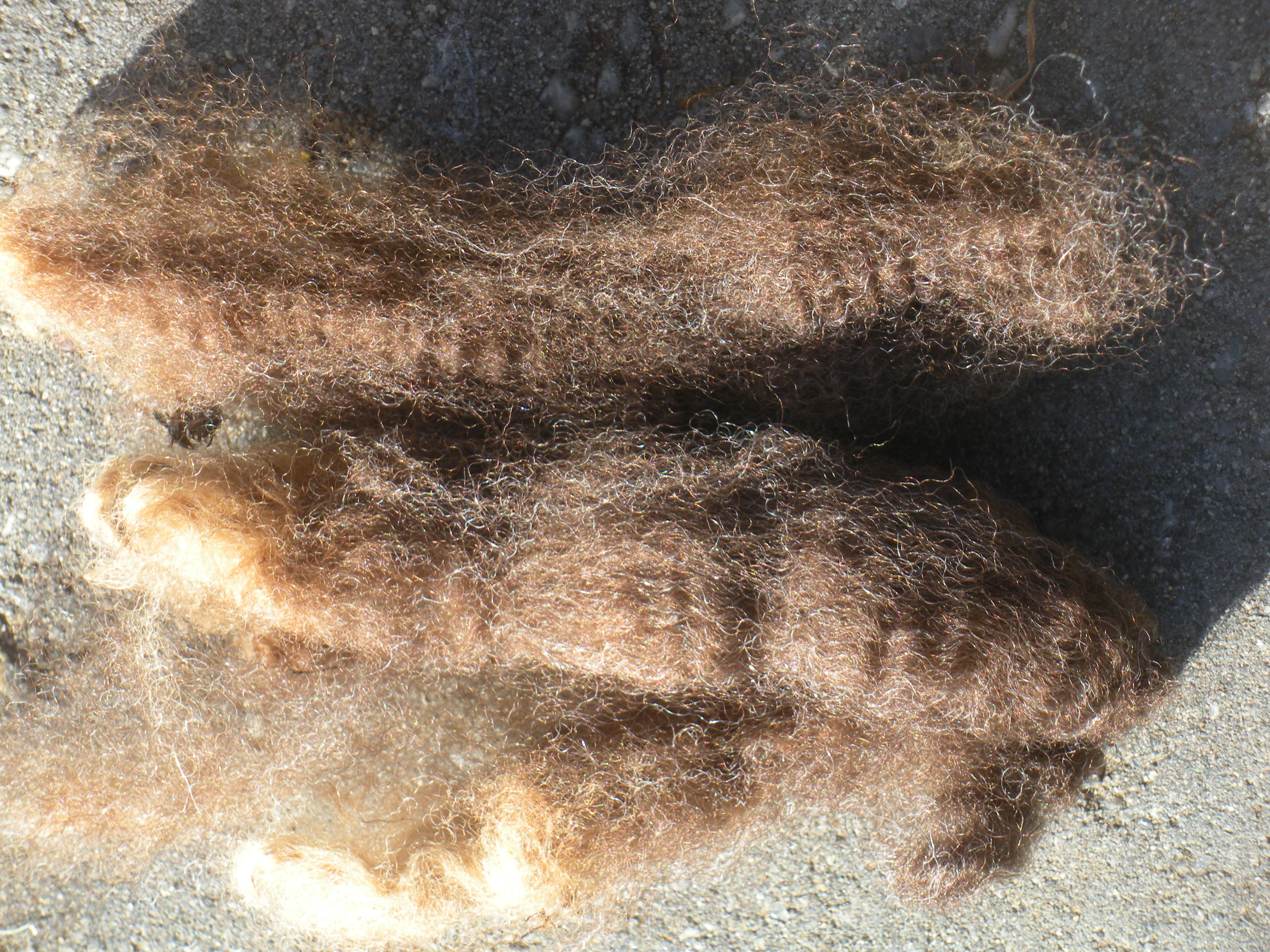
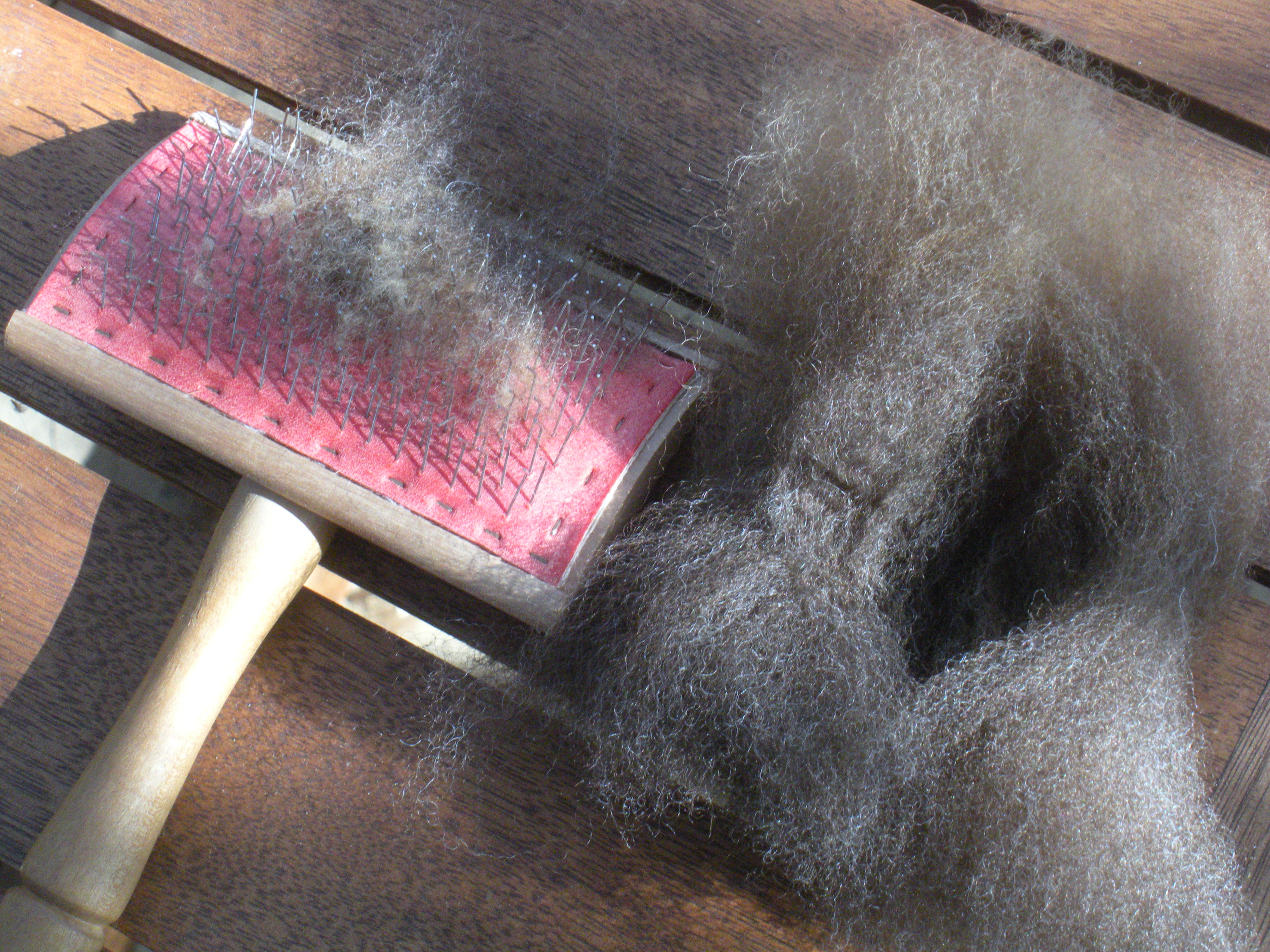
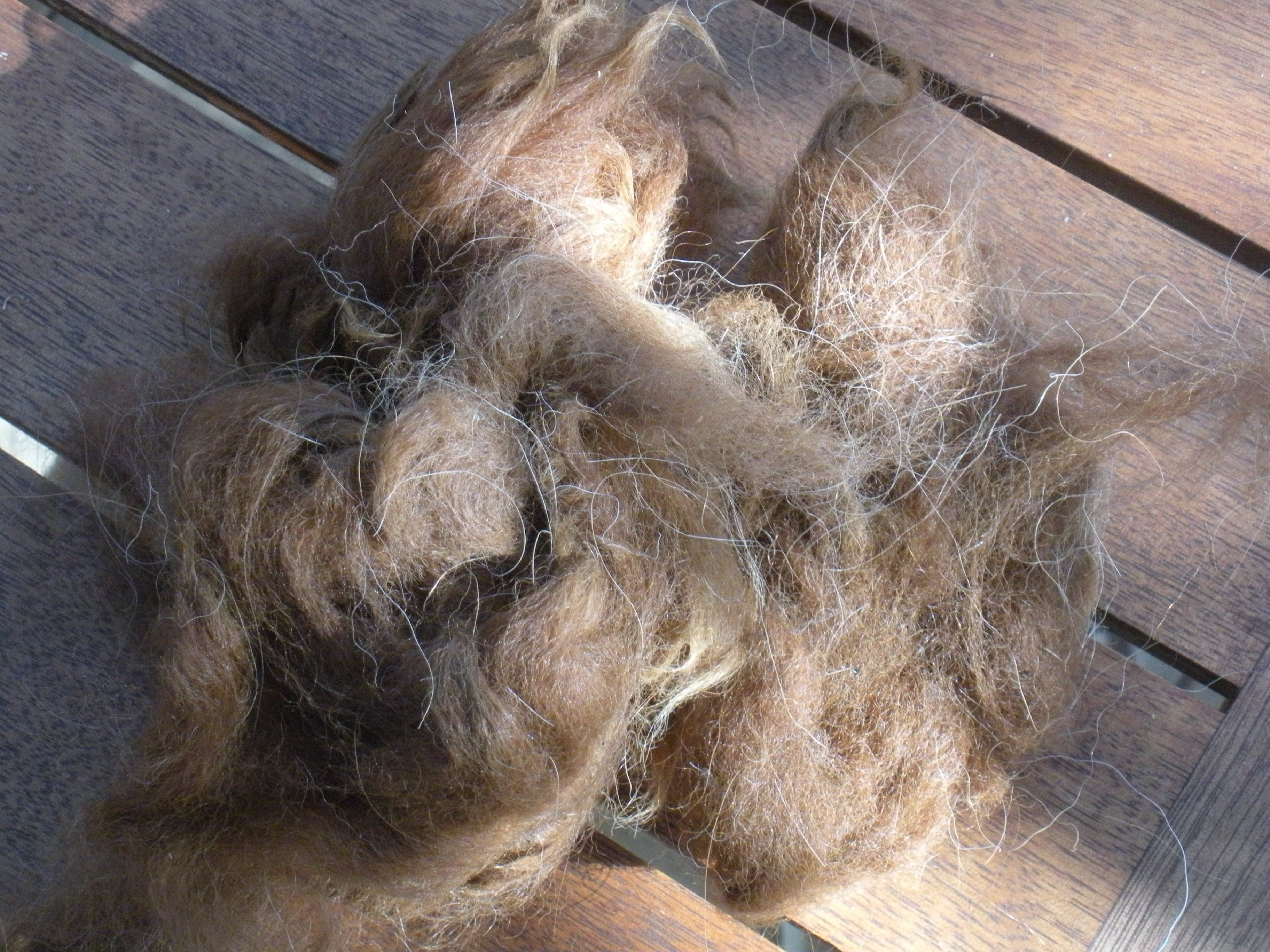
Anyway… having tried washing some more gifted alpaca fleece and some more gifted Polwarth, and using careful observation of how it behaves with flicking, combing and carding, I have decided the following.  1. The specific Polwarth fleece I am currently working on has tips that are weather damaged.  When I flick card them, they pull right off.  Is it any wonder that these paler tips appear as nepps in the batt when I card the same fleece? The other fleeces I have had from the same sheep don’t have these difficulties. The poor sheep must have had a tough year…

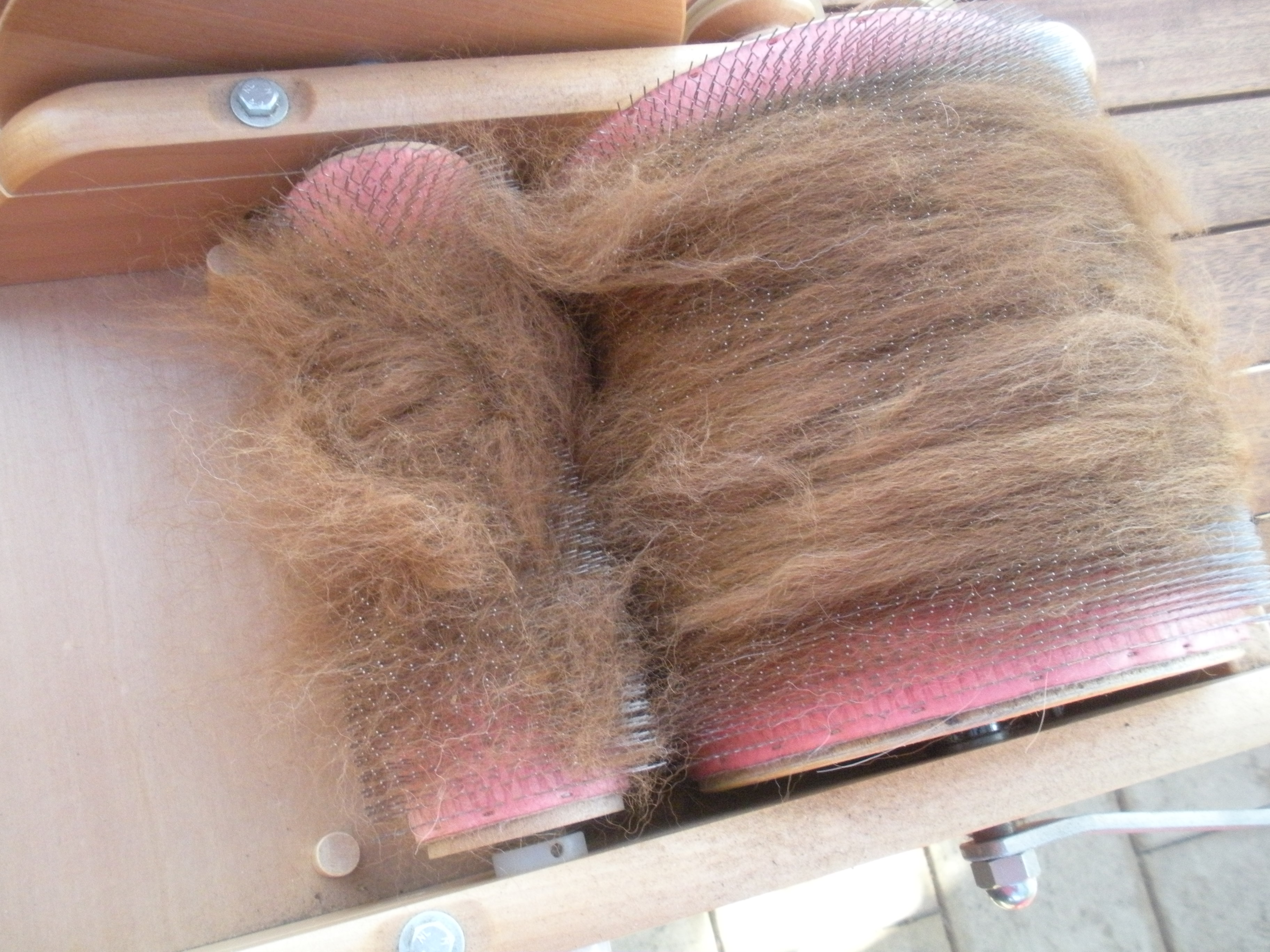
2. That same fleece has a break in it, so the longer locks are giving way under the tension involved in carding, again leading to less than optimal batts.  3. The alpaca is super short (happily, I have now worked with high quality alpaca and no longer assume this s just the way alpaca comes).  It has not really been skirted.  Most of it pulls onto the licker-in (the small drum on the drum carder) when carded. Yes, from the very start, and not only when the large drum is full.

4.That alpaca has big clumps of guard hair and has been shorn without consideration to the future spinner.  Hopefully the shearer was thinking of the animal’s welfare in taking so many passes!

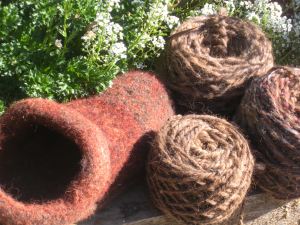
In short, these are not the highest quality fleeces possible and they would present challenges to anyone preparing them for spinning.  No matter how much time I spend I may not be able to turn these sow’s ears into the proverbial silk purses.  I have decided, instead, to attempt to turn them into felted slippers.  I am carding them together as a blend, spinning them up without too much fuss and very fat (good practice) and my ultimate plan is to knit slippers which will be felted and perhaps dyed.  Shazam!  Their less than ideal qualities will no longer be of importance.  I hope!

Here are my first few balls, and a slipper with some polwarth content and some eucalyptus dyed wool content to give me hope…
4 Comments

Filed under Fibre preparation, Knitting, Spinning, Uncategorized