Tag Archives: India Flint

Solace

India Flint posted some time ago about a new project of hers called Solace.  It speaks to lots of issues I think about a good deal.  Holding tough issues like climate change in my mind a lot, I found the concept of solace as a companion on that path a piece of genius.  She has asked for participants to make flags that could form part of an installation: ‘a collective impromptu poem, recorded on cloth, to sing in the winds’.  I love this idea too.  I pitched it to a group of friends who meet to figure out what we might be able to do about climate change.  We were thinking about despair and discouragement and how to respond to these things, and Solace seemed like one way to me.

2014-10-24 16.51.07

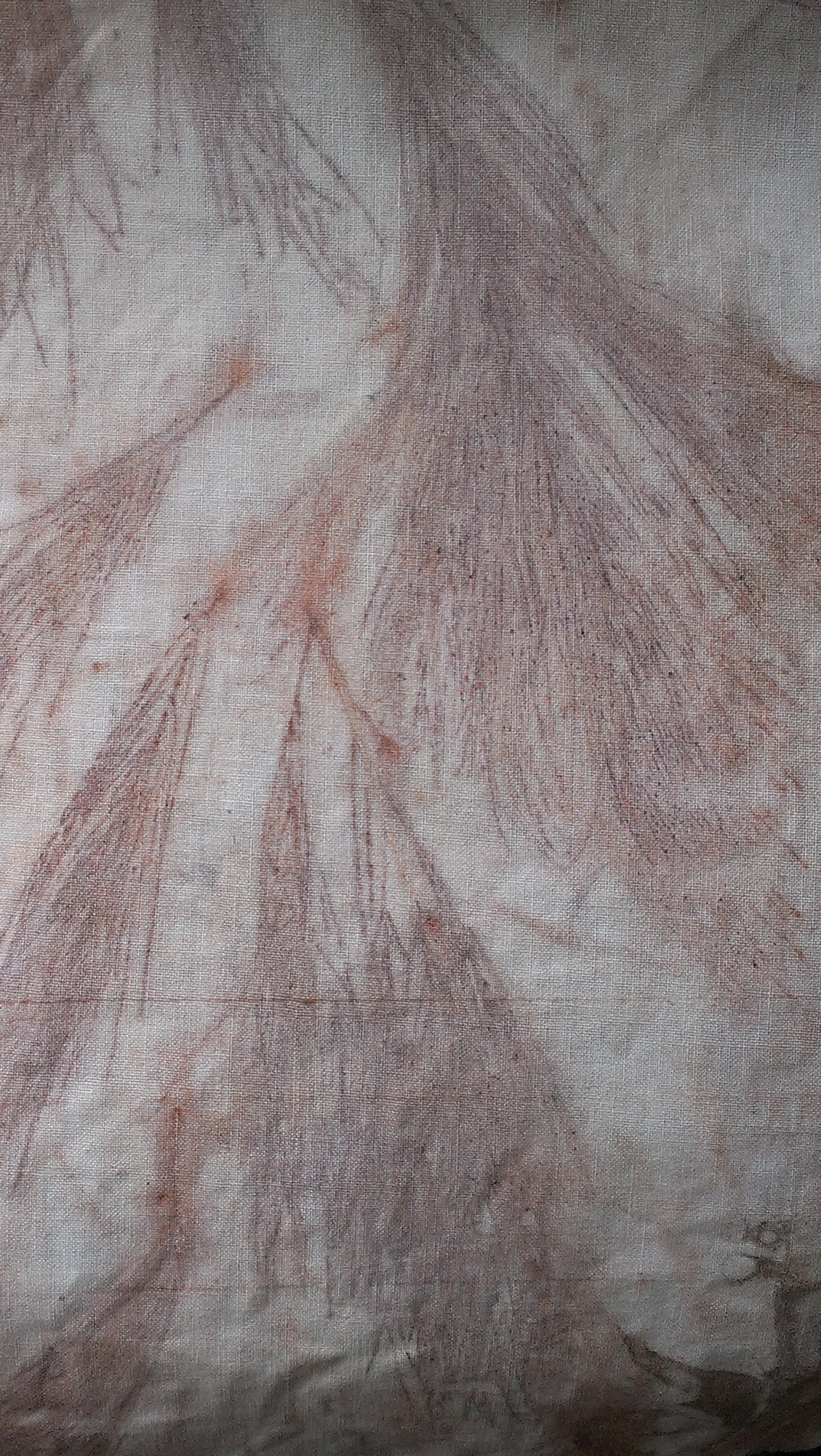
I packed my threads and other necessaries (and dinner…).  The core concept is to create a triangular flag (pennon) with a word or words stitched on it–so we needed thread and cloth.

2014-10-24 16.43.22

I also packed fabrics to share around… this one is a print of an extremely fine-leaved native she-oak… and sadly I wrote its name down in a very special secret place I cannot find now…

2014-10-24 16.43.42

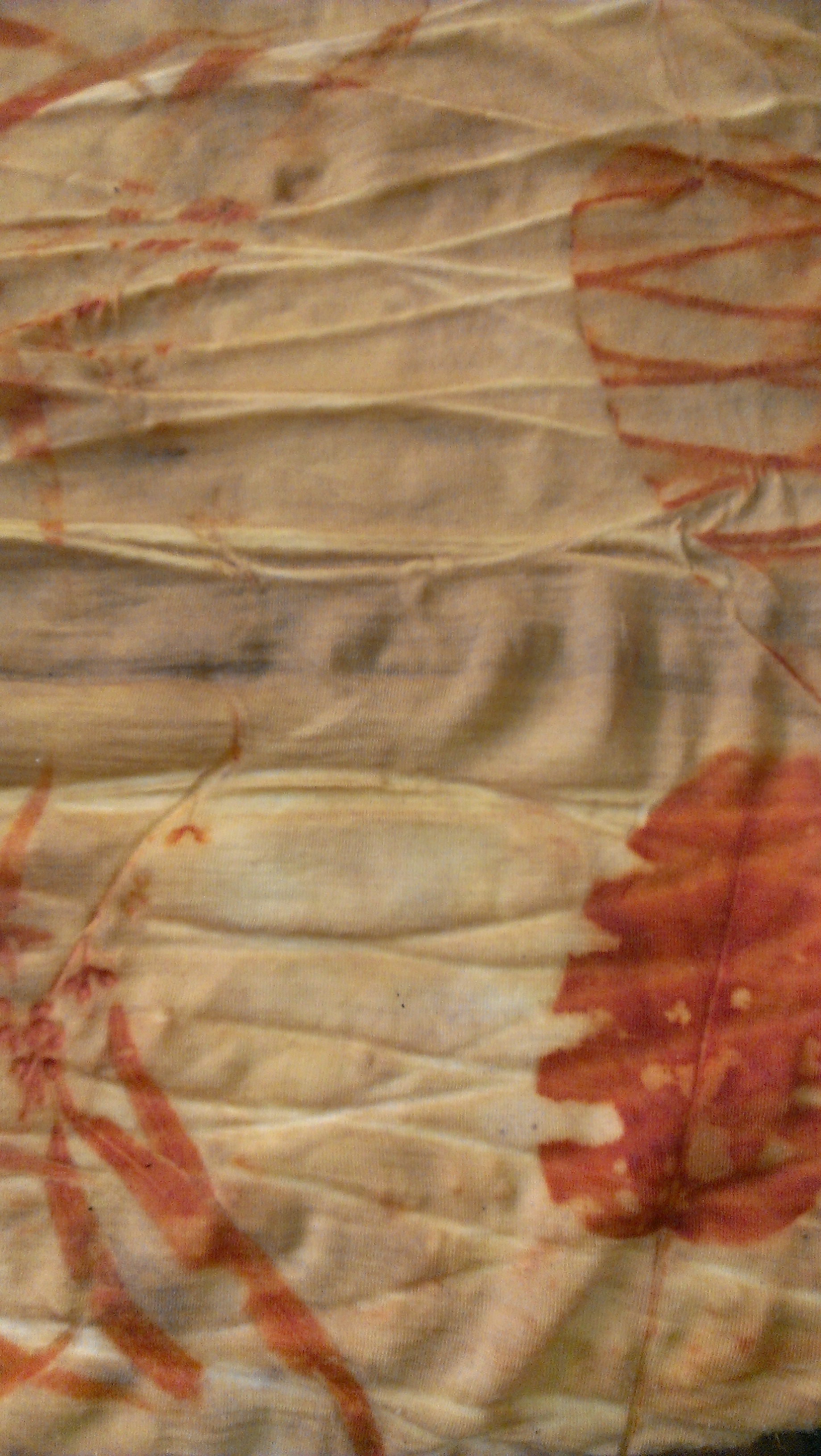
This print resulted from a tip India gave me at her workshop.  It was so exciting when I unwrapped this bundle it is hard to believe months have passed without my having another attempt at that glorious green!  My dear friend took this piece of fabric home with some marigold-dyed thread for him to finish later.  There are some others in development too…

2014-10-25 19.17.22

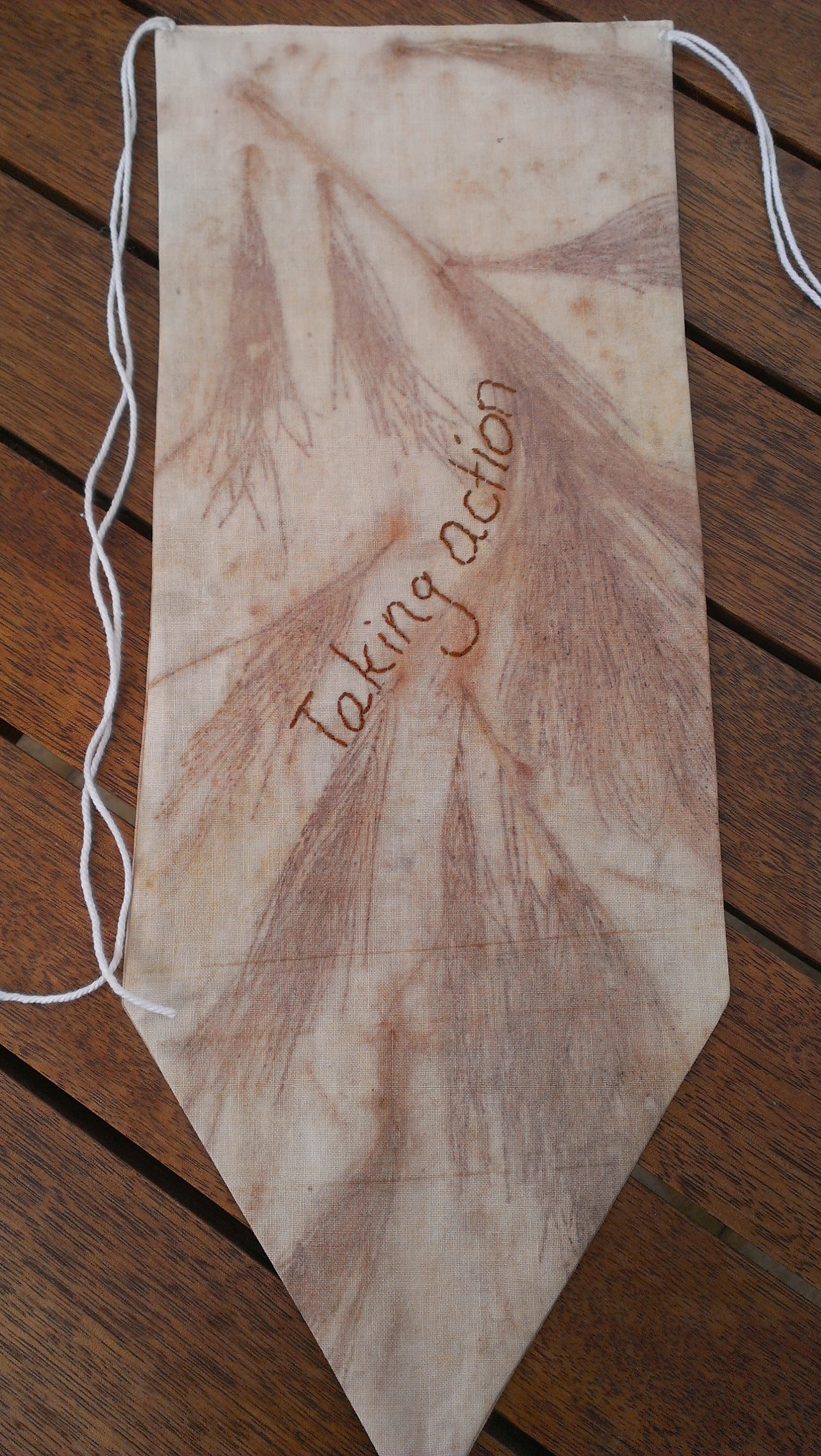
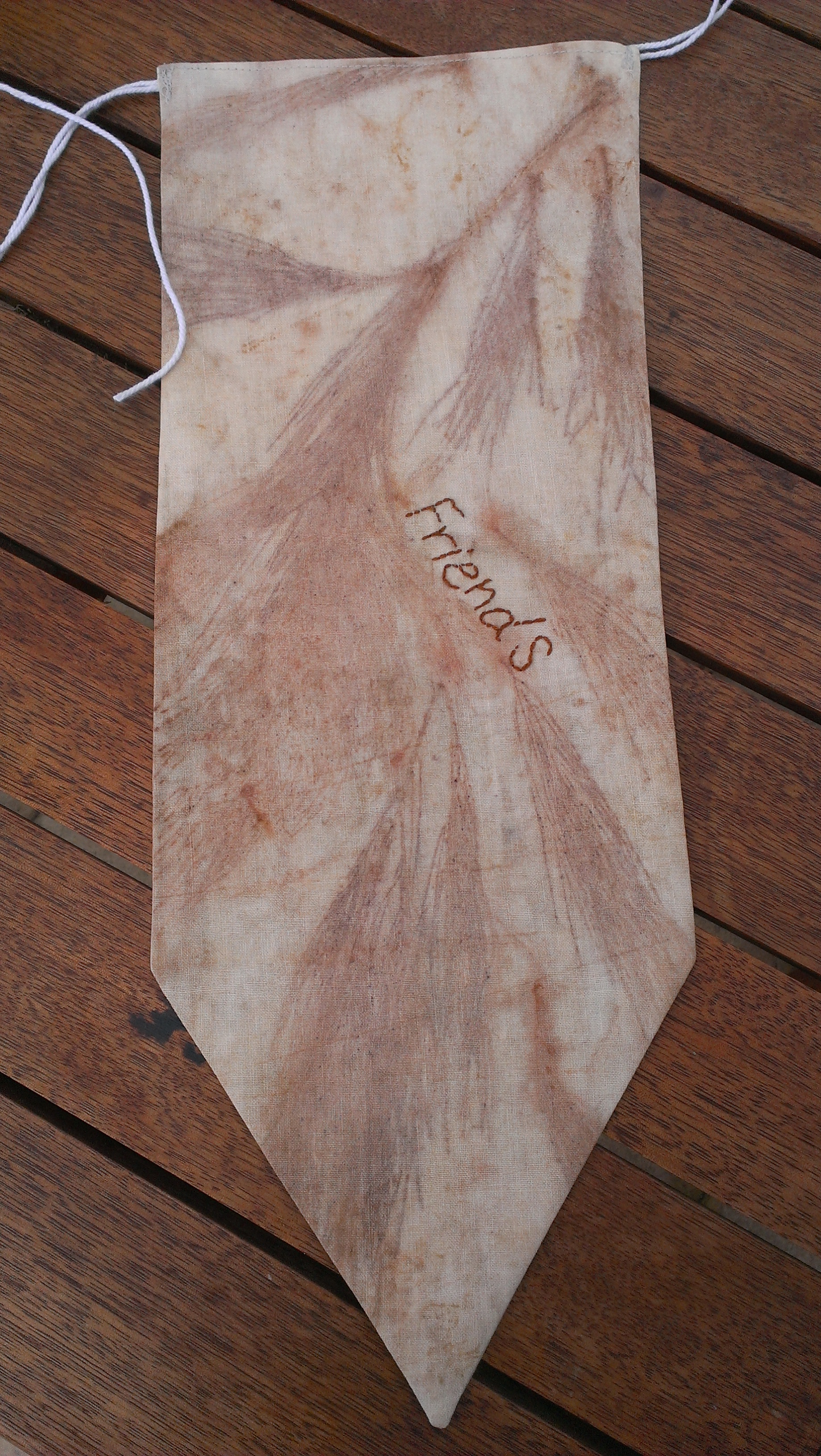
This one is a print from a friend’s pecan leaves.  India proposes: ‘Stitch on it a word or a phrase or a sentence that might act as a wish for peace or an acknowledgement of beauty, imply a sense of stillness or simply something that  gives you solace. It can be as brief or as long as you like. A haiku, a snatch of song, a word that takes you where you want to be.’

2014-11-02 09.25.22

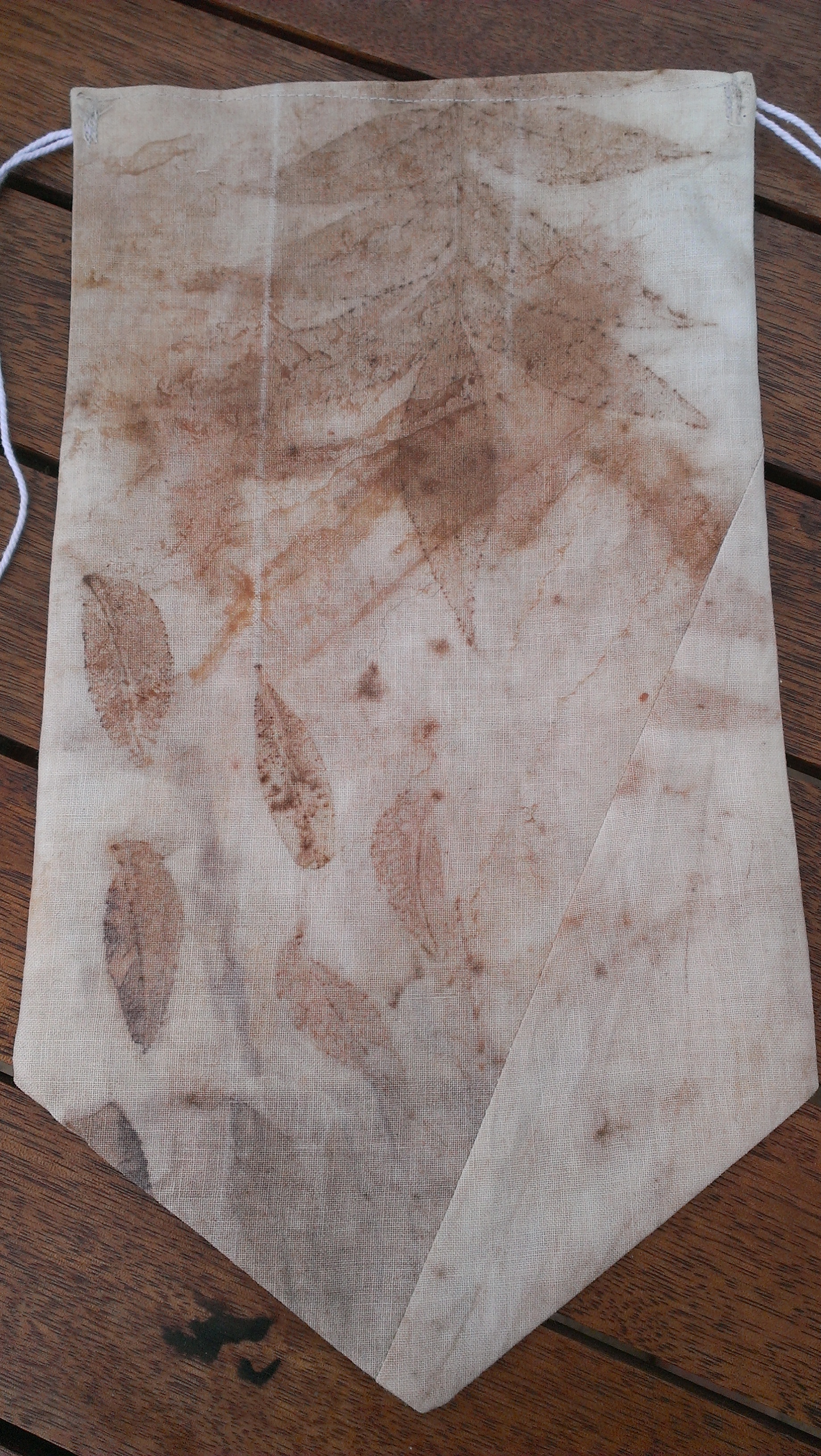
Now for the confession.  I can’t quite believe that I managed to take my eye off the rather simple instructions and make these shapes and not triangular flags as requested. Do not follow my example in this respect!  I am not sure how I’ve become so forgetful, or so bad at following instructions!

2014-11-02 09.25.29

I will either have to make some more–which I might do anyway for sheer pleasure and participation’s sake–and keep these ones at home–or just send these and hope that they will be OK in a crowd of triangles.  Perhaps with some triangular pennons for company.

2014-11-02 09.25.00

So… there is my start on joining in Solace for now. Anyone else participating?

2014-11-02 09.25.11

21 Comments

Filed under Craftivism, Leaf prints, Sewing

Alyogyne Huegelii

Alyogne Huegelii is a spectacular flowering shrub that is native to Western Australia.  It is drought hardy but blooms profusely, and this very much explains its popularity in gardens here in Adelaide.  There are a couple of these shrubs flowering spectacularly in my neighbourhood at the moment.

2014-10-19 19.21.35

One of the things I really like about natural dyeing is the fact that you can enjoy flowers, gather them as they fall or pass their best, and have the joy of the flower as well as your dyepot.  So I have been stopping by to collect fallen flowers from the footpath and the gutter, and pulling withered blooms that will not re-open.

2014-10-19 19.21.16

I crammed the dried petals into my jar along with some vinegar, foil, water and a woolen sample card.  For those who are not familiar, this is India Flint’s Stuff, Steep and Store process.  I have no idea if these flowers will yield dye–they are from the same plant family as hibiscus (and hibiscus petal yield dye)–so they do seem promising–but they are free and readily available and there is nothing but time to be lost by trying them out.  I might learn something!

2014-10-18 09.19.51

After cooking, I had a deep purple dyebath in my jar.  So I gave it a label, added it to my collection, and now we wait.  It belatedly occurred to me to check my reference books.  The Handweavers and Spinners Guild of Victoria’s Dyemaking with Australian Flora (1974) reports that they achieved pink-fawn using cream of tartar as a mordant (I haven’t heard of cream of tartar being used without alum, so I have learned something already).  They also achieved green and pale lemon with chrome, which I am not prepared to use.  My sample card has alum-mordanted and rhubarb-leaf mordanted sample yarns, as well as an unmordanted sample–and the jar contains aluminium foil.  Joyce Lloyd and India Flint’s books are silent on the matter.  So–we’ll just have to see what happens.

2014-10-19 13.39.32

I later decided on an alkaline jar, since hibiscus dyes are ph sensitive, and created another.  It leaked green liquid when I heated it, but the jar as a whole doesn’t look green (yet).

2014-10-24 15.41.50


Oh.  And, we have moths.

2014-10-25 13.46.05


8 Comments

Filed under Dye Plants, Natural dyeing

Quilt border dyeing

2014-10-04 18.05.19

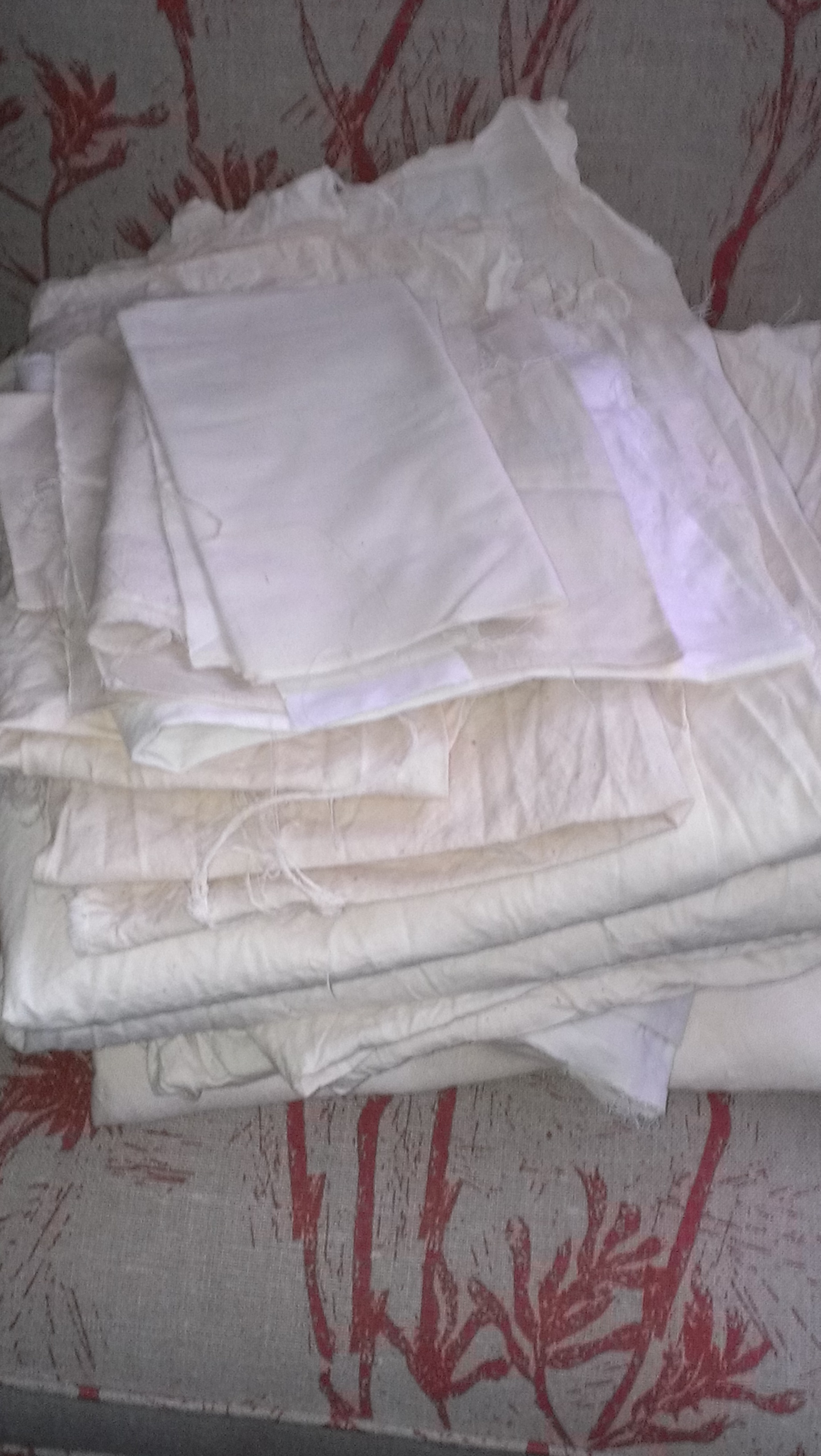
I came into a lot of fabric and various other items from a friend’s mother a while back, as some of you might remember.  Most of it I found happy homes for among friends and their connections, and through the Guild.  However, I did keep all the calico and other forms of plain, undyed natural fibre fabrics.  There was cotton sheeting, parts of calico sacks, pieces of cotton fabric from which some item or other had been cut, and some small pieces of linen that  might have been intended for embroidery.  There was one piece of raw silk, too, I  believe.  The cottons joined the other fabrics that have been queued up for the soybean bath.

IMAG0955

I have also been re-mordanting fabrics that didn’t turn out as I had hoped, and some that I mordanted with tannin to no especially good effect in the past. Here is one such piece of cloth before dyepot.

2014-10-04 13.47.21

I kept remembering India Flint’s wonderful statement at the workshop I went to.  Perhaps I am quoting freely, but it went something like : ‘Everything will be beautiful when it’s finished. And if it isn’t beautiful, it isn’t finished.’  So all manner of things hit the bucket, and then the dye pot.  Others are still waiting.

2014-10-04 13.59.55

I think these fabrics will make a good quilt border, and hopefully I now have enough to get all the way around my quilt.

2014-10-04 18.08.59

Even the over-dyed or previously tannin-mordanted fabrics came out more interesting than they went in.  I think they will make good binding for the quilt.  They should tone in nicely but offer some contrast.  Recent measurements indicate that I have more than enough so…. no excuses, it must be time to assemble this thing!

2014-10-04 18.08.49

3 Comments

Filed under Leaf prints, Natural dyeing

An invitation, a week 2 silkworm update and some random happenings

Let me begin with some dignity, because it won’t last. Soon we’ll be back to silkworms and other silly stuff.  Anne Harris of Annie’s Workroom would like to invite you to her exhibition.  It’s in Brisbane, Queensland–I am sorry to report this means I won’t be able to see it.

Invite Back & Front

Expressions of Love: Lovingly Interrupted brings together established contemporary artist Kim Schoenberger’s collection of treasured memories assembled from the humble teabag. And introduces emerging artist Anne Harris’s work of naturally dyed, painted and stitched images exploring the emotions of love. Official Opening 14th September 3.30pm. Closes 28th September: Gallery 159, 159 Payne Road, The Gap, Brisbane.  There is a special bus to make it easy for sunshine coast people to attend. Please call  Anne 0433 162 847 for more information or visit her on the web.

And now… for the silkworm update of the week.  OMG, as they say in the classics, the silkworms are still hatching!  I have been struggling to figure out a cross-national item to give a sense of scale (US coins don’t work for me).  Here is my trial object.  Let me know how I’m doing!

IMAG0983

Here is a close up of silk worms in several stages of growth–with more hatching every single day two weeks after they started!  They were all laid as eggs within a couple of days of one another, I hasten to add. What more can I say? There is still just one mulberry tree with leaves on it in the neighbourhood.

IMAG0984

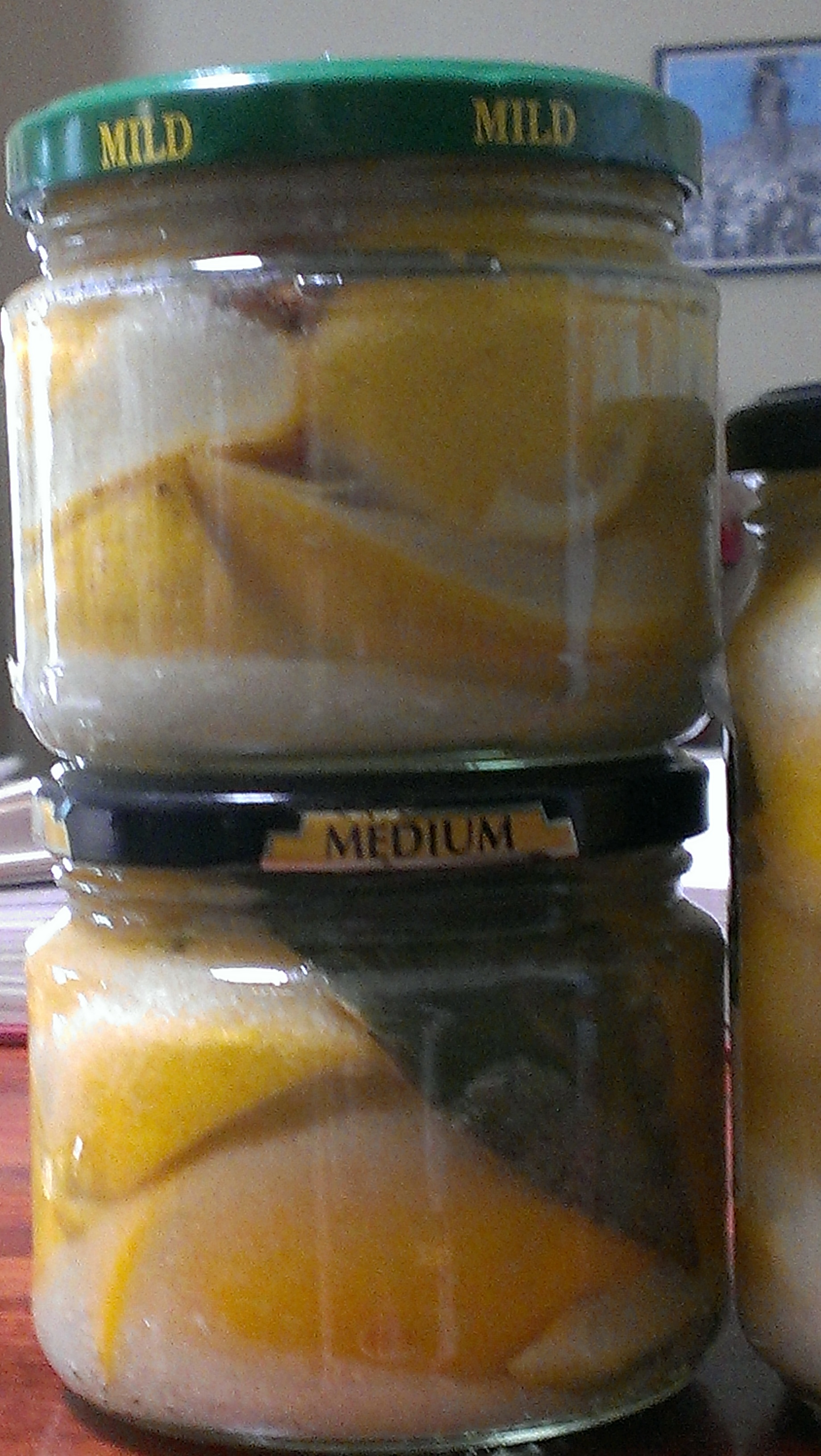
On the weekend, there was lemon preserving (the salty kind)… inspired in part by an anonymous donation of a bag of Meyer lemons left on our porch.  Three cheers for the grower and the tree!

IMAG0946

I had the urge to cast on, a lot.

IMAG0957

I also had the urge to dye and since it was warm and sunny, took advantage by mordanting fabric for future leaf prints.  I had the realisation some time ago that I had somehow managed not to find a section on mordanting cellulose fabrics, with quite specific instructions, in Eco-Colour.  I had always wished there was a section like that in there.  Happily India Flint has indeed put it in her gorgeous book and if only I had paid more attention… Anyway, since I can’t change the past, I have been waiting for sunny weather to dip and dry and dip and dry on a principle somewhat different to the one I have been experimenting with–and now the sunshine is here I got to it!  Good dyeing times are coming…

IMAG0942


12 Comments

Filed under Fibre preparation, Knitting, Natural dyeing, Neighbourhood pleasures

India Flint: ‘Back Country’ Barossa Regional Gallery

The South Australian Living Artists’ Festival has begun, and yesterday I went out to Tanunda to the Barossa Regional Gallery to see India Flint’s latest local exhibition, Back Country. Needless to say, I can’t show pictures of the exhibition itself, but India has posted some here and (later) here.  Her pages also include the poem the exhibition is named after, which speaks to my concerns about this continent of ours and of the planet.

Back Country contains works using a wide variety of skills, techniques and materials.  As you enter, you can see the eponymous poem painted onto the wall–in mud, perhaps, which is drying in a bowl beneath.  There are sculptures of found objects.  In the foyer, what looked to me like well worn and weathered metal parts of some kind of machine were arranged in a rather glorious horizontal triptych.  I wished I had my father with me—he would have known what those parts were or been prepared to voice his best guess equally confidently!  He is such a lover of all things metal, he would have been very entertained by some of the pieces on display, I think.  There was part of an old innerspring mattress–just some of the metal springs and their framing, mounted on the wall and titled ‘Sweet Dreams’–that made me grin.  So did the equally ironic rusted steel ‘snake’ and ‘string of pearls’.

There were many works on paper, some using eco printing (so far as I could tell); with or without stitched on textile fragments, others using plant dyes and other painting media, some bearing marks from metals.  Some were stitched, others treated with resin and made substantial and glossy.  Many contained repeating motifs–I wandered up and down one series painted and printed onto the pages of a book that might have been a dictionary entertained by the words peeking out from the paint and markings.  I love the way that each individual part of such a work has a life of its own that is in some way made different, more significant and more substantial through its relationship to other parts that are like it and yet unlike it.  A bit like human beings, really.

Rather wonderfully, there was one installation of bones suspended from the ceiling which had been partially coloured and (to judge from the list of works) treated with beeswax in a way that made them gleam in the gallery lighting.  It had been installed near an airconditioning duct outlet so that the bones were turning lazily in the afternoon sunlight.  I probably would have liked this installation if it hadn’t been moving, but the slowly twirling bones were particularly splendid.

2014-08-03 14.21.19

Turning to textiles… one of my favourite pieces was ‘groundsheet’, which the list of works describes as ‘vintage silk, pre-used cot sheet, plant dyes, stitch’.  The sheen of the silk formed the face of the work turned toward the viewer, while  another fabirc, which I assume was the cot sheet–perhaps flanellette–formed a light absorbing matte edge on two sides and seemed the have been stitched on as a backing.  I am always itching to touch and explore details, but respect decrees that I keep my itchy fingers in my pockets.  The leaf prints and resists on this quite large work were detailed, many rounded, and in a dark palette of greys, browns and blacks.  A similar palette and use of silk were evident in a series of smaller textile works using eco-printing called ‘ dust and sunlight’.  The effect of greys and blacks and the sheen of silk evokes silver in places in a way that gives a lovely gleaming, luminous quality to the paler parts of the work.

The work that seemed to me to have been set up as the feature of the exhibition can be seen at the link I’ve provided (with some of the works on paper on the walls in the background).  It is a floor length silk and wool dress suspended above a dark woollen blanket which has darker eucalypt prints on it (and a contrasting–cotton, I assume–darn in it).  The absent woman in the dress is surrounded by a suitcase and rusted enamelware, a common feature of Australian home life in the past that has largely gone out of fashion. To my mind, it gives an impression she is preparing to leave home. I don’t assume that is the artist’s intention–I have played in bands and had people explain to the songwriter what her songs are about–not!–while she politely listens with muted surprise…

I loved the dress.  It is sleeveless, the neckline and armscyes bound and stitched.  A small number of pleats below the neckline begin a cascade of complex folds and drapes.  I lack the language to describe the way this effect has been created.  Insets and piecing have been used in the lower parts of the gown to create volume which is gathered up and stitched in place to allow it to fall again in a different form of cascade.  The back of the dress features a shaping sash tie.  The upper part of the dress–which is not a separately stitched bodice, though at the back it is framed by the neckline and sash–features striking rust-brown and orange abstract contact prints.  There are small prints of gumnuts or buds and the odd leaf scattering down the fall of the fabric.  Yet there is quite a bit of paler colour–silver-grey and almost white, especially toward the hem (more evident in person than in the photo India has posted).  The contrasts are rather lovely.

So there you have it.  If you’re keen to see more images of India’s works on paper–you might like to look at fieldnotes on blurb: the preview will suggest what these works might be like–and of course, may tempt you to seeing more…

2014-08-03 14.22.06

The gallery itself is not exciting from the outside, though the inside was full of light, white walls and a lovely wooden floor.  It’s one of the myriad soldiers’ memorial halls built to commemorate Australian soldiers who lost their lives in the world wars.  They tell a story of many lives lost and so gravely missed from so many small rural communities.  This one has suffered a coating of grey spackle over its original frame, as the picture shows.  Since the new expressway from Adelaide to its north has numerous overpasses each named after a battle (some in Vietnam, some in Europe)… the futility of war and the realities of present wars were on my mind as I headed for Tanunda.

Inside the hall, the fallen were remembered with an intricately carved wooden memorial and pictures.  And right at back of the hall is a truly extraordinary pipe organ, which evidently used to live in the Adelaide Town Hall (a much bigger building, since Adelaide is the capital of this state).  It seems that it has only recently been restored and is soon to be celebrated with a concert.  It is certainly glorious in its restored state–gleaming, beautifully decorated and positively towering over an exhibition space. That room also contains a tapestry of the Barossa region called ‘Woven Recital’ worked by Katharina Urban (a member of my Guild) and the Barossa Weavers.  It includes images recognising the Indigenous peoples of the region, famous colonial women and men, and the wine tradition of the area as well as some of its current recreational activities—cycling and hot air ballooning.  There is also  a quilt depicting the Barossa Valley and celebrating its history of German migration , wine making , coopering and associated skills, religion, farming and famous buildings.  So, local folk–you have all of August to go and visit.  The Gallery is on Basedow Rd just off the main street, where I had never previously found it when wandering Murray St, Tanunda.


16 Comments

Filed under Leaf prints, Natural dyeing

Bundle dyeing–and a new book

After the recent massive vat dyeing project, and with so many Eucalyptus Cinerea leaves lying around drying slowly, I was itching to dye some bundles. After a full day of mordanting and dyeing and sewing in windy overcast weather… here’s the view over the back fence and up into the sky.

2014-06-28 17.26.19

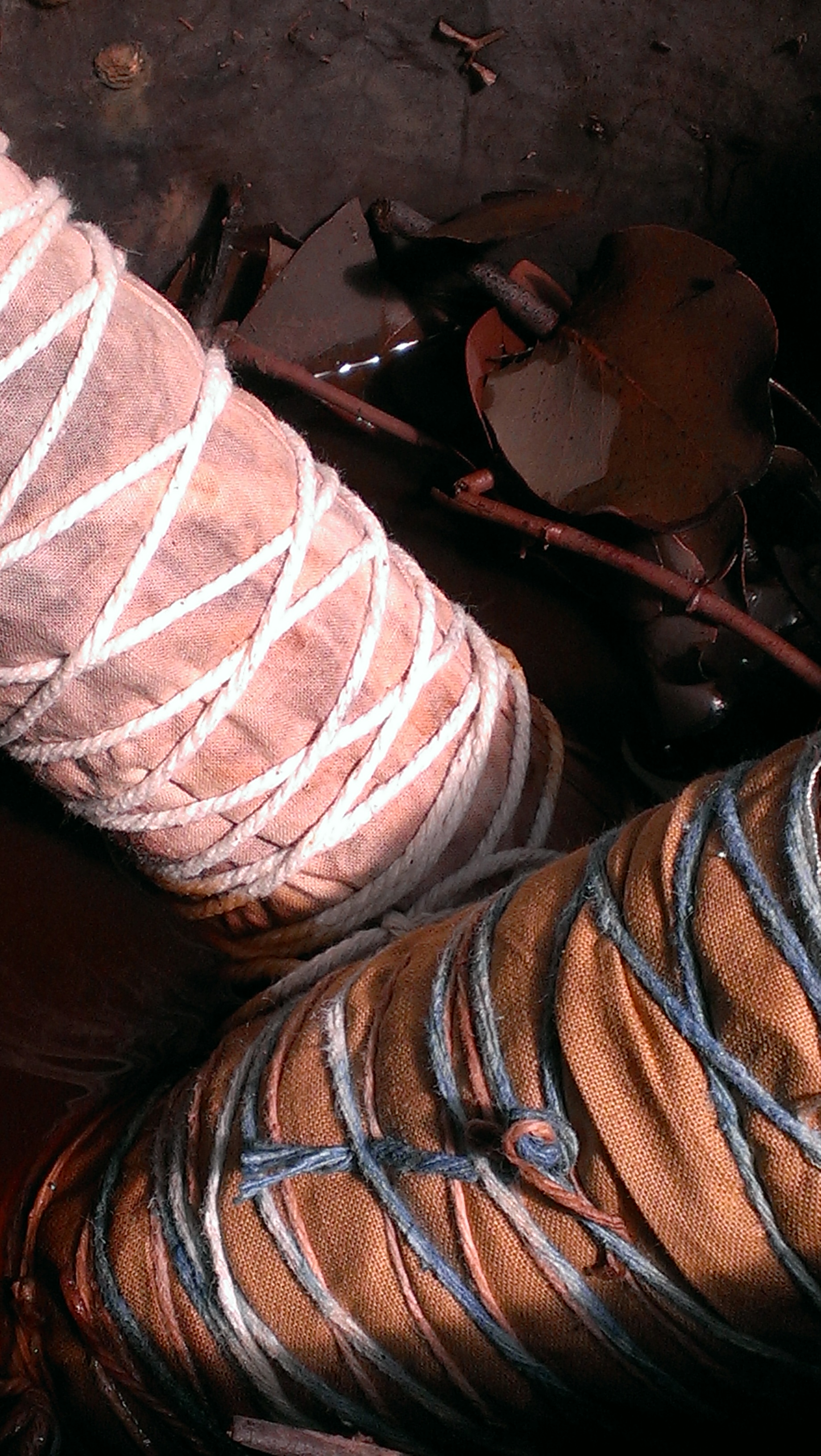
I had a piece of silk twill left when one of my workshop participants didn’t appear. In it went.  I also had a linen shirt and a cotton t shirt sourced at op shops and ready for renewal that I had mordanted in summer.  By the time I tied those bundles the sun was setting.

2014-06-28 17.19.53

I filled the pot with madder exhaust, and topped it up with some of my very-much reused alum pot. As the remains of the madder rose up the fabric and the temperature rose, the sun went down.

2014-06-28 17.25.37

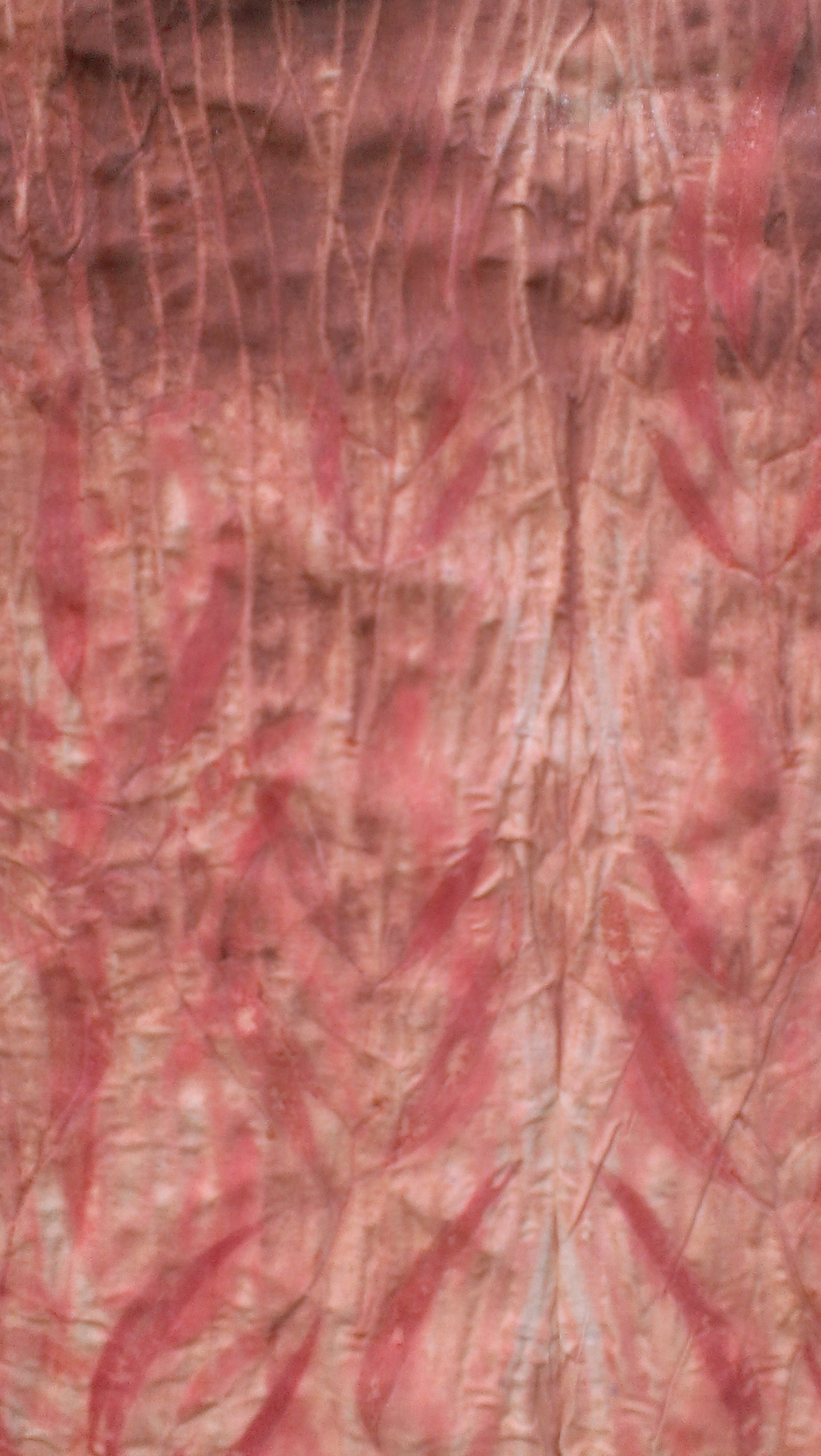
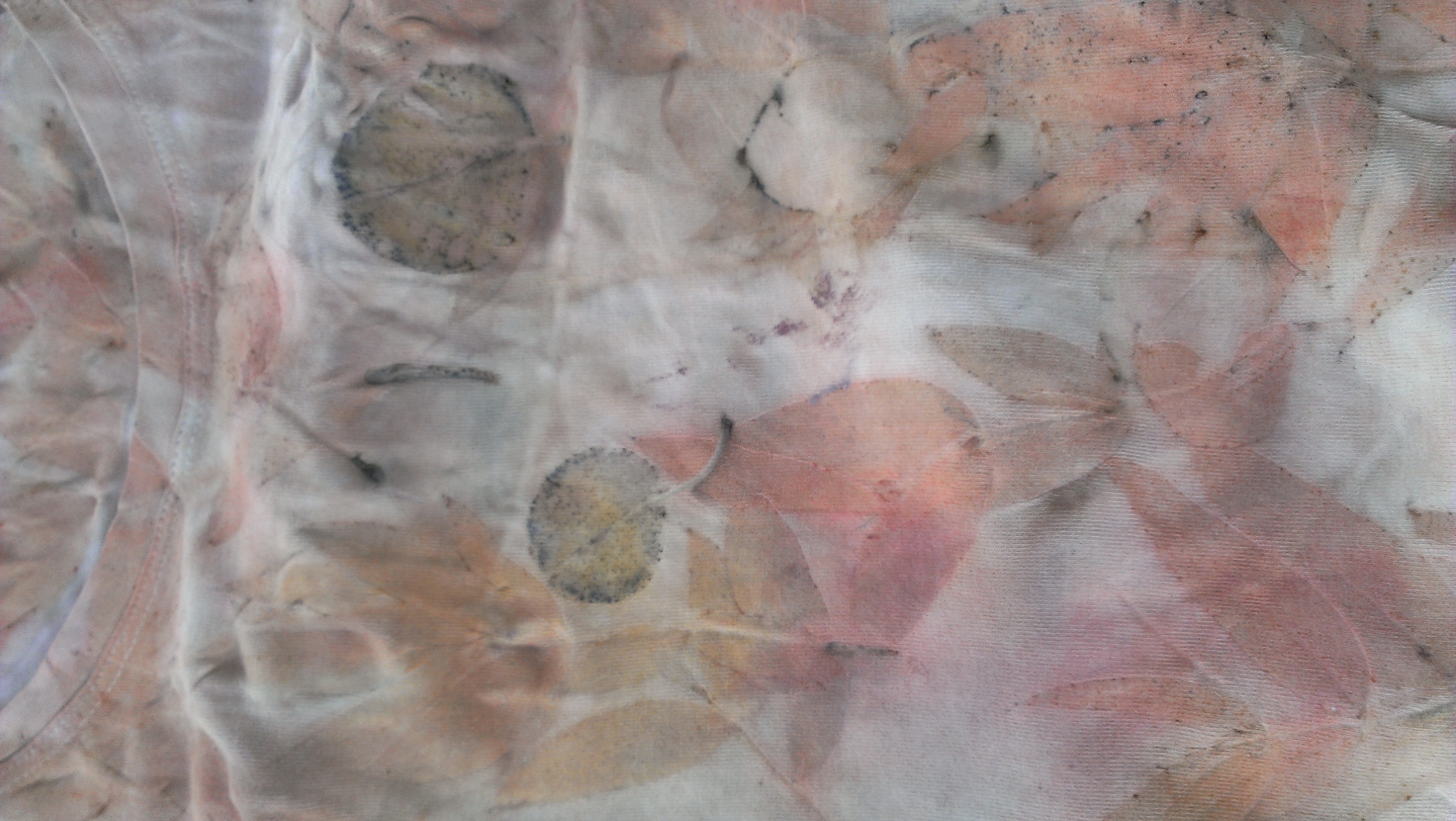
When I opened these first two bundles the impact of the chalk in the madder pot became clear.  And despite having allowed the leaves to dry for days, it is midwinter here.  Those leaves would have started out full of water, and they are drying very slowly.  Interesting results… This is the silk twill.  The round green shapes are from dried E Cladocalyx ‘Vintage Red’ leaves.

2014-07-16 09.10.56

This is the t shirt.

2014-07-03 16.41.11

Here is the part of the t-shirt bundle that was in the madder exhaust/alum blend.  So little colour from the E Cinerea!

2014-07-03 16.41.25

I decided to set the third bundle (linen shirt) aside and give it some more time in the pot, which I did after work later in the week. Front view:

2014-07-16 09.12.15

Back view.

2014-07-16 09.12.31

If you wish you could try this method and have experiments of your own and bundles to untie at your place–but you’re not sure where to start, India Flint has just published ‘the bundle book’.  It is a concise introduction to her technique on fabrics and on paper.  You can see an extensive preview if you follow the link.  This book is unspeakably cute–being both small and exquisitely illustrated with photos to inspire.

2014-07-17 09.29.06

It presents information about techniques (such as dyeing paper) not covered in her earlier books, strategies for sustainable and safe dyeing and a history of the eco-print method.  It also addresses fresh ideas developed since the publication of Eco Colour and Second Skin.  And, it is full of India Flint’s inimitable voice.  I am old enough to remember when recipe books were sold on  the basis of recipes and not celebrity cooks, and when the writing was bland and spreadable.  I don’t miss the bland and spreadable writing, though I’m less sure about the cult of celebrity cooks.  No danger of bland here!  I very much enjoy the sense of a unique intelligence at work on subject matter I think about a lot that is a feature of India Flint’s writing.  It is a rich addition to her insights and strategies about harvest, recycling and dyeing.

This book is published on demand, which is a no waste, effective way of publishing a book for something short of a mass market. I suspect it also means that the book you order in Australia is printed here, but a book ordered in North America will be printed there, and not have to travel the seas or skies to reach you.  The printed versions of the book are fairly expensive, however.  If your wallet is up for it, it’s a great way to support an independent artist and the end product is delectable.  If your wallet isn’t up for it, the downloadable pdf option is instant and very affordable, and still a great way to support an independent artist.

I’m looking forward to trying out dyeing paper… perhaps when the rain pauses (I went out to figure out why the gutters were overflowing mid-edit on this post–and fixed the trouble with my dyeing tongs!).  While the rain continues, I’m having a knitting jag suitable to the weather…

16 Comments

Filed under Book Review, Leaf prints, Natural dyeing

Of shoes, and ships, and sealing-wax. I mean, of silk, and string, and bias binding…

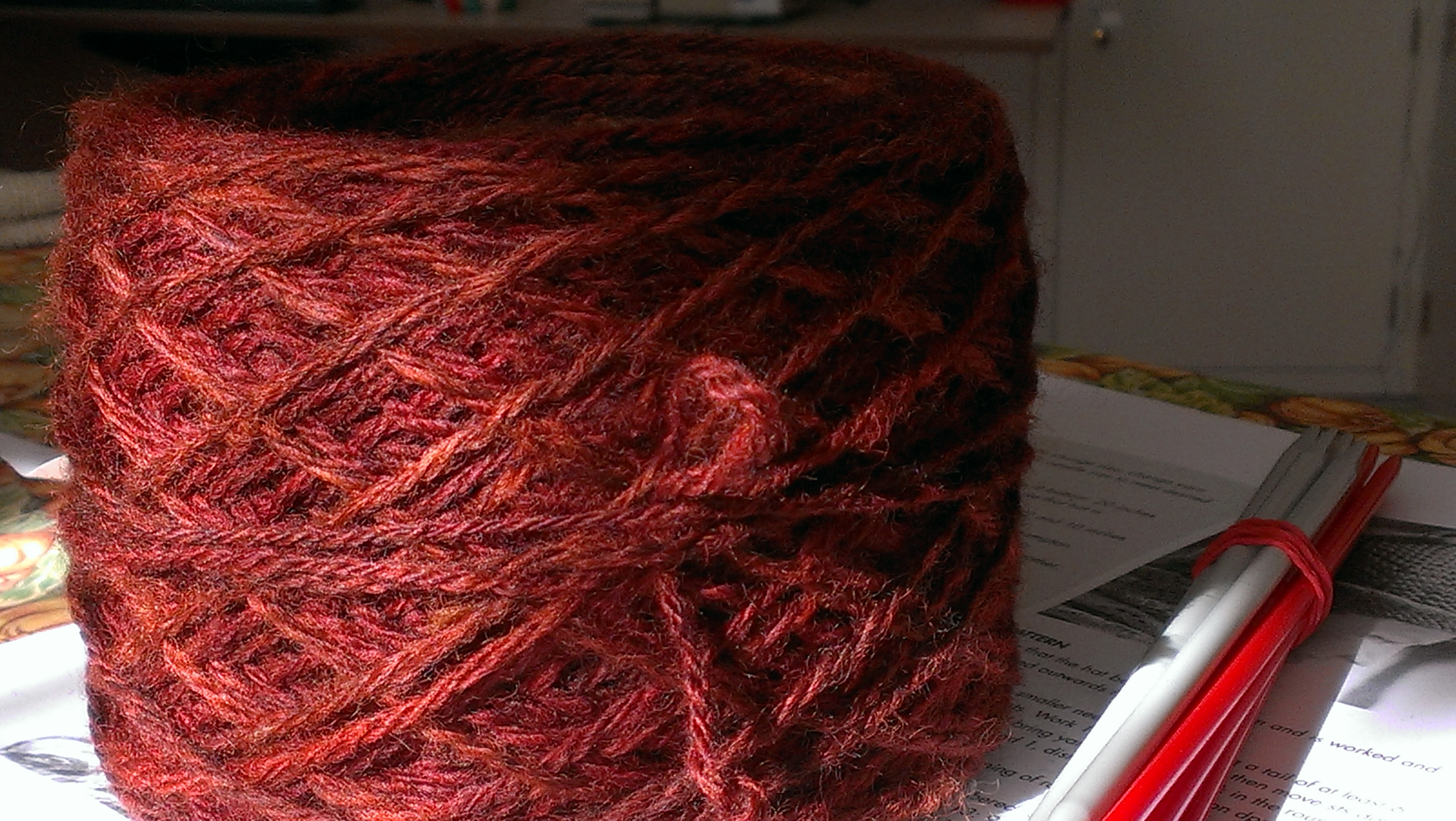
Sometimes you need a lot of Jabberwocky genius to join disparate elements into any kind of intriguing whole.  Or perhaps you just need rhyming couplets. I have neither, but I do have string and bias binding. I blame India Flint for infecting me with her enthusiasm for twining string.  I loved doing it with plant leaves, but it required pre-planning.  String from fabric shreds… you just decide it’s time and get going!

2014-07-04 12.46.48

I have shaggy string from my pyjama-making jag a while back.

2014-07-04 12.49.29

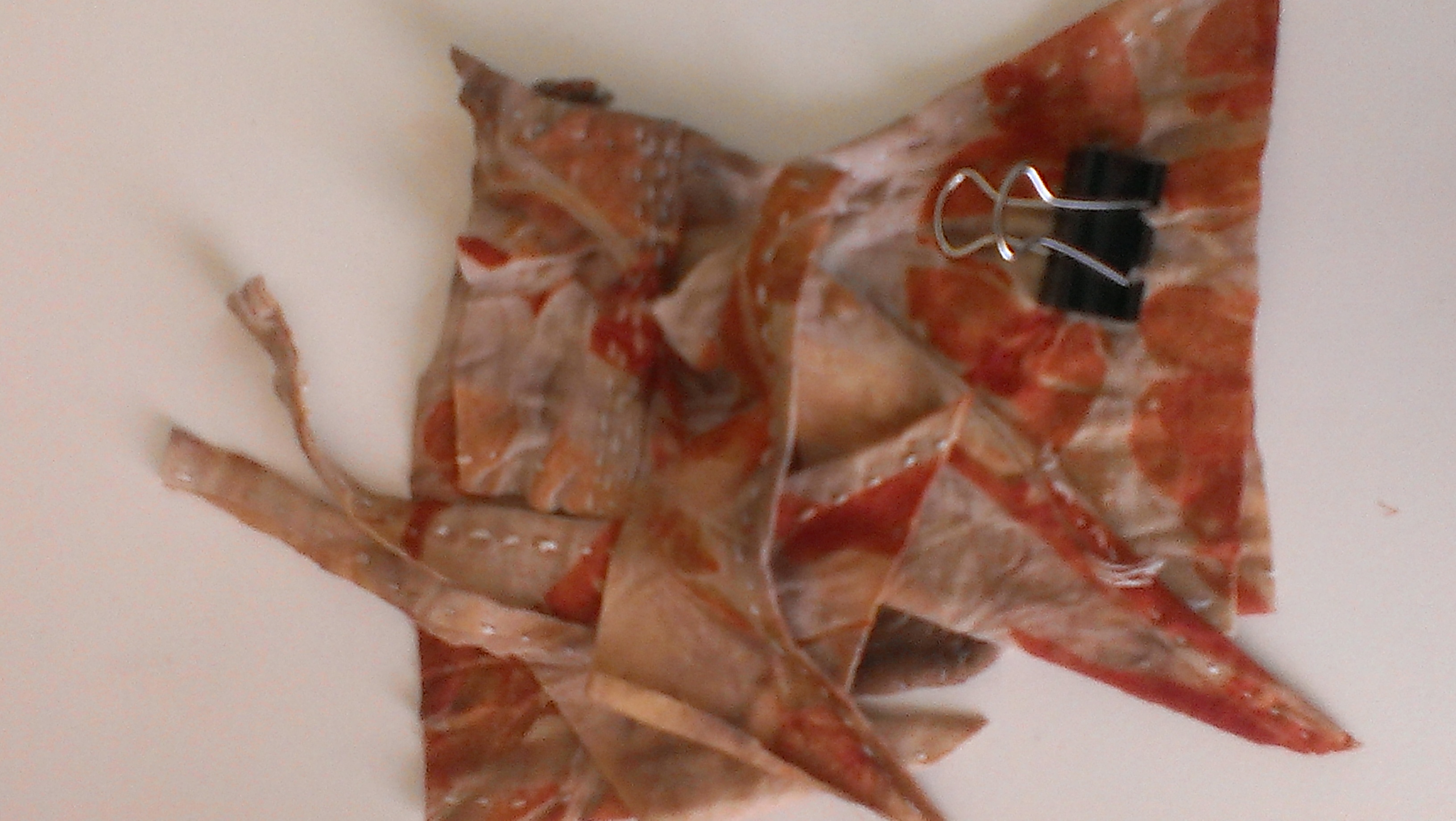
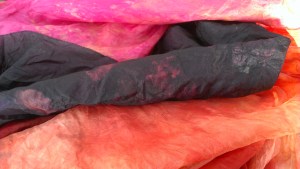
However, Wendi of the Treasure suggested silk string.  And then along came an opportunity to dye silk all kinds of wild colours.  I took up some silk paj that was among my very first Eco-Colour adventures. It took colour then, but not in any really riveting way, and it has been in the cupboard awaiting a new idea for some years.  Wendi’s was the new idea.  When it hit my workshop dye pots, the original onion skin and eucalypt dyed portions created all kinds of interesting effects.
2014-06-15 15.32.37

Thanks to Wendi and India, I now have logwood-dyed string so deep purple it is almost black, madder-dyed orange string, and cochineal pink string.

2014-07-04 12.52.33

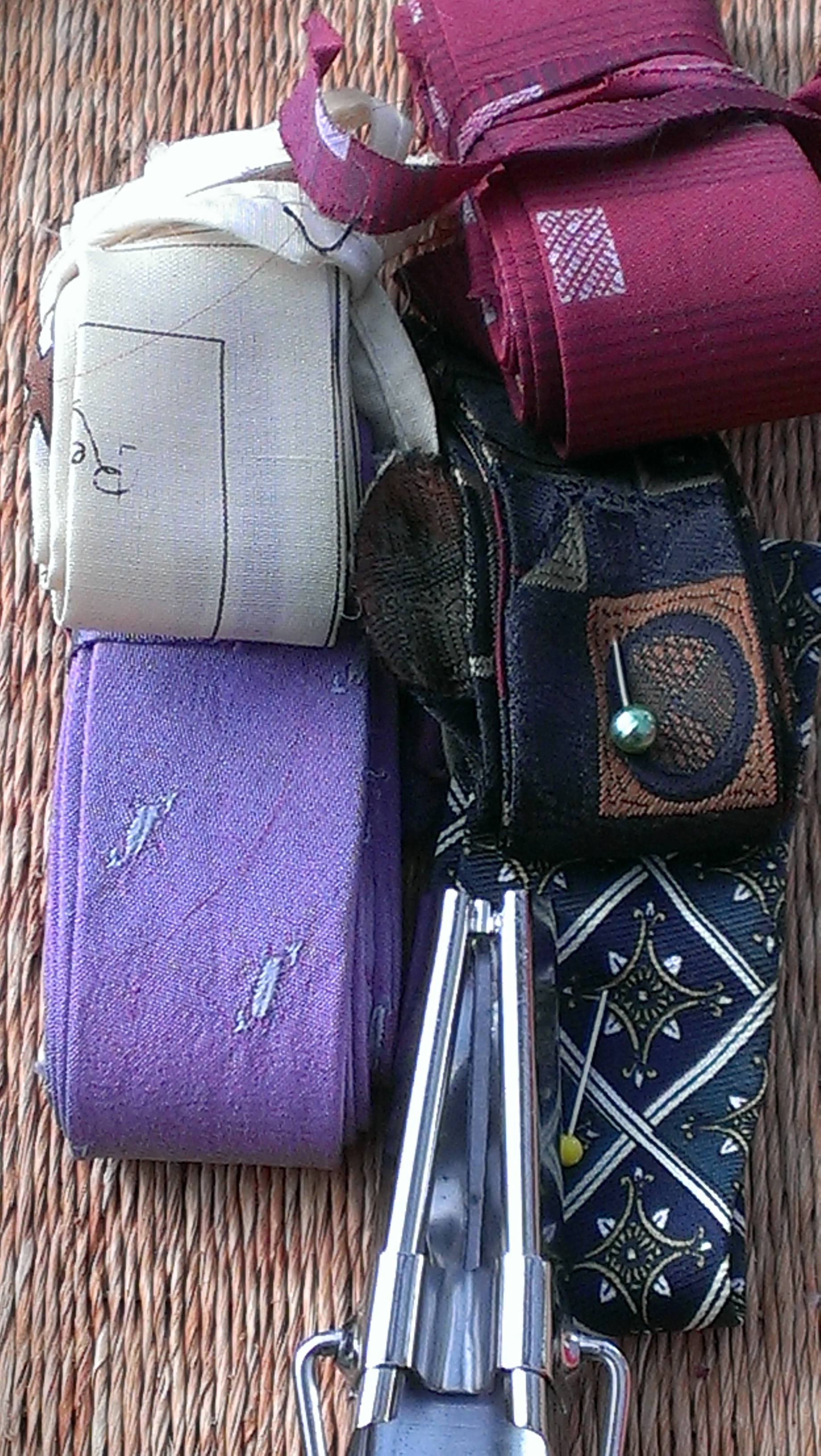
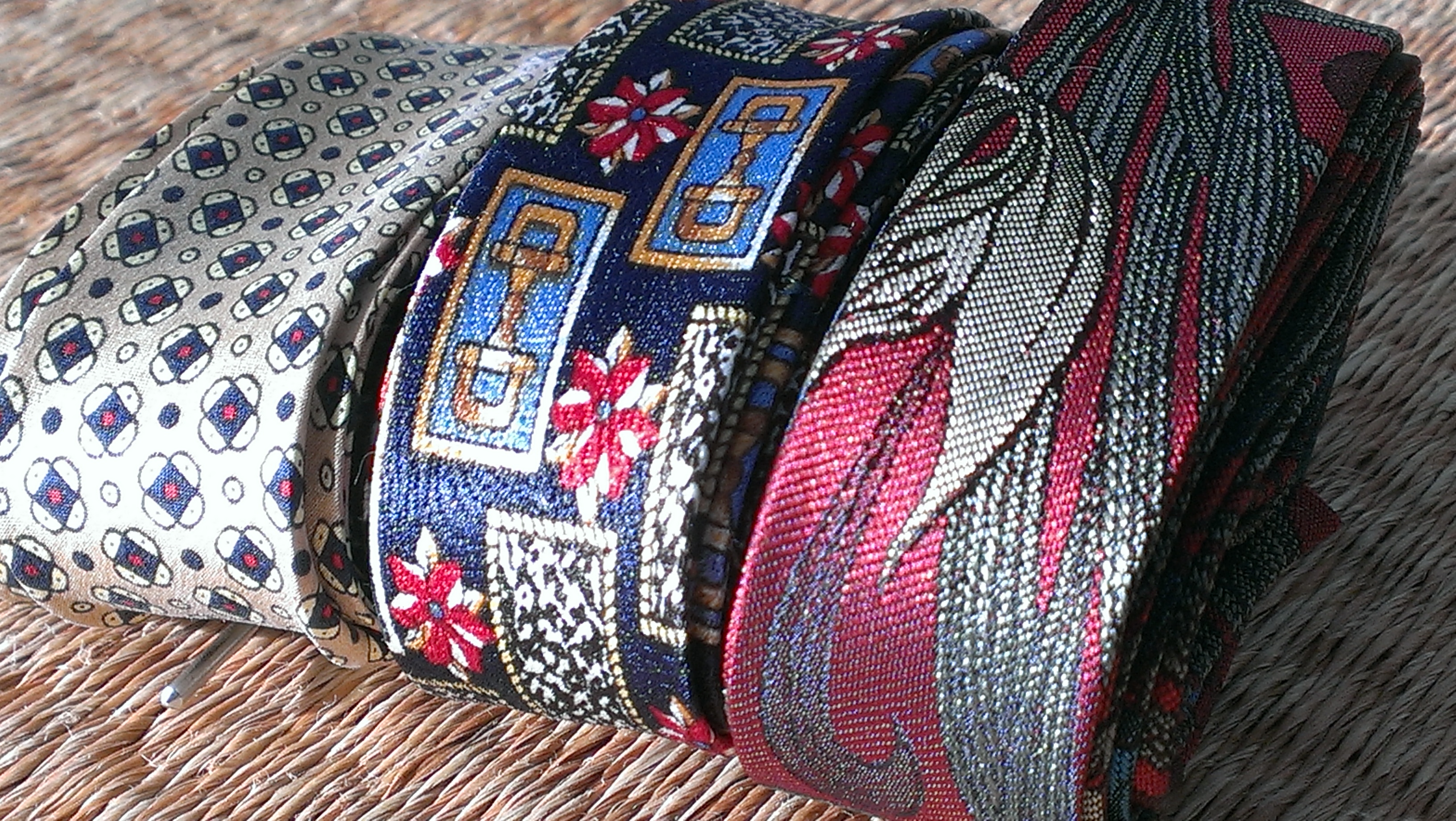
But there is more… I have had some ties unpicked, ironed and ready to be made into bias binding for years.  What can I say?  I have been engaged in a task in relation to my day job so mind numbingly dull that I realised the time for bias binding making was upon me, all of a sudden!  The existing collection of tie-bias binding was getting low.

2014-07-04 12.55.23

I now have this…

2014-07-04 12.54.14

And this… so if I am struck by the urge to create garments again soon, I’ll be able to create beguiling interior details in a heartbeat.

2014-07-05 14.51.45

Mercifully, my marking is over, too.

10 Comments

Filed under Natural dyeing, Sewing

Natural dyeing workshop

I began the final stage of preparation for my natural dyeing workshop by packing the car to capacity the night before and steeping logwood and madder in hot water. These are more of the dyes that have been left at the Guild.  It seemed good to share them with other Guildies this way.

2014-06-12 16.20.18

I came through the parklands on my way to the Guild and stopped in homage to a few trees.  This one turned out to be E Tricarpa…

2014-06-14 08.32.52

The unpacking was quite a thing.  This is a view of the back seat of the car before unpacking.

2014-06-14 08.42.38

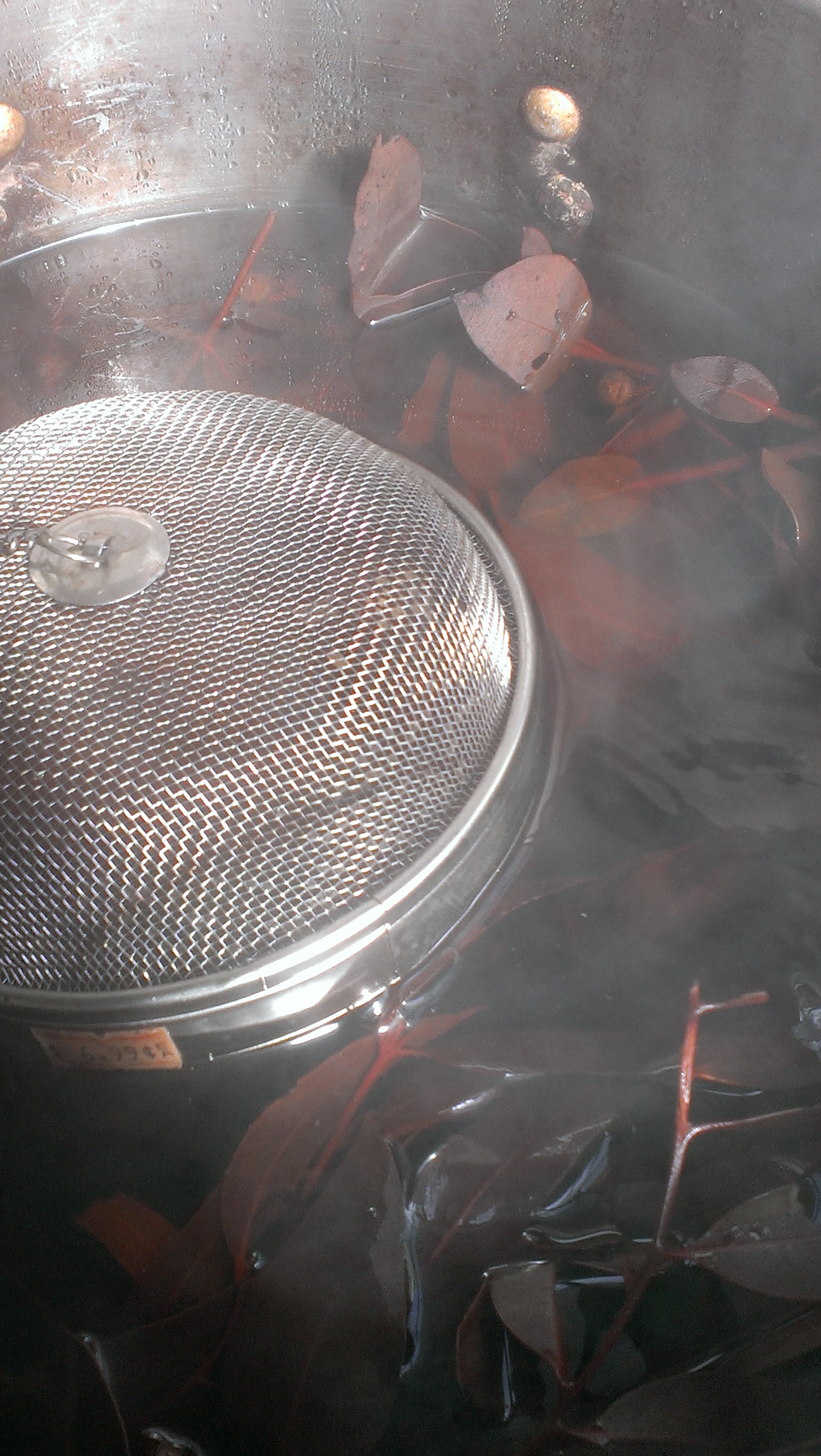
The steeped fermenting walnut hulls (another dyestuff left at the Guild) travelled in the front seat footwell, in a pot with a lid, in a big bucket in case of spills.  No spills.  Whew!! I put heat under them an hour before people arrived in hopes of getting it over with.  My friends, I will never do this again.  It may take me years to live down the smell this dye pot gave off!  At one point when a heater went on, someone told me they had found a dead mouse in the heater.  When I went to see, they were looking for a mouse they were sure must be in there because they could smell it.  Cough!  The women who were rostered on in the Little Glory Gallery in another part of the Guilds premises exclaimed.  So did the treasurer, who came in to work on the books and was similarly appalled.  Eventually walnut tailed off and a eucalyptus bark dyepot began to prevail.  The smell of natural dyeing had people who had come to the gallery wanting to come and see what we were doing all day!  I give you the walnut hulls I will be living down at the Guild for years to come.  They produced an inky dye.  Truly impressive.

2014-06-14 09.08.23

I set up a bit of a display table of yarns and knits, leaf prints, tea cosies, sample cards and books.

2014-06-14 09.41.47

People had their first go at India Flint’s eco-print technique.  Some had read the book but never tried it.  I don’t know how people can resist!  The Guild has a copper which had been repaired because we were planning to use it.  Use it we did!

2014-06-14 11.08.32

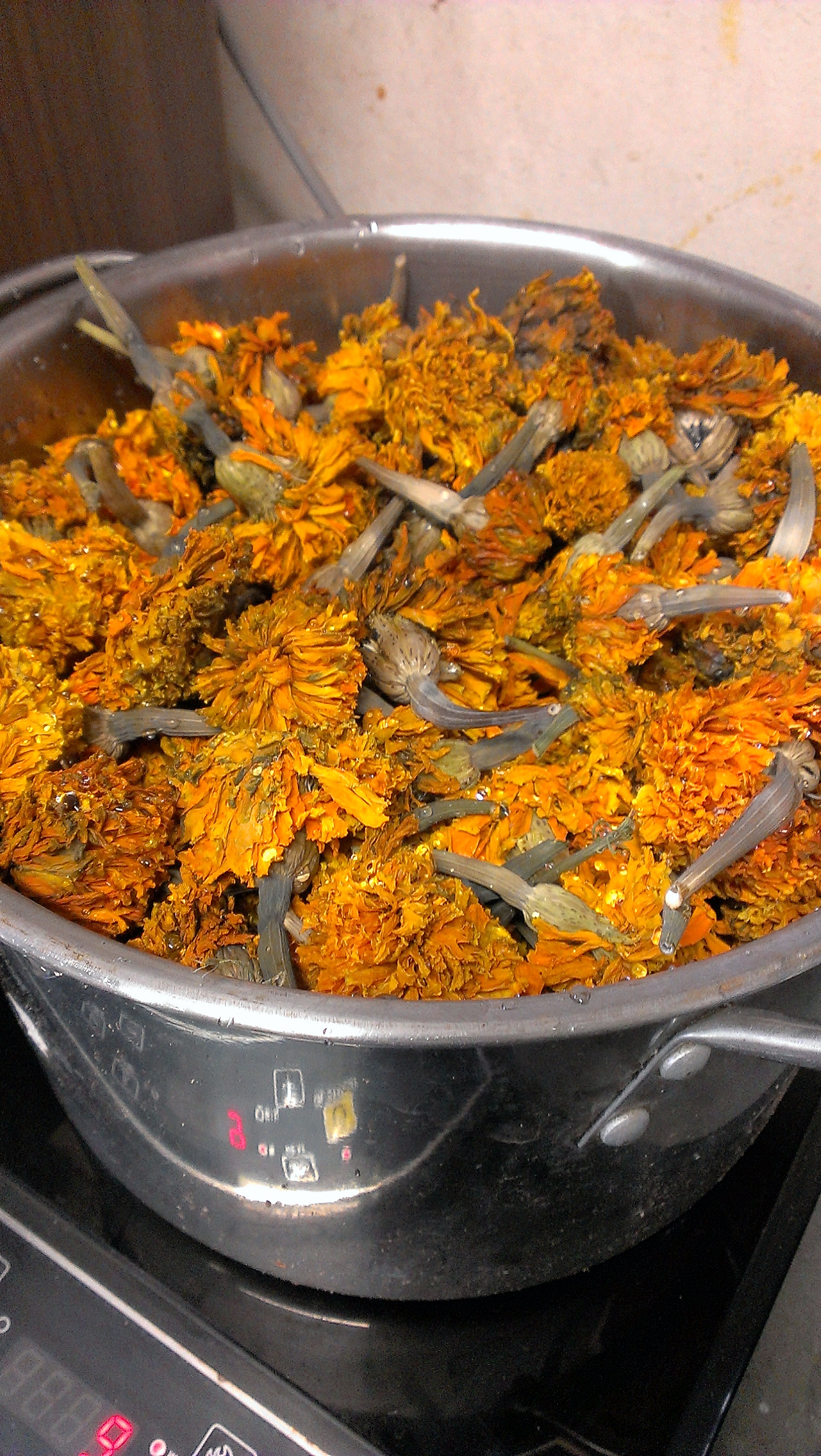
My Mum deadheaded her African marigolds for me through summer and they made a great yellow.

2014-06-14 13.42.52

I tried grinding the soaked madder in a blender as Rebecca Burgess suggests (the second hand blender was pretty challenged) and here it is in the dye bath, in its own stocking… we got some lovely reds.

2014-06-14 13.43.07

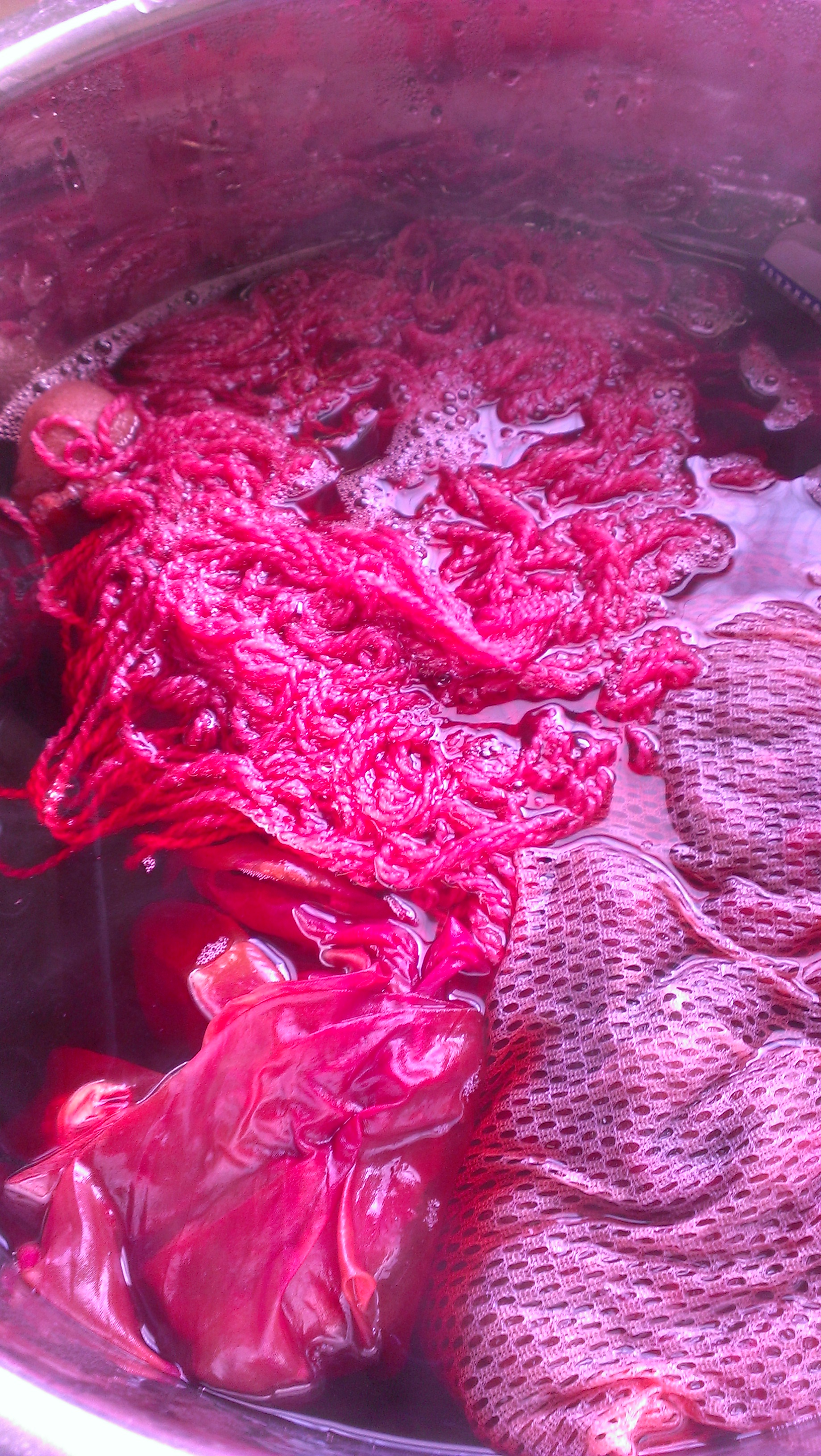
I used one of the bottles of pre-ground cochineal that had appeared in the dye room cupboard.  The colour was entirely startling!

2014-06-14 14.20.01

There was a pot of logwood that came out so deep it was virtually black.  There was a pot of E Scoparia bark that gave some burgundy on the first round and some tan for a skein added in later.  There was an E Scoparia leaf pot and an E Cinerea leaf pot–oranges of different shades.  The dye room at the Guild has four gas burners as well as the copper–so we went wild.

The wonder of unwrapping eco print bundles never wears thin!

2014-06-14 15.07.14

I used the opportunity of being at Beautiful Silks in March to acquire organic wool as well as silk noil twill and some silky merino for this workshop.  E Cinerea did its wonderful thing.

2014-06-14 15.07.21

And so did human imagination…

2014-06-14 15.07.35

The string print on the upper right of this next image was a lovely surprise…

2014-06-14 15.07.51

It was overcast and the results of the dye vats which were the focus of the day are seen here in all their glory drying in the Guild car park! These are eucalyptus and logwood.

2014-06-14 15.11.00

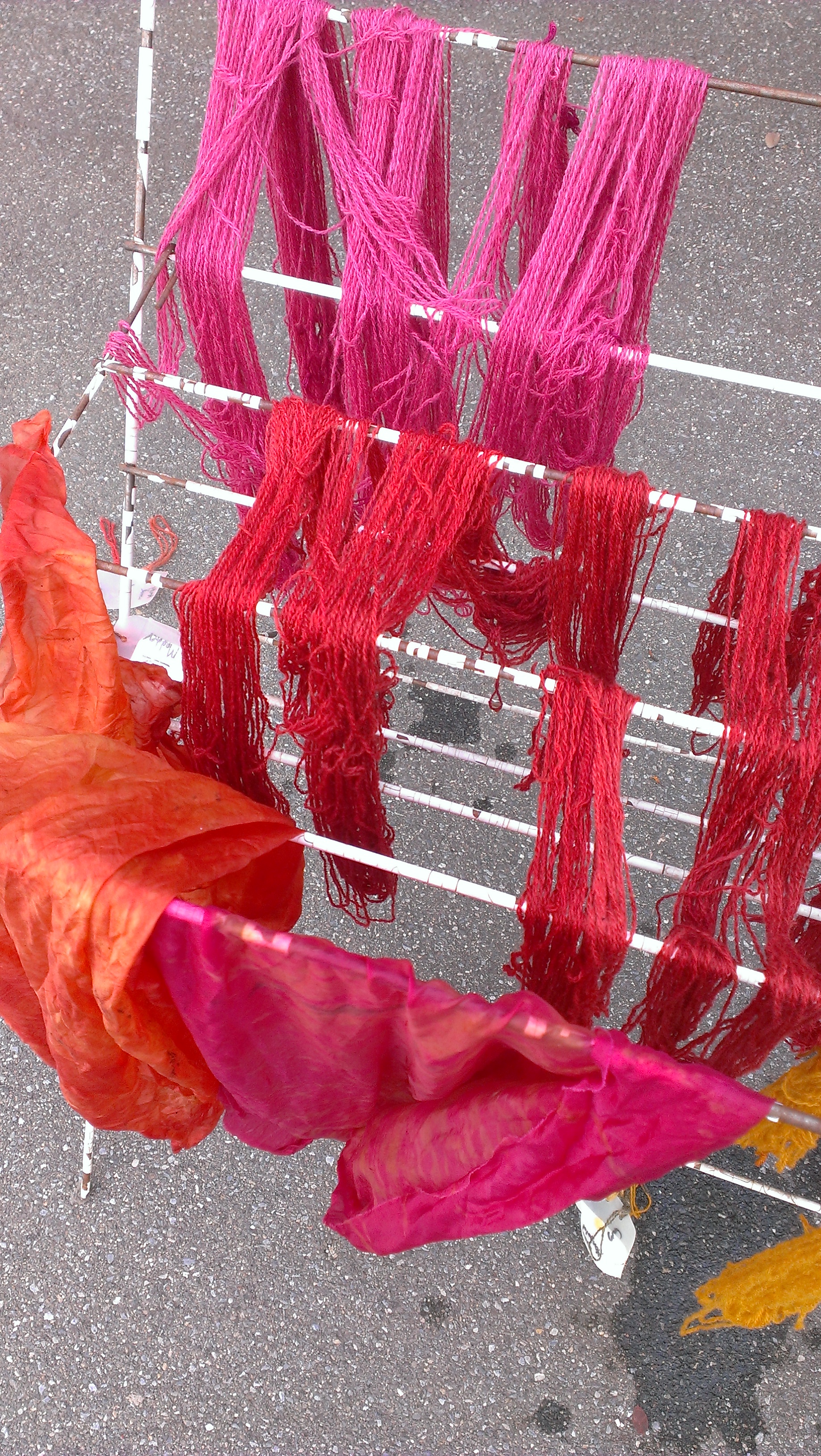
These are cochineal, madder and marigold.  I had mordanted some silk paj in alum and taken it along.  I tried eco printing it years ago and didn’t think much of the results.  Wendi of the Treasure suggested jewellery quality string (which sounds very promising to me), so I’d been planning to eucalypt dye them–but took this opportunity to expand my palette.  The silk went orange in the madder bath even though wool in the same bath was much more red–still good.

2014-06-14 15.11.40

People made their own series of test cards too.

2014-06-14 15.21.44

It was a day of happy experimentation, I think, the smell of fermented walnut hulls fighting it out with stewed eucalyptus bark notwithstanding.  The people who came were friendly, warm and generous–a delight to be among.  It was a treat to be in the company of other people who are fascinated by eucalypts and by the dye possibilities of plants. Folk were talking about what they might do with their cloth and how they might approach their neighbourhoods differently…  I hope that for at least some it will be the start of an exciting new journey.  By the end of the dye I was deeply weary.  I took the logwood, madder and cochineal baths home with me (after taking suitable precautions against spillage) and began some exhaust dye baths next day.  But by late afternoon I was down to twining silk string mindlessly and happily…

2014-06-14 15.21.07

19 Comments

Filed under Leaf prints, Natural dyeing

Milky Merino: First effort

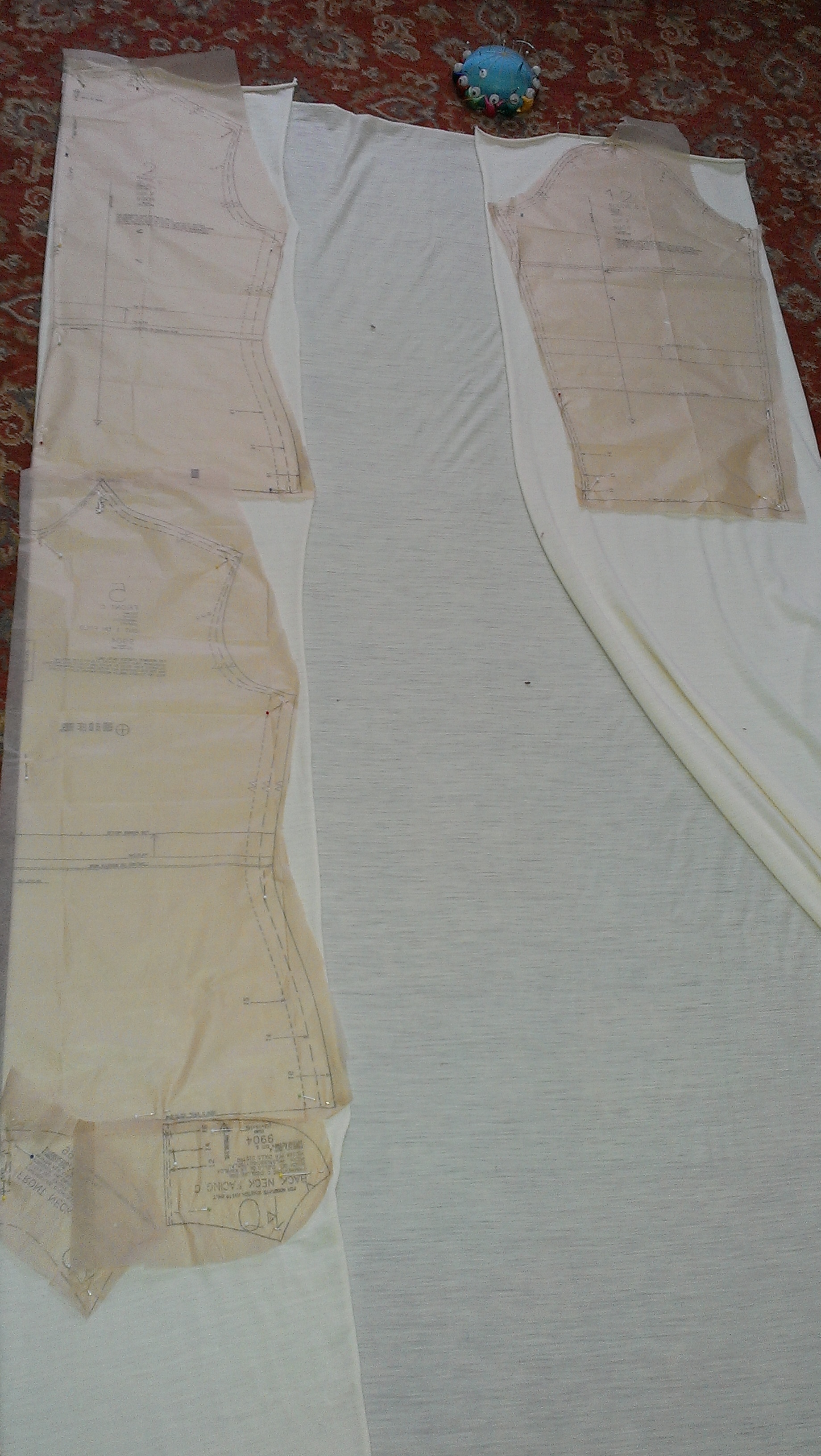
Last year, I managed (with a little help from cossack design) to acquire some milky merino knit fabric. I have been thinking that if I want to make all my own clothing I will need to learn how to make turtle neck, knit, long sleeved tops for winter and T shirts for summer (though perhaps it will be years before I wear out my current collection of T shirts–and people keep giving them to me)!  I decided to try a pattern I bought some time ago.  Then I managed to trace a pattern from a garment I already have and like to wear and cut one of those from the length of fabric I had as well.

IMAG1897

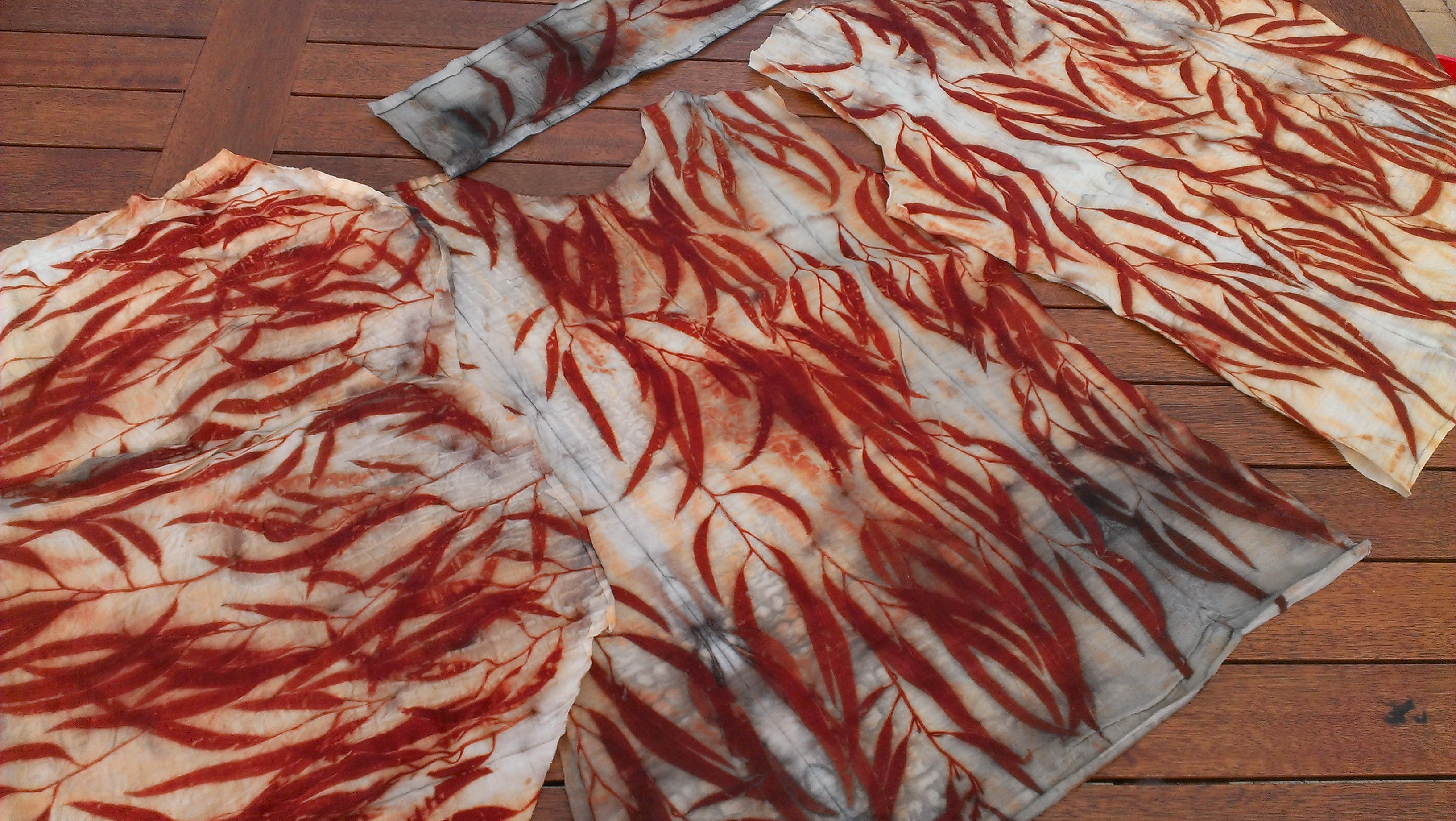
I was feeling positively gleeful about the potential for two garments to emerge from this experiment.  Many other dyers–see examples here, here and here have had beautiful results dyeing this fabric.

  IMAG1903 (1)

I’m delighted with these results.

IMAG1905

I also dyed the little samples that came in the pack, neatly enclosed in my soup ball:

IMAG2270


IMAG2277

This thread has since been applied to a ‘beloved tree’ banner.

IMAG2291

That was all very well.  I sewed my garment together, only to discover that I had succeeded in shrinking the fabric… and more in one direction than the other.  In the end, I gave the garment to a smaller friend and she adjusted it to fit her.  She looks wonderful in it!  Now I am building up my nerve to sew the second turtleneck together and see who that will fit!

12 Comments

Filed under Eucalypts, Leaf prints, Natural dyeing, Sewing

Whatever became of the dress?

IMAG0041

Well, my friends, true confession time.  I sounded out a lot of people about the second skin frock, on and off line.  Their, and your, ideas were full of genius.  If I’d had ten of that frock I could have made ten different lovely garments from it.  But I didn’t!  I still could not overcome the fundamental issue—believing I’d wear it no matter how lovely it was.

IMAG0042

I turned it into a series of what India Flint calls ‘infinity scarves’, though a  little less fancy than the model we created in Melbourne.  Three of them.  Two have already gone to happy homes, in fact I saw one in use yesterday.  It had a leaf print from a white cedar (Melia azaderach var australasica) leaf, pale green, which my friend had particularly appreciated.

IMAG0043

One has been hand-pieced to manage the top part of the garment, and naturally it’s my favourite.  I’m surprised to find that the clean, shiny white of the silk and cotton thread stitches against the dyed fabric is pleasing to the eye.

IMAG0044

I’m now left with only a small pile of little scraps.  Each time I come past them, I think ‘pincushion’.  So there may still be another object to emerge from what was once a frock…

IMAG0077

5 Comments

Filed under Leaf prints, Natural dyeing, Sewing