Tag Archives: linen

Drawstring project bags

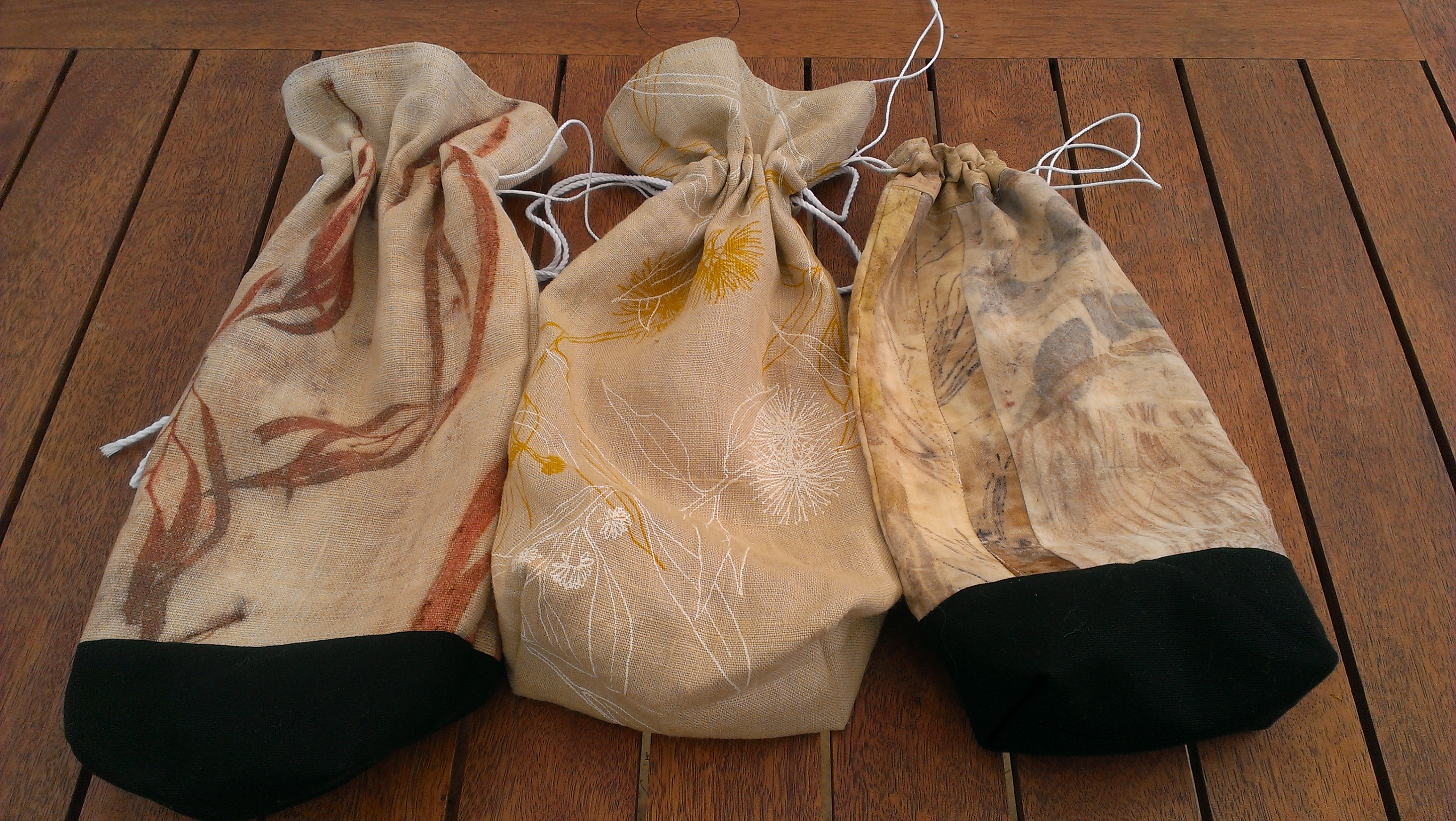
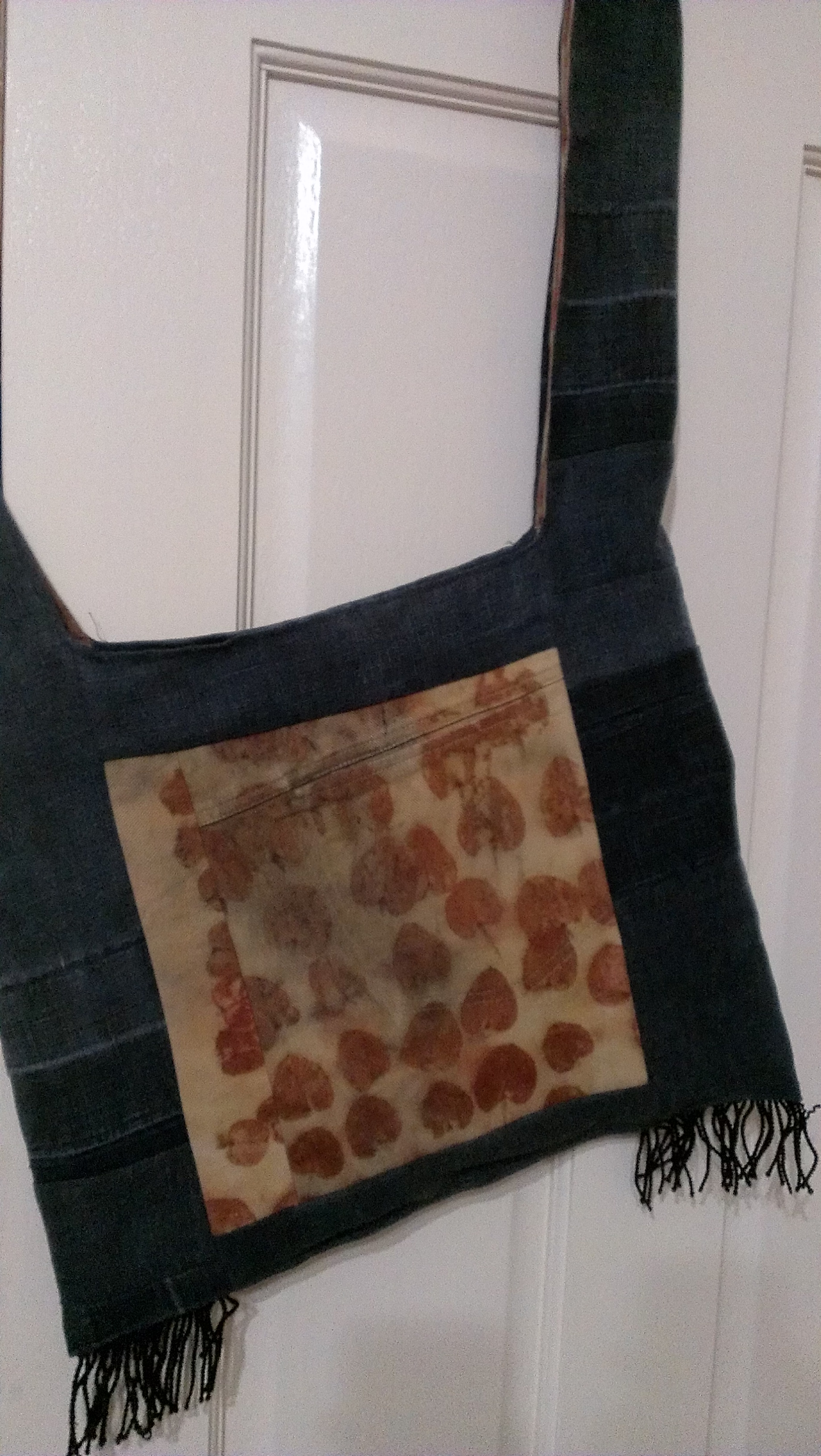
These are the bags that really started the party.  Fully lined drawstring project bags.

2015-03-29 16.52.37

Recycled suit linen with E Scoparia print; linen with an Australian designed print; cotton printed with prunus leaves and maple leaves.

2015-03-29 16.52.29

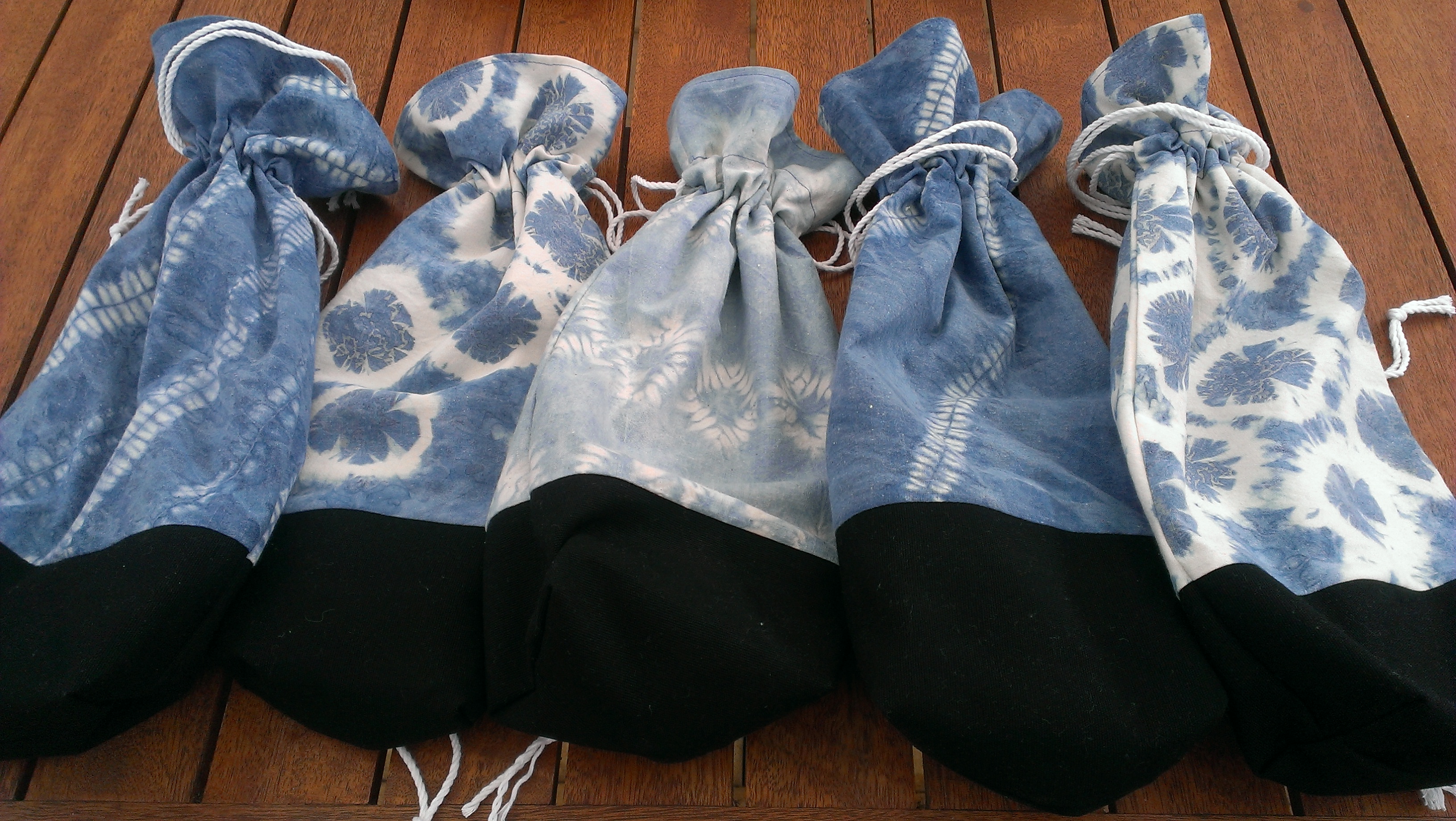
Indigo prints from the indigo dyeing day last year… paler prints went into the linings.

2015-03-30 11.49.03

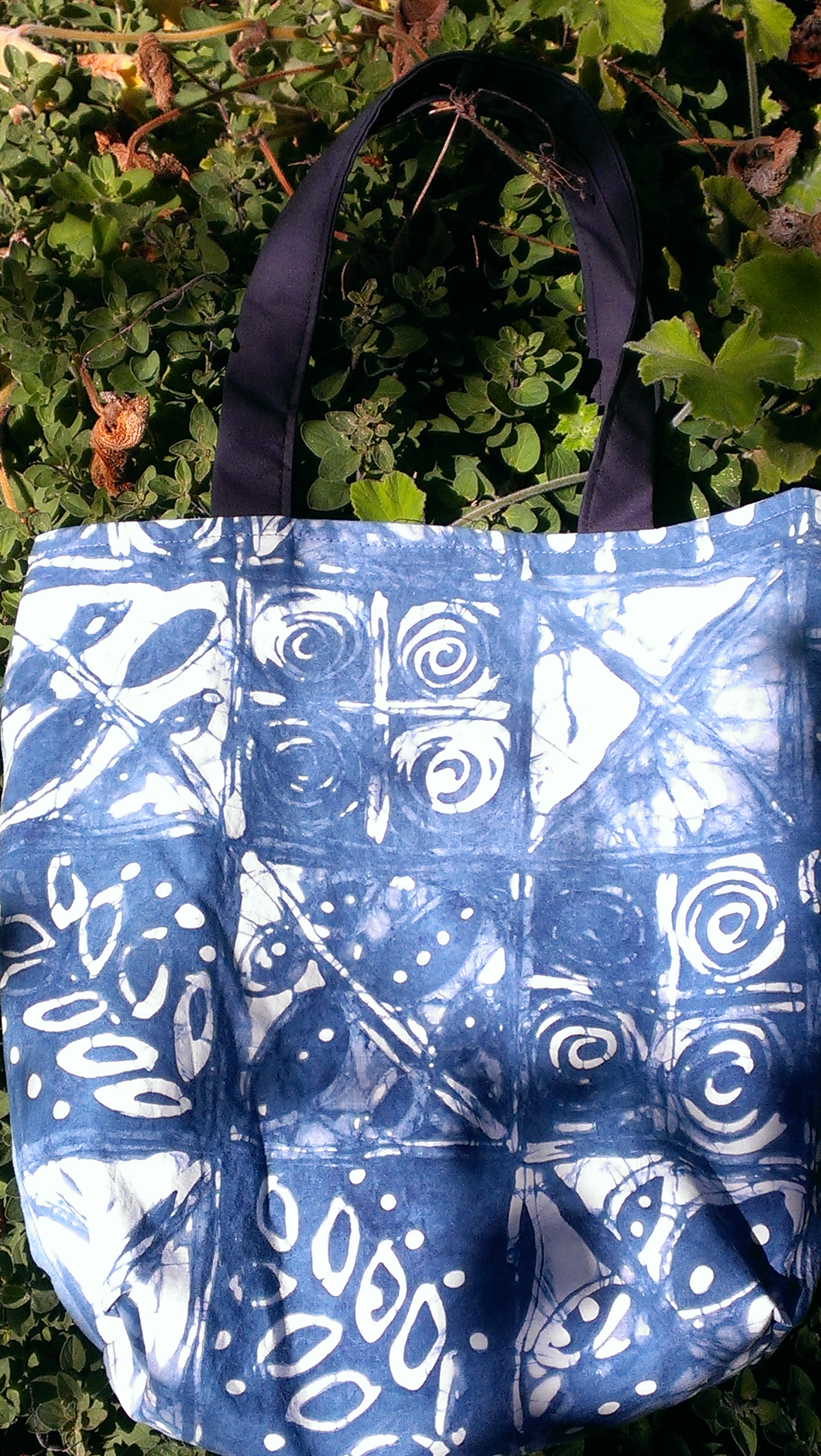
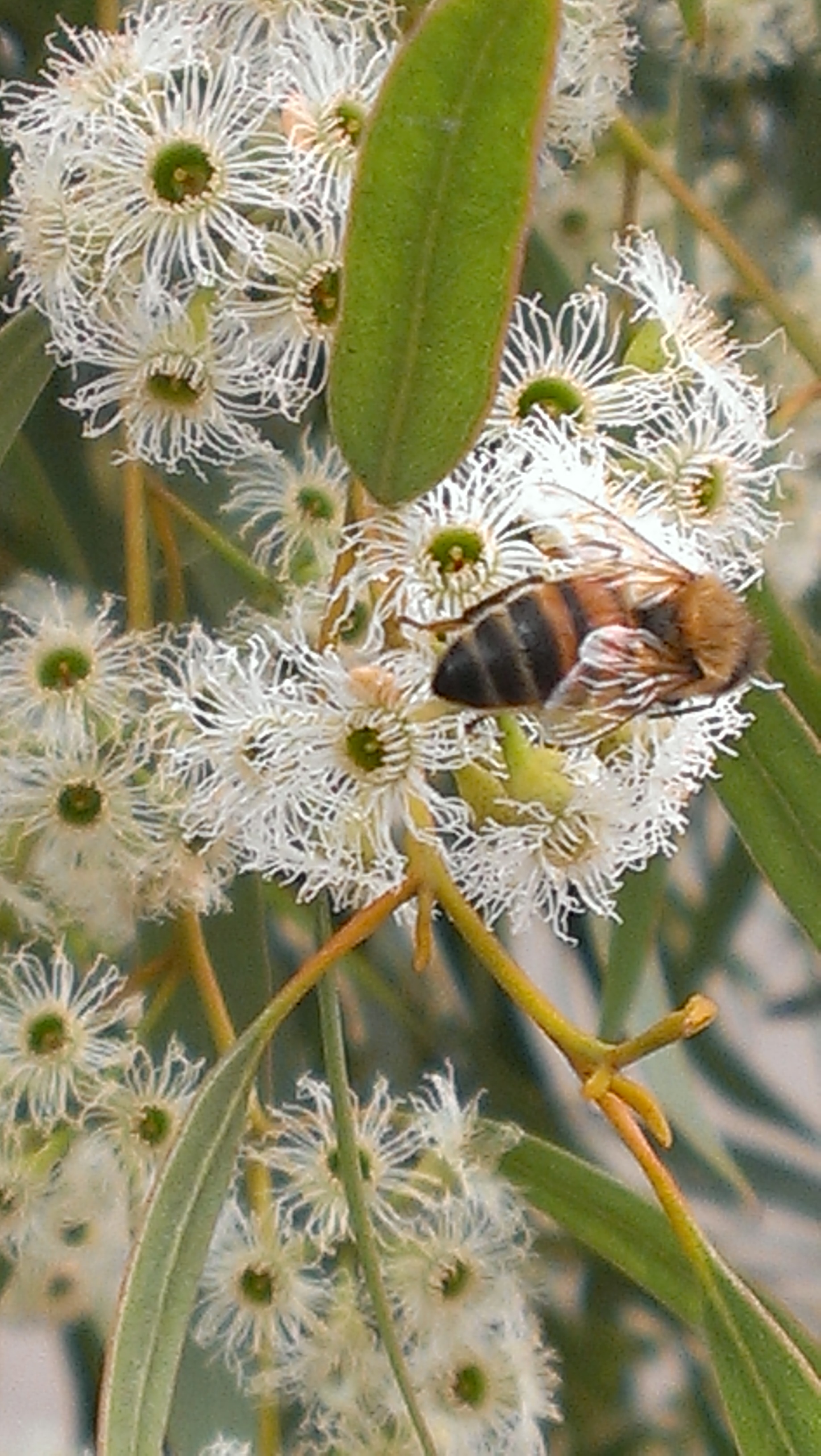
While I was on indigo prints I used up the last of my own indigo dyed fabrics making this.  And finally, a gratuitous photo of a bee enjoying a street tree in flower taken on my way to a lunch meeting.  Glorious!

2015-04-01 12.16.21

4 Comments

Filed under Leaf prints, Natural dyeing, Neighbourhood pleasures, Sewing

Seasonal happenings: Autumn

The weather is turning toward autumn. Leaves harvested last season are being converted into new forms. This linen collar came apart with some effort.

2015-03-21 13.49.17

Here it is in the process of becoming a project bag. Along with prunus prints…

2015-03-22 17.13.11

And maple prints from leaves I found over someone else’s fence!

2015-03-22 17.13.19

I’ve been making the best of the remaining sunny days, making soy milk mordant.

2015-03-22 15.47.39

This is a task best done when it is neither too hot nor too cold.  Too hot can leave your soy milk smelling nasty!

2015-03-22 15.48.38

The making doesn’t take warm weather, but multiple dips and dryings are greatly helped by sunshine.

2015-03-22 15.48.27

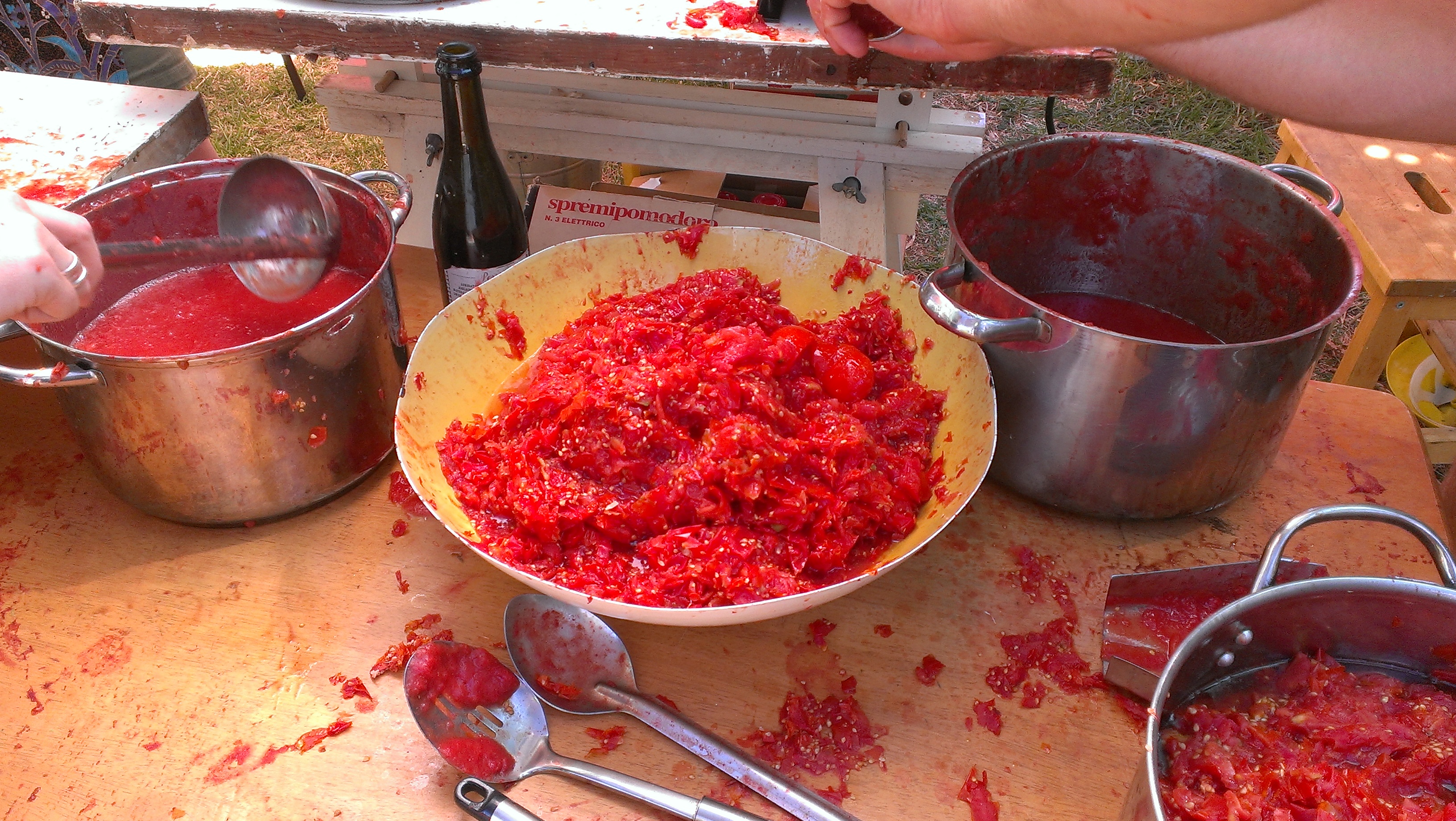
My friends held a big passata making day.  Many tomatoes pulped, skins and seeds removed.

2015-03-22 14.29.37

Many beer bottles repurposed.  By the end of the day, they were gone and all kinds of jars and bottles were pressed into use.

2015-03-22 14.55.40

And then, for the long, slow heating.

2015-03-22 14.29.22

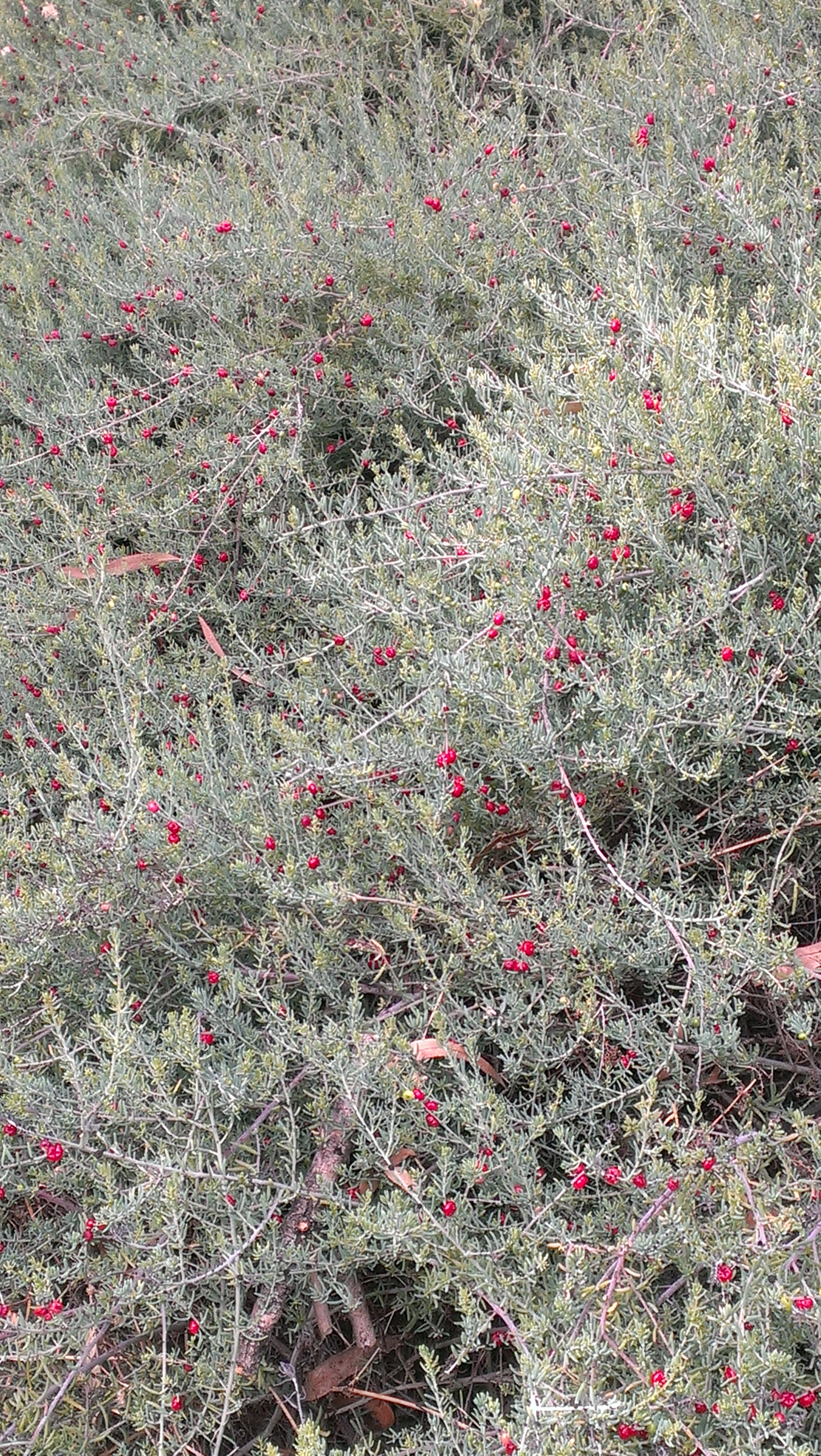
Ruby saltbush is still fruiting.

2015-03-12 14.39.55

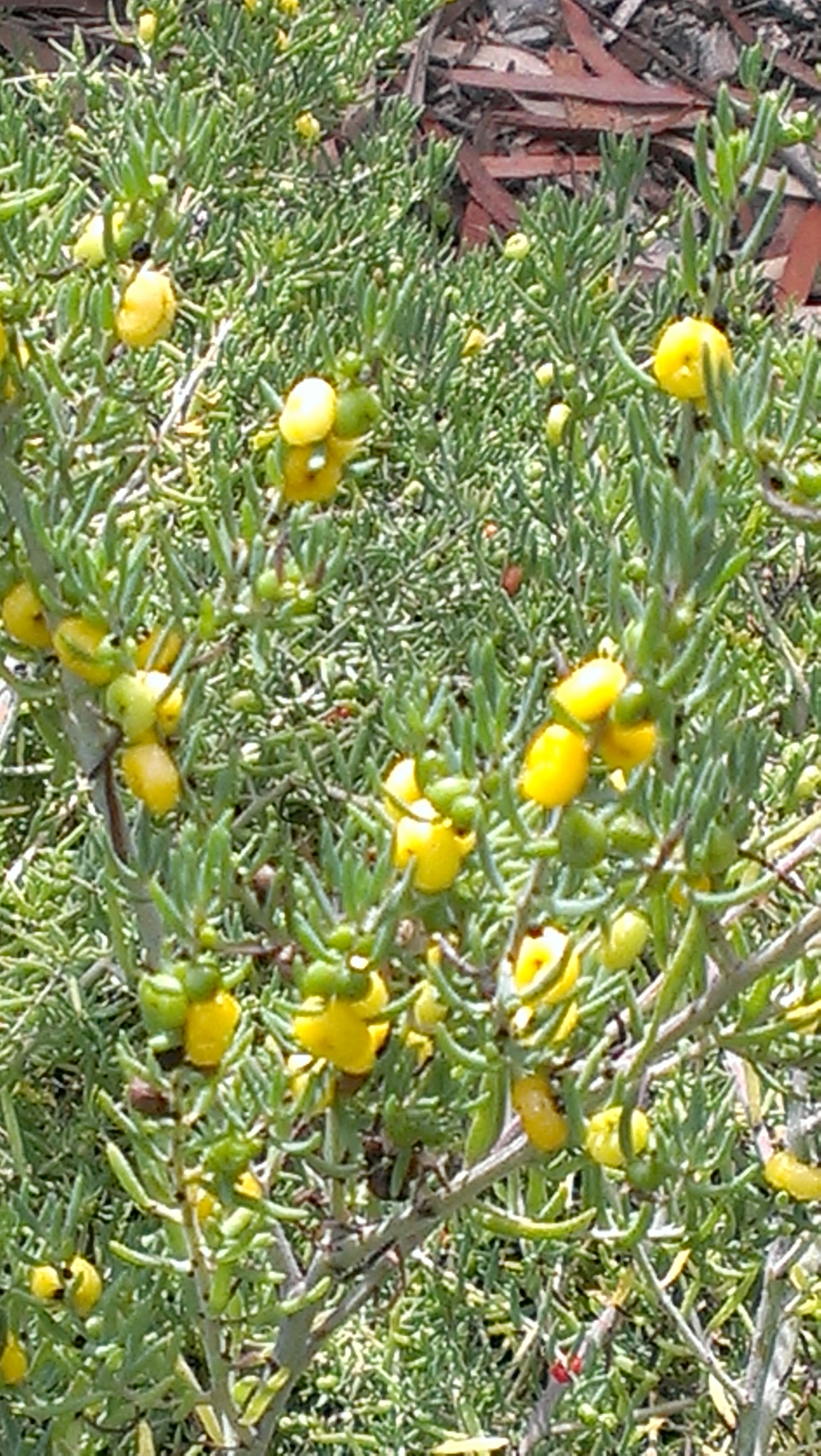
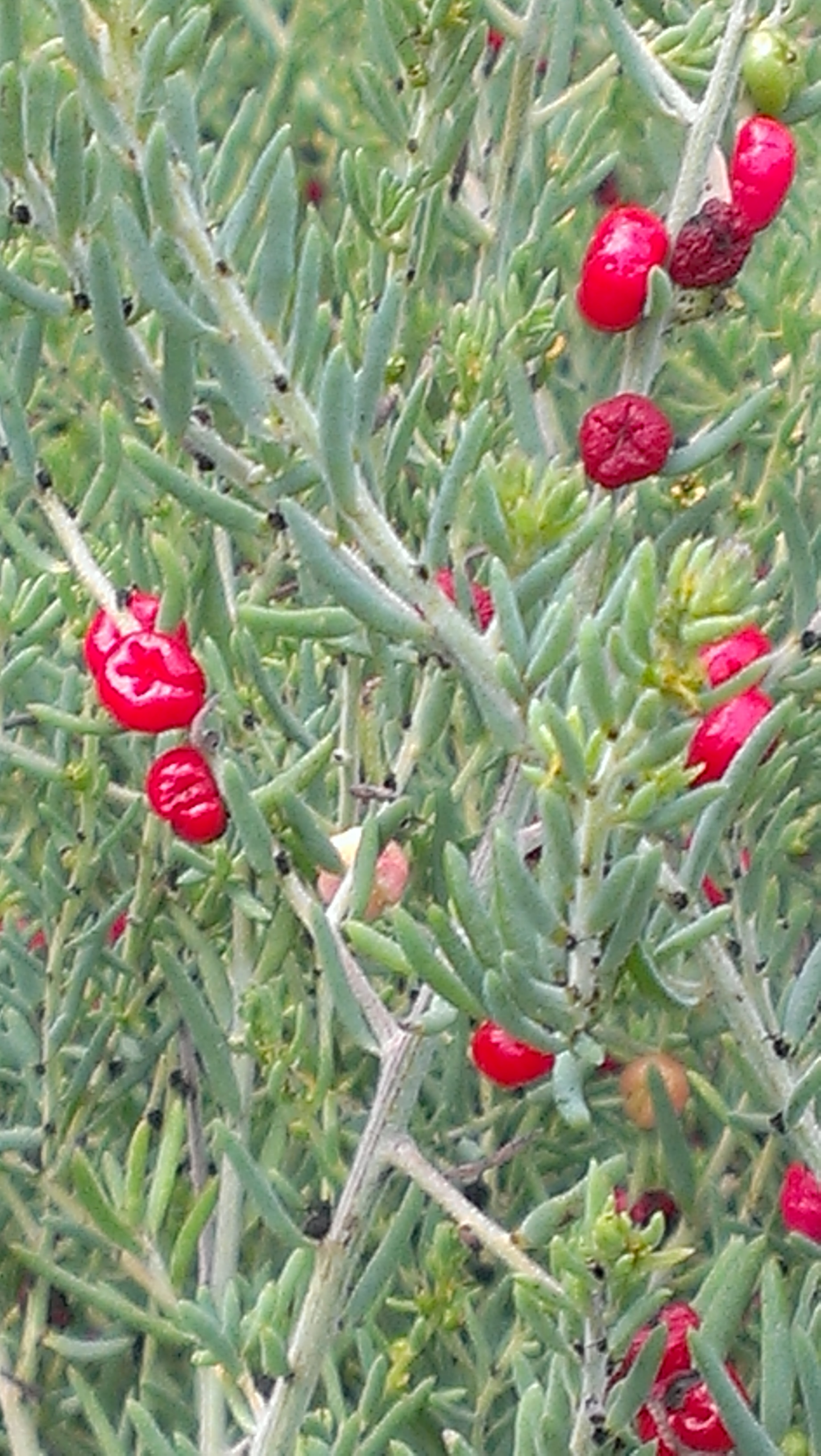
Several colours of leaves and of fruit.

2015-03-12 14.41.09

I have been taking advantage of the season to collect for next spring’s planting.

2015-03-12 14.40.10

I even managed to collect some more bladder saltbush seeds. Autumn is a lovely season!

2015-03-12 13.14.04

8 Comments

Filed under Fibre preparation, Leaf prints, Neighbourhood pleasures, Sewing

Summer Indigo 2: Dyeing and the colour run remover vats

When the big day arrived, I had more company than initially expected, with two of our beloved friends staying with us and keen to try indigo, and more coming over.  I have to say, I am intimidated by indigo and it was a holiday project that kept me nervous, planning this indigo dyeing day.  What if it didn’t work out?  What if my ignorance trumped my effort? What if people were bored? What if nothing worked and people’s things were ruined?   The funny thing about fret is that so often it has me focused on myself and my overdeveloped sense of responsibility, and that’s neither sensible, nor fun, nor realistic.  How could I even temporarily forget how wonderful my friends are, in the face of fret?  Everyone who came knew at least some of the other folk and it was such a generous and friendly gathering.  One of my near and dear spent the day taking photographs, so a big thanks to her for those that follow…

2014-12-29 11.27.43

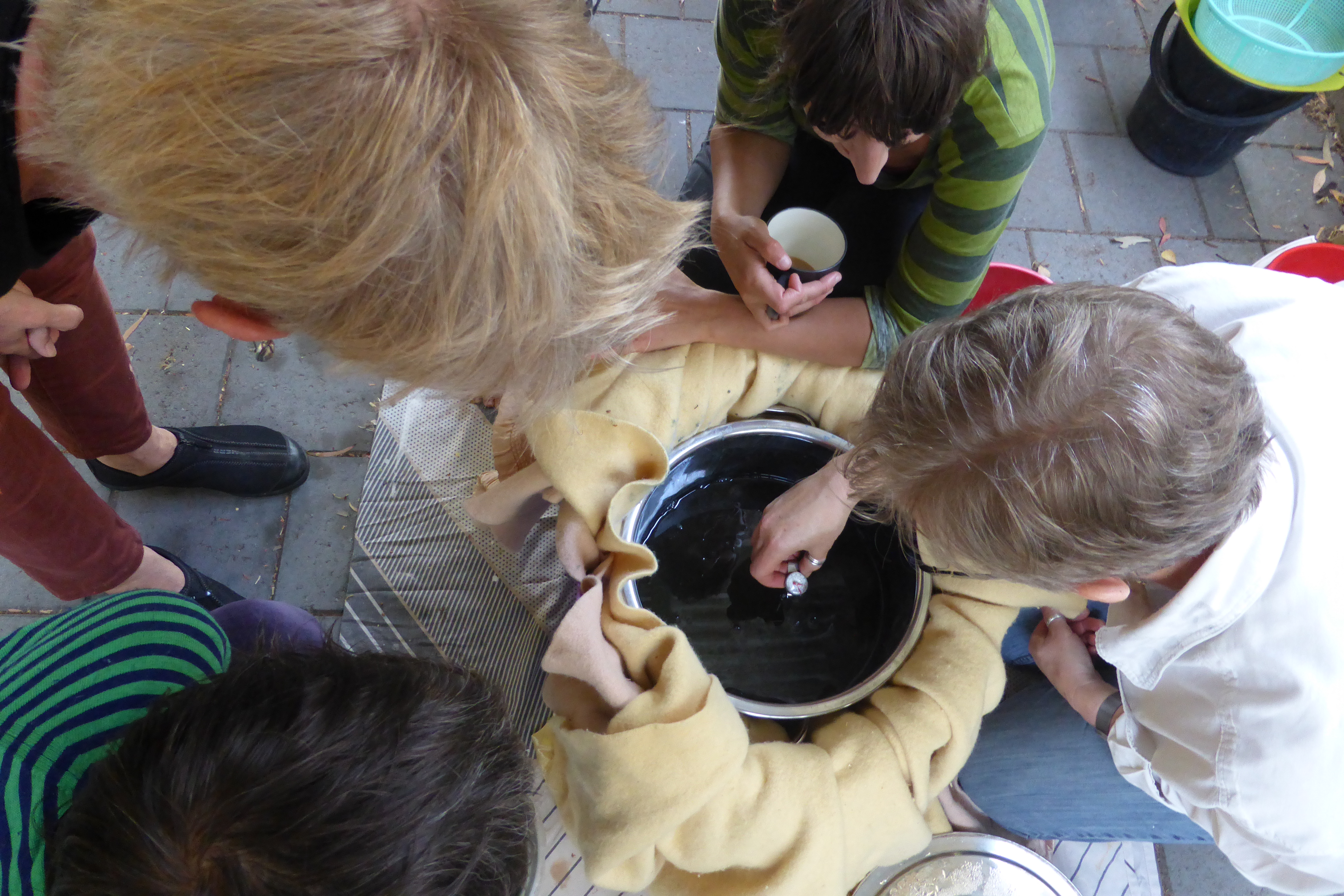
We practised our skills at getting fabric into and out of the dye without adding needless oxygen.

P1020572

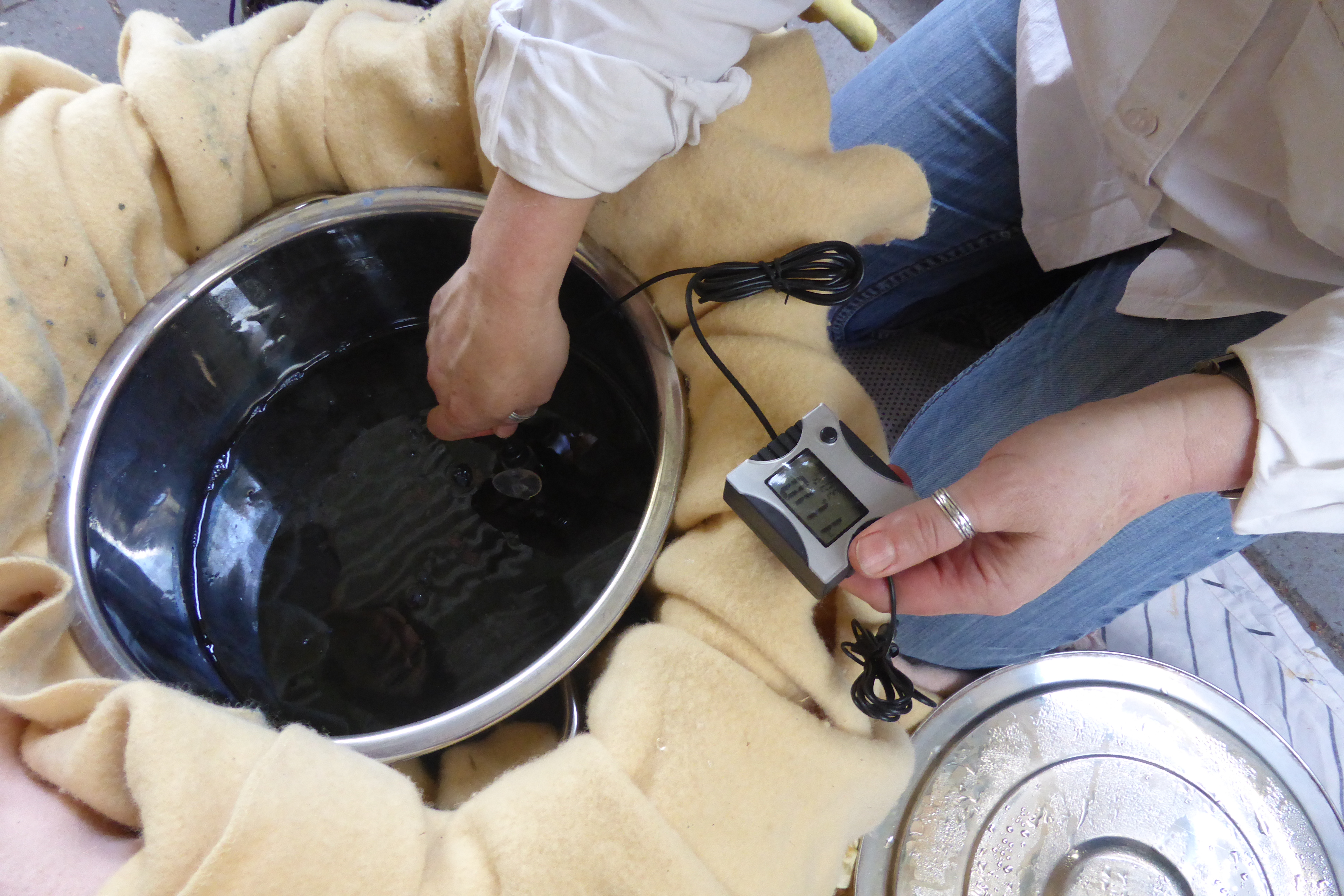
This time I had a dependable thermometer and used it!

P1020569

I also now have a Ph meter.  My dear Dad asked what I wanted for my birthday last year and when I said I wanted a Ph meter but wasn’t sure where to get one he had the answer!!!  You don’t know him, but eBay, my friends, is the answer to a shocking number of things for Dad…

P1020547

There wasn’t just the fructose vat.  I have decided that aiming for fermentation and fructose vats is a good long term goal for environmental, health and all kinds of other reasons (pure curiosity, for a start…) and I am growing woad and indigofera australis and Japanese indigo.  However, I have decided that in the interim, colour run remover (mostly sodium hydrosulphite) can rescue failures in my judgment and experience and save wastage of indigo. Since I have some synthetic indigo, I decided to use that in any hydrosulphite vats as it may not be so suitable for fermentation or fructose vats.  There was a lot of fabric when everyone piled in–so I set up two hydrosulphite vats and was delighted not to need to use hydrosulphite to troubleshoot the fructose vat.

P1020626

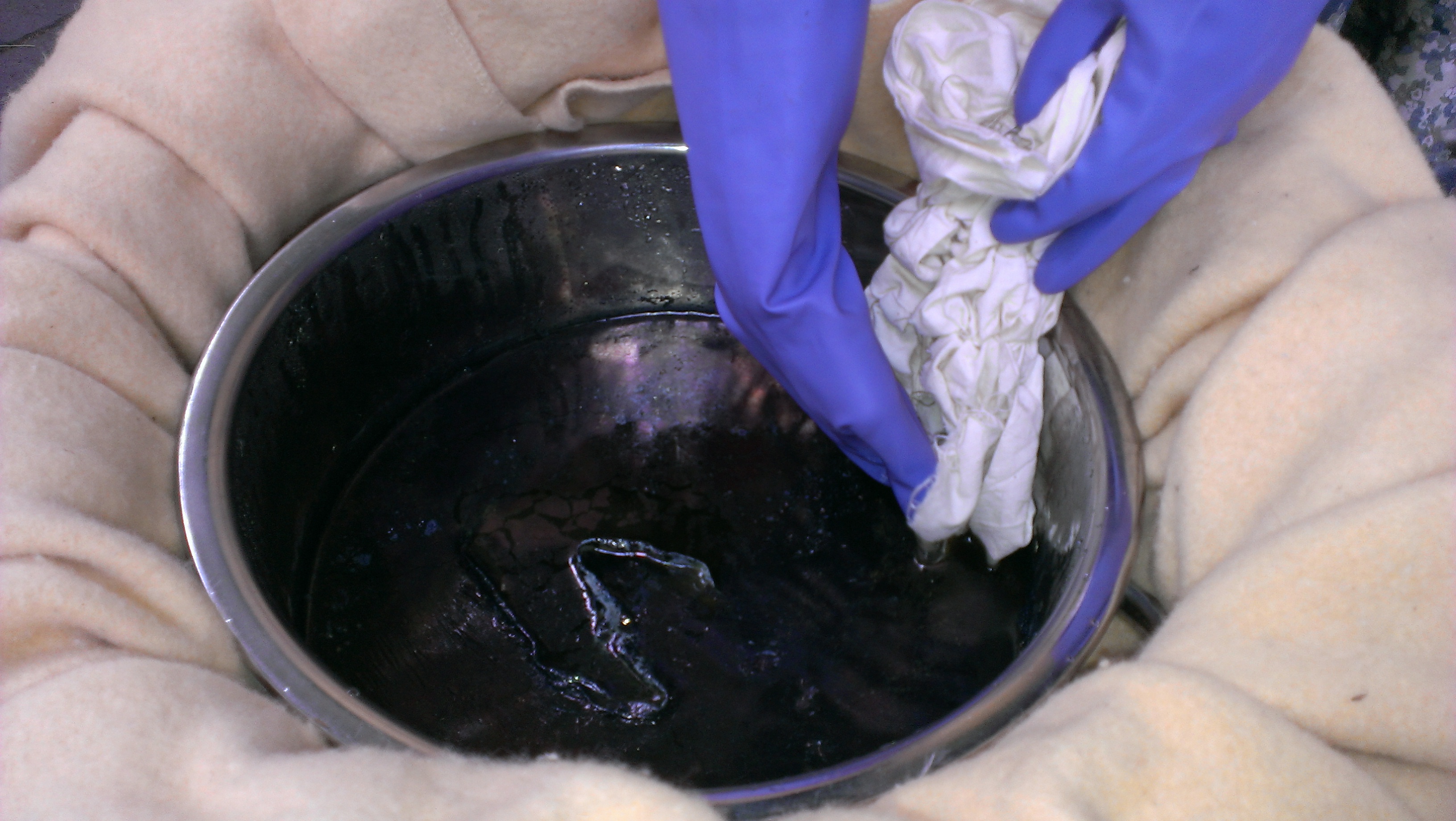
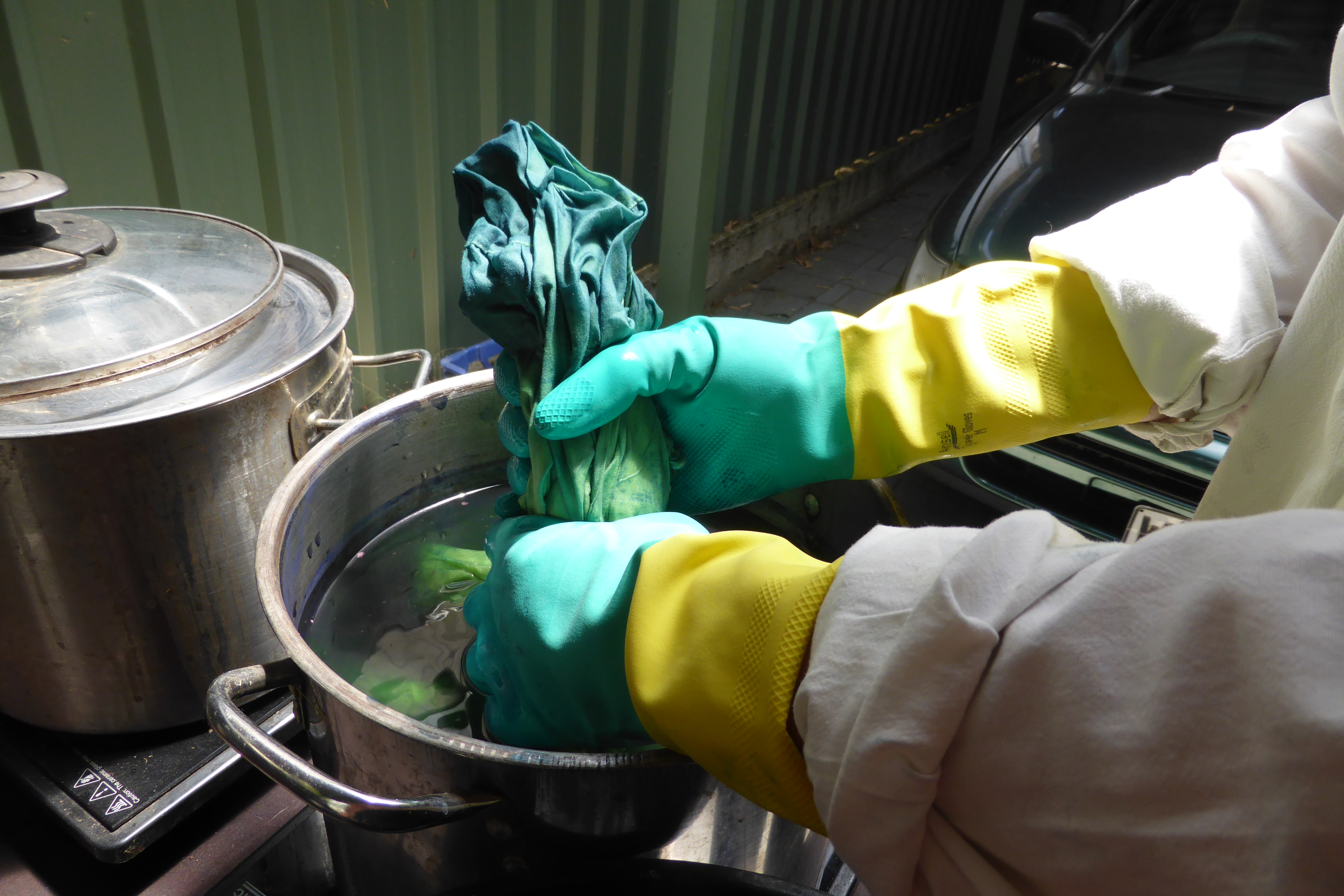
This is something-or-other coming out of one  colour run remover vat quite yellow and beginning to turn blue as the air strikes it.  For these vats, I tried Jenny Dean’s recipe for a colour run remover indigo vat from Wild Colour.  It worked really well and uses washing soda, a much milder alkali than some proposed in other books. It’s also designed for colour run remover and not pure hydrosulphite–and that is what I had.  The fructose vat smells MUCH better!
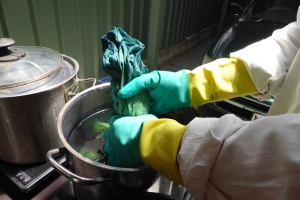
P1020646

I love this process of transformation!  The best item of all for this effect was a pair of pants tied around a length of garden hose.  It was long enough to be yellow at one end, green in the middle and various shades of blue as it slowly emerged from the pot.  My friends had been out researching techniques for resist–so there was stitching, wrapping, bundling, string, thread, rubber bands–and even wax resist, some applied with a biscuit cutter and some freehand.

P1020640

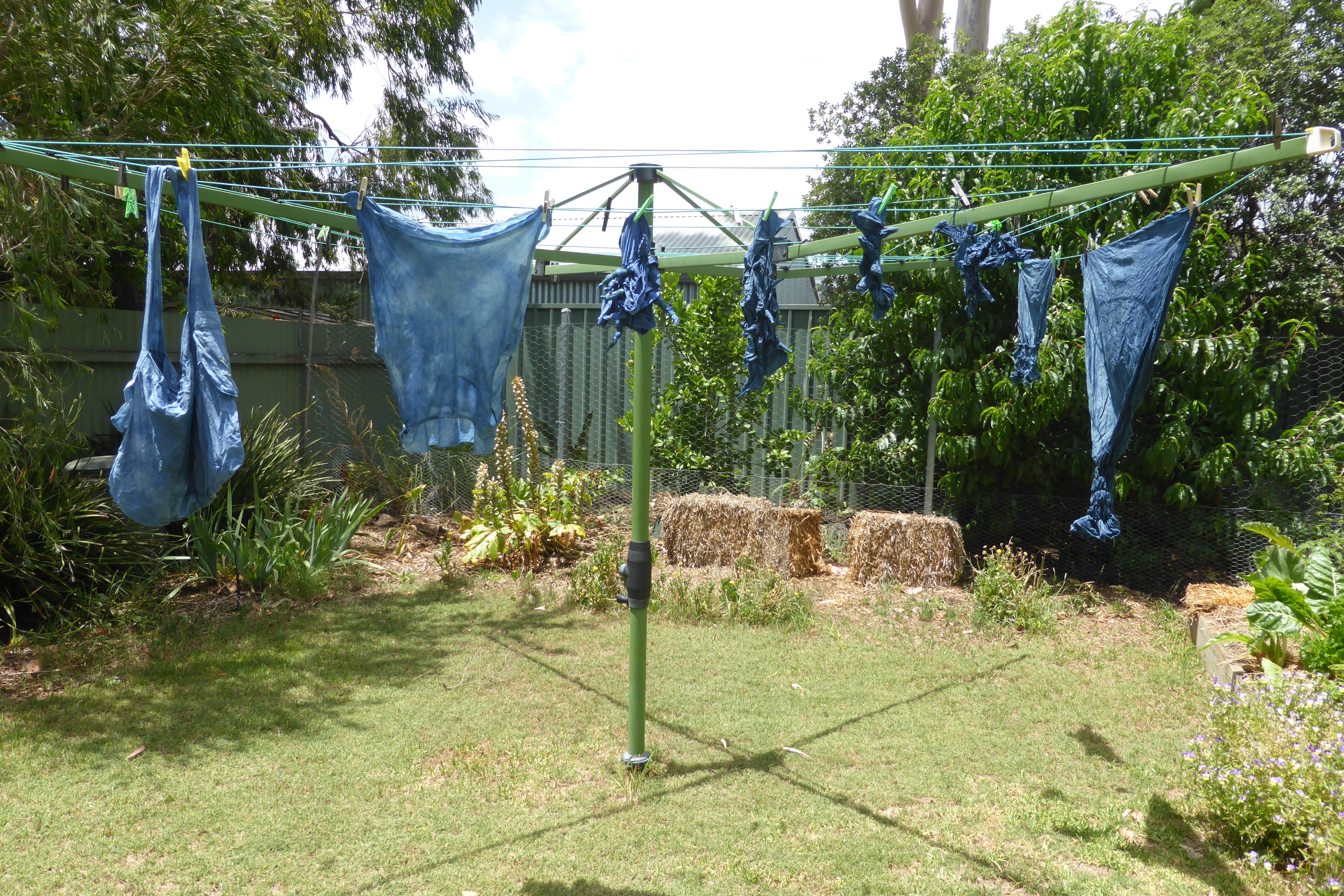
With three vats going, and regular monitoring of temperature and Ph and so on, the scene at the clothes line kept changing.
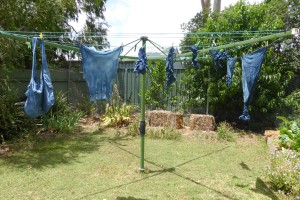
P1020617

There were whole-garment makeovers, a purpose made bag, scrap fabrics, an opportunistic bag makeover and the pieces for a pair of pants yet to be made.

P1020619

The shades kept changing–wet to dry and dip to dip.

P1020578

…Until finally we had done all we could do and time to head to our various homes started to arrive.  Then there was a lot of undoing and exclaiming… and I’ll save that for another post!

18 Comments

Filed under Natural dyeing

Leaf print experiments

2014-12-14 14.31.15

I’ve been trying leaves I don’t usually use and some different strategies for cooking them up. Prunus leaves, kindly contributed by this block of flats.  I am sure they wouldn’t mind!
2014-12-14 09.41.35

Maple… I think this is Japanese maple.

2014-12-14 14.07.59

I have tried several different sheoaks.

2014-12-14 14.14.17

Some of the results are really spectacular.  My favourite is quite green, very exciting.

2014-12-19 11.02.42

Here it is beside the prunus prints.

2014-12-19 11.03.47

They are pretty pale…

2014-12-19 11.03.25

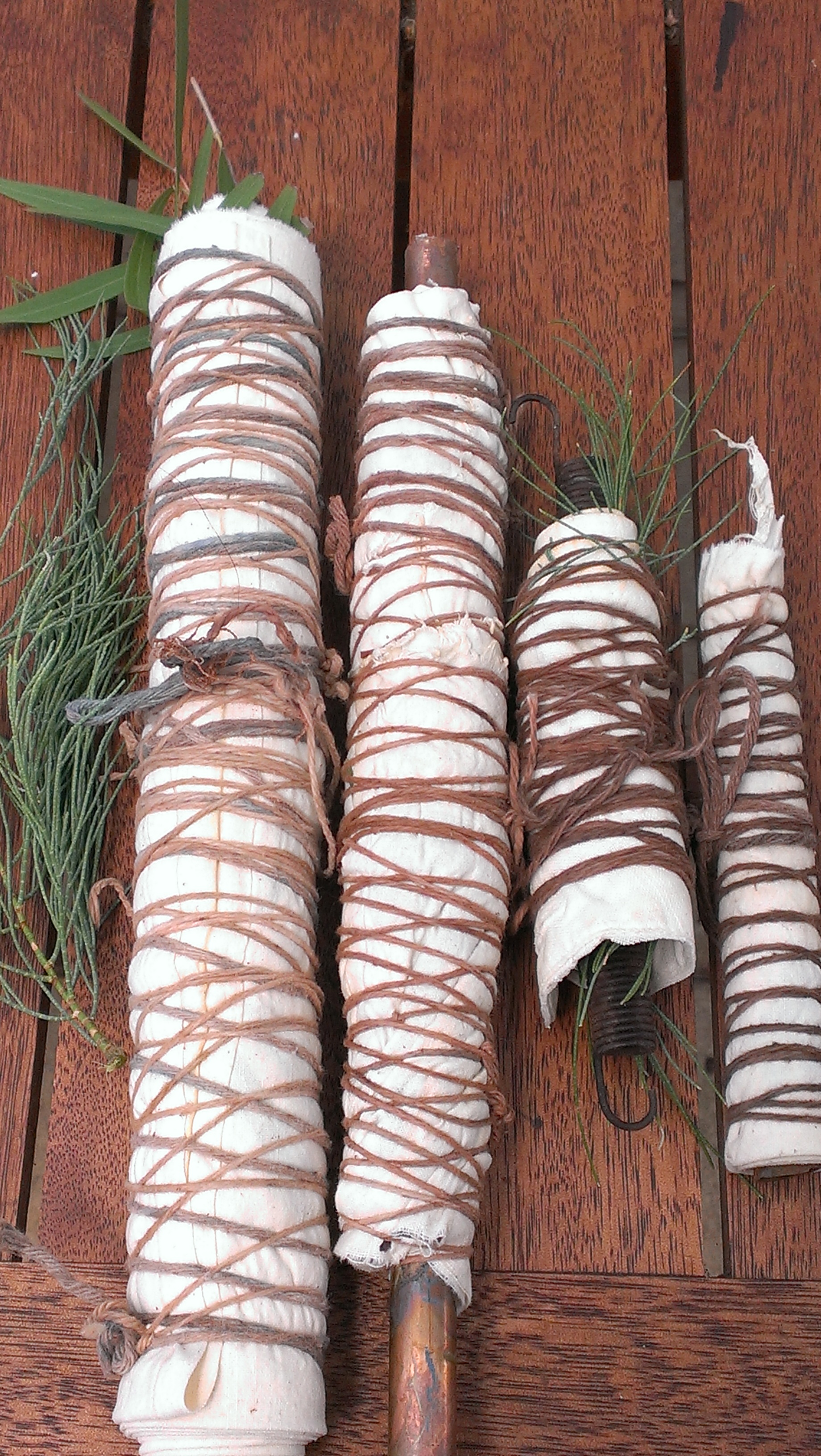
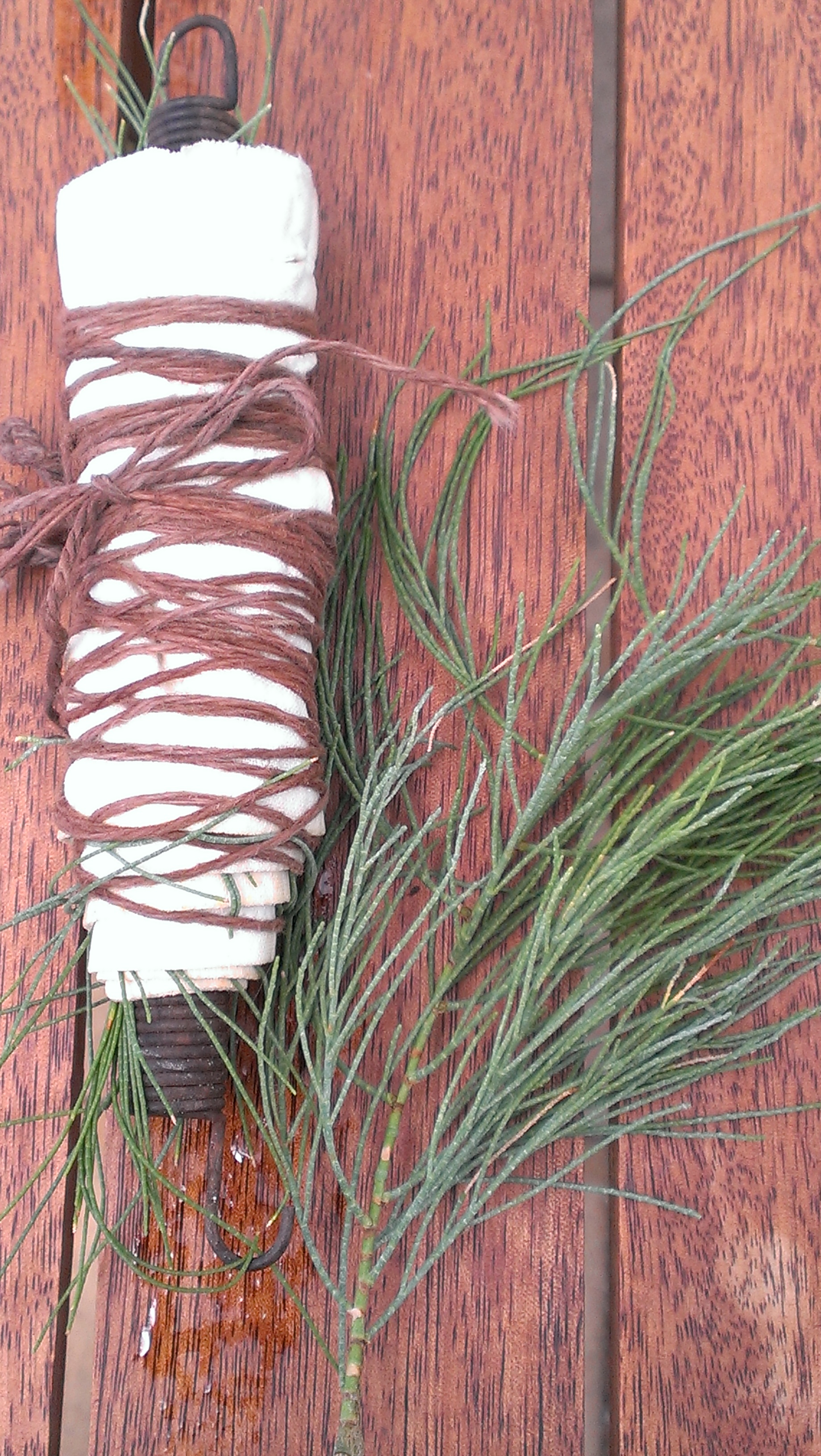
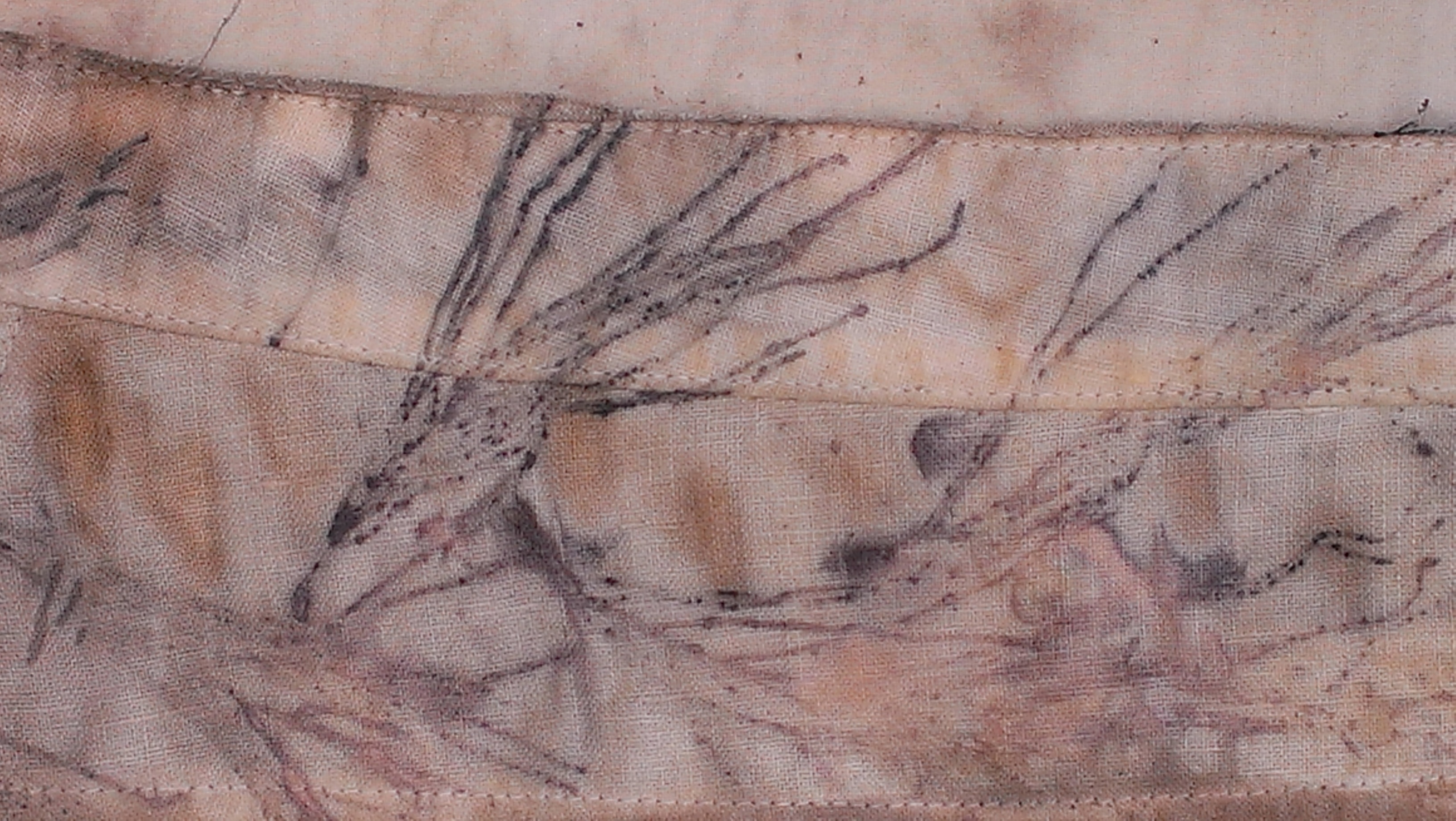
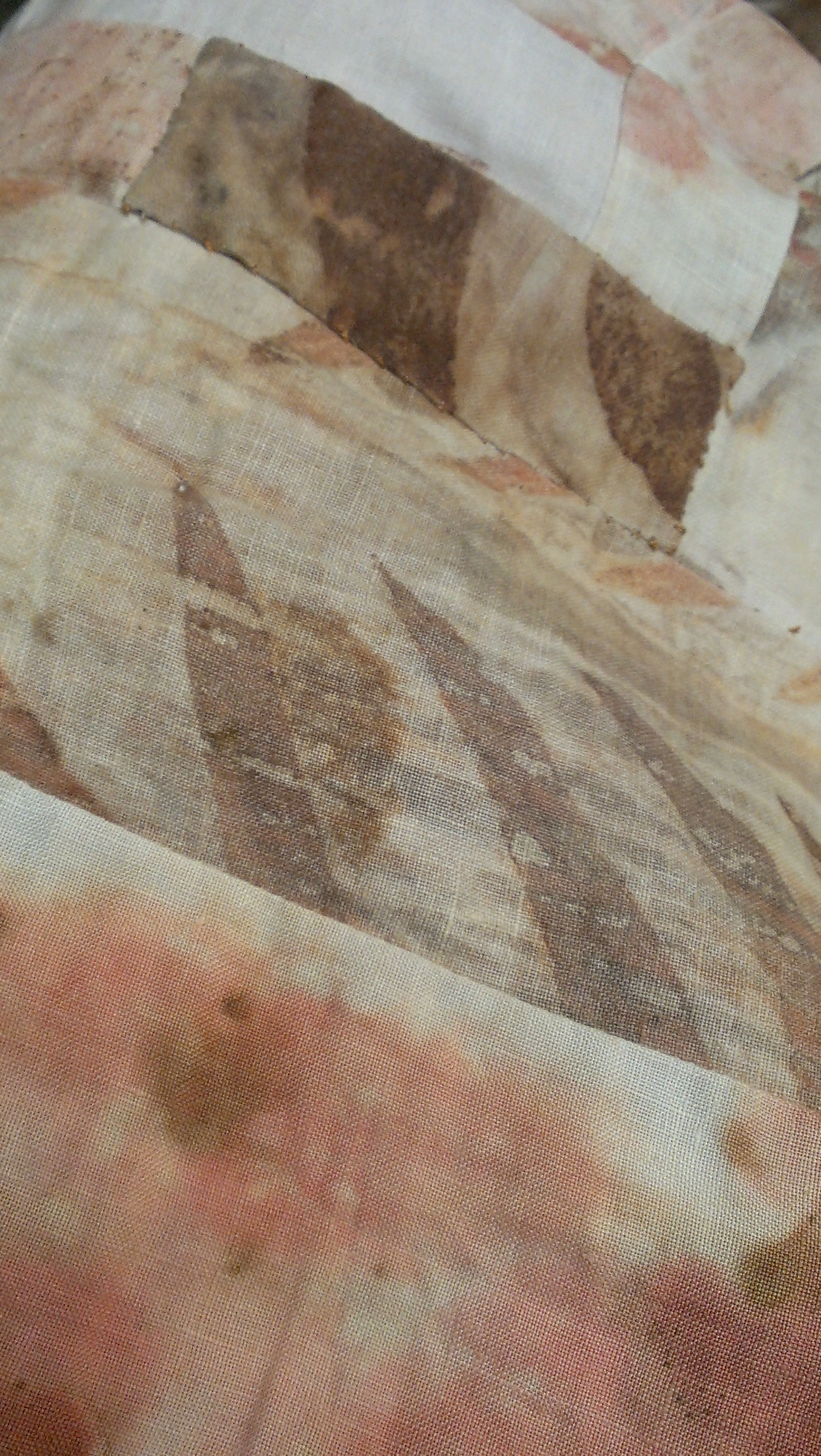
The maple leaves were interesting, and I love the impression of the string ties.  And this sheoak came out better than any other so far.  I tried 6he leaves out on a linen collar, and wrapped it around a rusty spring I found in my leaf gathering travels.  This bundle was so small I overlooked it, so this one had a long time in the pot, which is no doubt a clue for future experiments.

2014-12-19 11.02.27

Some results were less exciting.  I did get a pale green print from our birch leaves, which is a first and might be promising.

2014-12-19 11.01.23

I went back for more juvenile E Polyanthemos and this time, not so great prints resulted, but I did get some that were quite green, and that’s promising too.

2014-12-19 11.02.04

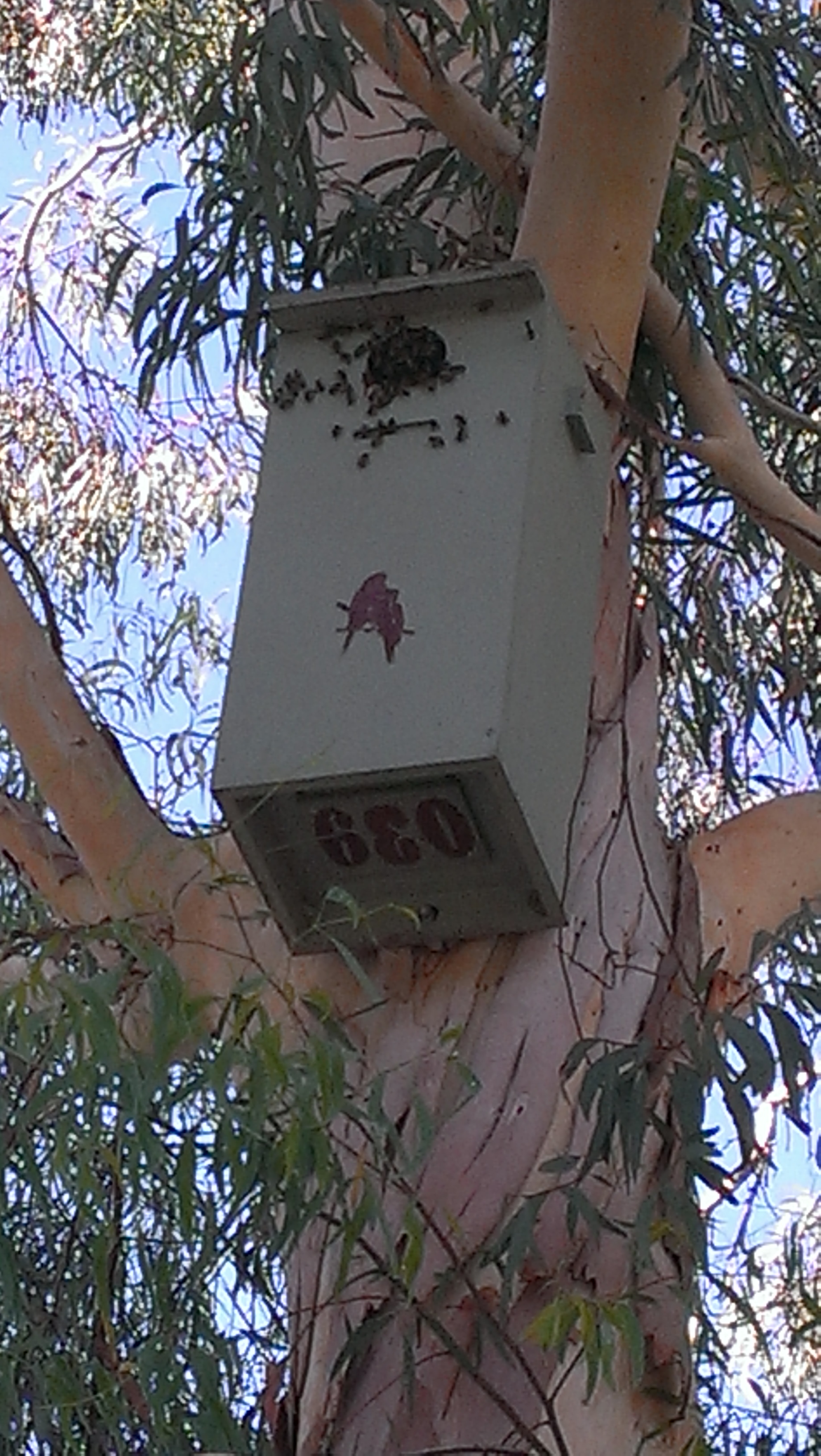
Meanwhile, the saga of the neighbourhood bees continues.  The lorikeets moved out of this nesting box, and the bees moved in weeks ago.  There is now honeycomb visible in the opening.

2014-12-14 09.46.25

8 Comments

Filed under Dye Plants, Leaf prints, Natural dyeing, Neighbourhood pleasures

Bag making

There came a point in the end of year crazy-pants where I couldn’t stand all the bits and pieces that were lurking around my office/sewing space. Finally, I decided to take action.  Who needs a potato sack in residence in their work space for months?  It went the way of so many potato sacks round here.  This one was a particularly nice sack, with quite a complex weave structure (for a hessian sack).  The printing was even less wash fast than usual (for a hessian sack) but hopefully it will now have another life being appreciated for its carrying qualities.

2014-11-29 16.38.19

Then there were all the small pieces of fabric left over from other things.  I created patchwork from them and soon had enough for a bag (or two!) lined with eco-prints I like less.

2014-11-29 18.15.55

These are mostly small pieces of pre-loved garments that have been turned into other things, with or without prior leaf prints.  This one has already gone to a happy home with friends who use bags all the time.

2014-11-29 18.15.49

And then there was the ongoing bag patching ritual.  There were three or four new holes… so my favourite bag got yet another patching job.  From this:

2014-11-23 12.35.17

To this!

2014-11-23 13.14.30

4 Comments

Filed under Leaf prints, Sewing

The quest for Eucalyptus Polyanthemos continues

One weekend recently, I went to Norwood.  Well, really, I was deposited in this well heeled inner Eastern  suburb while my beloved went on a mission further from home, with a plan for collecting me on her way back.  The idea was that I would look for a birthday present for my Mum.  I had a few other goals in mind that involved the very nice bookshop there and a bit of random wandering.

2014-11-01 14.53.35

At some stage I decided a gelati would be perfect, as you do, given the chance.  So, gelati in hand, I wandered away from the main road and down a side street to see what I could see.  There on a bank sloping down to an unlovely carpark were some glorious sheoaks and some not-so-common eucalypts.  To me they seemed like plausible instances of E Polyanthemos, but the tallest I had ever seen.

2014-11-01 14.54.29

The evidence there had been many-anthers was all over the ground.  I think my eyes were caught by the fluttering of somewhat oval leaves in the breeze.

2014-11-01 14.53.42

Before long I was climbing the bank and dodging the cars.  Some of the trees had been cut and had re-sprouted with juvenile leaves that were almost round, and quite large.  My manual (Holliday and Watton’s Gardener’s Companion to Eucalypts) says ‘The juvenile leaves are blue and almost circular, the apex notched.’  Round, yes.  Blue, yes.  Notched?

2014-11-01 14.55.02

One thing led to another, as it so often does (well, in my case)… so I picked a small sample and tucked it in my bag.

2014-11-01 15.45.36

After a long walk and as much shopping as I could take, I sat myself down at a bus stop and waited for the return of my beloved.

2014-11-01 15.47.51

This morning I unwrapped the resulting bundle… very pleasing.

IMAG1394


And another from the same pot… which is a little greener than the picture suggests…

IMAG1396

And now for today’s completely gratuitous flower picture. This poppy is a completely different colour from any of its predecessors.  You have to love nature, and the frolicsomeness of bees rolling around in pollen…

IMAG1388

9 Comments

Filed under Dye Plants, Eucalypts, Leaf prints, Natural dyeing

Festival of mending, continued…

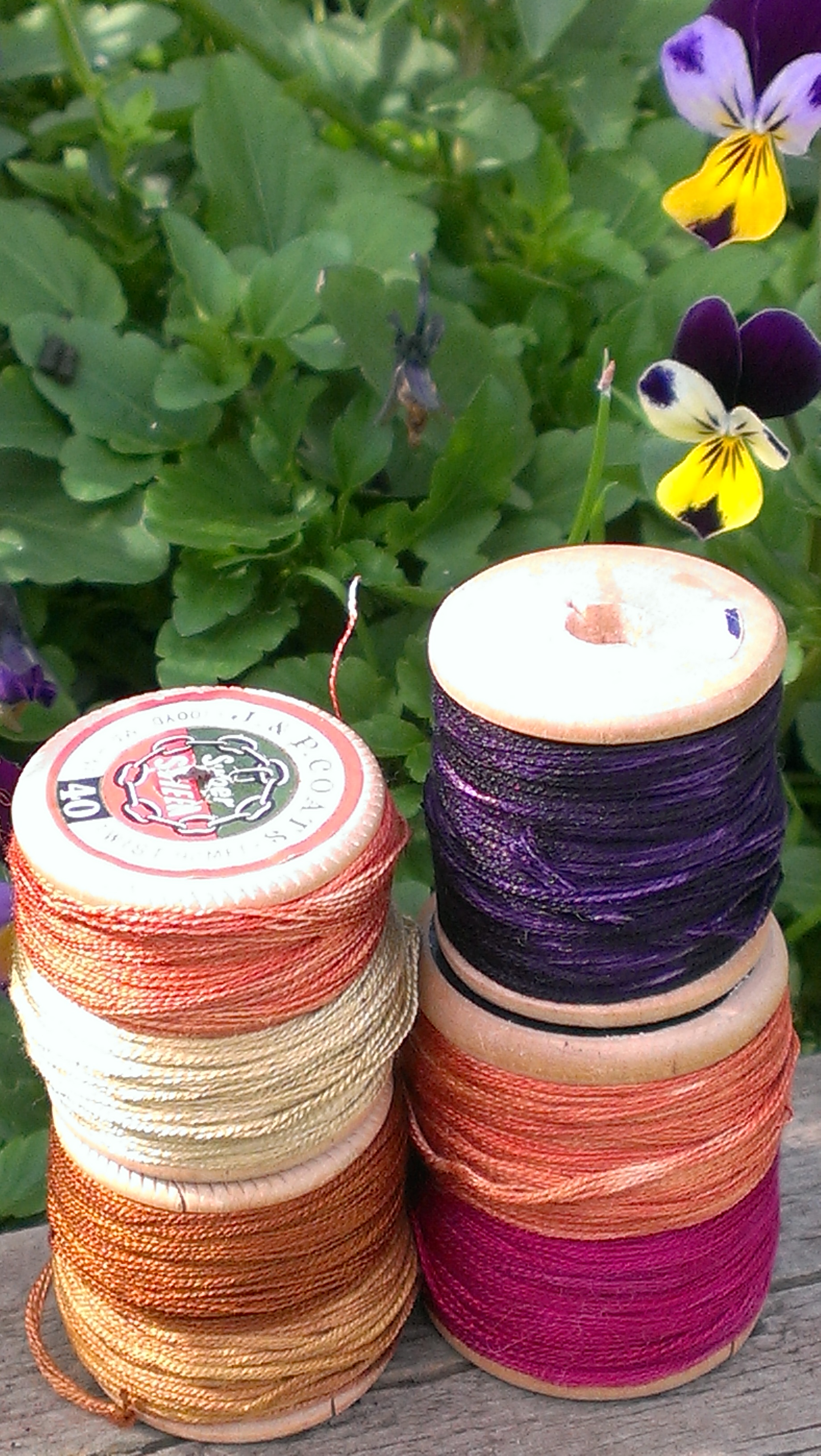
I have had plenty of occasions to get out my darning kit this week. Wendi of the Treasure’s comment on the post about moths and mending recently helped me decide to get organised for colour darning. I began by winding some of my silk embroidery threads onto reels.  Oranges from madder, tans from eucalypt and onion skins, purple from logwood, and fuchsia pink from cochineal.  I have other colours but ran out of reels!

2014-07-30 11.24.13

So… now that woollen items are being subjected to rigorous scrutiny before return to the cupboards… I give you indigo darning.

2014-07-31 07.48.19

Onion skin darning.

2014-07-31 07.48.47

And logwood darning. This may well be the place I failed to eradicate a couple of moths last year, as this top already has a series of darns dyed with Plum Pine.  As a washfastness test, those darns have continued to show that I have not found a way to make Plum Pine washfast–it is fading, but that has worked well with the mauve of the top.

2014-07-31 07.48.59

While I was on a roll, I appliqued a patch over this hole where two pieces of recycled fabric in the lining of a bag parted company.

2014-07-30 20.33.29


I don’t rate my applique but I have been practising!

2014-07-30 20.58.44


Then there was the worn through section of my quilt (made of recycled linen garments)…

2014-07-30 20.32.16


Now repaired with a piece of linen collar from a test-dye.

2014-07-30 21.26.00

Well.  My mending queue is getting plenty of attention, but it remains to be seen whether it will just continue to grow as washing exposes where the maws of those moth larvae have been…

21 Comments

Filed under Natural dyeing, Sewing

Bundle dyeing–and a new book

After the recent massive vat dyeing project, and with so many Eucalyptus Cinerea leaves lying around drying slowly, I was itching to dye some bundles. After a full day of mordanting and dyeing and sewing in windy overcast weather… here’s the view over the back fence and up into the sky.

2014-06-28 17.26.19

I had a piece of silk twill left when one of my workshop participants didn’t appear. In it went.  I also had a linen shirt and a cotton t shirt sourced at op shops and ready for renewal that I had mordanted in summer.  By the time I tied those bundles the sun was setting.

2014-06-28 17.19.53

I filled the pot with madder exhaust, and topped it up with some of my very-much reused alum pot. As the remains of the madder rose up the fabric and the temperature rose, the sun went down.

2014-06-28 17.25.37

When I opened these first two bundles the impact of the chalk in the madder pot became clear.  And despite having allowed the leaves to dry for days, it is midwinter here.  Those leaves would have started out full of water, and they are drying very slowly.  Interesting results… This is the silk twill.  The round green shapes are from dried E Cladocalyx ‘Vintage Red’ leaves.

2014-07-16 09.10.56

This is the t shirt.

2014-07-03 16.41.11

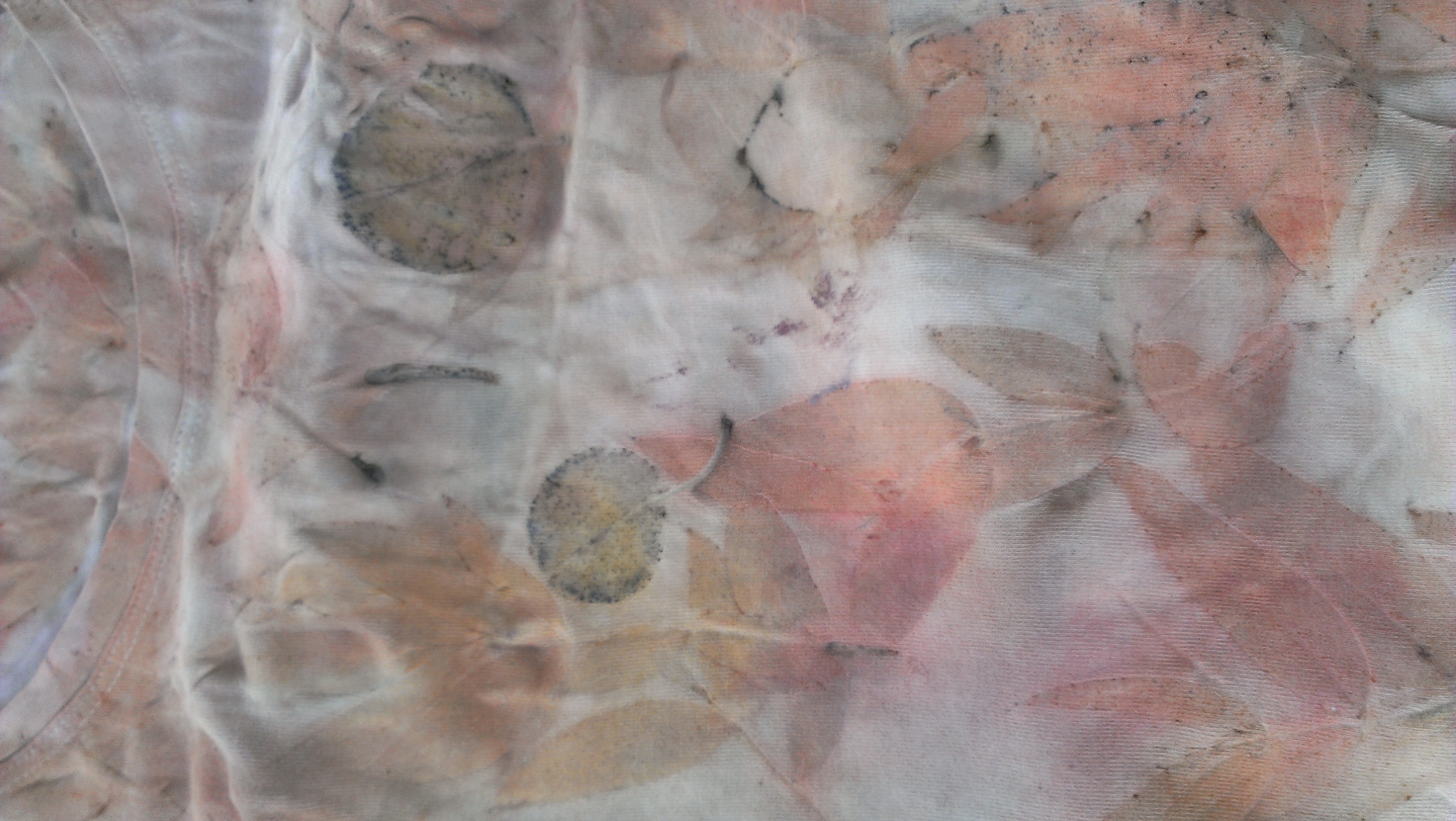
Here is the part of the t-shirt bundle that was in the madder exhaust/alum blend.  So little colour from the E Cinerea!

2014-07-03 16.41.25

I decided to set the third bundle (linen shirt) aside and give it some more time in the pot, which I did after work later in the week. Front view:

2014-07-16 09.12.15

Back view.

2014-07-16 09.12.31

If you wish you could try this method and have experiments of your own and bundles to untie at your place–but you’re not sure where to start, India Flint has just published ‘the bundle book’.  It is a concise introduction to her technique on fabrics and on paper.  You can see an extensive preview if you follow the link.  This book is unspeakably cute–being both small and exquisitely illustrated with photos to inspire.

2014-07-17 09.29.06

It presents information about techniques (such as dyeing paper) not covered in her earlier books, strategies for sustainable and safe dyeing and a history of the eco-print method.  It also addresses fresh ideas developed since the publication of Eco Colour and Second Skin.  And, it is full of India Flint’s inimitable voice.  I am old enough to remember when recipe books were sold on  the basis of recipes and not celebrity cooks, and when the writing was bland and spreadable.  I don’t miss the bland and spreadable writing, though I’m less sure about the cult of celebrity cooks.  No danger of bland here!  I very much enjoy the sense of a unique intelligence at work on subject matter I think about a lot that is a feature of India Flint’s writing.  It is a rich addition to her insights and strategies about harvest, recycling and dyeing.

This book is published on demand, which is a no waste, effective way of publishing a book for something short of a mass market. I suspect it also means that the book you order in Australia is printed here, but a book ordered in North America will be printed there, and not have to travel the seas or skies to reach you.  The printed versions of the book are fairly expensive, however.  If your wallet is up for it, it’s a great way to support an independent artist and the end product is delectable.  If your wallet isn’t up for it, the downloadable pdf option is instant and very affordable, and still a great way to support an independent artist.

I’m looking forward to trying out dyeing paper… perhaps when the rain pauses (I went out to figure out why the gutters were overflowing mid-edit on this post–and fixed the trouble with my dyeing tongs!).  While the rain continues, I’m having a knitting jag suitable to the weather…

16 Comments

Filed under Book Review, Leaf prints, Natural dyeing

Garments to bags…

The time has come for some of my clothes to find new uses.  These worn out jeans have had years of use as jeans…

2014-06-26 18.29.13

I made these shorts from a length of linen I found on a pile of hard rubbish on a Brisbane kerb when I was there one summer.  They have had years of hard wear and been re-dyed once or twice.  Surprisingly enough the screen printed design on the pocket details didn’t take dye!

2014-06-27 19.53.25

They are now completely threadbare in places that would create embarrassment if they were to fail, further evidence of the hard wearing qualities of linen.

2014-06-27 19.53.56

I paired the jeans up with some leftovers from past sewing adventures, which finished out the lining.

2014-06-27 18.47.06

The jeans pockets went on the inside, retained for future use.  The outside features the pockets of a pair of hemp shorts that hit the dye pot some time ago.

2014-06-29 20.07.39

I teamed the linen shorts up with the remainders of a pair of men’s twill cotton pants bought for a dollar from the Red Cross.

2014-06-29 20.06.44

I love a beautifully executed pocket, and there are two of them featured on the outside of this bag, while the back pockets of the shorts are still on the inside of the bag.

2014-06-29 20.06.05

In between the sewing, I spent the weekend mordanting fibre and continuing to try to exhaust dye baths from the workshop a fortnight ago!  By the end of the weekend I was down to pastels… And there was the odd Stuff, Steep and Store jar to be going on with.  Using the microwave has lowered the barriers to taking an opportunistic dye find or something that seems promising but whose dye properties are unknown to me and putting it up for future reference.  Here, rat-nibbled pomegranate remains collected off the ground… as no edible pomegranate would be turned to dye at our house!

2014-06-28 09.37.59

1 Comment

Filed under Leaf prints, Natural dyeing, Sewing

Eucalyptus Megacornuta: Warty Yate

Sometimes it is hard to know which to prefer.  The common name (Warty Yate)–splendiferous as it is–or the Latin name (E Megacornuta), also glorious!  Both names focus on the bud caps of this tree, which are both mega (4.5 cm long) and warty.

2014-06-12 08.30.35

There was a yate (one of the still-splendid but not-so-warty yates–I am guessing E Lehmanii) growing in the playground at the kindergarten I went to. We would put the bud caps on our fingers and chase each other around, yelling ‘witch’s fingers!’  Needless to say, we had been offered no information about whether witches really have long pointy fingers and no one had offered me the perspective that witches might mostly have been maligned herbalists and midwives…

2014-06-12 08.31.39

A friend’s dog is staying with us and we went for a walk the morning I picked these.  The flowers called out to me.  I identified this tree a couple of years back.  Those bud caps made identification simple, but as you might imagine this tree also has impressive fruit.   Speaking of awesomely good names, please note the ‘flattened, strap-like peduncle’ my eucalyptus manuals mention.

2014-06-12 08.31.29

I picked up fallen, dried leaves and took home a small sample.  My sample dyepot showed a barely-orange tinted brown. I did also create a small sample bundle.

2014-06-14 16.50.17


Fresh from the pot and still damp, it also was on the slightly orange side of brown.  However once dried out, washed and dried again, it had turned quite definitively brown.

2014-06-14 16.52.53


4 Comments

Filed under Dye Plants, Eucalypts, Leaf prints, Natural dyeing, Neighbourhood pleasures