Tag Archives: orange again

Unknown Eucalypts

IMAG1422

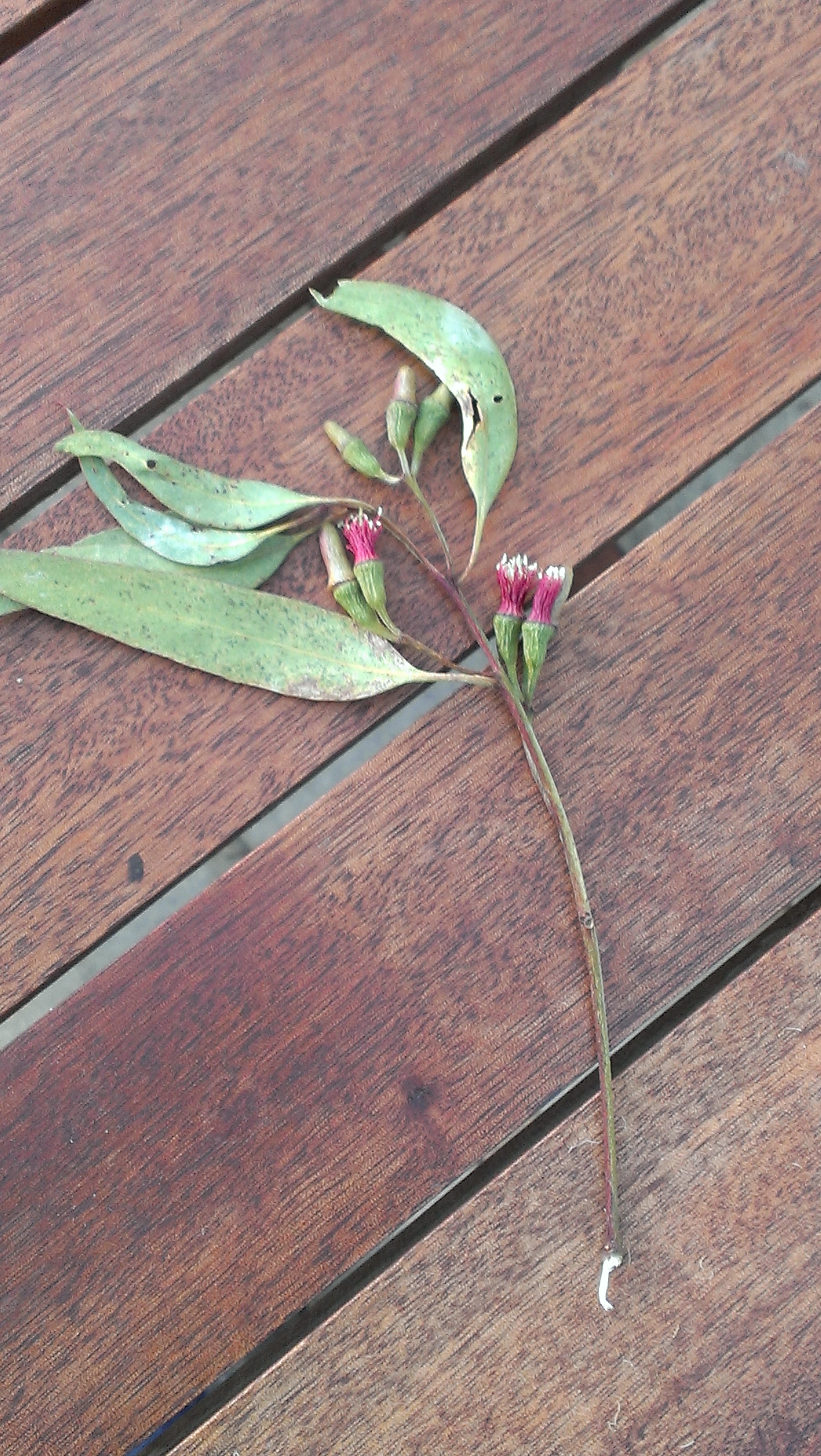
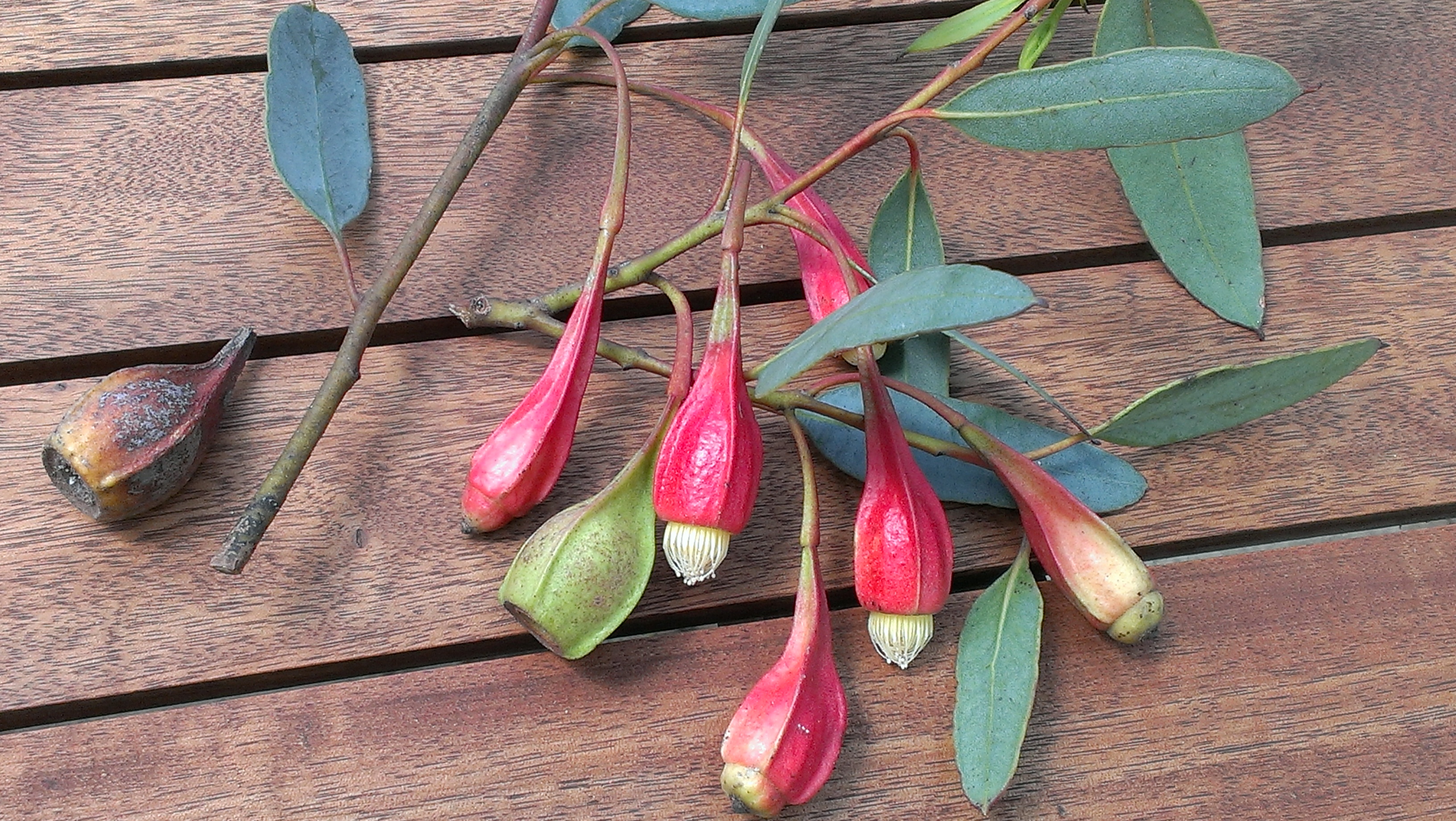
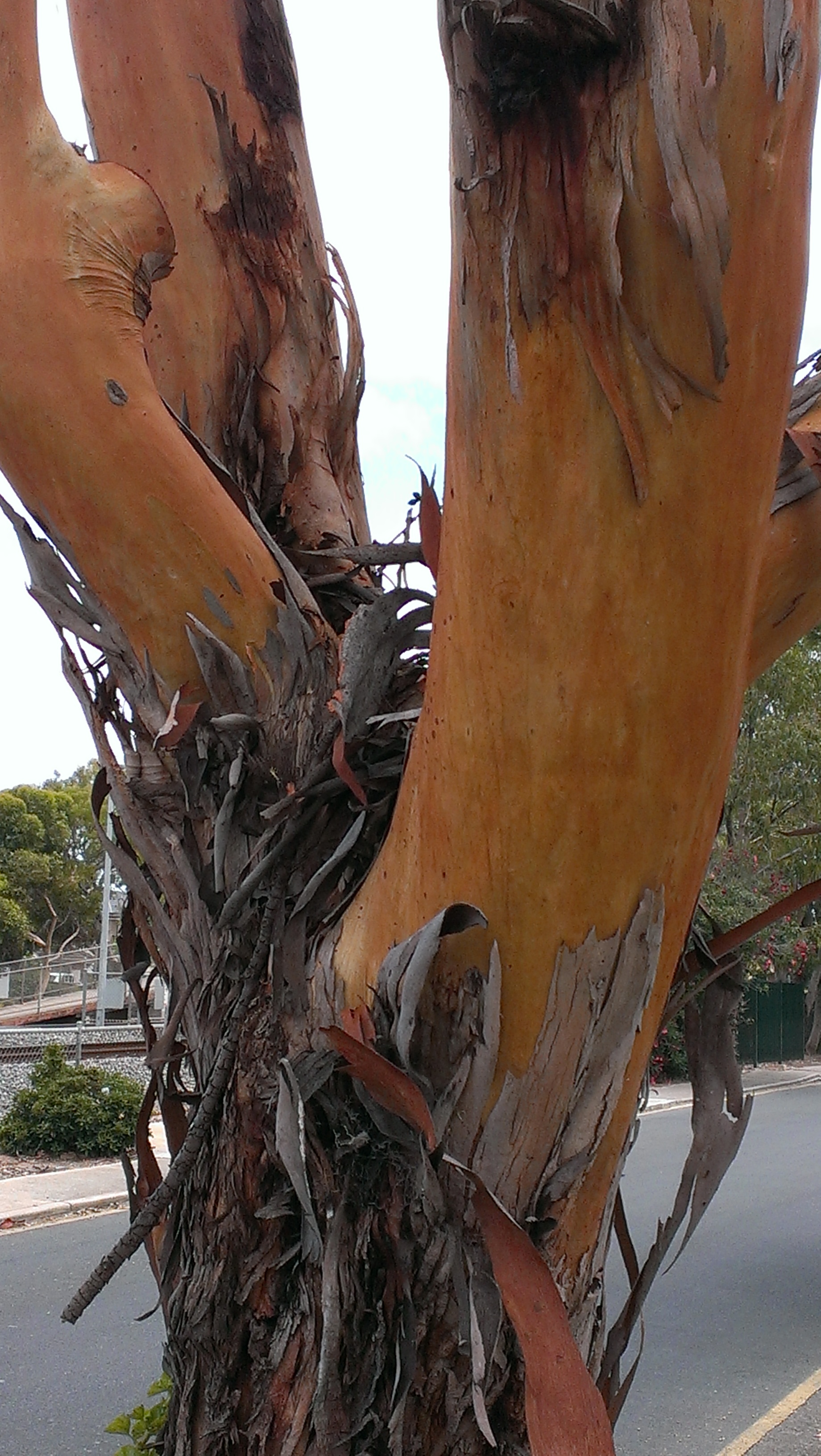
I found an unusual looking eucalypt in bloom on my favourite running track. Which means I had no camera and no bag with me.  This is a small dried sample… The tree has a lovely bronze, smooth trunk, with bark peeling in strips.  Euclid isn’t speaking to me at present but perhaps later identification will be possible with those wonderful red flowers!

IMAG1419

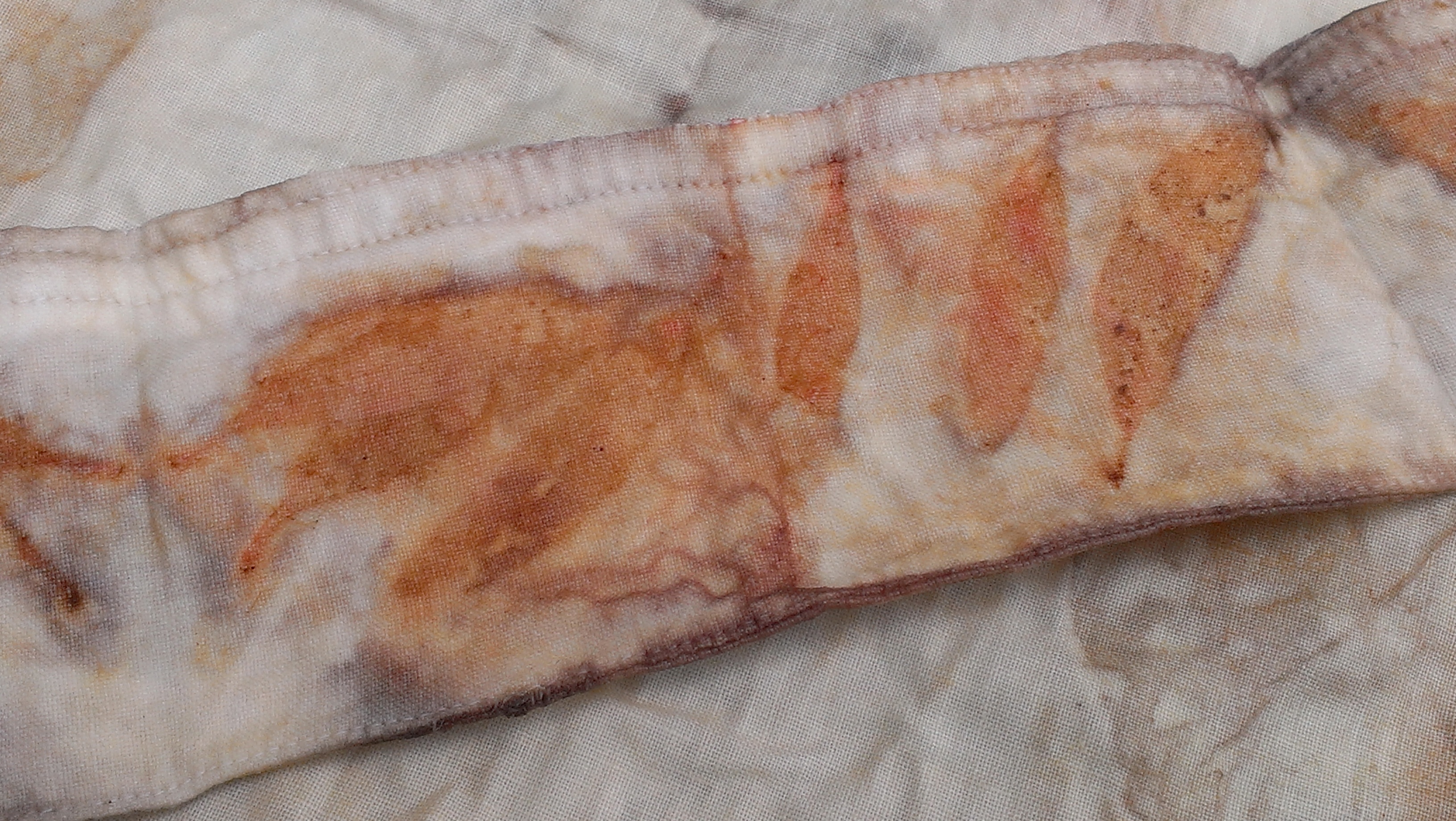
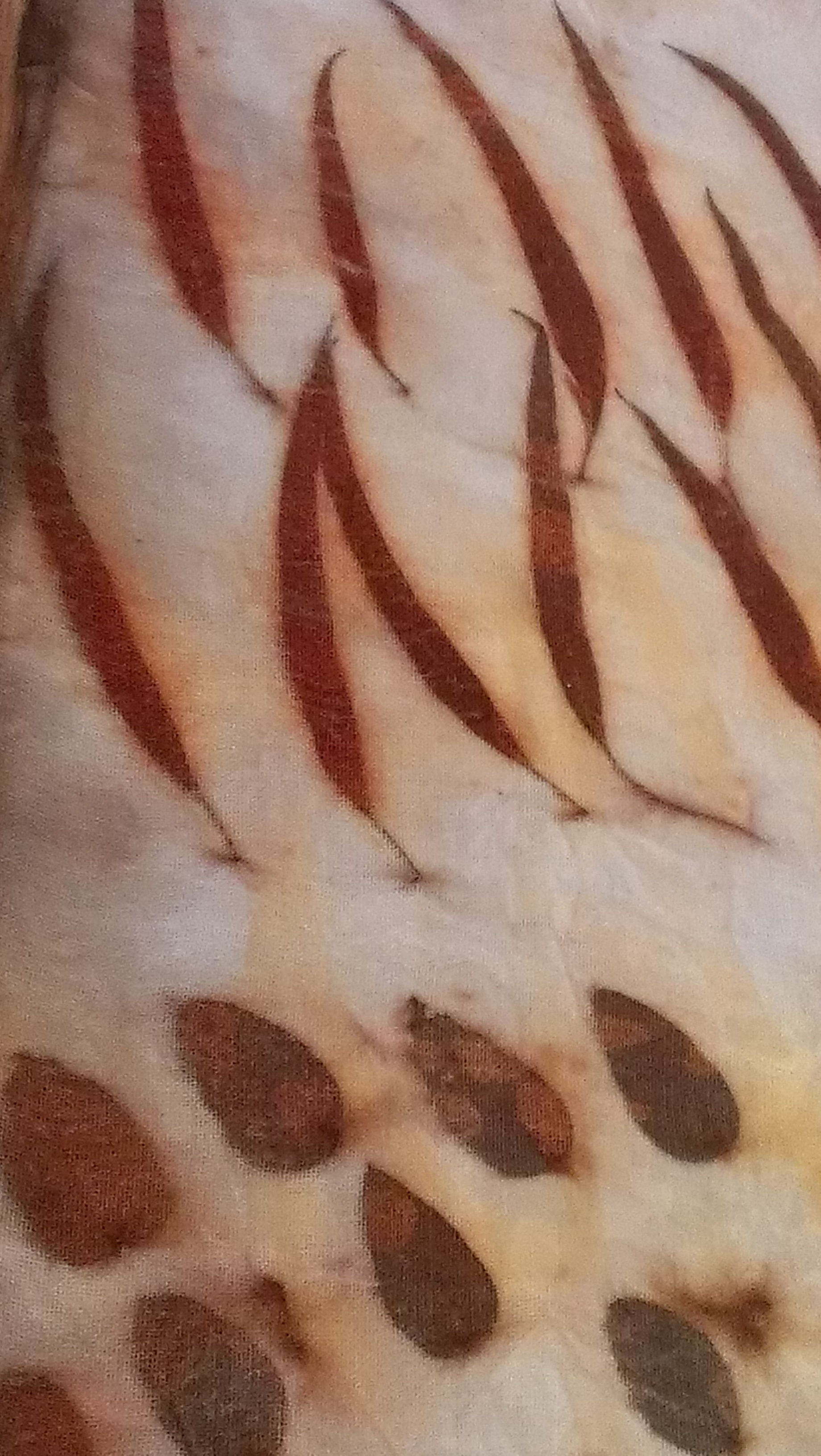
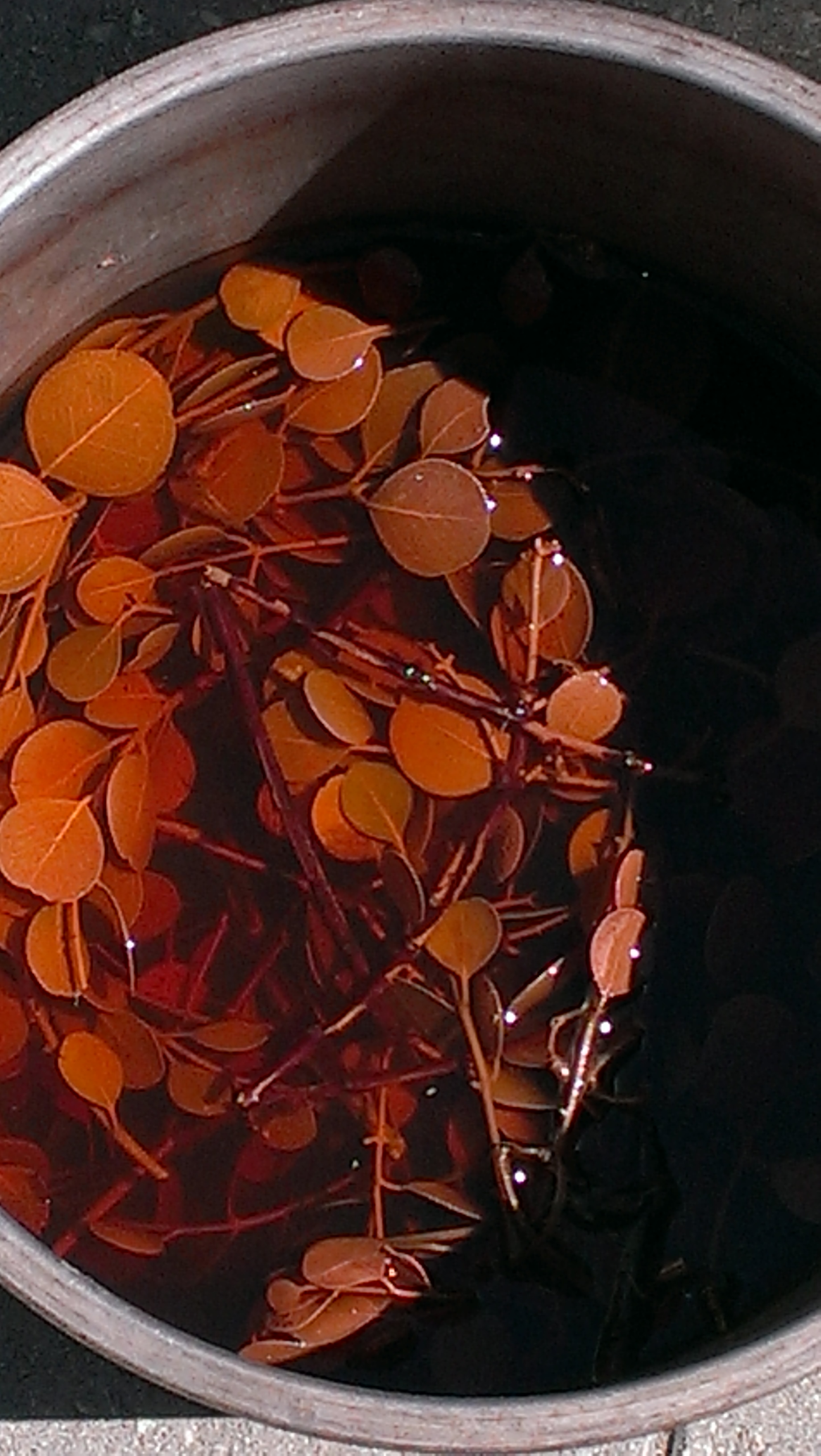
There is a smudge of red among the orange leaf prints these leaves gave…

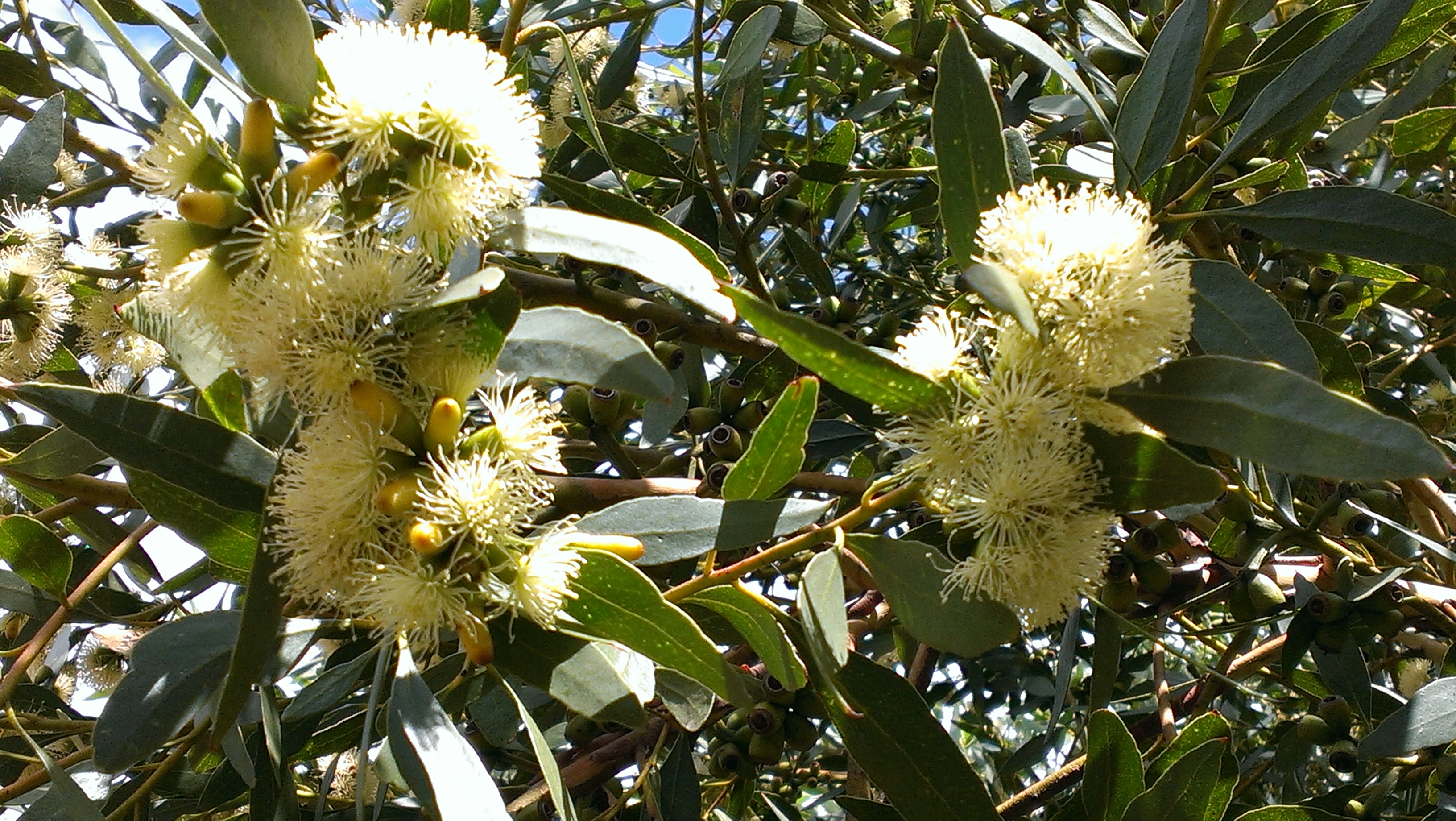
This is my second unidentified eucalypt.  It was growing in Botanic Park when I rode through recently.  It had been raining and this extremely tall tree had lost some twigs, leaves, buds and flowers.  Sadly, no one had given it a name tag for my edification… but it seemed an opportunity too good to miss.

IMAG1427

Or on the other hand… further evidence that there are Eucalypts which give very little colour!

IMAG1434

4 Comments

Filed under Dye Plants, Eucalypts, Leaf prints

Tour de Fleece continues…

Have I mentioned that I’m participating in the Tour de Fleece, spinning each day during the Tour de France?  Clearly this strikes a lot of people as a truly bizarre and quaint pastime. I am not an especially sports loving person, so from my point of view, this is great sport!

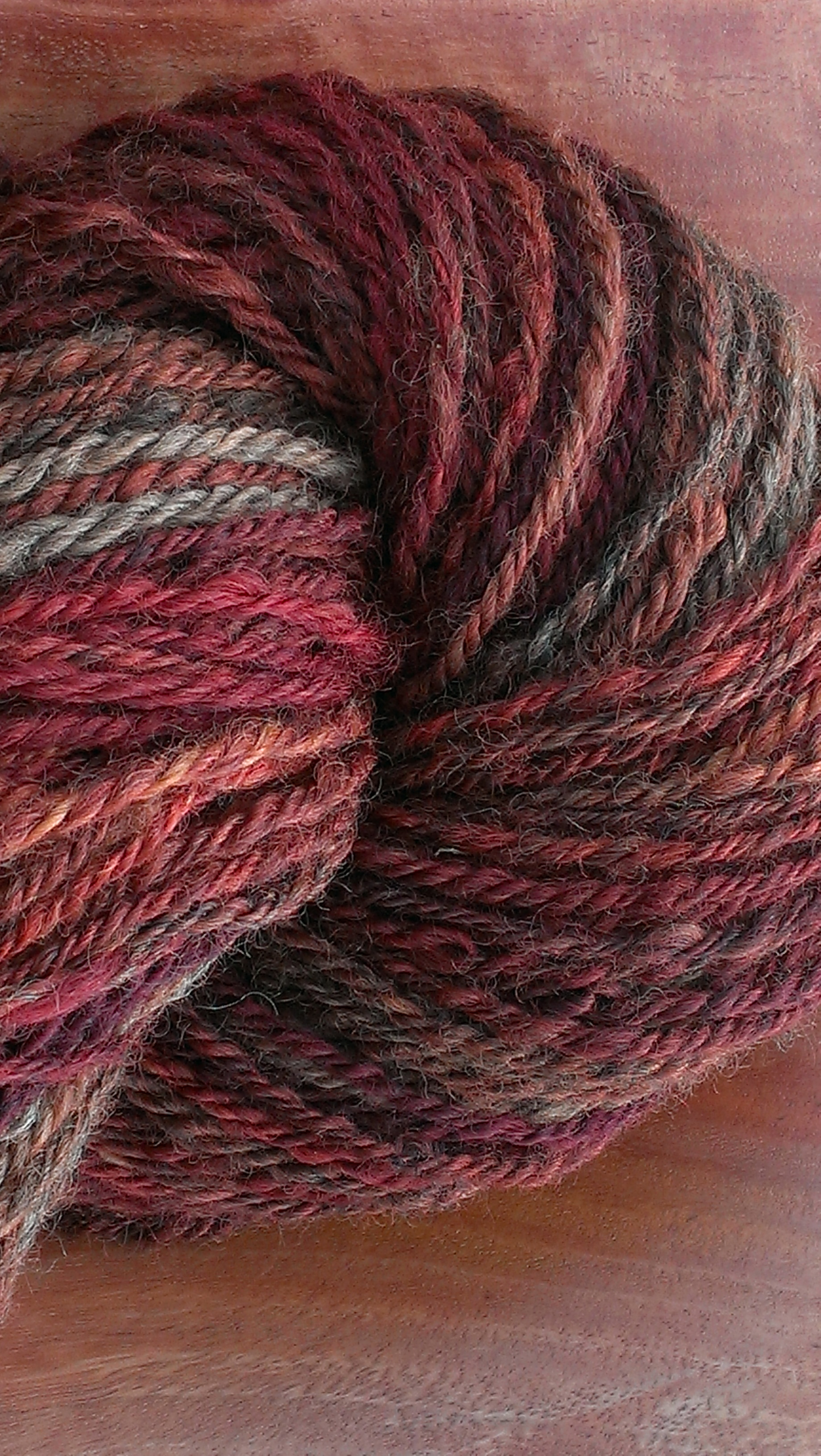
I have been spinning more of my eucalyptus dyed grey corriedale.  I loved the 3 ply yarn I made from it, but it isn’t going to make gauge for the cardigan I now have in mind and will stripe in a way that won’t work for it either.  This may be a clue that I should make the cardigan from some other fibre, of course, but I decided to try 2 ply, which raises entirely different issues about colour blending.

IMAG1776

I’m struggling to get the colours to show right in photos… but this approach clearly will even out the colour variations without making them disappear.  And perhaps it is time to try a swatch to discover how I am doing on gauge.  I have been feeling squeamish since plying… two plies of different colours is not something I would usually be aiming to achieve.  My beloved has offered the view that the yarn is lovely and will look ‘tweedy’, which sounds good to me…

5 Comments

Filed under Eucalypts, Natural dyeing, Spinning

Eucalyptus colours over grey wool

I have a lot of Polwarth fleece, both brown and variegated white/tan. All of it gifted from pet sheep that live nearby.  It is a privilege and it is also a difficulty.  Washing fleece so fine and so greasy has been intimidating as well as slow.  I have spun some in the grease, and washed some twice, and tried several different washing approaches.  I have dyed and spun and spun and dyed.  Two and three ply, corespun. you name it! I spun and knit an entire cardigan from naturally brown Polwarth, too.

And then one day someone at Guild said “I hate fine fleeces!” in my hearing, and it occurred to me that I do not have to spin it for the rest of my life.  I lashed out and bought a considerable quantity (3.5 kg) of grey Corriedale (nothing to approach the stash of Polwarth, mind you) and it has been heavenly.  I love grey fleece, and this is the loveliest corriedale I’ve ever had the pleasure to spin.

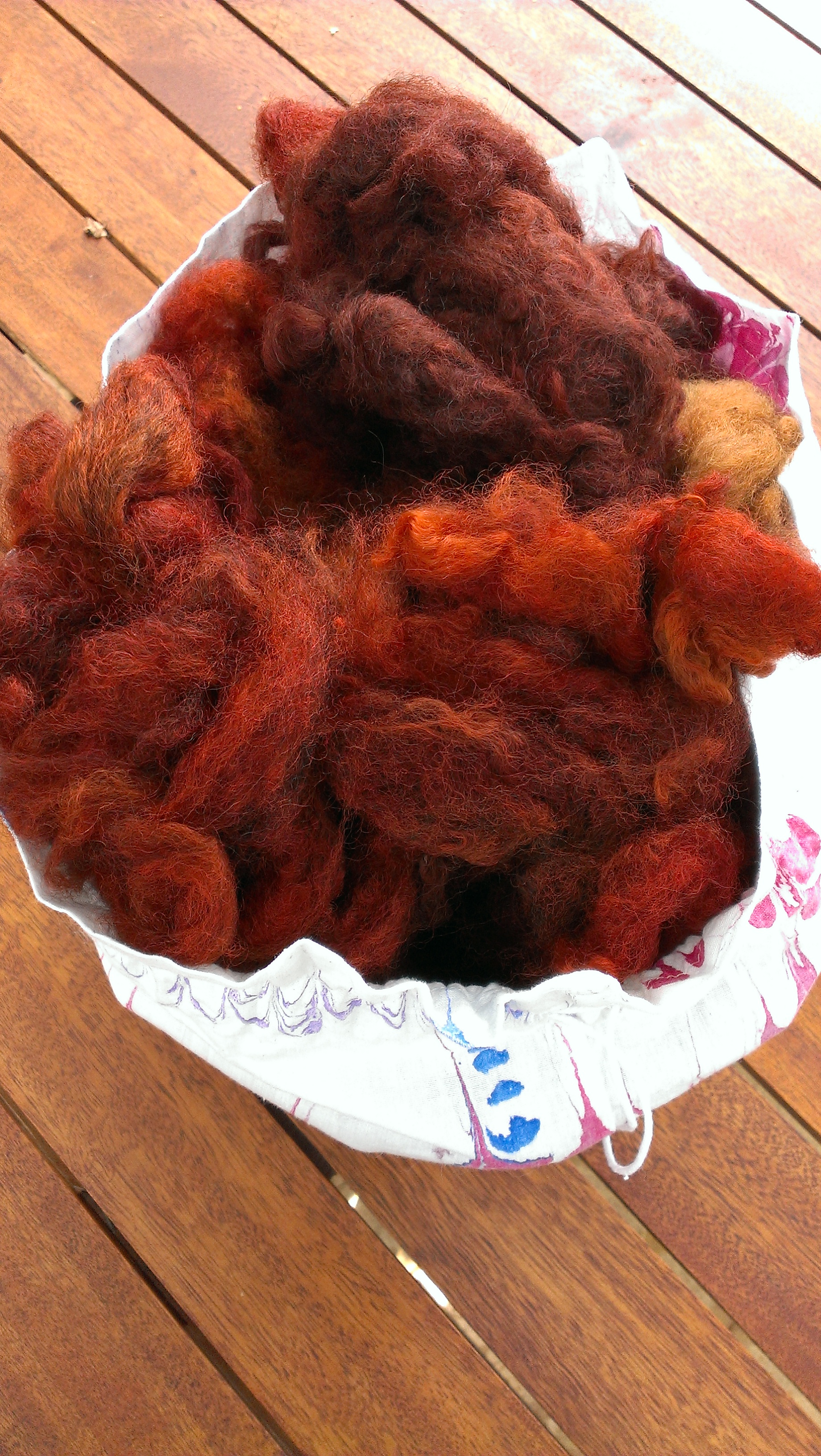
I have been dyeing it with eucalypt leaves and bark.  I have oranges of many shades from rust and brick to flame to gentle sunset.

IMAG1363

I have burgundy and plum.

IMAG1364

And I also have some tans and walnuts.  It appears I collected some bark that wasn’t exactly what I thought I had collected.  But to be honest, I think these are lovely additions in this context.  I’ve begun spinning yarns of many hues, chain plying to maintain the colour contrasts.  Lovely.  It’s hard to believe I can find these colours through combining bark and hot water and time with wool.

IMAG1308

Now… I have figured out that what I would really like to do with at least some of this wool is knit a particular cardigan.  And my beautful 3 ply yarn is too thick to make gauge for it!  Possibly also for the design I have in mind those colour changes will not be ideal.  So, I am about to embark on two ply yarns.  This is my Tour de Fleece project.

20 Comments

Filed under Eucalypts, Fibre preparation, Natural dyeing, Spinning

Eucalyptus Nicholii

I finally found E Nicholii, growing in Botanic Park. My beady eyes have been searching the suburbs of my city for this tree as I ride past, to no avail until now.

IMAG1407

This is such a finely-leaved tree!  Perhaps I have failed to identify it if I have seen one fully grown, mistaking it for another kind of tree altogether.  I had one growing in a pot but it suffered too much through summer. It is also the only tree I have ever seen as the subject of a public notice at Guild, where I once saw a hand lettered note asking if anyone could supply E Nicholii leaves for a dyer. My friend’s godmother–another dyer–who lives in NSW, recommended E Nicholii as her favourite dye plant.  These are some of the reasons I was trying to grow it in a pot.  I have given that up and we have a tiny specimen growing in the corner of the back yard.  And now–the reason why people are so keen!  I think this print is sensational.

IMAG1428

See that big black splodge?  I have wondered why I get one of these once in a while (and needless to say I have had a few theories).  Just recently the penny dropped.  Or should I say, the washer dropped–because that is what actually happened.  One of my dye pots has a glass lid with a knob screwed into the centre of it. All these eucalypt dye baths have eaten away at the metal of the screw and washers.  One washer recently fell off altogether, as the hole in it simply had been made too large for it to stay in position.  So… there has been an inadvertent contribution of iron to some of my dye baths, and some unintended black smudges where iron water drips down onto my bundles from above–since this lid is convex, I have preferred it when I have large bundles in the pot.  Aha!  Another mystery solved.  This may explain some of my surprise dye bath outcomes, too…

3 Comments

Filed under Dye Plants, Eucalypts, Leaf prints

Dyeing in Katoomba–and some local-to-Katoomba eucalypt species

Just recently I had a short holiday in Katoomba (New South Wales).  I spent part of a day doing some dyeing with a group of friends who meet as a textile group.  One of my dear friends did a lovely job of organising a space to meet.  The group had a lot of great skills–with artists, a chemist, bush regenerators, plant identifiers and a librarian among them.  They had read and been inspired by Eco-ColourIndia Flint‘s fabulous book on natural dyeing in which she sets out the eco-print process.  But they had not had a great deal of success and some had formed the view that we have special trees in South Australia.  Of course, we do have special trees in SA, and so do they in NSW!  I tried to explain that it was far more likely a question of species than state boundary…

I love the stages in this process of setting up and bundling…

IMAG1508

Cooking…  we ran one pot with vinegar, one with iron and one with onion skins (the orange bundles have spent time in the onion skin bath and then been moved to a different pot).

IMAG1532

And then the big reveal!  It reminds me of that fantastic Judy Horacek cartoon… which by coincidence my friends have up at their place in Katoomba.  Please follow the link to be introduced to a wonderful Australian cartoonist–and to see the cartoon!  E Scoparia and E Cinerea on wool:

IMAG1559

With so much expertise–and because my wise and sweetheart friends who were hosting our holiday as well as dye day had been out collecting and applying plant knowledge–we were able to try out some local species.  These samples are all on silk noil scraps, and have all been in hot water for at least an hour–just to test their potential really.

IMAG1513

We couldn’t resist trying Indigofera Australis even though it didn’t seem likely a hot process would be ideal for an indigo-bearing plant.  It wasn’t, leaving almost no mark except when dipped in an iron modifier.  Here it is, before and after.  The yellowy-greenish tinge is an effect of photography indoors.  Sorry about that part.

IMAG1521IMAG1561

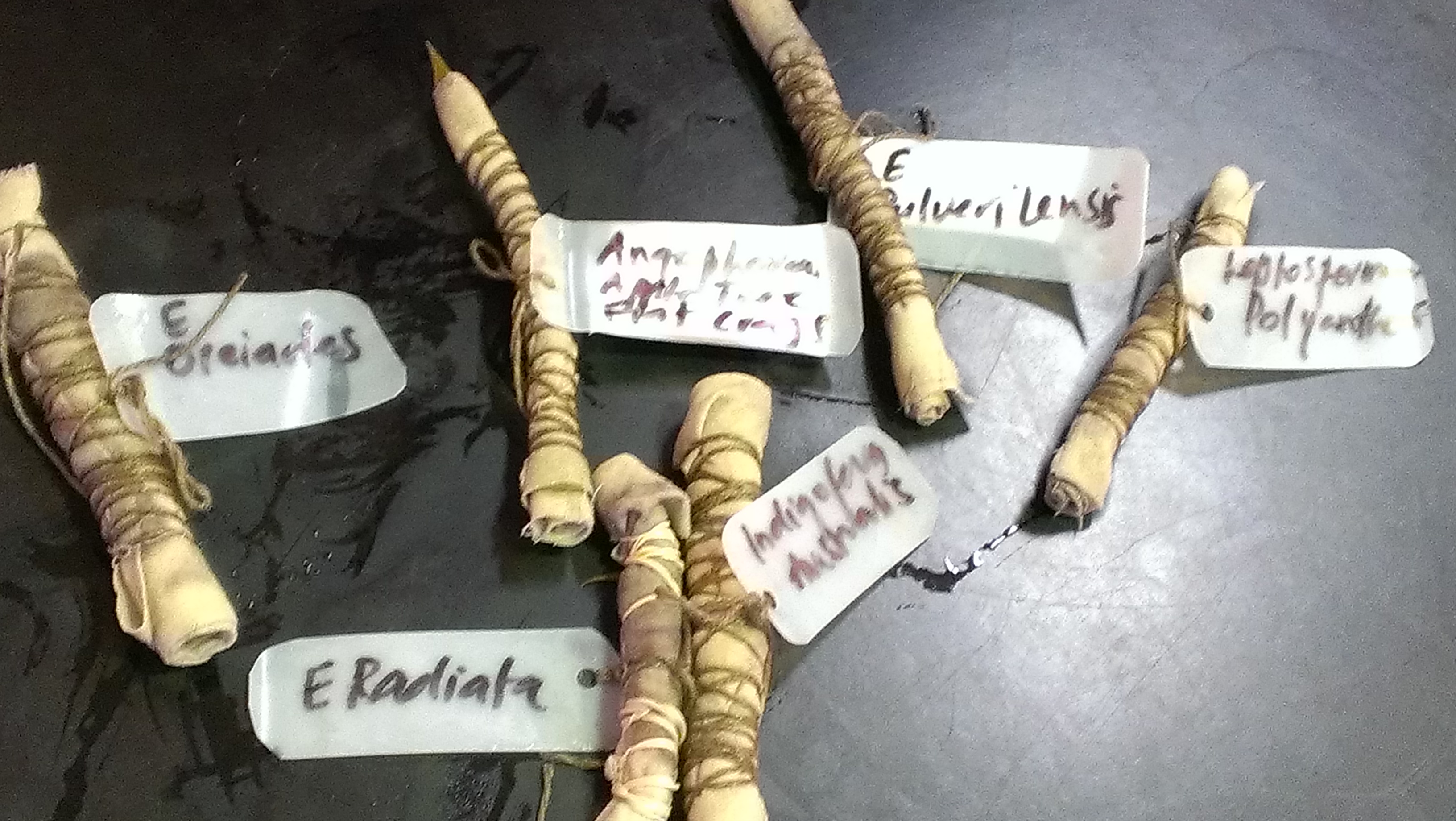
E Radiata, the Narrow-Leaved Peppermint:

IMAG1515

One of the especially beloved and tall local species is E Oreades, the Blue Mountains Ash–a truly local-to-Katoomba tree:

IMAG1517

And finally, E Pulverulenta, the Silver-leaved Mountain Gum, is a vulnerable species in the local area.  As a result, people who want to make sure it lives on are planting it in towns, and this sample came from a street tree.  Dyers will now have an additional reason to support the conservation effort!

IMAG1518

A big, big thanks to my Katoomba friends, and to the textile group for having me!

7 Comments

Filed under Dye Plants, Eucalypts, Leaf prints, Natural dyeing

Wash fastness: Eucalyptus leaves on cotton knit

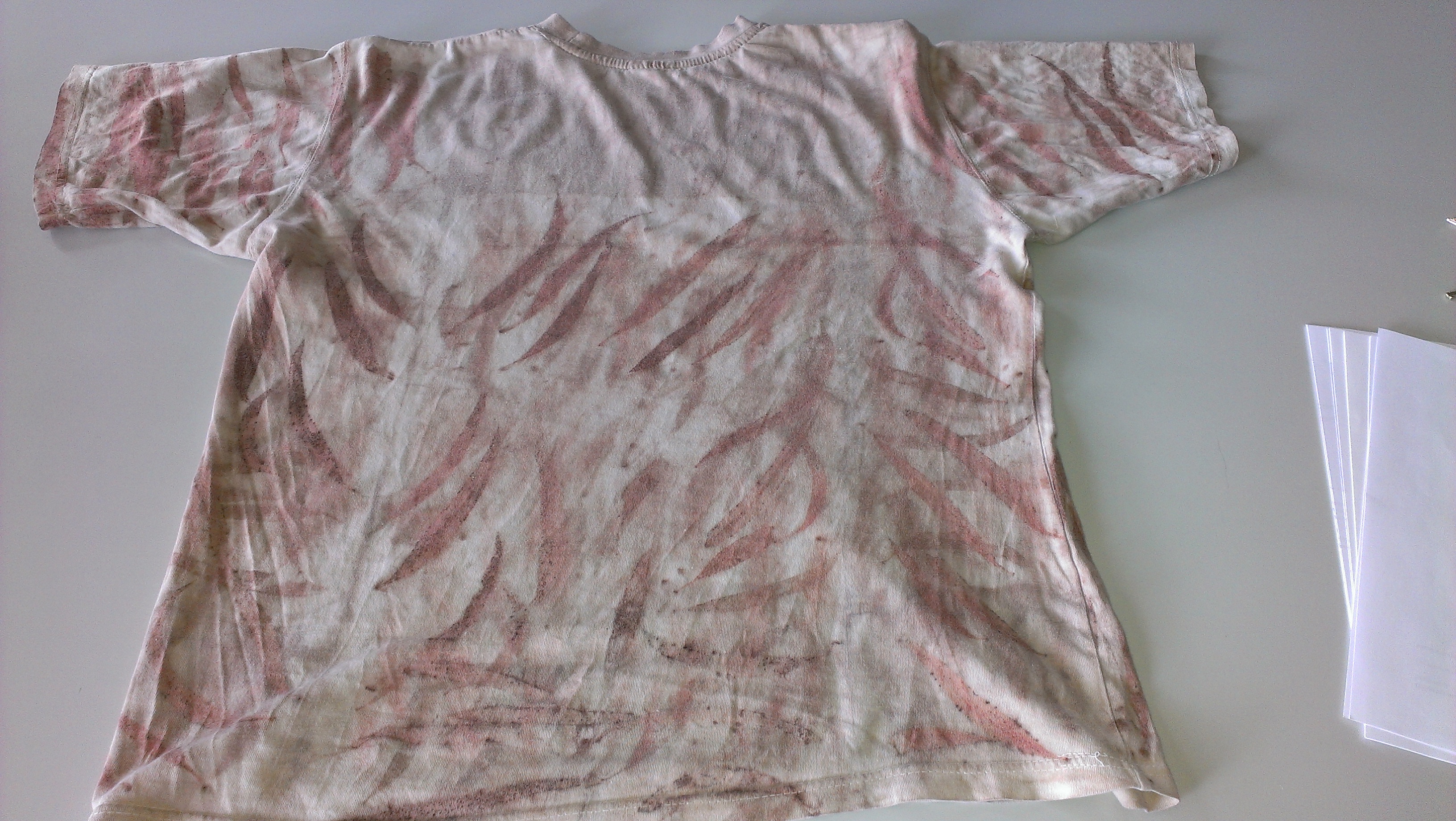
I leaf printed a cotton t shirt on 10 February 2013.  I prepared the fabric with soymilk and dyed using iron and E Scoparia leaves.

Here it is on my office desk after its first trip through the washing machine at 30C and its first trip to my office on my back as I rode to work. The front and the back (with the part that was outermost in the dye bath at the upper mid back):

IMAG0950 IMAG0951

It still smells strongly of eucalyptus when you’re up close (and sweaty), but the smell of soybean is almost gone, or overwhelmed by eucalyptus.  I am thinking I can take a photo of it in the (relatively) controlled light conditions of my office at regular intervals and see what we can notice.  One wash more and the smell of eucalyptus was fading a good deal.

Here it is in May, 12-15 washes later:

IMAG1289IMAG1288

I am just not sure about the influence of light on this image… to me as the person wearing the garment, it seems to have changed little except that the part on the upper mid back where the fabric was exposed to the dye bath (and consequently, to  iron) is much lighter.  There’s no doubt the photo looks much less orange, though the leaf prints are still entirely distinct.

6 Comments

Filed under Eucalypts, Leaf prints, Natural dyeing

Alpaca preparation

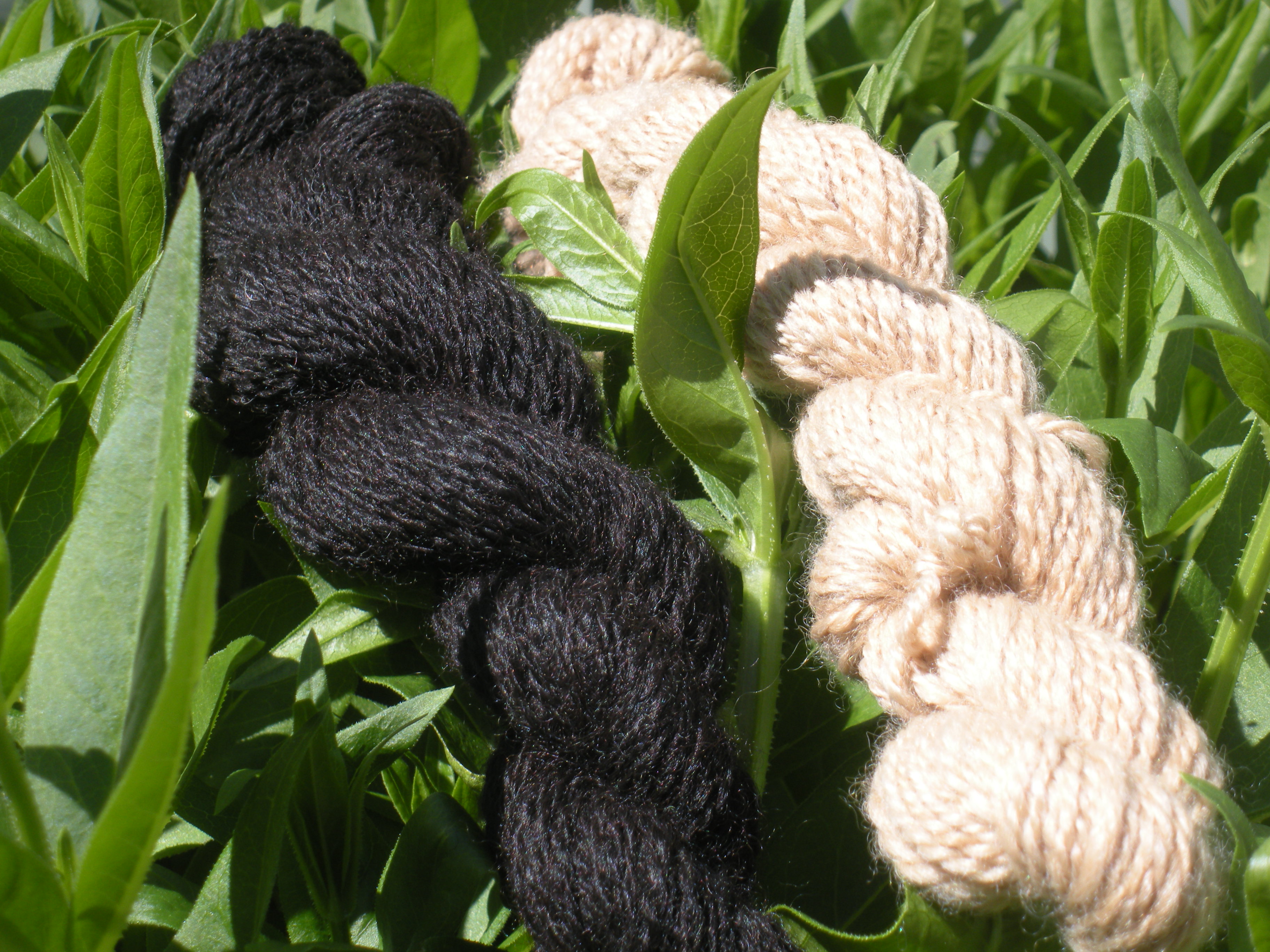
I’ve been having a lovely time spinning alpaca given to me by a generous friend.  She gave me samples of three different fleeces, white, black and what she rather fetchingly calls ‘champagne’.  I’ve been combing it and spinning it two ply and I’m very happy with the results.

I told my friend how lovely I thought the alpaca was, and she gave me more!  I have spun alpaca before, sometimes in quite a large quantity, but this has the longest staple I have ever seen, about 90 mm (these are the 90 mm matches I use to light to the dye pots–extra long.

I have to confess I have never washed alpaca, and it is always filthy, since alpacas roll and dust bathe.  My chooks dust bathe too, and watching them,  it’s no wonder that sand falls out of this fleece any time I move it! This fleece had so much dust in it that combing it was an outside activity that gave me hayfever.  I spun a lot of the white fleece rinsed and combed (that stopped the hayfever at least).  Then, I decided to brace myself and washed the rest of it.  And that led to dyeing the unspun fibre, as it turned out.  I have been working my dyepots hard experimenting toward red and…

IMAG1267

I am getting more interesting colours on silk thread (wrapped around the cards at left) than ever before.  My friends agree that the alpaca on the left, first through the dye bath, is red, then there is grey corriedale (second pass, same dye bath), more alpaca (third pass, still the same dyebath) and some still damp alpaca (fourth pass).  Three cheers for the potential to spin alpaca of many colours!

4 Comments

Filed under Dye Plants, Eucalypts, Fibre preparation, Natural dyeing, Spinning

Eucalyptus Orbifolia

Alas, poor Eucalyptus Orbifolia.  I grew this plant from a small seedling to a still small, but perhaps 50 cm high plant hardly worthy of the title ‘sapling’, in a large pot.  It seems to have been a casualty of the hot summer and perhaps its far flung location at the back of the yard.  Despite all the watering it received, poor old Orbi gives every impression of having curled up its toes.  So, I’ve cut back and harvested the leaves for the dye pot.  Perhaps there will be regrowth, but I’m not letting all the leaves fall while I wait to find out.

I bought this plant and not some other believing it to be a dye plant for some reason I can no longer remember.  I’ve been to the place I thought this idea generated but it isn’t there!  And now I can break the news to you, dear reader.  It isn’t going to join the list of truly exciting dye plants anytime soon.  Here is the dye pot after some hours of simmering.

IMAG1189

The dye liquor is still quite clear, with an amber tint.  The leaves are still the glorious shape that gives the tree its name.  I have leaf printed with them in the past and the result was definitely a print, though not any really impressive colour.  And here is the result of a dyebath test. The handspun with no mordant: orange.  The millspun superwash with alum mordant: brown.  What was I thinking mixing and matching fibres on my test cards in this batch? Silk thread, nothing of significance to report (E Orbifolia is in the middle). And for comparison, handspun Finn X dyed with E Scoparia bark at the bottom of the frame.

IMAG1215

5 Comments

Filed under Dye Plants, Eucalypts, Natural dyeing

Leafy pillowcases

A while back I leaf printed a length of seedy silk noil.  Today I turned it into two custom fit pillowcases for a small and contoured pillow I find very comfortable. One part of the fabric I printed wth E Scoparia–but you can see faint prints of E Cinerea leaves coming through too.

IMG_0060

The other, with E Cinerea. Interestingly enough, the lingering smell of eucalypt is very faint and the smell of raw silk overwhelms it: I’ve tried this before and it will last only a few washes. The colours are muted but the leaf shapes are clear.

IMG_0064

I love a simple sewing project… I’m one of those people who can make the same thing over and over again.

1 Comment

Filed under Eucalypts, Leaf prints

Sampling dye plants

IMAG0722

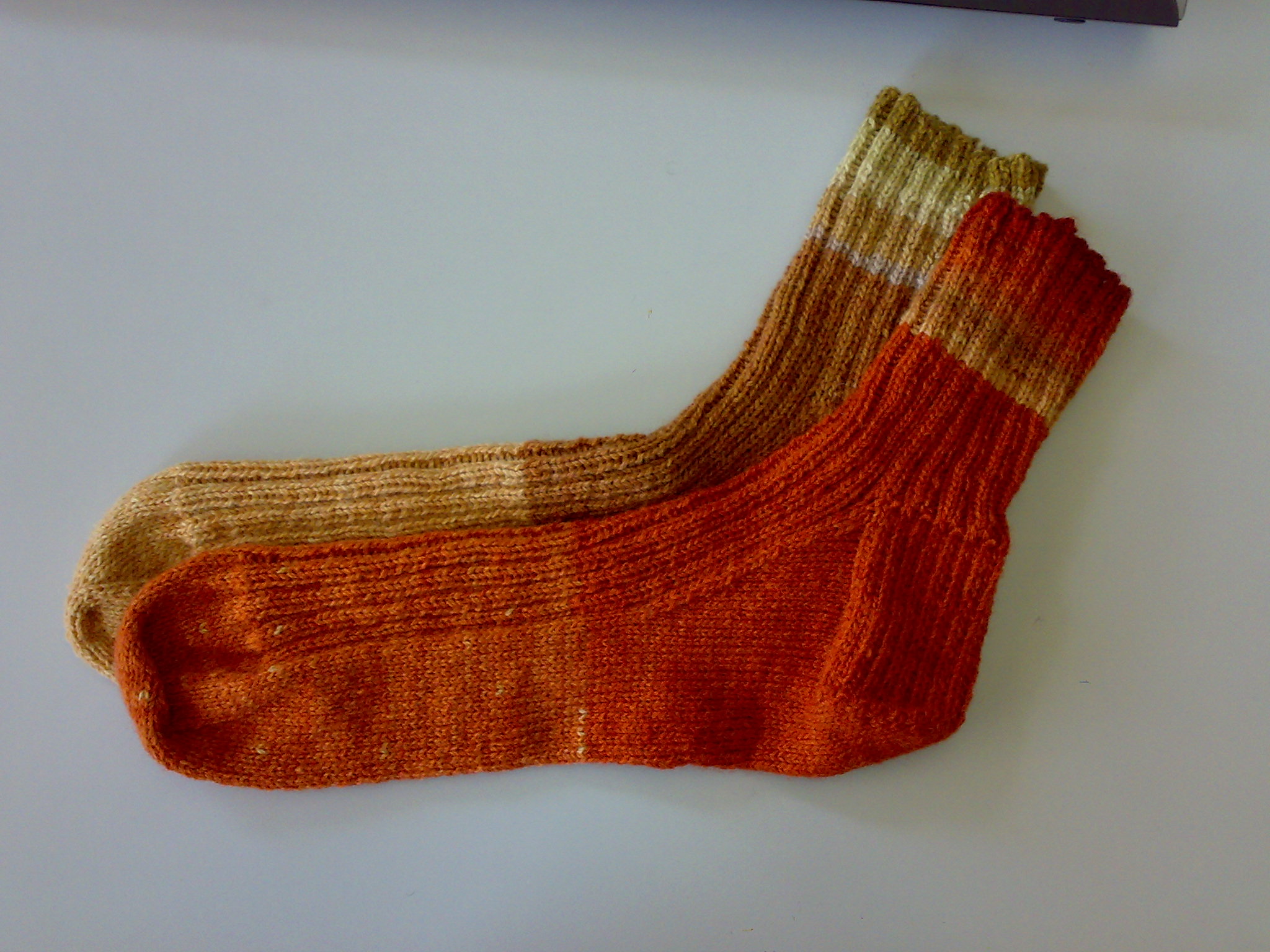
When I started plant dyeing, I used to make a tiny skein, about 1-2 metres long, and try out the leaves of trees around my neighbourhood on that.  In those early days, I tried rue after I found it listed in a book… oh my goodness…  the least said about that smell,  the better.  It almost put me off for good.  (Pale green, if anyone is wondering–not the red I was hoping for in my naivete).  When I had accumulated enough experiments to have identified some trees I wanted to keep visiting and some I would appreciate but not use for dye, I knit the samples into striped socks for a dear longtime friend. So that method had its advantages.  My friend asked for short cuffs (well, I thought he had–), so that’s what he got.

150620091160

I may have mentioned my devil-may-care attiutude to matching socks.  Happily my friend shares it, or he wouldn’t have scored this pair! 

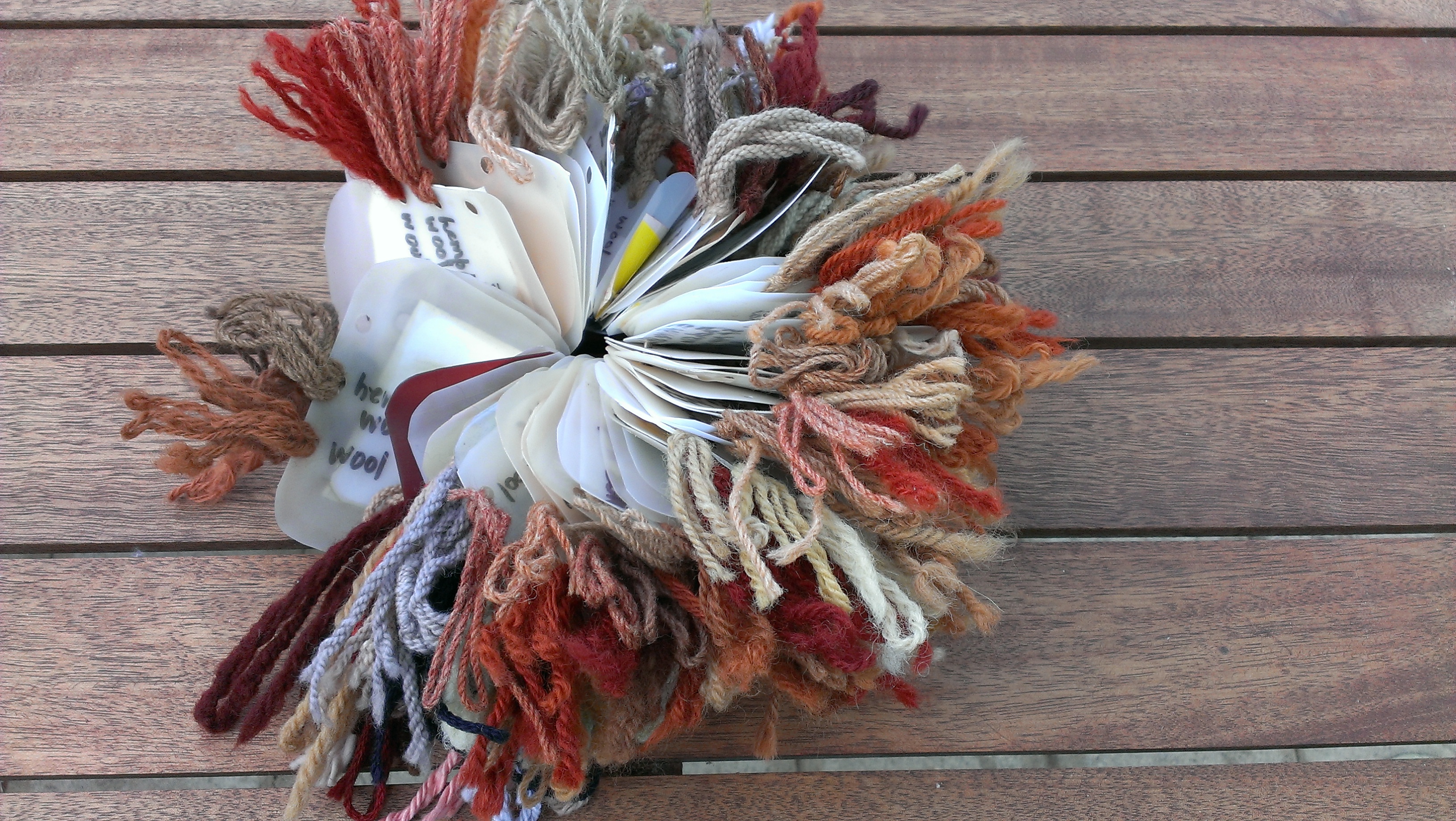
Eventually I learned about sample cards from more experienced dyers on Ravelry.

IMAG0723

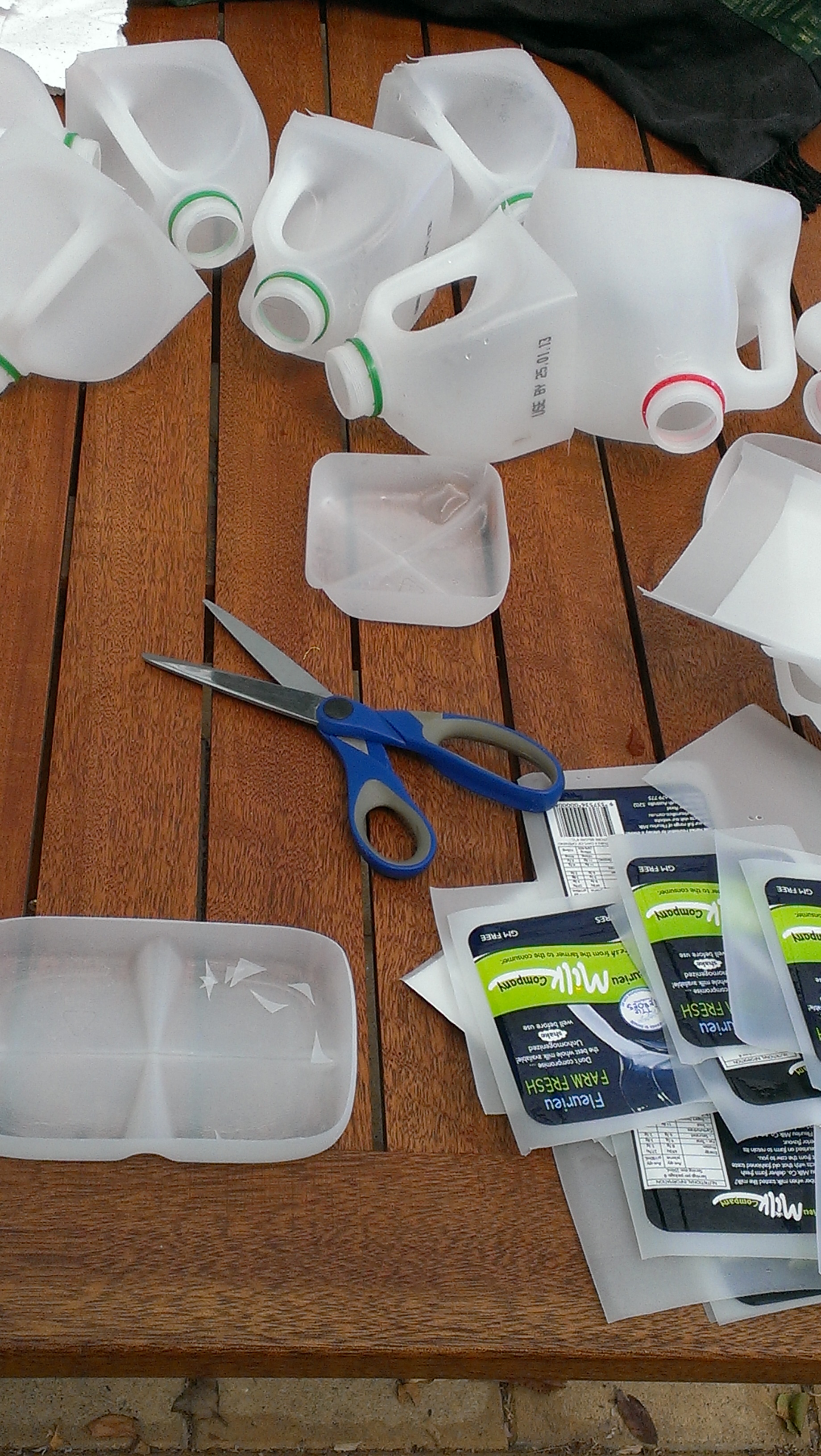
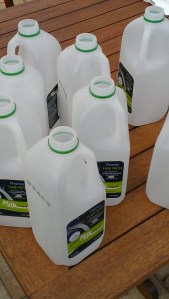
I use milk bottles to make mine.  We don’t use this kind at home any more, so I raided a recycling bin at a coffee cart during the weekly farmers’ market to get these.
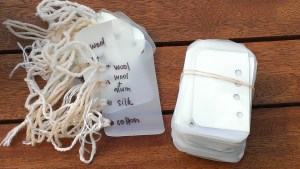
IMAG0768

I keep my samples on a split ring, which I think I also saw on Ravelry, and it’s a great record of plants investigated.  Some have been identified long after being cooked in the dyepot.  A few have been identified correctly after an initial misidentification.  Some have been tried several times.
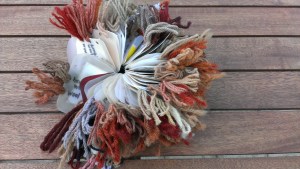
IMAG0773

And there are still so many to try out!  In the lead up to the recent workshops, I collected leaves fresh and dried: from trees, from the gutter, from fallen branches.  I collected more bark too.  This one is Eucalyptus Forrestiana,  believe:

IMAG0764

And I collected a few specimens I couldn’t identify… This one branched so high I couldn’t pick a leaf, but bud caps were raining down and lorikeets were having a great party high above me.

IMAG0760

This one was a sprawling mallee near the railway line, and came complete with new holland honeyeaters protesting my invasion.  I hope they had chicks in there somewhere, and this was the reason they kept trying to see me off even though they are about the length of my hand.

IMAG0746

This tree has fascinated me for some time: it gives a peach or apricot colour.  But I still can’t identify it.

IMAG0738

So many possibilities for the future….

6 Comments

Filed under Dye Plants, Eucalypts, Knitting, Natural dyeing