Tag Archives: yarn

Tour de Fleece continues…

Have I mentioned that I’m participating in the Tour de Fleece, spinning each day during the Tour de France?  Clearly this strikes a lot of people as a truly bizarre and quaint pastime. I am not an especially sports loving person, so from my point of view, this is great sport!

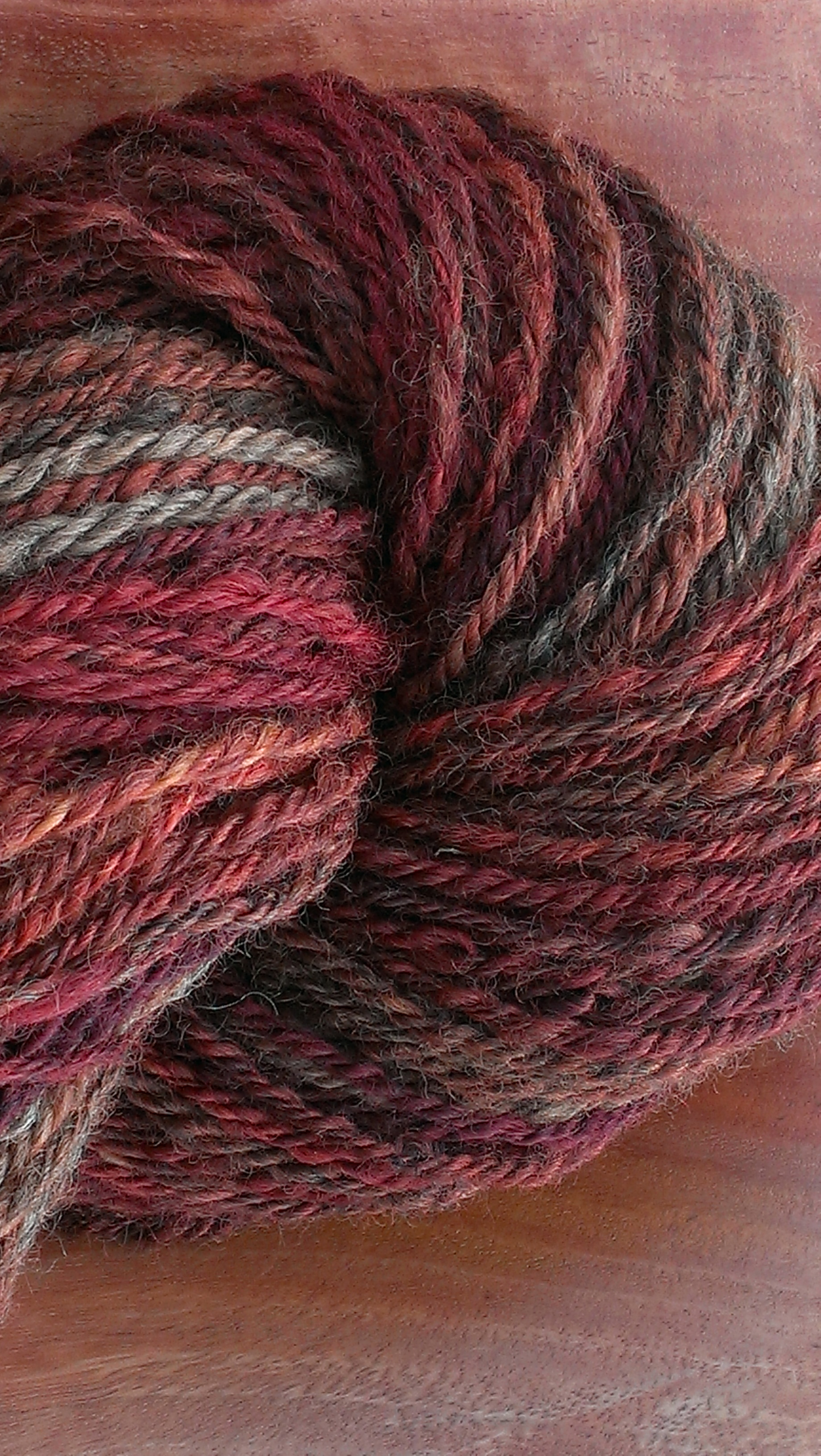
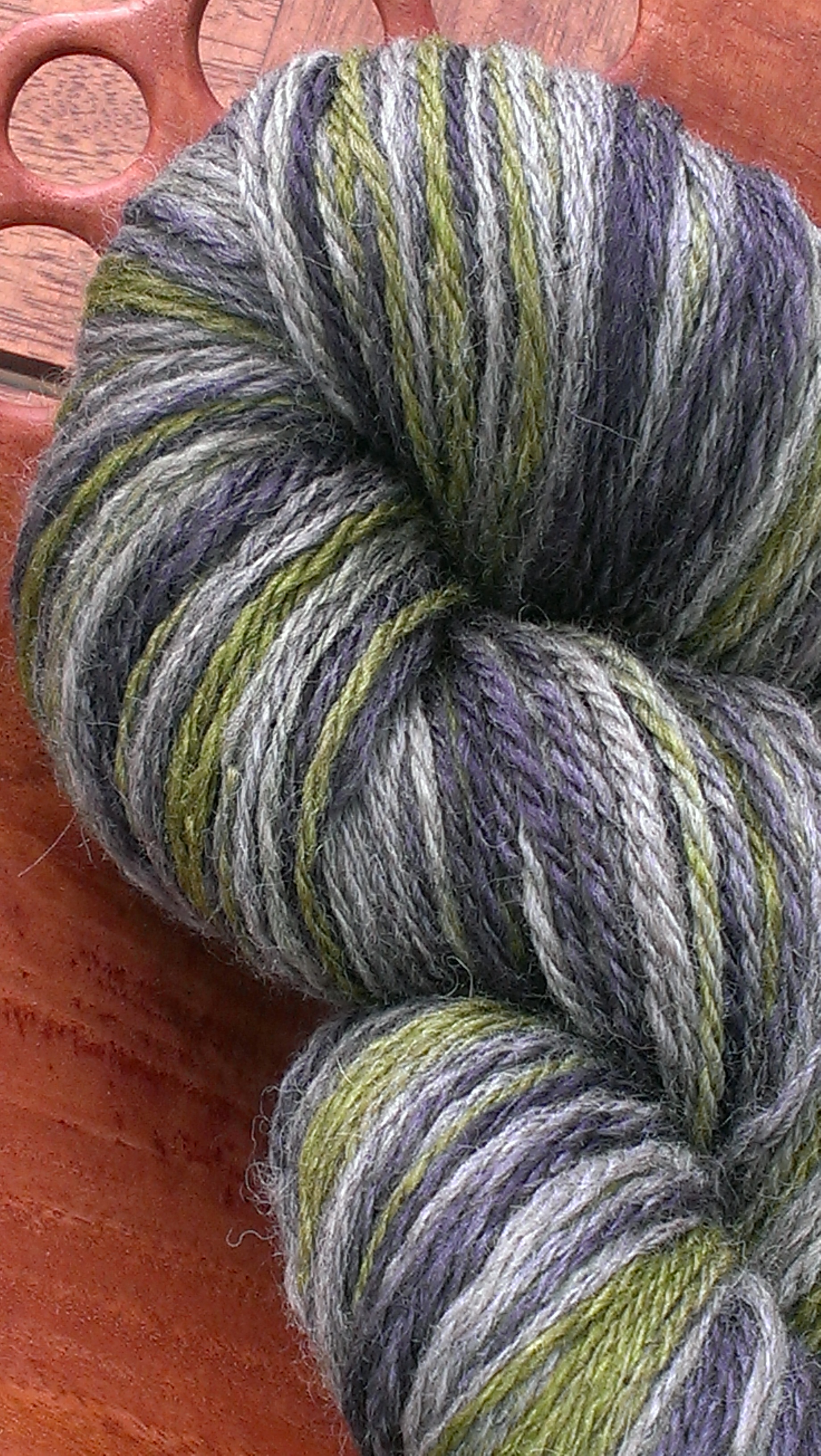
I have been spinning more of my eucalyptus dyed grey corriedale.  I loved the 3 ply yarn I made from it, but it isn’t going to make gauge for the cardigan I now have in mind and will stripe in a way that won’t work for it either.  This may be a clue that I should make the cardigan from some other fibre, of course, but I decided to try 2 ply, which raises entirely different issues about colour blending.

IMAG1776

I’m struggling to get the colours to show right in photos… but this approach clearly will even out the colour variations without making them disappear.  And perhaps it is time to try a swatch to discover how I am doing on gauge.  I have been feeling squeamish since plying… two plies of different colours is not something I would usually be aiming to achieve.  My beloved has offered the view that the yarn is lovely and will look ‘tweedy’, which sounds good to me…

5 Comments

Filed under Eucalypts, Natural dyeing, Spinning

Eucalyptus colours over grey wool

I have a lot of Polwarth fleece, both brown and variegated white/tan. All of it gifted from pet sheep that live nearby.  It is a privilege and it is also a difficulty.  Washing fleece so fine and so greasy has been intimidating as well as slow.  I have spun some in the grease, and washed some twice, and tried several different washing approaches.  I have dyed and spun and spun and dyed.  Two and three ply, corespun. you name it! I spun and knit an entire cardigan from naturally brown Polwarth, too.

And then one day someone at Guild said “I hate fine fleeces!” in my hearing, and it occurred to me that I do not have to spin it for the rest of my life.  I lashed out and bought a considerable quantity (3.5 kg) of grey Corriedale (nothing to approach the stash of Polwarth, mind you) and it has been heavenly.  I love grey fleece, and this is the loveliest corriedale I’ve ever had the pleasure to spin.

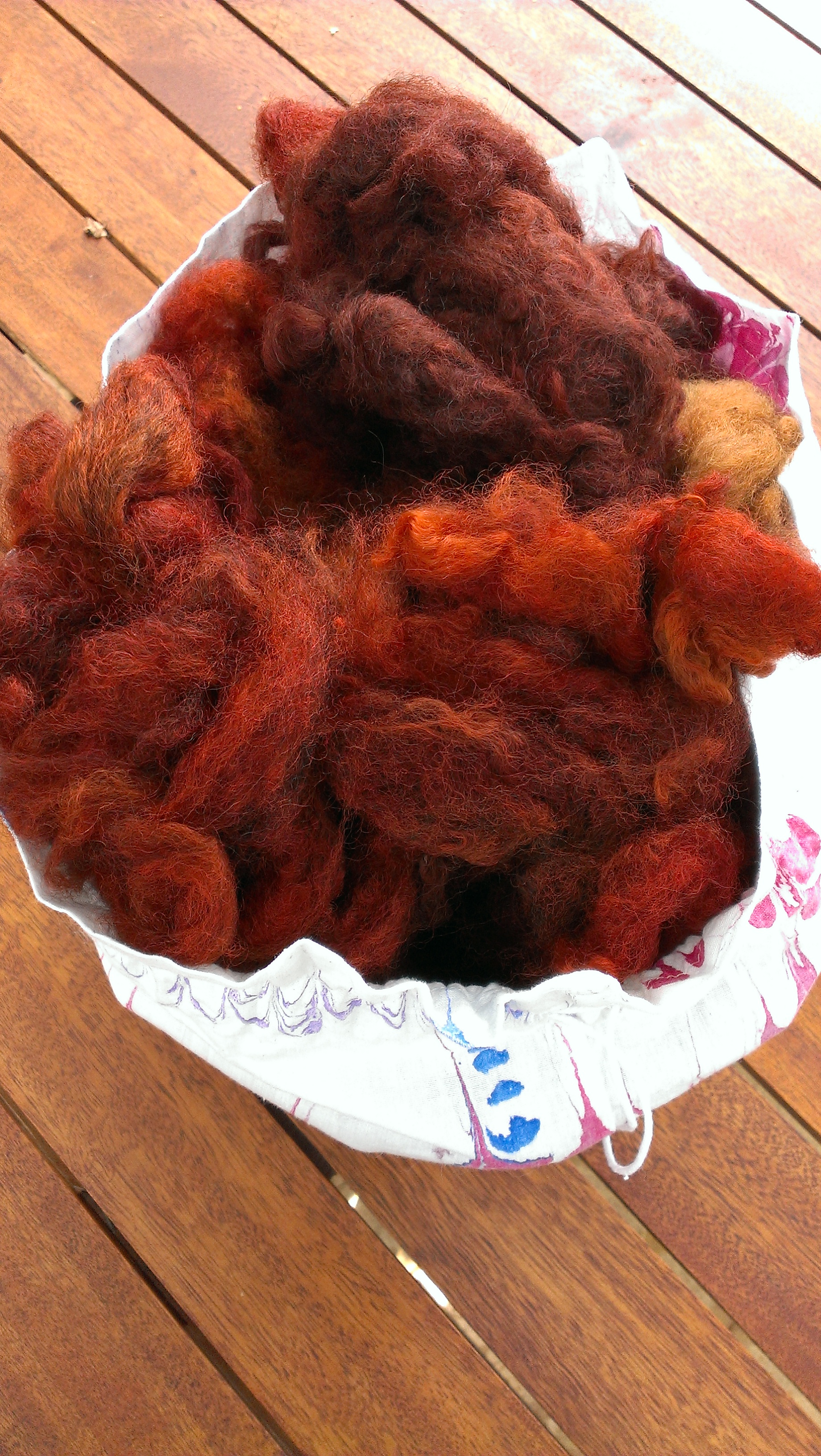
I have been dyeing it with eucalypt leaves and bark.  I have oranges of many shades from rust and brick to flame to gentle sunset.

IMAG1363

I have burgundy and plum.

IMAG1364

And I also have some tans and walnuts.  It appears I collected some bark that wasn’t exactly what I thought I had collected.  But to be honest, I think these are lovely additions in this context.  I’ve begun spinning yarns of many hues, chain plying to maintain the colour contrasts.  Lovely.  It’s hard to believe I can find these colours through combining bark and hot water and time with wool.

IMAG1308

Now… I have figured out that what I would really like to do with at least some of this wool is knit a particular cardigan.  And my beautful 3 ply yarn is too thick to make gauge for it!  Possibly also for the design I have in mind those colour changes will not be ideal.  So, I am about to embark on two ply yarns.  This is my Tour de Fleece project.

20 Comments

Filed under Eucalypts, Fibre preparation, Natural dyeing, Spinning

Austral Indigo 2: Hydrosulphite vat process

My second experiment with Indigofera Australis was a hydrospulphite vat. Robyn Heywood from the Victorian Handspinners and Weavers Guild has made her experiments with Indigofera Australis available online. I was delighted to be able to see the records and samples of the Victorian Handspinners and Weavers dyeing group at their Guild Rooms when I was in Melbourne last year.  It was really inspiring to see the variety of methods they had used and the range of colours they had achieved.

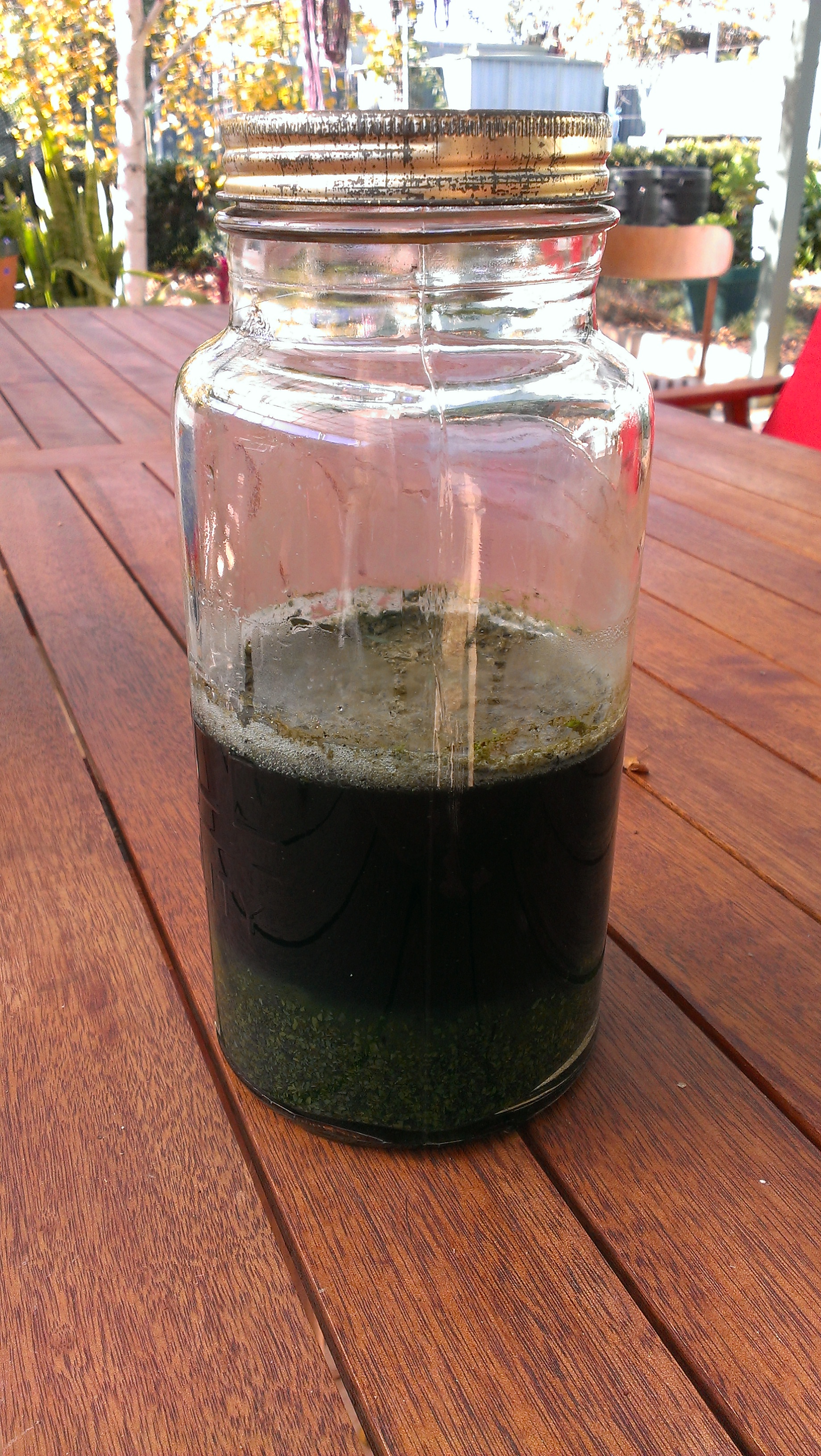
Robyn Heywood has trialled this method as well as the cold vinegar method and provided instructions.  So, since I still had some hydrosulphite left from my last indigo vat, I decided to try it.  Robyn Heywood soaked the leaves… apparently it is too much to expect that I would follow instructions exactly.  I blended them and left to soak for a couple of days. Here they are 18 hours later.
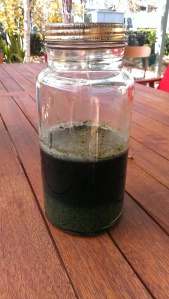
IMAG1614

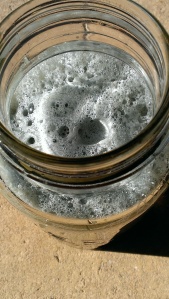
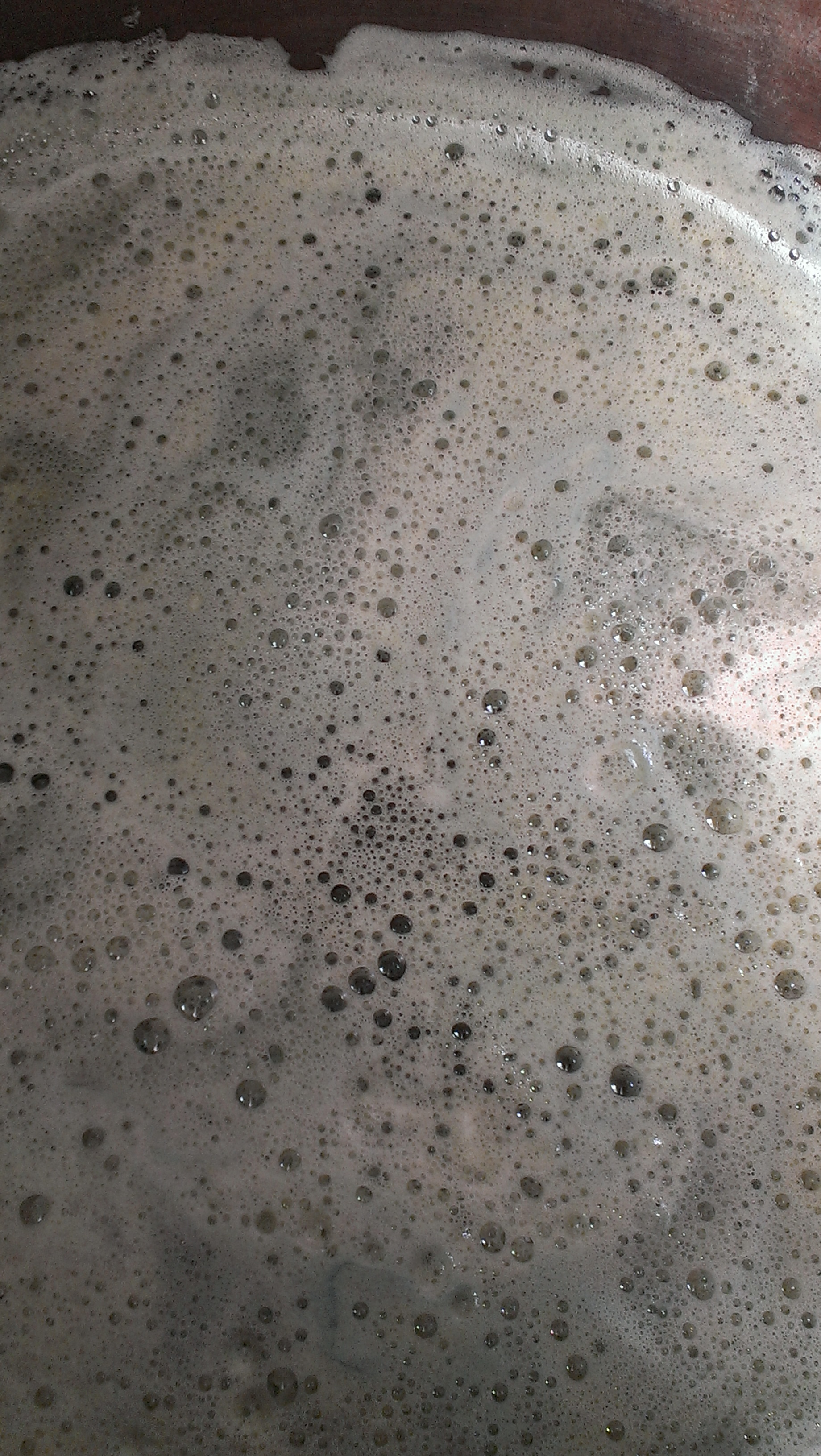
Robyn’s proposal was to leave them in a warm place.  I created one the first night by sitting my vat in a bucket of warm water, and then since the days aren’t warm right now (17C maximum)– the best I could do was a sunny spot.  48 hours later–or so–I started in on the preparation of the vat.  First, I sieved out the plant matter.  Then, added washing soda.  Now for aeration.  I went with the trusty blender method, which I was sure would introduce a lot of air.  Before:

IMAG1624

After:

IMAG1629 (1)

I watched sceptically, but indeed, the bubbles did turn from green to bluish!  I prepared a hot water bath to raise the temperature of my vat.  I put the jar into it.  I turned away, and a few minutes later there was an almighty crack as the jar came apart.  Rude words were used.  On the down side, I now had glass shards I couldn’t see in my dye;  evidence of poor judgment on my part; a  broken jar and a clean up job.  My dye bath had at least 1.5 litres of water added to it, so probably now had three times the amount of water I had decided on (that sounded like a weak vat to me!)  And it was now in a stainless steel dyepot, along with whatever contaminants it contained after being rinsed out.  On the up side, the bath got to 50C almost immediately and the bubbles were still going blue.
IMAG1632

‘Press on, how do I know what will happen?’  I thought.  ‘Don’t be wasting that precious dyestuff’, I thought.   I got out my trusty milk crate/felted blanket dyebath insulating system, filled up one hot water bottle which promptly sprung a leak; filled up another hot water bottle, sprinkled on the dye run remover, applied hot water bottle and felt blanket to vat and walked away.  ‘Que sera, sera and all that’,  I said, sighing.  Well, I need not have sighed, because the vat turned a vivid yellow.  In went some silk/cotton thread and a piece of hemp fabric.

IMAG1641

They came out bright yellow and turned green and then blue-ish almost immediately.
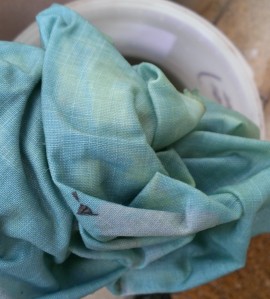
IMAG1649

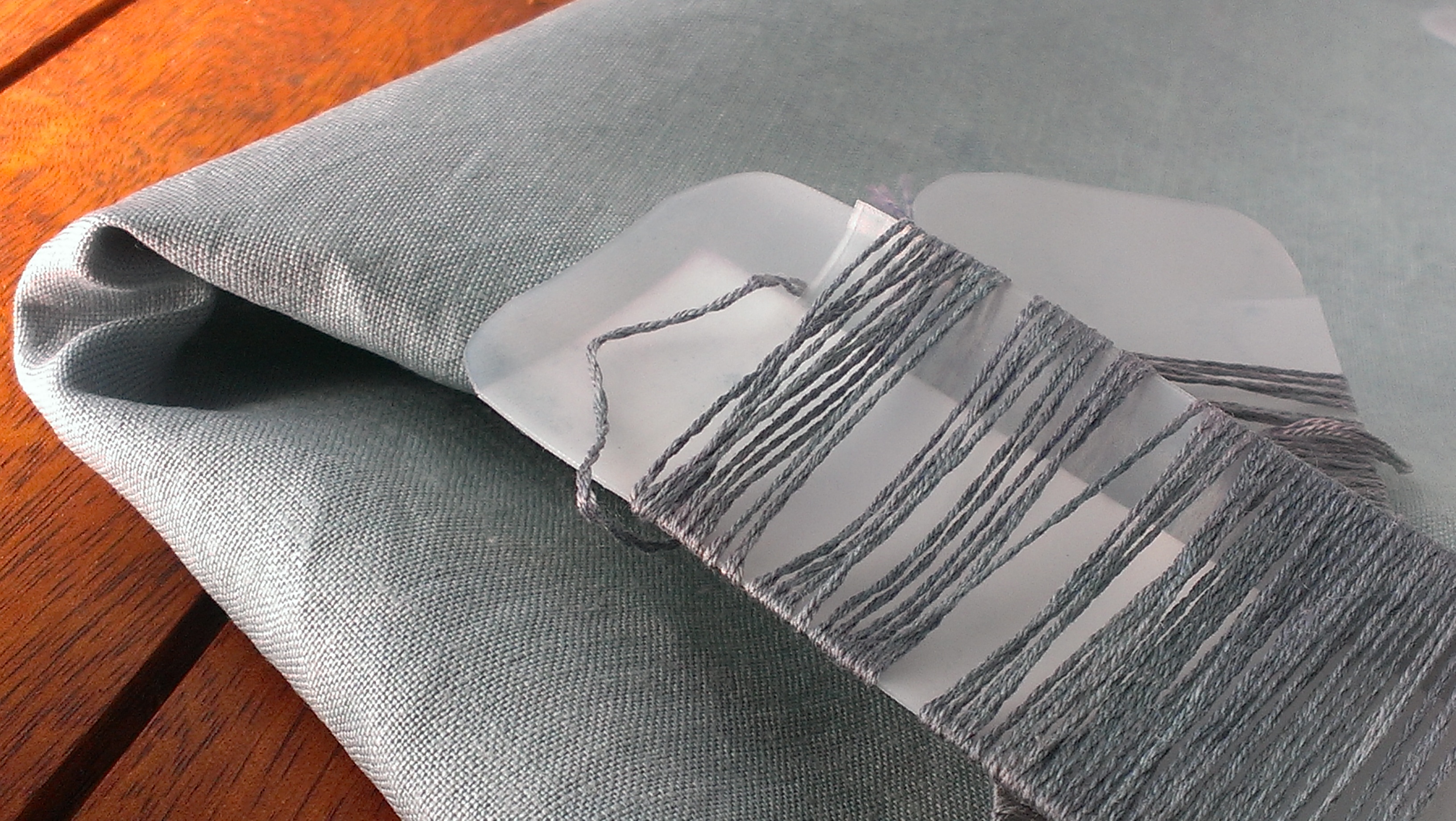
And so, to re-dipping, gleefully (and repeatedly).  Yield: several lengths of silk thread in shades of blue and grey, and a piece of pale blue fabric.  I have plans for them.  I am not sure whether this amount of leaf would always have produced a pale shade and to what extent my accidentally diluted dyebath contributed.  But, some blue resulted, and that part is excellent!

IMAG1664

6 Comments

Filed under Dye Plants, Natural dyeing

Plum Pine 3: Let the dyefastness testing begin!

Unbelievably, the plum pine is still fruiting, and I am keen to dye enough to be able to do some wash and light-fastness tests in the year before it fruits next time.  So I harvested again, picking up fallen ripe fruit from the ground until I filled the bags I had with me.  A man in white overalls who seemed to be working nearby was gripped to see me doing this and asked me all about what I was doing and why.  He was fully supportive of ‘making use of our natural resources’–as he put it–!

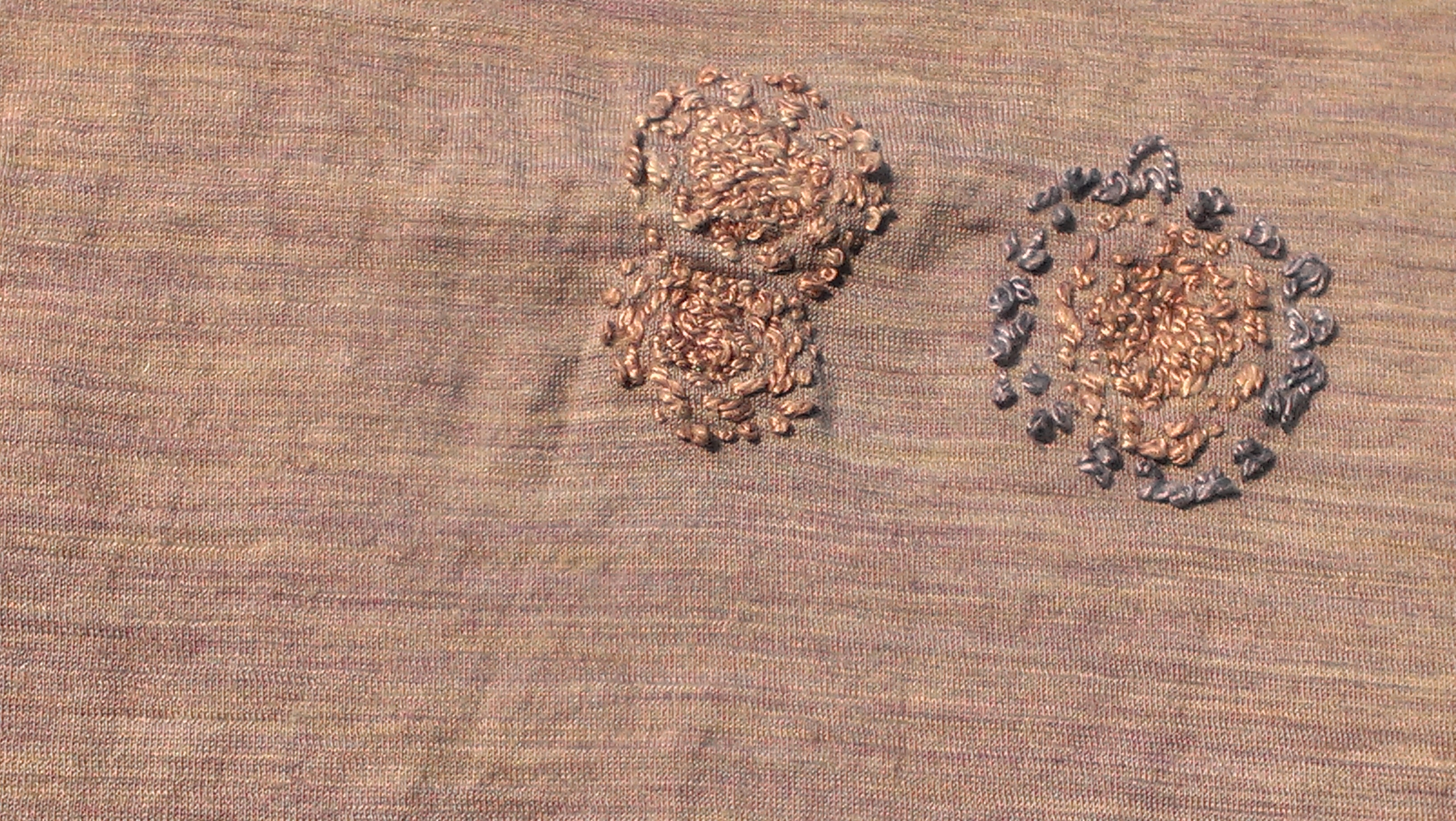
Early signs are that my silk threads dyed without alum will not be washfast. My mending has changed colour in only a couple of washes, and seems to be Ph sensitive, with pink without alum noticeably paler and purple with alum (the contrasting outermost ring on the right) turning blue in a mildly alkaline wash.

IMAG1571

Only someone accustomed to dyeing with eucalypts, which are fast on wool and silk with no mordant, would think unmordanted yarns were a good beginning place.  So, I’ve had a mordant bath on the hob.  I did not have loads of anything much ready to mordant and dye except Bendigo Woollen Mills alpaca rich, so 200g of that hit the alum and cream of tartar bath along with smaller quantities of other yarns.

After removing the seeds, I had 2650g of fruit.  I was a bit gobsmacked by the quantity!  Never one to shy away from a challenge,   I put my fruit in a pot of rainwater with a cup of vinegar and simmered for an hour.  Then, I entered some handspun wool, some commercial alpaca-wool blend and some silk thread and silk/cotton 70/30 thread, all mordanted in alum and cream of tartar.  The colour takeup on the silk was dramatic and almost immediate!  I simmered for another hour and then left overnight.  The colour change overnight was again worth the wait.

IMAG1656

Meanwhile, I’ve set up further washfastness and lightfastness tests…

Leave a comment

Filed under Dye Plants, Fibre preparation, Natural dyeing

Paxillus Involutus

We have some very impressive fungi coming up in our front garden.

IMAG1439

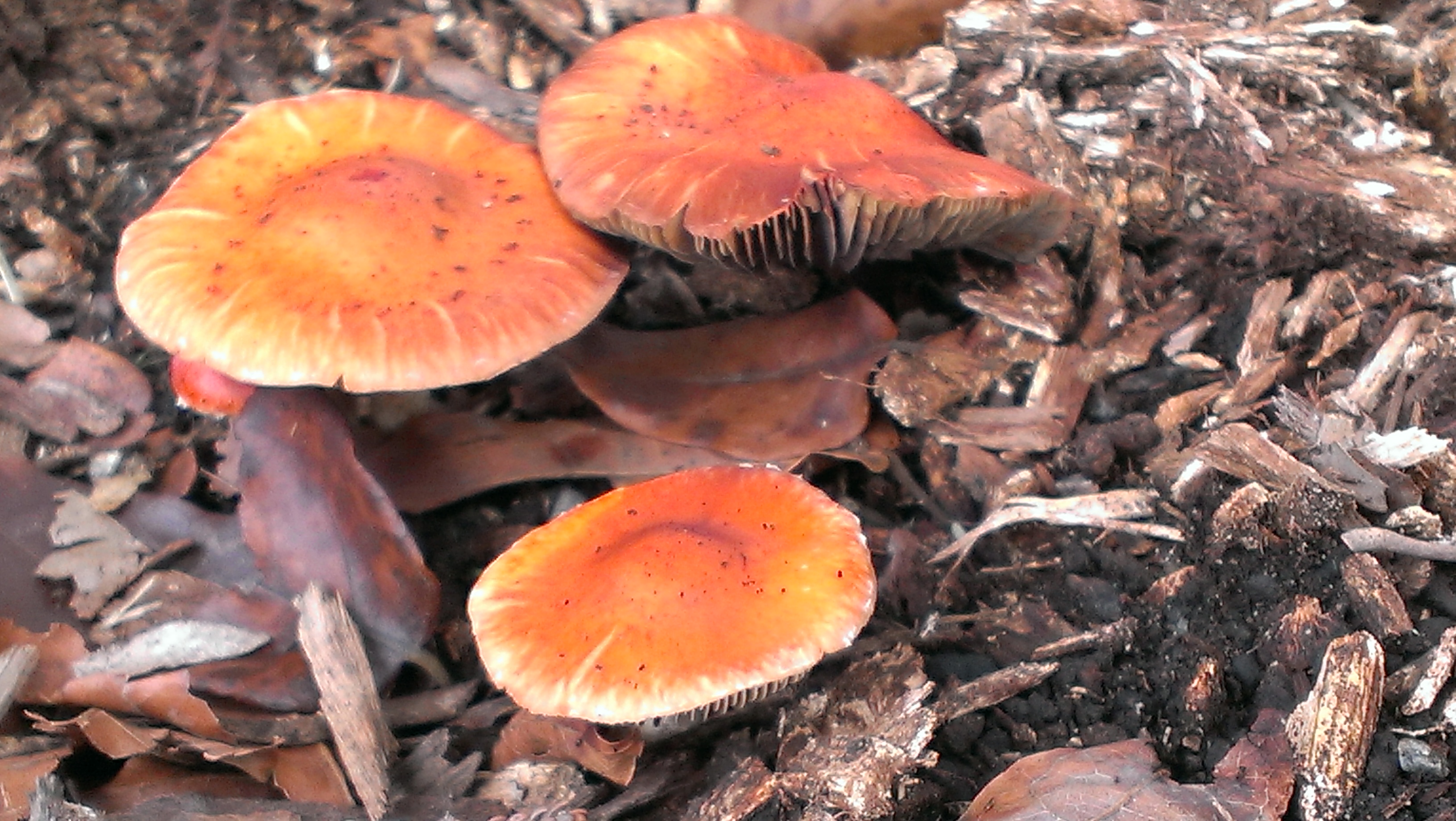
Unbelievably, one of our neighbours is a mycologist who was only too happy to tell me what they are.  Paxillus Involutus, also known as ‘Poison Pax’.  I readily agreed not to include them in dinner! These fungi are not native to Australia but have been inadvertently introduced.  We initially thought their appearance in the root zone of a silver birch at our place meant the birch might not live long.  It turns out that these fungi serve the plant and form a relationship with it which is of benefit to the tree.

IMAG1440

I’ve wandered the interwebs looking for information and discovered a range of different perspectives on what colour these fungi can give in dyeing, with some suggesting a shade of beige–Riihivilla says they are ‘not worth picking most of the time’– while other dyers suggest they give pinkish and greenish browns.  None of it sounds really thrilling, but my opportunities for sustainably dyeing with fungi have been non existent so far.  So…  I consulted Karen Casselman’s Craft of the Dyer, picked a specimen, tore it up and cooked it for an hour.  Then, in with my test sample.  I kept that hot for a further hour.  It doesn’t really surprise me that Riihivilla is right about this … but it was so exciting to have this fungus in my own yard, I had to try it out.

IMAG1463

Since I’m talking fungi, here are some I came across walking through Botanic Park on a completely different dye mission on the weekend.  I left them exactly as I found them.

IMAG1449

On the whole, the best thing for a fungi ignoramus to do, I believe, except when acting on expert advice.

IMAG1450

2 Comments

Filed under Dye Plants, Natural dyeing

More socks!

More socks off the needles after a long period of being unfinished…

IMAG1421

Long ago I had the opportunity to buy part of a raw Suffolk fleece that had been discarded by another spinner.  I had been steadily reading my way through the Guild’s library, so I recognised this as a breed that was eminently suitable for sock spinning.  At the time, I only knit socks.  They were the whole reason I had learned to knit, and then to spin.

As it turned out, the Suffolk was a very short staple and none too clean fleece.  Never mind.  I gleefully acquired it and proceeded to use my beginning dyeing skills on it.  Four pairs of socks came of it.  One, pink dyed with hibiscus flowers, went to my Mum.  Another was dyed in eucalyptus leaves as fleece and spun up afterward.  I can’t remember who I gave that pair to.  I think they might have gone to tree lovers in the Blue Mountains.  I made my father a glorious pair that were purple and blue, blended rather beautifully after dyeing (and at that stage, their loveliness was an accident!)

These were made from Suffolk blended with tencel, which may have been ill advised–time and wear will tell.  The colour could have been better and the blend is uneven, but a three ply handspun yarn is a work of dedication and there was enough even for a pair of large feet, so I knit these.  They are going to a dear friend who lives nearby, who does indeed have large feet.  Last night he spoke about a pair I made him years back that he is still wearing hiking.  This pair may not last as long but I hope they will keep his toes warm at the very least!

Leave a comment

Filed under Knitting, Spinning

Steeked!

Perhaps you remember this yarn, spun and chain plied from a beautiful blend by The Thylacine.

IMAG1220

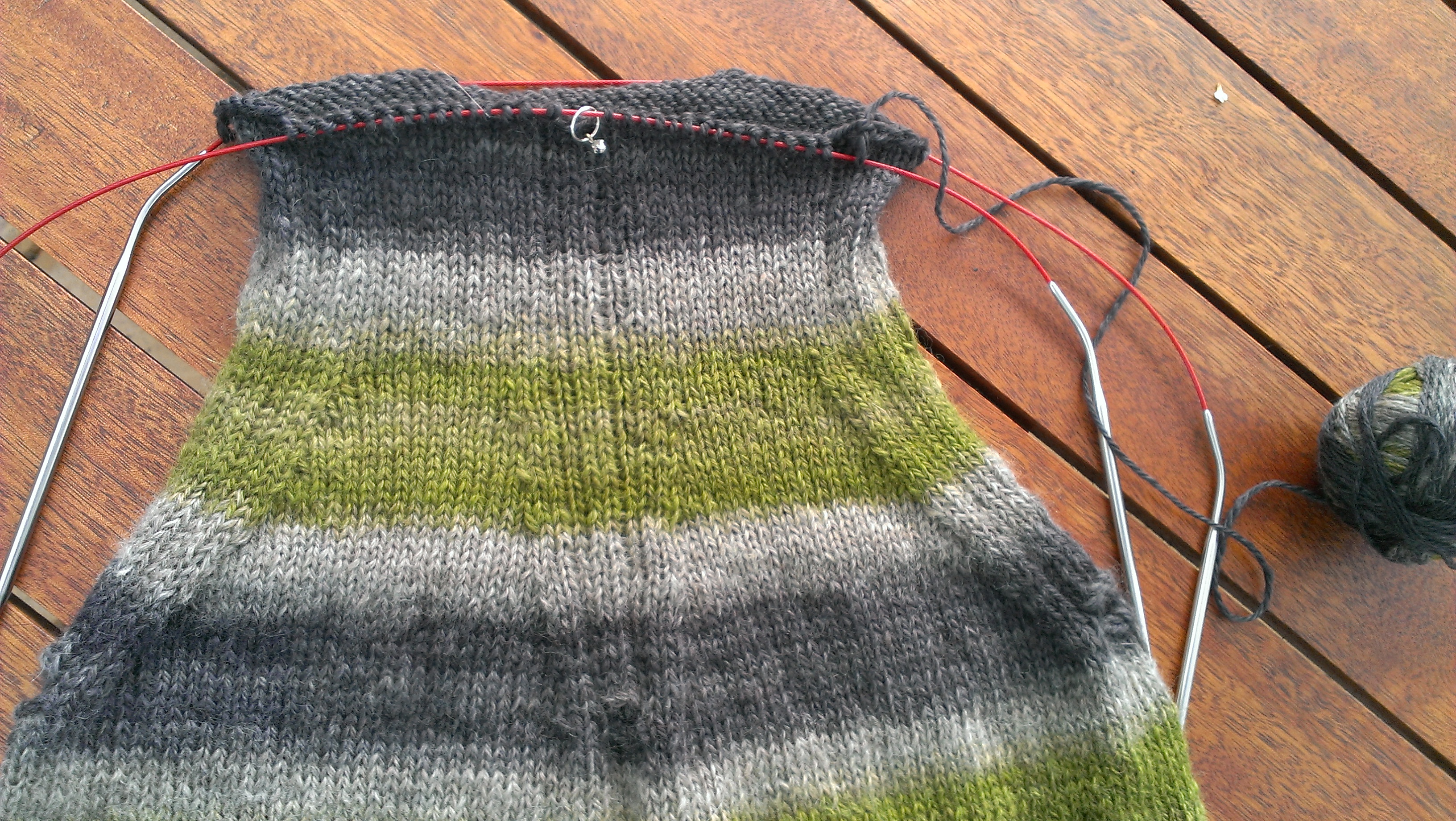
I decided on a vest for my fairy godson, an appreciator of handmade items if ever there was one.  He is a not-so-small six year old person growing ever taller and thus, growing out of last winter’s woolies. I designed (I  do realise this is a very plain garment!) the vest based on measurements from one he already has that is a generous fit.  100% handspun alpaca for the band at the bottom, in seed stitch.  When I reached the place where I wanted the neck and armscyes to begin, I cast off a few stitches, then cast them on again on the next round (leaving a slot) to create a steek bridge.

IMAG1349

Here is the upper part a bit closer up.  I have decreased just the way I would have done knitting this garment by any other method, but kept knitting in the round, making sure those stripes are maintained with wonderful simplicity. Knitting in the round feels normal to me, since I took up knitting in order to knit socks.  I much prefer knitting in the round to knitting flat.

IMAG1350

Then came the day of truth, when I stitched through the knitting all the way from one end of the steek bridge to the other and cut, yes, CUT! the neckline and armholes prior to grafting the shoulders together and picking up the edgings.

IMAG1351

Wonderfully simple if you can hold your nerve.  I am so happy with the finished result, I’m on tenterhooks waiting for the intended wearer to return from holidays soon for the handover.  I sure hope he likes it.  I have yarn left over from 100g of fibre. Amazing!

IMAG1371

PS–yes, it fits!

4 Comments

Filed under Knitting, Spinning

The spinning continues

Unfortunately, it has been a time of illness and low energy round here just lately.  Fortunately, spinning provides solace and the level of exercise I’ve been capable of undertaking.

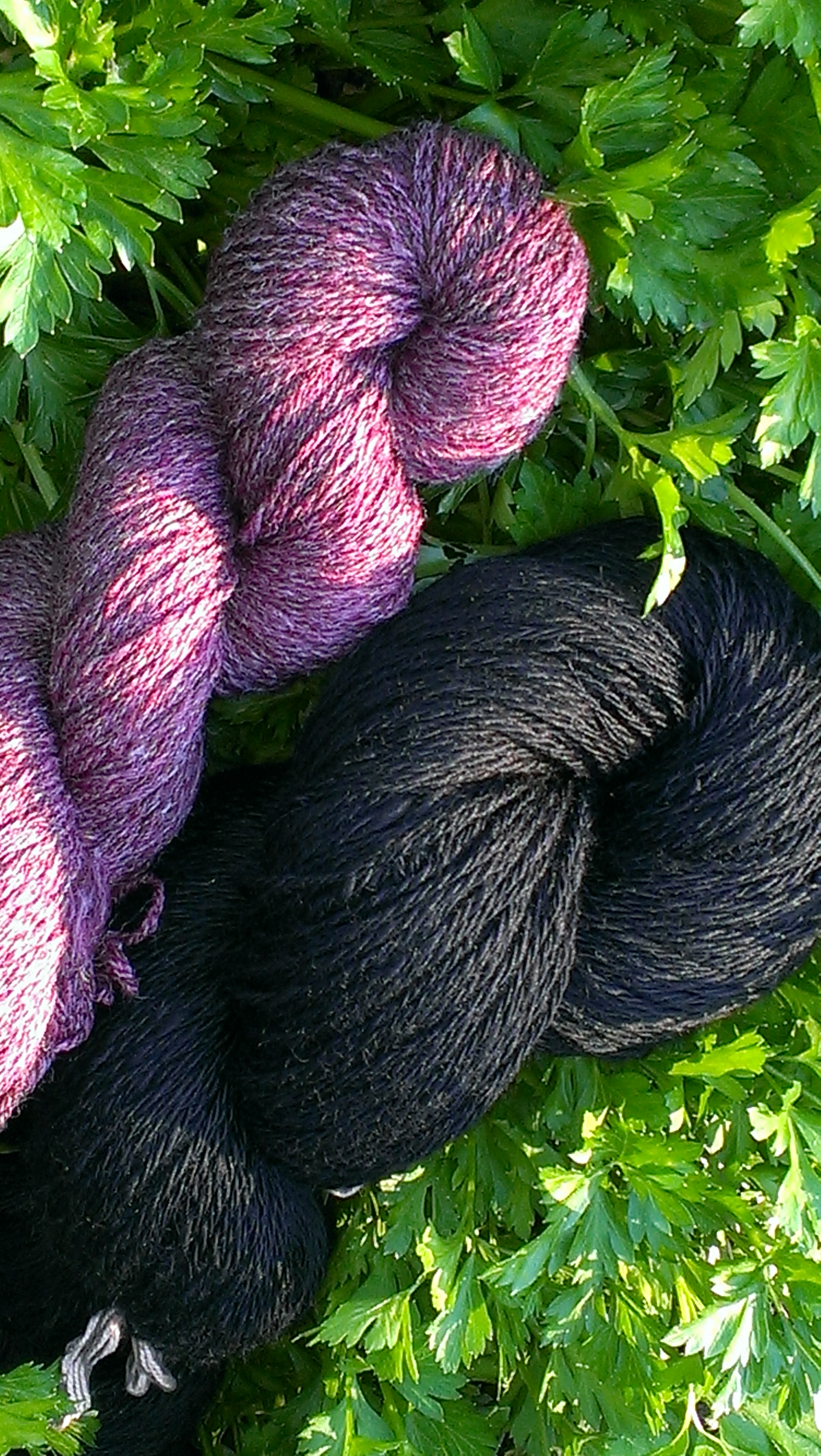
Here, some delicious black baby alpaca I bought from SpunOut at Bendigo (three plied).  It is called Handspinners Dream and, mmmm.  It was! Luxury fibre with a price tag to match.

IMAG1234

I also finished some spinning intended as sock yarn–the purple yarn in the photo.  It is a true three ply yarn with high twist.  I spun it slowly since it has been on the wheel I take to the Guild only twice a month.  There have been many jokes about frog hair, and more than one person has asked me if I am really spinning, because the singles were so fine they couldn’t be seen from across the hall.  I will be so interested to see how this works out as  socks.  Despite all the joking, this is not too fine for sock knitting.  Since I have three pairs of socks on my needles at present and all three are still in the first sock stage, I may not find out for a while.  I have one still on the leg, one just past the heel and still on the gusset, and one almost at the toe.

Back to spinning though–and that is where my time has been spent lately–the purple sock yarn is from Ewe Give Me the Knits.  It’s her Superwash Merino/Bamboo/Nylon blend, especially for sock spinners.  Another lovely spinning experience.  I am warming up to spinning some of the fleece I’ve washed through summer after all this pre-prepared fibre.

3 Comments

Filed under Knitting, Spinning

After Bendigo

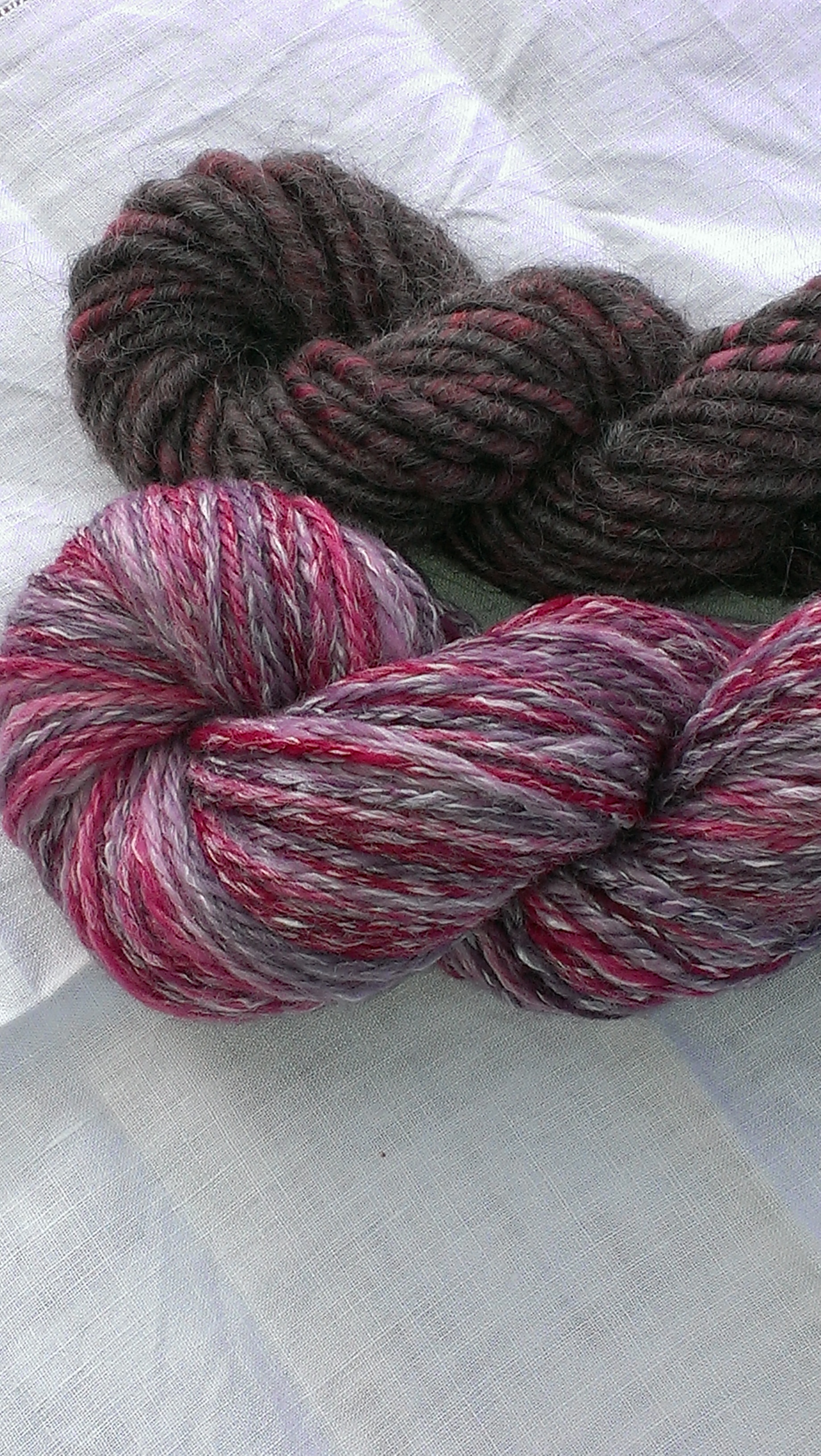
Last year I went to the Bendigo Sheep and Wool Show with a friend.  We had a great time, and I spent plenty!  Just recently I decided to spin some of the prepared fibre I bought there.  This is grey merino/llama/silk dyed by the Thylacine in Evandale.  It was luscious to spin and inspired me to get back to dyeing over grey fleece. I chain-plied it to maintain distinct colours.

IMAG1223

I bought some Raxor batts: Corriedale x English Leicester and Blue-faced Leicester in ‘Before dawn’.  Clearly also from my grey period.  I core spun these over a crossbred grey wool core. The pink skein is chain plied merino/bamboo dyed ‘berry lush’ from Kathys Fibres.  All a delight to spin.

IMAG1187

2 Comments

Filed under Spinning

Sampling dye plants

IMAG0722

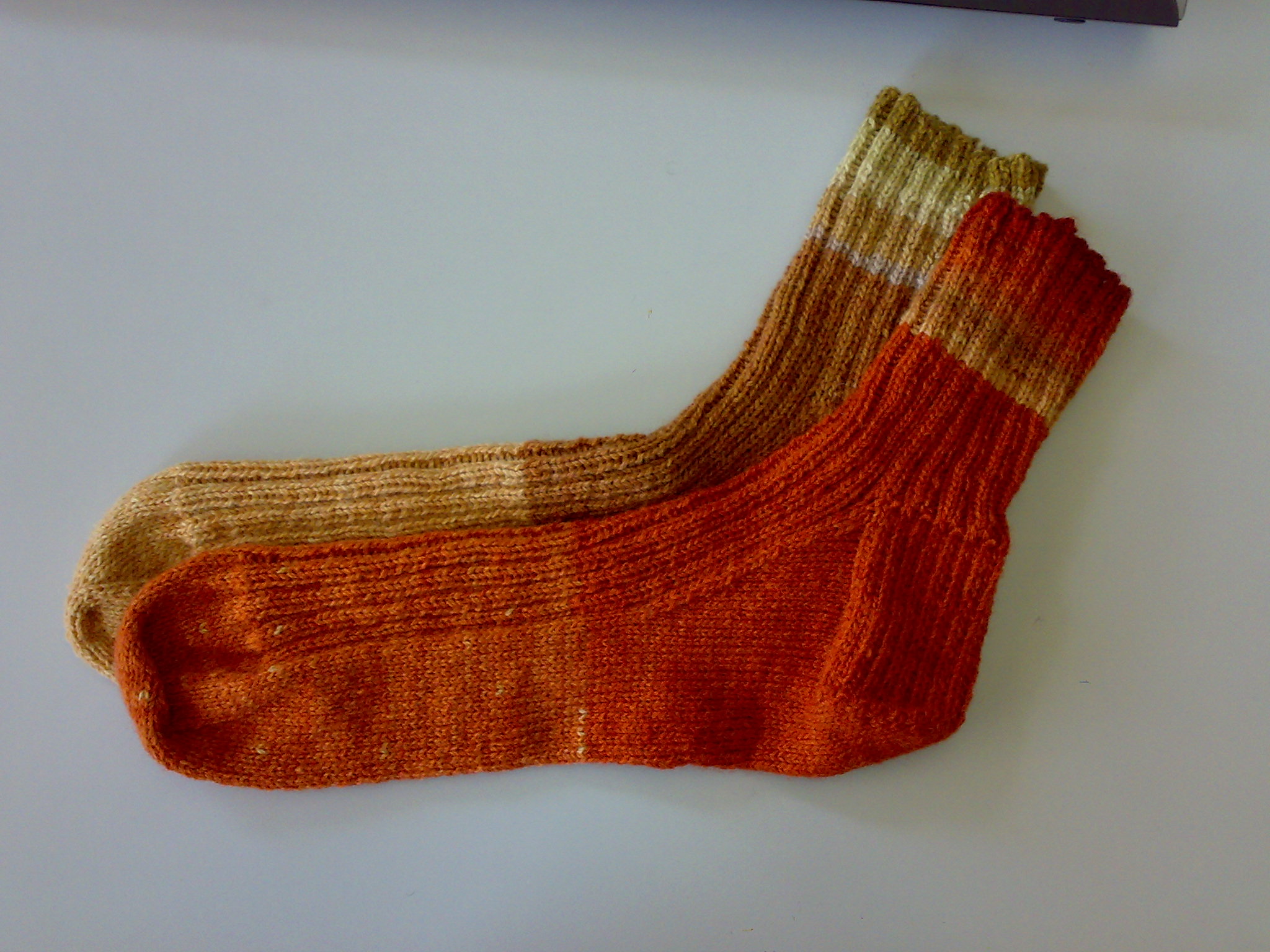
When I started plant dyeing, I used to make a tiny skein, about 1-2 metres long, and try out the leaves of trees around my neighbourhood on that.  In those early days, I tried rue after I found it listed in a book… oh my goodness…  the least said about that smell,  the better.  It almost put me off for good.  (Pale green, if anyone is wondering–not the red I was hoping for in my naivete).  When I had accumulated enough experiments to have identified some trees I wanted to keep visiting and some I would appreciate but not use for dye, I knit the samples into striped socks for a dear longtime friend. So that method had its advantages.  My friend asked for short cuffs (well, I thought he had–), so that’s what he got.

150620091160

I may have mentioned my devil-may-care attiutude to matching socks.  Happily my friend shares it, or he wouldn’t have scored this pair! 

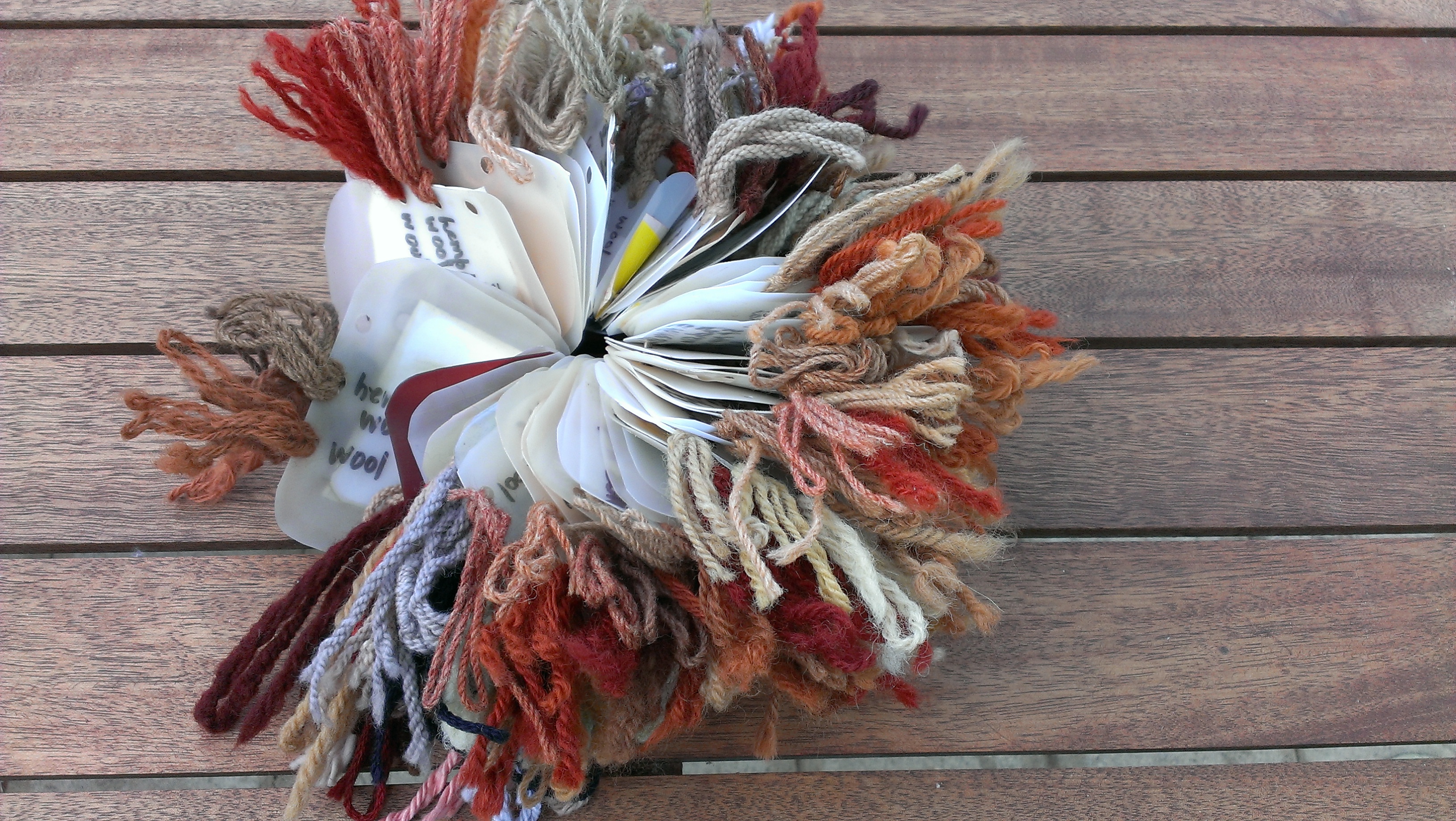
Eventually I learned about sample cards from more experienced dyers on Ravelry.

IMAG0723

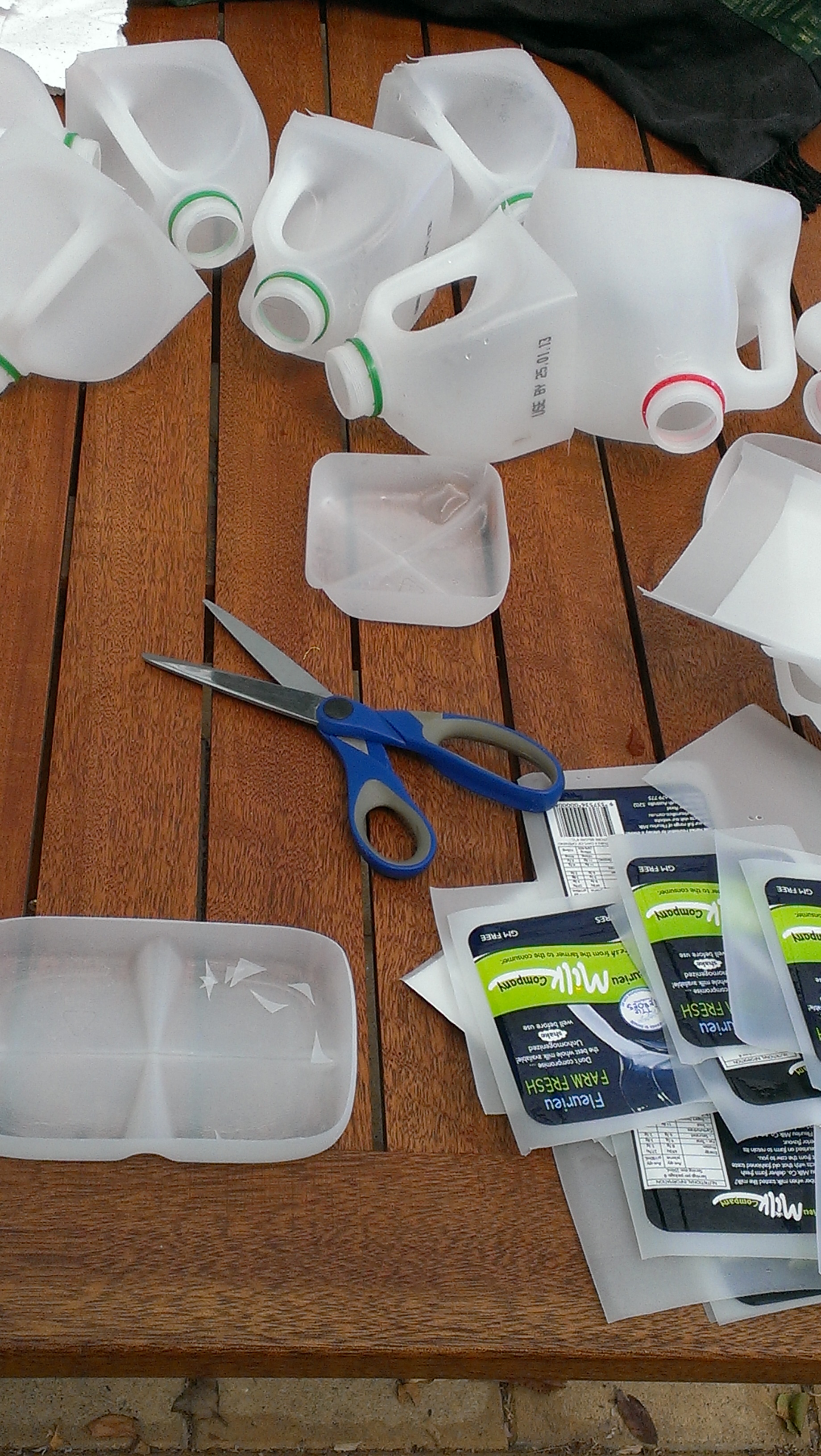
I use milk bottles to make mine.  We don’t use this kind at home any more, so I raided a recycling bin at a coffee cart during the weekly farmers’ market to get these.

IMAG0768

I keep my samples on a split ring, which I think I also saw on Ravelry, and it’s a great record of plants investigated.  Some have been identified long after being cooked in the dyepot.  A few have been identified correctly after an initial misidentification.  Some have been tried several times.

IMAG0773

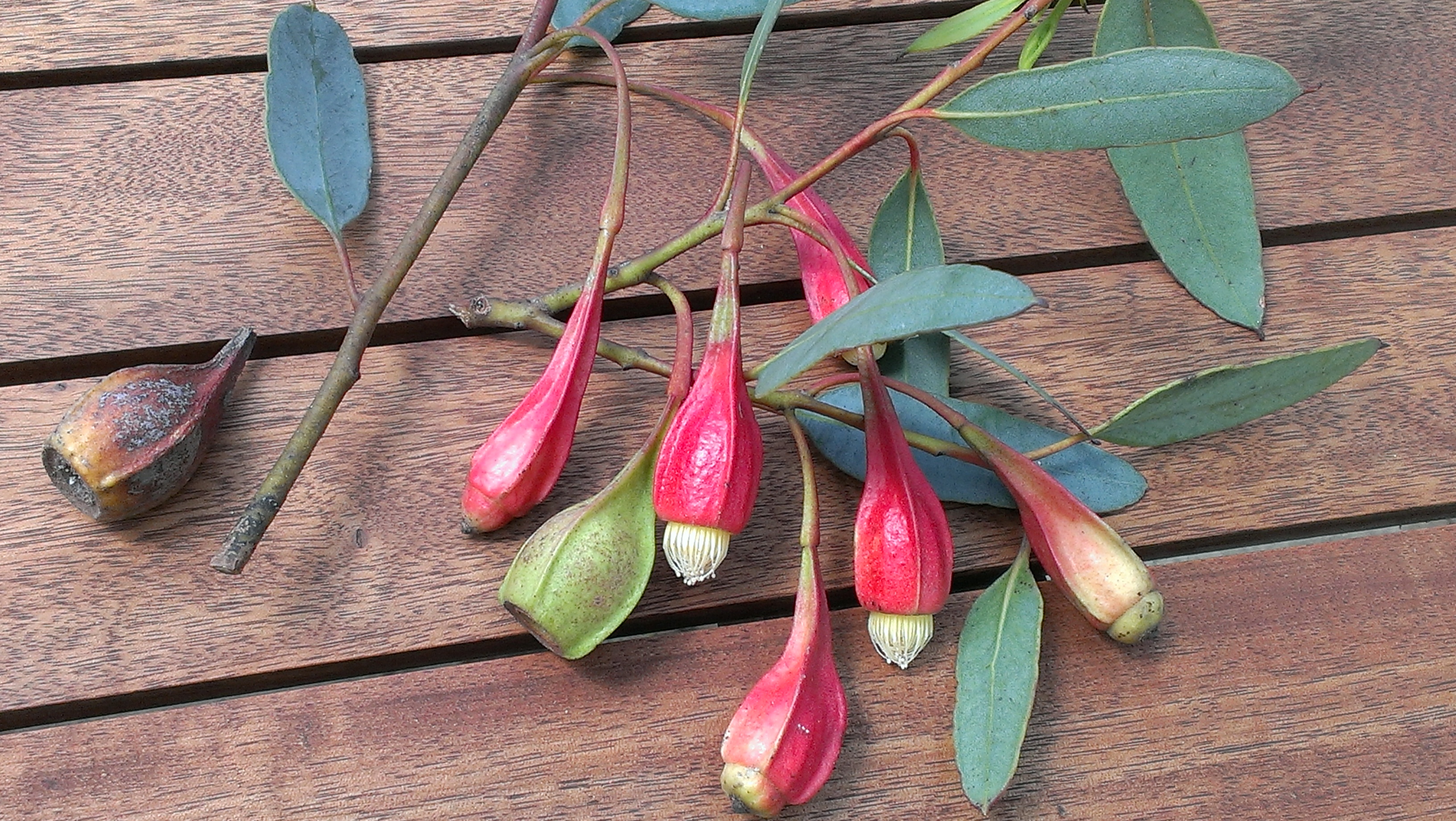
And there are still so many to try out!  In the lead up to the recent workshops, I collected leaves fresh and dried: from trees, from the gutter, from fallen branches.  I collected more bark too.  This one is Eucalyptus Forrestiana,  believe:

IMAG0764

And I collected a few specimens I couldn’t identify… This one branched so high I couldn’t pick a leaf, but bud caps were raining down and lorikeets were having a great party high above me.

IMAG0760

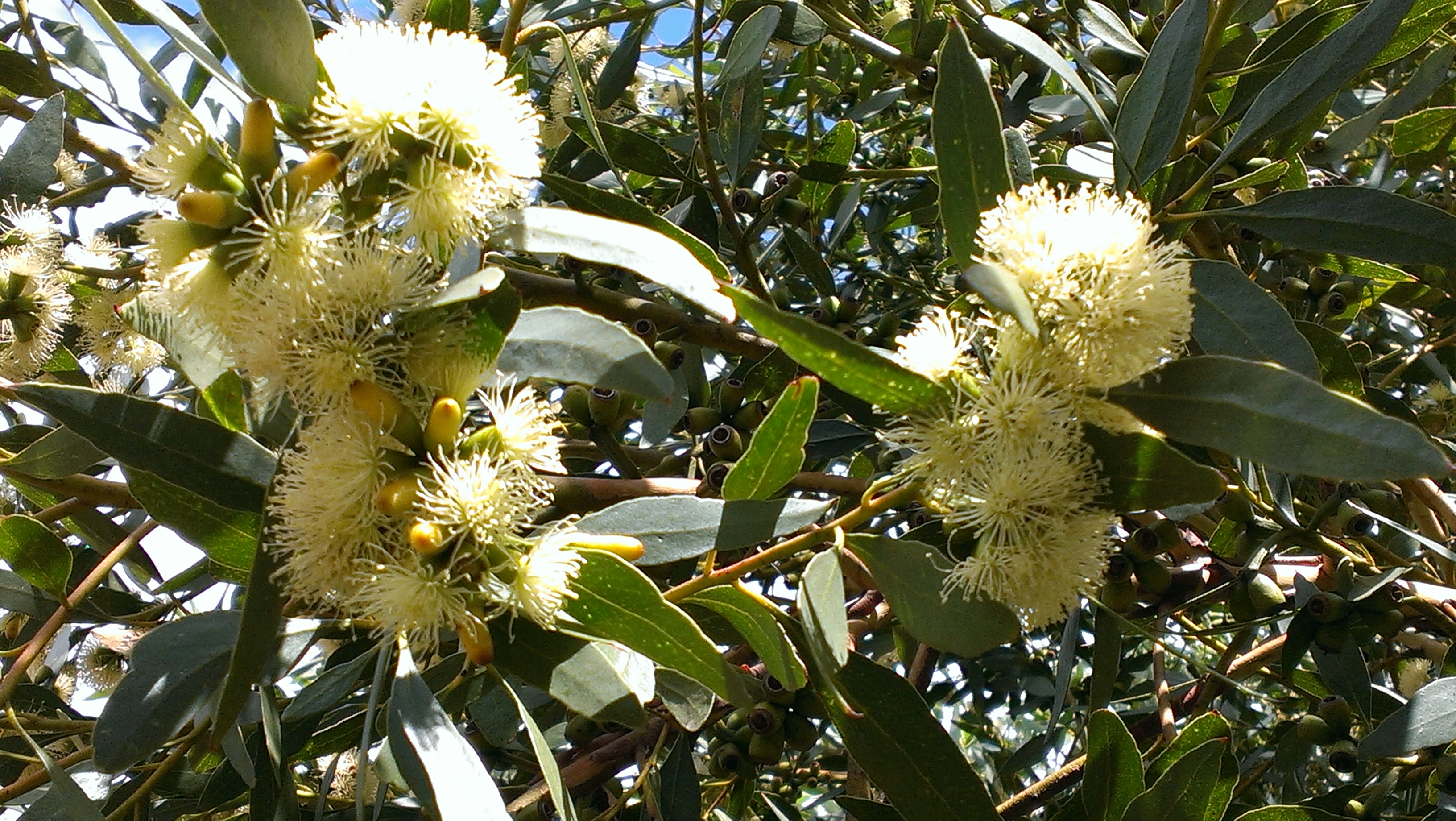
This one was a sprawling mallee near the railway line, and came complete with new holland honeyeaters protesting my invasion.  I hope they had chicks in there somewhere, and this was the reason they kept trying to see me off even though they are about the length of my hand.

IMAG0746

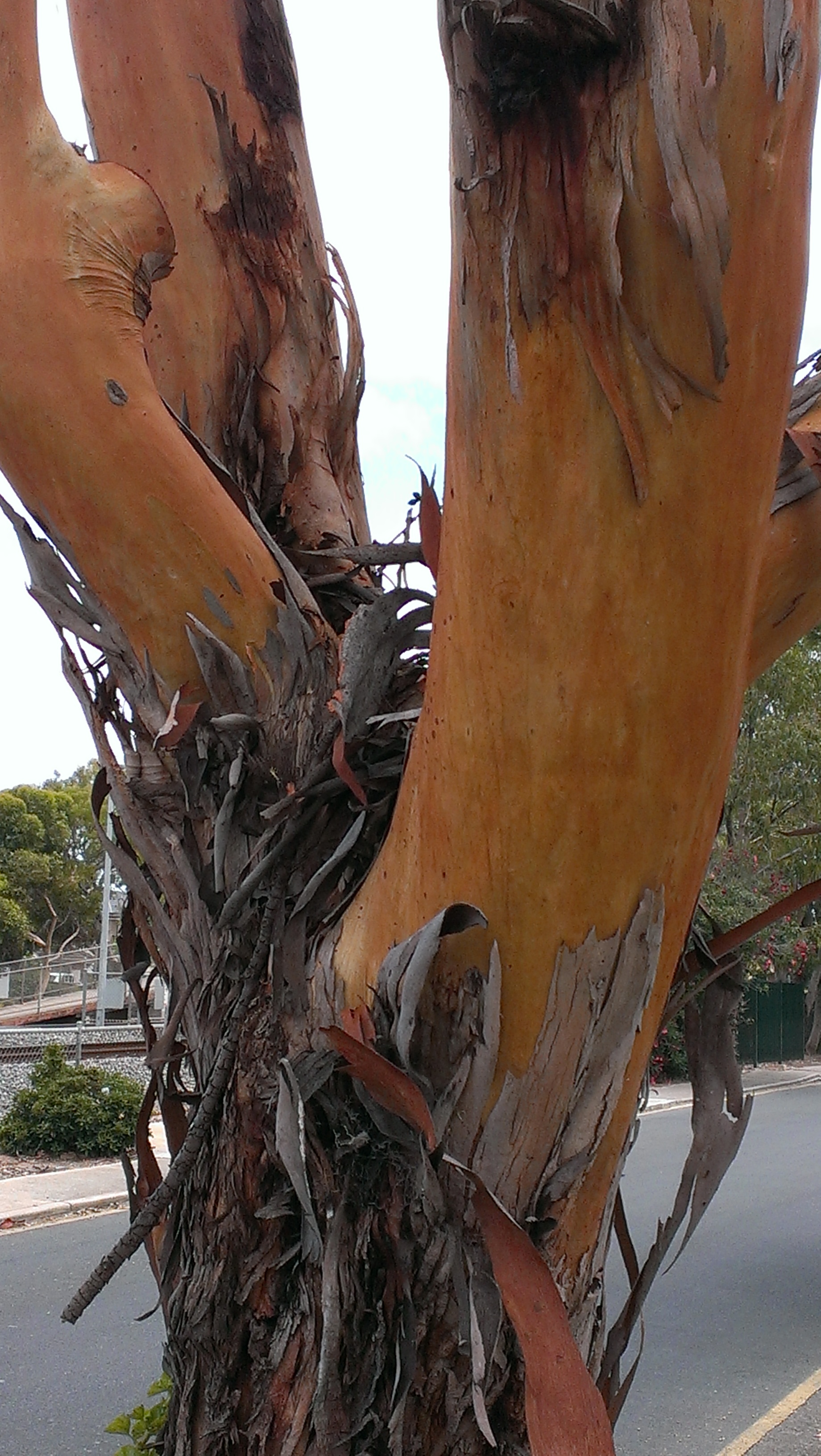
This tree has fascinated me for some time: it gives a peach or apricot colour.  But I still can’t identify it.

IMAG0738

So many possibilities for the future….

6 Comments

Filed under Dye Plants, Eucalypts, Knitting, Natural dyeing