Category Archives: Dye Plants

Yellows from coreopsis flowers and osage orange

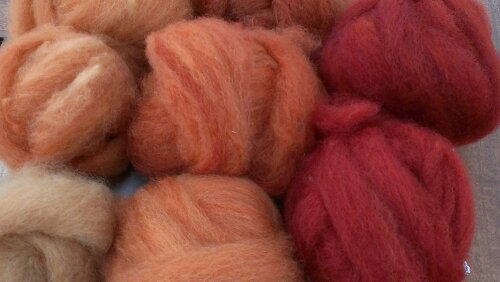
I have decided to branch out from the eucalyptus based palette of ochre–caramel–tan–orange–red–maroon I have been so focused on for the last while and plan toward an indigo vat.  Don’t you love these bold statements?

I still love the eucalypt colours: here, a small quantity of alpaca passing through various stages of preparation.  Picked, dyed locks;

IMAG2377

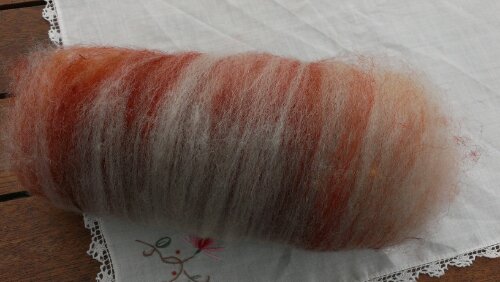
Partially carded batt;

IMAG2379

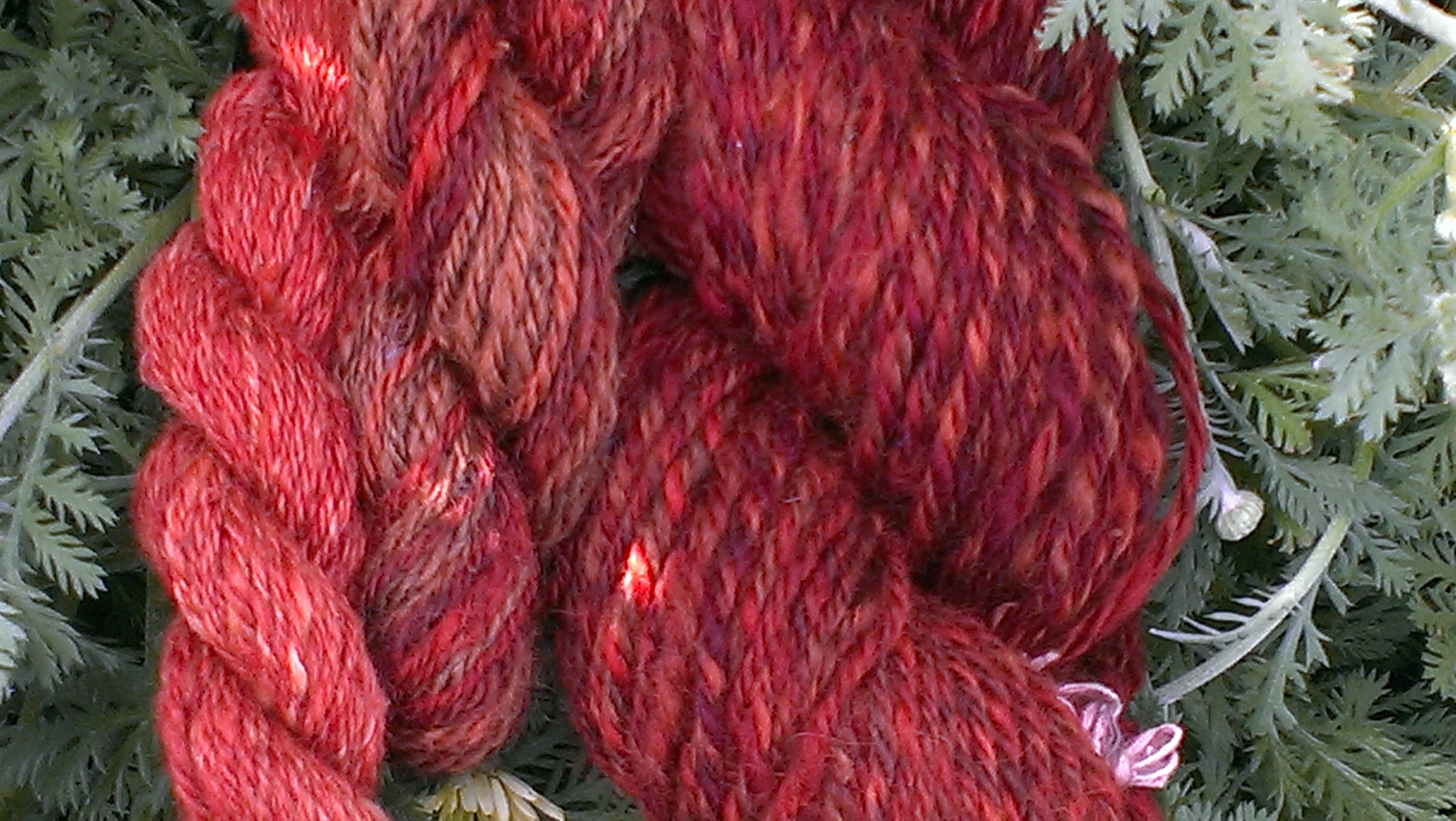
and, finally, yarn–pictured in the dyer’s chamomile patch.
IMAG2428

I have decided to try for yellow–green–blue transitions, which will necessarily begin with yellow.  I had coreopsis flowers my mother saved me one summer, as she deadheaded her plants. This collection of flower heads speak to me of her love and her fine qualities as a gardener and a person who loves to share.  I had reservations about the colour I would get from them, as some had gone mouldy.  Her -plants are just so prolific–the stack of wilted heads had trapped enough moisture to create mould.

IMAG2370

I also had a little remaining quantity of osage orange shavings of antiquity, gifted to me from the Guild.

IMAG2371

I prepared them both for the dyebath, but have to say my tea ball was not a good enough receptacle to retain the osage orange.  I not only sieved the dye vat before adding wool (thank goodness I remembered to do this as I tackled it one night when the amount of sawdust in the vat was not as obvious as in the clear light of day) but also placed the whole tea ball in another fine cloth bag before running an exhaust bath.

IMAG2372

Even after the first bath of each dye, there was a lot of colour left, so I ran an exhaust bath and dyed a total of about 800g of white corriedale.  I was especially impressed with the amount of colour and the wonderful smell of the coreopsis bath.  I need not have worried about the mould.  Here is the coreopsis bath between dyeings.

IMAG2383

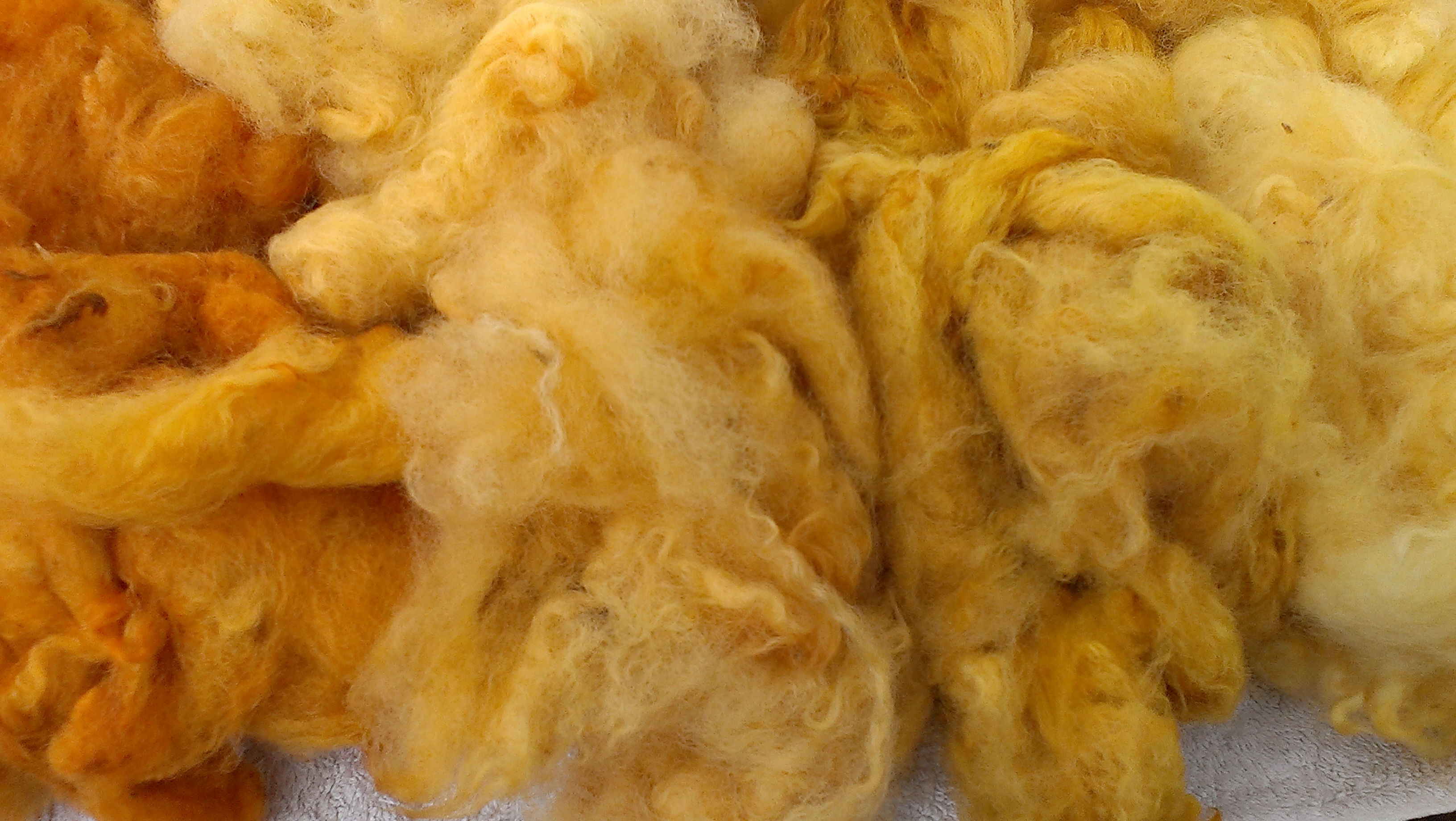
The resulting yellows are lovely.  On the left, coreopsis bath 1, then coreopsis bath 2, osage orange bath 1 and osage orange bath 2.  The coreopsis yellows are quite buttery and golden and the osage orange colours are a little more lemony.  And, there is further evidence that grass seeds and other vegetable matter take dyes quite well!  Now, to build up my courage for the indigo stage and some greens and blues.
IMAG2453

10 Comments

Filed under Dye Plants, Eucalypts, Fibre preparation, Natural dyeing

Silkworms: 4 week update

The silkworm marathon continues. This week, there has been a hiatus in the relentless chewing while they prepare to shed their skins and move on to a still larger stage of life.

image

Meanwhile, I have been carding my eucalyptus dyed corriedale in preparation for spinning…

image

And creating another trash batt from the carder waste and some polwarth locks.

image

Leave a comment

Filed under Dye Plants, Eucalypts, Fibre preparation, Natural dyeing

Local windfalls 2

I went for a walk the other day after more gale force winds.  The wind had been so impressive I watched every piece of mulch in our backyard become airborne the previous evening!  I took my trusty secateurs and a calico bag with me.

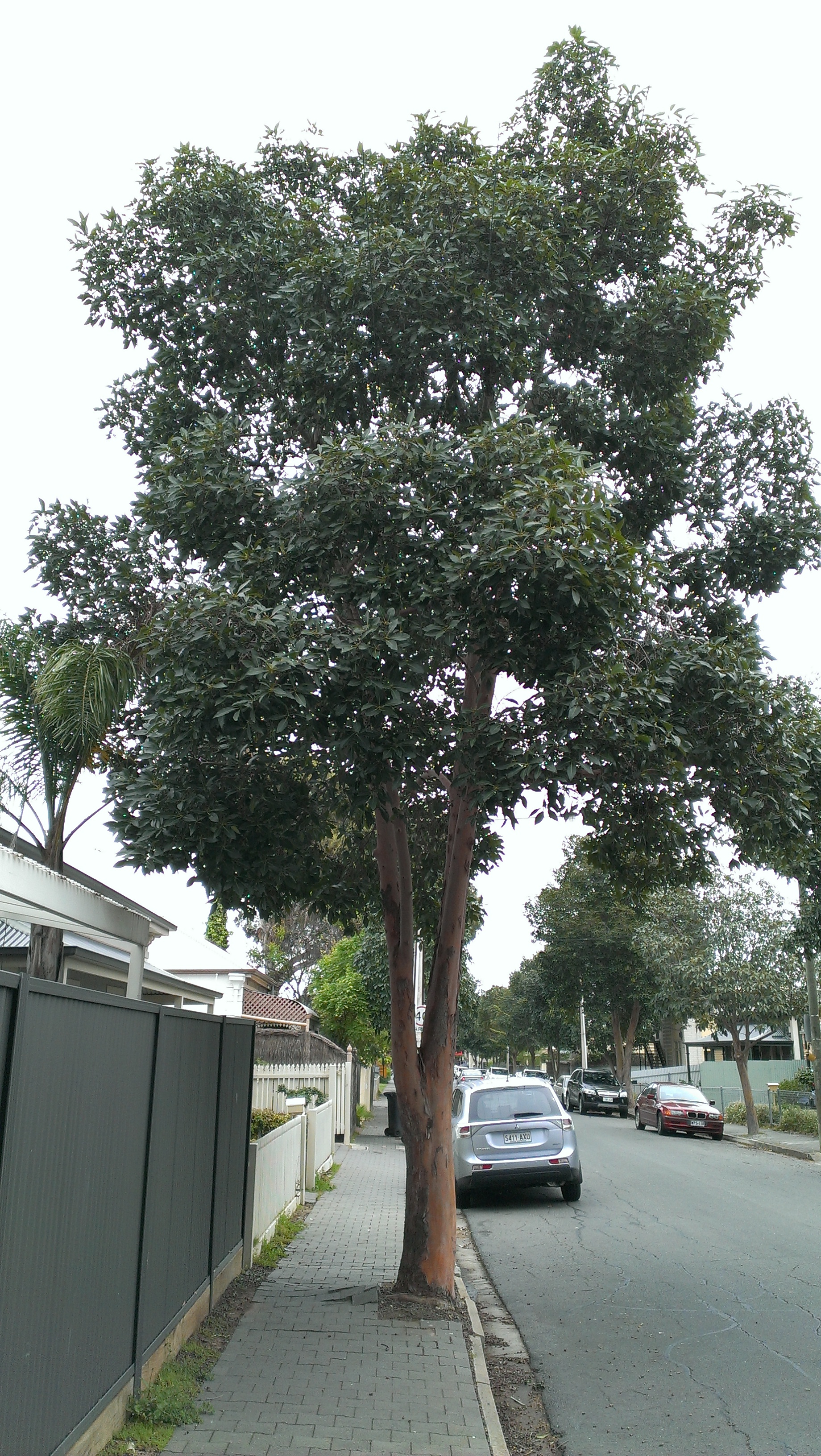
My first candidate (for the dye pot) is a tree my father calls Queensland Box.  Wikipedia suggests my father is right, and also that this tree is widely cultivated outside Australia.  It is Lophestemon Confertus–and its flower is just lovely (go to Wilkipedia if you’d like to see it–they are not in flower here right now).  The trunks peel to a lovely burnt orange but at present this process has barely begun.

IMAG2320

They are widely planted as street trees here.

IMAG2321  #

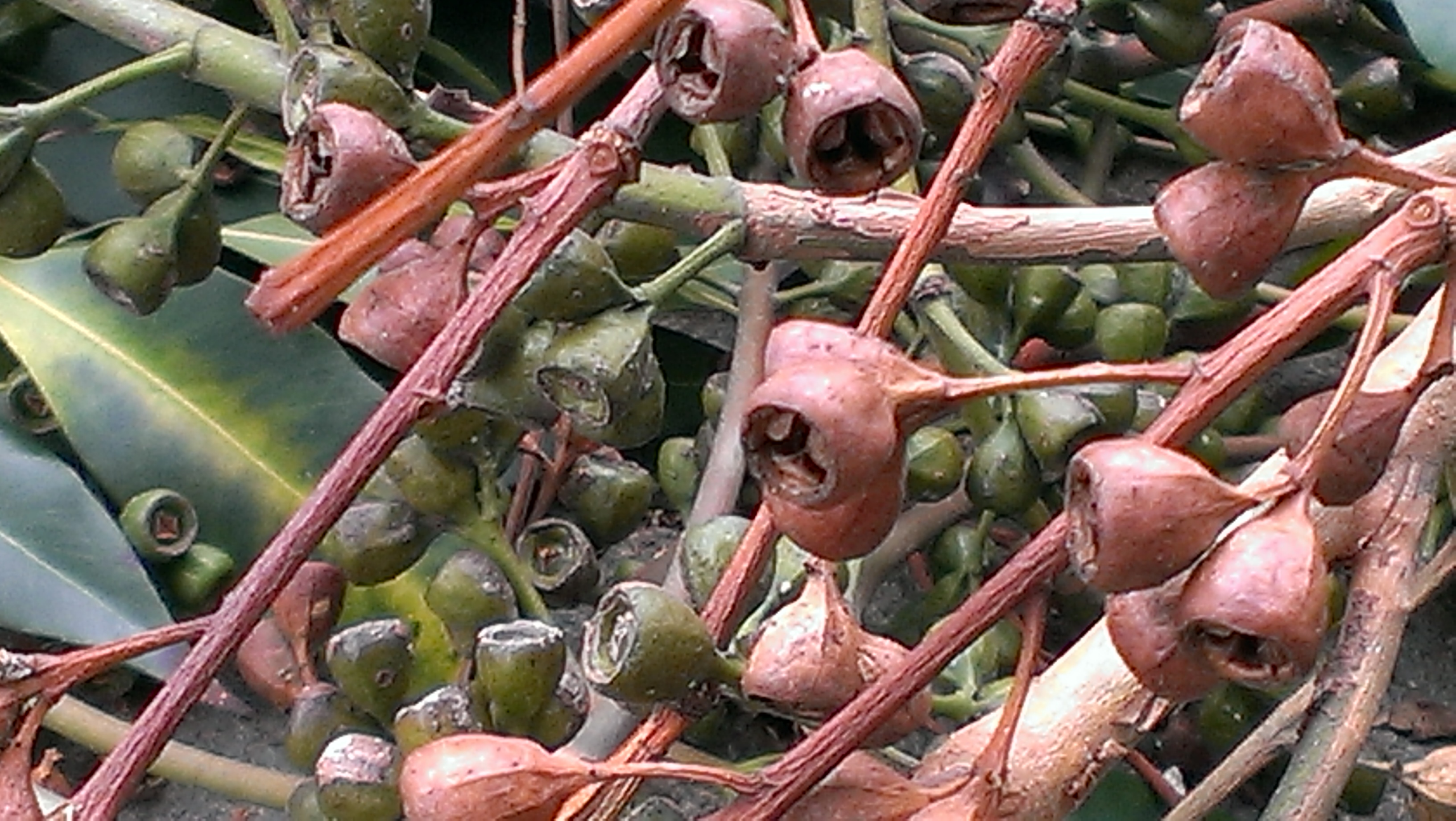
And they certainly are fruiting, with two generations of seed pods on show at present among glossy leaves.

IMAG2326

Two generations of fruit is one thing. Dye pot candidate two had four generations on show.  This eucalypt has been pruned ruthlessly but shows mostly smooth bark with rough, peeling bark near the base.  My best guess is E Macrandra (River Yate)–but this really is a guess.

IMAG2338

Now for the reproductive material! I think this is a ‘flattened, strap like peduncle’ as constantly referred to in my reference works. Those tiny ‘fingers’ are buds.

IMAG2339

Here the buds are again, a lot further along, in the second generation:

IMAG2344

Immature fruit:

IMAG2340

Still immature but older fruit:

IMAG2341

Finally, I came past a stand of ironbarks where I often collect after wind, and collected my third candidate.  It’s a mixed stand from which I sometimes get good colour and sometimes very little.  Three dye pots full waiting their turn on the hob…

IMAG2346

The results were not tremendously exciting… different shades of tan and pale apricot from the eucalypts (clearly the ironbark was not E Sideroxylon). I have to confess that I forgot to photograph these unexciting outcomes before overdyeing them with E Cinerea.  The Queensland Box showed its capacity to give tan in the presence of alum, especially.  The samples are (from left to right) wool, wool+alum, silk and cotton.

IMAG2361

Leave a comment

Filed under Dye Plants, Eucalypts, Natural dyeing, Neighbourhood pleasures

Neighbourhood windfalls 1

We’ve had gale force winds here lately.  One morning about a week ago, 40% of my city had no power when we woke up (we were happily still connected to the grid).  Needless to say, this has led to windfalls, and I was still collecting them yesterday as further gale force winds began a week later.

The first windfall was an ironbark.  Guessing from its location (a stand of three ironbarks) and the gumnuts still intact, I think it is E Tricarpa. Sadly, just as unremarkable as a dye plant, as the last time I tried!

IMAG2302IMAG2304

I have not managed to identify this tree, partly because it branches metres above ground level.  Even with so much of its canopy on the ground, I didn’t find a single bud, flower or fruit to help me identify it.  The trunk is rough and pale. The whole tree is difficult to capture in a photo, especially on such a gloomy day.  It must be at least 20 metres tall.

IMAG2335IMAG2336

It seems to be under attack from some kind of scale insect.  Every single leaf was affected. Here it is after some hours in hot water–suggestive of a beige outcome….

IMAG2309IMAG2349

Compare my third windfall.  This is a tree that has been cut to accommodate cars parking beside it, in the car park of a recreation area.  I haven’t been sure whether it was E Scoparia, E Camaldulensis, or some other unknown eucalypt.  Both E Scoparia and E Camaldulensis have similar shaped and sized leaves, small fruit and both can have pale, smooth trunks (but this trunk looks more E Camaldulensis to my admittedly self-trained eye).  The branch that fell to the ground had an uncharacteristically large number of fruit on it for E Scoparia.  On the other hand, the clusters of seven fruit with 3 valves apiece made me think it might be E Scoparia after all.  So did the colour of the dye bath, though the leaves did not turn orange the way E Scoparia usually does.

In spite of the colour of that dye bath, the result says that this is not E Scoparia, and the 3 valves say that it isn’t E Camaldulensis either (4 valves).  Even with vinegar to help bring out whatever orange or red might be there to be had, and still damp from the dyebath… the 3 valved tree is at the top (brown-beige?) and the 20 metre tall tree is at the bottom (caramel-beige).

IMAG2350IMAG2351

Here are the results of a bath with a fallen branch from an actual E Scoparia, downed in the same windy night.  They’re the red and orange samples, with the E Tricarpa for contrast.

IMAG2316

13 Comments

Filed under Dye Plants, Eucalypts, Natural dyeing

Show time!

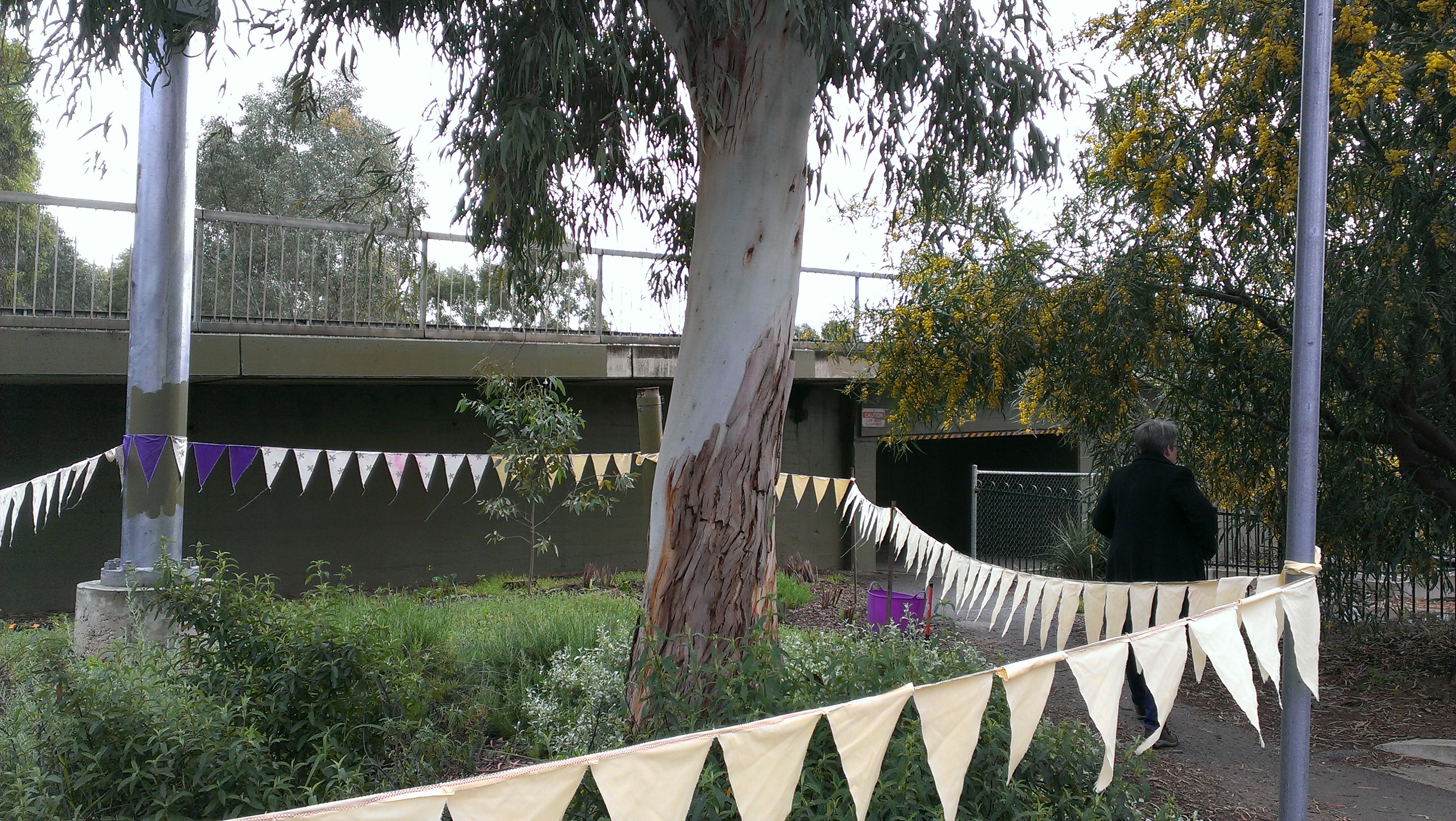
It is Adelaide Royal Show time again.  Spring began here only a few days ago, by the calendar.  There was a brief hot spell–33C is too much too soon for me–and then for the first day of the show, overcast and threatening rain as these dim pictures may suggest.  This week I have been tuning up the bunting I made to protect our little community revegetation project–around one of my favourite E Scoparia trees.  I sewed all the pieces back together, made some more, joined it all with some recycled cotton yarn, and… this morning we went out and applied it.

IMAG2153

The saltbush and other natives we have planted here have come on wonderfully–and there has been a spectacular fail with transplanting dianellas which I’ll pull out once the show is over. The yellow flowering tree on the right is a wattle that is doing really well (and not because we planted it).  The modest goal of this bunting is to gently suggest to people walking from the show (who will likely come down the path on the right of the image below) heading for the car parking on the left of the image below… that they should walk around this patch rather than trampling it in the dark after the fireworks are over, tipsy/sleepy/not paying attention as they may well be after an exciting day and too much fairy floss.  I think I replaced it three times last year, so I have some backup bunting already in hand, and I’m keeping my fingers crossed.  Happy show!  Happy springtime!

IMAG2154

1 Comment

Filed under Dye Plants, Eucalypts, Sewing

A pair of backyard Eucalypts…

Recently I discovered that a friend who has one of the biggest E Cinerea trees I have ever seen in her back yard would like some of it removed.  I offered to cut and take away the dead and insect affected parts, to her surprise, and have now made three visits to do just that. I’ve begun some dye pots with alpaca another friend has asked me to dye.

IMAG2075

On the second visit to trim the E Cinerea, my friend’s partner spoke about the loss of a bough on their other eucalypt.  I looked closely at this second very large tree with rough, fibrous bark on the trunk and very narrow leaves and ‘Eucalyptus Nicholii’ went through my head.  Could I at last have found a fully grown specimen?  It branched so high and the ground had been so thoroughly cleared in the effort to remove all the fallen material that I couldn’t find fruit.  I did manage enough leaves for a dye pot however… and it is very promising! I heated the leaves for an hour, dropped the sample card in and went for a bike ride leaving the heat off.  When I got back:

IMAG2078

As I write I have added some alpaca fleece.  I will have to wait to make a more definitive identification… I have sometimes found that all the hours I’ve spent with books on Eucalypts have created the context for me to have a correct intuition about a particular tree.  Equally often, though–I have completely the wrong end of the stick!  But the alpaca is looking good as it sits draining…

IMAG2101

8 Comments

Filed under Dye Plants, Eucalypts, Natural dyeing

Intriguing trees…

I returned today to two trees I have sampled a little that are growing on my favourite running track.  We rode our bikes down it, so I took pictures (and some more leaves, needless to say!)

IMAG2069 IMAG2073

Into the dye pot they went, with a sample card.

IMAG2100

Since I have two burners, I also ran a pot from leaves I collected when we went planting native trees on a friend’s farm.  It looked like E Cinerea to me… but an enormous tree, growing where there is so much more water than in the city where we live.

IMAG2099

The dye pot confirms that the E Cinerea gives great colour.  And the mystery trees gave  rusty orange with some tan undertones on handspun wool with no mordant, and brown on alum mordanted superwash.  Even more intriguing, really!

2 Comments

Filed under Dye Plants, Eucalypts, Natural dyeing

Small things…

They say ‘small things amuse small minds’. I think that if you can be amused by small things, you can be amused and delighted on a regular basis.  And that small things are often delightful.  Moss, for instance.

IMAG1909

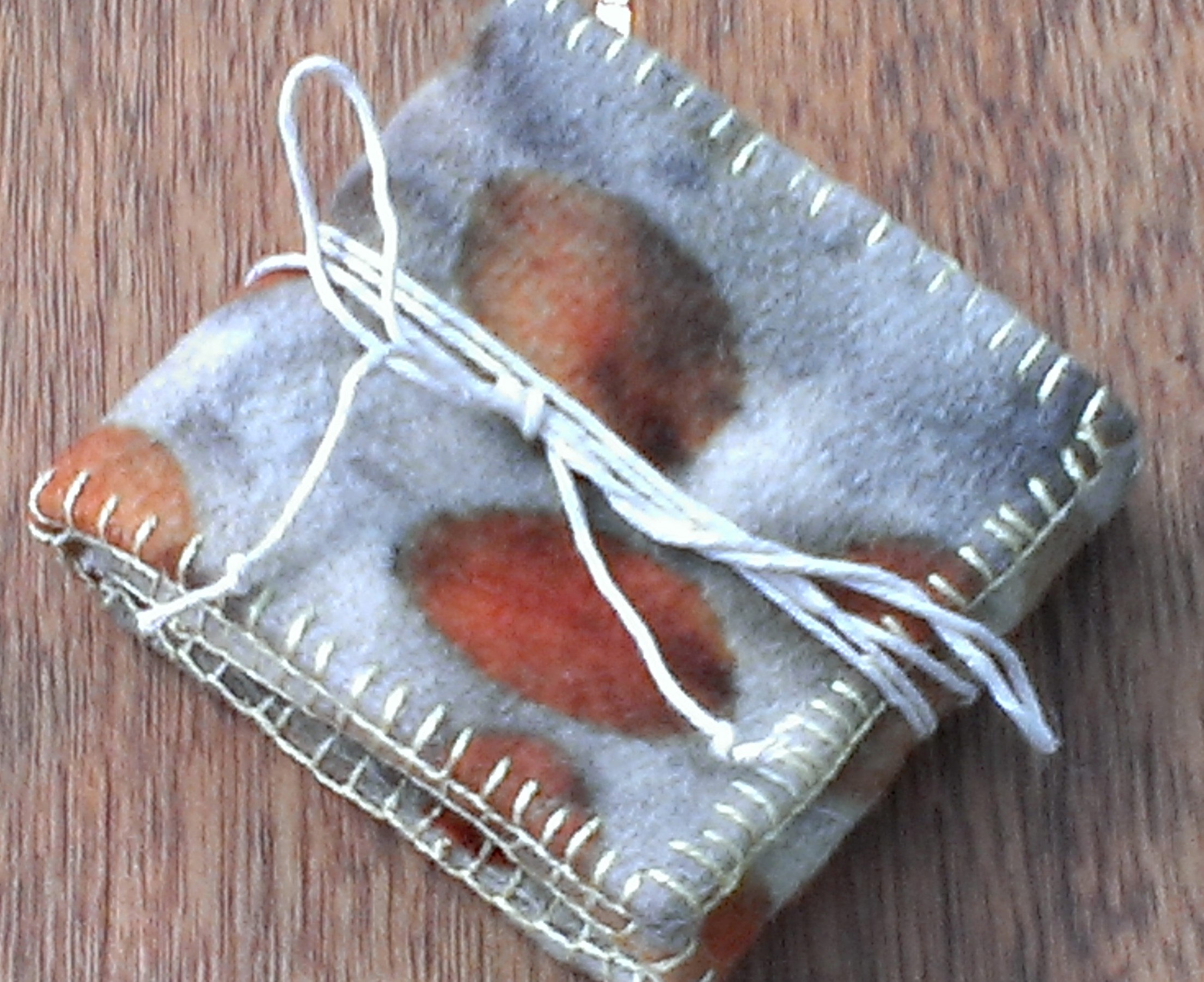
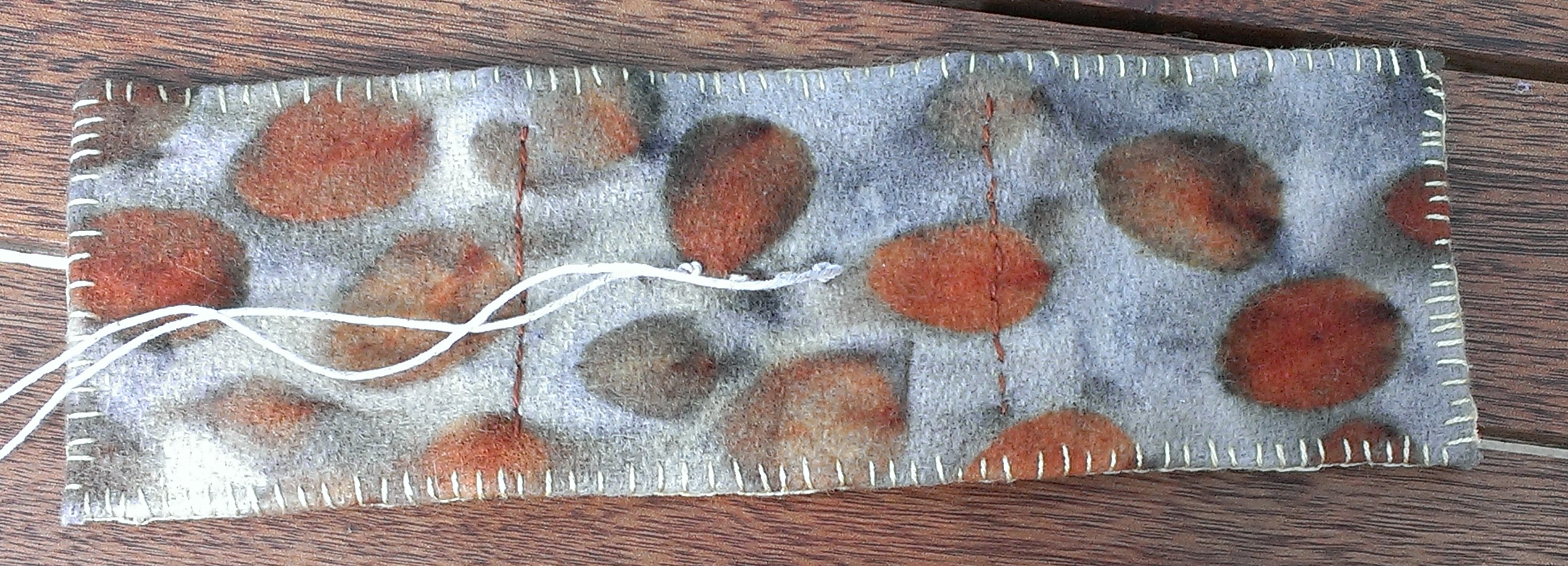
This is such a small thing. I loved Cossack Design’s needle safe, and what with all the embroidery going on round here, I decided to make my own needle case.  I think the last one I made was created in my primary school years–both long gone. 
IMAG1919 (1)

I decided on golden stitching for the edges, so dyed some silk with Silky Oak (Grevillea Robusta) leaves.  A nod to Ida Grae of Nature’s Colors fame for the recipe, wherever she may now be.  Hopefully hale and hearty and dyeing away though apparently no longer publishing.  How wonderful that she figured out this dye plant–which is native to Australia–from California!

IMAG1882

Here is the thread…

IMAG1914

And the inside of the needle case. These two fine scraps of recycled woolen blanket and that lovely piece of cotton string saved for just such a special occasion have found happy homes at last.

IMAG1917

7 Comments

Filed under Dye Plants, Eucalypts, Leaf prints, Sewing

Plum Pine 5: Lightfastness

Having discovered that plum pine had so much potential for colour, I felt obliged to test for lightfastness and washfastness. This is my lightfastness testing apparatus on the day I set it up: it is a none too sophisticated set of threads wrapped around card, inside a heavy card envelope with a window cut out of it, which has been sitting in the front window since 23 June 2013.

IMAG1602

At the top, 3 silk thread samples, handspun Wensleydale, handspun Polwarth, two shades dyed on BWM alpaca rich and finally, two shades dyed on Patonyle (superwash woool+nylon blend).

After over a month in the (winter) sun, fading is quite evident.  I realise now that I could have made a lightfastness test which made the results clearer, but you’re stuck with my limitations on this learning curve. If you squint, you can see the original colour at the sides.  The fibre that performed best was the handspun wensleydale with alum.  It was also the winner on the washfastness test.

IMAG1890

I have to say that I think I have chosen well in using the bulk of the yarn I dyed for some slippers (they are Fibertrends Clogs), which might spend their lives tucked under a bed and come out only at night!  Here they are awaiting felting…

IMAG1889

And here they are after a wash at 40C, with some commercially dyed companions.

IMAG1906

5 Comments

Filed under Dye Plants, Dyefastness, Natural dyeing

Plum Pine 4: Washfastness

I decided the obvious way to test for washfastness was to wash.  So I embroidered with the plum pine fruit–no mordant–silk thread, and with the plum pine fruit-with alum and cream of tartar on a piece of cotton… and added a little eucalyptus dyed silk thread for good measure.  Not the best example of embroidery ever seen, but it will do the job.  The two upper examples were purple (like the thread on the cards) when they went into a normal wash–30C with eco-detergent.  One wash later, the no-alum sample is grey and the with-alum sample is green-grey.  Eucalyptus shows its true colours yet again.

IMAG1655

Yesterday I tried washing my sample cards at 40C with eco-balls (we have laundry variety here, as you will shortly understand) and they were still purple when they came out of the wash.  Interesting… this made me wonder if part of what is going on here about Ph.  Detergent would be more alkaline than eco-balls.

After 4 more washes:

IMAG1892

You might remember that I did some darning with my early silk samples.  They have not fared well either–but the mending is still doing the job!  The pink is still pink, but much faded after what I would guess as being about 8-10 washes.  The purple is blue, and paler.

IMAG1894

I knit some test samples from my yarns.  They fared better, washed with other woollens, cold with soapnuts rather than detergent (if anything, a slightly acidic wash).  The sample on the right has two shades of plum pine with alum and CoT on BWM alpaca rich, with a band of cotton used to tie the skeins in between because this yarn took so much colour during the dyeing I was curious.  The sample on the left has two shades of plum pine on patonyle (wool and nylon superwash sock yarn and a sample of handspun Wensleydale).  One has gone from purple to grey and the other from purple to blue.  Blue?  Before:

IMAG1661

After, with unwashed BWM Alpaca Rich in the background for comparison.

IMAG1893

Well then.  Not what you’d call really excellent washfastness. And some new mysteries to ponder, as usual.

3 Comments

Filed under Dye Plants, Dyefastness, Natural dyeing