Category Archives: Fibre preparation

Unloved fibres of yesteryear and some eucalyptus dyeing

Some time ago I received a lot of fibres that even the felt group at my Guild didn’t want anymore.  I think this was because I taught a class on ‘novelty yarns’, known to online spinners as ‘art yarns’ or ‘textured spinning’.  It is true, people like Pluckyfluff have been known to spin semi-felted wool and all manner of inexplicable (yet ultimately gorgeous) things–and I’ve done some fairly inexplicable, or at least hard-to-explain, spinning,  myself.  But there are limits!  It seems some people equate artyarn with awful yarns made from awful fibres.  I wasn’t about to inflict most of this fibre on beginners.  What I felt was readily useable, I carded into batts for people to experiment on some time ago,.  Some I turned into trash batts.  Some I re-washed and turned into yarn.  But just recently I found there was still some in my stash.  Some was simply suffering from poor washing.  Sticky and unpleasant to touch.  I washed it.

IMAG4022

The amount of mohair the felting group handed over makes me think mohair isn’t favoured as a felting fibre.  So some was just mohair.  I carded it up and found it was neppy mohair, but still.

IMAG4025

Some was extremely short and rather matted. I would rate this trash batt standard, so carded it up with some longer wool to hold it together.
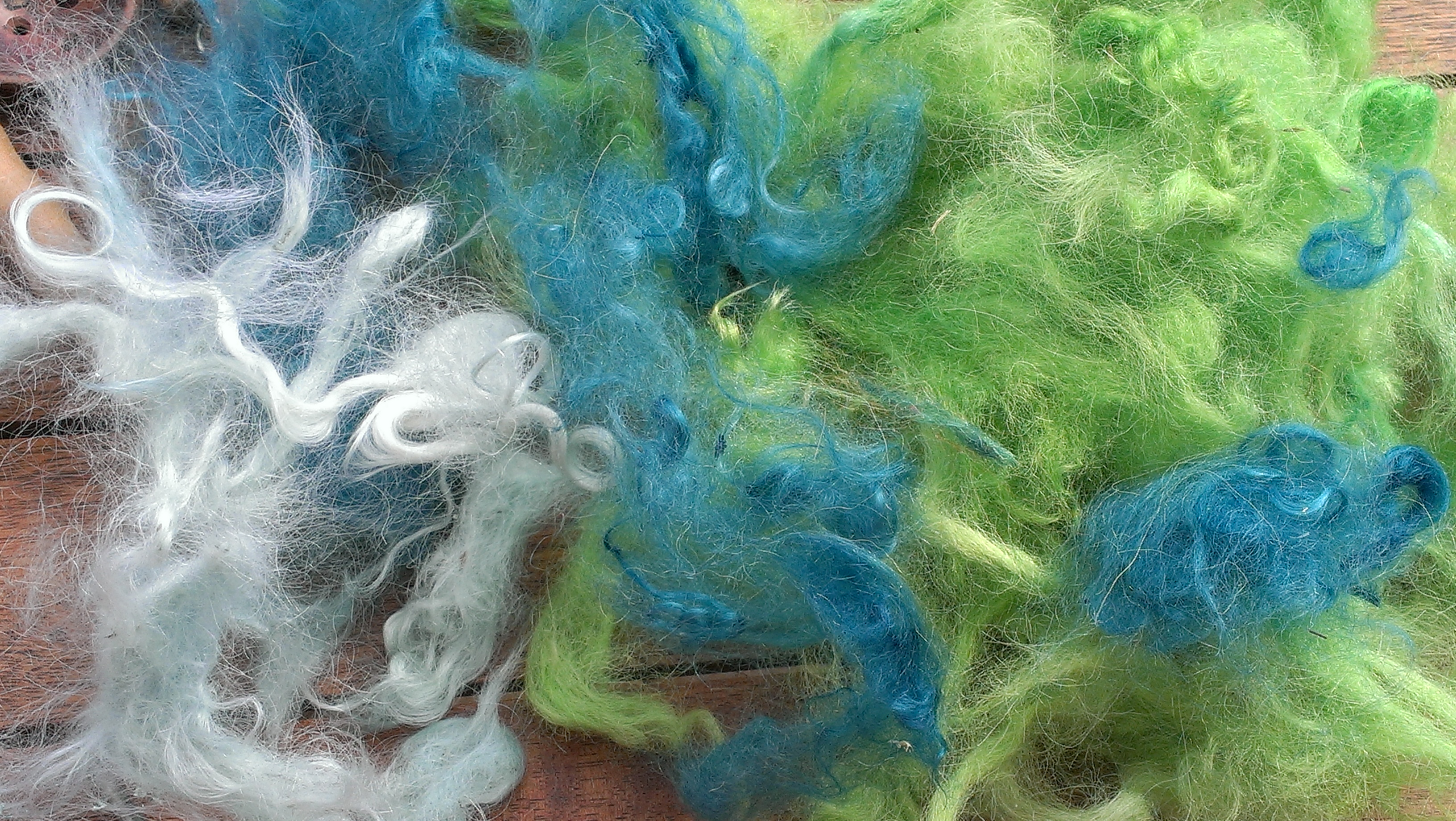
IMAG4024

Some was low quality alpaca in small quantities.  I carded that with some longer fine wool too.
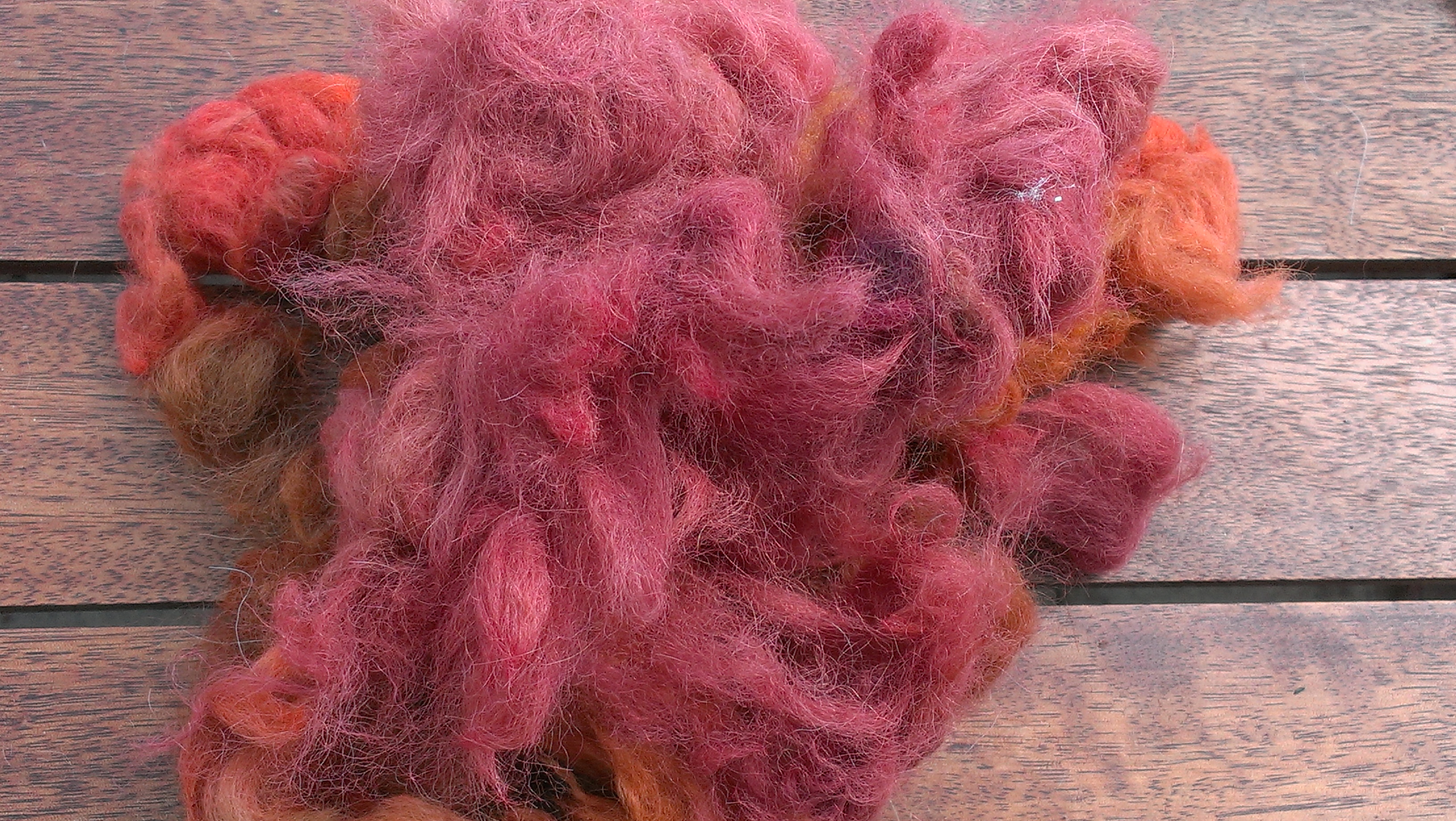
IMAG4023

I would rate almost all the resulting yarns basically suitable for yarnbombing… or perhaps I should offer them back to the felters!

IMAG4562


Only the mohair really became a yarn of any quality… not too surprising given what went in to the others!

IMAG4584


I also had some small amounts of fibre from an exchange.  One was some kind of ruggy (coarse) wool with lots of contrasting nepps in it, and the other a quantity of a lustre longwool, something like English Leicester.  I checked my perceptions with two spinners of much experience at the Guild and we all agreed on these conclusions, which was a happy thing, suggesting I am learning about identifying wools.  I decided on eucalypt dyes.  In each case I divided the fibre in half, and dyed one half in the first dyebath and the other half in an exhaust dyebath of the same leaves, to get two different tones.  Then I spun the fibres up to retain the colours as distinct stripes.
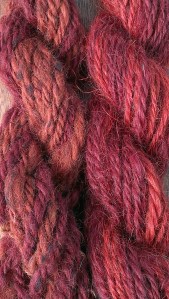
IMAG4567

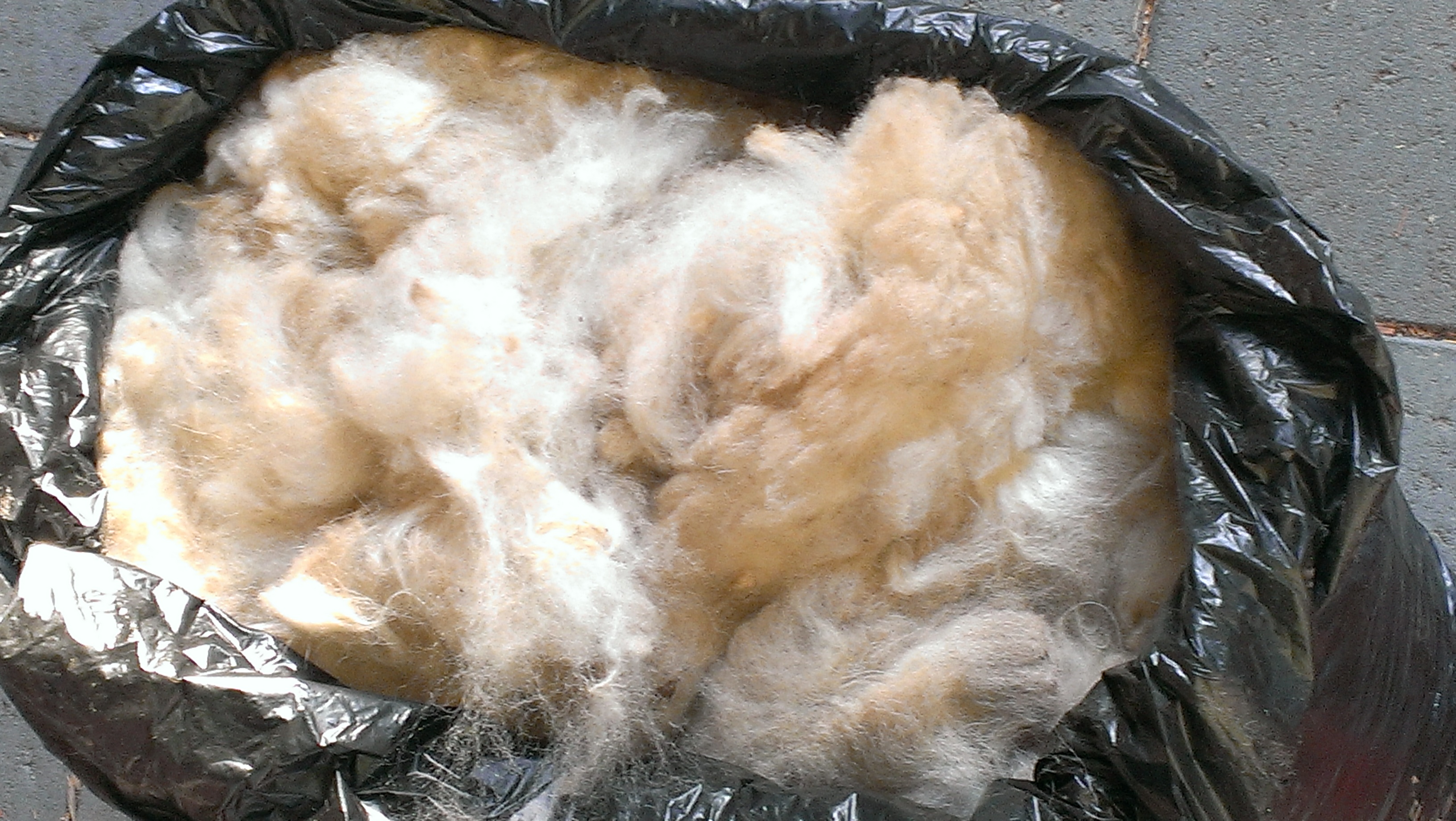
And now, back to spinning a large quantity of alpaca…
4 Comments

Filed under Fibre preparation, Natural dyeing, Spinning

Never look a gift alpaca in the mouth

I have been in Melbourne at a workshop with India Flint.  It was a great three days and I can’t wait to write about it…. but my phone steadfastly refused to cooperate woth WordPress–or perhaps it was the other way round–and it turned out sharing a computer wasn’t really an option.  So, writing about that will have to wait a minute or two!

In the meantime… maybe the proverbial instruction that you never look a gift horse in the mouth (implying you are checking whether it is an old horse and not a fresh, strong young one) only holds true for horses.  I’ve had gifts of alpaca that were full of moths, smelled of mould or were terribly short and full of guard hairs.  People making such gifts are well intentioned but have no idea what it takes to transform that fibre into yarn or how many hours I’ll spend touching and smelling it!

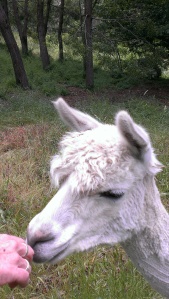
However, the two I have started in on recently are lovely.  They’re from friends who live in the hills–the people whose community was the former home of Malcolm the Corriedale.  There’s a white fleece that I am dyeing with eucalypts (so far).

IMAG3943

I have found that I can take raw alpaca fleece and dye it without pre-washing.  I can wash the fleece in the same step as rinsing out dyebath–saving water and getting the benefit of eucalyptus cleansing.  The dyebath no doubt has earth in it already if it contains leaves from a gutter or bark from under a tree.

IMAG4004

Then there is a wonderfully black fleece.  Two kilogrammes of it.  By the way, I believe I did look into the mouth of this particular alpaca, and its teeth were mighty long!  We had enough rain weeks back that we have run the whole house on rainwater ever since.  The weather was still hot and dry most of the time until recently.  So it seemed seasonally appropriate to wash fleece.  Then I had the key thought: ‘I feel as though I could just wash half that fleece right now.  And maybe the rest tomorrow.’ If I ever have a thought like that about housework, I make it a habit to act on the impulse immediately, before it can get away!  Fleece washing is not really fun, but it makes other forms of fun possible, and it is necessary.  Alpaca is filthy because the animals roll and dust bathe, but it is not greasy, which makes washing it far simpler than washing sheep fleece.

IMAG4037

So now: let the spinning begin…

2 Comments

Filed under Fibre preparation, Natural dyeing

Cool spectrum gradient yarn

There has been some plain Jane spinning.  Three ply natural Polwarth, finaly plied after a long wait. Not my best work, unfortunately.  One of the singles is plumper and fluffier than the other two.  Just the same, it’s yarn and it’s a true three ply made from three singles.

IMAG3856

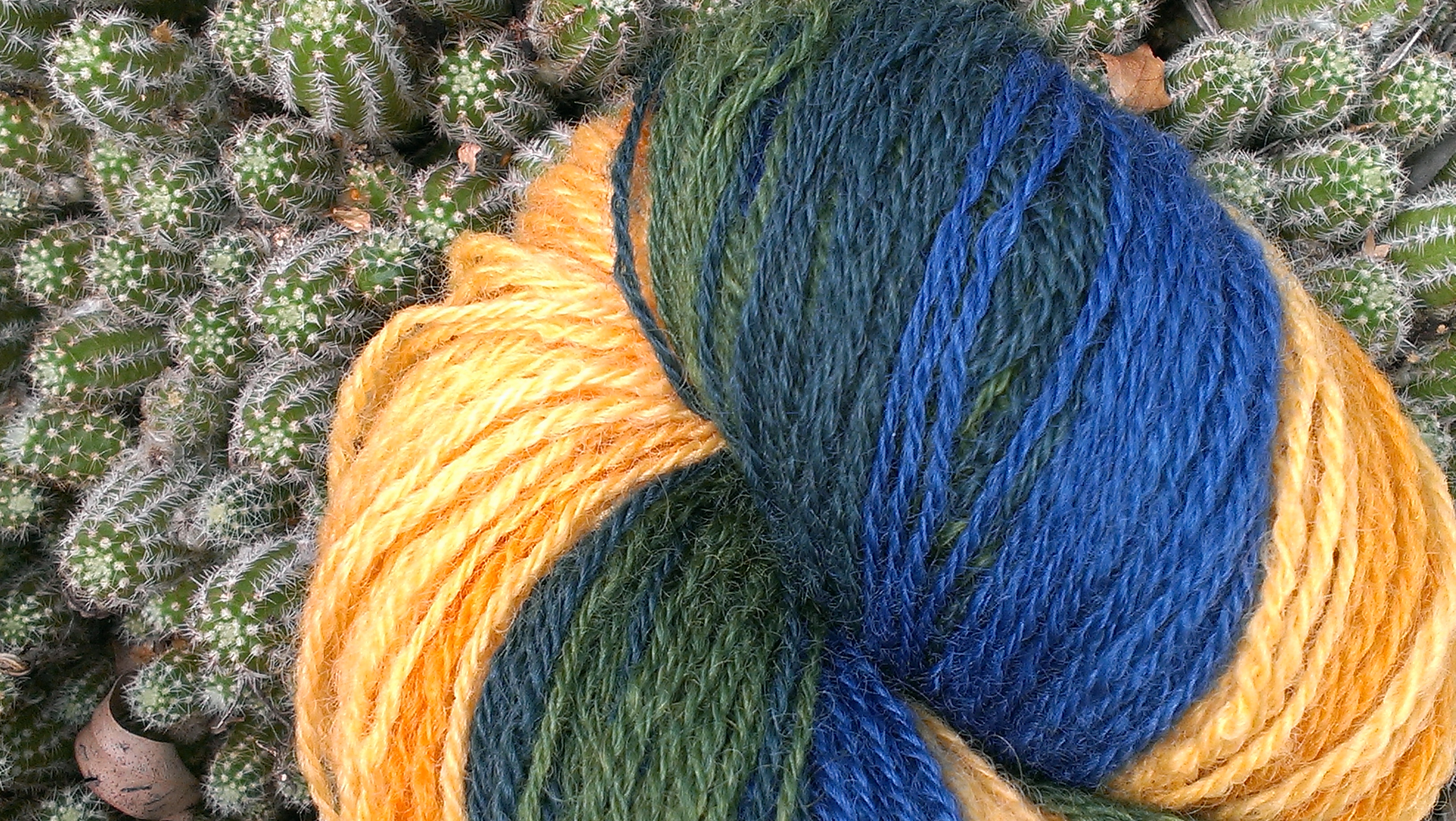
In the not-so-plain stakes, there has also been plying of some of the holiday spinning.  This one is Malcolm the Corriedale, dyed yellow with osange orange and my mother’s coreopsis flowers (she is generous enough to collect her dead flowers for me and such a committed gardener that she deadheads her coreopsis).  I overdyed with indigo to create greens and, of course, blue.

IMAG3870


No sign of crocking, just in case you’re wondering!  I have several more flour sacks of this fibre carded, pulled into roving through a diz and ready to spin.  Mmmm!

IMAG2939

The yarn is three ply and I’ve chain plied it so it will stripe… and just for the sheer pleasure of it.  Because I met internet spinners before I met many in real life, chain plying never seemed to me to be an unusual skill.  I took it up quite early in my spinning career and expected it to be challenging, because I was beginner and most things were challenging.  While I was plying this yarn at my regular Guild group, women who have been spinning for decades were commenting about how easy I made it look.  Ah, the warm glow of competence…  I admire all the things they can do that I find difficult, and there they are, doing just the same thing in reverse.

IMAG3858

6 Comments

Filed under Fibre preparation, Natural dyeing, Spinning

What to do with silk cocoons 4: Spin degummed cocoons

For those who have not been following the silkworm saga… I raised a good number of silkworms last year, starting with the hatching and ending (after riveting weekly updates, believe me), with the very last silkworm creating a cocoon. Since then there has been a small series of ‘what I did with my silk cocoons’ posts… and I think this is the last one for this season of silk.
With  A Silk Worker’s Notebook by Cheryl Kolander (Interweave Press, Colorado USA 1985) as my guide, I moved on to my final experiment.  Cheryl describes the potential of spinning from degummed cocoons as ‘unlimited’ (page 71).  In fact, she goes so far as to say: ‘Direct spinning from degummed cocoons is the classic form for handspun silk. In fact, there is no easier fiber to spin.’

As it happens, I bought 25g of degummed cocoons last time I visited the Victorian Guild, (they have a lovely shop and gallery) for the princessly sum of $3.20.  It’s a good thing I did, because these are the only degummed silk cocoons I have ever touched. It can be difficult to embark on a process (such as degumming) when you have never seen anyone do it (other than on YouTube perhaps) and you have never seen or touched the finished product–and you have only a paragraph of text as your guide.

IMAG3043

Degumming is a way of releasing the sticky substance that holds the strands of silk together to form the cocoon, so these are still roughly cocoon shaped but fluffy by comparison with their intact counterparts.  Now, I have to begin by saying that Cheryl Kolander has skills that far exceed my own, but for me this was not the easiest fibre I have ever spun!

IMAG3480

Just the same, I managed to spin it, extract most of the chrysalis remains that were included and produce yarn, even if I was quite unsure how to turn it into something even and lovely.  I didn’t really expect to do that on my first attempt–but I would not object to being surprised by beginners’ luck at some point in my life. I re-read the relevant part of the book to discover that even from Cheryl’s skill level and point of view, some parts are not spinnable, and they were the ones I struggled with most.  Here is what I produced:

IMAG3430

The next thing to do was to follow Cheryl’s advice on how to degum silk cocoons and try this process with my own.

IMAG3447

There were two accounts of how to degum in the book, one of which implied that the cocoons were degummed with the chrysalis intact (since it was extracted at a certain point in the spinning process).  The other advised cutting the cocoons up the side and removing the chrysalis before before degumming,  In the end, I decided to do that because the idea of a well simmered chrysalis did not excite me.  Call me unprepared to pick small insect parts from my fibre–stronger insults have come my way!

IMAG3487

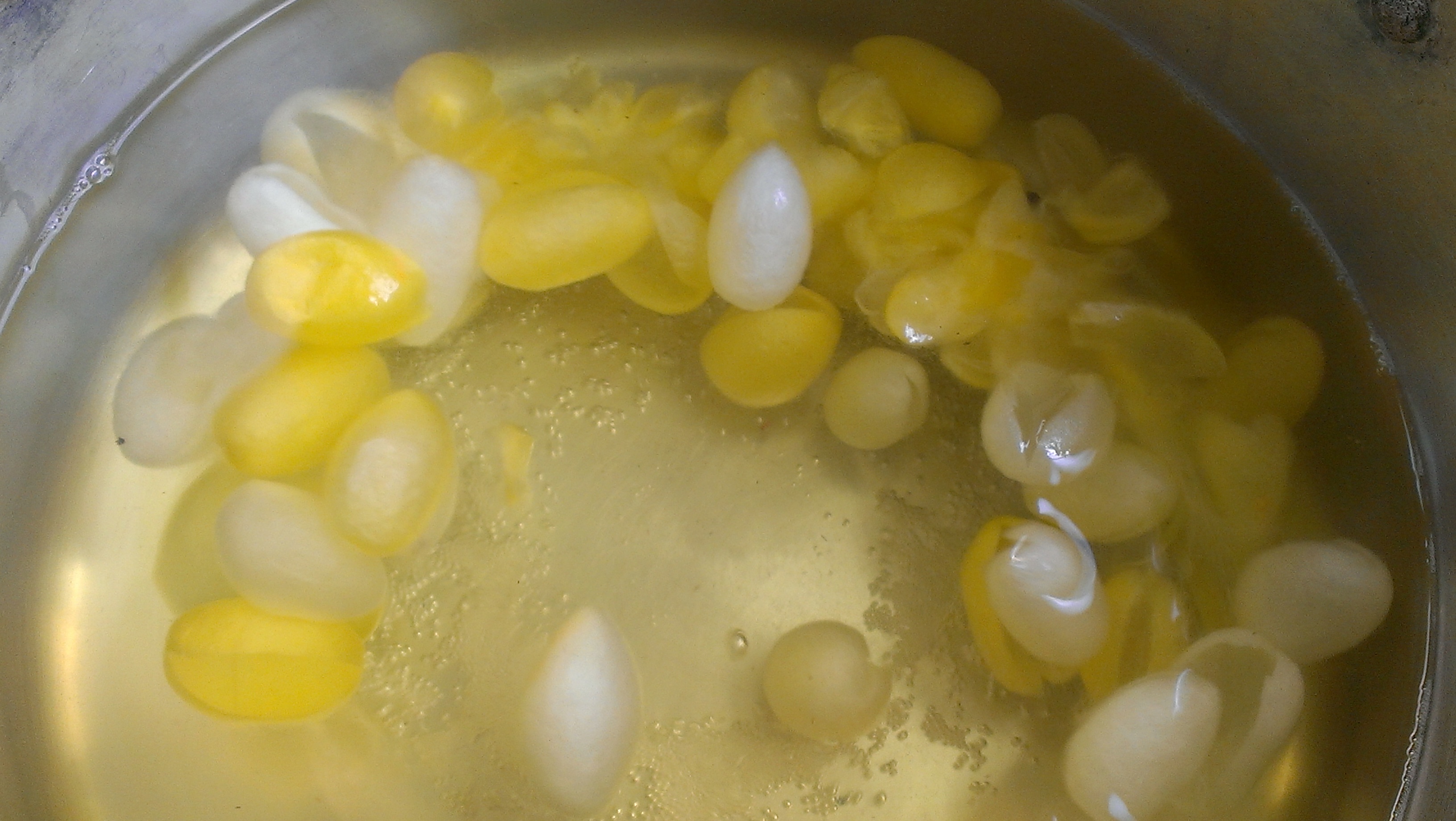
So, into the pot went the white cocoons, the yellow cocoons and the parts left over from spinning raw cocoons, just in case more could be done with them.  There were mysterious elements, as there often are with instructional texts from the US–for me, at least.  What is Ivory dish detergent?  Does the brand matter?  What would count as a big squirt?  This complication in understanding what others actually do is particularly entertaining in reading online discussion of washing wool–I recommend the thousands of accounts of the ‘only’ and ‘best’ way to clean raw fleece that you can find in any forum where this issue is discussed as fine entertainment!

As usual, I resolved these mysteries with the judicious application of guesswork.  Some time later I had this, a circular mass of silk fibres with quite a bit less structure, much less colour and some yellow water:

IMAG3495

I rinsed–and had something decidedly mangy and sad looking at the end of the process.  So I drew it out into a longish lumpy mass and hung it out to dry.

IMAG3527

Then, the struggle to spin began.  I think the temperature on my degumming pot may have been a problem… in that my burners maintain temperature by intermittently heating, which sometimes produces bubbling. I think this introduced a level of tangling that the cocoons I bought from the Victorian Guild did not suffer from.  But of course… this was probably only one of my beginner mistakes. My cocoons did not contain as much fibre as those I had purchased either, so the ratio of spinnable silk to fine inner layer was different too.

In the end, there was some yarn.  Not very much, and not very lovely.  But there was yarn.

IMAG3598

Time to put my feet up until next September, I guess!

7 Comments

Filed under Fibre preparation, Spinning

Leaf prints of the week: Pecan and Eucalyptus on cotton

Last week there was some leaf printing. Eucalyptus Scoparia leaves, one of my favourites.

IMAG3492

Pecan leaves, inspired by Lotta Helleberg (when I went to her blog to insert this link there was an especially delectable pecan leaf printed fabric on show, by complete coincidence) and by a wonderful lunch with friends who have a pecan tree. The leaves have been patiently waiting in my freezer.

IMAG3490

Let me admit right here and now that I had some alum and tannin mordanted fabric which took no colour at all–I must have made some kind of mistake there!

IMAG3489

As always, the thrill of seeing good things begin to emerge.

IMAG3496

Then waiting to unwrap bundles.  I saved these until I had a friend over for dinner who I realised would enjoy the reveal as much as I do.

IMAG3499

Some pecan prints were better than others, but the good ones are lovely.

IMAG3535

And the Eucalyptus leaf prints were all I hoped for and more.

IMAG3534

6 Comments

Filed under Eucalypts, Fibre preparation, Leaf prints

What to do with silk cocoons 2: Spin raw cocoons

On the last Guild meeting day for 2013 I wandered into the library intent on borrowing for the coming 2 months–including holiday time.  One of my loans was A Silk Worker’s Notebook by Cheryl Kolander (Interweave Press, Colorado USA 1985). She describes spinning raw (softened in water but not degummed), degummed whole and cut and degummed cocoons.  Choices, choices, choices!

She instructs the reader to soak the cocoons to soften them.  I soaked them cold and nothing much happened.

IMAG3411

I double checked and Cheryl Kolander says to soak in warm water.  I did, and by bedtime, I had spun a very small number of cocoons over a considerable amount of time with great effort and decided soaking until the following evening would be necessary, since I do in fact have a job to go to…

IMAG3415

Kolander’s instructions make gradually drawing out fibre from one end of the cocoon sound straightforward.  Bless her heart, if she can do that, she has greater skills and/or strength than I do!  I have never applied so much sheer force to draft anything.  I found I had to snip the cocoon to make a start, enlarge the hole by pulling, remove the chrysalis and then tear or stretch the cocoon far enough that I could grab one half in one hand and the other half in my other hand and create a bridge of fibres I could attenuate and attempt to join to my thread.  All while still wet.

IMAG3460

Kolander promised a stiff thread and mine did not disappoint. Can you see the end of the thread heading off to the upper right in the next picture?  No wind or special effects were applied to this image!

IMAG3466

This was the smallest reel I could find.  But I am delighted to have managed to spin a thread.  I drew the line at plying and left it as a single.  As always, experiments like these give some finger-and-muscle-understanding and not just a vague intellectual sense of the tremendous skill and sheer hard work and time commitment of people who create fine reeled silk and all manner of silk yarns and fabrics with the most basic of equipment. I won’t be giving up my day job anytime soon!

IMAG3474

2 Comments

Filed under Fibre preparation, Spinning

What to do with silk cocoons 1: Spin the blaze!

One of my more knowledgeable friends (who loves working with silk) told me that the loose fluffy fibres around a silk cocoon–where the silkworm was just getting started on anchoring themselves in space and creating a scaffolding for the eventual cocoon–is called the ‘blaze’. She was planning to try spinning the blaze–and I decided to follow her example.  I had never seen this feature of a silk cocoon before growing my own.  I guess it is removed or destroyed when cocoons are dyed or prepared for sale.  But this puffy little cloud of fibre is rather lovely.

IMAG3395

I tried spinning it by just drafting it away from the cocoons.

IMAG3398

This sometimes meant several cocoons were caught up in my drafting, and occasionally one was dangling in mid-air, hanging from a filament so slender as to be invisible.

IMAG3402

Here are the cocoons, now without their blaze.

IMAG3404

And here is the resulting tiny three-ply skein with some cocoons for scale.

IMAG3420

It’s pretty but tiny!

IMAG3433

10 Comments

Filed under Fibre preparation, Spinning

A squeak of glee and a visit to the beach

I was in Melbourne when I saw that India Flint had put out a new book: Stuff, Steep and Store.  Yesterday (well, the day before I wrote this post–) it arrived in the mail and I gave out a squeak of glee.  It is short but lovely, so there was one reading before bed and another over breakfast.  I happened to be heading out to an early appointment at a suburb near the beach.  Inspired as I was, and consequently full of exciting plans, I decided to go to the beach to dip some fabric (the last of a roll of cotton sheeting from a church fete) in the sea and  collect seawater for later use.  And, of course, for a walk.

IMAG3291

I am my father’s daughter, so my walk was accompanied by the collection of glass shards from the sand.  There was also the greeting of a lot of dogs and a smaller number of humans.

IMAG3302

A great start to the day, and multiple dyeings to come.

IMAG3300

10 Comments

Filed under Fibre preparation, Natural dyeing

Alas, poor Malcolm the Corriedale

We had a glorious visit to our friends in the hills on the weekend. There were recently shorn alpacas.  In black…

IMAG2929

In white…

IMAG2926

And in cinnamon.  But like the sheep, the brown alpacas were too shy for photos.  There was a woodlot of blackwood trees, and some stumps with very impressive fungi growing on them:

IMAG2932

There was a wealth of eucalypts and a knowledgeable community member who knew what many of them were. I brought home E Nicholii leaves (I have not had the chance to greet a fully grown specimen before, let alone a row of them), E Cinerea leaves and some massive juvenile E Globulus leaves.

IMAG2935

There was fine company, cake and scones and home grown cherries.  Not only that, but koala sightings and visits with rescue joeys (baby kangaroos whose mothers have been killed on the road, being raised by hand with tender loving care).  Such awesomeness!  I took lots of handspun yarn and left quite a bit behind where creative minds were whirling with plans and fingers were itching to get knitting… but there was bad news too.  I got to meet with the people who hand raised the corriedale whose fleece I have been working with most recently, from a lamb.  And sadly, poor Malcolm had recently and unexpectedly died, just before the shearer was due to visit.  We paused on Malcolm’s grave.  So it was special to have taken yarns made from Malcolm’s fleece to share… and I still have some, plus fleece that I dyed with eucalypts last week (it is E Scoparia bark peeling season) …

IMAG2936


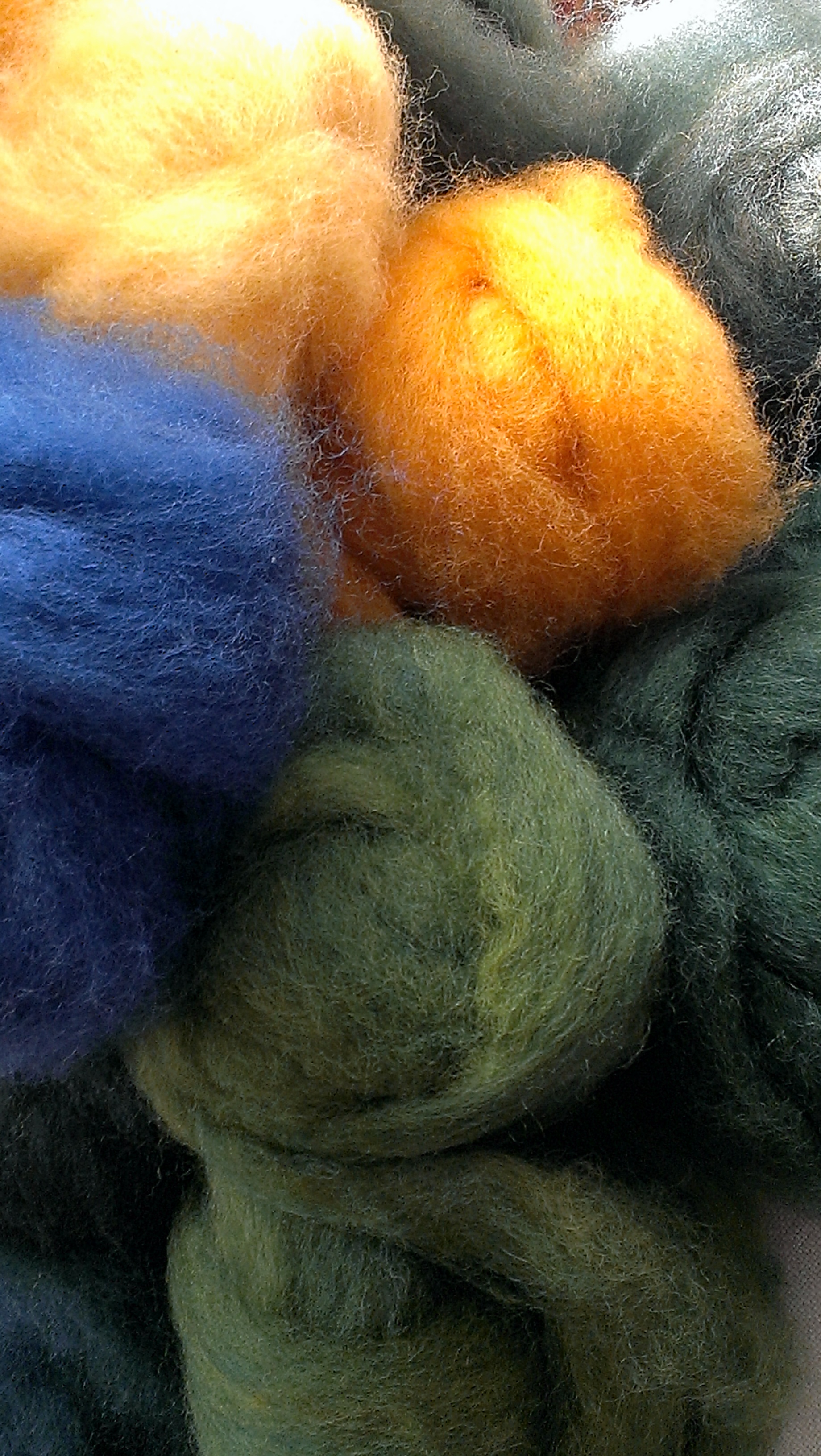
And fleece that is prepared and ready to spin, from my recent coreopsis–osage orange–indigo dyeing season.  So… although I never did get to meet Malcolm, it’s conceivable I’ve spent more hours with my hands in his fleece than anyone…

IMAG2939

And I now have 5 alpaca fleeces and one from Lentil the sheep to think about and share around, such is the generosity of our friends!

7 Comments

Filed under Dye Plants, Eucalypts, Fibre preparation, Natural dyeing, Spinning

Eucalyptus dyed gradient yarns

Some time ago I blogged about dyeing with windfall eucalyptus leaves. I had been dyeing over white corriedale and had quite a range of colours in the range of ochre and caramel through flame orange and… opinions differ about whether that really is red. Here it is, wet from dyeing and ready to be rinsed:

IMAG2316

I divided my fleece up into colour groupings, carded it and pulled a roving straight from the carder drum with a diz.  What a great technique.  You can find it on YouTube, but it was watching a friend from the Guild demonstrate it that really convinced me to try it out.  This Youtube video has an explanation of the same simple homemade diz my friend has made, so maybe she was inspired by that video.  Here are my rovings.  Creating these made me feel like I have learned a few things about fleece preparation.

IMAG2392

Then I created bumps of roving with segments of each colour, lined up to create a gradient from ochre through to reddish. Then, there was spinning and plying and skeining and washing–spinning being a craft of many stages–and now…

wpid-IMAG2742.jpg

I am so happy with this yarn! I can’t wait to share it with the friends whose sheep this wool came from.  Coincidentally, the week I finished this yarn, they invited me to their place for shearing time.

wpid-IMAG2750.jpg

16 Comments

Filed under Eucalypts, Fibre preparation, Natural dyeing, Spinning