Category Archives: Leaf prints

Eucalyptus Erythrocorys


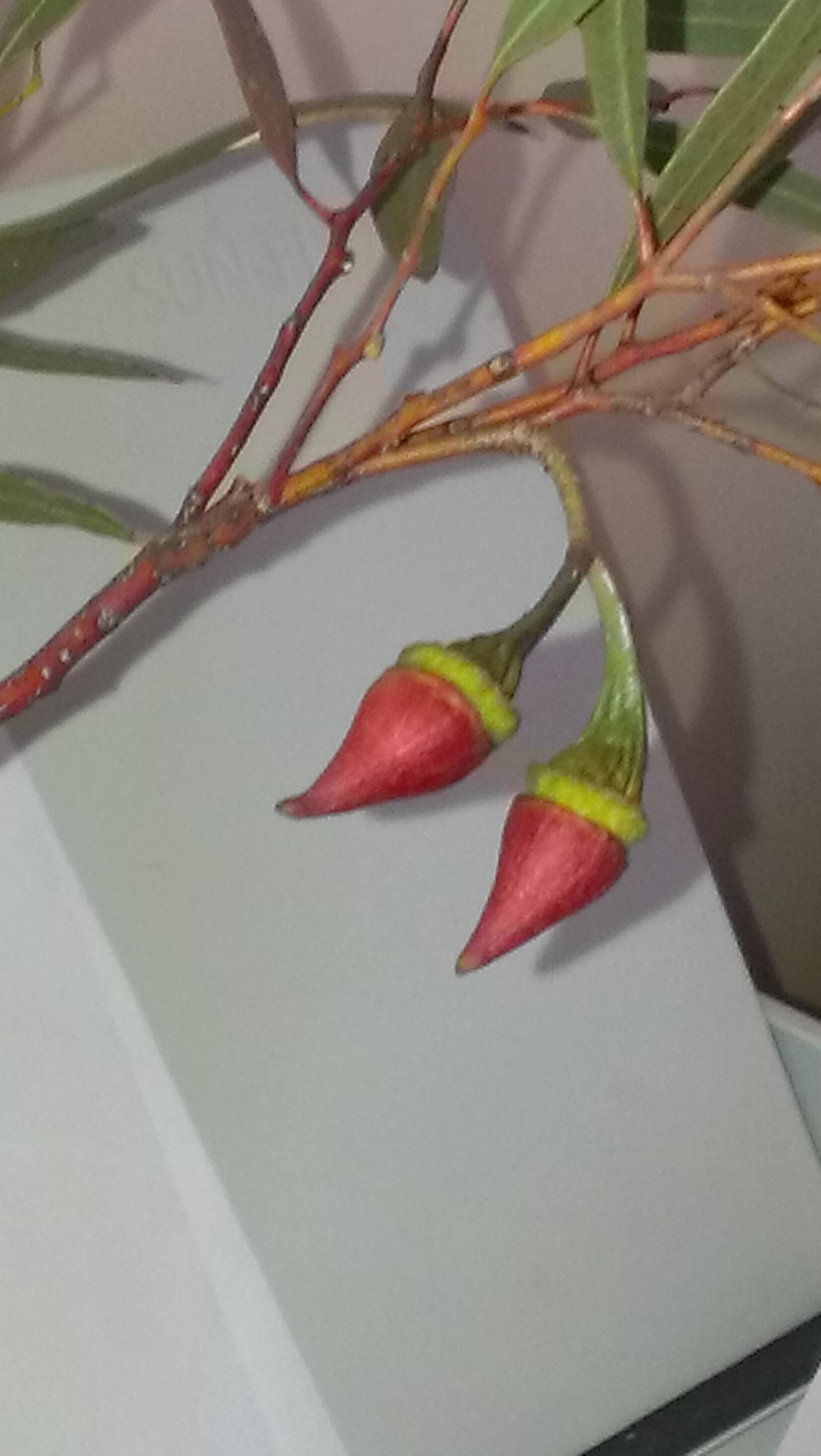
E Erythrocorys (Ilyarrie) is in bud at present. The buds are large, with impressive, unusually shaped bud caps.

IMAG0910

I found a few flowers on one of the trees near a car park at work, but they were high up. The fruits of the previous season are still maturing, and they are just enormous–the size of a large apricot or plum.

IMAG0823

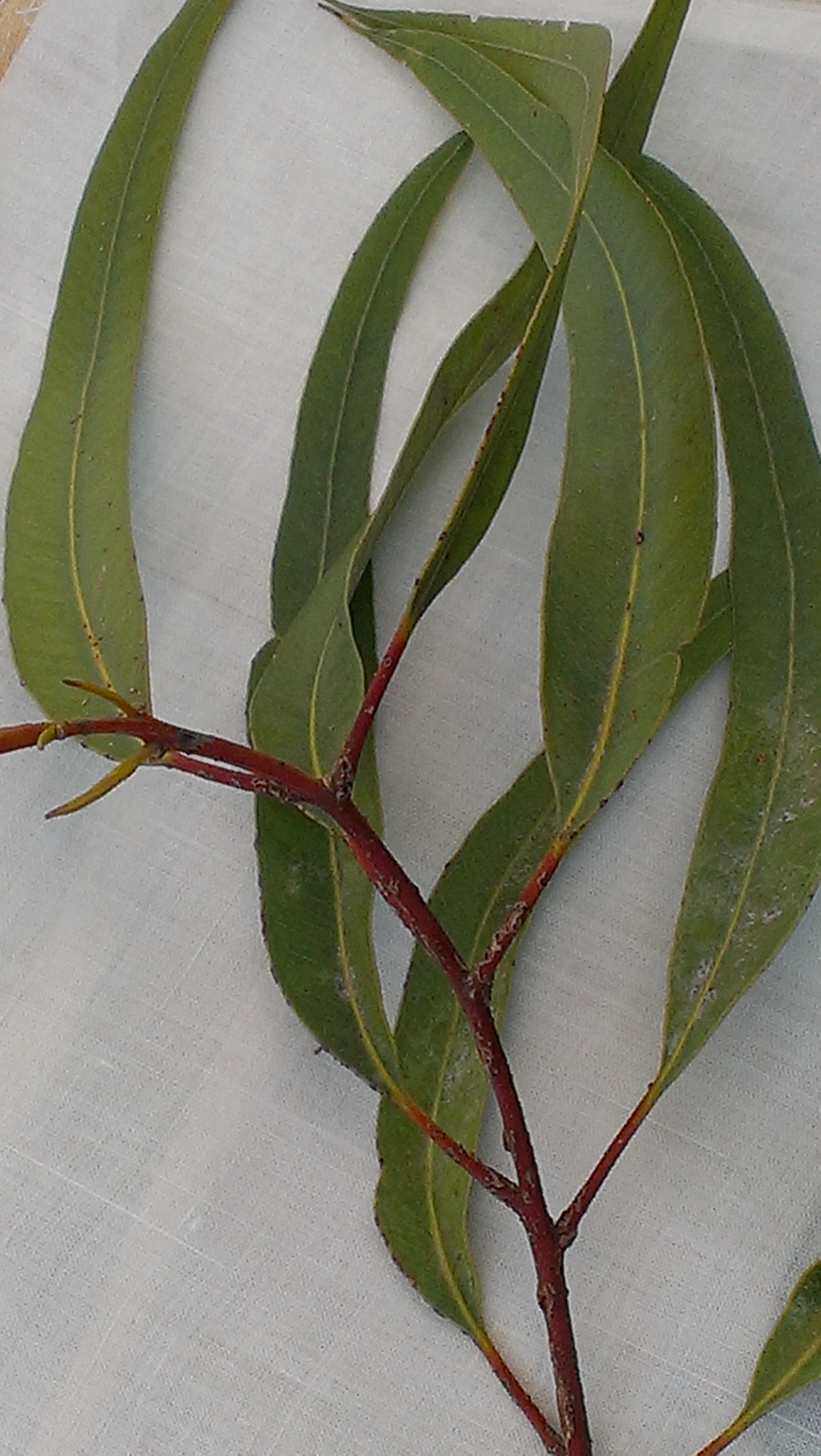
The leaves are long, too.  I’ve experimented with this tree in the past, obtaining a mid-orange from dried fallen leaves. This time I tried leaf prints.  Before…

IMAG0829

And after simmering with iron.  Another not-too-exciting result.

IMAG0849

Leave a comment

Filed under Dye Plants, Eucalypts, Leaf prints, Natural dyeing

Eucalyptus Lehmanii bark dyepot

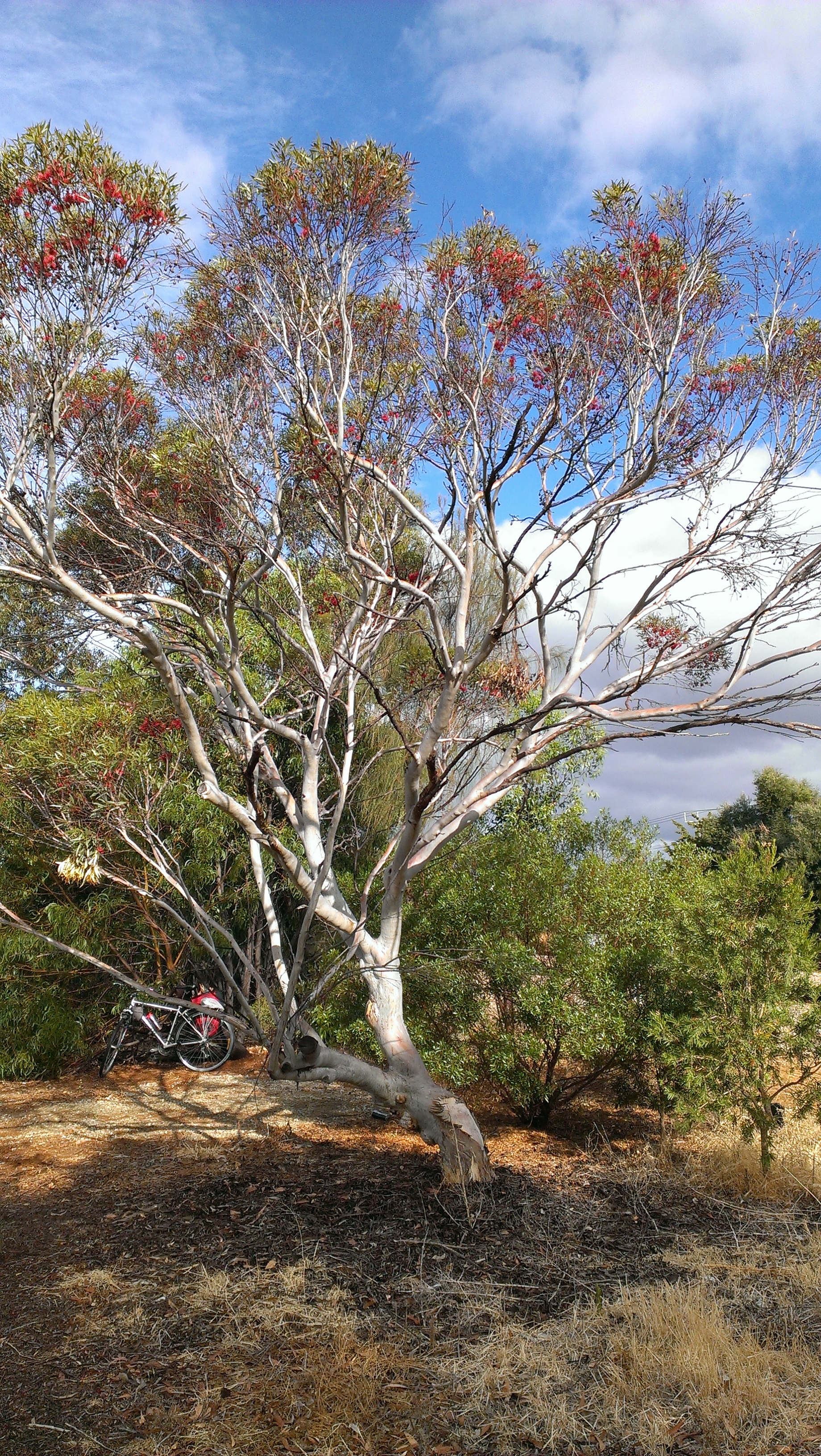
E Lehmanii (bushy yate) has a very distinctive arrangement of buds, flowers and fruit.  When I was a kindergardener, we used to put the long bud caps on our fingers and call them witch’s fingers and chase each other around.  I can’t pretend to have had any sophisticated critique of the concept ‘witch’ at that stage in my life!

I came across some planted as street trees while I was out doing a run with friends.  On the way back to our car, I managed to collect some bark–since it had helpfully fallen.  I also collected a few leaves.  I have a sample card from a previous experiment with bushy yate leaves from a friend’s property, which gave quite a strong orange-brown.

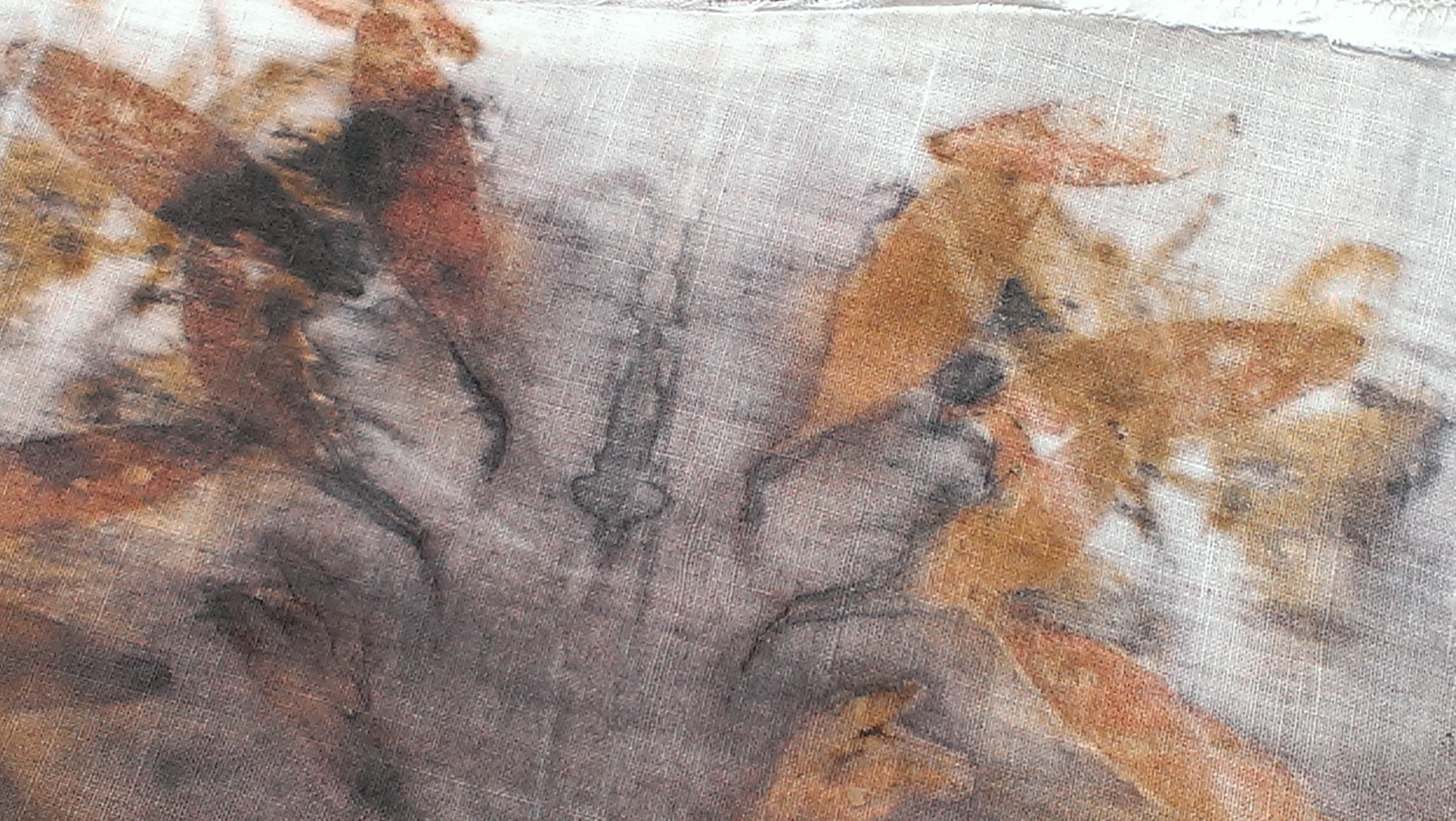
I used iron with the leaves, and the contribution from the iron on this occasion was really quite intense.  Before…

IMAG0828

After… a result that won’t have me rushing out to collect bushy yate for leaf prints, but a result just the same.

IMAG0845

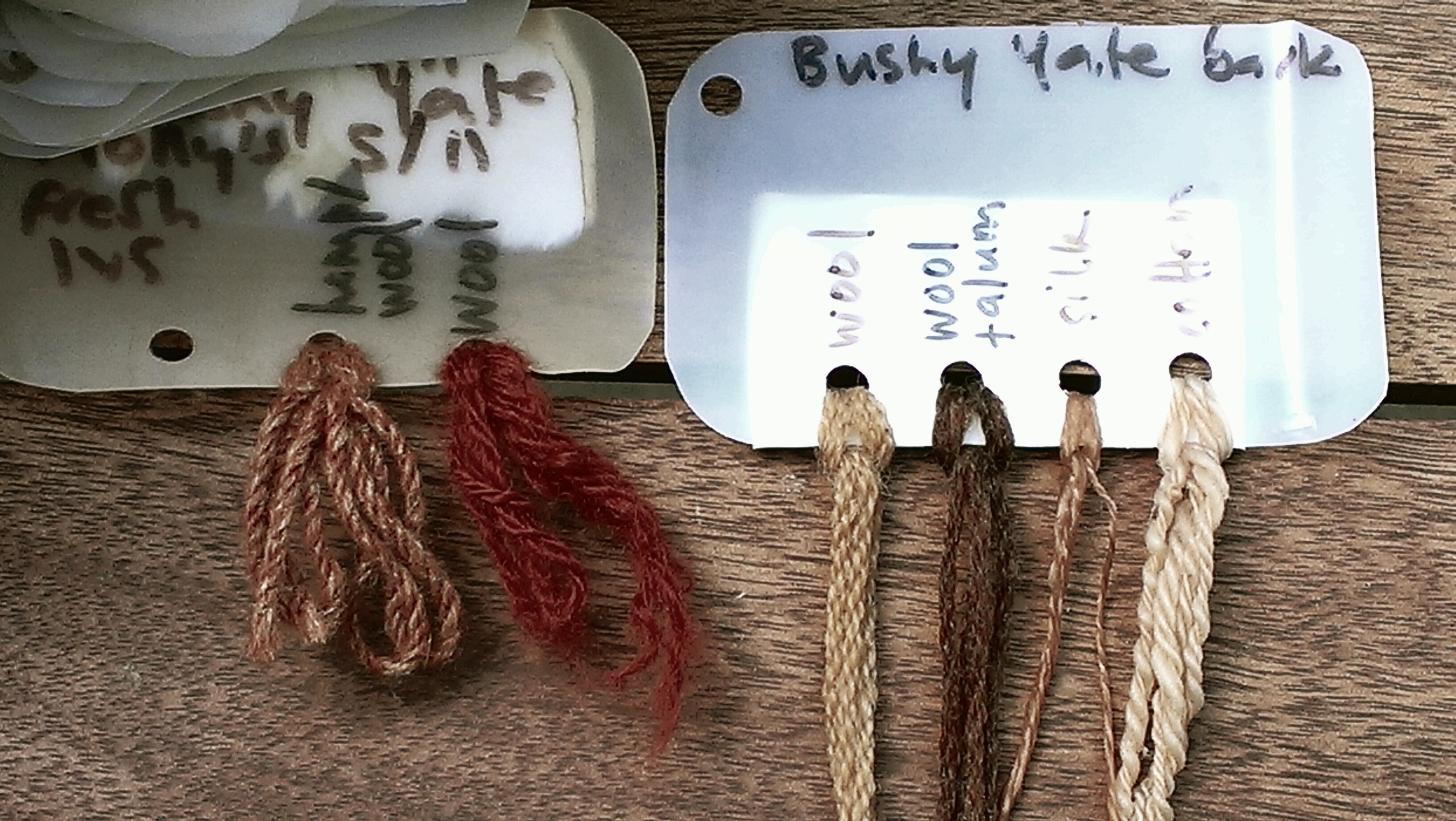
And as for the bark pot… tan, again!  I would have to rate the biggest take home message from the series of bark dye pots this summer as being that alum really makes a difference with the Eucalypt barks I’ve tried.  With leaves, I seldom see any impressive difference between alum mordanted wool and plain wool.  I dye with E Scoparia bark often and have found no point in mordanting with alum (though this experience makes me think I should try again and double check). The bark pots, however, have given various shades of tan without mordant and much stronger browns with alum, and E Lehmanii is no exception. On the left, sample card from a pot of fresh leaves.  On the right, results of the bark pot, simmered for an hour and a half.

IMAG0844_1

2 Comments

Filed under Dye Plants, Eucalypts, Fibre preparation, Leaf prints, Natural dyeing

After the workshop

This week I ran a natural dyeing workshop for my Guild.  It was exhausting but fun!  I tried taking a picture inside the hall and my poor old camera wanted to use the flash–pretty useless.  Between that and having a lot going on, I decided to forget taking photos.  We ran lots of dye pots: E Scoparia bark, dried E Scoparia leaves (oranges), silky oak leaves (yellow), logwood from the abandoned/donated dyestuffs of the past stash (purple), black beans (not as blue as I hoped)… we mordanted with alum and with soy, there were leaf print experiments.  We dyed silk, alpaca, wool, cotton; fleece, roving, yarn and fabric.  Phew!

I came home with cooked bark and leaves and  ground soybeans to compost, quite a bit of remaining pre-mordanted yarn, a bucket of black beans with yarn tucked into it, a bucket of homemade soymilk and the logwood bath.  Can I just quietly mention how relieved I was when I got home without having sloshed a bucket over in the car?

IMAG0786

I have run the logwood bath twice more so far.  This is the second effort: superwash wool in the foreground, alpaca/wool blend in the middle, and greeny-grey-blue black bean dyed sock yarn at the back.  I have some roving still soaking and rinsing after the third logwood bath, and I’m mordanting more fibre to go into a fourth bath right now.  I wish that logwood was a sustainable local dyestuff.  It is spectacular and straightforward, and purple is a great colour.  I loved pouring boiling water on wood chips and getting purple water; dipping fibre into what became a brownish dyebath and pulling it out purple.  But logwood isn’t local or sustainable, so I’m making the most intense use of the logwood that I have been given that I can figure out.

I hope that my forebears at the Guild who abandoned the logwood there or donated it to the Guild would be happy if they could see the excitement it provoked in the workshop.  It’s possible that the former owners of this logwood are still coming to the Guild and will let me know what they think when word gets out of what we did in the dyeroom this week.  I feel so blessed to be part of the Guild–fancy being part of an organisation that has a dye room!

6 Comments

Filed under Dye Plants, Eucalypts, Leaf prints, Natural dyeing

Eucalyptus Erythronema var Erythronema

Riding along the railway corridor near Oaklands railway station, I passed one striking red-flowered tree I didn’t recognise and kept pedalling, but when I saw a second, I pulled over.  Here’s the tree.

IMAG0676

The flowers were especially striking: bright red, with stamens curling back up and around the base of the fruit.  The bud caps are bright red, coming to a pointed tip.

IMAG0679

Quite a sight.

IMAG0678

In her book Eco Colour, India Flint argues that eco-prints are a good way to test potential dye plants using minimal leaf material, and she is, of course, right. On the right, E Erythronema var Erythronema.  Not much of a dye specimen.  On the left, leaves from another E Scoparia, I believe.

IMG_0046

4 Comments

Filed under Dye Plants, Eucalypts, Leaf prints, Natural dyeing, Uncategorized

Hits and misses

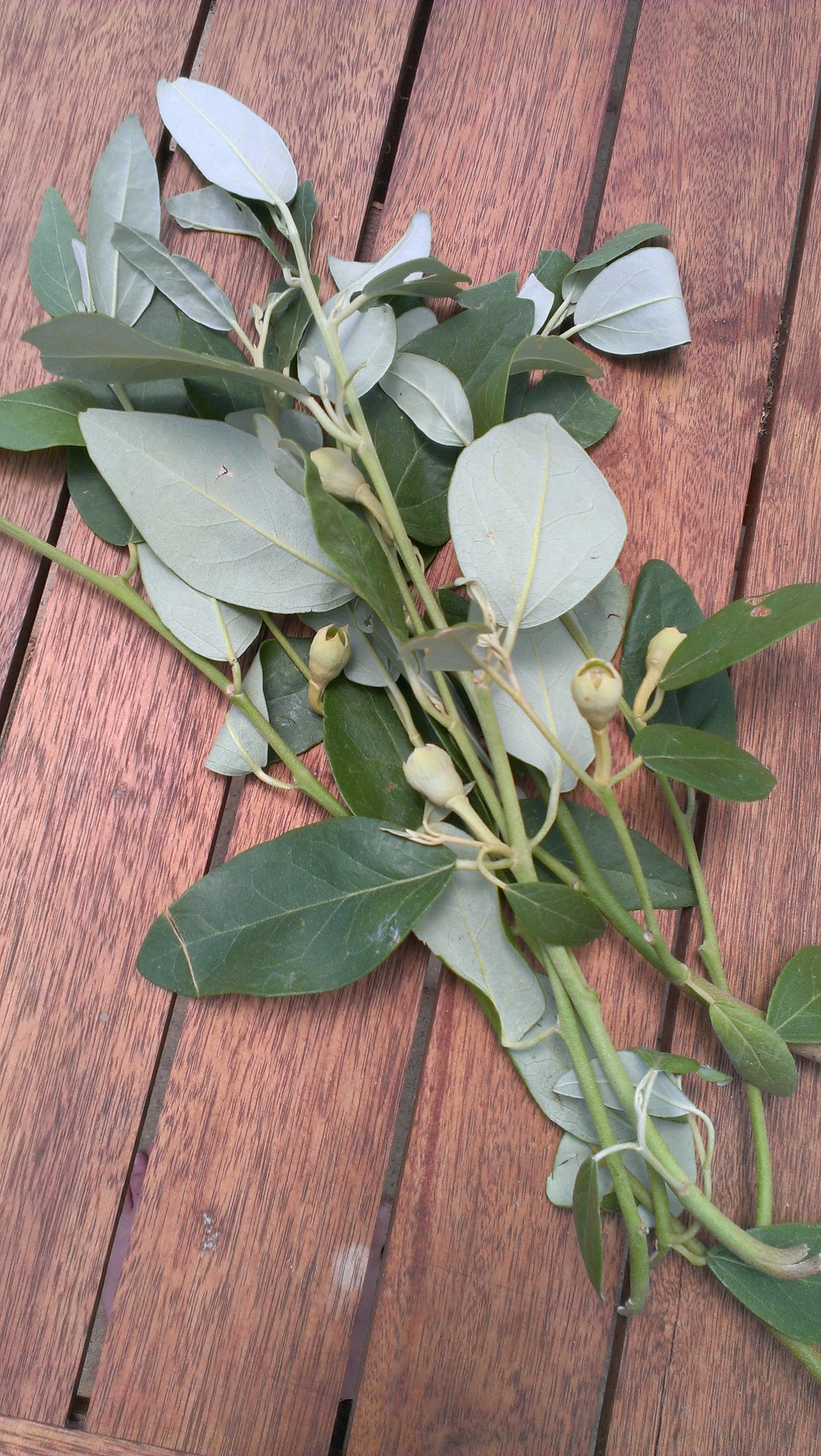
The other day I was at an exercise class in a park.  One if the trees was helpfully labelled Lagunaria patersonia (pyramid tree).  It turns out to be native (to Australia, though not to this part of it).  So… I decided to take a sample and test its dye properties.

1953

I am here to report to you, dear reader, that this is not one of the stellar dye plants of our time.  That smudge on the right of the linen square with the questionable machine embroidery is the best I can show for a leaf print after an hour and with teh presence of iron and soy mordant.  The only fibre on my swatch showing any colour after an hour of simmering is wool + alum, a delicate shade of yellow-green.

IMAG0565

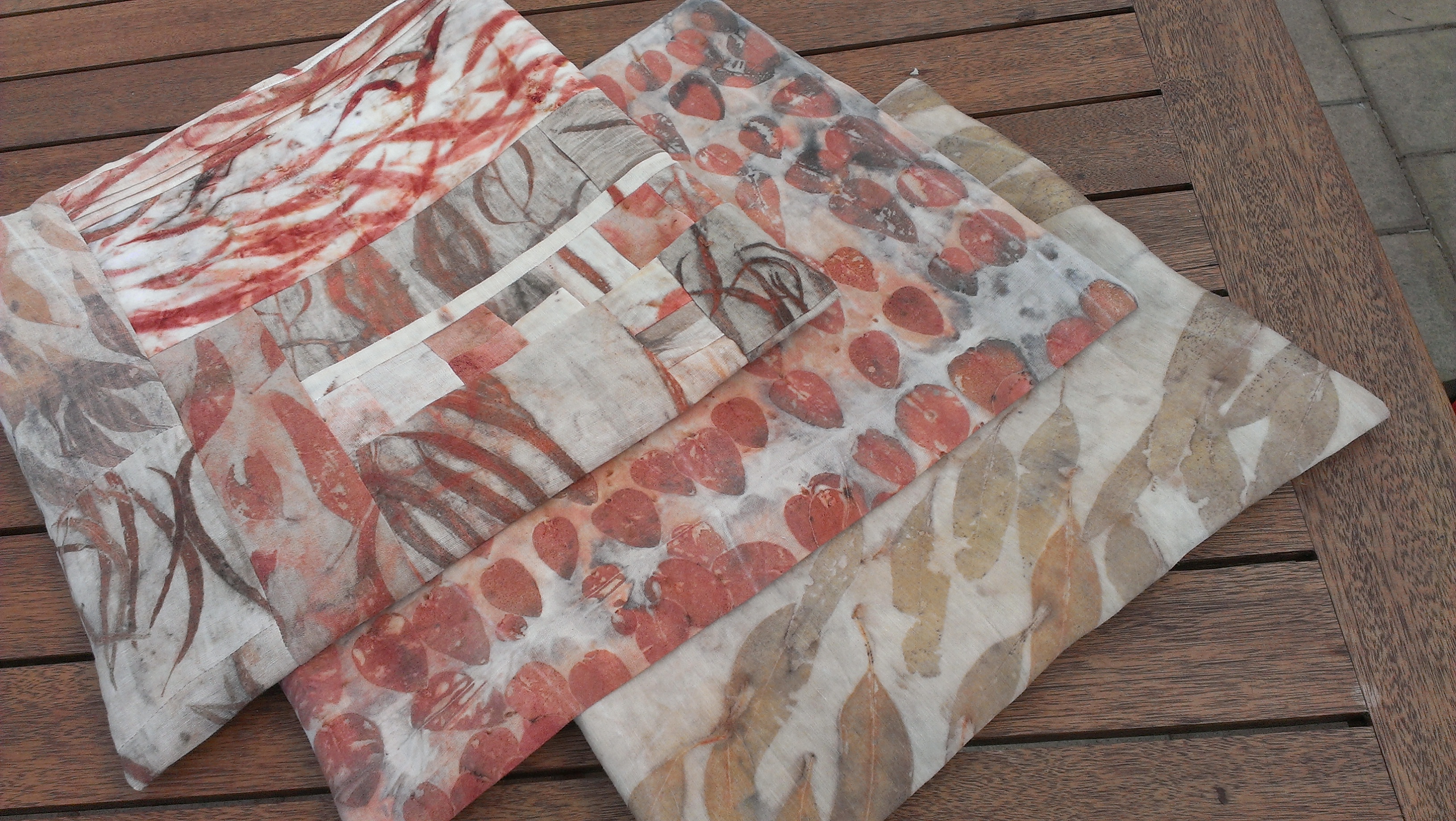
On the other hand, I made these cushion covers from leaf-printed cotton and linen.  They are for friends who invited us to a holiday house they share near Mittagong.  I hope they’ll accept these as thanks for the lovely relaxing time we had with them.

1963

They are custom fit to the cushions on the verandah of their holiday house, whose covers have seen better days.

1962

6 Comments

Filed under Dye Plants, Eucalypts, Leaf prints, Natural dyeing, Sewing, Uncategorized

Oak leaf ‘prints’

Following Rebecca Burgess’ instructions for a fall dye starter from Harvesting Color, I pulled out my rusty nail solution and, given the difficulty of collecting maple leaves nearby, took the opportunity when I was passing a street where oaks had been planted as street trees. 

IMAG0339

I wrapped my bundle and put it in a jar of vinegar and rust nail water on 16 December (that’s it beween the rusty nail jar and the hibiscus dye jar).  Now to see what happens.  I have to say it is a mystery to me why my rusty nails, which were…rusty and orange… have produced a black solution over time in my case.  I have added more vinergar and water to the nails and the black particles have settled out in the bundle jar overnight in this photo.

IMAG0341

After two weeks in the sun, my rusty water looks more rusty (and you can just see my bundle in there):

IMAG0530

And yes, I did get a leaf print, albeit a mostly very blurred one.  The colour is impressive, but I think this is a clear case of time (unusually) not being the dyer’s friend.  Rebecca Burgess suggested 2-3 days and I left this for 10-11 days, which suited me but not the process.  I will be sure to try again and be more obedient in my instruction-following!

IMAG0553

Leave a comment

Filed under Leaf prints, Natural dyeing, Uncategorized

Leaf prints of the week: Eucalyptus Cinerea and pecan leaves

It was another weekend with leaf prints.

Leaf prints 005

Eucalyptus Cinerea, before..

Leaf prints 001

and after:

Leaf prints 021

My test cotton sample, demonstrating that the mordanting I wrote about a little while back should work out just fine for the natural dyeing workshop I’ll be running.

Leaf prints 022

On the weekend I travelled south of the city to celebrate the lives and love of two dear friends.  They had an all-in-one birthday party and anniversary.  I gave them a teapot and teacosy dyed with silky oak leaves (grevillea Robusta) and eucalypt, and they found it suitably funny.

Dyeing 005

As we left, one of them pointed out their now-flourishing, though still relatively small,  pecan tree.  I had seen pecan eco-prints on Lotta Helleberg’s lovely blog.  I asked if I could pluck a few, and then I took them home and wrapped them in a piece of cotton twill that used to be a pair of trousers.  It was ready and waiting, mordanted in soy and ready to go!  Before… (such lovely leaves…)

Leaf prints 002

and, after:

Leaf prints 025

I had also saved this sample of an unidentified eucalypt a friend was growing in his backyard, but sadly it yielded a few brownish smudges.  It’s much prettier in person than as a leaf print.  I think it is Eucalyptus Kruseana (Bookleaf Mallee).

Leaf prints 003      Leaf prints 009

And I spent some time creating textured batts ready for textured yarn spinning… wool with mohair locks, while I tried a new method for washing wool.

Leaf prints 014

Good times!

1 Comment

Filed under Dye Plants, Eucalypts, Fibre preparation, Leaf prints

Pohutukawa leaves

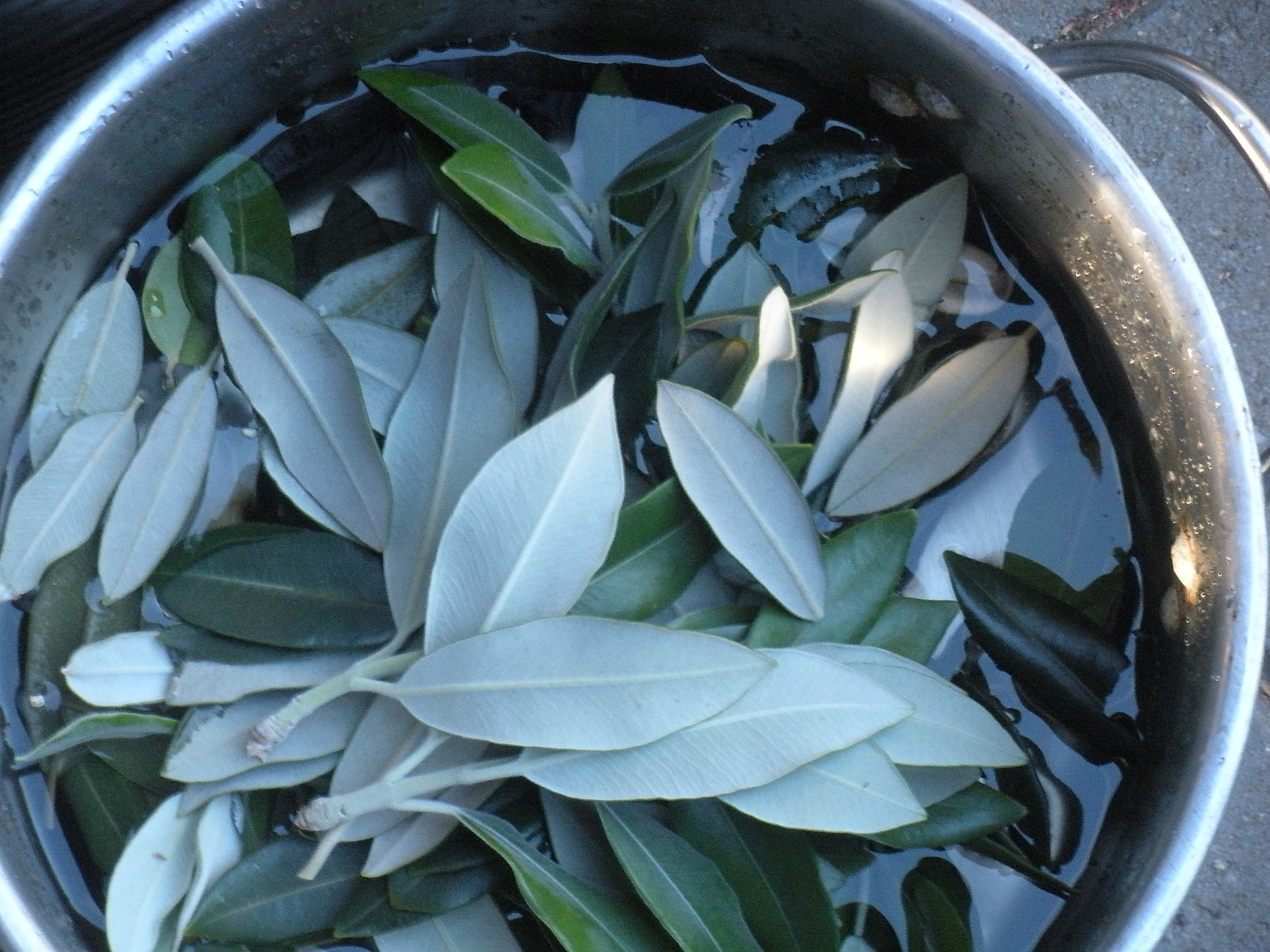
Pohutukawa (Metrosideros Excelsa; known in Australia as New Zealand Christmas Tree) is a native plant from New Zealand, which is grown in Australia as a street tree, particularly in seaside locations.  In New Zealand/Aotearoa I saw it growing right on the beach, gloriously.  It is a hardy and beautiful tree.  I came past dozens of them on Oaklands Road (a main road in the southern suburbs of Adelaide) yesterday and pulled over.  I was immediately approached by some people who were looking for Marion Pool, so I gave some directions while I was there harvesting.

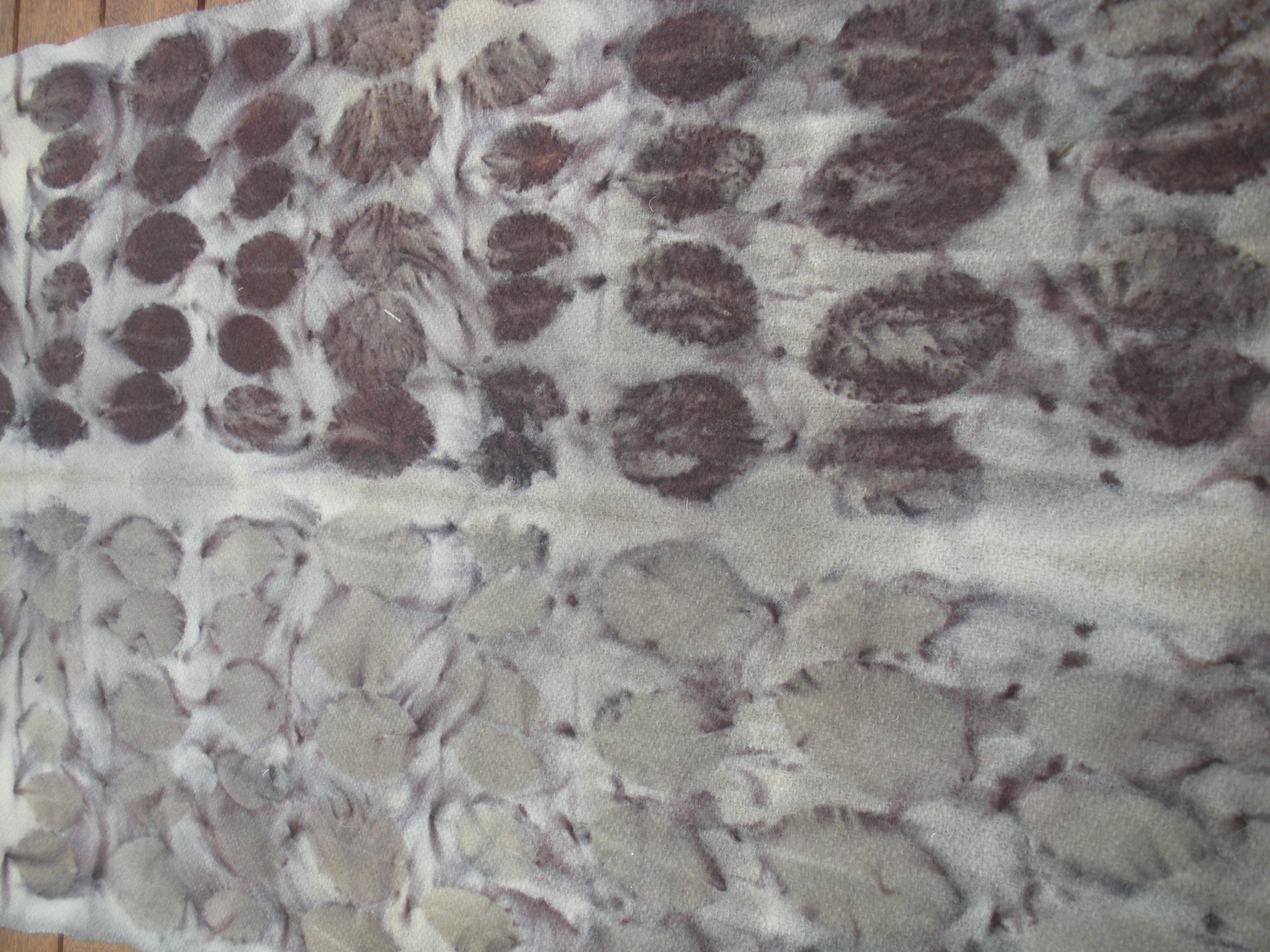
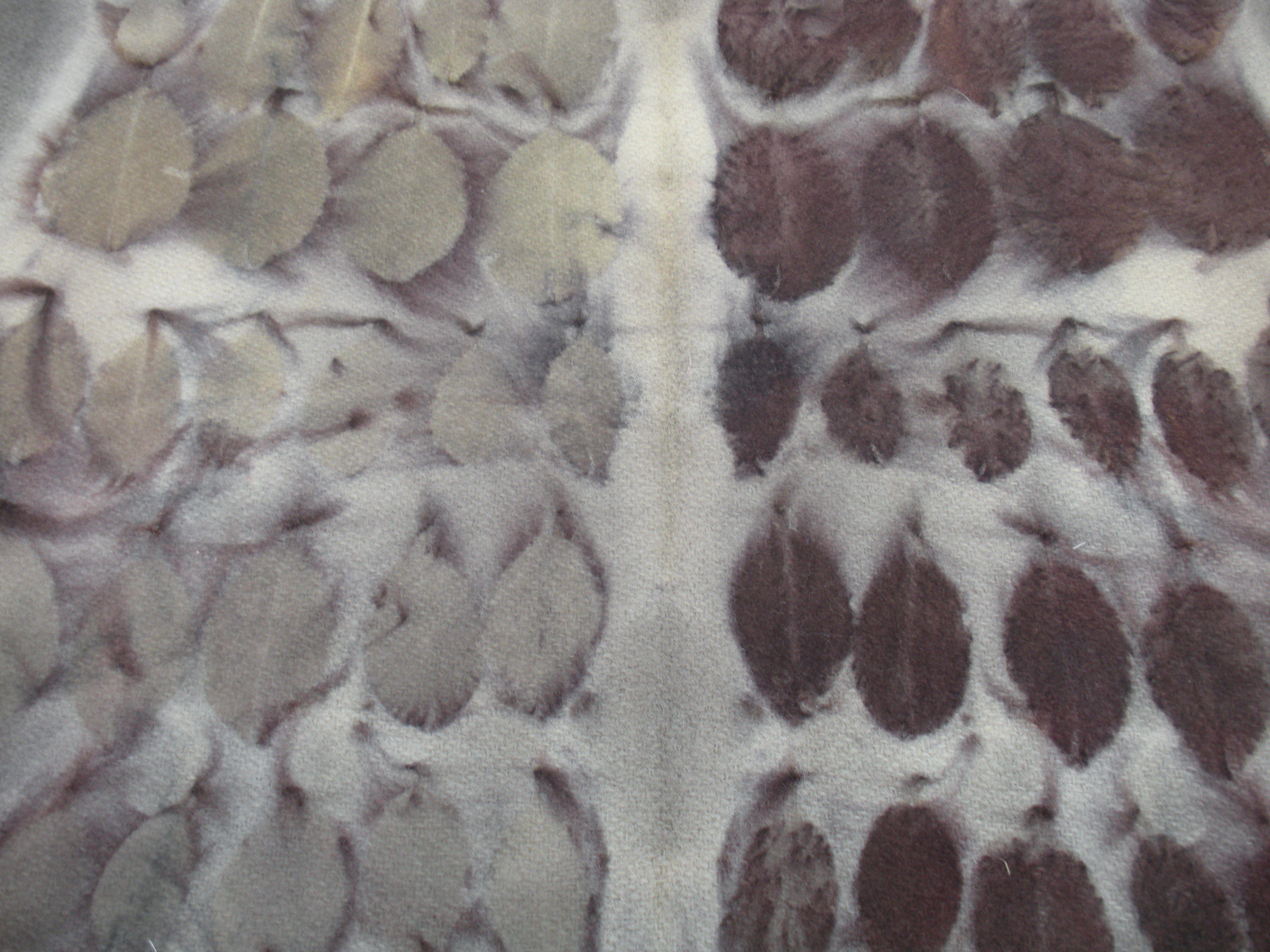
I was keen to try dyeing with the leaves of this tree because I’ve leaf printed with them on wool and found the colour almost purple. These leaf prints are on a strip of cream-coloured woolen blanket.

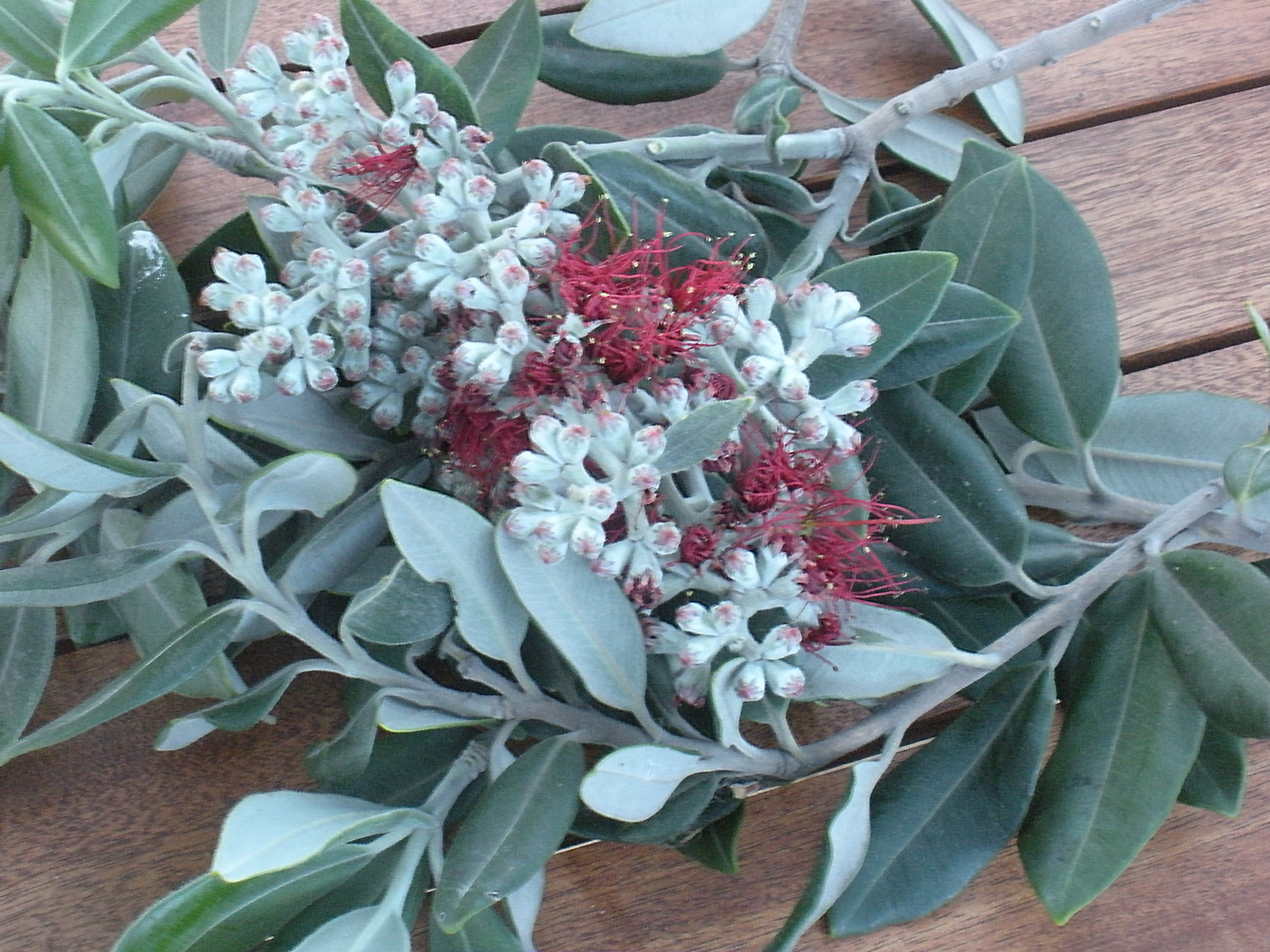
The leaves are green and glossy on one side and almost white and slightly fluffy on the back.  One side printed pale green and the other, deep purply-brown. Or perhaps the purple part is in my imagination. These leaf prints were cooked with a set of eucalyptus prints, so for about 3 hours.  It is possible a shorter time would be better for these leaves, though they are tough too.

Searching the web and Ravelry for clues yesterday though all I found were browns.  Undeterred, I went ahead with two test dyebaths.

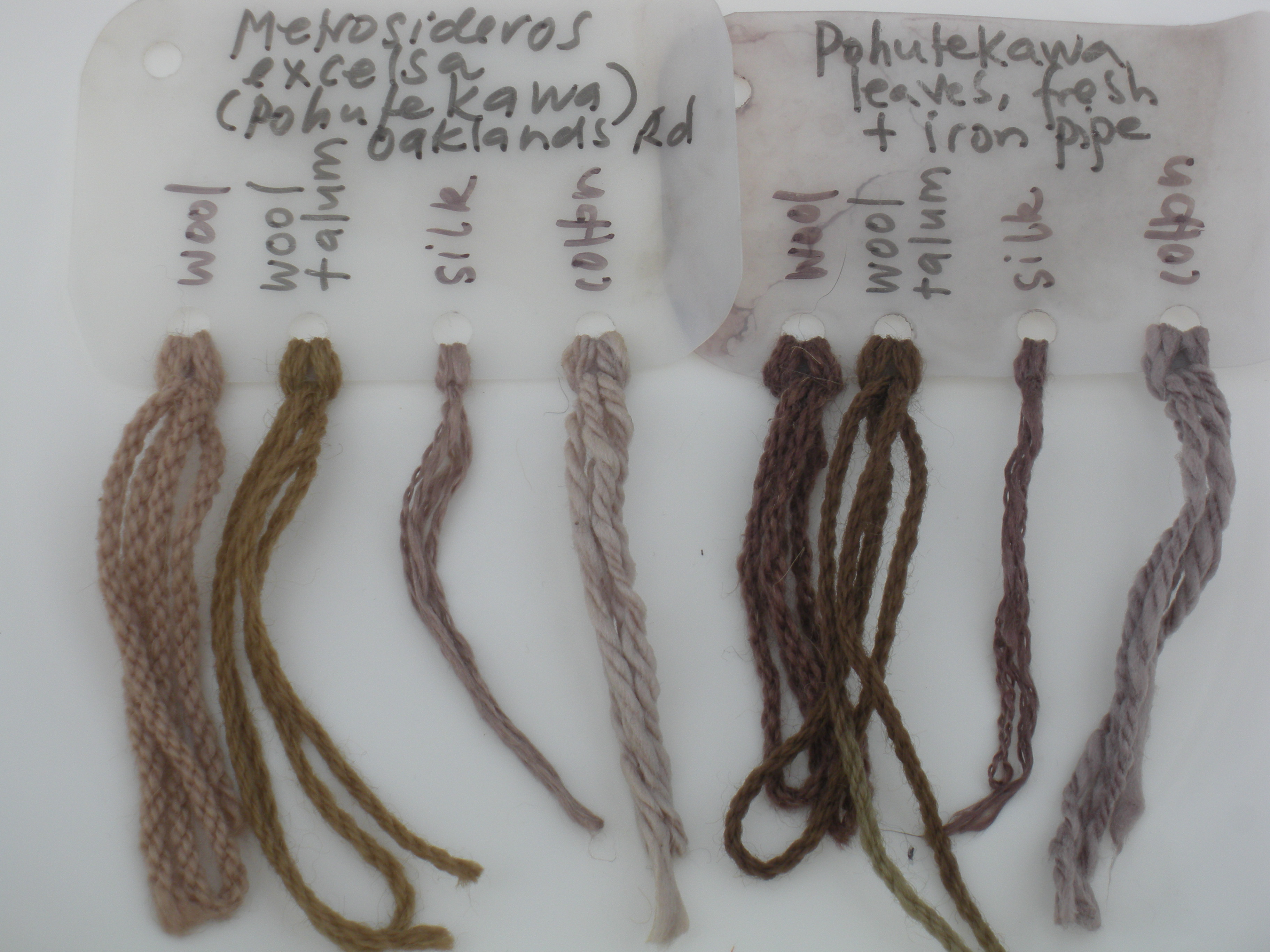
I cooked one with the leaves alone in rainwater and one with leaves, rainwater, and a trusty piece of iron pipe.  I cooked them for an hour at a light simmer and left to cool and sit overnight.  The olive green (or is it khaki) on alumed wool with leaves alone is interesting, but if there are exciting colours to be coaxed from these leaves, clearly I’ll have to try another method. For now, leaf prints are the best result I have achieved.

Leaves alone in rainwater (left) and  leaves, rainwater, and  iron pipe (right) with wool; wool + alum; silk; cotton).

4 Comments

Filed under Dye Plants, Leaf prints, Natural dyeing

Eucalyptus leaf prints of the week

Alongside all these  yarn samples, I made leaf prints.  I sprayed my fabrics in vinegar (as India Flint recommends in her beautiful book Eco-Colour: follow the link on her blog and support her that way if buying online: it is in the left hand sidebar).  Next, I sandwiched the leaves between two layers of fabric, wrapped them tightly around cast iron pipe and cooked them in rainwater for about three hours.

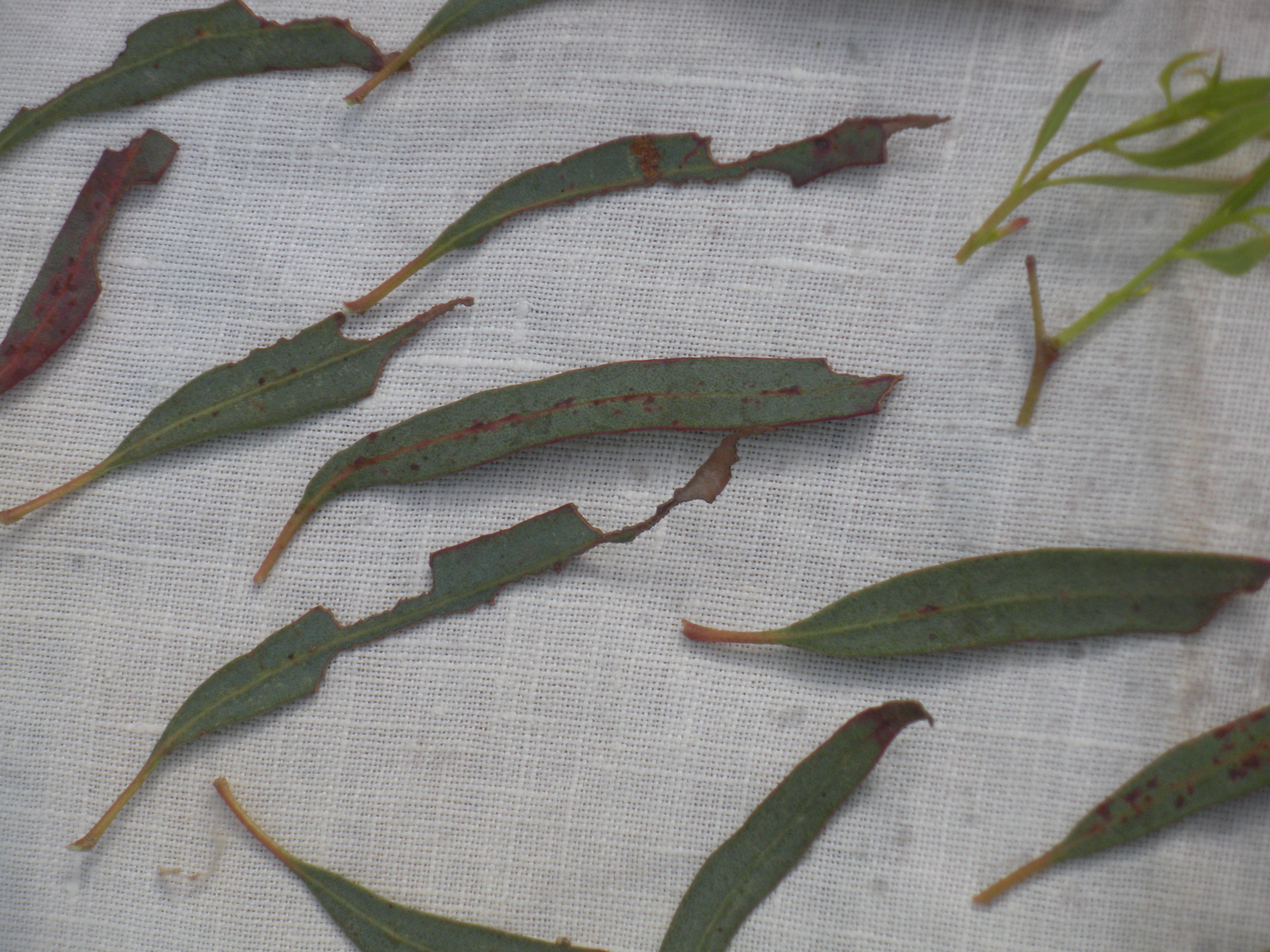
Here is my suspected E Scoparia before cooking: I got a small sample and only what I could reach, and when I got it home, there was a lot of evidence of insect activity!

E Scoparia? Sample

After…

I also set up some E Sideroxylon leaf prints, which as I have now confided in you, were not E Sideroxylon at all!   Some on recycled hemp shorts (I’ve decided that I am allowed to use the fabric of garments I no longer like/want for other purposes), and some on some hemp/silk fabric I ordered online. Here is one piece of what used to be a pair of shorts, before:

I am planning to make a leaf-printed shirt, but I am a bit scared.  I mordanted this fabric months ago.  I have a great pattern.  I did not expect this fabric to have one silk face and one hemp face, and I can’t decide which is the’ right’ side.  So I set up one sample on the silk face and one on the hemp face.  Here are the results.

Silk side:

Hemp side:

So… I think the silk side might be the ‘right’ side.  Feel free to offer alternative opinions!  And I might use a different tree for the shirt prints when I gather my courage.

1 Comment

Filed under Eucalypts, Leaf prints

Eucalyptus Torquata: Leaf Prints and Modifiers

Remember my modifier experiment?  I have two jars of wonder, based on Jenny Dean’s instructions.  One contains offcuts of copper pipe from my Dad, vinegar and water.  It’s been steeping for months.  My first effort at iron water didn’t work out as I’d hoped, more like a science experiment!  This one is based on my friend’s collecton of bent nails.  He has been turning pallets into furniture, so he has removed a lot of nails.  They got left out in the rain and, bless him!  He thought of me.  Here they are, left to right:

Mystery Science Experiment, Rusty Nail Water, Copper Pipe Water.

Here are my E Torquata samples on hand spun wool and commercial wool/hemp blend:
Unmodified at the top, Iron modifier next, Copper modifier at the bottom.  I have to admit, this isn’t a deeply exciting result.

And here are my E Torquata leaf prints on recycled linen (the darker one was the side against the cast iron pipe):
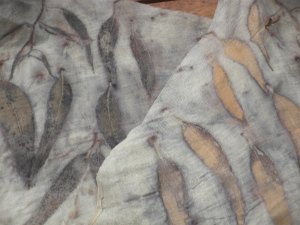
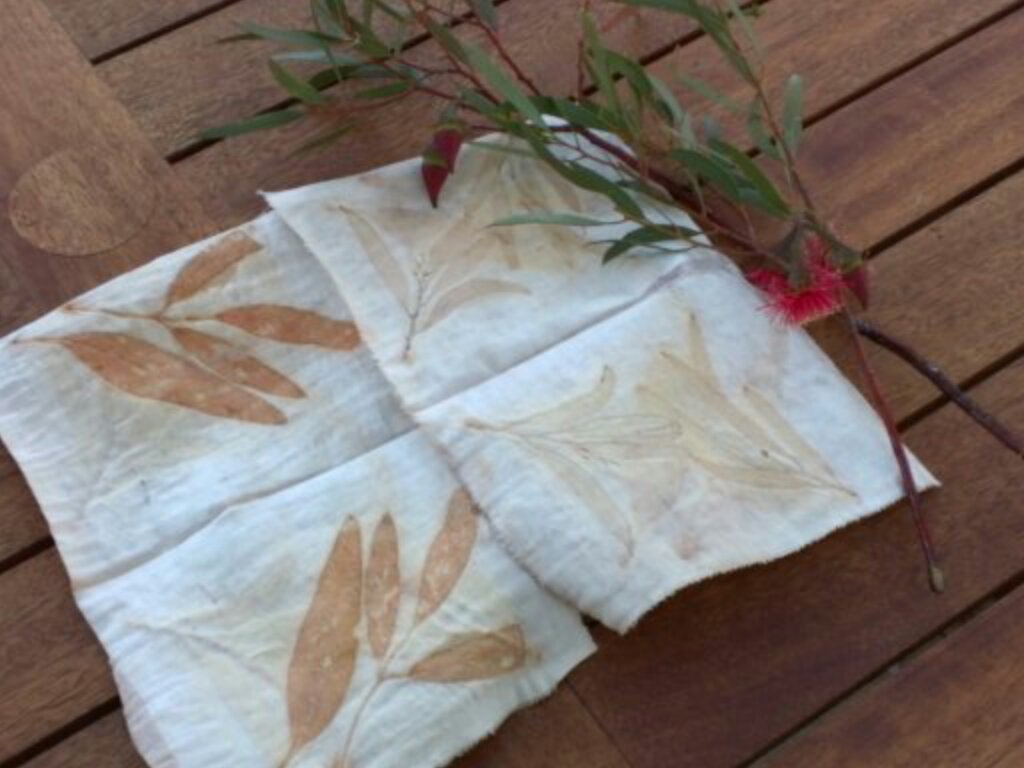
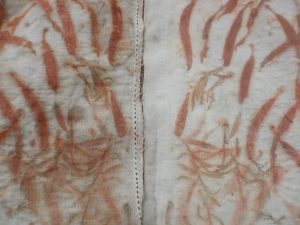
Here are the prints from my ‘is it E Scoparia?’ experiment.  The answer is a tentative ‘yes!’  Recycled linen on the left, recycled silk on the right.  I included the very young, soft, green foliage you can see printed toward the bottom partly because I have been asked whether it is true you need to use young foliage to get good leaf prints.  My experience is that you don’t (though of course, you can).
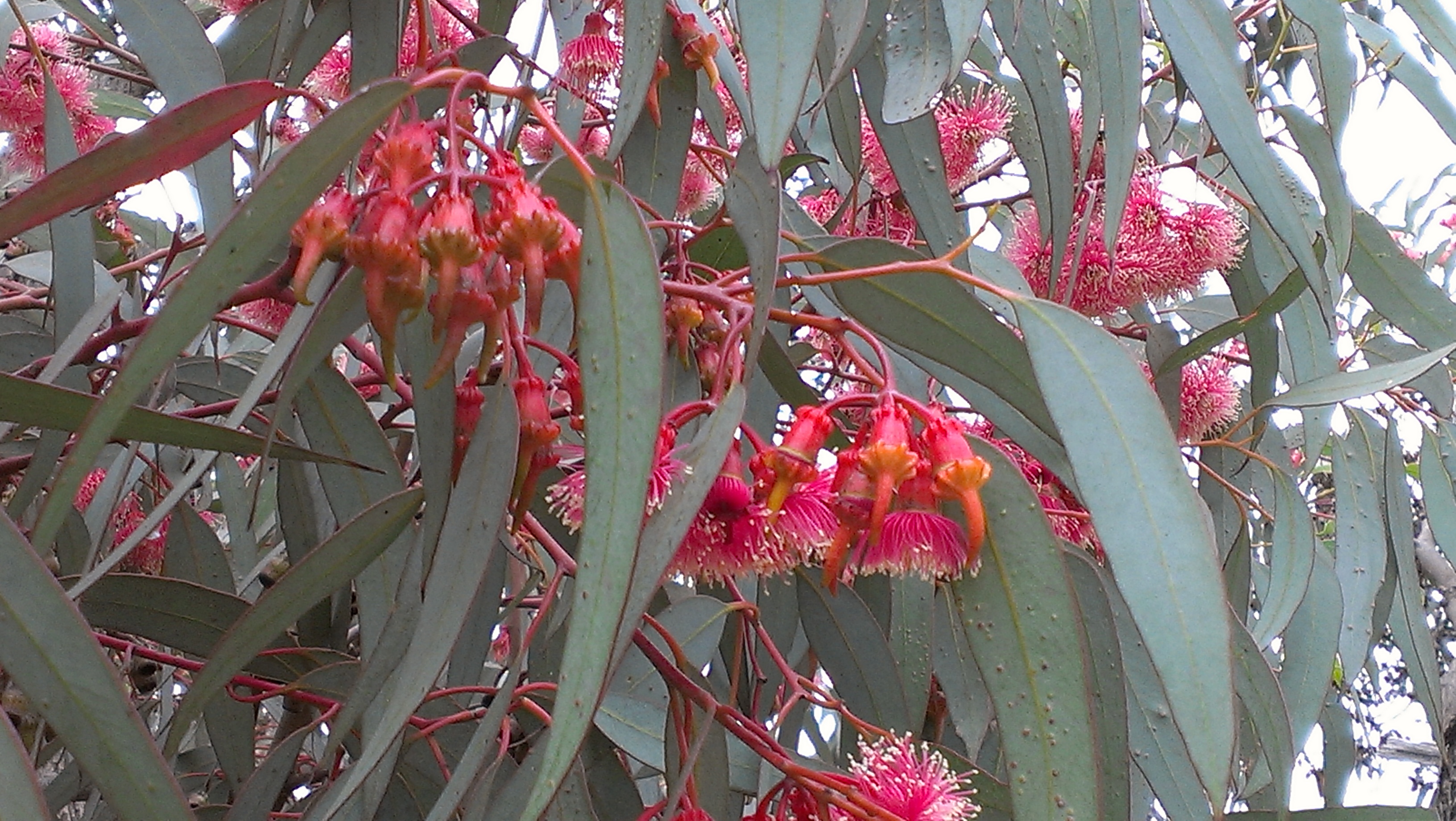
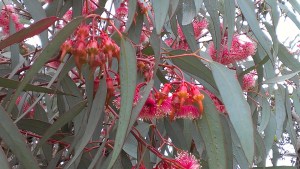
Finally… a gratuitous photo of an E Torquata flowering very pinkly in a car park in my place of work.  One of my co-workers came out of the building to see me with a pile of papers in one hand and my phone in the other, and said: ‘What are you doing, Mary?’  As you would, really.
4 Comments

Filed under Dye Plants, Eucalypts, Leaf prints, Natural dyeing