Category Archives: Natural dyeing

Adventures in woad

2016-03-12 10.44.46

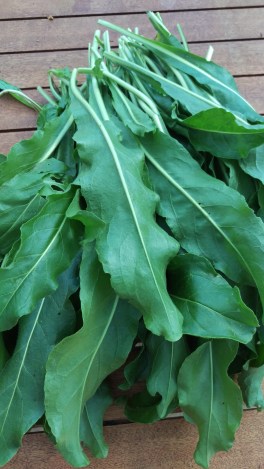
Woad has been one of the success stories in our summer garden.  Until two years ago I had no success at all growing a seedling. This summer, it has really grown and thrived.  So I have decided I can try a few things out.  I started with India Flint’s ice flower method.  She describes using it with with Japanese Indigo on silk here. It seemed logical to me that if it worked with Japanese Indigo, it should work with woad.  But logic requires consideration of all the facts, and I know for sure I don’t understand all the chemistry and plant magic involved.  So who knew what might happen? The last time I tried this, with some Japanese Indigo leaves, nothing obvious happened and I decided I just didn’t have enough leaf matter (and the leaves were tired and sad in any case).
2016-03-13 15.17.21

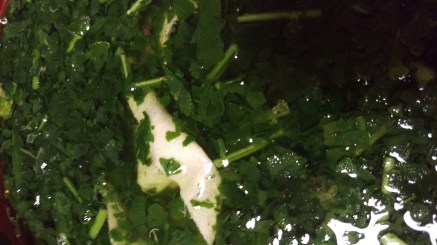
This time I was rich in leaves, though woad is a low-indigo plant. I followed the instructions.  After a night in the freezer, here are my woad leaves in filtered rainwater, with a little pre-loved raw silk and some silk embroidery thread.

2016-03-13 17.04.47

A while later, there were exciting signs of success.  A couple of hours later, the colour was deeper still and the embroidery thread was looking good too. Definitely deep turquoise–tending to green rather than blue, but that would be a happy outcome. I added more thread! That looked good too, so I added some more fabric and went to bed.  The next morning the woad leaves were very green, but the silk was not!

2016-03-14 14.08.18

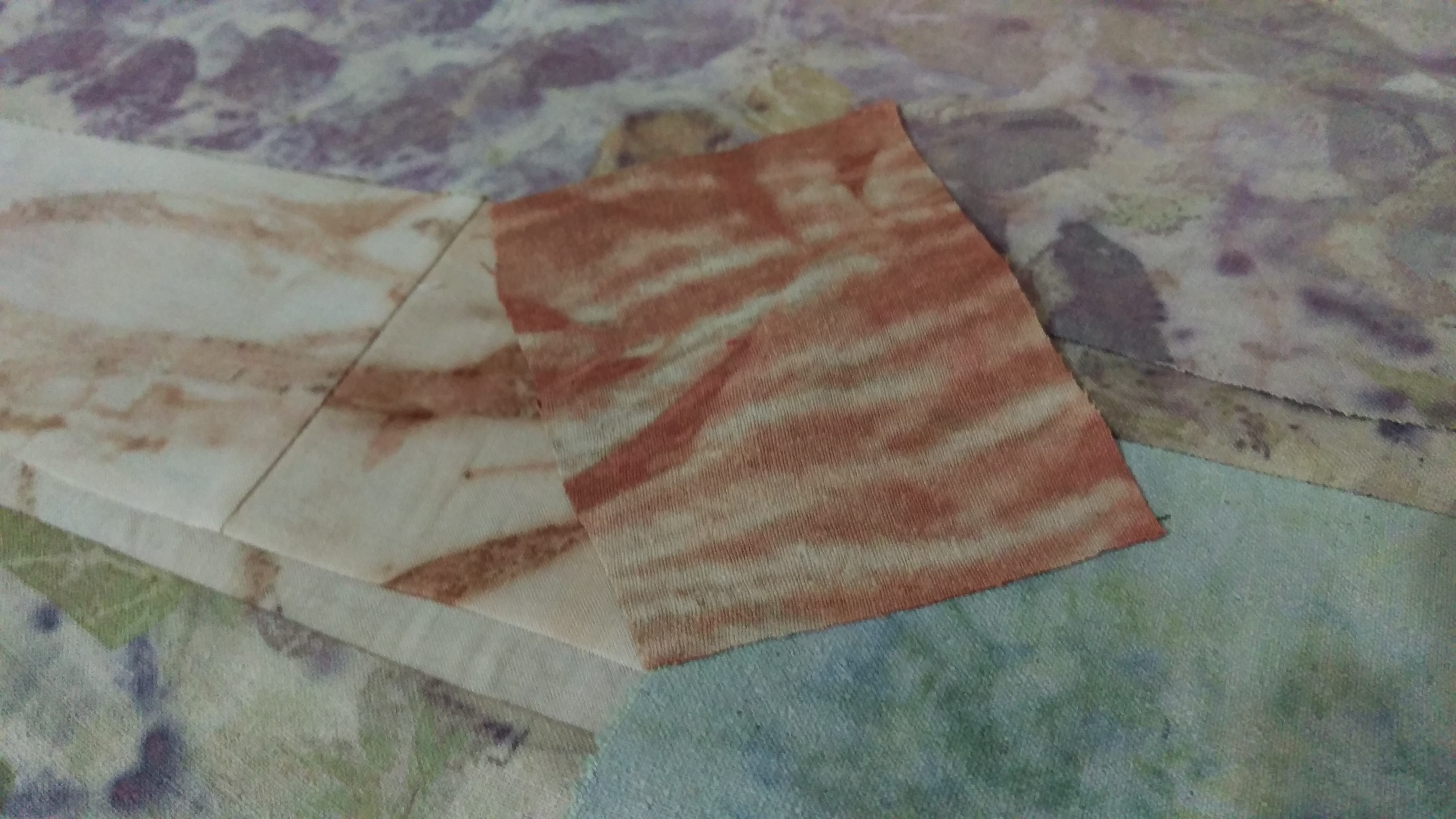
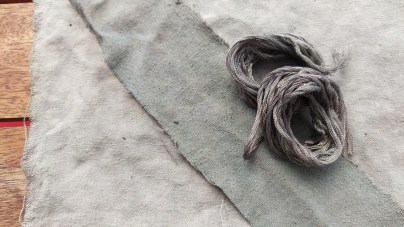
I haven’t had a lot of luck catching the colours exactly, but…. grey is close enough!  The thread is a sheeny steely grey that I have obtained from Austral Indigo in the past by a similar method.  I really enjoyed stitching with it and now I have a new supply.  The smaller fabric that went in first is a darker colour and slightly green-grey.  the larger piece is a rosy-grey, perhaps.
2016-03-14 14.06.43

I forgot to alkanise as India suggests, which would have been a good idea: that might be the issue.  The silk is much worn and washed.  Contaminants?  The woad has had a hard summer? I have chosen a plant in its second year without much indigotin: that is entirely possible.  This method doesn’t suit woad?  I should have pulled the fabric and thread out sooner, when I liked the colour?  Further oversights on my part?  I just don’t know!
 

8 Comments

Filed under Natural dyeing

Just Mend It!
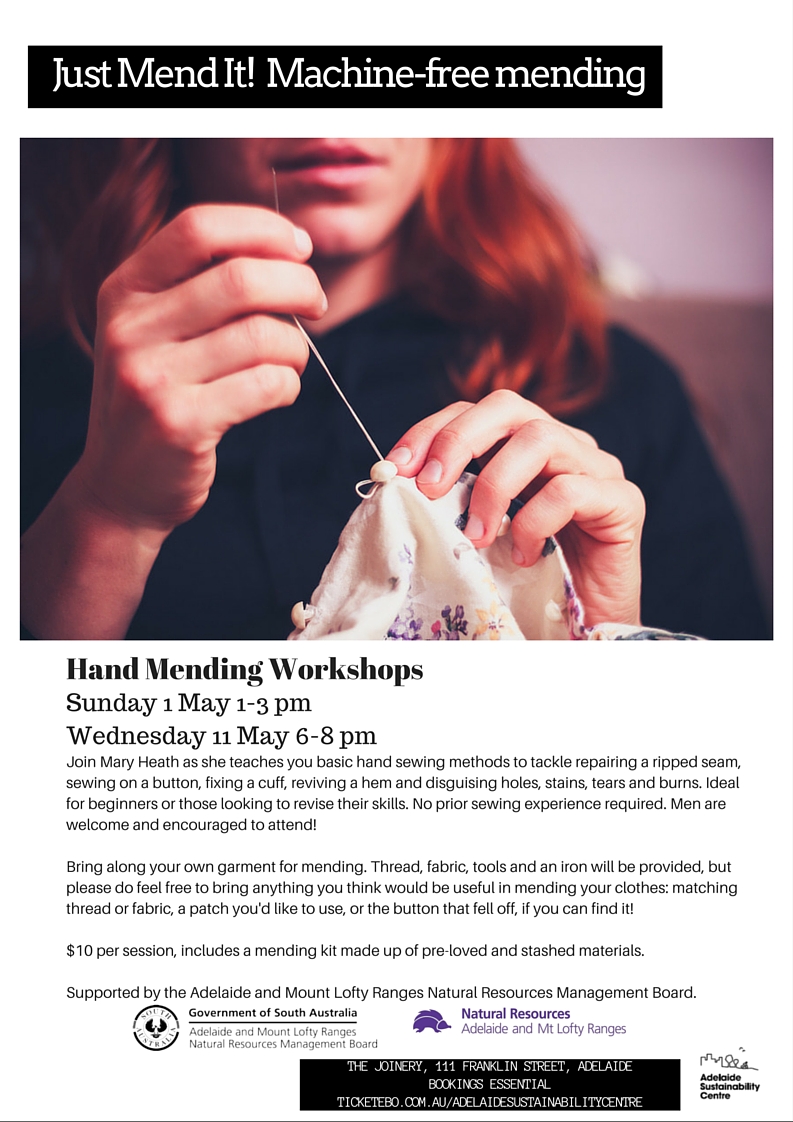
Exciting news!  I will be spreading the joy of mending (and some skills for mending) in two workshops at The Joinery (a lovely, central, public transport accessible venue) coming up in May and organised by the good folk at the Adelaide Sustainability Centre. Should you be local and keen…

Just Mend It - jpeg

So–bring along holey socks, dropped hems, missing buttons, evidence that clothes moths have left their babies to feed in your drawers and whatever else is plaguing your wardrobe and we’ll see what we can do!

2016-04-12 12.41.29

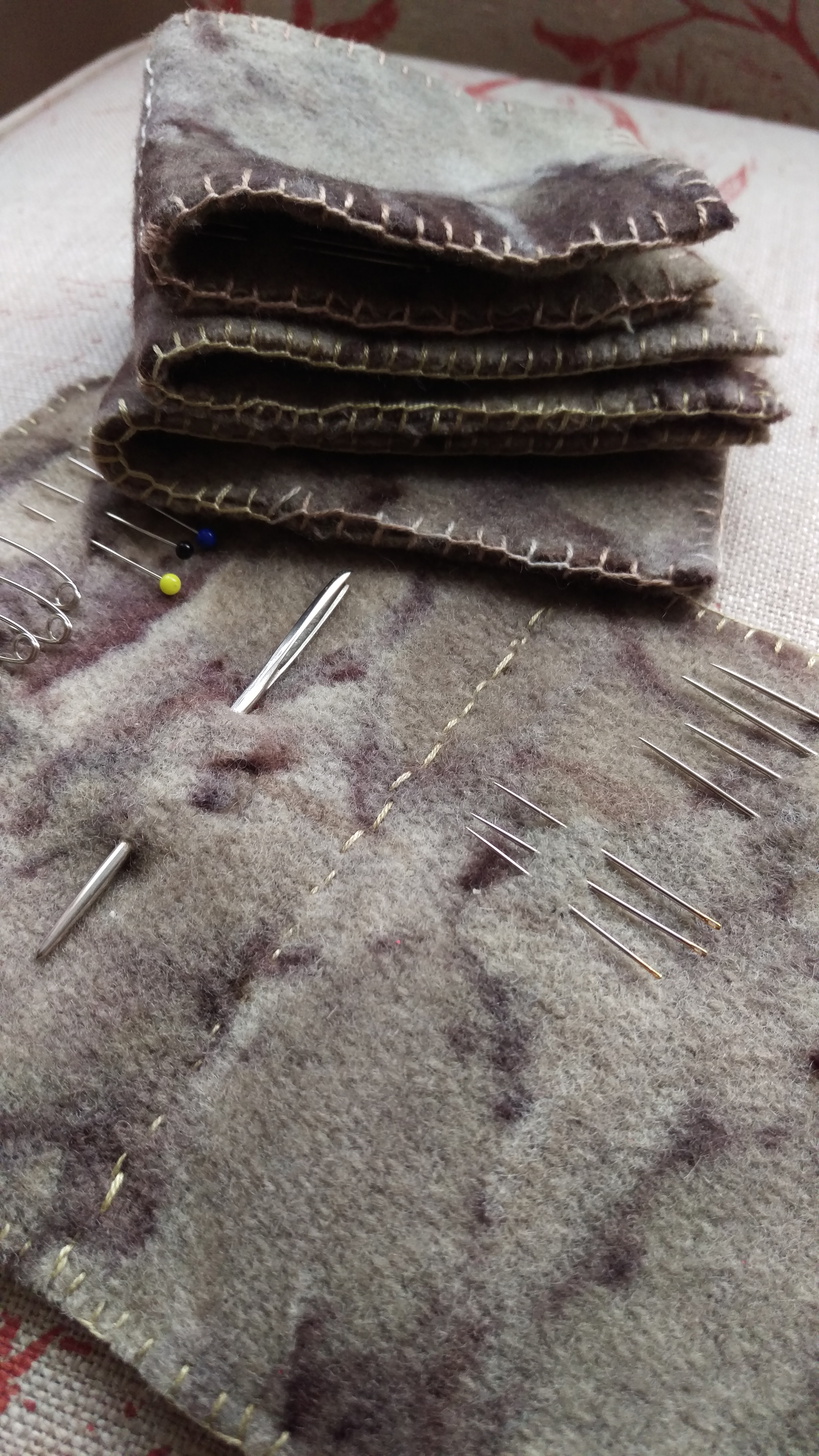
In preparation for the big event, I am constructing mending kits.  No doubt some people who come will be dedicated menders.  Others may not be so well equipped, and these kits are for all comers. I began with a leftover scrap of woolen blanket dyed with pohutukawa leaves. Soon, I had a little pile of hand-stitched needle books complete with pins and needles and suchlike. Meanwhile, the call has gone out for boxes and tins for the kits to go into and tins formerly full of tea or chocolate and all manner of other good things are trickling in.

2016-04-12 12.41.13

Then I started on needle books made from fabric scraps, and since I found some woolen felt of unknown origin rolled up in the cupboard, I tried some with scrap leather and vinyl samples as covers with felt pages within. My grandmother’s pinking shears were pulled out for use rather than wonderment for the first time in ten years, at least!

2016-04-12 12.42.37

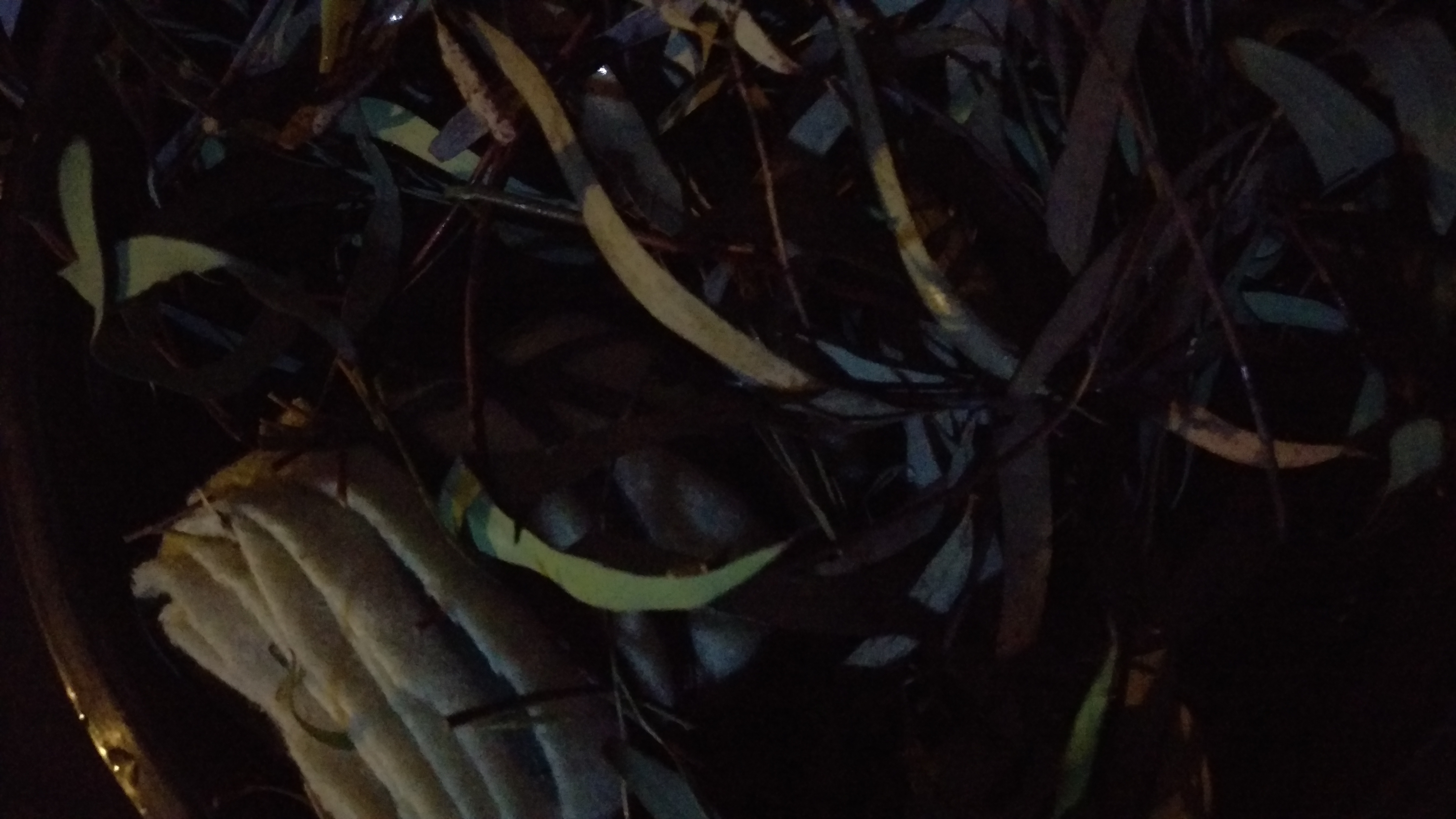
Soon it led to a wish for more woollen blanket and as it happens I have a few blankets acquired at the op shops of Adelaide on a previous occasion.  I walked out to my favourite Eucalyptus Scoparia as the sun went down after work, and set the dye bath to heat by the light of a moon though cloud (this is a picturesque way of saying this photo is dark…)

2016-04-11 18.44.57

Next day, things were looking promising…

2016-04-12 12.25.37

And it may be this is enough to make needle books for everyone I know.

2016-04-12 12.26.02

10 Comments

Filed under Leaf prints, Natural dyeing, Sewing

More adventures in plant dyed embroidery

2016-03-07 17.44.42

I still have some upholstery fabric left from having some chairs re-covered.  It is natural linen, a lovely fabric.  I have been wondering what to do with it.  One day I went to an exhibition of Papunya artists in the City Gallery of Flinders University (on the ground floor of the State Library) and I came home longing to embroider.  I can’t exactly say why.  Perhaps it is partly that some of these glorious paintings are such clear manifestations of the principle that many tiny marks can make a whole that is sheer wonder.  I marvelled at the capacity of these artists to hold entire desert landscapes and the stories of these places in their minds, and from these to create spectacular images which somehow communicate the story and the place. Even if I cannot begin to grasp all that they might have in mind in creating these works, I can still stand in awe.

2016-03-07 17.44.50

I don’t need to be able to create wonder.  I don’t expect to, and I don’t mind.  But stitches are tiny.  Perhaps the immediate thing was simply the invitation to begin.

2016-03-07 17.45.00

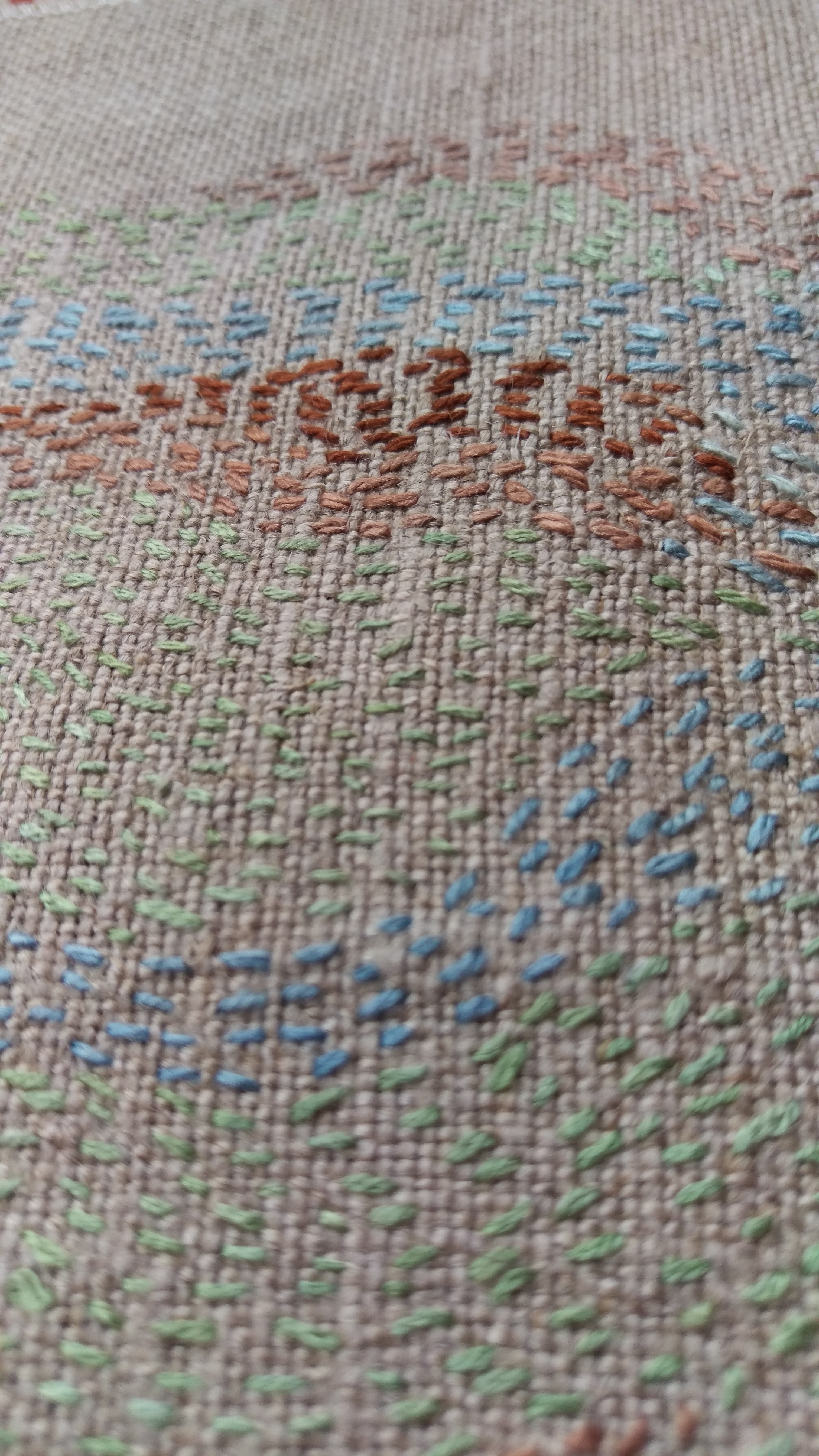
These threads have been dyed with indigo, pansy, hibiscus and eucalyptus.  I love their subtlety and the slight sheen of the silk thread against the matte texture of the linen.  I love the effects of uneven dyeing, as it turns out.  Even dyeing is overrated!  Once I had decided I was done (which is a com0plicated thing in itself, I find), I settled on yet another bag.

2016-03-16 13.21.01

The lining is made of patchworked silk scraps dyed with all kinds of plants.

2016-03-14 19.19.45

And then, just because I can never make just one… I made another with a different piece of upholstery fabric and some scraps of recycled fabric of different weights.

2016-03-16 13.21.30


9 Comments

Filed under Natural dyeing, Sewing

Transformations: Table cloth to top #64

2015-11-23 17.53.36

Once upon a time there was a linen tablecloth.   It was a round table cloth with an overlocked edge, gifted to me by someone who no longer had a round table.

2015-11-23 17.52.20

It went into the dyepot one week, but since the dye pot is only so big, I tore it into strips and dyed it that way, mostly with E Scoparia, but also with cotinus (smokebush) leaves and flowering heads picked when they poked out through a fence near our food co-op.  I really could not believe the purple from the cotinus and I am not sure why it happened.  Needless to say, I will try that again and see if it repeats.  I did also try woad leaves but that was less spectacular.  Pinky but not very leaf printy.

2015-11-30 18.00.59

Some time last year I had a sudden whim to turn it into Merchant and Mills Top #64 and pieced parts together to make that happen, and cut it out.  Then after a while it was rolled up.  Then it was parked for some months.  Just recently I did some cleaning up and thought maybe I should finish some things. I just sewed a seam or two a day in a busy time.

2016-03-01 17.34.31

Since so many readers here were interested in my recent discussion of interfacing, here’s what happened this time.  I cut the neck facing out of a piece of leaf printed calico.  I actually cut it back out of a piece of patchwork, also unfinished.

2016-03-07 22.05.44

The interfacing fabric is a piece of a much loved kimono that has passed beyond the mending interest of my mother-out-law. You can see it layered under the facing here after stitching teh layers together but before finishing the edge.

2016-03-10 10.13.15

I think my mother-out-law is rather enjoying being able to send me her raggedy, beloved things as they get past the point of original use and getting stories of their conversion into all manner of other things.  I stitched the two pieces of fabric together and overlocked (serged) the outer edge.  Here it is pinned on and ready to stitch.

2016-03-10 13.17.32

And finally…

2016-03-14 15.27.03

Here is the back view:

2016-03-14 15.27.40

And some closer views…

2016-03-14 15.27.12

It is rather stiff at present, after its preparatory baths in soy milk mordant.  But that will change with more washing.

2016-03-14 15.27.50

All the little bits and pieces were, needless to say, so interesting to me that I patched them together months before I sewed the garment!

2015-12-13 15.20.52

8 Comments

Filed under Leaf prints, Natural dyeing, Neighbourhood pleasures, Sewing

Transformations: Towel to pot holders

There was just a strip of towel left from my previous effort in towel transformations.  One day I was looking at our very sad pot holders (we call them pot grabbers here!) and it occurred to me that we could have some new ones. Pretty soon I had two layers cobbled together from my towel ends.

2016-02-25 09.44.41

The old ones were made the same way and in the end I washed them and re-covered them. This one obviously had a moment in the flame, and a hard life!

2016-02-25 09.46.40

The first one got a new cover stitched by machine and hand finished with some embroidery thread that was a really good match!

2016-02-25 11.12.23

Done!

2016-02-25 17.58.17

The next one got a new cover with E Cinerea prints. You can see what an improvement it would be…

2016-02-25 18.12.12

Then finally, in a week focused on finishing things… and after my beloved asked if we would ever get them back…. I covered the final pot grabber.

2016-03-14 15.10.54

I know it’s traditional to have a loop or a ring on a pot holder’s corner.  Last time I sewed on curtain rings.  This time I have faced the reality.  We are slatterns who just throw the pot grabbers into the cupboard with the saucepans.  We have no hook for them and clearly we’re not bothered by its absence.  So here they are, done at last!

2016-03-14 15.10.37


8 Comments

Filed under Natural dyeing

An outbreak of hats

2015-09-10 15.29.04

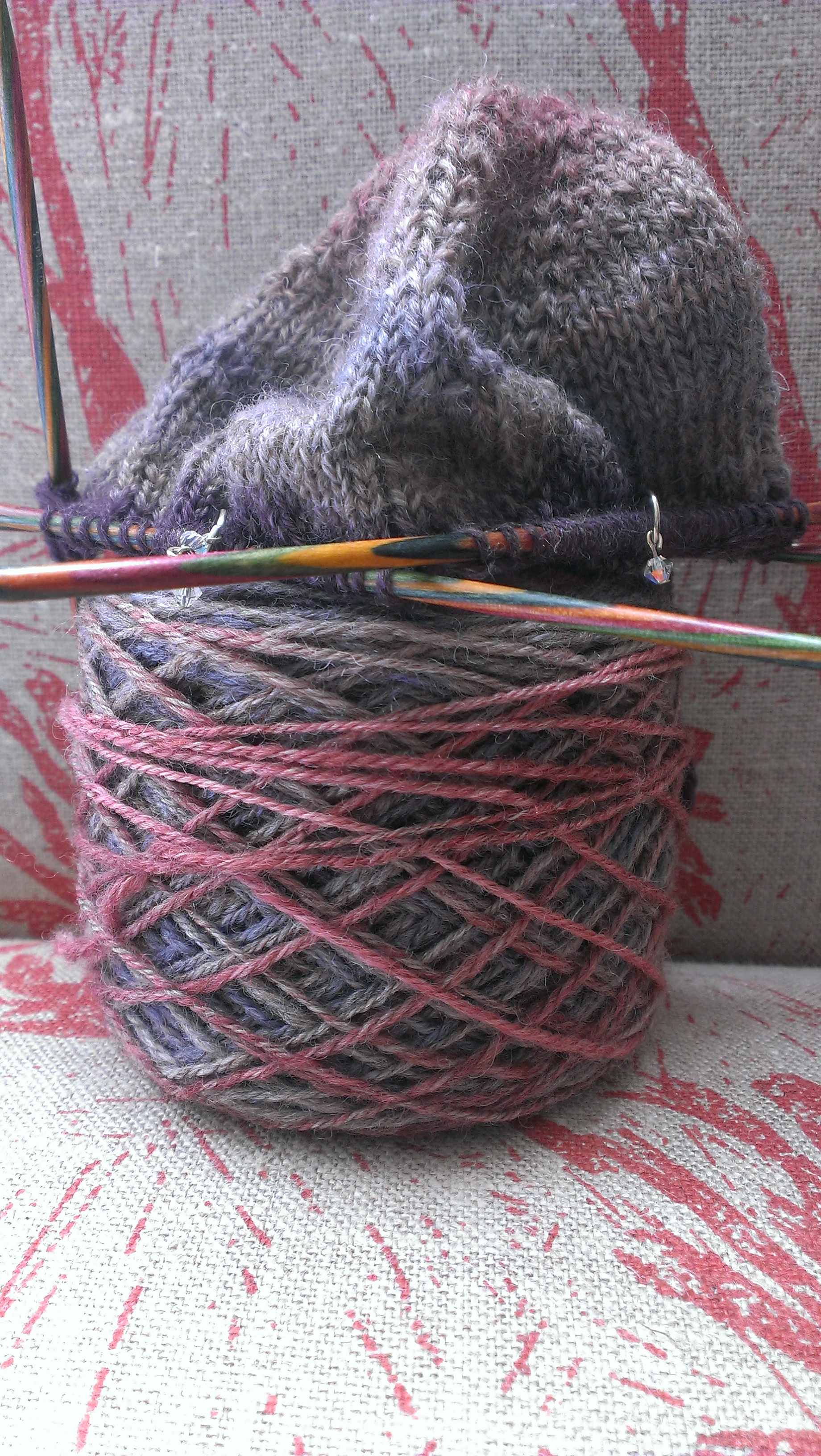
This is an oatmeal Blue Faced Leicester dyed by The Thylacine and spun three ply by me.

2015-09-10 15.29.21

It is rather fine, but I decided to knit a hat anyway and settled on one from Barbara Walker’s Knitting from the top, which is more of a concept plan than a pattern.  Perfect for handspun.  And then it turned out I could use the DPNs a friend surprised me by giving me a while back (I had helped her out with i-cord, and it was sheer pleasure, but I think that may have triggered the gift in some way).  They are a rather unusual size, delectably pretty and perfect for the job.

2015-09-27 14.03.50

While this hat was on the needles, I decided to cast on another in grey corriedale, dyed with eucalyptus and spun three ply and about 10 ply (worsted).  I made a rolled brim hat from Knitting for Peace. Easy and fast.  My picture taking was interrupted by our house guest, who turned out to be camera shy.

2015-09-27 14.04.29

At about this point, there was a hiatus and that first hat sat on the needles until holidays rolled around.  And then, there was an absolute outbreak that continued for some time after we returned from holidays.  There were some with oddments of experimental yarns (some early corespun in this case).

2016-03-07 13.09.15

Here is some handspun natural polwarth with some Noro sock yarn for contrast. Blocking wouldn’t hurt it a bit.

2016-03-07 13.09.50

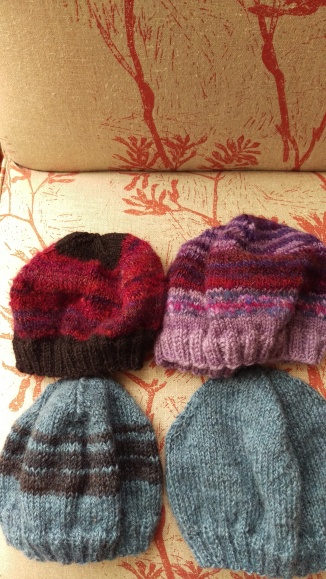
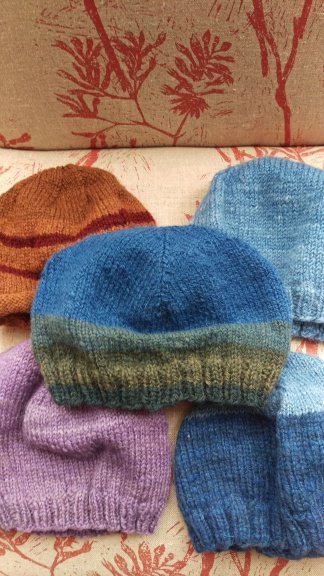
Indigo dyes, logwood exhaust dye, eucalyptus bark dyes…

2016-03-07 13.08.29

Mohair, alpaca blend… you name it!  I even used up random commercial black yarn.

2016-03-07 13.08.51

I made some doll and bear hats. What else are oddments for?

2016-03-07 13.09.33

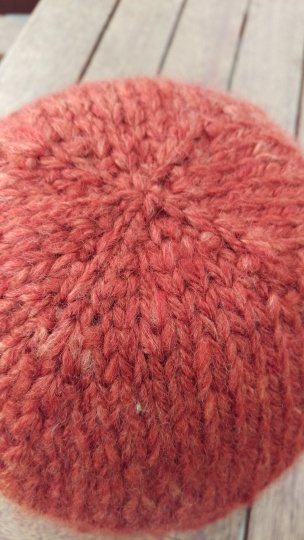
Then came the day I cast on with some super thick, super soft eucalyptus dyed wool of mystery and stopped.  Last night I managed to finish, finally.  I lashed out and blocked this one just to show I can.

2016-03-07 12.46.17

Most of these are Jared Flood’s Turn A Square.  More or less.  That first hat–I did finish it, and it was claimed by a friend while we were on holiday.  I don’t think she would really want her photo on the interwebs, so you’ll just have to trust me about it being finished.  However, half the skein remains so there may yet be a reprise. If I can ever bear to knit another hat!  I am the person doing all these repetitive series of makes, and even I find it hard to understand…

2016-03-07 12.46.07

15 Comments

Filed under Knitting, Natural dyeing

Adventures at Mount George

2016-02-14 16.09.53

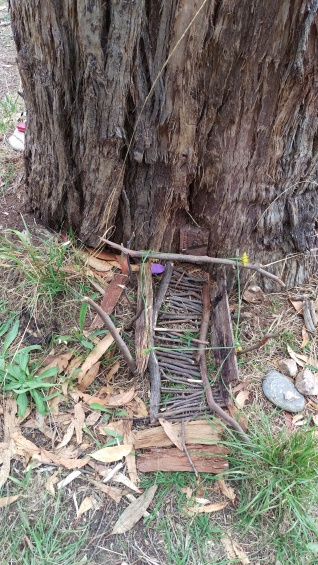
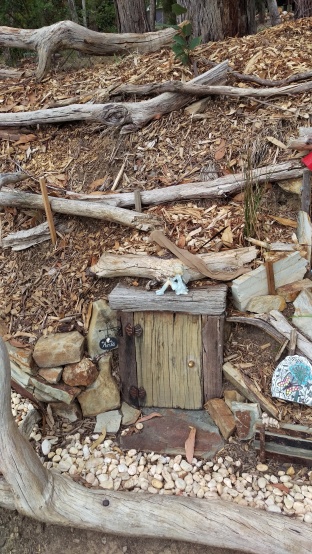
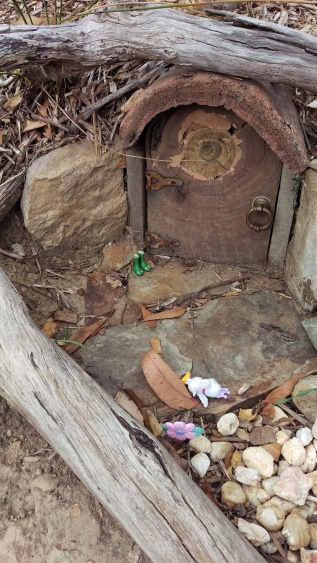
Recently I was invited for a walk and blackberry picking at Mount George with dear friends.  We began by going past the ‘fairy’ homes.

2016-02-14 16.13.33

Clearly some small people have had a lot of fun here.  There were even letters for the fairy folk.

2016-02-14 16.13.45

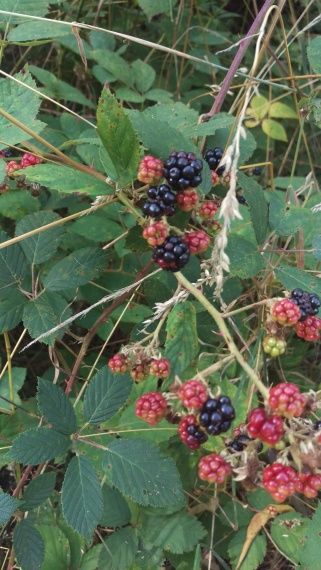
Then we were passing through the creek where the blackberries ramble.  They are an awful pest in Australia, intentionally introduced initially (and still a source of free food) and then spread by every bird and beast, by water and trouser cuff and so on.

2016-02-14 17.05.34

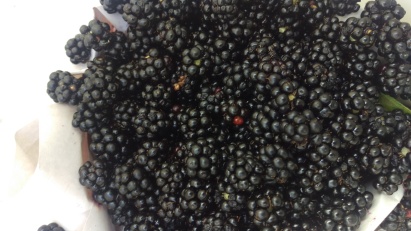
I have many happy childhood memories of searching for free food of various sorts.  Clearly my parents had special talents in this area!  We picked many blackberries along the banks of the Yarra when we lived in outer Melbourne and there was a suburban block sized bramble at the end of our street, where Melbourne then ended.  And since then, in so many national parks and otherwise beautiful spots.  They are delicious but horribly invasive.

2016-02-14 17.05.23

Then, off up the mount to a favourite picnic spot of my friends’ in a rock formation.  I found evidence of other spinners at work.

2016-02-14 17.15.49

Right at the top, some austral indigo (indigofera australis) which I did not realise was native to our state.  And a spectacular picnic!

2016-02-14 17.27.51

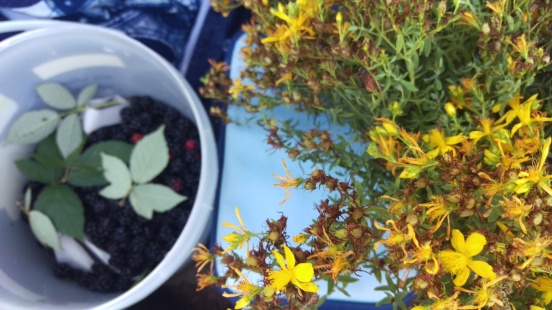
Then on the way back, a stand of St John’s wort.  I picked a big bunch, and probably should have done the bush a favour and taken it all.

2016-02-14 18.53.41

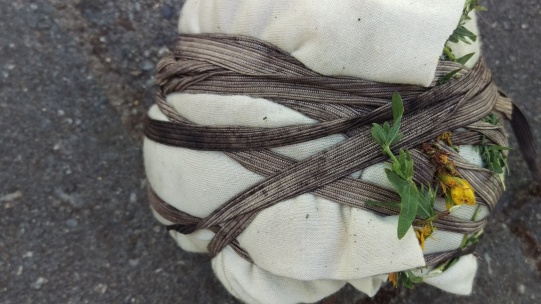
It was a week of time poverty, so after some days in the fridge, I decided it was now or never and bundled up my St John’s wort, wrapping some thread in with the fabric for later use.

2016-02-17 15.08.39

On a whim, I put dried prunus leaves in the bath, and then began some days of cycling between slow cooking and wrapping in my trusty dog blanket in time with my schedule of many other things to do.  I am delighted to say that I think I really learned something from India about dyeing with this kind of plant, at Mansfield.  Where once I was experiencing an awful lot of mystery, now I’m able to apply a little knowledge and judgment–even if cramped a bit by other commitments.  With understanding, I find I can often manage those to my advantage.

2016-02-21 11.00.55

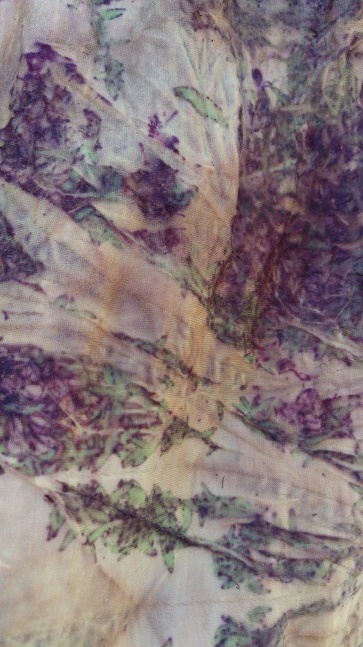
When I finally unbundled, there was some lovely purple and green.  The prunus bath was less exciting and quite brown (not a bad effect, but not purple either).  I decided to replenish the leaves and go again with some alum mordanted wool and see what happened.

2016-02-21 11.03.11

My hurried bundle has left a landscape of wrinkles and plant prints on some parts of the fabric.  I think I can have some fun times sewing this into something snug for winter…

13 Comments

Filed under Dye Plants, Leaf prints, Natural dyeing

Quebracho and Dyer’s Chamomile

2016-01-31 20.00.02

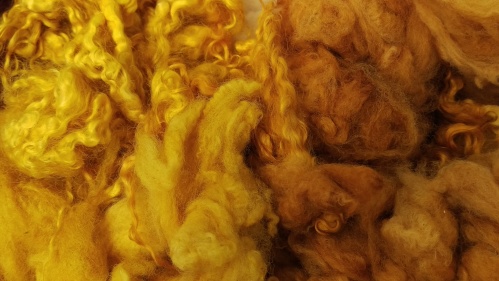
I am on a project to create my own sock yarns this year using natural fibres.  As part of the dyeing–because I like wildly coloured socks!  I decide to dye some mohair and suffolk fleece.  I have some dyes that were gifted to–or abandoned in–the dye room at the Guild.  This time I chose Quebracho–which was not mentioned in any of my dye books but I assumed would require an alum mordant.  I organised that, and found to my surprise that the preparation of quebracho I had completely dissolved.  It’s a tree-based dye so I had rather imagined it was finely ground wood.  Wrong.  Interesting!  Then, a second surprise.  I thought it would be red, but actually, quebracho comes in a range of colours and I had quebracho yellow.

2016-01-31 18.34.32

Which was a shame, really, as my second dye pot was dyer’s chamomile.  Never mind.  Yellow fibres can be readily blended and overdyed and needless to say I have some fibre dyed with eucalyptus destined to join this blend which might blend beautifully…..

2016-01-31 20.05.13

The first dye bath from each came out rather splendidly and intensely yellow (quebracho on the right), and I was reminded that dyers’ chamomile always smells edible.  Also, that it might be the right time of year to harvest this plant again (I took secateurs to the dead flowers of a patch growing in a city park last year).  I love the smell of eucalyptus, but edible isn’t the thought that comes to mind!

2016-02-17 15.13.19

I ran exhaust baths with some of Viola’s (crossbred) fleece.  It had been in a cold alum mordant bucket for some months.  Perfect!  Ready to go at just the right moment! Another win for slow dyeing processes… and one step closer to an all natural sock yarn.

2016-02-17 15.13.23

12 Comments

Filed under Dye Plants, Natural dyeing

Cotton socks

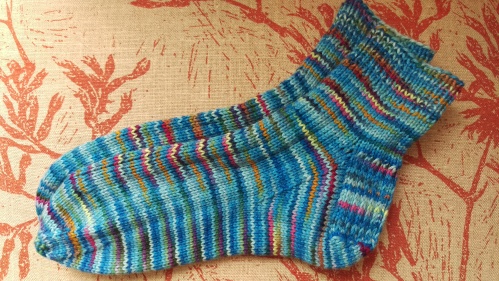
My mother can’t do wool socks.  It took her a while to explain this to me. Partly because the first pair I knit her were made from crochet cotton (because I was ignorant and it was cheap and pretty).  Those socks may have violated some key principles of received sock knitting wisdom, but eventually she told me that they were her favourites, that she likes that they are short, and that she loves to wear them when she gardens.  The more complicated ones I knit from fabulous sock yarns made mostly of wool, she can neither wear nor bear to part with.  But I am glad she finally told me so I didn’t have to foist this curious arrangement on her with yet more unwearable pairs!2015-12-26 11.50.56

Quite some time ago I was wondering what might work for her and looking for a wool free sock yarn I had managed to find in the shop on some previous visit.  There was no more wool free sock yarn to be had that day in that place.  However, I came across this Misti alpaca, cotton and silk blend.  I cast on with enthusiasm, and then they sat languishing for months due to concern that I might not have enough yarn to finish them.  It is hard to say what it could be about a long period in the naughty corner that might cause more yarn to magically appear in the knitting bag, but apparently hope springs eternal!

2015-12-26 11.50.46

These socks came on holiday part finished, and they were completed in double quick time.  They have been handed over and now I’ve even had a cheery text from Mum which shows them on her feet.  She says they fit, and more importantly, that they are comfy!  I am sure  a moment after she took that snap, she whipped them off her too-hot feet and set them aside to wait for winter…

2016-01-15 17.05.07

8 Comments

Filed under Knitting, Natural dyeing

Experiments with E Cinerea

2016-01-24 16.25.58

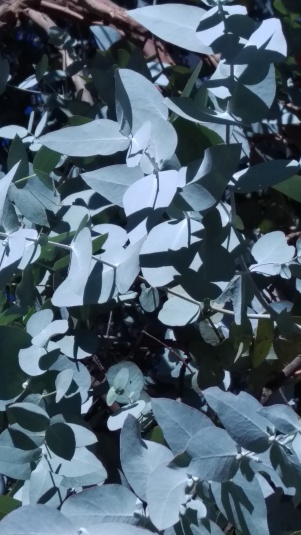
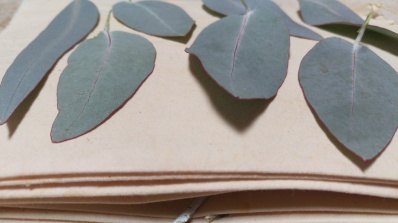
It all began with a trip to the Adelaide Hills to visit a friend who had just moved into a new house one weekend.  On the way, I saw a massive E Cinerea with a huge variety of leaf types and sizes.  On the way back, we made a brief stop to harvest a few of the leaves overhanging a car park.

2016-01-24 16.26.17

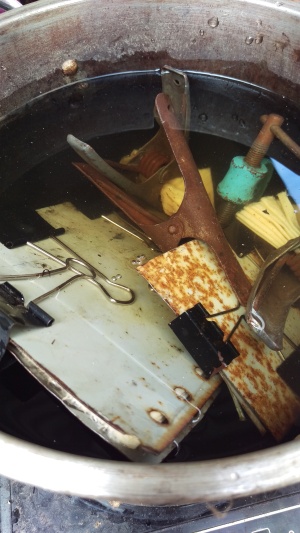
That evening, we went to my parents’ for dinner, and I asked my father if he had any metal disks.  He helpfully offered quite a range of recycled washers and then asked a lot of questions.  I underestimated his interest in understanding what I’m doing and how he could help me out!  This led him to suggest bottle tops (up there for thinking!  Why didn’t I have that thought? Surely I have heard this idea before…).  He also offered me clamps.  He really felt that bulldog clips (my suggestion) might not be strong enough.  He had a collection of tired old clamps he didn’t want, so I chose some and headed home with all kinds of ideas.

2016-01-26 13.24.58

There was ironing and folding and general faffing, until I crammed all I could into the pot.  The pot, it must be said, is not designed for G clamps in large sizes and numbers.

2016-01-26 13.50.18

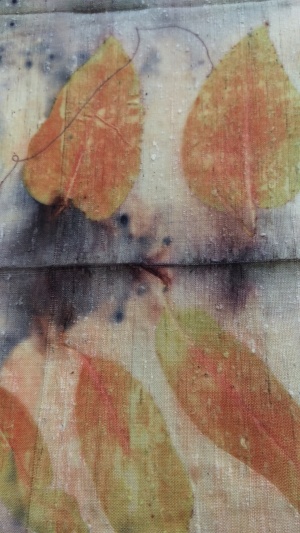
I like the results a lot, though when you try any approach new to you, there is always a lot to experiment with. Perhaps the bulldog clips would actually be better?

2016-01-28 19.50.05

In this piece the holes in the piece of metal I used have allowed the dye bath in to create dots…

2016-01-28 19.49.54

I tried some silk…

2016-01-28 19.51.13

And I love these strips, inspired by Jude Hill’s indigo moons. Only different.  I found myself wondering what shape I would really like to create, and answering with the thought that the shape of a leaf is very difficult to improve upon.  I love leaves so much.  The second round hit the dye bath in double quick time!

2016-01-28 19.51.37


22 Comments

Filed under Dye Plants, Leaf prints, Natural dyeing