Category Archives: Natural dyeing

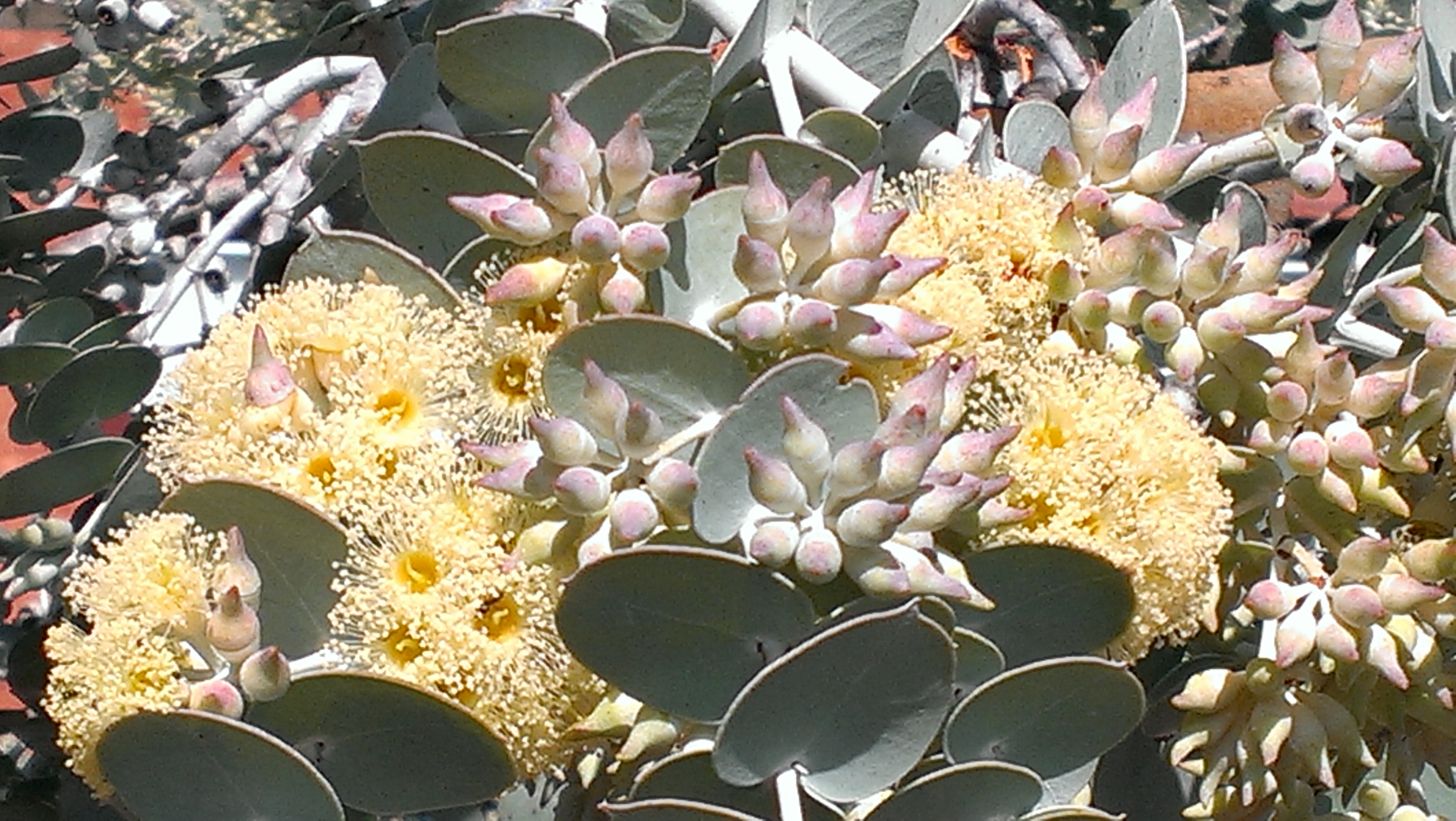
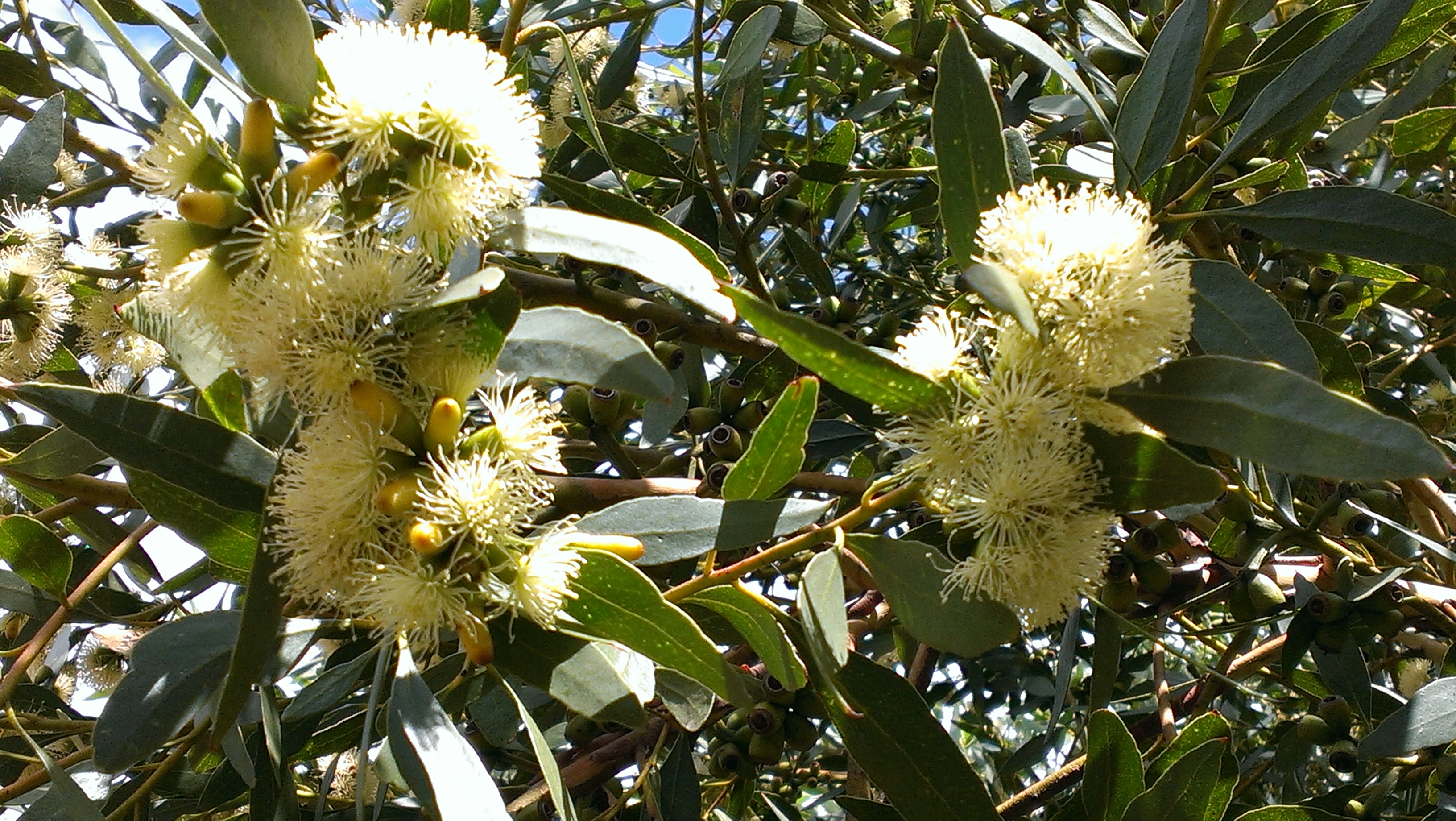
Eucalyptus Leptophylla; Eucalyptus Gillii

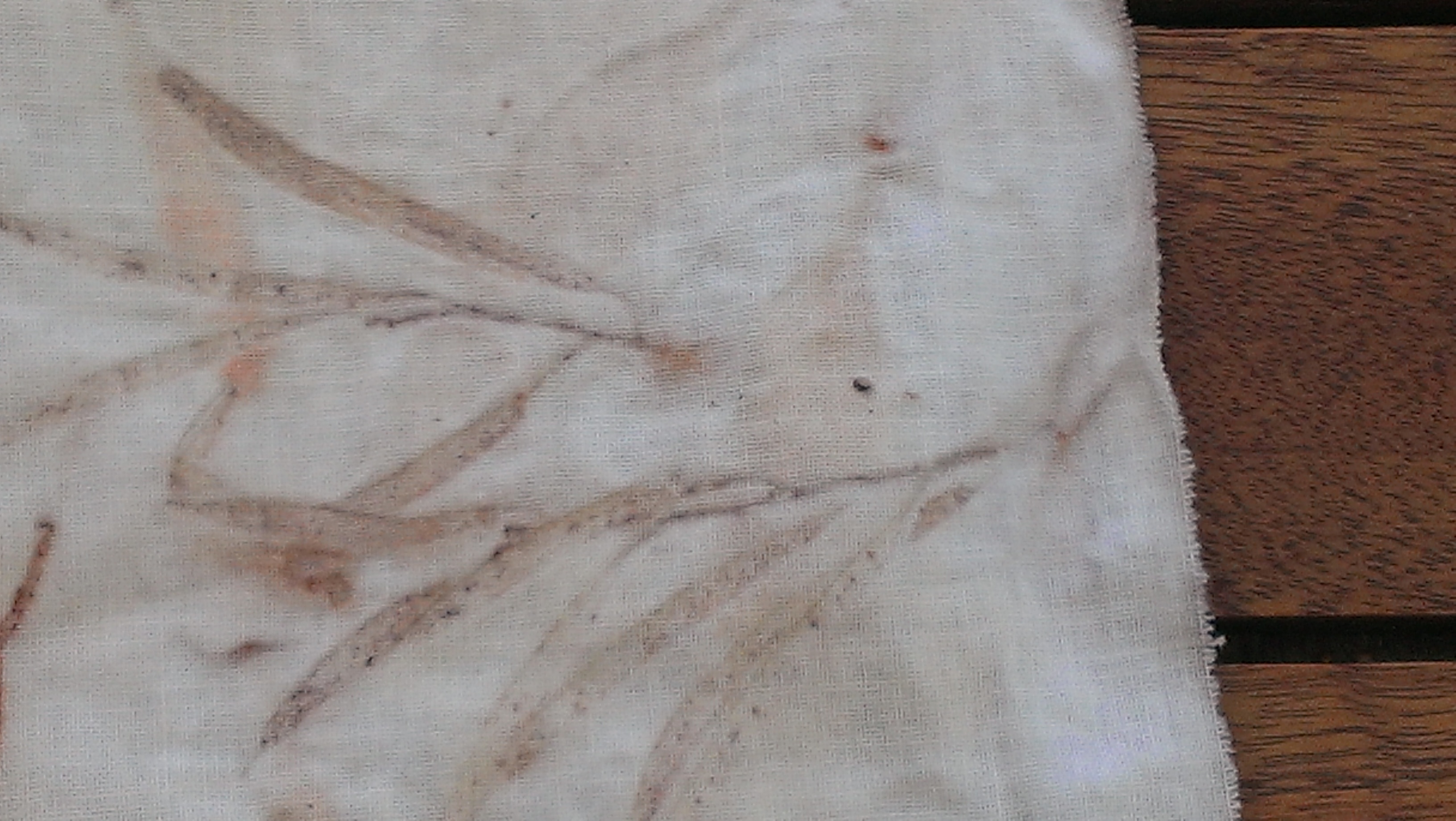
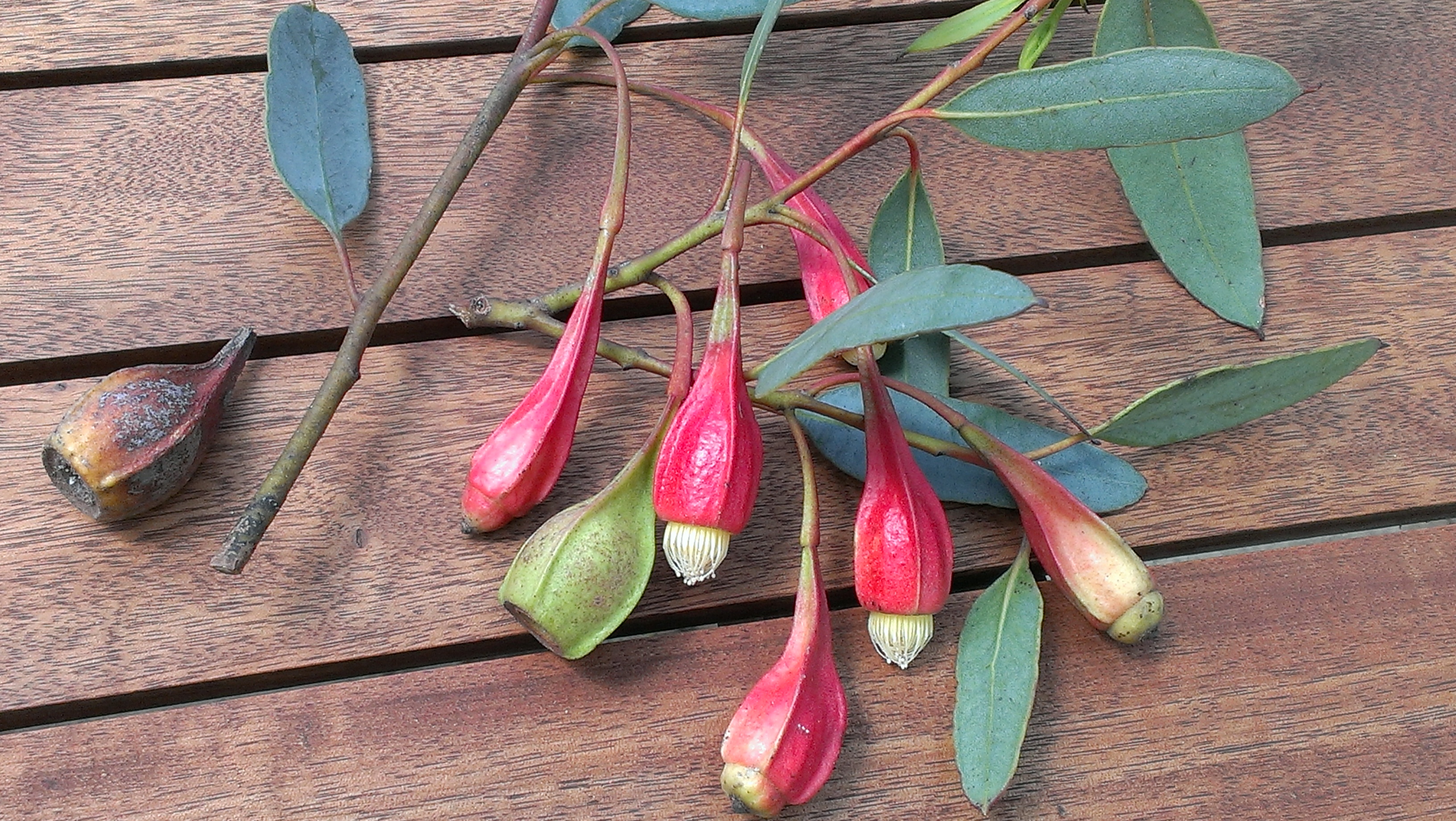
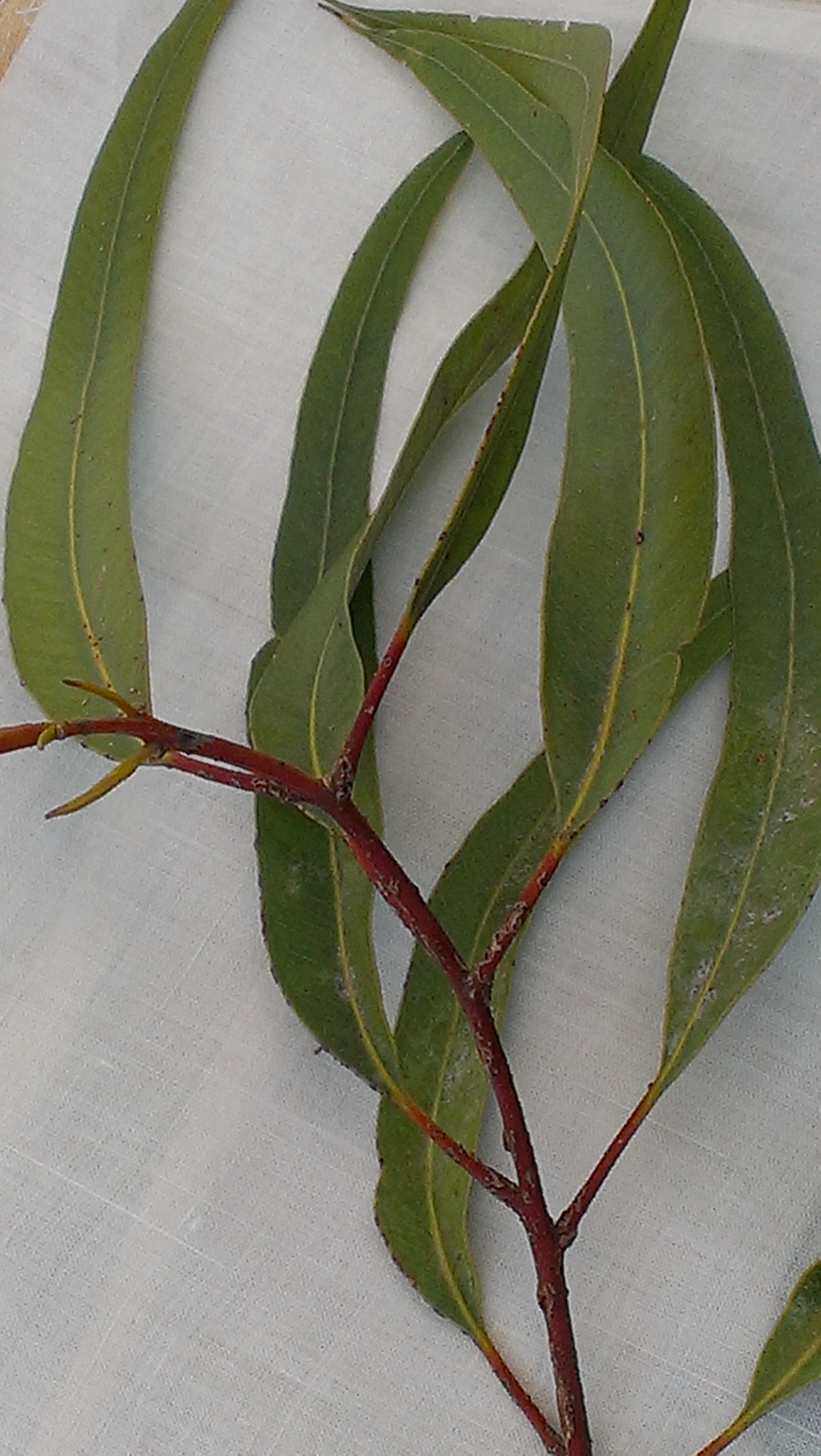
I love botanical gardens, where the trees are helpfully labelled.  In Adelaide, this is true even of those outside the grounds… which is how I came to take a few leaves from E Leptophylla.

IMAG0959

For lovers of brown, this might be a viable dye plant.  I’m still working on loving brown for most applications.  I tend to think brown sheep are made for creating brown wool.  But I’m blessed with access to coloured sheep fleece, and not everyone is so lucky.

IMAG0920

I have to say that it is more of a dye prospect than E Gillii.  A friend has this beautiful plant growing in his backyard, so I tried it out some time ago and got smudgy tan marks and no more.  It’s best admired for loveliness of leaf and flower in my view.  I also tried Chinese elm–no colour at all.

IMAG0965

A visit to the botanical gardens, even when I am really outside the gates, is never wasted.

Leave a comment

Filed under Dye Plants, Eucalypts, Leaf prints, Natural dyeing

India Flint at Murray Bridge Regional Gallery

The weekend that just was, was a long weekend for us.  Adelaide Cup Day honours a horse race–a strange reason for a public holiday, but we welcome public holidays!  5 of us went together to see India Flint’s exhibition in Murray Bridge.

It was an hour long trip each way with Totally Gourdgeous sing-a-longs, word games, a ‘how many songs connected to Africa can you sing?’ game and I-spy.  I highly recommend Totally Gourdgeous.  Where else can you hear orginal Australian music on gourd instruments?  And find reviews which actually are plausible when you’ve heard the band, like:

“Joni Mitchell meets James Brown in Bob Marley’s pumpkin patch via the Muppets!”  There was a picnic under some river red gums, with climbing on old trains (which was the highlight of the day for one of us).  And there was a fabulous almond and rice banana cake. 

But… the exhibition was very much the reason for the trip.

By way of introduction… because I feel a little odd saying anything at all about this experience, but at the same time, I’d really like to share it a little… as a musician I have been fascinated to hear people speak about songs I’ve sung. Sometimes the listener has complete confidence they know what the songwriter had in mind.  As the singer, sometimes I’ve been in conversation with the songwriter about interpreting that song from when it was half-written, and know that the songwriter was quite emphatically not thinking what the listener believes s/he heard.  I believe that art succeeds when it moves people and makes them think.  But the feelings and thoughts that result from encounters with art may be only loosely connected to what the artist offered, let alone intended!

The exhibition spans two rooms in a lovely gallery–in one of them, the lighting is bright and the dominant colours are white and– it was a subject of conversation between us–orange–red? India Flint has offered a preview on her blog for those far from Murray Bridge.  The long span of fabric suspended on hooks which dominates the room is extraordinary: brilliant colours and shapes.  It is a spectacular sight hanging in space looking fragile and gauzy yet vibrant and strong.  In the same room hangs a work called ‘waterbag’.  I just loved this work but struggled to explain why.  One of my friends theorised my fascination with bags–using, giving and making–might be part of it, but even with that suggestion I’m not sure.  I was drawn to its complexity–the dyeing, the form of the bag, the vivid stitching.

In the second room was a poem about New Orleans seven years after the storm painted on the wall in mud, together with an arrangement of paper and silk boats in a range of subtle colours. We spent a lot of time looking into individual boats as well as admiring the effect of the boats from a distance and reading the poetry.  Then there was a selection of eco-bundles wrapped around various pieces of pipe suspended in the air–also spectacular.  It made my fingers itch to unwrap them!  There were a series of works on the wall… one of them a single piece of fabric in purples and greys with a spectacular repeating compound leaf eco-print on it.  The others were rich and complex: pieced, stitched/embroidered and plant dyed in a multitude of different ways, using different fibres and mostly in dark colours–greys, browns, blacks and blues.

It gave rise to a series of conversations.

One was about the extraordinary source of inspiration that India Flint and her work have been.  Her work has been so generative.  In its showing the possibilities of eco-printing as a process.  In its incitement to experiment–explicit and implicit.  In its focus on local and native plants (eucalypts for us, of course–but clearly people in other parts of the world have taken up the invitation with plants local to them).  In its deployment of mending and boro and patching and darning as skills, aesthetics and practices.  In its use of a wide variety of materials.  In its uses of stitching.  In its invocation of the natural world and the potential of sustainable dyeing practices that would respect that world.

Another conversation was about the hoary old question of art and craft.  Naturally we did not resolve it (or try to), but we spoke about the phenomenon of people like India Flint, who are gesturing at larger ideas, images and aesthetics in their chosen media.  Who carry ideas into their works and express ideas through their works.  And then, there are people, me for instance, who seldom do this and have more of their attention on the process of making and the function of the ultimate thing/s made.  This is not to say that they don’t overlap or cannot coincide. They must, they clearly do… but they are not exactly identical processes or intentions and they affect what might be understood as an interesting outcome, too.

There was a lot of interest and speculation about process–how was this done?  What could have produced this shape/colour/amazing thing of wonder?

There were a number of conversations about which works or parts of them drew attention viewed from close up and which were fascinating from further away.

It was a lovely adventure.  Thanks to India Flint for inspiring it, and so much else besides.

4 Comments

Filed under Eucalypts, Leaf prints, Natural dyeing, Sewing

Leftovers

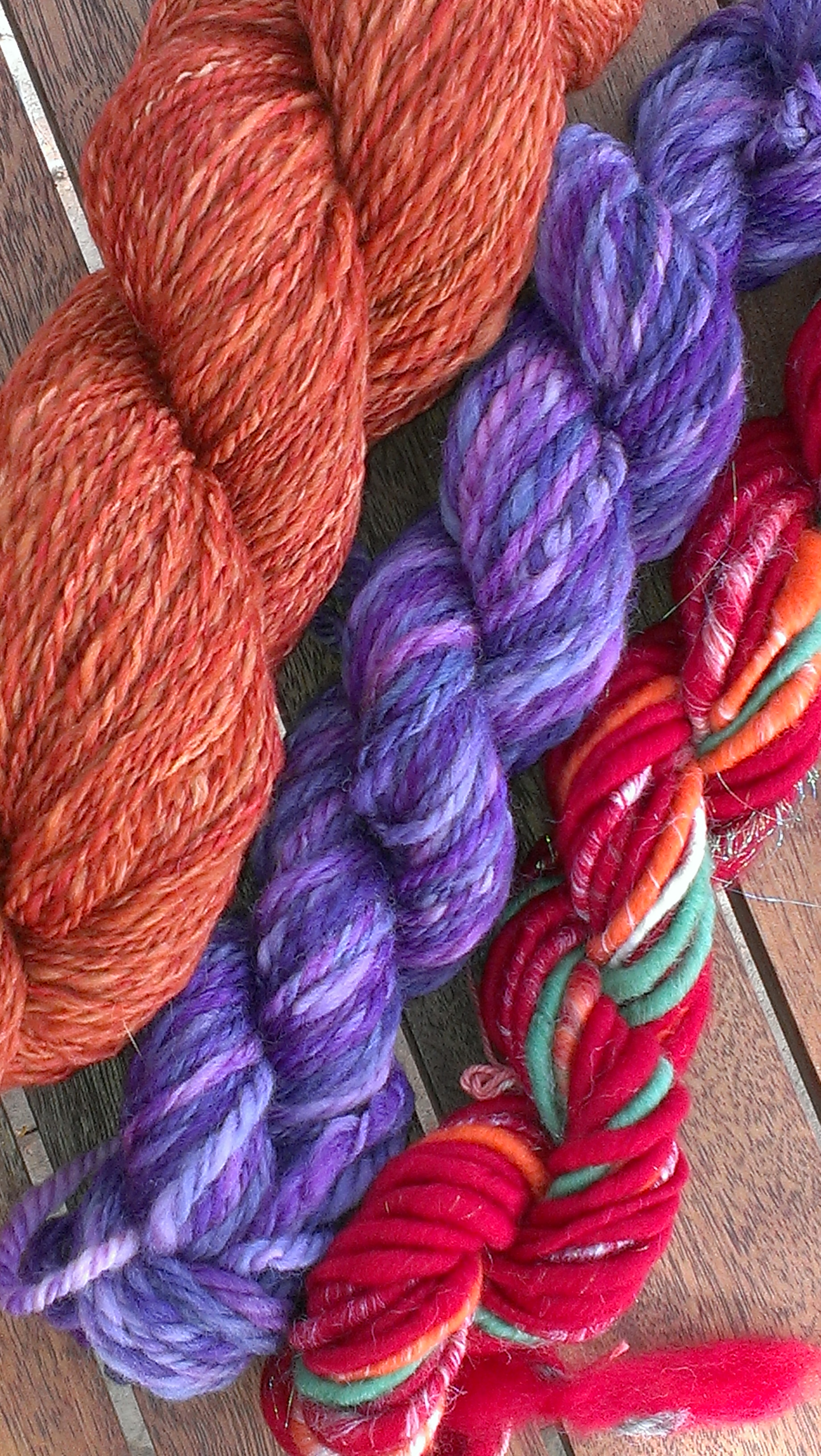
I had a few leftovers from a spinning workshop I held recently.  I made sure workshop participants took away all the roving I’d dyed and braided and all the batts I’d made, so they could practice at home. And we made more batts as part of the workshop and that was fun too.  But there were little bits left from demonstrating techniques.  Sometimes leftovers are the best part of a meal, and I really enjoyed spinning up the pink and purple end of a piece of roving, and corespinning one gloriously red batt–merino, silk and green sparkly stuff.  And that meant I found the neglected bobbins of eucalyptus-dyed merino that I had blended with some commercially dyed merino/silk in golds and reds.  So those singles finally got plied.  It’s nice to be back at the wheel.  It’s been too hot for dyepots!

IMAG1071

8 Comments

Filed under Eucalypts, Natural dyeing, Spinning

Sampling dye plants

IMAG0722

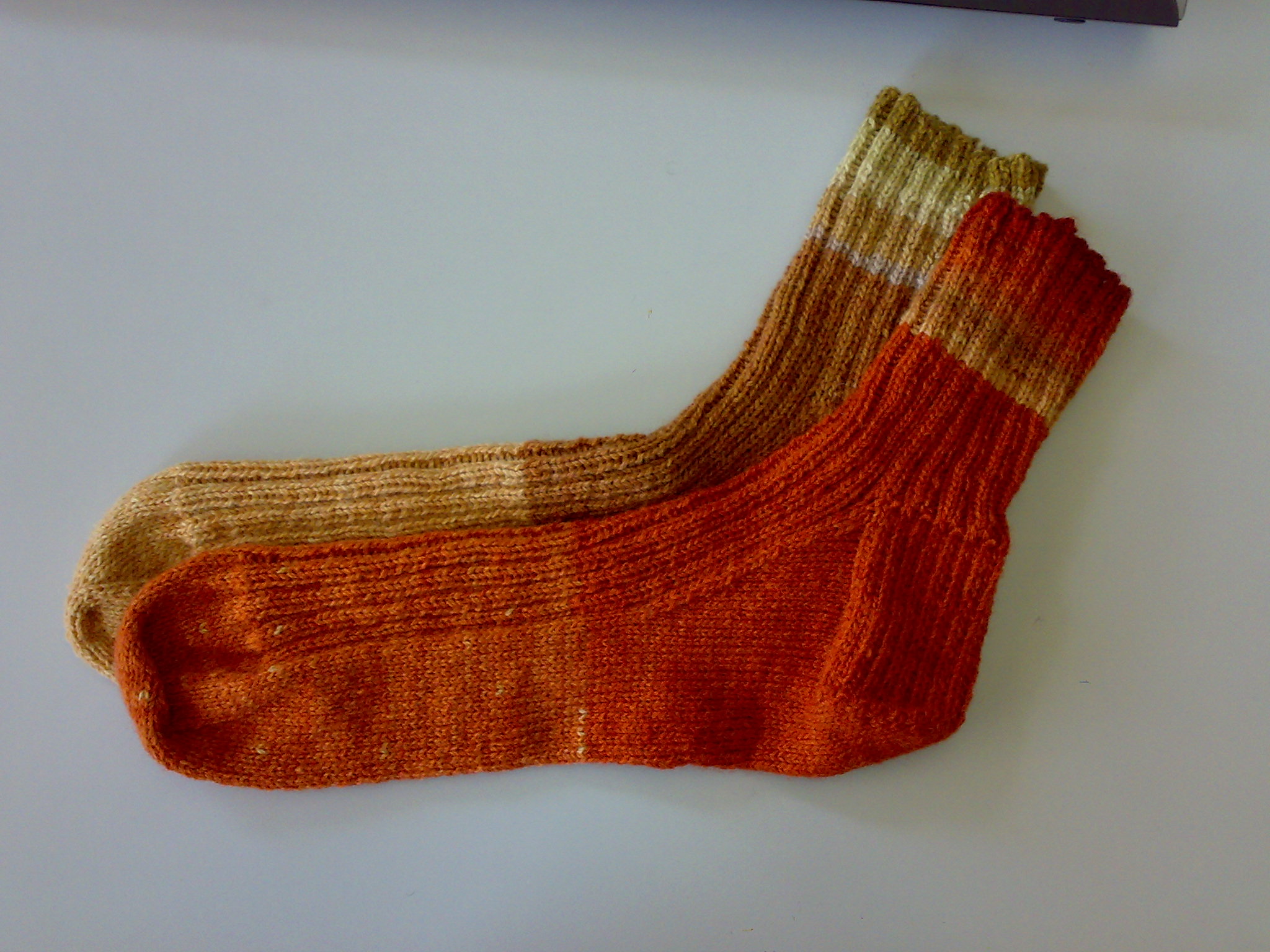
When I started plant dyeing, I used to make a tiny skein, about 1-2 metres long, and try out the leaves of trees around my neighbourhood on that.  In those early days, I tried rue after I found it listed in a book… oh my goodness…  the least said about that smell,  the better.  It almost put me off for good.  (Pale green, if anyone is wondering–not the red I was hoping for in my naivete).  When I had accumulated enough experiments to have identified some trees I wanted to keep visiting and some I would appreciate but not use for dye, I knit the samples into striped socks for a dear longtime friend. So that method had its advantages.  My friend asked for short cuffs (well, I thought he had–), so that’s what he got.

150620091160

I may have mentioned my devil-may-care attiutude to matching socks.  Happily my friend shares it, or he wouldn’t have scored this pair! 

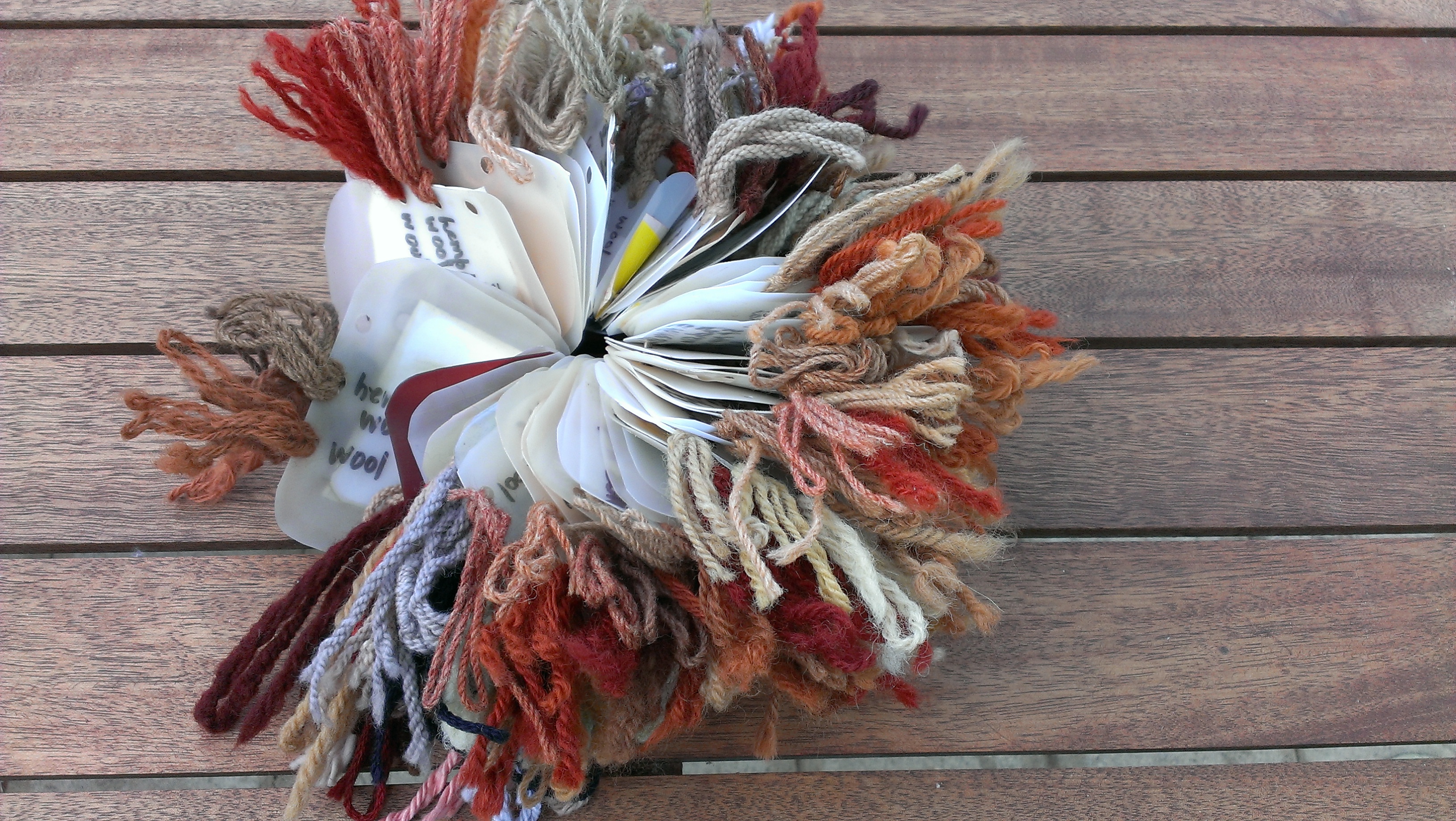
Eventually I learned about sample cards from more experienced dyers on Ravelry.

IMAG0723

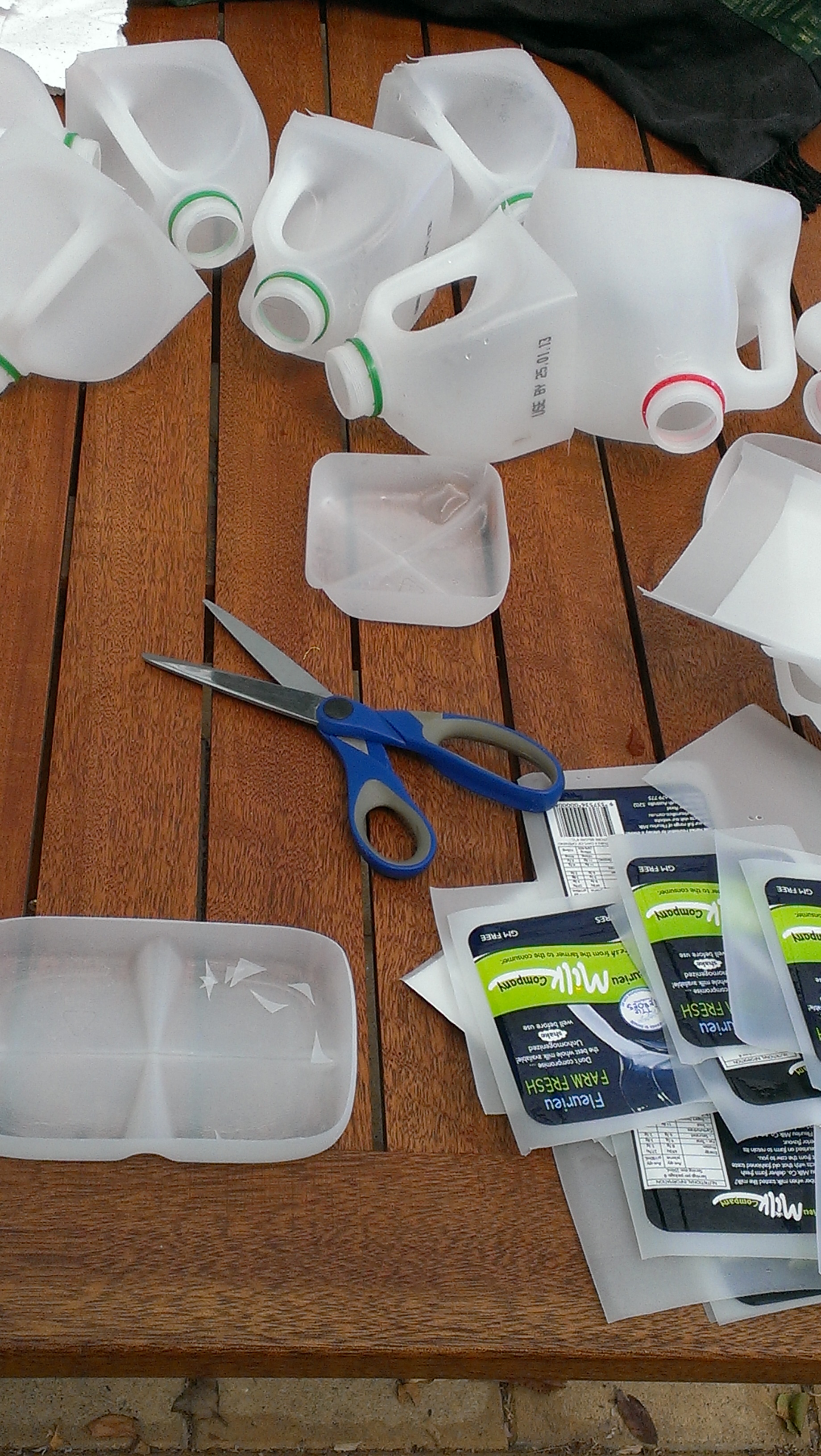
I use milk bottles to make mine.  We don’t use this kind at home any more, so I raided a recycling bin at a coffee cart during the weekly farmers’ market to get these.

IMAG0768

I keep my samples on a split ring, which I think I also saw on Ravelry, and it’s a great record of plants investigated.  Some have been identified long after being cooked in the dyepot.  A few have been identified correctly after an initial misidentification.  Some have been tried several times.

IMAG0773

And there are still so many to try out!  In the lead up to the recent workshops, I collected leaves fresh and dried: from trees, from the gutter, from fallen branches.  I collected more bark too.  This one is Eucalyptus Forrestiana,  believe:

IMAG0764

And I collected a few specimens I couldn’t identify… This one branched so high I couldn’t pick a leaf, but bud caps were raining down and lorikeets were having a great party high above me.

IMAG0760

This one was a sprawling mallee near the railway line, and came complete with new holland honeyeaters protesting my invasion.  I hope they had chicks in there somewhere, and this was the reason they kept trying to see me off even though they are about the length of my hand.

IMAG0746

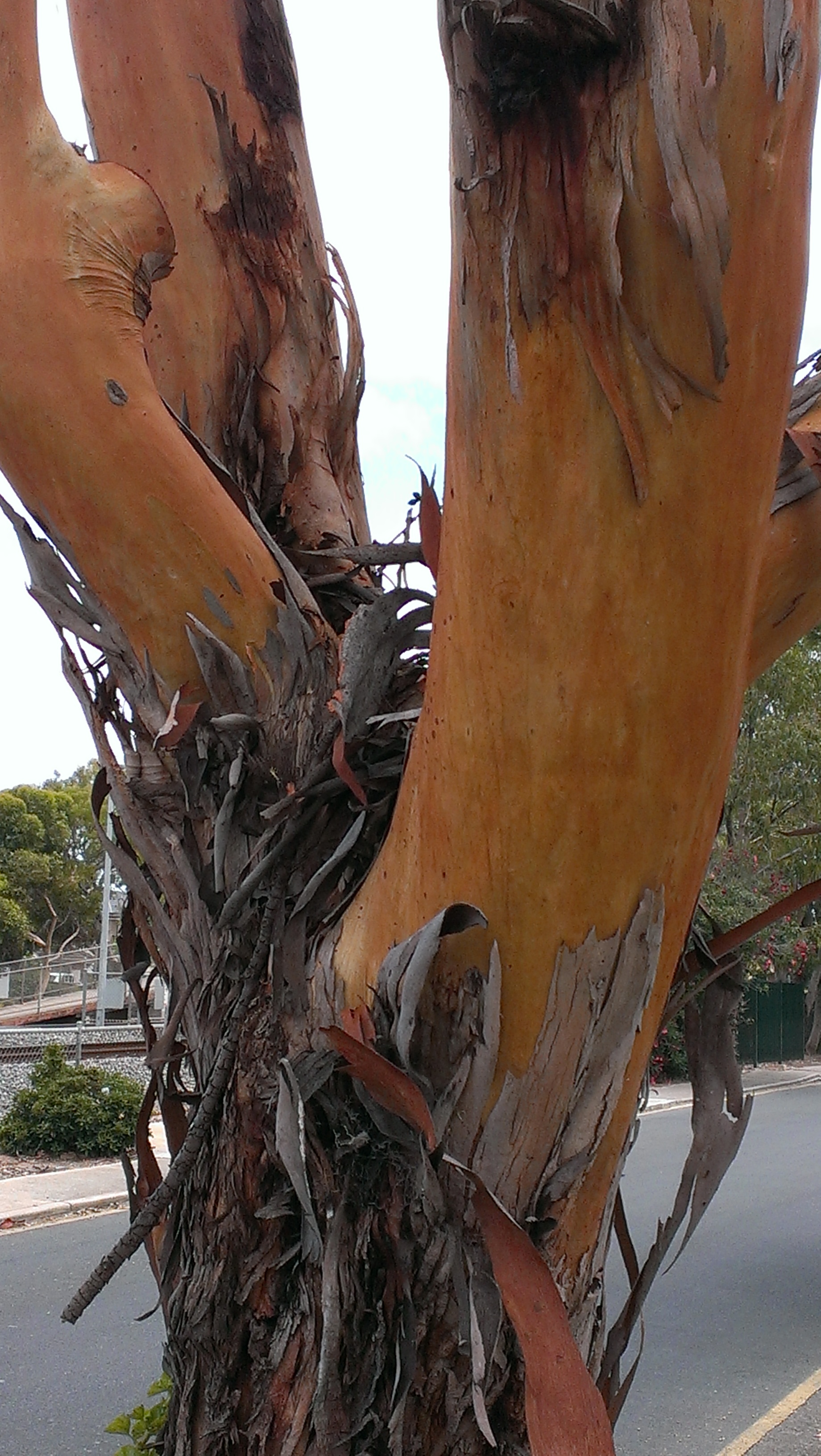
This tree has fascinated me for some time: it gives a peach or apricot colour.  But I still can’t identify it.

IMAG0738

So many possibilities for the future….

6 Comments

Filed under Dye Plants, Eucalypts, Knitting, Natural dyeing

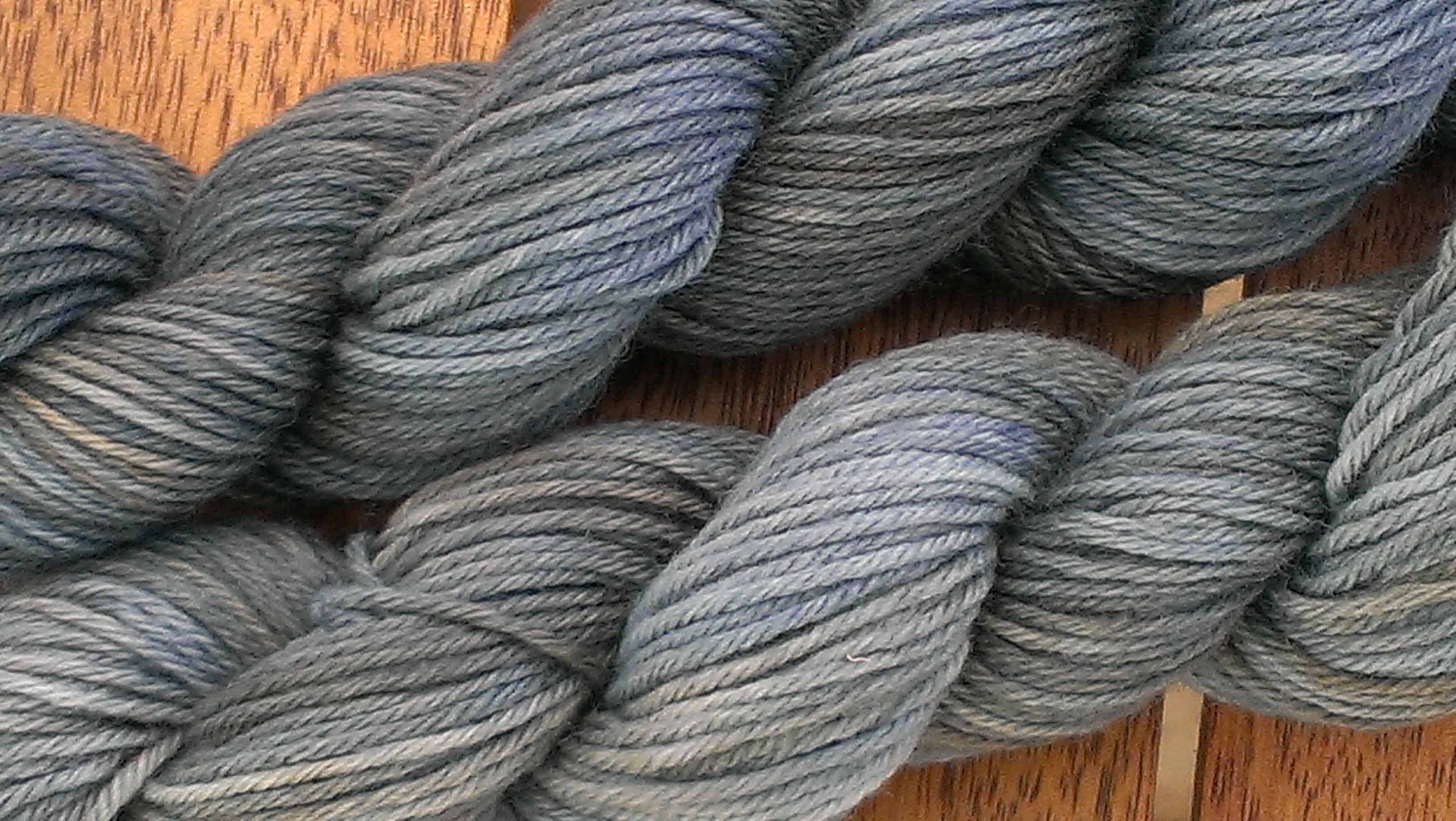
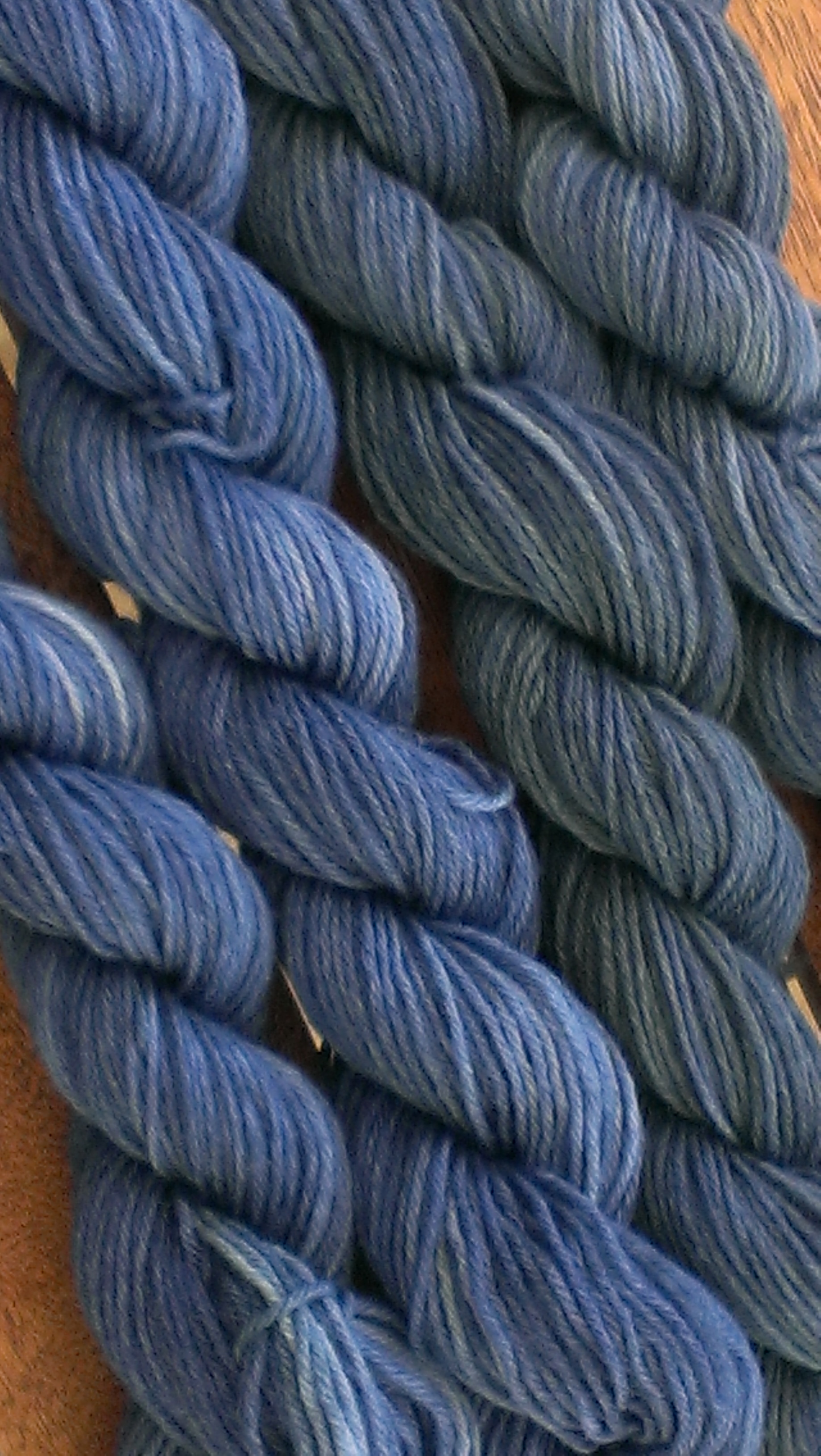
Dyeing with black beans

At the workshops I ran recently at the Guild, I demonstrated black bean dyeing.  It’s a cold process that takes some days, so it isn’t possible to complete it during a workshop.  I had pre-mordanted my fibres in alum and chosen some 25g skeins of patonyle I acquired at a garage sale.  This is a superwash wool/nylon blend that is designed for socks.  It started out a cream colour rather than absolutely white.  The first workshop took place during a hot period.  It was 36C on the day and I was longing to have enough space for a bucket of beans in the fridge.  Travelling home with them in my car was not as sweet smelling as a person might like.  The resulting colour wasn’t at the high end of blues I have previously achieved with black beans, either.

IMAG0907

For the second workshop, I used a different pack of beans from a different source, and when I looked at the bag, which said ‘1 kg black eyed beans, $3.40’–clearly inaccurate on the naming front–I couldn’t even remember where I found them.  Quite likely in an Asian grocery rather than a supermarket chain, looking at the label.  They had been packaged by someone who wasn’t working in a gigantic factory. I travelled home from the second workshop with soymilk and black beans in the front seat of the car.

The black bean colour was so lovely and so strong-looking by the evening of that day that I decided to throw the two skeins in the picture above in as well.

IMAG0930

I used 3 cups of beans (about half the pack) and tap water (as rain water had not imparted any special magic the first time).  100g sock yarn dyed for $1.70 with the option to remove the beans from the dye bath before putting the wool in and make them into dinner!  My thanks to the geniuses who posted about their experiments online on Ravelry.

I’ve heard online that this isn’t the most lightfast dye known to humankind but I’ve dyed and knit two sets of socks with black beans so far and they’re doing well.  I figure socks don’t get a lot of exposure to light, and if they fade… I can cold dye them again to tune them up.


2 Comments

Filed under Natural dyeing

Another workshop done!

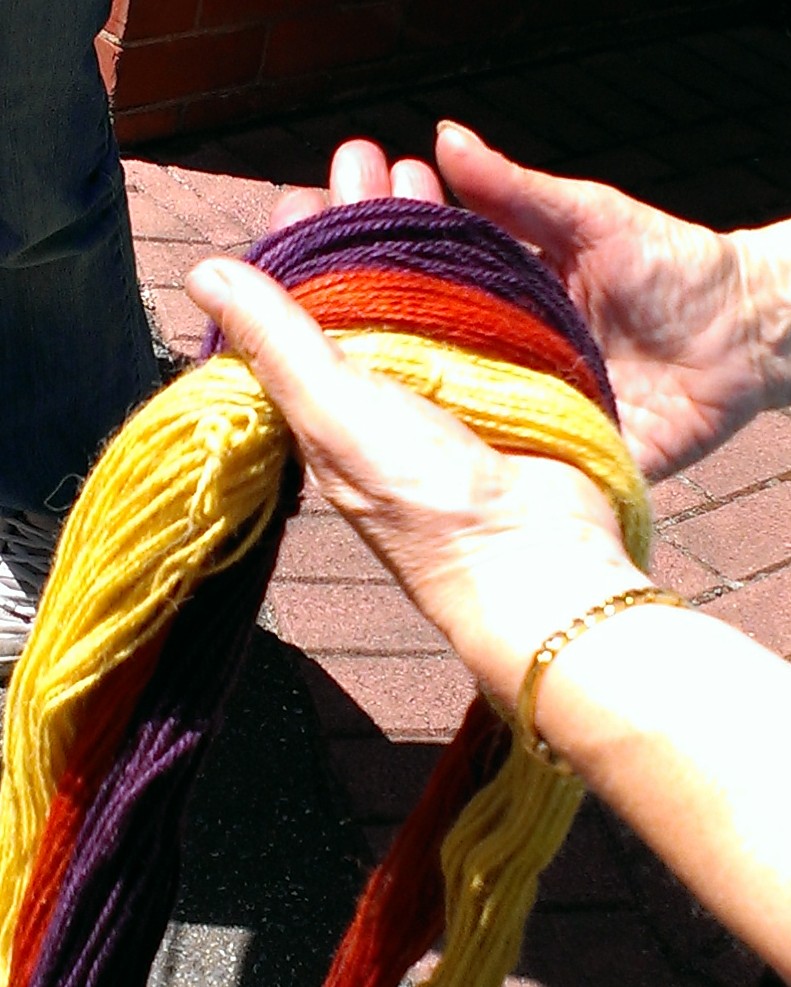
The second in my little series of workshops at the Guild went really well. There was yarn, fleece and roving dyeing.  Brown, orange, almost-red and maroon from E Scoparia (bark and leaves) and E Cinerea leaves, yellow from silky oak (Grevillea Robusta) using Ida Grae’s recipe from Nature’s Colors: Dyes from Plants, and the ever-astonishing purple from red sanderswood with alum.  I again used Jenny Dean’s method from Wild Colour and still got nothing like the oranges she suggests are likely.

IMAG0896

Mysterious outcomes in natural dyeing are not all that uncommon (at least for me!), as the number of variables is so huge.  But this one is out of the box–purple!?  Since my last post on the subject, Jenny Dean has very generously been in touch with her thoughts on the matter.  She suggests this purple could be the result of alkalinity (but given I made no attempt to generate an alkaline bath, it seems unlikely it was seriously alkaline).

Or–and I agree with her that this is much more likely, even though I used 4 different jars/packs labelled “sanderswood”–perhaps the dyestuff  was never sanderswood to begin with.  The colour is very, very like the logwood results I have had, just about indistinguishable.  I am still not complaining about the result–I love purple and so did the participants.  I was hoping for purple on this occasion, as I have no more logwood–that I know to be logwood.  Perhaps there was a time in the past when a batch of “sanderswood” came to our Guild or a supplier nearby and all the different jars I’ve used ultimately can be traced back to the same mislabelled supply. This would fit with my experience of Eucalypts… it is much more likely that I have misidentified my tree than that the dye bath is giving a completely different colour.  Variation to some extent, however, is completely expected.

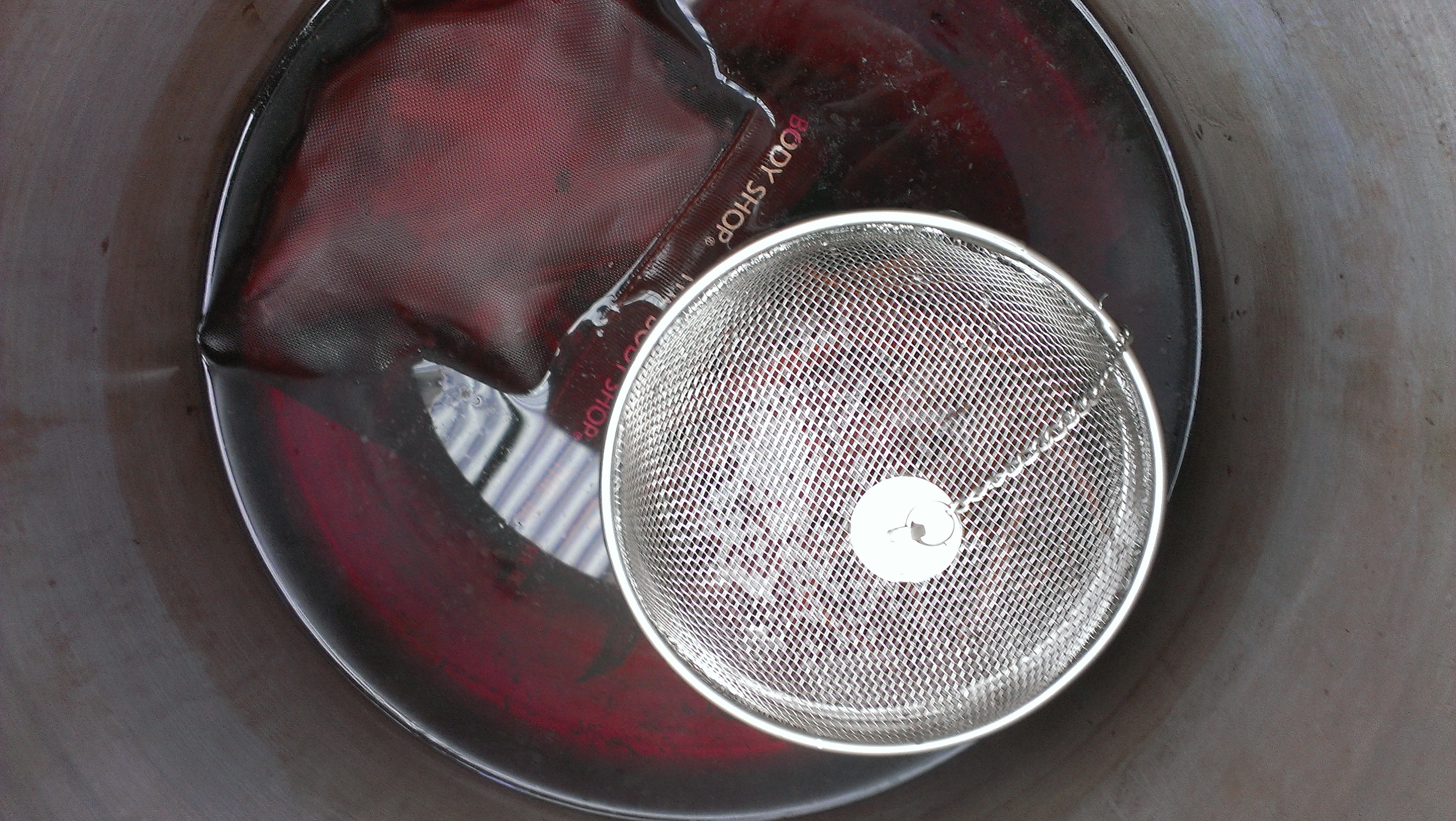
Here is the “sanderswood” just after I poured boiling water over it–Jenny says this looks like a logwood bath to her.  I bow to her much more extensive experience and wisdom, without hesitation.

IMAG0862

I have the biggest chips in a little zippered mesh pouch that must once have held toiletries.  The smallest chips/splinters are in something that looks just like a giant tea ball.  I saw it for sale in a Vietnamese grocery where I was investing in greens, seaweed and soy products and immediately saw its possibilities.  The woman who sold it to me had an eye-popping moment (evidently she hasn’t sold one to an Anglo before), and asked me what I was planning to do with it.  I love those moments in Asian groceries, because once I’ve been ask the question and given my (admittedly bizarre) response, I can ask about the ordinary use of the device or food in question.  This one is usually used to contain whole spices when making a big pot of stock or soup.  This point was helpfully illustrated by a packet of soup seasonings–star anise and cinnamon and coriander seed were some of the spices I could identify right away.

People tried out India  Flint‘s eco-print technique on cotton, wool prefelt and silk.  I hope she will get some extra book sales as a result (if you’d like to acquire her books, click on the link to her blog and look for the option to buy them postage free in the left hand sidebar).

IMAG0871

There were biscuits and icy poles and lots of chat.  I demonstrated soy mordanting and black bean dyeing.  And while we were at the Guild and using the copper, which is such a generously sized vessel by comparison with my dye pots, I leaf printed some significant lengths of fabric that I brought to the workshop bundled up and ready to go.  The copper really is copper lined, but I could detect no obvious impact on the colours.  Seedy silk noil:

IMAG0903

Wool prefelt… the degree of detail is fantastic.  This is destined for felting experimentation by a dear friend who generously assisted me at the workshop.  Her practical help, support, constant grace and good cheer made things go so smoothly.  I also decided to start some processes before participants arrived, which I didn’t do at the previous workshop.  I think that helped.  But it was a fabulous group of people too.

IMAG0913

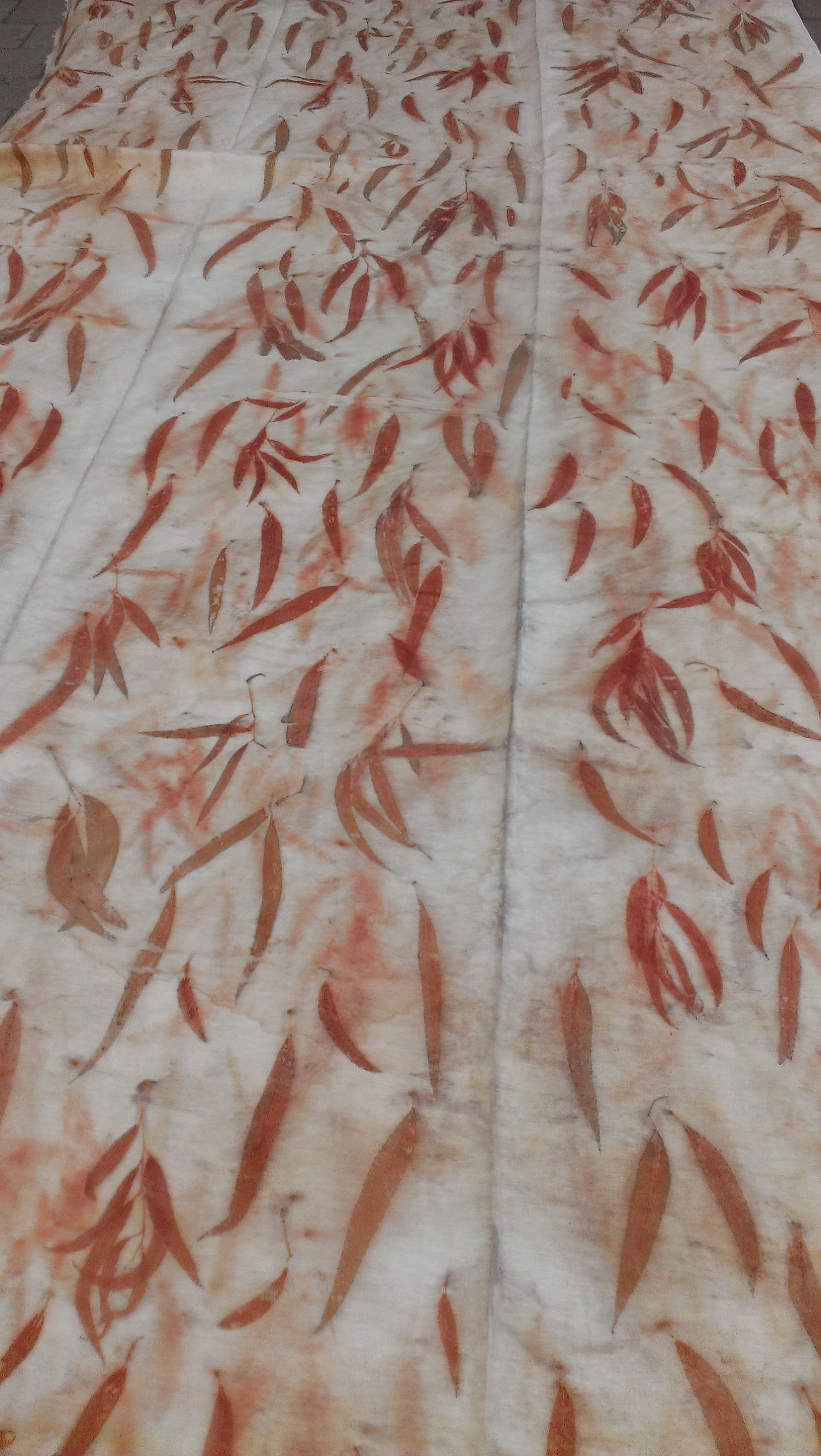
And finally, silk/hemp blend, destined to be made into a shirt (by me, so it may take a while).  I am delighted with how it turned out, after many months of putting off the day.

IMAG0924

9 Comments

Filed under Eucalypts, Leaf prints, Natural dyeing

A story of a quandong and its mistletoe

One weekend recently we went to visit a friend who lives near the Aldinga Scrub. While I was there we went for a wonderful walk on the beach, making the dog and ourselves happy.  So I collected a couple of samples while we were out, as many local people, like my friend, are planting as many local species as they can around their homes.  I decided to try a quandong and its mistletoe.  In case you’re not from around here, dear reader, let me advise that in Australia, mistletoe is a big family of parasitic plants which will eventually (but usually slowly) kill their hosts.  It isn’t so much the romantic plant under which people kiss at certain festivals.  There are lots of mistletoes, and they are cunningly adapted to a narrow range of host plants.

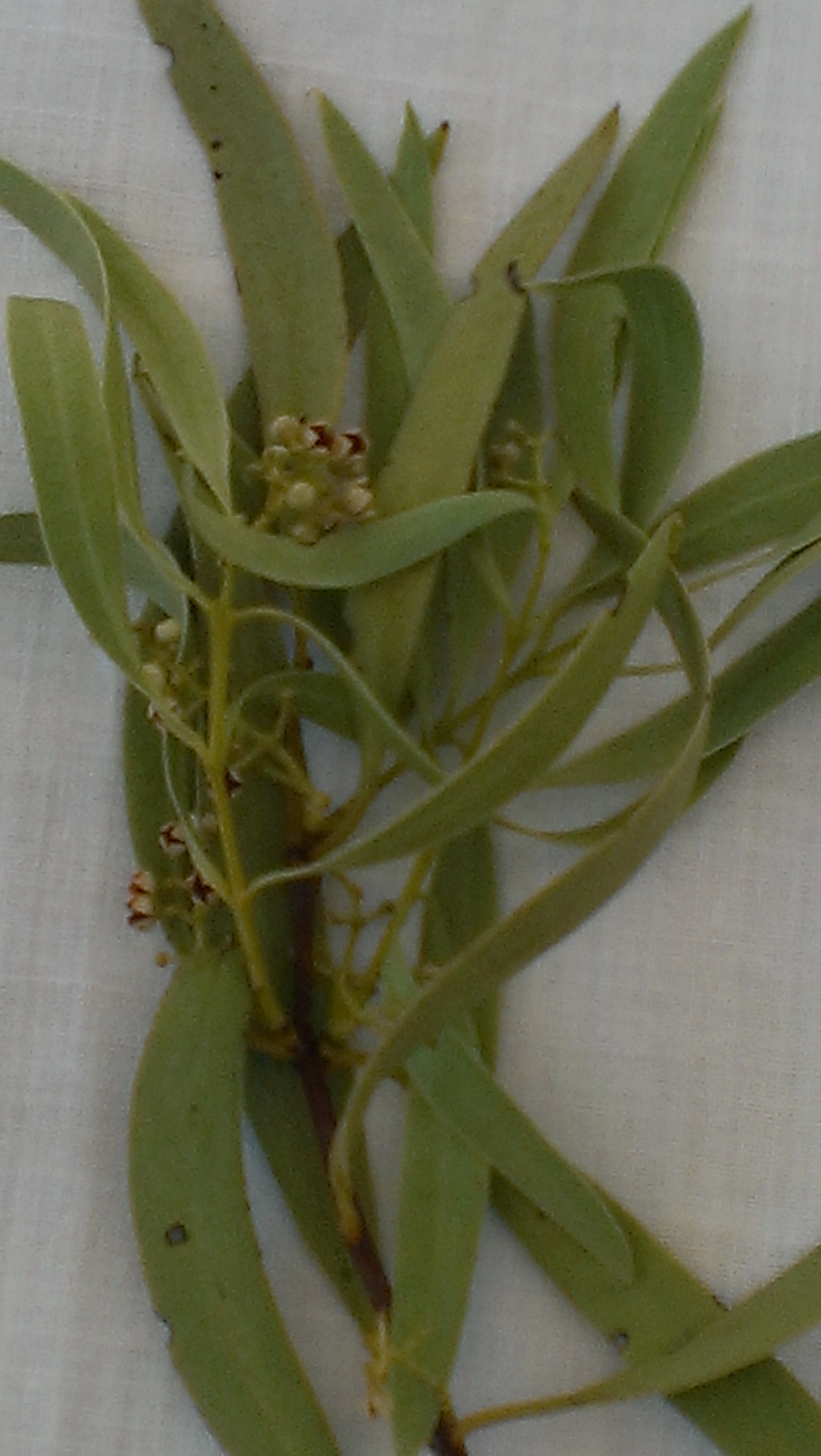
I have a fabulous book on mistletoes, Mistletoes of Southern Australia by David M Watson, published by the CSIRO.  It has me in awe of these extraordinary plants, but has convinced me that I am unlikely ever to be able to identify them with confidence.  There are only 46 to choose from in this part of the continent, though, so the task is a good bit smaller than learning Eucalypt identification.  There are some mistletoes in the book that this plant is clearly not.  But as to which one it is… I have several candidates in mind.  And I don’t know which of the quandongs this is, either.  It doesn’t look like the favoured bush food species Santalum acuminatum to me.  But Wikipedia lists a lot of other varieties all called ‘quandong’!

Anyway, on to the leaf prints.  Quandong in flower, before:

IMAG0825

After cooking with iron, which left quite an impression:

IMAG0846

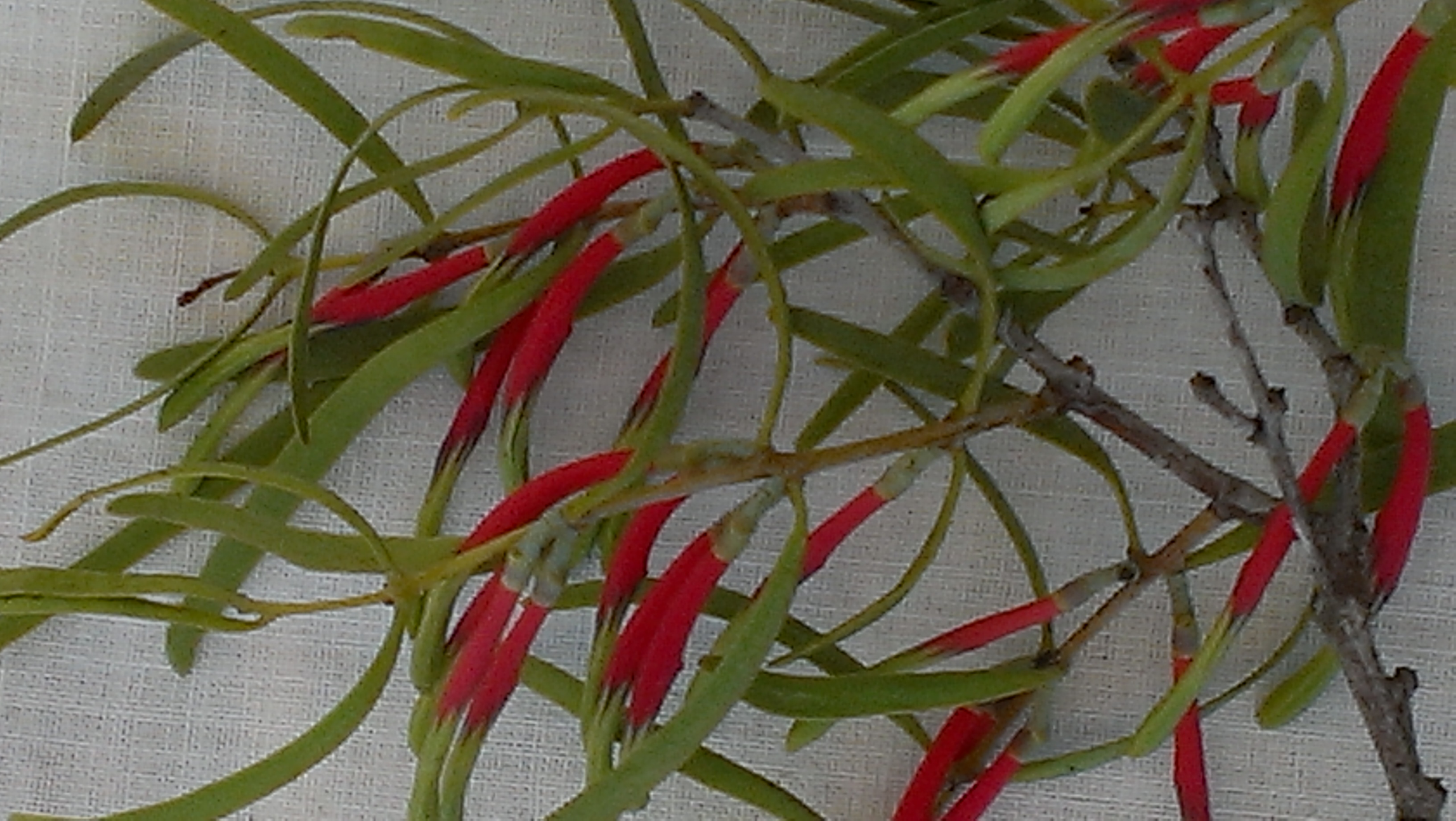
The iron may have made an impression, but this convinced me that this quandong isn’t much of a dye plant.  And now, the mistletoe, which is in glorious flower and will later create a rather impressive berry.  Before:

IMAG0827

And after.  I think this leaf print is a good bit less glorious than the plant, but this is definitely a distinct print.  So the mistletoe has dye potential.

IMAG0848

And that is the story of the quandong and its mistletoe for now…

4 Comments

Filed under Dye Plants, Leaf prints, Natural dyeing, Uncategorized

Eucalyptus Erythrocorys


E Erythrocorys (Ilyarrie) is in bud at present. The buds are large, with impressive, unusually shaped bud caps.

IMAG0910

I found a few flowers on one of the trees near a car park at work, but they were high up. The fruits of the previous season are still maturing, and they are just enormous–the size of a large apricot or plum.

IMAG0823

The leaves are long, too.  I’ve experimented with this tree in the past, obtaining a mid-orange from dried fallen leaves. This time I tried leaf prints.  Before…

IMAG0829

And after simmering with iron.  Another not-too-exciting result.

IMAG0849

Leave a comment

Filed under Dye Plants, Eucalypts, Leaf prints, Natural dyeing

Eucalyptus Lehmanii bark dyepot

E Lehmanii (bushy yate) has a very distinctive arrangement of buds, flowers and fruit.  When I was a kindergardener, we used to put the long bud caps on our fingers and call them witch’s fingers and chase each other around.  I can’t pretend to have had any sophisticated critique of the concept ‘witch’ at that stage in my life!

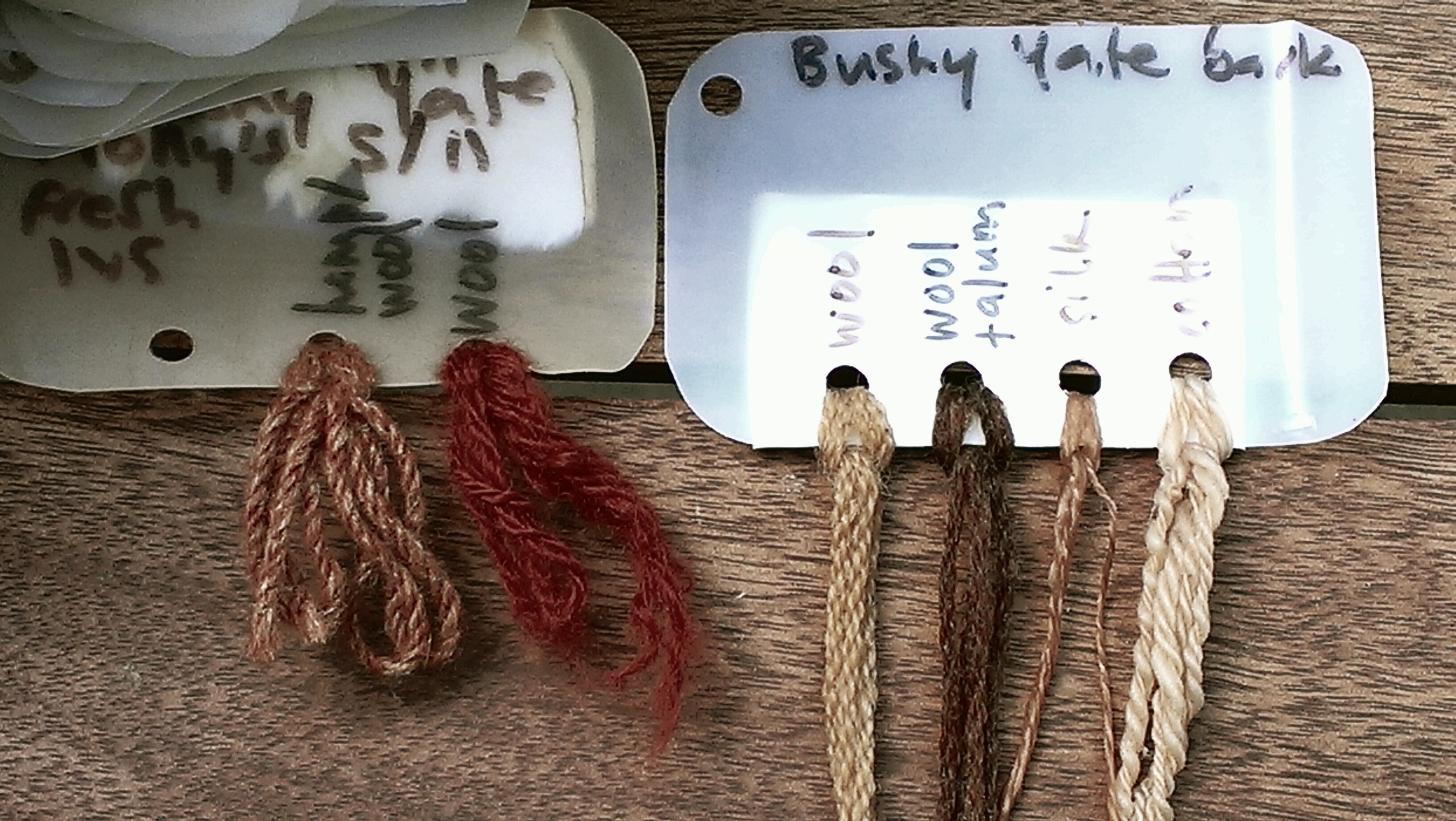
I came across some planted as street trees while I was out doing a run with friends.  On the way back to our car, I managed to collect some bark–since it had helpfully fallen.  I also collected a few leaves.  I have a sample card from a previous experiment with bushy yate leaves from a friend’s property, which gave quite a strong orange-brown.

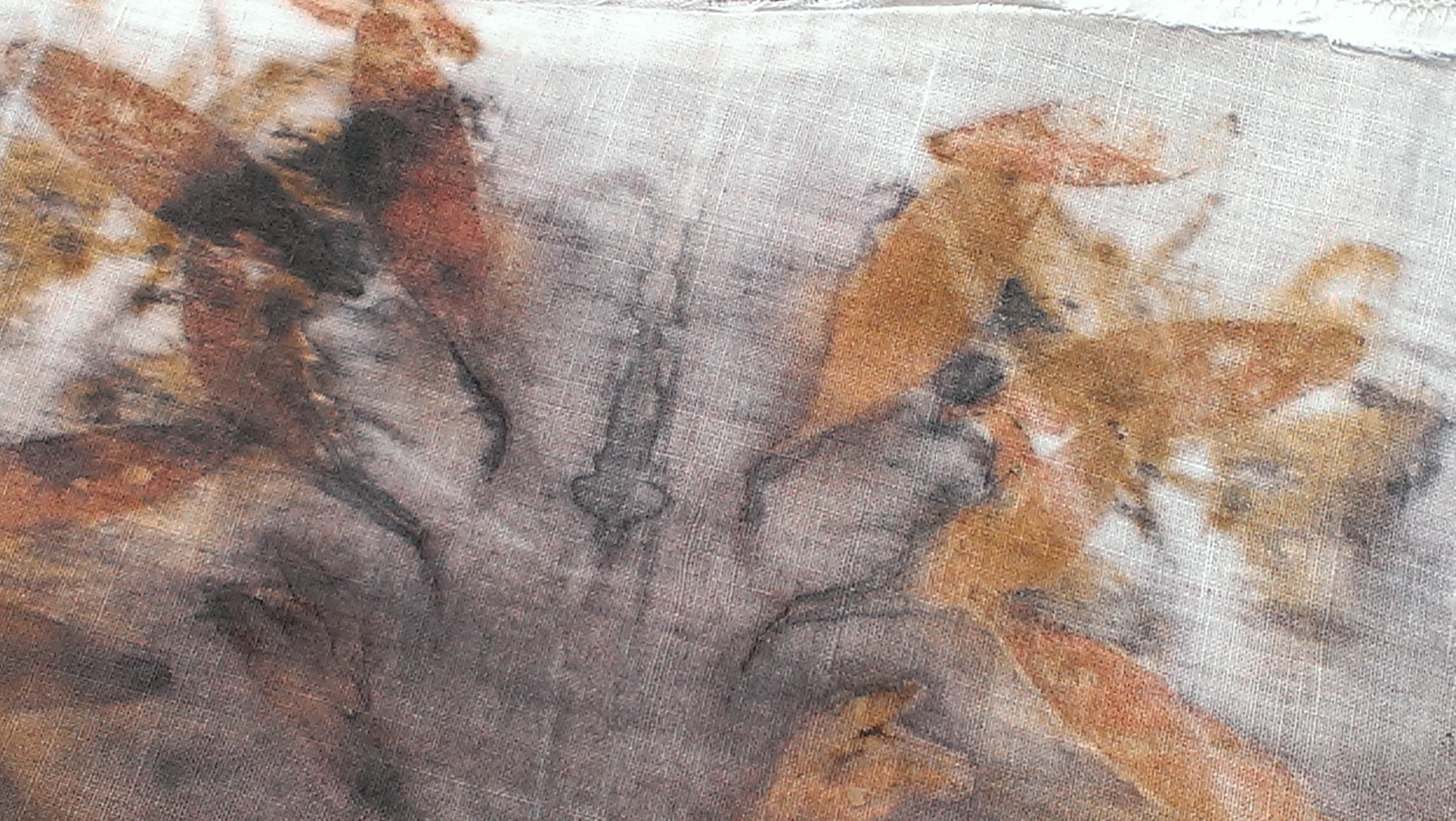
I used iron with the leaves, and the contribution from the iron on this occasion was really quite intense.  Before…

IMAG0828

After… a result that won’t have me rushing out to collect bushy yate for leaf prints, but a result just the same.

IMAG0845

And as for the bark pot… tan, again!  I would have to rate the biggest take home message from the series of bark dye pots this summer as being that alum really makes a difference with the Eucalypt barks I’ve tried.  With leaves, I seldom see any impressive difference between alum mordanted wool and plain wool.  I dye with E Scoparia bark often and have found no point in mordanting with alum (though this experience makes me think I should try again and double check). The bark pots, however, have given various shades of tan without mordant and much stronger browns with alum, and E Lehmanii is no exception. On the left, sample card from a pot of fresh leaves.  On the right, results of the bark pot, simmered for an hour and a half.

IMAG0844_1

2 Comments

Filed under Dye Plants, Eucalypts, Fibre preparation, Leaf prints, Natural dyeing

Things I’ve done with with plant dyed yarns…

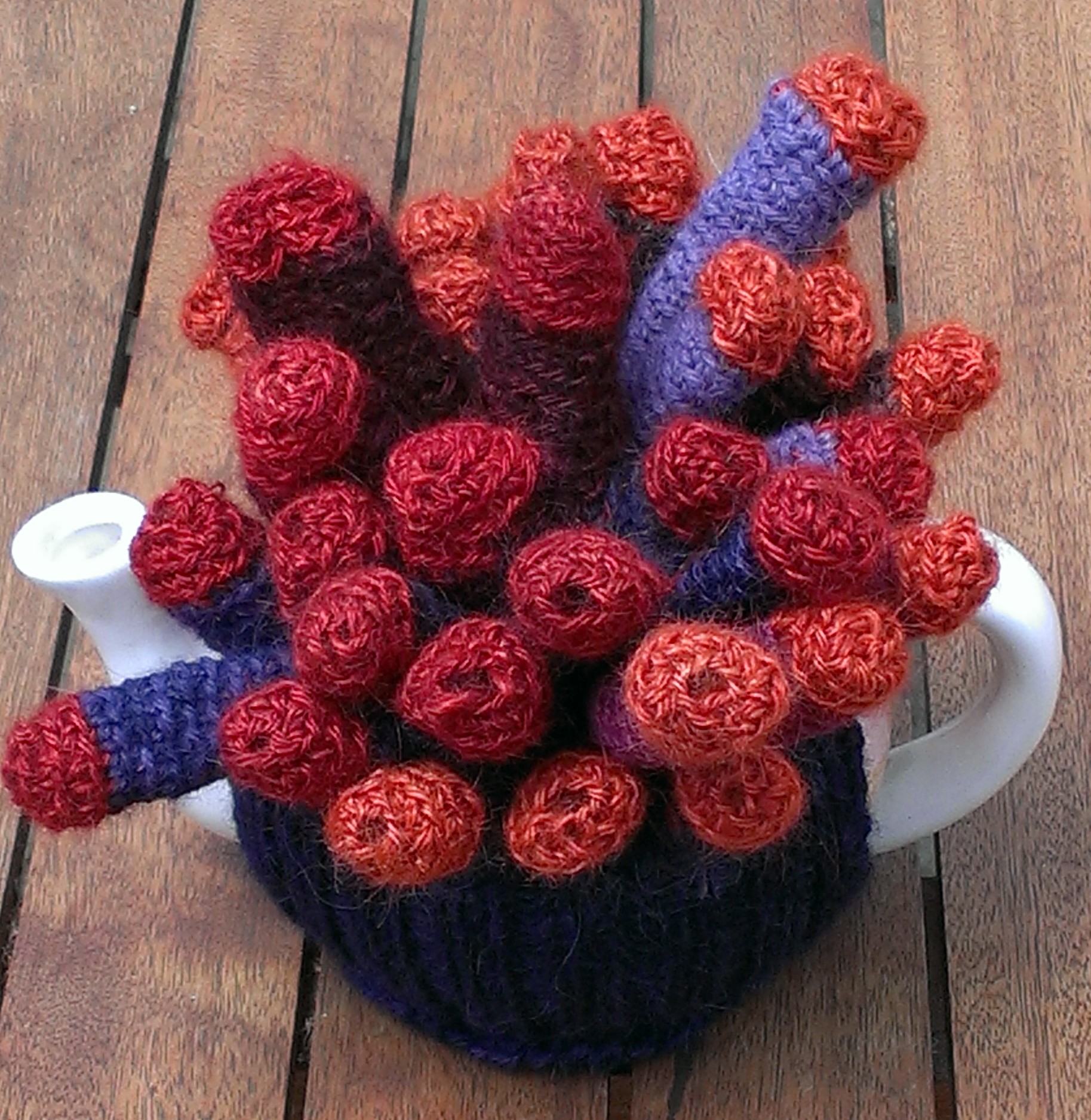
When I was preparing for the natural dyeing workshop I ran recently, I mordanted a lot of Bendigo Woollen Mills yarn as well as some handspun in small skeins–25g or less.  Having all those small skeins of different colours in alpaca and wool and mohair, activated my imagination. Eventually it led to this…

IMAG0792

These are madder-tipped, logwood-stemmed crocheted coral thingummies, inspired by Loani Prior’s ‘coral punk’.  When I say ‘inspired by’, let me confess.  I bought her beautifully designed and entertaining book Really Wild Tea Cosies with a Christmas book voucher I was given.  So I had the pattern.  But even though only one, basic, crochet stitch was involved, my crochet skills are decidedly remedial and I don’t happen to have a crochet instructor on tap.

I turned to Maggie Righetti’s book Crocheting in Plain English (I don’t have the new revised edition, needless to say).  Apparently sometimes I just can’t believe what I am reading… or perhaps I just don’t understand on the first eight passes.  I see students I teach with the same difficulties!  By the time I had finished this tea cosy and started on the next, I’d managed to figure out that I wasn’t doing what Loani Prior must have believed was involved in the one stitch involved in her cosy.  Luckily for me crocheting badly still produces a fabric of a sort.  I also figured out that for me, improvising a knit version of the pot cover itself was going to beat freeform crocheting one as the pattern suggests with my inadequate skill set.  So that’s what I did, and Loani Prior shouldn’t be held responsible for the outcome.  I like it anyway.

IMAG0843

It has highly entertained people who watched me crocheting coral at parties (as one does) as well as those who have seen the finished object, many of whom thought immediately of a sea anemone.

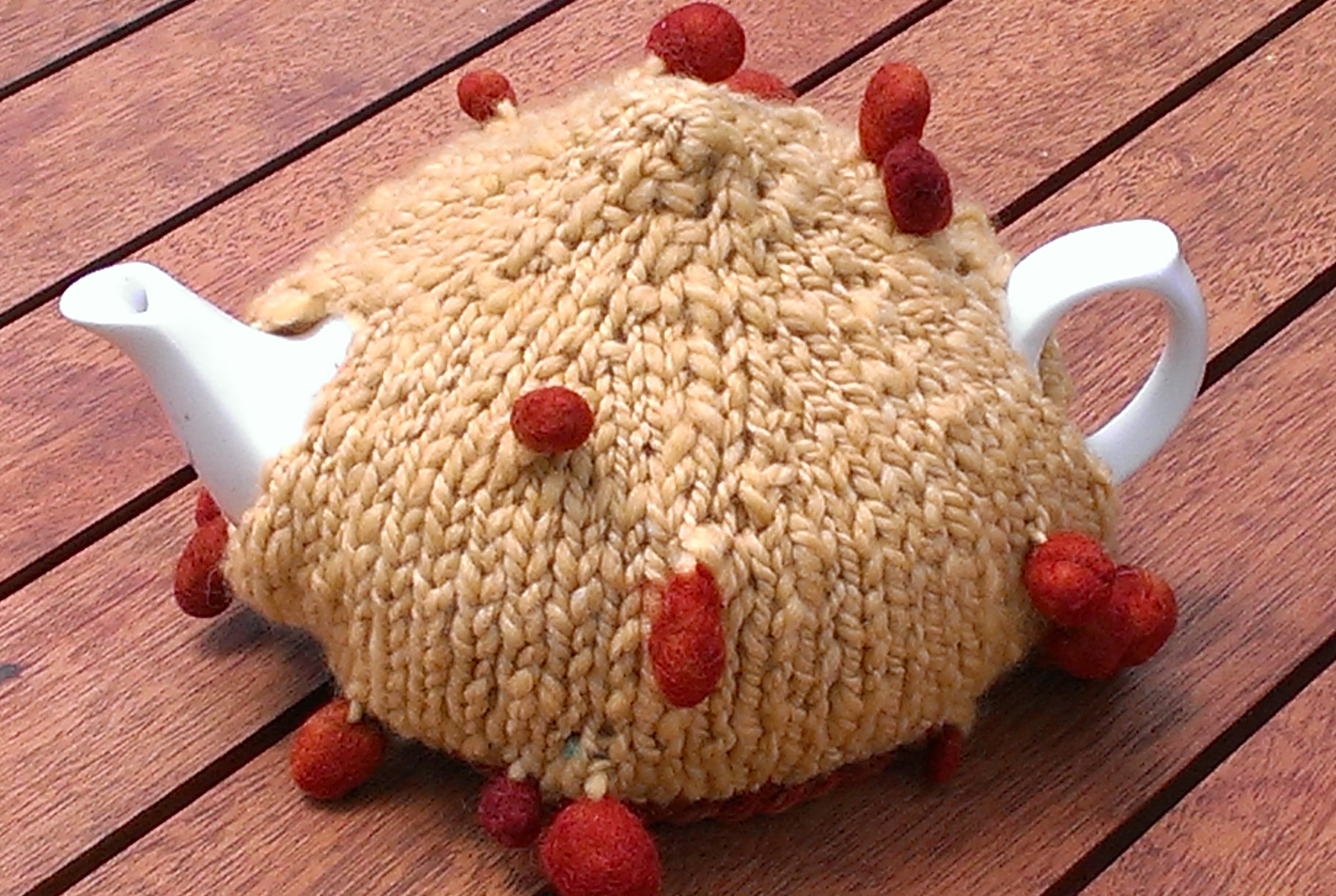
Let it be said that at present coral punk is not alone.  Here is the present plain Jane of the tea cosy selection at our place: yellow from silky oak leaves and orange from eucalyptus–with the felted blobs spun into the yarn.  Pattern improvised.  Luckily, tea pots are just not that fussy about how you clothe them.

IMAG0840

I’ve been branching out and using up some particularly strange art yarn spinning experiments.  This next one is commercially dyed mohair with silk curricula cocoons spun onto it.  Scratchy for a head, perfect for a teapot!  I was surprised how many people liked the look of the ‘hat’ emerging as I knit this at a picnic, riffing off Funhouse Fibers’ Fast and Fun Cozy.  Once again, that is to say, dispensing with the pattern when it became inconvenient.  I guess the hat admirers hadn’t felt the yarn yet.

IMAG0842

And for anyone who is wondering, I have continued to dye with the logwood exhaust from the dyeing workshop.  I ran out of yarn for a while and dyed two, 200g lengths of merino roving.  This morning I pulled out another 100g of superwash yarn.  I think it might be just about done, and I only wish I had kept a record of the weight of fibre that has been dyed with what was a small quantity of logwood in the beginning!  This weekend, the second in a series of two natural dyeing workshops. I’d better eat my crusts and get my beauty sleep in preparation.

IMAG0839

2 Comments

Filed under Crochet, Eucalypts, Knitting, Natural dyeing, Spinning, Uncategorized