Blog Hop Around the World

Leah from Seattle Spinner has generously nominated me as the next person in her blog hop around the world.  If you’ve stopped by because she mentioned my blog, a special welcome!  For regular readers of this blog who don’t know her… Leah says:

Spin, knit, weave…I LOVE these areas, for a multitude of reasons. … I am fascinated with things that go to the root of who we are–things or ideas that existed before the world of modern technology. Instead of being pastimes, these were things needed for our very survival.

She has an Etsy shop: all proceeds (after costs) go to to support a non profit organization in Peru called Awamaki which ‘is a nonprofit social enterprise that empowers rural Andean women with skills training, connects them to global market opportunities, and enables them to earn an income to transform their communities.’  Such a sensational idea…

And now for my answers to the blog hop questions!

1. What are you working on?

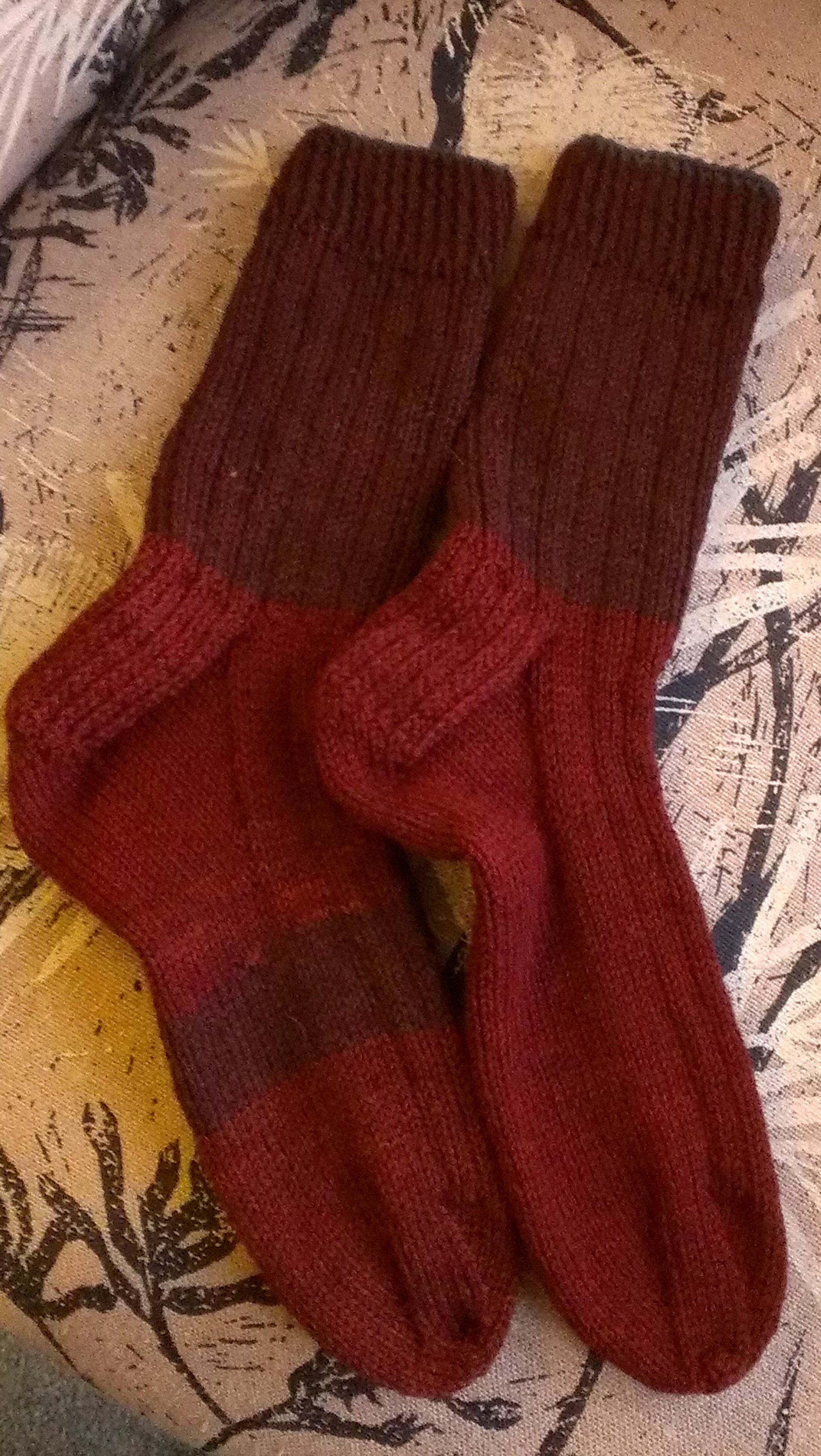
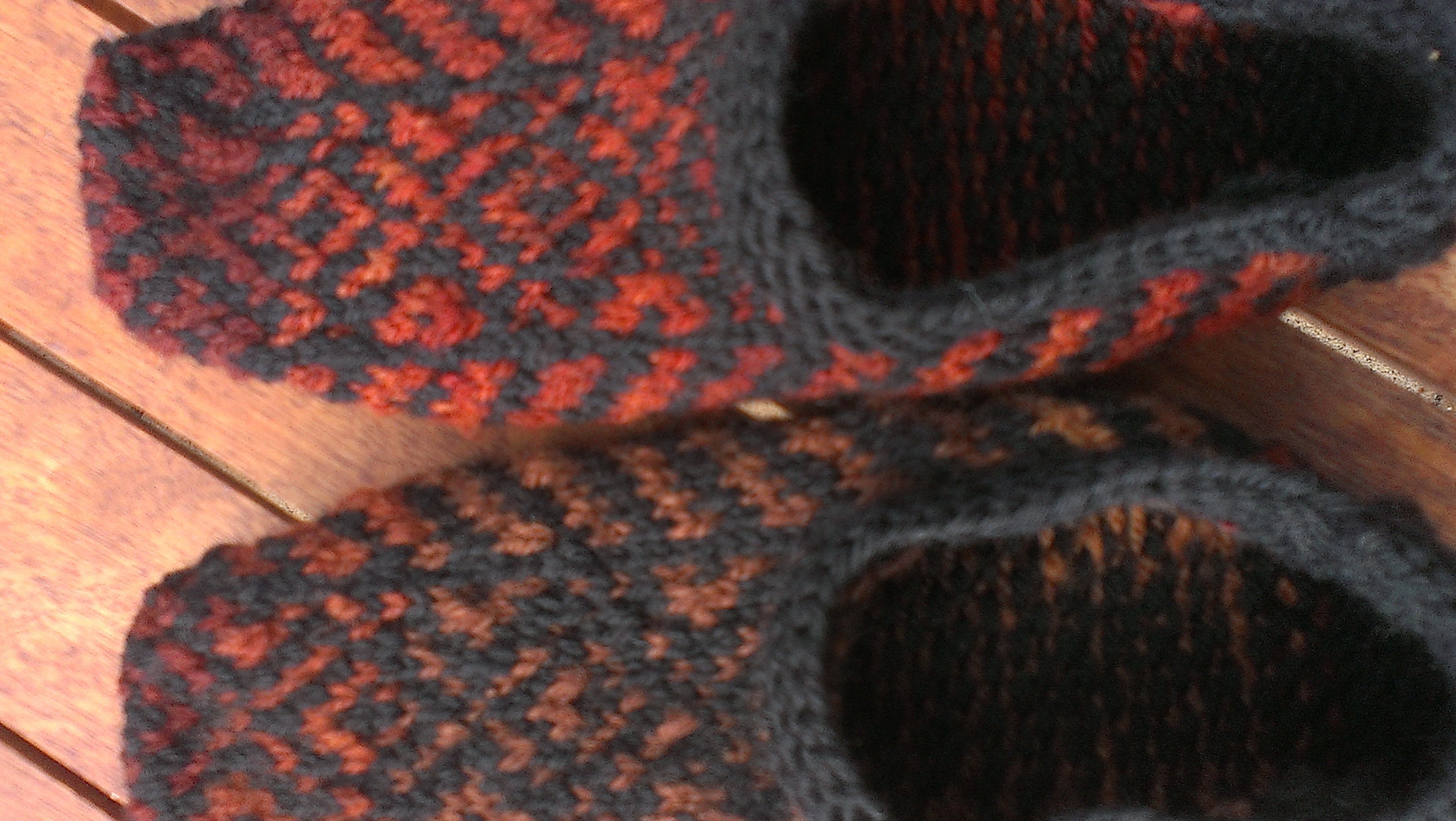
I always have more projects on the go than makes any kind of sense.  Some lie around for extended periods until I can find the right amount of time or mental space to move them forward.  Right now I am knitting a pair of socks… these travel with me on public transport and to meetings.  I am practicing my picking and Norwegian purling, since I think this would be a far more efficient way to knit than the throwing, ‘English’-style knitting I learned first.  I just need to build up some skill by doing it enough…

IMAG0967

I have a quilt in progress.  Must get back to it!  All the blocks use India Flint’s eco-print technique to showcase a eucalypt species and I’ve embroidered the name of each tree onto the block in eucalyptus-dyed silk.  And stopped, having dyed the fabric for the front and pieced the back… apparently there is something about cutting the sashing I can’t face… or some part of me that thinks I need a week to do it in!

IMAG0959

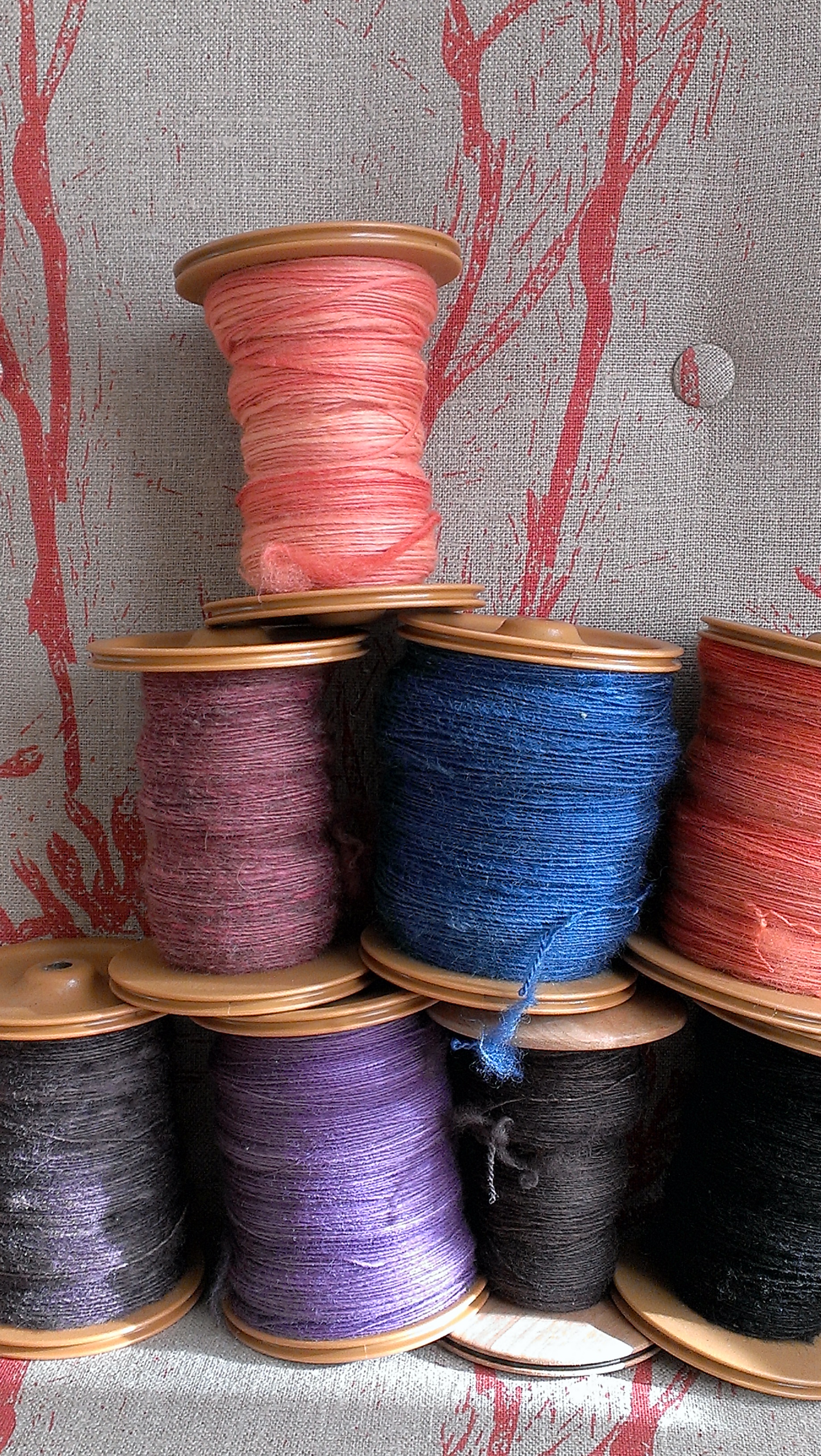
I am spinning a lot, in several different fibres.  I went to a weekend away with members of my Guild recently and carded a lot of naturally dyed wool.  It must be time to do some plying soon!  These colours include indigo, logwood and cochineal. Many came from exhaust dyebaths after a dyeing workshop where I used old dyestuffs donated to the Guild.
IMAG0963

2. How does my work differ from others?

I am not sure it always does!  Over time, I find myself working further and further back along the process of creating things: over some years I went from knitting socks to spinning yarn to dyeing fibre to processing raw fleece and identifying local weeds and trees for dyeing and growing dye plants.  This doesn’t interest everyone.  Yet, I can’t claim to be all about process. I enjoy creating a finished thing that will be of use.  I am less excited about things that are just for display.

IMAG0966

I also find that I like to recycle things… I am interested in using every last scrap of a piece of fabric or yarn, and I enjoy turning fabrics that would otherwise be discarded into something useful.  Sometimes I think this is a recent impulse, but then I look into my wardrobe where there are shirts made from flour sacks and old damask tablecloth… However–I also have a large collection of all manner of fabrics, yarn and threads and have become a collecting place for other women’s fabrics and notions. Happily, I am able to give a lot of things away to people who will use and enjoy them.  This weekend, I am mordanting these fabrics, mostly salvaged from a friend’s mother’s stash.  Most of the prints and plain coloured fabrics have gone to new homes but I kept the offcuts of calico and white sheeting for leaf printing…

IMAG0955

3. Why do I create what I do?

I love to identify something that is wanted or needed, and the raw materials that would bring that thing into existence, and match the two.  Sometimes I make to request or to fill a need I perceive in someone else.  or I just imagine the delight a handmade item might produce.  I look for opportunities to make something special and think about the recipient as I stitch it.  But I also do things as they interest or inspire me and the look for the right home for them to go to.  I make plenty of mistakes and have become adept at turning mistakes into useful items and finding ways to use or refashion things that are not as intended, or seem at first not-too-promising.

2014-08-23 11.57.15

I also create to satisfy my fidgety nature, I think.  To fend off the possibility of wasted time or boredom, and turn what might otherwise be wasted to use.
IMAG0086

4. How does my creative process work?

Gradually.  I have a substantial day job, which means that I don’t need to make a living from my craft, and also that I have limited time for crafting.  I do what I can, when I can, and I am motivated by having an exciting idea, wanting to meet a date for a gift, or seeking to meet a need for some specific item.  I don’t have a spiritual or romantic sense of creative process.  Rather, I see myself as part of a long tradition of thrift, skill and creativity–and this delights me.  So many people in the developed world are now bereft of the skills needed to meet simple, everyday material needs for themselves.  I would feel a great sense of loss at not being able to make or mend.  These activities are sources of pleasure and satisfaction in my life.

IMAG0128

I have chosen to pass the baton to Barbro from Barbro’s Threads–from Australia to Finland! She says she is:

a handspinner who likes to work with many kinds of fibers in all forms. I’m interested in the history and cultural history of sheep and textiles. … Right now I’m spinning and researching for my master spinner title in my guild Björken at Stundars. I’m concentrating on three sheep from Finland (Finnsheep, Kainuu Grey, and Åland sheep), and three from Sweden (Swedish Finull, Gotland sheep, and Värmland sheep).

I am in awe of Barbro’s skills as a spinner and love reading about her textile adventures–learning new skills and visiting museums full of textile traditions quite different to the ones I can see here in Australia.  I am so impressed by her work toward becoming a Master Spinner.  This is something members of my Guild speak about but which my Guild can’t currently support.  Barbro also has a very handsome dog… I hope you’ll visit her blog and enjoy it as much as I do!

9 Comments

Filed under Knitting, Leaf prints, Natural dyeing, Sewing, Spinning

Scogger!

Do you read those articles that come out every once in a while announcing the words that have been added to the dictionary since the last edition (like this and this?) and perhaps lamenting those that have gone into disuse?  I do.  I have a long standing love affair with dictionaries that began when I was a primary school child.  I had the insight that I could never get in trouble for reading the dictionary under the desk during classes while I was still in primary school.  I must have been regularly bored, or gripped by the dictionary, because I read it a lot.  Strange events followed, like the time I used ‘annular’ in a sentence, in a primary school story.  At the time we lived in the middle of Western Australia, where this was evidently unexpected.  I had a teacher who was capable of raising just one eyebrow, a skill I wistfully hoped to master and practiced a lot, without much success.  ‘Annular’ caused those expressive eyebrows to rise much higher than usual!

2014-08-28 17.16.12

I digress, but I am sure you had noticed.  I believe it was in Richard Rutt’s history of hand knitting that I found the word ‘scogger’. One of the happy moments of my young adult life was coming into possession of a Shorter Oxford dictionary, and ‘scogger’ is in it, right beside ‘scofflaw’.  It is defined in the OED as ‘A footless stocking, or a knitted article of similar form, worn either as a gaiter or as a sleeve to protect the arm; also the foot of a stocking worn over the boot to prevent slipping on ice’ and attributed to a northern dialect.  The examples listed go back to 1615: ‘R. Brathwait Strappado 130:   Fute-sare I was, for Bille shoon had neane..Nor hose-legs (wele I wate) but skoggers aud, That hardly hap’t poore Billes legs fra caud.’


Anyone who is wondering–especially anyone who has a native language other than English–should understand the meaning of this statement is not self evident me either.  At a guess: ‘I was footsore, for I (Bill) had no shoes… Nor leg warmers, but only old scoggers, that hardly kept my (Bill’s) poor legs from the cold.’  ‘Wele I wate’ has me puzzled even after some digging around. ‘Wele’ could mean ‘we will’ or  ‘choose’ according to OED or ‘weal’ according to one online source.  ‘Wate’ could mean ‘wait’ or ‘what’.  So this phrase might mean ‘while I wait’ and require context… or might mean something completely different!  The wonders of the internet make the whole poem available!  This makes it clear Bill is describing his rise from poverty and wretched, inadequate, hand-me-down clothing to rather finer garb.

2014-08-28 17.17.28

This scogger is for a friend who has a plastic elbow joint.  She feels the cold in it rather badly, though unlike poor Bille in the example from the OED, she certainly does have shoes!  This scogger is destined to warm her elbow on chilly mornings when she is tending to the hens and donkeys and on cold evenings when she’s checking on them again.  That’s me modelling it (ah, the challenges of taking a photo of my own arm!), and I admit, she is a different shape–but she’s tried it on and declared it suitable. It’s made of dependable sock yarn and shirring elastic, knit into the ends to ensure snug fit, as requested.  It comes complete with a heel an elbow for maximum movement, and needless to say, since I knit it in meetings, on buses and in queues, quite a few folk have been introduced to the scogger: both the word and the article.

7 Comments

Filed under Natural dyeing

What to do with hessian sacks

In my childhood, hessian sacks (I think these are burlap sacks in North America) were a common feature of life. They were the packaging in which all kinds of supplies for the garden and from the hardware arrived, and they also carried potatoes and large quantities of other eatables.  They were routinely re-used to carry things (mulch or wood) as mats (for example, in the shed or the boat or outdoors) or as linings (for example, in the boot of a car).

2014-08-23 17.46.50

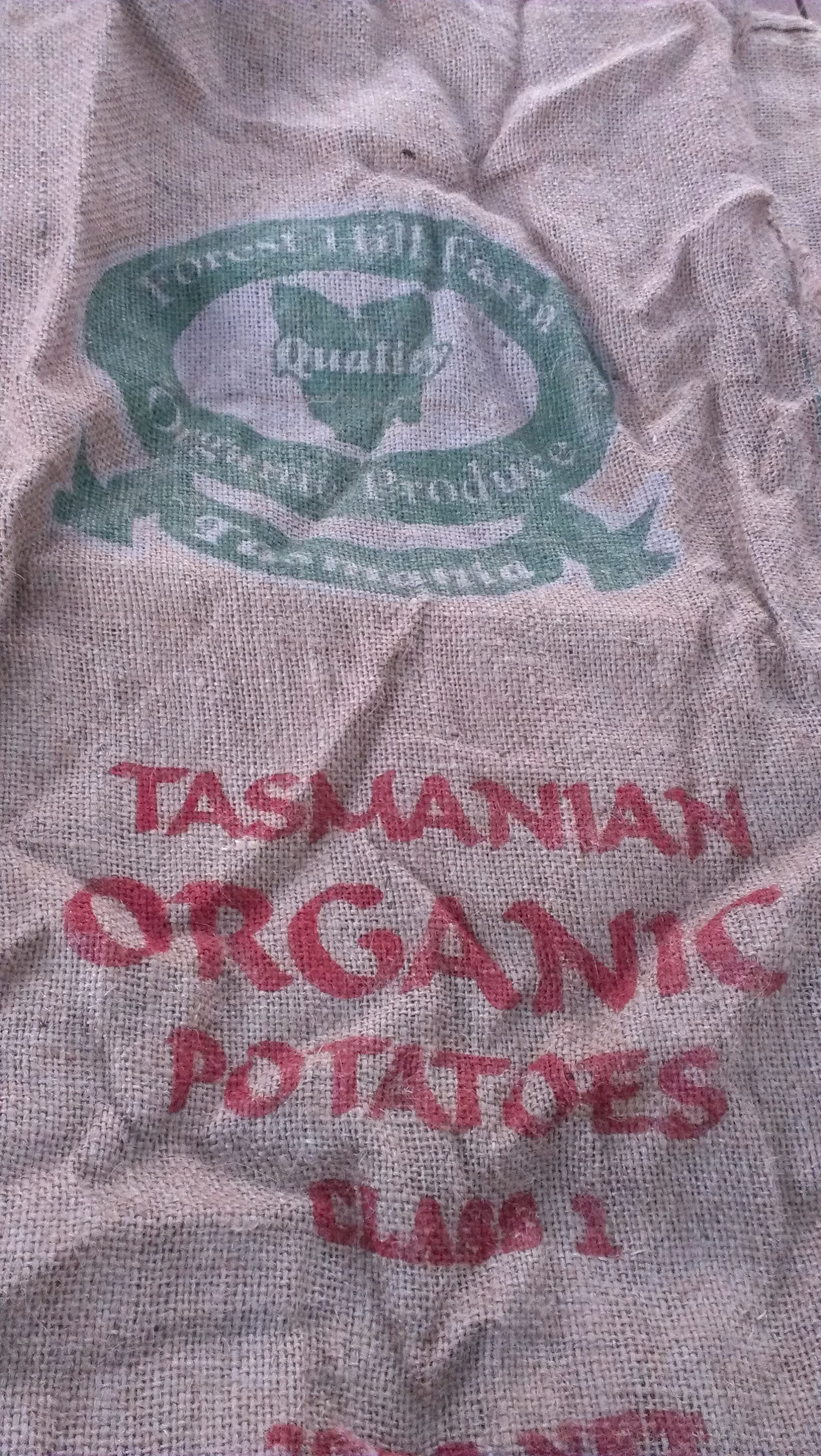
Many things that once came in hessian now arrive in plastic sacks–chook food being the most obvious example in my life.  Happily, the organic fruit and vegetable co-op we belong to still gets potatoes in sacks. Some are particularly cute.  This one features a wombat, in case this is not obvious to those from far away places!  In the past, I used to get spud (potato) sacks with spud man on them, a little animated potato chap.  I a made a lot of bags for co-op members from them.  The cute ones are especially motivating.  I think they make great lined carry bags.

2014-08-23 17.46.41

First wash your sack, inside-out, to remove the mud that is great for growing vegetables but particularly unfortunate if it finds its way into your sewing machine.  Choose shape and size of bag.  Stitch side and bottom seams, fold over a top hem, and then square the corners if you like a flat bottom (I do).  (Not sure what I mean?  scroll down to ‘stitch miter seams’ in this tutorial).

2014-08-24 09.18.49

Next, make a lining of similar size from whatever scraps you have and seam it up the same way.  No shortage of scrap fabrics at my place! If in doubt, make it a fraction smaller than the hessian outer.

2014-08-24 09.30.48

Next, choose fabric for handles, iron hems, fold in half and stitch. Finally, slip the lining into the outer.  Check for fit.  Pin lining to outer, and pin handles into position,  Stitch around the top of your bag, with some reinforcing stitches to keep your handle in good order.  And there you have it!

2014-08-24 17.03.59

I have one more bag in progress.  This one is posing in the potato patch, quite shamelessly… unfortunately, the woolly caterpillars have rampaged through the garden for weeks, munching everything they fancied in the process, and the potato plants themselves are looking less glamorous than they might.

2014-08-28 17.15.44

8 Comments

Filed under Sewing

Silkworm update: Week 1

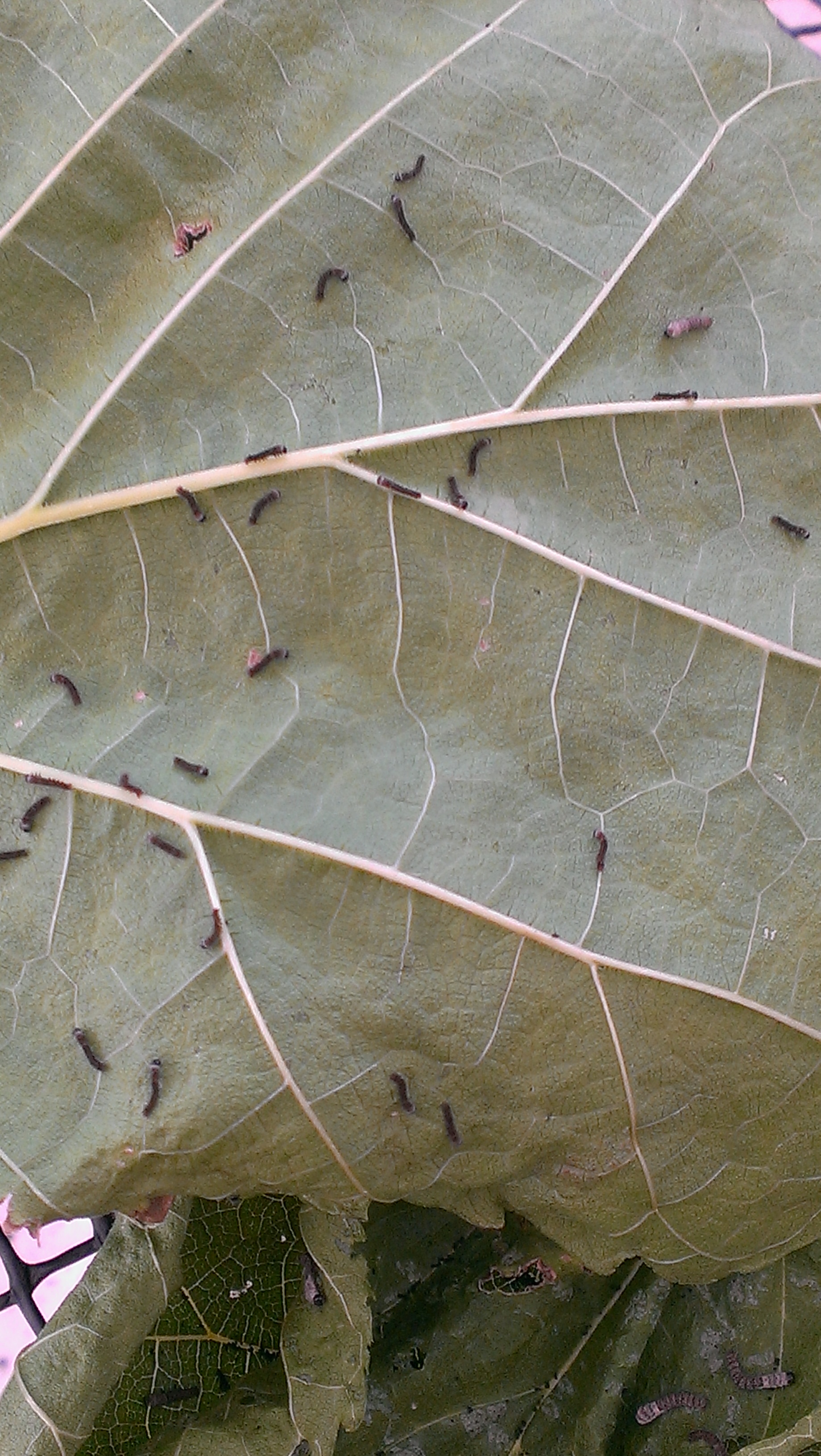
The silkworms are still hatching.  In considerable numbers. I don’t have it in me to make this an exciting photo essay, though!

2014-09-01 16.20.28


If your eyesight is keen, you will see some have already morphed into the next stage of their lives.  See the larger one that is grey with a cream coloured head instead of looking like a tiny black ant?  Its at about 7 or 8 o’clock in the image below.  Did I mention the tiny factor?

2014-09-01 16.20.51

In sad news of the week (which has been all about more and more silkworms otherwise), I have discovered that very few mulberry trees are in leaf locally.  One in my neighbourhood, to be exact, on this first day of spring.  The weeping mulberries are showing no signs of green.  The black mulberries in the park lands (which I made a special bike detour to visit in hope) are leafless.  So there is just one white mulberry supporting my growing brood so far.  Luckily, those micro-maws don’t consume a lot of leaf each day… yet!

Leave a comment

Filed under Fibre preparation

Sheet bundles

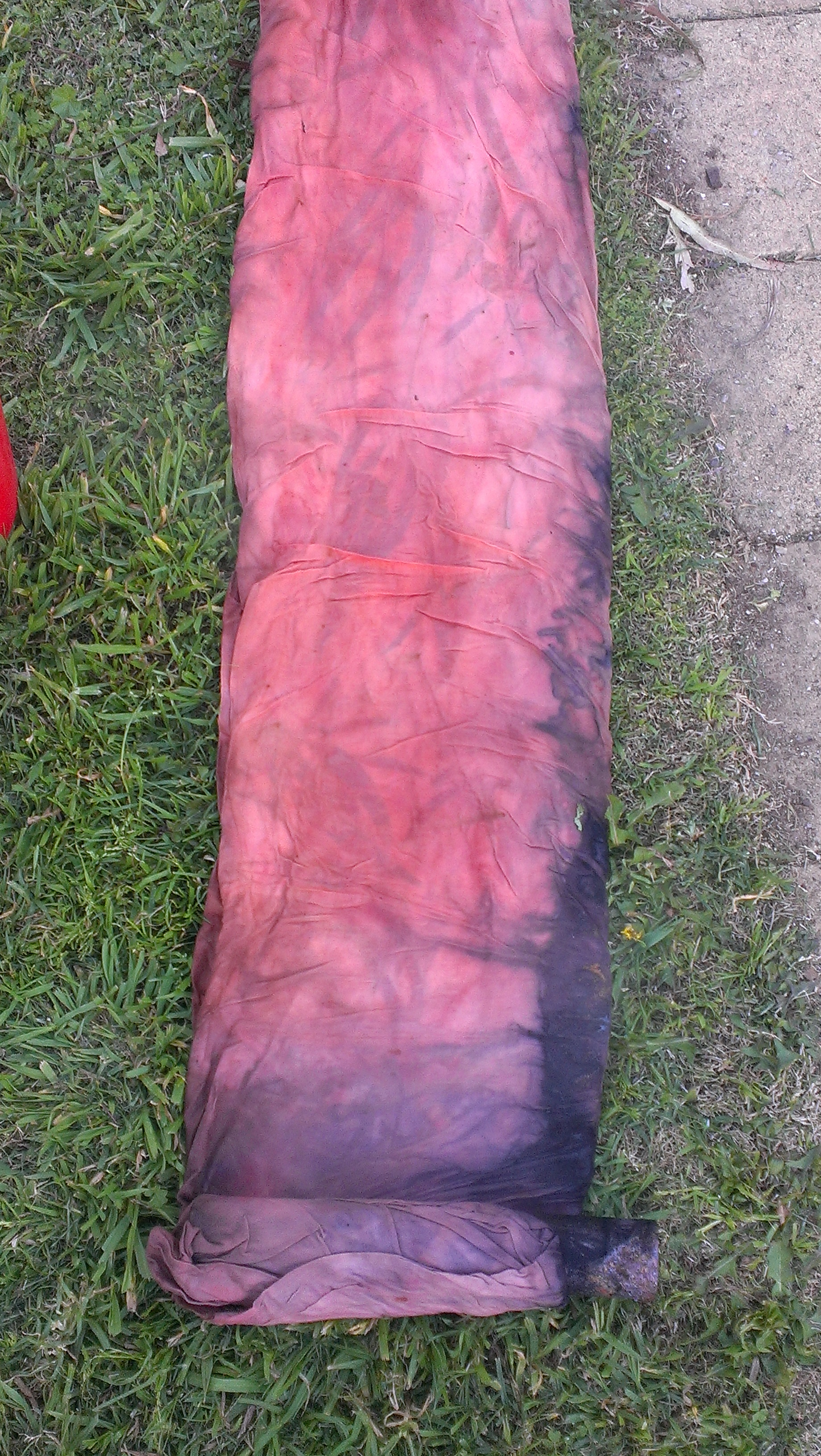
There has been some more bundle cooking for my friend.  She handed over these massive bundles–they are bedsheets. We’d walked over to visit with a bale of straw for our friends’ hens… and walked back with the bundles and cartons of fabric.  I spent time helping a friend clear out her Mum’s sewing room recently and since then have been finding new homes for sewing machines, yarn, fabric and a wide array of other items.  Some of my fellow guildies were delighted to take possession of tapestry bobbins…

2014-08-23 17.19.02


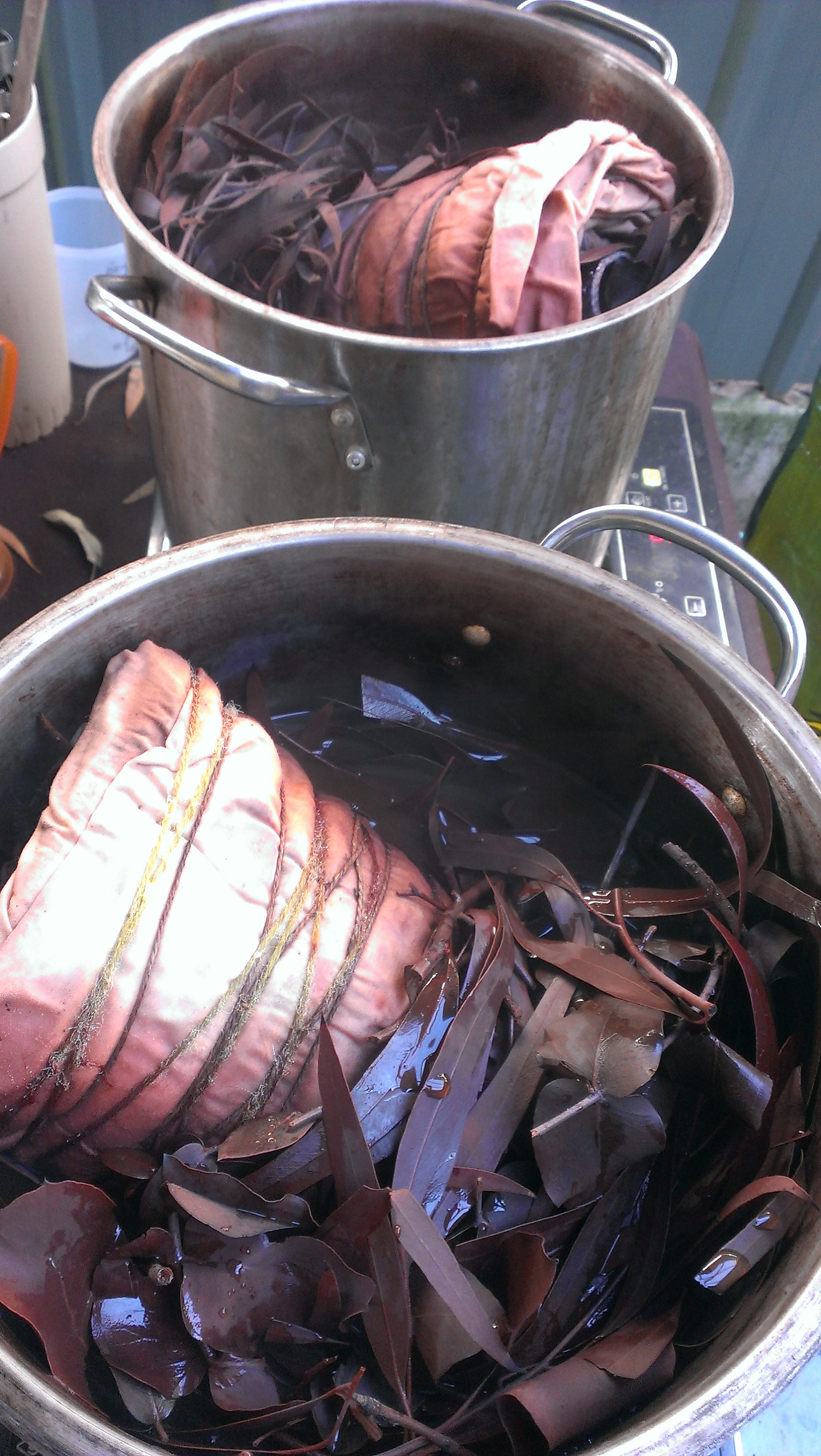
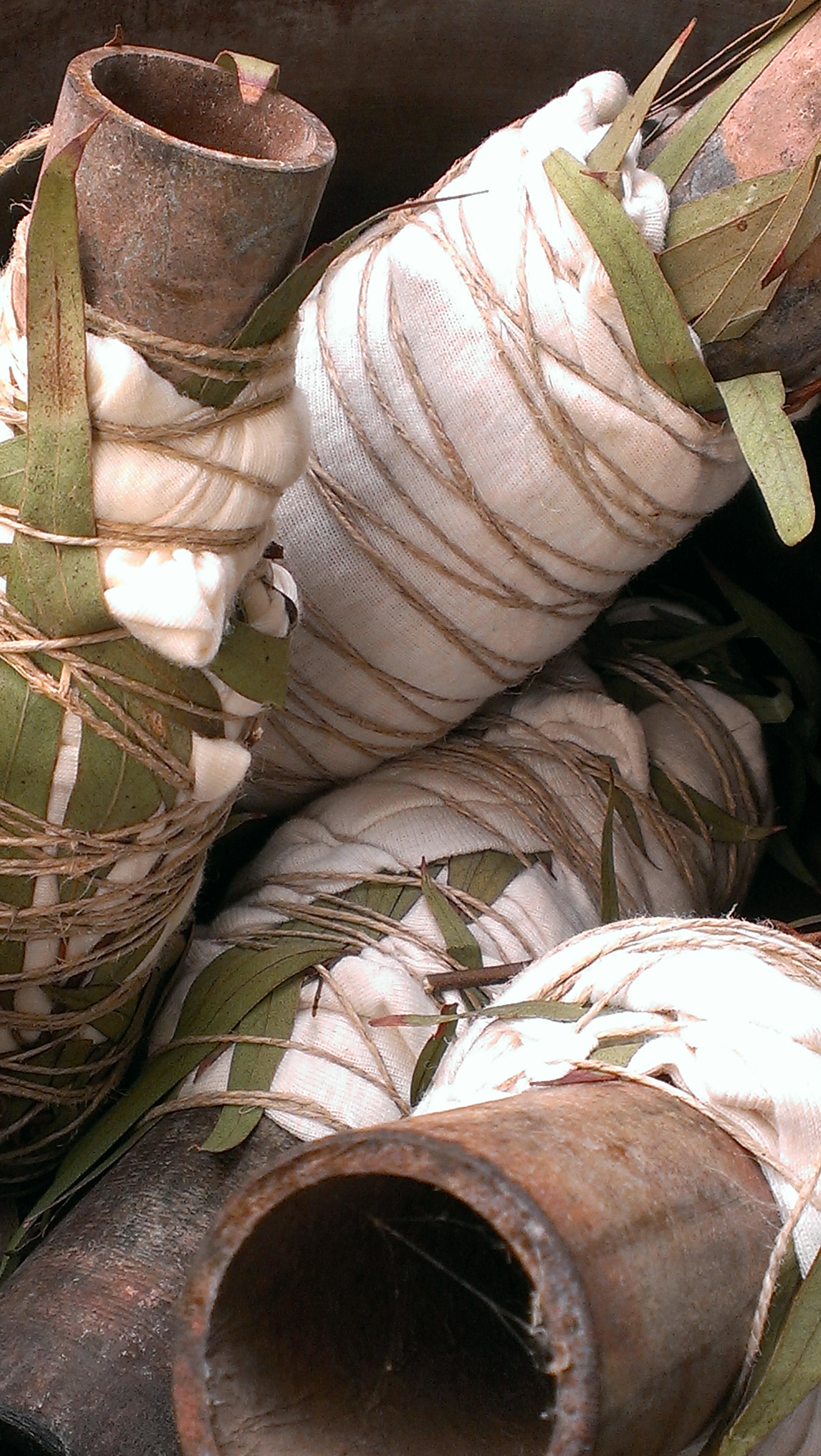
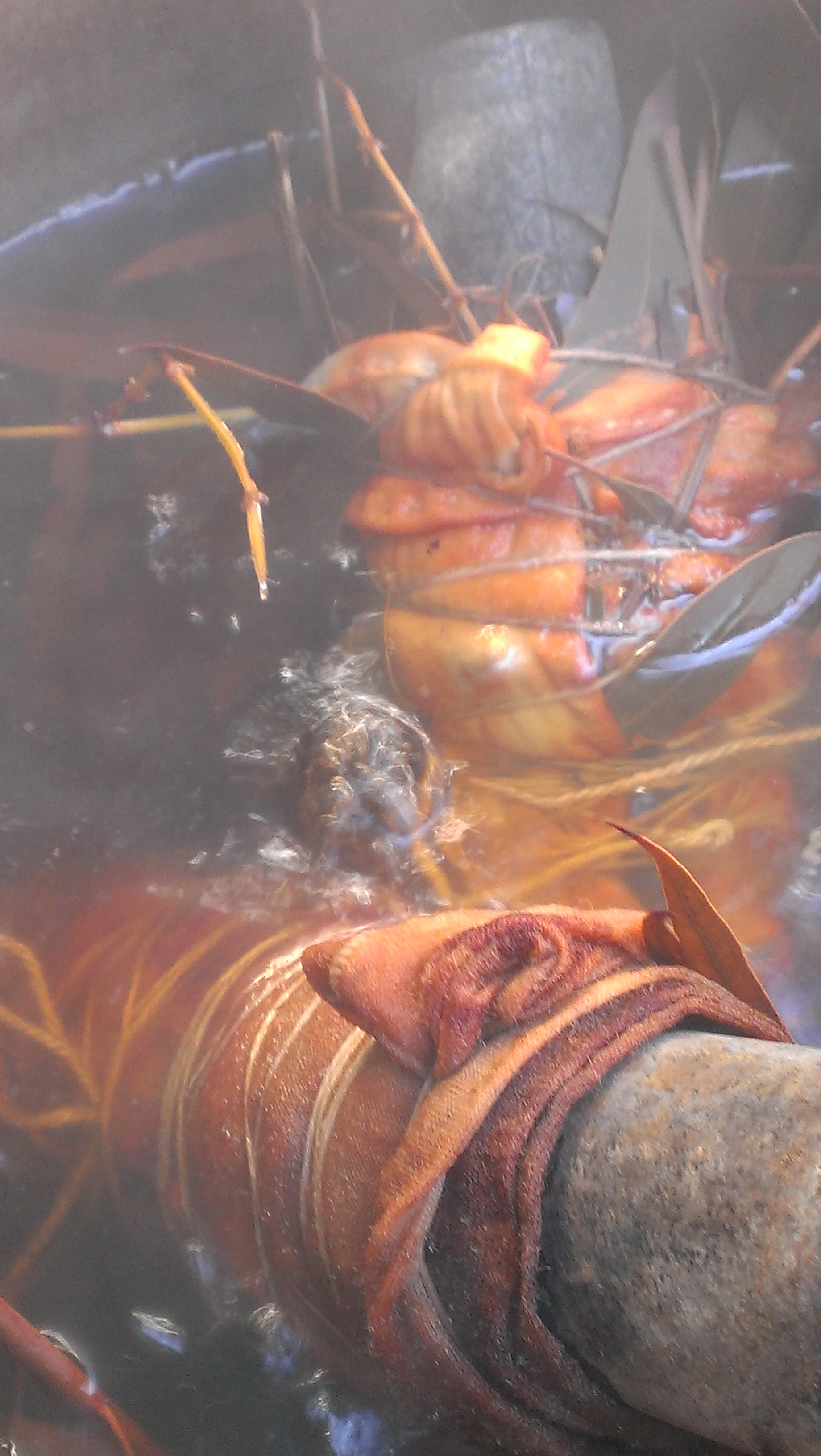
Here are the parcels going into the pot, packed with dried leaves.  My friends have an E Scoparia at the end of their street, and that’s what was inside the bundle… leaves and some bark, too!


2014-08-23 17.33.28


Some time later…

2014-08-24 08.15.25

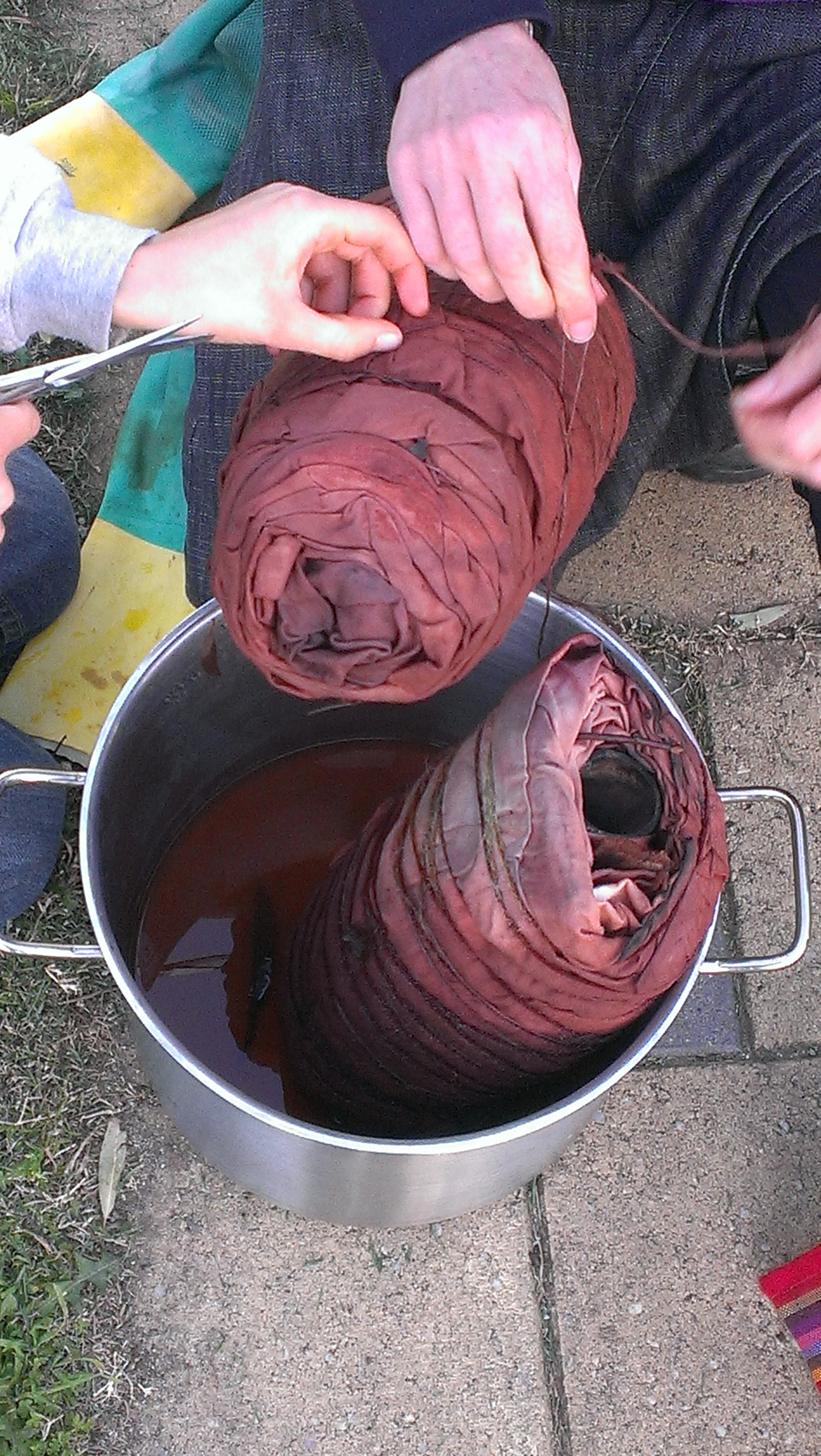
And being unbundled!

2014-08-24 16.43.03

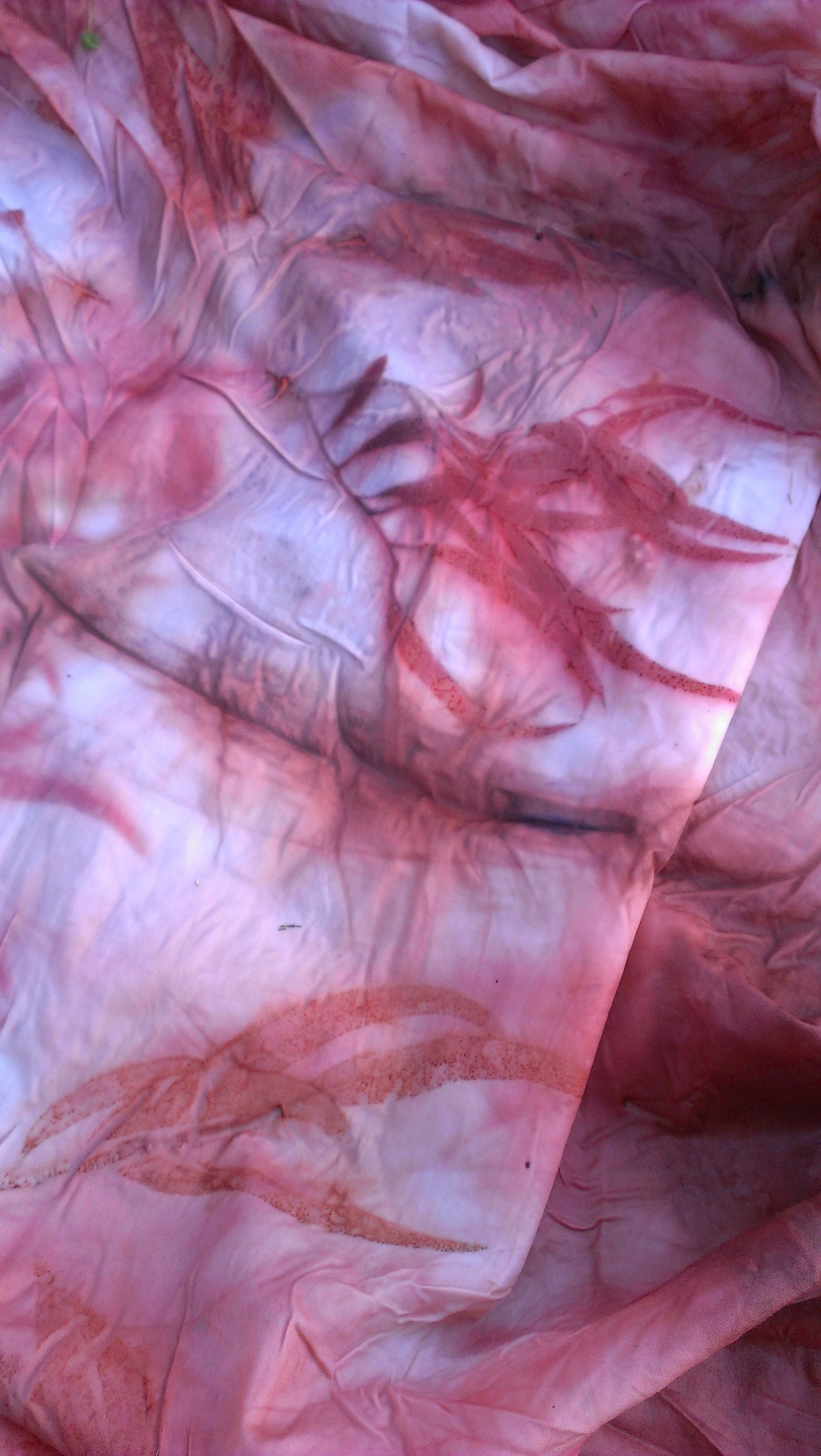
One had remarkably little in the way of distinct leaf prints.  I am amazed that there was enough dye in those leaves to colour so much fabric.  Unrolling…

2014-08-24 16.48.16


Flapping about over the lawn, wet from the dye pot…

2014-08-24 16.52.15

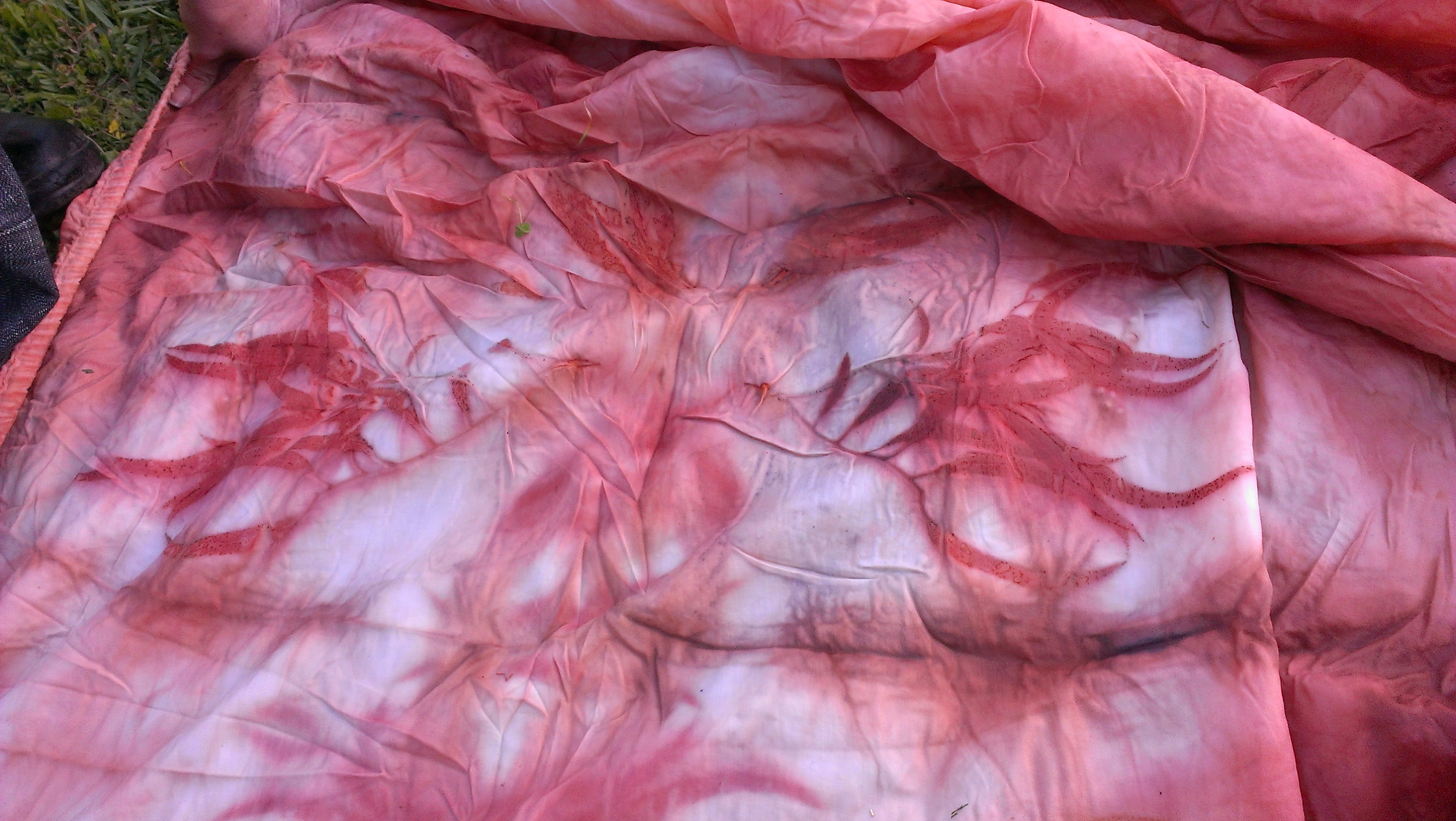
The second one had some prints in closest to the centre of the bundle. 

2014-08-24 16.58.53


Glorious!  A third immense bundle has gone home with my biggest pot, for some time on a gas burner.  I love that big pot but it just doesn’t work with my electric burners.  This is going to be one fabulous set of sheets!

2014-08-24 16.58.56

13 Comments

Filed under Leaf prints, Neighbourhood pleasures

Early silkworm hatchlings: Week 1, day 2

Last year, the silkworms hatched in September.  This year, in August.  I am not sure if that has more to do with the micro climate in my front room or global warming.  I am sorry to report I believe global warming is more likely.  Last night I went out and picked young lettuce for them.  This morning, I’ve been out examining the neighbourhood mulberry trees.  In good news for my little tiny silkworms, they are in leaf.

2014-08-25 08.35.56

So, brace yourselves!  We are re-entering the silkworm rollercoaster for another season!

2014-08-25 08.54.12

2 Comments

Filed under Fibre preparation, Neighbourhood pleasures

Dyes of antiquity: Carmine cochineal

2014-06-14 14.20.01

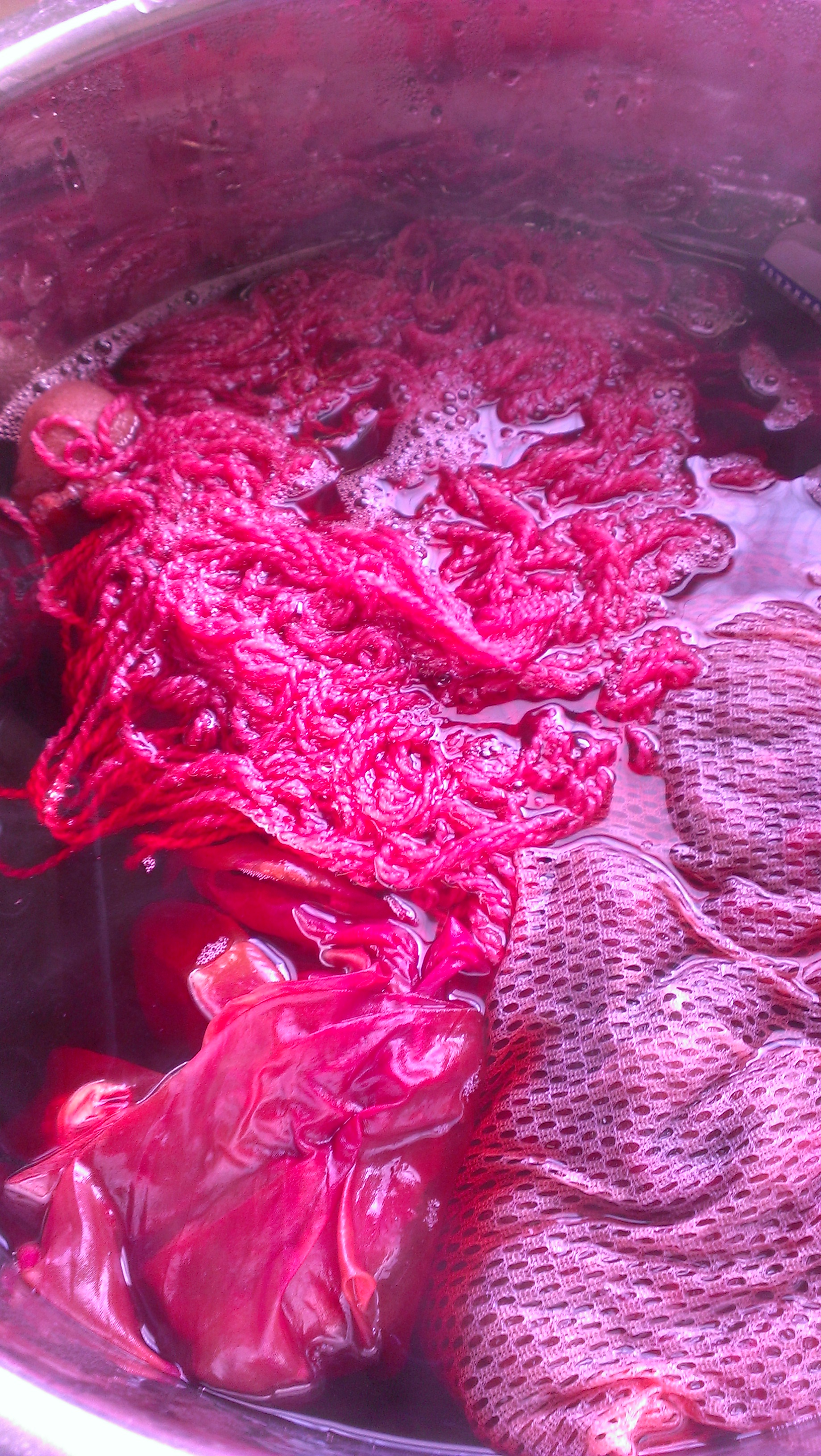
Cochineal is another of the dyes I received from the Guild and used at the workshop a while back.  In fact, there was a choice of cochineals.  In what I realise now was my ignorance, I chose ‘carmine cochineal’ because it was ground up and I was unsure how I could adequately grind the whole dried insects I also have.  As you can see, after an initial period of being dull ornage, the dye bath was an impressively shocking pink.  It turns out that ‘carmine cochineal’ is not a shade of cochineal but a preparation of cochineal boiled with ammonia or sodium carbonate.  I borrowed Frederick Gerber’s Cochineal and the Insect Dyes 1978 from, the Guild and found that the deeper red colour I had in mind when I saw the term ‘carmine’ could only be obtained from this preparation with the application of a tin mordant which I am not prepared to use.  the colours we achieved with alum were well within the range indicated by the included colour chart of wool samples (those were the days!)

2014-07-20 16.00.18

The colour range on this card (with madder beneath for comparison) is impressive even without tin. 

2014-07-21 14.33.21

We dyed organic wool. I dyed silk paj and twined string (the orange string was dyed with madder). 

2014-07-04 12.52.33

I brought the vat home with me and dyed a lot more fibre in an attempt to exhaust it.  Here is grey corriedale mordanted with alum and overdyed with carmine cochineal.

2014-07-30 11.27.48

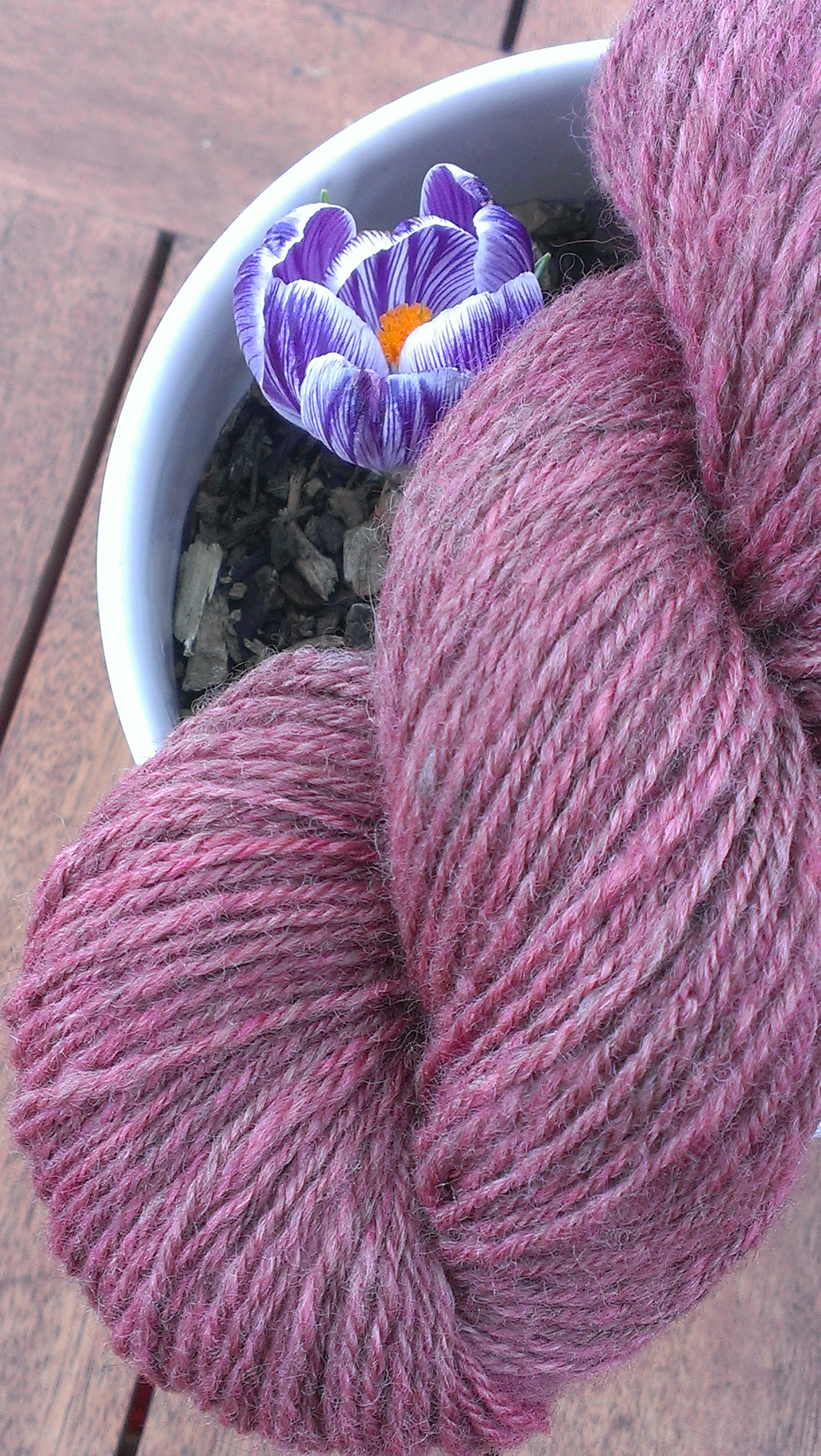
And spun–three plied.  This is my first ever crocus flower, by the way!

2014-08-23 11.57.30

The magenta silk embroidery thread had maximum time in the bath, since I fished it out when removing the dyestuff (in its recycled stocking) prior to disposing of the bath!

2014-07-30 11.23.55


12 Comments

Filed under Natural dyeing, Spinning

Socks for active toes

Last weekend I finished these socks–eucalyptus-dyed patonyle with a subtle indigo blue stripe at the cuff (I mention its subtlety since it is invisible in the image above).  We went to visit the intended recipient yesterday and I could wait no longer for the right moment to take a picture in daylight.

2014-08-16 16.14.27

There was less than a metre of yarn left when I finished these.  I handed them over and they were whipped onto enthusiastic feet in no time at all.  This was he closest to a still image I was likely to get.

2014-08-16 16.23.50

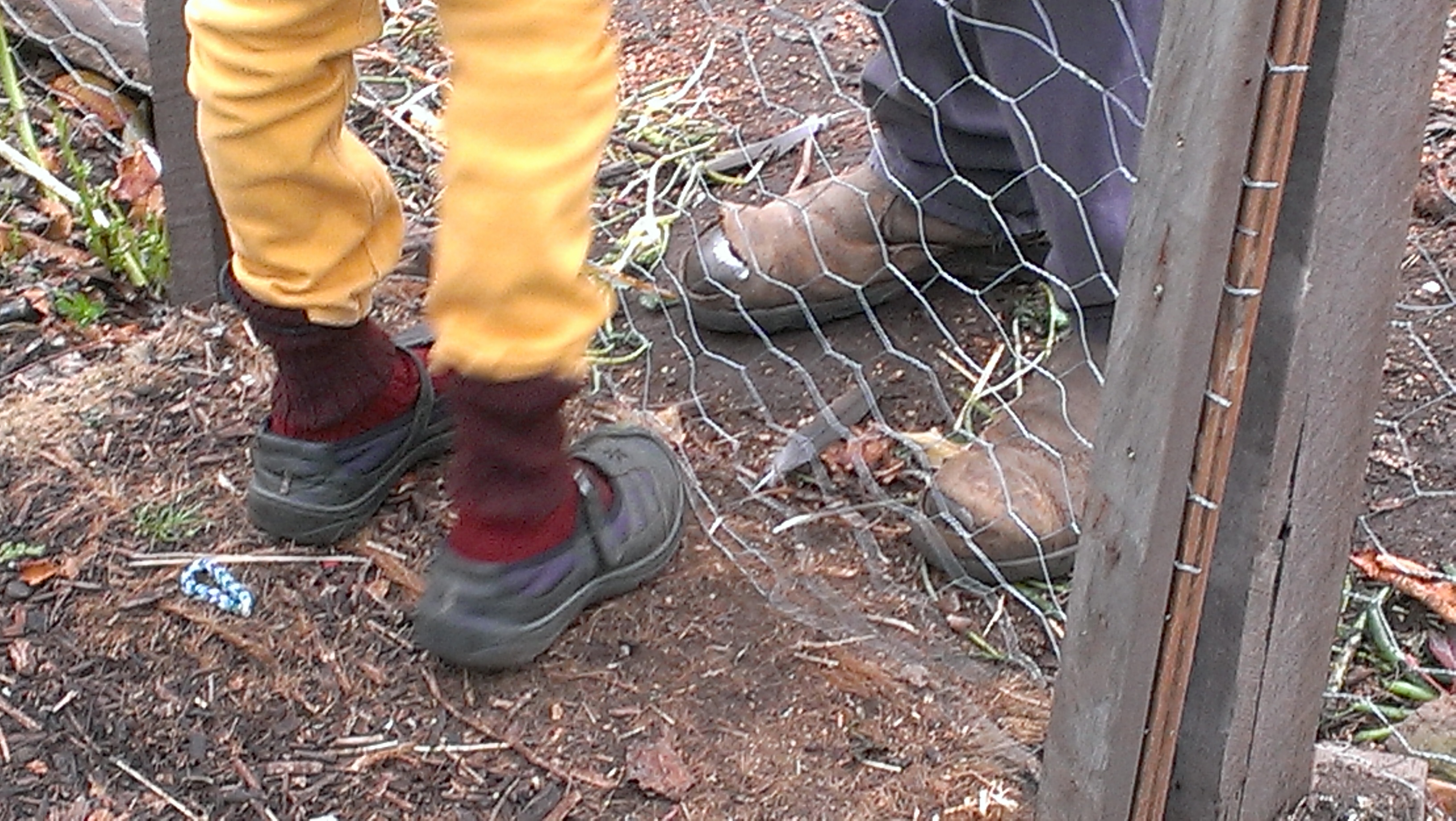
Pretty soon they were out into the chook yard with someone else’s shoes over them…

2014-08-16 16.25.12

Happily these fast-growing feet are the same size as those of an adult in the family–so in case they are outgrown they will still be of use.

2014-08-16 16.25.29

Then, up into the mandarin tree in weatherproof pants because of impending rain..

2014-08-16 16.33.13

And pretty soon my pocket full of socks had become a pocket full of flowers and beautiful leaves and we were heading home after some guitar playing, hot chocolate (or carob or dandelion, depending), chat and plans for a future shared meal and off into the evening with enough mandarins for marmalade and more.  Friends are such wonder and delight!

1 Comment

Filed under Knitting, Natural dyeing

Dyeing red with dandelion–more speculation

Some time ago, there was quite a conversation about dyeing with dandelion here. Just in case the name of a chicory that I grow–Chicory ‘red dandelion’ might be a clue to some crooked turn in the path on this subject where names had been mixed up–I tried dyeing with chicory root here to no very exciting outcome.  I did a bit more research on the subject after our last conversation, and here is what I can add…

Accounts of how reds may be obtained from dandelions:

Winifred E Shand gives the account that got me started on the dandelions in my garden, in: ‘Dyeing Wool in the Outer Hebrides’ in Dye Plants and Dyeing–A Handbook (Brooklyn Botanical Gardens, Brooklyn NY, 1964) 64.  She says that to obtain ‘Dandelion (Bearnan Bride) Magenta (Taraxacum officinale) Use whole plant, boil for two hours, remove plant and boil wool for half an hour.’  The author clearly collected these recipes from other people, though she does refer to ‘most of the recipes which I have collected and tried out…’.  Mordants are mentioned in many recipes but not this one, and it is clear there are some  recipes she hasn’t tried out.  Those involving urine, for example, where her feelings on the subject are made known in plain terms!

There is a writer on Ravelry who states that she has obtained red from dandelion but was not using taraxacum officinale.  Rather, she believes the original Scottish plant was a red-veined form called Leontodon palustre.  Now known as taraxacum palustre (marsh dandelion) it clearly has been identified in North America and many other parts of the world.  It was thought to be a subspecies of taraxacum officinale in the past, and is known by a variety of other names.  You can read her account of how it was done, using a fermentation method, by searching for Purple from Dandelions on Ravelry.  That, my friends, is the end of all I can tell you about how to obtain red from dandelion.  On the other hand, I can point to a couple of  sceptics:

  • Hetty Wickens, Natural Dyes for Spinners and Weavers (Batsford, , London, 1983) 10-11 ‘Dandelion roots have always been a great disappointment to me.  Scottish dyers are said to have obtained magenta from dandelion roots, but I have only obtained a dirty yellow.  (My dandelions grew in Sussex).’
  • Ida Grae Nature’s Colors: Dyes from Plants (MacMillan Publishing, New York, 1974) 20 ‘Much mention has been made of the dandelion root yielding magenta.  I have never found it so.  One of my students from the East Coast [USA] says that a lavender-gray is sometimes obtained from this root.’

A number of authors I have read describe dandelion as a source of greens and/or yellows only:

  • Jenny Dean, Wild Colour: How to Grow, Prepare and Use Natural Plant Dyes (revised) (Mitchell Beazley, London 2010) 137 (Though see this post on Jenny dean’s blog which speaks to their reputation for giving magenta).
  • Karen Leigh Casselman Craft of the Dyer: Colour from Plants and Lichens (2nd edition) (Dover Press, New York, 1993) 134
  • Joyce Lloyd Dyes from Plants of Australia and new Zealand: A Practical Guide for Craftworkers (Reed, Sydney, 1971) 37
  • Alma Lesch, Vegetable Dyeing: 151 Color Recipes for Dyeing Yarns and Fabrics with Natural Materials (Watson-Guptill, New York, 1970) 41-42
  • See, too, the Harris Tweed Authority (this page has wonderful pictures of Scots women dyeing).

A couple of others I consulted offered no comment whatever:

  • Betty E M Jacobs Growing Herbs and Plants for Dyeing (Select Books, Missouri, 1977)
  • Rita J Adrosko Natural Dyes and Home Dyeing (Dover Publications, new York, 1971)

So there you have it!  Dandelions have many fine qualities but magenta dye may or may not be one of them unless, perhaps you can access Leontodon palustre

11 Comments

Filed under Dye Plants, Natural dyeing

Bundle over-dyeing

2014-08-02 13.49.00

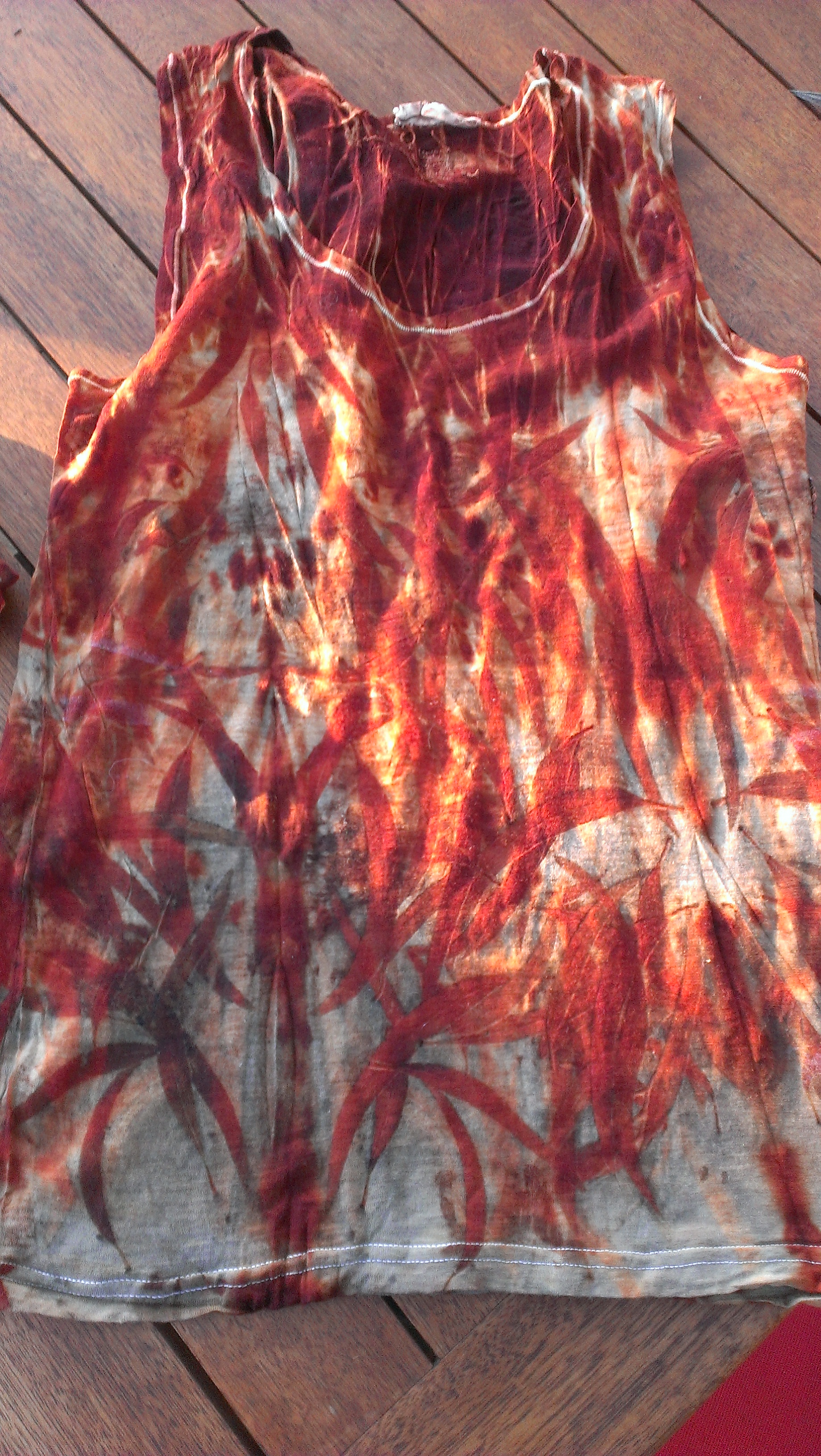
I began with this… a much worn and washed and somewhat faded and darned merino singlet.  There was also a silky merino infinity scarf, but the ‘before’ picture was not too exciting.

2014-08-02 14.35.52

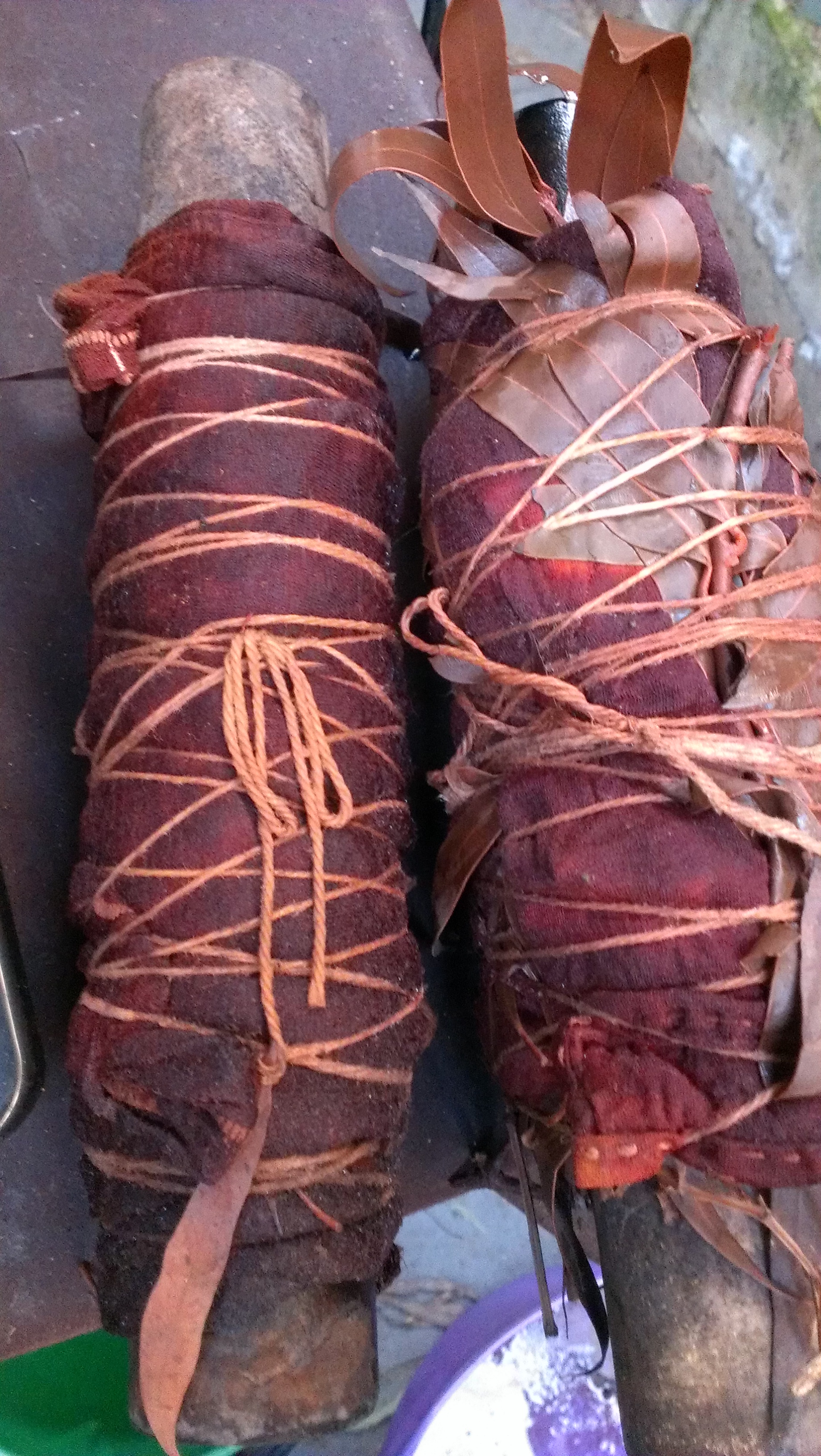
And there were these… four bundles friends had wrapped up and prepared for the dye pot.  So much creativity…

2014-08-02 14.22.39

Needless to say, heat and eucalyptus worked their magic.

2014-08-02 16.04.00

By next day, I had these bundles to pass on to my friends at the local farmers’ market (where one was unwrapped on the spot)!

2014-08-03 09.51.33

My two were unwrapped on my happy return from Back Country, which seemed entirely appropriate to me.

2014-08-03 17.03.18

Here they are, wet and glorious, freshly unbundled.

2014-08-03 17.08.31

The silky merino was more red/yellow and orange–and the overdye full of greys and blacks and reds.

2014-08-03 17.48.17

Finding daylight and sunshine to photograph in has been challenging, but… I am wearing the scarf today at work and feel very snug and cheery about it.

2014-08-06 07.57.15

And the singlet looks even darker and richer than this photo, and the darning has receded into  the background quite suitably!

2014-08-06 07.56.37


14 Comments

Filed under Eucalypts, Leaf prints, Natural dyeing, Neighbourhood pleasures