How diverting!

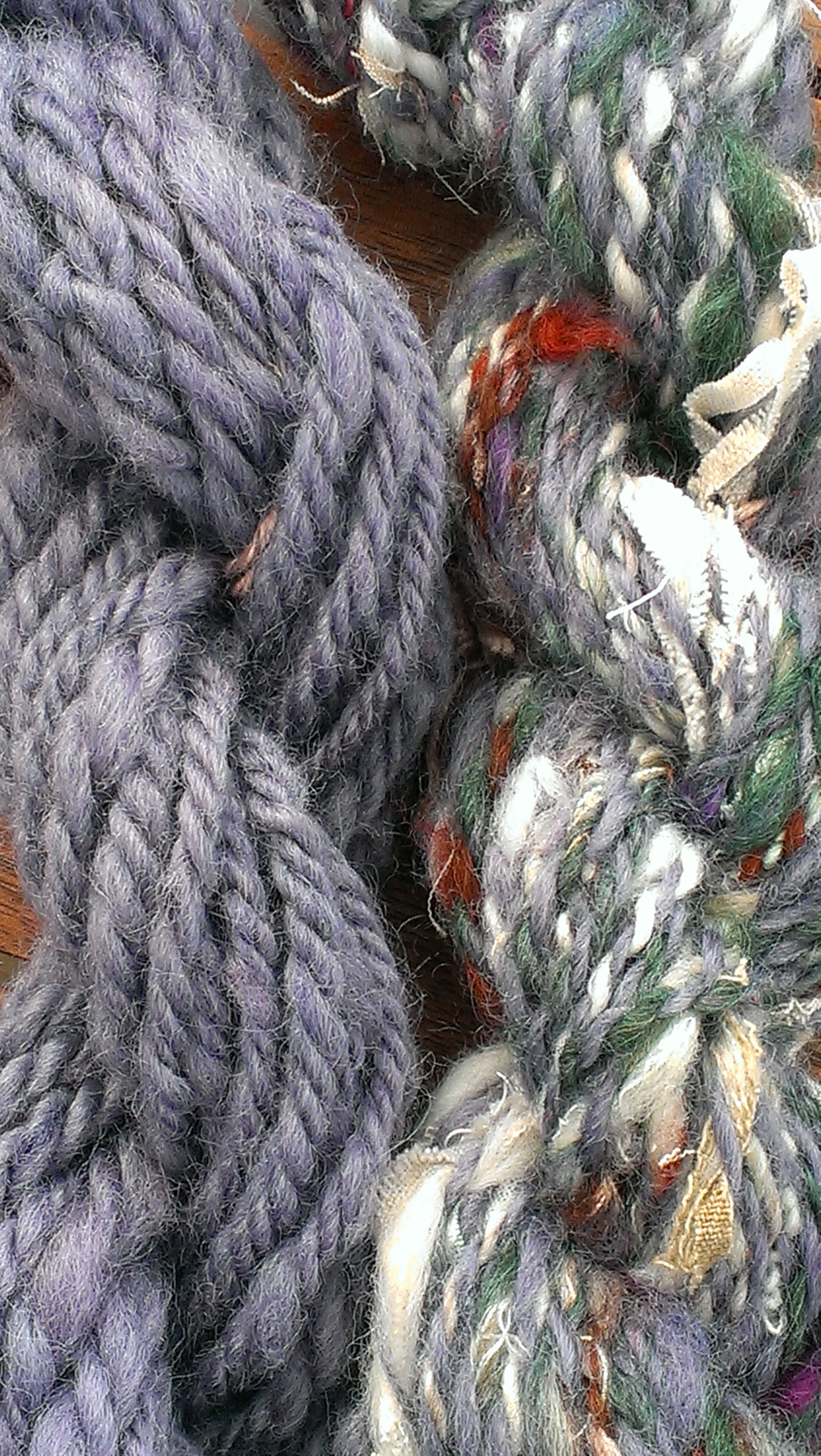
Experiments in diverting textile waste from the rubbish bin or compost continue… The lavender wool and the entirely waste batt are all spun up.  In the end, I plied the trash batt with a single of the lavender wool.  I can’t say I expected loveliness, and to my mind this is not lovely. As for the spinning experience: it was fine to spin though my lack of foresight about a plying strategy wasn’t ideal and I didn’t think a chain 3 ply would work.  I also have to say that even with a  generous apron under my drafting zone, this yarn shed loads of pieces of chopped thread at every stage, which didn’t make me popular with my beloved.
IMAG2278

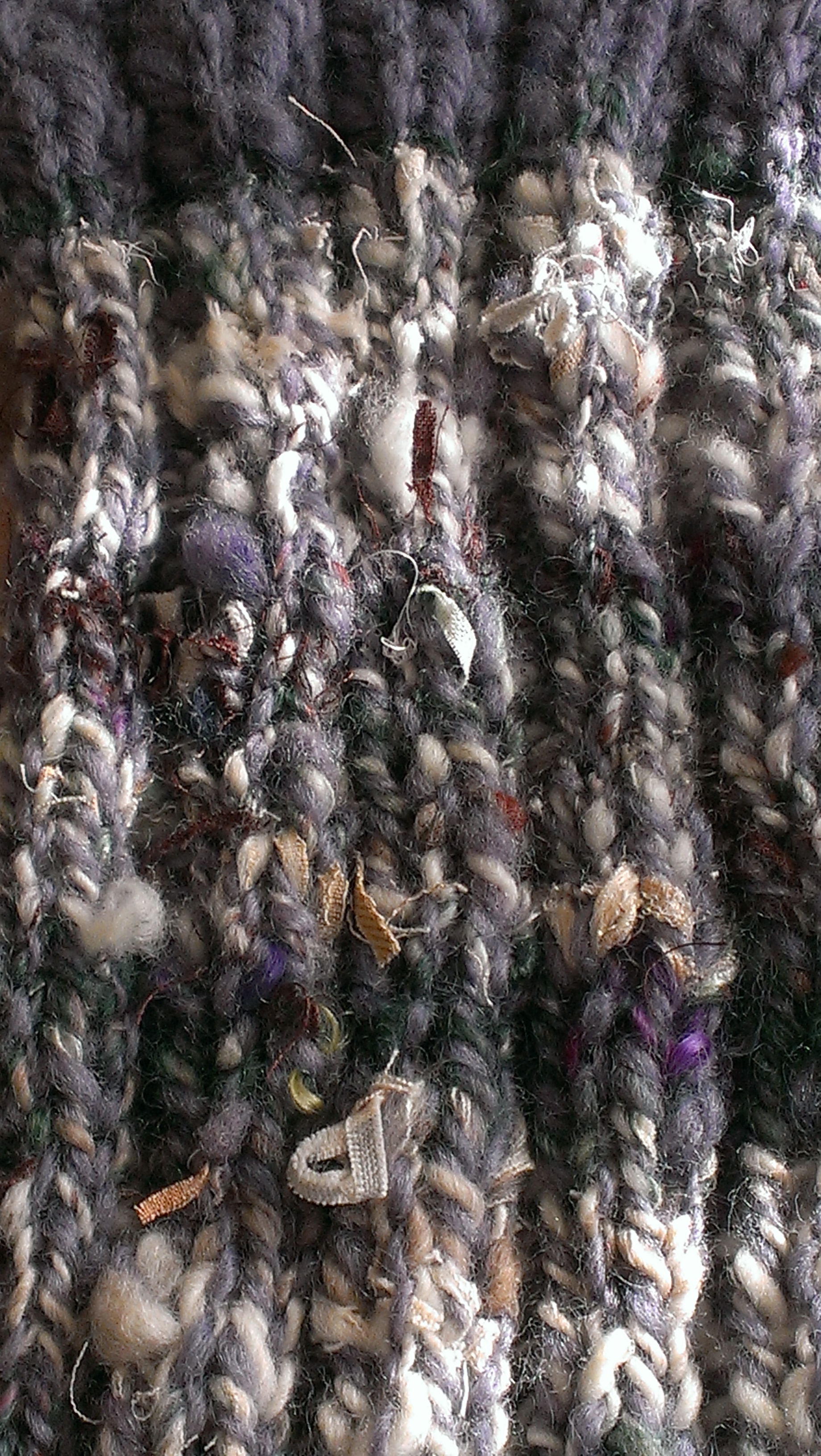
These yarns are destoned for yarnbomb glory.  I knit then into K2P2 ribbing and will apply them when I’ve chosen a suitable spot and the rain and wind abate!
IMAG2353

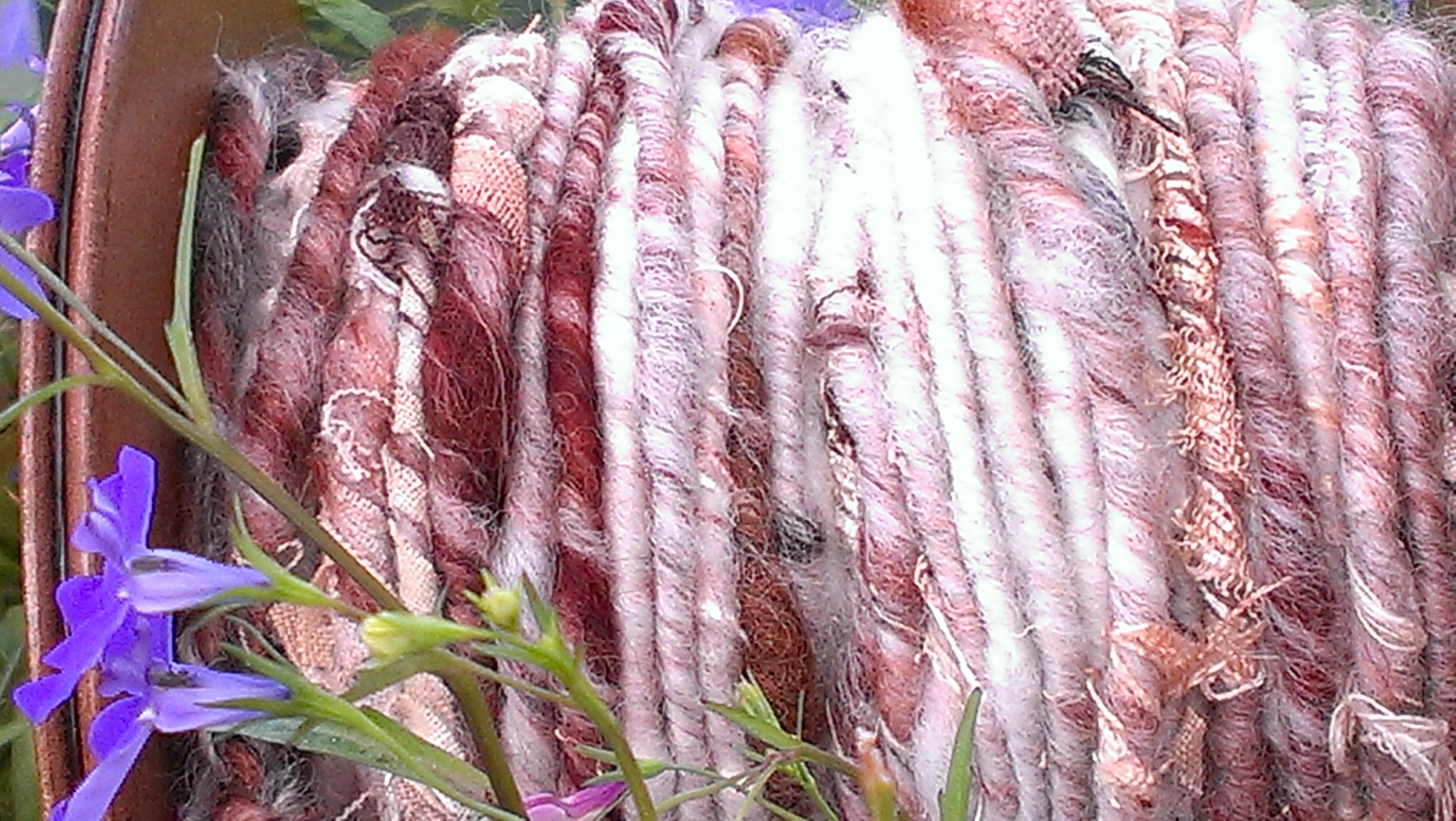
On the other hand, here is a corespun yarn made from the batt composed of white polwarth locks, eucalyptus dyed corriedale carding waste and overlocker waste (much of it from leaf printed fabrics).  I like this very much. I think the ratio of polwarth to other inclusions is part of what works, but so is the texture of the polwarth–it helps hold everything together.  The happy combination of colours doesn’t go astray either…
IMAG2281

6 Comments

Filed under Knitting, Spinning

Neighbourhood windfalls 1

We’ve had gale force winds here lately.  One morning about a week ago, 40% of my city had no power when we woke up (we were happily still connected to the grid).  Needless to say, this has led to windfalls, and I was still collecting them yesterday as further gale force winds began a week later.

The first windfall was an ironbark.  Guessing from its location (a stand of three ironbarks) and the gumnuts still intact, I think it is E Tricarpa. Sadly, just as unremarkable as a dye plant, as the last time I tried!

IMAG2302IMAG2304

I have not managed to identify this tree, partly because it branches metres above ground level.  Even with so much of its canopy on the ground, I didn’t find a single bud, flower or fruit to help me identify it.  The trunk is rough and pale. The whole tree is difficult to capture in a photo, especially on such a gloomy day.  It must be at least 20 metres tall.

IMAG2335IMAG2336

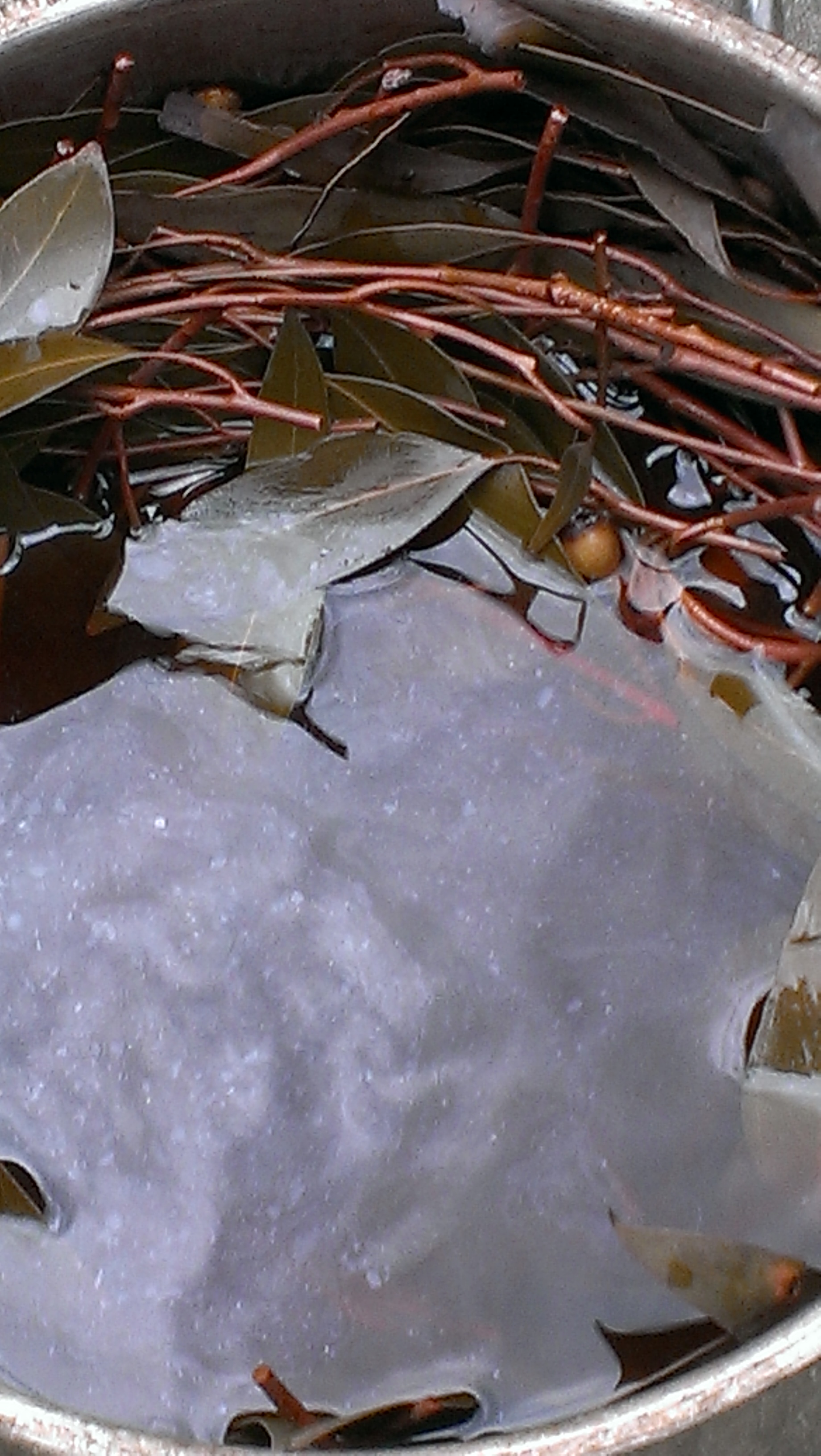
It seems to be under attack from some kind of scale insect.  Every single leaf was affected. Here it is after some hours in hot water–suggestive of a beige outcome….

IMAG2309IMAG2349

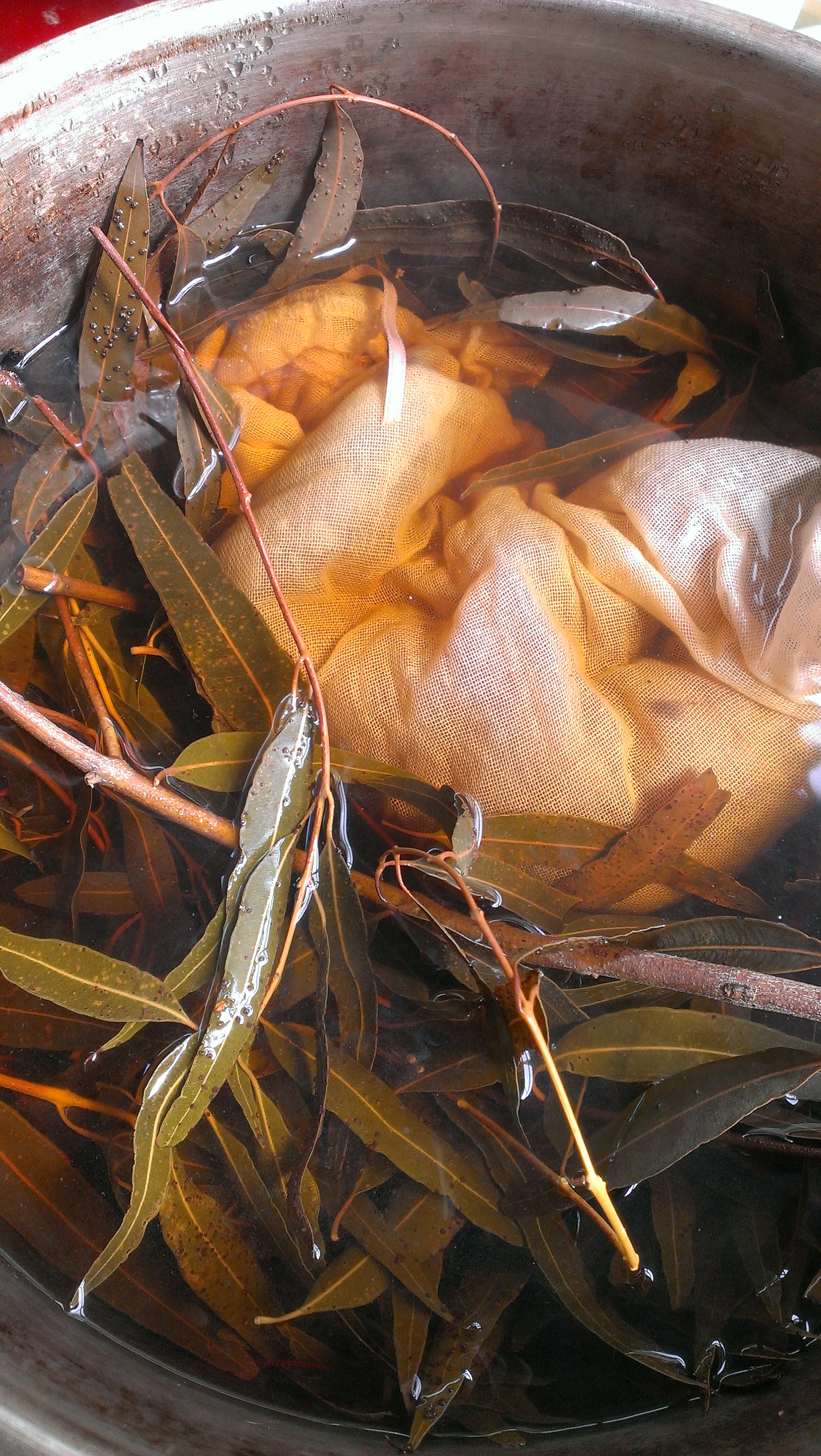
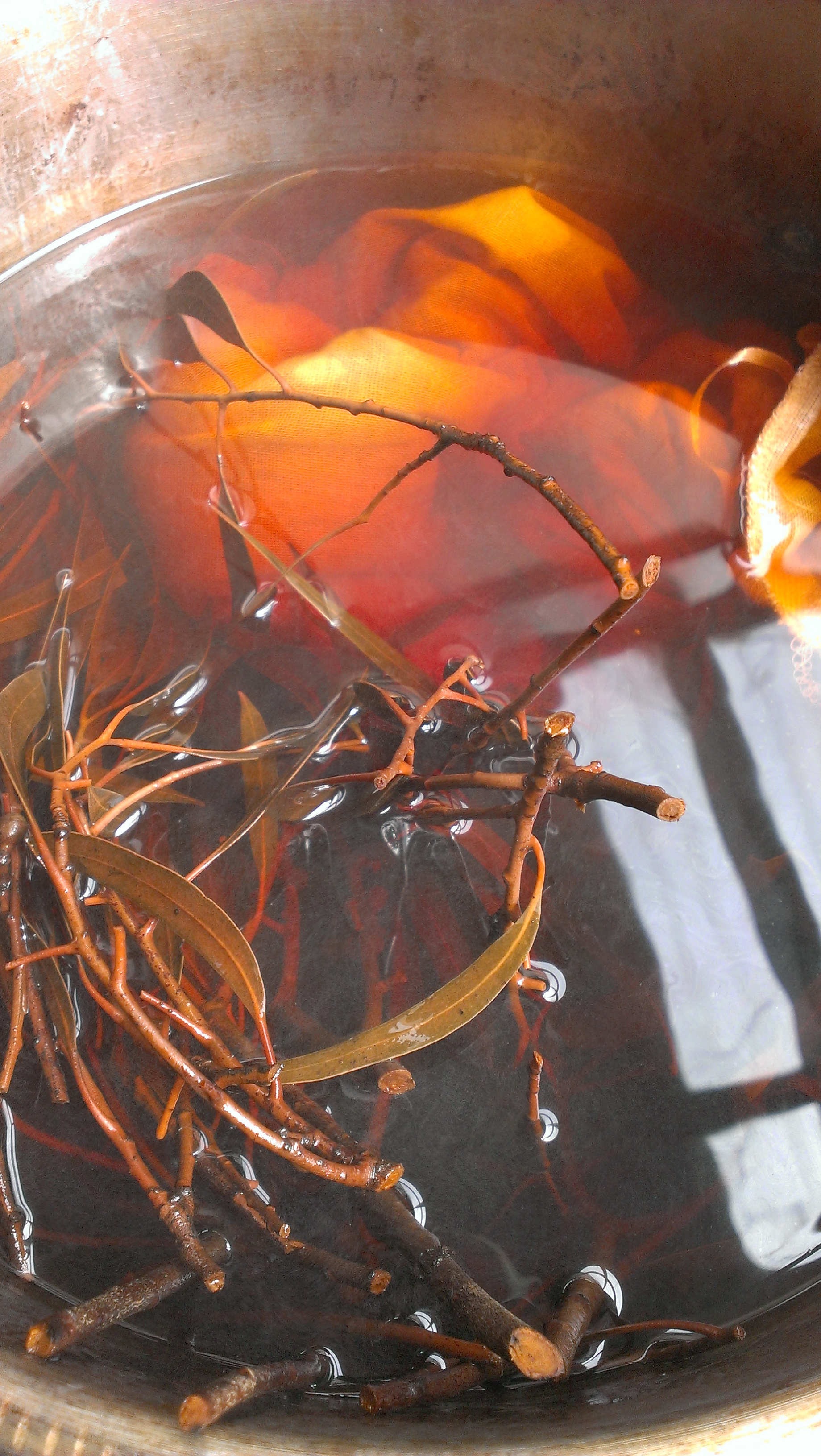
Compare my third windfall.  This is a tree that has been cut to accommodate cars parking beside it, in the car park of a recreation area.  I haven’t been sure whether it was E Scoparia, E Camaldulensis, or some other unknown eucalypt.  Both E Scoparia and E Camaldulensis have similar shaped and sized leaves, small fruit and both can have pale, smooth trunks (but this trunk looks more E Camaldulensis to my admittedly self-trained eye).  The branch that fell to the ground had an uncharacteristically large number of fruit on it for E Scoparia.  On the other hand, the clusters of seven fruit with 3 valves apiece made me think it might be E Scoparia after all.  So did the colour of the dye bath, though the leaves did not turn orange the way E Scoparia usually does.

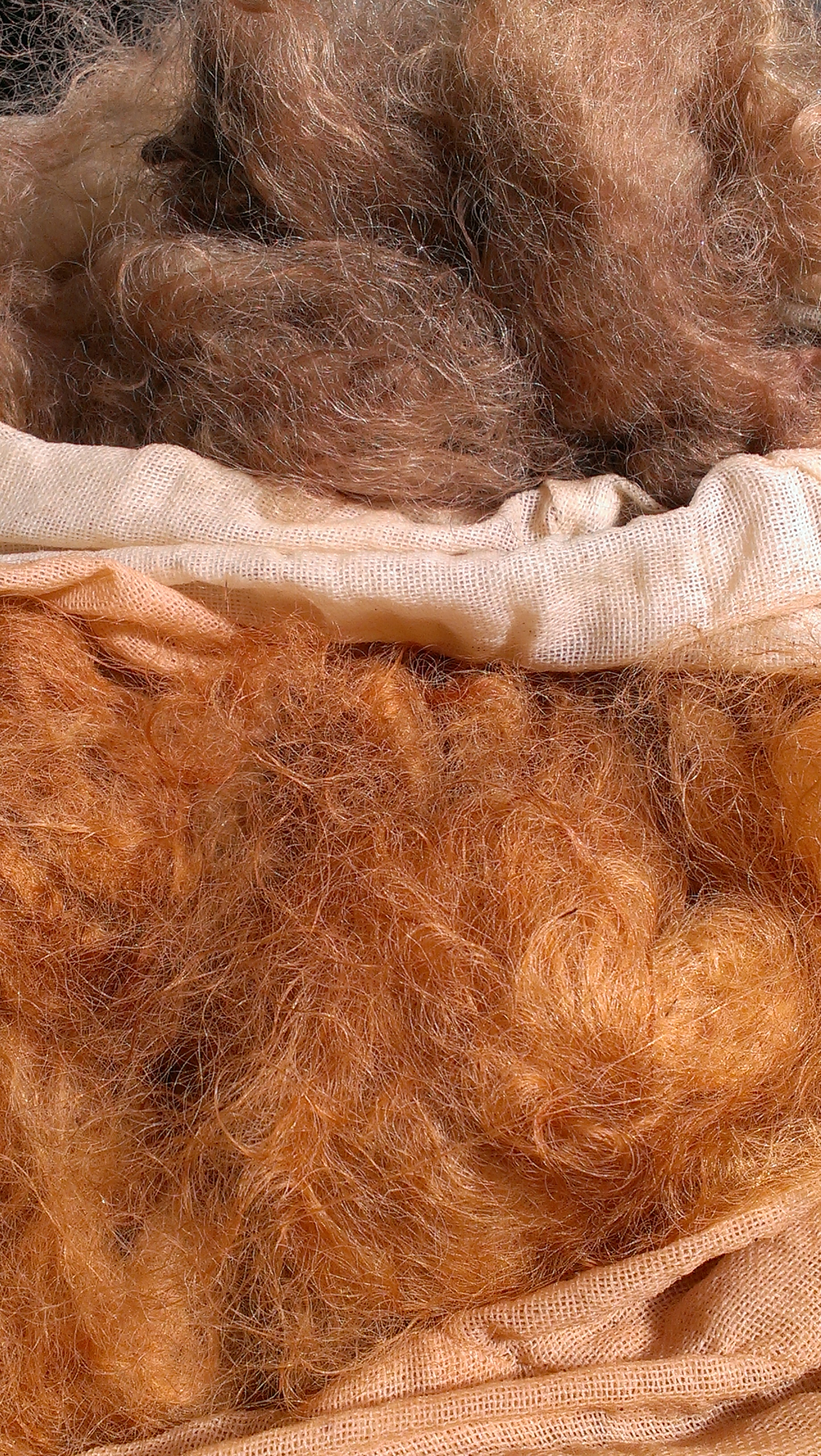
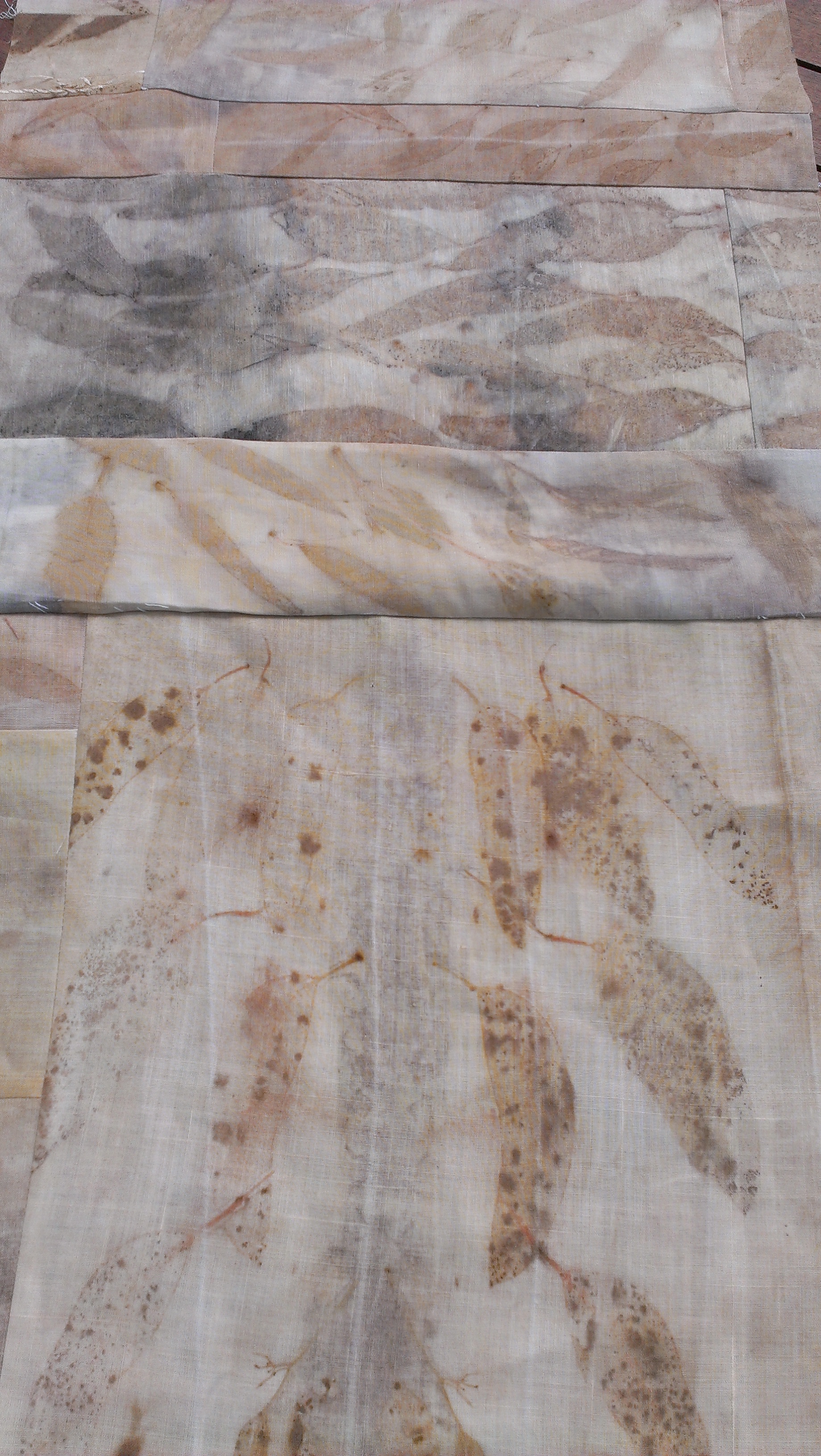
In spite of the colour of that dye bath, the result says that this is not E Scoparia, and the 3 valves say that it isn’t E Camaldulensis either (4 valves).  Even with vinegar to help bring out whatever orange or red might be there to be had, and still damp from the dyebath… the 3 valved tree is at the top (brown-beige?) and the 20 metre tall tree is at the bottom (caramel-beige).

IMAG2350IMAG2351

Here are the results of a bath with a fallen branch from an actual E Scoparia, downed in the same windy night.  They’re the red and orange samples, with the E Tricarpa for contrast.

IMAG2316

13 Comments

Filed under Dye Plants, Eucalypts, Natural dyeing

WordPress Family Blog Award

Some time ago I was kindly nominated for the WordPress family Blog Award by tinkerbellknits, who has a lovely blog you might like to visit.  Thanks so much, tinkerbellknits!

IMG_6233

Award Description:
“This is an award for everyone who is part of the “Word Press Family” I start this award on the basis that the WordPress family has taken me in, and showed me love and a caring side only WordPress can. The way people take a second to be nice, to answer a question and not make things a competition amazes me here. I know I have been given many awards, but I wanted to leave my own legacy on here by creating my own award, as many have done before. This represents “Family” we never meet, but are there for us as family. It is my honour to start this award.”

IMG_6244

I am in turn nominating the following bloggers as people who have had a positive impact on my experience as a blogger… through their writing and what its shows about their craft and their values, their modelling of what a blog could be and what a blogger could be.

I hope you might check out their blogs.

Cossack design http://cossackdesigns.wordpress.com/

Wendi of the Treasure http://wendiofthetreasure.com/

Grackle and Sun http://grackleandsun.wordpress.com/

Sea Green and Sapphire http://seagreenandsapphire.wordpress.com/

Pia at Colour Cottage http://colourcottage.wordpress.com/

R1K1Spin http://run1knit1spin.wordpress.com/

Deb McClintock http://debmcclintock.wordpress.com/

Trembling Inside the Cocoon http://tremblinginsidethecocoon.wordpress.com/

HXGreen Soul http://hxgreensoul.wordpress.com/

SeattleSpinner http://seattlespinner.com/

My thanks to all those who have supported this blog–I started out quite unsure whether I would enjoy or persist with it, and I find that I do and I will.

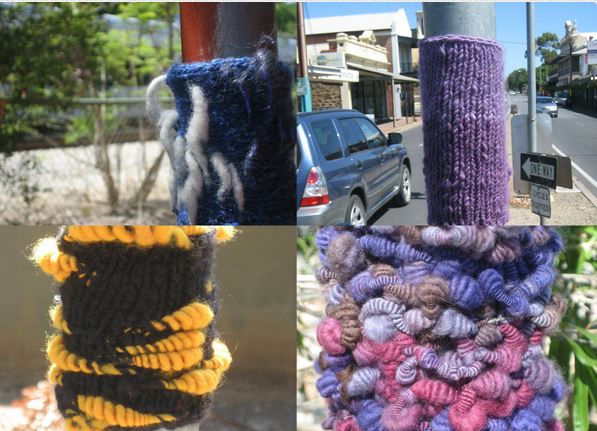
…and since we have been talking yarn bombs a little lately, here are some I added to the local bike path quite a while back.  They are some of my early experiments in art yarn–some even made at a workshop with the inimitable Jacey Boggs (others made after poring over her book or DVDs).  Cocoons, corespun, beehives and supercoils.

Collage of Yarn bombs

2 Comments

Filed under Leaf prints, Neighbourhood pleasures, Spinning

Silkworms: 2 week update

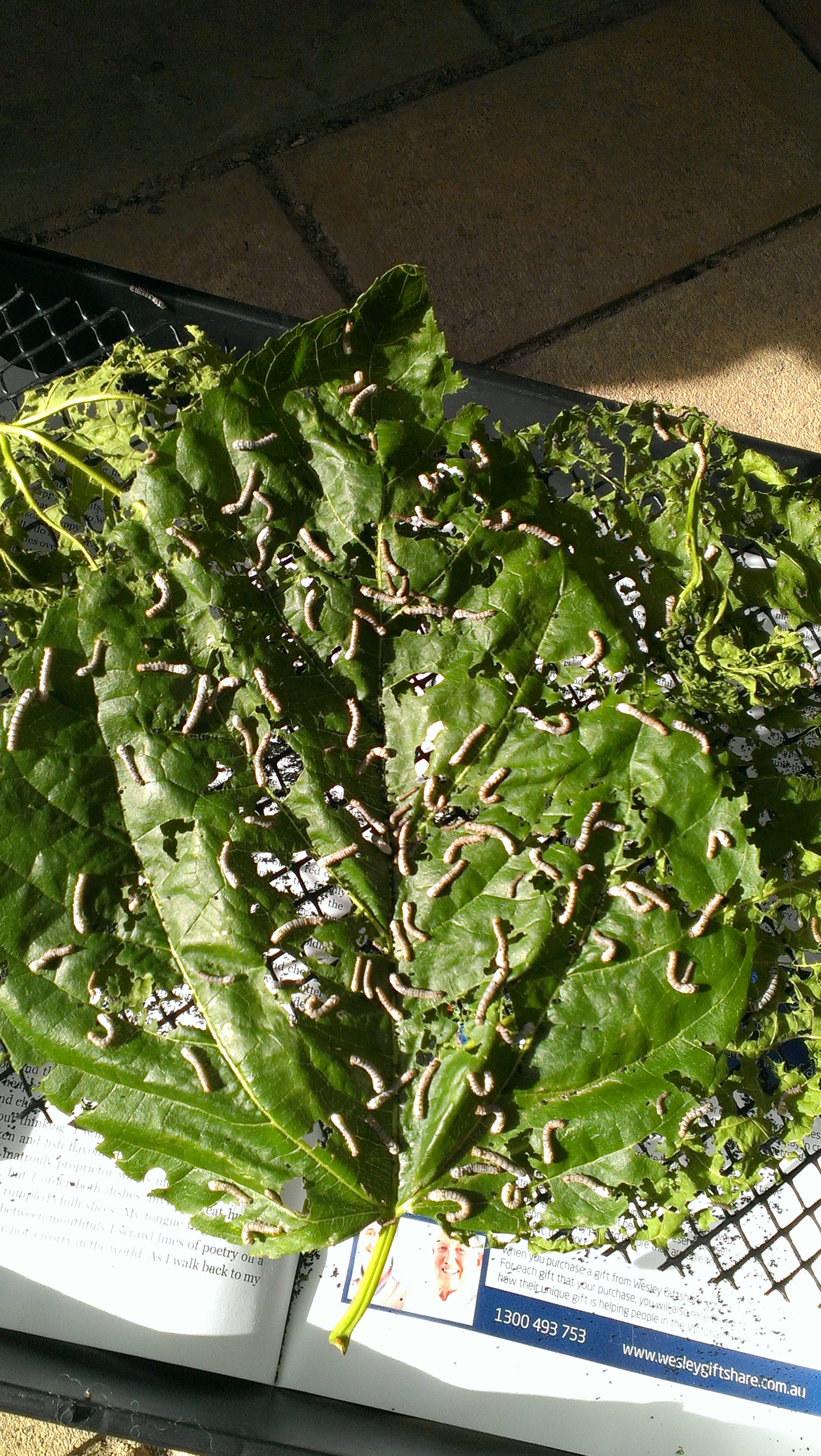
My goodness…  they just keep growing!
IMAG2267


I don’t mean to sound surprised by this… and I am not sure how to make it interesting viewing, either.

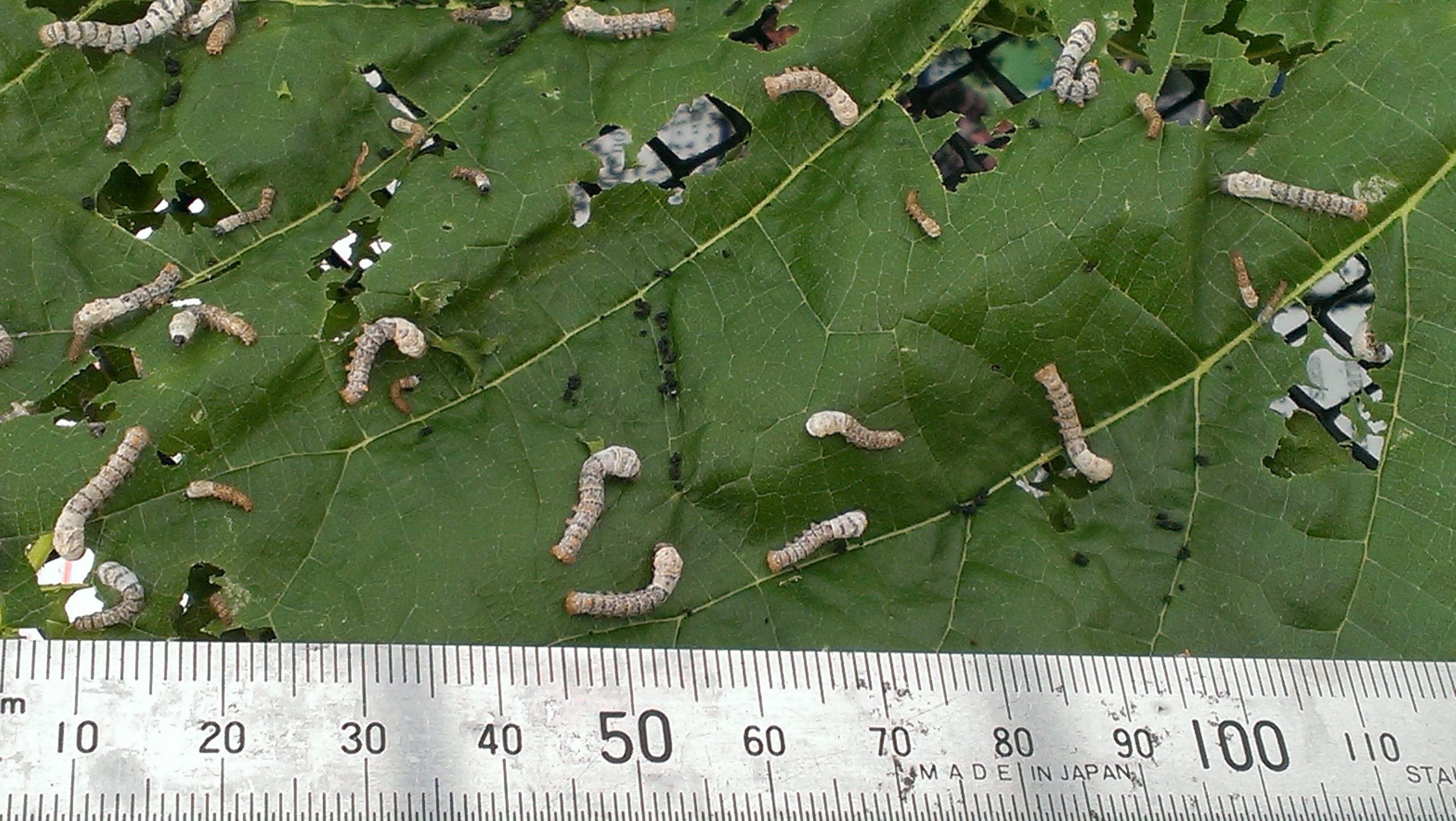
IMAG2265

It’s hard to even give a sense of scale… but I think they’re at least double the size they were last week, which isn’t bad going.  You can still see tinier silkworms amid the bigger ones in the images above.

IMAG2269

And just for the curious, my parents inform me (based on first hand, childhood experience living in a country town with few mulberry trees) that a hungry silkworm will eat a grape vine leaf.  I tested this theory and mine definitely chose mulberry leaves over grape leaves–but a few were prepared to nibble on the grape leaves.  For today… mulberry leaf again!

2 Comments

Filed under Fibre preparation

Further experiments in converting textile waste

I have been wondering about trying some more spinning experiments with waste from the overlocker and the carding process.  There is nothing like yarn bombing to make me consider any kind of yarn useable!  Yarn bombing is even more forgiving than teapots when it comes to the texture and qualities of the fibre concerned… and there is an argument for only using fibres that can’t be made into clothing or blankets for yarn bombing, I think.  So in a  burst of carding enthusiasm, I’ve been preparing batts.

First up, carding waste (corriedale dyed with eucalypt), overlocker waste (from bag making, mostly–silk, cotton, linen and some polyester blend) and some polwarth locks to hold it all together.  Here it is going into the drum carder:

IMAG2241

Carded and ready to spin.

IMAG2249

More fabric scraps and overlocker thread in some parts than others…

IMAG2256

While I was on the job, I carded some rough lavender wool of unknown origin.  It was discarded by the felting group at the Guild: say no more!   I re-washed it, which improved its texture and cleanliness somewhat…

IMAG2262

The felters also passed on this green fibre of unknown origin, which was improved very much by re-washing and carded out beautifully.  I have added dyed mohair locks and silk noil, and we’ll see if it can become a repectable art yarn.

IMAG2261

Carding waste from those two batts and some more overlocker waste…

IMAG2264

I’ll report back when I’ve tried turning these away from the waste stream and into something of use!

12 Comments

Filed under Fibre preparation

Guerilla Gardeners and Yarn Bombers Strike the Neighbourhood!

Yarn bombers have been out and about in our neighbourhood!  They have improved a neglected spot a short distance from our place, cheering up people who’ve had a year of more construction noise, dust and reverse beeping than most of us can readily stand.  Bless them!

IMAG2226

Not content with tree decorating, they bombed the odd pole as well…

IMAG2228

Plus a raised herb garden for the locals to enjoy…

IMAG2229

They even left a potted lime tree and a bougainvillea.  I took a down-at-mouth neighbour along to see and she was quite cheered up by the constructive neighbourhood reclamation and whimsy of it all.  So was I.

IMAG2231

They go by the name of ‘Viva La Broad Bean’ and I can only congratulate and cheer them on.  I met one of them when I went to take these pictures and congratulated her in person.  I was able to share our neighbourhood revegetation projects with her, too.

IMAG2230

Meanwhile, the streets nearby are full of bottlebrush (callistemon) trees in flower.  Thousands of blooms, each the size of an old fashioned bottlebrush–but splendidly red.  It occurred to me that this is a form of wonder and beauty that non-Australians mostly don’t experience.

IMAG2220

The abundance of flowers has brought lorikeets into the neighbourhood to feed on the nectar and hold high pitched, apparently gleeful conversation.  They don’t hang about to be photographed, but I managed to take a picture of this rainbow lorikeet before it flew off like a green comet.

IMAG2232

10 Comments

Filed under Knitting, Neighbourhood pleasures, Sewing

Silkworms: 1 week update

IMAG2217

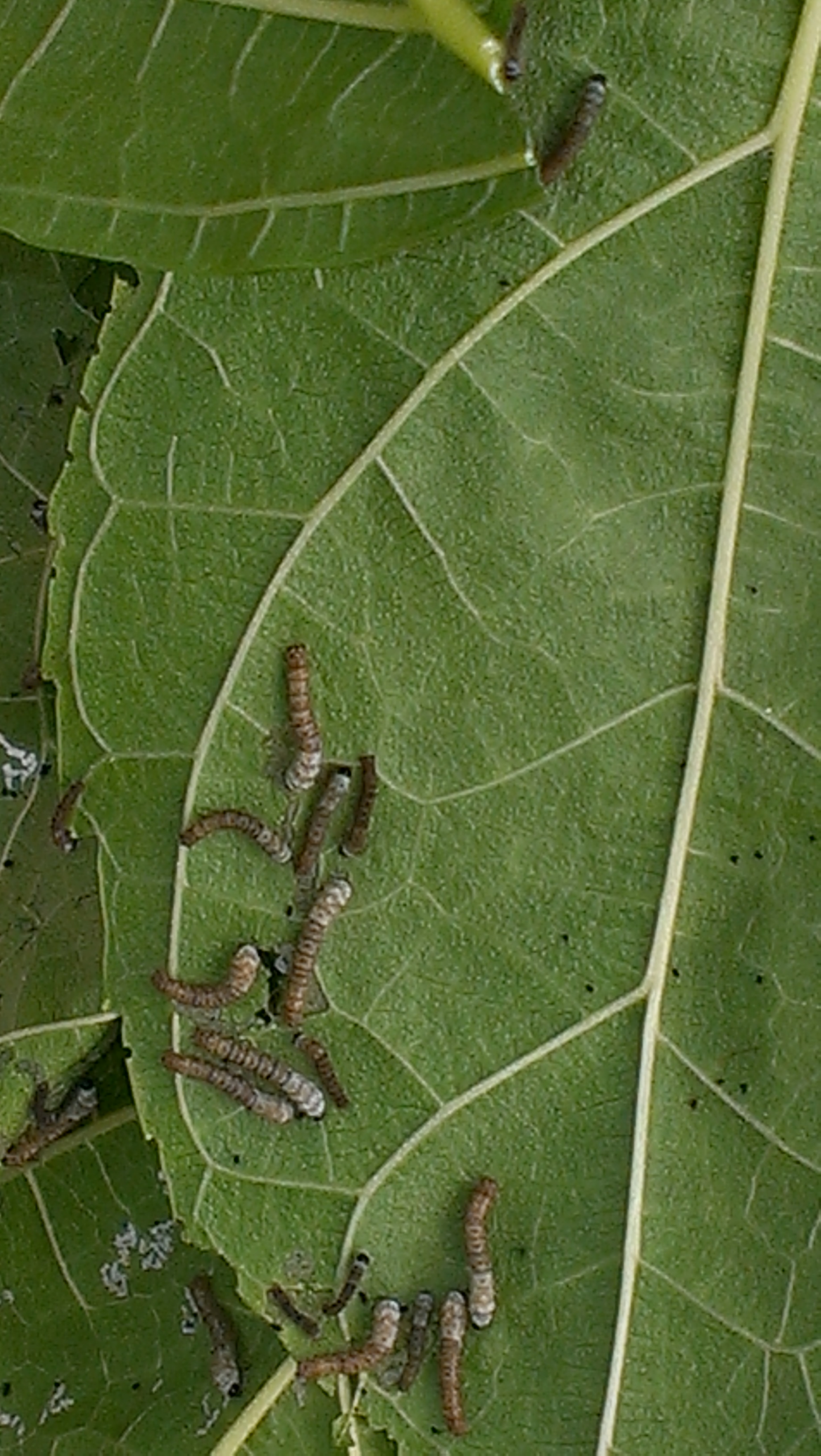
One week along, I have at least 100 silkworms and have started trying to find them future homes.  The wigglers with pale heads are a week old, but you can see two tiny black ones toward the bottom of this image which have hatched much more recently.  I will be needing a lot of mulberry leaves if this keeps up!

Leave a comment

Filed under Fibre preparation

Pecan leaf print bag

Pecans do grown in this part of the world, even if they are not terribly common.  A long while back I wrote about leaf printing with pecan leaves from our friends’ tree.  I have had it in mind all the while to make them something from those leaf prints.  Finally I have made good on this idea.  In fact, my beloved saw one of our pecan-growing friends yesterday and told her I’d made them a gift… so this bag is destined for the post sooner rather than later.

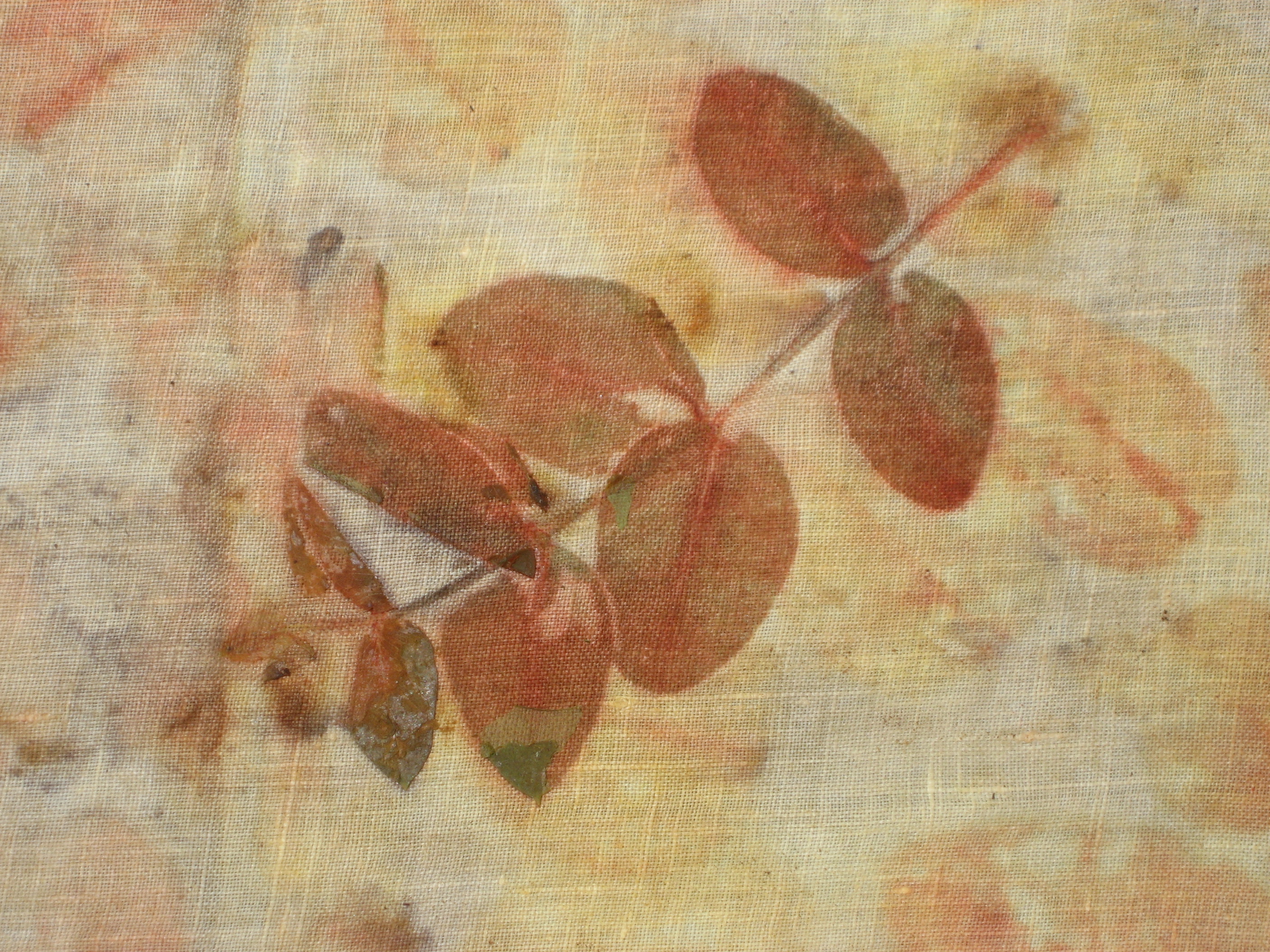
I started out with this sun-faded linen frock–the shades of colour you see are not effects of the sun falling on the fabric but the impact of fading.  I think I paid $2 for the frock at a red cross op shop.

IMAG2191

The lining has a pocket from a recycled ramie shirt, and a patchworked panel of leaf printed silk offcuts from another recycled frock.  Here are the inside panels ready to be stitched to the rest of the lining.

IMAG2189

The remainder of the lining is yellow.  A  long time ago there was shop in our neighbourhood that just sold offcuts from a sheet manufacturer, and having made entire quilts, bunting and bags from those offcuts I still have some left!  Here is the finished item on top of my madder patch.  The madder is appreciating the warmer weather–at least until it gets too hot for it to enjoy, and I am hoping my friends will like their present.

IMAG2214 (1)

6 Comments

Filed under Leaf prints, Sewing, Uncategorized

Hatchling silkworms and other thrills

Last year, I bought five silk worms at a school fair and raised them into moths. Later, when I was wondering what to expect next, I had quite a conversation with a delightful woman in the Button Bar in the Adelaide Arcade, as you do.  I can’t remember how we got from the tea cosy she was knitting to silk worms, but somehow we did.  She told me to expect the eggs that resulted from a dalliance between a couple of my moths to hatch in September.  I remember thinking about this on 1 September.  Then on Friday 13 September I realised I had taken no action and sprinted down the hall to check on them and lo!  There were tiny black creatures wiggling around!  I made an immediate mercy dash to the nearest mulberry tree.  Can you make the hatchlings out?

IMAG2179

The hatchlings are the tiny black lines.  Those spots on the cardboard are eggs.  Today I conservatively estimate I have 50 silkworm hatchlings, and I have started working on finding some of them new homes.

Meanwhile, I have been on a bag jag… sewing loads more bags and taming [some of] my scrap collection.  I decided to photograph a lining in progress on the weekend, because what is more thrilling than a lining?


IMAG2182

Well, one of our chooks seemed to think so.  She could tell whatever was happening on the table was worth looking into, so she flew up immediately to check into it.  Regrettably, this was not an edible thrill from her point of view.

IMAG2184

Thrills come in very disparate packages, all depending on perspective… or so it seems to me!  Audrey finds earwigs a lot more thrilling than I do.

Meanwhile, I have taken the nettle stems back out of the retting bath (which this time certainly did go to the garden–) and set them out in the rain to rinse.  Since so much of my crafting takes place in crevices of time and is ordered by whim rather than a linear plan, I hope you’re managing to follow all these emerging themes …

10 Comments

Filed under Fibre preparation, Leaf prints, Sewing

Fibre processing continues…

For those who are wondering… the nettle stems are back in the retting wheelbarrow for now. So I return to our regularly scheduled fibre–wool.

All I want to say about this last Polwarth fleece, with the prickly seedheads and the tips that were spiny and pulled off… is that I have reached the end of it.  Here it is–the last of it–!  It will be keeping toes warm for years to come once these slippers are felted. I do not need to spin more of it, ever.  The fleece from this sheep’s sibling, and fleece from this sheep in other years, are lovely, and I will return to those in time.

IMAG2143

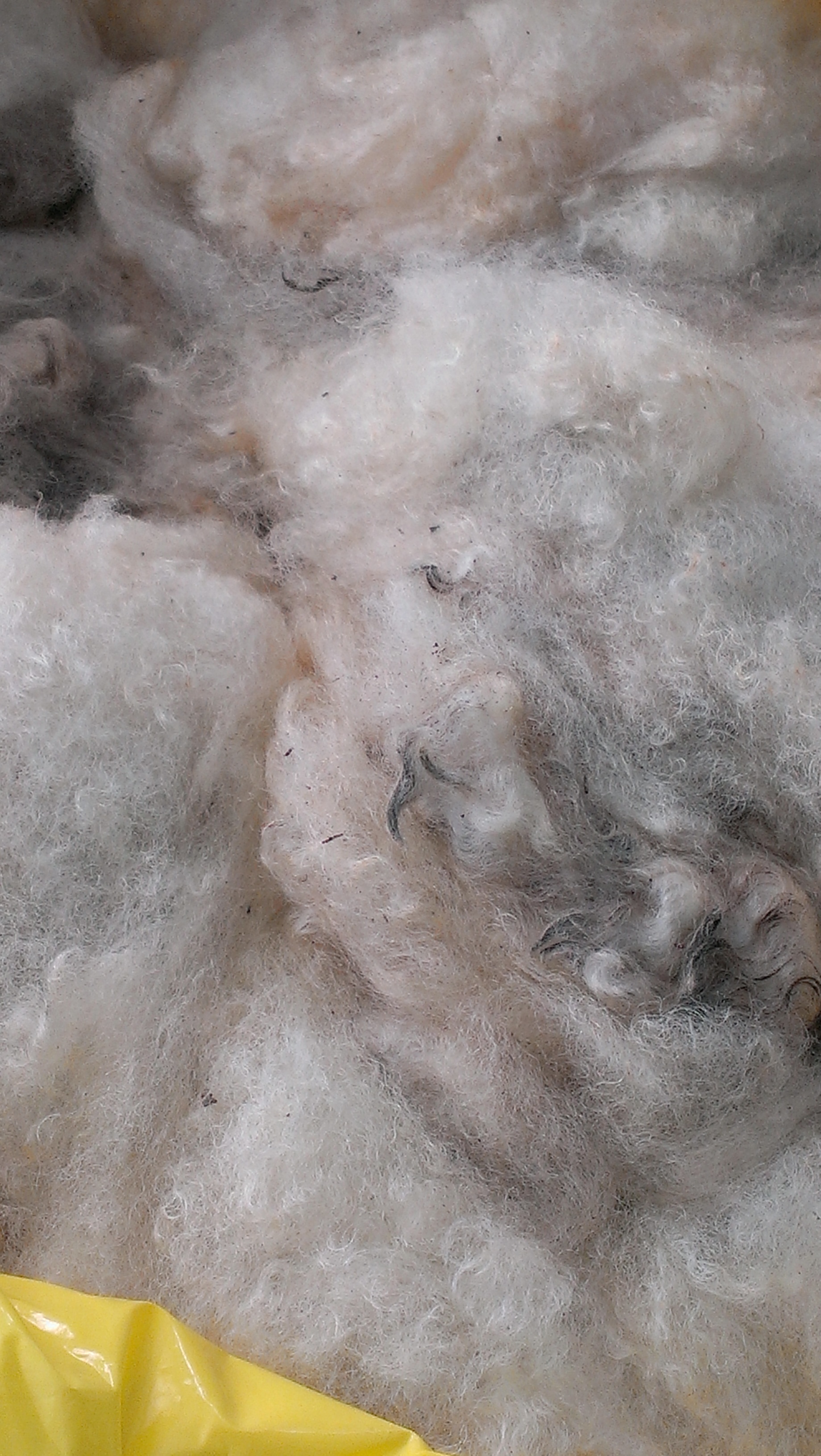
Next stop on the fibre processing journey is a Corriedale fleece one of my co-workers gave me (in 2011!! I wrote the date down).  I dyed some greasy a year or so ago and it came out badly.  I can be put off by experiences like that, which so often indicate the current limitations of my skills or patience, or both.  I put the Corriedale down and haven’t come back to it for at least a year.  It does have vegetable matter in it, but it is otherwise a lovely fleece.  I weighed the remainder and there was 2.3 kg still to wash.  It’s in a yellow plastic bag designed for a double bed feather quilt.

IMAG2138

I sat a kilogramme of it to soak cold for a few days, because I’ve seen this suggested on Ravelry and it makes good sense as a first stage in getting mud, as well as grease, out of the fleece.  having tried it now, I would definitely use this process again.

IMAG2139

This kilogramme is now clean and drying, and that leaves only 1.3kg of this fleece yet to be washed.  After that, only one more Polwarth fleece left to wash. I admit, a Polwarth is a mighty big sheep.  However, this is the closest I have been in years to having the fleece stash clean and ready to spin!

7 Comments

Filed under Fibre preparation, Knitting, Spinning