Tag Archives: E Cinerea

Happily spinning alpaca

2014-06-05 11.36.43

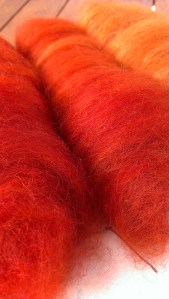
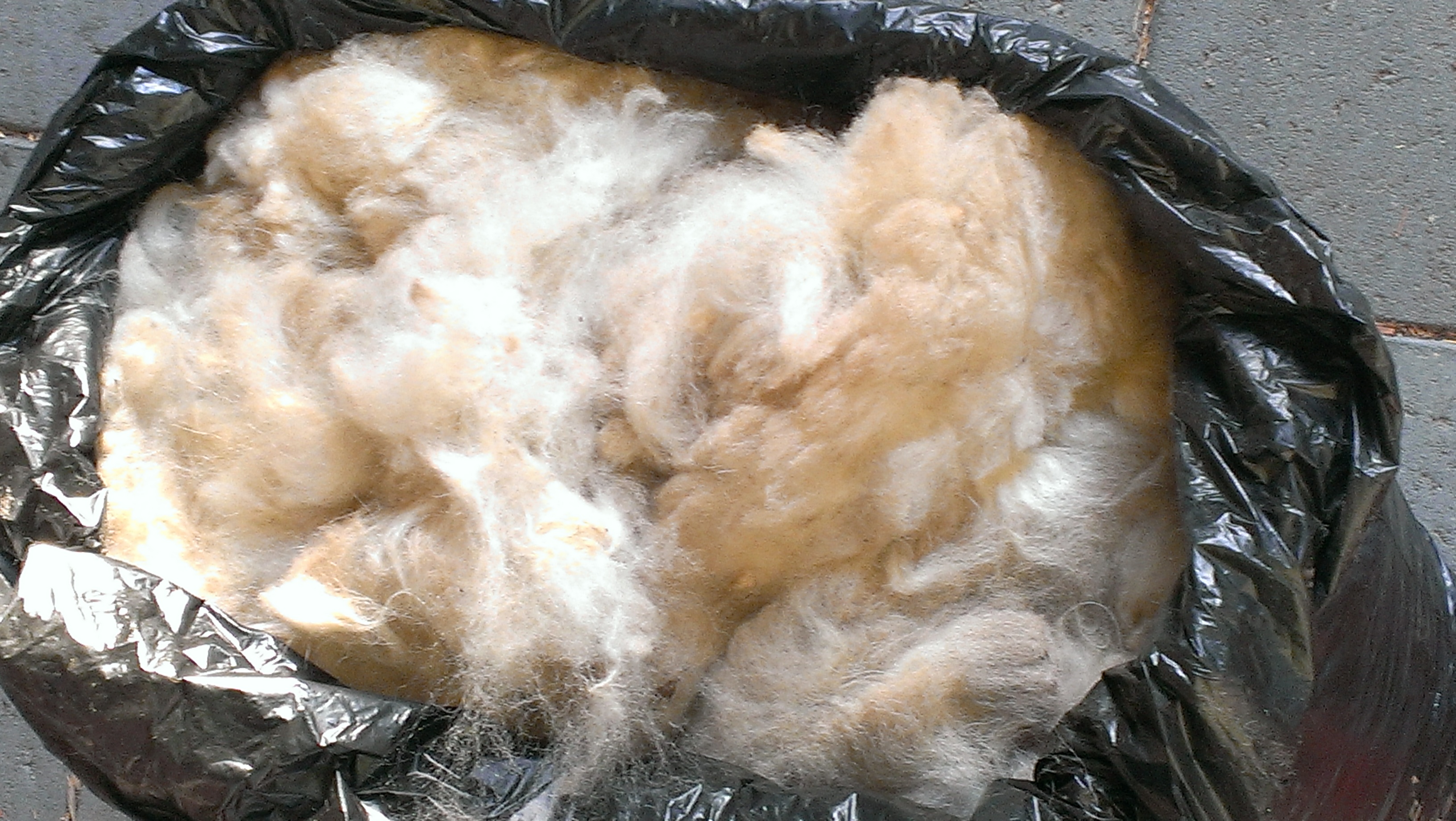
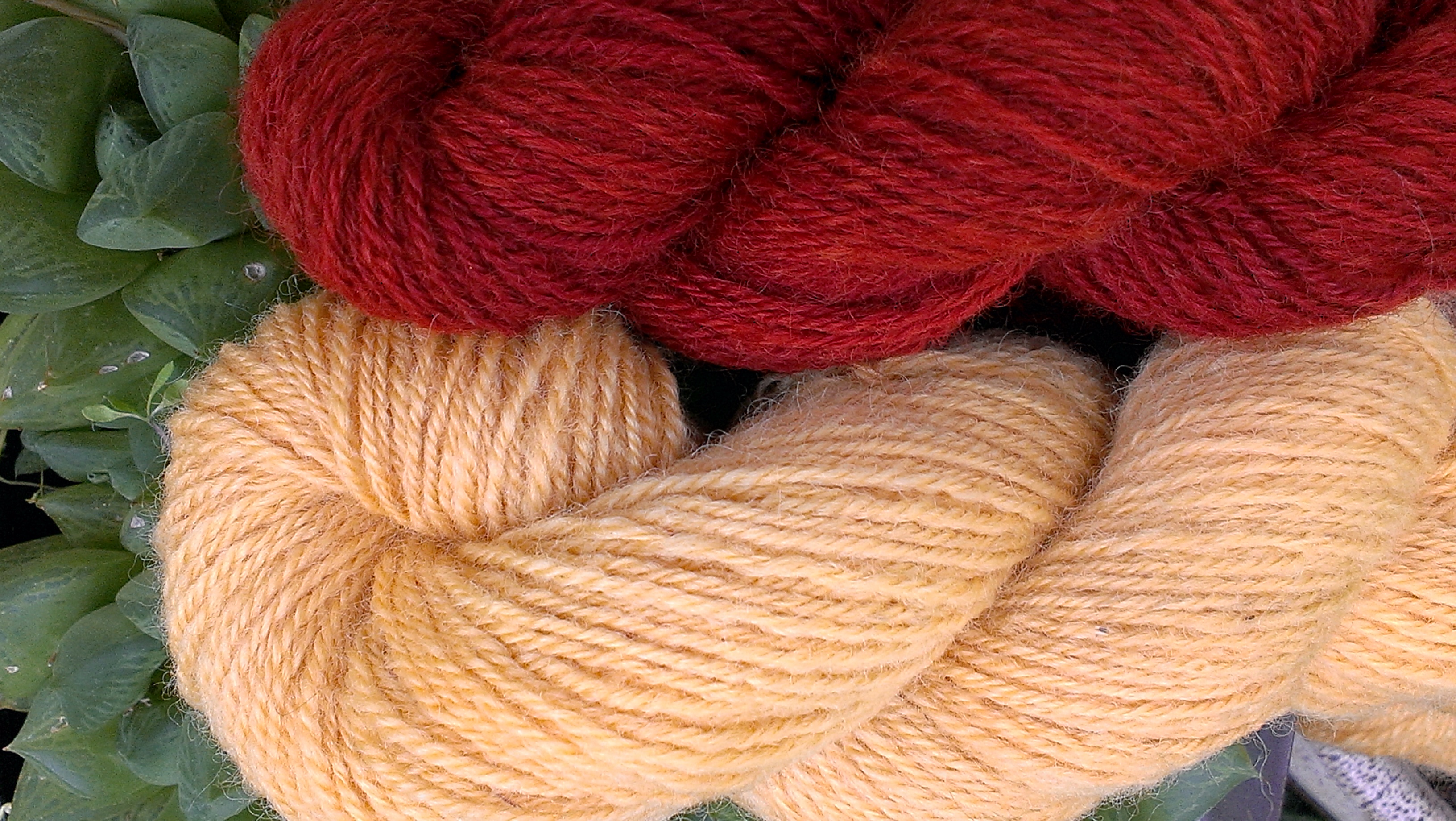
I have been happily but slowly dyeing an entire white alpaca fleece with eucalypts. I’ve been dyeing it without washing it, what’s more! The washing stage comes after dyeing instead, treating the dye bath as stage 1 of the cleaning process. I love the way muddy tips create a resist which will produce a sunny yellow which shows wonderfully among all that flame orange.

IMAG1727

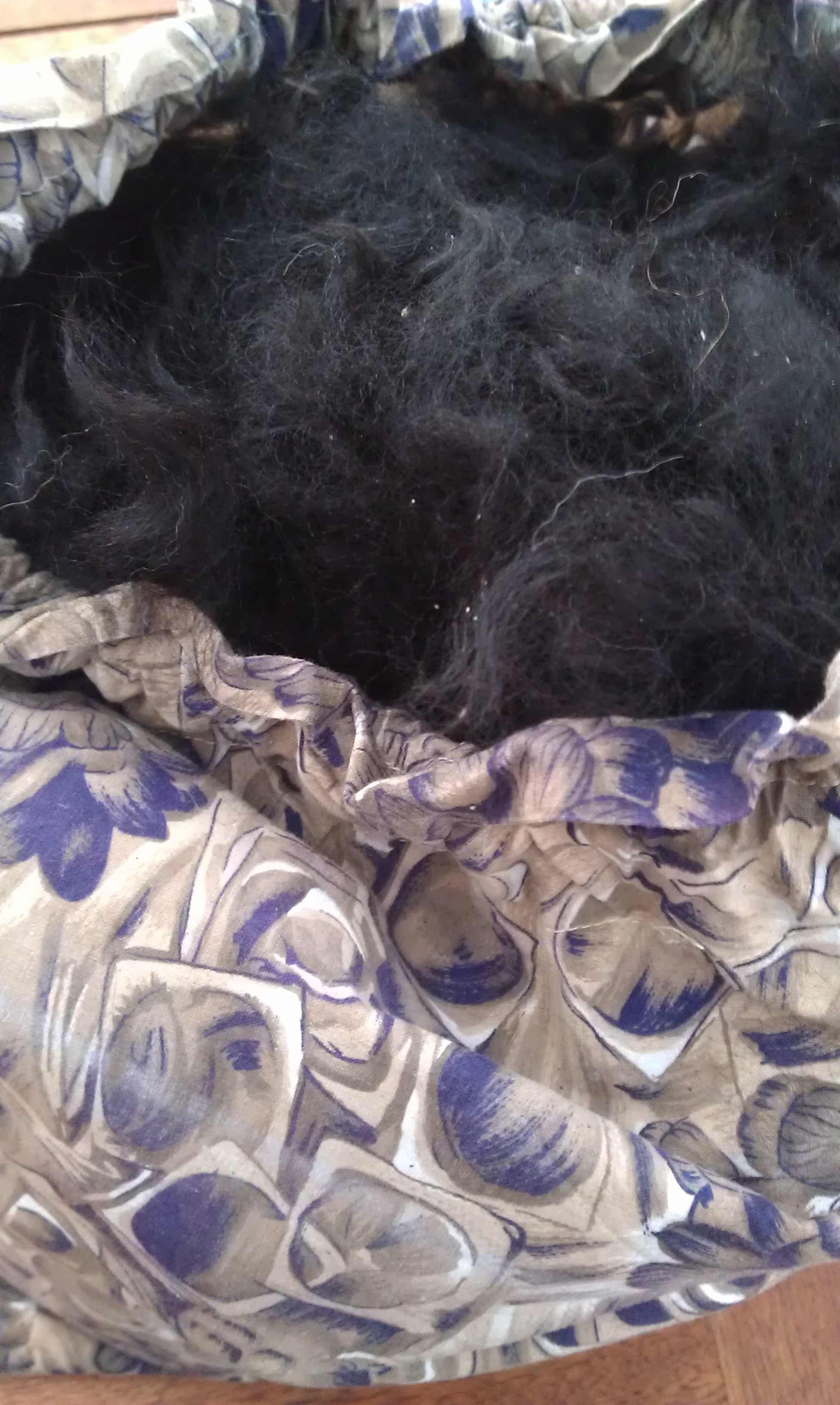
I have a lot of black alpaca too… this I have already washed.

IMAG1686

On weekends sometimes there is fibre processing and vegetable harvesting–this is one of the last of the capsicums.

IMAG1730

Then, of course, carding.

2014-06-05 13.47.18

Out in the back yard when the weather is sunny.

IMAG1764

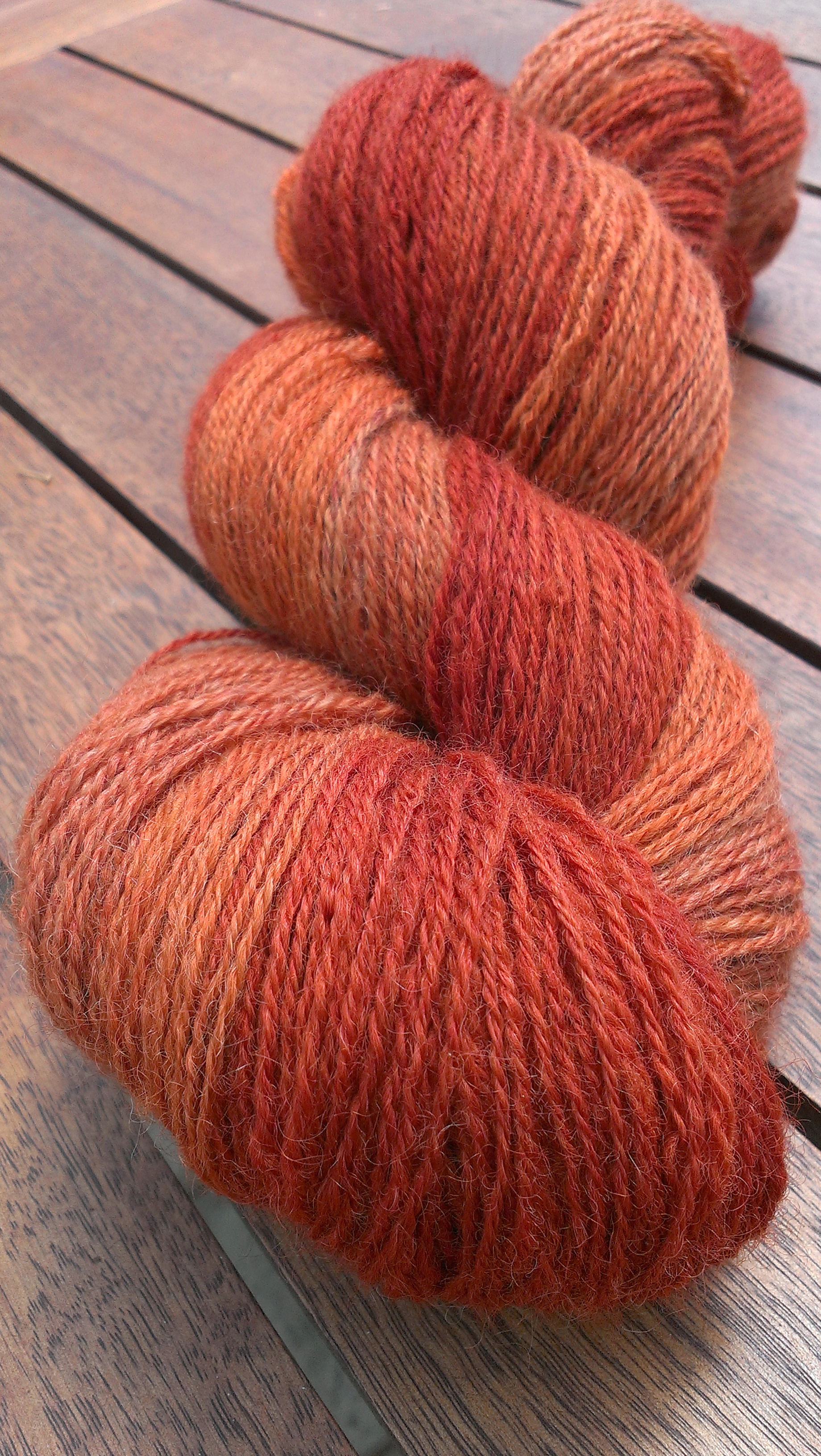
I’ve been spinning up more colour changing yarns and including some of the black alpaca… and that is the entirety of the lemon crop beside the skein.  Can’t wait until the fruit trees grow up a bit…

IMAG1697

4 Comments

Filed under Natural dyeing, Spinning

For the love of mending: Make do and mend afternoon

We had a make do and mend afternoon with friends recently.  We’re investigating actions we might take about climate change, and we’ve begun with some conversations about consumerism.  Who knows where that might lead?  I began by stitching up a torn out seam for my partner and tightening all the screws on the clothes rack so it works properly. Meanwhile a rusty frypan was rehabilitated, an electrical plug was replaced, and the endless chewing of moths on fine wool was darned in by others.

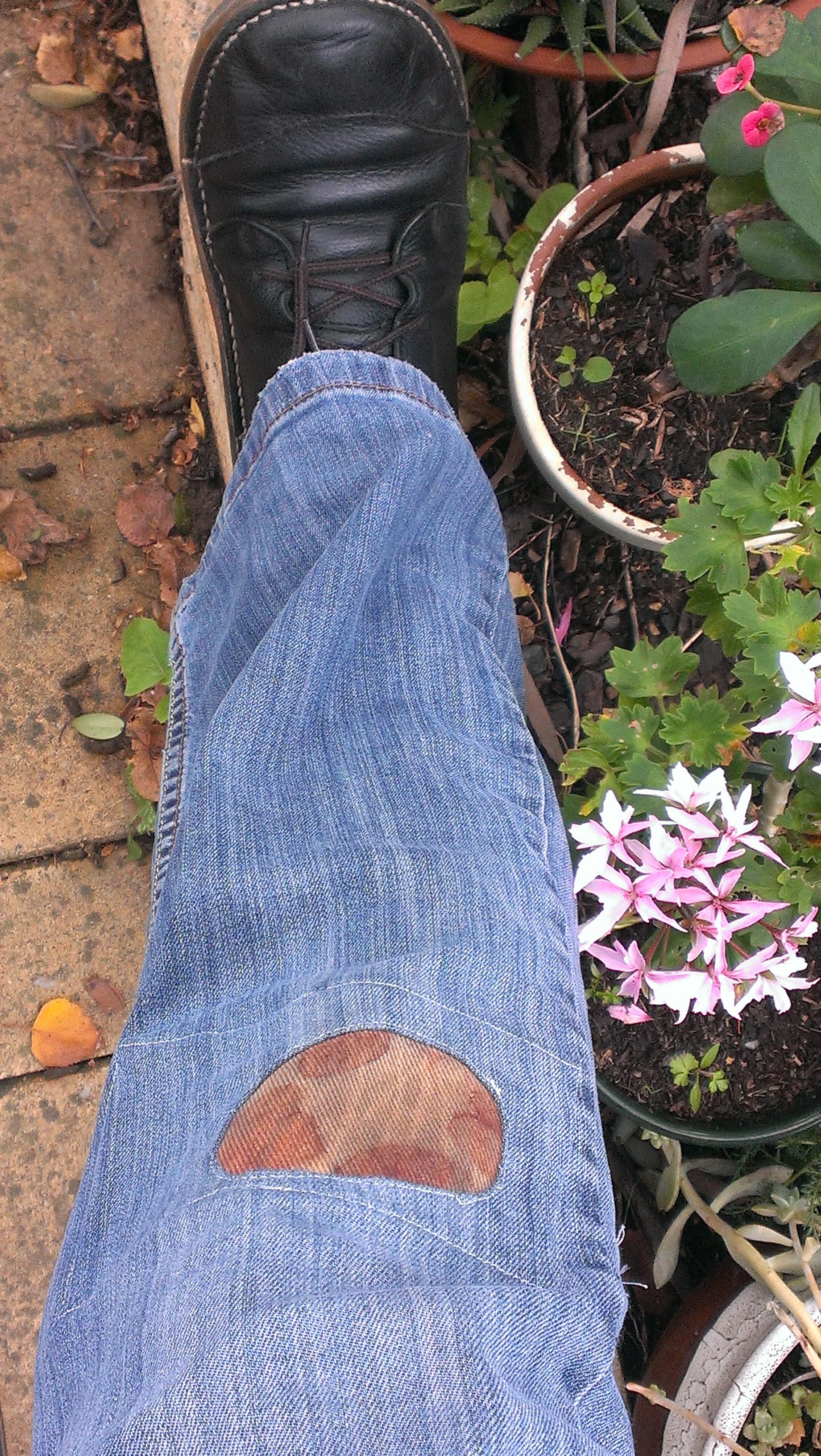
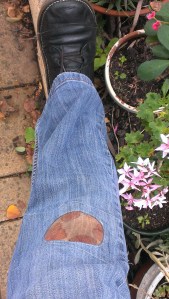
I have a wardrobe which is heavy on the bottom end.  I always have more clothes suitable for gardening and doing filthy jobs than I have clothes for best.  And my favourites are usually my gardening clothes.  Things that are no longer suitable for wearing to work or to visit my mother, unless I’ll be weeding while I’m there. My father is a bit like me.  When I knit him socks he puts them in the drawer until he has worn out a previous pair.  My current favourite jeans are well past their best, and weeks ago they went through in the knee.  I kept thinking I would turn them into a bag, but then I kept taking them out of the reuse pile and pulling them on.  So with a crowd of friends who were mending and repairing too, and a pot of pumpkin soup to keep it cheery, I patched them.  Maybe one day this patch will be part of a bag!

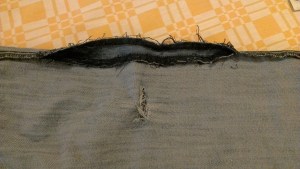
For those who wish they knew how to patch the knee of jeans, step one for a simple mend is to rip out whichever seam is less complicated.  Leave the flat felled, beautifully topstitched seam intact and rip the other one, if there is a choice.
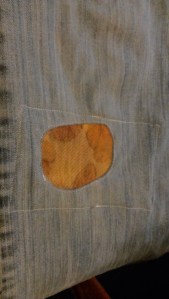
2014-05-31 11.56.28

Choose a nice patch.  This one was once part of a pair of cotton twill pants and is now eco printed with E Cinerea leaves.  Trim back the hole to some solid fabric, and shape it.  My mother taught me this mend and always created a straight sided shape, like a rectangle.  I decided to try something rounded.  Put the patch on the inside, and turn the edges of the jeans under all around, attaching to the patch fabric. Tacking would be a great way to proceed, but I prefer pins.  Call me a daredevil!

2014-05-31 12.54.58

On the inside, turn the edges of the patch under, toward the wrong side of the jeans.  Stitching the first seam and then turning the second would have been a good idea, but I was having an interesting conversation and didn’t want to leave the room to use the sewing machine yet!

2014-05-31 12.55.33

Stitch around each edge.

2014-05-31 13.36.11

Apologies for the indoor pictures on a rainy day–but here is the patch, being a mend on gardening jeans, in the garden, with the sun out, however weakly!
2014-06-01 12.47.08

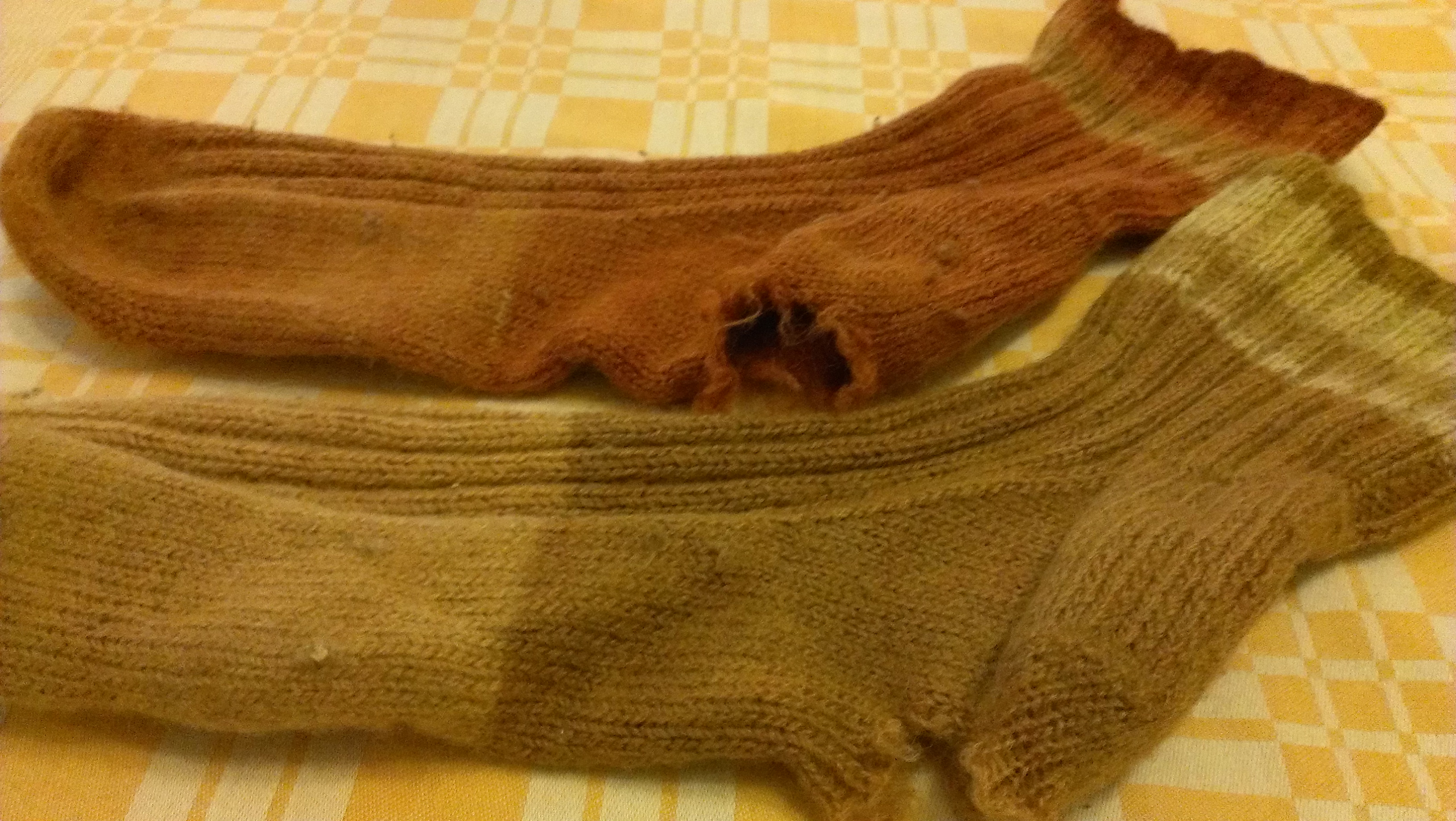
One of my treasured friends brought some socks with him.  It’s a shame about the lighting, but never mind.

2014-05-31 12.56.32

I made these from Cleckheaton 5 ply crepe in pure wool (not the best possible choice for socks) in 2009. Here they are on my desk at work in all their glory in 2009.  Who can believe I managed to find the photo (or understand why I took it at work?)

150620091161

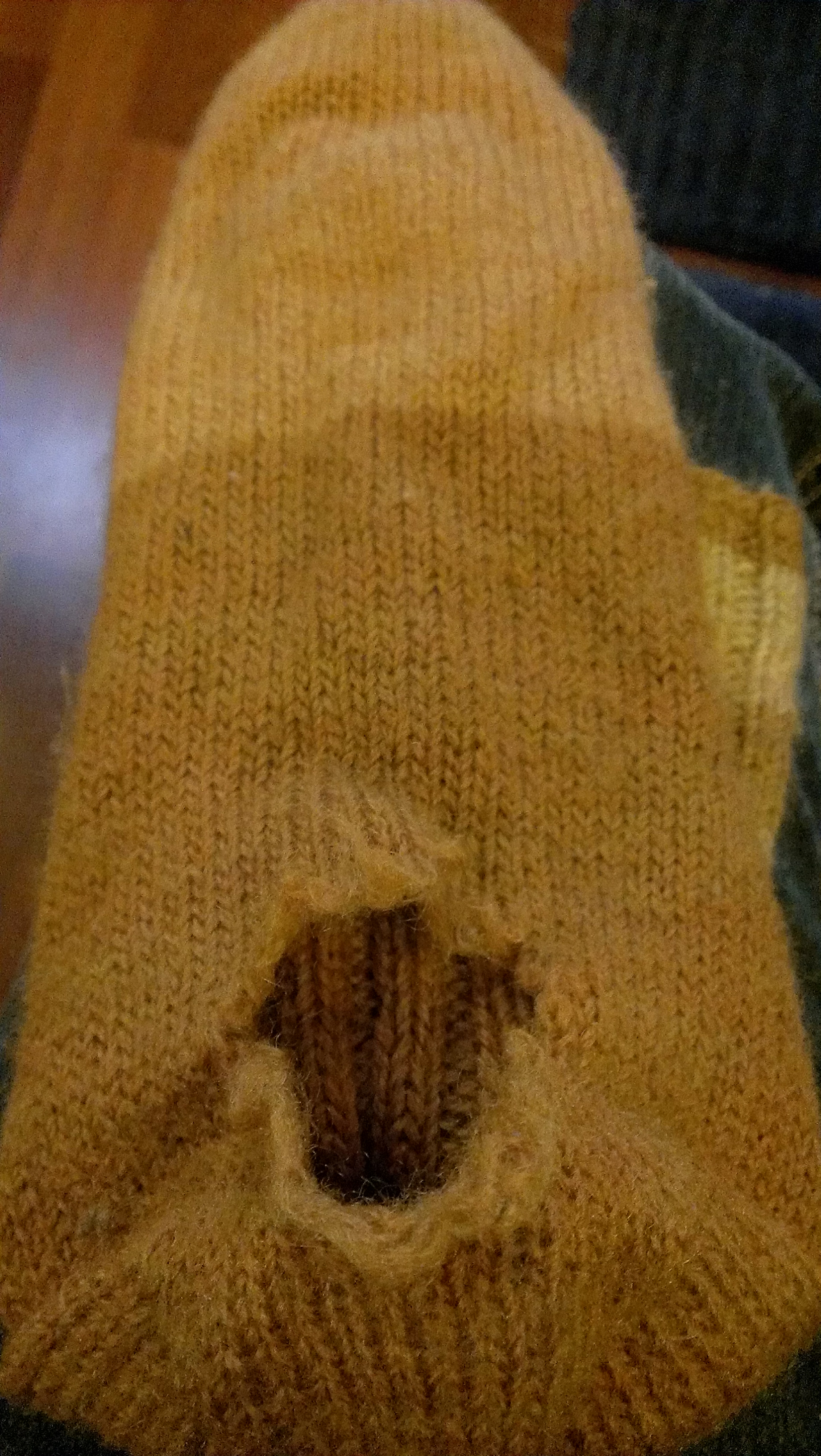
The stripes at the tops are all my samples for the previous period–a metre or two of yarn dyed with samples of local eucalypts and other plants.  The rue dyepot was the worst ever–but a triumph of neighbourhood cooperation involving a rendezvous at the local train station where my friend handed a bag of rue prunings out the door and I stood there ready receive them as he continued on his way on the train relieved of his pungent burden!  One of the socks is all in orange tones and the other tans and greens.  Rue.  The ordinary kind does not give red, my friends, take it from me (or sort me out if you know how to get red from it–seems like there is a Siberian kind that might give red–but only from the seeds–or some such).  I digress.  These socks have been worn a lot, which is very flattering, and my heart’s friend wanted to keep them, though perhaps only for in-slipper wear.  We consulted about whether it was feasible to darn these holes.  I wasn’t sure.  He can darn but has not kept up his knitting skills in a period when carpentry has been needed more at his place.
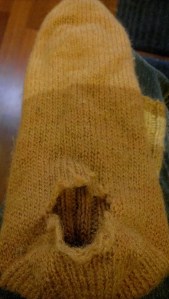
2014-05-31 14.38.03

He has the biggest feet on my knitting roster.  These holes are BIG.  I wasn’t sure about darning them.  He went off to tend to a bicycle (there were others people dealing with wood and still others entertaining children with the wheelbarrow and others still darning).  I thought it over, no doubt drawing on things I’ve seen and read, and wondered if I could just pick up and knit on a patch.  I pulled out 4 ply patonyle dyed with eucalypts.  I’ve learned a few things about getting a strong colour since I dyed these socks.  the original wool in the socks has worn thin and the 4 ply was fine for the job.  I decided on a visible mending aesthetic.

2014-05-31 14.36.46

At first, I wasn’t sure how to join on the sides on.  Then it dawned on me… pick up a further stitch and knit or purl it together with the edge stitch.  What could be simpler?

Put your sunglasses on, I must have changed the settings on the camera.

2014-05-31 14.23.12

When I got to the end of each hole, I decided to graft.

2014-05-31 14.25.19

I picked up more stitches and kitchener stitched (grafted) them together.  And in the end… the conversation was so good I mended all three of the big holes.  Comfy socks to wear when your feet are up.  Eat your hearts out!
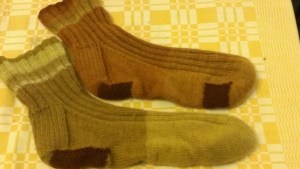
2014-05-31 16.24.11

10 Comments

Filed under Knitting, Natural dyeing, Neighbourhood pleasures, Sewing

Milky merino: Second effort

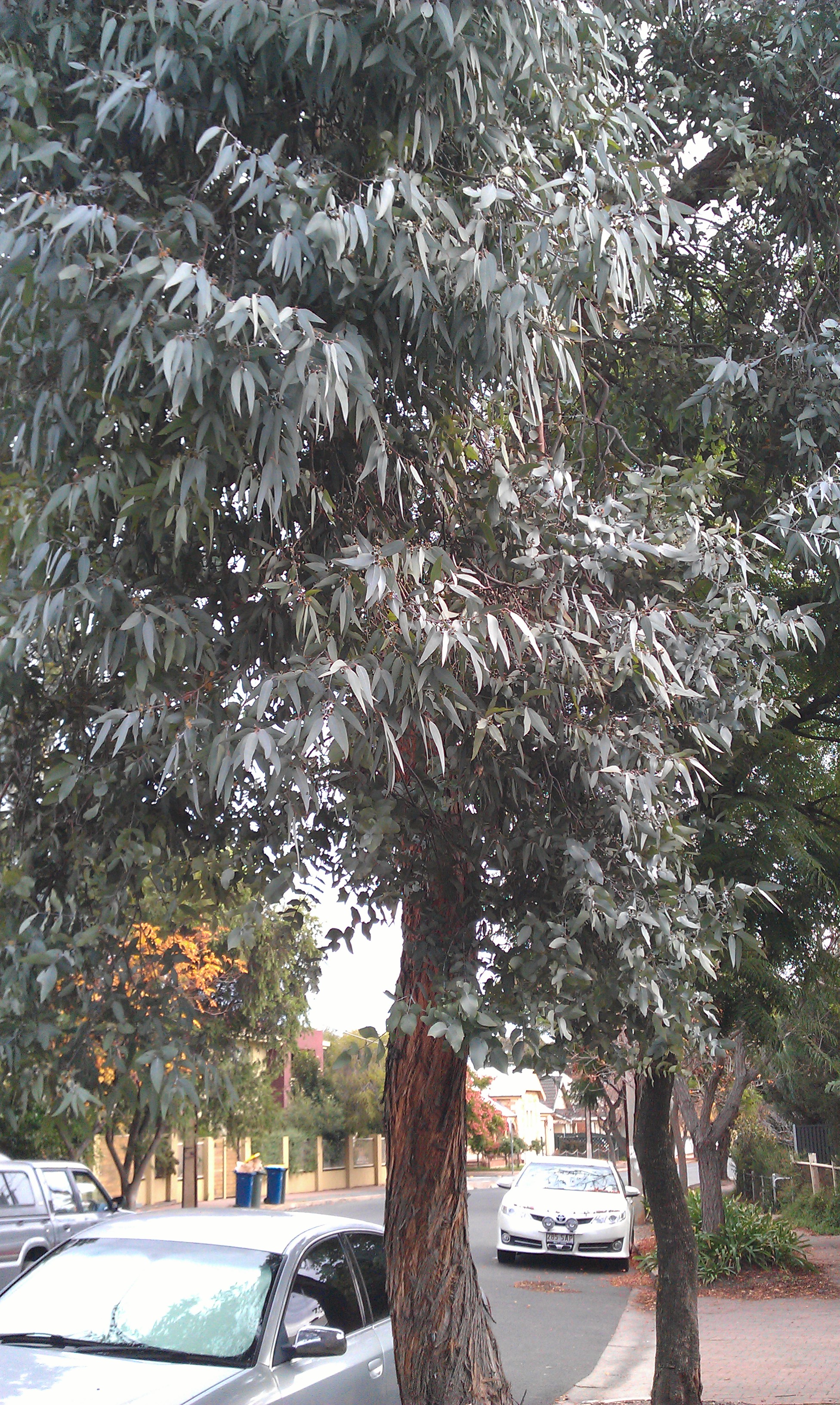
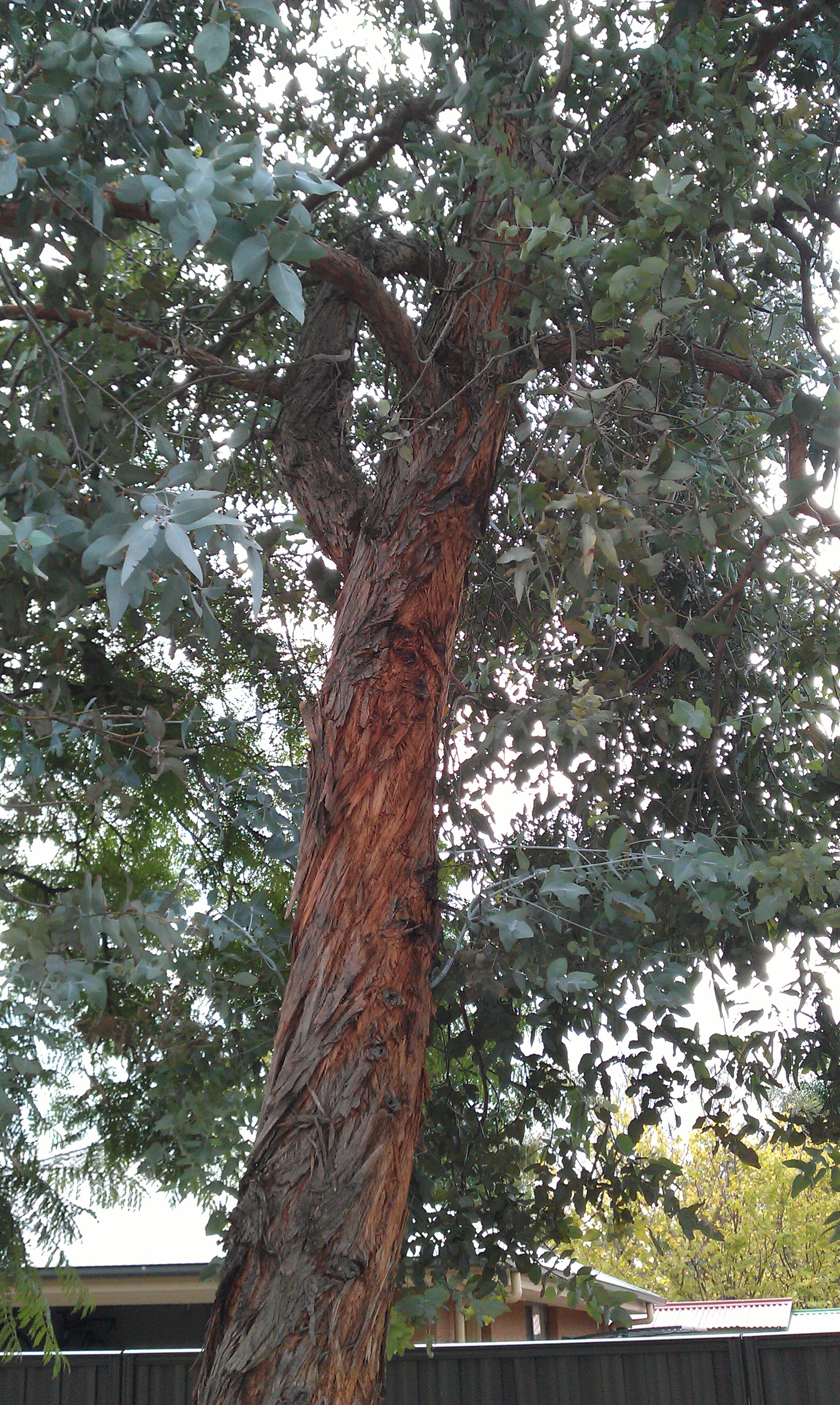
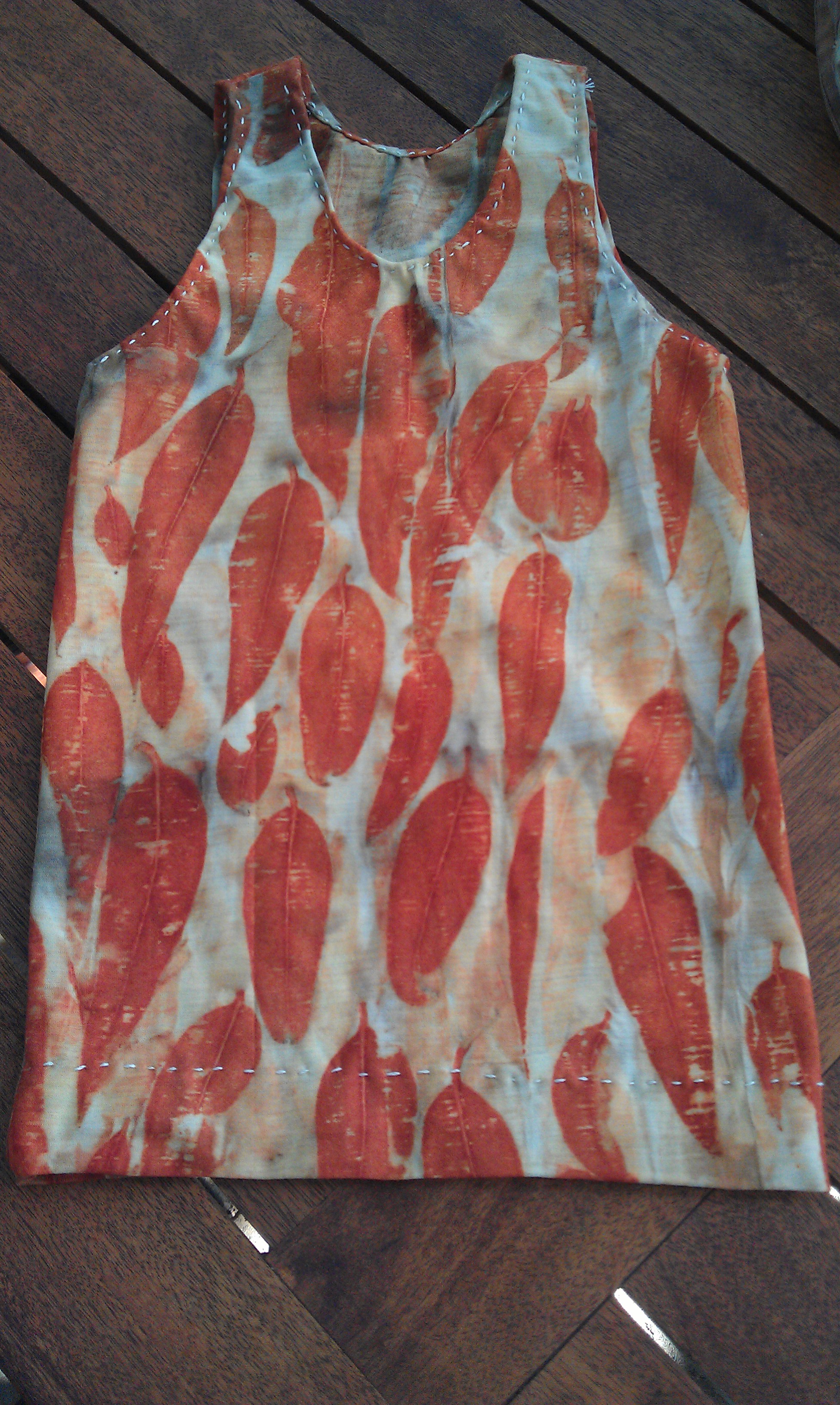
I decided to use the scraps from my milky merino to make a singlet for a small friend. One inspiration was the discovery of another E Cinerea nearby on a suburban street.  It is beautiful.

IMAG1723

It is covered in new growth, whose leaves are larger and teardop shaped rather than the rounder heart shape that is usual for mature leaves.

IMAG1722

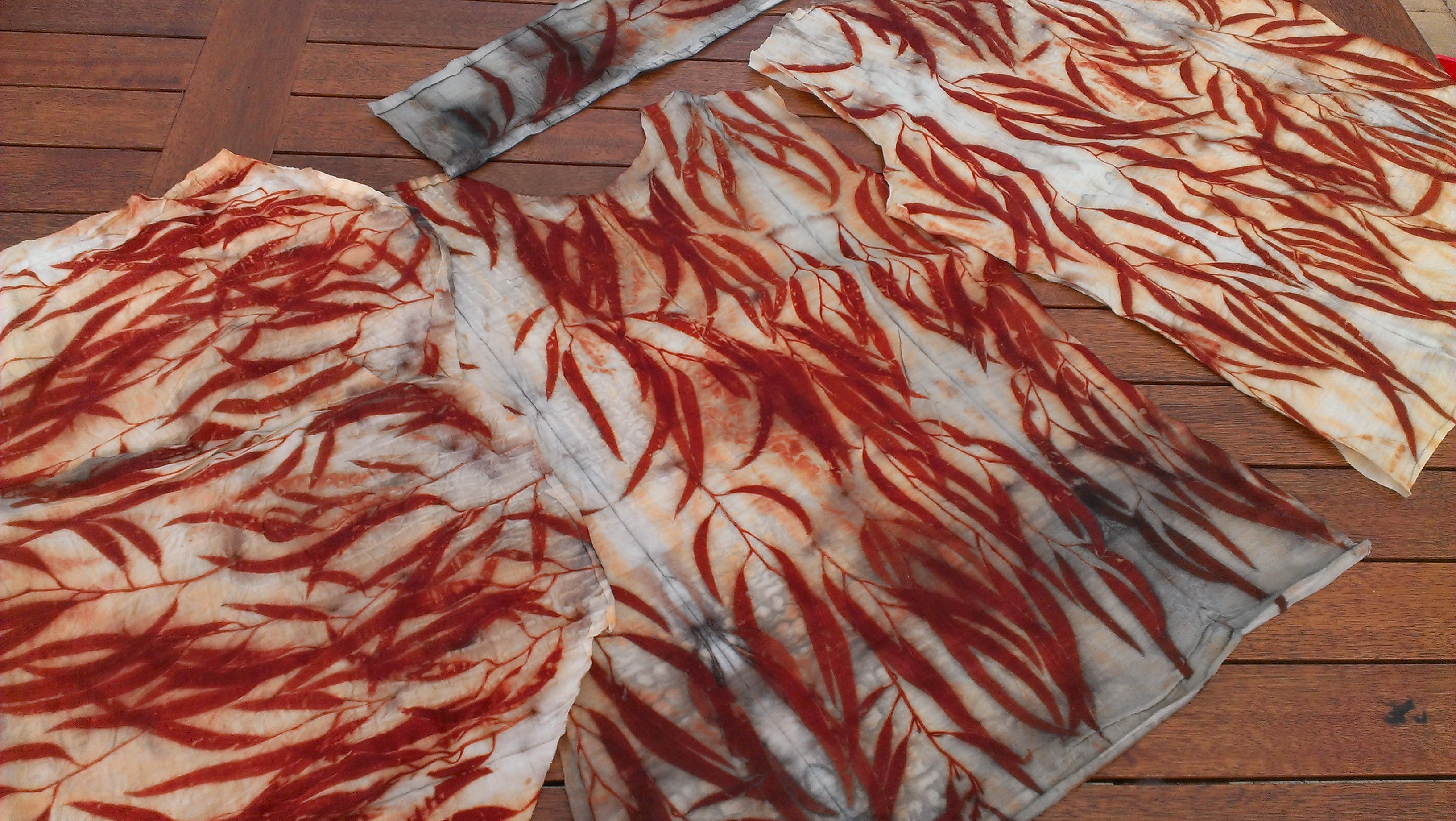
I have to say milky merino is a glorious fabric to use for eco-printing.  It takes colour in a most spectacular fashion.  I bundled up one night and unbundled a day or so later.

IMAG1731

I love the way the fabric took on a golden creamy colour where it did not absorb a direct print.

IMAG1733]

Action shot!

IMAG1735

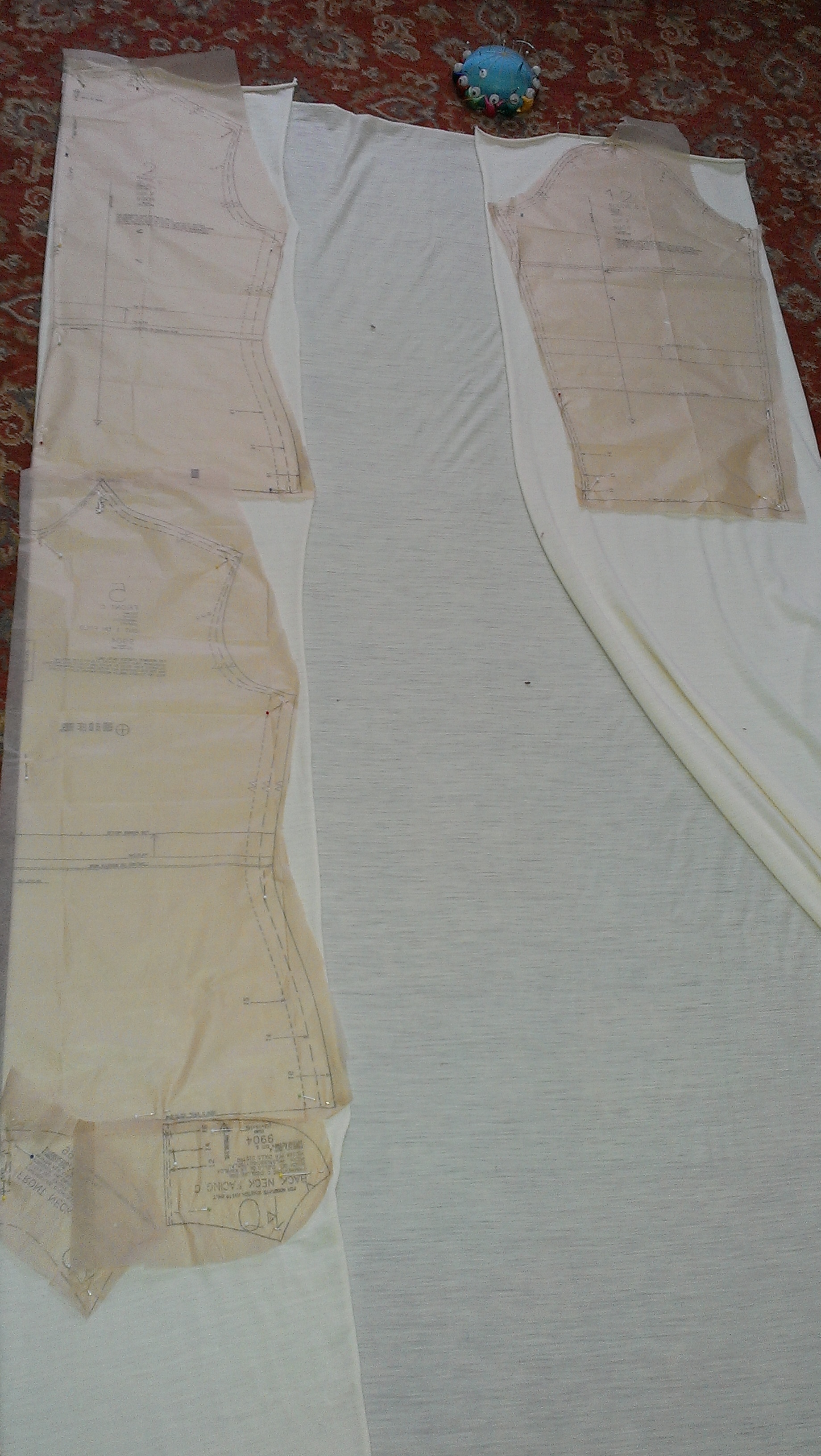
I created a pattern from an existing garment and set about cutting and sewing it from the fabric.

IMAG1753

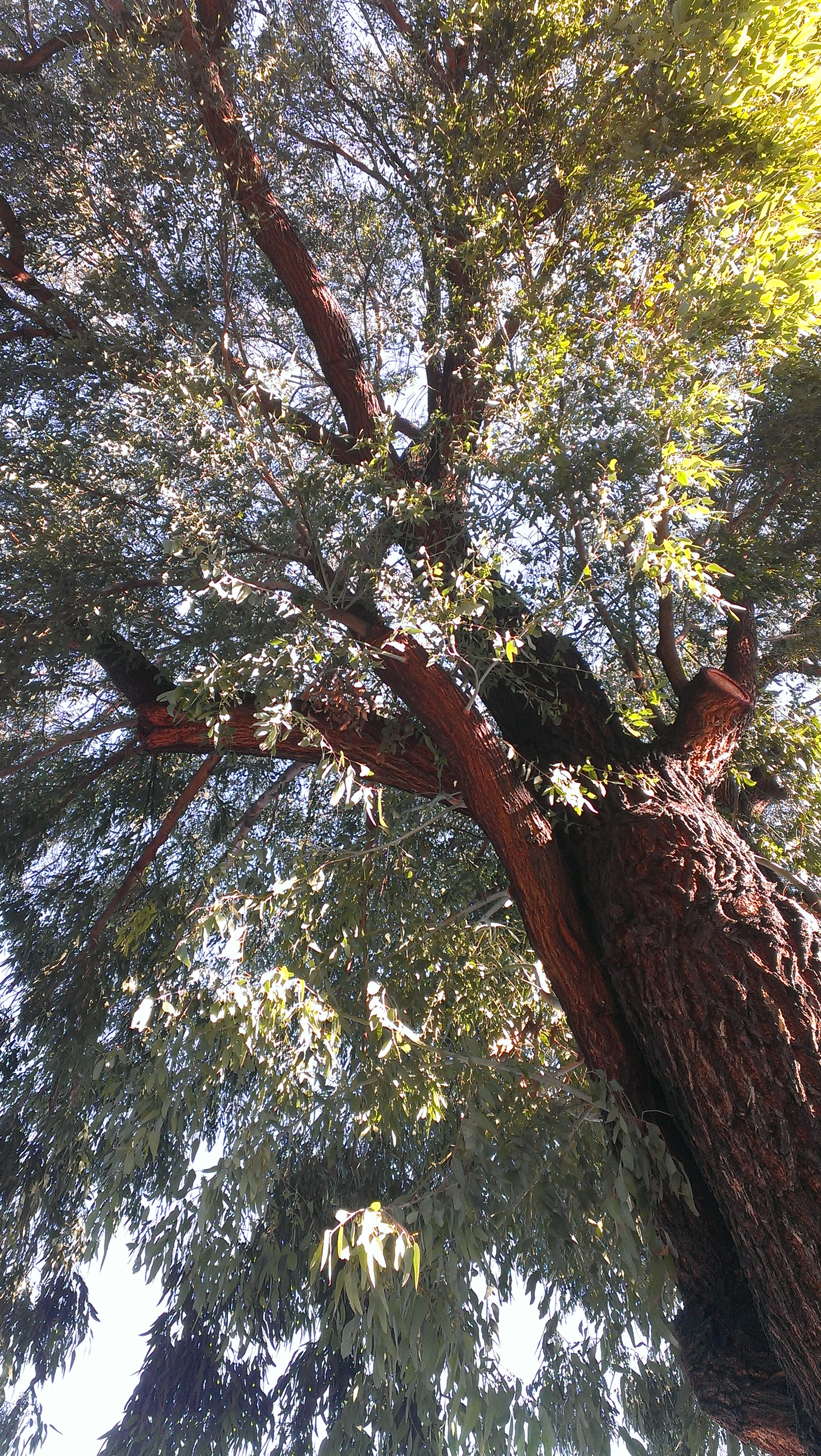
The finished garment is sooo cute, and so tiny I need to find a different recipient for it.  I should have recognised the difference in stretch between the garment I measured up and the milky merino…!
IMAG1754


9 Comments

Filed under Dye Plants, Eucalypts, Leaf prints, Natural dyeing, Neighbourhood pleasures, Sewing

Milky Merino: First effort

Last year, I managed (with a little help from cossack design) to acquire some milky merino knit fabric. I have been thinking that if I want to make all my own clothing I will need to learn how to make turtle neck, knit, long sleeved tops for winter and T shirts for summer (though perhaps it will be years before I wear out my current collection of T shirts–and people keep giving them to me)!  I decided to try a pattern I bought some time ago.  Then I managed to trace a pattern from a garment I already have and like to wear and cut one of those from the length of fabric I had as well.

IMAG1897

I was feeling positively gleeful about the potential for two garments to emerge from this experiment.  Many other dyers–see examples here, here and here have had beautiful results dyeing this fabric.

  IMAG1903 (1)

I’m delighted with these results.

IMAG1905

I also dyed the little samples that came in the pack, neatly enclosed in my soup ball:

IMAG2270


IMAG2277

This thread has since been applied to a ‘beloved tree’ banner.

IMAG2291

That was all very well.  I sewed my garment together, only to discover that I had succeeded in shrinking the fabric… and more in one direction than the other.  In the end, I gave the garment to a smaller friend and she adjusted it to fit her.  She looks wonderful in it!  Now I am building up my nerve to sew the second turtleneck together and see who that will fit!

12 Comments

Filed under Eucalypts, Leaf prints, Natural dyeing, Sewing

These are a few of my favourite trees

The ‘Beloved tree’ banners are out in the neighbourhood.  A bunch of us put up the first couple, and I pedalled around attaching the rest on Mother’s Day.  This one is on a massive ironbark.

IMAG0114

It stands beside the tram bridge in Goodwood.

IMAG0116

This one is dwarfed by a huge E Camaldulensis in a park beside Brownhill Creek.

IMAG0118

This trunk has survived a lot of depredations, whether human, animal or insect.

IMAG0119

I’ve tried to capture a sense of its canopy…


IMAG0120

But it is hard to show all there is to see when you stand beneath its curved limbs and beside that massive trunk.  Needless to say it isn’t all about what you can see, in any case.

IMAG0122

This is the place where lorikeets sometimes nest.  I’ve seen them wiggling their way in through the hole they have nibbled out of the pace where a branch used to be, as well as flying out at speed like small, feathered, green comets.

IMAG0123

This next tree is an E Sideroxylon. It stands outside the Le Cornu warehouse on Leader St.

  IMAG0124

IMAG0125

I used to be able to reach its lowest leaves, but the chainsaws took off the lower limbs some time back.  It is still magnificent.

IMAG0126

The light wasn’t great for it, but since there is at least one appreciator of industrial buildings reading, here is a shot of the background. I oriented my banner toward pedestrians.

IMAG0127

Next, one of the largest E Cinereas in the neighbourhood, standing outside what seems to be a disused office in Leader St.  Perhaps people work there but are not interested in the garden!

IMAG0128

It has suffered the chainsaw too, losing a truly huge bough.
IMAG0129

Still glorious.

IMAG0132

Still vast.

IMAG0133

Finally, my old friend on the corner of Laught and East Sts.  I thought this was an E Scoparia at first, but while the leaves give amazing colour, the bark produces a different result than other E Scoparias I’ve dyed with.  Name, uncertain. Beauty, obvious.

IMAG0134

This time I was spared conversation with the tree hater who lives opposite this tree and can only see it as a source of litter.  I was on the bike, so picked up a bagful of fallen dried leaves.  When I have more carrying capacity I take fallen twigs and whatever bark or wood is lying beneath it in hopes of mollifying the tree hater. 

IMAG0136 (1)


Fabulous.  I must say that visiting all these beloved trees and wrapping my arms around each one… I did feel like a tree hugger.  And proud!

IMAG0137

6 Comments

Filed under Craftivism, Dye Plants, Eucalypts, Neighbourhood pleasures

Never look a gift alpaca in the mouth

I have been in Melbourne at a workshop with India Flint.  It was a great three days and I can’t wait to write about it…. but my phone steadfastly refused to cooperate woth WordPress–or perhaps it was the other way round–and it turned out sharing a computer wasn’t really an option.  So, writing about that will have to wait a minute or two!

In the meantime… maybe the proverbial instruction that you never look a gift horse in the mouth (implying you are checking whether it is an old horse and not a fresh, strong young one) only holds true for horses.  I’ve had gifts of alpaca that were full of moths, smelled of mould or were terribly short and full of guard hairs.  People making such gifts are well intentioned but have no idea what it takes to transform that fibre into yarn or how many hours I’ll spend touching and smelling it!

However, the two I have started in on recently are lovely.  They’re from friends who live in the hills–the people whose community was the former home of Malcolm the Corriedale.  There’s a white fleece that I am dyeing with eucalypts (so far).

IMAG3943

I have found that I can take raw alpaca fleece and dye it without pre-washing.  I can wash the fleece in the same step as rinsing out dyebath–saving water and getting the benefit of eucalyptus cleansing.  The dyebath no doubt has earth in it already if it contains leaves from a gutter or bark from under a tree.

IMAG4004

Then there is a wonderfully black fleece.  Two kilogrammes of it.  By the way, I believe I did look into the mouth of this particular alpaca, and its teeth were mighty long!  We had enough rain weeks back that we have run the whole house on rainwater ever since.  The weather was still hot and dry most of the time until recently.  So it seemed seasonally appropriate to wash fleece.  Then I had the key thought: ‘I feel as though I could just wash half that fleece right now.  And maybe the rest tomorrow.’ If I ever have a thought like that about housework, I make it a habit to act on the impulse immediately, before it can get away!  Fleece washing is not really fun, but it makes other forms of fun possible, and it is necessary.  Alpaca is filthy because the animals roll and dust bathe, but it is not greasy, which makes washing it far simpler than washing sheep fleece.

IMAG4037

So now: let the spinning begin…

2 Comments

Filed under Fibre preparation, Natural dyeing

Drive-by dyeing and mending

On my bike ride home from work (about a 40 minute ride), I pass just one Eucalyptus Cinerea. Well, there are two, but one is inside someone’s front garden.  A person has to have some boundaries!  The street tree had dropped a small branch.

IMAG4127

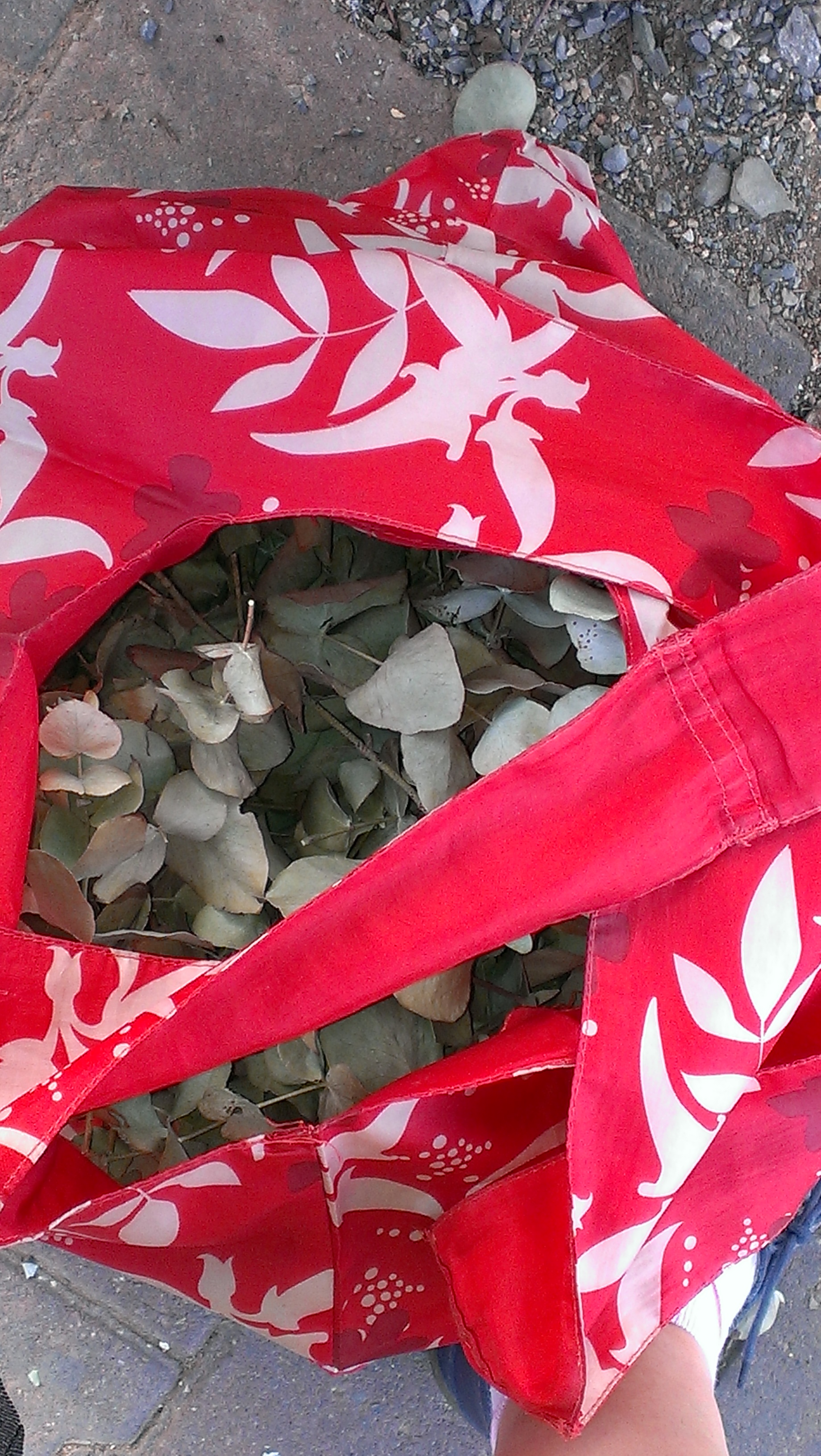
I decided I’d better collect it.  Usually I carry a calico bag in my bike pannier for such contingencies, but this was what I found when I scrabbled about in the bottom of my pannier on the day, so in went all the stray leaves I could find.

IMAG4131

This tree has had to contend with a lot.  It has had a  very strange pruning job designed to protect the electrical wires that now pass through its branches.  The pruning took out a lot of the canopy, but the tree is still standing.  For this, I am grateful.

IMAG4128

Recent events have caused me to reflect on the way I think about trees on my regular routes… like old acquaintances.  I think about them as I pass, the way I think of people when I pass near their homes without visiting.  I notice what happens to them.  I check them over when I have the chance.  I remember how they were when they were younger, or before that accident befell them.  It’s not entirely unlike the way I notice people I don’t know well, but see out and about in the neighbourhood regularly.

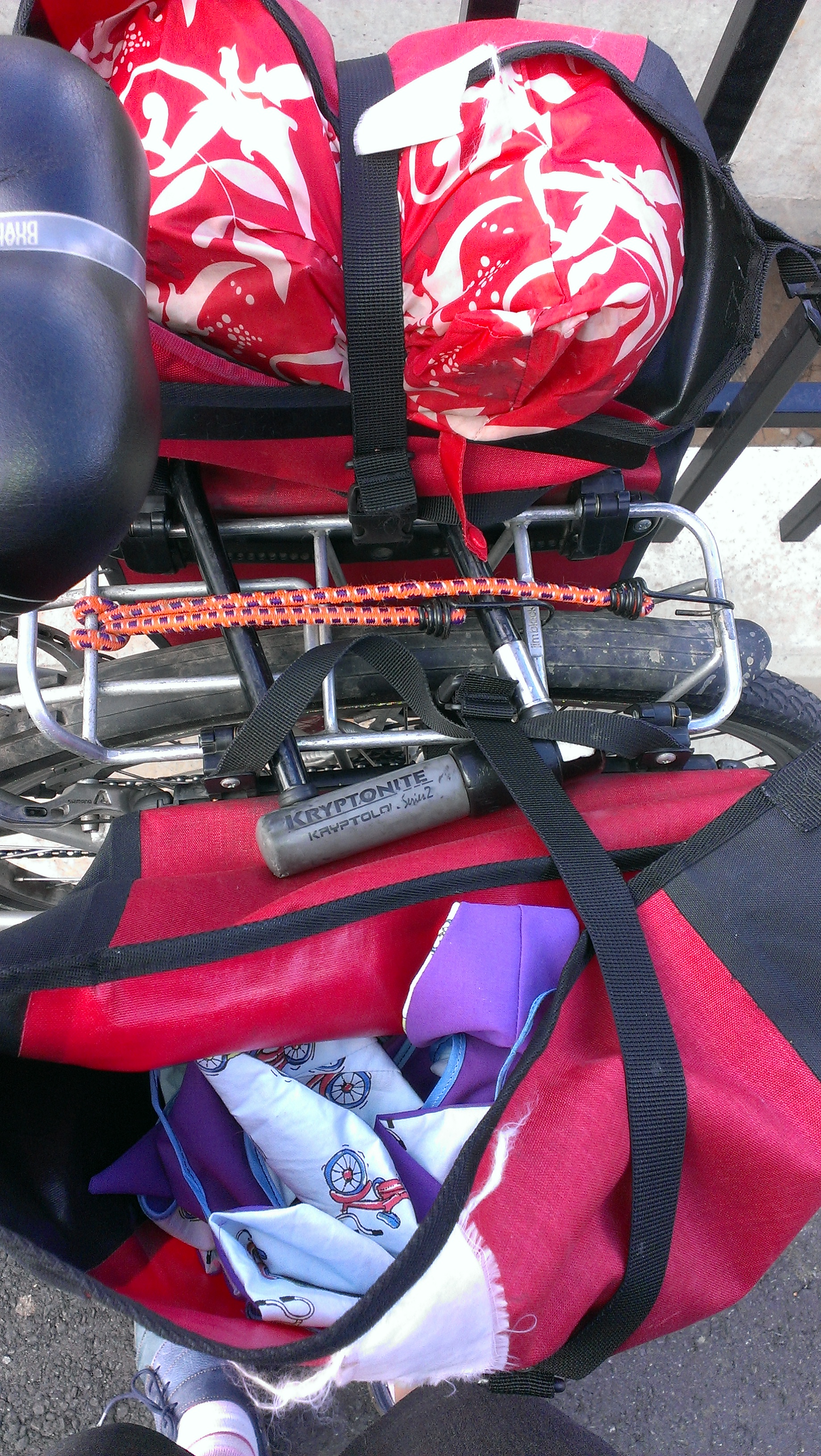
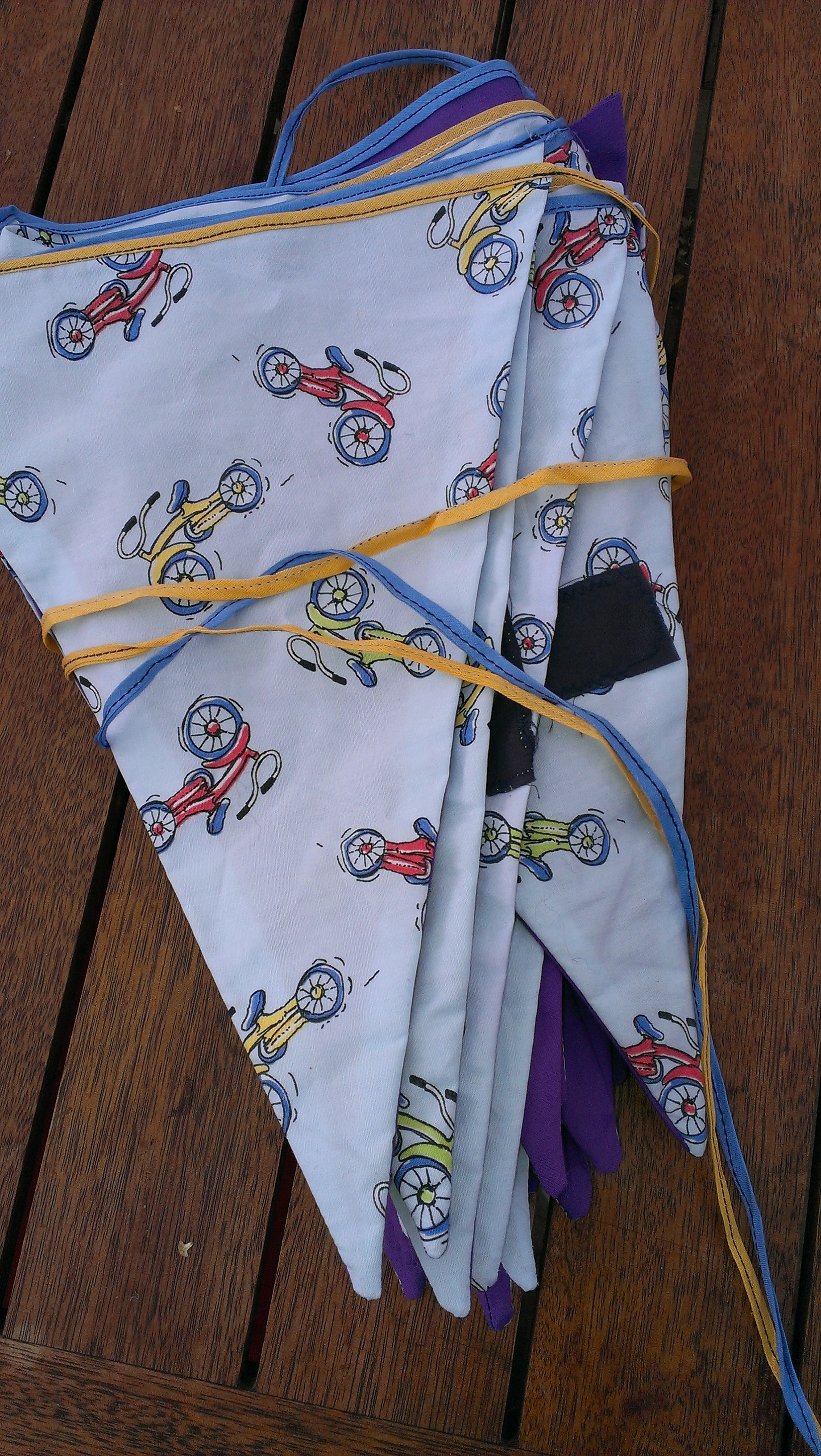
Further along, I saw that my “thanks for cycling” bunting had been ripped and some of it was lying on the ground.  Soon it was in my other pannier headed for the mending pile.

IMAG4135

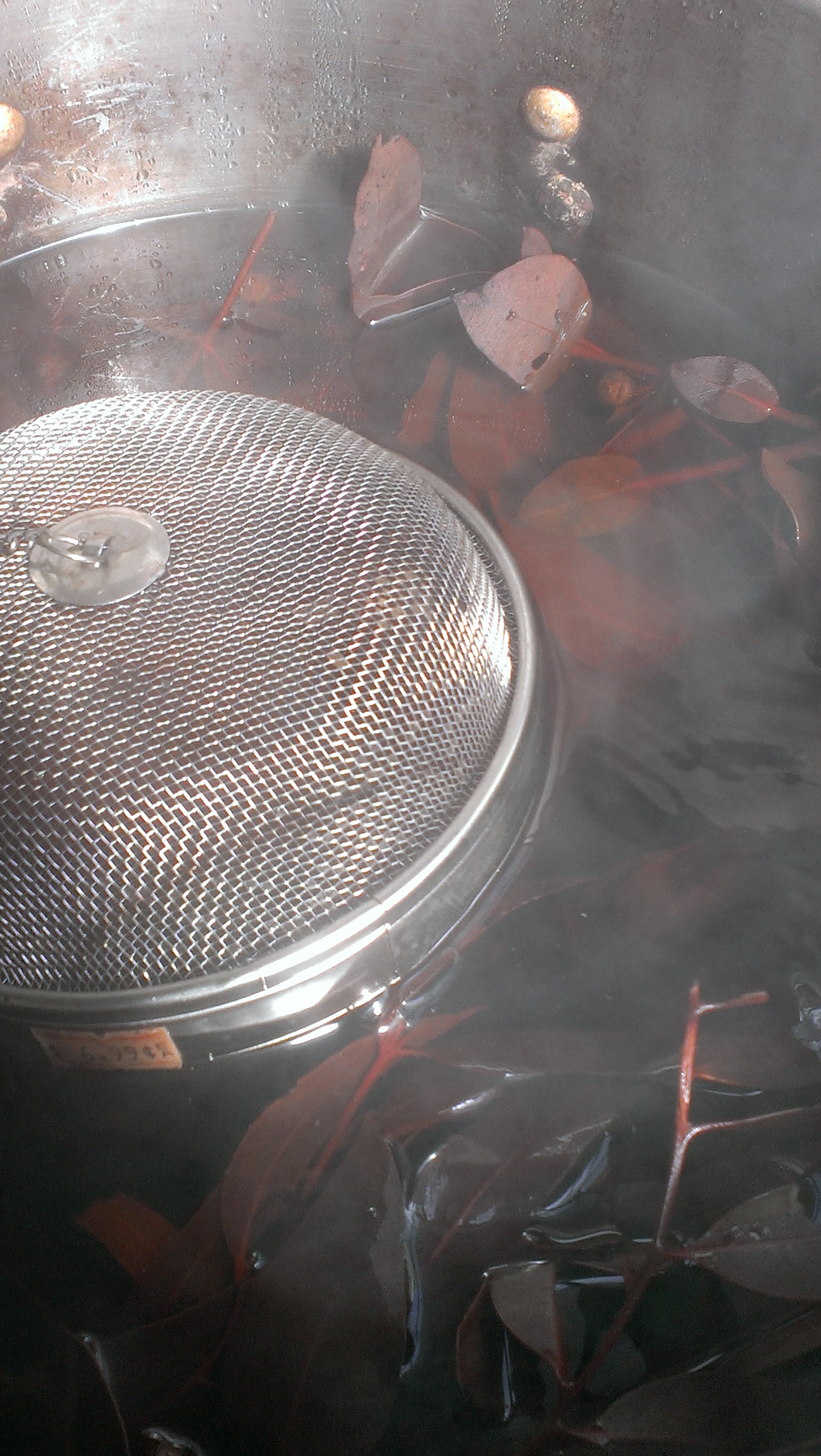
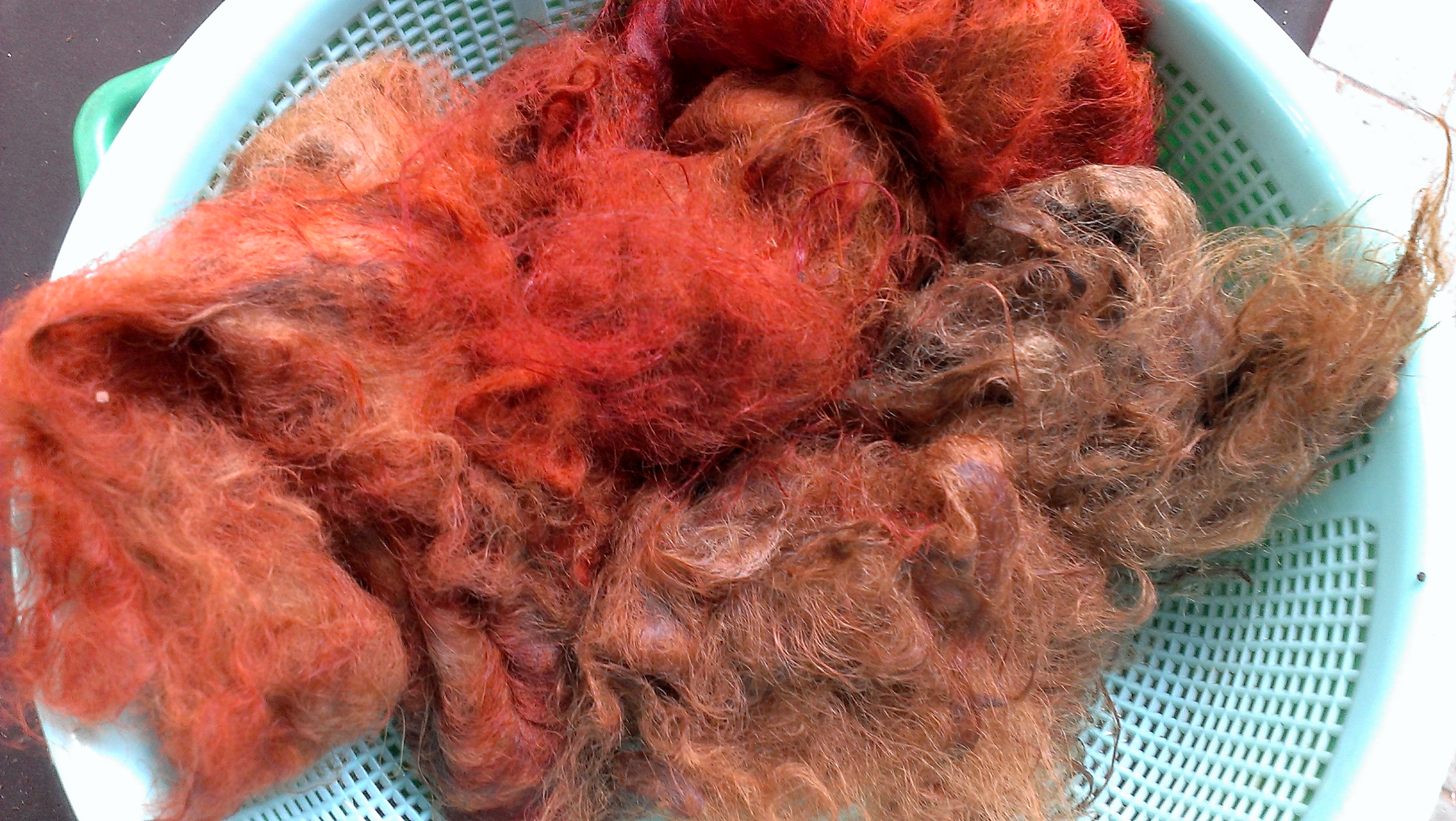
A few days later, the E Cinerea made it into the dye pot and produced its usual dependable flamelike orange.  I also collected some ironbark leaves that had fallen in the parklands near where we had exercise class.  Once the E Cinerea was all but exhausted I reused that dyebath with the ironbark leaves, thinking I would save water and energy, but clearly this was not E Sideroxylon–it produced that sad, damp little pile of fawn alpaca on the right.

IMAG4183

I have come to regard this as a sign: The orange leaves in the picture below are the E Cinerea leaves, which have gone from silver-grey-green to orange in the dyebath.  The ironbark leaves, on the other hand, have remained a robustly green shade even after cooking.

IMAG4180

And, I’ve mended the bunting ready to hang it again on a suitable occasion…

IMAG4184

4 Comments

Filed under Craftivism, Dye Plants, Eucalypts, Natural dyeing, Neighbourhood pleasures

Spinning up a storm. And some more newspaper.

I am continuing to ply the holiday spinning, but this is the last of it… This coreopsis-dyed yellow yarn has been waiting patiently for weeks.  The eucalyptus-dyed yarn is a new spin.

IMAG4174

Of course, there is more eucalyptus-dyed corriedale spun on holiday and plied recently.  I elected to keep the two shades distinct.  When I began dyeing I preferred dyeing yarn and was afraid to dye fleece.  Now I prefer to dye the fleece, because it gives me so much choice when it comes to spinning (and I have learned a few things about controlling the temperature of the dye bath to avoid felting).

IMAG4007

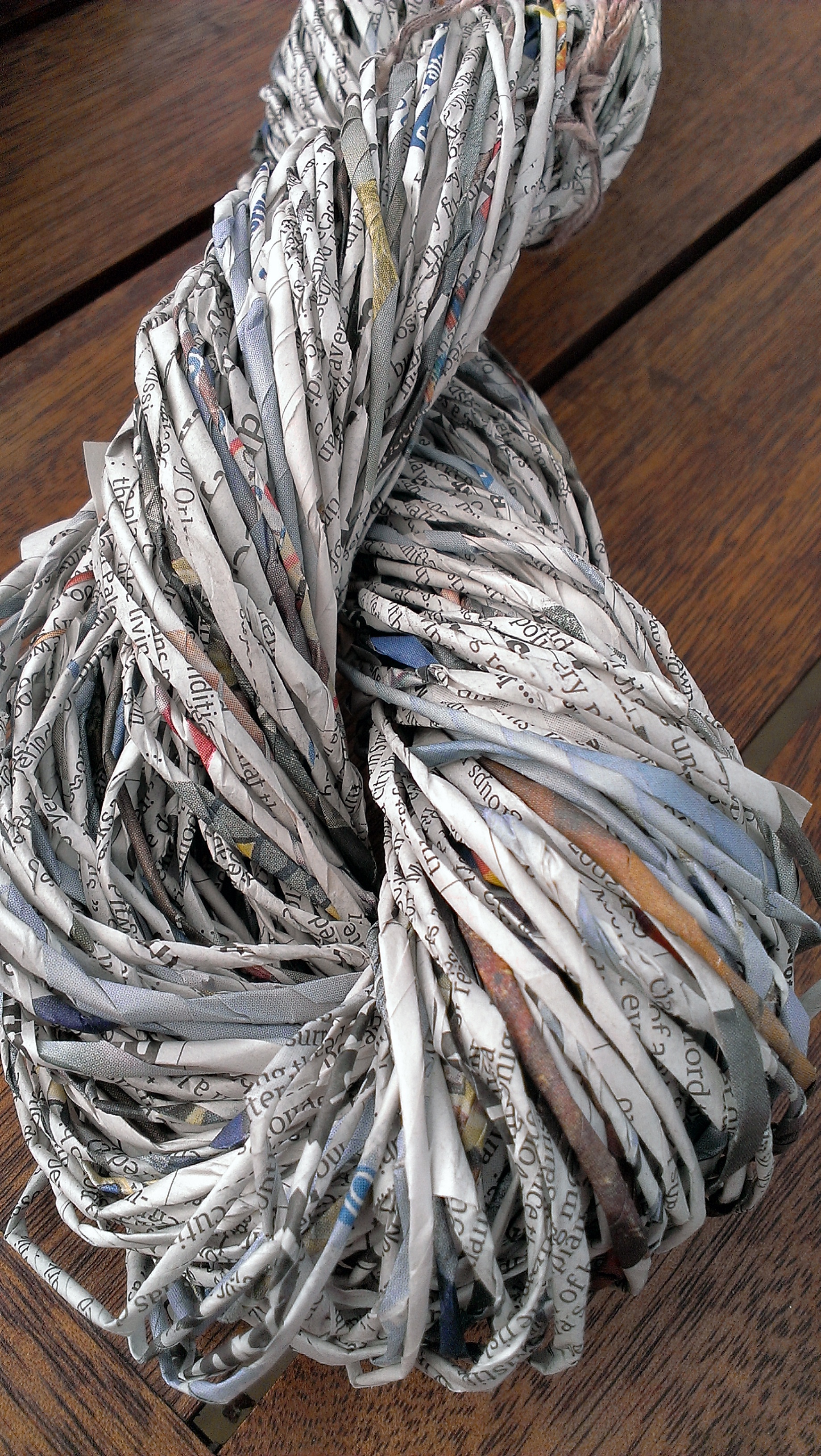
I also decided that I could probably refine my newspaper spinning skills, and you know, I think I have!  It’s possible to coax the newspaper strips into a tube as you spin, and I like the effect better.  I think I also succeeded in creating a lower twist single that still holds together.  More fun than I had ever expected…

IMAG4171

2 Comments

Filed under Natural dyeing, Spinning

Leafy quilt back finished!

IMAG3956
On the weekend, I finally stitched together the back for a quilt that has been in some kind of progress through most of the last year.
IMAG3952
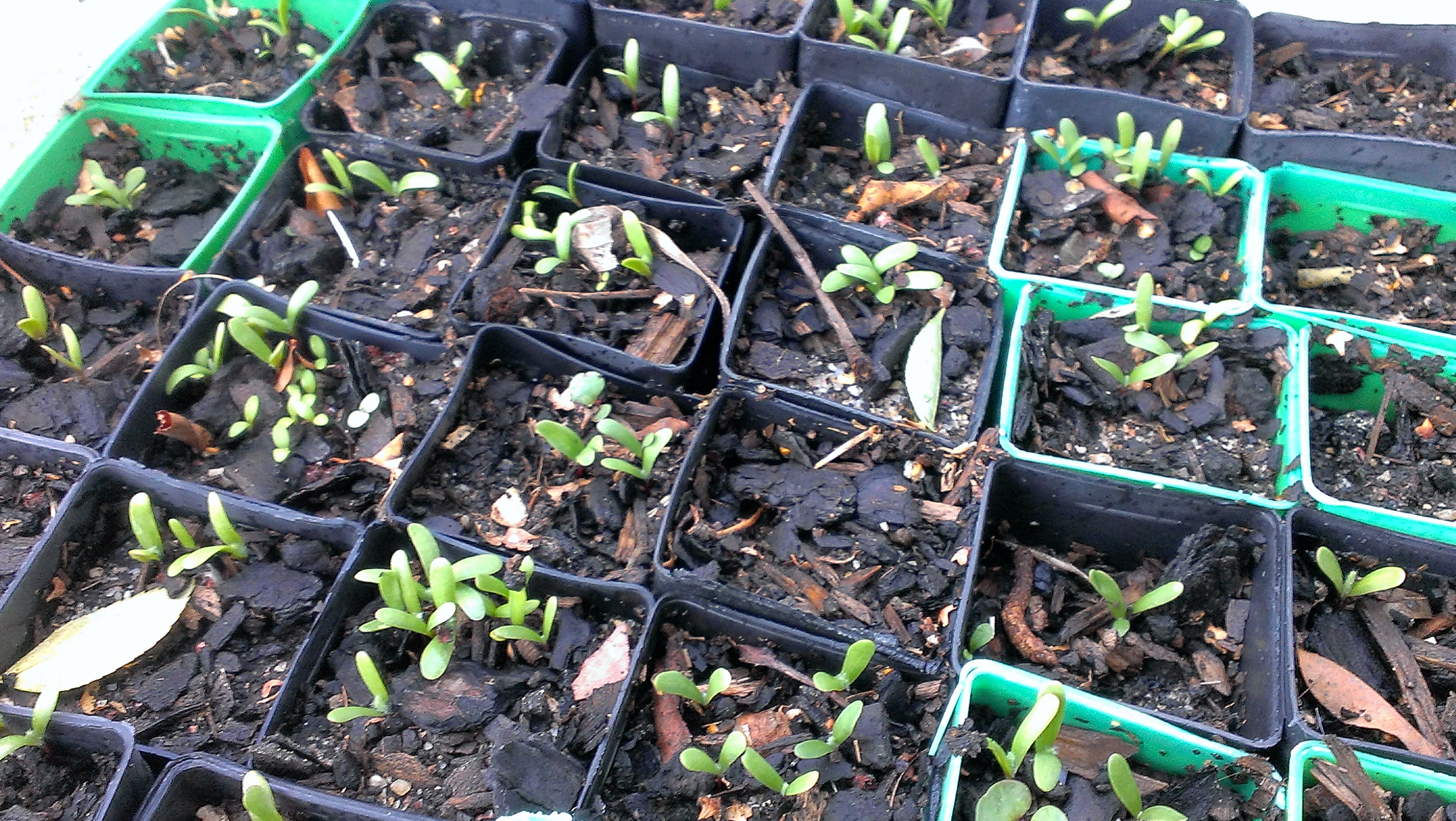
The blocks for the front are finished and I hope I have eco printed enough fabric for a border. A friend who was over on the weekend advised me about the sashing. So… now I need to get started on piecing the front together. Don’t hold your breath! Meanwhile, the saltbush seed I collected while we were on holidays is coming up and so are my vegetable seedlings, and I’m contemplating what to do with the home grown indigo and when I should do it!
IMAG3893

5 Comments

Filed under Leaf prints, Natural dyeing, Sewing

Leaf print of the week

IMG_0020_1

These are Eucalyptus Cinerea leaves on silk velvet. The velvet came from Beautiful Silks.  Just four small squares in a couple of scrap packs I bought along with whatever I was ordering at the time.  From my point of view this was lucky dip by post, and more fun than most lucky dips I remember as a child.  I would never have expected to enjoy velvet so much!  Here are both squares fresh from unbundling.

IMAG3229

Perhaps I’ll have to make a cushion cover… as proposed in the comments.  Finally, a little close-up.  E Cinerea famously has heart-shaped leaves, but this tree had been pruned (mostly by me) and the new growth has come out in quite different shapes, which suits me just fine.  For some reason, I love the leaves that have provided food to caterpillars at least as much as the intact leaves, if not more.

IMAG3264 (1)

Meanwhile, I still have at least 80g of indigo dyed sock yarn (enough for a pair of socks), so after all the cheering on from readers recently, I have tried the least difficult solution to crocking I found (start with simple!) and soaked it overnight in a vinegar solution.  No bleeding into the rinse water… and I’ve left the yarn out to dry.  Fingers crossed!

10 Comments

Filed under Eucalypts, Leaf prints