Tag Archives: for the love of the Guild

Natural dyeing workshop

I began the final stage of preparation for my natural dyeing workshop by packing the car to capacity the night before and steeping logwood and madder in hot water. These are more of the dyes that have been left at the Guild.  It seemed good to share them with other Guildies this way.

2014-06-12 16.20.18

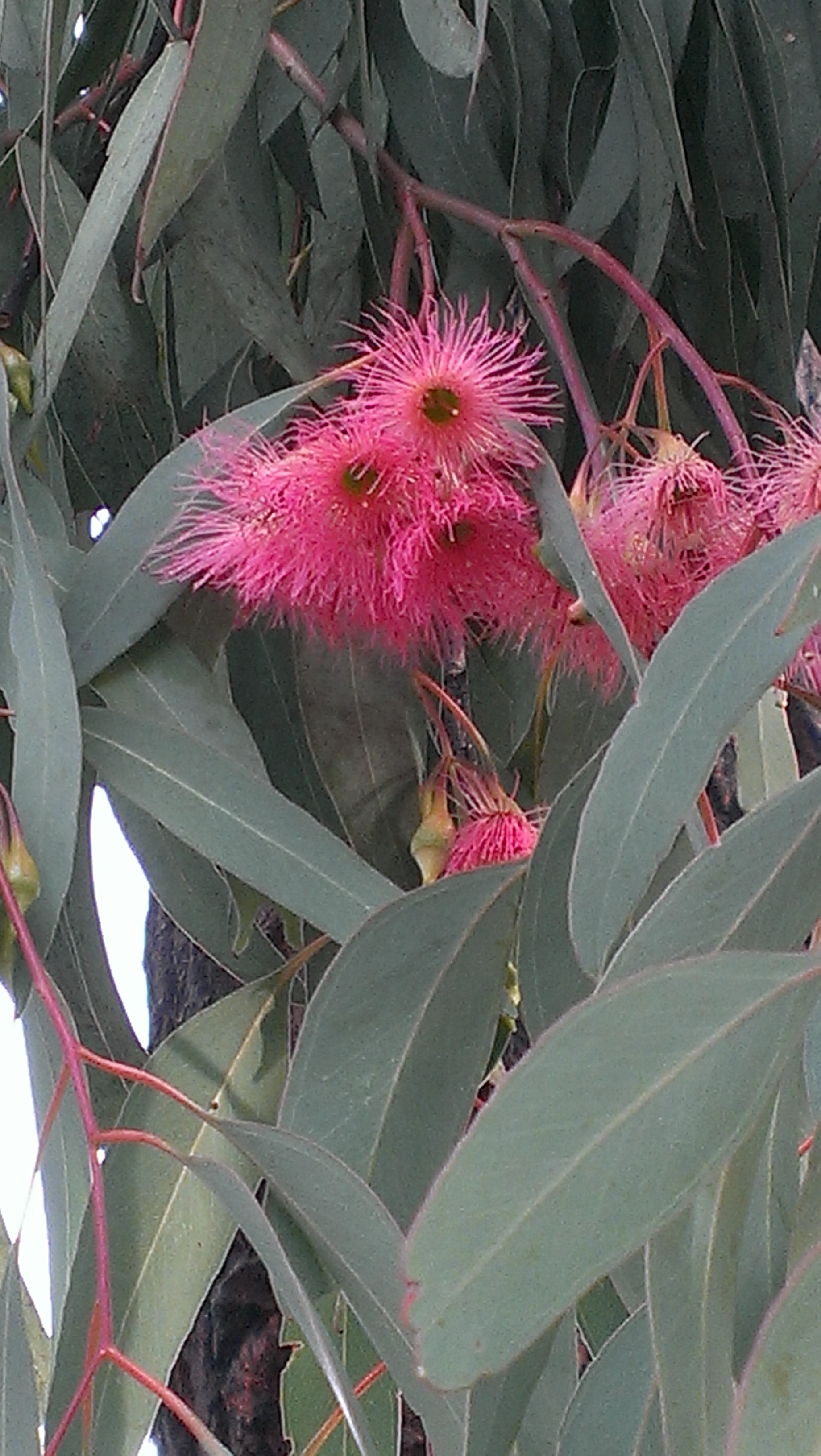
I came through the parklands on my way to the Guild and stopped in homage to a few trees.  This one turned out to be E Tricarpa…

2014-06-14 08.32.52

The unpacking was quite a thing.  This is a view of the back seat of the car before unpacking.

2014-06-14 08.42.38

The steeped fermenting walnut hulls (another dyestuff left at the Guild) travelled in the front seat footwell, in a pot with a lid, in a big bucket in case of spills.  No spills.  Whew!! I put heat under them an hour before people arrived in hopes of getting it over with.  My friends, I will never do this again.  It may take me years to live down the smell this dye pot gave off!  At one point when a heater went on, someone told me they had found a dead mouse in the heater.  When I went to see, they were looking for a mouse they were sure must be in there because they could smell it.  Cough!  The women who were rostered on in the Little Glory Gallery in another part of the Guilds premises exclaimed.  So did the treasurer, who came in to work on the books and was similarly appalled.  Eventually walnut tailed off and a eucalyptus bark dyepot began to prevail.  The smell of natural dyeing had people who had come to the gallery wanting to come and see what we were doing all day!  I give you the walnut hulls I will be living down at the Guild for years to come.  They produced an inky dye.  Truly impressive.

2014-06-14 09.08.23

I set up a bit of a display table of yarns and knits, leaf prints, tea cosies, sample cards and books.

2014-06-14 09.41.47

People had their first go at India Flint’s eco-print technique.  Some had read the book but never tried it.  I don’t know how people can resist!  The Guild has a copper which had been repaired because we were planning to use it.  Use it we did!

2014-06-14 11.08.32

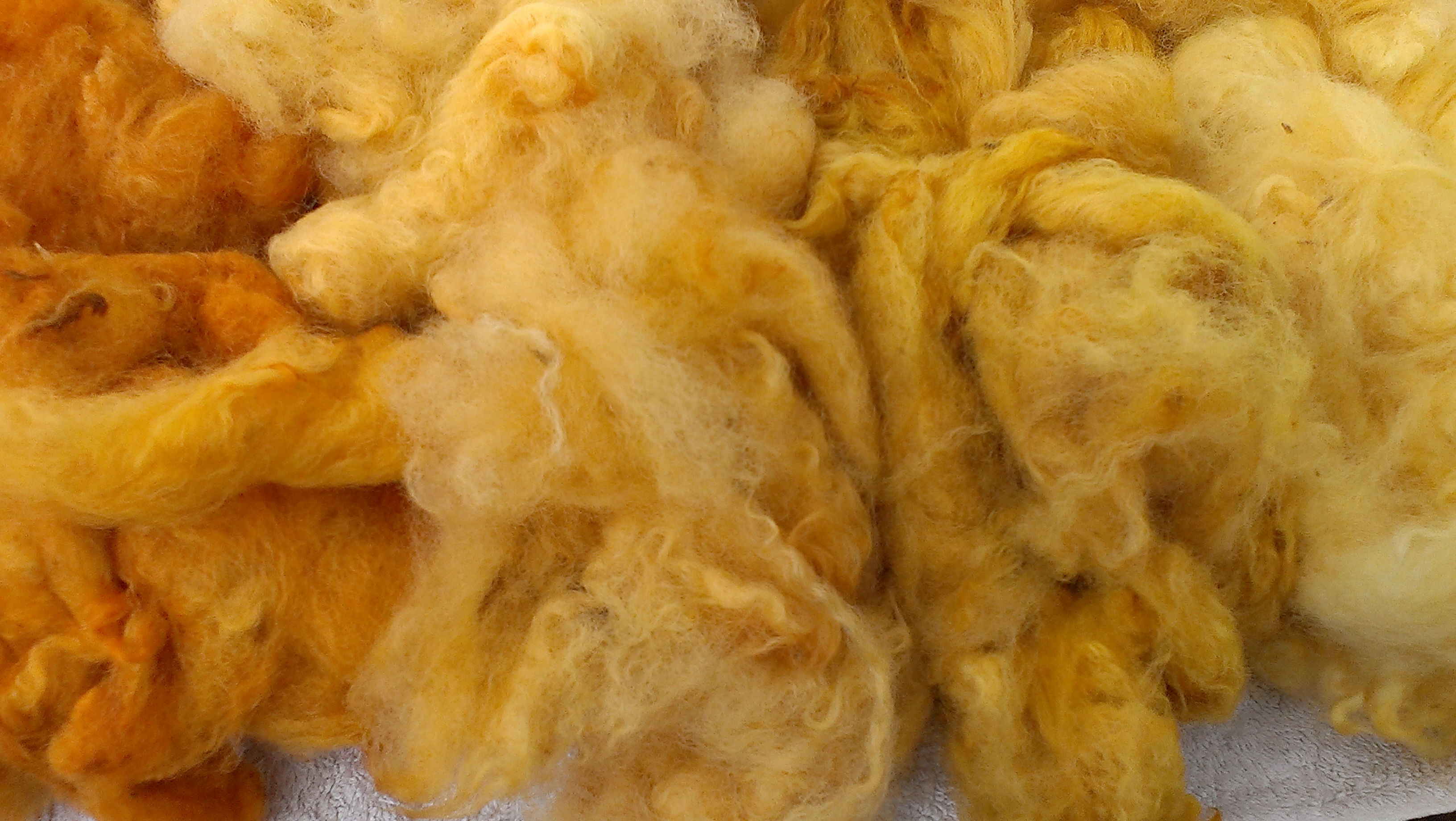
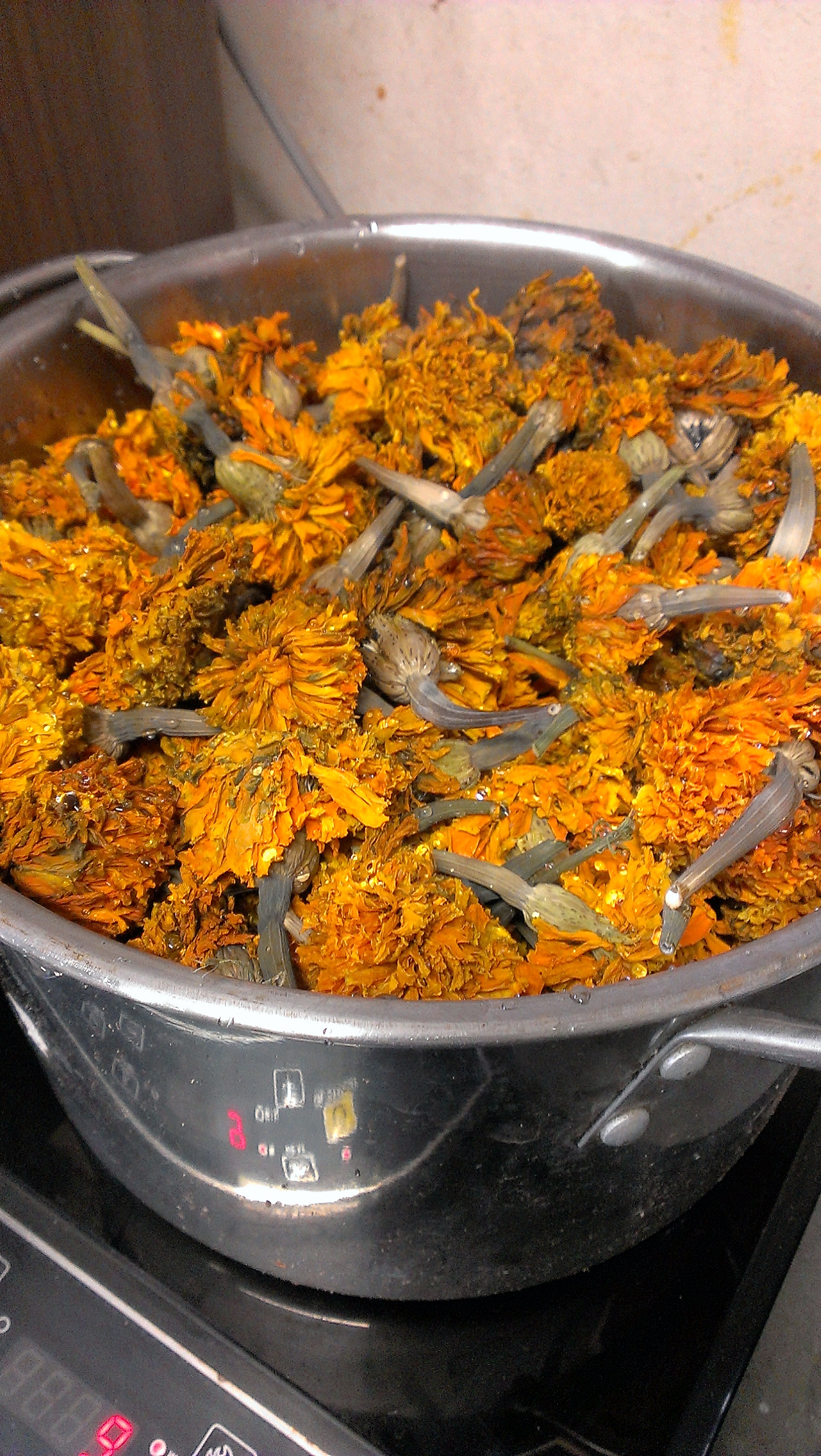
My Mum deadheaded her African marigolds for me through summer and they made a great yellow.
2014-06-14 13.42.52

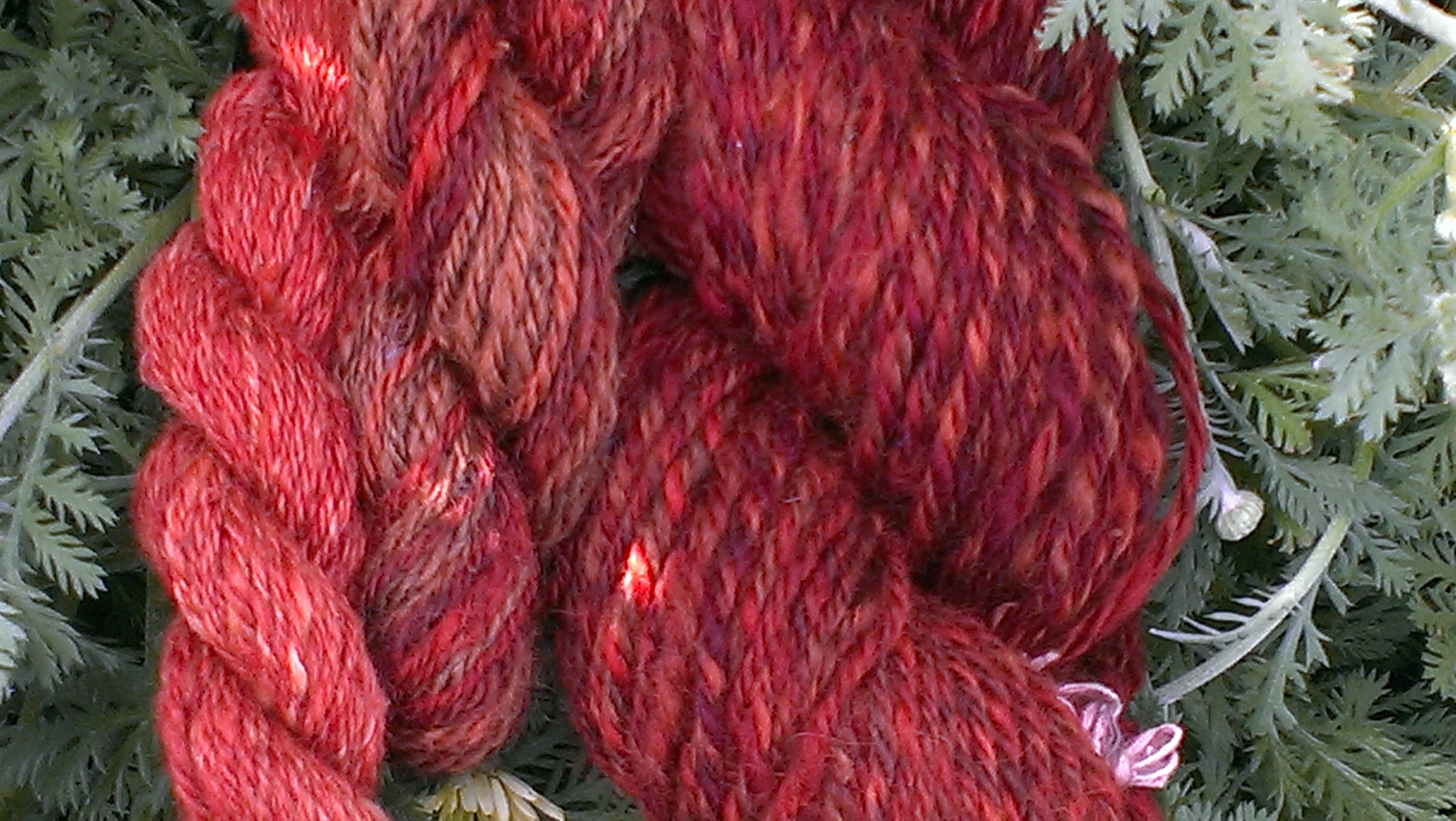
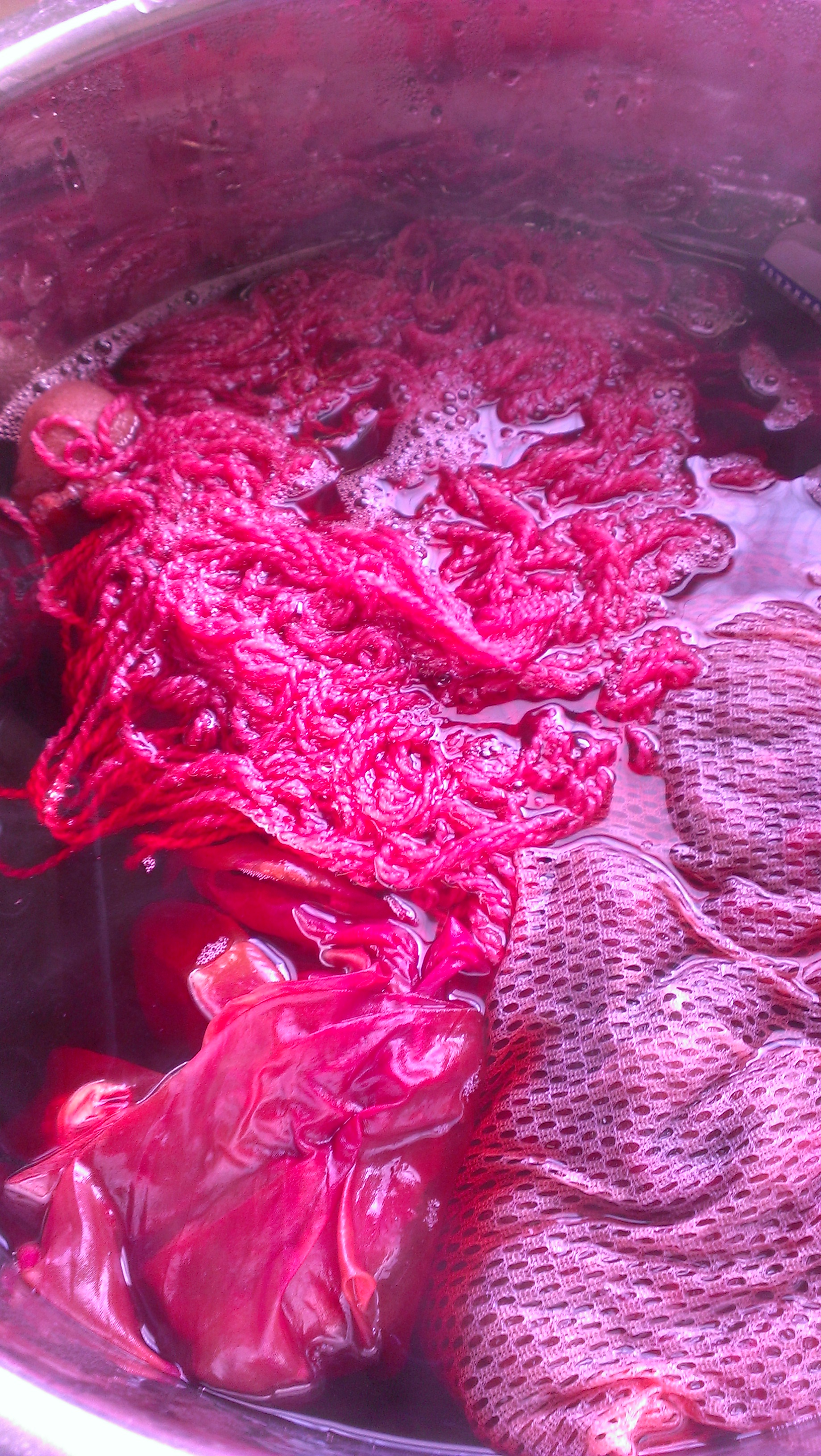
I tried grinding the soaked madder in a blender as Rebecca Burgess suggests (the second hand blender was pretty challenged) and here it is in the dye bath, in its own stocking… we got some lovely reds.

2014-06-14 13.43.07

I used one of the bottles of pre-ground cochineal that had appeared in the dye room cupboard.  The colour was entirely startling!
2014-06-14 14.20.01

There was a pot of logwood that came out so deep it was virtually black.  There was a pot of E Scoparia bark that gave some burgundy on the first round and some tan for a skein added in later.  There was an E Scoparia leaf pot and an E Cinerea leaf pot–oranges of different shades.  The dye room at the Guild has four gas burners as well as the copper–so we went wild.

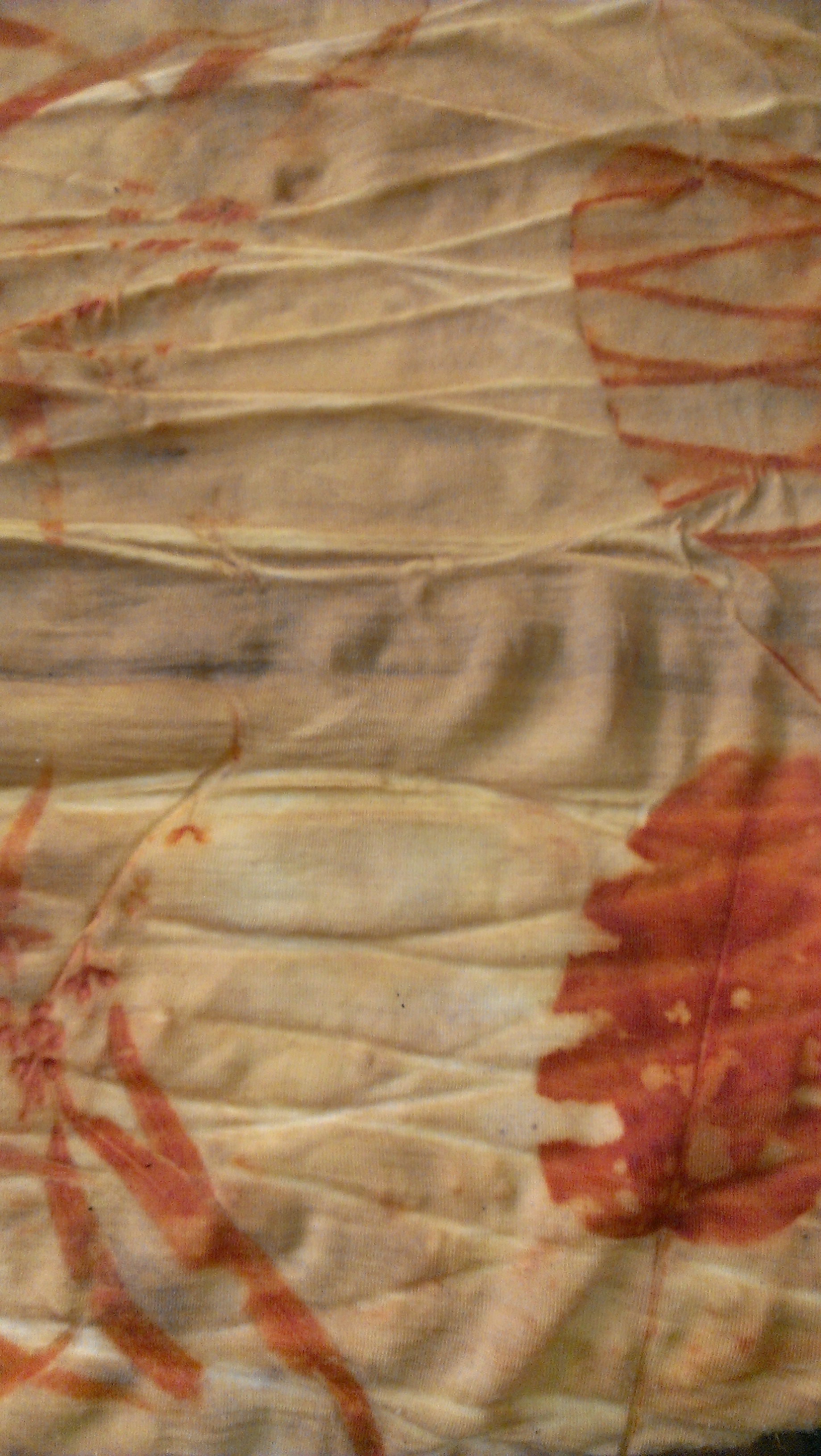
The wonder of unwrapping eco print bundles never wears thin!

2014-06-14 15.07.14

I used the opportunity of being at Beautiful Silks in March to acquire organic wool as well as silk noil twill and some silky merino for this workshop.  E Cinerea did its wonderful thing.

2014-06-14 15.07.21

And so did human imagination…

2014-06-14 15.07.35

The string print on the upper right of this next image was a lovely surprise…
2014-06-14 15.07.51

It was overcast and the results of the dye vats which were the focus of the day are seen here in all their glory drying in the Guild car park! These are eucalyptus and logwood.

2014-06-14 15.11.00

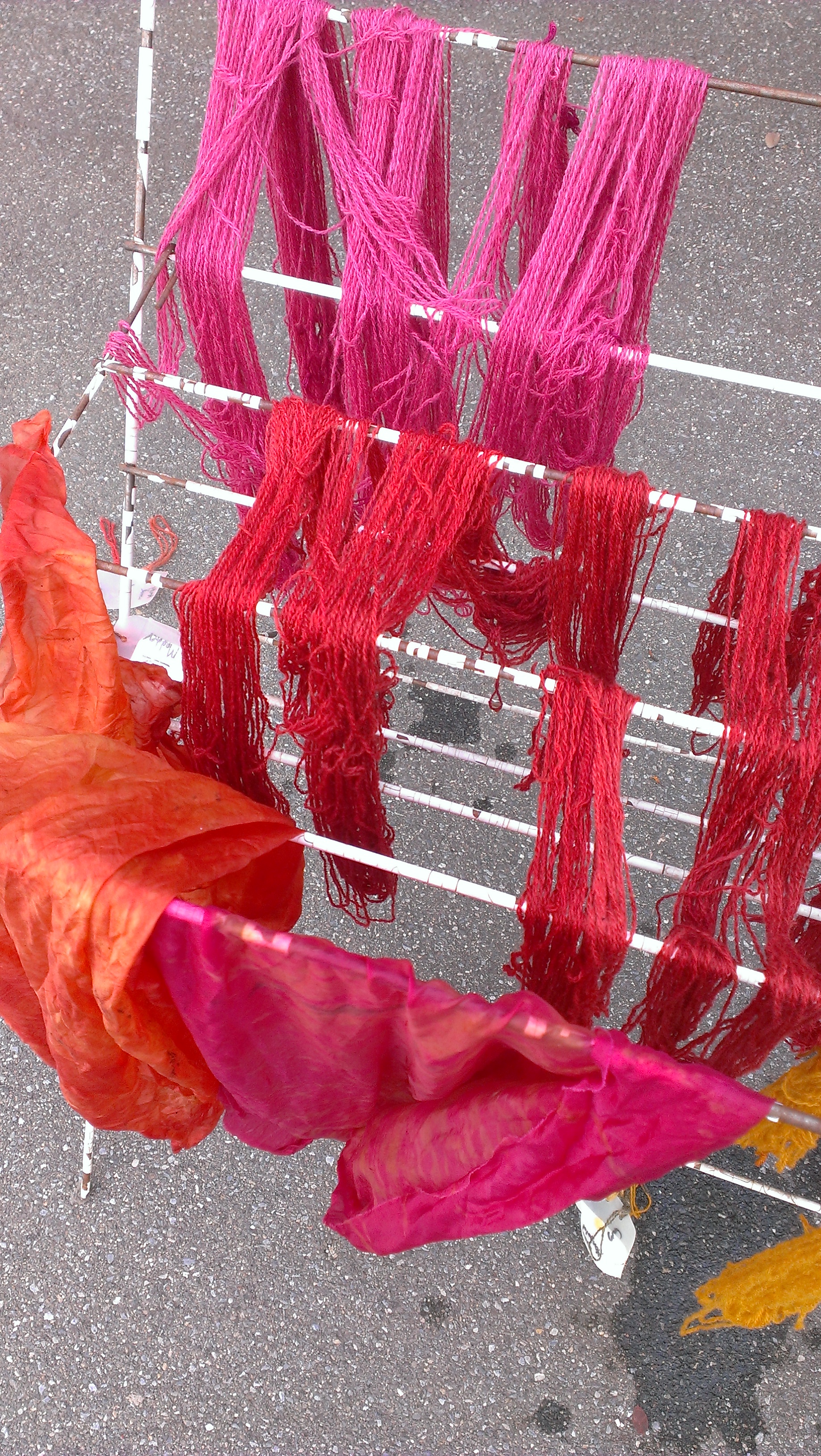
These are cochineal, madder and marigold.  I had mordanted some silk paj in alum and taken it along.  I tried eco printing it years ago and didn’t think much of the results.  Wendi of the Treasure suggested jewellery quality string (which sounds very promising to me), so I’d been planning to eucalypt dye them–but took this opportunity to expand my palette.  The silk went orange in the madder bath even though wool in the same bath was much more red–still good.
2014-06-14 15.11.40

People made their own series of test cards too.

2014-06-14 15.21.44

It was a day of happy experimentation, I think, the smell of fermented walnut hulls fighting it out with stewed eucalyptus bark notwithstanding.  The people who came were friendly, warm and generous–a delight to be among.  It was a treat to be in the company of other people who are fascinated by eucalypts and by the dye possibilities of plants. Folk were talking about what they might do with their cloth and how they might approach their neighbourhoods differently…  I hope that for at least some it will be the start of an exciting new journey.  By the end of the dye I was deeply weary.  I took the logwood, madder and cochineal baths home with me (after taking suitable precautions against spillage) and began some exhaust dye baths next day.  But by late afternoon I was down to twining silk string mindlessly and happily…

2014-06-14 15.21.07

19 Comments

Filed under Leaf prints, Natural dyeing

In preparation for a natural dyeing workshop

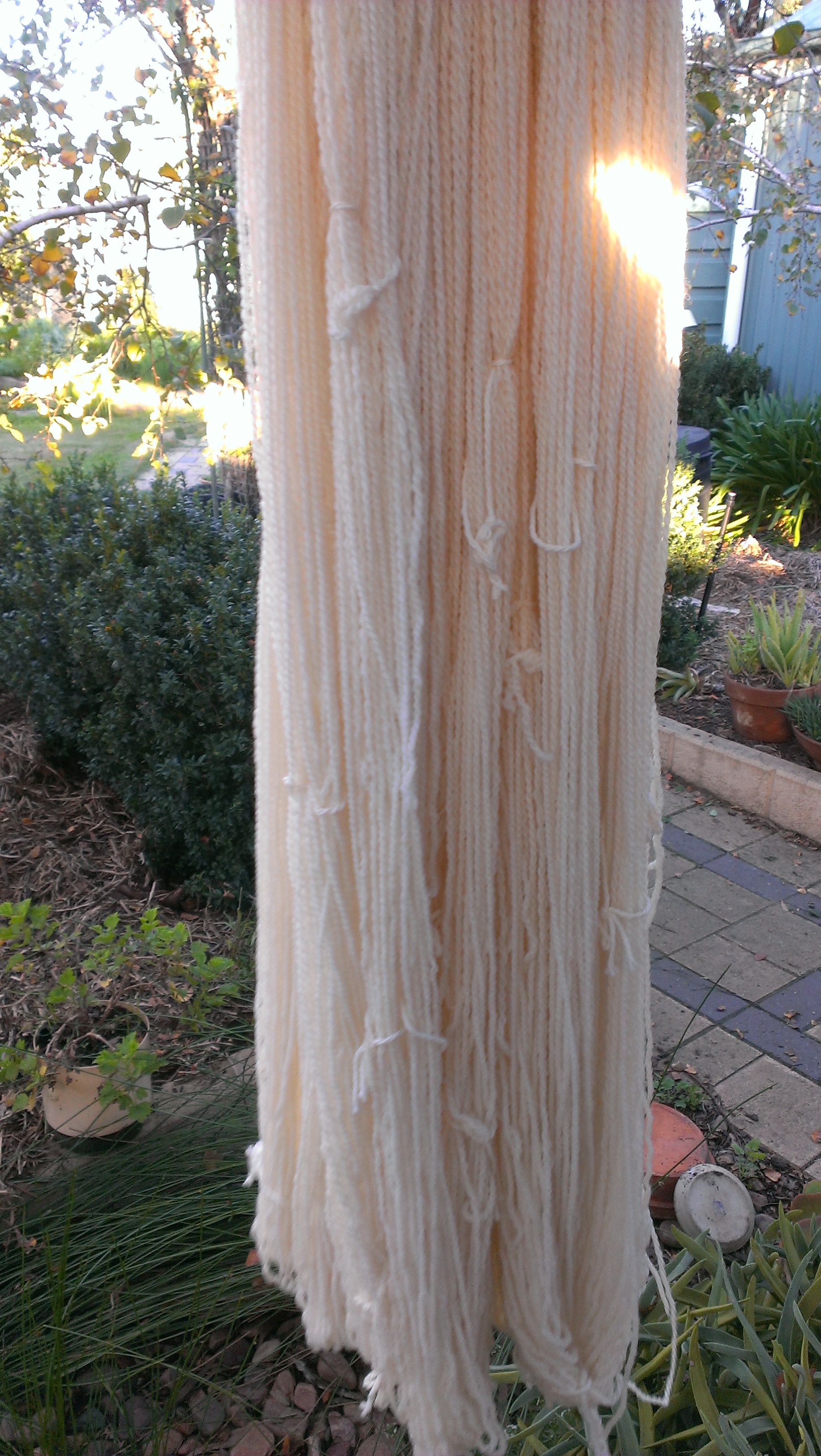
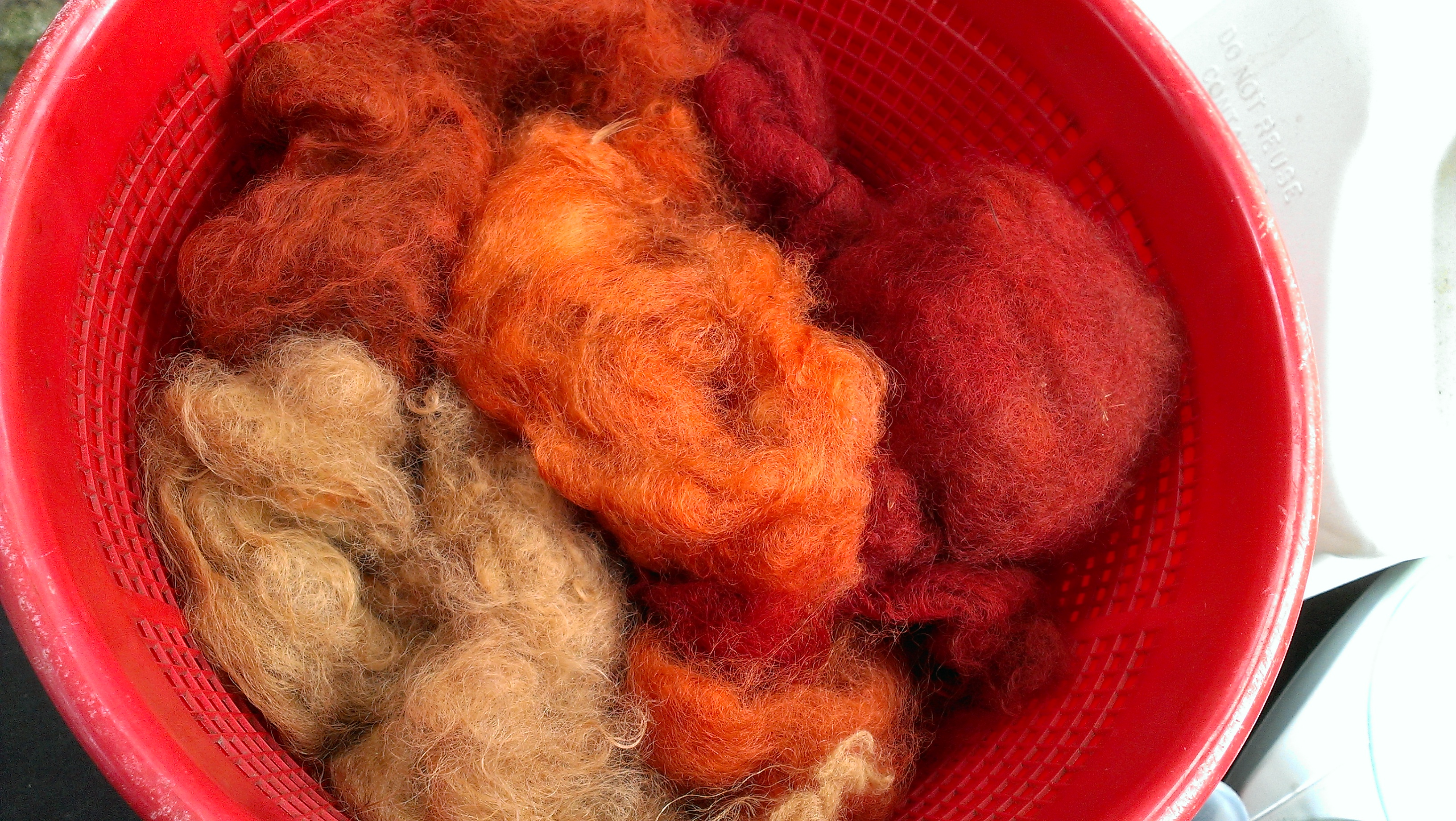
As I write, I’m preparing to run a workshop at my Guild.  I’m counting down and there are only a few days left.  Preparation has been going on for weeks now! I’ve skeined beautiful organic wool and mordanted some.

2014-06-08 16.22.13

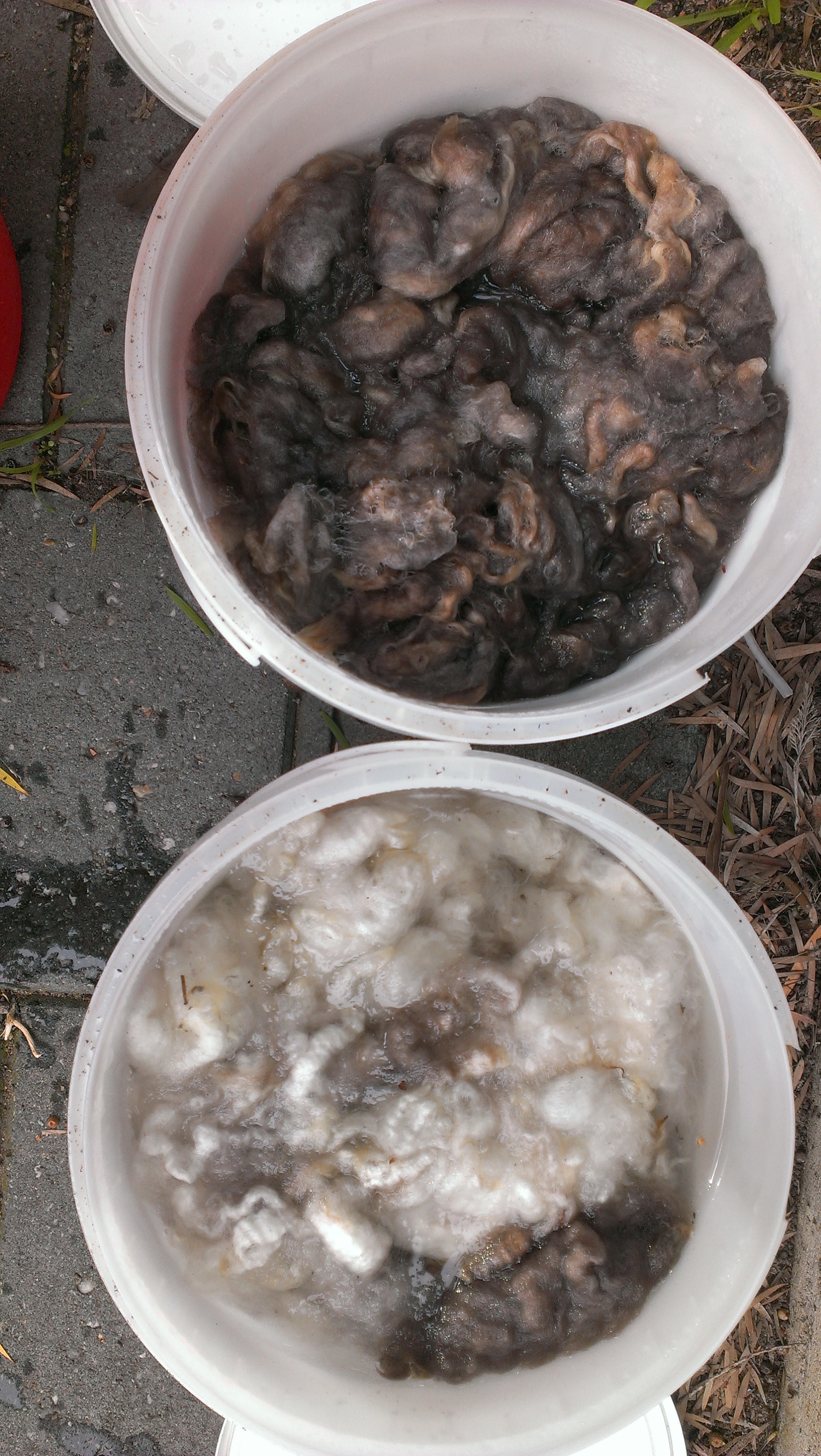
I’ve washed fleece in two colours and two breeds, and mordanted some.  I’ve decided being able to mordant cold in alum is a real benefit to preparing unspun fibres.  Less opportunity for felting or simply mooshing the fibres.  Three cheers to Jenny Dean, who introduced me to the idea of cold mordanting with alum.

2014-06-09 12.38.23

I treated some merino roving to a cold alum bath too. Later I decided that past unlovely experiments with paj silk could go in the mordant bath with a view to being overdyed.  And added silk embroidery thread.

2014-06-09 12.59.57

I have been packing things into bags and writing lists. I’ve begged milk bottles from coffee carts and turned them into sample cards. Finally, on the weekend, I wandered the neighbourhood on my bike gleaning leaves, and finding some damaged pomegranates that might be used for dyeing–the rats that were scampering along the fence nearby had clearly been having a banquet!  It was overcast, but can you see these two E Cinereas forming an arch at the end of this street?  Cute as a button!

2014-06-09 14.58.15

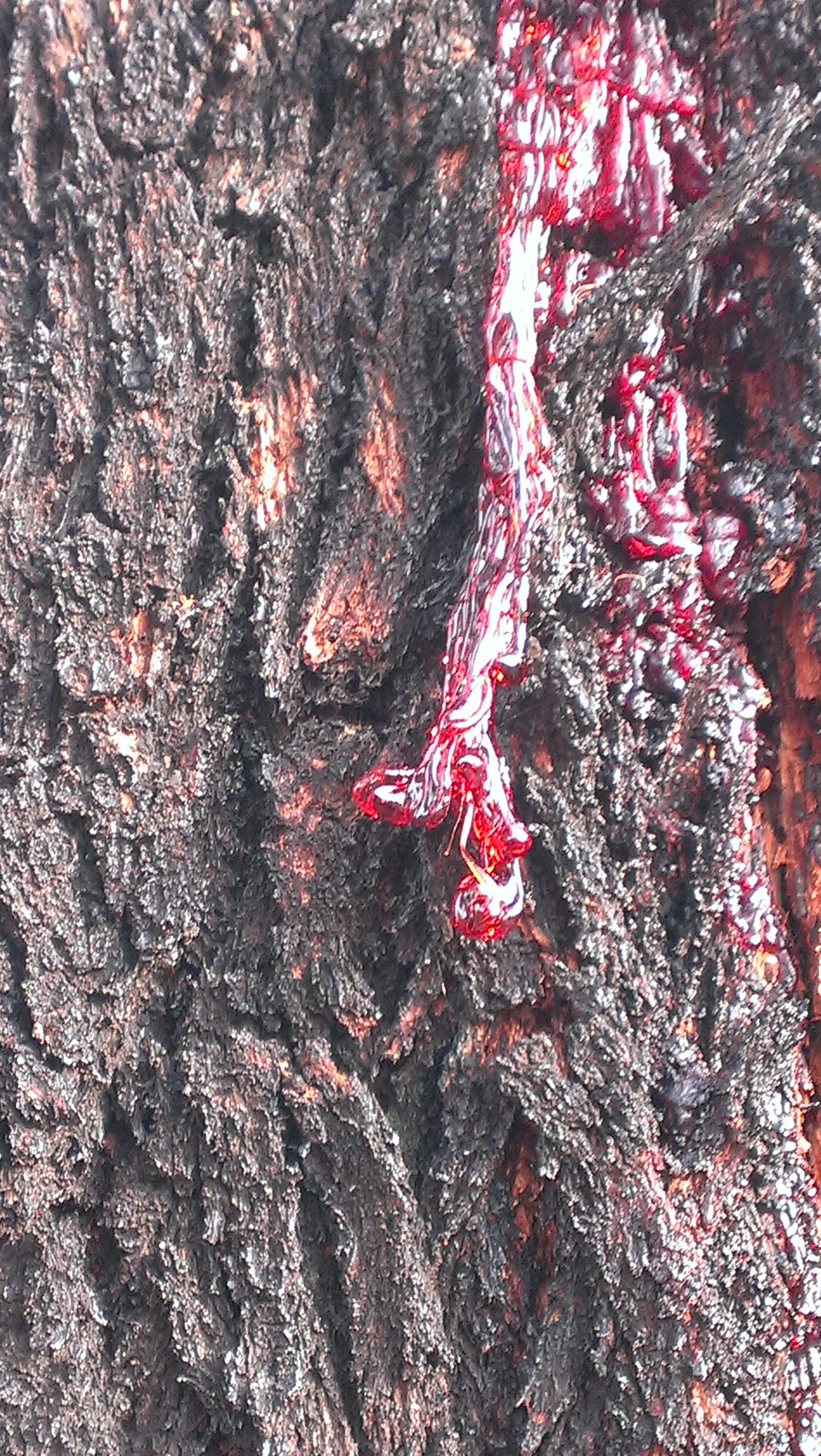
Ironbarks were oozing kino, which is their main strategy for avoiding pest attack.  This one seemed to have gone a bit too far…

2014-06-09 15.46.52

Some ironbarks were in flower. Gloriously.

2014-06-09 15.47.02

In some streets there was a carpet of flowers on the ground where lorikeets and rosellas had been partying.

2014-06-09 15.47.16

Some of the neighbourhood E Cinereas have recovered from the most recent attack of the chainsaws a bit.

2014-06-09 15.50.43

I stopped off at my favourite E Scoparia on my way home.  It now has some leaves I can reach for the first time since a bough was lopped a couple of years ago.

2014-06-09 16.08.04

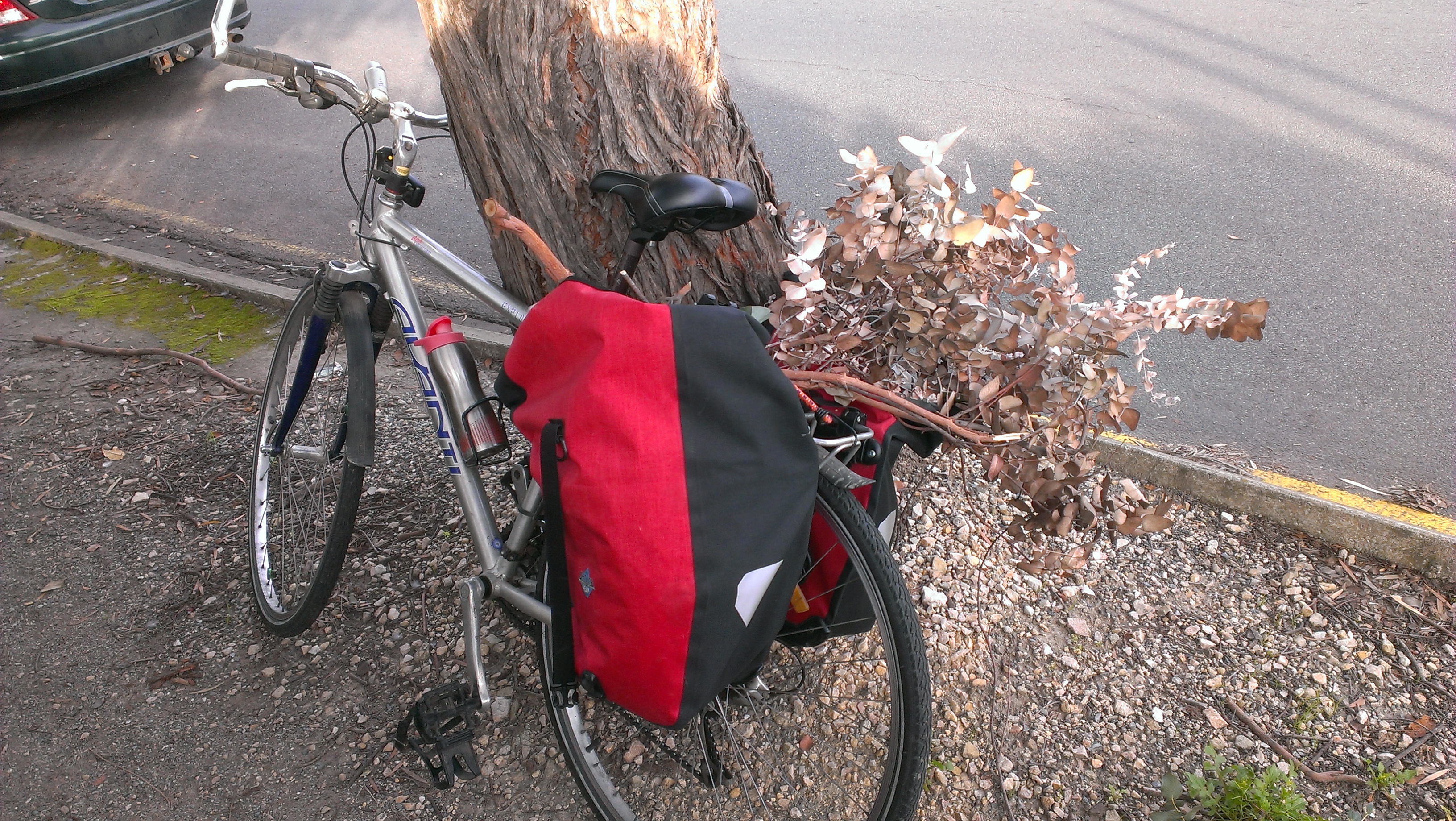
So, I came home fully laden.  I even found an E Cinerea branch that had been cut some time ago but must have fallen to the ground more recently. Needless to say, it came home with me.

2014-06-09 15.59.41

Hopefully, my preparations are nearing completion.  I had a dream the other night where my workshop went terribly wrong… for one thing, there were two workshops and I had not prepared for the first one at all… and the Guild hall, which is a bit of a rabbit warren, had several rooms that I had not previously seen!  Perhaps it is the idea of using cochineal for the first time acting on my overdeveloped sense of responsibility…
7 Comments

Filed under Dye Plants, Eucalypts, Fibre preparation, Natural dyeing, Neighbourhood pleasures

Dyes of antiquity: Eucalyptus leaves

My friends, there is going to be a little series on dyes of antiquity here on this blog. It arises from plant dyestuffs that have been donated anonymously to my Guild, which have come to me as the person currently teaching natural dyeing at the Guild.  Needless to say, there are women at the Guild who know more about natural dyeing than I do and have decades of experience.  Some are dyes used in antiquity (cochineal, indigo, kermes).  Others are in packaging that predates metric weights  in Australia, which came in in 1977.  Certainly, safe disposal of mordants that are now regarded as toxic has had to be arranged.  So I am using the word ‘antiquity’ both literally and figuratively–but I have a trove of dyestuffs which I would usually not have come across, and some of which I would not be prepared to buy if they were available.  Some require identification.  Some require research, so I can figure out how to dye with them.  I decided to start with what I know.

2014-06-05 13.47.06

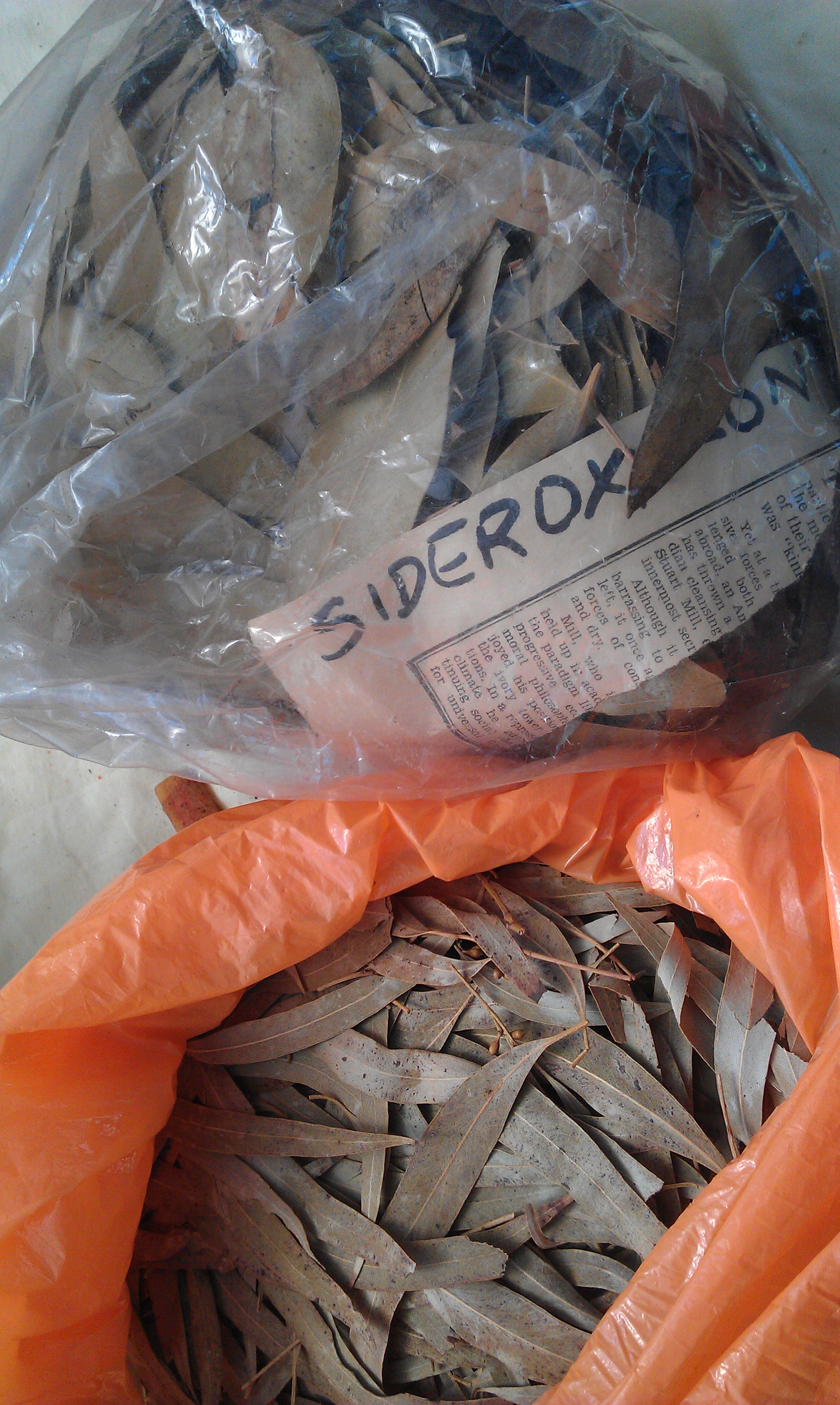
There were bags of varying sizes containing eucalypt leaves.  One was clearly E Sideroxylon leaves.  Then there was the orange bag of unidentified leaves–possibly E Nicholii (which has clearly been in widespread use at the Guild in the past).

IMAG1772

Then there was a lovingly stored and labelled small pack of E Crenulata leaves.

IMAG1773

From time to time, people online ask whether you can store Eucalyptus leaves for too long.  I don’t know.  I tend to use what I have on a rotating basis, partly because I have seen what insects can do to stored vegetable matter!  These leaves appeared to have been stored for a long time, but under good conditions.  No signs of insect damage.  They had clearly been dried prior to being bagged for storage.  They retained some green colour. They were sitting on top of a stack of newspapers dated 1991.  Was that a clue?  I don’t know!  A fellow Guild member who helped me clean out the cupboards thought they were probably older!

2014-05-31 11.57.29

The E Sideroxylon leaves gave far more intense colour, partly because there were more of them.  And possibly because the small fine leaves were not from an exciting dye species and the second dyepot was mostly relying on the small quantity of E Crenulata.  Just the same, more of my white alpaca fleece is getting dyed, spun and ready to be knit all the time…
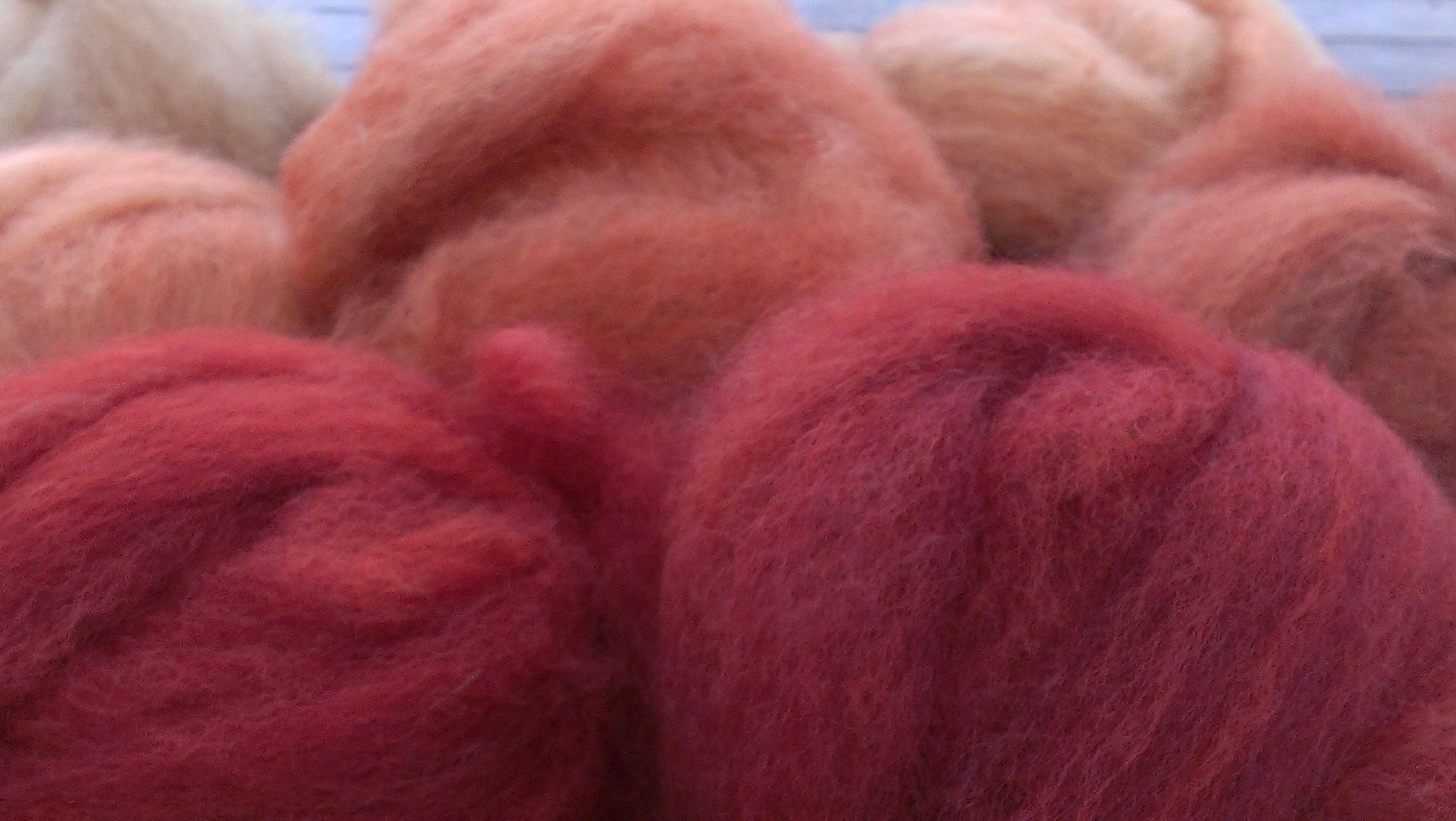
Meanwhile, I am preparing for a dyeing workshop at the Guild and deciding which of the dyes that have come to me are suitable for use there… I’m thinking madder, walnut, cochineal and logwood!!

4 Comments

Filed under Eucalypts, Natural dyeing

Cool spectrum gradient yarn

There has been some plain Jane spinning.  Three ply natural Polwarth, finaly plied after a long wait. Not my best work, unfortunately.  One of the singles is plumper and fluffier than the other two.  Just the same, it’s yarn and it’s a true three ply made from three singles.

IMAG3856

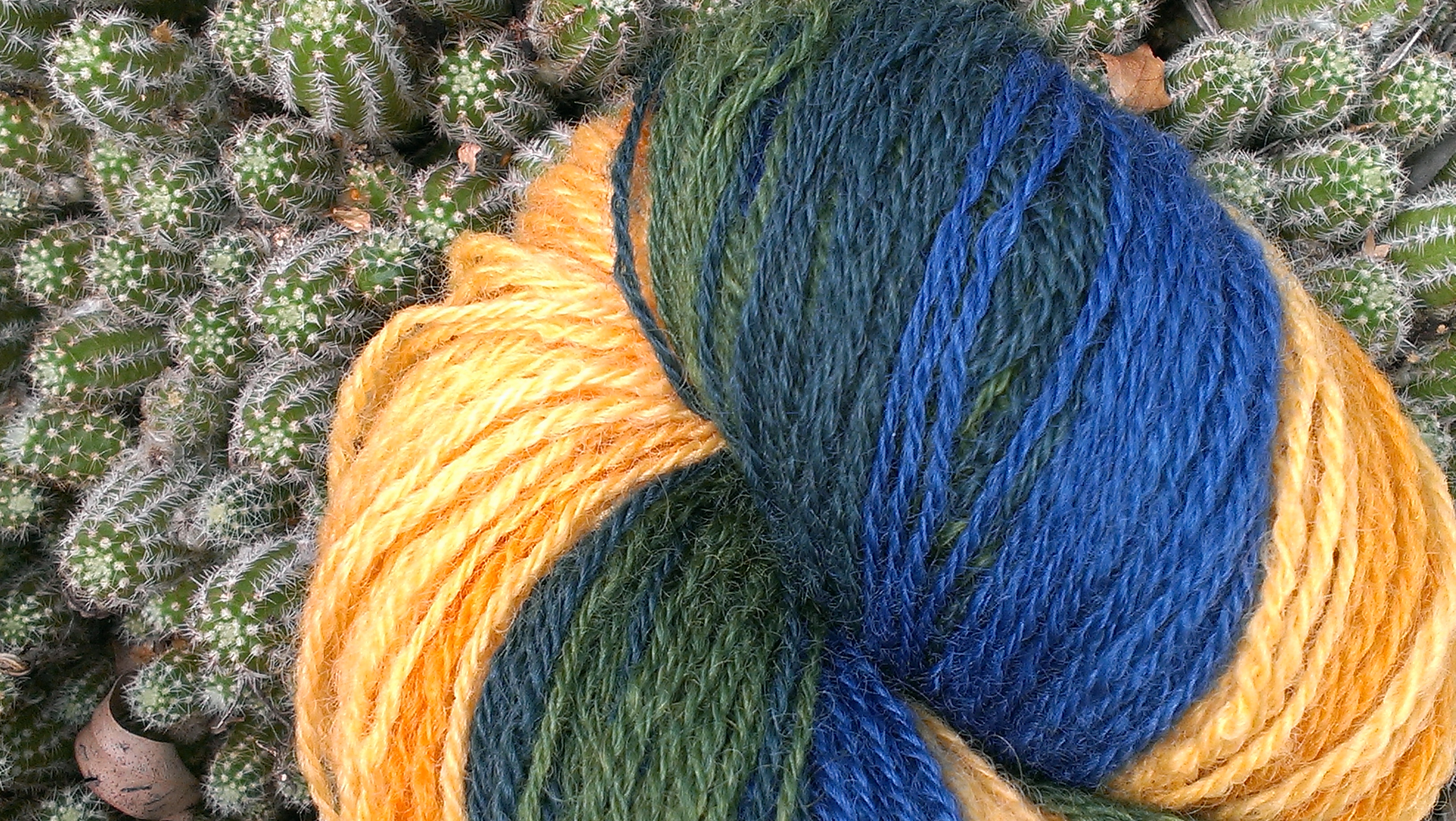
In the not-so-plain stakes, there has also been plying of some of the holiday spinning.  This one is Malcolm the Corriedale, dyed yellow with osange orange and my mother’s coreopsis flowers (she is generous enough to collect her dead flowers for me and such a committed gardener that she deadheads her coreopsis).  I overdyed with indigo to create greens and, of course, blue.

IMAG3870


No sign of crocking, just in case you’re wondering!  I have several more flour sacks of this fibre carded, pulled into roving through a diz and ready to spin.  Mmmm!

IMAG2939

The yarn is three ply and I’ve chain plied it so it will stripe… and just for the sheer pleasure of it.  Because I met internet spinners before I met many in real life, chain plying never seemed to me to be an unusual skill.  I took it up quite early in my spinning career and expected it to be challenging, because I was beginner and most things were challenging.  While I was plying this yarn at my regular Guild group, women who have been spinning for decades were commenting about how easy I made it look.  Ah, the warm glow of competence…  I admire all the things they can do that I find difficult, and there they are, doing just the same thing in reverse.

IMAG3858

6 Comments

Filed under Fibre preparation, Natural dyeing, Spinning

What to do with silk cocoons 4: Spin degummed cocoons

For those who have not been following the silkworm saga… I raised a good number of silkworms last year, starting with the hatching and ending (after riveting weekly updates, believe me), with the very last silkworm creating a cocoon. Since then there has been a small series of ‘what I did with my silk cocoons’ posts… and I think this is the last one for this season of silk.

With  A Silk Worker’s Notebook by Cheryl Kolander (Interweave Press, Colorado USA 1985) as my guide, I moved on to my final experiment.  Cheryl describes the potential of spinning from degummed cocoons as ‘unlimited’ (page 71).  In fact, she goes so far as to say: ‘Direct spinning from degummed cocoons is the classic form for handspun silk. In fact, there is no easier fiber to spin.’

As it happens, I bought 25g of degummed cocoons last time I visited the Victorian Guild, (they have a lovely shop and gallery) for the princessly sum of $3.20.  It’s a good thing I did, because these are the only degummed silk cocoons I have ever touched. It can be difficult to embark on a process (such as degumming) when you have never seen anyone do it (other than on YouTube perhaps) and you have never seen or touched the finished product–and you have only a paragraph of text as your guide.

IMAG3043

Degumming is a way of releasing the sticky substance that holds the strands of silk together to form the cocoon, so these are still roughly cocoon shaped but fluffy by comparison with their intact counterparts.  Now, I have to begin by saying that Cheryl Kolander has skills that far exceed my own, but for me this was not the easiest fibre I have ever spun!

IMAG3480

Just the same, I managed to spin it, extract most of the chrysalis remains that were included and produce yarn, even if I was quite unsure how to turn it into something even and lovely.  I didn’t really expect to do that on my first attempt–but I would not object to being surprised by beginners’ luck at some point in my life. I re-read the relevant part of the book to discover that even from Cheryl’s skill level and point of view, some parts are not spinnable, and they were the ones I struggled with most.  Here is what I produced:

IMAG3430

The next thing to do was to follow Cheryl’s advice on how to degum silk cocoons and try this process with my own.

IMAG3447

There were two accounts of how to degum in the book, one of which implied that the cocoons were degummed with the chrysalis intact (since it was extracted at a certain point in the spinning process).  The other advised cutting the cocoons up the side and removing the chrysalis before before degumming,  In the end, I decided to do that because the idea of a well simmered chrysalis did not excite me.  Call me unprepared to pick small insect parts from my fibre–stronger insults have come my way!

IMAG3487

So, into the pot went the white cocoons, the yellow cocoons and the parts left over from spinning raw cocoons, just in case more could be done with them.  There were mysterious elements, as there often are with instructional texts from the US–for me, at least.  What is Ivory dish detergent?  Does the brand matter?  What would count as a big squirt?  This complication in understanding what others actually do is particularly entertaining in reading online discussion of washing wool–I recommend the thousands of accounts of the ‘only’ and ‘best’ way to clean raw fleece that you can find in any forum where this issue is discussed as fine entertainment!

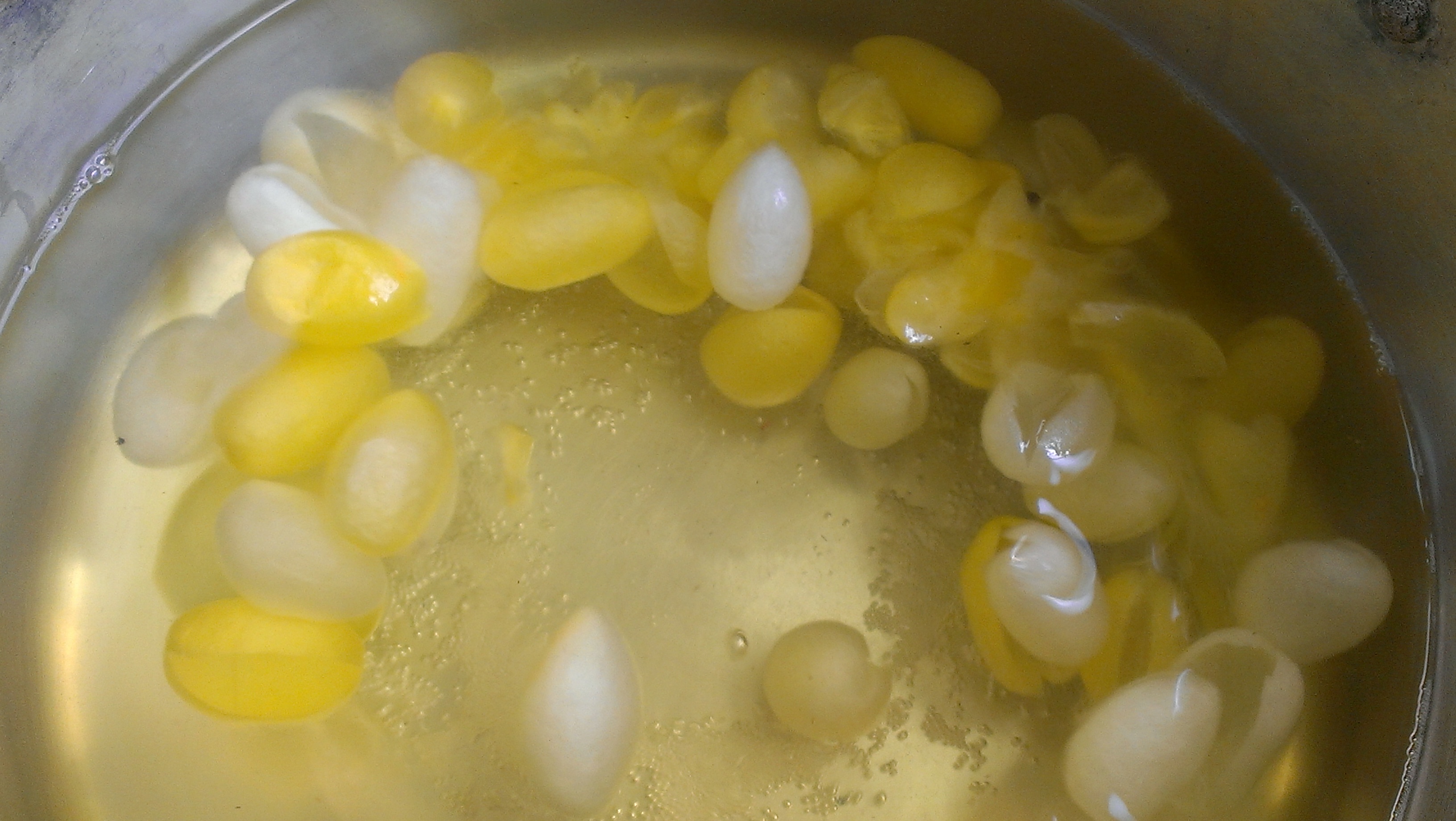
As usual, I resolved these mysteries with the judicious application of guesswork.  Some time later I had this, a circular mass of silk fibres with quite a bit less structure, much less colour and some yellow water:

IMAG3495

I rinsed–and had something decidedly mangy and sad looking at the end of the process.  So I drew it out into a longish lumpy mass and hung it out to dry.

IMAG3527

Then, the struggle to spin began.  I think the temperature on my degumming pot may have been a problem… in that my burners maintain temperature by intermittently heating, which sometimes produces bubbling. I think this introduced a level of tangling that the cocoons I bought from the Victorian Guild did not suffer from.  But of course… this was probably only one of my beginner mistakes. My cocoons did not contain as much fibre as those I had purchased either, so the ratio of spinnable silk to fine inner layer was different too.

In the end, there was some yarn.  Not very much, and not very lovely.  But there was yarn.

IMAG3598

Time to put my feet up until next September, I guess!

7 Comments

Filed under Fibre preparation, Spinning

What to do with silk cocoons 2: Spin raw cocoons

On the last Guild meeting day for 2013 I wandered into the library intent on borrowing for the coming 2 months–including holiday time.  One of my loans was A Silk Worker’s Notebook by Cheryl Kolander (Interweave Press, Colorado USA 1985). She describes spinning raw (softened in water but not degummed), degummed whole and cut and degummed cocoons.  Choices, choices, choices!

She instructs the reader to soak the cocoons to soften them.  I soaked them cold and nothing much happened.

IMAG3411

I double checked and Cheryl Kolander says to soak in warm water.  I did, and by bedtime, I had spun a very small number of cocoons over a considerable amount of time with great effort and decided soaking until the following evening would be necessary, since I do in fact have a job to go to…

IMAG3415

Kolander’s instructions make gradually drawing out fibre from one end of the cocoon sound straightforward.  Bless her heart, if she can do that, she has greater skills and/or strength than I do!  I have never applied so much sheer force to draft anything.  I found I had to snip the cocoon to make a start, enlarge the hole by pulling, remove the chrysalis and then tear or stretch the cocoon far enough that I could grab one half in one hand and the other half in my other hand and create a bridge of fibres I could attenuate and attempt to join to my thread.  All while still wet.

IMAG3460

Kolander promised a stiff thread and mine did not disappoint. Can you see the end of the thread heading off to the upper right in the next picture?  No wind or special effects were applied to this image!

IMAG3466

This was the smallest reel I could find.  But I am delighted to have managed to spin a thread.  I drew the line at plying and left it as a single.  As always, experiments like these give some finger-and-muscle-understanding and not just a vague intellectual sense of the tremendous skill and sheer hard work and time commitment of people who create fine reeled silk and all manner of silk yarns and fabrics with the most basic of equipment. I won’t be giving up my day job anytime soon!

IMAG3474

2 Comments

Filed under Fibre preparation, Spinning

Harvesting the neighbourhood: Dyer’s Chamomile

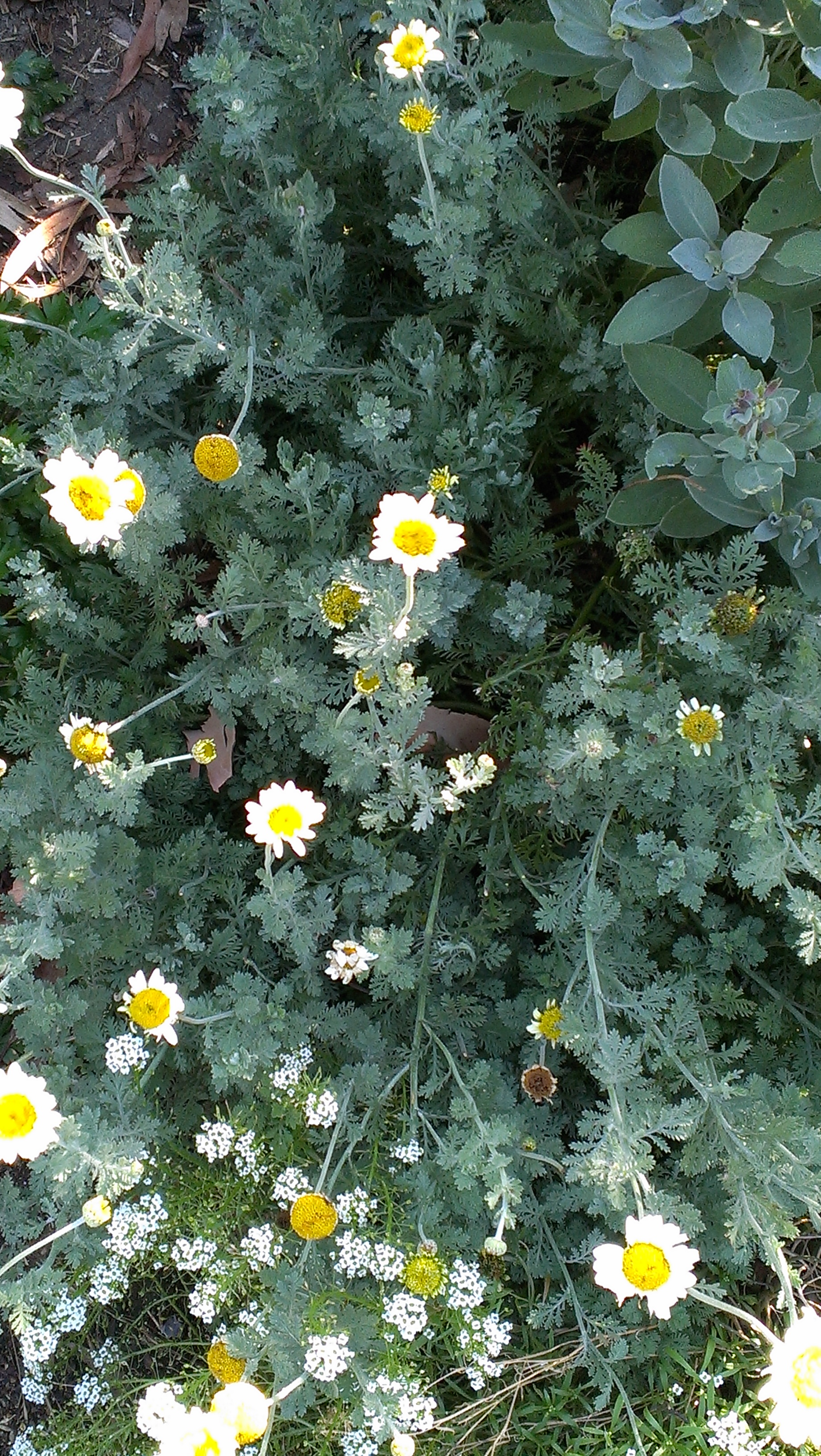
This summer, I have been collecting dyer’s chamomile for the first time.  I have some in the garden, gifted to me by a fellow Guild member who was keen to have some of my madder (this wish granted, needless to say)! It has white petals.

IMAG3008

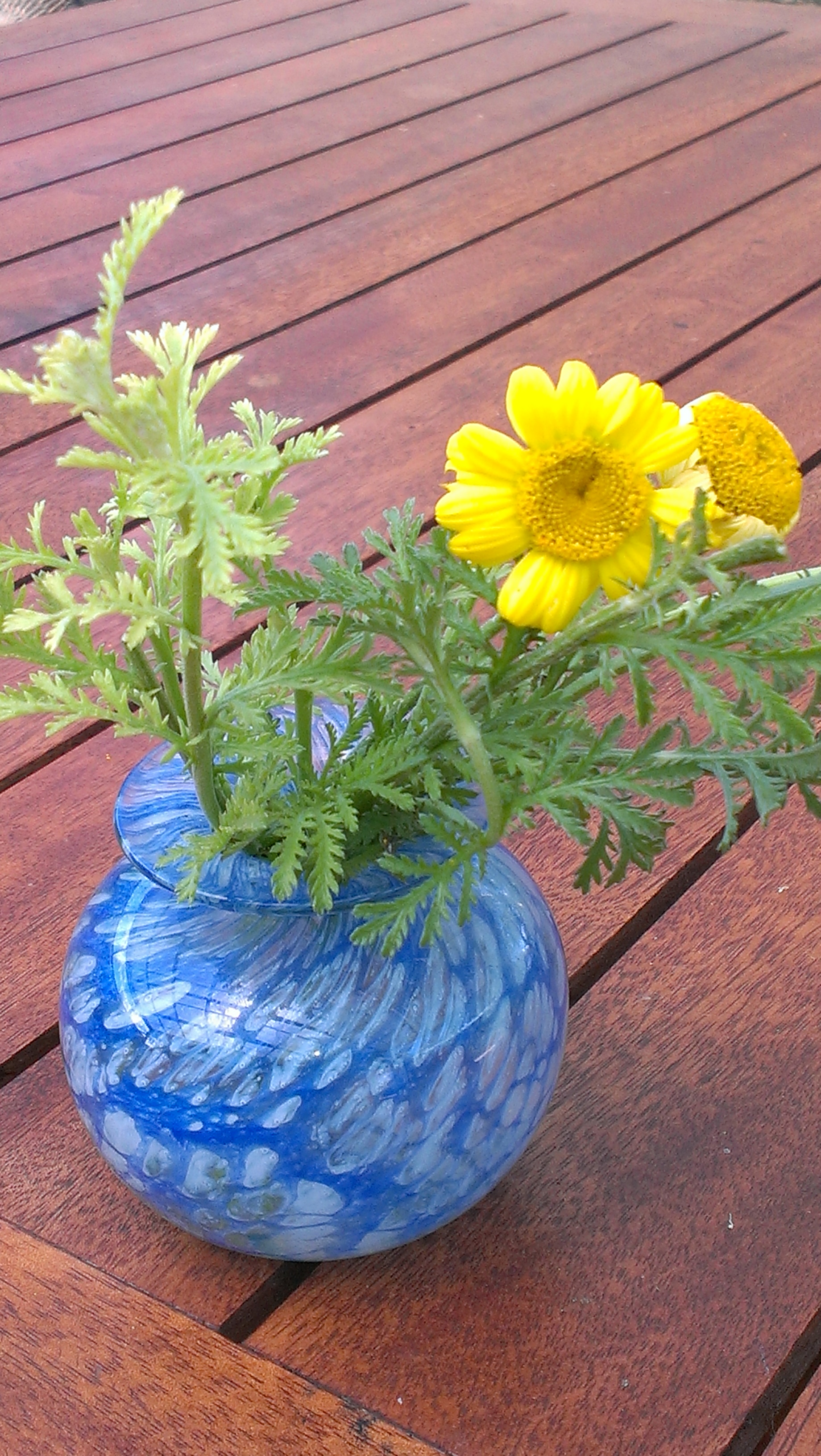
But recently I found some with vivid yellow petals in the parklands beside the river Torrens.

IMAG3026 (2)

Our exercise class were astonished when I said I was planning to harvest while we were out on a DIY exercise session (our instructor was off doing the Busselton Ironman–she is our hero).  They offered to shield me from passersby who might intervene.  I think they underestimated how scared most people seem to be when they see someone doing something so inexplicable (to them)! I let them know I’d only be taking the dead flowers and we all relaxed again.  The patch is so big I really want to go back with more time… and it is flowering so generously, I am sure I have weeks in which to organise a return visit.

IMAG2998

Meanwhile, we’ve been harvesting at home, too.

IMAG3035

I keep thinking I’ll make rhubarb leaf mordant, and then not getting round to it!

IMAG3021

Leave a comment

Filed under Dye Plants, Eucalypts, Neighbourhood pleasures

Eucalyptus dyed gradient yarns

Some time ago I blogged about dyeing with windfall eucalyptus leaves. I had been dyeing over white corriedale and had quite a range of colours in the range of ochre and caramel through flame orange and… opinions differ about whether that really is red. Here it is, wet from dyeing and ready to be rinsed:

IMAG2316

I divided my fleece up into colour groupings, carded it and pulled a roving straight from the carder drum with a diz.  What a great technique.  You can find it on YouTube, but it was watching a friend from the Guild demonstrate it that really convinced me to try it out.  This Youtube video has an explanation of the same simple homemade diz my friend has made, so maybe she was inspired by that video.  Here are my rovings.  Creating these made me feel like I have learned a few things about fleece preparation.

IMAG2392

Then I created bumps of roving with segments of each colour, lined up to create a gradient from ochre through to reddish. Then, there was spinning and plying and skeining and washing–spinning being a craft of many stages–and now…

wpid-IMAG2742.jpg

I am so happy with this yarn! I can’t wait to share it with the friends whose sheep this wool came from.  Coincidentally, the week I finished this yarn, they invited me to their place for shearing time.

wpid-IMAG2750.jpg

16 Comments

Filed under Eucalypts, Fibre preparation, Natural dyeing, Spinning

Textured spinning and trash batts

I went on a weekend away with members of my Guild recently and had a fabulous time chatting, spinning and eating way more than made any sense.  I took some little packs I made up beforehand, each designed to create a skein of yarn. This first one began as Finn cross locks I bought pre-dyed and perhaps a little felted, with curly tips.  Perfect for this technique, I thought.

IMAG2260

Here they are as a lockspun yarn, with the teased-out, butt ends of the locks corespun around a crossbred grey wool core that can no longer be seen, and the curly tips on display.

IMAG2427

This batt of unloved green fleece that I was given includes some orange silk noil and some pre-dyed mohair locks.

IMAG2261

Here it is corespun over that same grey crossbred core.  I learned these two techniques from the fine writing and DVDs of Jacey Boggs.

IMAG2557

The trash batt experiments continue!  This is eucalyptus dyed carder waste (and nepps pulled out as I was spinning) carded with white and tan Polwarth locks.

IMAG2389

I used it for my first attempt at a  new textured spinning technique–a friend gave me a copy of The Wheel that contained this technique and you can also see it here.  It originates with Steph Gorin, who demonstrates here.  (The video also includes advertising for Ashford.)

IMAG2546

Here is the outcome of a batt made with the flick carding waste from the blue lockspun yarn above, and a eucalyptus dyed carder waste and polwarth batt.

IMAG2579

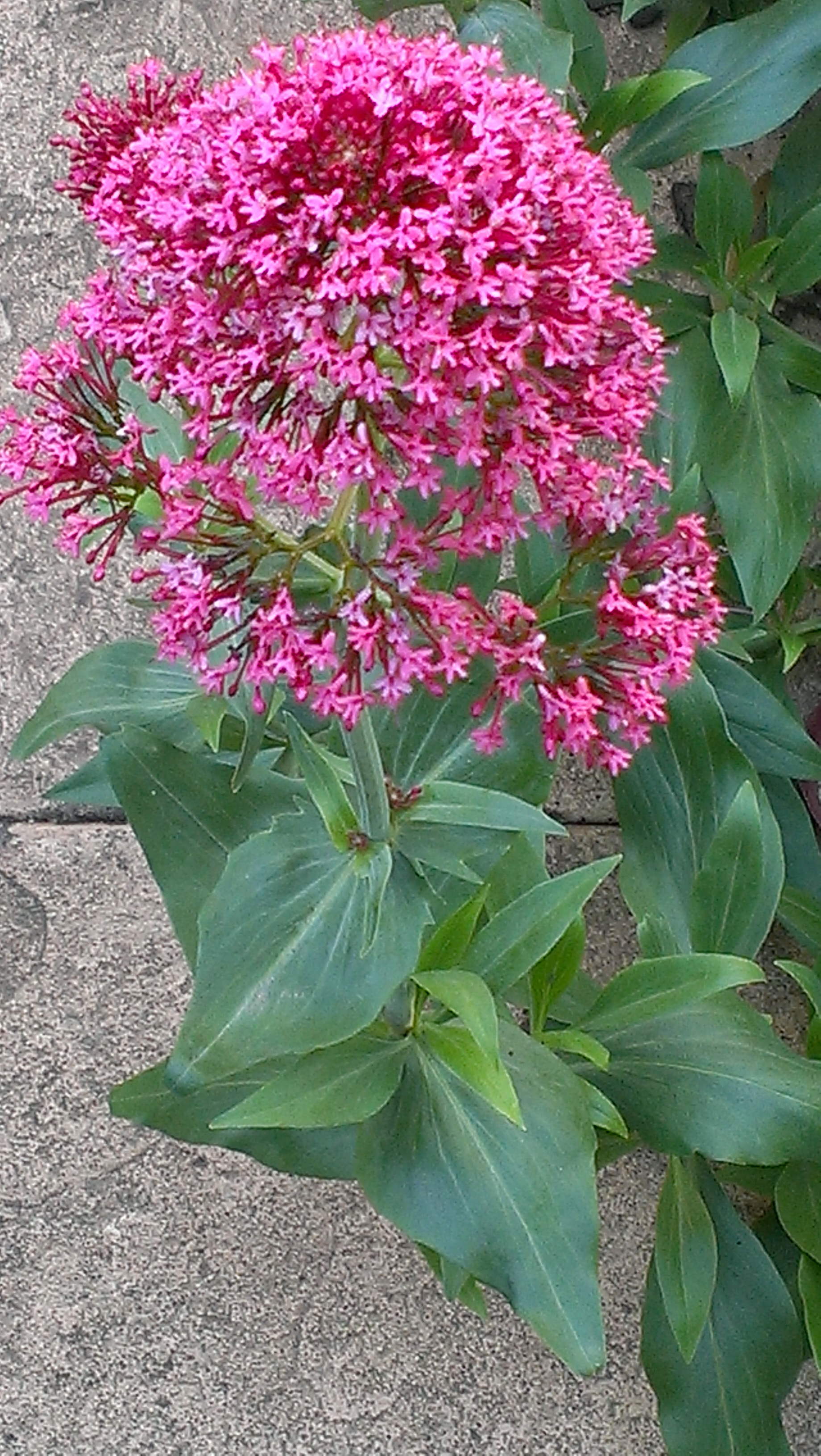
Finally, a gratuitous picture of what appears to me to be valerian in flower in my garden.  Which is gorgeous apart from the fact that I bought it because it was soapwort.  It doesn’t look like any soapwort I have ever seen now it is in flower, which makes me glad it wasn’t big enough to harvest until now!

IMAG2584

6 Comments

Filed under Fibre preparation, Natural dyeing, Spinning

Yellows from coreopsis flowers and osage orange

I have decided to branch out from the eucalyptus based palette of ochre–caramel–tan–orange–red–maroon I have been so focused on for the last while and plan toward an indigo vat.  Don’t you love these bold statements?

I still love the eucalypt colours: here, a small quantity of alpaca passing through various stages of preparation.  Picked, dyed locks;

IMAG2377

Partially carded batt;

IMAG2379

and, finally, yarn–pictured in the dyer’s chamomile patch.

IMAG2428

I have decided to try for yellow–green–blue transitions, which will necessarily begin with yellow.  I had coreopsis flowers my mother saved me one summer, as she deadheaded her plants. This collection of flower heads speak to me of her love and her fine qualities as a gardener and a person who loves to share.  I had reservations about the colour I would get from them, as some had gone mouldy.  Her -plants are just so prolific–the stack of wilted heads had trapped enough moisture to create mould.

IMAG2370

I also had a little remaining quantity of osage orange shavings of antiquity, gifted to me from the Guild.

IMAG2371

I prepared them both for the dyebath, but have to say my tea ball was not a good enough receptacle to retain the osage orange.  I not only sieved the dye vat before adding wool (thank goodness I remembered to do this as I tackled it one night when the amount of sawdust in the vat was not as obvious as in the clear light of day) but also placed the whole tea ball in another fine cloth bag before running an exhaust bath.

IMAG2372

Even after the first bath of each dye, there was a lot of colour left, so I ran an exhaust bath and dyed a total of about 800g of white corriedale.  I was especially impressed with the amount of colour and the wonderful smell of the coreopsis bath.  I need not have worried about the mould.  Here is the coreopsis bath between dyeings.

IMAG2383

The resulting yellows are lovely.  On the left, coreopsis bath 1, then coreopsis bath 2, osage orange bath 1 and osage orange bath 2.  The coreopsis yellows are quite buttery and golden and the osage orange colours are a little more lemony.  And, there is further evidence that grass seeds and other vegetable matter take dyes quite well!  Now, to build up my courage for the indigo stage and some greens and blues.

IMAG2453

10 Comments

Filed under Dye Plants, Eucalypts, Fibre preparation, Natural dyeing