Tag Archives: for the love of the Guild

Further experiments in converting textile waste

I have been wondering about trying some more spinning experiments with waste from the overlocker and the carding process.  There is nothing like yarn bombing to make me consider any kind of yarn useable!  Yarn bombing is even more forgiving than teapots when it comes to the texture and qualities of the fibre concerned… and there is an argument for only using fibres that can’t be made into clothing or blankets for yarn bombing, I think.  So in a  burst of carding enthusiasm, I’ve been preparing batts.

First up, carding waste (corriedale dyed with eucalypt), overlocker waste (from bag making, mostly–silk, cotton, linen and some polyester blend) and some polwarth locks to hold it all together.  Here it is going into the drum carder:

IMAG2241

Carded and ready to spin.

IMAG2249

More fabric scraps and overlocker thread in some parts than others…

IMAG2256

While I was on the job, I carded some rough lavender wool of unknown origin.  It was discarded by the felting group at the Guild: say no more!   I re-washed it, which improved its texture and cleanliness somewhat…

IMAG2262

The felters also passed on this green fibre of unknown origin, which was improved very much by re-washing and carded out beautifully.  I have added dyed mohair locks and silk noil, and we’ll see if it can become a repectable art yarn.

IMAG2261

Carding waste from those two batts and some more overlocker waste…

IMAG2264

I’ll report back when I’ve tried turning these away from the waste stream and into something of use!

12 Comments

Filed under Fibre preparation

Eucalyptus colours over grey wool

I have a lot of Polwarth fleece, both brown and variegated white/tan. All of it gifted from pet sheep that live nearby.  It is a privilege and it is also a difficulty.  Washing fleece so fine and so greasy has been intimidating as well as slow.  I have spun some in the grease, and washed some twice, and tried several different washing approaches.  I have dyed and spun and spun and dyed.  Two and three ply, corespun. you name it! I spun and knit an entire cardigan from naturally brown Polwarth, too.

And then one day someone at Guild said “I hate fine fleeces!” in my hearing, and it occurred to me that I do not have to spin it for the rest of my life.  I lashed out and bought a considerable quantity (3.5 kg) of grey Corriedale (nothing to approach the stash of Polwarth, mind you) and it has been heavenly.  I love grey fleece, and this is the loveliest corriedale I’ve ever had the pleasure to spin.

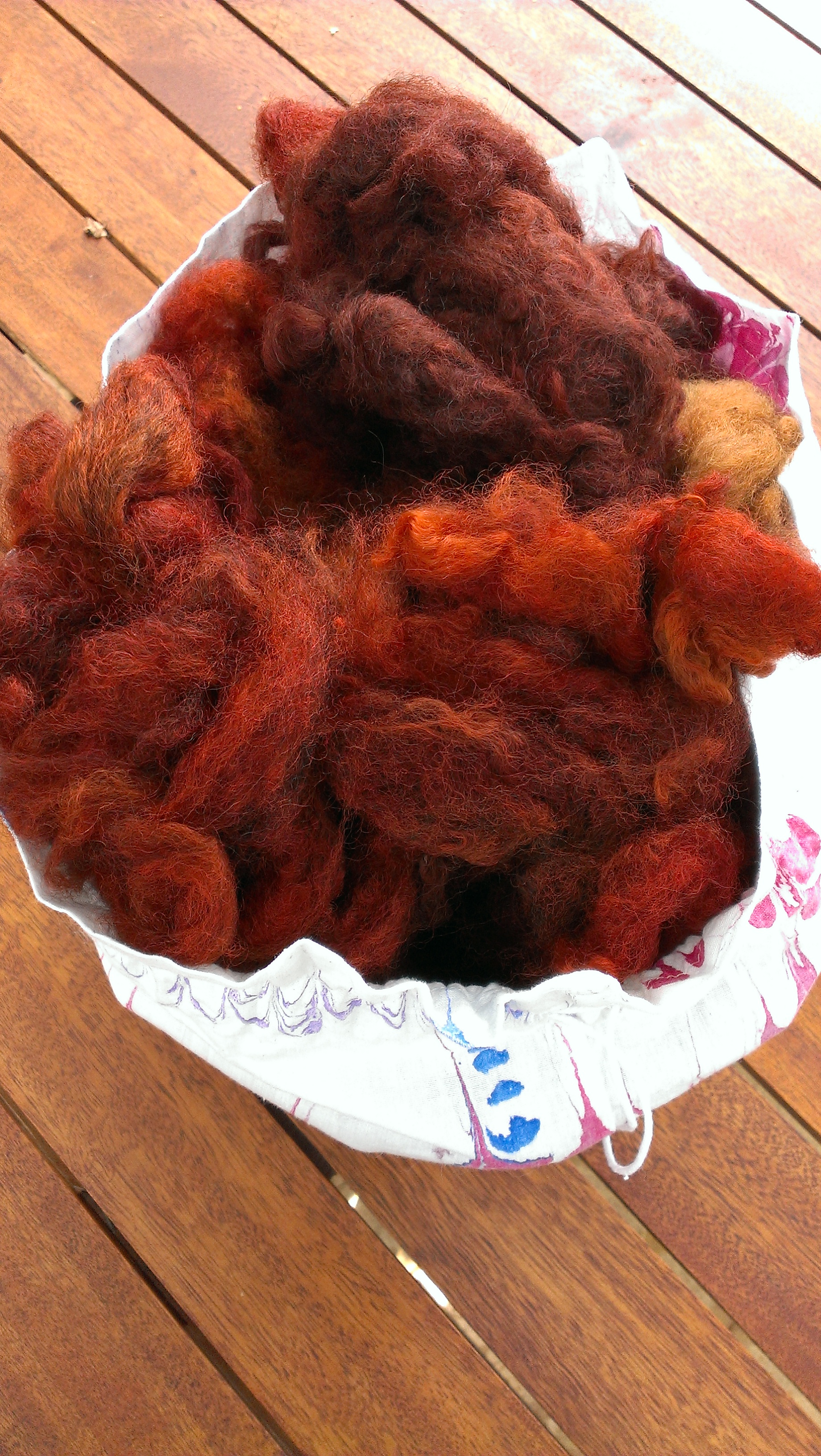
I have been dyeing it with eucalypt leaves and bark.  I have oranges of many shades from rust and brick to flame to gentle sunset.

IMAG1363

I have burgundy and plum.

IMAG1364

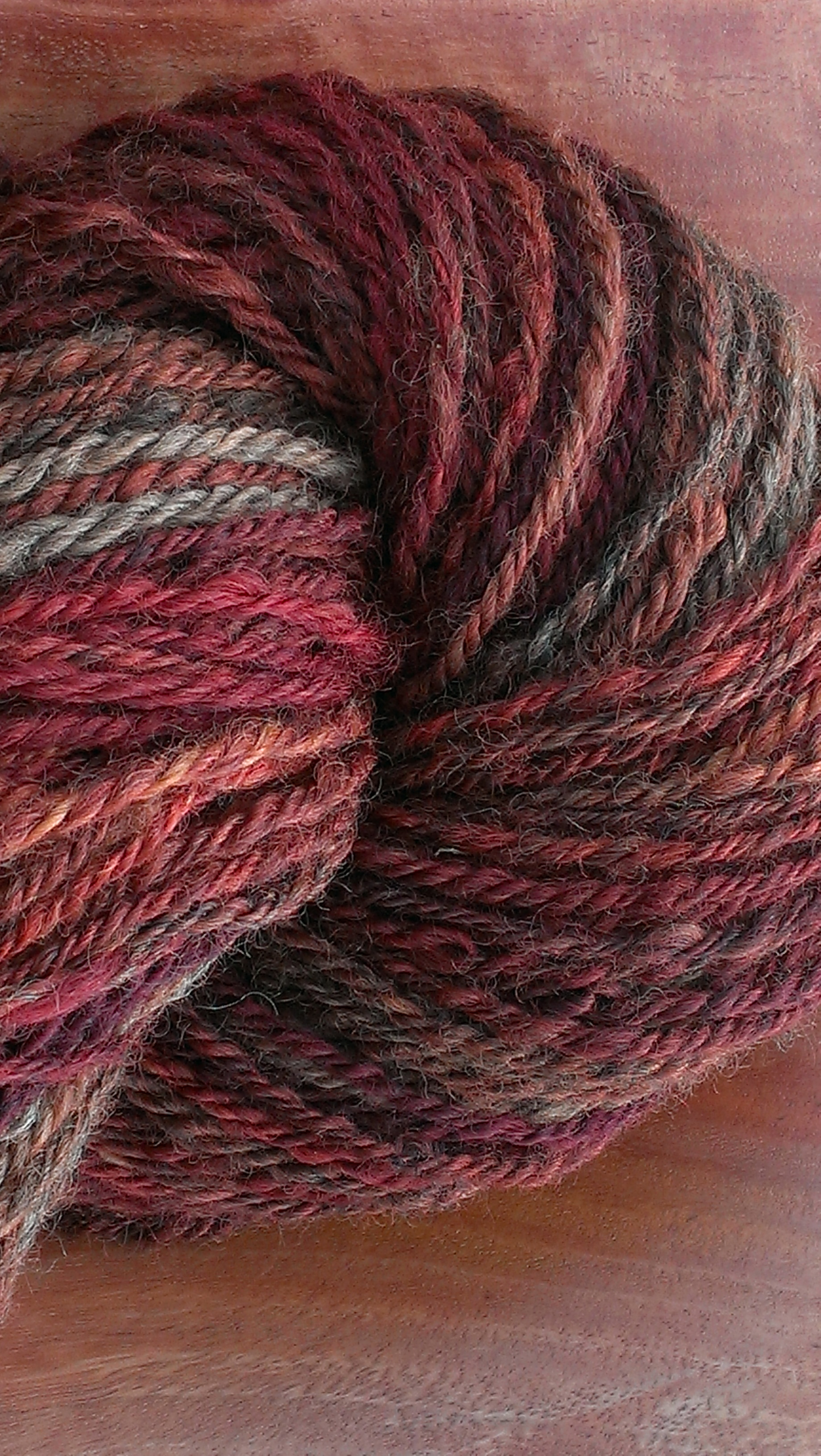
And I also have some tans and walnuts.  It appears I collected some bark that wasn’t exactly what I thought I had collected.  But to be honest, I think these are lovely additions in this context.  I’ve begun spinning yarns of many hues, chain plying to maintain the colour contrasts.  Lovely.  It’s hard to believe I can find these colours through combining bark and hot water and time with wool.

IMAG1308

Now… I have figured out that what I would really like to do with at least some of this wool is knit a particular cardigan.  And my beautful 3 ply yarn is too thick to make gauge for it!  Possibly also for the design I have in mind those colour changes will not be ideal.  So, I am about to embark on two ply yarns.  This is my Tour de Fleece project.

20 Comments

Filed under Eucalypts, Fibre preparation, Natural dyeing, Spinning

Preparing

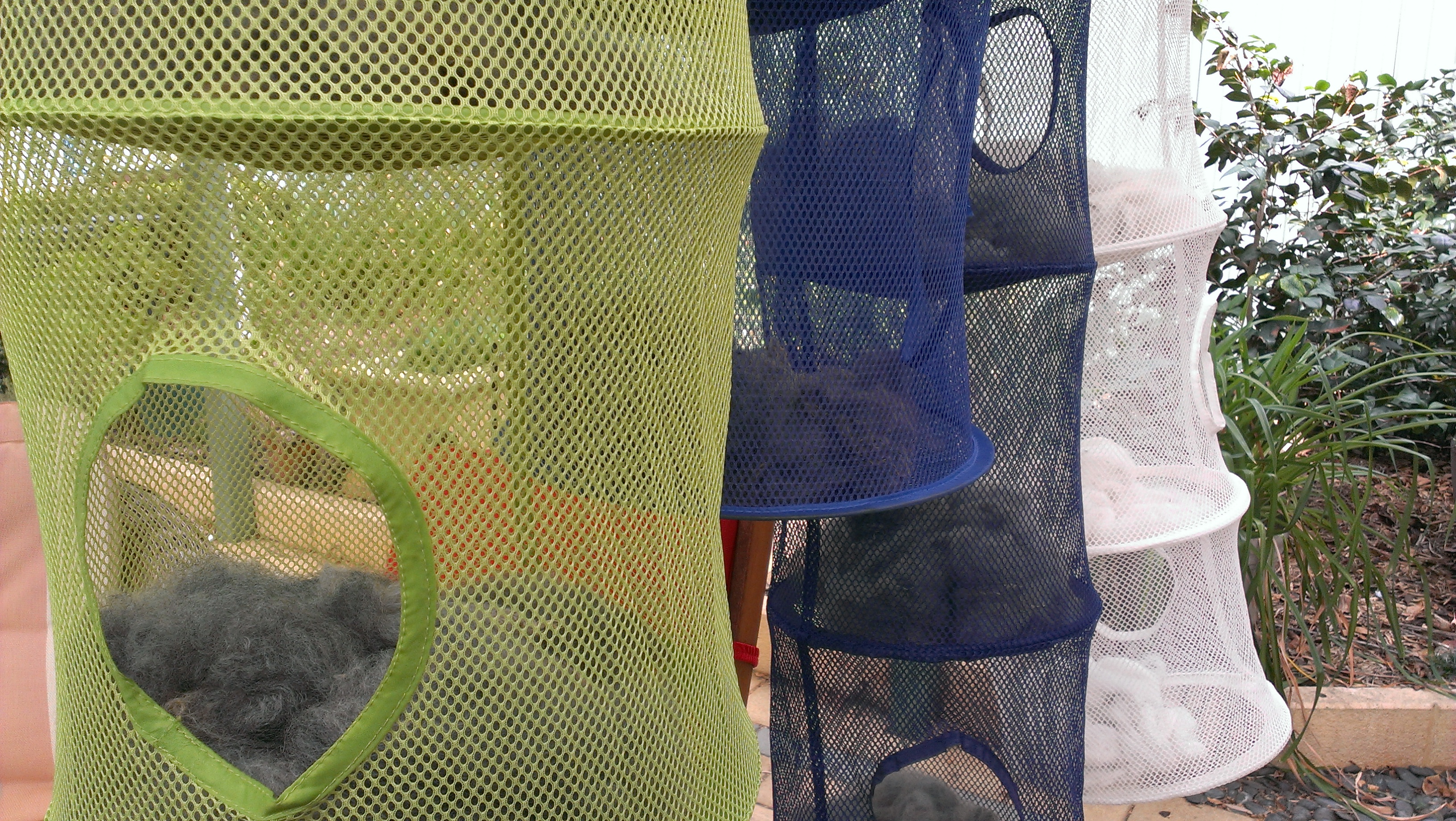
It has been a time of preparation, lately.  I’ve been on a fleece washing project.  After months of thinking I should wash while it is still warm but feeling quite unable to begin, apparently the change in the weather (toward autumn) brought on the sense that fleece washing would be possible. I have washed all that remained of over 3 kg of grey corriedale and some white alpaca for good measure.  My motley collection of drying apparatus have all been in use.  I still have a lot of high-grease polwarth and a filthy corriedale to wash.

IMAG1226

A bunch of friends got together to make passata and I was too sick to go and join in the fun.  However, my partner went along and I put the results up in these jars preparing for the winter.  The Fowlers Vacola outfit is steaming on the stove as I type.

IMG_0109

Our freezer is full of pesto from all the basil of this summer.

wpid-IMG_0133.JPG

I have some Lincoln locks sitting waiting for cold dyes to fix .  And I had better get ready to use the drum carder!

3 Comments

Filed under Fibre preparation

The spinning continues

Unfortunately, it has been a time of illness and low energy round here just lately.  Fortunately, spinning provides solace and the level of exercise I’ve been capable of undertaking.

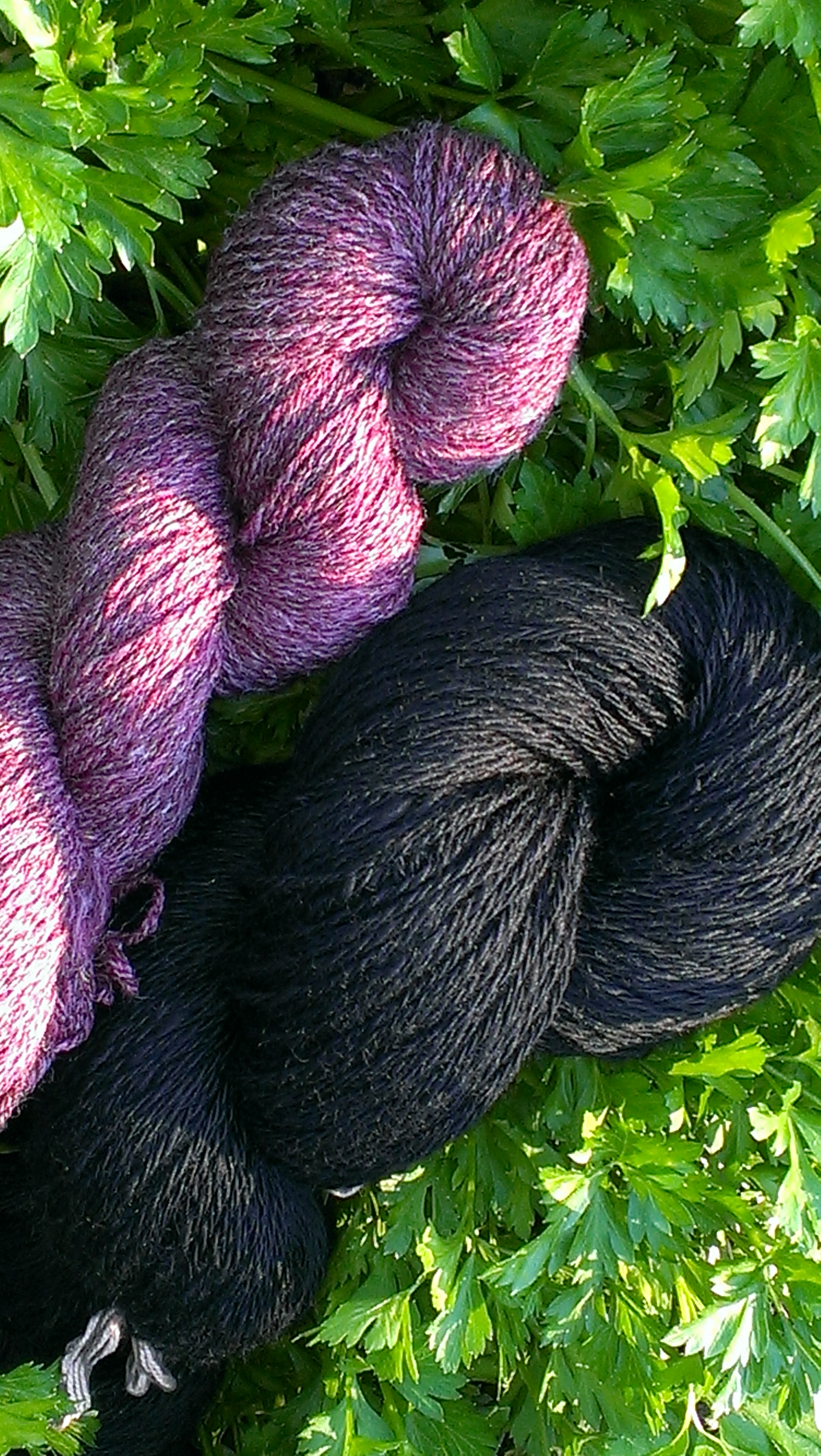
Here, some delicious black baby alpaca I bought from SpunOut at Bendigo (three plied).  It is called Handspinners Dream and, mmmm.  It was! Luxury fibre with a price tag to match.

IMAG1234

I also finished some spinning intended as sock yarn–the purple yarn in the photo.  It is a true three ply yarn with high twist.  I spun it slowly since it has been on the wheel I take to the Guild only twice a month.  There have been many jokes about frog hair, and more than one person has asked me if I am really spinning, because the singles were so fine they couldn’t be seen from across the hall.  I will be so interested to see how this works out as  socks.  Despite all the joking, this is not too fine for sock knitting.  Since I have three pairs of socks on my needles at present and all three are still in the first sock stage, I may not find out for a while.  I have one still on the leg, one just past the heel and still on the gusset, and one almost at the toe.

Back to spinning though–and that is where my time has been spent lately–the purple sock yarn is from Ewe Give Me the Knits.  It’s her Superwash Merino/Bamboo/Nylon blend, especially for sock spinners.  Another lovely spinning experience.  I am warming up to spinning some of the fleece I’ve washed through summer after all this pre-prepared fibre.

3 Comments

Filed under Knitting, Spinning

Sampling dye plants

IMAG0722

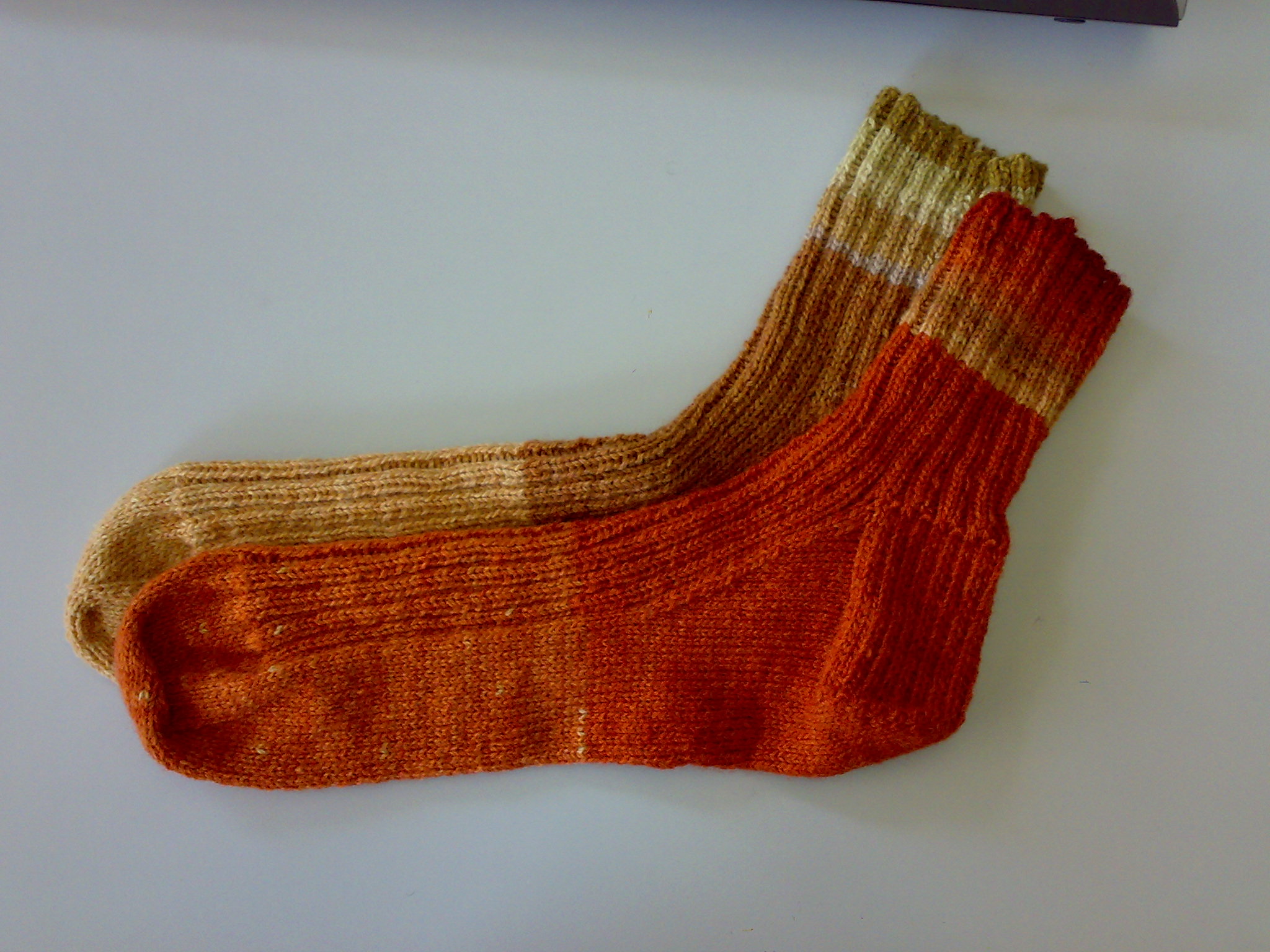
When I started plant dyeing, I used to make a tiny skein, about 1-2 metres long, and try out the leaves of trees around my neighbourhood on that.  In those early days, I tried rue after I found it listed in a book… oh my goodness…  the least said about that smell,  the better.  It almost put me off for good.  (Pale green, if anyone is wondering–not the red I was hoping for in my naivete).  When I had accumulated enough experiments to have identified some trees I wanted to keep visiting and some I would appreciate but not use for dye, I knit the samples into striped socks for a dear longtime friend. So that method had its advantages.  My friend asked for short cuffs (well, I thought he had–), so that’s what he got.

150620091160

I may have mentioned my devil-may-care attiutude to matching socks.  Happily my friend shares it, or he wouldn’t have scored this pair! 

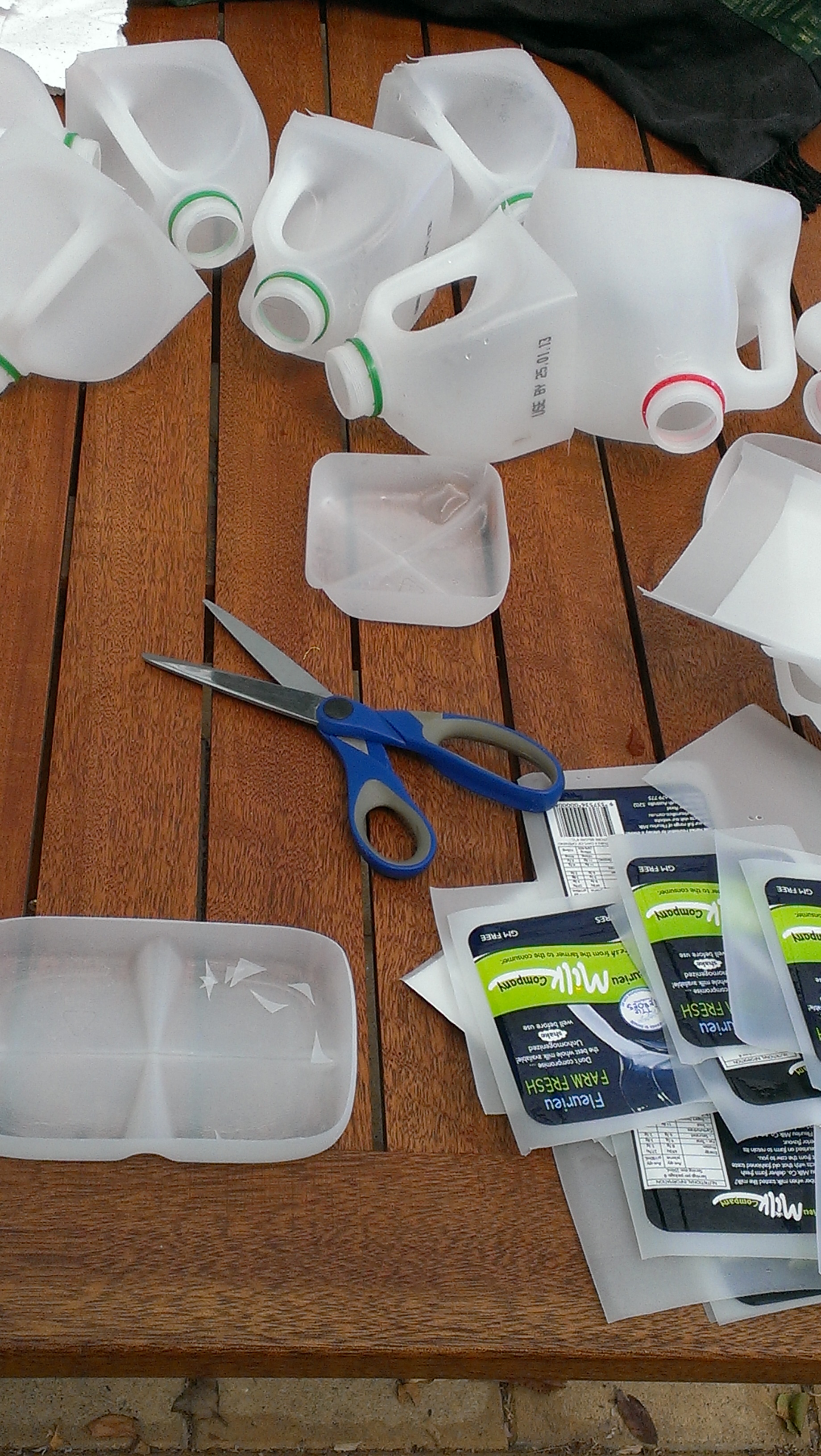
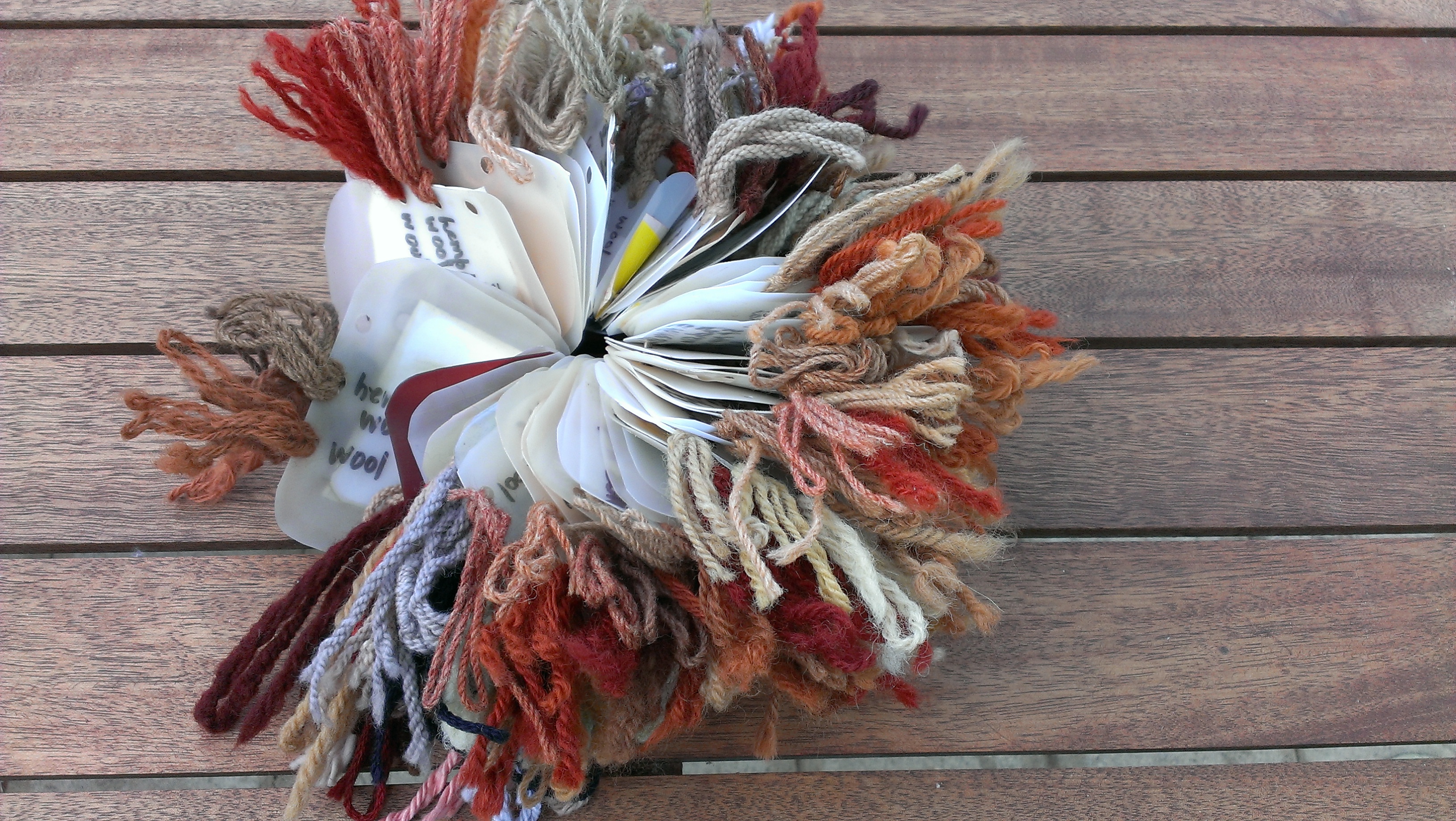
Eventually I learned about sample cards from more experienced dyers on Ravelry.

IMAG0723

I use milk bottles to make mine.  We don’t use this kind at home any more, so I raided a recycling bin at a coffee cart during the weekly farmers’ market to get these.

IMAG0768

I keep my samples on a split ring, which I think I also saw on Ravelry, and it’s a great record of plants investigated.  Some have been identified long after being cooked in the dyepot.  A few have been identified correctly after an initial misidentification.  Some have been tried several times.

IMAG0773

And there are still so many to try out!  In the lead up to the recent workshops, I collected leaves fresh and dried: from trees, from the gutter, from fallen branches.  I collected more bark too.  This one is Eucalyptus Forrestiana,  believe:

IMAG0764

And I collected a few specimens I couldn’t identify… This one branched so high I couldn’t pick a leaf, but bud caps were raining down and lorikeets were having a great party high above me.

IMAG0760

This one was a sprawling mallee near the railway line, and came complete with new holland honeyeaters protesting my invasion.  I hope they had chicks in there somewhere, and this was the reason they kept trying to see me off even though they are about the length of my hand.

IMAG0746

This tree has fascinated me for some time: it gives a peach or apricot colour.  But I still can’t identify it.

IMAG0738

So many possibilities for the future….

6 Comments

Filed under Dye Plants, Eucalypts, Knitting, Natural dyeing

Spinning

I loved running workshops over summer, but it has also been a treat to return to my spinning wheel.  This skein began as grey corriedale fleece.  I dyed it in the grease with Earth Palette dyes, carded, and pulled a roving directly from the drum carder through a diz.  I have seen this technique demonstrated on YouTube, but I was only prepared to try it after someone from my Guild (who is a fabulous spinner) showed a group of us how she does it.

I like the colour, and enjoyed the process of producing roving.  Being able to dye in the grease is one of the things that has me returning to Earth Palette dyes. It improves my pleasure in scouring, and makes me content with scouring small quantities.   Does my impatience show?

IMAG0995

One of the workshops I ran over summer was on ‘fancy yarns’–artyarns to the inhabitants of the internet–and it has been good to come back to spinning the kind of yarns I prefer to knit.  I love the challenge of artyarn spinning, and the results, but I am a plain spinner in my heart, apparently.  This is relaxing spinning for me and I’m enjoying relaxing a little.  The yellow/green/blue corriedale that I dyed at the same time has already become a beanie for a dear friend’s birthday, even though there will be no call for him to wear it for some months yet!

Dyeing over a grey base has pleased me so much that I want to return to trying it with eucalypts.  I guess I’d better get over myself about scouring…

2 Comments

Filed under Fibre preparation, Knitting, Spinning

E Kingsmillii subsp Alatissima

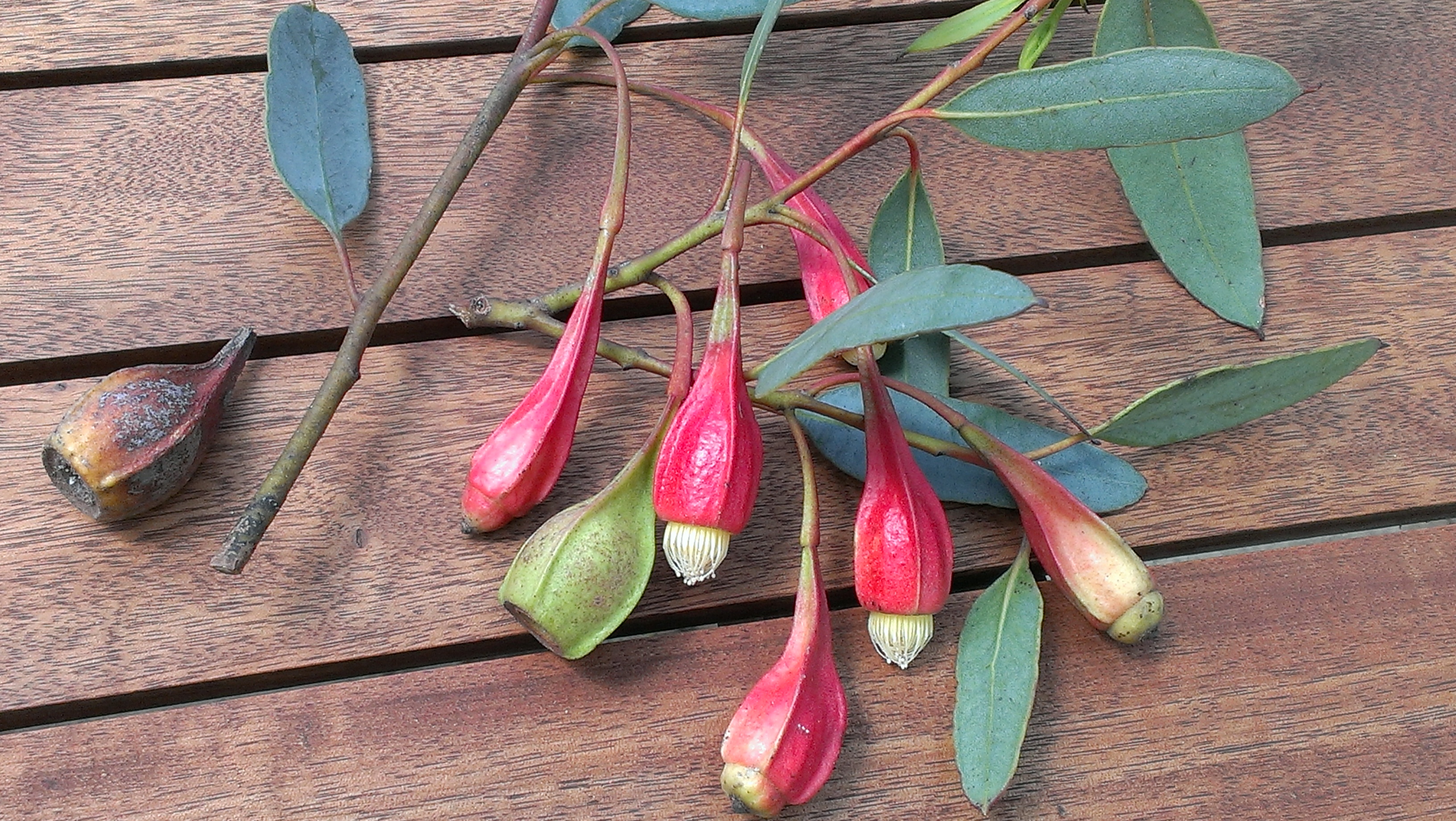
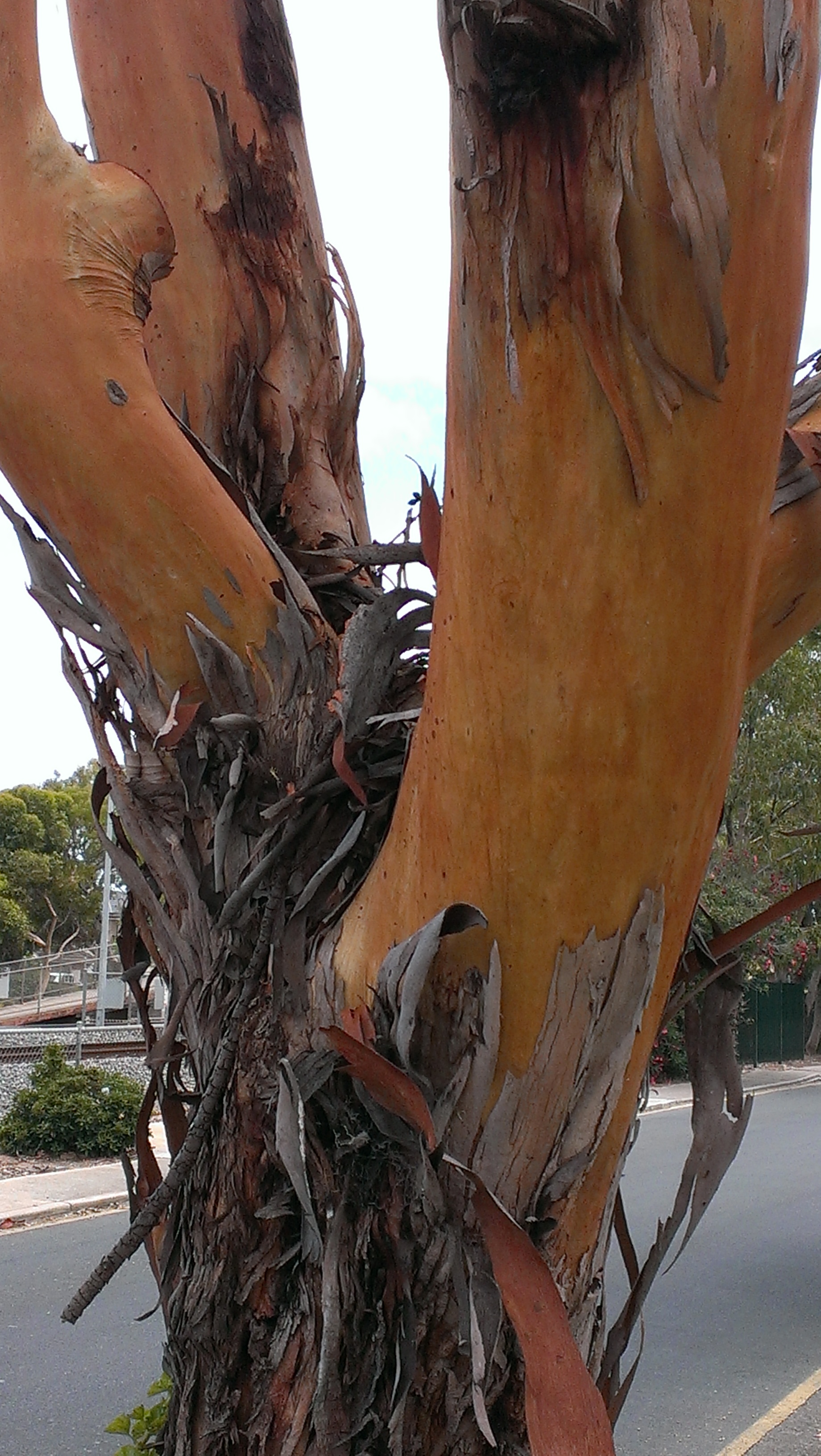
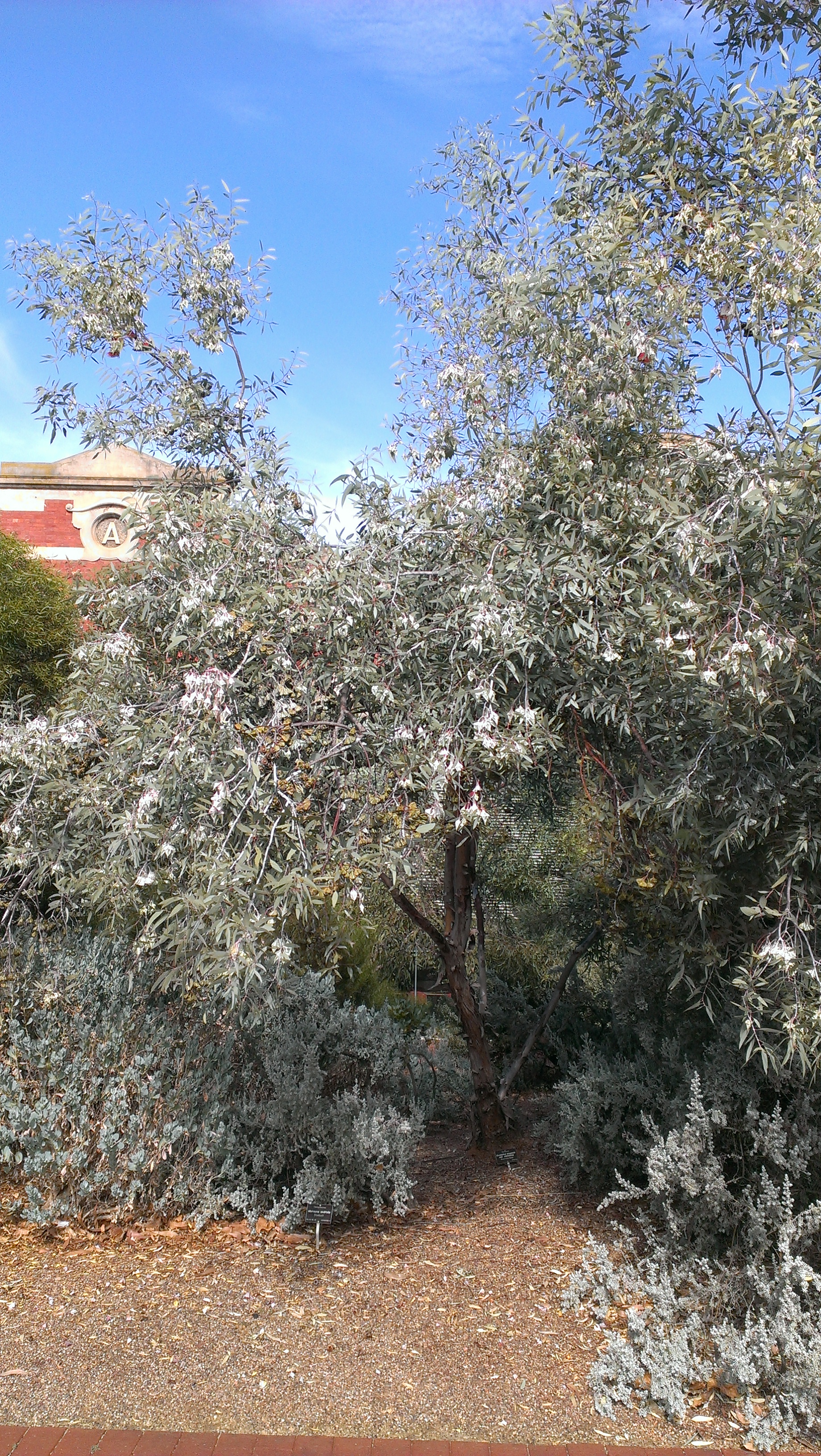
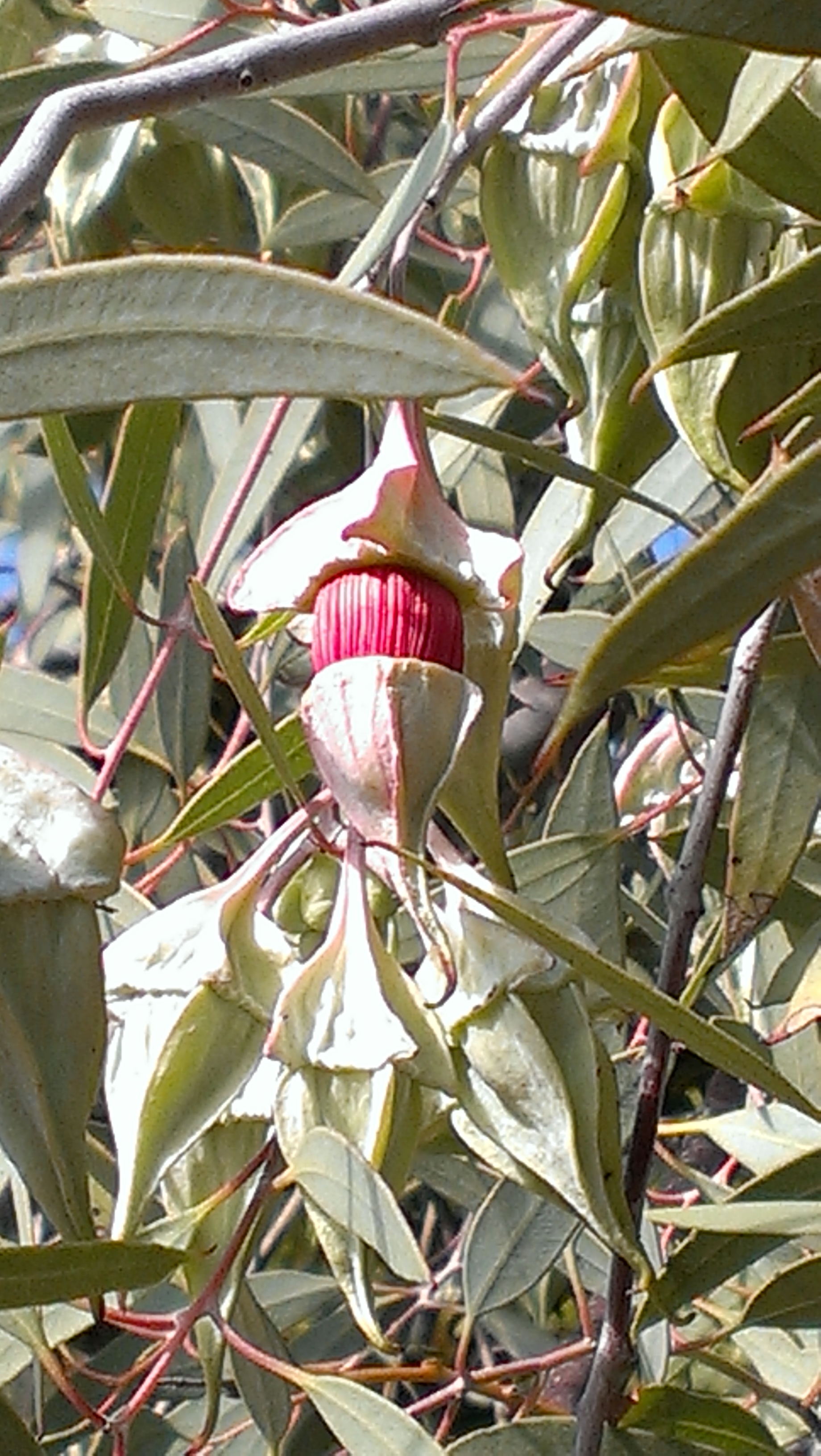
How spectacular is E Kingsmillii (Kingsmill’s Mallee; wing-fruited mallee)?

IMAG0952

Perhaps the tree doesn’t seem obviously wonderful.  The buds are truly glorious!

IMAG0955

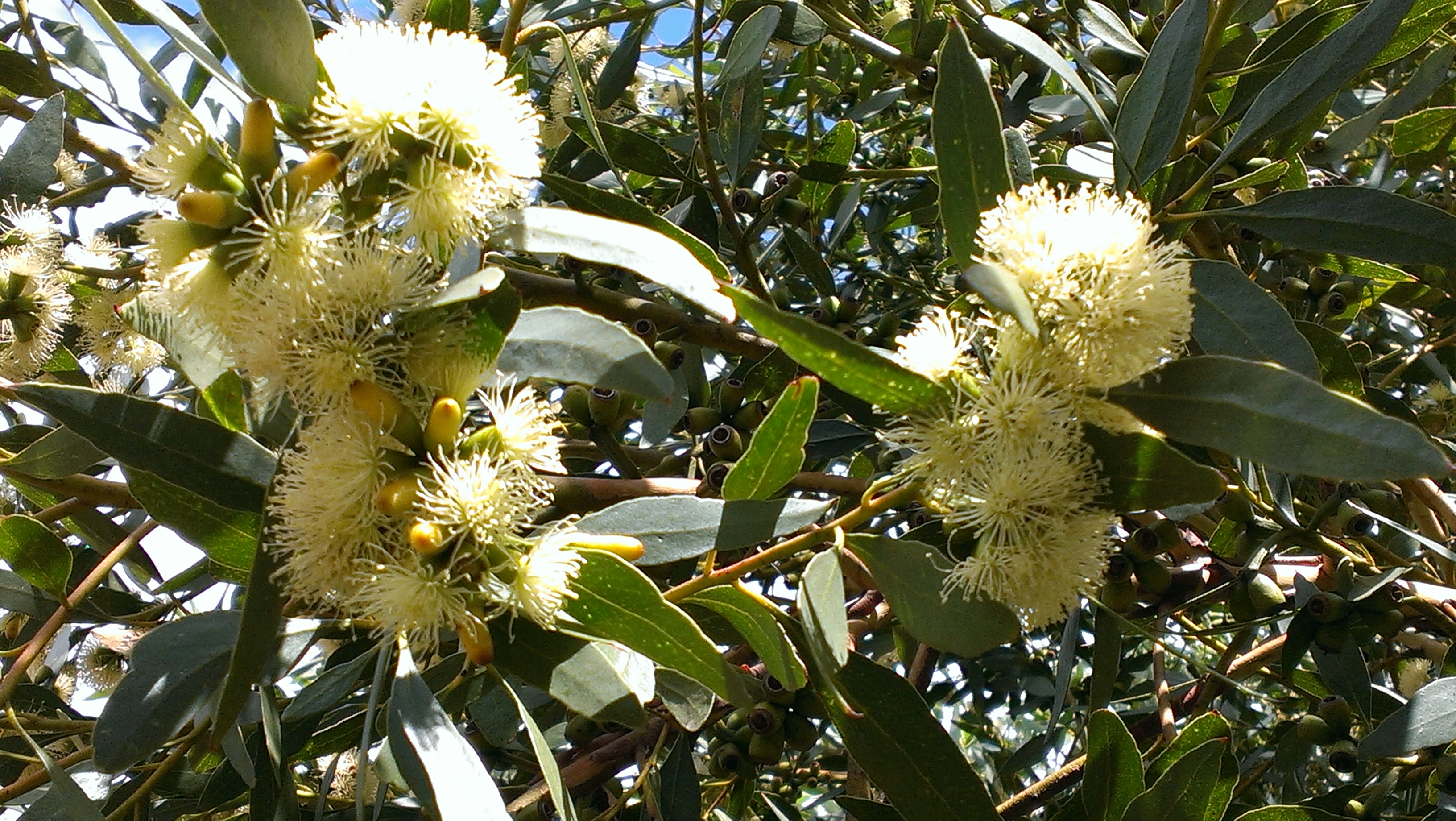
And so are the flowers and the fruits.  It turned out I was photographing this tree outside the Botanical Gardens centre for plant diversity.  My eucalypt admiration was shared with a woman who came by and offered me more information, so I told her about this beauty being a dye plant.  It isn’t every day you get this kind of fun on your way to a conference!

IMAG0957

And… for me this is a happy result, pulled from the copper at the Guild as a test during our workshop.  I am so prejudiced in the matter of red.  I just love it…

IMAG0919

4 Comments

Filed under Dye Plants, Eucalypts, Leaf prints

Another workshop done!

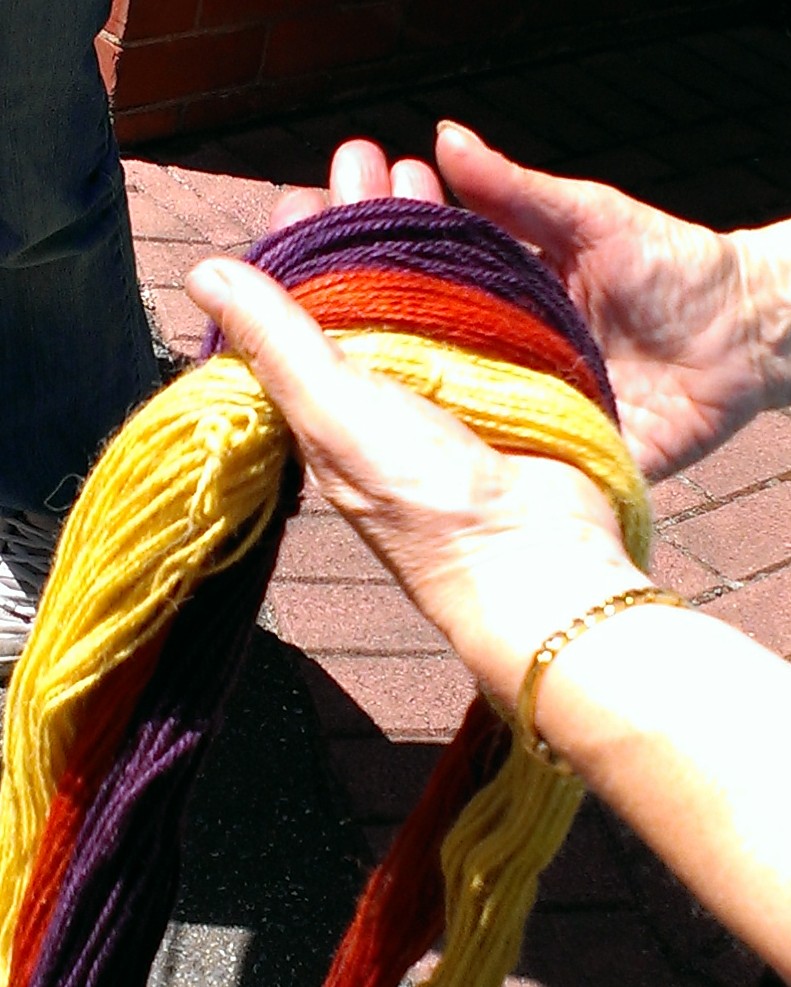
The second in my little series of workshops at the Guild went really well. There was yarn, fleece and roving dyeing.  Brown, orange, almost-red and maroon from E Scoparia (bark and leaves) and E Cinerea leaves, yellow from silky oak (Grevillea Robusta) using Ida Grae’s recipe from Nature’s Colors: Dyes from Plants, and the ever-astonishing purple from red sanderswood with alum.  I again used Jenny Dean’s method from Wild Colour and still got nothing like the oranges she suggests are likely.

IMAG0896

Mysterious outcomes in natural dyeing are not all that uncommon (at least for me!), as the number of variables is so huge.  But this one is out of the box–purple!?  Since my last post on the subject, Jenny Dean has very generously been in touch with her thoughts on the matter.  She suggests this purple could be the result of alkalinity (but given I made no attempt to generate an alkaline bath, it seems unlikely it was seriously alkaline).

Or–and I agree with her that this is much more likely, even though I used 4 different jars/packs labelled “sanderswood”–perhaps the dyestuff  was never sanderswood to begin with.  The colour is very, very like the logwood results I have had, just about indistinguishable.  I am still not complaining about the result–I love purple and so did the participants.  I was hoping for purple on this occasion, as I have no more logwood–that I know to be logwood.  Perhaps there was a time in the past when a batch of “sanderswood” came to our Guild or a supplier nearby and all the different jars I’ve used ultimately can be traced back to the same mislabelled supply. This would fit with my experience of Eucalypts… it is much more likely that I have misidentified my tree than that the dye bath is giving a completely different colour.  Variation to some extent, however, is completely expected.

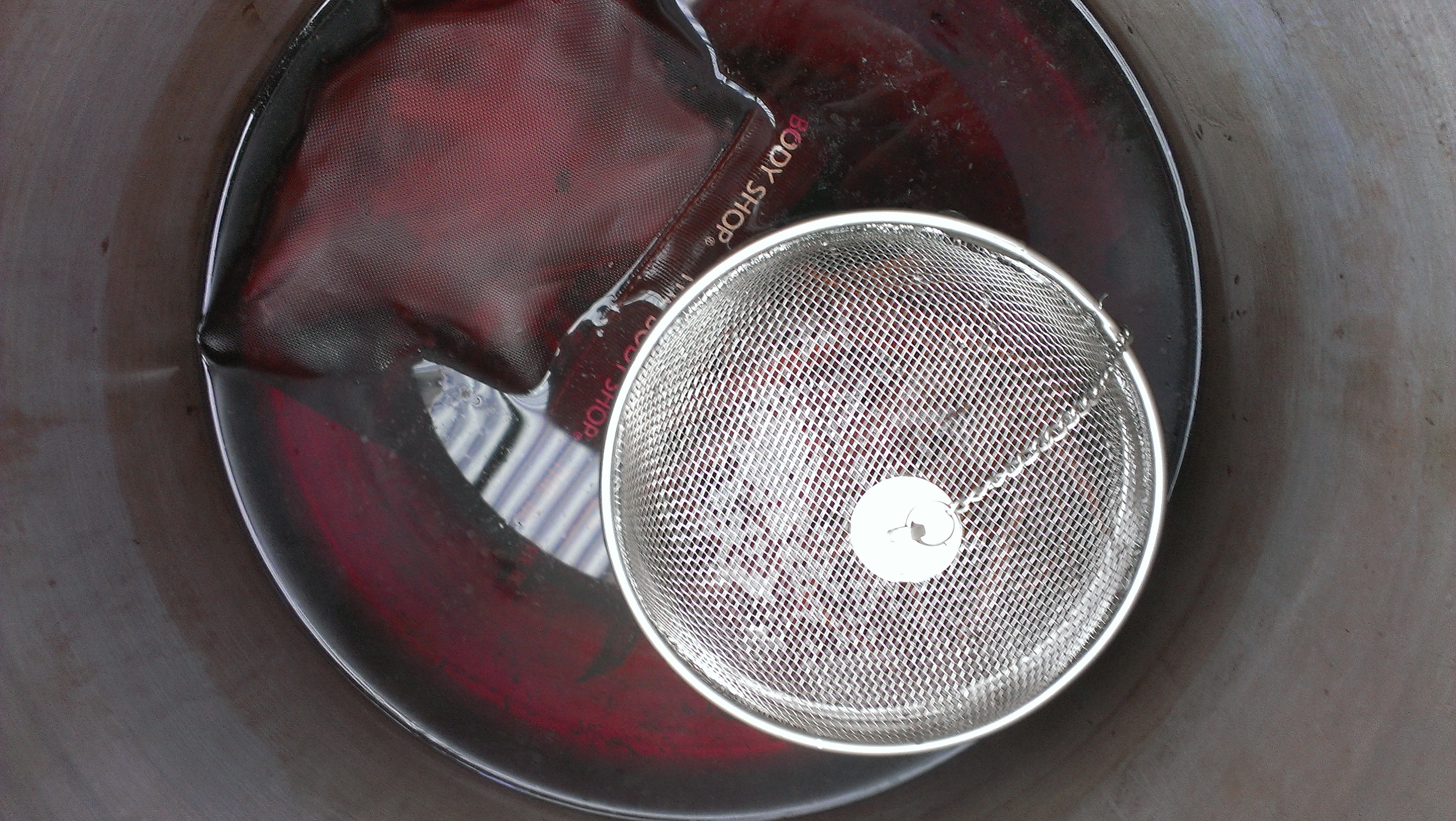
Here is the “sanderswood” just after I poured boiling water over it–Jenny says this looks like a logwood bath to her.  I bow to her much more extensive experience and wisdom, without hesitation.

IMAG0862

I have the biggest chips in a little zippered mesh pouch that must once have held toiletries.  The smallest chips/splinters are in something that looks just like a giant tea ball.  I saw it for sale in a Vietnamese grocery where I was investing in greens, seaweed and soy products and immediately saw its possibilities.  The woman who sold it to me had an eye-popping moment (evidently she hasn’t sold one to an Anglo before), and asked me what I was planning to do with it.  I love those moments in Asian groceries, because once I’ve been ask the question and given my (admittedly bizarre) response, I can ask about the ordinary use of the device or food in question.  This one is usually used to contain whole spices when making a big pot of stock or soup.  This point was helpfully illustrated by a packet of soup seasonings–star anise and cinnamon and coriander seed were some of the spices I could identify right away.

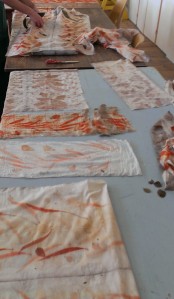
People tried out India  Flint‘s eco-print technique on cotton, wool prefelt and silk.  I hope she will get some extra book sales as a result (if you’d like to acquire her books, click on the link to her blog and look for the option to buy them postage free in the left hand sidebar).
IMAG0871

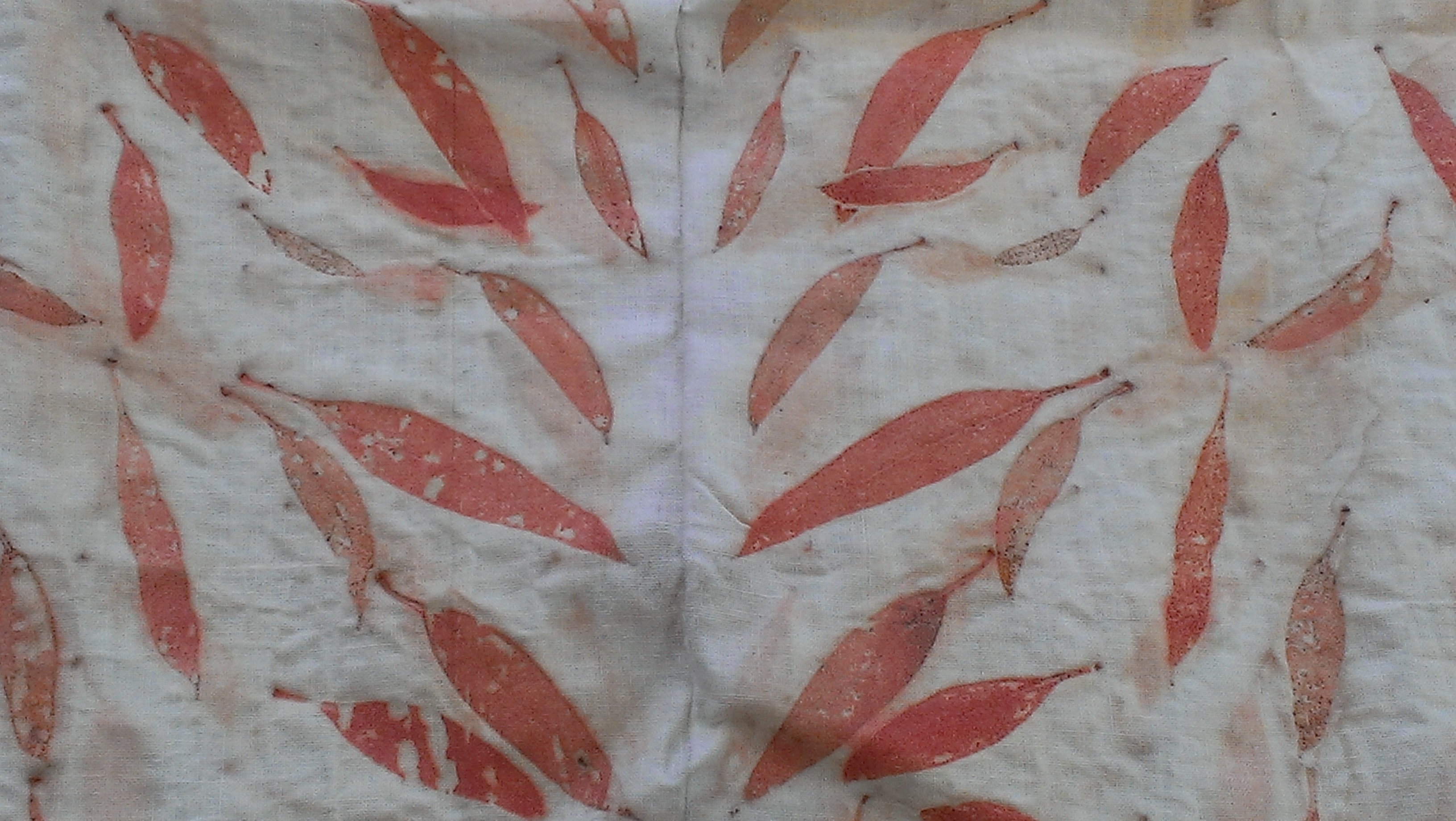
There were biscuits and icy poles and lots of chat.  I demonstrated soy mordanting and black bean dyeing.  And while we were at the Guild and using the copper, which is such a generously sized vessel by comparison with my dye pots, I leaf printed some significant lengths of fabric that I brought to the workshop bundled up and ready to go.  The copper really is copper lined, but I could detect no obvious impact on the colours.  Seedy silk noil:

IMAG0903

Wool prefelt… the degree of detail is fantastic.  This is destined for felting experimentation by a dear friend who generously assisted me at the workshop.  Her practical help, support, constant grace and good cheer made things go so smoothly.  I also decided to start some processes before participants arrived, which I didn’t do at the previous workshop.  I think that helped.  But it was a fabulous group of people too.

IMAG0913

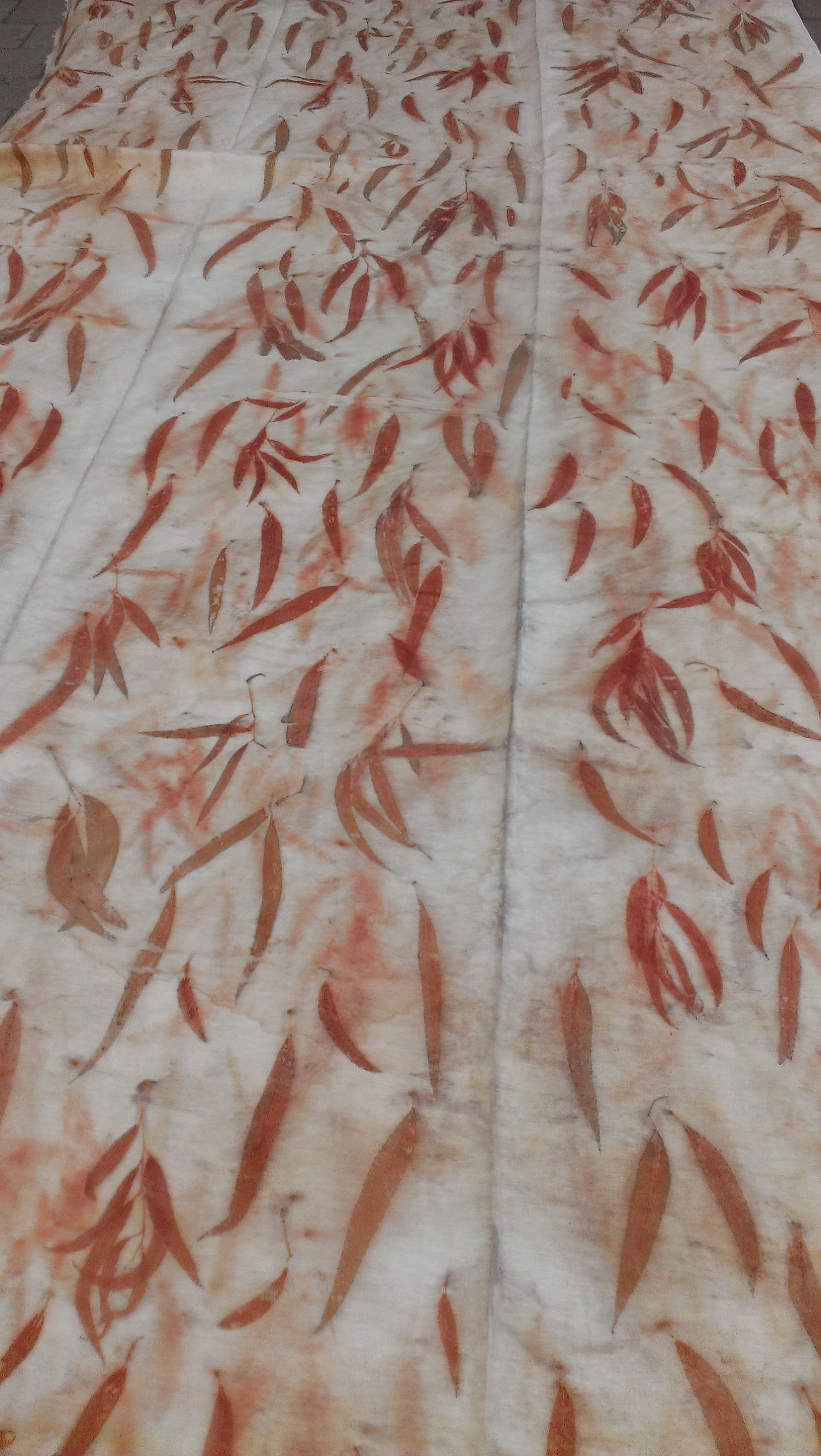
And finally, silk/hemp blend, destined to be made into a shirt (by me, so it may take a while).  I am delighted with how it turned out, after many months of putting off the day.

IMAG0924

9 Comments

Filed under Eucalypts, Leaf prints, Natural dyeing

Things I’ve done with with plant dyed yarns…

When I was preparing for the natural dyeing workshop I ran recently, I mordanted a lot of Bendigo Woollen Mills yarn as well as some handspun in small skeins–25g or less.  Having all those small skeins of different colours in alpaca and wool and mohair, activated my imagination. Eventually it led to this…

IMAG0792

These are madder-tipped, logwood-stemmed crocheted coral thingummies, inspired by Loani Prior’s ‘coral punk’.  When I say ‘inspired by’, let me confess.  I bought her beautifully designed and entertaining book Really Wild Tea Cosies with a Christmas book voucher I was given.  So I had the pattern.  But even though only one, basic, crochet stitch was involved, my crochet skills are decidedly remedial and I don’t happen to have a crochet instructor on tap.

I turned to Maggie Righetti’s book Crocheting in Plain English (I don’t have the new revised edition, needless to say).  Apparently sometimes I just can’t believe what I am reading… or perhaps I just don’t understand on the first eight passes.  I see students I teach with the same difficulties!  By the time I had finished this tea cosy and started on the next, I’d managed to figure out that I wasn’t doing what Loani Prior must have believed was involved in the one stitch involved in her cosy.  Luckily for me crocheting badly still produces a fabric of a sort.  I also figured out that for me, improvising a knit version of the pot cover itself was going to beat freeform crocheting one as the pattern suggests with my inadequate skill set.  So that’s what I did, and Loani Prior shouldn’t be held responsible for the outcome.  I like it anyway.
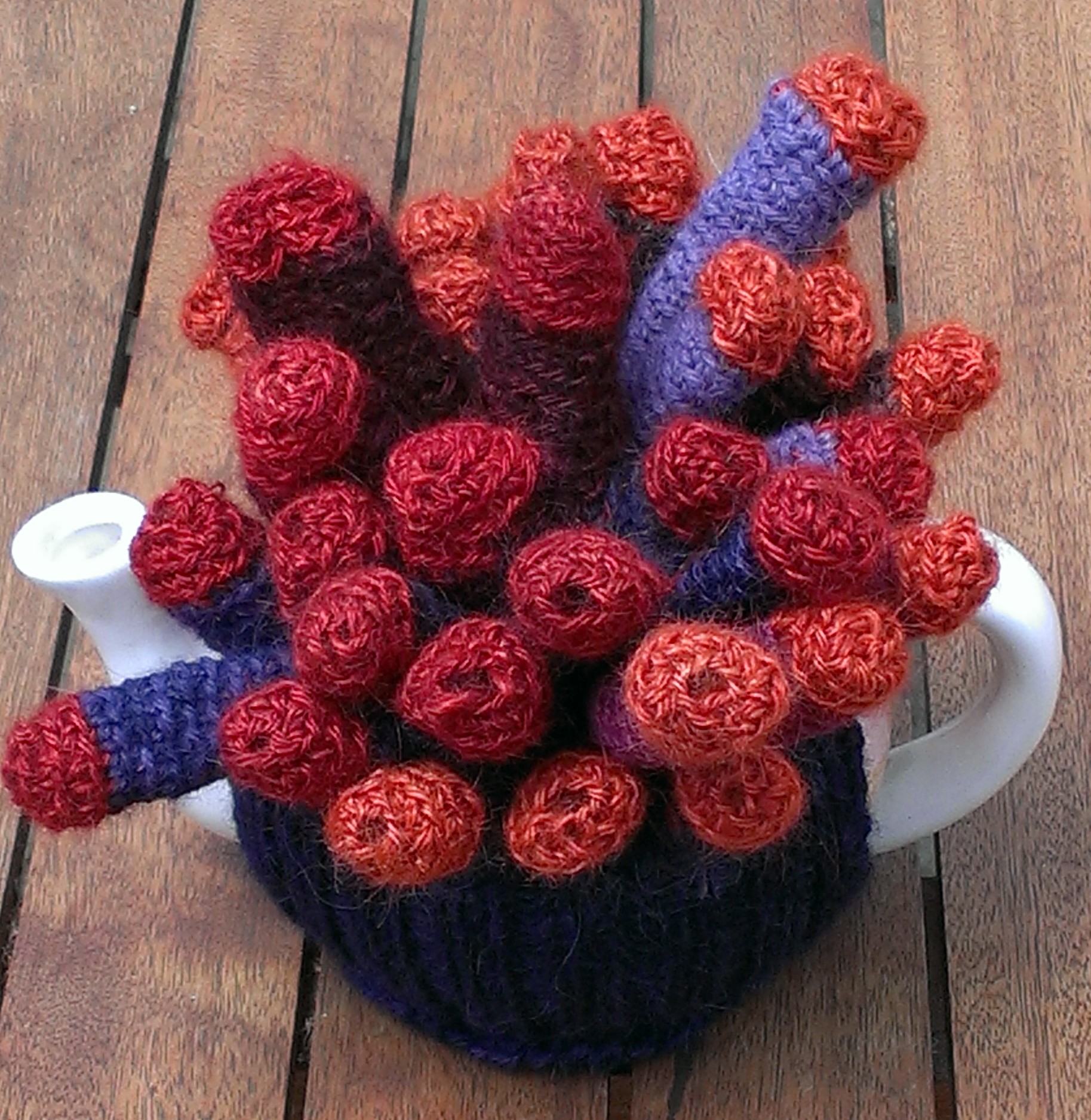
IMAG0843

It has highly entertained people who watched me crocheting coral at parties (as one does) as well as those who have seen the finished object, many of whom thought immediately of a sea anemone.

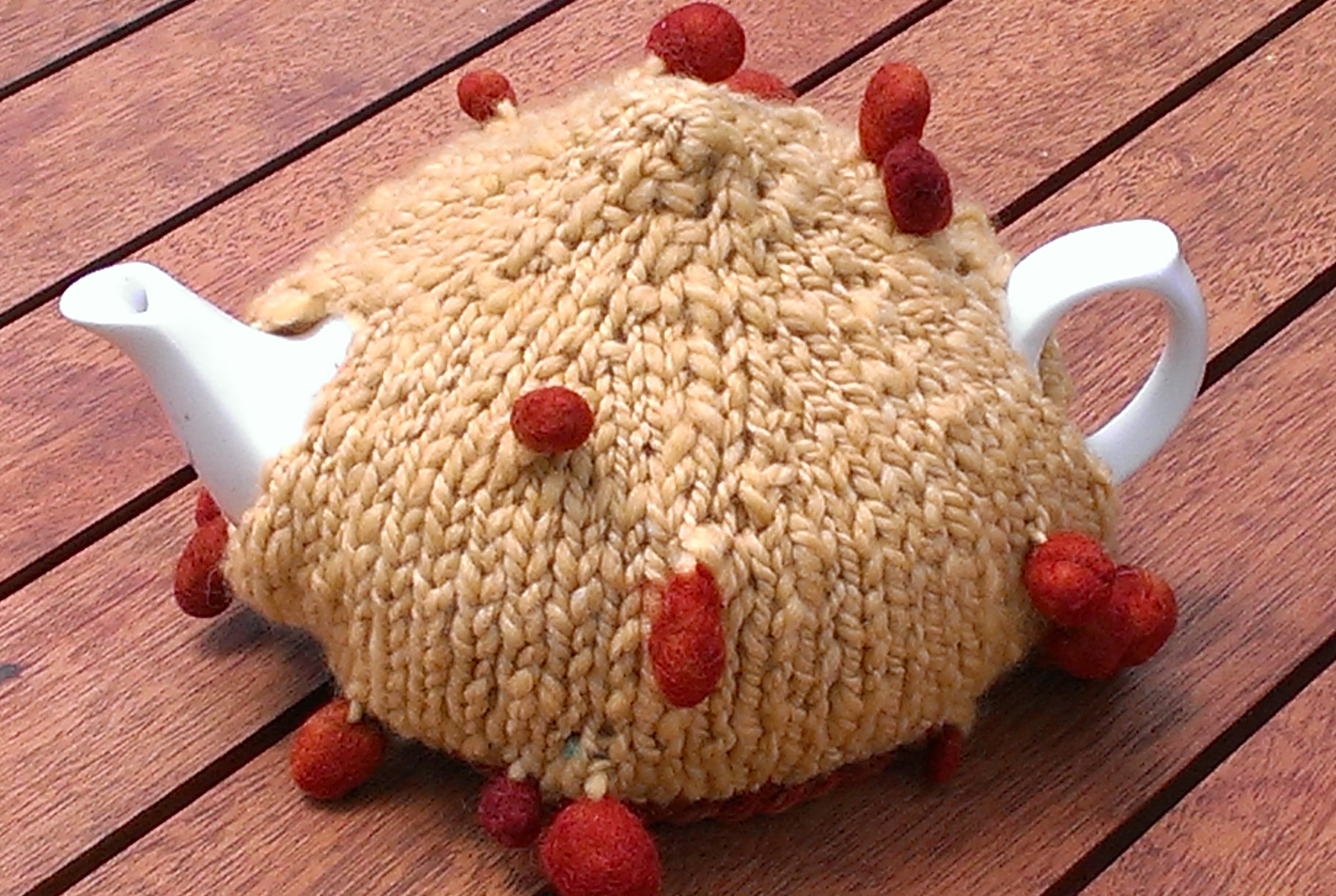
Let it be said that at present coral punk is not alone.  Here is the present plain Jane of the tea cosy selection at our place: yellow from silky oak leaves and orange from eucalyptus–with the felted blobs spun into the yarn.  Pattern improvised.  Luckily, tea pots are just not that fussy about how you clothe them.

IMAG0840

I’ve been branching out and using up some particularly strange art yarn spinning experiments.  This next one is commercially dyed mohair with silk curricula cocoons spun onto it.  Scratchy for a head, perfect for a teapot!  I was surprised how many people liked the look of the ‘hat’ emerging as I knit this at a picnic, riffing off Funhouse Fibers’ Fast and Fun Cozy.  Once again, that is to say, dispensing with the pattern when it became inconvenient.  I guess the hat admirers hadn’t felt the yarn yet.
IMAG0842

And for anyone who is wondering, I have continued to dye with the logwood exhaust from the dyeing workshop.  I ran out of yarn for a while and dyed two, 200g lengths of merino roving.  This morning I pulled out another 100g of superwash yarn.  I think it might be just about done, and I only wish I had kept a record of the weight of fibre that has been dyed with what was a small quantity of logwood in the beginning!  This weekend, the second in a series of two natural dyeing workshops. I’d better eat my crusts and get my beauty sleep in preparation.

IMAG0839

2 Comments

Filed under Crochet, Eucalypts, Knitting, Natural dyeing, Spinning, Uncategorized

After the workshop

This week I ran a natural dyeing workshop for my Guild.  It was exhausting but fun!  I tried taking a picture inside the hall and my poor old camera wanted to use the flash–pretty useless.  Between that and having a lot going on, I decided to forget taking photos.  We ran lots of dye pots: E Scoparia bark, dried E Scoparia leaves (oranges), silky oak leaves (yellow), logwood from the abandoned/donated dyestuffs of the past stash (purple), black beans (not as blue as I hoped)… we mordanted with alum and with soy, there were leaf print experiments.  We dyed silk, alpaca, wool, cotton; fleece, roving, yarn and fabric.  Phew!

I came home with cooked bark and leaves and  ground soybeans to compost, quite a bit of remaining pre-mordanted yarn, a bucket of black beans with yarn tucked into it, a bucket of homemade soymilk and the logwood bath.  Can I just quietly mention how relieved I was when I got home without having sloshed a bucket over in the car?

IMAG0786

I have run the logwood bath twice more so far.  This is the second effort: superwash wool in the foreground, alpaca/wool blend in the middle, and greeny-grey-blue black bean dyed sock yarn at the back.  I have some roving still soaking and rinsing after the third logwood bath, and I’m mordanting more fibre to go into a fourth bath right now.  I wish that logwood was a sustainable local dyestuff.  It is spectacular and straightforward, and purple is a great colour.  I loved pouring boiling water on wood chips and getting purple water; dipping fibre into what became a brownish dyebath and pulling it out purple.  But logwood isn’t local or sustainable, so I’m making the most intense use of the logwood that I have been given that I can figure out.

I hope that my forebears at the Guild who abandoned the logwood there or donated it to the Guild would be happy if they could see the excitement it provoked in the workshop.  It’s possible that the former owners of this logwood are still coming to the Guild and will let me know what they think when word gets out of what we did in the dyeroom this week.  I feel so blessed to be part of the Guild–fancy being part of an organisation that has a dye room!

6 Comments

Filed under Dye Plants, Eucalypts, Leaf prints, Natural dyeing