Tag Archives: neighbourhood dyeplants

Eucalyptus dyes over grey corriedale: The spinning finale

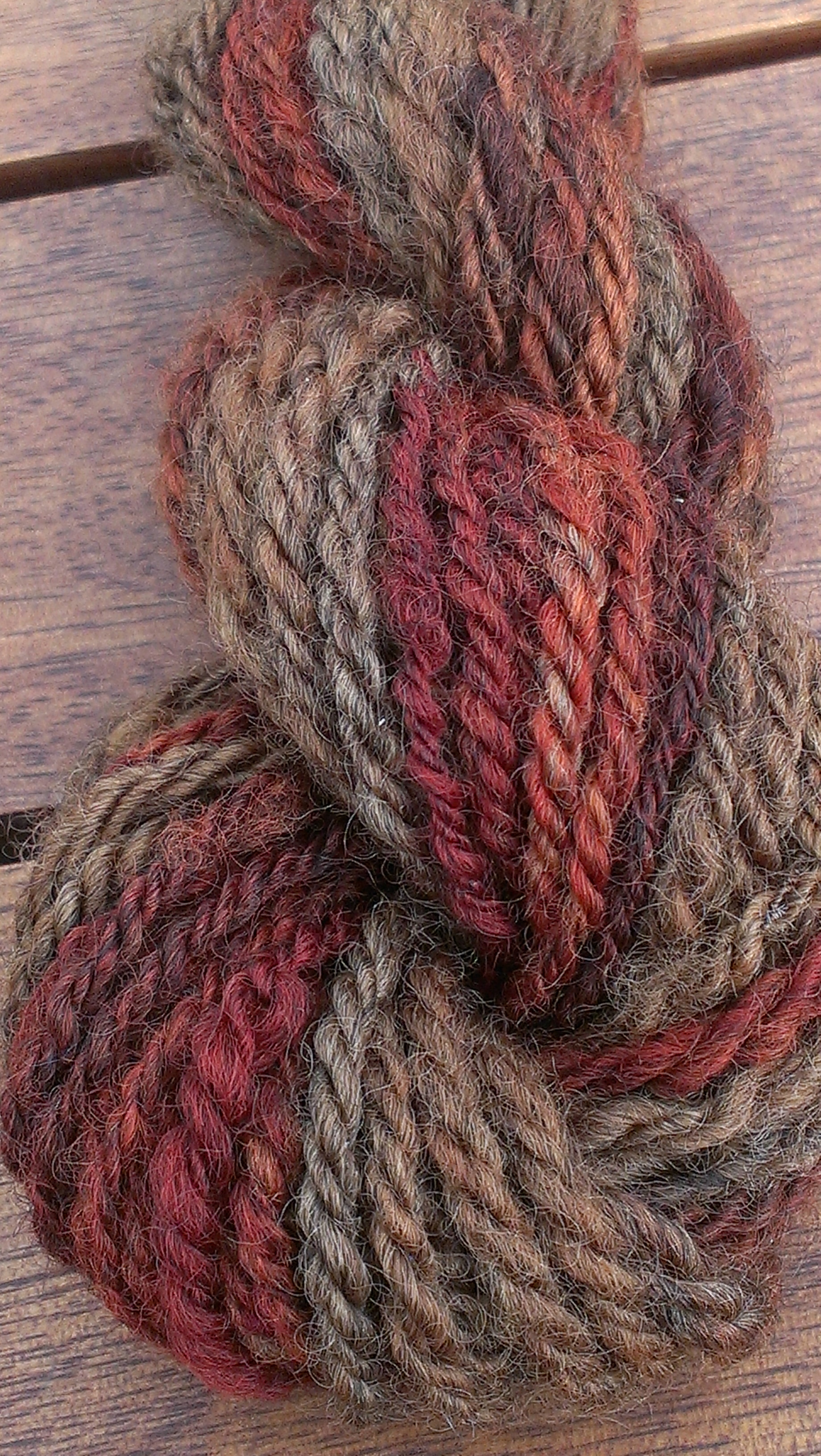
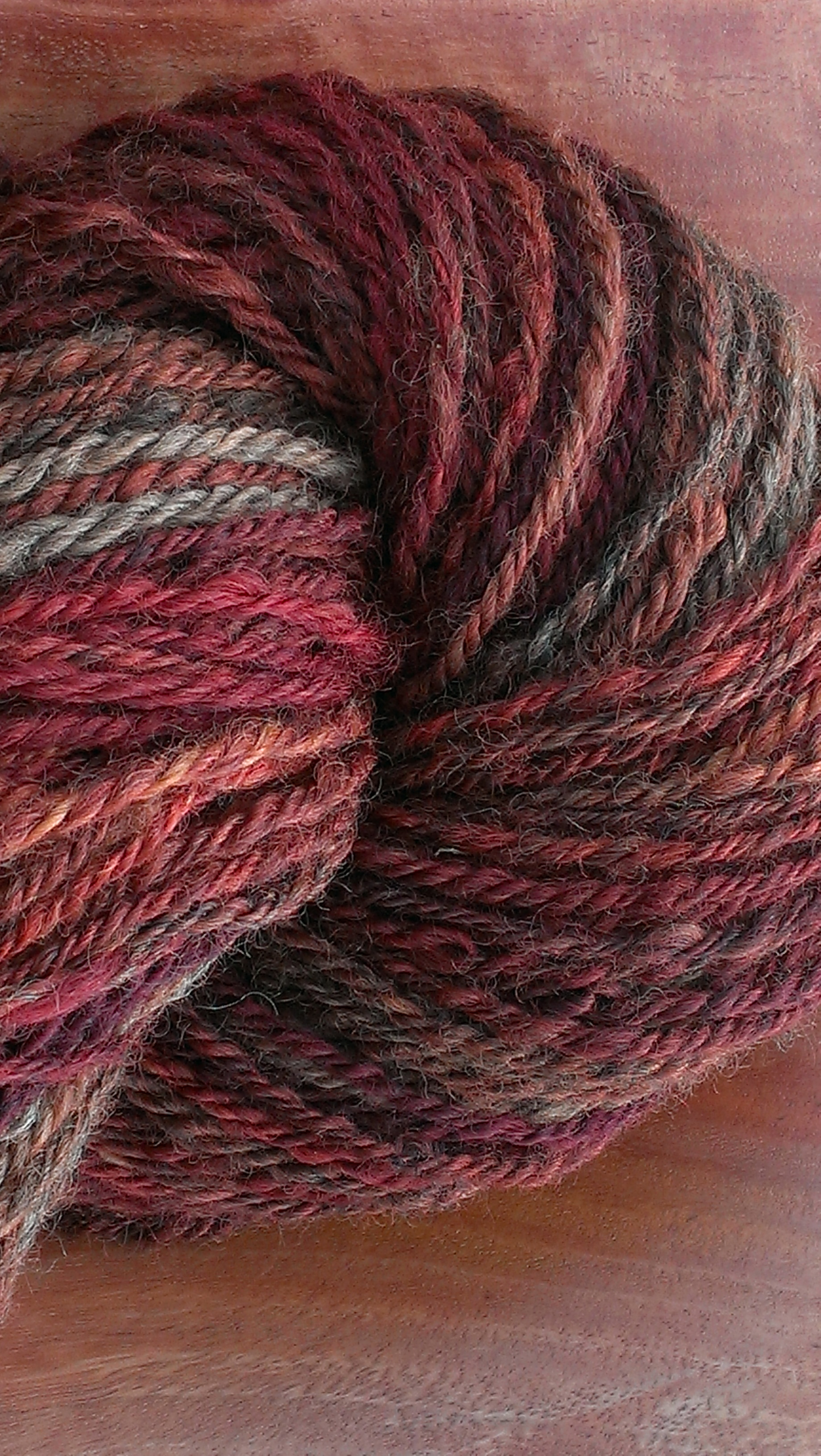
I have a bit of a tendency to go a long way toward the completion of a big project and then pause near the end.  Sometimes for a little while, sometimes for a long while.  So here, finally, is the very last of the grey corriedale I dyed months ago and planned to spin during the Tour de Fleece. I loved the two ply yarn I created during the Tour a good bit less than my initial chain plied skein, even though it is what I need if I ever knit that cardigan I dream of.

I found the label for this fleece on the weekend and I started out with 3.5 kg of fleece.  I made a true three ply yarn (three singles plied together) from most of the last part…

IMAG2559

And chain plied the rest (one single plied on itself in a chain).  I think the long pause on this was caused by the way my heart sank when I stopped chain plying it in the first place.  I love the distinct colours in the last little leftover skein!   IMAG2562

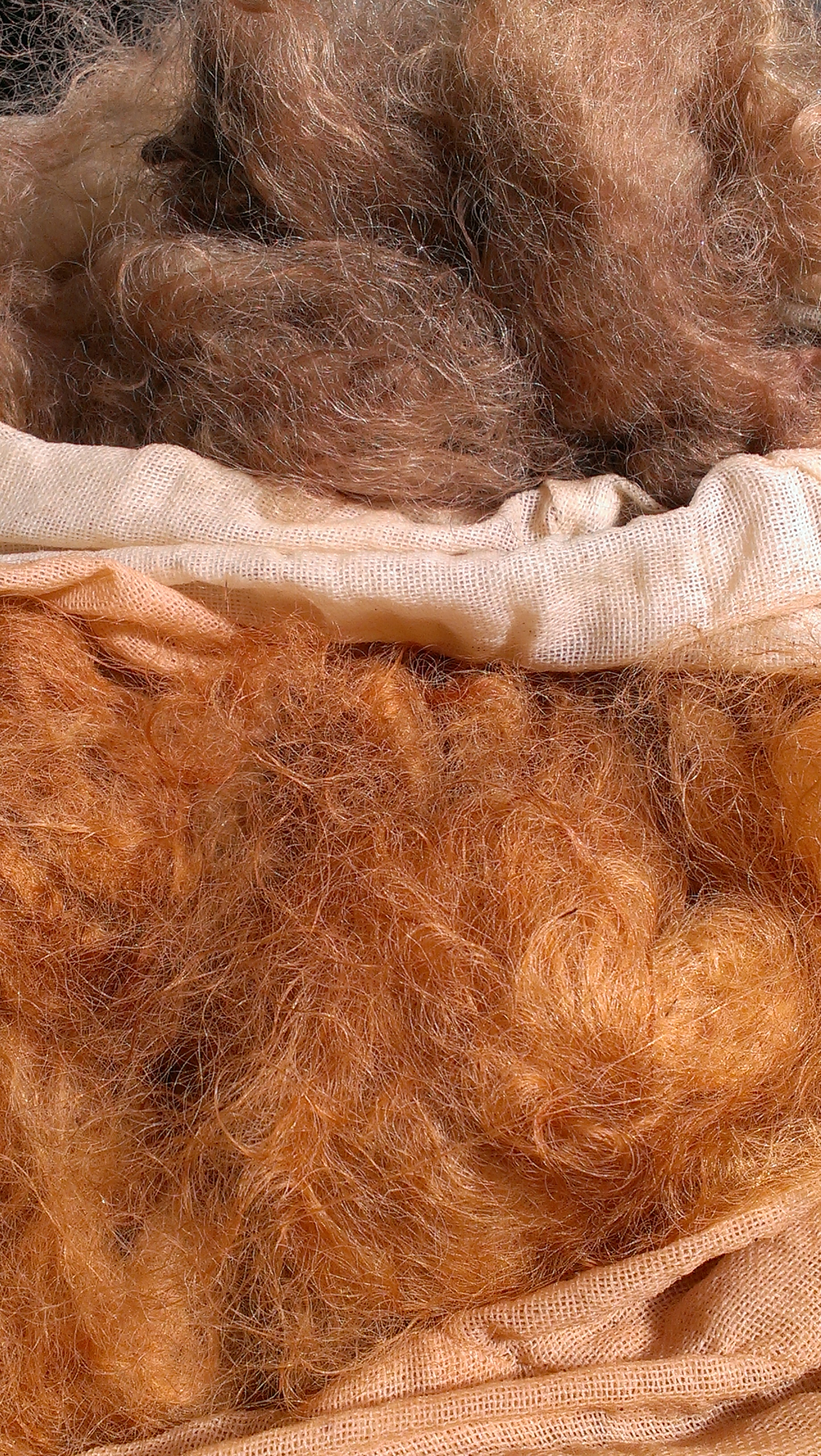
I also spun up a little batt of alpaca dyed in eucalyptus.

IMAG2382


Three ply wins again!

IMAG2563

Leave a comment

Filed under Eucalypts, Fibre preparation, Natural dyeing, Spinning

Local windfalls 2

I went for a walk the other day after more gale force winds.  The wind had been so impressive I watched every piece of mulch in our backyard become airborne the previous evening!  I took my trusty secateurs and a calico bag with me.

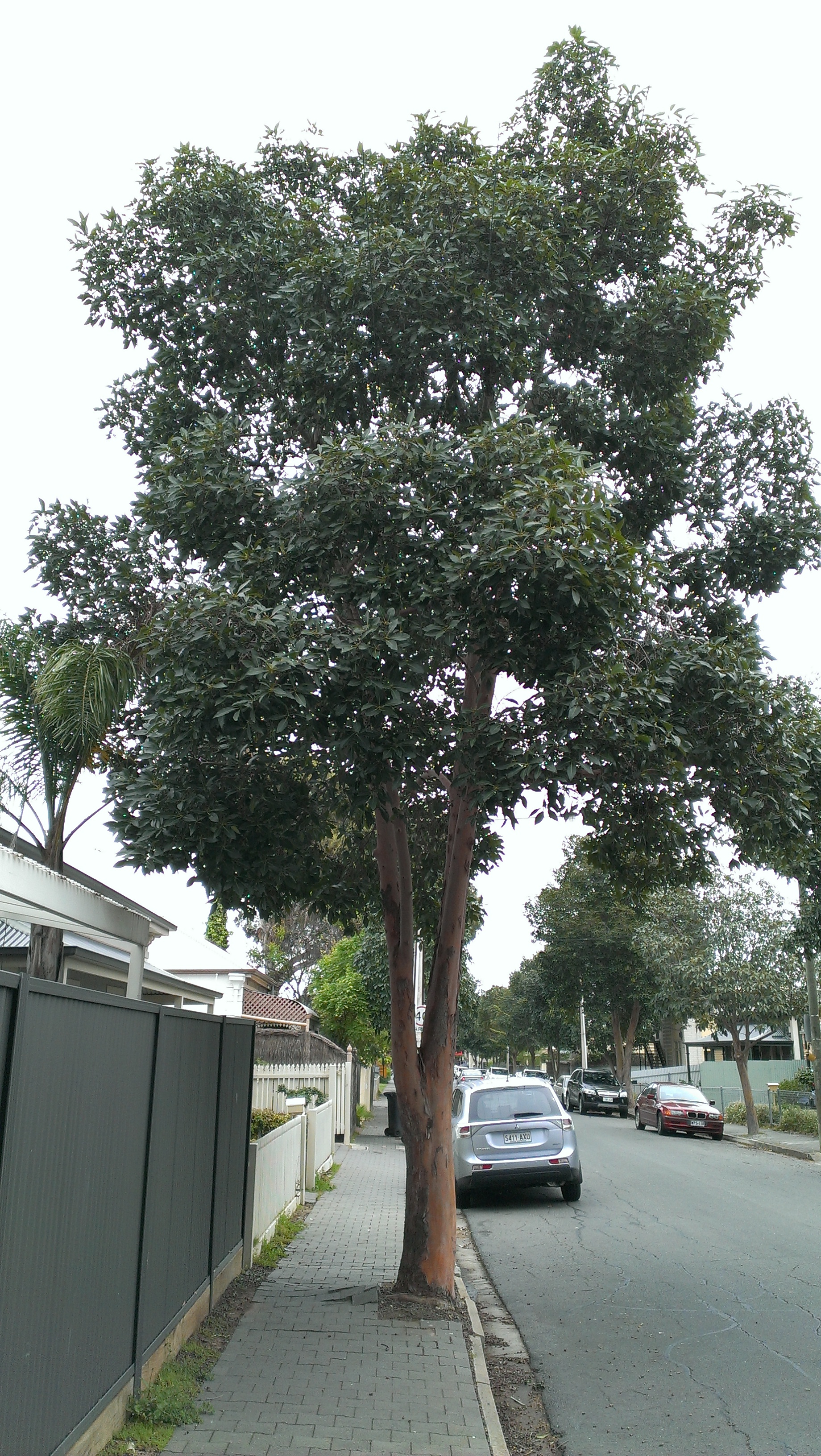
My first candidate (for the dye pot) is a tree my father calls Queensland Box.  Wikipedia suggests my father is right, and also that this tree is widely cultivated outside Australia.  It is Lophestemon Confertus–and its flower is just lovely (go to Wilkipedia if you’d like to see it–they are not in flower here right now).  The trunks peel to a lovely burnt orange but at present this process has barely begun.

IMAG2320

They are widely planted as street trees here.

IMAG2321  #

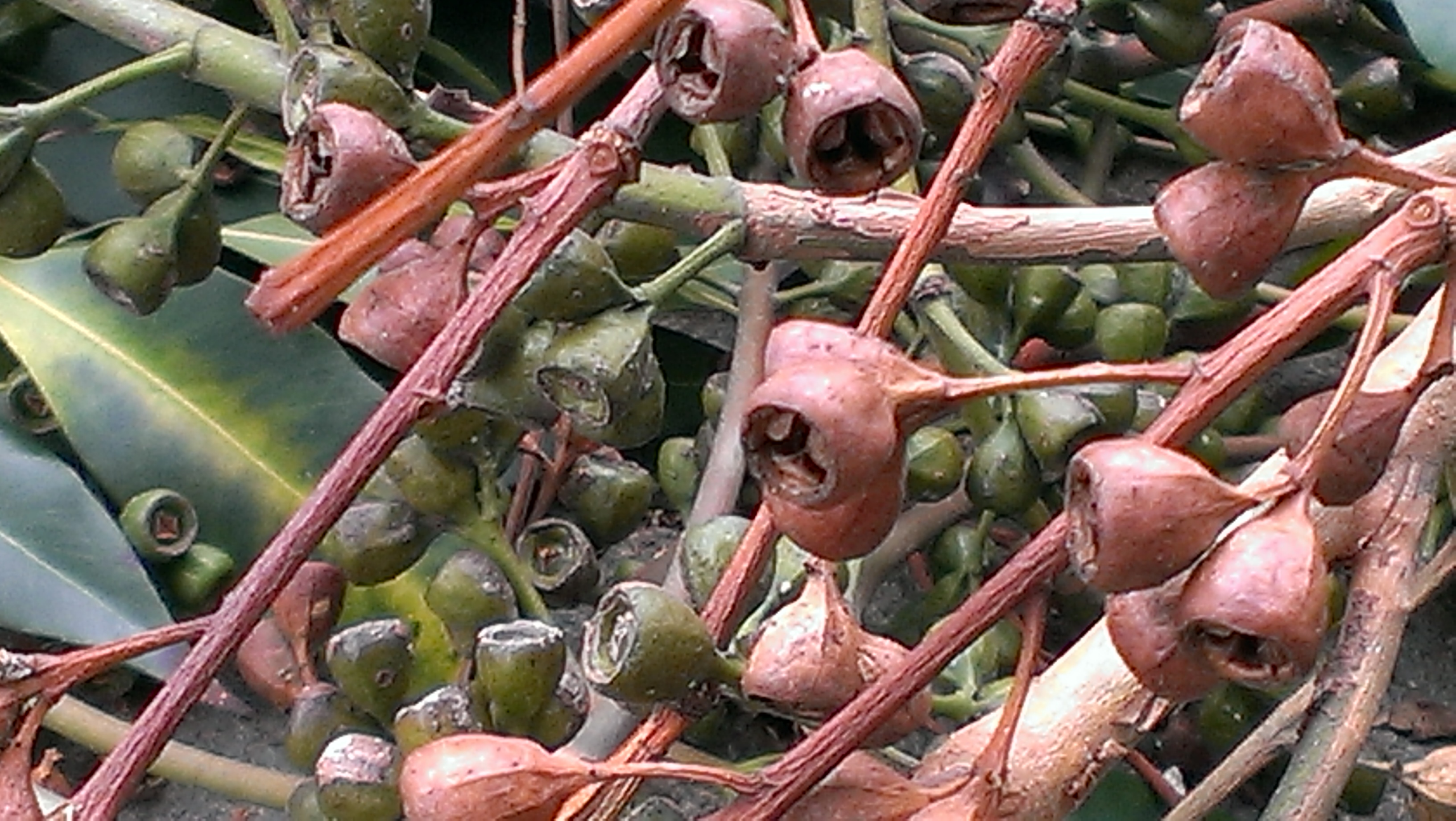
And they certainly are fruiting, with two generations of seed pods on show at present among glossy leaves.

IMAG2326

Two generations of fruit is one thing. Dye pot candidate two had four generations on show.  This eucalypt has been pruned ruthlessly but shows mostly smooth bark with rough, peeling bark near the base.  My best guess is E Macrandra (River Yate)–but this really is a guess.

IMAG2338

Now for the reproductive material! I think this is a ‘flattened, strap like peduncle’ as constantly referred to in my reference works. Those tiny ‘fingers’ are buds.

IMAG2339

Here the buds are again, a lot further along, in the second generation:

IMAG2344

Immature fruit:

IMAG2340

Still immature but older fruit:

IMAG2341

Finally, I came past a stand of ironbarks where I often collect after wind, and collected my third candidate.  It’s a mixed stand from which I sometimes get good colour and sometimes very little.  Three dye pots full waiting their turn on the hob…

IMAG2346

The results were not tremendously exciting… different shades of tan and pale apricot from the eucalypts (clearly the ironbark was not E Sideroxylon). I have to confess that I forgot to photograph these unexciting outcomes before overdyeing them with E Cinerea.  The Queensland Box showed its capacity to give tan in the presence of alum, especially.  The samples are (from left to right) wool, wool+alum, silk and cotton.

IMAG2361

Leave a comment

Filed under Dye Plants, Eucalypts, Natural dyeing, Neighbourhood pleasures

Neighbourhood windfalls 1

We’ve had gale force winds here lately.  One morning about a week ago, 40% of my city had no power when we woke up (we were happily still connected to the grid).  Needless to say, this has led to windfalls, and I was still collecting them yesterday as further gale force winds began a week later.

The first windfall was an ironbark.  Guessing from its location (a stand of three ironbarks) and the gumnuts still intact, I think it is E Tricarpa. Sadly, just as unremarkable as a dye plant, as the last time I tried!
IMAG2302IMAG2304

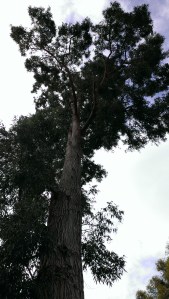
I have not managed to identify this tree, partly because it branches metres above ground level.  Even with so much of its canopy on the ground, I didn’t find a single bud, flower or fruit to help me identify it.  The trunk is rough and pale. The whole tree is difficult to capture in a photo, especially on such a gloomy day.  It must be at least 20 metres tall.

IMAG2335IMAG2336

It seems to be under attack from some kind of scale insect.  Every single leaf was affected. Here it is after some hours in hot water–suggestive of a beige outcome….

IMAG2309IMAG2349

Compare my third windfall.  This is a tree that has been cut to accommodate cars parking beside it, in the car park of a recreation area.  I haven’t been sure whether it was E Scoparia, E Camaldulensis, or some other unknown eucalypt.  Both E Scoparia and E Camaldulensis have similar shaped and sized leaves, small fruit and both can have pale, smooth trunks (but this trunk looks more E Camaldulensis to my admittedly self-trained eye).  The branch that fell to the ground had an uncharacteristically large number of fruit on it for E Scoparia.  On the other hand, the clusters of seven fruit with 3 valves apiece made me think it might be E Scoparia after all.  So did the colour of the dye bath, though the leaves did not turn orange the way E Scoparia usually does.

In spite of the colour of that dye bath, the result says that this is not E Scoparia, and the 3 valves say that it isn’t E Camaldulensis either (4 valves).  Even with vinegar to help bring out whatever orange or red might be there to be had, and still damp from the dyebath… the 3 valved tree is at the top (brown-beige?) and the 20 metre tall tree is at the bottom (caramel-beige).

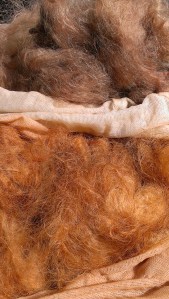
IMAG2350IMAG2351

Here are the results of a bath with a fallen branch from an actual E Scoparia, downed in the same windy night.  They’re the red and orange samples, with the E Tricarpa for contrast.
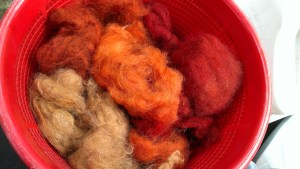
IMAG2316

13 Comments

Filed under Dye Plants, Eucalypts, Natural dyeing

Show time!

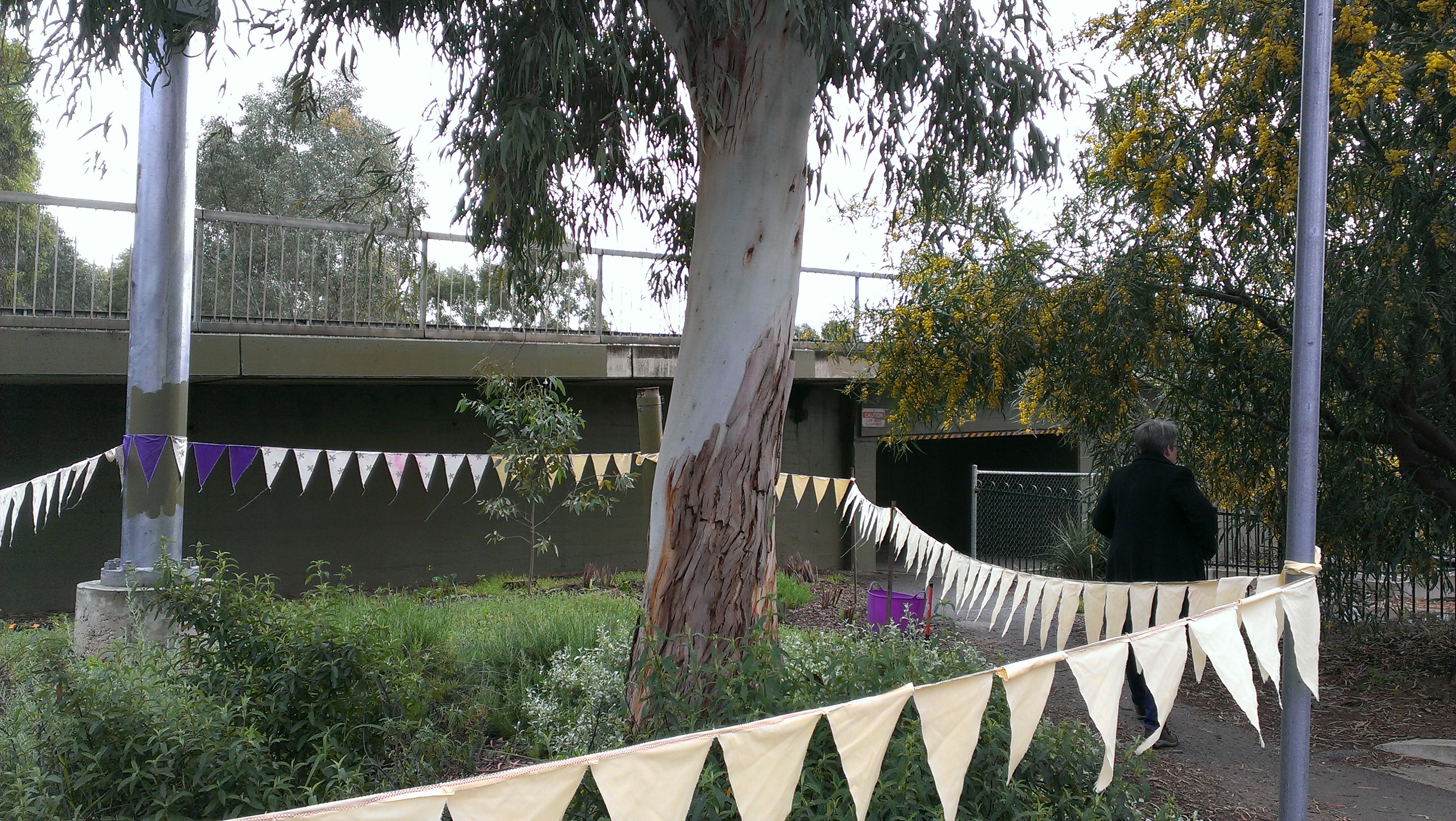
It is Adelaide Royal Show time again.  Spring began here only a few days ago, by the calendar.  There was a brief hot spell–33C is too much too soon for me–and then for the first day of the show, overcast and threatening rain as these dim pictures may suggest.  This week I have been tuning up the bunting I made to protect our little community revegetation project–around one of my favourite E Scoparia trees.  I sewed all the pieces back together, made some more, joined it all with some recycled cotton yarn, and… this morning we went out and applied it.

IMAG2153

The saltbush and other natives we have planted here have come on wonderfully–and there has been a spectacular fail with transplanting dianellas which I’ll pull out once the show is over. The yellow flowering tree on the right is a wattle that is doing really well (and not because we planted it).  The modest goal of this bunting is to gently suggest to people walking from the show (who will likely come down the path on the right of the image below) heading for the car parking on the left of the image below… that they should walk around this patch rather than trampling it in the dark after the fireworks are over, tipsy/sleepy/not paying attention as they may well be after an exciting day and too much fairy floss.  I think I replaced it three times last year, so I have some backup bunting already in hand, and I’m keeping my fingers crossed.  Happy show!  Happy springtime!

IMAG2154

1 Comment

Filed under Dye Plants, Eucalypts, Sewing

Small things…

They say ‘small things amuse small minds’. I think that if you can be amused by small things, you can be amused and delighted on a regular basis.  And that small things are often delightful.  Moss, for instance.

IMAG1909

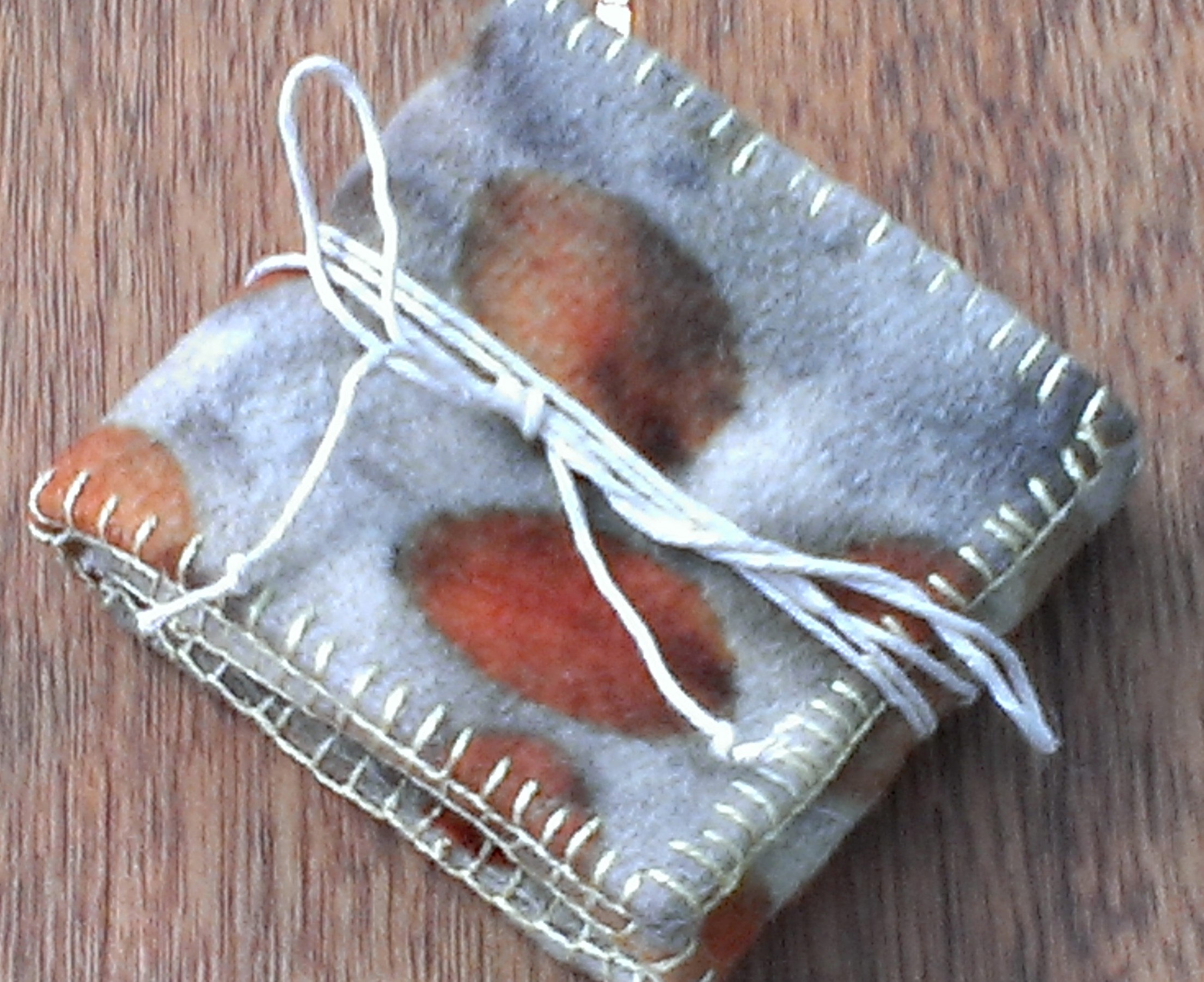
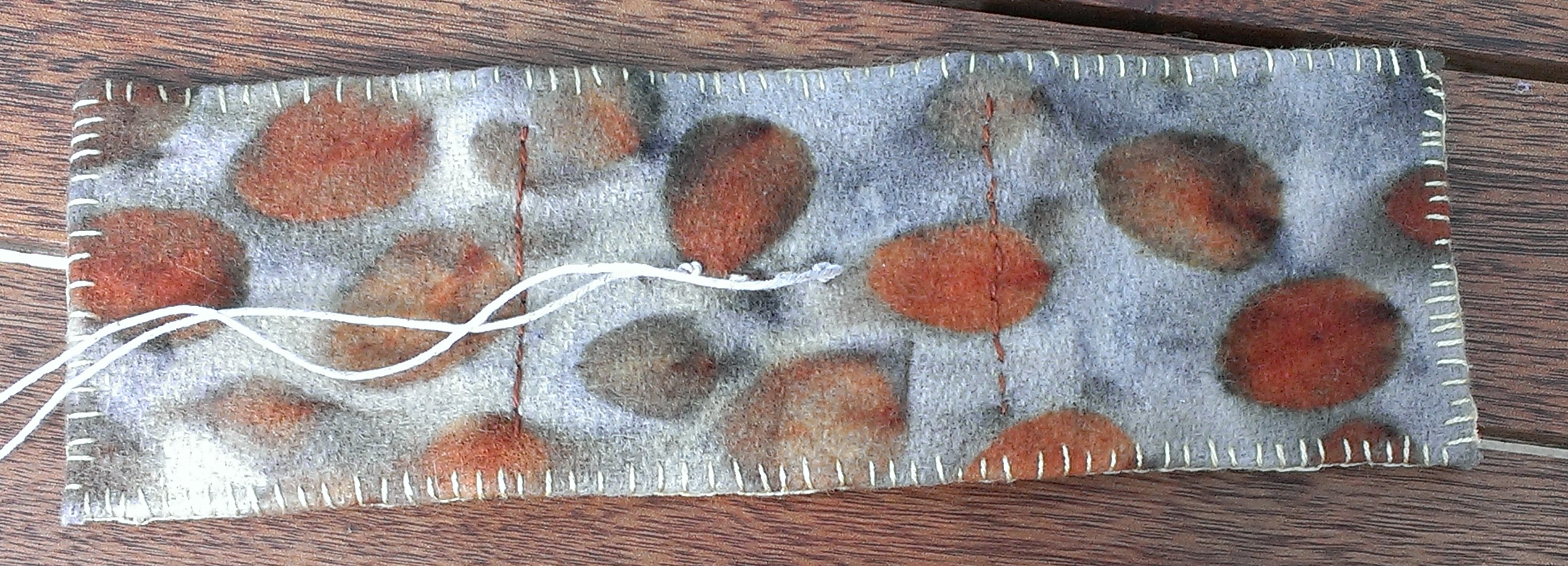
This is such a small thing. I loved Cossack Design’s needle safe, and what with all the embroidery going on round here, I decided to make my own needle case.  I think the last one I made was created in my primary school years–both long gone. 
IMAG1919 (1)

I decided on golden stitching for the edges, so dyed some silk with Silky Oak (Grevillea Robusta) leaves.  A nod to Ida Grae of Nature’s Colors fame for the recipe, wherever she may now be.  Hopefully hale and hearty and dyeing away though apparently no longer publishing.  How wonderful that she figured out this dye plant–which is native to Australia–from California!

IMAG1882

Here is the thread…

IMAG1914

And the inside of the needle case. These two fine scraps of recycled woolen blanket and that lovely piece of cotton string saved for just such a special occasion have found happy homes at last.
IMAG1917

7 Comments

Filed under Dye Plants, Eucalypts, Leaf prints, Sewing

Eucalyptus colours over grey wool

I have a lot of Polwarth fleece, both brown and variegated white/tan. All of it gifted from pet sheep that live nearby.  It is a privilege and it is also a difficulty.  Washing fleece so fine and so greasy has been intimidating as well as slow.  I have spun some in the grease, and washed some twice, and tried several different washing approaches.  I have dyed and spun and spun and dyed.  Two and three ply, corespun. you name it! I spun and knit an entire cardigan from naturally brown Polwarth, too.

And then one day someone at Guild said “I hate fine fleeces!” in my hearing, and it occurred to me that I do not have to spin it for the rest of my life.  I lashed out and bought a considerable quantity (3.5 kg) of grey Corriedale (nothing to approach the stash of Polwarth, mind you) and it has been heavenly.  I love grey fleece, and this is the loveliest corriedale I’ve ever had the pleasure to spin.

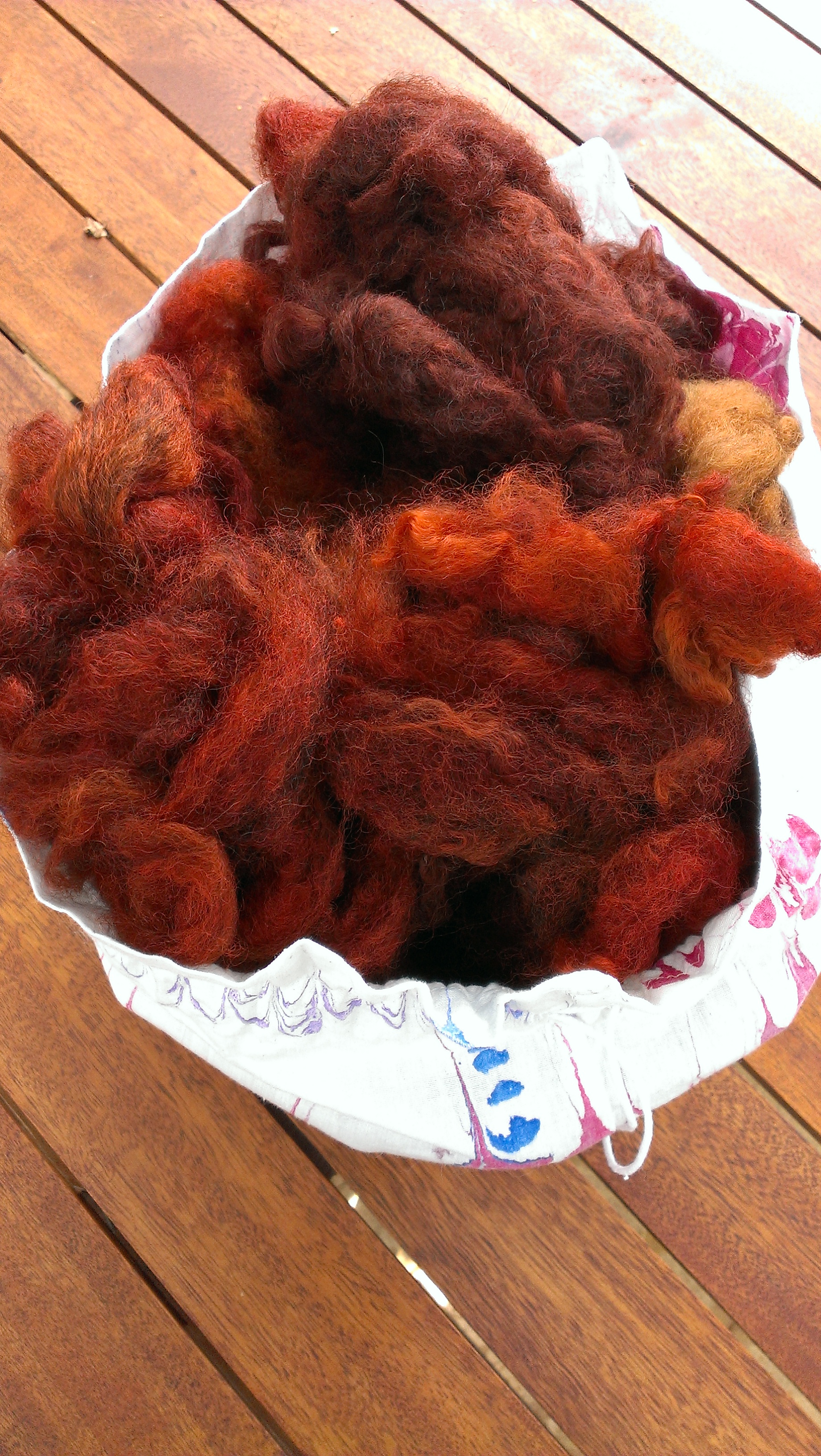
I have been dyeing it with eucalypt leaves and bark.  I have oranges of many shades from rust and brick to flame to gentle sunset.

IMAG1363

I have burgundy and plum.

IMAG1364

And I also have some tans and walnuts.  It appears I collected some bark that wasn’t exactly what I thought I had collected.  But to be honest, I think these are lovely additions in this context.  I’ve begun spinning yarns of many hues, chain plying to maintain the colour contrasts.  Lovely.  It’s hard to believe I can find these colours through combining bark and hot water and time with wool.

IMAG1308

Now… I have figured out that what I would really like to do with at least some of this wool is knit a particular cardigan.  And my beautful 3 ply yarn is too thick to make gauge for it!  Possibly also for the design I have in mind those colour changes will not be ideal.  So, I am about to embark on two ply yarns.  This is my Tour de Fleece project.

20 Comments

Filed under Eucalypts, Fibre preparation, Natural dyeing, Spinning

Plum Pine 3: Let the dyefastness testing begin!

Unbelievably, the plum pine is still fruiting, and I am keen to dye enough to be able to do some wash and light-fastness tests in the year before it fruits next time.  So I harvested again, picking up fallen ripe fruit from the ground until I filled the bags I had with me.  A man in white overalls who seemed to be working nearby was gripped to see me doing this and asked me all about what I was doing and why.  He was fully supportive of ‘making use of our natural resources’–as he put it–!

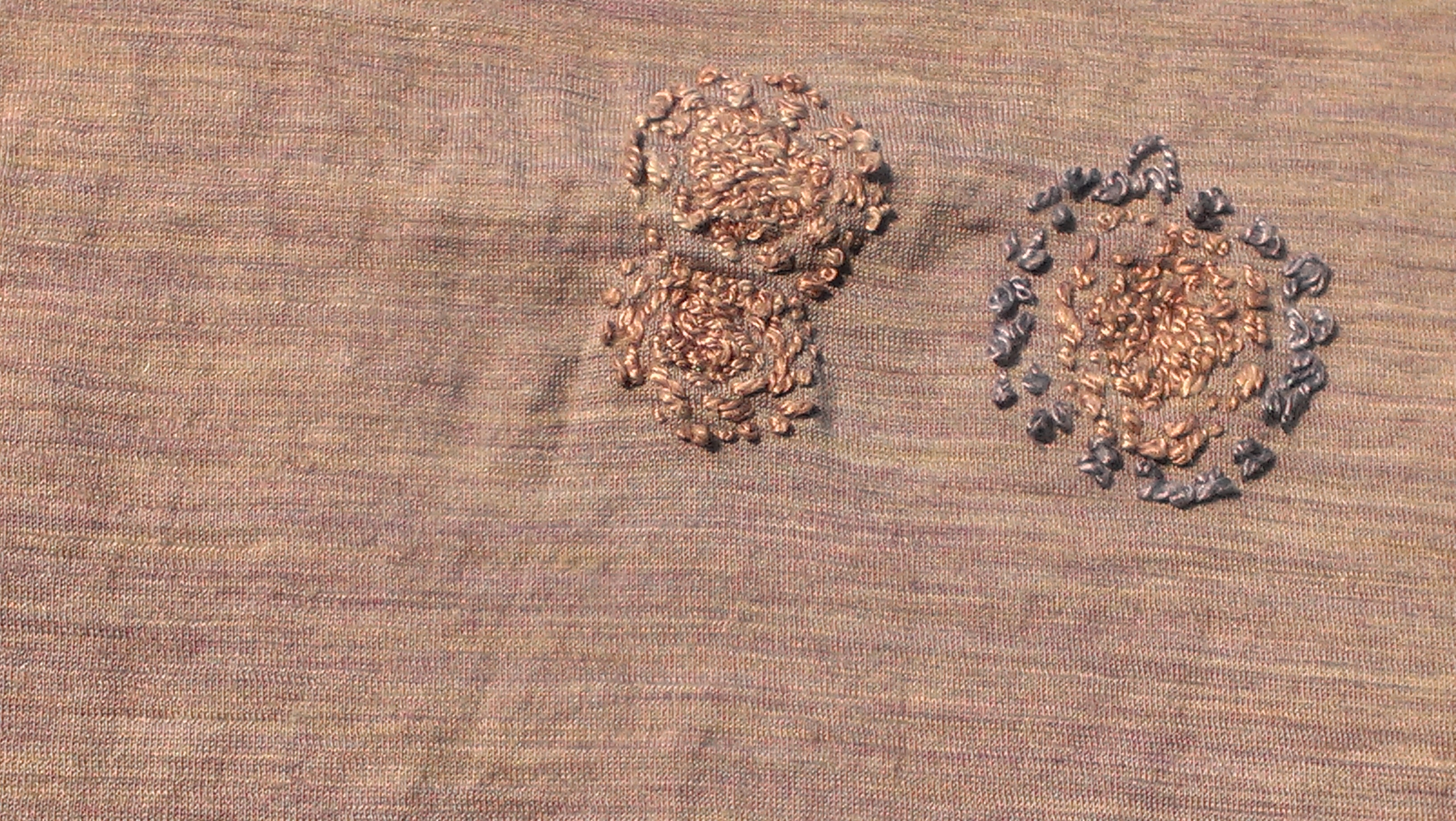
Early signs are that my silk threads dyed without alum will not be washfast. My mending has changed colour in only a couple of washes, and seems to be Ph sensitive, with pink without alum noticeably paler and purple with alum (the contrasting outermost ring on the right) turning blue in a mildly alkaline wash.

IMAG1571

Only someone accustomed to dyeing with eucalypts, which are fast on wool and silk with no mordant, would think unmordanted yarns were a good beginning place.  So, I’ve had a mordant bath on the hob.  I did not have loads of anything much ready to mordant and dye except Bendigo Woollen Mills alpaca rich, so 200g of that hit the alum and cream of tartar bath along with smaller quantities of other yarns.

After removing the seeds, I had 2650g of fruit.  I was a bit gobsmacked by the quantity!  Never one to shy away from a challenge,   I put my fruit in a pot of rainwater with a cup of vinegar and simmered for an hour.  Then, I entered some handspun wool, some commercial alpaca-wool blend and some silk thread and silk/cotton 70/30 thread, all mordanted in alum and cream of tartar.  The colour takeup on the silk was dramatic and almost immediate!  I simmered for another hour and then left overnight.  The colour change overnight was again worth the wait.

IMAG1656

Meanwhile, I’ve set up further washfastness and lightfastness tests…

Leave a comment

Filed under Dye Plants, Fibre preparation, Natural dyeing

Saffron Milk Caps

My neighbour brought round edible fungi, including Saffron Milk Caps (Lactarius deliciosus) to share with us.  Such generosity!  These are an introduced species often found in conjunction with pine forests.  One was too large to be good eating, so into the dye pot it went, since its gills are so brilliantly orange–and even more so when cut or crushed.

IMAG1474

I could not find a reference to this fungus as a dye plant anywhere so can’t pretend to be surprised that my test cards showed almost no change at all.  Perhaps a slightly more golden shade of white/cream.  Still…  that saffron milk cap was headed for compost in any case and just had a stop in the dye bath on the way there.

Yes, we did eat them, fried in olive oil and garlic with parsley.  Reviews ranged from ‘absolutely delicious!’ to ‘I’ll stick to the usual sort but they are OK’ at our dinner table.

2 Comments

Filed under Natural dyeing

Paxillus Involutus

We have some very impressive fungi coming up in our front garden.

IMAG1439

Unbelievably, one of our neighbours is a mycologist who was only too happy to tell me what they are.  Paxillus Involutus, also known as ‘Poison Pax’.  I readily agreed not to include them in dinner! These fungi are not native to Australia but have been inadvertently introduced.  We initially thought their appearance in the root zone of a silver birch at our place meant the birch might not live long.  It turns out that these fungi serve the plant and form a relationship with it which is of benefit to the tree.

IMAG1440

I’ve wandered the interwebs looking for information and discovered a range of different perspectives on what colour these fungi can give in dyeing, with some suggesting a shade of beige–Riihivilla says they are ‘not worth picking most of the time’– while other dyers suggest they give pinkish and greenish browns.  None of it sounds really thrilling, but my opportunities for sustainably dyeing with fungi have been non existent so far.  So…  I consulted Karen Casselman’s Craft of the Dyer, picked a specimen, tore it up and cooked it for an hour.  Then, in with my test sample.  I kept that hot for a further hour.  It doesn’t really surprise me that Riihivilla is right about this … but it was so exciting to have this fungus in my own yard, I had to try it out.

IMAG1463

Since I’m talking fungi, here are some I came across walking through Botanic Park on a completely different dye mission on the weekend.  I left them exactly as I found them.

IMAG1449

On the whole, the best thing for a fungi ignoramus to do, I believe, except when acting on expert advice.

IMAG1450

2 Comments

Filed under Dye Plants, Natural dyeing

Lillypilly fruit

IMAG1282

Lillypillies are in fruit around my suburb.  They are the fruit of a large, glossy-leaved forest tree and they stain the footpath in a most impressive and promising manner.  This one is Szygium Smithii (but this is a family of trees some of which are widely grown ornamentally in Australia).  The fruit is edible, but in the case of this species, unexciting in terms of flavour, with a crisp texture and a fairly large seed inside.  On the dye front…  I did not find this an exciting outcome.  Fawn on silk (the card on the right), brown on wool with alum and tan on unmordanted wool.  I think I’ll stick with cooking lillypillies and admiring their enormousness and the spectacle of so much fruit!

IMAG1306

2 Comments

Filed under Dye Plants, Natural dyeing