Monthly Archives: January 2013

Hits and misses

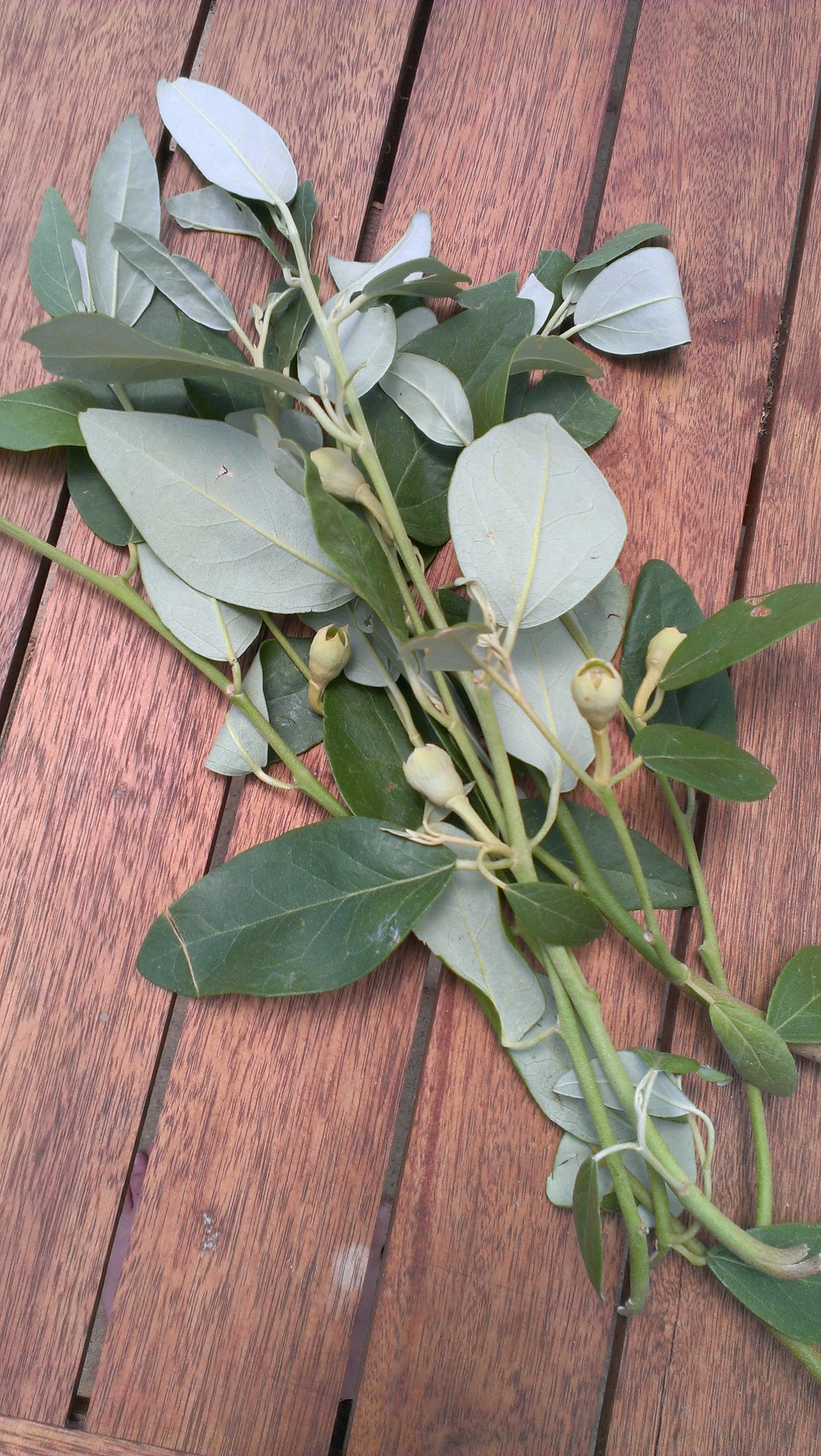
The other day I was at an exercise class in a park.  One if the trees was helpfully labelled Lagunaria patersonia (pyramid tree).  It turns out to be native (to Australia, though not to this part of it).  So… I decided to take a sample and test its dye properties.

1953

I am here to report to you, dear reader, that this is not one of the stellar dye plants of our time.  That smudge on the right of the linen square with the questionable machine embroidery is the best I can show for a leaf print after an hour and with teh presence of iron and soy mordant.  The only fibre on my swatch showing any colour after an hour of simmering is wool + alum, a delicate shade of yellow-green.

IMAG0565

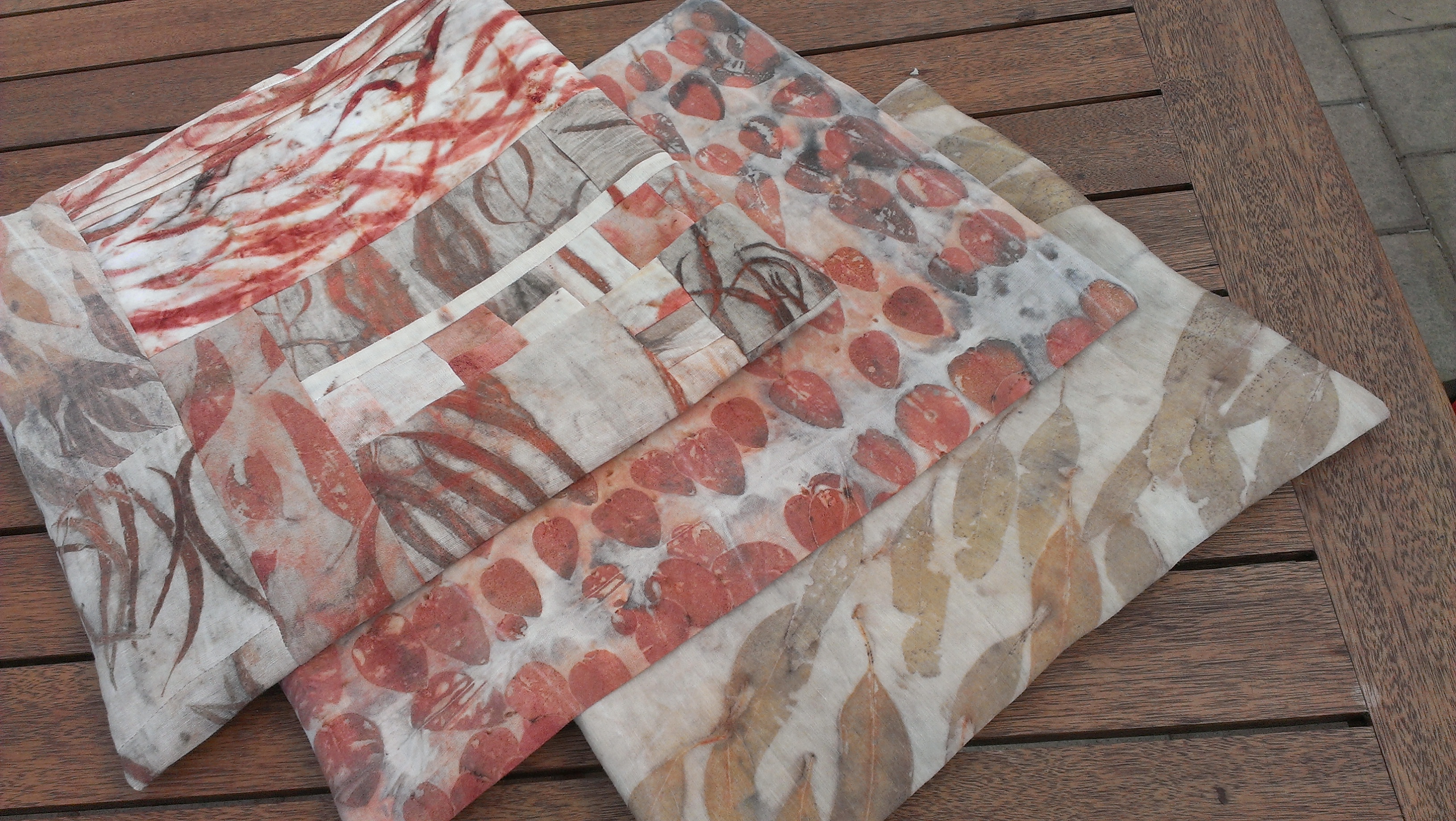
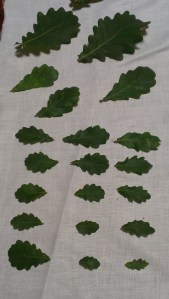
On the other hand, I made these cushion covers from leaf-printed cotton and linen.  They are for friends who invited us to a holiday house they share near Mittagong.  I hope they’ll accept these as thanks for the lovely relaxing time we had with them.

1963

They are custom fit to the cushions on the verandah of their holiday house, whose covers have seen better days.

1962

6 Comments

Filed under Dye Plants, Eucalypts, Leaf prints, Natural dyeing, Sewing, Uncategorized

More Eucalyptus Cladocalyx Bark Outcomes

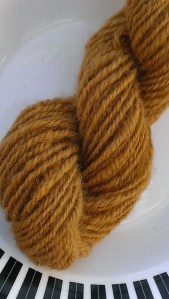
Given the level of colour in my E Cladocalyx bark tannin bath (see previous post), I couldn’t resist trying to dye some wool.  This is handspun finn cross wool, cooked for about 90 minutes in a solution of E Cladocalyx bark, which had been soaked in a sunny spot for 14 days prior to dyeing. The commercial superwash, alum mordanted strand of wool on my test card is a much darker shade of brown.

IMAG0557

Leave a comment

Filed under Dye Plants, Eucalypts, Natural dyeing

Illumination

I am touched and delighted to have been nominated for the Illuminating Blogger Award by Dre from Grackle & Sun.  I am inspired not only by her thoroughgoing approach to natural dyeing and her witty and illuminating way of writing about it, but also by her dedication to her wellbeing and to getting fit.  I haven’t been writing about it here, but 2012 was the year I started running (jogging… slowly), so I’ve been on a wellbeing and fitness journey of my own on which all fellow travellers are welcome!

Illuminating Blogger Award

The rules of the award  ask that:

I share a random thing about myself: Yesterday morning I saw a pair of gang-gang cockatoos in the bush, near Mittagong, New South Wales.  This is the first time I’ve ever seen one in the wild: it was just so exciting!  The last time I saw a gang-gang I was in some kind of zoo or wildlife park inside a big cage.  I was wearing a spectacularly light catching and quite large stud in my ear–some kind of plastic bling.  The male gang-gang landed on my shoulder, which was amazing.  We had a short chat, and then he applied his considerable and strong beak to my earring, which was pretty scary really… but I still have an earlobe to this day.

Years ago I sang in a trio and one of the other members of the trio set ‘Bird and Man’ by Douglas Stewart to music in a most wonderful way (I believe some liberties may have been taken with the lyrics).  My favourite couplet remains: ‘Bird is gang-gang, well he knows/His whole head’s feathered like a rose’.  It turns out Douglas Stewart also wrote ‘A Flock of Gang Gangs’.

Nominate 5 (or more) other bloggers whose posts are informative and illuminating.

Wendi of the Treasure

I love Wendi’s use of local and native plants, sense of experimentation and the sense her blog gives of her living a good life.

an impartation of colour

Pallas’ approach to dyeing is wonderfully systematic and so beautifully communicated. I love her generosity in sharing her dyeing processes and her experience as a dyer.

debmcclintock

I find Deb’s blog full of information and a wealth of experience, and she is a delightful and thoughtful writer.

textileranger

Every time I visit ‘Deep in the heart of textiles’, I find myself humming that famous tune as I enjoy textile ranger’s wonderfully eclectic and colourful blog.

Rihivilla, dyeing with natural dyes

I love Leena’s wonderful photography, dedication to growing and harvesting dye plants and her delicious colours. Her blog is a source of inspiration as well as beauty and information.

What a pleasure it has been to think about these bloggers and all I admire about their writing and dyeing!  Have a happy and colourful new year…

2 Comments

Filed under Natural dyeing, Uncategorized

Oak leaf ‘prints’

Following Rebecca Burgess’ instructions for a fall dye starter from Harvesting Color, I pulled out my rusty nail solution and, given the difficulty of collecting maple leaves nearby, took the opportunity when I was passing a street where oaks had been planted as street trees. 

IMAG0339

I wrapped my bundle and put it in a jar of vinegar and rust nail water on 16 December (that’s it beween the rusty nail jar and the hibiscus dye jar).  Now to see what happens.  I have to say it is a mystery to me why my rusty nails, which were…rusty and orange… have produced a black solution over time in my case.  I have added more vinergar and water to the nails and the black particles have settled out in the bundle jar overnight in this photo.

IMAG0341

After two weeks in the sun, my rusty water looks more rusty (and you can just see my bundle in there):

IMAG0530

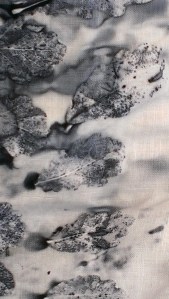
And yes, I did get a leaf print, albeit a mostly very blurred one.  The colour is impressive, but I think this is a clear case of time (unusually) not being the dyer’s friend.  Rebecca Burgess suggested 2-3 days and I left this for 10-11 days, which suited me but not the process.  I will be sure to try again and be more obedient in my instruction-following!

IMAG0553

Leave a comment

Filed under Leaf prints, Natural dyeing, Uncategorized

Eucalyptus Cladocalyx Bark

I have been reading Rebecca Burgess’ gorgeous book, Harvesting Color, which had me thinking about how to create a tannin solution.  The local solution for her is to gather acorns.  That might be possible for me in autumn, too. There are some avenues of oaks in my city, and they have tiny newly formed acorns right now.  But it seems to me that eucalypt bark would be a promising source in my own region.  I thought it seemed logical to collect bark from a species that hadn’t shown a lot of dye potential (I’m trying for mordant, not dye).   So I stopped outside the royal showgrounds where this huge E. Claodocalyx (Sugar Gum) had shed its bark recently.  We were having unseasonably cool weather as this dull photograph shows.

IMAG0317

I picked up a bag full of bark and headed home to let it steep in rainwater. This will be an opportunity to consider the dye potential of the bark as well as try it as a source of tannins.  There are many of these trees around my area and this is a truly huge tree when full grown, which sheds its bark once a year, so if this is a good source of dye, I will have access to a lot of it! Here is how it looked on 15 December:

IMAG0330

And two days later:

IMAG0342

…so I put a metre of cotton cloth into it, which immediately turned golden yellow:

IMAG0347

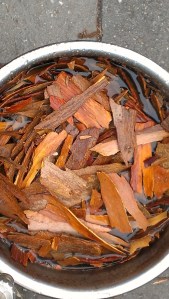
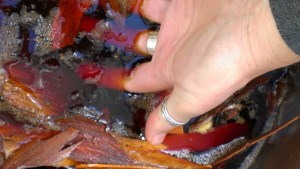
I left the pot in a sunny spot.  The temperatures have ranged from mid-twenties celcius to 40C.  By 1 January, the pot was darker still, with the liquid seeming a ruby red shade.

IMAG0545

And here is the cotton I immersed in it  so many days ago after drying.

IMAG0547

Needless to say, I am now planning to dye wool in my bark liquor and see what happens…

Leave a comment

Filed under Dye Plants, Eucalypts, Fibre preparation, Natural dyeing, Uncategorized