Category Archives: Natural dyeing

Summer Dye Camp at Beautiful Silks

2017-01-19-18-33-59

Over the holidays, I went to a summer dye cap at the Botanical Studio run by Beautiful Silks, in Allansford (near Warrnambool) country Victoria.  I stayed in a cabin at one of the caravan parks by the beachfront in Warrnambool because the on site accommodation was booked out.  I haven’t been to Warrnambool since I was a child.  It was just beautiful.  The frisking around of many small people on skates and scooters and bikes had me in mind of childhood holidays at the beach.
2017-01-20-12-29-23

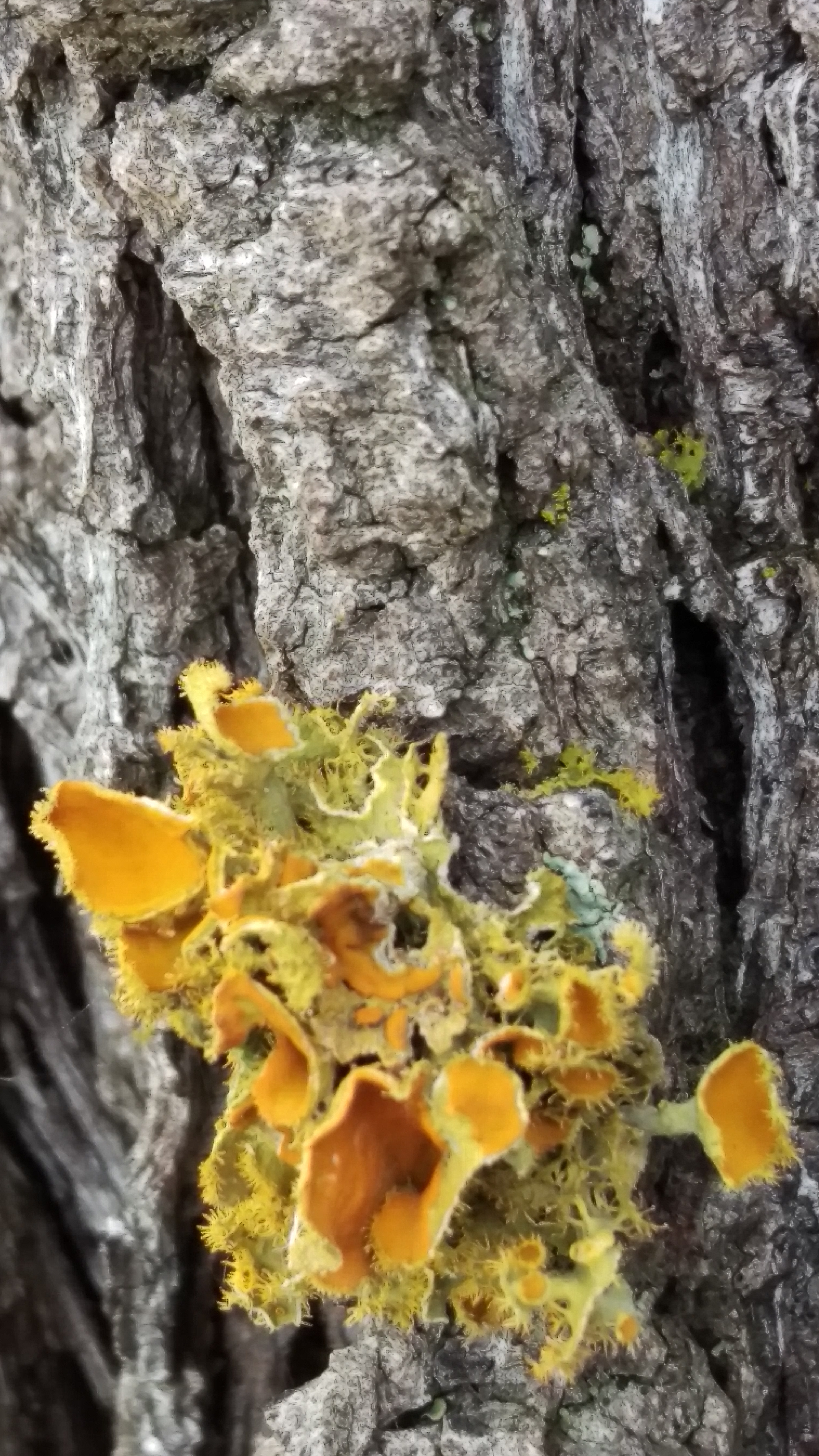
I arrived early and had beach walks and runs before dye camp each day and long strolls through town too.  My photos of scenery are a bit rubbish and really don’t reflect the glory.  Like me, my photos are largely focused on small lovelinesses such as lichen.

2017-01-21-19-14-58

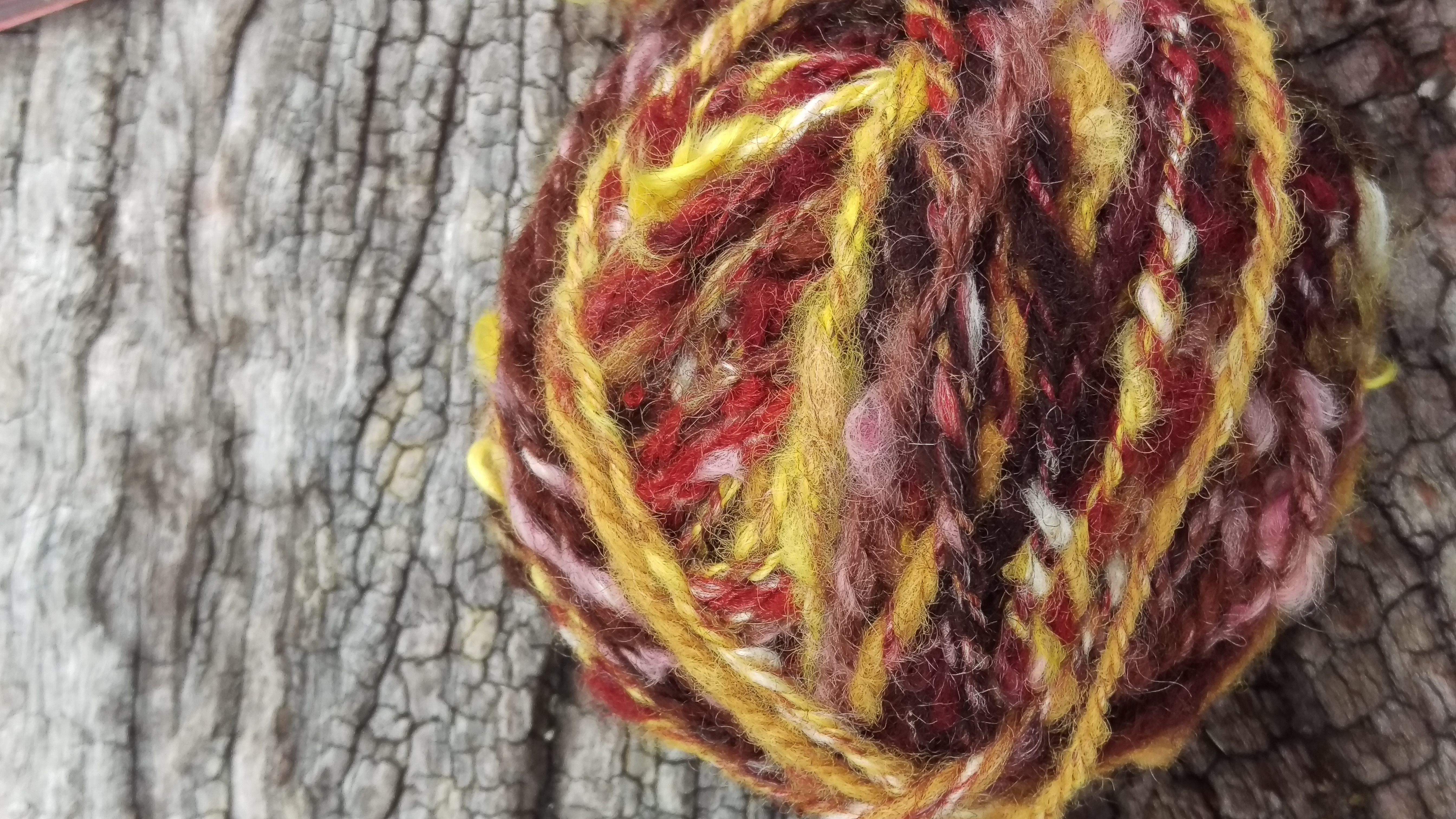
After dark there was spinning and some experimental printing on paper.  Since I had the car to myself, I came with wheel and dye pot! I converted carding waste to yarn and knit some yarn bombs. One night I had a wonderful dinner with a couple of the other dye campers.  I taught one of them how to cast on a sock and how to turn a heel with short rows, and we talked blogging and dyeing and, well, everything.  Awesome and lovely.
2017-01-20-18-25-07

All round, it was a fabulous holiday.  But dye camp!  Dye camp was focused on indigo and woad.  We had Jenai Hooke from Eudlo in Queensland as our expert guide and instructor, and I learned so much.  There were some big fructose vats.  The method I really do want to learn. Perfect.  We learned how to start them, how to feed and tend them, how to dye in them.

2017-01-21-10-13-19

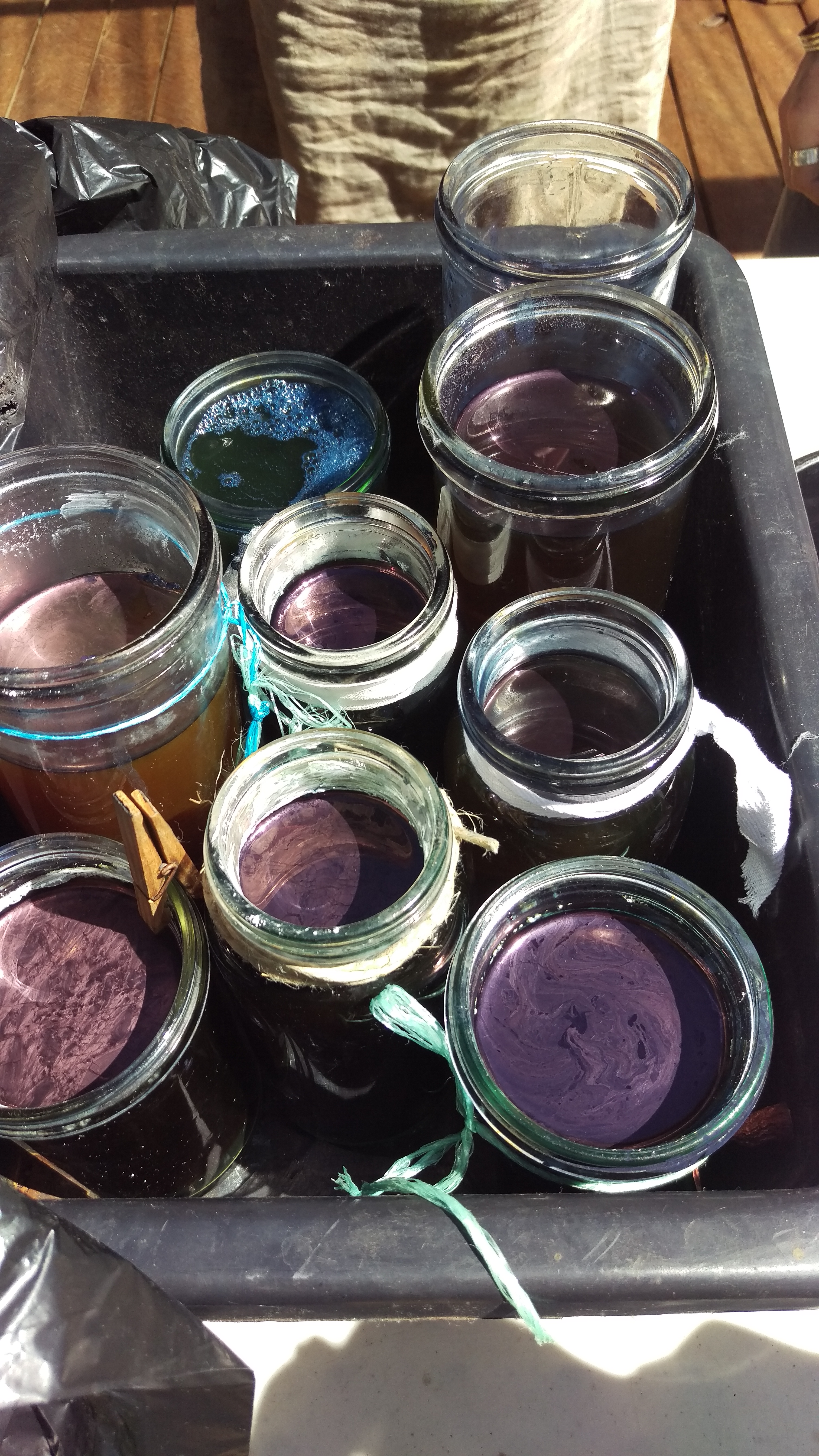
There was making of little vats so we could grasp the principles.
2017-01-21-15-51-56

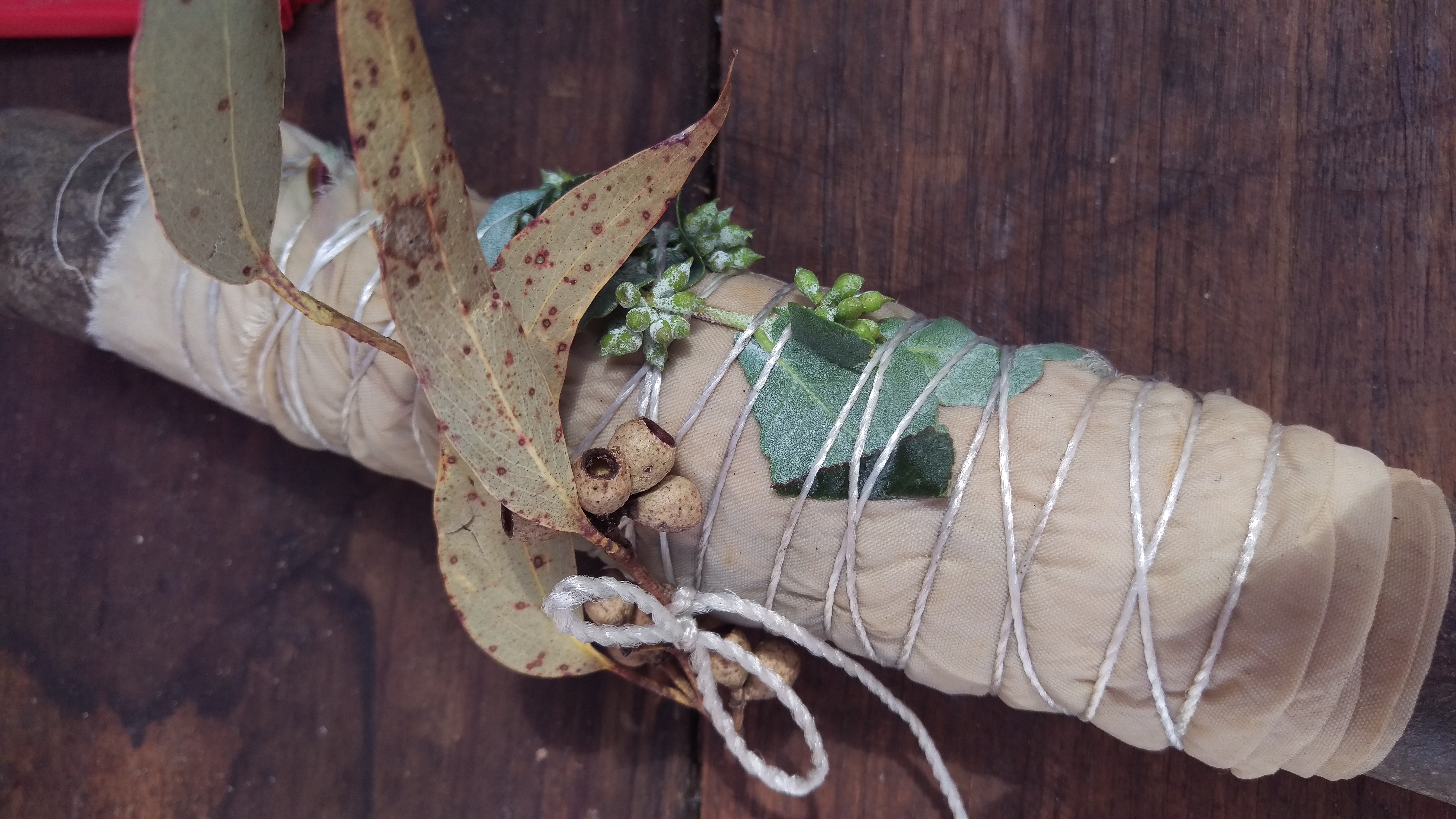
There was a massive pot with leafy bundles in it. E Crenulata sent its spicy notes through us all on the first day.

2017-01-21-11-58-31

Who doesn’t love leafy bundles?? Some of my companions had brought along leaf printed samples, their own indigo dyeing, their hand made and dyed scarves and bags, samples of their wild and creative experiments in dyeing yarns, and of course their genius, skills, ideas and energy.  There was hand sewn and hand made clothing, spontaneous pattern drafting and people’s own clothing designs. There were three other women from Adelaide, hurrah! In short, I was among my people, and this seemed to be a shared feeling.
2017-01-21-15-51-10

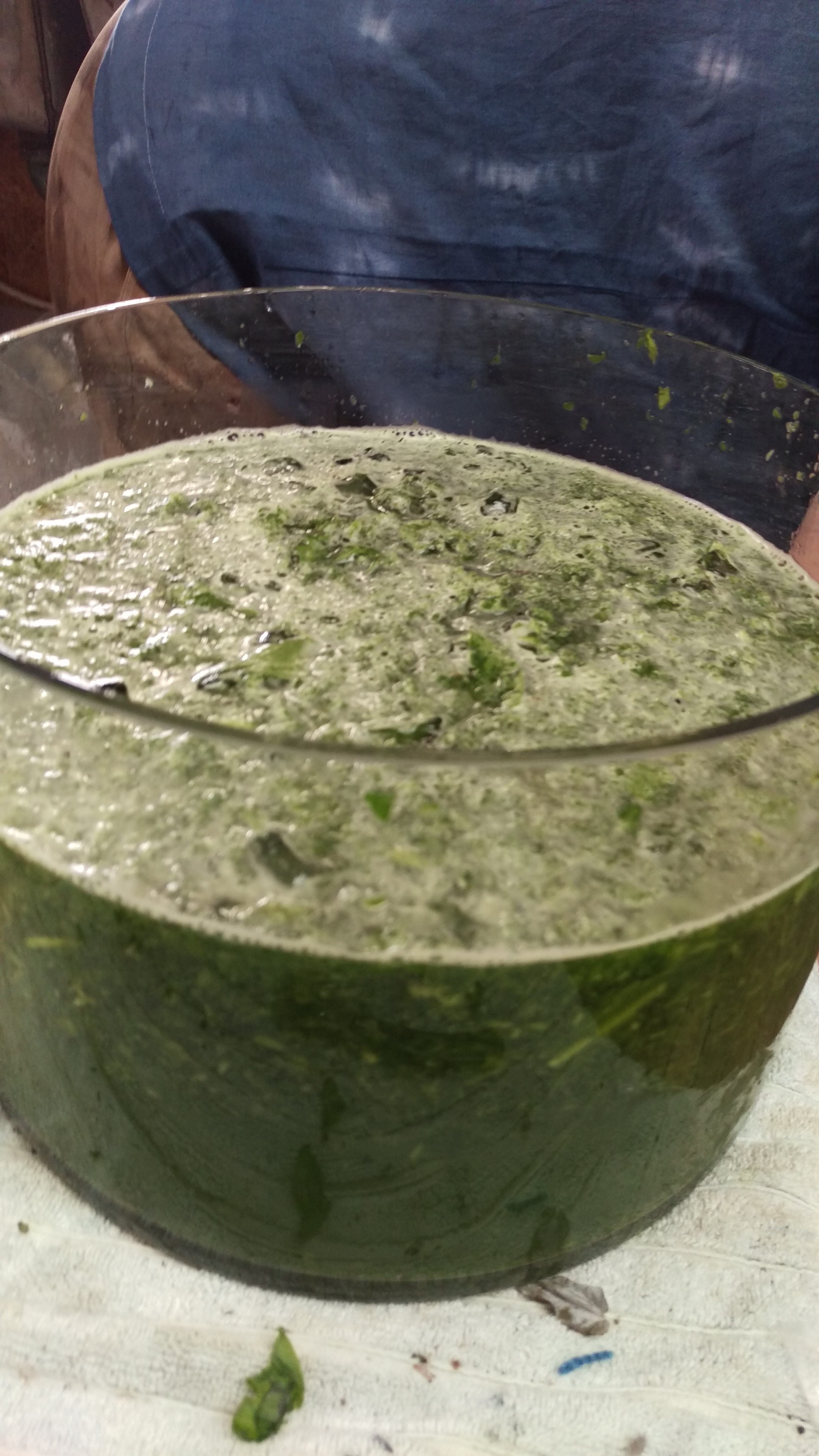
There was ice-dyeing with fresh woad leaves.
2017-01-23-10-27-55

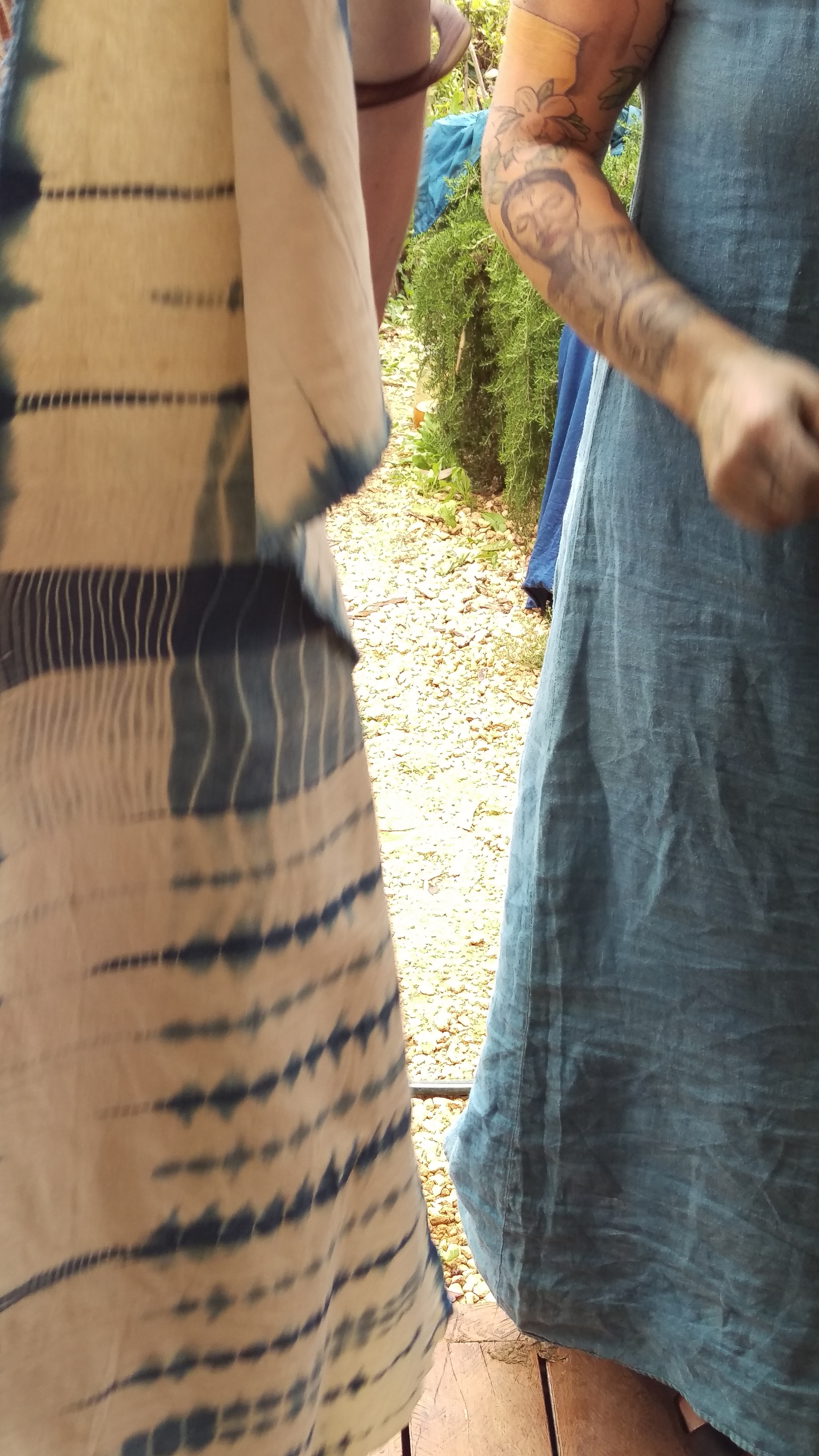
There was shibori.  Jenai is a shibori expert and teacher, and taught the basics to some of us with spectacular results (the others were too busy dyeing to stop for that!).  In short, there was dyeing.
2017-01-23-15-12-15

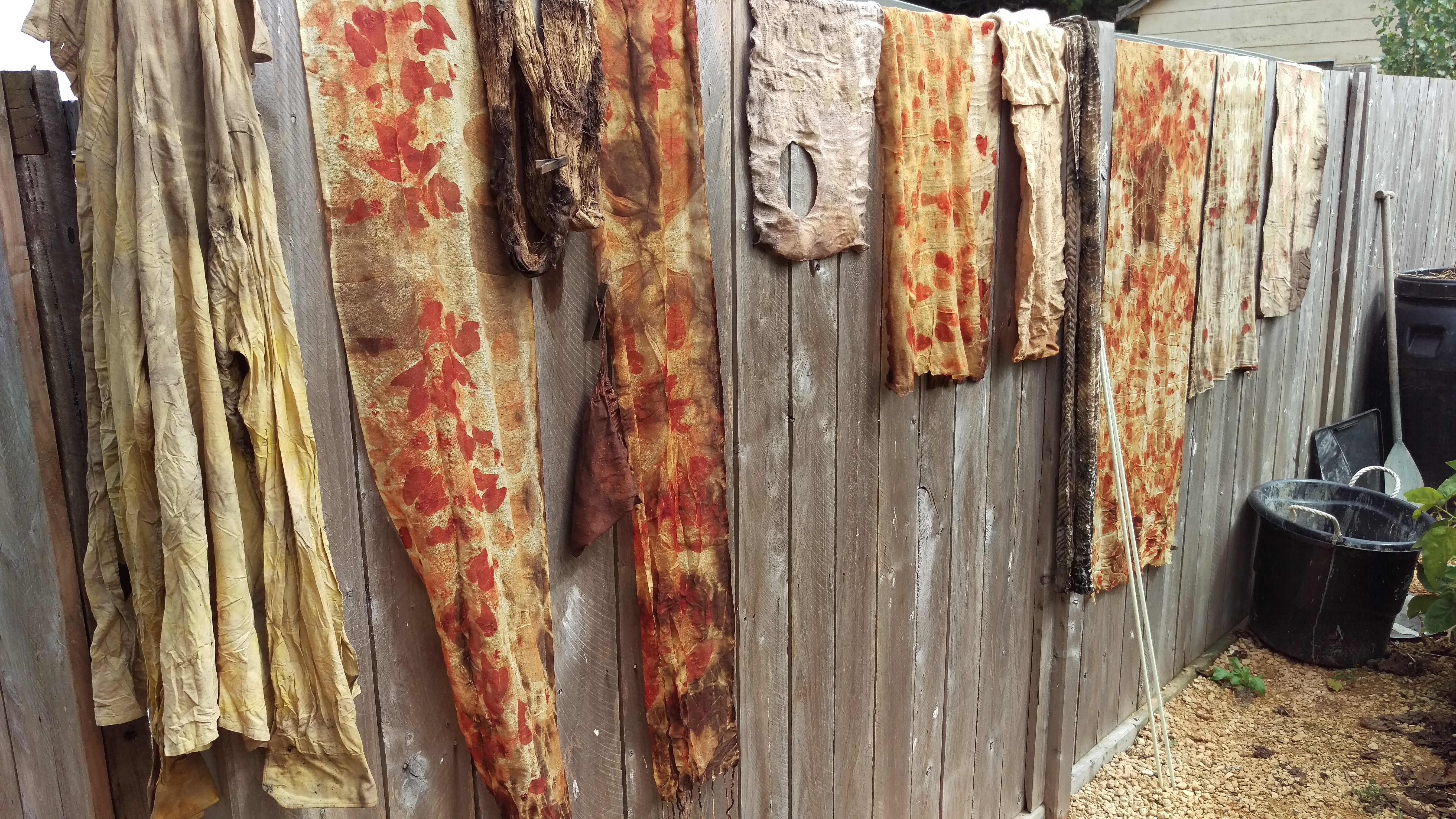
So much dyeing.  I could not believe the number of garments and other things that turned blue.  Light blue, mid blue, blue-black. Turquoise-green colours from the ice dyeing.   Oranges and browns from eucalypts.

2017-01-23-15-13-01

We ran out of drying space.

2017-01-23-11-06-01

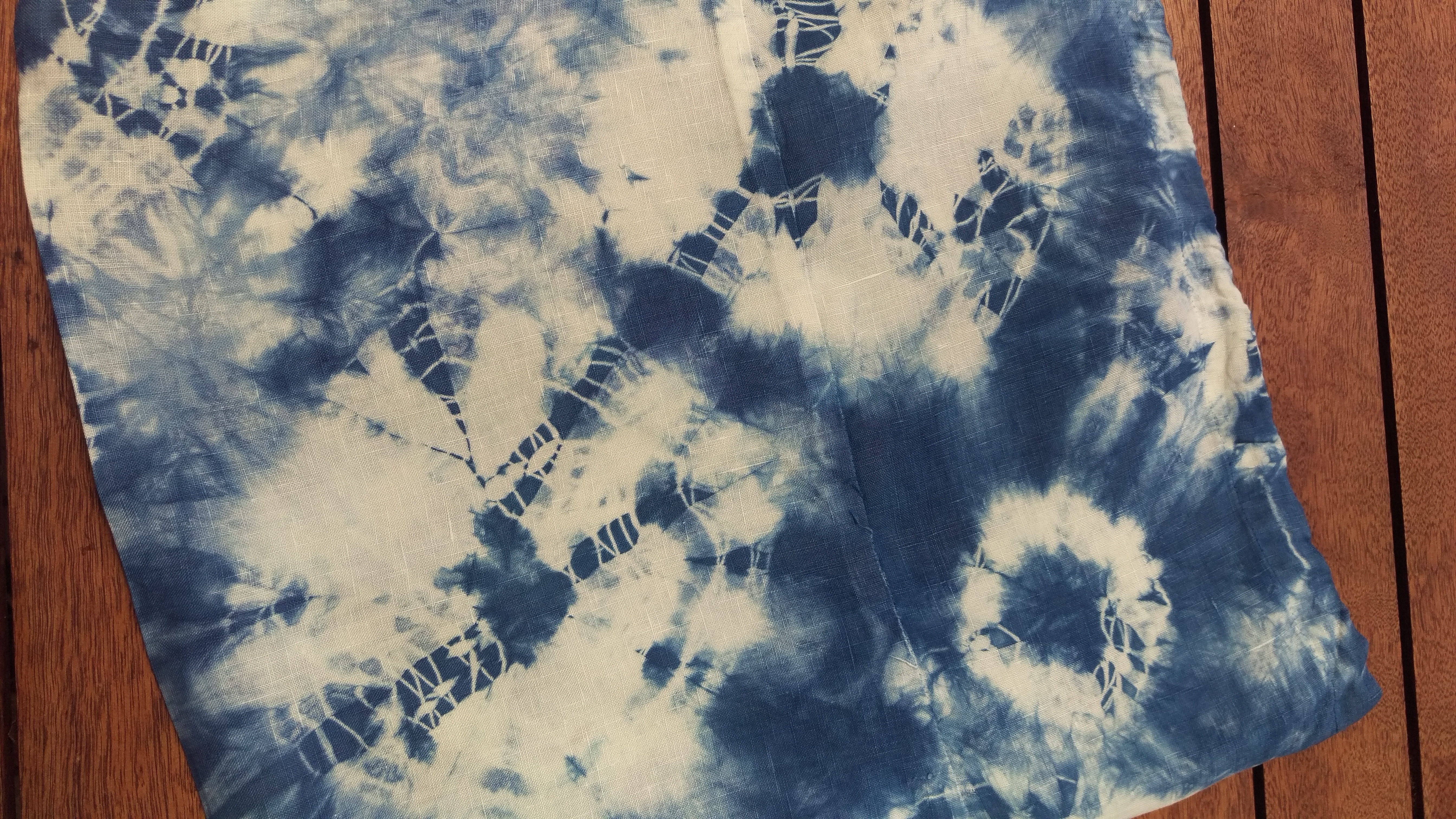
I dyed bags.  I know, shocking.  I got deeper blues than before.  I believe I deepened my understanding. And it was good to be reminded of the complexity of the skills, the complexity of the process and the years of apprenticeship that would have been undertaken by historic dyers. A little humility is a good thing in the face of a large learning curve.
2017-01-25-14-49-00

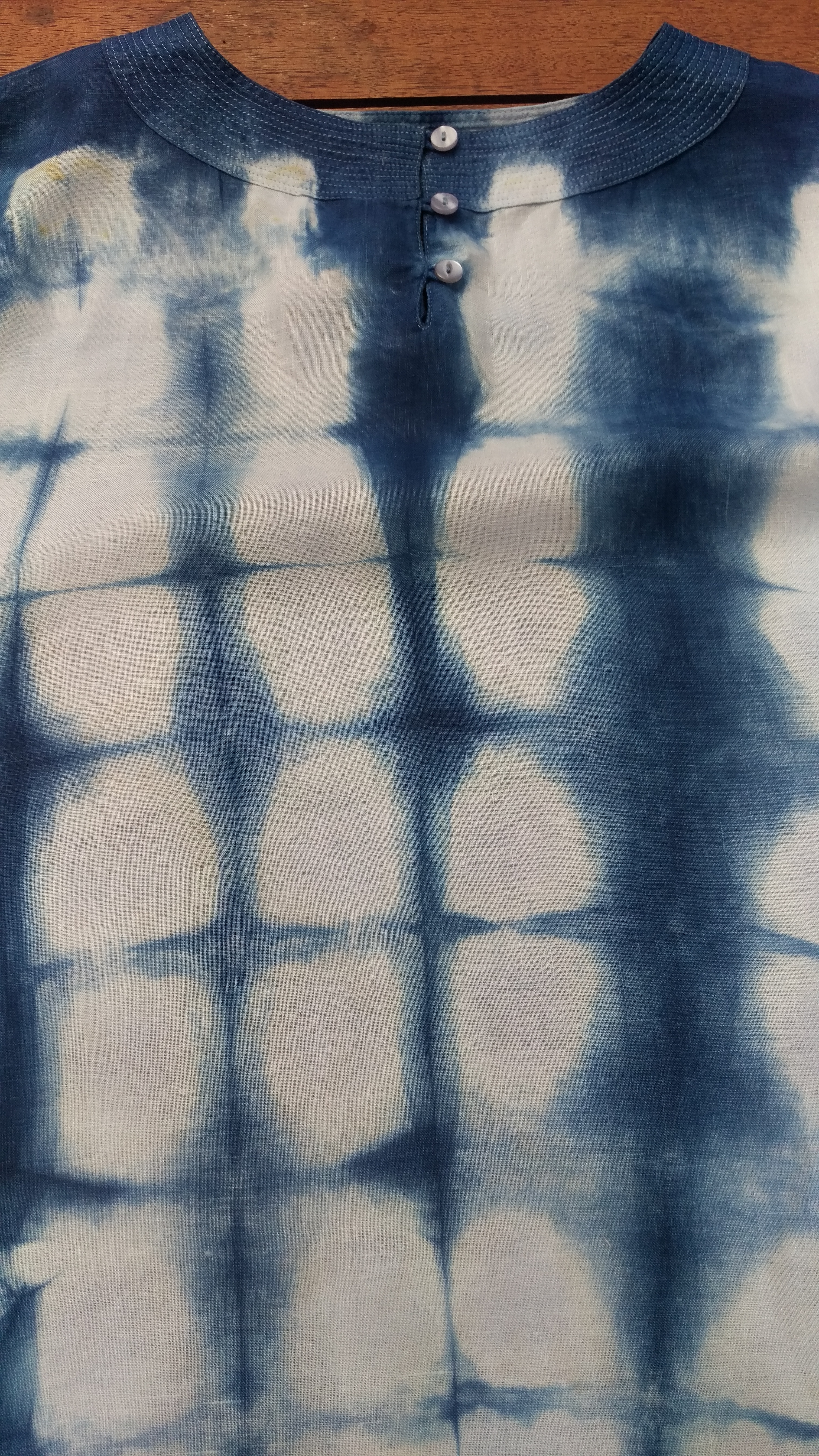
I even dyed a linen shirt.  I pulled it out of the cupboard where clothes go awaiting reincarnation, and felt moved to try it on (it was an op shop find).  I decided it just needed a new button, and it was clamped and dyed and has been out in public several times already!
2017-01-25-14-51-58

Immense thanks to Marion Gorr and Elephant at Beautiful Silks for a wonderful learning opportunity and fabulous catering and company, and to Jenai Hooke for such wonderful education!

2017-01-21-20-18-05

1 Comment

Filed under Leaf prints, Natural dyeing, Spinning

41C in Adelaide

It’s 41C in my town the day I am writing. Things are much worse in other parts of Australia–where it has already been above 40C for over a week. And here’s what I did to prepare for 41C.

2017-02-07-09-02-09

Step 1: recommit to action on climate change.  This country (among others, some already going under the sea) will not be habitable for future life unless we succeed, and there are some rather specific signs of inadequate action both here and in other first world nations right now.  If in doubt, ask the Climate Council.  You know: scientists who know their stuff and know how to communicate.

2017-02-07-09-07-07

Step 2: water plants deeply.  Freeze water for the worm farms.  Ensure ample water and shade for the chooks (hens).  Put water in the fridge.  Make sure cool air can get into the house, if there is any, during the night. Invite friends who can’t cool their homes to come over.

2017-02-07-10-42-53

Step 3: wash fleece, because wool drying weather this good should be taken advantage of.  Dye fleece with heat-activated “cold pad batch” dyes and place in the right spot to maximise the heat it will get on the big hot days.  I have mixed up the last of these dyes I own and given away my fixative.  It’s been fun but I’m committing to plant dyes and just seeing out the chemical dyes I already have.

2017-02-07-13-27-53

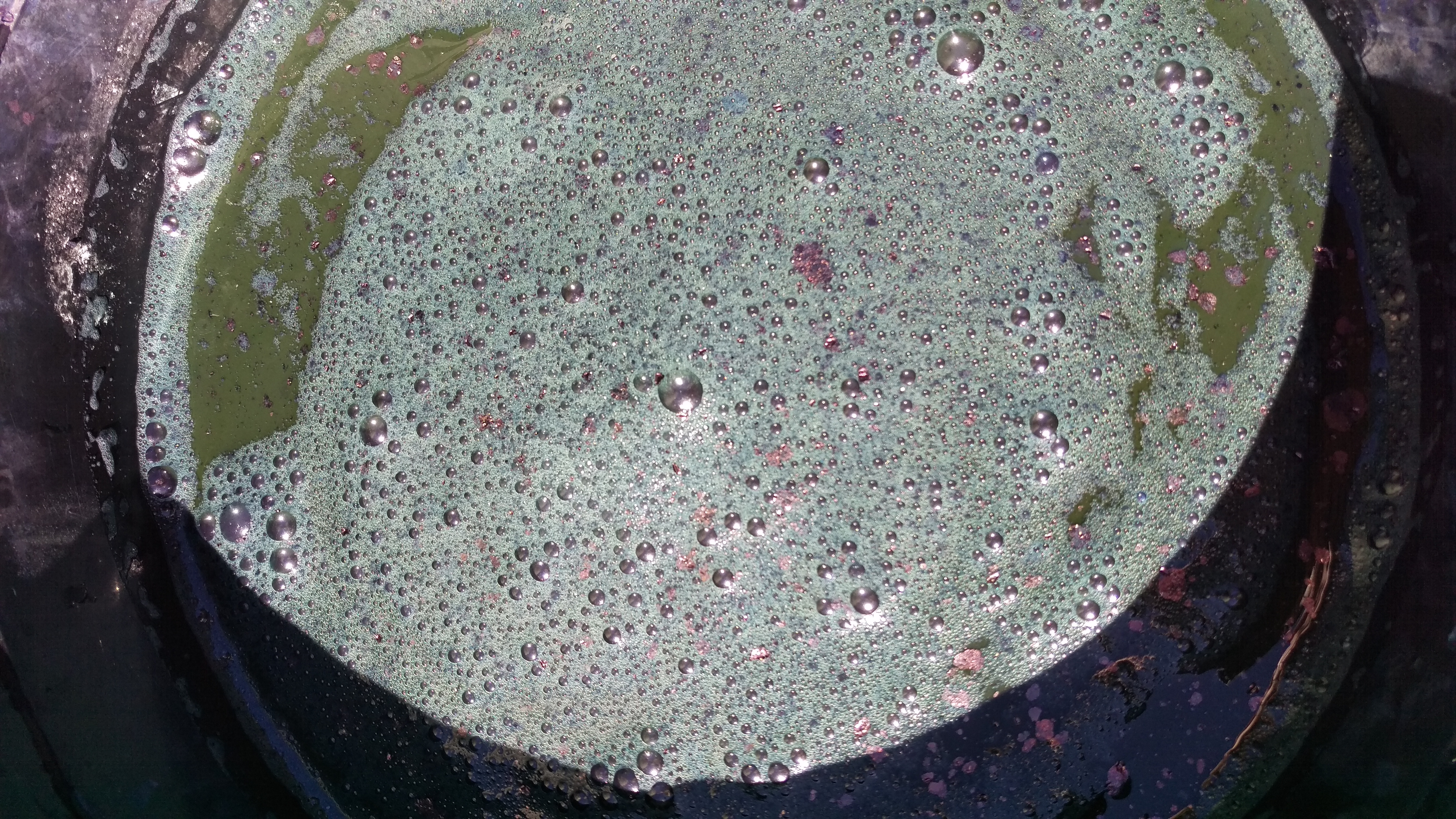
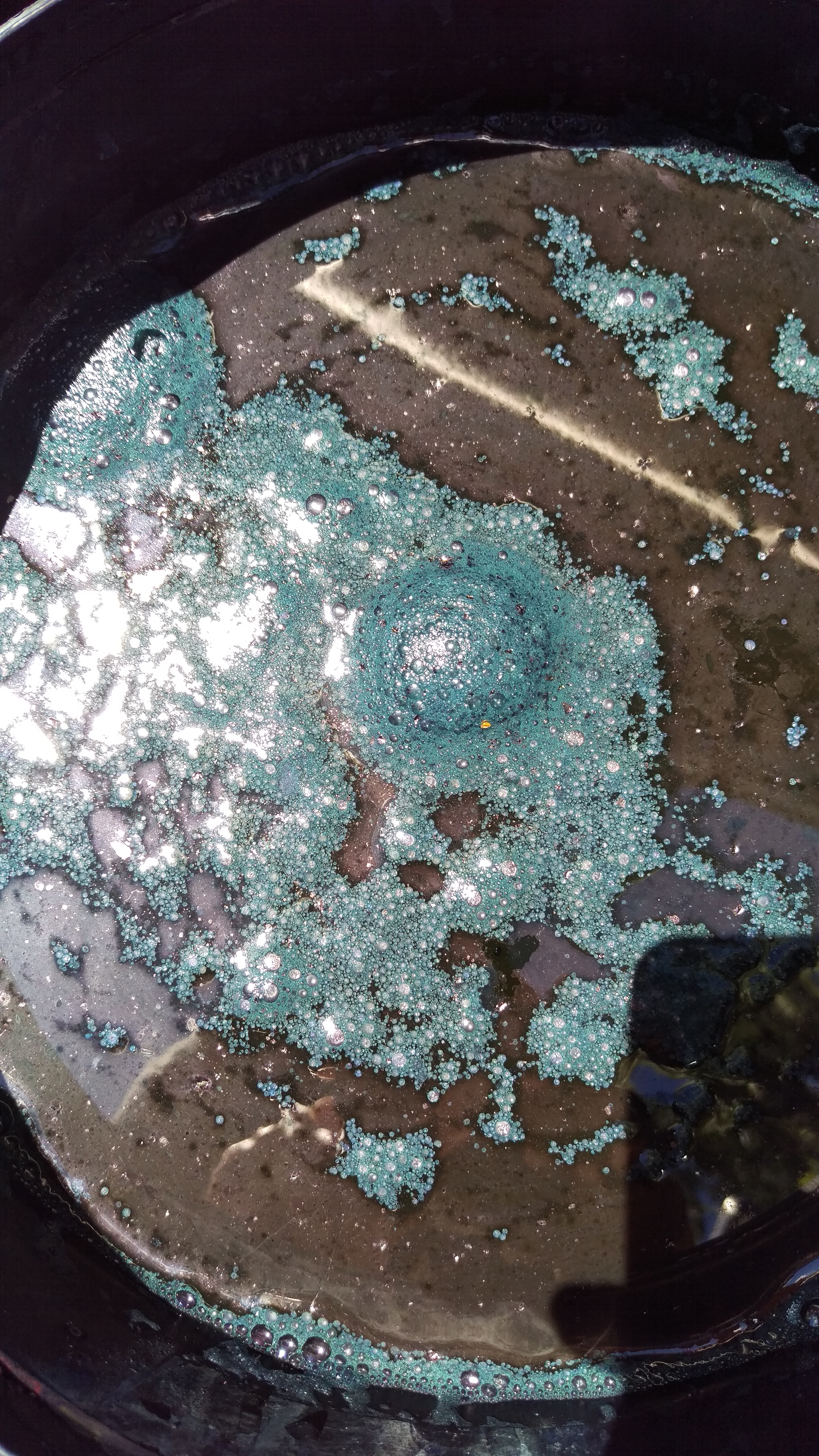
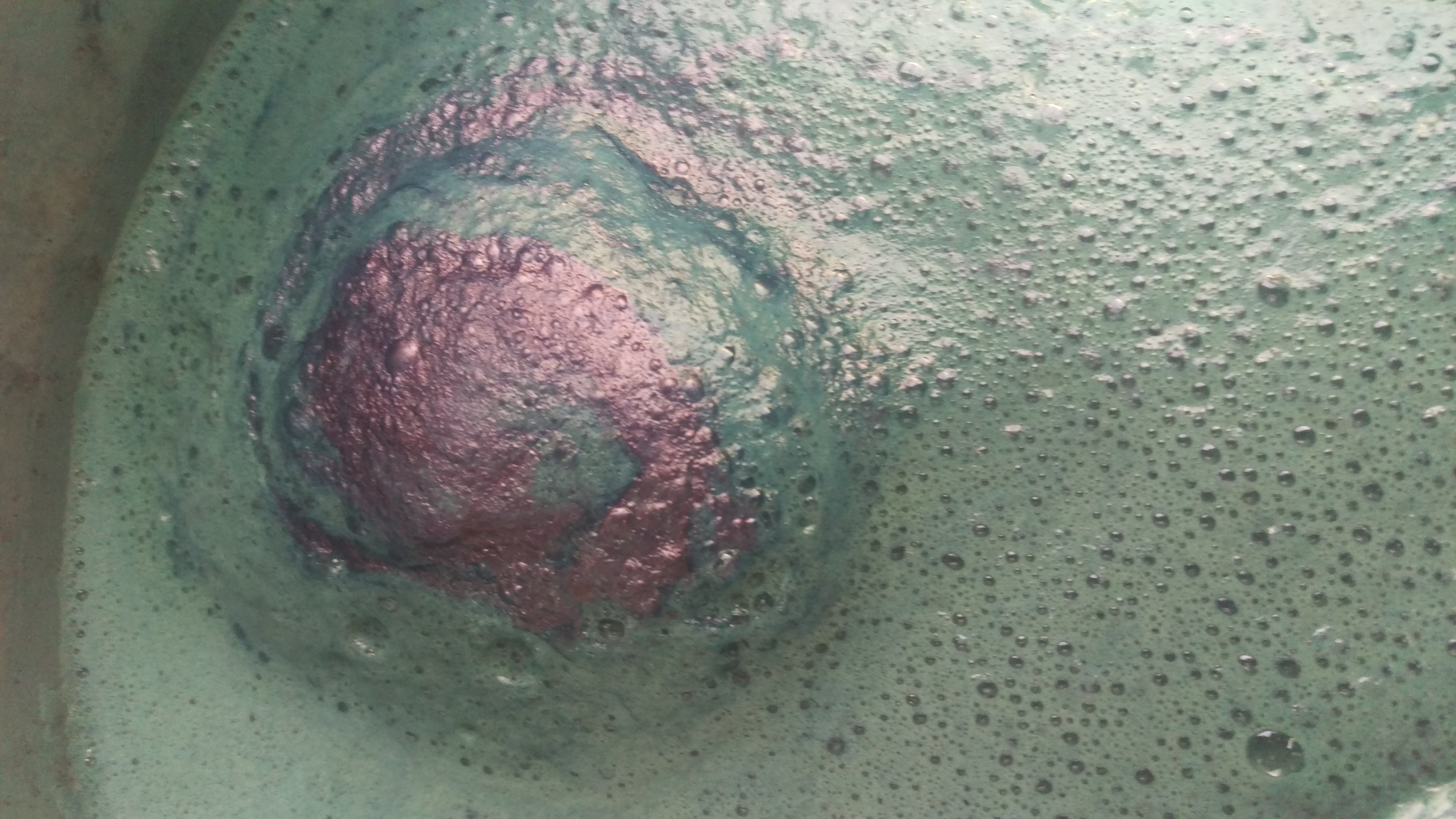
Step 4: harvest woad.  Could you tell that was woad steeping in hot water in the first picture?  Extract pigment.  That second image of the blue froth with a coppery blue swirl in the middle? The most exciting thing that has happened when I’ve tried to extract pigment from woad to date.  I’ve read high summer is the best time to get blue from woad, and–this is high summer.  Add woad to indigo vat.  Rebalance Ph.  Do your best to create conditions for reduction. Stir carefully. That’s where things are at in image 3. Image 4 is some hours later. Keep warm overnight.  Place vat in a sunny spot first thing.

And on the day… stay inside except when tending living things and hanging loads of washing.  Check as the temp of the indigo/woad vat rises to 35 and then 45C.  Enjoy the sound of the inverter for the solar panels as it cranks out power from the sun.


9 Comments

Filed under Fibre preparation, Natural dyeing, Neighbourhood pleasures

Shibusa: India Flint at the Onkaparinga Woollen Mills, Lobethal

India Flint is exhibiting at the historic Onkaparinga Woollen Mill in Lobethal (for those of you far away, this is a small town in the hills outside Adelaide).  A dear friend and I made a date and went to see the exhibit last weekend and there is one weekend to go!  21 January-12 February, Building 20, 11.30-4.00 pm on weekends only.  Check details here.  Yes, friends, this exhibit (part of it, at least) has been on show in Texas, and now–we have it to see and admire right here (I know, lots of you are not here)!

2017-02-04-13-45-37

‘Shibusa’ is a Japanese concept which is described in the exhibition documents as ‘a way of being that contrasts elegance with imperfection, spontaneity with restraint’.  Clearly an extremely good fit with India’s way of working and aesthetic.  ‘The seven elements of shibusa are simplicity, implicity, modesty, silence, naturalness, everydayness, and imperfection’.  Here, shibusa becomes an organising principle that brings together natural fibres, the imperfections of clothing that has been well-loved and well-worn, plant dyes and an immense imagination and a huge body of technique and skill.

2017-02-04-13-46-31

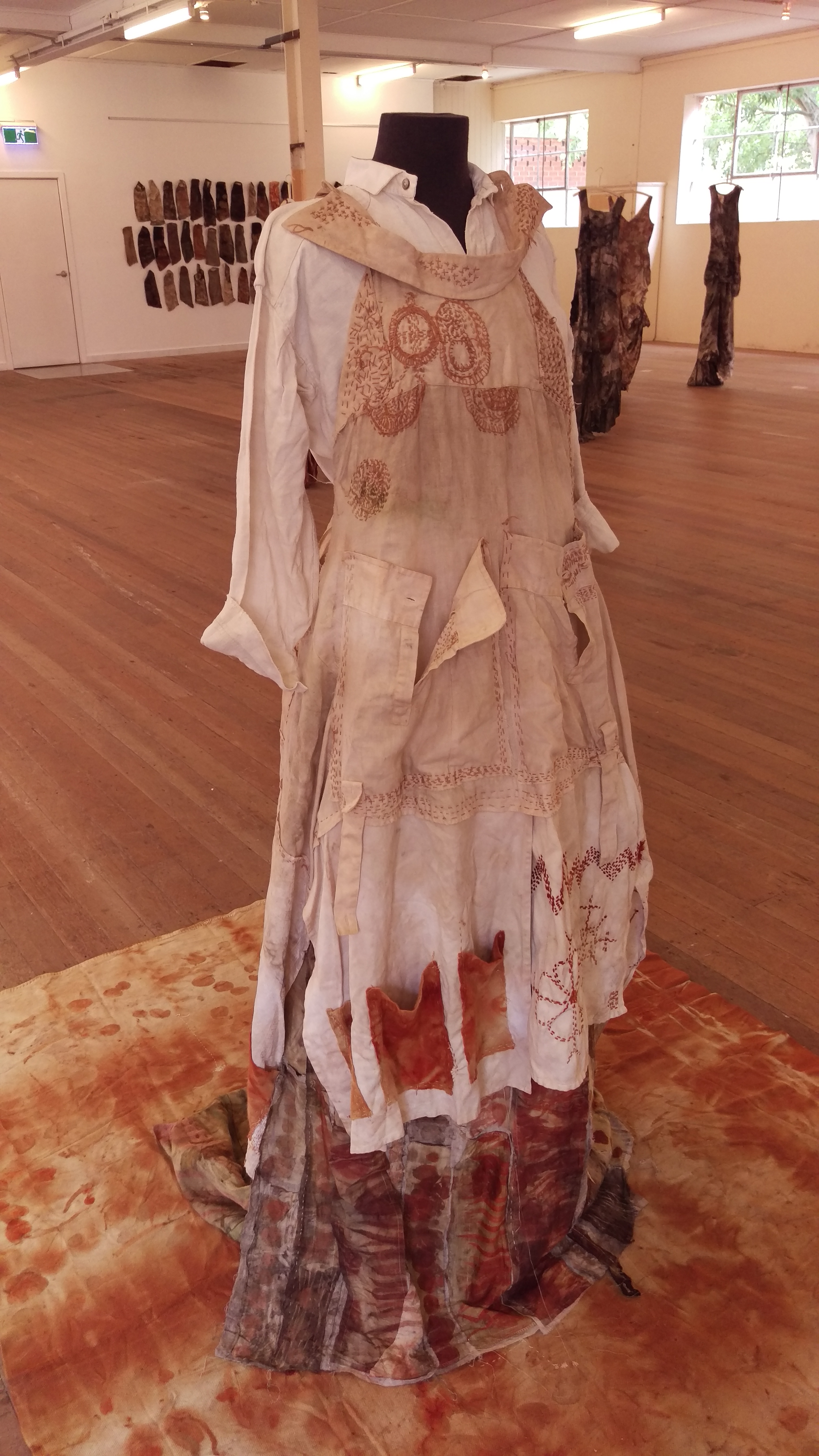
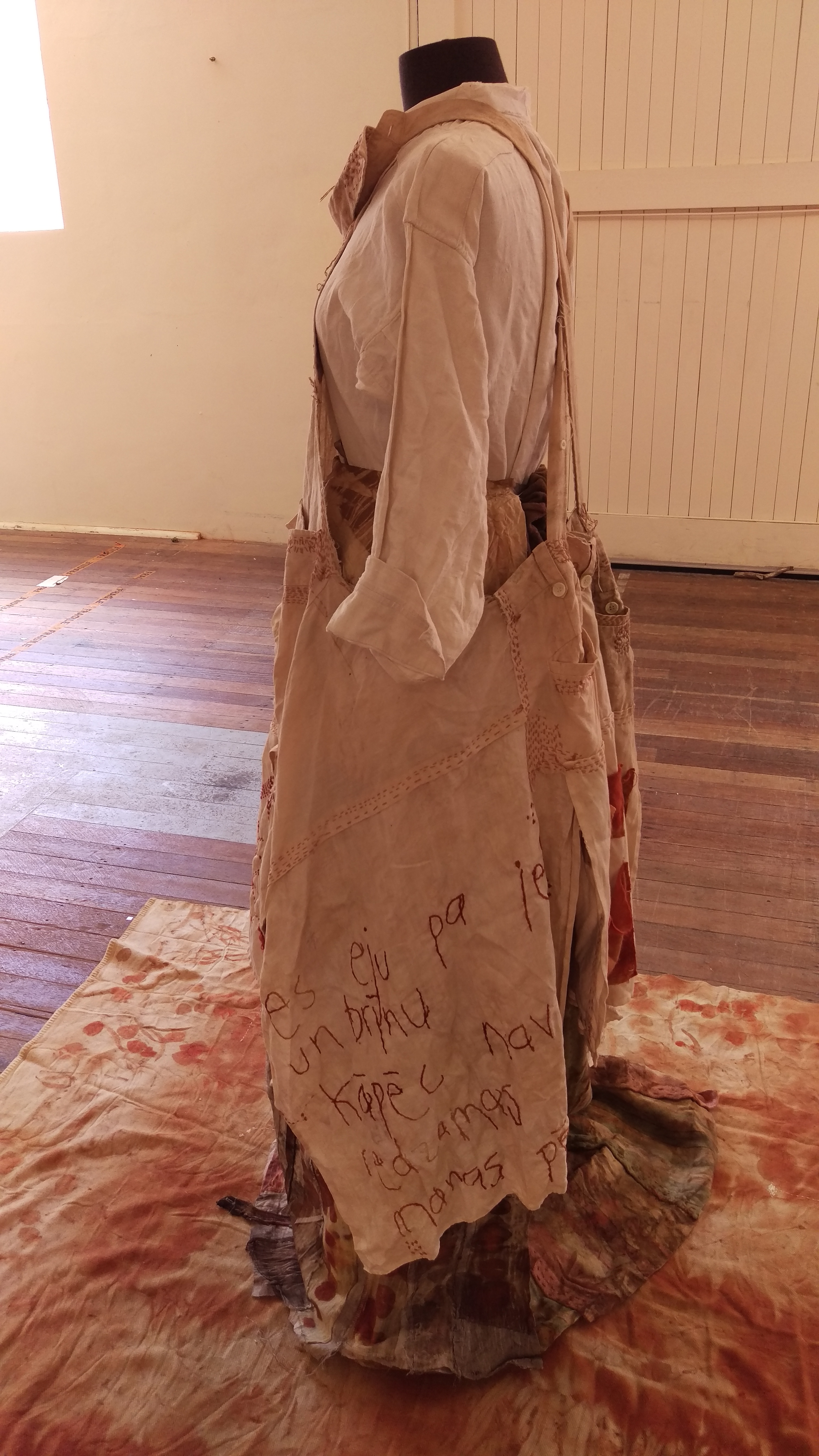
There is a very striking piece that felt as though it was greeting us or calling to us on our way into the space.  It draws on Latvian clothing traditions and includes embroidered Latvian text.  It drew our attention immediately.  India Flint has written about this piece herself in a rather wonderful way right here on her blog.  She has many more images of this work in her post, and explains its autobiographical references.  Despite its obviously tactile, material, concrete form, this aproned figure bearing words of such significance that they have been stitched into her surface nevertheless conveys an impression of ghostliness, one that it seems was intended by the artist herself.

2017-02-04-13-49-24

Like all of the works in the exhibition, the details are wonderful: dense stitching, reconstructed garments pieced together in ingenious ways, resist marks as well as leafy details.  And always the generous number of pockets that a wanderer–by choice or without alternatives–might need, no matter the occasion.  Hidden pockets, tiny pockets, pockets that contrast, former cuffs and sleeves transmogrified into pockets, front, back and side pockets.  Pockets full of bones.

2017-02-04-13-58-39

Garments dominate the space, a quiet but rather elegant crowd.  It is only in getting close to them that themes emerge.  Some of these dresses are rich in strips: torn pieces of silk; plackets that have become separated from their original garments and restitched, ribbons, shreds of lace.  Some have pockets in even greater abundance than others.  Some are gathered and pleated and feature gathers and pleats that might once have formed the front of a short or the feature on a jacket.  Some bear text: they are signed, or stitched with song lyrics.  It is only when you get close to them that you form the sense that their elegance has been formed from elements that are rescued, sometimes threadbare, newly transformed into new shapes, for the new purposes of new wearers.

2017-02-04-14-13-40

The ingenuity with which India reshapes garments never ceases to fascinate me.  You could say that transforming old garments and other textiles is something that also consumes my sewing life.  But the ways in which India undertakes this kind of shape-changing is utterly different, full of whimsy and genius. And always, full of leaves.

2017-02-04-14-08-29

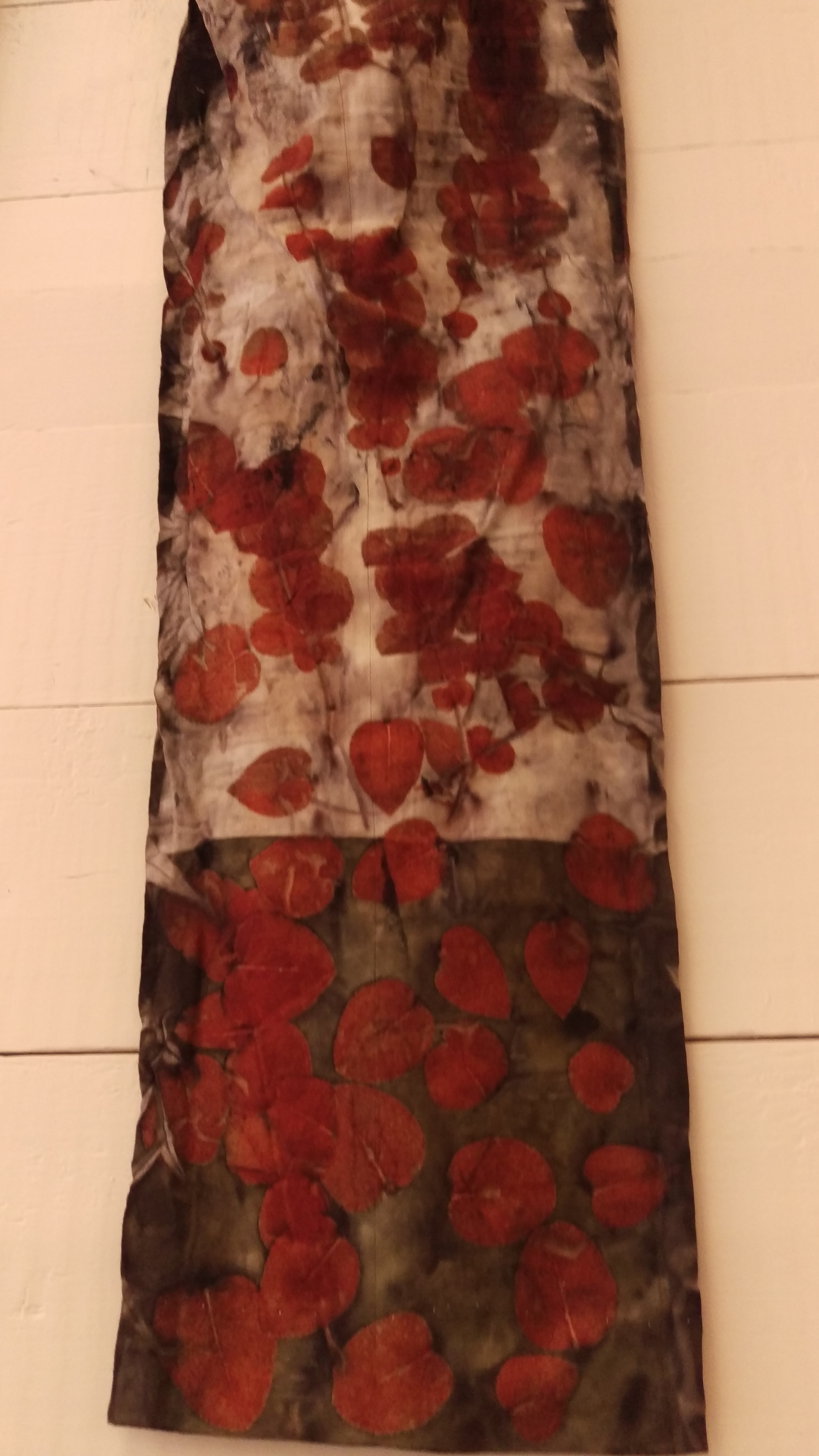
We studied the garments in some detail, and I struggled to capture what it is I find interesting and lovely about them in images.  But I was rather riveted by two other parts of the exhibition.  One, a wall of trouser legs, separated from their previous partners.

2017-02-04-13-52-04

Needless to say, they were also dyed in rather spectacular fashion.

2017-02-04-13-52-25

Then, there was the wall of sleeves, severed from their former bodies and transformed by eucalypts and perhaps a few other plants.

2017-02-04-13-55-57

The shapes and colours and details are just so wonderful.

2017-02-04-13-55-43

We stepped out into the afternoon and went on to visit the India Flint made- and/or dyed-clothing and cushions available at Poet’s Ode in Hahndorf in what I understand are the last week or two the shop will be open.  And to talk up our plans for dyeing and stitching, inspired and delighted.  I hope some of you can also visit while the opportunity is still available!

2017-02-04-13-56-50

18 Comments

Filed under Eucalypts, Leaf prints, Natural dyeing

Wandercards

Some time back, I invested in India Flint’s wander cards for wayfaring wonderers.  I’ve had fine times pondering the packs for ‘in the mind and ‘in the armchair’ and left them in their original state for quite some time, but over summer the time came for the blank ones to slide into the dye pot.

2017-01-01-17-26-49

As always (for me–others have more experience and skill, naturally) some blurred into watercolours and some came out crisp and amazing.

2017-01-01-17-26-23

I like them all very much.

2017-01-01-17-26-05

So now I have a pack of extra lovely cards, and of course I had another look at the silk they came wrapped in.  Once I really looked at it, and at the cards… it clearly needed to become a drawstring bag for them to live in.  And so it now is.

2016-12-31-11-31-21

Here is  the other side, under the cards, looking all chocolate and caramel. Well, that says as much about me as it does about the silk!

2016-12-31-11-36-49

A few weeks after that, when I was writing down yet another quote I might like to embroider, and wondering when I will actually make the time to embroider all the inspirational wisdom I might need to carry me through each and every day of the current times, I had a thought.  I will not abandon the embroidery plans, but now I know what is going onto these cards.  Maya Angelou… Maya Stein… and others, of course!

2017-01-31-17-31-01


16 Comments

Filed under Leaf prints, Natural dyeing, Sewing

Shawl dyeing

Dear and lovely readers, it has been a while.  I’ve been on holidays and blessedly away from the keyboard.  But it hasn’t all been holiday blessedness… I’ve missed you!  And of course, much has happened in our world. It is going to take a fair few posts to catch you up on what has happened in localandbespoke land since last I wrote. But that should be fun, yes? Welcome and thank you to those who followed the blog while it was sleepier than usual! Let’s count our blessings as we roll up our sleeves to face the times we are in with courage and among friends.

2017-01-04-15-29-00

A dear friend came to visit us over the holidays.  I met her in the peace movement in the 1990s and it has been my privilege to have her in my life through many changes in both our lives, since.

2017-01-04-15-29-50

I bought some shawls and scarves from Beautiful Silks last year and have been dyeing them as gifts. I decided she might like one and set about giving it layers of walnut leaf and eucalyptus. I had a fairly major fail on getting good images of it before gifting it away. Summer sun here can be pretty brutal! Pictures aside, my friend loves this big, snuggly piece of merino wool.

2017-01-04-15-29-41

It has gone to live at her beachside home.  She sent a lovely picture of it on her bed in a sunny room, with morning light flooding in and the rich colours of eucalyptus lighting it up in a different way.

2017-01-04-15-31-01

What a treat to be able to share these colours and images and touches of what is local and lovely to me, with people who live in other beautiful places, with other trees and other views. It’s one glorious opportunity to share the love in a tactile way. I hope it will give her joy when times are good and comfort when it’s chilly and times are less kind.  She is a woman of courage, persistence and such an awesome intelligence and wit! Long may she be surrounded by love and good company (and the odd snug woolly item)…

2017-01-04-15-36-12

10 Comments

Filed under Eucalypts, Leaf prints, Natural dyeing

Colours of woad

2016-11-30-08-09-35

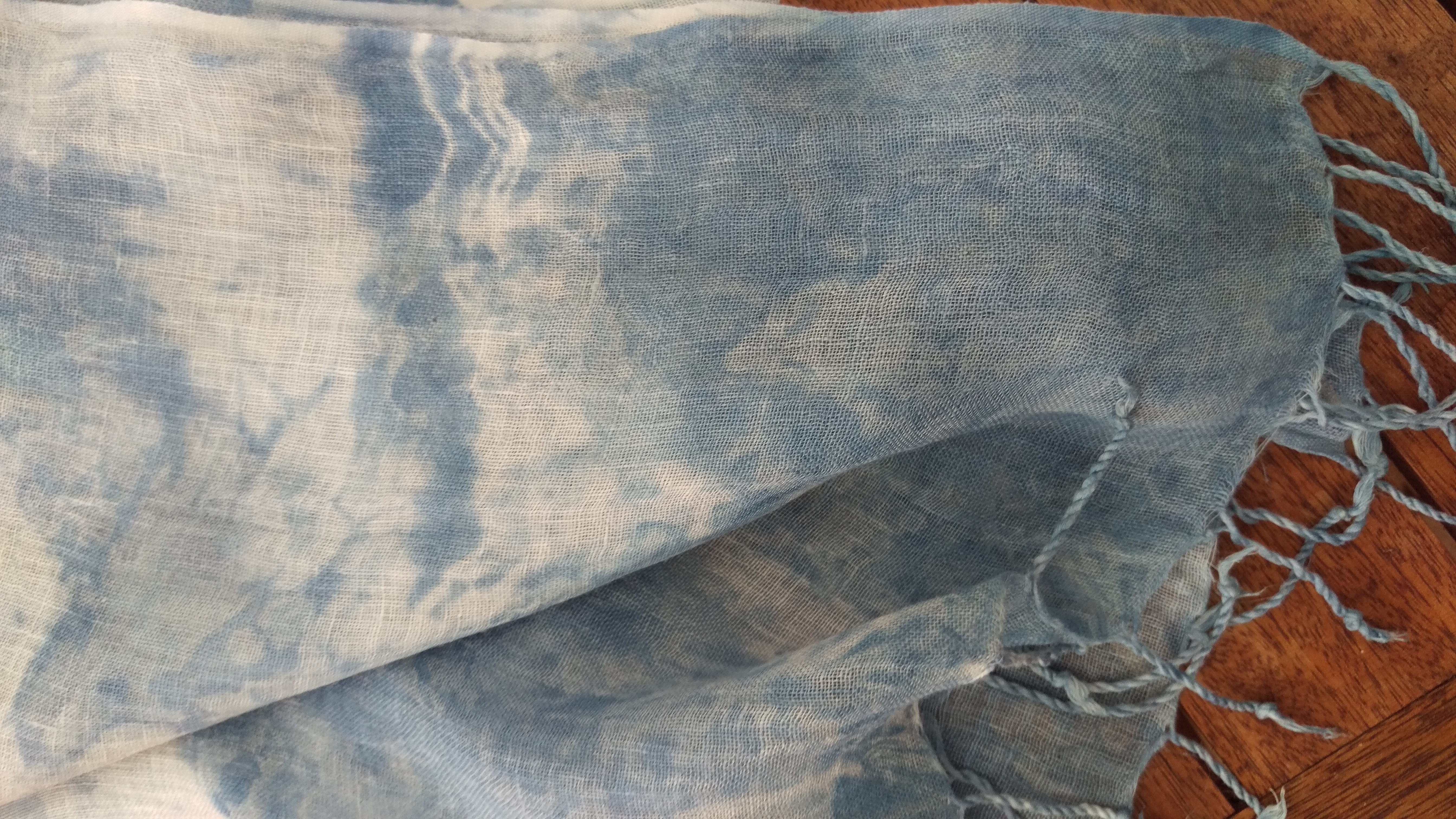
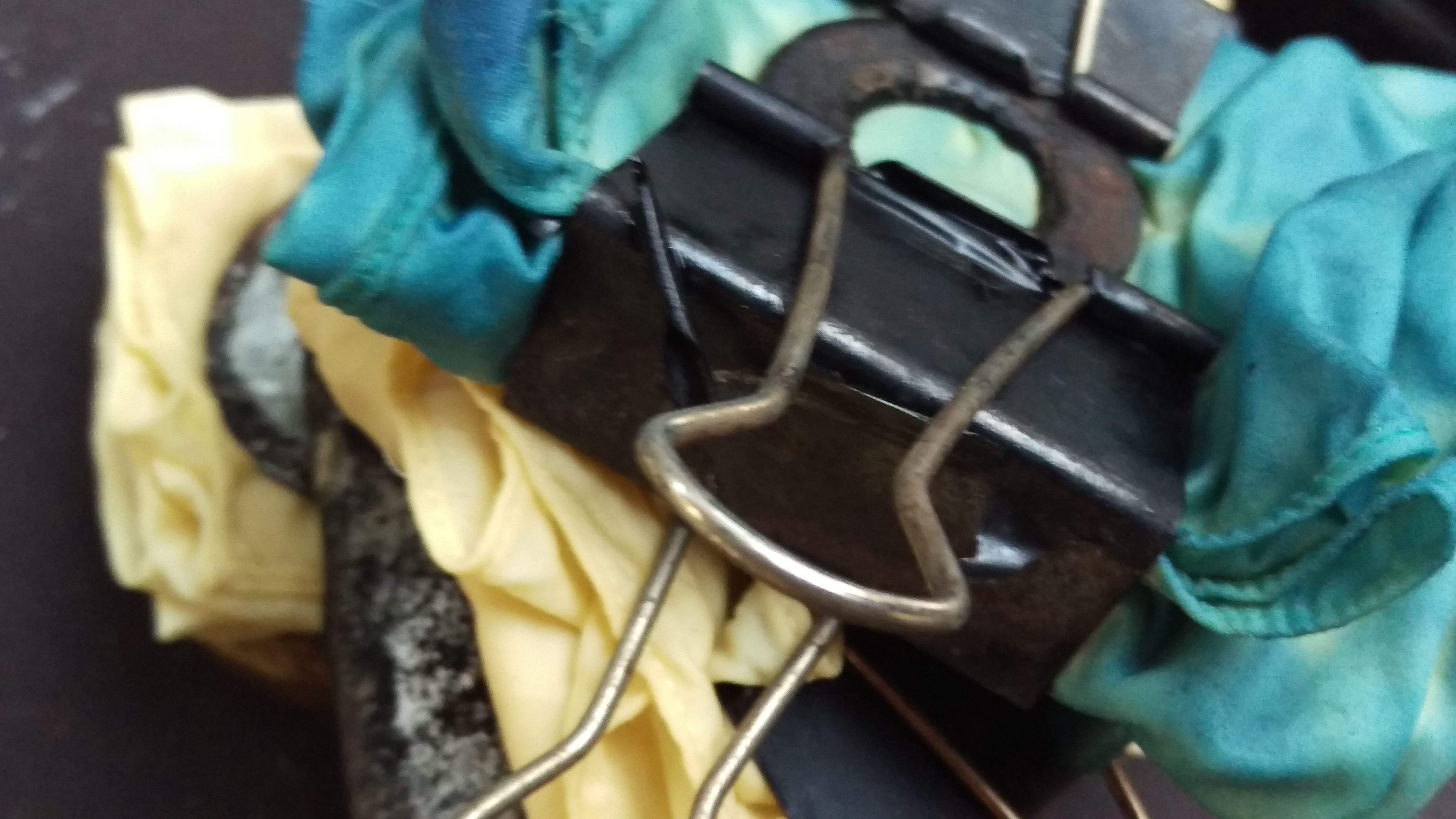
Now that everything is clean and dry, I thought I might show some outcome pictures.  First there was a linen gauze scarf.  I am hoping it might offer some portable sun protection for my neck over summer. Later there was some clamp action.

2016-11-28-19-36-26

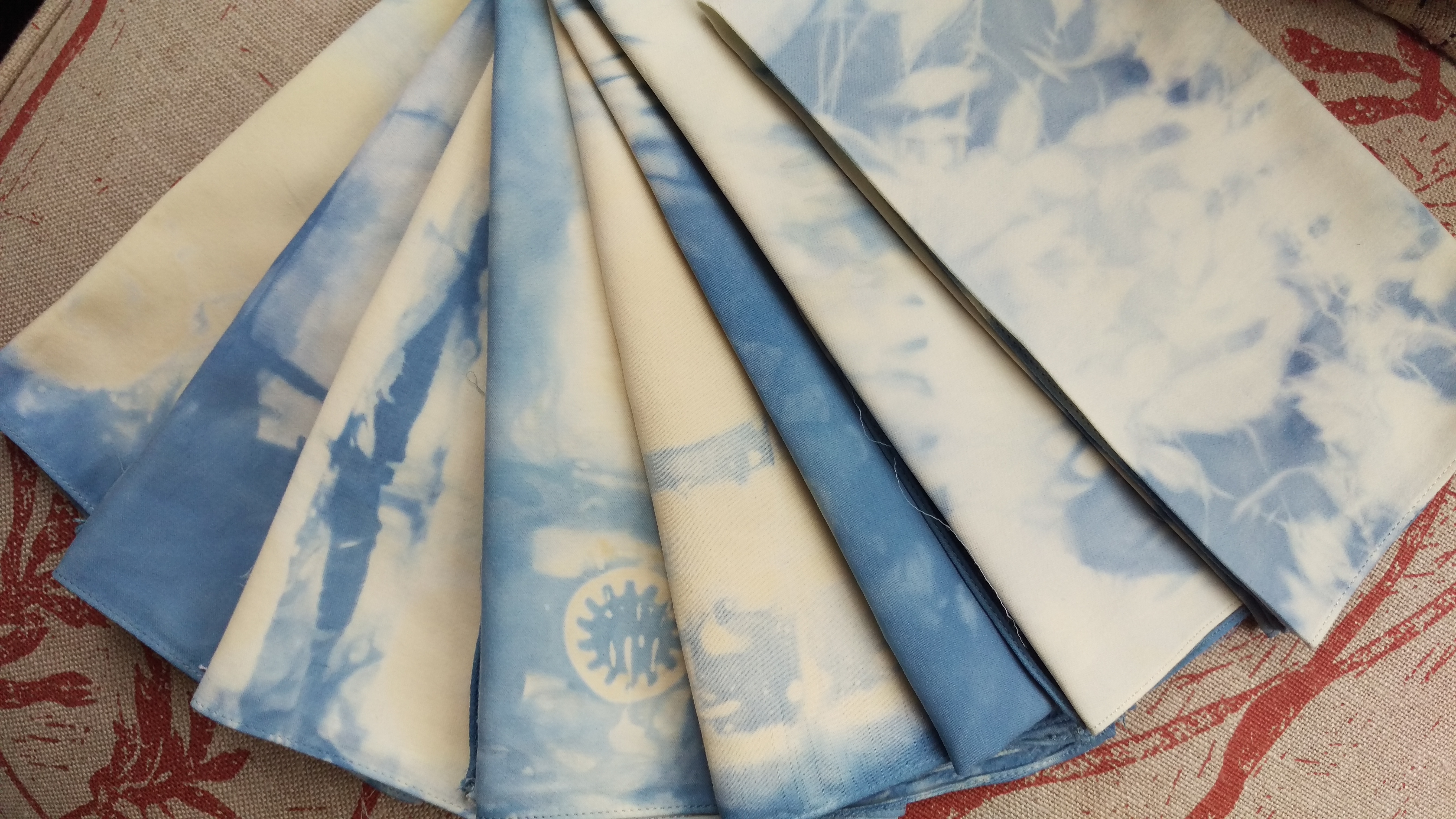
These are handkerchiefs I made some time back from a buttery yellow sheet that passed beyond being able to be used on a bed.  I simply did not prepare for woad success and expected far less colour.  Then I remembered that I had intended to stitch and ye them with indigo…

2016-12-04-15-58-01

I do like the way they turned out!  I am still figuring out whether multiple dips actually does give me deeper colour.  If I am at the start of something and not having a – success experience with woad, I will experiment so I can make comparisons.  So far I have not been convinced that multiple dips gives deeper colour.  I am not sure whether my perception is incorrect, I have skipped a vital step, or I have prepared some of my vats in a way that means colour gets stripped out and re-deposited, which is how it seems to me.  It will be simple enough to run a test and figure out whether it’s my own eye and mind.  My technique will surely improve if I keep going.

2016-12-04-15-58-04

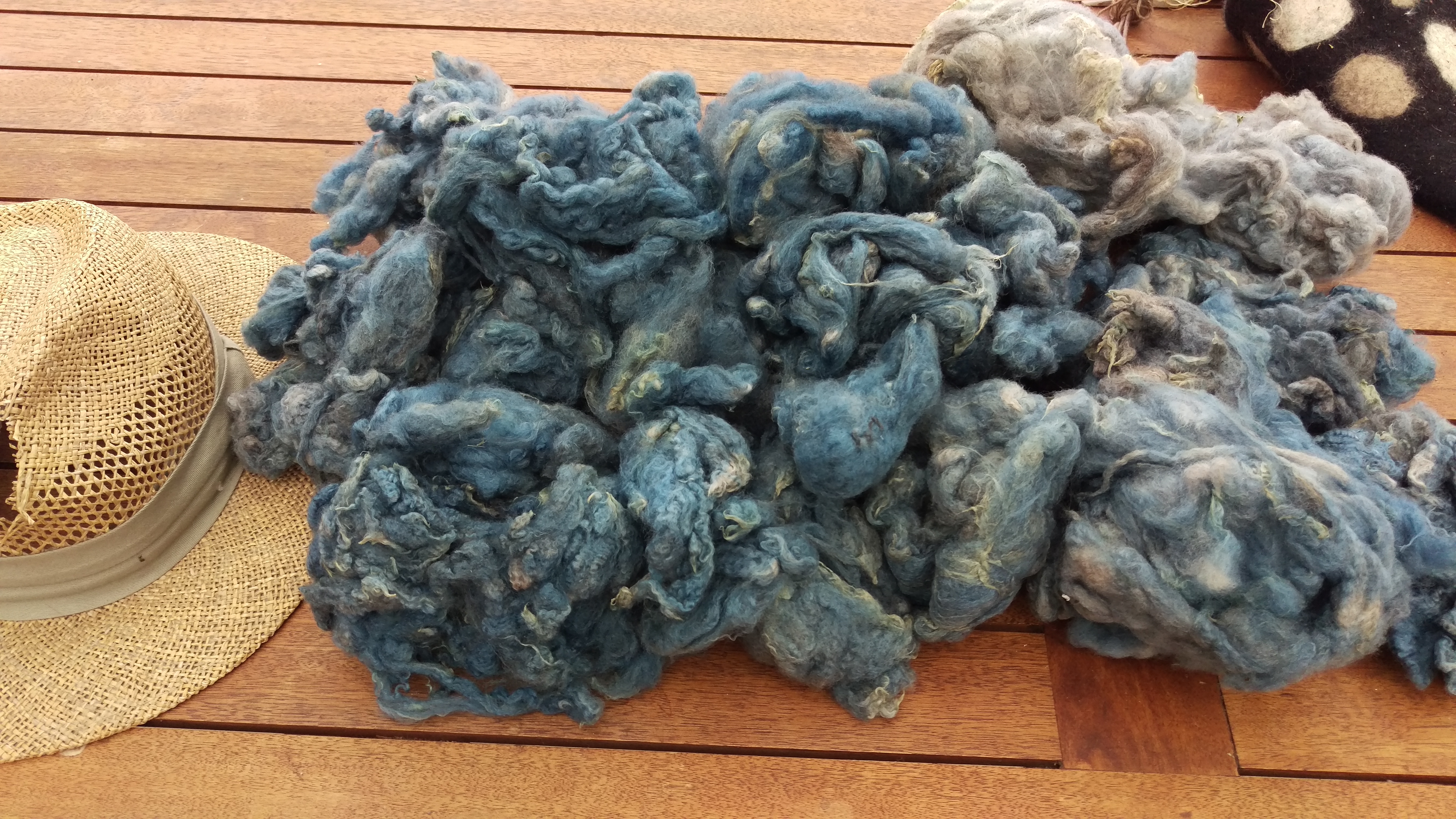
And finally, as the Ph of the vats dropped into the zone more suitable for wool and there was still colour, in went grey merino locks.  LOTS of woad dyed wool! So there is woad spinning yet to come.  Happiness!

2016-12-07-15-50-19


9 Comments

Filed under Natural dyeing

Blue silk bags

2016-11-23-14-59-13

Could I stop at … ahem… was it twelve? I lost count of the bags I had already made…and no, as usual, I couldn’t stop.  I had one more piece of silk that started out a pale blue and ended up more like this.

2016-11-23-14-59-33

There were a few pieces of cream or bronze fabric left and they were pieced in.

2016-11-23-15-00-00

The first has already gone to a lovely friend I was lucky enough to visit with when I went to Brisbane, and the second to a house warming.  And I love the buds, especially!  Well.  I am ready for any number of occasions for gifts now!  In the meantime I am still trying to work out how to wind back the Christmas gifting obligations in my family.  How to honour the ideas of generosity and reciprocity and love that perhaps moved this tradition to come into existence, but to detach from its wasteful and consumerist present.  Maybe I have to begun by asking that I not be given gifts.  Or perhaps talking about how my daughter has clearly decided that from now on she will only buy me second hand gifts.  She reached this decision without discussing it with me specifically–and it has really made me feel that she sees me!  Well.  One step at a time.

2016-11-23-15-00-15

5 Comments

Filed under Leaf prints, Natural dyeing, Sewing

Mellow blueness

2016-11-26-12-27-18

The woad has been thriving in this time of rain followed by warmth.  (The potatoes aren’t doing badly either, as you can see). And that can only mean one thing, when free time opens up!

2016-11-26-15-06-35

I managed to obtain Jill Goodman’s A Dyer’s Manual recently, and had the benefit of others helping me to grasp the chemistry of fresh woad and how it differs from using indigo that has already been prepared from fresh plants by someone else. I came by the book at the annual spinner’s retreat where there were folk with interest and knowledge–perfect, and very helpful indeed.  So this time I felt I knew why I was adding air in the early stages of the process, only to then remove it in the de-oygenation process required to have the dye become fully soluble and able to attach to fibres.  Previously this has been a total mystery or had me feeling I had done something wrong, or both.

2016-11-27-14-09-18

I still had part of one package of hydrosulphite left.  I am pretty keen to have it be the last.  Hydrosulphite is a substance the earth could do without. But equally, since I have it, better to use it rather than let it become stale and unusable for this process.  So I tried two vats: one with hydrosulphite and one with fructose.  The picture above is grey merino fleece descending through the ‘flower’ on the surface of the hydrosulphite vat and into the yellowy depths below.

2016-11-26-17-45-56

This image is the fructose vat, which involved some guesswork on my part (no way to measure how much woad pigment there was in my solution). I am not experienced enough to have great judgment or to trust my own judgement.  I can measure temperature and I can measure Ph.  The complex part is judging the reduction (de-oxygenation) of the vat. This looked very promising to me!  That said, there were moments when I had realisations that gave me pause.  Jill Goodman, for example, seems to live in England and I suspect her conditions and mine are not the same. She goes from scalding leaves with boiling water through various processes to heating the vat to raise it to 50C (there was a lot of conversion to metric involved for me)… I did the processes concerned and still had a vat at 70C and decided in the end to put the vat in a sink of cold water and ice!

2016-11-26-16-57-16

This linen scarf did the amazing woad magic of going from yellow to green to blue when put out into the air.

2016-11-26-17-13-35

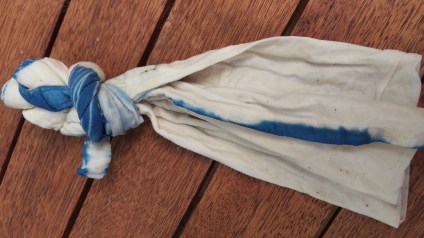
Both of my tied textiles dyed only on the outside and therefore were re-tied and re-dipped. The greeny-blue of the image above converted to blue very quickly on rinsing (you can see an image further down).

2016-11-27-15-37-27

Soon I had dyed my planned fabrics and imagined that the vat would be exhausted, because previous vats have yielded so little.  The next day it was clear that the hydros vat was not exhausted, so I adjusted Ph and temperature and set about continuing to dye. The fructose vat was still not reduced, so far as I could tell with a test dip, though again it looked promising and eventually looked much like the hydros vat.  However, it still had not reduced, and thus, was unable to dye.  In the late afternoon I decided it probably didn’t have any dye in it. Do not read on if you have a weak constitution–but one of the reasons for my belief was that I had accidentally boiled the fructose vat early in the process. Eeek! I had a very little hydros left, so added some to the fructose vat.  Then half an hour later, a little more.  30 minutes later, it came into order and began to dye, and I dyed using both vats until bed time using the only clean fleece I seem to have. The fructose-hydros vat dyed over two more days, as it turned out!

2016-11-27-18-18-18

I threw in more cloth and went to bed, feeling extremely pleased.  On the down side, I used hydros.  On the up side, it can only have been a matter of time before that fructose vat would have reduced.  I just needed to hold my nerve and be patient.  Maybe add more fructose. Admittedly, time is one of my biggest issues because I do have a day job and other commitments.  However, this is by far the most successful woad effort to date.  I now understand that I need to use a vat rather than direct dyeing for the woad to be wash-fast.  I think I now have a sense of how to tell whether there is dye in the vat (at all) as I process the solution.  The low concentrations of colour claimed for woad are not so low as to make it useless, and I have quite a bit of leaf.  One vat with 1.6 kg leaves and one with 900g leaves from one part of the garden where other things have struggled to grow well–and this is my second harvest from them.  I also have the happy sense that my understanding is sufficient to reach success with a fermentation/fructose vat given time.  The pigment from my previous crop of woad is in a different vat which has not shown promise even though I have been waiting for weeks.  But it still may!  And I am confident now that reduction is the main issue and not one of the other possibilities.  Very encouraging mellow blues–and more pictures to come when everything is clean and dry.

9 Comments

Filed under Dye Plants, Natural dyeing

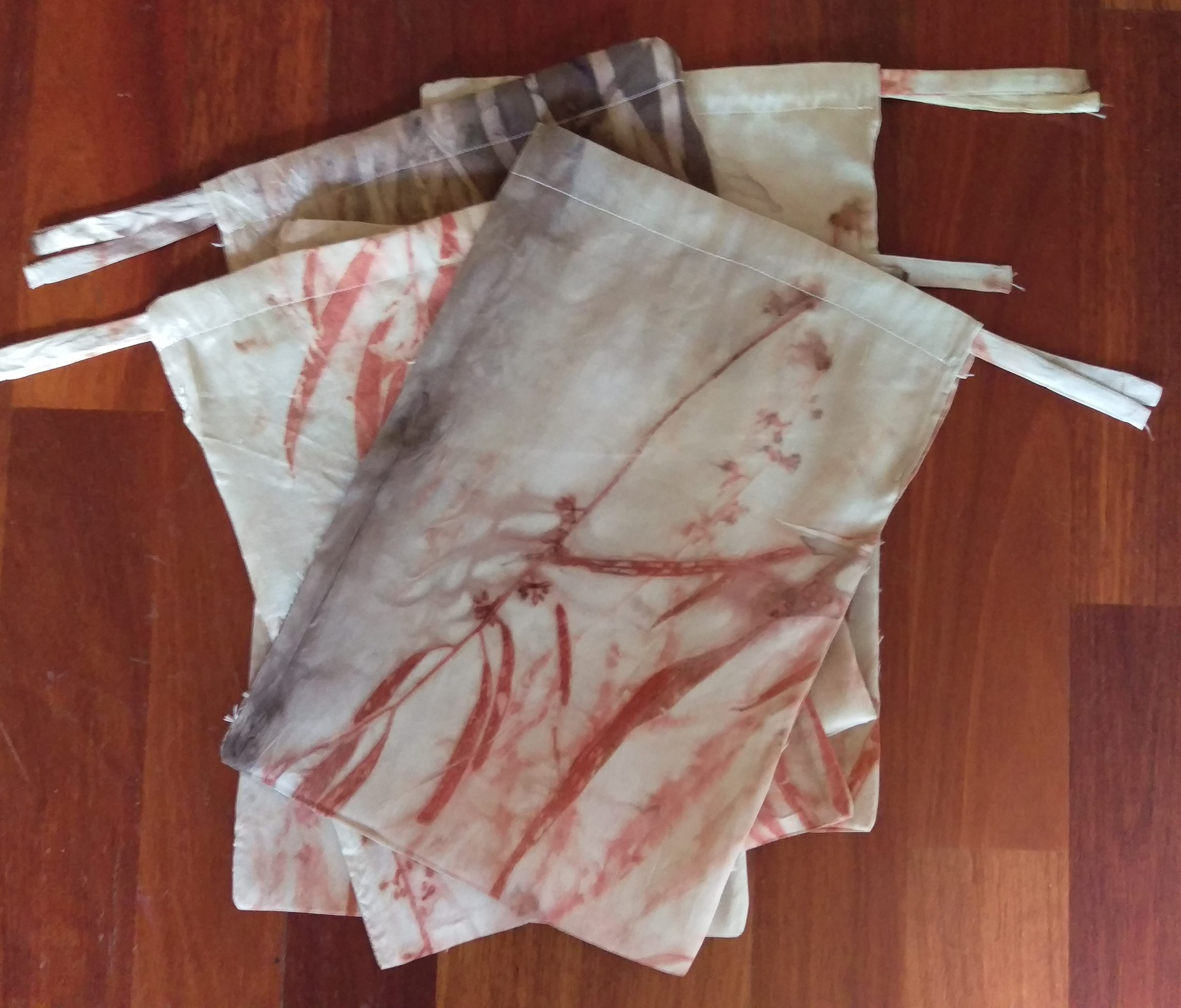
Drawstring silk bags

2016-11-19-18-01-27

Some time ago I dyed some silk I found at the Guild trading table. Just recently though, I stopped looking at it, draped around the place, and realised what it could become. I am hoping these little bags will be pleasing gifts, and in some cases, replace wrapping paper in the coming season of compulsory gifting, which I prefer to involve as little waste as possible, as I have not managed to convert my family to thinking perhaps this is not the best possible way to show our affection for one another. I love giving people gifts, but I find the compulsory nature of it and the set date, just leads to waste, and giving and getting things that are not always wanted or needed.

2016-11-19-18-01-36

You knew where this was going, didn’t you?  I couldn’t possibly stop at one or two.

2016-11-19-18-01-52

I think it is partly the satisfaction of figuring something out and routinising it.  Practising it.  Being able to create a little system.  This wouldn’t satisfy every mind, but evidently there is something in it for me.

2016-11-19-18-02-01

I think it is also as simple as getting on a roll and being able to make maximum use of a piece of fabric. Again, not something that has an inherent logic that would work for everyone. And clearly the attitude of a person who has an outward bound stash rather than just one precious piece of fabric. I enjoyed piecing together some of the fabric so I could use it all, as you can see.

2016-11-19-18-02-39

I also made one from one of the fronts of a linen shirt dyed some time ago. The bronze-coloured fabric became two larger bags with double draw strings. And so here I am, hours of pleasurable bag making behind me and happy times of gifting ahead!  I hope your plans for the gifting season are going well…

2016-11-19-18-02-55

12 Comments

Filed under Leaf prints, Natural dyeing, Sewing

Needle books on the Murray River

2016-11-11-17-28-37

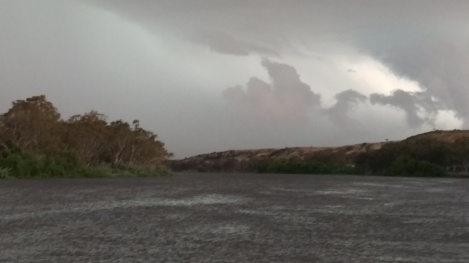
We went for a birthday holiday on a house boat on the Mighty Murray River.  I’ve never been on a house boat before and it was pretty funny to be in something with six bedrooms, but on the water!  We set out on a sunny day and it was just lovely.  And then, hours before sunset, the sky turned dark.  The river was anything but calm.  My capable companions decided it was time to find a mooring, and that the green tinge in the distant clouds was a sign of hail even though it is November.  And we moored just in time for powerful winds, amazing rain… the whole thing.

2016-11-11-19-40-19

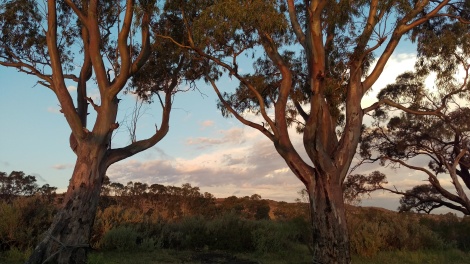
Eventually things calmed down and for those feeling nauseous, that part subsided, and the sun set over beautiful river red gums.

2016-11-12-10-22-00

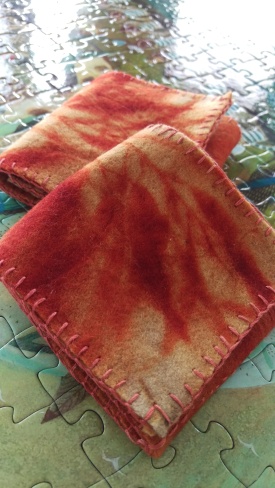
Last week I finally stitched these two little eucalyptus dyed needle books together with madder-dyed thread and they were in my sewing tin along with everything else, so they found new homes among my companions.  Here they sit on the obligatory holiday puzzle.

2016-11-12-11-00-33

It wasn’t all wild weather… there were naps and songs and stories and birthday cake and lots of delicious food and company, and beautiful views.  There were so many birds… cormorants, pelicans, ducks and ducklings, superb blue wrens, raptors of various kinds… fabulous!

2016-11-12-13-06-00

On our return we discovered that every single car (and a lot of houseboats) had been hit by hail the size of golf balls.  In November.  We’d had a summary phoned in on our first night out, but it was quite a sight in person.  After a safety check, we drove home slowly, with the light dancing off all the cracks from 17 major hits on the windscreen. Too many dents in the car to count! Just as well there were needle books to keep things a little bit sensible in between times.  A person needs evidence of the ordinary in these challenging times.

2016-11-13-18-58-12

14 Comments

Filed under Natural dyeing, Sewing