Dyeing in Katoomba–and some local-to-Katoomba eucalypt species

Just recently I had a short holiday in Katoomba (New South Wales).  I spent part of a day doing some dyeing with a group of friends who meet as a textile group.  One of my dear friends did a lovely job of organising a space to meet.  The group had a lot of great skills–with artists, a chemist, bush regenerators, plant identifiers and a librarian among them.  They had read and been inspired by Eco-ColourIndia Flint‘s fabulous book on natural dyeing in which she sets out the eco-print process.  But they had not had a great deal of success and some had formed the view that we have special trees in South Australia.  Of course, we do have special trees in SA, and so do they in NSW!  I tried to explain that it was far more likely a question of species than state boundary…

I love the stages in this process of setting up and bundling…

IMAG1508

Cooking…  we ran one pot with vinegar, one with iron and one with onion skins (the orange bundles have spent time in the onion skin bath and then been moved to a different pot).

IMAG1532

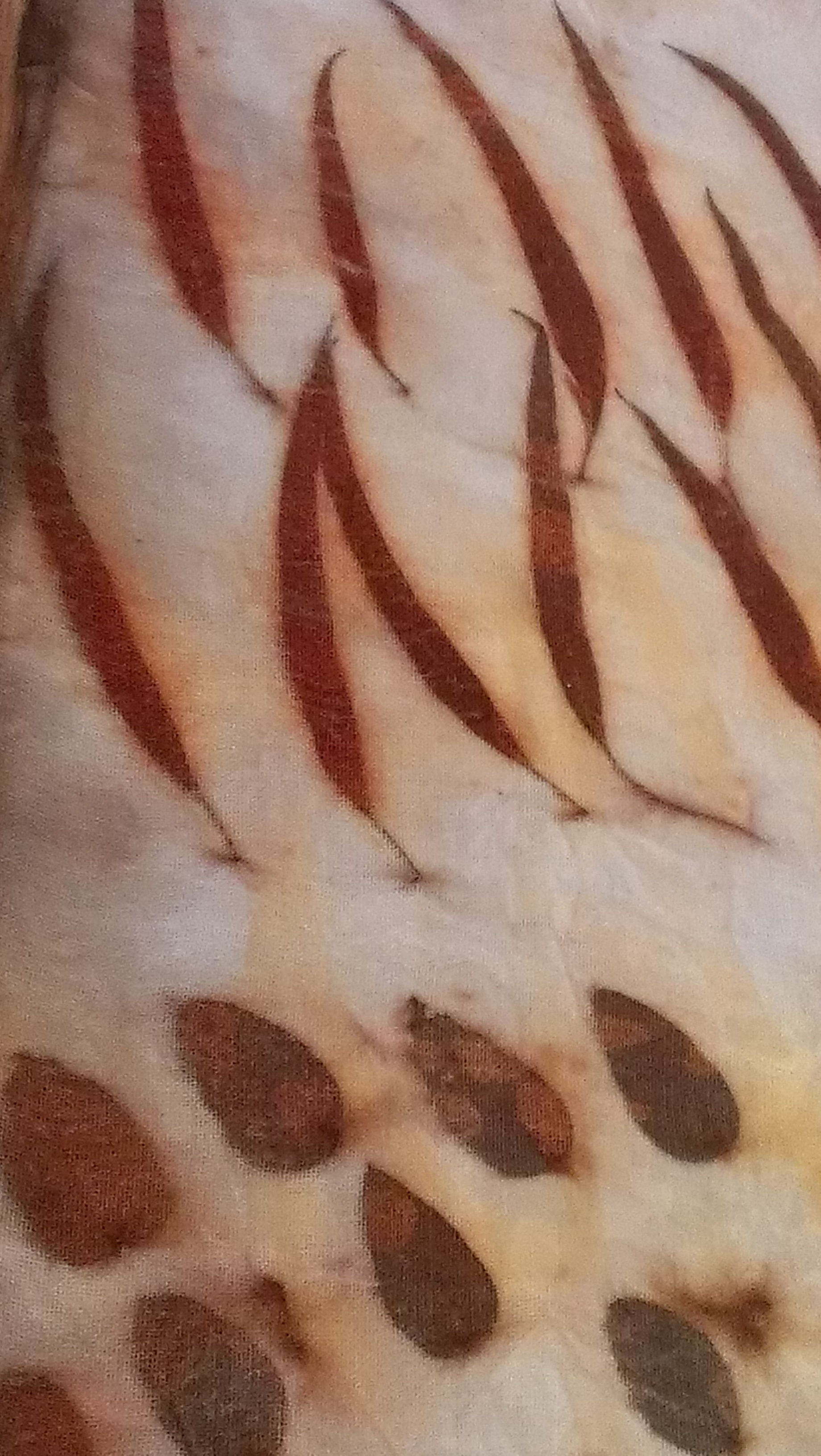
And then the big reveal!  It reminds me of that fantastic Judy Horacek cartoon… which by coincidence my friends have up at their place in Katoomba.  Please follow the link to be introduced to a wonderful Australian cartoonist–and to see the cartoon!  E Scoparia and E Cinerea on wool:
IMAG1559

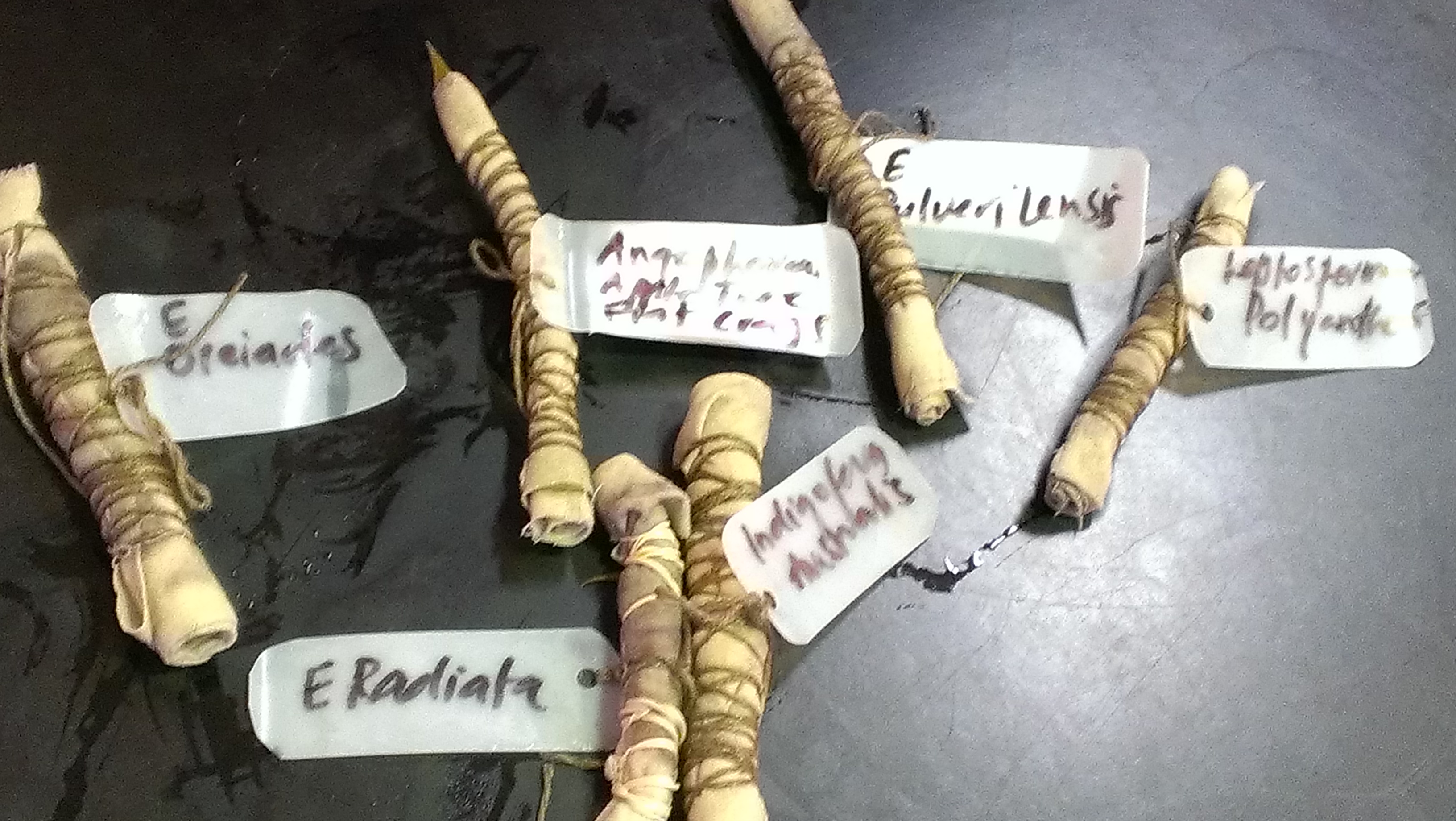
With so much expertise–and because my wise and sweetheart friends who were hosting our holiday as well as dye day had been out collecting and applying plant knowledge–we were able to try out some local species.  These samples are all on silk noil scraps, and have all been in hot water for at least an hour–just to test their potential really.
IMAG1513

We couldn’t resist trying Indigofera Australis even though it didn’t seem likely a hot process would be ideal for an indigo-bearing plant.  It wasn’t, leaving almost no mark except when dipped in an iron modifier.  Here it is, before and after.  The yellowy-greenish tinge is an effect of photography indoors.  Sorry about that part.

IMAG1521IMAG1561

E Radiata, the Narrow-Leaved Peppermint:

IMAG1515

One of the especially beloved and tall local species is E Oreades, the Blue Mountains Ash–a truly local-to-Katoomba tree:

IMAG1517

And finally, E Pulverulenta, the Silver-leaved Mountain Gum, is a vulnerable species in the local area.  As a result, people who want to make sure it lives on are planting it in towns, and this sample came from a street tree.  Dyers will now have an additional reason to support the conservation effort!

IMAG1518

A big, big thanks to my Katoomba friends, and to the textile group for having me!

7 Comments

Filed under Dye Plants, Eucalypts, Leaf prints, Natural dyeing

Saffron Milk Caps

My neighbour brought round edible fungi, including Saffron Milk Caps (Lactarius deliciosus) to share with us.  Such generosity!  These are an introduced species often found in conjunction with pine forests.  One was too large to be good eating, so into the dye pot it went, since its gills are so brilliantly orange–and even more so when cut or crushed.

IMAG1474

I could not find a reference to this fungus as a dye plant anywhere so can’t pretend to be surprised that my test cards showed almost no change at all.  Perhaps a slightly more golden shade of white/cream.  Still…  that saffron milk cap was headed for compost in any case and just had a stop in the dye bath on the way there.

Yes, we did eat them, fried in olive oil and garlic with parsley.  Reviews ranged from ‘absolutely delicious!’ to ‘I’ll stick to the usual sort but they are OK’ at our dinner table.

2 Comments

Filed under Natural dyeing

Of moths and mending

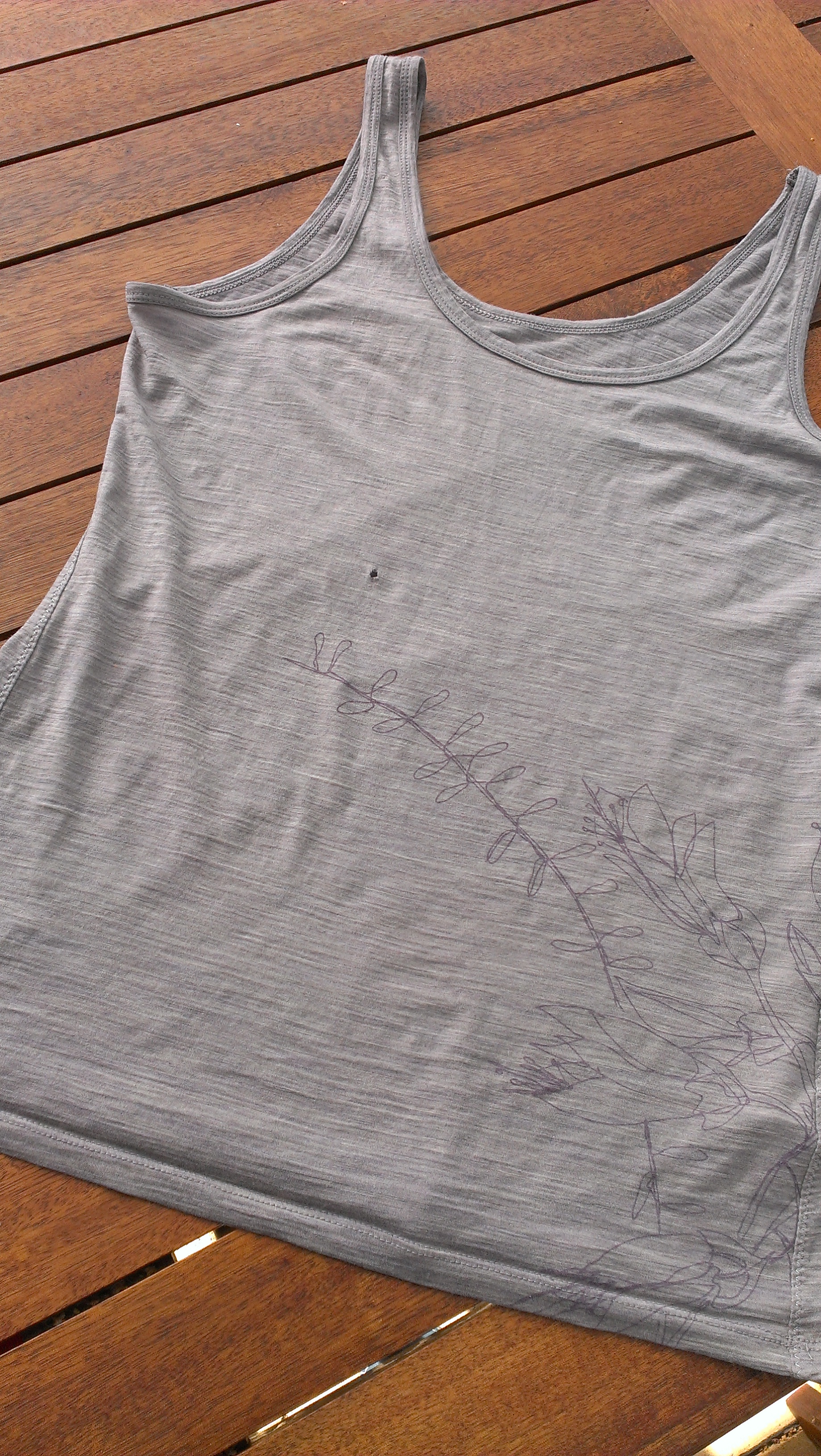
I have a serious programme of moth management due to the amount of wool that is stored at my place.  It involves ziplock bags, careful wool storage, regular washing of clothing and pheromone traps.  However, there are noticeably more moths in this house than our previous one, and it has wool carpets.  This winter when I pulled out my woolens, the jumpers were all intact but one of my fine woollen undergarments had suffered some nibbling.  There is a small hole on the front:

IMAG1464

And a small cluster of holes on the back.

IMAG1466

I thought I might just leave them.  This garment is not outerwear and surely they wouldn’t run too far.  But then I thought of mending them with silk thread and overdyeing the whole garment in eucalyptus… and just when that was tickling my fancy, I dyed silk embroidery thread with Plum Pine and got colours that seemed like they might fit… and so I spent an evening working on my mending.

IMAG1490

Since the moths gave me circles (more or less), I worked with that theme.  I’ve tried to leave a little extra thread at the outer edge of each part of the darn to accommodate stretch–which is what my Mum taught me to do when darning a sock.

IMAG1488

The silk yarn I pulled out of the plum pine and vinegar dyepot the day after darning is a deeper shade, so I’m considering further embellishment with that, or the silk I dyed the night we worked with the indigo dyepot.  But for now, I’m pleased to have mended these holes… and on the same weekend as I mended a ravelled hem, for good measure.  This will be an initial washfastness test for the plum pine on silk, too…

5 Comments

Filed under Natural dyeing, Sewing

Plum Pine 2: Mordant and Modifiers

Having had success with a test dyebath, I made a point of returning to Botanic Park to collect more fruit on weekend, en route to celebrating World Wide Knit in Public Day.  I dyed some grey corriedale locks in my test bath and they went from grey to a dull brownish shade, so I opted for superwash + alum and silk as the most likely candidates for success. I mordanted sock yarn of antiquity (picked up at a garage sale) and prepared another dyebath.  I regard sock yarn as a no risk option.  If I knit socks for a friend, I can make an open offer to re-dye at any point they fade to an unacceptable shade (and I can ask how they’re faring under normal wear and washing).

IMAG1461

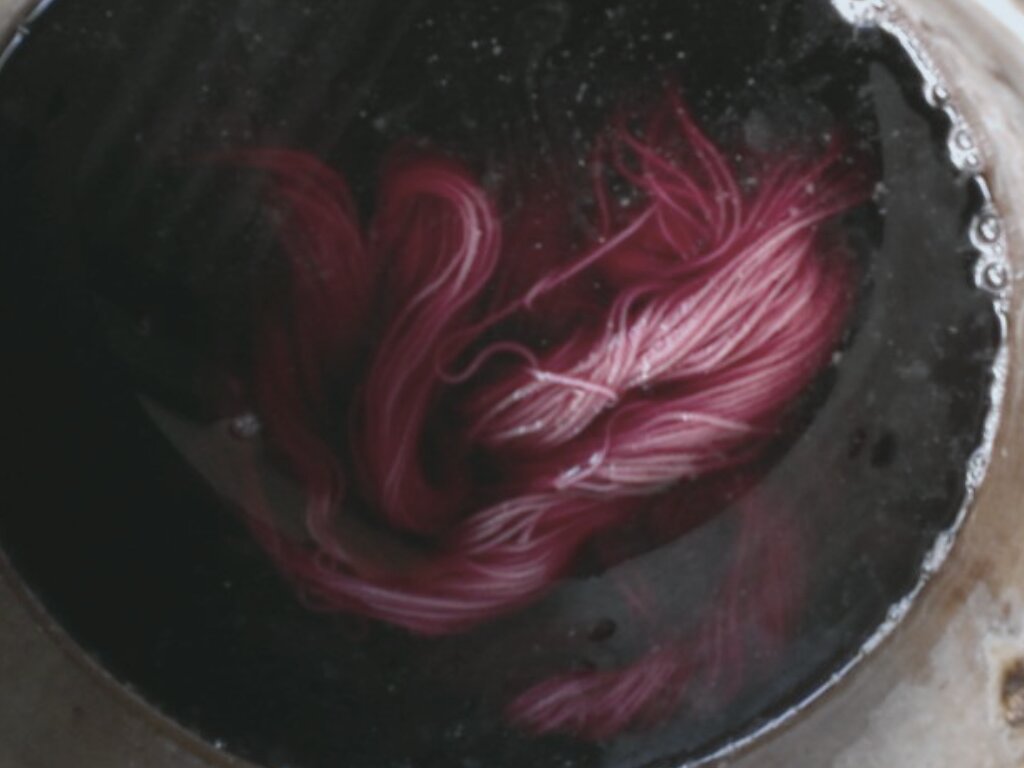
The dye bath looked fantastic.

IMG_0168

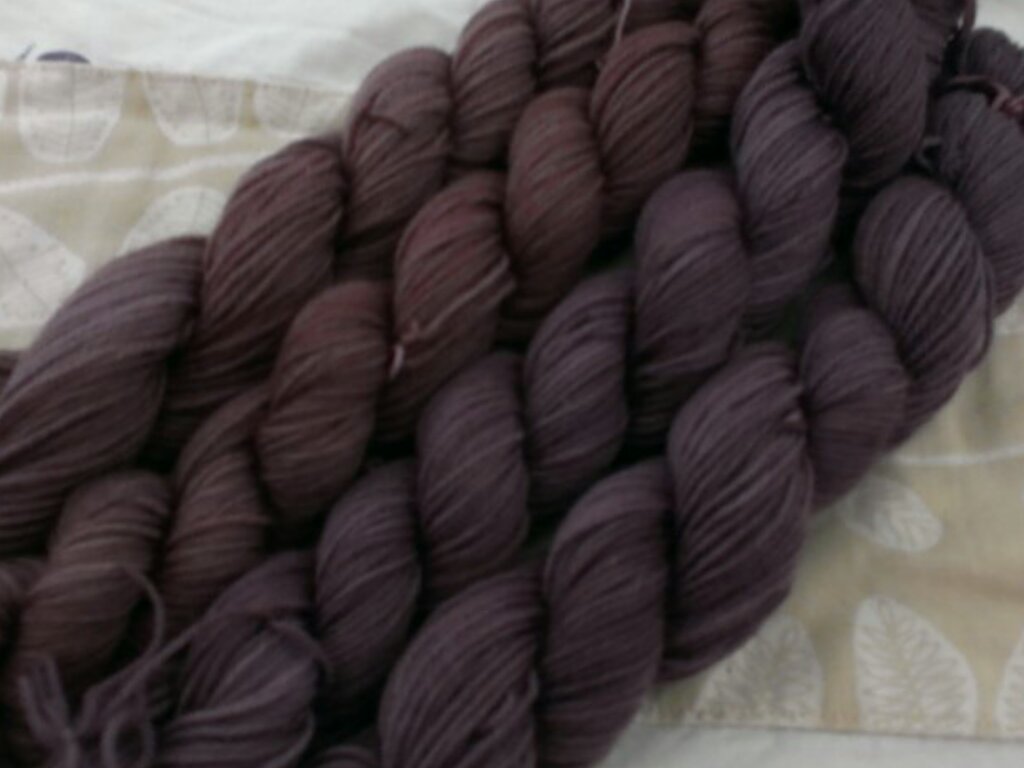
I ran two baths with this fruit, because the first one produced purple on my alum mordanted skeins of sock yarn (wool-nylon).  I pulled it out of the bath after dark and in artificial light it looked quite brown. So I dropped the skeins back in the bath for the night and put test samples into an iron bath and a vinegar bath. Next morning the sock yarn was purple! The exhaust dyebath was a lighter and browner shade of mauve.  I apologise for these photos but it’s winter here and sunlight is in short supply.

IMG_0183

My tiny skeins of silk thread came out various shades of rose pink through to magenta too… and I have embarked on an embroidery project, so that was exciting.  The shades on the right are both using vinegar in the dyebath.

IMG_0178

The modifiers were interesting: the wool+alum strand was noticeably more purple with vinegar and noticeably more brown/grey with iron, which is, I think, about what should be expected.  So… a promising beginning to experiments with a new dye plant–but with no sense yet of how washfast or lightfast it might be.

IMAG1499

7 Comments

Filed under Dye Plants, Natural dyeing

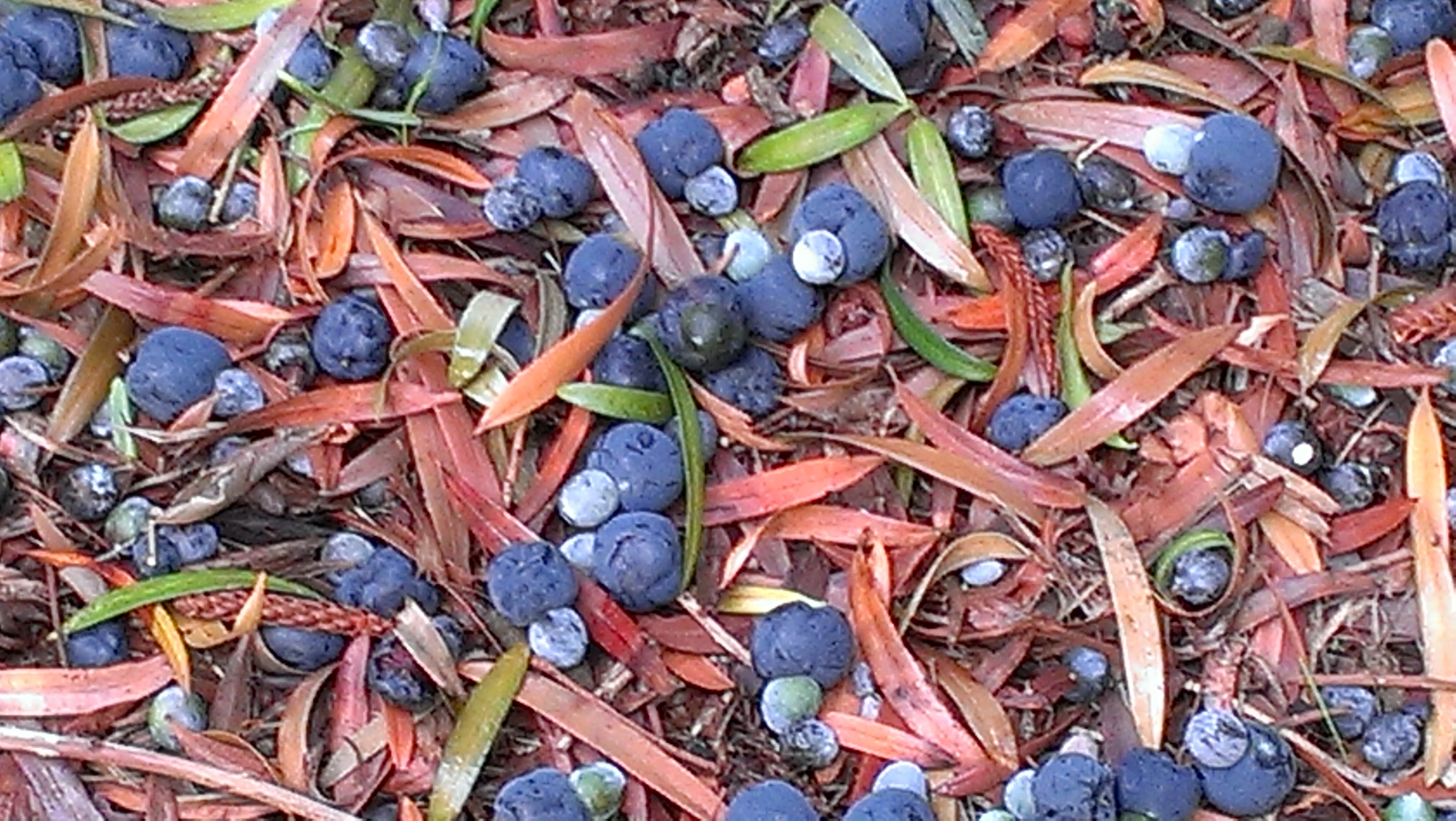
Plum pine 1

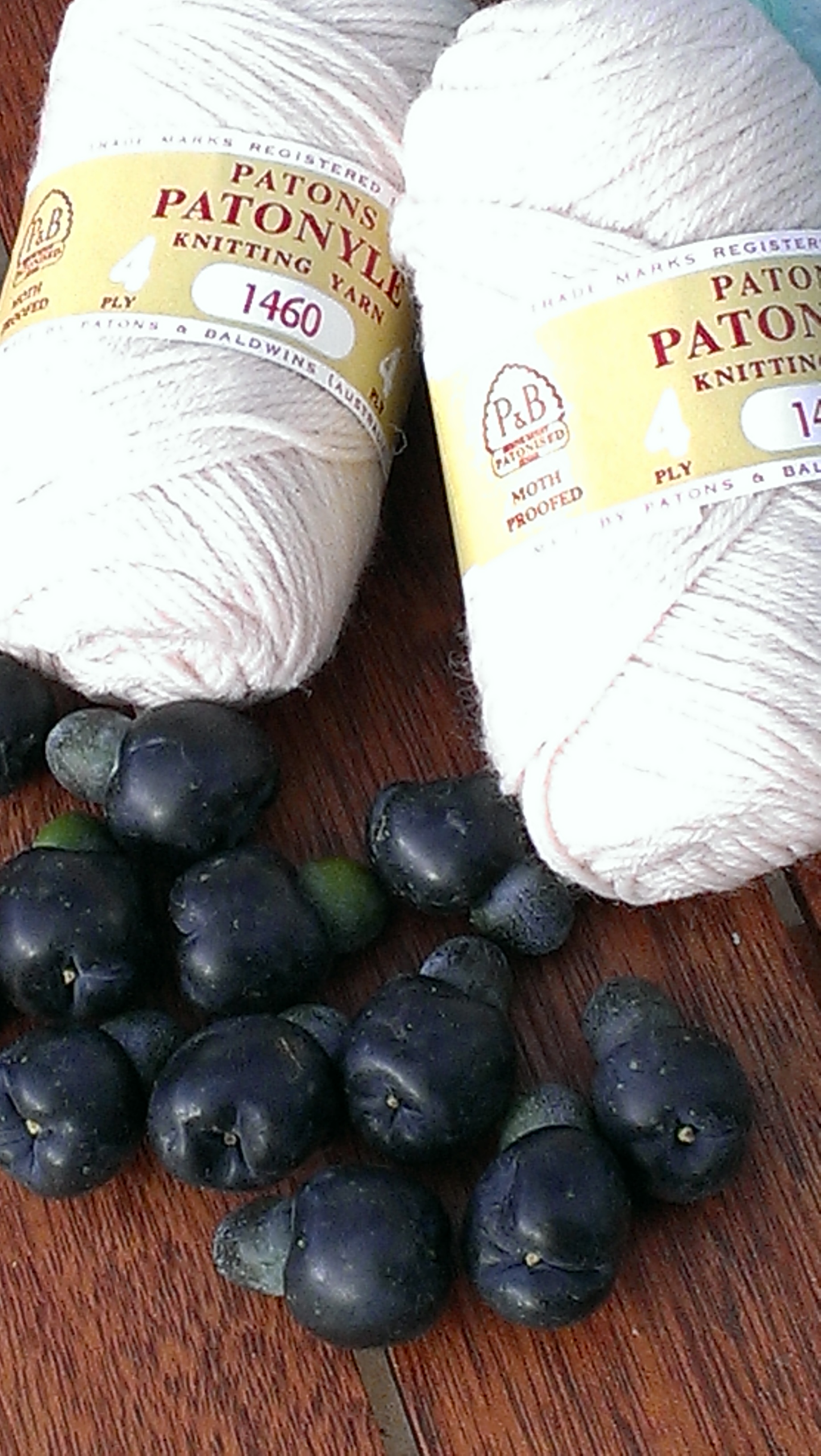
Podocarpus elatus is fruiting in Botanic Park.  I rode past recently with my beady eyes alert, looking for this tree.  I’ve investigated its qualities previously and discovered the fruit is edible.  And today, there they were, lying on the ground in plenty.  They offer plenty of weirdness by regular fruit standards, since the seed is outside the fruit.  One of the less common forms of fruit in my limited experience!  Here they are on the tree…

IMAG1412

And on the ground below.

IMAG1413

This is the tree itself.  It is native to Australia, but it is a rainforest tree.  For those who don’t know…  I am not living anywhere near a rainforest.  South Australia is generously described as having a Mediterranean climate.  Those less generous just call it a desert, and a fair amount of the state answers that description.

IMAG1414

I tried eating one of the fruits and it was just as I remembered it from last time: subtle is the most I could say about the flavour, and the word ‘mucilaginous’ came to mind immediately.  If there is a commercial application for this fruit perhaps it would be… lubricant.  Or perhaps it could be the gumbo of Australian bush food desserts.  I tried leaf prints… but nothing too exciting came of it.

IMAG1432

I twisted the seeds off the fruit and soaked the fruit overnight–pitting plums has never been so simple.  No change in the colour of the water.  I cooked them for almost an hour–water a deep plum colour by now–and then threw in a  sample card and some silk thread.  Soon after that, the alum mordanted wool looked almost blue, and the other fibres (cotton, silk, wool) looked pink.  After about an hour of heat, the alum mordanted wool was deep grey-blue, the wool was deep rose-pink and the other fibres looked paler shades of pink.

IMAG1462

Needless to say, this outcome made me think I should go back to that tree 🙂

7 Comments

Filed under Dye Plants, Leaf prints, Natural dyeing

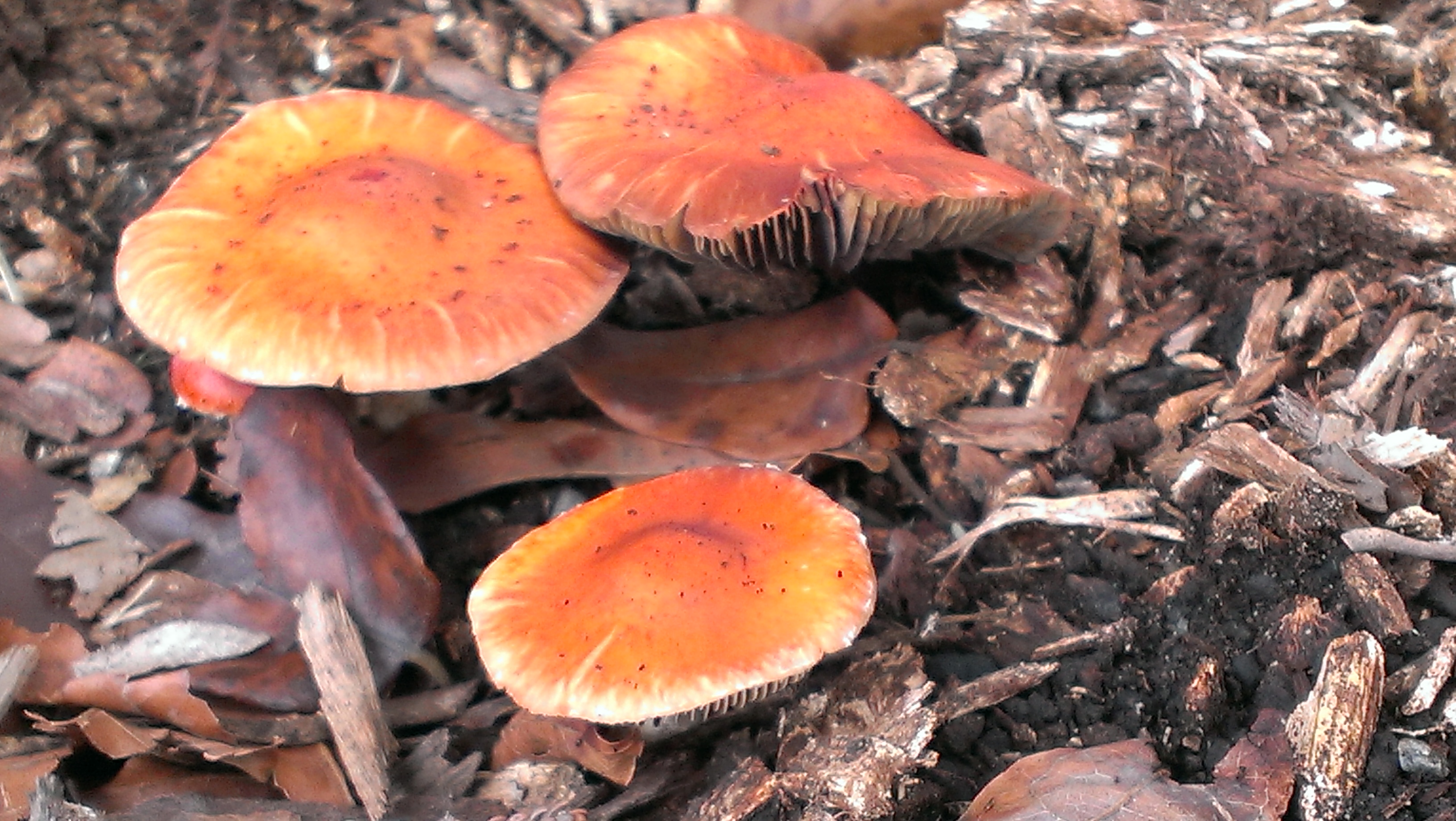
Paxillus Involutus

We have some very impressive fungi coming up in our front garden.

IMAG1439

Unbelievably, one of our neighbours is a mycologist who was only too happy to tell me what they are.  Paxillus Involutus, also known as ‘Poison Pax’.  I readily agreed not to include them in dinner! These fungi are not native to Australia but have been inadvertently introduced.  We initially thought their appearance in the root zone of a silver birch at our place meant the birch might not live long.  It turns out that these fungi serve the plant and form a relationship with it which is of benefit to the tree.

IMAG1440

I’ve wandered the interwebs looking for information and discovered a range of different perspectives on what colour these fungi can give in dyeing, with some suggesting a shade of beige–Riihivilla says they are ‘not worth picking most of the time’– while other dyers suggest they give pinkish and greenish browns.  None of it sounds really thrilling, but my opportunities for sustainably dyeing with fungi have been non existent so far.  So…  I consulted Karen Casselman’s Craft of the Dyer, picked a specimen, tore it up and cooked it for an hour.  Then, in with my test sample.  I kept that hot for a further hour.  It doesn’t really surprise me that Riihivilla is right about this … but it was so exciting to have this fungus in my own yard, I had to try it out.

IMAG1463

Since I’m talking fungi, here are some I came across walking through Botanic Park on a completely different dye mission on the weekend.  I left them exactly as I found them.

IMAG1449

On the whole, the best thing for a fungi ignoramus to do, I believe, except when acting on expert advice.

IMAG1450

2 Comments

Filed under Dye Plants, Natural dyeing

More socks!

More socks off the needles after a long period of being unfinished…

IMAG1421

Long ago I had the opportunity to buy part of a raw Suffolk fleece that had been discarded by another spinner.  I had been steadily reading my way through the Guild’s library, so I recognised this as a breed that was eminently suitable for sock spinning.  At the time, I only knit socks.  They were the whole reason I had learned to knit, and then to spin.

As it turned out, the Suffolk was a very short staple and none too clean fleece.  Never mind.  I gleefully acquired it and proceeded to use my beginning dyeing skills on it.  Four pairs of socks came of it.  One, pink dyed with hibiscus flowers, went to my Mum.  Another was dyed in eucalyptus leaves as fleece and spun up afterward.  I can’t remember who I gave that pair to.  I think they might have gone to tree lovers in the Blue Mountains.  I made my father a glorious pair that were purple and blue, blended rather beautifully after dyeing (and at that stage, their loveliness was an accident!)

These were made from Suffolk blended with tencel, which may have been ill advised–time and wear will tell.  The colour could have been better and the blend is uneven, but a three ply handspun yarn is a work of dedication and there was enough even for a pair of large feet, so I knit these.  They are going to a dear friend who lives nearby, who does indeed have large feet.  Last night he spoke about a pair I made him years back that he is still wearing hiking.  This pair may not last as long but I hope they will keep his toes warm at the very least!

Leave a comment

Filed under Knitting, Spinning

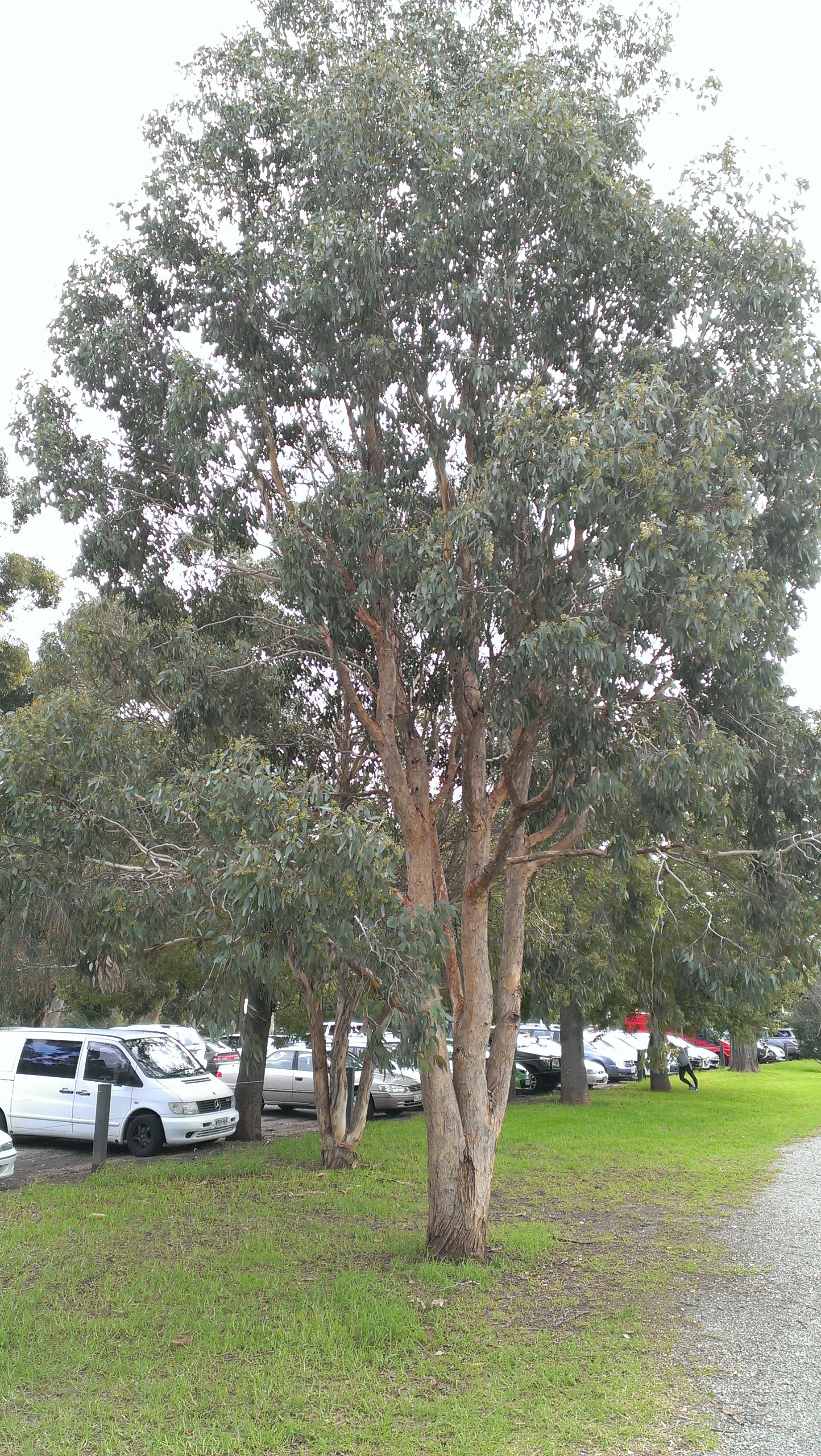
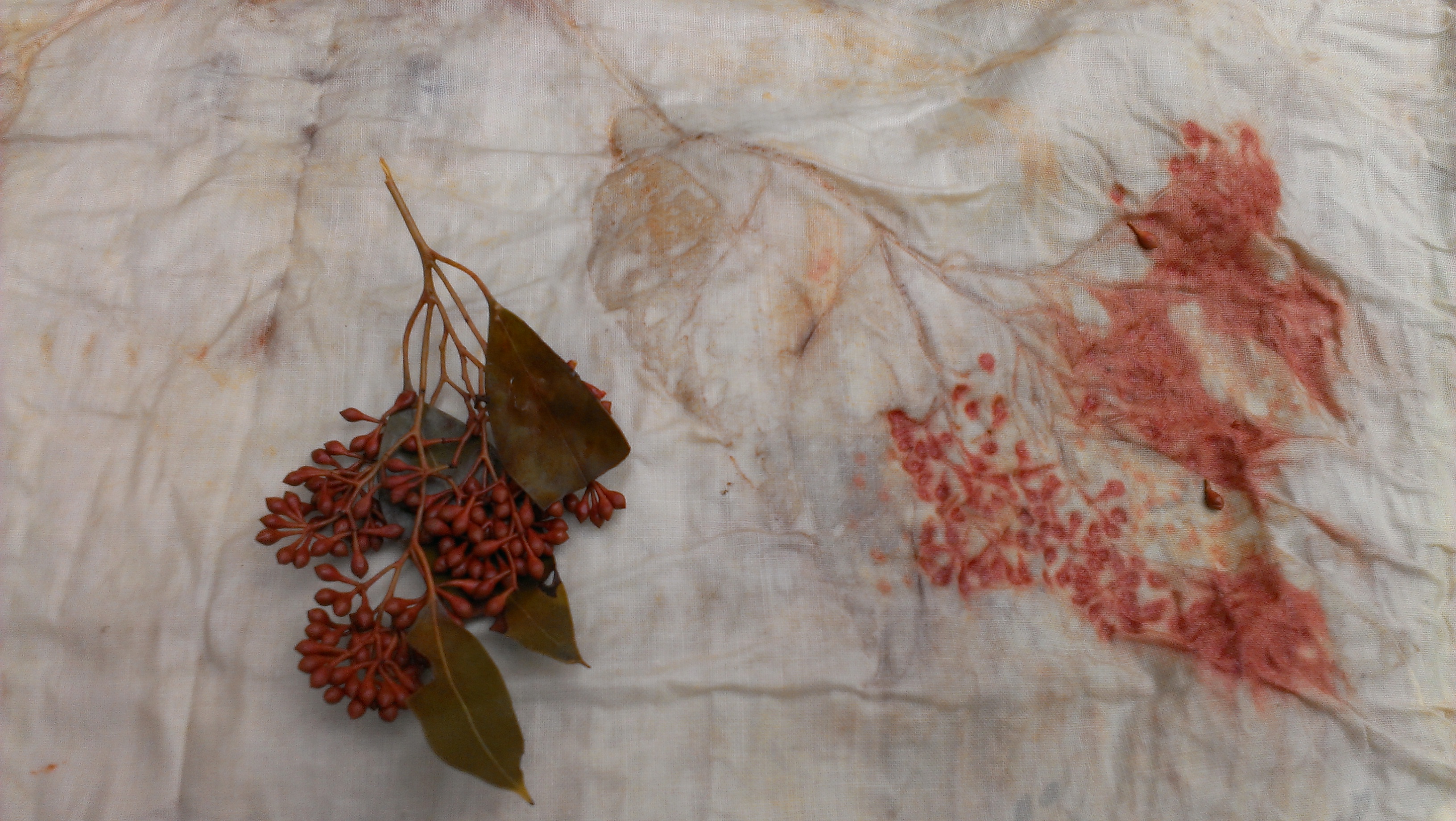
Unidentified Eucalypt Buds of Wonder

I have seen this Eucalypt before, and dyed with it before. At most, I have had apricot on silk from the leaves.

IMAG1399

Sadly, I can tell when I am looking at the same species (I think) but have not been able to identify the species.  If any reader knows the species, I’d be glad of your advice.  The bark is a lovely rough tan.

IMAG1393

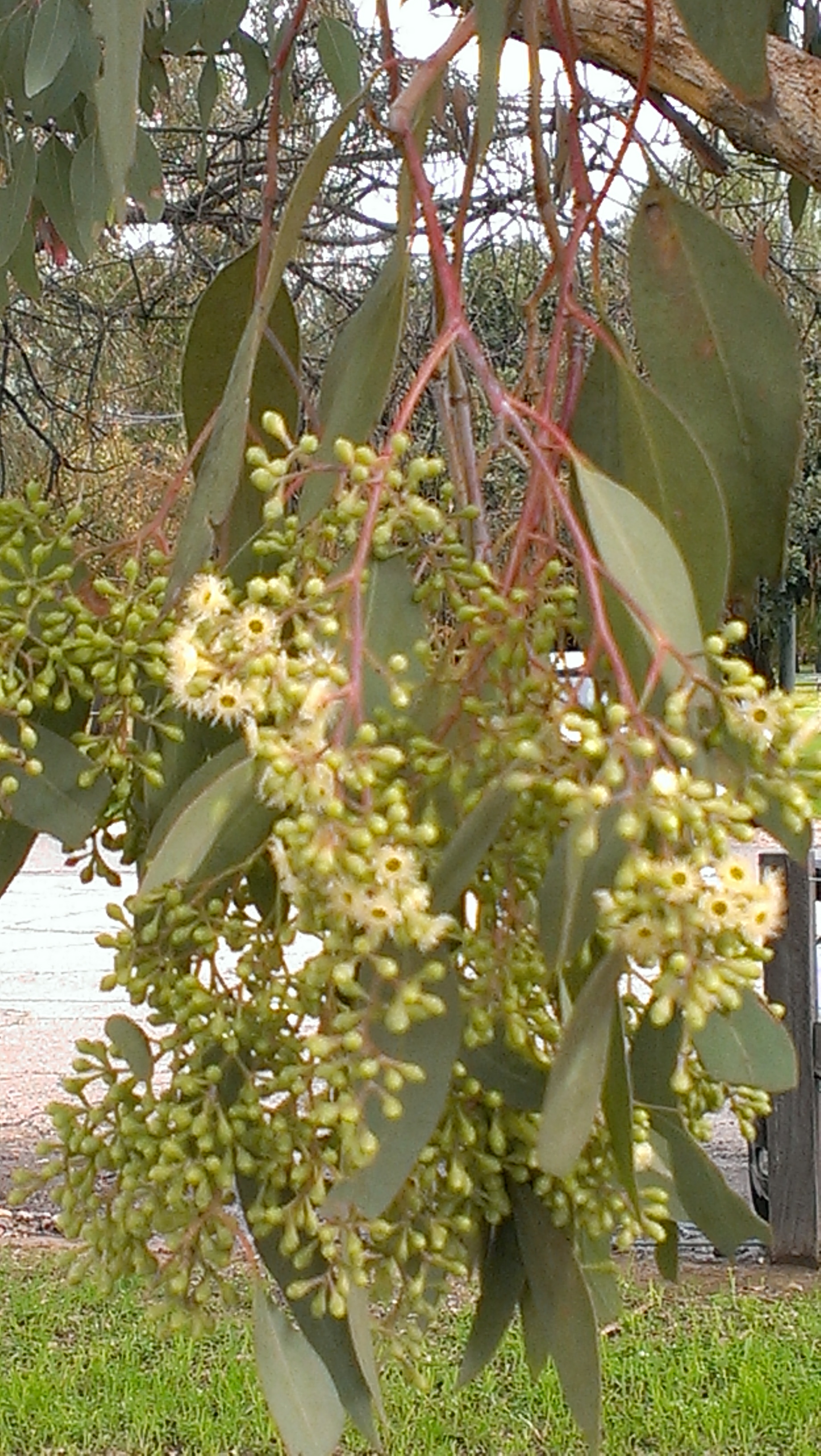
Then I found this one in full bud and beginning to flower, in early June.

IMAG1394

I decided to try again and got the same result: the leaves barely make a mark, but oh my!  The buds!

IMAG1418

2 Comments

Filed under Dye Plants, Eucalypts, Leaf prints

Steeked!

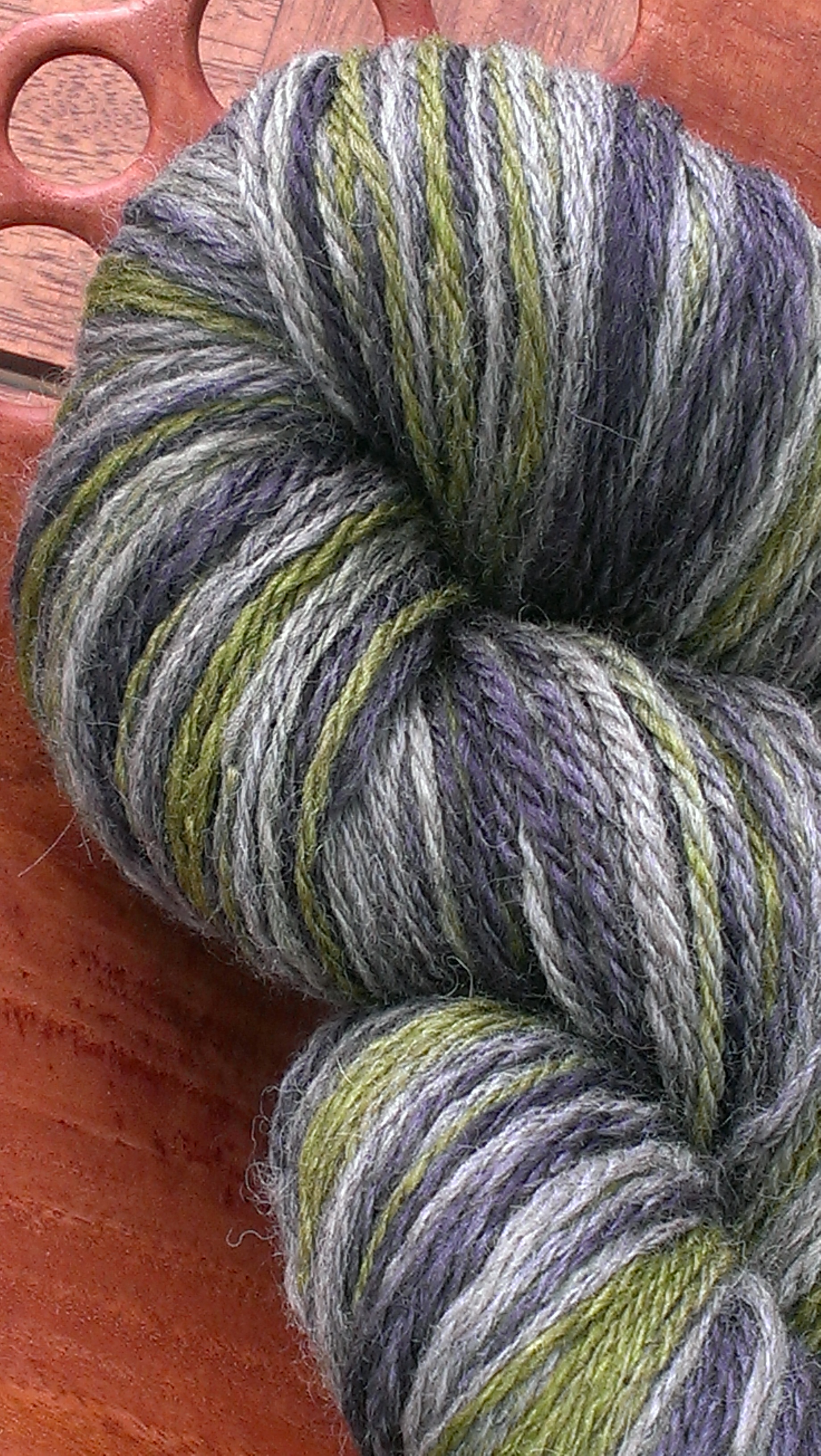
Perhaps you remember this yarn, spun and chain plied from a beautiful blend by The Thylacine.

IMAG1220

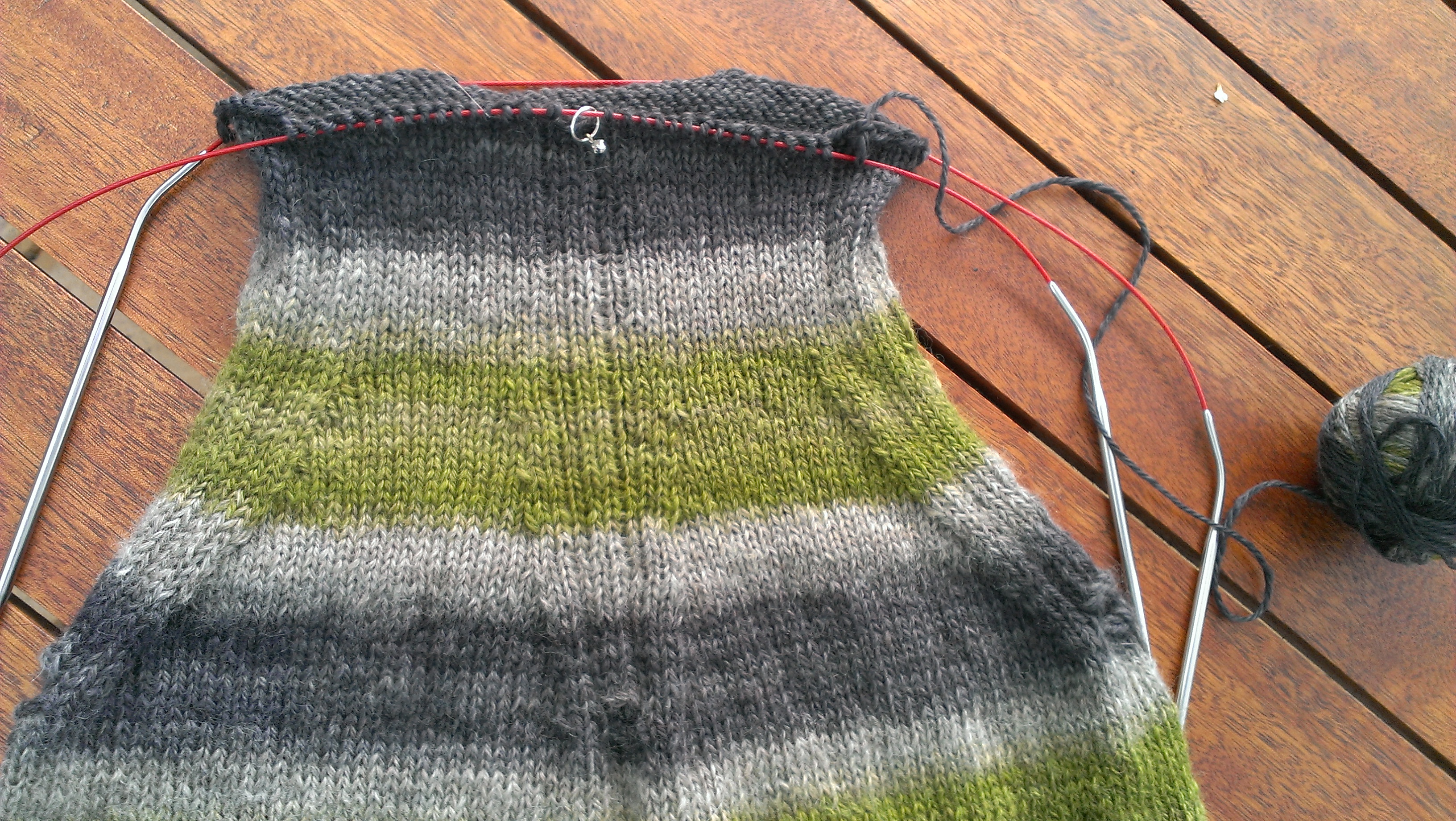
I decided on a vest for my fairy godson, an appreciator of handmade items if ever there was one.  He is a not-so-small six year old person growing ever taller and thus, growing out of last winter’s woolies. I designed (I  do realise this is a very plain garment!) the vest based on measurements from one he already has that is a generous fit.  100% handspun alpaca for the band at the bottom, in seed stitch.  When I reached the place where I wanted the neck and armscyes to begin, I cast off a few stitches, then cast them on again on the next round (leaving a slot) to create a steek bridge.

IMAG1349

Here is the upper part a bit closer up.  I have decreased just the way I would have done knitting this garment by any other method, but kept knitting in the round, making sure those stripes are maintained with wonderful simplicity. Knitting in the round feels normal to me, since I took up knitting in order to knit socks.  I much prefer knitting in the round to knitting flat.

IMAG1350

Then came the day of truth, when I stitched through the knitting all the way from one end of the steek bridge to the other and cut, yes, CUT! the neckline and armholes prior to grafting the shoulders together and picking up the edgings.

IMAG1351

Wonderfully simple if you can hold your nerve.  I am so happy with the finished result, I’m on tenterhooks waiting for the intended wearer to return from holidays soon for the handover.  I sure hope he likes it.  I have yarn left over from 100g of fibre. Amazing!

IMAG1371

PS–yes, it fits!

4 Comments

Filed under Knitting, Spinning

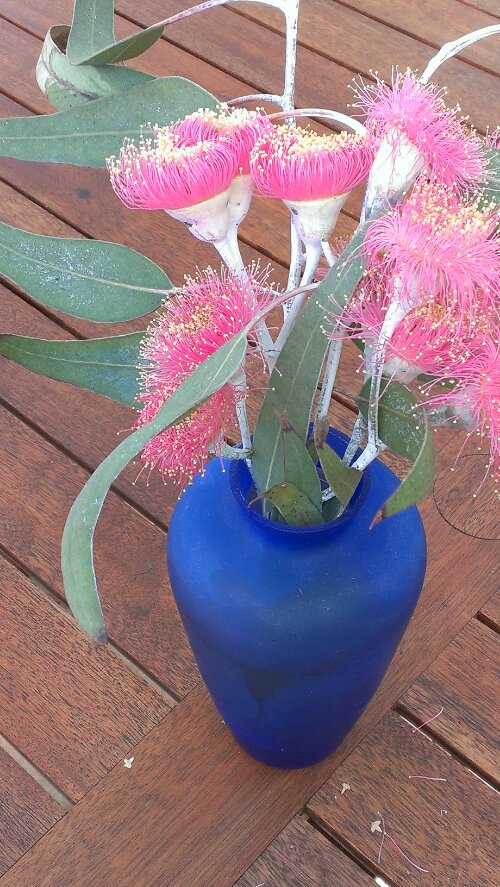
Eucalyptus Caesia

image

My parents came around one weekend as autumn was beginning and brought gifts from their garden: quince, guavas, mandarins, and these lovely flowers from their front yard. Eucalyptus Caesia ‘Silver Princess’.

It has been quite a season. We have made an incredible amount of pesto from our basil plants and had enough to share as well.  The final pesto fest was last weekend, shared gleefully with a friend who is a wonderful cook. We also made a walnut and pomegranate molasses dip of wonder, a rice pudding flavoured with mastic and orange flower water and some fiendishly rich and delectable mastic and rosewater icecream.  Finally, she read poetry.  Exquisite!

image

Once the flowers wilted, into the pot the leaves went.  Nothing too exciting came out, which has been my experience in the past.  However, the lovely weeping habit, young white bark, minnirichi bark on the trunk (the bark peels in vertical strips in a rather amazing way) and the spectacular flowers… are probably enough delights for one plant to provide.

IMAG1374

2 Comments

Filed under Dye Plants, Eucalypts, Leaf prints, Natural dyeing