Tag Archives: cotton

Fabrics in Kyoto

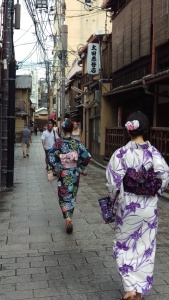
I think regular readers will have worked out that there were some obvious reasons I saw textiles everywhere in Japan–after all, I was seeking them out! I must admit though–and I’ve already explained that my ignorance and lack of language are a limitation–that fabric in Kyoto seemed far more accessible than at home. I was really impressed by the range of scrap fabric and recycled fabric available, and the range of places it was for sale. My friend and I bought scrap packs at a high end Shibori store.  There were packs of scrap fabrics available on street stalls during the evening street parties that came with the Gion festival.  Kimono is a big business in Kyoto and no doubt especially during the Gion festival, when people clearly go out of their way to dress up and dress traditionally, and tourists often do so as well.
IMAG0538

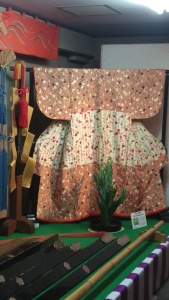
This may be one reason that secondhand kimono are for sale in so many places. The amount of silk made into clothing in Japan (relative to Australia) might also account for the availability of bolt ends of kimono silk and for some of the scraps which seem to have been torn off when a hem was raised, for example. But to my ignorant eyes it also seemed there was a different kind of reverence for beautiful fabric and design. During the Gion festival when community treasures are on display, fabulous garments were among them.
IMAG0738

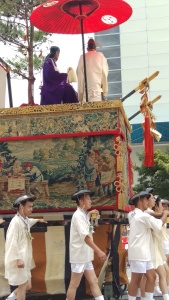
When the Gion floats were paraded through the streets, they were hung with amazing, and in some cases, ancient, tapestries and carpets, often imported (long ago and from far away).

IMAG0882

Here is another example.

IMAG0915

And another!  It was amazing! I had been watching some of the floats being assembled out on the streets (remember the temperature is 39C or above every day at this stage), visited them on display once complete and seen the Gion Bayashi musicians rehearsing in them. Then we saw them lifted, pulled or wheeled through the streets on one of the two parade days. To see them all was extraordinary–each with a complex history and a heavy freight of symbols.  How hard it must have been to be pulling them through the streets–some of them weighing tonnes and with antique wooden wheels, being kept on track by a wooden chock dextrously applied as the wheels turned, and cornering without steering by use of wet bamboo slats and brute strength.  Sweaty work even for the very committed.

IMAG0947

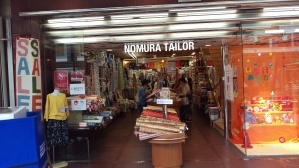
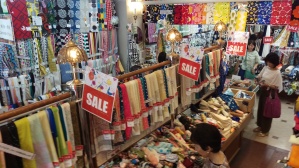
But wait, there’s more.  I’d researched some things prior to departure and understood Nomura Tailor was not to be missed. The main store was on the big shopping strip of Kyoto (the Rundle Mall of Kyoto for local-to-me readers). It looks small here but there were four, or perhaps five, floors!
IMAG1111

I was entirely unsure whether it was acceptable to take photographs, and found myself in someone’s way no matter where I stood on any floor with a small reprieve on the top floor where haberdashery was for sale. I was utterly embarrassed!
IMAG1110

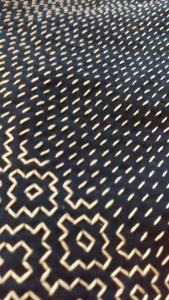
Here was for sale every kind of cloth. Every colour of linen.  Lots of cute prints (I now understand a little more about the cute aesthetic in Japan, but not a whole lot)! In the image above you can see an entire display of Marimekko. I have never seen so many Liberty prints outside a Liberty store. And so on (remember, this is only what I could recognise). It was overwhelming. I try not to buy new stuff as a general rule–but I really wanted to buy here and could find no way to make a decision about where I would stop if I started. I came back on a second day to see if I had more judgment or perhaps it was less crowded.  I still could not bring myself to buy fabric, overwhelmed by how I would ask for it, not understanding how to initiate a purchase, not wanting to hold up the queue, and in general feeling all heffalump in a very organised and efficient space in which I was unable to grasp the key organisational and efficiency principles. I bought some braid, some Japanese zippers and some sashiko sampler packs. The difference between buying fixed items and negotiating yardage is profound, or at least it felt that way to me on the day!
IMAG1324

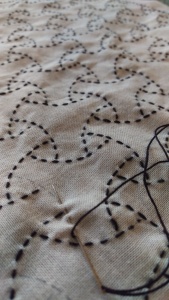
The sashiko samplers turned out to be cushion covers but only the shape of the fabric and the pictures with the Japanese instructions inside allowed me to work this out.  I became ill a week or so after returning and did a lot of stitching!
IMAG1298

None of these was the highlight for me. The highlight really was going to a shrine sale the day we left.  We went to the flea market, and it was immense.  It was not a fabric sale–pottery, tools, metal, ready to eat food, brushware, vegetables, pickles… just abut everything!  It was over 40C that day and I inhabited a fantasy that I could look around and come back to things sighted earlier.  Oops! That is one thing I do regret.  Here was every kind of fabric, new and second hand. New garments and second hand garments. Second hand sake bags.

IMAG1146_BURST002

Sacking, advertising materials on fabric (as far as I could tell). Cheap mass produced stuff. I bought what turned out to be strips from the ends of bolts (lengths?) of white silk kimono fabric. Then there were so many second hand fabrics whose origins I could only guess.

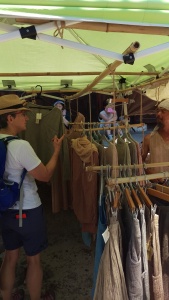
There were plant dyed clothes, and while indigo was prominent some were dyed with nettles, cedar bark or wormwood (that is what I could understand at any rate–)
IMAG0746

There was vintage clothing and fabric in every stage from well preserved to utterly disintegrating and in every stage of being mended from a patch here or there to rags stitched together–the boro tradition.  There were also many stallholders converting scraps of beautiful silk or vintage indigo dyed fabric into small items of loveliness, honouring them by transforming them.

I have read about boro and seen images, and read its history.  But while some of these items spoke of thrift and long wear, some were so ragged and so much mended that I was confronted by a sense of grief and awe for the people whose suffering and resilience created these clothes and cloths. While they now sell for a good deal of money (which does not go to anyone who used them), these items speak of the sheer poverty and difficult lives as well as speaking of the diligence, skill, love and care that must have gone into them.

In the end, I felt as though the flea market was an education in the life of everyday people through textiles. The museums I visited focused on things of high quality and amazing craft and design skill (as museums often do). Yet, this means museums often tell the stories of the wealthy and powerful, even when it is their clothing that is on show. At the flea market, the incredible effort that went into staying warm and covered for so many people who made that wealth possible was on show instead.
6 Comments

Filed under Natural dyeing, Sewing

Boomerang Bags–a few more!

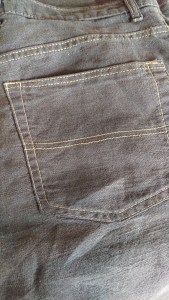
Well, I’ve had some weeks of illness in which knitting seemed too much. I know, I know!! But I managed to slowly make more Boomerang bags some days.  I finally cut up a pair of ramie jeans I must have kept for at least 15 years since they  wore right out, in case I’d learn how to make another pair… or something.  I can see why I loved these from the time I bought them second hand in, oh, the late 1980s or early 1990s– but I’ve finally let my longing to reproduce them go and taken the scissors to them.

IMAG1221

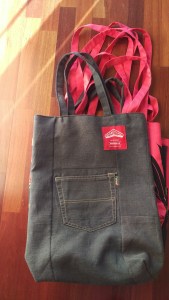
They made some nice bags…

IMAG1234

I found yet more bits and pieces to create linings from, including jeans pockets and other leftovers from the last round of bags.

This series of bags all came from a striking border print I had in stash.  Origins lost in the mists of time, but I guarantee I never imagined myself in a square dancing circle skirt made of this!

Then there was this shirt I made many years ago and had years of happy times wearing.  Now that fabulous print gets a new lease on life.

The last of one of Joyce’s fabrics, teamed with jeans that have passed the point of no return for a nice strong base.

Finally, I had quite a score of big prints on cotton canvas one day at the op shop. A black and white panel seemingly designed to hang on a wall and then these red and green prints.

And that is a wrap! But not a single use plastic wrap, haha….


3 Comments

Filed under Sewing

Komebukuro bags

It all began with a visit with friends, who took us for a trip through part of Tasmania, months ago.  We went to a country market and right beside it was Wafu Works. What a place!  Full of all kinds of Japanese paper, textiles and tools. I ended up with some thread an sashiko needles, and bought a kit to make a rice bag with some gift money… Indigo dyed fabrics on the outside, a red lining and a drawstring cord.

IMAG6295

I was so intrigued.  I learned a new stitch and a cunning construction. I loved the vintage fabrics.  You know what happened next, right?  I paired the leftover fabric with some of my own indigo dyeing, and cut up a mauve linen shirt I remember buying about 16 years ago for the lining, and pieced the scraps together…

IMAG0015

In the end I made three, and I’m now itching to make more…


7 Comments

Filed under Sewing

Boomerang bags

I decided to raid my stash of pockets.  They have been cut out of garments I am turning into other things (like bags!) and here they are now, stitched to the inside of Boomerang Bags.

What bags?  I hear you asking.  These bags. Historical cotton, and upholstery fabric left for me by the charming BB volunteer organiser who collected my last lot of completed bags (she apparently does not understand the supply issue at my place is oversupply).


Oh, and I mean these bags too.

And these! I have now reached the end of the 1980s eye-bleeding fabrics from hard rubbish and moved back to whittling away the back catalogue of fabrics I have inherited, bought, thrifted, or upcycled from garments and manchester. Scraps are getting thinner in the cupboards.  My love of tablecloths shows less. The ancient pairs of trousers and jeans ran out and I have acquired some jeans through the op shop so I have sturdy fabric for places I need it (handles, for example).  In fact, I have started reorganising the supplies in the room I use to sew, and I’ve also decided to release some fabrics into the wild.  Some were needed for a friend’s school project, and he liked some fake fur scraps so much they went home with him too. I took some more to the Guild last night because… I am reaching layers of my own stash that I cannot imagine ever using and there is no obvious reason I should keep them instead of taking them to places where other people might enjoy them! And… twelve or more fully lined Boomerang bags are under construction and moving gradually to the finish line right now.


Leave a comment

Filed under Sewing

Plant dyed fabrics

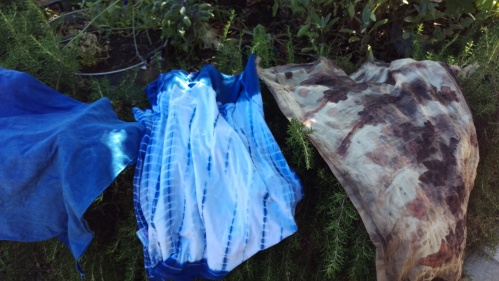
These are the results of my last day of dyeing, dried and ironed and ready for use.  Some have already gone to new happy homes and the one at top right has become a pocket!

2 Comments

Filed under Leaf prints, Natural dyeing

Rinse and repeat

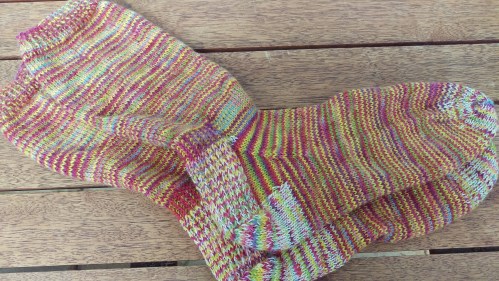
If these socks look familiar, its because a beloved friend brought me two skeins of lovely wool naturally dyed by Aurinkokehra. I knit a pair of socks from the first skein not so long ago and in the end, could not resist knitting another.  I’ve repeated the calf shaping, reinforcing stitches,  and the cotton and silk reinforcing thread.  The result is equally delightful.  There is something about yarn that changes colour as you knit that I really enjoy.  Such a well chosen gift for me!  These socks contain no nylon and no superwash–so I guess that they might be #tuffsocksnaturally but the yarn is certainly not my handspun.

IMAG6383

3 Comments

Filed under Knitting, Natural dyeing

PS: More on mending

IMAG6483

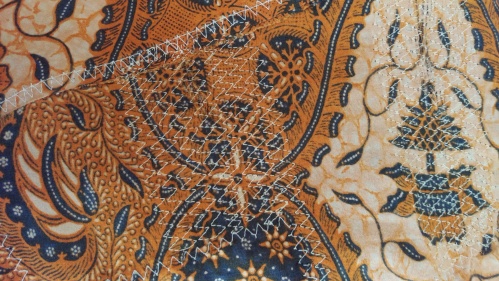
Just as I felt the mending was done, I found two–two!  Holes had worn through in my pyjamas.  The fabric is so thin.  I decided a big patch and a lot of machine stitching was the solution this time.  Here it is on the inside (below).  The patch was just a scrap left over from cutting something else out and I decided it was fine as it was.  Making it a rectangle didn’t seem likely to improve it.

IMAG6477

Then I realised how many patches there already were. At least three–with some pictures from the inside and some from the outside below. Some of these look just like scribbling to me.

And that same day, I mended the stiffening rectangle at the bottom of a shopping bag… and my beloved handed over some ripped jeans for repair!

7 Comments

Filed under Sewing

Mending the mending

Recently the pile of mending on my mind reached a point where it became the weekend’s project. But–I realised that there was only one thing I was mending for the first time.  I’ve reached the mending on mending stage.  This knitting bag has been waiting for a few more stitches into the base–the fabric the base is made from has just worn through over time.  But I don’t want to let the bag go.  It was made by one dear friend and embroidered by another and it was a birthday gift from years back.  It’s a treasure.  This time I fully embraced the idea of stitching the outer and lining together because I think this bag is at a stage in life where more mending is inevitable and not too far away.

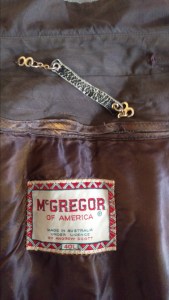
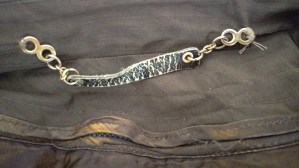
Then there was the raincoat.  This op-shop find has had years of living on my office door for emergency wear because it is shower proof and has a zip-out wool lining. It’s a high quality garment!  If I am caught by wind or rain on my way home, I can grab it and run for the bus. It had this sophisticated arrangement for hanging on a hook (and I do hang it on a hook) and it has been broken for quite a while.

IMAG6437

This week I was caught by sudden wind and rain and wore it home.  The hanging arrangement is now stitched back with waxed linen thread.

IMAG6438

And I did some mends to the wool lining.  Yes, visible mending it is. Check out the fringe on the wool liner!

IMAG6458

My leafy linen bag, patched together from offcuts of my earliest eco-printing experiments on recycled linen shirts had worn through in several places again. Here it is  in use in 2014 and being mended in 2014.  The fading shows. Could I bear to let it go?  Not yet.  The new patches are all from one piece of dyed cloth that took up a lot of yellows.

Then there was the mighty flourbag shirt, which was mightily mended in 2015.  The patches on the inside fronts had not been stitched to the seams in every single place, and now there are holes right where I missed that rather crucial step in mending a garment that has been worn this much.  here are some of the holes and frayed parts…

And here are the mends seen from the inside and outside:

Sometimes when I mend people post asking why I bother.  Which is a decent question.  In a case like this raggedy shirt I think the only explanation can be that I love this shirt so much I don’t want to give it up.  Even though I wear it for gardening and such (let me be clear, I love having time in the garden).  the fact that I made it is part of it, but I make other things that I don’t love this way.  I love the feel of the calico and I have come to enjoy patching it up.  There are more places that have worn through where I am not going to bother at this stage–like where some layers of the collar have worn away but there are others still holding together.

And speaking of gardening, here are my gardening jeans.  Another case of thinking you have patched out to where there is some fabric with integrity and finding that a hole wears through just beyond the patch.  Never mind, just add on!  These jeans are comfortable for grubbing around in, and although I have another pair that are beyond use in polite company, they are made from poor quality denim that won’t bear a whole lot of mending.  They had a twin pair and I tried–but sometimes I can’t mend something back to wearable.  How do you decide when to mend your mending and when to let it go?

9 Comments

Filed under Sewing

Of Aprons and Alchemy

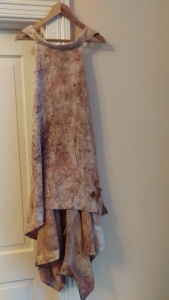
Some years ago, I made an apron at an India Flint workshop.  It’s an ingenious design India has created which starts with a shirt with a collar and ends with a coverall with straps that cross over at the back.  This model also has some stitched-on panels creating a generous length at the back.

IMAG6331

I brought this garment home to dye it, and it would be fair to say that I never loved the outcome (friends who were consulted recently liked it more than I did).  And, it had some large holes for which I was responsible and which I had a lot of [bad] feelings about having created.  In short, this garment has been in the naughty corner (the place garments go to wait when I have been naughty) for some extended time.  But then, India put up an online course called The Alchemist’s Apron.   It is further supported by an online community of eager stitchers and dyers from all round the world on facebook.  I was lucky enough to be gifted an enrolment (Thank you India!)–and this turned out to be the trigger for getting the apron out of the naughty corner and into my hands again.

IMAG6322

First step, give it a wash and soften it up a bit (soy mordant no doubt was responsible for starching it a little).  Second step, mending. Mending is an evening occupation for me, thus the mood lighting… I have learned some things about mending since these holes appeared and decided to use several different strategies.

Some mends went over the hem (they were the most discouraging). These round-ish mends I especially like.

Once that was done, a second pass through the soy mordanting process, a wander around my neighbourhood by bicycle collecting leaves, and a bundle up with home made string (hems and seams left from cutting up and recycling clothing, in this case).

IMAG6359

I do love eucalyptus.

IMAG6361

The mends still stand out but I think that is OK, because #visiblemending!  I had chosen linen patching and cotton thread, which did rather guarantee they would stand out as the patches are mostly in the added border at the back of the apron which is cut from a recycled op shop raw silk pant suit a friend gave me.

IMAG6389

I like the new apron much more!

IMAG6385

And here is the back view… with the button placket still sporting buttons.  It’s a bit glorious now, I think. Do you have things waiting in the naughty corner?  How do they get there, and more importantly, what motivates you to get them out again?

IMAG6386

14 Comments

Filed under Natural dyeing, Sewing

Summer Dye Camp at Beautiful Silks

It seems so long since I went to Beautiful Silks in Allansford for Summer Dye Camp and yet–no post.  The tutor once again was Jenai Hooke, full of expertise and inspiration, and dye camp was wonderful!

IMAG5994

We dyed with fresh woad from the garden and ice.

2018-01-23 12.08.55

My fellow dyers did all kinds of amazing things with indigo and leaves. The crowd at Beautiful Silks never fails to be full of inspiring and interesting humans.

2018-01-23 14.43.49

Critters dropped in!

IMAG5997

This is a strategy for dyeing yarn that would never have occurred to me.  Stunning in the skein (and all multi coloured skeins have their challenges).

IMAG6017

I dyed with indigo and with eucalypts.

IMAG6009

I learned a new-to-me and very effective way of mordanting with soy, and was re-educated about the importance of scouring.

IMAG6006

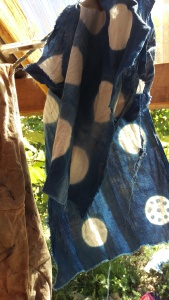
I made indigo circles for later use, inspired by Jude Hill’s indigo moons on Spirit Cloth.

There was so much more!  Madder, cochineal, walnut, tannins, mud, indigo painting… what a fabulous way to spend a holiday, plus the glorious time spent in Warrnambool and surrounds.  Highly recommended.
4 Comments

Filed under Natural dyeing