Tag Archives: think globally

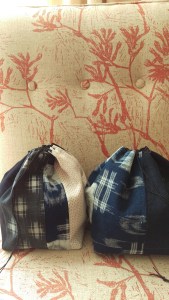
Komebukuro Rice-Bags

IMAG1455

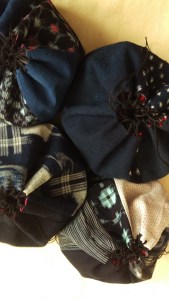
I am still in love with this traditional Japanese style of bag.  Having acquired Japanese fabric scraps in Japan, I made some more, combining recycled clothing (a red linen shirt from the op shop and a maroon sleeveless linen shirt worn very much by me since the 1990s became linings) with fabric I have dyed with indigo as well as all kinds of Japanese fabric scraps.

IMAG1458

I find this design very cunning, and in Japan, I was struck by the different styles that casings tended to take, with drawstrings travelling through casings that were quite separate from the main bag.  In the drawstring constructions I more often have encountered and created, the drawstring passes through a casing in the garment or bag itself.

IMAG1454

And there it is again.  I constantly find myself creating series, and I constantly find myself much more readily making scraps, remnants and recycled fabrics into projects rather than using untouched loveliness in my possession, as if it is too special and valuable to cut, even when it is a gift!  I’ll have to work on that, because of course I want people to use the things I gift them!

IMAG1453

8 Comments

Filed under Sewing

Fabrics in Kyoto

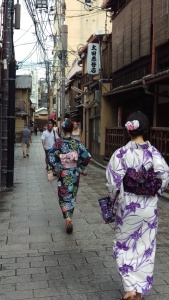
I think regular readers will have worked out that there were some obvious reasons I saw textiles everywhere in Japan–after all, I was seeking them out! I must admit though–and I’ve already explained that my ignorance and lack of language are a limitation–that fabric in Kyoto seemed far more accessible than at home. I was really impressed by the range of scrap fabric and recycled fabric available, and the range of places it was for sale. My friend and I bought scrap packs at a high end Shibori store.  There were packs of scrap fabrics available on street stalls during the evening street parties that came with the Gion festival.  Kimono is a big business in Kyoto and no doubt especially during the Gion festival, when people clearly go out of their way to dress up and dress traditionally, and tourists often do so as well.
IMAG0538

This may be one reason that secondhand kimono are for sale in so many places. The amount of silk made into clothing in Japan (relative to Australia) might also account for the availability of bolt ends of kimono silk and for some of the scraps which seem to have been torn off when a hem was raised, for example. But to my ignorant eyes it also seemed there was a different kind of reverence for beautiful fabric and design. During the Gion festival when community treasures are on display, fabulous garments were among them.
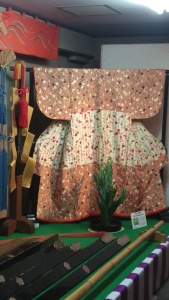
IMAG0738

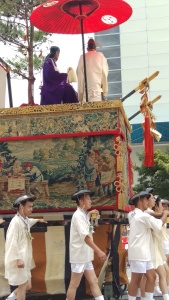
When the Gion floats were paraded through the streets, they were hung with amazing, and in some cases, ancient, tapestries and carpets, often imported (long ago and from far away).

IMAG0882

Here is another example.

IMAG0915

And another!  It was amazing! I had been watching some of the floats being assembled out on the streets (remember the temperature is 39C or above every day at this stage), visited them on display once complete and seen the Gion Bayashi musicians rehearsing in them. Then we saw them lifted, pulled or wheeled through the streets on one of the two parade days. To see them all was extraordinary–each with a complex history and a heavy freight of symbols.  How hard it must have been to be pulling them through the streets–some of them weighing tonnes and with antique wooden wheels, being kept on track by a wooden chock dextrously applied as the wheels turned, and cornering without steering by use of wet bamboo slats and brute strength.  Sweaty work even for the very committed.

IMAG0947

But wait, there’s more.  I’d researched some things prior to departure and understood Nomura Tailor was not to be missed. The main store was on the big shopping strip of Kyoto (the Rundle Mall of Kyoto for local-to-me readers). It looks small here but there were four, or perhaps five, floors!
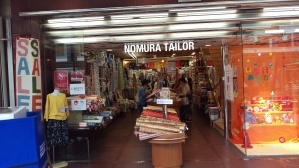
IMAG1111

I was entirely unsure whether it was acceptable to take photographs, and found myself in someone’s way no matter where I stood on any floor with a small reprieve on the top floor where haberdashery was for sale. I was utterly embarrassed!
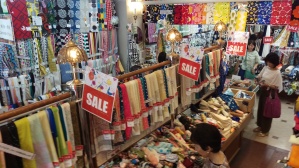
IMAG1110

Here was for sale every kind of cloth. Every colour of linen.  Lots of cute prints (I now understand a little more about the cute aesthetic in Japan, but not a whole lot)! In the image above you can see an entire display of Marimekko. I have never seen so many Liberty prints outside a Liberty store. And so on (remember, this is only what I could recognise). It was overwhelming. I try not to buy new stuff as a general rule–but I really wanted to buy here and could find no way to make a decision about where I would stop if I started. I came back on a second day to see if I had more judgment or perhaps it was less crowded.  I still could not bring myself to buy fabric, overwhelmed by how I would ask for it, not understanding how to initiate a purchase, not wanting to hold up the queue, and in general feeling all heffalump in a very organised and efficient space in which I was unable to grasp the key organisational and efficiency principles. I bought some braid, some Japanese zippers and some sashiko sampler packs. The difference between buying fixed items and negotiating yardage is profound, or at least it felt that way to me on the day!
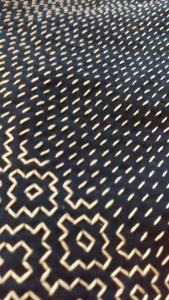
IMAG1324

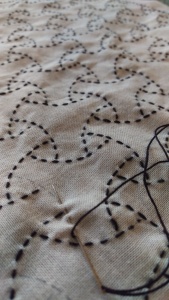
The sashiko samplers turned out to be cushion covers but only the shape of the fabric and the pictures with the Japanese instructions inside allowed me to work this out.  I became ill a week or so after returning and did a lot of stitching!
IMAG1298

None of these was the highlight for me. The highlight really was going to a shrine sale the day we left.  We went to the flea market, and it was immense.  It was not a fabric sale–pottery, tools, metal, ready to eat food, brushware, vegetables, pickles… just abut everything!  It was over 40C that day and I inhabited a fantasy that I could look around and come back to things sighted earlier.  Oops! That is one thing I do regret.  Here was every kind of fabric, new and second hand. New garments and second hand garments. Second hand sake bags.

IMAG1146_BURST002

Sacking, advertising materials on fabric (as far as I could tell). Cheap mass produced stuff. I bought what turned out to be strips from the ends of bolts (lengths?) of white silk kimono fabric. Then there were so many second hand fabrics whose origins I could only guess.

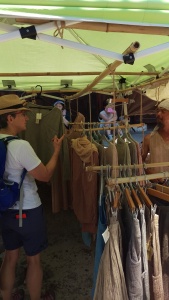
There were plant dyed clothes, and while indigo was prominent some were dyed with nettles, cedar bark or wormwood (that is what I could understand at any rate–)
IMAG0746

There was vintage clothing and fabric in every stage from well preserved to utterly disintegrating and in every stage of being mended from a patch here or there to rags stitched together–the boro tradition.  There were also many stallholders converting scraps of beautiful silk or vintage indigo dyed fabric into small items of loveliness, honouring them by transforming them.

I have read about boro and seen images, and read its history.  But while some of these items spoke of thrift and long wear, some were so ragged and so much mended that I was confronted by a sense of grief and awe for the people whose suffering and resilience created these clothes and cloths. While they now sell for a good deal of money (which does not go to anyone who used them), these items speak of the sheer poverty and difficult lives as well as speaking of the diligence, skill, love and care that must have gone into them.

In the end, I felt as though the flea market was an education in the life of everyday people through textiles. The museums I visited focused on things of high quality and amazing craft and design skill (as museums often do). Yet, this means museums often tell the stories of the wealthy and powerful, even when it is their clothing that is on show. At the flea market, the incredible effort that went into staying warm and covered for so many people who made that wealth possible was on show instead.

6 Comments

Filed under Natural dyeing, Sewing

Boomerang Bags–a few more!

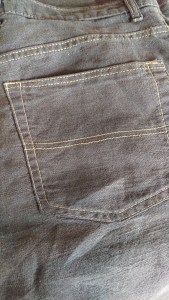
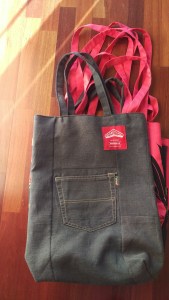
Well, I’ve had some weeks of illness in which knitting seemed too much. I know, I know!! But I managed to slowly make more Boomerang bags some days.  I finally cut up a pair of ramie jeans I must have kept for at least 15 years since they  wore right out, in case I’d learn how to make another pair… or something.  I can see why I loved these from the time I bought them second hand in, oh, the late 1980s or early 1990s– but I’ve finally let my longing to reproduce them go and taken the scissors to them.

IMAG1221

They made some nice bags…

IMAG1234

I found yet more bits and pieces to create linings from, including jeans pockets and other leftovers from the last round of bags.

This series of bags all came from a striking border print I had in stash.  Origins lost in the mists of time, but I guarantee I never imagined myself in a square dancing circle skirt made of this!

Then there was this shirt I made many years ago and had years of happy times wearing.  Now that fabulous print gets a new lease on life.

The last of one of Joyce’s fabrics, teamed with jeans that have passed the point of no return for a nice strong base.

Finally, I had quite a score of big prints on cotton canvas one day at the op shop. A black and white panel seemingly designed to hang on a wall and then these red and green prints.

And that is a wrap! But not a single use plastic wrap, haha….


3 Comments

Filed under Sewing

Waste and strategies to avoid it in Japan 1

I sometimes think that travel is at least as much an encounter with your own ignorance and arrogance as it is with another country and its cultures. In Australia, I have heard various things about waste and thrift in Japan from Japanese people as well as from Australians who have travelled to Japan (but weren’t born there).  I’ve heard both about minimalism and about a culture of everything needing to be new and old things being always thrown away.  I’ve read about boro and also about extravagant, amazing silken fabrics. And, as with the culture/s I live in, surely there would be diversity and contradiction? I was interested to see what I could learn about avoiding waste from being in Japan, and to see how recycling was managed there.

IMAG0669

One place where I noticed a very striking difference between Japan and Australia was public bathrooms/toilets. I am not referring to the differences in toilets between these two places, though those are considerable. For those who do not wish to hear anything more on this subject–skip the next two paragraphs!

IMG_20180713_194057_807

In an upscale public toilet (airports, big cultural institutions, department stores) Australia has toilets that while clean and even occasionally stylish, are metaphorically like an old fashioned phone. Though water saving, they often offer half or full flush, and that is all they do, like a phone that merely allows you to make or receive a phone call.  Japan has these too, but they also have the toilet equivalents of the SmartPhone. They play music, may come with a motion sensor and light up, mist water and/or play music as you approach (which made me giggle a lot). Some offer a heated seat with different heats, multiple washing/bidet options and self cleaning.  It’s also routine for Japanese public toilets to have an emergency call button (not so in Australia). Half and full flush, of course. Designed so the lid must be down to flush (which would be capable of ending gender wars on several continents if adopted worldwide–or maybe that’s an Australian thing). And that’s what I figured out without being able to decode all the options (because I couldn’t read the buttons and even our hotel had decided English speakers only needed translation of about 4-6 of about 20 options).

IMAG0287

On the other hand, in less flash places where tourists were less likely (some shrines, supermarkets, smaller or older public institutions) what my place of work calls a “natural posture” toilet, often translated in Japan as “traditional” and called by English speakers a “squat toilet” was the only option, and flush and emergency call were the only options. Much easier to figure out which to choose for the clueless such as myself. I could see from wordless queue exchanges where I was the only foreigner that I was not expected to use the traditional model (whether or not there were choices in the matter). In one museum I saw why Japanese people have reached this view when I saw a European looking woman open the door of a cubicle, startle visibly and hurry out. Also interesting, at a shrine sale where I had to watch the flow of people to even find a toilet, was a small bathroom being used by people of all genders, with gentlemen clearly expecting to use the urinal in mixed company with no evidence of embarrassment, and only the usual polite averting of eyes from people doing private things.  There was no evidence this was embarrassing to women or children, even with a fair sized queue standing by.

Well. How was that for a digression?

IMAG0441

When I go to a public toilet, I hope for a toilet and a place to wash my hands. And this was on offer everywhere we went. What I almost never saw outside of a major airport was a place to dry your hands nor anything to dry them with.  Contrast Australia where there will usually be a paper towel dispenser, electric hand dryer, or both–and in more traditional establishments, eco conscious businesses or people’s homes, a hand towel.  In Japan, none of these was common, no matter how upscale the building or how thick the traffic of tourists. I watched closely hoping to understand what was happening instead. I saw no clues at all, and clearly it was at least as impolite to stare in Japan as in any bathroom at home. Just imagine how much paper and power is being saved in this way, I thought!

IMAG0194

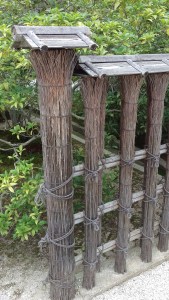
I did wonder if I had seen a clue out in plain view (hot as it was)–many people carried, wore or used a neck towel, at least in the heat wave we experienced.   I believe this might be the tenugui, often made of thin woven material or perhaps terry clothing on one side and plain weave on the other, narrower than an Australian hand towel and longer. People working or playing in the heat might have it draped over or wound around their heads (men and children), hanging dampened around their necks (anyone) or held in their hands. In the picture below, the men are participating in one of the major parades of the Gion festival in 39C heat and you can see these cloths in use. Sometimes I would see a woman pull one out of her handbag or bike basket and dab her face or neck at traffic lights or apply it to a sweaty child. Was this a sign that no one needed anything to dry their hands with because they had something suitable with them? I couldn’t figure it out but I never saw anyone shake their hands or dry them on their clothing either.
IMAG0981

After return to Australia, a Japanese zero waste instagram account I am following linked to some interesting sounding content, so I wandered off to their blog to find all manner of interesting applications of Japanese traditional knowledge and traditions to resolving the question of how to create less waste and use less plastic and there it was, another clue, perhaps.  The post is headed “homemade reusable wet wipes”. I am not sure this is the answer to my personal state of ignorance either, but the wet cloth in a container with a lid in this blog post, carried with you, seems to me an application of the Japanese custom of providing a wet hand towel with a meal. These tiny towels varied from room temperature to chilled, from clean individual white towels in nice restaurants to a shared, coloured cloth like a damp face washer made available to you at a food market stall where you might have been given a tasting of something that you could only eat with your hands, down to a non woven, disposable wet wipe in an individual plastic package in a downmarket eatery. It was usually available in place of the now-ubiquitous paper napkin I would find in a similar context at home. In some contexts–the reusable rather than single use item seems to me less wasteful as well as much nicer and more effective. On the other hand, the single use plastic wrapped kind may be even worse waste-wise than a compostable paper napkin, while both are offered in such a way they cannot really be refused.

IMAG0886


3 Comments

Filed under Sewing

Guerilla Gardening Winter Edition 2: propagating

Autumn is the season for cuttings. So as the weather cooled I started out with ‘old man’ saltbush. Here it is getting dipped in honey prior to planting.

IMAG6345

I’ve planted a lot of creeping boobialla of two different kinds and it is thriving around the neighbourhood.

So now I can take cuttings from these plants to make more!

I’ve been trying out correas and rock roses and had success with last year’s trials.

I have also dug out root divisions from the dianellas around our way to grow more, and cuttings from pigface too. So I now have a couple of hundred pots which are looking promising so far… and now I need to get myself into condition to be able to plant them when spring arrives.

IMAG6638


6 Comments

Filed under Neighbourhood pleasures

Guerilla Gardening Winter Edition 1: Planting out

Once winter seemed to have set in, I put my last plantings in the ground around the neighbourhood.  Everything that was sprouted from seed in spring and summer has now been planted out.

IMAG6683

There have been some losses as the Council or its contractors have been cutting down trees which have died sue to a soil borne fungus. Undergrowth often gets taken out in the complexity of removing entire tress. But they have also been planting more trees that are a decent size when they go in.  And then (I am guessing) one of my neighbours dug out my most successful weaving sedge, undoubtedly with different ideas about how to manage water flow through the neighbourhood after the flood. Even more recently, someone decided to take out two huge thriving wattles that I liked very much, presumably as a way of dealing with the gentleman who had been storing things behind them, sorting through them and then leaving behind what he didn’t want or need. I’d picked up the discarded items a few times, but evidently not enough for someone… or there was other trouble going on from someone’s point of view!

Some things are really thriving and this year I have direct seeded saltbush into some parts of the neighbourhood where ground cover is low, while in others, saltbush is being itself and spreading itself around freely. Thank goodness.

IMAG6685

Some of last year’s sheoaks have survived a more widespread than usual weed spraying programme and their understorey of saltbush and other tough native plants is growing too.

IMAG6689

In this very challenging spot I planted some random plants given to me by various people and this hibiscus has been flowering for months.  Understorey boobialla, some eucalypts and a feijoa tree are still growing too. Life just keeps growing up.

IMAG6713

Leave a comment

Filed under Natural dyeing, Neighbourhood pleasures

Boomerang bags

I decided to raid my stash of pockets.  They have been cut out of garments I am turning into other things (like bags!) and here they are now, stitched to the inside of Boomerang Bags.

What bags?  I hear you asking.  These bags. Historical cotton, and upholstery fabric left for me by the charming BB volunteer organiser who collected my last lot of completed bags (she apparently does not understand the supply issue at my place is oversupply).


Oh, and I mean these bags too.

And these! I have now reached the end of the 1980s eye-bleeding fabrics from hard rubbish and moved back to whittling away the back catalogue of fabrics I have inherited, bought, thrifted, or upcycled from garments and manchester. Scraps are getting thinner in the cupboards.  My love of tablecloths shows less. The ancient pairs of trousers and jeans ran out and I have acquired some jeans through the op shop so I have sturdy fabric for places I need it (handles, for example).  In fact, I have started reorganising the supplies in the room I use to sew, and I’ve also decided to release some fabrics into the wild.  Some were needed for a friend’s school project, and he liked some fake fur scraps so much they went home with him too. I took some more to the Guild last night because… I am reaching layers of my own stash that I cannot imagine ever using and there is no obvious reason I should keep them instead of taking them to places where other people might enjoy them! And… twelve or more fully lined Boomerang bags are under construction and moving gradually to the finish line right now.


Leave a comment

Filed under Sewing

Indigo dyed sock spinning

Friends, I have not been keeping up with my blogging. I apologise. Life in my day job has been challenging this last year, but change is coming and perhaps we will see more of each other in the not-too-distant. This not keeping up means I have crafting projects that happened some time ago that you have never seen.  Here is one of those projects.

IMAG6350

This post is part of the Tuff Socks Naturally project, an open, collaborative project exploring more sustainable alternatives to superwash and nylon in sock yarn. You can join in on the discussion on this blog or on the blog of the fabulous Rebecca at Needle and Spindle or on instagram using the hashtag #tuffsocksnaturally.

IMAG6374

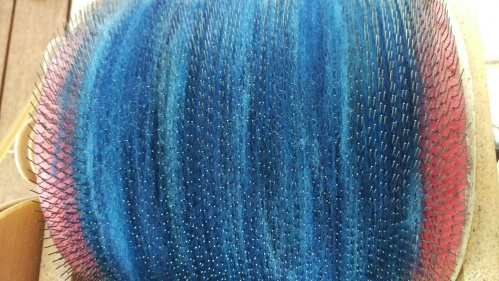
I am still working with Suffolk fleece, and I have been really keen to dye some with indigo.  I finally gathered up my nerve and tried refreshing my indigo vat over a long weekend.  And, success!!! In order to conserve dye and because the Suffolk is robust, full of vegetable matter, dirty even after washing, and hard to felt, I decided to flick card the locks prior to dyeing. That is what you can see in the top image. When I was able to achieve that deep blue in the picture above (the photo colour is not perfect–but this is NOT pastel blue), I felt no regrets.

IMAG6375

Then, to the drum carder.  No felting at all despite the challenging-to-wool alkaline environment of the vat followed by a lot of rinsing. Now the image below shows the colour most accurately. Colour me extremely happy about this yarn.

IMAG6536

My previous sock spinning efforts had persuaded me that I was not getting enough ply twist to create a robust sock yarn.  When I bought my spinning wheel, I decided to invest in a high speed head as well as two interchangeable whorls.  I was experiencing confidence that I would be spinning well into my future and want to use the wheel to its maximum capacity.  Since then, the place I bought that wheel, then the only spinning wheel seller in the city outside my Guild (which sells second hand) has closed. I’ve used everything that came with the wheel with only one exception, so that was a good call. Now to use the last accessory: the high speed head that would make it easier to get serious amounts of twist into my yarn even on evenings of weary spinning and distracted plying.

IMAG6546

Well, here is that yarn all wound up and ready to knit, waiting its turn in the knitting queue!  Just between me and you… as I write it has made it onto the needles and I’ve had the all-important conversation with a recipient who feels no reservation about this not-Merino-soft, local, plant dyed, single breed yarn.  Over a hot chocolate and chat tonight she took one look, squeezed the sock-in-progress and said YES!

7 Comments

Filed under Fibre preparation, Natural dyeing, Spinning

Leftovers socks

IMAG6439Trying to be thoughtful about sock yarns in a period where I knit socks constantly and quite quickly has led to all manner of interesting insights.  This post introduces another.  At present it is not an option for me to leave home without a sock in progress.  I’m spending a lot of time on public transport–which is good, but requires management.  I go to a lot of meetings and presentations–which is sometimes good and sometimes challenging. Socks help me!

IMAG6465

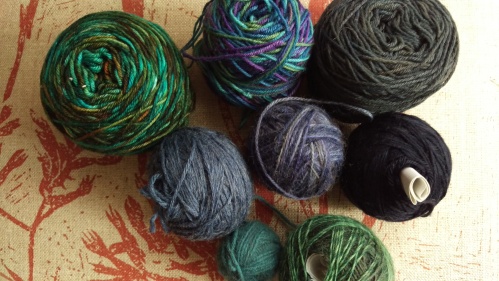
The tuffsocksnaturally project has been one great outcome of trying to move in an eco-friendly direction–and I have sock yarn spinning to show! However, creating sock yarn involves slowly spinning (I can’t take that on the bus!), dyeing, washing and converting skeins to balls.  All of which is pleasurable time spent but certainly does take time. In the case of my Suffolk adventures, I also need to be confident the intended recipient will enjoy and be able to comfortably wear the resulting socks, which requires some chat.  BUT: if there is some point where I do not have a handspun sock ready to knit and I reach the end of my current pair–I need a plan!

IMAG6462

A while back, I went to a two day meeting in Parramatta, which is now part of greater Sydney.  The tree and the sculpture are images from my roaming around in the few daylight hours I had outside a meeting there.  As I prepared to leave for an entire two days of meeting, with airport waiting, airtrain trips, waiting in train stations, and who knows what kind of night in a hotel, I ran out of sock yarn.  So I decided to knit leftover yarns in the same colour family into socks.  Yes, dear Readers, I am blessed with friends who have said to me “just knit up whatever you’ve got!  I’m not bothered if you use up your scraps” or, when I asked another friend if he fancied socks that were knit this way, said that sounded like fun.  To me this sounded a lot more attractive as a knitting project than some of the patterns I see popping up from time to time directed at people like me who have knit a lot of socks and have leftover sock yarns (some of which go to the recipient so they can darn in the future but some of which stay with me).

IMAG6509

And that is how one of my friends came to get these socks, which were received with a squeak of glee!

IMAG6511

8 Comments

Filed under Knitting

PS: More on mending

IMAG6483

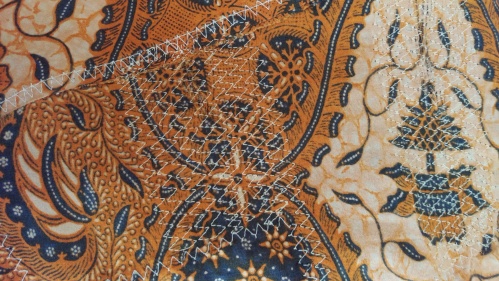
Just as I felt the mending was done, I found two–two!  Holes had worn through in my pyjamas.  The fabric is so thin.  I decided a big patch and a lot of machine stitching was the solution this time.  Here it is on the inside (below).  The patch was just a scrap left over from cutting something else out and I decided it was fine as it was.  Making it a rectangle didn’t seem likely to improve it.

IMAG6477

Then I realised how many patches there already were. At least three–with some pictures from the inside and some from the outside below. Some of these look just like scribbling to me.

And that same day, I mended the stiffening rectangle at the bottom of a shopping bag… and my beloved handed over some ripped jeans for repair!

7 Comments

Filed under Sewing