Category Archives: Natural dyeing

Local windfalls 2

I went for a walk the other day after more gale force winds.  The wind had been so impressive I watched every piece of mulch in our backyard become airborne the previous evening!  I took my trusty secateurs and a calico bag with me.

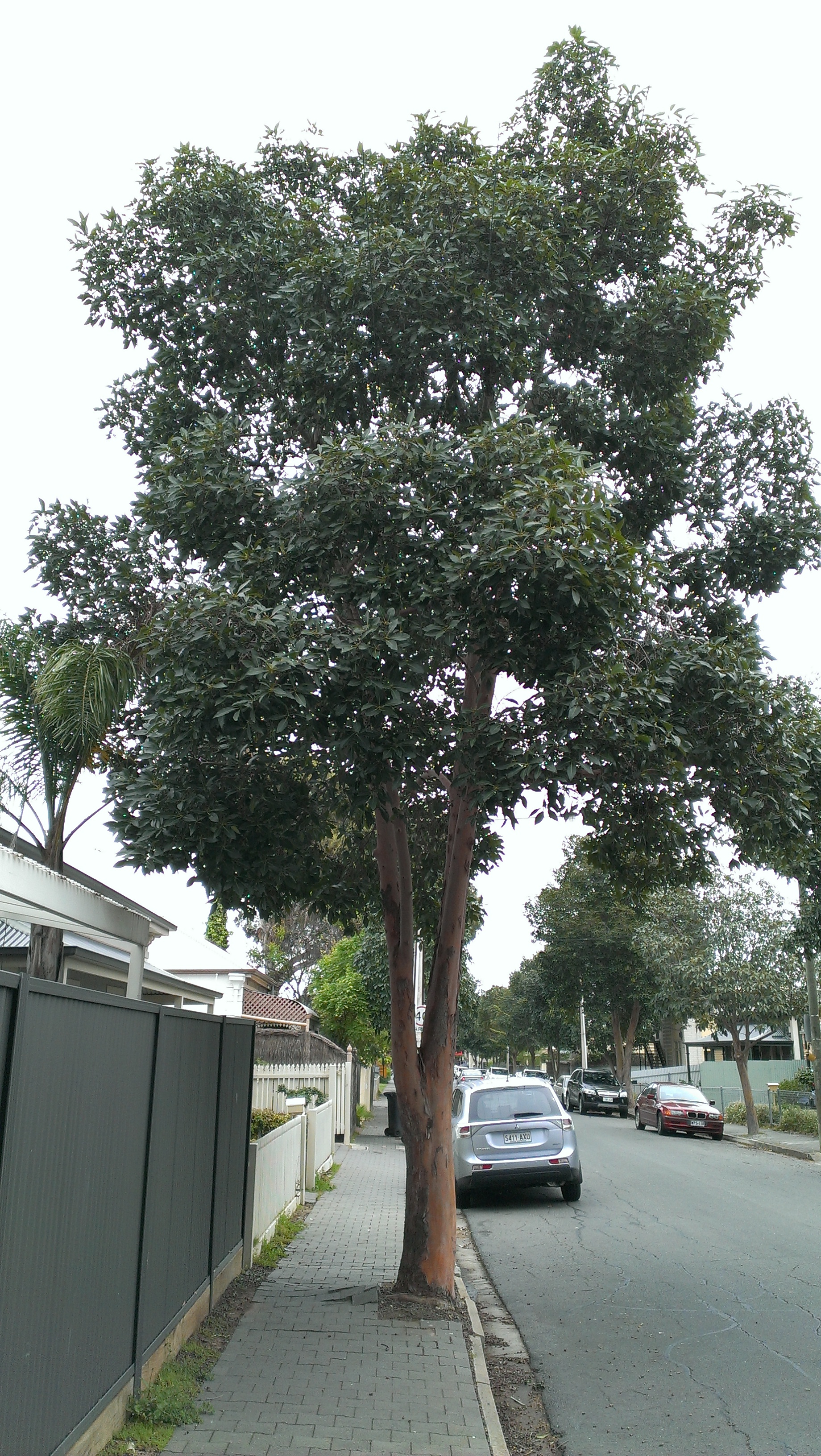
My first candidate (for the dye pot) is a tree my father calls Queensland Box.  Wikipedia suggests my father is right, and also that this tree is widely cultivated outside Australia.  It is Lophestemon Confertus–and its flower is just lovely (go to Wilkipedia if you’d like to see it–they are not in flower here right now).  The trunks peel to a lovely burnt orange but at present this process has barely begun.

IMAG2320

They are widely planted as street trees here.

IMAG2321  #

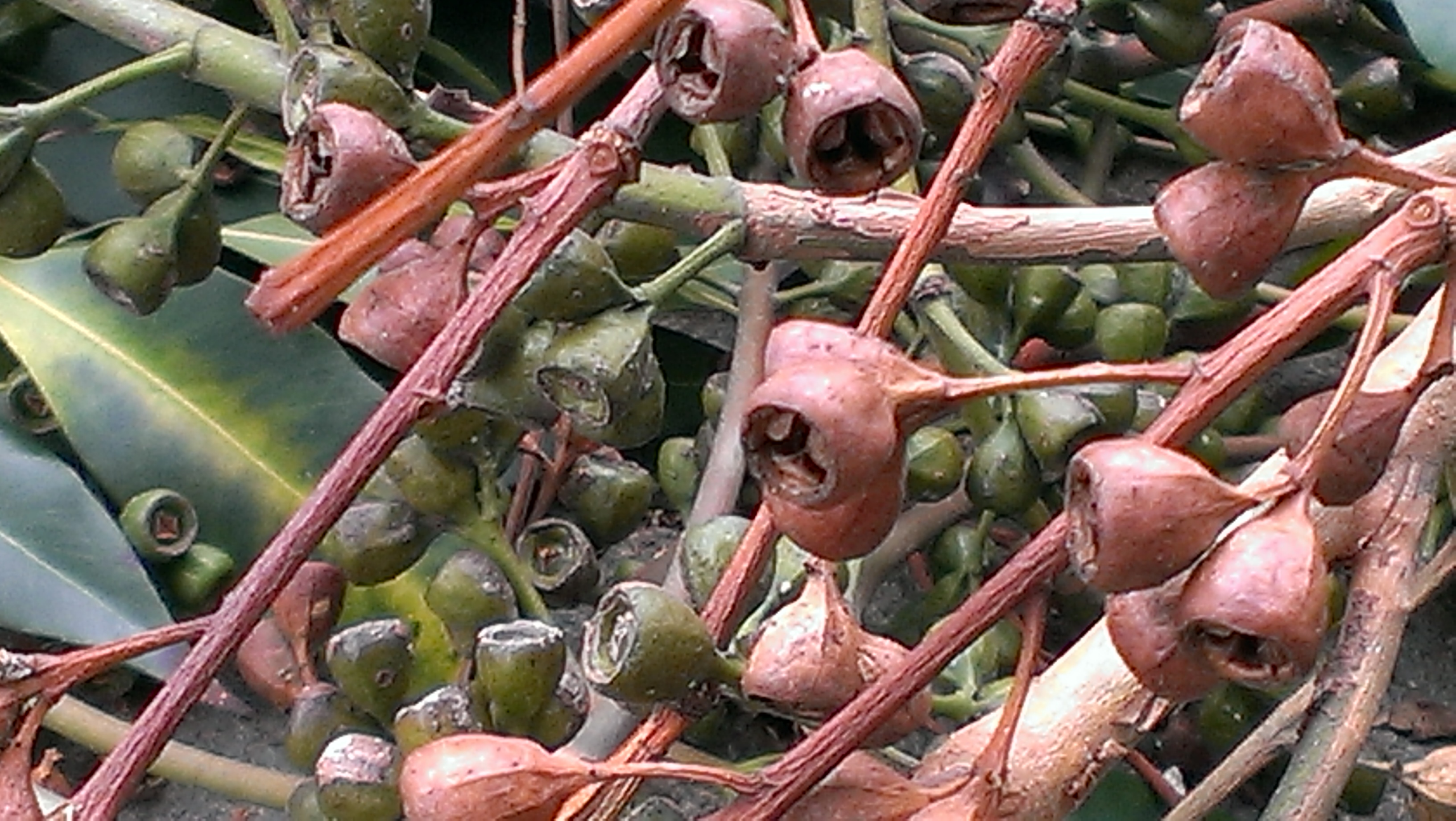
And they certainly are fruiting, with two generations of seed pods on show at present among glossy leaves.

IMAG2326

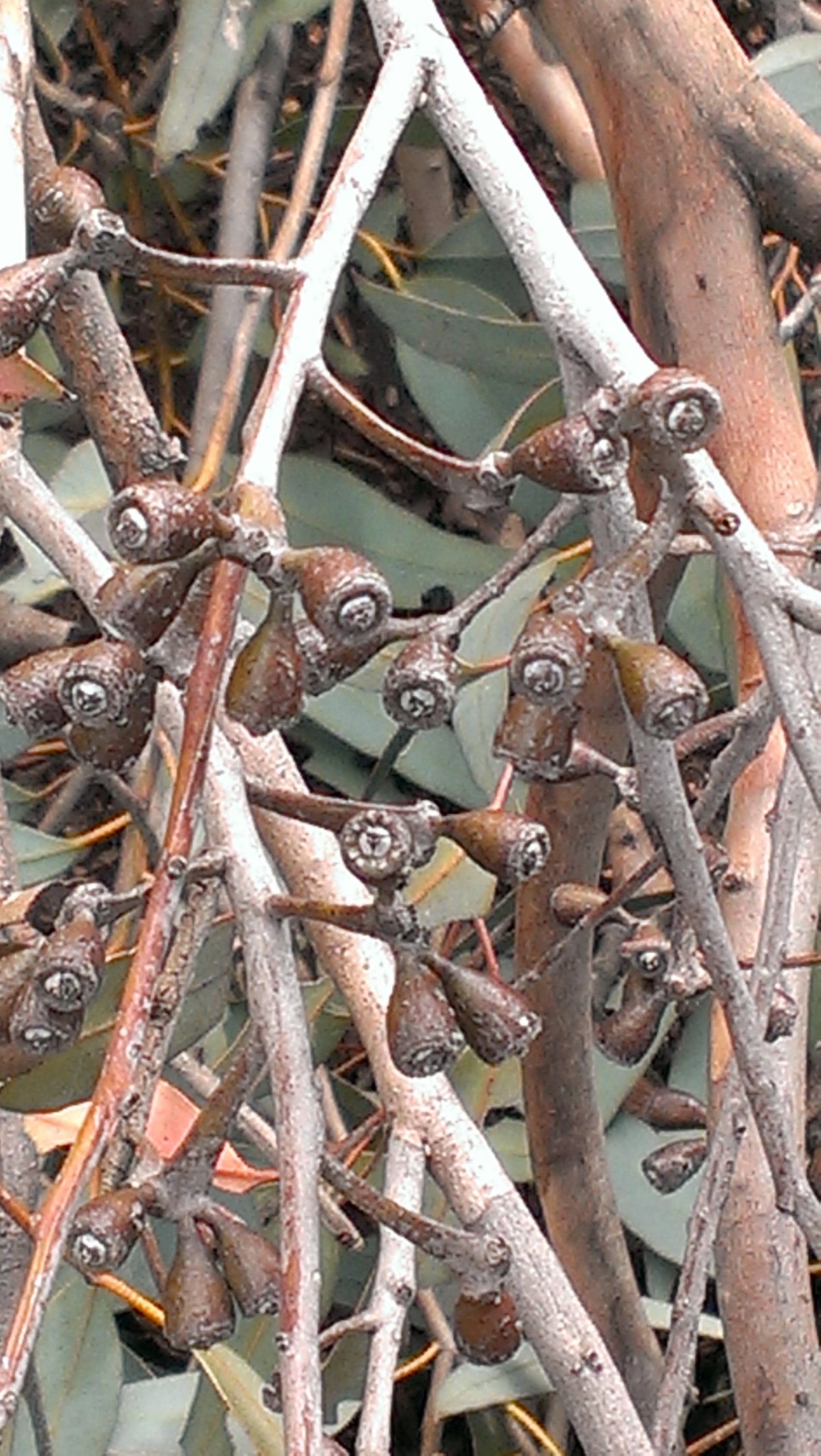
Two generations of fruit is one thing. Dye pot candidate two had four generations on show.  This eucalypt has been pruned ruthlessly but shows mostly smooth bark with rough, peeling bark near the base.  My best guess is E Macrandra (River Yate)–but this really is a guess.

IMAG2338

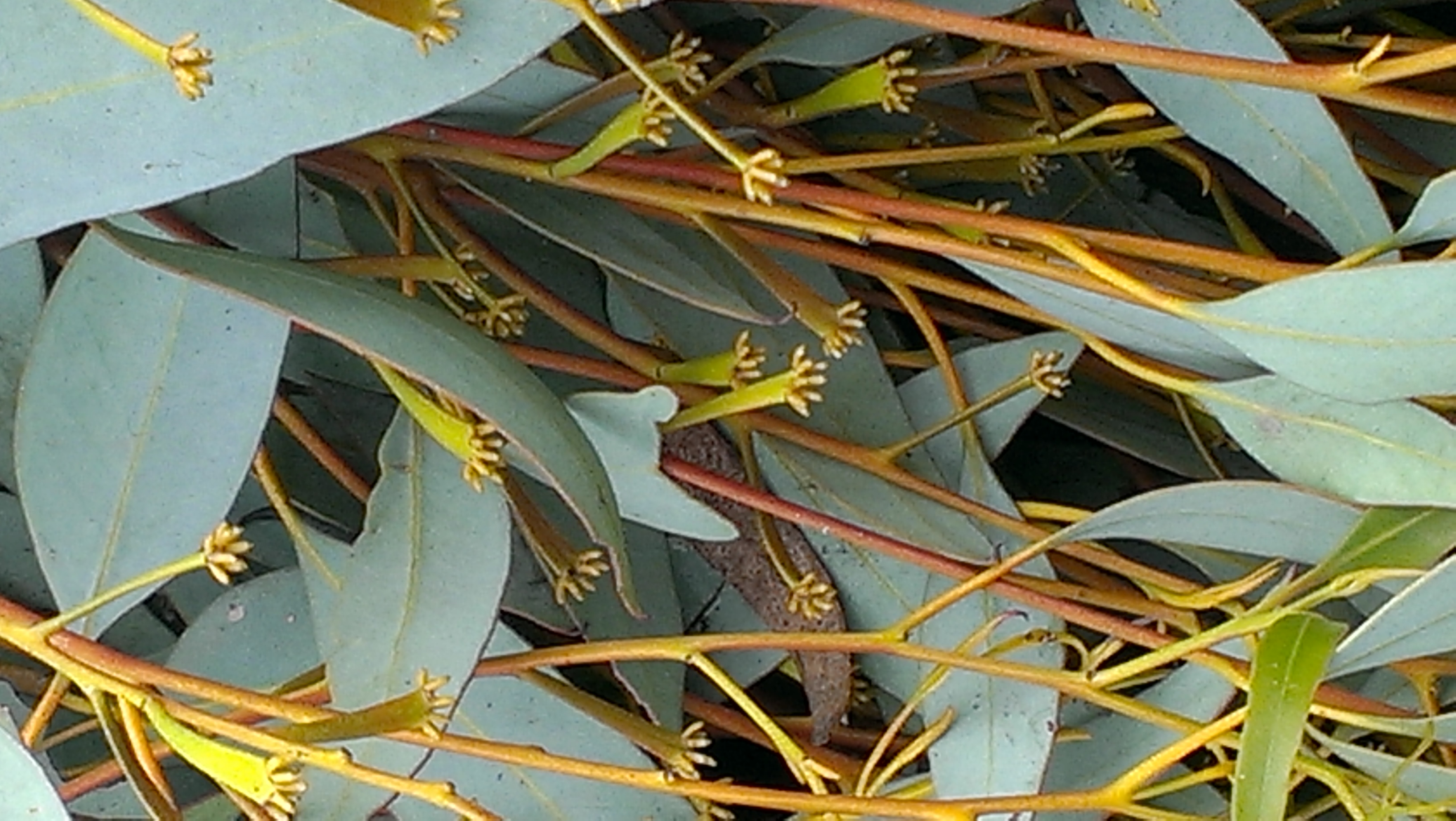
Now for the reproductive material! I think this is a ‘flattened, strap like peduncle’ as constantly referred to in my reference works. Those tiny ‘fingers’ are buds.

IMAG2339

Here the buds are again, a lot further along, in the second generation:

IMAG2344

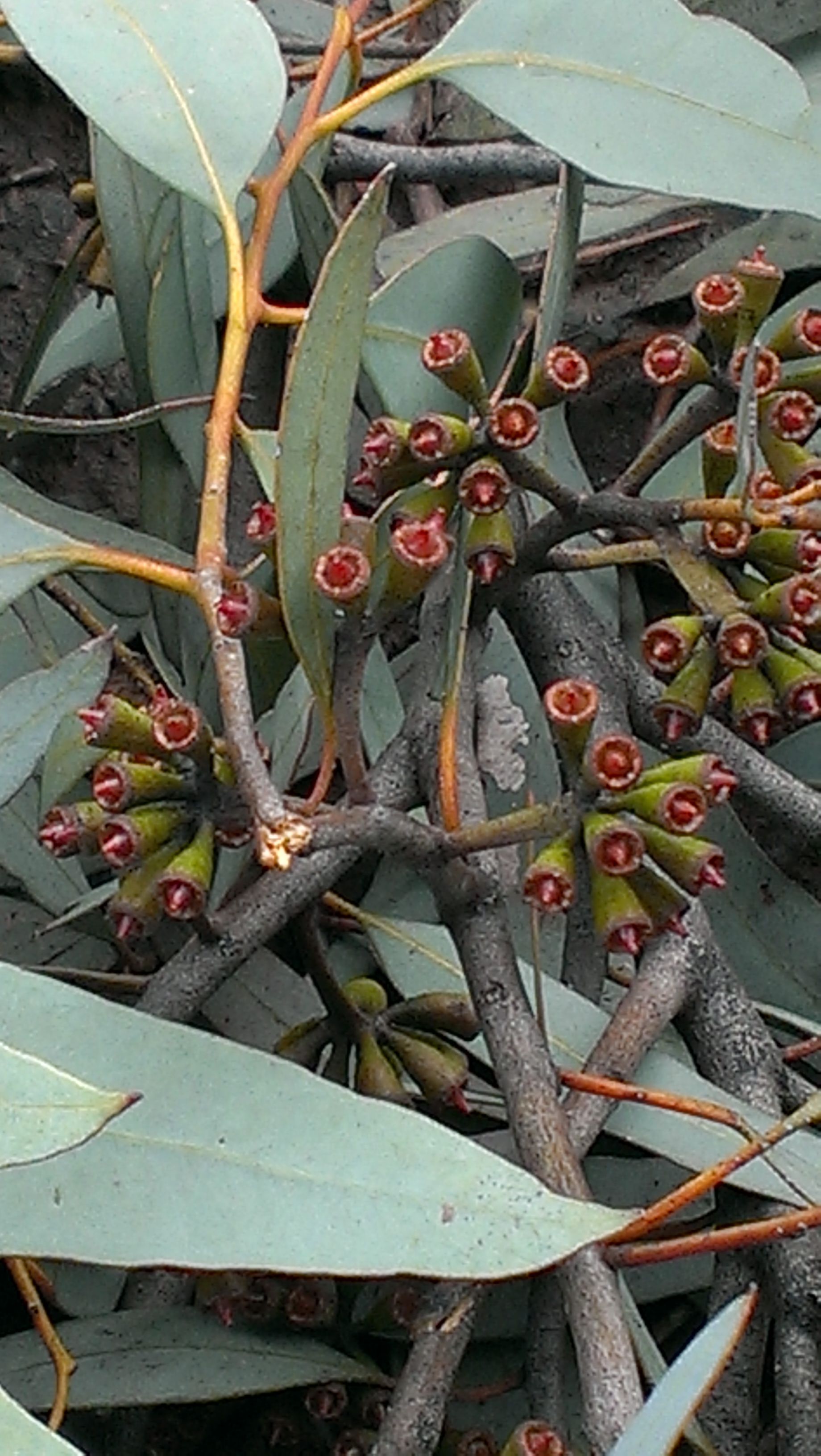
Immature fruit:

IMAG2340

Still immature but older fruit:

IMAG2341

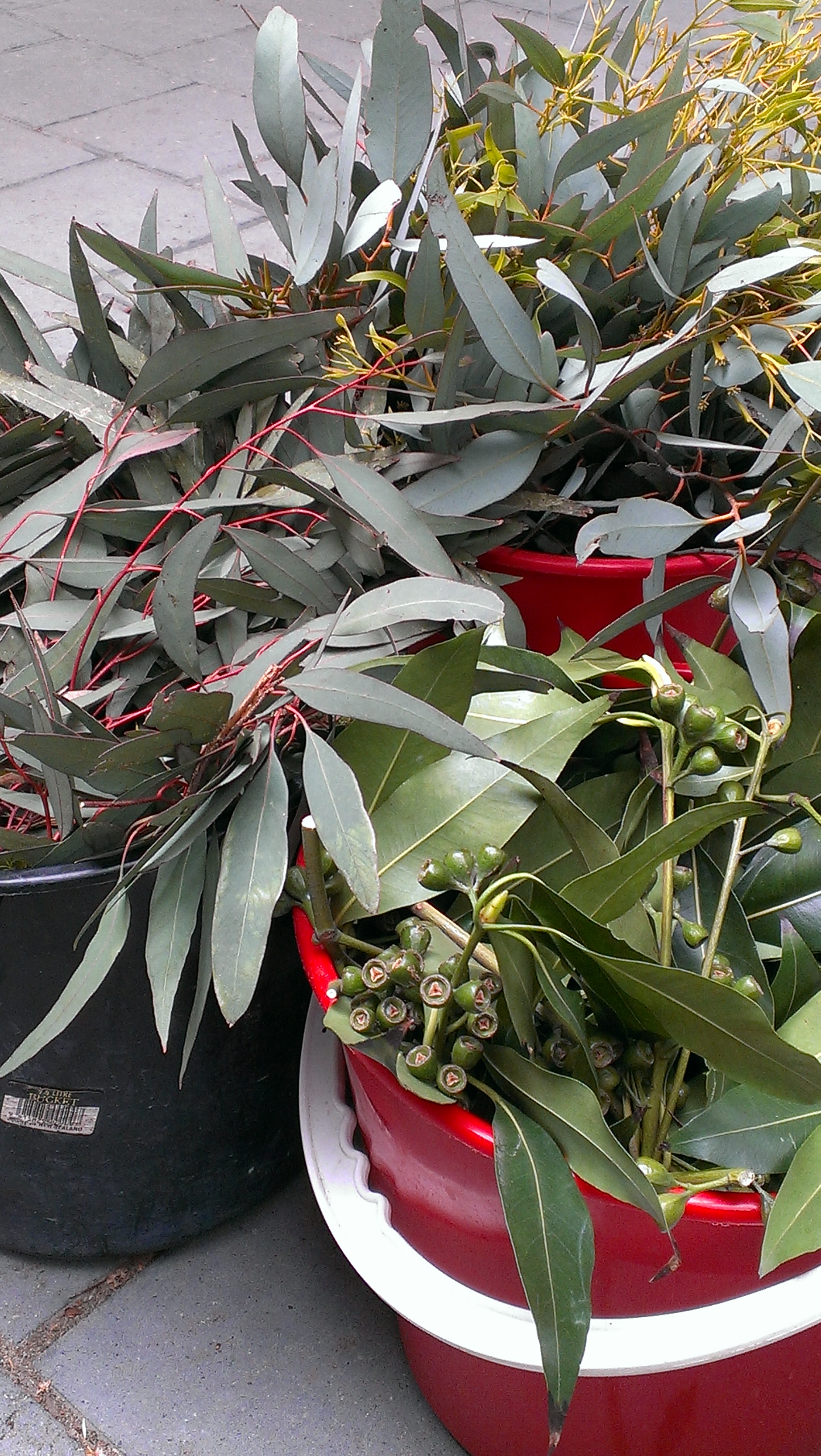
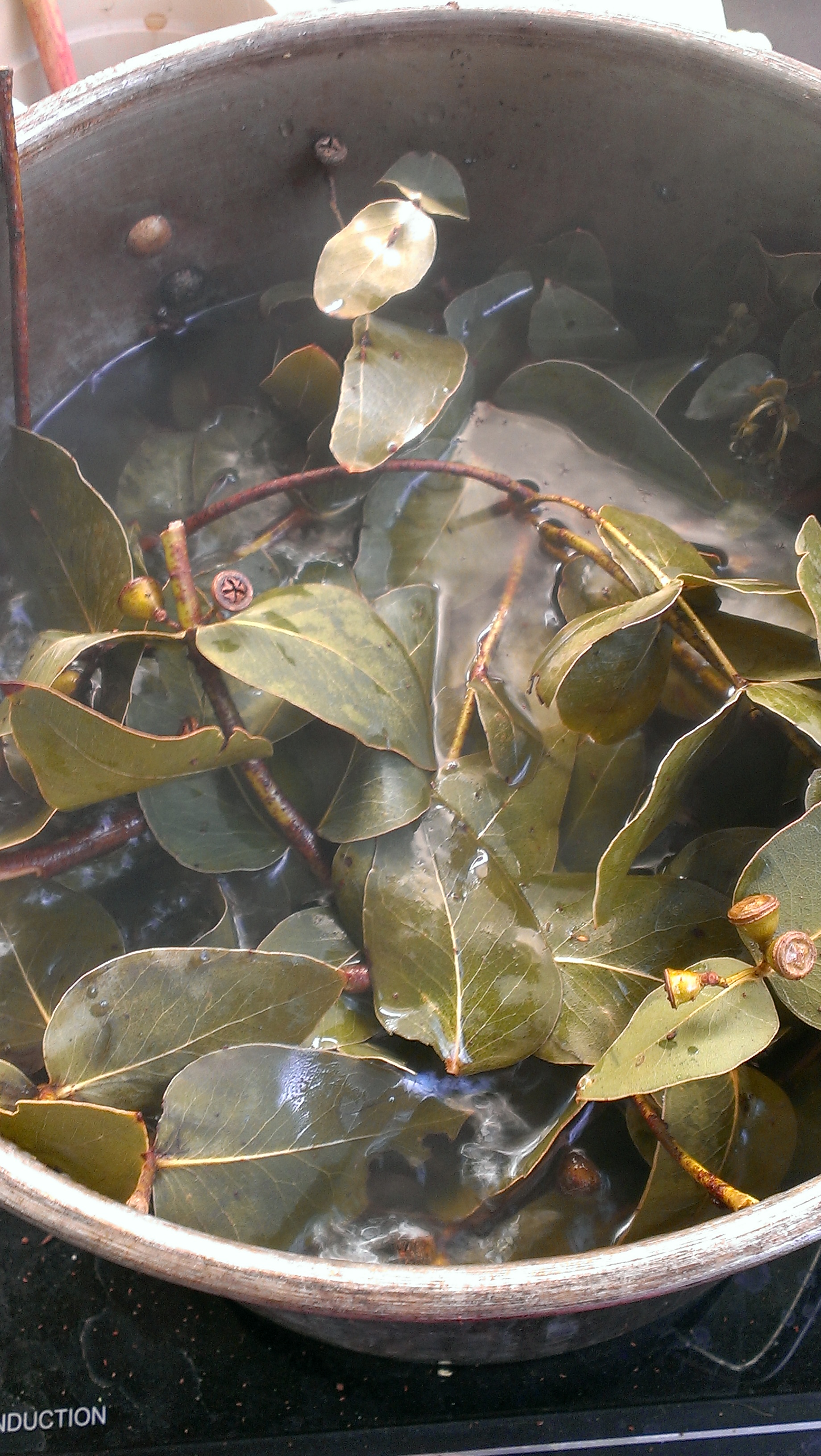
Finally, I came past a stand of ironbarks where I often collect after wind, and collected my third candidate.  It’s a mixed stand from which I sometimes get good colour and sometimes very little.  Three dye pots full waiting their turn on the hob…

IMAG2346

The results were not tremendously exciting… different shades of tan and pale apricot from the eucalypts (clearly the ironbark was not E Sideroxylon). I have to confess that I forgot to photograph these unexciting outcomes before overdyeing them with E Cinerea.  The Queensland Box showed its capacity to give tan in the presence of alum, especially.  The samples are (from left to right) wool, wool+alum, silk and cotton.

IMAG2361

Leave a comment

Filed under Dye Plants, Eucalypts, Natural dyeing, Neighbourhood pleasures

Neighbourhood windfalls 1

We’ve had gale force winds here lately.  One morning about a week ago, 40% of my city had no power when we woke up (we were happily still connected to the grid).  Needless to say, this has led to windfalls, and I was still collecting them yesterday as further gale force winds began a week later.

The first windfall was an ironbark.  Guessing from its location (a stand of three ironbarks) and the gumnuts still intact, I think it is E Tricarpa. Sadly, just as unremarkable as a dye plant, as the last time I tried!

IMAG2302IMAG2304

I have not managed to identify this tree, partly because it branches metres above ground level.  Even with so much of its canopy on the ground, I didn’t find a single bud, flower or fruit to help me identify it.  The trunk is rough and pale. The whole tree is difficult to capture in a photo, especially on such a gloomy day.  It must be at least 20 metres tall.

IMAG2335IMAG2336

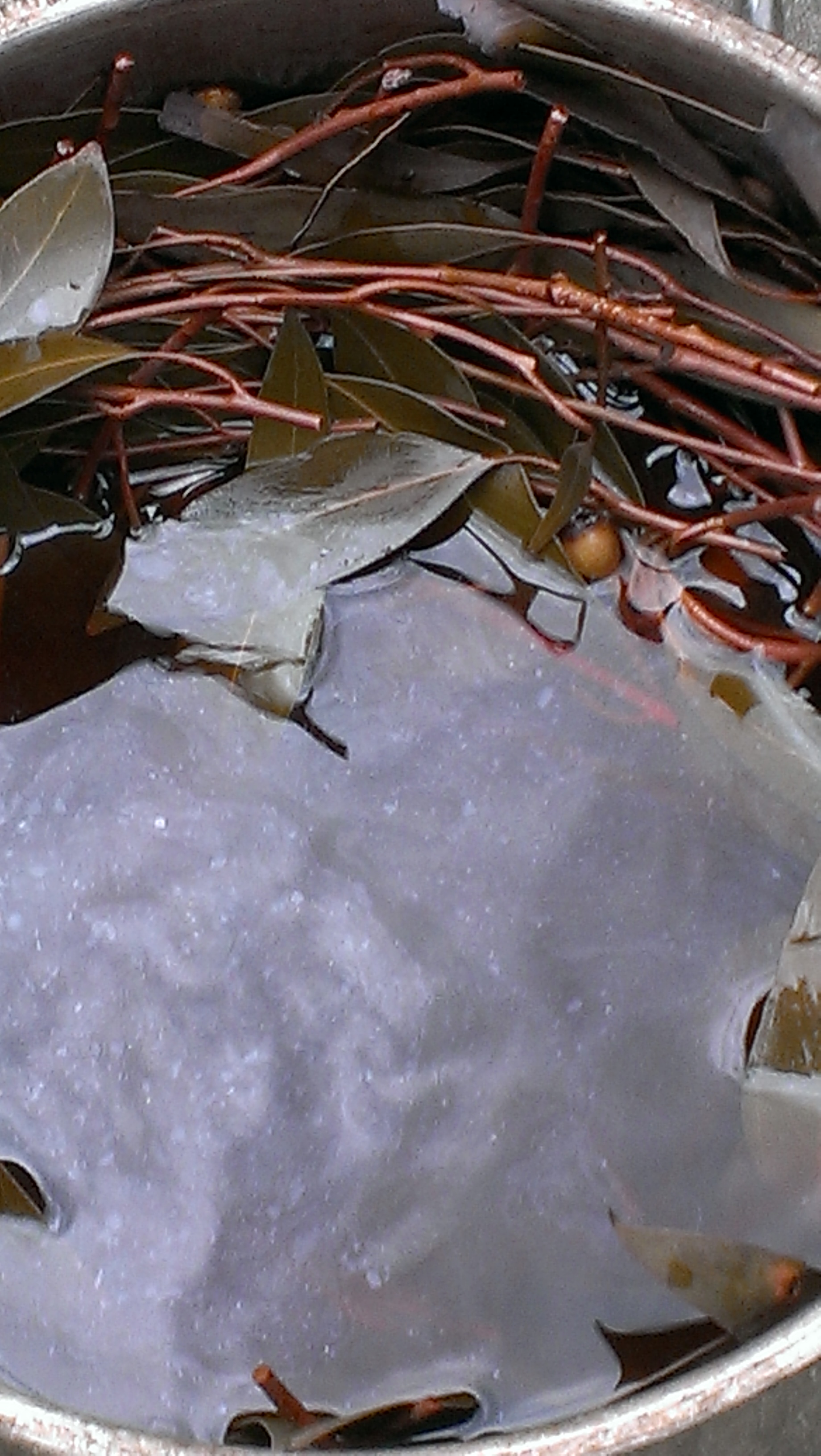
It seems to be under attack from some kind of scale insect.  Every single leaf was affected. Here it is after some hours in hot water–suggestive of a beige outcome….

IMAG2309IMAG2349

Compare my third windfall.  This is a tree that has been cut to accommodate cars parking beside it, in the car park of a recreation area.  I haven’t been sure whether it was E Scoparia, E Camaldulensis, or some other unknown eucalypt.  Both E Scoparia and E Camaldulensis have similar shaped and sized leaves, small fruit and both can have pale, smooth trunks (but this trunk looks more E Camaldulensis to my admittedly self-trained eye).  The branch that fell to the ground had an uncharacteristically large number of fruit on it for E Scoparia.  On the other hand, the clusters of seven fruit with 3 valves apiece made me think it might be E Scoparia after all.  So did the colour of the dye bath, though the leaves did not turn orange the way E Scoparia usually does.

In spite of the colour of that dye bath, the result says that this is not E Scoparia, and the 3 valves say that it isn’t E Camaldulensis either (4 valves).  Even with vinegar to help bring out whatever orange or red might be there to be had, and still damp from the dyebath… the 3 valved tree is at the top (brown-beige?) and the 20 metre tall tree is at the bottom (caramel-beige).

IMAG2350IMAG2351

Here are the results of a bath with a fallen branch from an actual E Scoparia, downed in the same windy night.  They’re the red and orange samples, with the E Tricarpa for contrast.

IMAG2316

13 Comments

Filed under Dye Plants, Eucalypts, Natural dyeing

Waste not, want not, with a side serving of the election

I live in a society so wealthy and so wasteful, in global context, that any selection of actions I make about waste reduction can feel a bit arbitrary.  I see so many missed opportunities every day!  But still the principle that waste should be avoided is beyond criticism, and the principle that I should do what I can, is likewise sound.  So this election night, I took the eucalyptus-printed silk/hemp scraps from my previous foray into shirtmaking (I was piecing them together back in this post) and the scraps of my skirt adventure, and created bags from them. I love bags.  I love making them, giving them and carrying them around.  I seldom leave home with less than three, a curious fact I’ve decided to relax about.

Skirt bag 1: has already gone to an enthusiastic new owner who cooked a fabulous dinner for us last night:
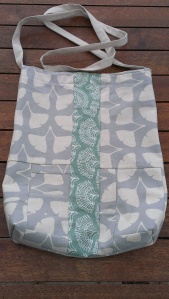
IMAG2172

Skirt bag 2 is with me now and soon to be introduced to someone I am confident will like it:
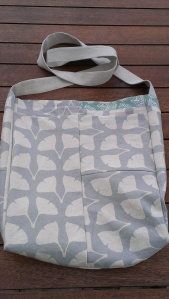
IMAG2174

I decided to line the hemp/silk bags on account of the method of piecing I had chosen and being unsure of the fabric’s propensity to wear.  I had leftover silk noil from various workshops and from making pillowcases.  Apologies for the dodgy pictures taken after dark, indoors, with a flash.  Some bloggers are so impatient!
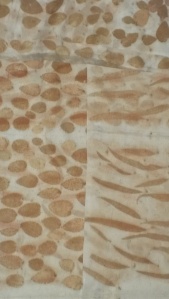
IMAG2164

There were some small sample pieces that had indigo australis and local eucalyptus leaves printed onto them and then an iron afterbath in the Blue Mountains.  I took these pictures just before they vanished into the interior of the bags to be seen only by the new owners, whom I hope will enjoy having this treat inside their bags!  I personally am the kind of person who revels in pocket linings made of treasured fabrics, whether they are organic flour bags or were formerly part of my late Grandmother’s extensive scarf collection.  Needless to say, I love a bag lining with a story.
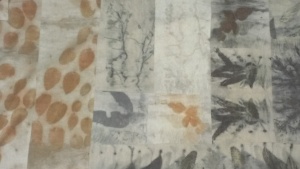
IMAG2166

I like these bags a lot. The weight of the fabric with the lining works well, to my way of thinking.  I could feel the urge to give these away before they were off the sewing machine, so here are pictures on an overcast morning!
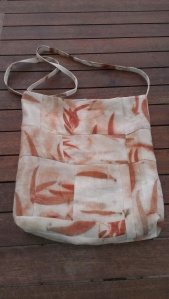
IMAG2170 (1)

This next one has been rated suitable as a gift for my mother-out-law, who is apparently generous enough in her assessment of my skills to talk to her friends about my crafting sometimes.  She has friends who have been weavers and dyers for years.  She herself has been a wonderful garment creator for decades and keeps thinking she has given it up and then changing her mind, so her judgment may not be unbiased but I am flattered by it nonetheless.  Her bag has been finished with a strip from a heavy weight ramie shirt found at an op shop (thrift store)–beautiful fabric and sewing skill but an appalling garment I felt no compunction about cutting up and redeploying.  Most of it became another bag complete with interior welt/flap pockets which had been a beautifully crafted feature of the front of the shirt.  Sadly they were an offence against fashion even to me, and I don’t hold with fashion much!

IMAG2168

And for gratuitous images, I have these of our hens.  They don’t stand around waiting for their photos to be taken when there are earwigs to be found.
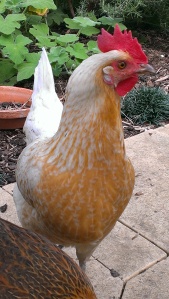
IMAG2157

However, they are glorious, and they are also blissfully ignorant of the election that was taking place the day I snapped their pictures.  We were planting and pruning and mowing and they were seeking insects and seeds.

I feel deeply sad that the people of my country have elected a government that thinks we need to pay less international aid to fund infrastructure here; that expresses routine contempt rather than compassion for refugees taking desperate measures to escape their mostly war torn homelands and get to our shores; that thinks roads are a higher priority than public transport; that cares little for renewable energy and plans to fund it less; and that has expressed little interest in participating in global efforts to halt or turn back environmental devastation or climate change.  Here’s India Flint on the subject, should you wish for more.  I haven’t made a habit of commenting on the state of our nation here, but I felt the need to mark the day.  There will be some serious further consideration given to the forms of action that might be needed in the coming period at our house and in our community of friends.  Thinking about the state of the world and our impact upon it, in all their complexity, will continue to be crucial.

11 Comments

Filed under Eucalypts, Leaf prints, Natural dyeing, Sewing

A pair of backyard Eucalypts…

Recently I discovered that a friend who has one of the biggest E Cinerea trees I have ever seen in her back yard would like some of it removed.  I offered to cut and take away the dead and insect affected parts, to her surprise, and have now made three visits to do just that. I’ve begun some dye pots with alpaca another friend has asked me to dye.

IMAG2075

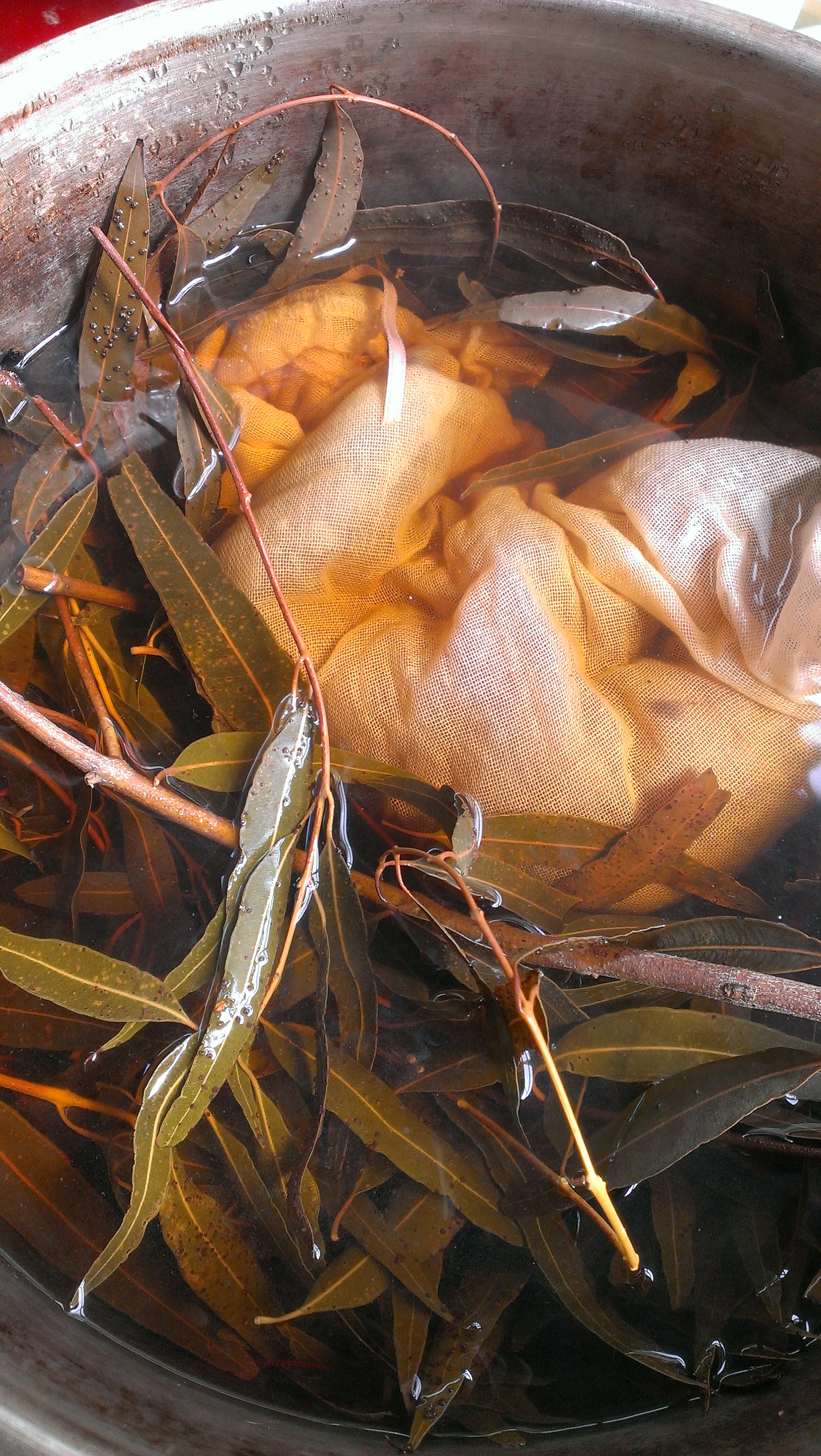
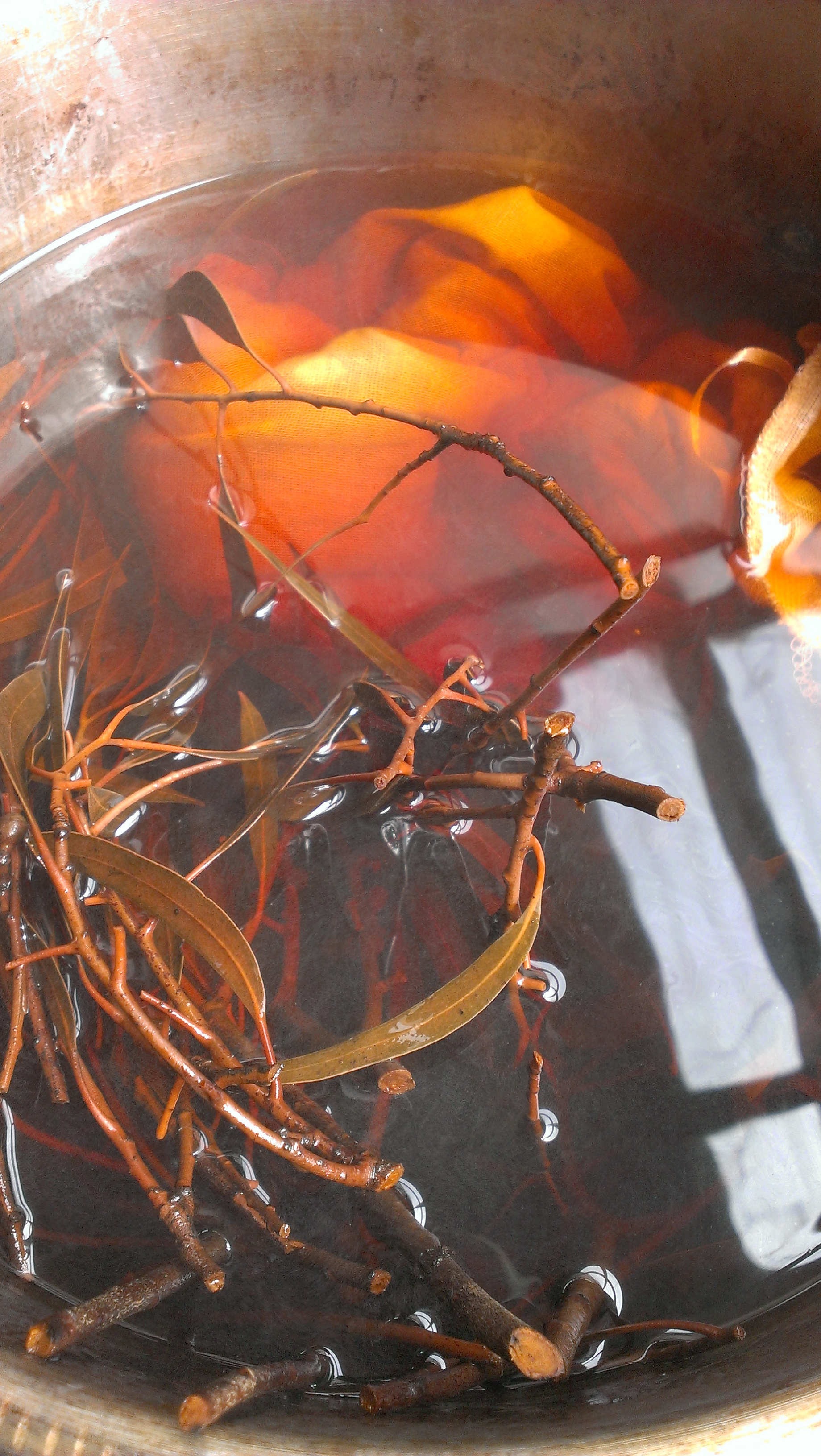
On the second visit to trim the E Cinerea, my friend’s partner spoke about the loss of a bough on their other eucalypt.  I looked closely at this second very large tree with rough, fibrous bark on the trunk and very narrow leaves and ‘Eucalyptus Nicholii’ went through my head.  Could I at last have found a fully grown specimen?  It branched so high and the ground had been so thoroughly cleared in the effort to remove all the fallen material that I couldn’t find fruit.  I did manage enough leaves for a dye pot however… and it is very promising! I heated the leaves for an hour, dropped the sample card in and went for a bike ride leaving the heat off.  When I got back:

IMAG2078

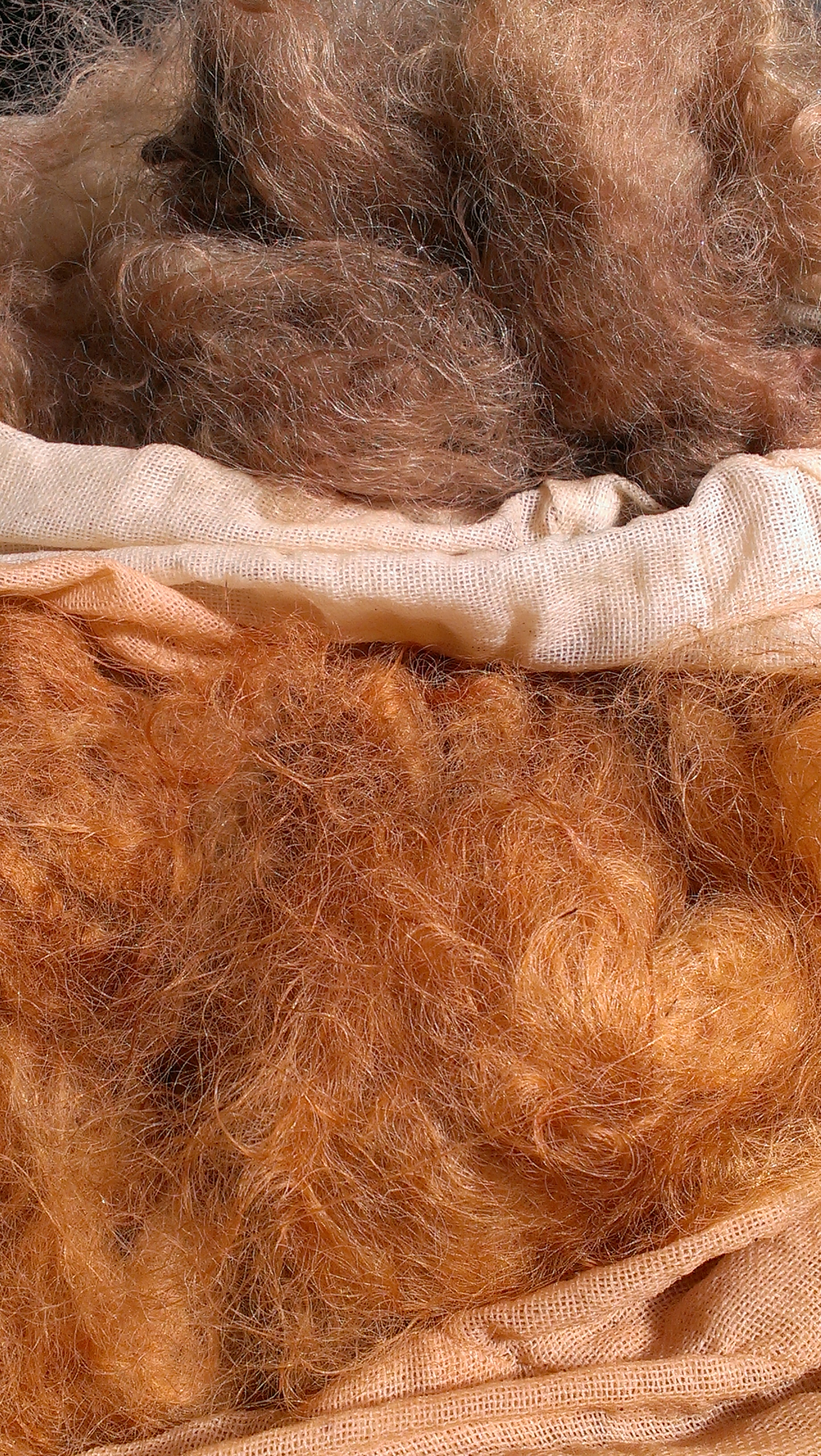
As I write I have added some alpaca fleece.  I will have to wait to make a more definitive identification… I have sometimes found that all the hours I’ve spent with books on Eucalypts have created the context for me to have a correct intuition about a particular tree.  Equally often, though–I have completely the wrong end of the stick!  But the alpaca is looking good as it sits draining…

IMAG2101

8 Comments

Filed under Dye Plants, Eucalypts, Natural dyeing

Intriguing trees…

I returned today to two trees I have sampled a little that are growing on my favourite running track.  We rode our bikes down it, so I took pictures (and some more leaves, needless to say!)

IMAG2069 IMAG2073

Into the dye pot they went, with a sample card.

IMAG2100

Since I have two burners, I also ran a pot from leaves I collected when we went planting native trees on a friend’s farm.  It looked like E Cinerea to me… but an enormous tree, growing where there is so much more water than in the city where we live.

IMAG2099

The dye pot confirms that the E Cinerea gives great colour.  And the mystery trees gave  rusty orange with some tan undertones on handspun wool with no mordant, and brown on alum mordanted superwash.  Even more intriguing, really!

2 Comments

Filed under Dye Plants, Eucalypts, Natural dyeing

Embroidery for the heart, from the heart

One of my friends is a poet, and a social worker.  She has spent years dedicating herself to the wellbeing of the people in the locality where she works, a place where poverty and violence have taken their toll, creating tough lives.  She witnesses people’s skills and talents in the face of difficulty and enables the bringing into existence of new connections, new skills, new capacities and new lives.  She helps those who must escape violence to make that difficult, vital journey into new lives without abuse.  I am full of admiration for all that she can do and all that she is.

IMAG1901

She has been facing some powerful challenges of her own in the face of government budget cuts and policy changes.  I have been thinking of her a great deal.  There is one poem in particular that brings her solace.  I decided to embroider it for her.  It has been a pleasure to spend so many hours thinking of her, holding her in my heart and wishing her well.  I’ve stitched the words on hemp dyed with indigofera australis and thread dyed with indigofera for blue and silky oak for yellow.

Leave a comment

Filed under Natural dyeing, Sewing

Plum Pine 5: Lightfastness

Having discovered that plum pine had so much potential for colour, I felt obliged to test for lightfastness and washfastness. This is my lightfastness testing apparatus on the day I set it up: it is a none too sophisticated set of threads wrapped around card, inside a heavy card envelope with a window cut out of it, which has been sitting in the front window since 23 June 2013.

IMAG1602

At the top, 3 silk thread samples, handspun Wensleydale, handspun Polwarth, two shades dyed on BWM alpaca rich and finally, two shades dyed on Patonyle (superwash woool+nylon blend).

After over a month in the (winter) sun, fading is quite evident.  I realise now that I could have made a lightfastness test which made the results clearer, but you’re stuck with my limitations on this learning curve. If you squint, you can see the original colour at the sides.  The fibre that performed best was the handspun wensleydale with alum.  It was also the winner on the washfastness test.

IMAG1890

I have to say that I think I have chosen well in using the bulk of the yarn I dyed for some slippers (they are Fibertrends Clogs), which might spend their lives tucked under a bed and come out only at night!  Here they are awaiting felting…

IMAG1889

And here they are after a wash at 40C, with some commercially dyed companions.

IMAG1906

5 Comments

Filed under Dye Plants, Dyefastness, Natural dyeing

Plum Pine 4: Washfastness

I decided the obvious way to test for washfastness was to wash.  So I embroidered with the plum pine fruit–no mordant–silk thread, and with the plum pine fruit-with alum and cream of tartar on a piece of cotton… and added a little eucalyptus dyed silk thread for good measure.  Not the best example of embroidery ever seen, but it will do the job.  The two upper examples were purple (like the thread on the cards) when they went into a normal wash–30C with eco-detergent.  One wash later, the no-alum sample is grey and the with-alum sample is green-grey.  Eucalyptus shows its true colours yet again.

IMAG1655

Yesterday I tried washing my sample cards at 40C with eco-balls (we have laundry variety here, as you will shortly understand) and they were still purple when they came out of the wash.  Interesting… this made me wonder if part of what is going on here about Ph.  Detergent would be more alkaline than eco-balls.

After 4 more washes:

IMAG1892

You might remember that I did some darning with my early silk samples.  They have not fared well either–but the mending is still doing the job!  The pink is still pink, but much faded after what I would guess as being about 8-10 washes.  The purple is blue, and paler.

IMAG1894

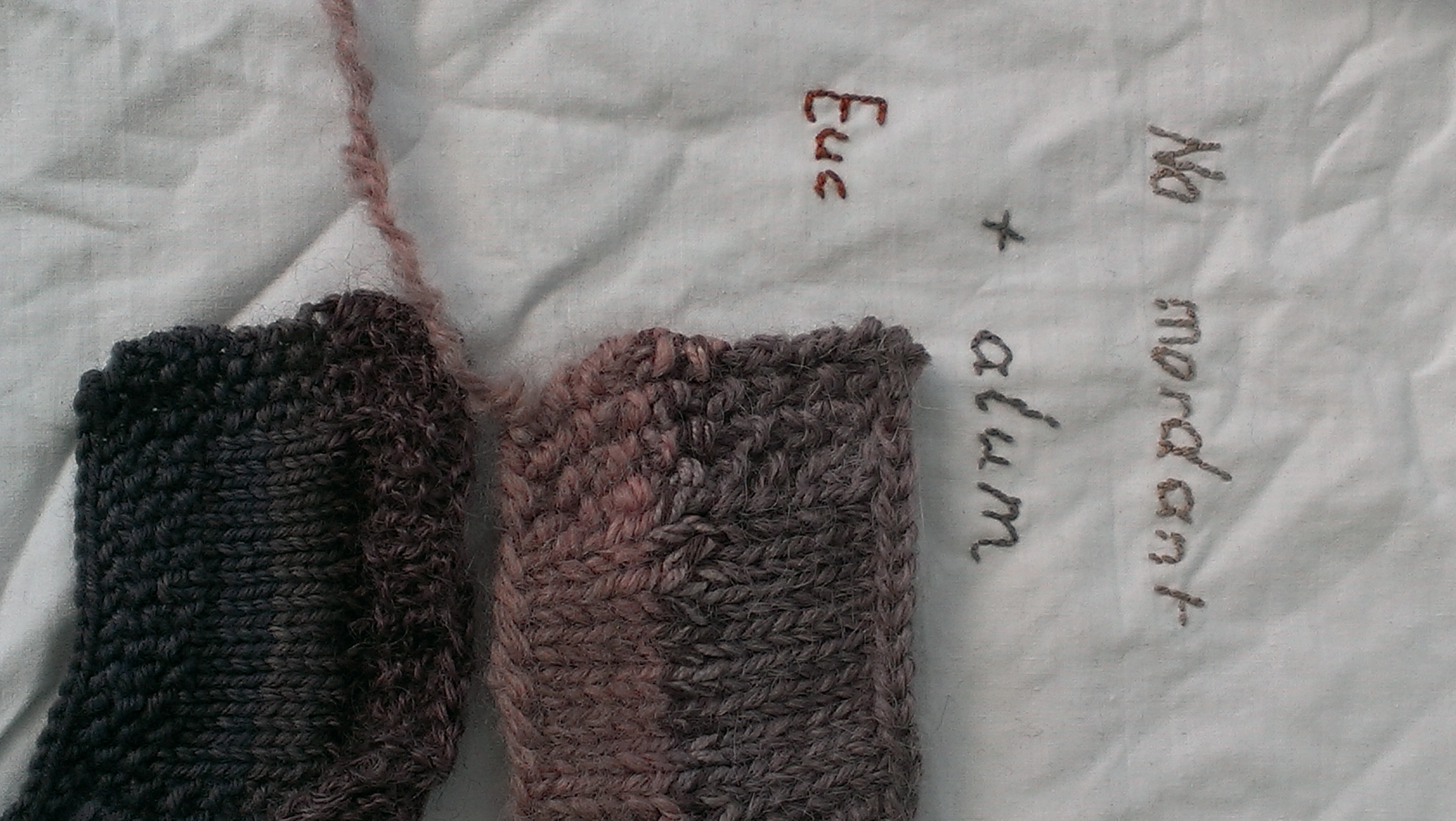
I knit some test samples from my yarns.  They fared better, washed with other woollens, cold with soapnuts rather than detergent (if anything, a slightly acidic wash).  The sample on the right has two shades of plum pine with alum and CoT on BWM alpaca rich, with a band of cotton used to tie the skeins in between because this yarn took so much colour during the dyeing I was curious.  The sample on the left has two shades of plum pine on patonyle (wool and nylon superwash sock yarn and a sample of handspun Wensleydale).  One has gone from purple to grey and the other from purple to blue.  Blue?  Before:

IMAG1661

After, with unwashed BWM Alpaca Rich in the background for comparison.

IMAG1893

Well then.  Not what you’d call really excellent washfastness. And some new mysteries to ponder, as usual.

3 Comments

Filed under Dye Plants, Dyefastness, Natural dyeing

Who knew embroidery could be so much fun?

IMAG1378

I have been so inspired by other dyers’ work with naturally dyed embroidery thread that I decided a while back that perhaps I could include some silk thread in my many dye pots.  I dyed a large quantity of wool in small batches over the last few months, so there have been quite a few opportunities.  Really, I had friends who like to embroider in mind at the time.  I thought I could gift them my little lengths of dyed thread.  However, a vast new plan has sprung into my mind.  I dug out the embroidery hoop I brought home from an op shop years back, but have never used.  It helps enormously but also makes embroidery rather louder than I had anticipated, as if the fabric were a drumhead!  I did not expect to find embroidery so thrilling, or so noisy.

This new project has had me out and about in the neighbourhood visiting species of eucalypt I use less.  There have been some  surprises.  The two spindly E Websterianas with their minnirichi bark and their heart-shaped leaves are gone!  They were not thriving in that location just a few blocks away, I admit.  But I am sorry to have lost them (let alone that someone probably took all that leafage to the dump).

Another day I went to two different E Scoparias, walking further to get to the one which dependably hangs low when I couldn’t reach the leaves of the closest.  Gone was the lush straggly undergrowth that used to surround it, and gone was the low hanging branch.  I am not sure whom it had offended.

IMAG1384

At least the tree is still there, snuggled up to an equally large carob tree.  Since major infrastructure came to my neighbourhood and trucks became a constant form of traffic through streets large, medium and small, the low hanging branches of many of my favourite trees have been removed.  Apparently no one was considering the suburban gleaner at the time…

On a subsequent trip, I discovered that the largest, most luxurious E Scoparia in my neighbourhood, whose tree hating neighbour had me worried when I was collecting bark, has been pruned with a chain saw so that no longer do its lovely leaves hang anywhere I will be able to reach them without a ladder.  Luckily, the bark will fall where I can reach it, and the tree is still there despite having such a determined human enemy.

12 Comments

Filed under Dye Plants, Eucalypts, Leaf prints, Natural dyeing, Sewing

Davidson’s Plum

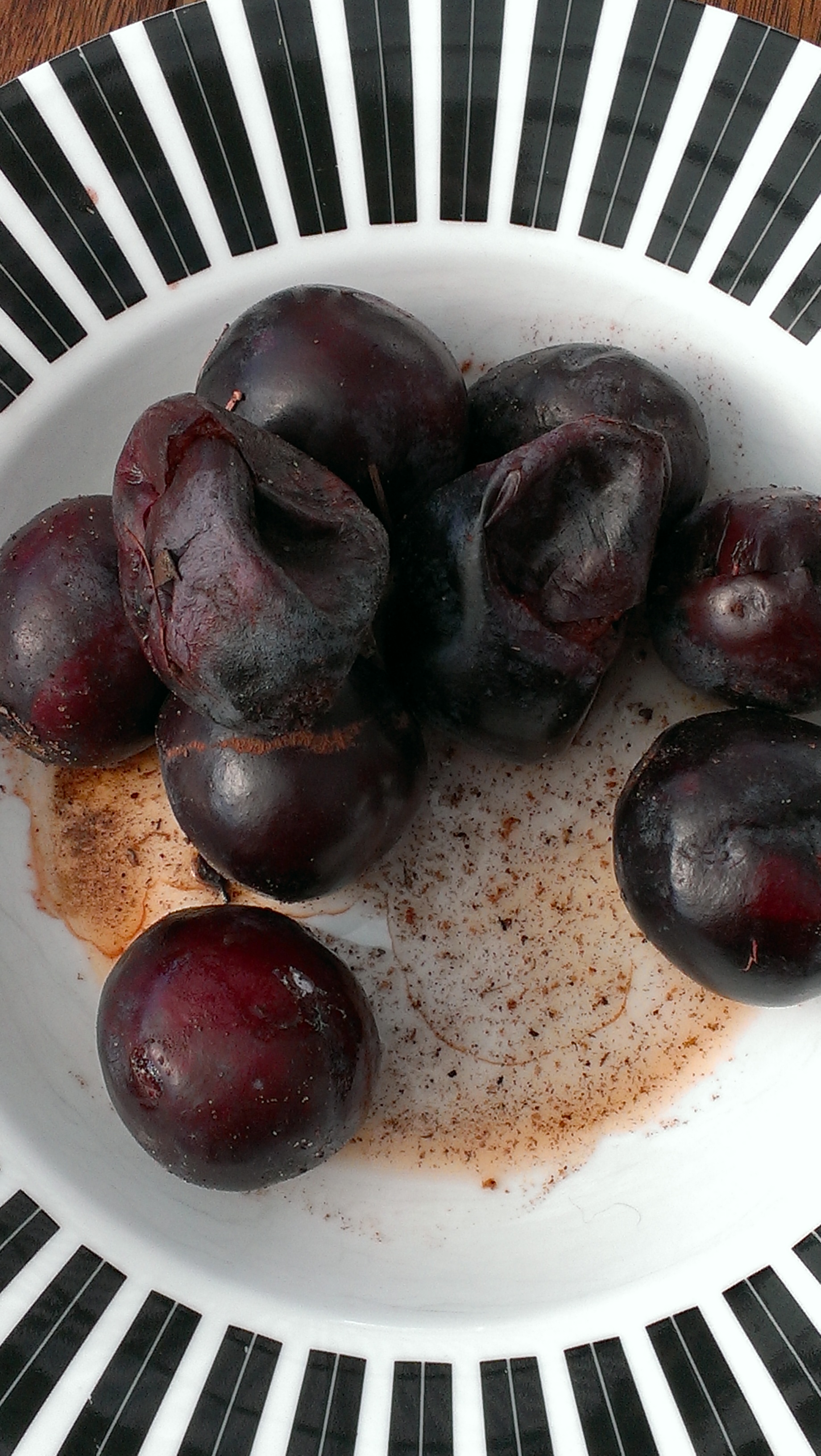
In the interests of experimentation, when I came across some fallen Davidson’s Plums recently, I picked them up and carried them home.  As you do!

IMAG1754

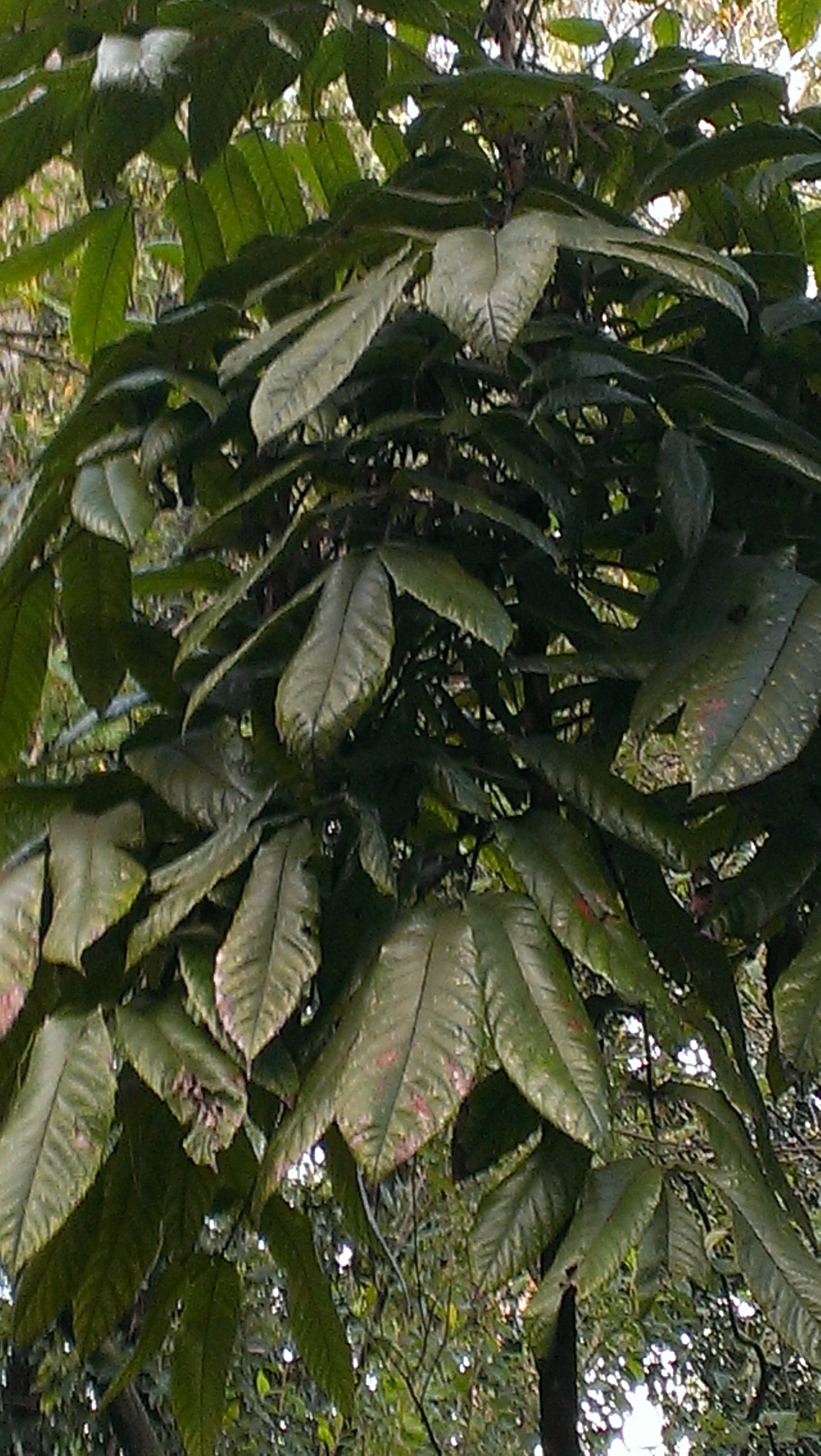
This is a rainforest tree, native to Queensland: Davidsonia Pruriens.

IMAG1743

It’s narrow and tall and the fruit are surprisingly large (many native fruits are small by comparison with the European cultivated fruits they reminded colonists about).

IMAG1744

There might be a way to get colour from these fruits.  But the way I chose (cooking the fruit and applying to alum mordanted fibre) is not really one of them.  The alum mordanted wool turned a pale tan–and this may be a generous interpretatio– and the alum mordanted silk became ever such a pastel shade of apricot.

IMAG1775 (1)

5 Comments

Filed under Dye Plants, Natural dyeing