Tag Archives: wool

Plum Pine 2: Mordant and Modifiers

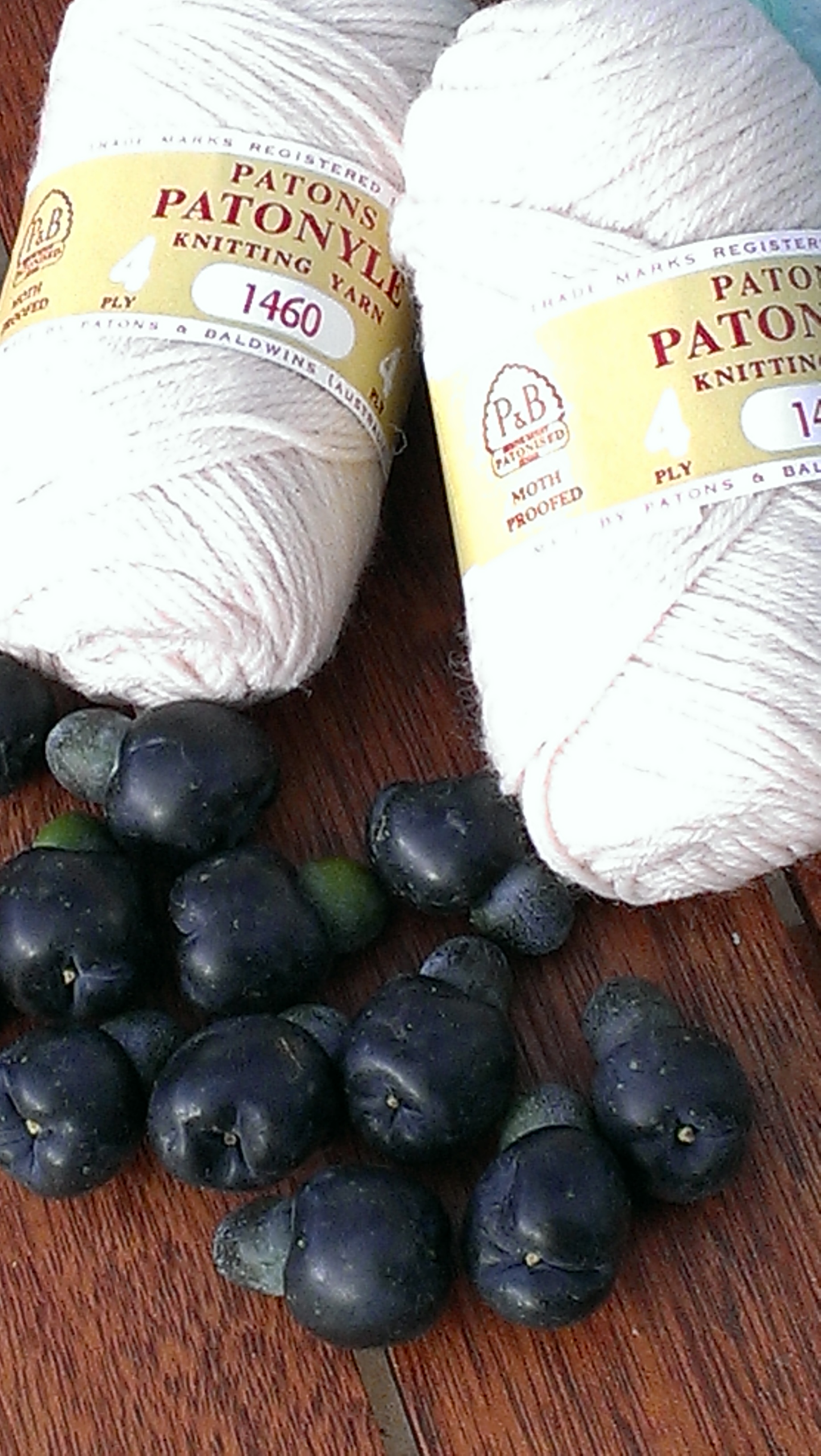
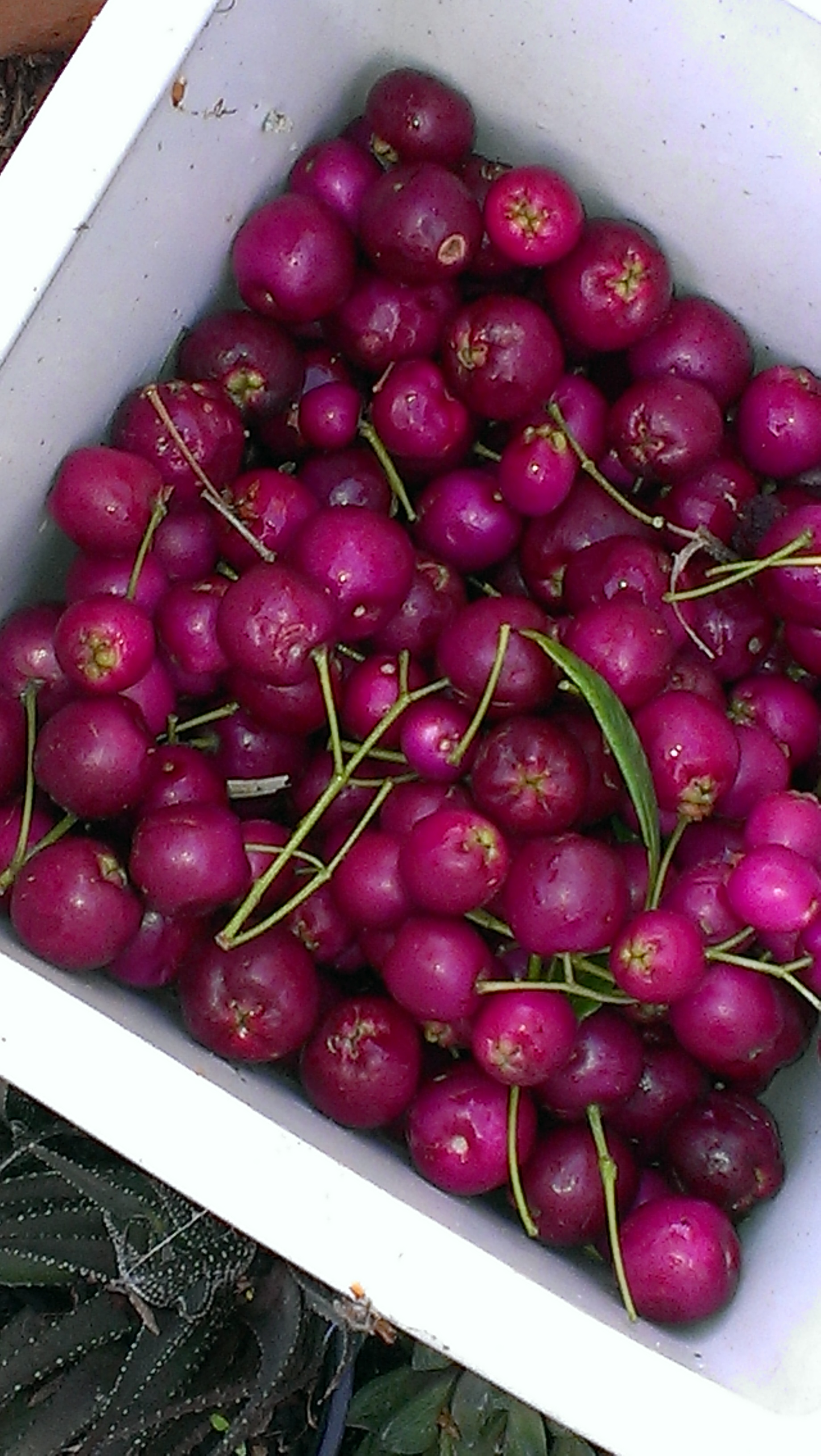
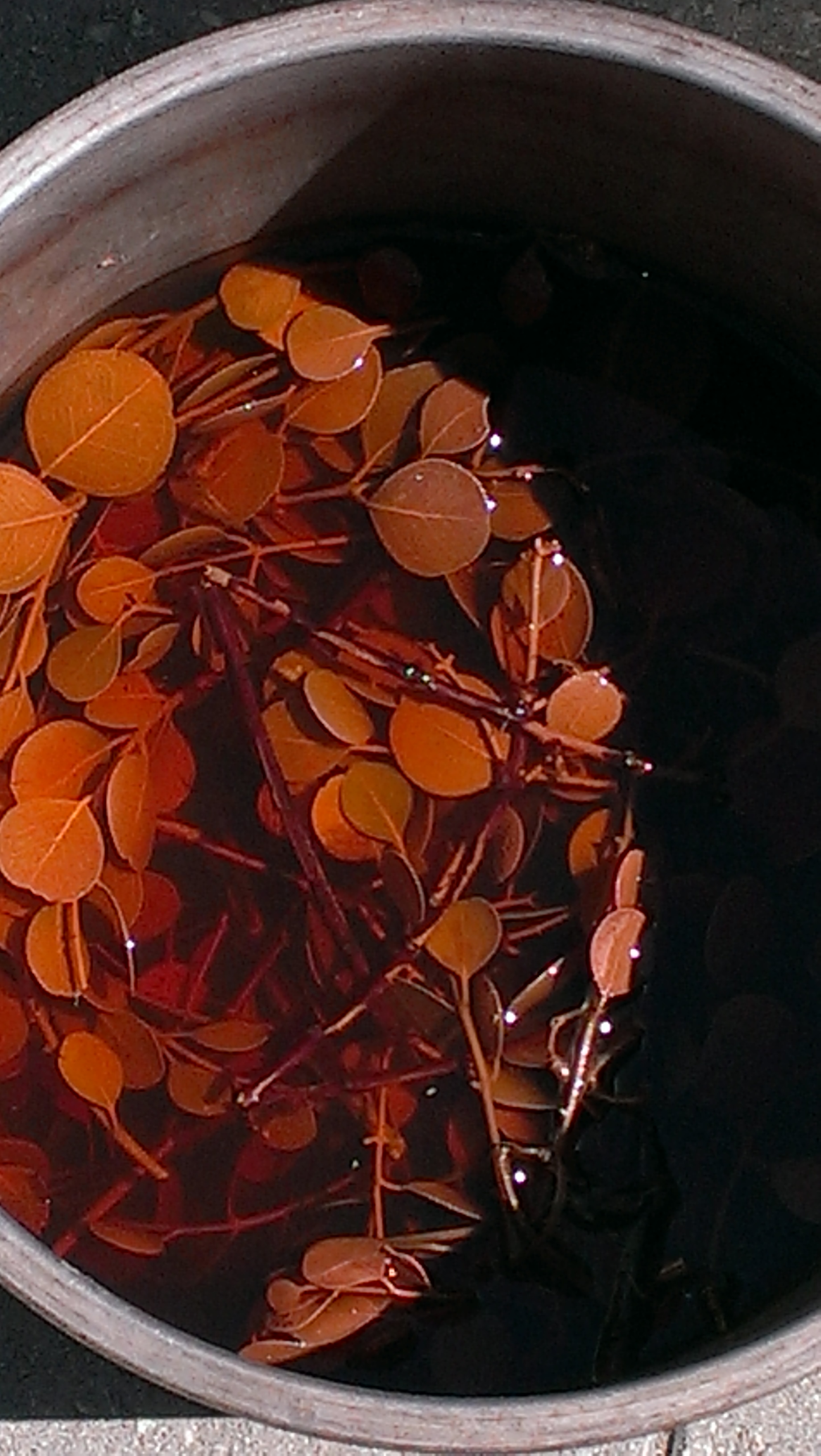
Having had success with a test dyebath, I made a point of returning to Botanic Park to collect more fruit on weekend, en route to celebrating World Wide Knit in Public Day.  I dyed some grey corriedale locks in my test bath and they went from grey to a dull brownish shade, so I opted for superwash + alum and silk as the most likely candidates for success. I mordanted sock yarn of antiquity (picked up at a garage sale) and prepared another dyebath.  I regard sock yarn as a no risk option.  If I knit socks for a friend, I can make an open offer to re-dye at any point they fade to an unacceptable shade (and I can ask how they’re faring under normal wear and washing).

IMAG1461

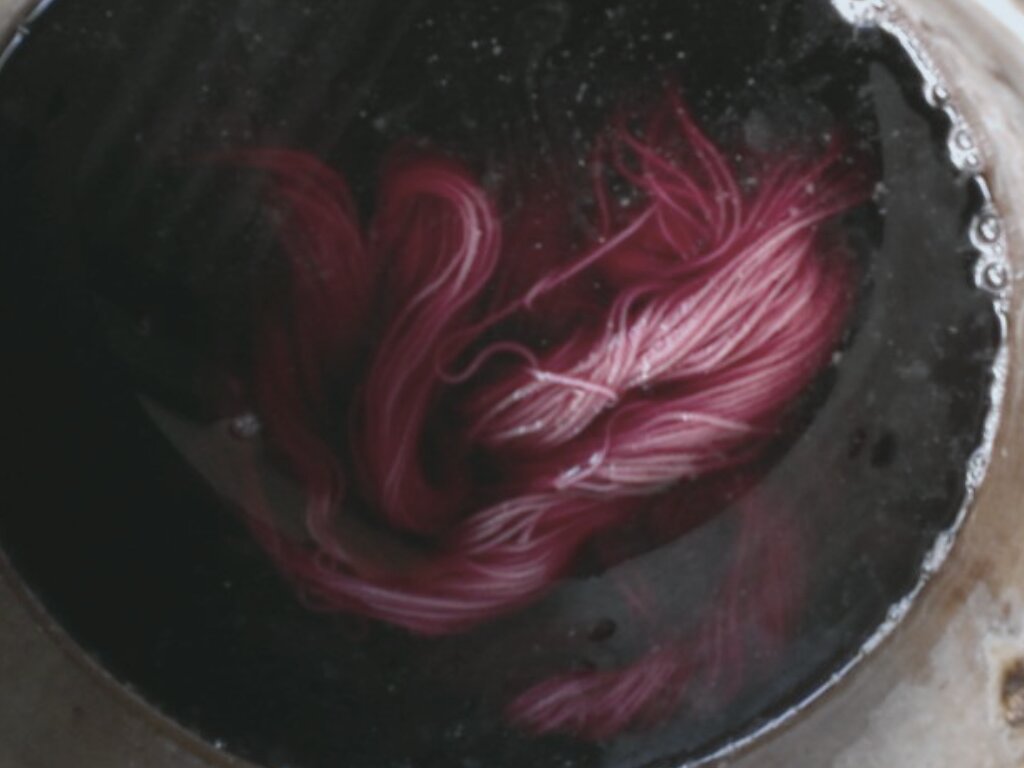
The dye bath looked fantastic.

IMG_0168

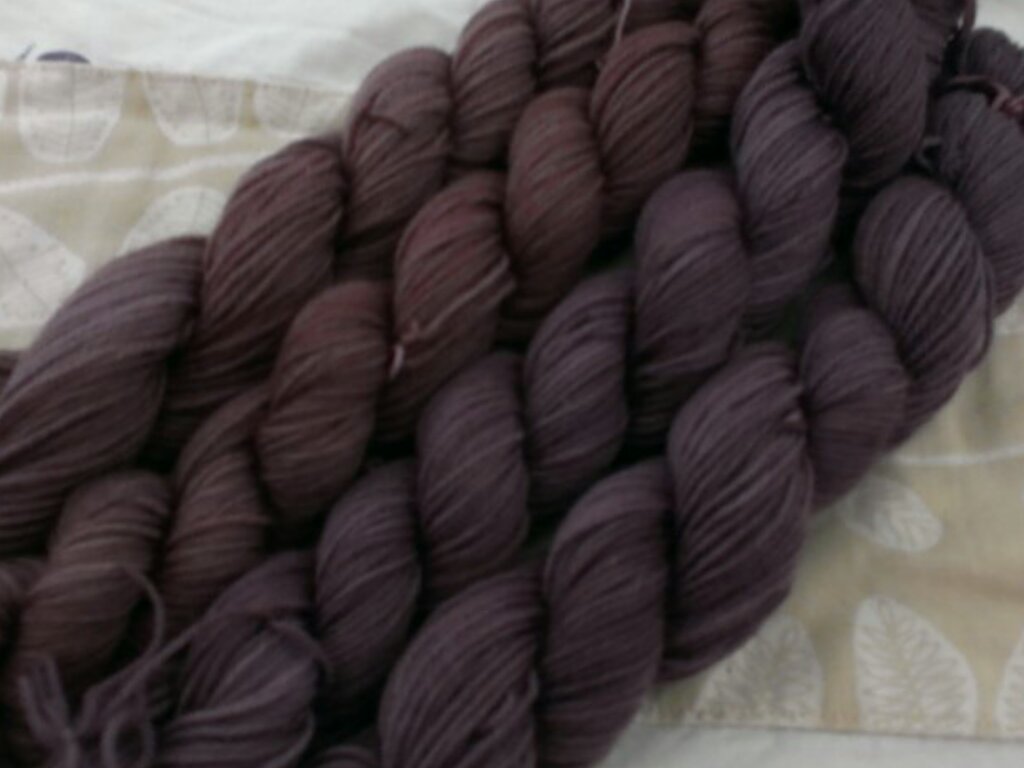
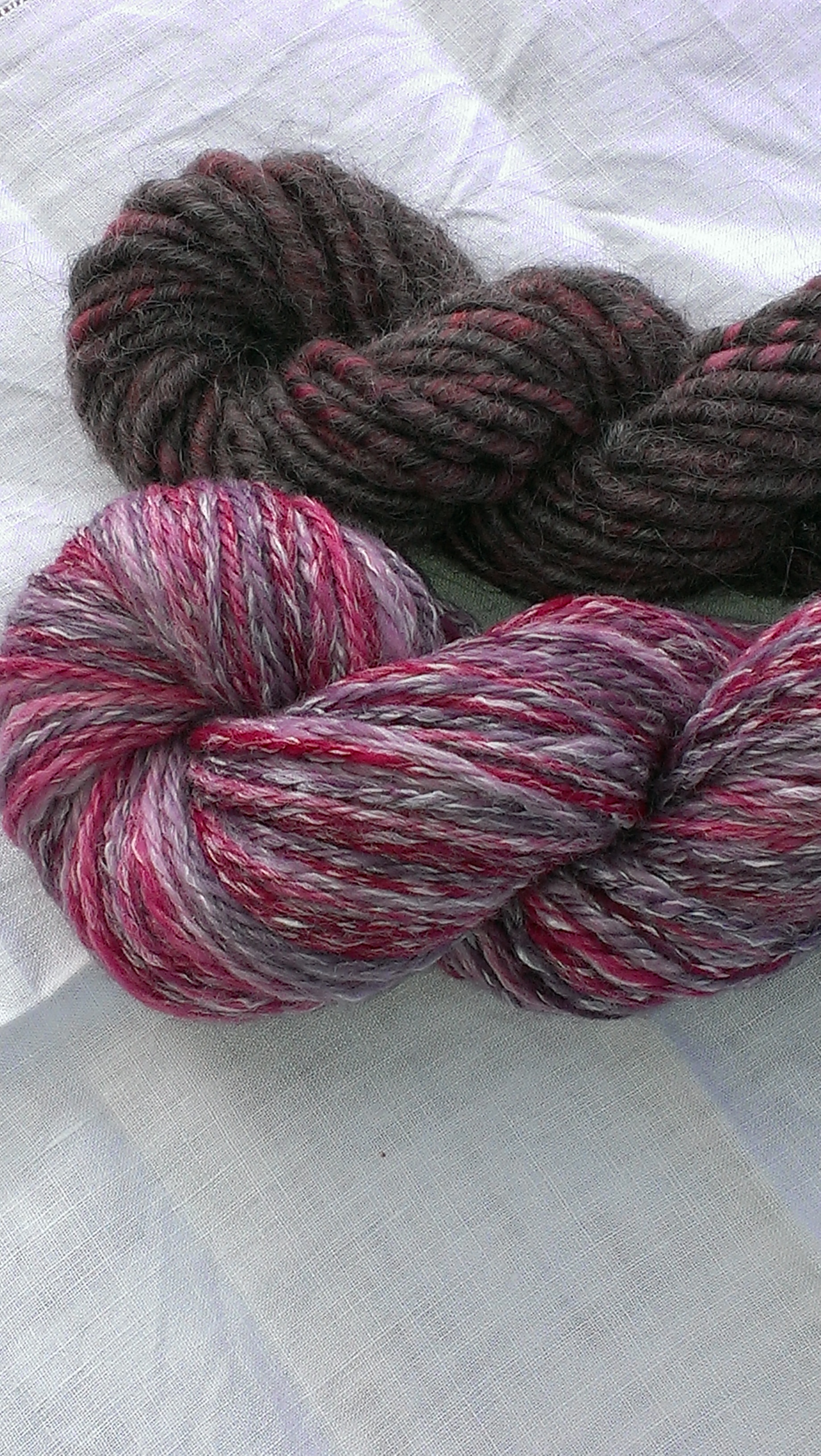
I ran two baths with this fruit, because the first one produced purple on my alum mordanted skeins of sock yarn (wool-nylon).  I pulled it out of the bath after dark and in artificial light it looked quite brown. So I dropped the skeins back in the bath for the night and put test samples into an iron bath and a vinegar bath. Next morning the sock yarn was purple! The exhaust dyebath was a lighter and browner shade of mauve.  I apologise for these photos but it’s winter here and sunlight is in short supply.

IMG_0183

My tiny skeins of silk thread came out various shades of rose pink through to magenta too… and I have embarked on an embroidery project, so that was exciting.  The shades on the right are both using vinegar in the dyebath.

IMG_0178

The modifiers were interesting: the wool+alum strand was noticeably more purple with vinegar and noticeably more brown/grey with iron, which is, I think, about what should be expected.  So… a promising beginning to experiments with a new dye plant–but with no sense yet of how washfast or lightfast it might be.

IMAG1499

7 Comments

Filed under Dye Plants, Natural dyeing

More socks!

More socks off the needles after a long period of being unfinished…

IMAG1421

Long ago I had the opportunity to buy part of a raw Suffolk fleece that had been discarded by another spinner.  I had been steadily reading my way through the Guild’s library, so I recognised this as a breed that was eminently suitable for sock spinning.  At the time, I only knit socks.  They were the whole reason I had learned to knit, and then to spin.

As it turned out, the Suffolk was a very short staple and none too clean fleece.  Never mind.  I gleefully acquired it and proceeded to use my beginning dyeing skills on it.  Four pairs of socks came of it.  One, pink dyed with hibiscus flowers, went to my Mum.  Another was dyed in eucalyptus leaves as fleece and spun up afterward.  I can’t remember who I gave that pair to.  I think they might have gone to tree lovers in the Blue Mountains.  I made my father a glorious pair that were purple and blue, blended rather beautifully after dyeing (and at that stage, their loveliness was an accident!)

These were made from Suffolk blended with tencel, which may have been ill advised–time and wear will tell.  The colour could have been better and the blend is uneven, but a three ply handspun yarn is a work of dedication and there was enough even for a pair of large feet, so I knit these.  They are going to a dear friend who lives nearby, who does indeed have large feet.  Last night he spoke about a pair I made him years back that he is still wearing hiking.  This pair may not last as long but I hope they will keep his toes warm at the very least!

Leave a comment

Filed under Knitting, Spinning

Steeked!

Perhaps you remember this yarn, spun and chain plied from a beautiful blend by The Thylacine.

IMAG1220

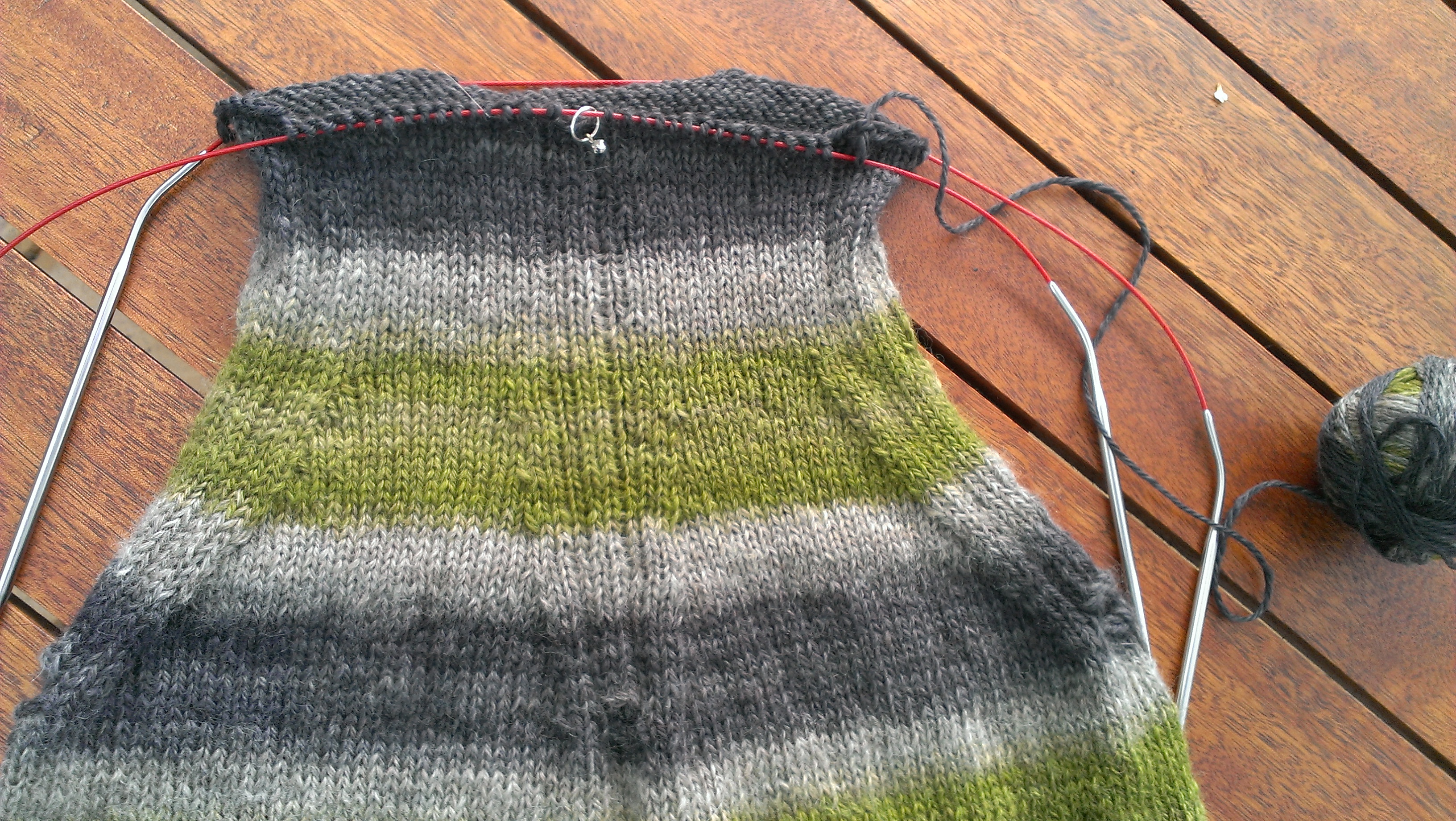
I decided on a vest for my fairy godson, an appreciator of handmade items if ever there was one.  He is a not-so-small six year old person growing ever taller and thus, growing out of last winter’s woolies. I designed (I  do realise this is a very plain garment!) the vest based on measurements from one he already has that is a generous fit.  100% handspun alpaca for the band at the bottom, in seed stitch.  When I reached the place where I wanted the neck and armscyes to begin, I cast off a few stitches, then cast them on again on the next round (leaving a slot) to create a steek bridge.

IMAG1349

Here is the upper part a bit closer up.  I have decreased just the way I would have done knitting this garment by any other method, but kept knitting in the round, making sure those stripes are maintained with wonderful simplicity. Knitting in the round feels normal to me, since I took up knitting in order to knit socks.  I much prefer knitting in the round to knitting flat.

IMAG1350

Then came the day of truth, when I stitched through the knitting all the way from one end of the steek bridge to the other and cut, yes, CUT! the neckline and armholes prior to grafting the shoulders together and picking up the edgings.

IMAG1351

Wonderfully simple if you can hold your nerve.  I am so happy with the finished result, I’m on tenterhooks waiting for the intended wearer to return from holidays soon for the handover.  I sure hope he likes it.  I have yarn left over from 100g of fibre. Amazing!

IMAG1371

PS–yes, it fits!

4 Comments

Filed under Knitting, Spinning

Lillypilly fruit

IMAG1282

Lillypillies are in fruit around my suburb.  They are the fruit of a large, glossy-leaved forest tree and they stain the footpath in a most impressive and promising manner.  This one is Szygium Smithii (but this is a family of trees some of which are widely grown ornamentally in Australia).  The fruit is edible, but in the case of this species, unexciting in terms of flavour, with a crisp texture and a fairly large seed inside.  On the dye front…  I did not find this an exciting outcome.  Fawn on silk (the card on the right), brown on wool with alum and tan on unmordanted wool.  I think I’ll stick with cooking lillypillies and admiring their enormousness and the spectacle of so much fruit!

IMAG1306

2 Comments

Filed under Dye Plants, Natural dyeing

Alpaca preparation

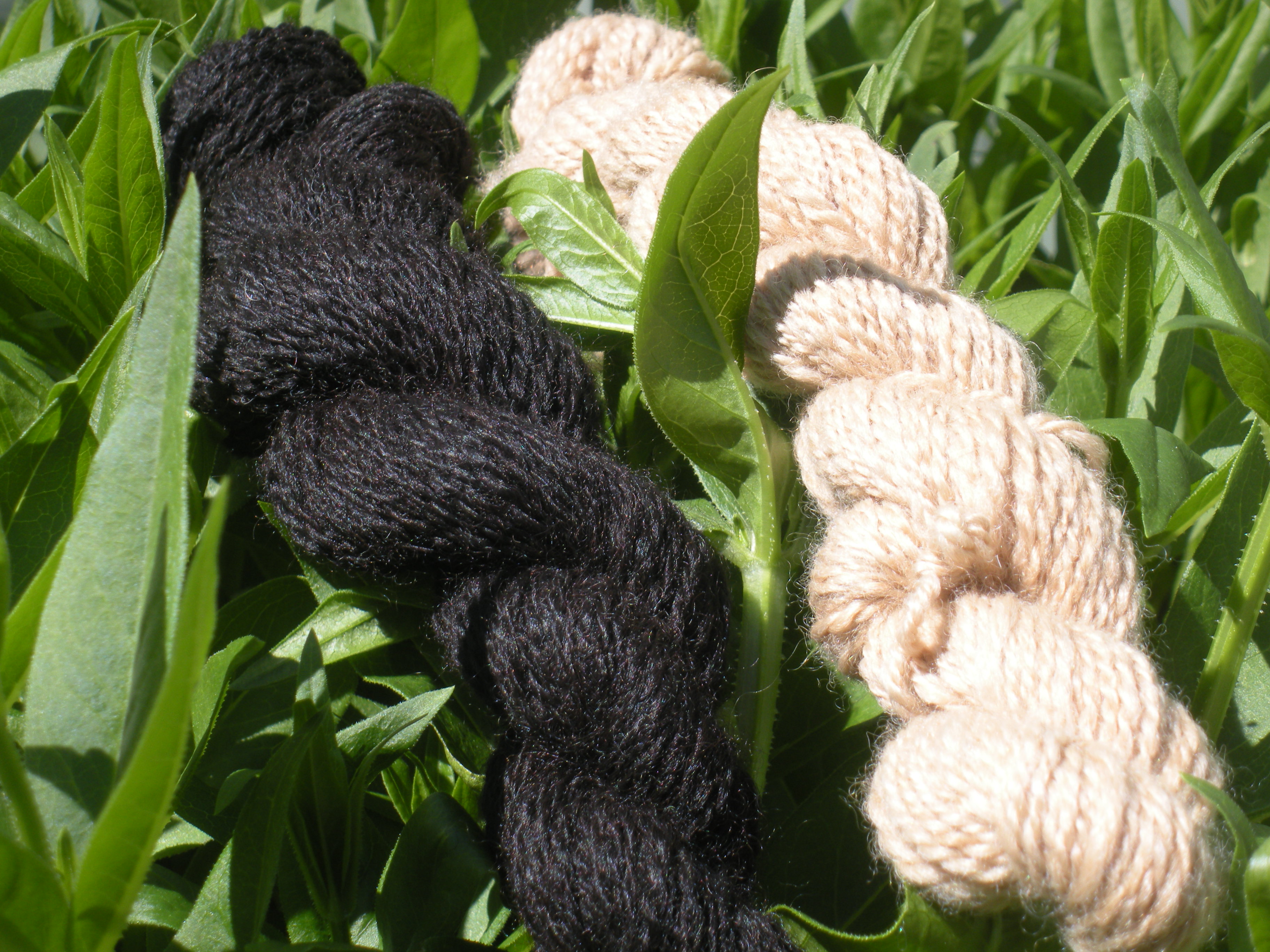
I’ve been having a lovely time spinning alpaca given to me by a generous friend.  She gave me samples of three different fleeces, white, black and what she rather fetchingly calls ‘champagne’.  I’ve been combing it and spinning it two ply and I’m very happy with the results.

I told my friend how lovely I thought the alpaca was, and she gave me more!  I have spun alpaca before, sometimes in quite a large quantity, but this has the longest staple I have ever seen, about 90 mm (these are the 90 mm matches I use to light to the dye pots–extra long.

I have to confess I have never washed alpaca, and it is always filthy, since alpacas roll and dust bathe.  My chooks dust bathe too, and watching them,  it’s no wonder that sand falls out of this fleece any time I move it! This fleece had so much dust in it that combing it was an outside activity that gave me hayfever.  I spun a lot of the white fleece rinsed and combed (that stopped the hayfever at least).  Then, I decided to brace myself and washed the rest of it.  And that led to dyeing the unspun fibre, as it turned out.  I have been working my dyepots hard experimenting toward red and…

IMAG1267

I am getting more interesting colours on silk thread (wrapped around the cards at left) than ever before.  My friends agree that the alpaca on the left, first through the dye bath, is red, then there is grey corriedale (second pass, same dye bath), more alpaca (third pass, still the same dyebath) and some still damp alpaca (fourth pass).  Three cheers for the potential to spin alpaca of many colours!

4 Comments

Filed under Dye Plants, Eucalypts, Fibre preparation, Natural dyeing, Spinning

On obtaining reds from Eucalypts

I’ve spent a good deal of time trying to figure out how to get stronger colours, and especially red to burgundy, from Eucalypts.  I’ve had occasional, but not dependable, success.

I have had the thought that the temperature of a dye bath might affect the colour obtained from eucalypts several times.  In particular, I’ve had the thought that relatively low temperatures might be required to obtain reds. Bear with me in my ignorance about chemistry… I’ve had this idea when thinking about the way that madder turns toward brown if heated too much. The chemical constituents are not the same, but perhaps their reaction to heat could be.   I’ve had the same idea reading the inspiring Karen Casselman’s Craft of the Dyer, in which she mentions that tannin bearing plant dyes will move toward brown if overheated.  I’ve certainly obtained many oranges from boiled eucalypt dyebaths.  I had this idea about reds and temperature again reading this glorious and informative post by Dustin Kahn and her comments.  I had it when reading Ravelry and coming across very infrequent references to people achieving red from eucalypts of unknown variety, in which I’ve noticed slow cooker or crockpot methods seem to get success sometimes, suggesting low temperatures and long processing.  I’ve noticed that when I’ve achieved red or maroon shades I’ve considered temperature to be a factor sometimes.

I used to use two gas burners that would do ‘boiling hard’ or ‘blowing out’ with only luck in between, and a lot of turning on and turning off to manage my results.  Now that I have hobs that will allow relatively finely tuned temperature control, I think it is time to test this theory a bit more systematically. I’ve tried to test it before and been unable to replicate anything close to red. More recently I tested it again and felt that while keeping the pot at a simmer close to but below boiling is a good idea in order not to create felt, the lower temperatures I trued did not generate reds and sometimes were too low for good fixation. For the time being I am letting go of my temperature theory.  So what are the other factors?

It is beyond question that the variety of eucalypt will predict the range of colours that are possible.  I have best results with E Scoparia, E Cinerea, E Kingsmillii Alatissima and E Sideroxylon in the red range and of these, the best is E Scoparia bark in my own experiments.

I’ve found that sheer quantity of dyestuff to fibre is a factor in achieving any strong colour, certainly including red, but it is not a guarantee.  Dustin Kahn reported using 340g fresh E Sideroxylon leaves and stems to 10g yarn to obtain brick red (and then achieved yellow and orange on two other 10g skeins).  I am convinced that time is a factor.  Rebecca Burgess and Dustin Kahn both report heating their dyestuffs for long periods with cooling in between (which I have found changes the colour but not in a red direction necessarily). The redoubtable Ida Grae reports achieving red from E Cinerea only after 3 hours of simmering.

India Flint recommends acidity as influencing brightness of colour, but I have to admit having tried it without being confident it made a difference–hence, more experiments needed, preferably with higher acidity levels. At a recent workshop, we had two E Scoparia bark pots running.  We did a trial and put vinegar in one pot and not the other.  The no-vinegar pot gave brown on alum mordanted superwash wool and alum mordanted alpaca.  Brown surprised me, but I wouldn’t usually use alum.  We’d run out of unmordanted wool in the mix that day.  In the with-vinegar pot, grey handspun wool with no mordant came out burgundy, which was very exciting!  Polwarth locks with no mordant came out brilliant orange, and the alum mordanted skeins of alpaca and alpaca blends came out toward the red end of orange.  We cooked them on as low a heat as we could–but the no vinegar pot was bigger, so heat control was easier.

So… I am continuing to experiment with favourite species, no excessive heat (wasteful in any case), a high ratio of dyestuff to fibre and acidity.

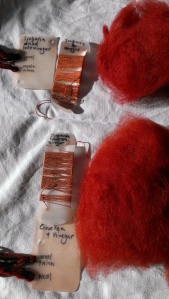
Here are the latest findings: red on alpaca!  Burgundy on the wool samples, rosy pink and orange on silk thread.  The top sample used E Scoparia (dried leaves) and The lower samples used dried E Cinerea leaves, both with white wine vinegar.
IMAG1270


18 Comments

Filed under Dye Plants, Eucalypts, Natural dyeing

Preparing

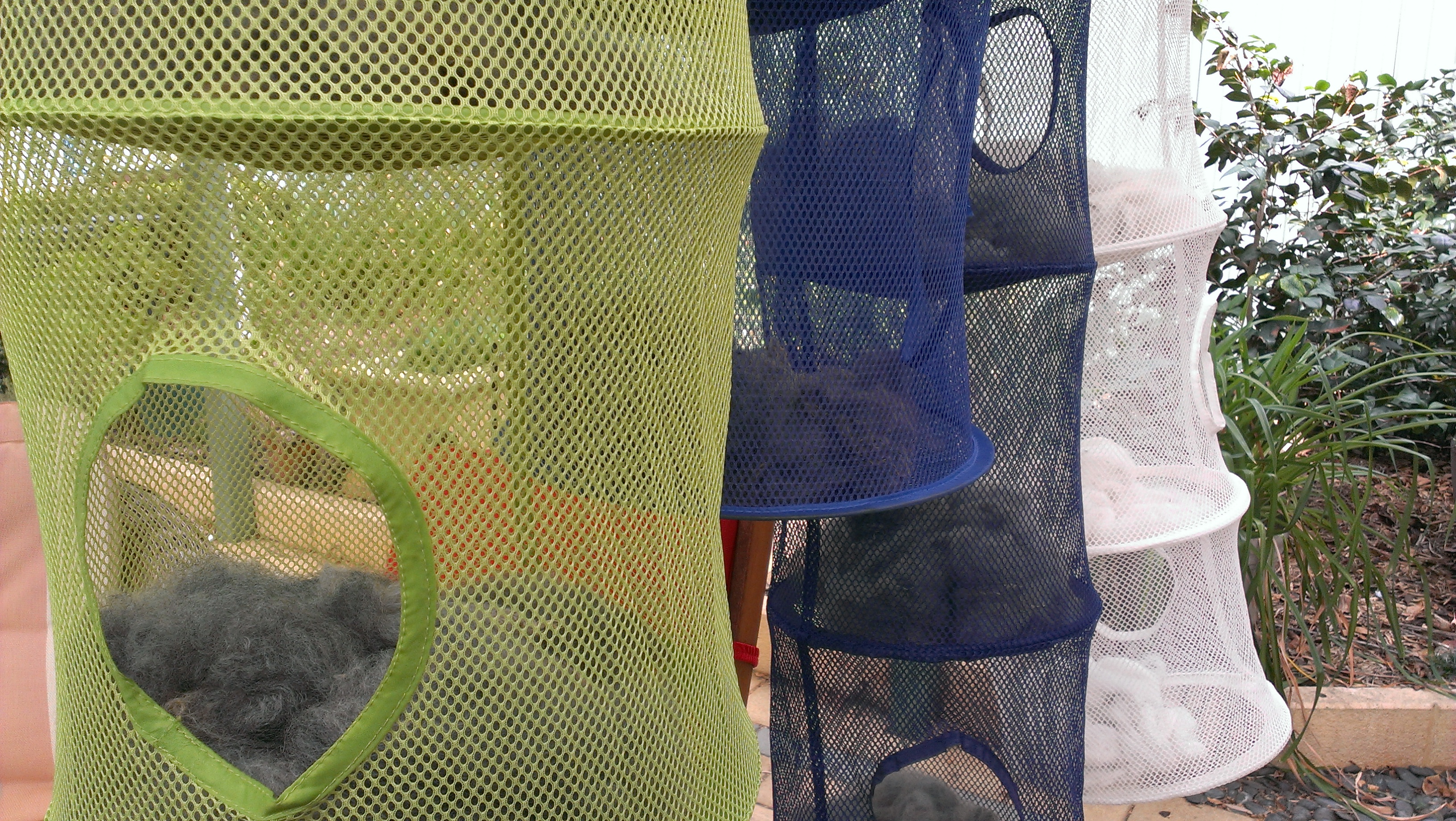
It has been a time of preparation, lately.  I’ve been on a fleece washing project.  After months of thinking I should wash while it is still warm but feeling quite unable to begin, apparently the change in the weather (toward autumn) brought on the sense that fleece washing would be possible. I have washed all that remained of over 3 kg of grey corriedale and some white alpaca for good measure.  My motley collection of drying apparatus have all been in use.  I still have a lot of high-grease polwarth and a filthy corriedale to wash.

IMAG1226

A bunch of friends got together to make passata and I was too sick to go and join in the fun.  However, my partner went along and I put the results up in these jars preparing for the winter.  The Fowlers Vacola outfit is steaming on the stove as I type.

IMG_0109

Our freezer is full of pesto from all the basil of this summer.

wpid-IMG_0133.JPG

I have some Lincoln locks sitting waiting for cold dyes to fix .  And I had better get ready to use the drum carder!

3 Comments

Filed under Fibre preparation

After Bendigo

Last year I went to the Bendigo Sheep and Wool Show with a friend.  We had a great time, and I spent plenty!  Just recently I decided to spin some of the prepared fibre I bought there.  This is grey merino/llama/silk dyed by the Thylacine in Evandale.  It was luscious to spin and inspired me to get back to dyeing over grey fleece. I chain-plied it to maintain distinct colours.

IMAG1223

I bought some Raxor batts: Corriedale x English Leicester and Blue-faced Leicester in ‘Before dawn’.  Clearly also from my grey period.  I core spun these over a crossbred grey wool core. The pink skein is chain plied merino/bamboo dyed ‘berry lush’ from Kathys Fibres.  All a delight to spin.

IMAG1187

2 Comments

Filed under Spinning

Eucalyptus Orbifolia

Alas, poor Eucalyptus Orbifolia.  I grew this plant from a small seedling to a still small, but perhaps 50 cm high plant hardly worthy of the title ‘sapling’, in a large pot.  It seems to have been a casualty of the hot summer and perhaps its far flung location at the back of the yard.  Despite all the watering it received, poor old Orbi gives every impression of having curled up its toes.  So, I’ve cut back and harvested the leaves for the dye pot.  Perhaps there will be regrowth, but I’m not letting all the leaves fall while I wait to find out.

I bought this plant and not some other believing it to be a dye plant for some reason I can no longer remember.  I’ve been to the place I thought this idea generated but it isn’t there!  And now I can break the news to you, dear reader.  It isn’t going to join the list of truly exciting dye plants anytime soon.  Here is the dye pot after some hours of simmering.

IMAG1189

The dye liquor is still quite clear, with an amber tint.  The leaves are still the glorious shape that gives the tree its name.  I have leaf printed with them in the past and the result was definitely a print, though not any really impressive colour.  And here is the result of a dyebath test. The handspun with no mordant: orange.  The millspun superwash with alum mordant: brown.  What was I thinking mixing and matching fibres on my test cards in this batch? Silk thread, nothing of significance to report (E Orbifolia is in the middle). And for comparison, handspun Finn X dyed with E Scoparia bark at the bottom of the frame.

IMAG1215

5 Comments

Filed under Dye Plants, Eucalypts, Natural dyeing

Random harvest

In the beginning, when I’d read the Handweavers and Spinners Guild of Victoria Dyemaking with Australian Flora (1974) and perhaps Jean Carman’s Dyemaking with Eucalypts (1978) and knew just about nothing about identifying eucalypts, I used to just choose a tree at random and try it out on some wool.  Sometimes that is still the thing to do!

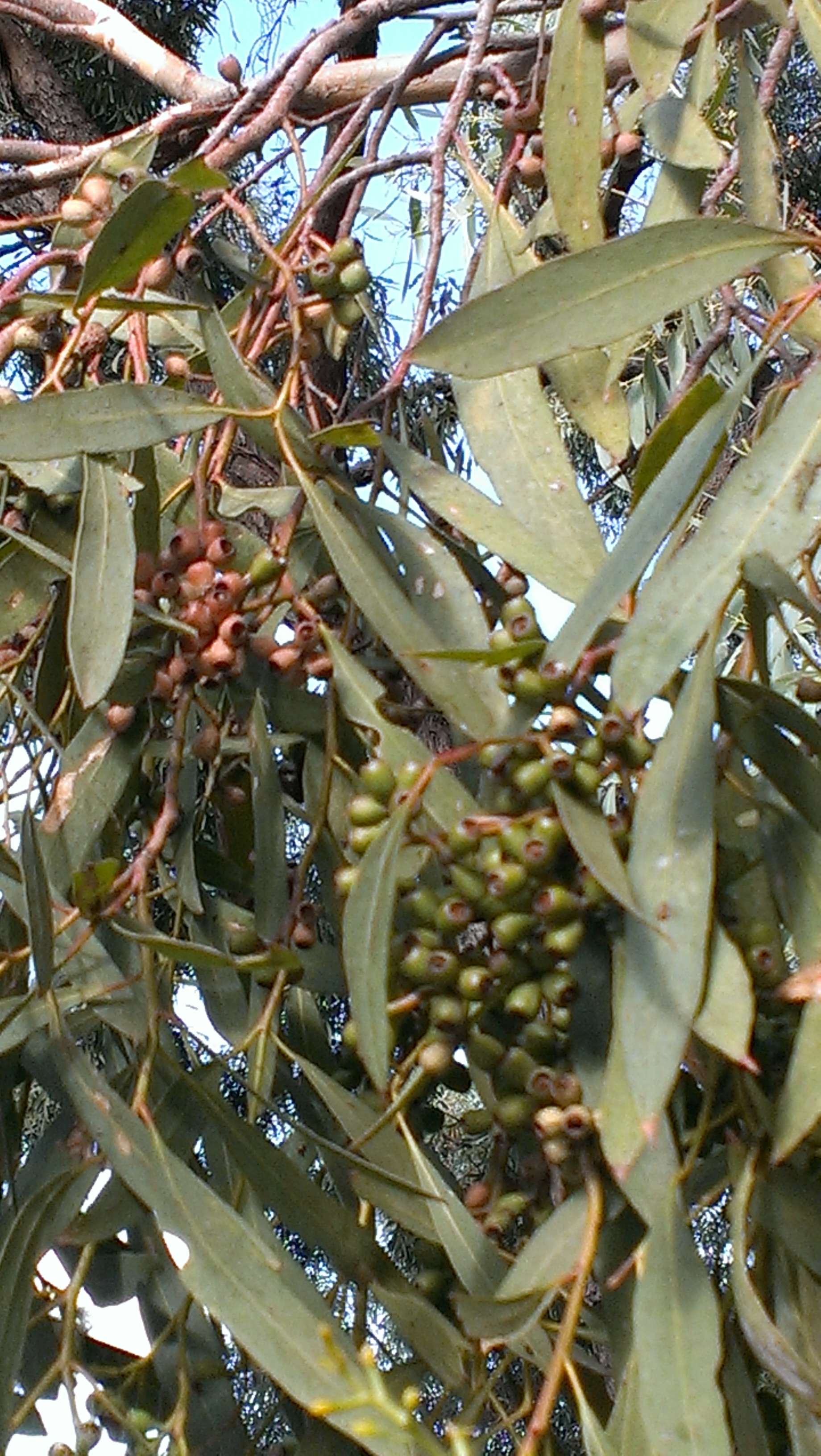
Last week I had a testing trip home from work by public transport.  It took one and a half times as long as doing the trip by bike would have done, partly because I travelled on a bus route further from home and walked a good way.  So I looked for entertainment on my walk.  This rough barked tree was in flower (small, cream-white flowers) and hanging through a park fence.

IMAG1105

Lots of fruit in several stages of maturity.  I took a small leafy sample. 

IMAG1107

I kept walking.and came across this tree with its spectacular peeling bark and bronzed trunk by the tramline.  There was a broken branch still hanging suspended from the intact branches, so I broke off enough dried leaves to make a meaningful test dye bath.

IMAG1109 IMAG1110

Along the tramline closer to home, I saw this beauty with coppery bark (suggesting it might be a mallet, I believe) but quite a broad leaf by comparison with the family member I know best, the swamp mallet, E Spathulata. A few more leaves selected.

IMAG1111 IMAG1112

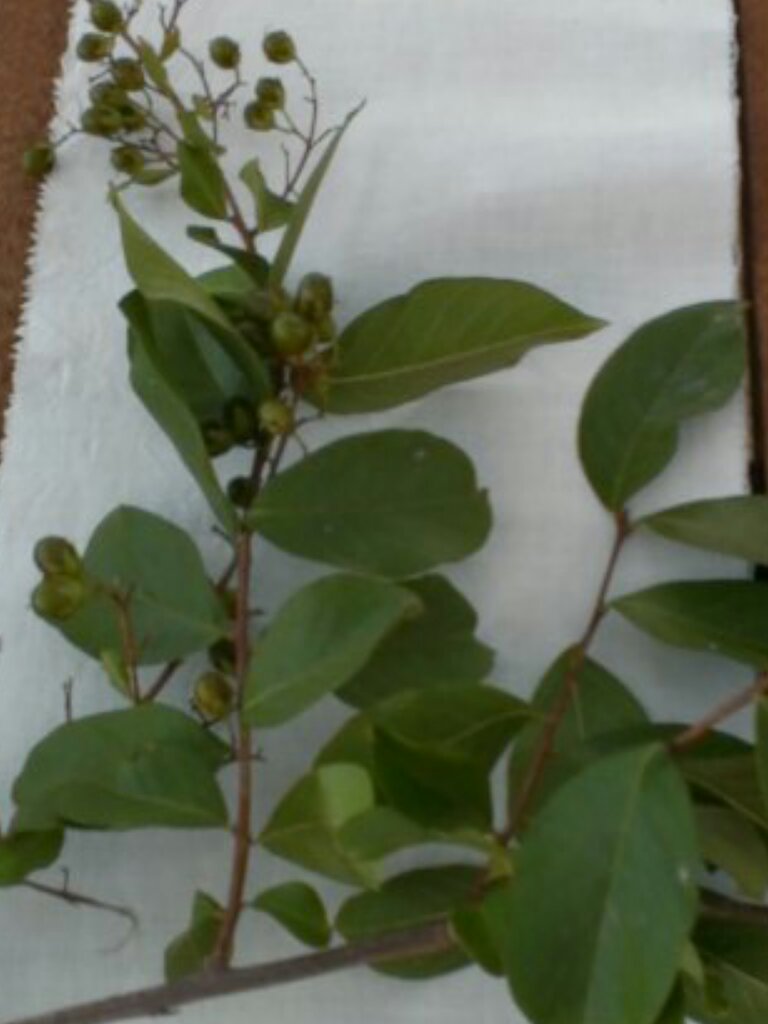
Finally, I passed a friend’s place.  His neighbour’s house had been demolished that day and part of the crepe myrtle (Lagerstroemia Indica) on the street had been a casualty, so I picked a sample of that, too, and when he came out of his garden, there was a chat to be had as well. Crepe myrtle turns out not o be an indigenous species.

IMG_0083

And now for the (dyeing) punchline.  I won’t be losing sleep identifying these trees! That’s the crepe myrtle to the left.  You can see the leaves have acted as a resist to the iron in my bath, with some tan patterning from the leaves themselves.

IMAG1216

And… here is the result from the dried leaf dye bath from the tree with bark peeling in strips.  Tan or brown, depending.

IMAG1214

3 Comments

Filed under Dye Plants, Eucalypts, Leaf prints, Natural dyeing