Tag Archives: local trees

Eucalyptus Nicholii

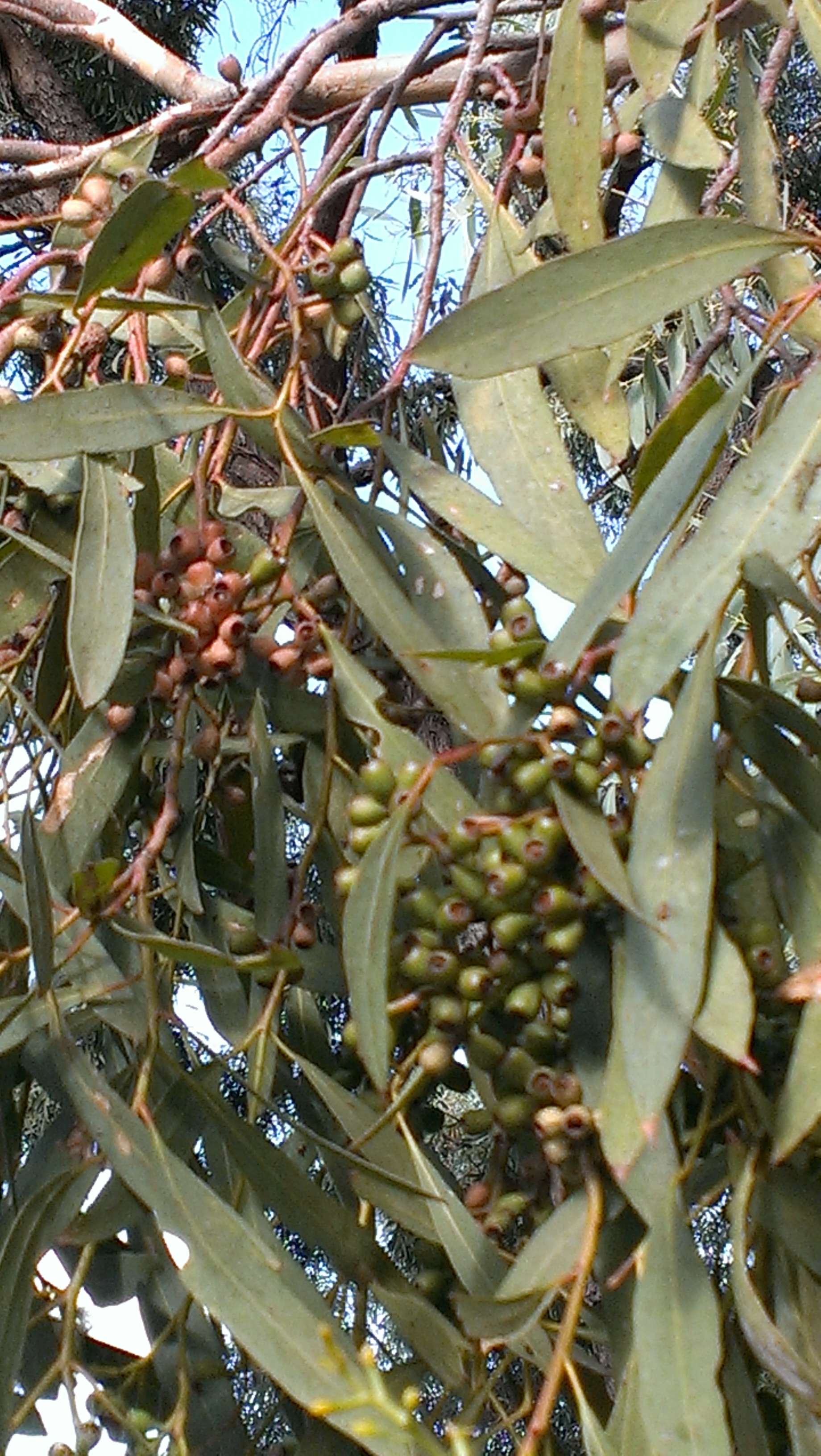
I finally found E Nicholii, growing in Botanic Park. My beady eyes have been searching the suburbs of my city for this tree as I ride past, to no avail until now.

IMAG1407

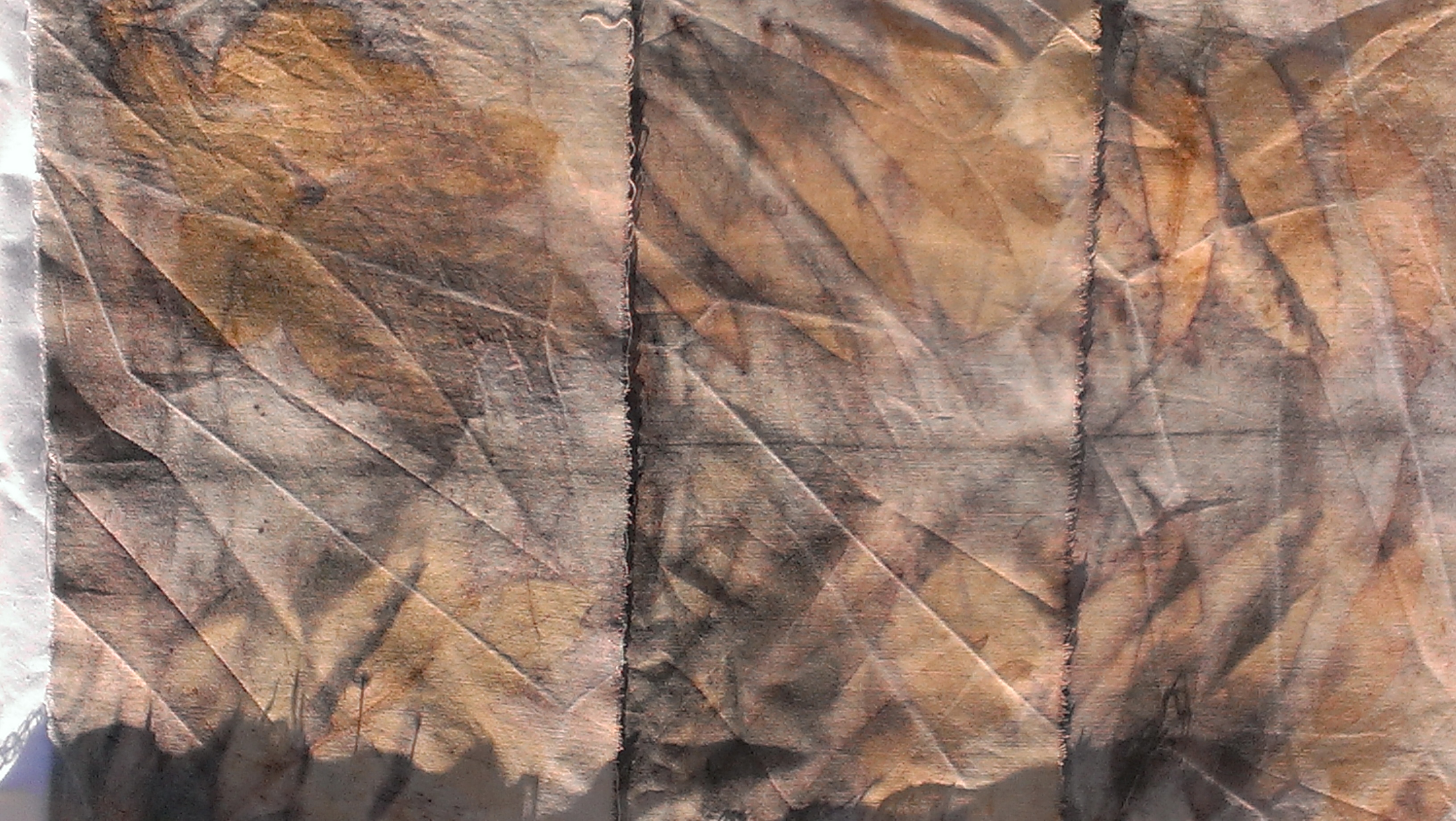
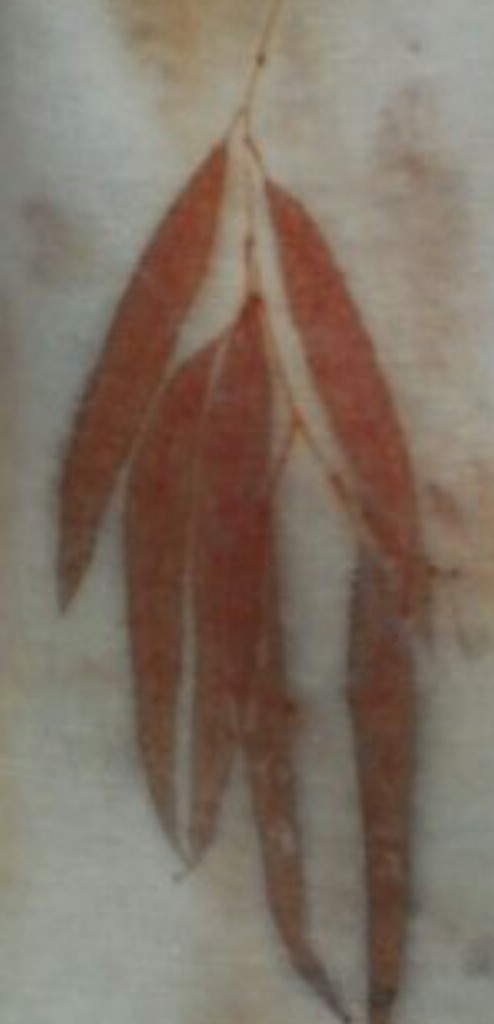
This is such a finely-leaved tree!  Perhaps I have failed to identify it if I have seen one fully grown, mistaking it for another kind of tree altogether.  I had one growing in a pot but it suffered too much through summer. It is also the only tree I have ever seen as the subject of a public notice at Guild, where I once saw a hand lettered note asking if anyone could supply E Nicholii leaves for a dyer. My friend’s godmother–another dyer–who lives in NSW, recommended E Nicholii as her favourite dye plant.  These are some of the reasons I was trying to grow it in a pot.  I have given that up and we have a tiny specimen growing in the corner of the back yard.  And now–the reason why people are so keen!  I think this print is sensational.

IMAG1428

See that big black splodge?  I have wondered why I get one of these once in a while (and needless to say I have had a few theories).  Just recently the penny dropped.  Or should I say, the washer dropped–because that is what actually happened.  One of my dye pots has a glass lid with a knob screwed into the centre of it. All these eucalypt dye baths have eaten away at the metal of the screw and washers.  One washer recently fell off altogether, as the hole in it simply had been made too large for it to stay in position.  So… there has been an inadvertent contribution of iron to some of my dye baths, and some unintended black smudges where iron water drips down onto my bundles from above–since this lid is convex, I have preferred it when I have large bundles in the pot.  Aha!  Another mystery solved.  This may explain some of my surprise dye bath outcomes, too…

3 Comments

Filed under Dye Plants, Eucalypts, Leaf prints

Plum pine 1

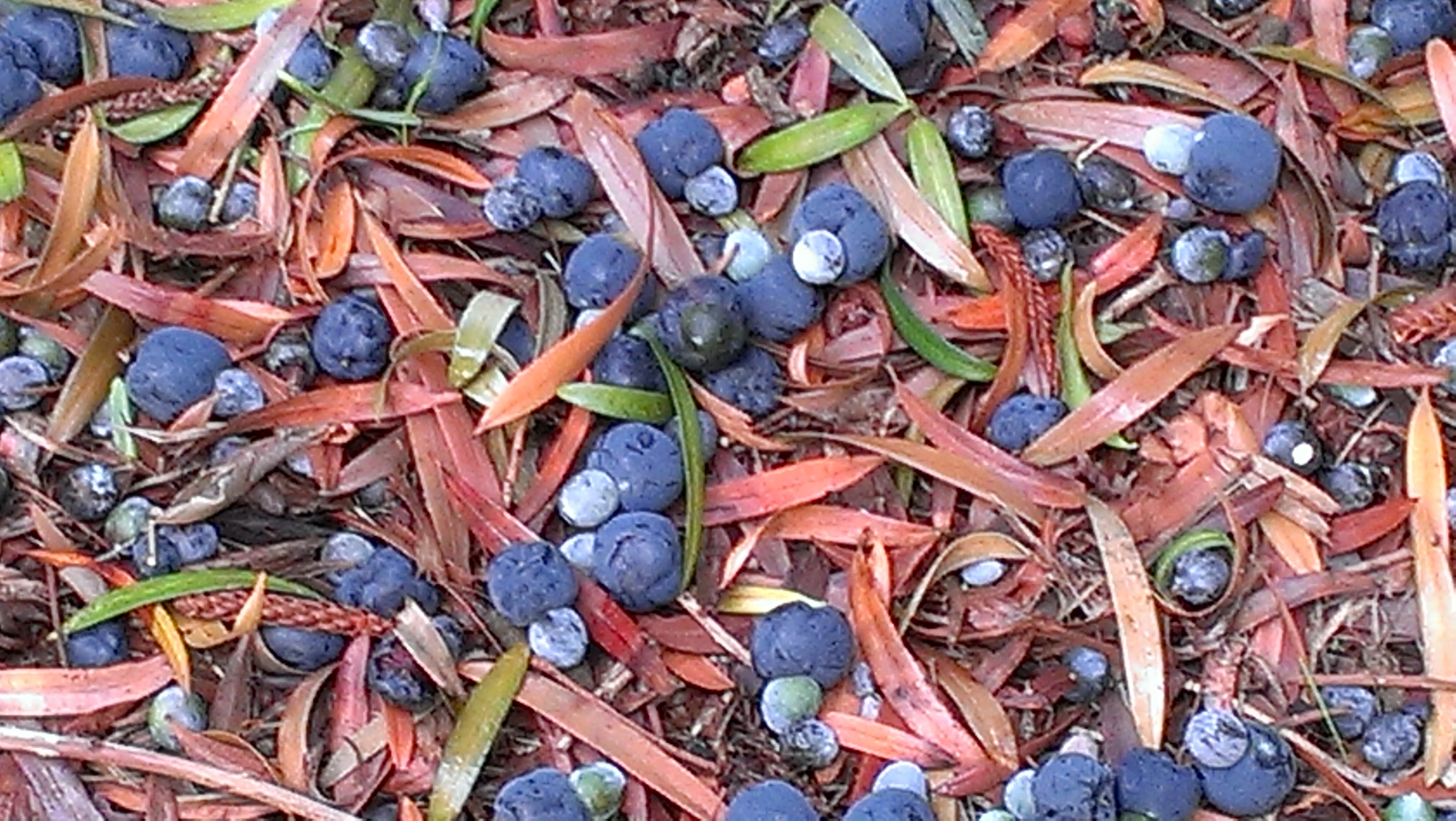
Podocarpus elatus is fruiting in Botanic Park.  I rode past recently with my beady eyes alert, looking for this tree.  I’ve investigated its qualities previously and discovered the fruit is edible.  And today, there they were, lying on the ground in plenty.  They offer plenty of weirdness by regular fruit standards, since the seed is outside the fruit.  One of the less common forms of fruit in my limited experience!  Here they are on the tree…

IMAG1412

And on the ground below.

IMAG1413

This is the tree itself.  It is native to Australia, but it is a rainforest tree.  For those who don’t know…  I am not living anywhere near a rainforest.  South Australia is generously described as having a Mediterranean climate.  Those less generous just call it a desert, and a fair amount of the state answers that description.

IMAG1414

I tried eating one of the fruits and it was just as I remembered it from last time: subtle is the most I could say about the flavour, and the word ‘mucilaginous’ came to mind immediately.  If there is a commercial application for this fruit perhaps it would be… lubricant.  Or perhaps it could be the gumbo of Australian bush food desserts.  I tried leaf prints… but nothing too exciting came of it.

IMAG1432

I twisted the seeds off the fruit and soaked the fruit overnight–pitting plums has never been so simple.  No change in the colour of the water.  I cooked them for almost an hour–water a deep plum colour by now–and then threw in a  sample card and some silk thread.  Soon after that, the alum mordanted wool looked almost blue, and the other fibres (cotton, silk, wool) looked pink.  After about an hour of heat, the alum mordanted wool was deep grey-blue, the wool was deep rose-pink and the other fibres looked paler shades of pink.

IMAG1462

Needless to say, this outcome made me think I should go back to that tree 🙂

7 Comments

Filed under Dye Plants, Leaf prints, Natural dyeing

Lillypilly fruit

IMAG1282

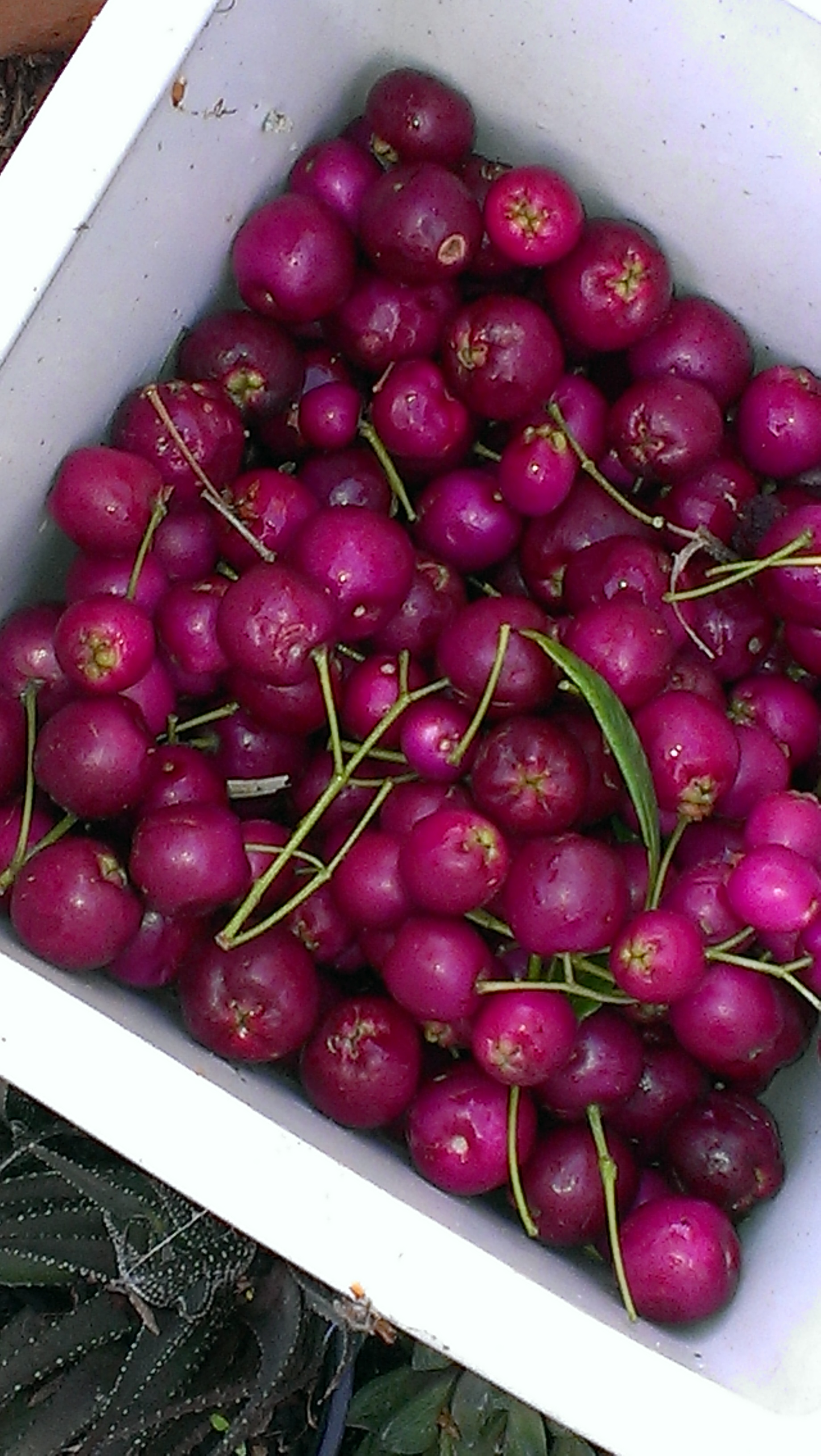
Lillypillies are in fruit around my suburb.  They are the fruit of a large, glossy-leaved forest tree and they stain the footpath in a most impressive and promising manner.  This one is Szygium Smithii (but this is a family of trees some of which are widely grown ornamentally in Australia).  The fruit is edible, but in the case of this species, unexciting in terms of flavour, with a crisp texture and a fairly large seed inside.  On the dye front…  I did not find this an exciting outcome.  Fawn on silk (the card on the right), brown on wool with alum and tan on unmordanted wool.  I think I’ll stick with cooking lillypillies and admiring their enormousness and the spectacle of so much fruit!

IMAG1306

2 Comments

Filed under Dye Plants, Natural dyeing

Wash fastness: Eucalyptus leaves on cotton knit

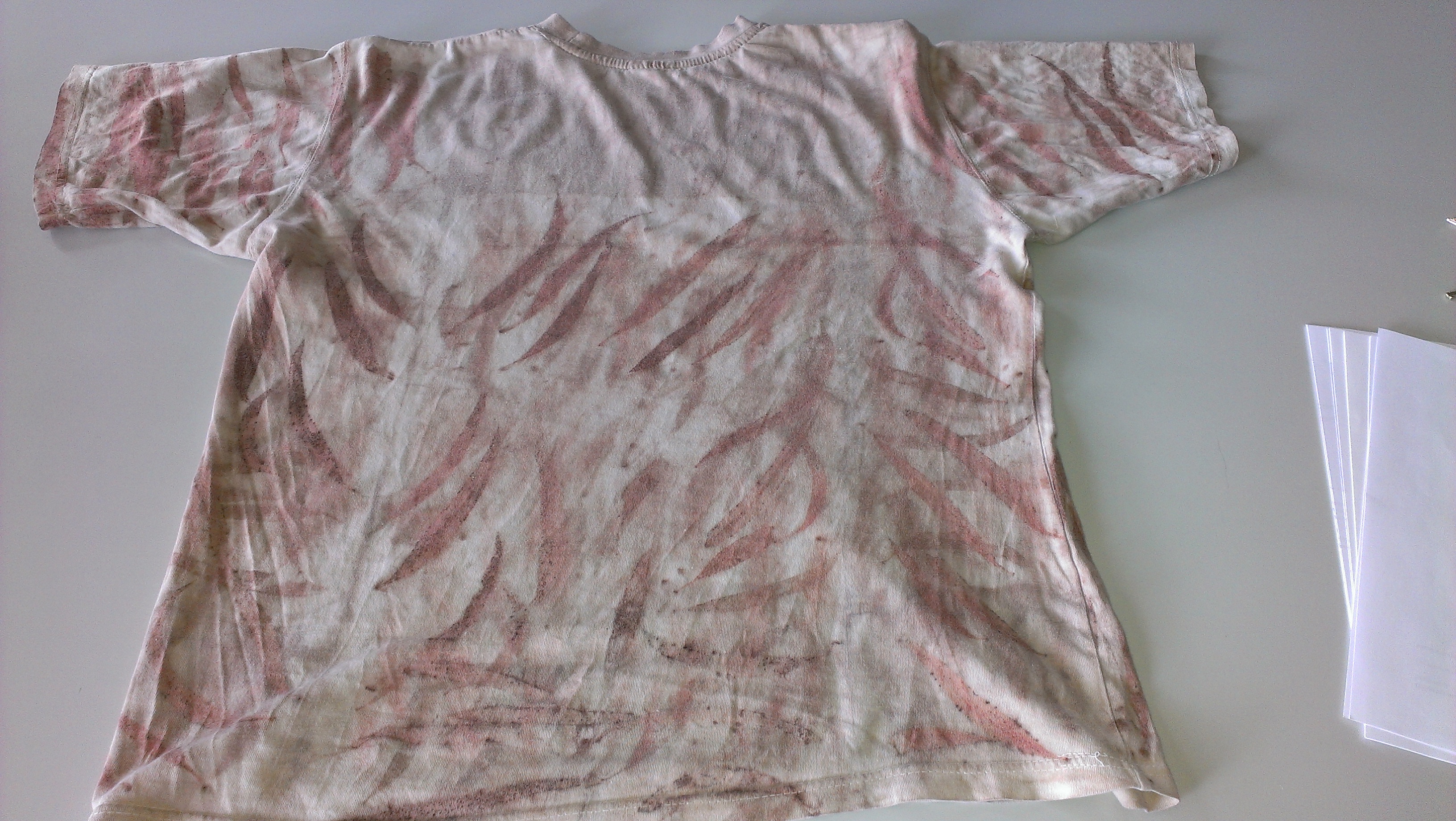
I leaf printed a cotton t shirt on 10 February 2013.  I prepared the fabric with soymilk and dyed using iron and E Scoparia leaves.

Here it is on my office desk after its first trip through the washing machine at 30C and its first trip to my office on my back as I rode to work. The front and the back (with the part that was outermost in the dye bath at the upper mid back):

IMAG0950 IMAG0951

It still smells strongly of eucalyptus when you’re up close (and sweaty), but the smell of soybean is almost gone, or overwhelmed by eucalyptus.  I am thinking I can take a photo of it in the (relatively) controlled light conditions of my office at regular intervals and see what we can notice.  One wash more and the smell of eucalyptus was fading a good deal.

Here it is in May, 12-15 washes later:

IMAG1289IMAG1288

I am just not sure about the influence of light on this image… to me as the person wearing the garment, it seems to have changed little except that the part on the upper mid back where the fabric was exposed to the dye bath (and consequently, to  iron) is much lighter.  There’s no doubt the photo looks much less orange, though the leaf prints are still entirely distinct.

6 Comments

Filed under Eucalypts, Leaf prints, Natural dyeing

Alpaca preparation

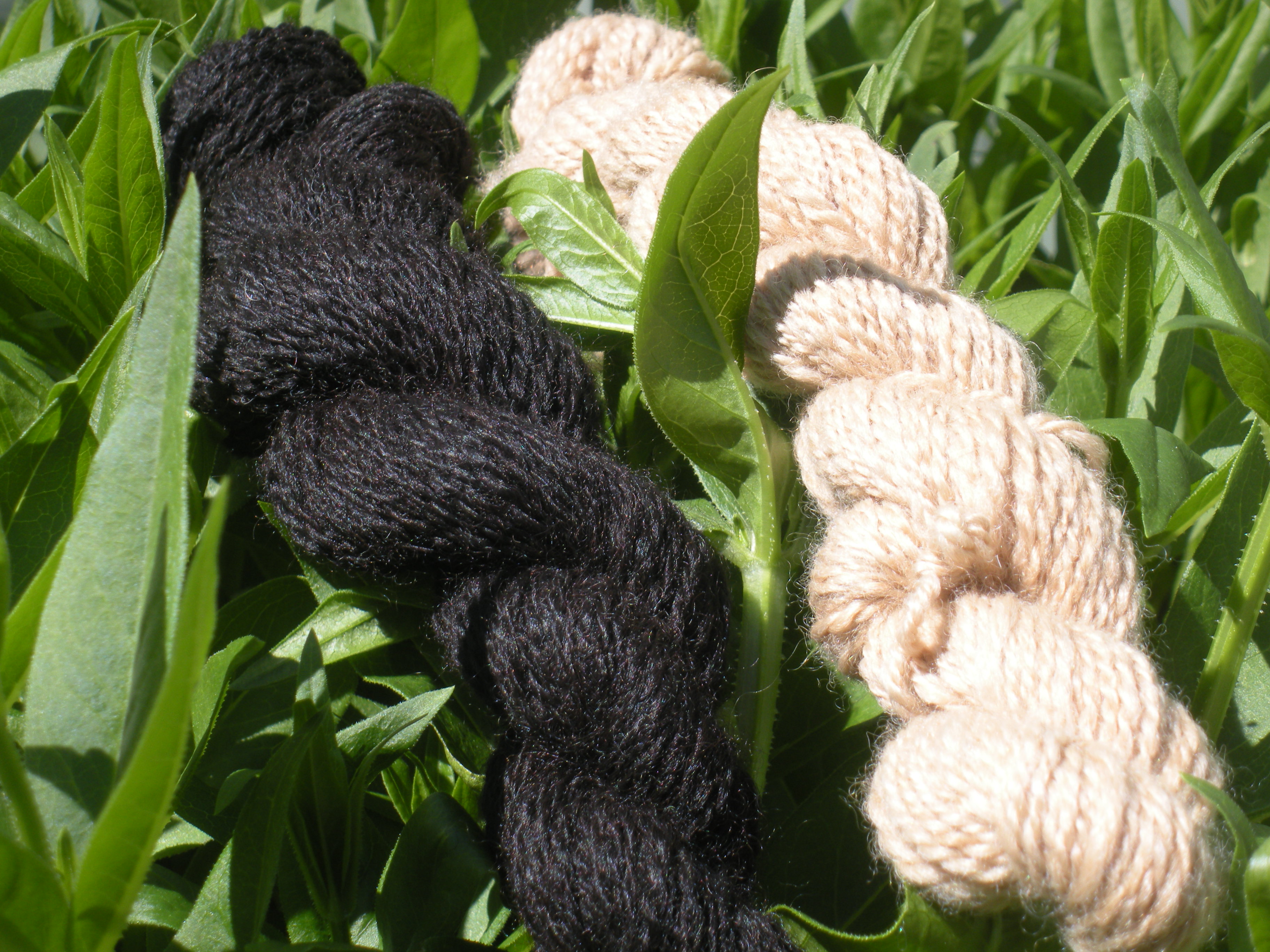
I’ve been having a lovely time spinning alpaca given to me by a generous friend.  She gave me samples of three different fleeces, white, black and what she rather fetchingly calls ‘champagne’.  I’ve been combing it and spinning it two ply and I’m very happy with the results.

I told my friend how lovely I thought the alpaca was, and she gave me more!  I have spun alpaca before, sometimes in quite a large quantity, but this has the longest staple I have ever seen, about 90 mm (these are the 90 mm matches I use to light to the dye pots–extra long.

I have to confess I have never washed alpaca, and it is always filthy, since alpacas roll and dust bathe.  My chooks dust bathe too, and watching them,  it’s no wonder that sand falls out of this fleece any time I move it! This fleece had so much dust in it that combing it was an outside activity that gave me hayfever.  I spun a lot of the white fleece rinsed and combed (that stopped the hayfever at least).  Then, I decided to brace myself and washed the rest of it.  And that led to dyeing the unspun fibre, as it turned out.  I have been working my dyepots hard experimenting toward red and…

IMAG1267

I am getting more interesting colours on silk thread (wrapped around the cards at left) than ever before.  My friends agree that the alpaca on the left, first through the dye bath, is red, then there is grey corriedale (second pass, same dye bath), more alpaca (third pass, still the same dyebath) and some still damp alpaca (fourth pass).  Three cheers for the potential to spin alpaca of many colours!

4 Comments

Filed under Dye Plants, Eucalypts, Fibre preparation, Natural dyeing, Spinning

Leaf prints with rust water

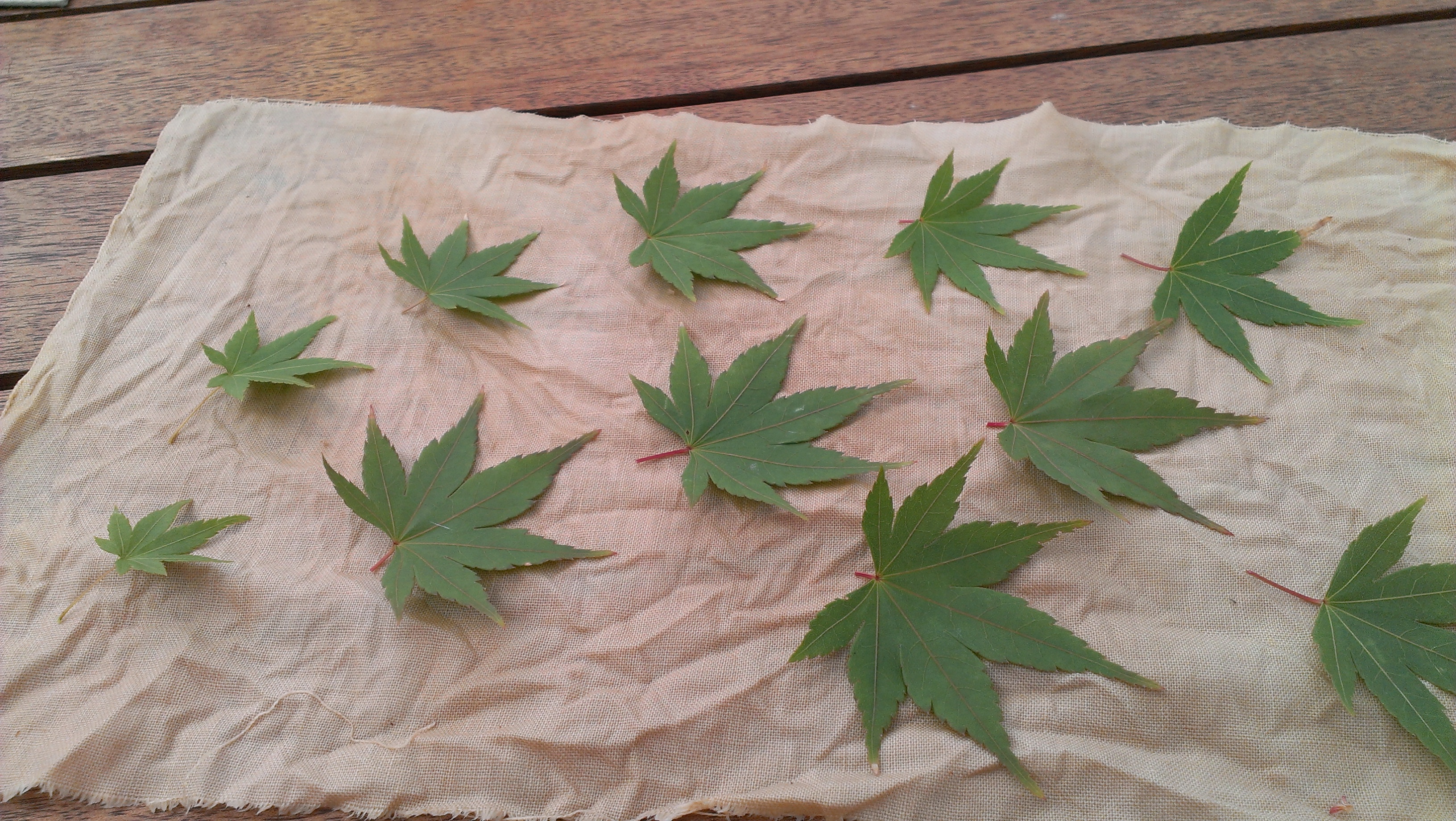
I have continued my experiments with Rebecca Burgess‘ ‘fall dye starter’ from Harvesting Color. I admit, it is barely autumn here and I’ve actually been trying this out through our summer… but this is a mere detail, I hope! I tried these three lobed leaves which someone told me were from a maple (I know little about maples), and birch leaves–why not?

IMAG0662 IMAG0765

I like the results a lot, but I won’t bother with birch again. I also collected oak leaves and wrapped them.

IMAG0661IMAG0766

Finally, I made a special trip to what I was confident was a maple to collect these exquisite five-lobed leaves.    I tried these on fabric cooked with tannin-bearing eucalyptus bark, which is not what Burgess recommends at all.

IMAG0658

This produced hardly a smudge.  So, I may have to review my ideas about tannin.  Or on the other hand, I may have to reconsider my naive ideas about maples!

4 Comments

Filed under Dye Plants, Leaf prints, Natural dyeing

Waste not want not

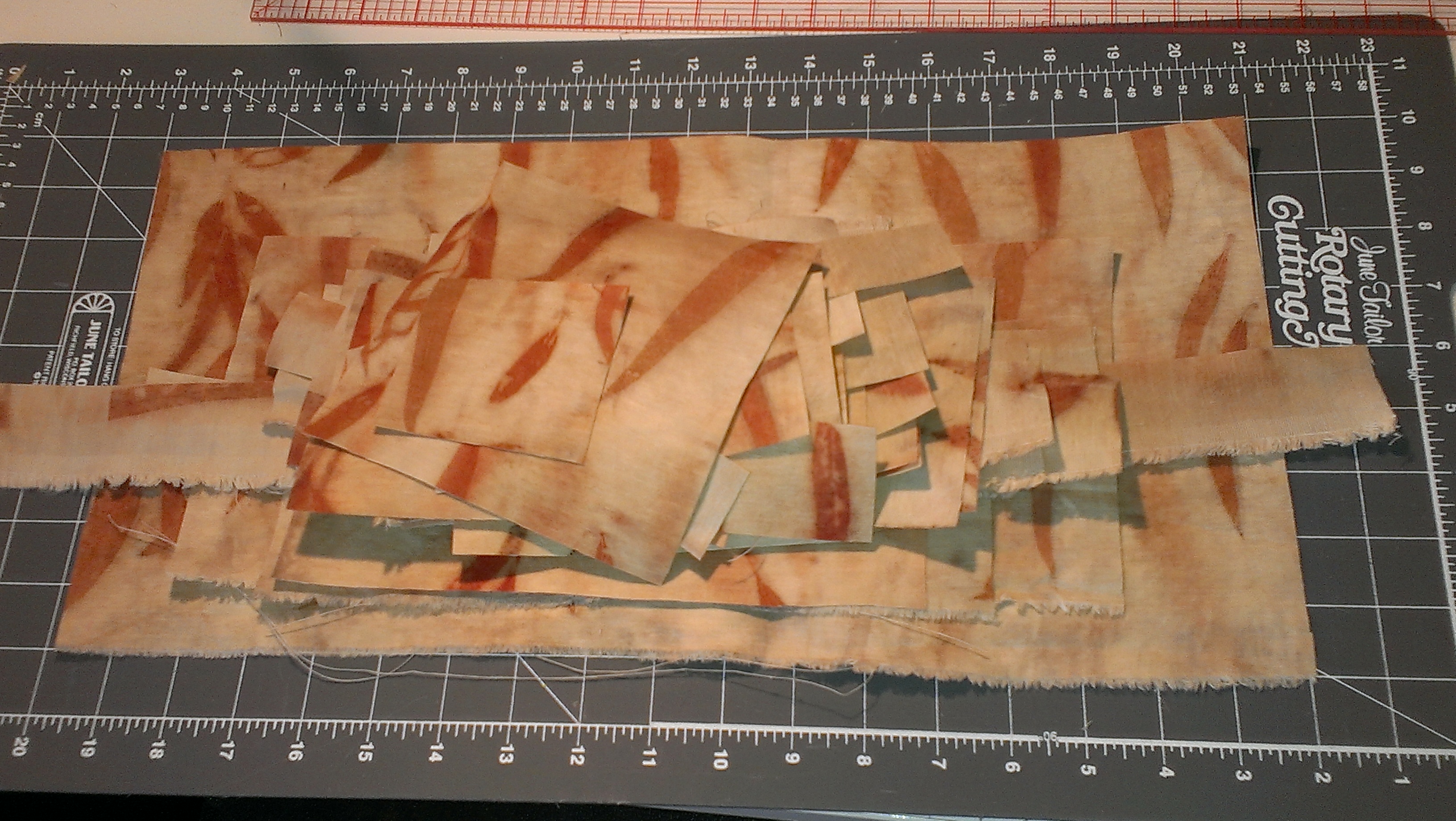
Having made two shirts from my length of leaf-printed hemp/silk, I was left with a selection of mostly quite small pieces.  Other people have clever ways of designing that don’t leave waste but use the whole length of fabric.  Not me.  Maybe I’ll learn this one day.  But I have my ways.  I cut all the pieces into rectangles and squares.

IMAG1075

Then I start piecing them together and matching sizes.

IMAG1078

I stitch them into bigger and bigger pieces, until I can decide whether to make a bag or a cushion cover or whatever seems to suit the fabric and design.  Finally all I have left are useable pieces of patchwork.

IMG_0059

And a really small pile of scraps.

IMAG1073

And of course, the second shirt.

IMG_0118

5 Comments

Filed under Eucalypts, Leaf prints, Sewing

Eucalyptus Orbifolia

Alas, poor Eucalyptus Orbifolia.  I grew this plant from a small seedling to a still small, but perhaps 50 cm high plant hardly worthy of the title ‘sapling’, in a large pot.  It seems to have been a casualty of the hot summer and perhaps its far flung location at the back of the yard.  Despite all the watering it received, poor old Orbi gives every impression of having curled up its toes.  So, I’ve cut back and harvested the leaves for the dye pot.  Perhaps there will be regrowth, but I’m not letting all the leaves fall while I wait to find out.

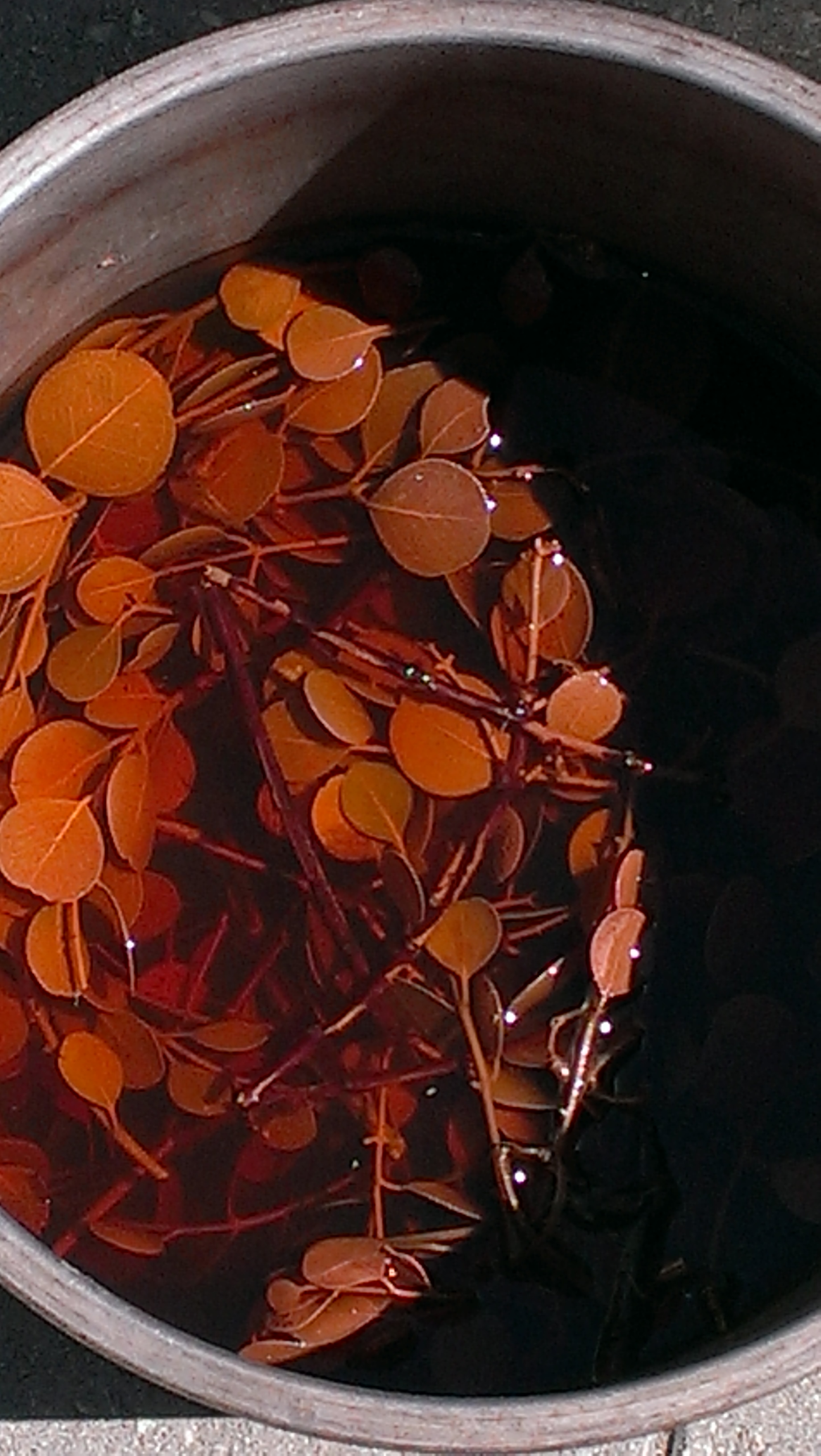
I bought this plant and not some other believing it to be a dye plant for some reason I can no longer remember.  I’ve been to the place I thought this idea generated but it isn’t there!  And now I can break the news to you, dear reader.  It isn’t going to join the list of truly exciting dye plants anytime soon.  Here is the dye pot after some hours of simmering.

IMAG1189

The dye liquor is still quite clear, with an amber tint.  The leaves are still the glorious shape that gives the tree its name.  I have leaf printed with them in the past and the result was definitely a print, though not any really impressive colour.  And here is the result of a dyebath test. The handspun with no mordant: orange.  The millspun superwash with alum mordant: brown.  What was I thinking mixing and matching fibres on my test cards in this batch? Silk thread, nothing of significance to report (E Orbifolia is in the middle). And for comparison, handspun Finn X dyed with E Scoparia bark at the bottom of the frame.

IMAG1215

5 Comments

Filed under Dye Plants, Eucalypts, Natural dyeing

Random harvest

In the beginning, when I’d read the Handweavers and Spinners Guild of Victoria Dyemaking with Australian Flora (1974) and perhaps Jean Carman’s Dyemaking with Eucalypts (1978) and knew just about nothing about identifying eucalypts, I used to just choose a tree at random and try it out on some wool.  Sometimes that is still the thing to do!

Last week I had a testing trip home from work by public transport.  It took one and a half times as long as doing the trip by bike would have done, partly because I travelled on a bus route further from home and walked a good way.  So I looked for entertainment on my walk.  This rough barked tree was in flower (small, cream-white flowers) and hanging through a park fence.

IMAG1105

Lots of fruit in several stages of maturity.  I took a small leafy sample. 

IMAG1107

I kept walking.and came across this tree with its spectacular peeling bark and bronzed trunk by the tramline.  There was a broken branch still hanging suspended from the intact branches, so I broke off enough dried leaves to make a meaningful test dye bath.

IMAG1109 IMAG1110

Along the tramline closer to home, I saw this beauty with coppery bark (suggesting it might be a mallet, I believe) but quite a broad leaf by comparison with the family member I know best, the swamp mallet, E Spathulata. A few more leaves selected.

IMAG1111 IMAG1112

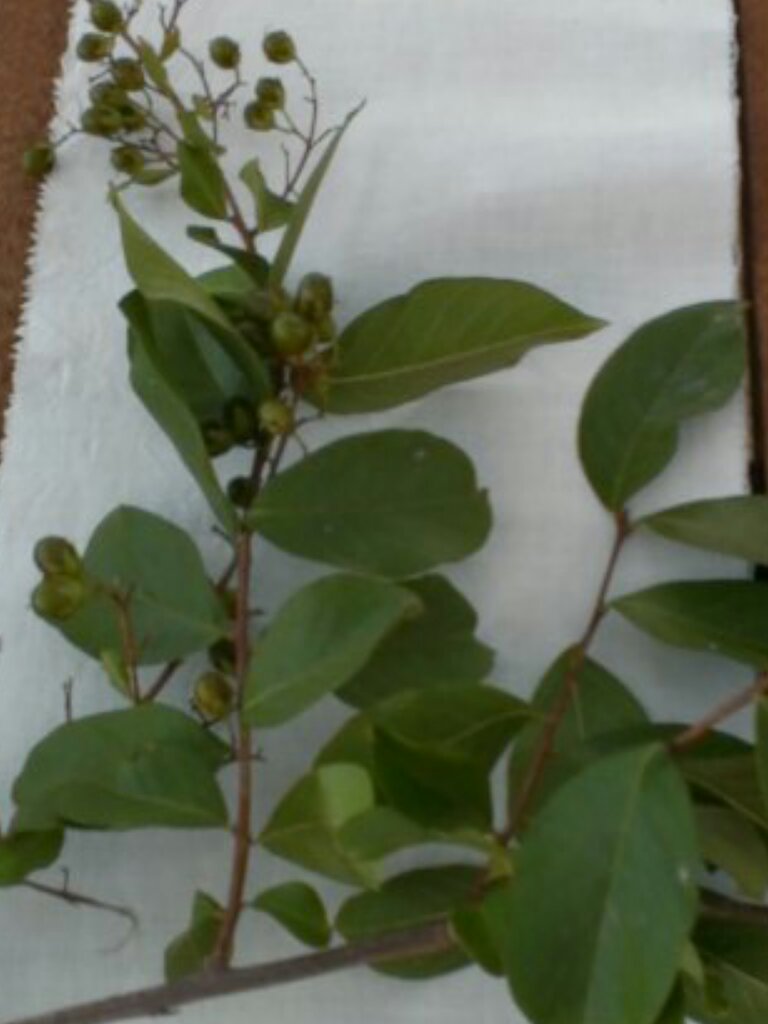
Finally, I passed a friend’s place.  His neighbour’s house had been demolished that day and part of the crepe myrtle (Lagerstroemia Indica) on the street had been a casualty, so I picked a sample of that, too, and when he came out of his garden, there was a chat to be had as well. Crepe myrtle turns out not o be an indigenous species.

IMG_0083

And now for the (dyeing) punchline.  I won’t be losing sleep identifying these trees! That’s the crepe myrtle to the left.  You can see the leaves have acted as a resist to the iron in my bath, with some tan patterning from the leaves themselves.

IMAG1216

And… here is the result from the dried leaf dye bath from the tree with bark peeling in strips.  Tan or brown, depending.

IMAG1214

3 Comments

Filed under Dye Plants, Eucalypts, Leaf prints, Natural dyeing

Tribeca shirt

At last, the piece of lovely fabric I was speaking about toward the end of this post has become a garment.  The fabric is a silk/hemp blend from Margaret River Hempco.  The pattern is the Tribeca Shirt from the Sewing Workshop.  The leaf prints use India Flint’s techniques and Eucalyptus Scoparia leaves.

IMG_0080

I invested in this pattern because I have been making the same unisex shirt from McCall’s for years in different fabrics.  It is an oversized shirt with collar, collar stand, button bands, plackets and cuffs.  I’ve had great value from that pattern, making it for myself numerous times and for other people from time to time. Sometimes I’ve made it with collar stand and no collar, or a differently shaped collar.  I’ve made it from recycled linen tablecloths, lovely quilting fabrics and even a screenprint from an Indigenous business on the Tiwi Islands.

IMG_0074

I wanted something different and I decided on this.  It really was different.  No facings, no cuffs, the funnel neck involves no collar, and the whole shirt is designed for french seams. I had a failure of nerve prior to setting in the sleeves using french seams and had to set it aside for a couple of days!  The buttonholes are placed over a patch sewn to the reverse side.  Shaping is achieved with darts.  This is really interesting but also really efficient sewing.

IMG_0078

The level of instruction in the pattern worked well for me.  As usual, the bodies contemplated by the pattern measurements and my own body seemed to have little in common.  My pattern adjustment skills are better than they have ever been but could still use improvement–just the same, the result has me feeling really happy.  I had enough fabric leftover to cut out a second, simple shirt which is now waiting for my attention. Now all I need is the right occasion for a first outing.

IMG_0076

8 Comments

Filed under Eucalypts, Leaf prints, Sewing