Tag Archives: think globally

New year’s crafty wrap up

I realise that new year passed a while back… but there are a few things to report.  I did some serious plying on my January holidays–

2015-02-10 08.57.29

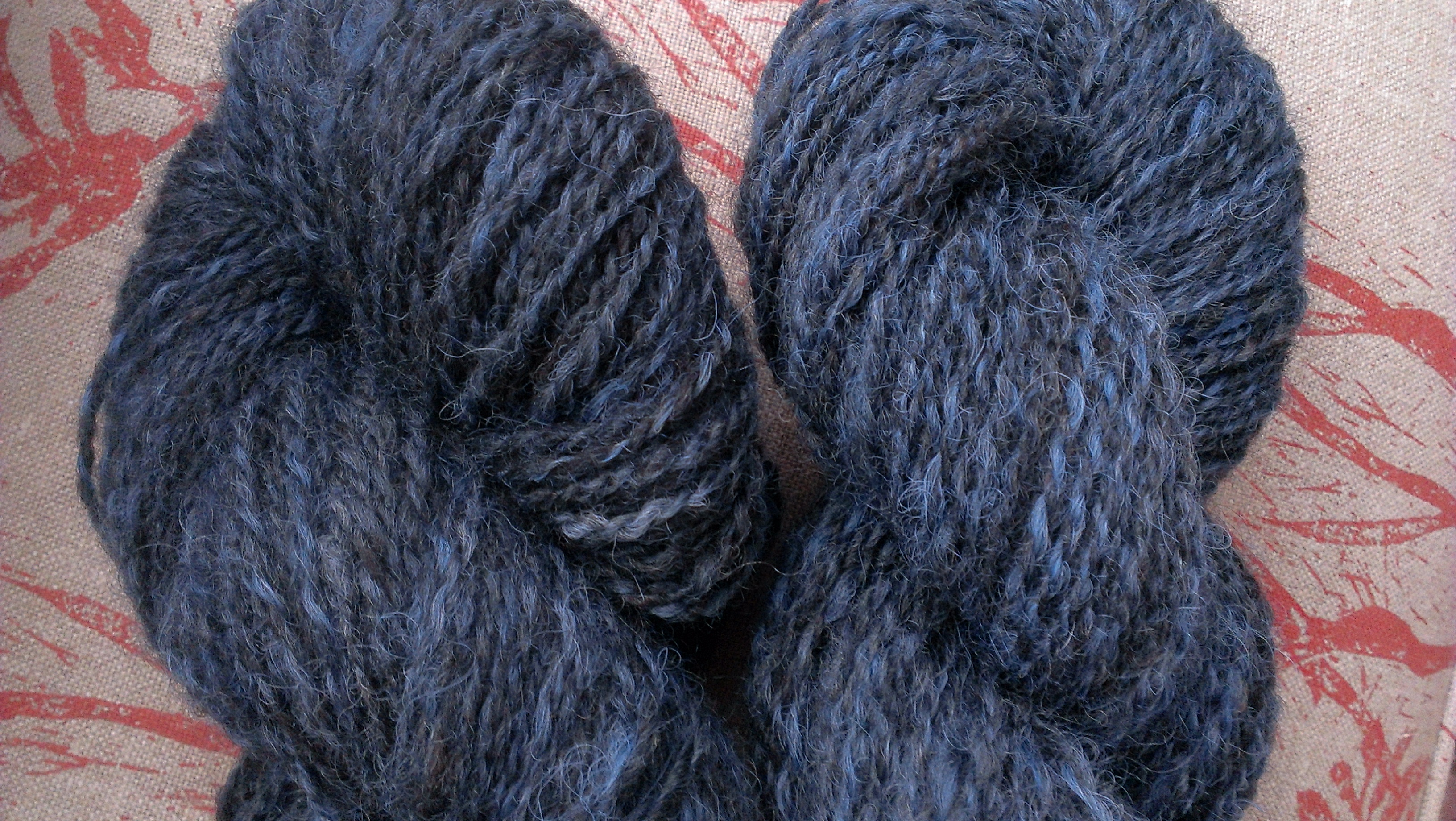
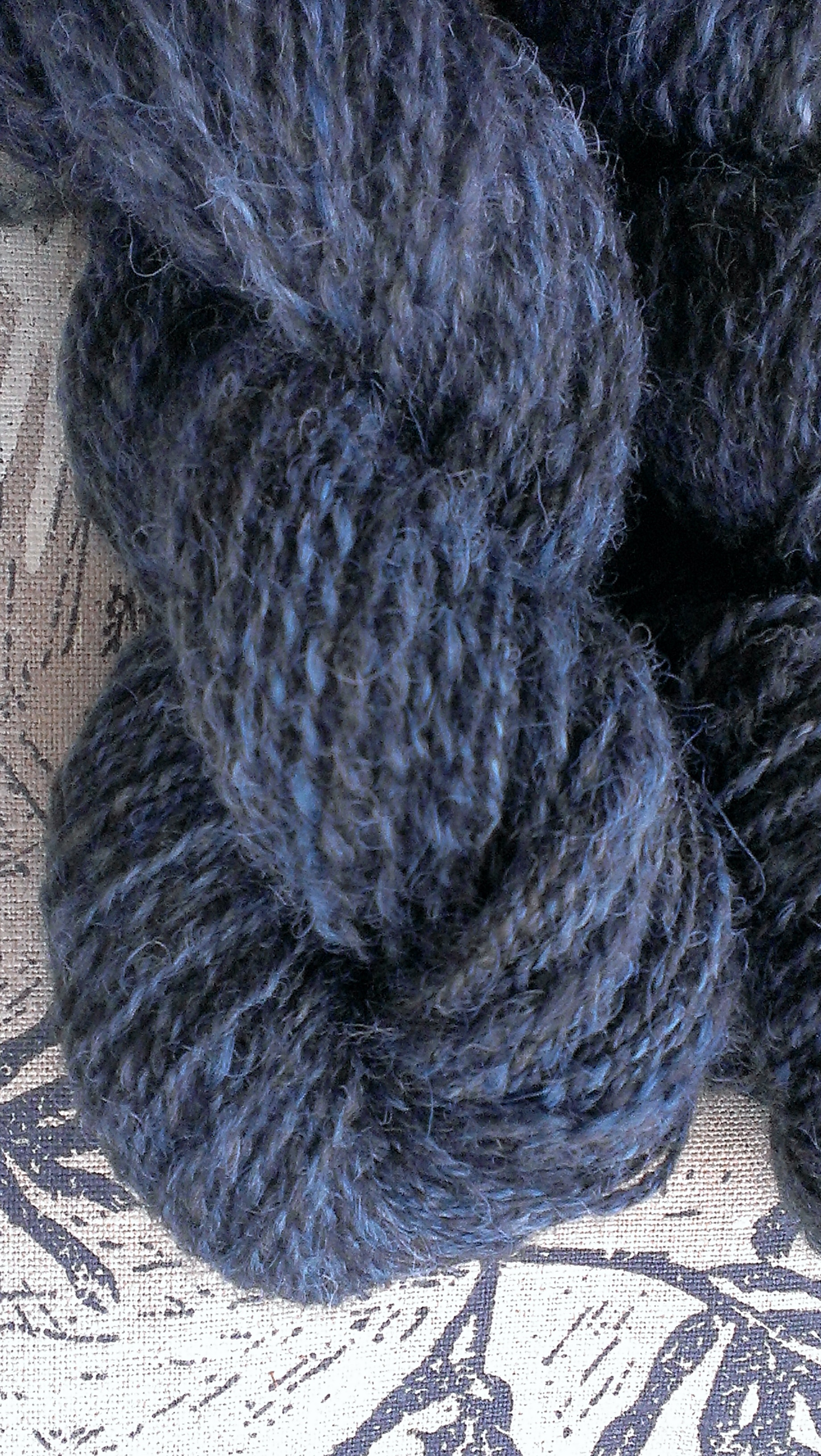
This is the indigo dyed grey crossbred fleece you might remember.

2015-02-10 08.58.04

Surprisingly hard to photograph, but I like it very much.

2015-02-11 08.53.39

I also plied two immense hanks of black alpaca yarn.  The fleece was a gift from a community with lawnmowing sheep and alpacas.  I am thinking I will check whether any of the resident knitters would like this yarn.  It is deep black and happily… now virtually free of scurf.  Spinning is such an educational pursuit!  I had not encountered animal dandruff before, but my online research reassured me it was just one more of the things to pull and shake out and nothing to be afraid of… 2015-01-14 15.19.11

Last year’s calendars have been turned into envelopes, as they so often are.   This lovely piece of whimsy covered in Indigenous animals and detail of lunar cycles is by now-local artist Lucy Everitt. She also has delectable cards and other items for sale, and a beautiful blog. Her 2015 lunar calendar is available here.

2015-01-12 10.01.23

This calendar, all about Japanese art.

2014-12-14 16.48.41

Did I mention the shopping trolley?  My beloved and one of our friends restored the metal parts of this vintage item to their former glory.

2014-12-14 16.47.40

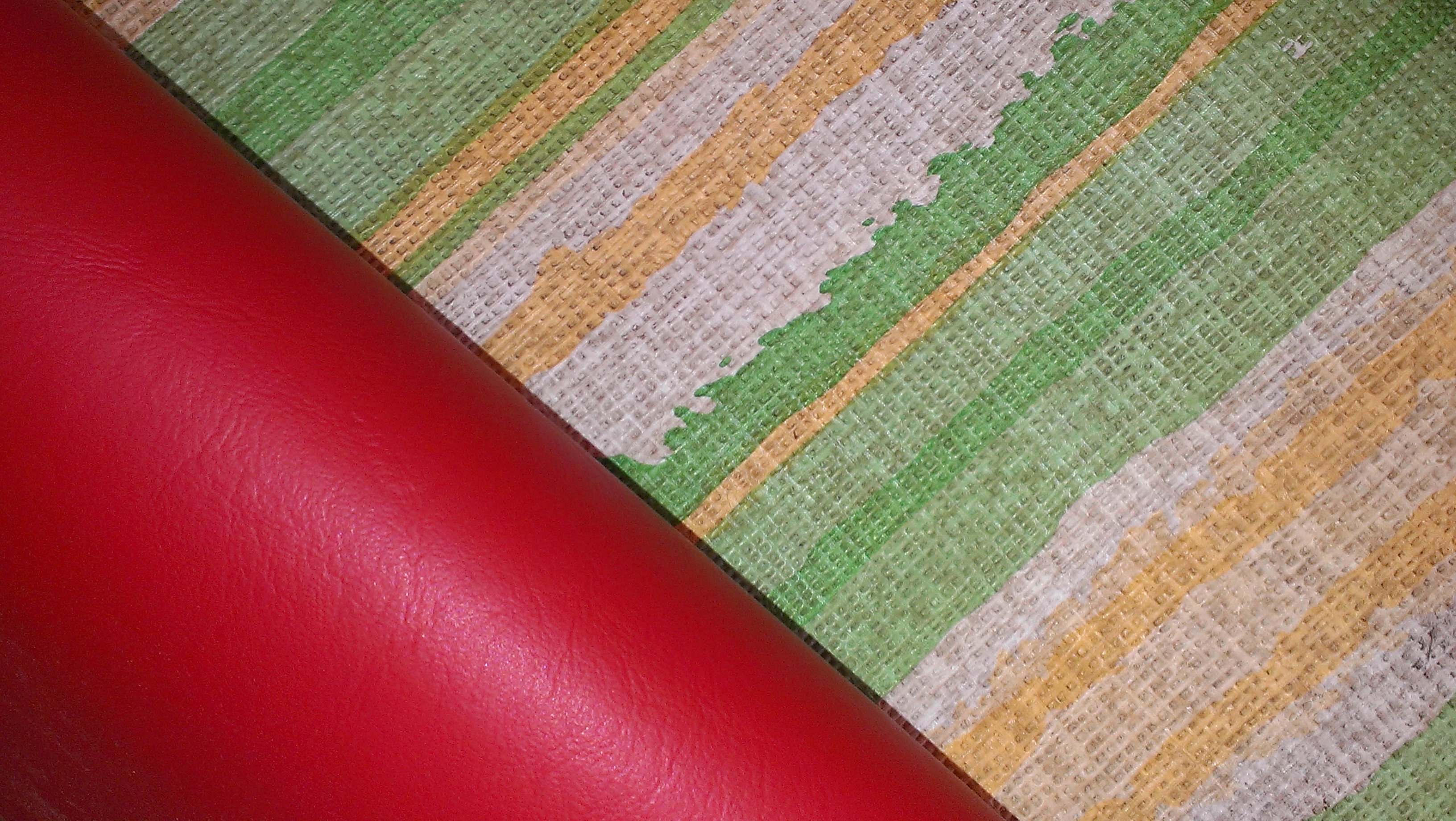
I had the job of taking the ripped, torn and stained vinyl cover (yellow, green and white) and making a new one from red vinyl.  It didn’t convert me to vinyl at all!

2014-12-14 16.48.31

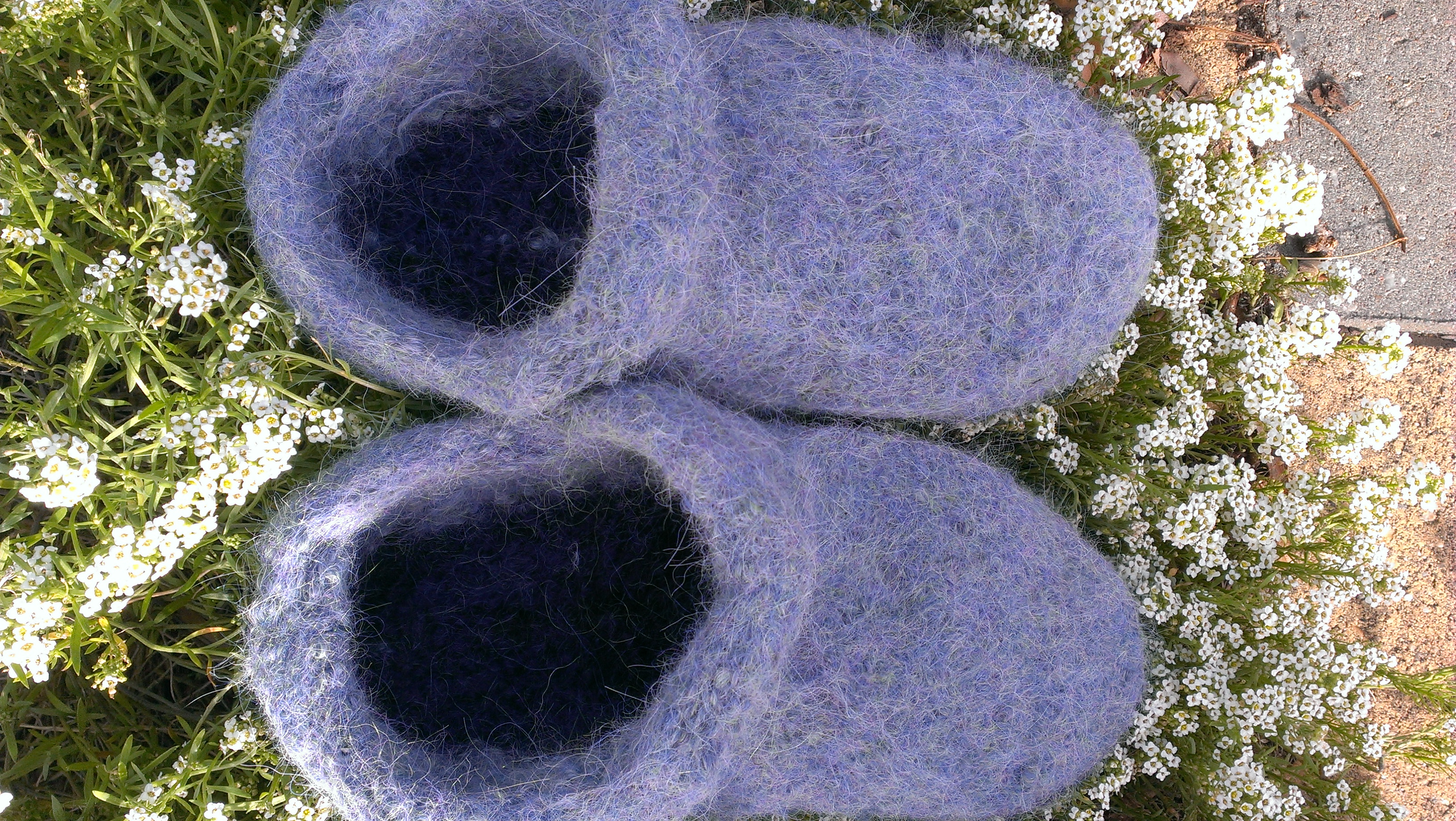
And then there were the late 2014 slippers.  Two different models in blue alpaca yarns. 2015-01-17 08.39.54

Apparently the procession of slippers will never end, as I have long suspected might be the case… 2015-01-17 08.39.34

8 Comments

Filed under Knitting, Neighbourhood pleasures, Sewing, Spinning

Quilt finished at long last!

It has been a long time coming, but toward the end of my first burst of holiday time I finally got a proverbial wriggle on and made some serious quilt progress. I have created a series of blocks that each showcase leaves from a specific eucalypt, and embroidered the name of the eucalypt onto the block with eucalyptus-dyed silk thread. Who knew I had it in me?  I thought I had decided against embroidery as a child, never to go back.  I tracked the old posts on this project because I wondered just how long I have been working on this quilt (or not working on it, which is the routine case, of course!)  Just between you and me, this post in July 2013 is my first intimation on the blog that this project was in my mind.  Blocks sitting waiting for courage here.  Blocks finished here.  Sashing attached with help from a visiting friend here. Dyeing the border here.  Back finished here.  Finally, it was assembly time!  Here is the back, pinned out flat on the floor, wrong side up.

2015-01-03 14.38.04

I love the wrong side.  Of most things. The back is made of a mix of recycled, inherited and thrifted fabric.  Next, the minimal batting option for women of a certain age in a warm climate: an ancient flannellette sheet, well past its prime.  It’s hard to tell it was ever blue now.
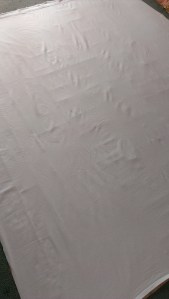
2015-01-03 14.56.57

The top, pinned out over the rest, is made of stash black fabrics and a mix of recycled and thrifted fabric again:
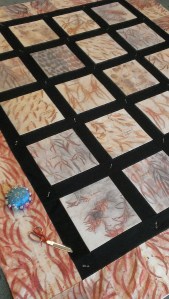
2015-01-03 16.05.14

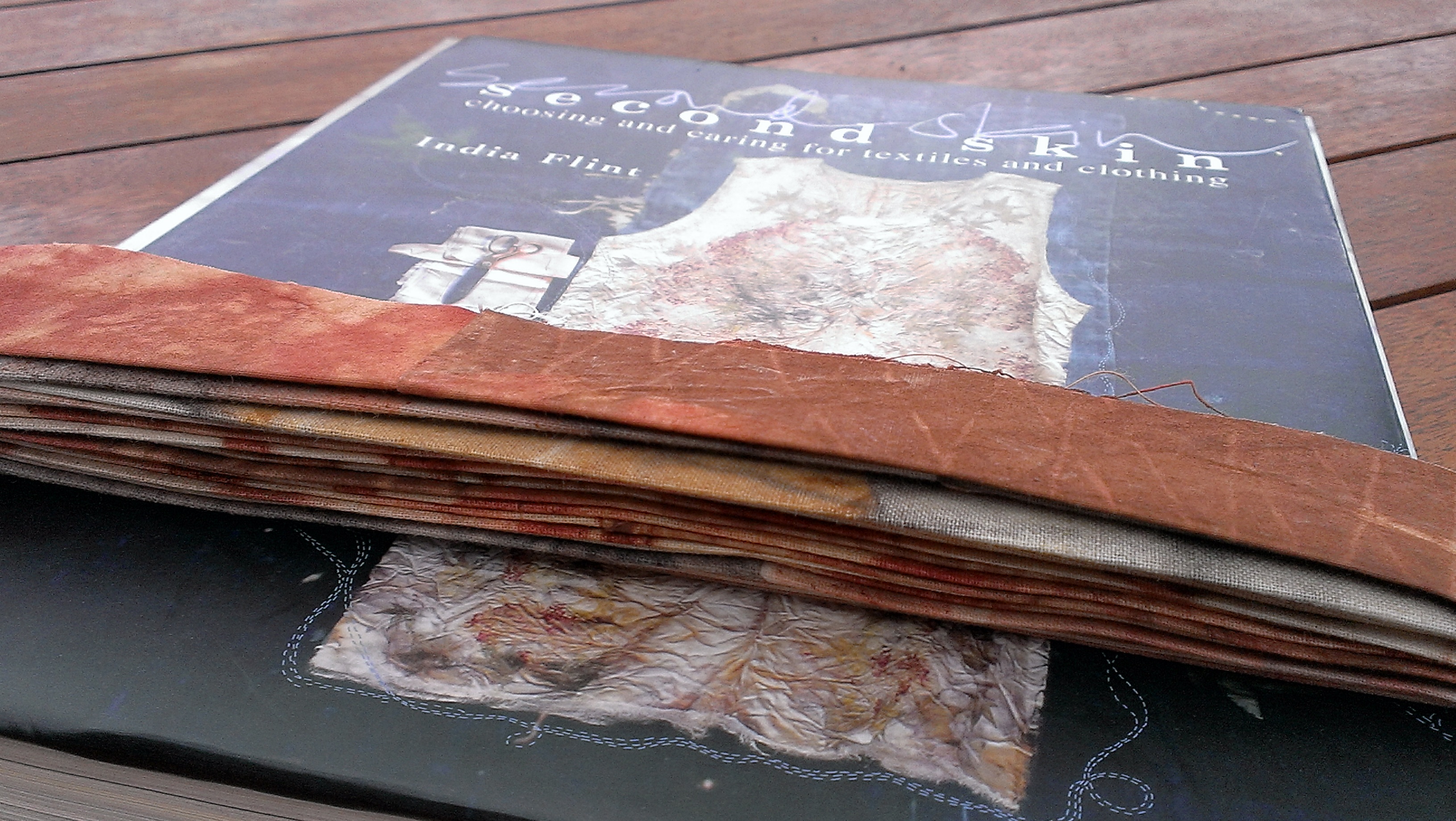
All layers pinned together, I decided on machine quilting, coaxed by a friend. The quilting part has never gripped me.  My last quilt was tie-quilted and not really ‘quilted’ with stitching much at all. Clearly the patchwork is my main interest, and the dyeing, of course.  Then, time to make the binding.  There were plenty of leftovers.  I made metres of binding and followed the instructions in Block Party by Alissa Haight Carlton and Kristen Lejnieks.   As usual, with less precision than the authors suggest might be warranted.  Just the same… here it is, kept tidy until stitching-on time…  Second Skin was right behind the ironing board, and seemed perfect for multiple reasons…

2015-01-03 16.44.04

I do understand bias binding, and there are places for it, but I can’t see the point when binding a straight edge, so I went with on-the-grain binding and contrary to the instructions, sewed seams straight across at 90 degrees (okay, it creates less bulk to use 45 degree seams–that part, I concede). I made an exception when I had a moment of curiosity and finished with a lovely 45 degree seam–seen under sewing-machine-mood-lighting below.  Because who needs seams that match?  Maybe next time I’ll give all the binding that treatment, you just never know.  I followed the instructions for mitred corners.  Simple and effective!  Much better than my own past efforts at reverse engineering without instructions.  Done!

2015-01-04 16.57.11

Apart, that is, from the metres and metres of hand stitching required on the back.  And here it is, midsummer!
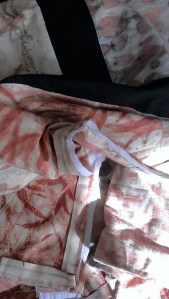
2015-01-04 16.59.16

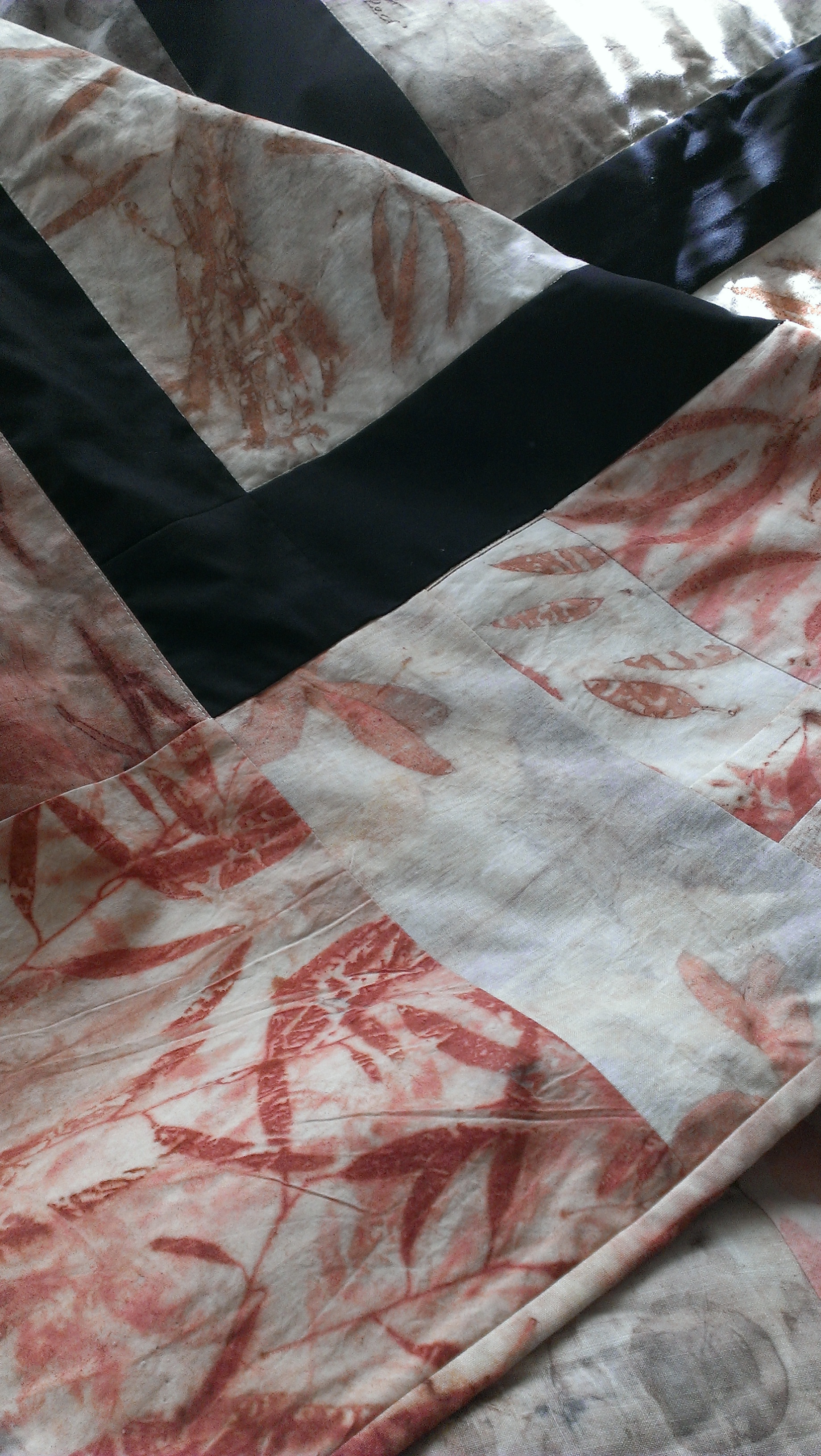
But all such jobs come to an end, and now, finally, I have a quilt I love.  I am surprised by how much I like the embroidery.  It just glowed in the sunlit window the day I tried for pictures.

2015-01-14 15.24.40

I like all those blocks with their Latin names and motley prints.
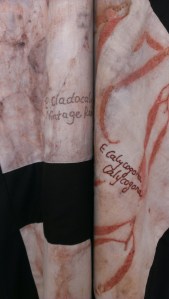
2015-01-14 15.53.07

And I like its all-over-leafiness and the nicely bound edge.  I expect this quilt will be a companion for many years to come, and this is such a happy thing!

2015-01-14 15.25.10


24 Comments

Filed under Leaf prints, Natural dyeing, Sewing

…because there can never be too much plant-protective bunting

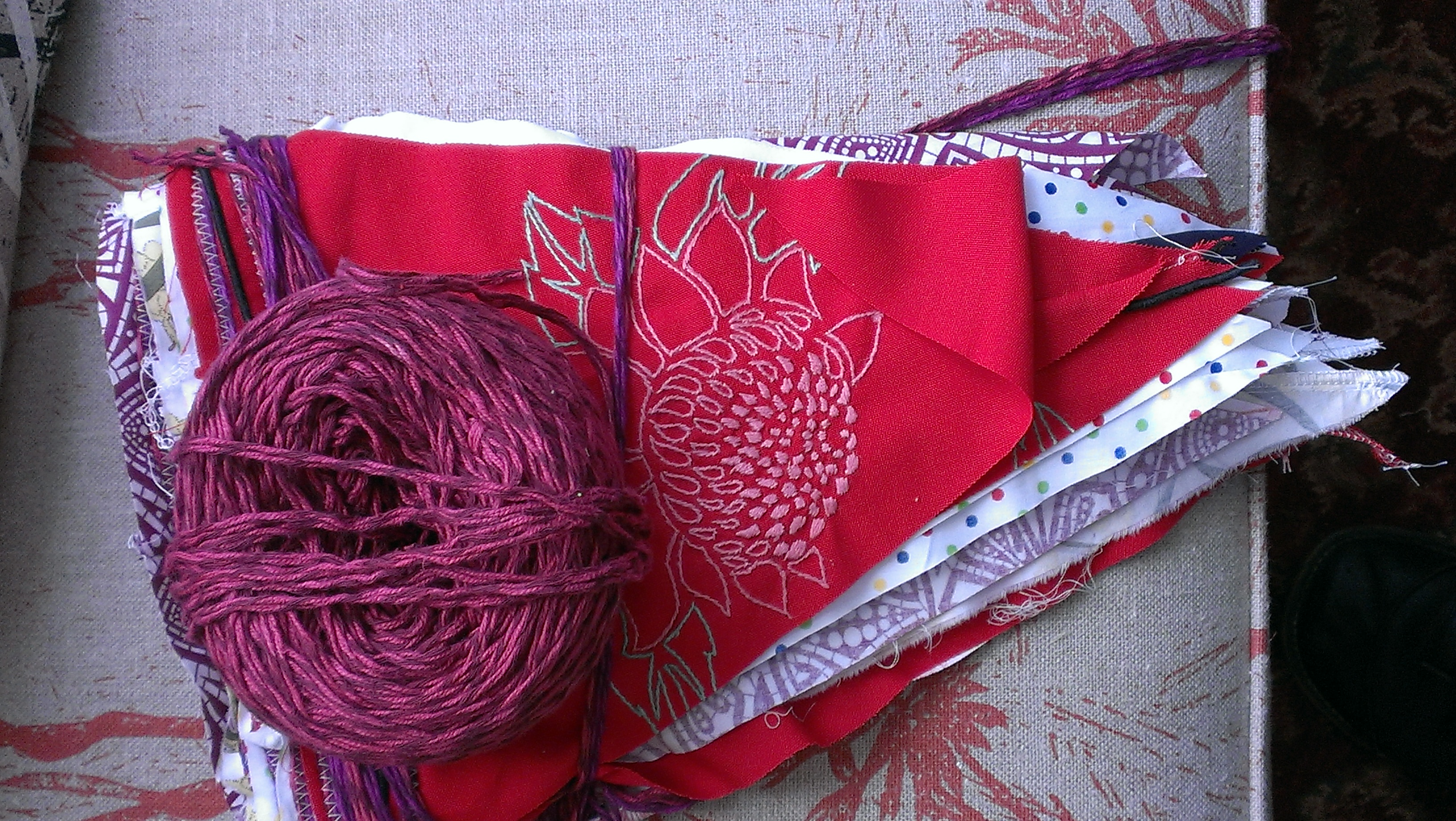
I have been tidying up the bunting we set up to protect recently planted and small native plants as I pass, adding a few pennants and re-tying after wind and rain.  I am surprised it has lasted so long.  But there are other plants in need of protection.  A woman had a long chat with me as we each tried to figure out what to do about cars parked in ‘the garden’, as she put it, in another nearby newly planted patch.  She confided that there was bunting across the way and it was wonderful and effective and she wished there was some in her street.  I confessed I’d made it and explained how in answer to her questions.  She asked for some.

2015-01-14 17.11.08

We discussed the council and what we might be able to do. I encouraged her to call them.   In the end, I made some more bunting.

2015-01-14 17.48.01

It’s low-fi bunting, this.  I have made some that is labour intensive and lovely, but in the case of bunting that suggests people should stop going where they feel entitled to go–through experience I have learned that sometimes metres of it will be ripped down and vanish in a single night.  I’m not up for that when I have spent a lavish amount of time and care.  This is bunting made from scraps, with minimal effort.

2015-01-14 17.48.08

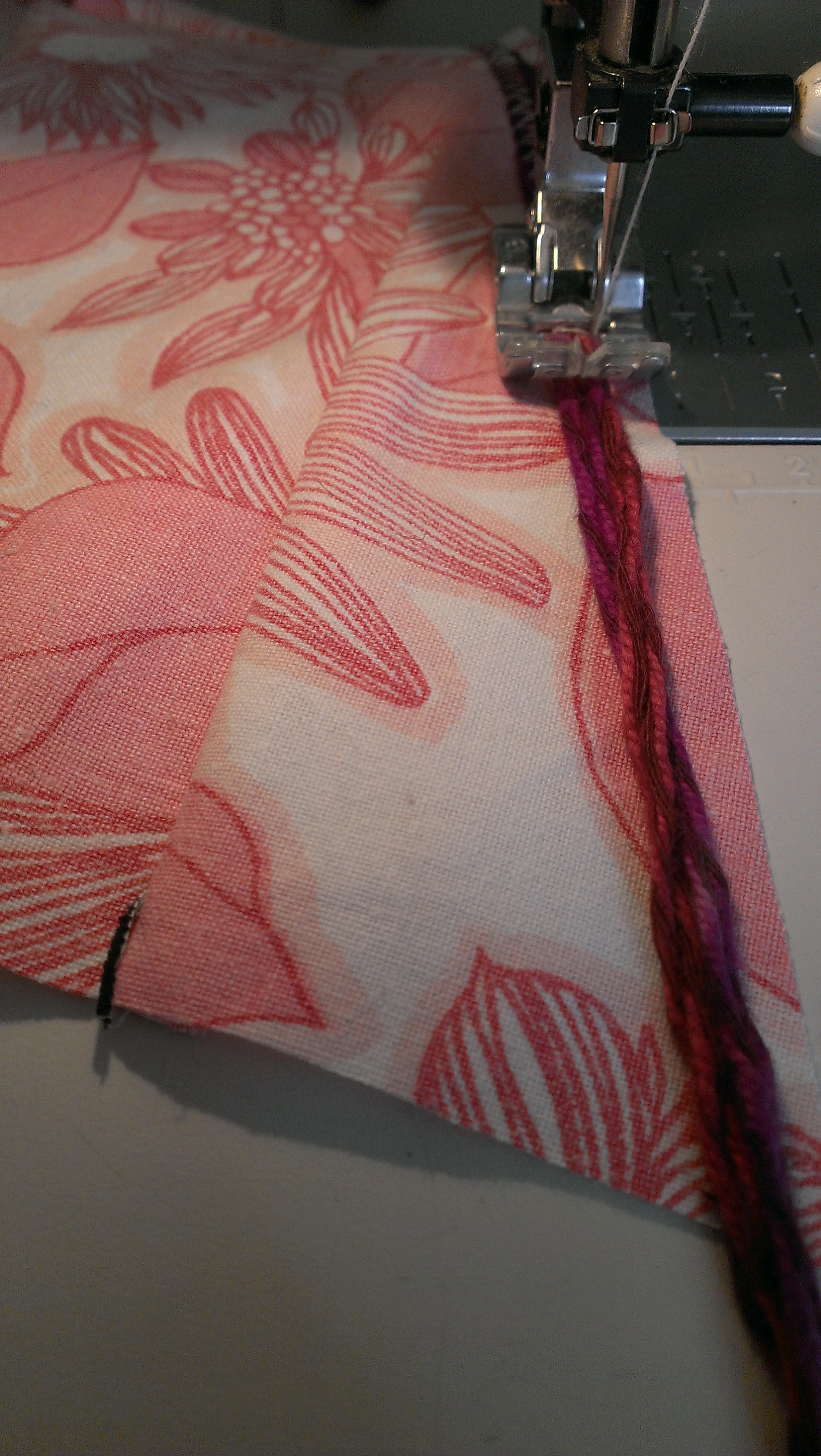
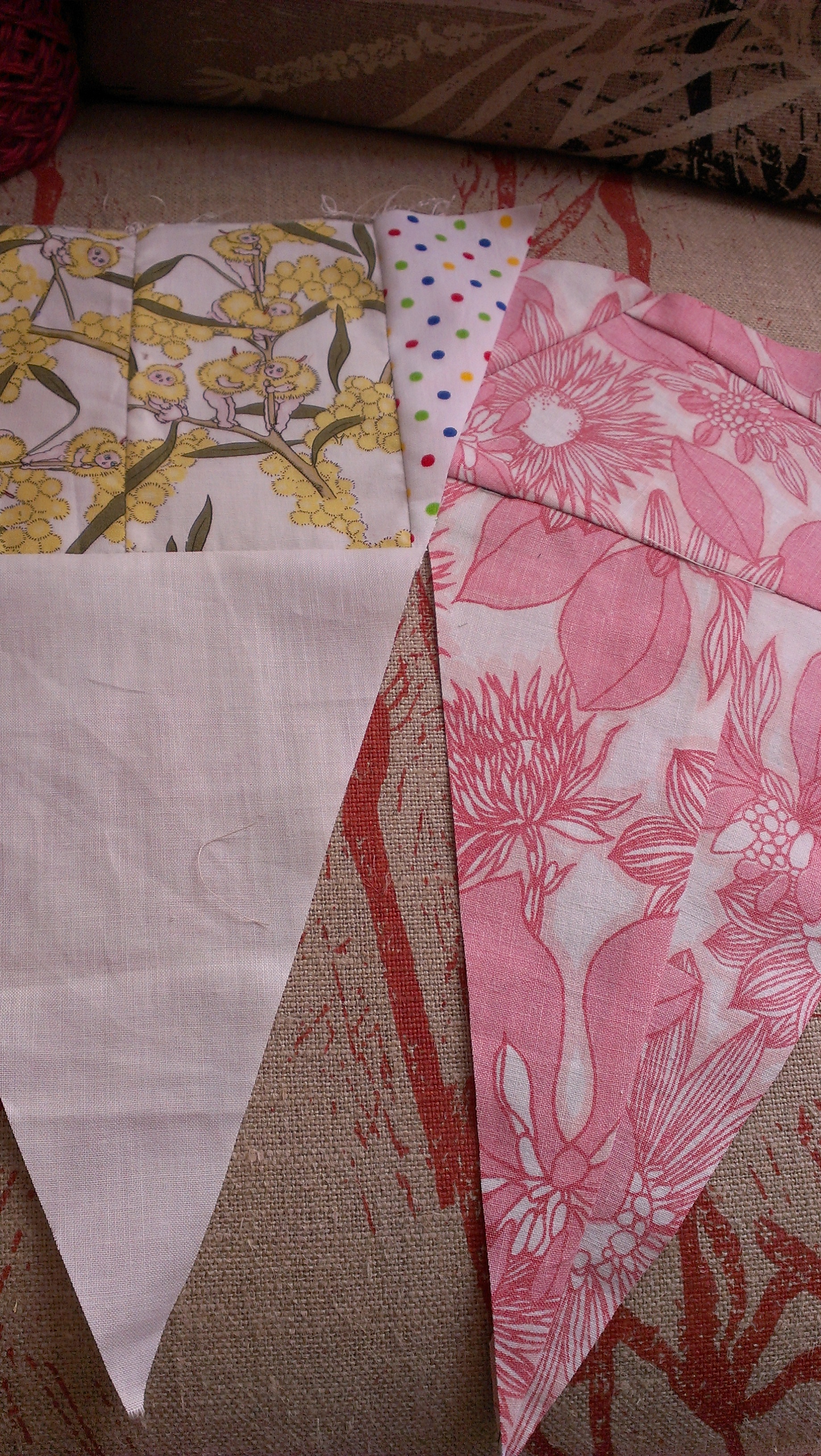
I cut fabrics to shape, and then sew onto recycled string.  Here, two strands of cotton yarn from an unpicked second hand jumper.  I dyed them years back, inadvisedly, but here they are, coming into their own.  The fabrics include a second hand napkin, what is left of a thrifted sheet (considering most of it became a shirt for a friend years back), remainders of a bag made for my mother, little bits from the cupboard, a panel from a thrifted skirt…

2015-01-14 17.12.16

I piece together little bits, and don’t worry about grain and such.  They just need to flutter in the breeze and offer a tip that this is not a parking bay.  Drape is not a big concern!

2015-01-14 18.26.18

My very patient beloved agreed to come and help me put it up.

2015-01-14 18.41.26

And here we are, admiring our handiwork as the sun goes down and passersby come past with their dogs, too polite to ask. As you can see, the plants we are trying to protect are still small.  Those that haven’t already died must be hard to see from a car.   There is still another spot near here where people park… so there may yet be more bunting!

6 Comments

Filed under Craftivism, Sewing

Home made mending kits

On a visit to relatives not so long ago, I discovered that an entire family were depending on a single tin of buttons and needles and thread for mending.  When we visited, I was called on to assist in mending and when the tin could not be found–repairs could not be made.  I decided that this was not good enough.  So when we got home, I made up two mending kits to add to the family resources, as two members of the family are reaching the fledging stage of life.  Each comes with a Pohutukawa-leaf needle case, a seam ripper, thread, buttons, and a few other basics.

2015-01-03 17.09.36

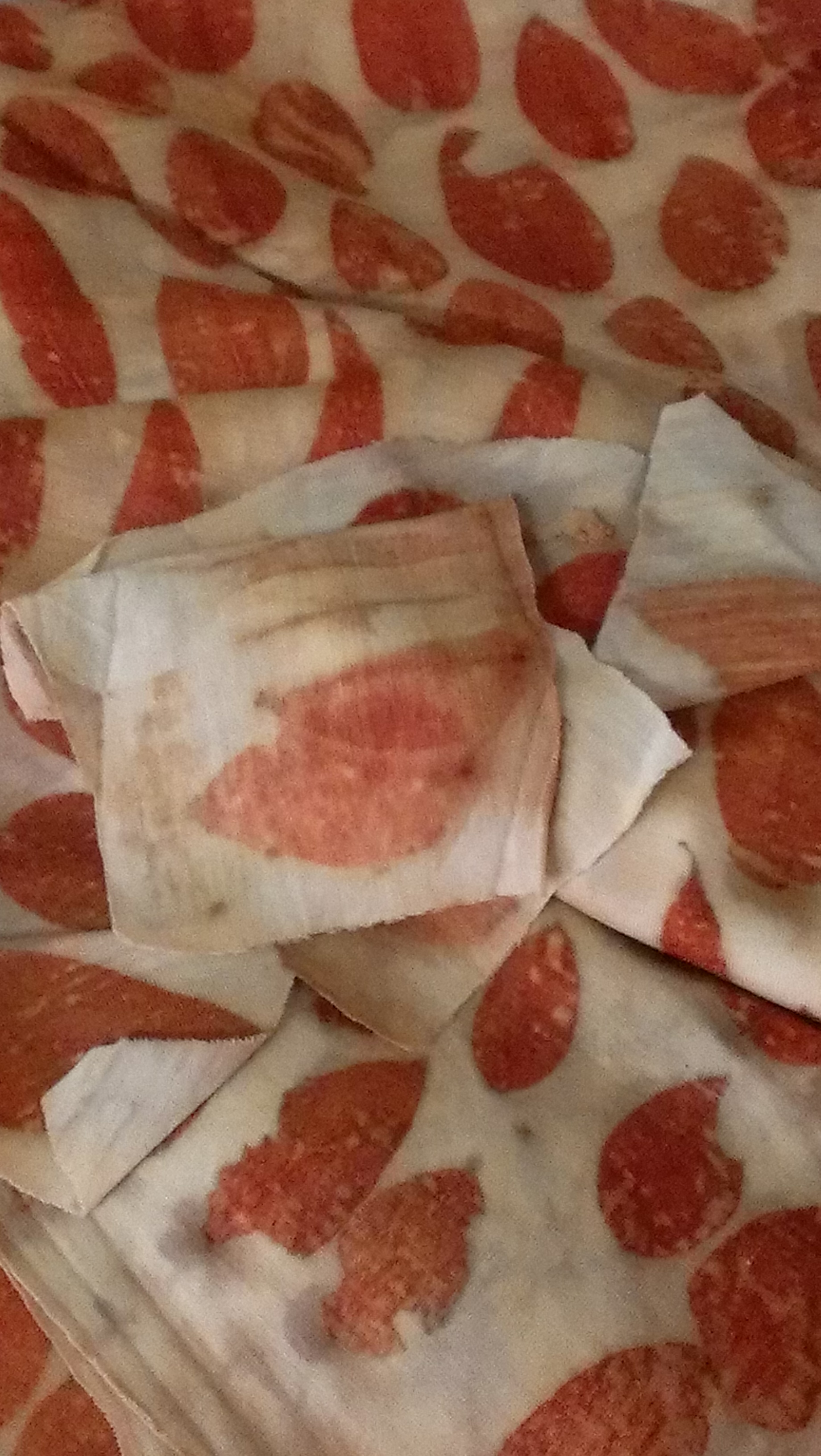
Pohutukawa (Metrosideros excelsa) is native to Aotearoa/New Zealand and widely grown in Australia.  Here is the interior view of one of the needle case.  They are simple: two layers of leaf-printed wool blanketing, blanket-stitched together.  The leaves gave completely different prints on each side, so the outside of the needle case is one side of the leaf and the inside is a print from the other side.

2015-01-03 17.09.53

This kit makes use of a tin left behind by recent Austrian visitors. It contained a rather delicious Austrian chocolate covered delicacy, but not for long!  I’m delighted to find the next use for this tin.  This kit was big enough to also fit a pre-loved darning mushroom.

2015-01-03 17.08.11

These little kits have found their way to their new homes by mail–I received a text message of thanks today.  And now, I’ll finish on a gratuitous koala picture.

2015-01-07 17.01.35

The appearance of this amazing creature on a Manchurian pear tree at my place of work is not a good sign.  It arrived in a period of extreme heat and little rainfall, no doubt seeking water (and fame, I’m sure–in the bush, koalas are much further away and very hard to photograph effectively–JOKE!).  Over the years a koala has turned up in this spot once in a while–presumably the same one–and water is provided.  In a day or two, it heads back to the nearby eucalypts, since koalas have a very narrow dietary range.  Sometimes one or two can be sighted from a glass walkway up on the second floor, hanging out in the treetops, to equal fascination on the part of passing humans.  Enjoy!

8 Comments

Filed under Leaf prints, Natural dyeing, Sewing

Week 4 Silkworm update

It’s well and truly spring,  Our native orchids are in bloom.

2014-09-21 17.59.54

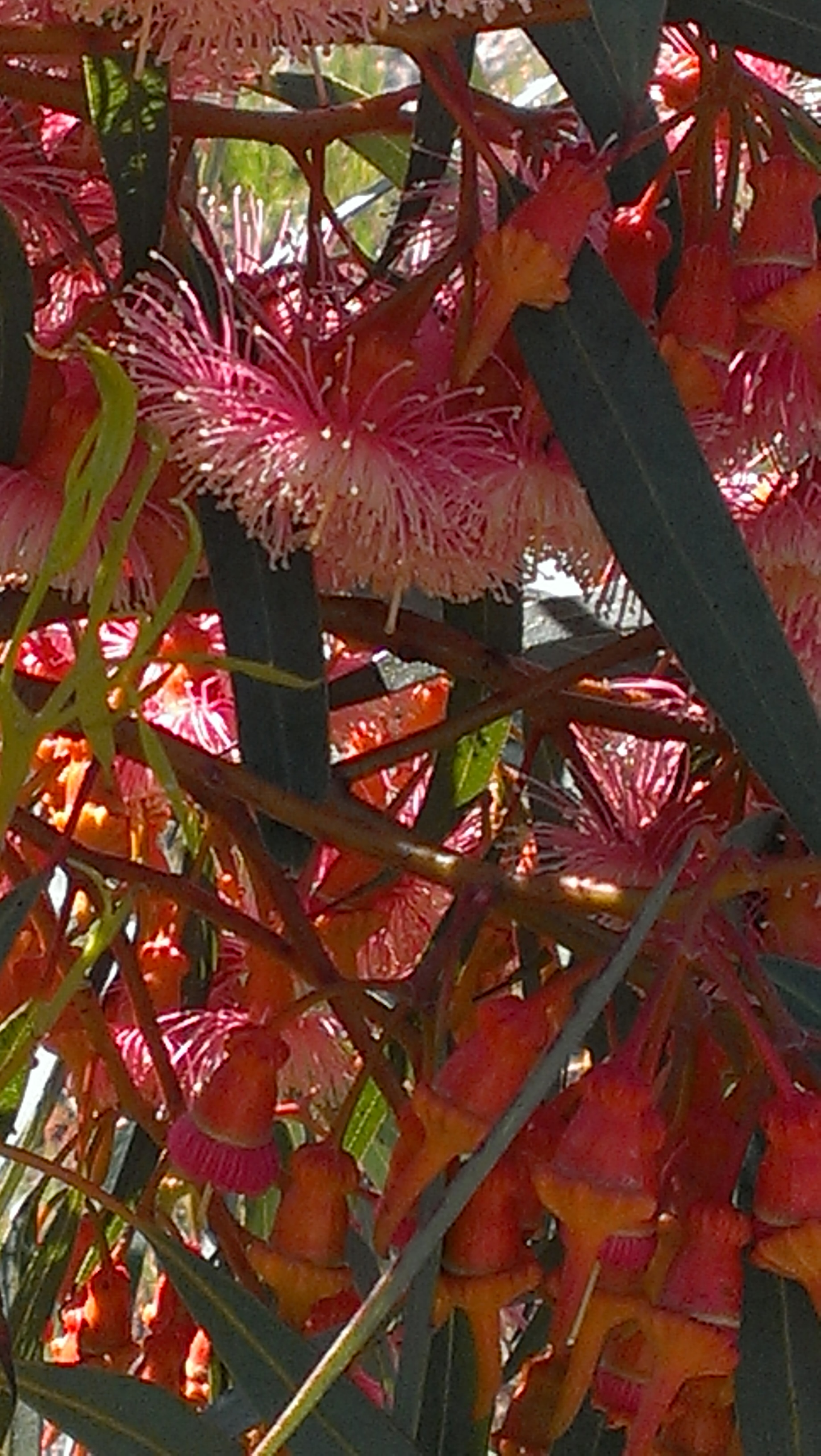
So is E Torquata, the Coolgardie gum.  The bees are happy about the whole thing.

2014-09-20 14.04.05

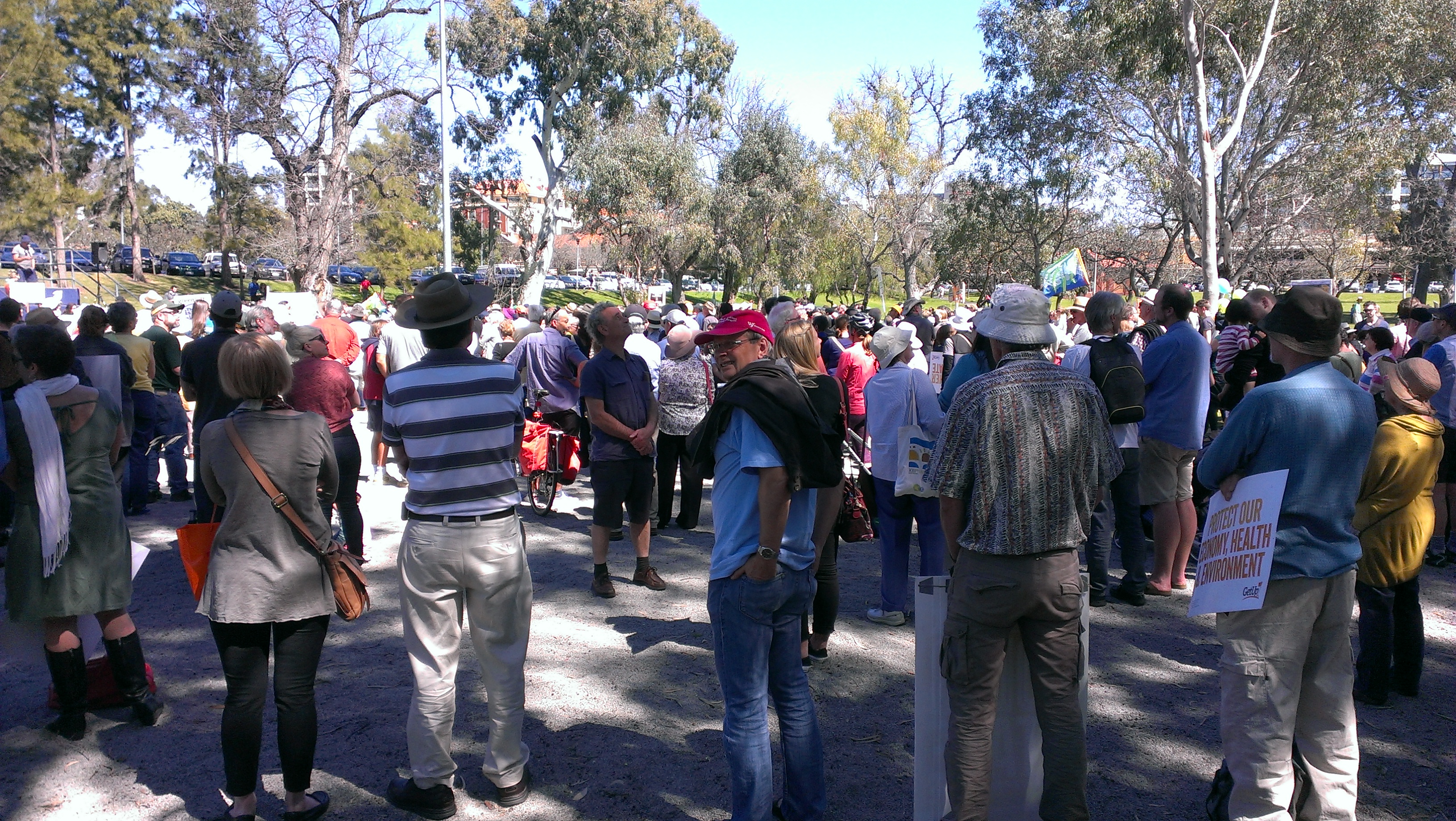
I’ve been out demanding action on climate change, with people all over the world (and hundreds locally).

2014-09-20 11.35.15

Fledging birds are getting in strife all over the metropolitan area (and many more are flying without difficulty, I hope)!

2014-09-20 12.40.29

The nettle harvest is in, such as it is.  I have gathered the largest nettles from our backyard, my parents’ garden and the local verges.

2014-09-21 17.59.25

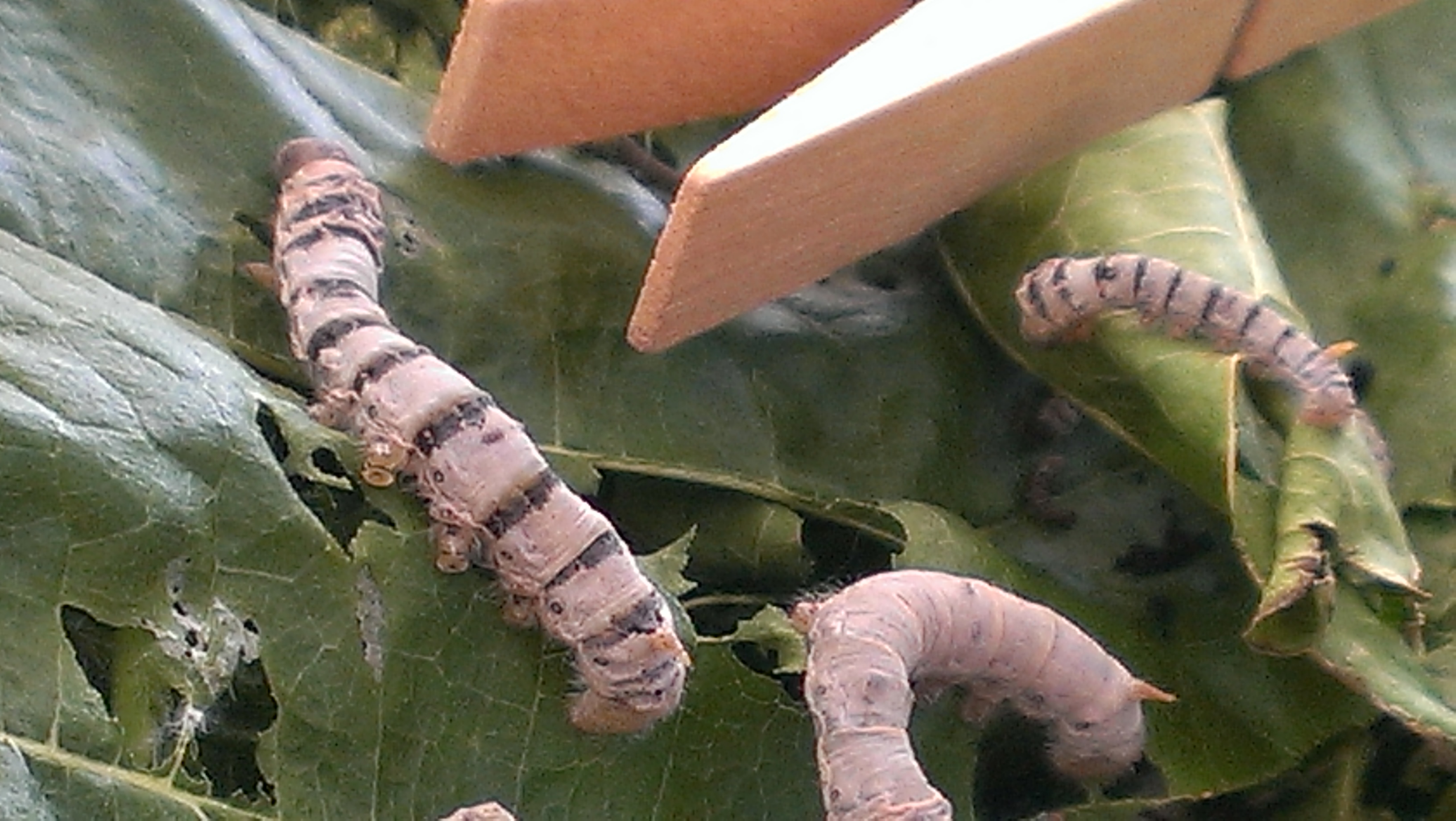
And the silkworms are growing.  The small ones are still very small, and there is still only one mulberry tree with enough leaves to pick in the neighbourhood.  I’m picking fruit as well as leaves.

2014-09-23 08.04.23

The silkworms are stripy in some cases and creamy in others, just like last year… and I still have no idea why.  We’ve done our 12km City to Bay run!!  And work has been overwhelming.  Hopefully, less so from this point forward–so there might be a bit more crafting and posting.

2014-09-23 08.04.38

4 Comments

Filed under Fibre preparation, Neighbourhood pleasures

DIY ironing board cover

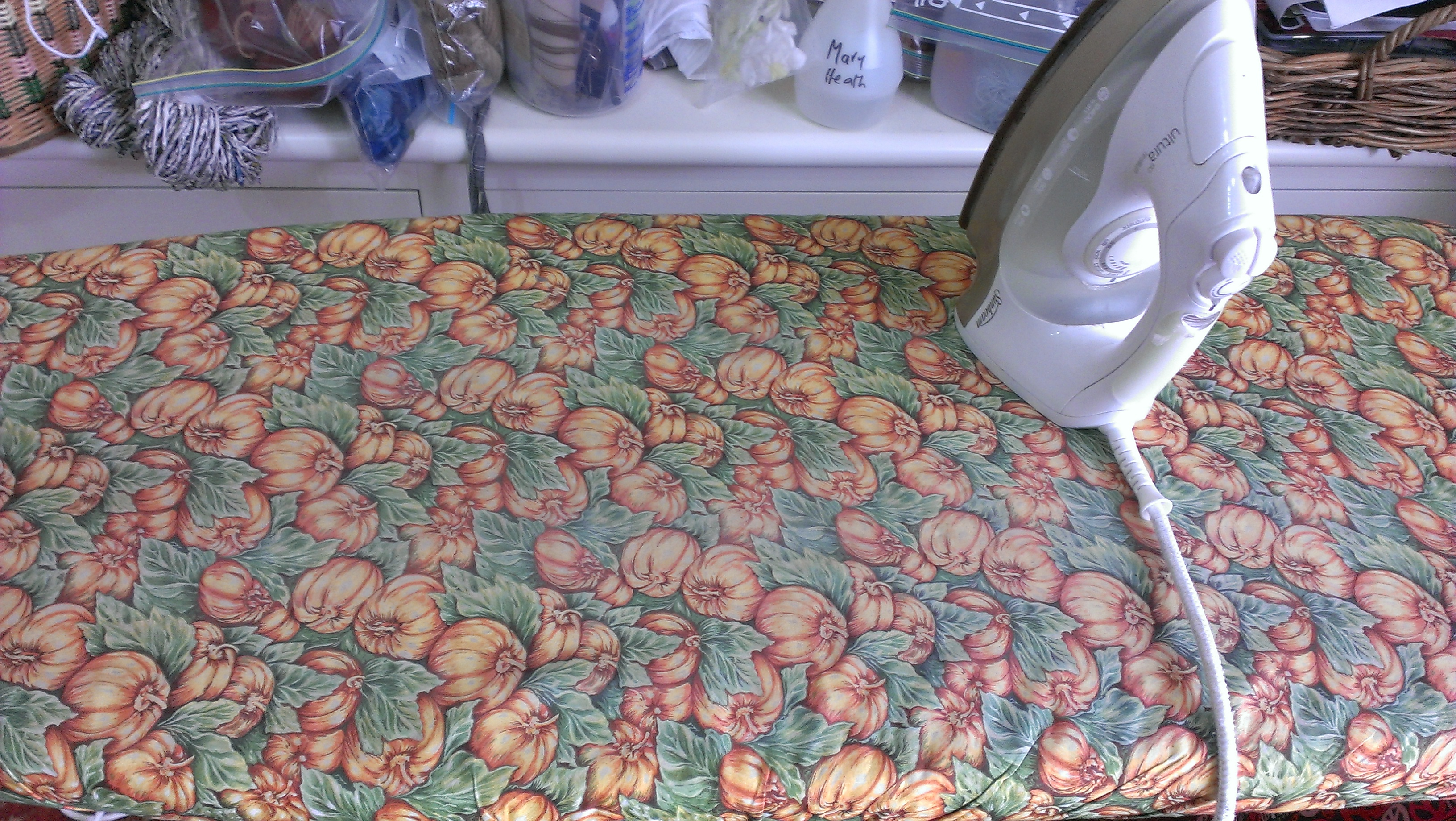
Why buy an ironing board cover when you can make one of your own–from fabric you like–in very little time?  I knew it was time when the tip of the iron went right through this (faded and sad) one.

IMAG0970

When I pulled it off the board to rip out the elastic and cord holding it onto the ironing board and use them again, I discovered the one below had been in such poor shape I had to mend it to cover over it neatly!

IMAG0973

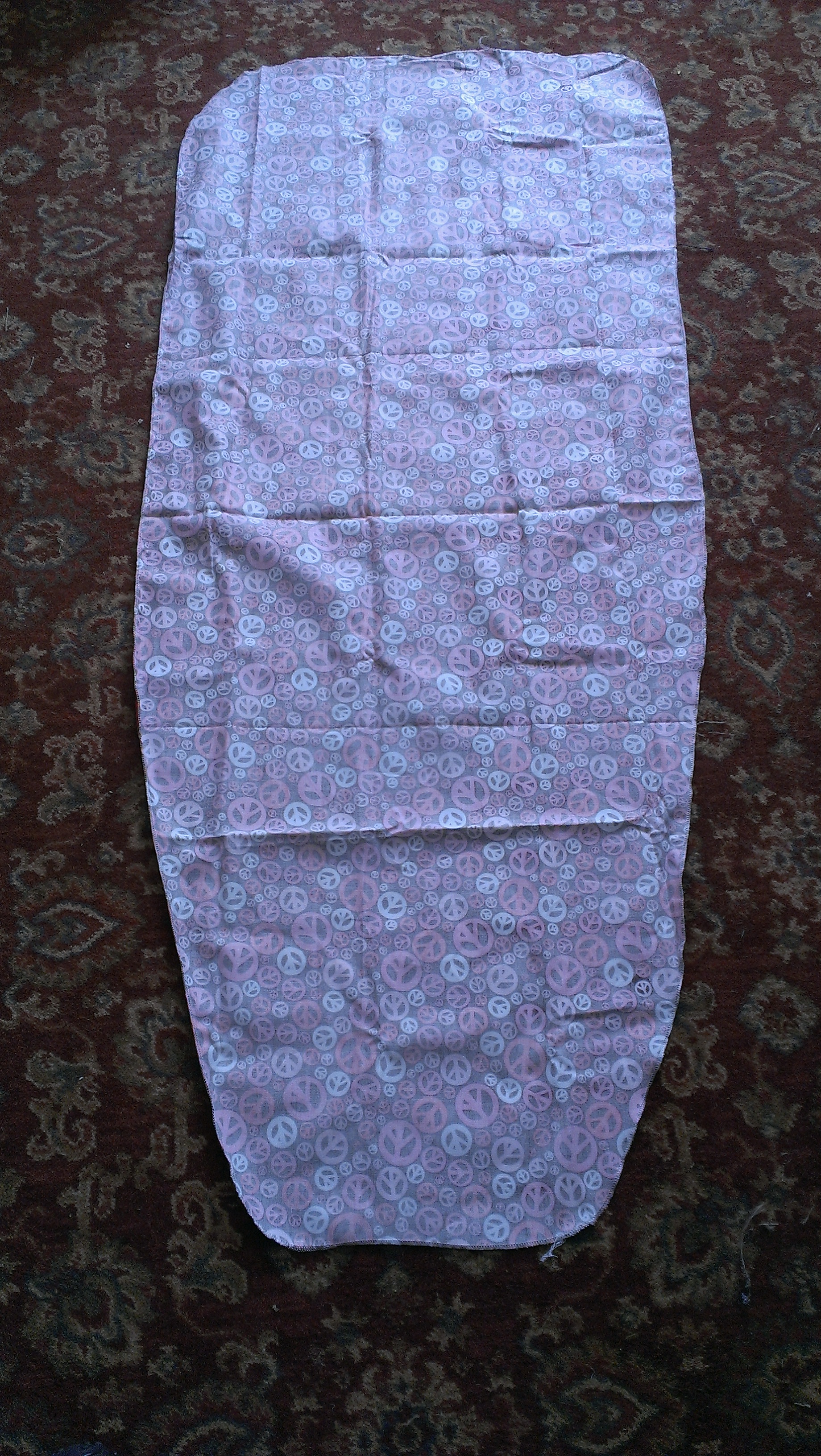
Step 1: choose your fabric.  In this case, a gift from a  friend who has evidently noticed my peaceable inclinations.  I like to use cotton, and I like not to pre-shrink it if that is an option, as having it shrink onto the ironing board is helpful.  Unlike having your newly sewn jeans shrink and become too short and tight, despite having pre-washed the denim twice–but let’s not talk about that–clearly I don’t know anything about it.

IMAG0969

This is the time to figure out whether you want any upgrades.  If the metal edge of the board creates grief in your ironing life, now is the time to find a padding layer.  This board has several old covers on it for softness, and also has a padding layer of the ugliest woollen fabric I have ever seen, which I inherited from someone else’s mother.  It has vastly improved my ironing life despite being unseen.  I would never willingly wear anything made of that combination of green, red and black–perhaps my friend’s mother reached the same conclusion and that is why it came to me.

Step 2: Trace your pattern.  I use the complex method of upending the ironing board onto the fabric, tracing around it with a nice allowance all round and cutting out.

IMAG0975

You can either sew a casing all the way round the edge (in which case you need to cut generously enough for this to be possible) or sew on something that will allow you to tighten the cover over the board by some other method.  In the past, I sewed a casing and threaded a piece of twine through it, which works.  Having discovered a large quantity of elastic with a cord running through the middle in an op shop years ago, I have been using that instead, and it also does the job.  Here it is freshly ripped off the old cover and ready to be applied to the new.

IMAG0974

Step 3: Finish edges, if you like.  I overlocked mine.

IMAG0977

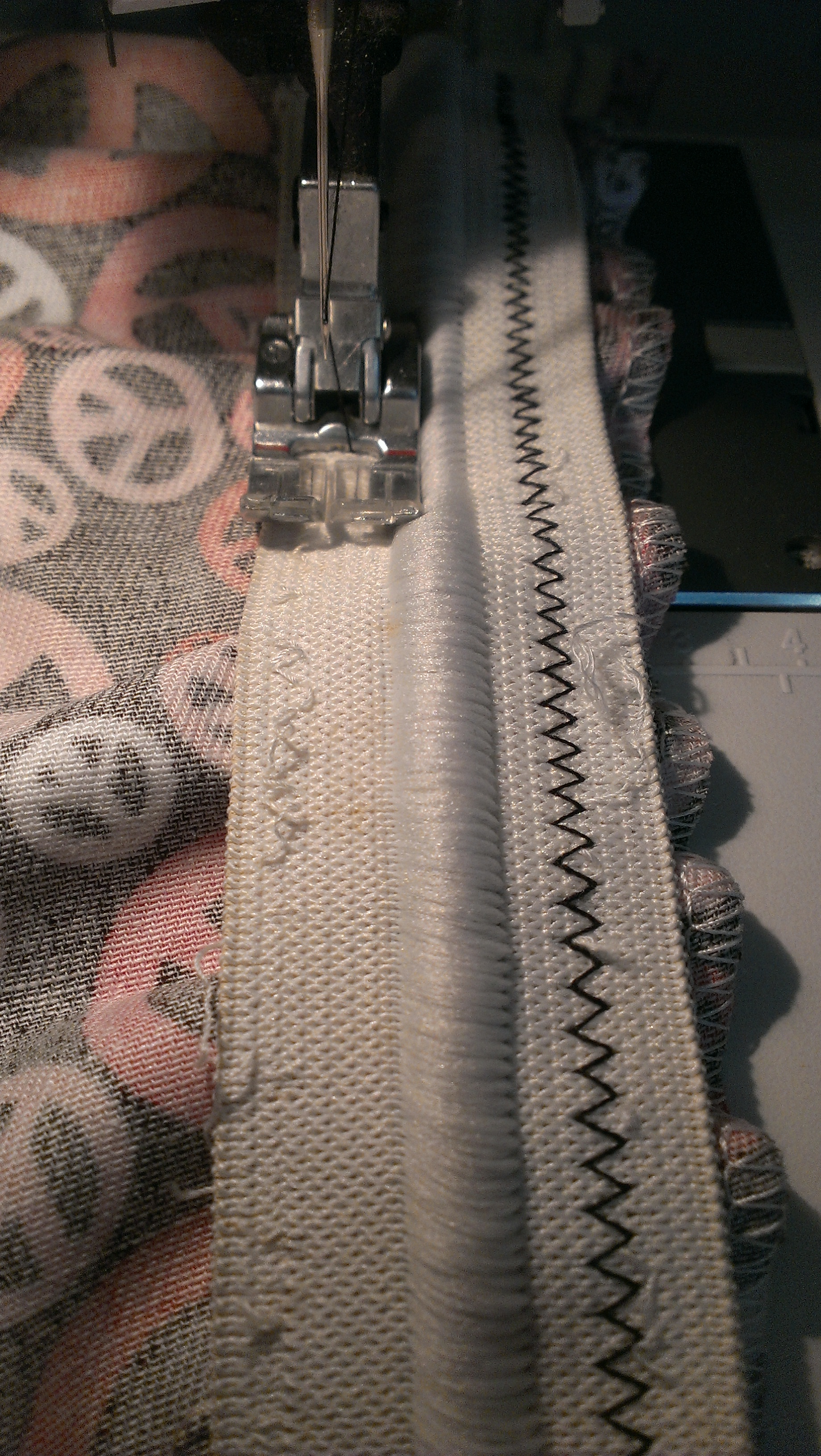
Step 4: Sew casing for twine/cord or apply alternative.  Here I am sewing on my elasticated cord thingummy by mood lighting.  This may look rough and ready–and it is–but this will not be visible when the finished item is on the board and I have other things to do 🙂

IMAG0978

Step 5: Get the whole thing nice and wet.  Here is a worked example in my bathroom handbasin.  It only needs to be damp, so wring it out and prepare to apply to your board.

IMAG0979

Step 6: Tighten and coax into a nice smooth edge, tie the ends securely, –and you’re done!

IMAG0981


5 Comments

Filed under Sewing

What to do with hessian sacks

In my childhood, hessian sacks (I think these are burlap sacks in North America) were a common feature of life. They were the packaging in which all kinds of supplies for the garden and from the hardware arrived, and they also carried potatoes and large quantities of other eatables.  They were routinely re-used to carry things (mulch or wood) as mats (for example, in the shed or the boat or outdoors) or as linings (for example, in the boot of a car).

2014-08-23 17.46.50

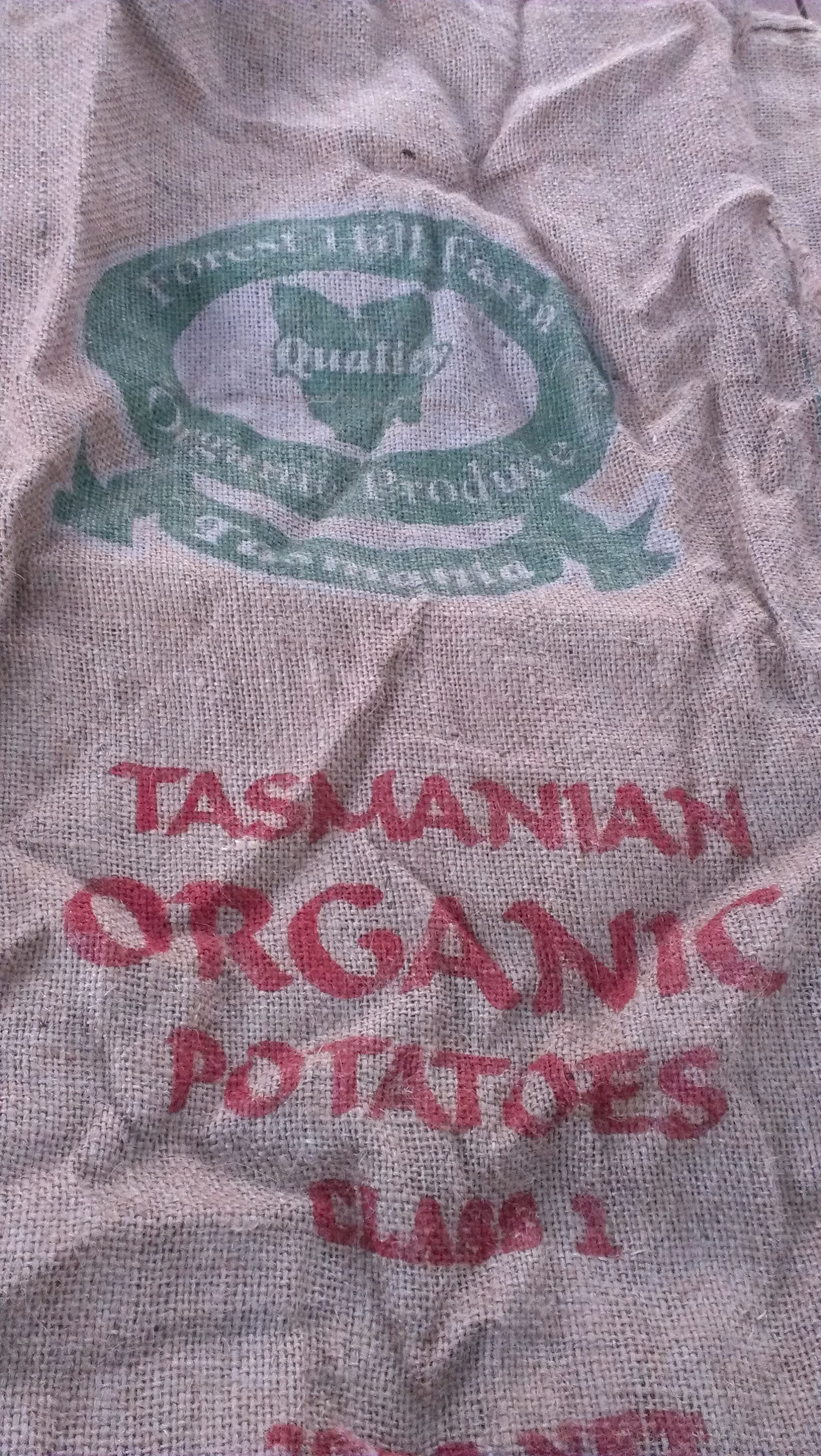
Many things that once came in hessian now arrive in plastic sacks–chook food being the most obvious example in my life.  Happily, the organic fruit and vegetable co-op we belong to still gets potatoes in sacks. Some are particularly cute.  This one features a wombat, in case this is not obvious to those from far away places!  In the past, I used to get spud (potato) sacks with spud man on them, a little animated potato chap.  I a made a lot of bags for co-op members from them.  The cute ones are especially motivating.  I think they make great lined carry bags.

2014-08-23 17.46.41

First wash your sack, inside-out, to remove the mud that is great for growing vegetables but particularly unfortunate if it finds its way into your sewing machine.  Choose shape and size of bag.  Stitch side and bottom seams, fold over a top hem, and then square the corners if you like a flat bottom (I do).  (Not sure what I mean?  scroll down to ‘stitch miter seams’ in this tutorial).

2014-08-24 09.18.49

Next, make a lining of similar size from whatever scraps you have and seam it up the same way.  No shortage of scrap fabrics at my place! If in doubt, make it a fraction smaller than the hessian outer.

2014-08-24 09.30.48

Next, choose fabric for handles, iron hems, fold in half and stitch. Finally, slip the lining into the outer.  Check for fit.  Pin lining to outer, and pin handles into position,  Stitch around the top of your bag, with some reinforcing stitches to keep your handle in good order.  And there you have it!

2014-08-24 17.03.59

I have one more bag in progress.  This one is posing in the potato patch, quite shamelessly… unfortunately, the woolly caterpillars have rampaged through the garden for weeks, munching everything they fancied in the process, and the potato plants themselves are looking less glamorous than they might.

2014-08-28 17.15.44

8 Comments

Filed under Sewing

Weeds, seeds and dyestuffs around the neighbourhood

When roaming my neighbourhood in the suburbs, I am sometimes just wandering and only incidentally finding dyestuffs I might want to collect and take home.  Sometimes, though, I go out with a concrete plan.  I was out and about one weekend in April looking to collect saltbush seed for propagation and dyestuffs for stuffing, steeping and storing. I had success in a couple of places with hibiscus flowers that had bloomed and shrivelled away, so I deadheaded a few neighbourhood hibiscus.  They went into a jar for dyeing purposes… and folk on Ravelry inform me that these are tropical hibiscus and not hardy hibiscus, from a North American point of view (good to know, as I have North American dye books and ‘hardy hibiscus’ is not a category I have heard here).

IMAG0062

I also managed to collect saltbush seed, but by then it was too dark to take a picture.  Mostly because I was waylaid by caltrop.

IMAG0060

I find this weed especially loathsome because it has vicious, large thorns which help spread its seeds around, and they are cunningly organised so that they break apart and lie on the ground with the spine of the thorn pointing toward the sky,  Which is to say, just about every thorn on a caltrop plant will come to maturity pointing toward any passing foot or bicycle tyre.  I have spent a lot of persistent effort eradicating it from a local park which sees a lot of barefoot children and passing bike traffic.  This was the first time I had seen it in this particular location, so I pulled out every single plant I could find and carried them away to the nearest bin I could find.  Three cheers for bin night.

IMAG0061

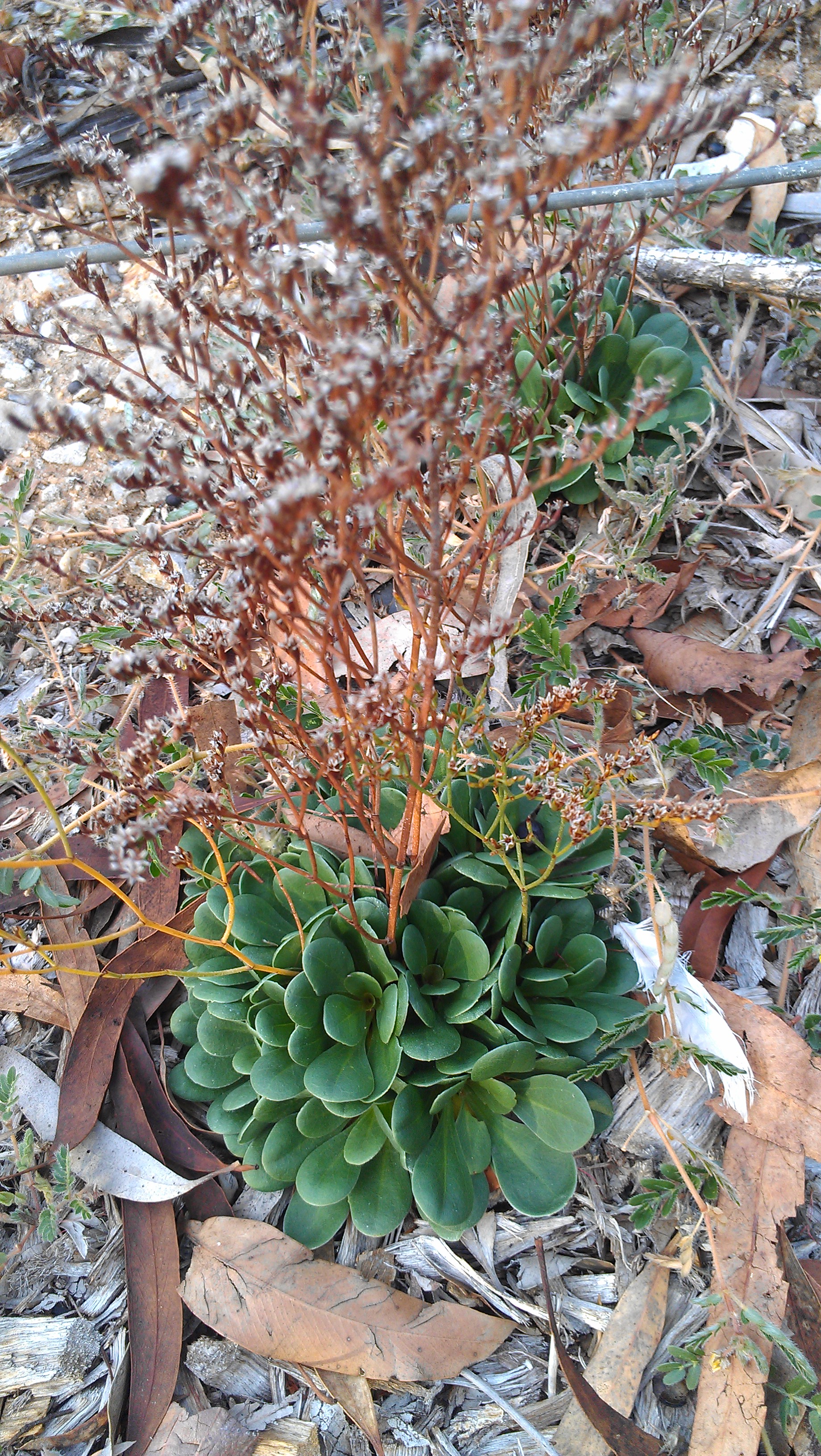
On the up side… the caltrop was growing beside some miniature statice in a spot so unpromising that only tough customers like these two plants could make it there.  So… I gathered seed from the statice which I’ll try to propagate in due course too!

IMAG0059

I’ve had my eyes open and it looks to me like it is time to plant these seeds–little plants are emerging in this unpromising spot.  The seasons are turning toward spring.

5 Comments

Filed under Natural dyeing, Neighbourhood pleasures

How not to sew knits

Last winter, I believe… I bundled up this milky merino and dyed it.  Actually, I cut and dyed two different garments, and when I stitched the first one, I found the fabric had shrunk in one direction.  I think this was the appalling realisation that led me to put this garment aside for at least a year.

2014-07-19 16.52.57

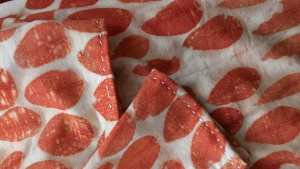
One weekend a while back, I had a new sense of the possible.  If it has shrunk, waiting won’t make it grow back and I’ll just have to figure out what to do then, I thought.  I measured it against the pattern pieces.  I has indeed shrunk–but I pressed on.  I sat down to sew and that’s when I realised there was another profound sense of foreboding involved in my reluctance to start stitching this together.  Step 2 of Very Easy Vogue 9904 involves setting in an invisible zipper.  Suggesting Vogue’s idea of ‘very easy’ may have as much in common with mine as ‘the Vogue body’ has with my body shape!  I have applied a lot of zippers, albeit intermittently, but not into a knit fabric.  And not with any real pretence to invisibility.  I won’t catalogue all the things that went wrong.  I’ll just sum up by saying that sometimes a sense of foreboding is your subconscious letting you know–ahem, you don’t have the skills for this to go well!

2014-08-01 15.26.22

I set the zipper in by machine the first time and it was truly appalling.  In the end, I did it again by hand.  Decent!  I won’t bore you with all the missteps–in the end I hand stitched the hems as well, and I like them too.  Perhaps I should have dyed the thread, but I quite like the luminous stitches. I used dyed thread for the zipper after all the chat in the comments and so much practice sewing with embroidery thread.

2014-08-01 15.35.53

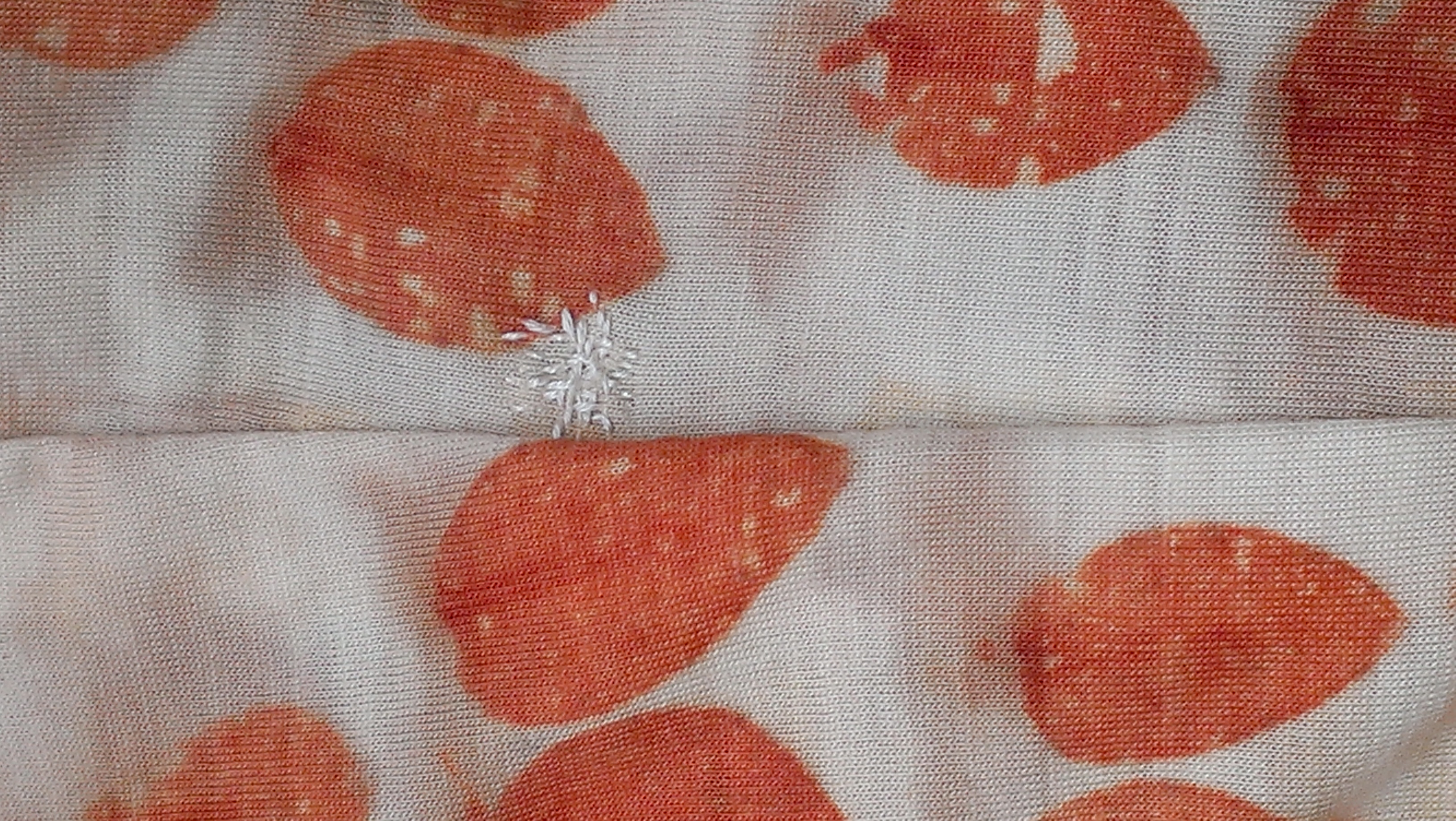
Speaking of which, right now… no wool garment story could be complete without darning.  Sigh!  I spoke to another friend who has been doing unprecedented levels of darning at her place this morning at Guild.

2014-08-01 15.36.24

In fact–I needed about six darns on this garment. Without washing or wear.

2014-08-01 15.36.15

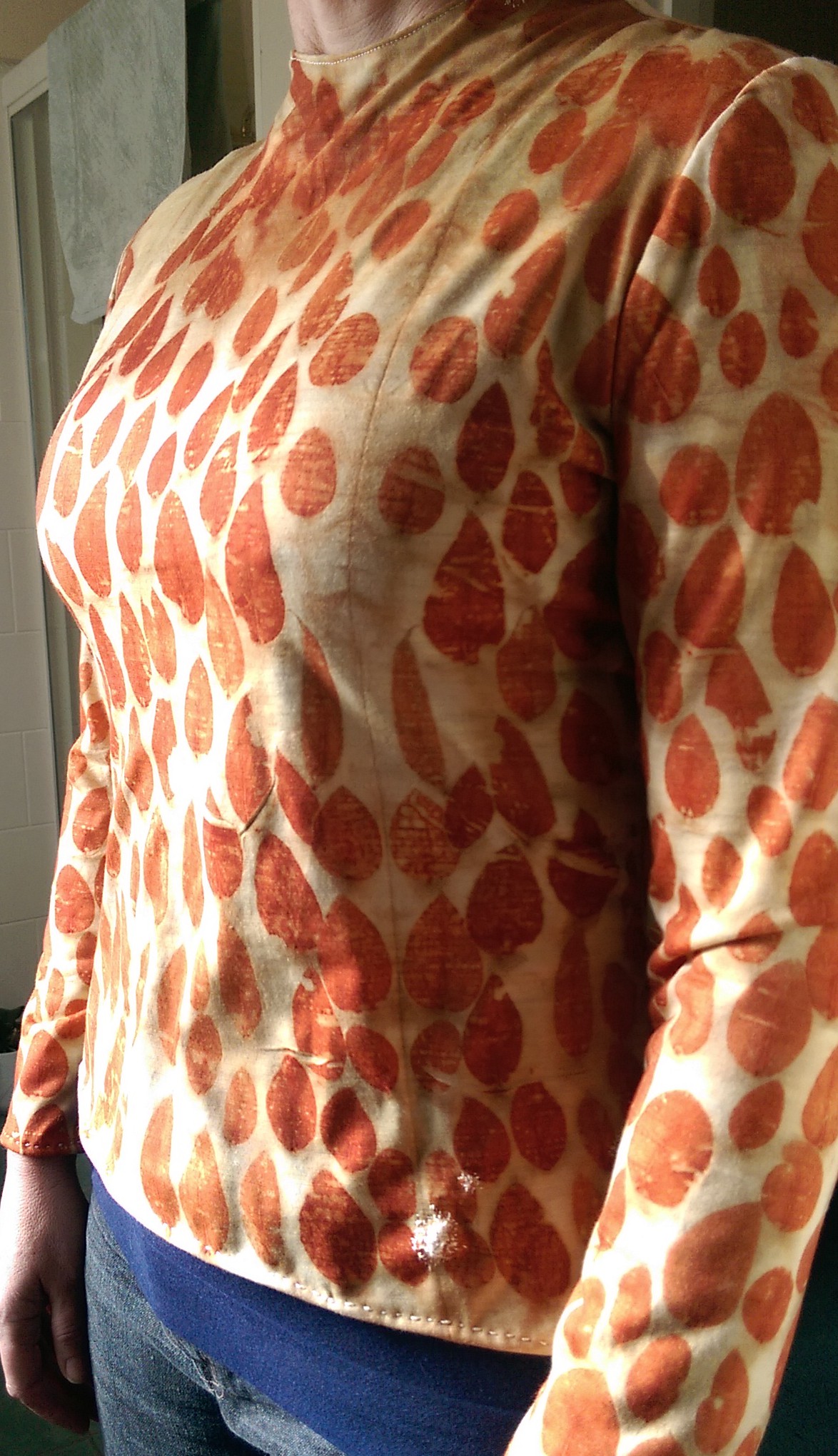
Never before have I needed to darn prior to completing a garment!  But… I like the garment.  I would prefer it hadn’t required darning!  I’d make this pattern again, and the fit might be smaller than I intended and snugglier than I prefer… but it’s decent.  Even if it ends up being an underlayer, that’s better than staying on the chair where the moths found, it, not being finished!
IMAG0115

10 Comments

Filed under Leaf prints, Natural dyeing, Sewing

Festival of mending, continued…

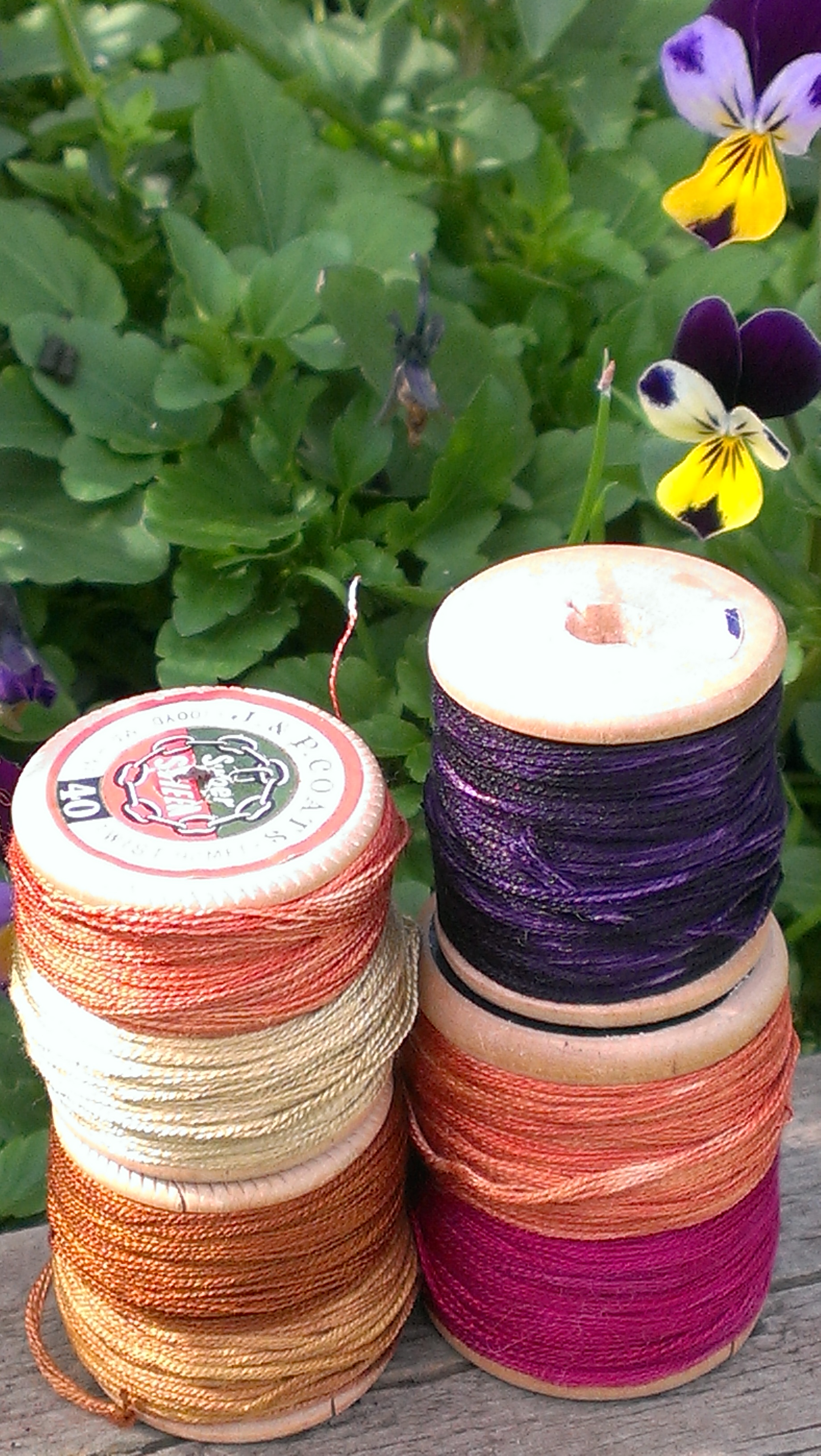
I have had plenty of occasions to get out my darning kit this week. Wendi of the Treasure’s comment on the post about moths and mending recently helped me decide to get organised for colour darning. I began by winding some of my silk embroidery threads onto reels.  Oranges from madder, tans from eucalypt and onion skins, purple from logwood, and fuchsia pink from cochineal.  I have other colours but ran out of reels!

2014-07-30 11.24.13

So… now that woollen items are being subjected to rigorous scrutiny before return to the cupboards… I give you indigo darning.

2014-07-31 07.48.19

Onion skin darning.

2014-07-31 07.48.47

And logwood darning. This may well be the place I failed to eradicate a couple of moths last year, as this top already has a series of darns dyed with Plum Pine.  As a washfastness test, those darns have continued to show that I have not found a way to make Plum Pine washfast–it is fading, but that has worked well with the mauve of the top.

2014-07-31 07.48.59

While I was on a roll, I appliqued a patch over this hole where two pieces of recycled fabric in the lining of a bag parted company.

2014-07-30 20.33.29


I don’t rate my applique but I have been practising!

2014-07-30 20.58.44


Then there was the worn through section of my quilt (made of recycled linen garments)…

2014-07-30 20.32.16


Now repaired with a piece of linen collar from a test-dye.

2014-07-30 21.26.00

Well.  My mending queue is getting plenty of attention, but it remains to be seen whether it will just continue to grow as washing exposes where the maws of those moth larvae have been…

21 Comments

Filed under Natural dyeing, Sewing