Tag Archives: indigo

Crafting locally…

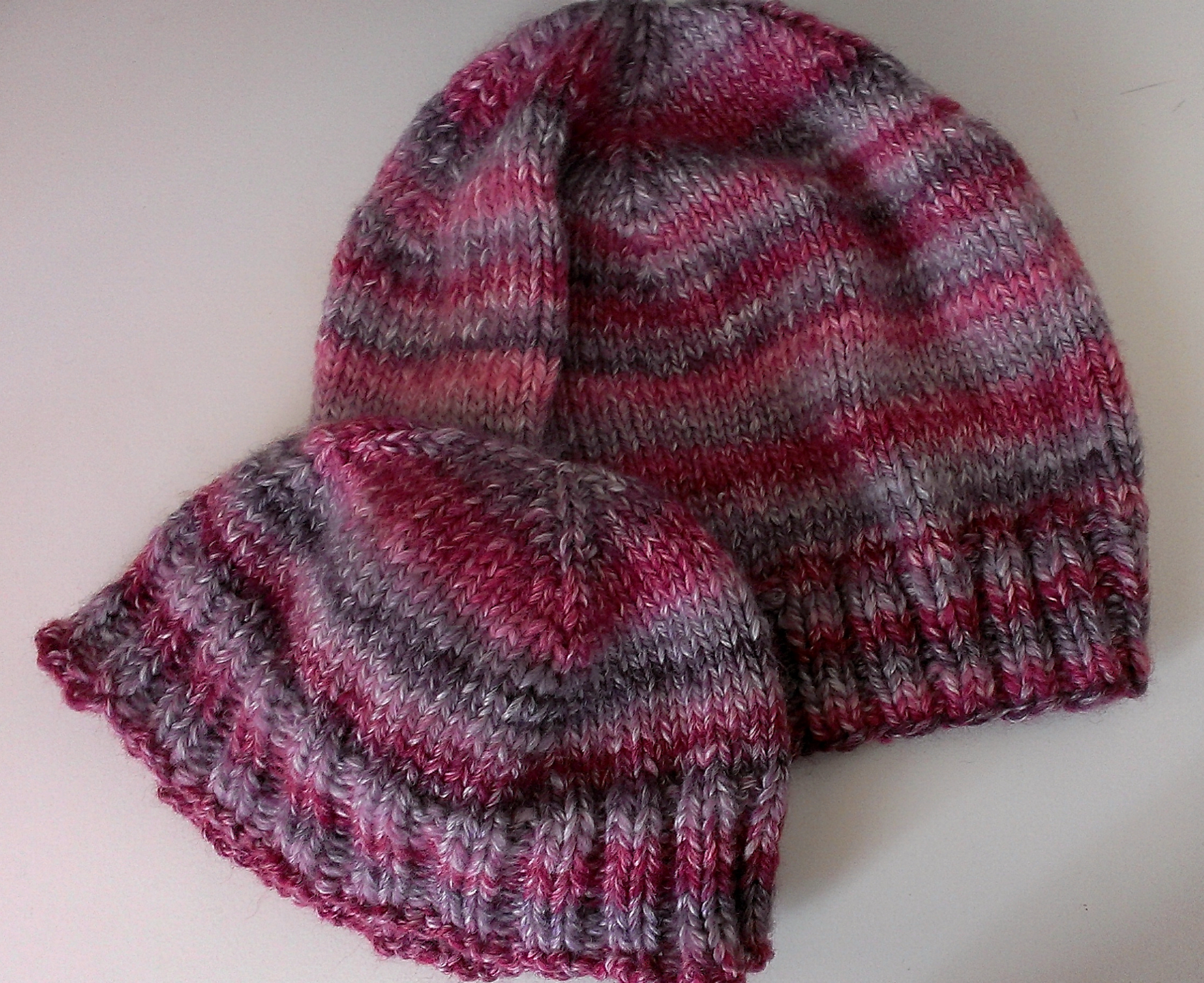
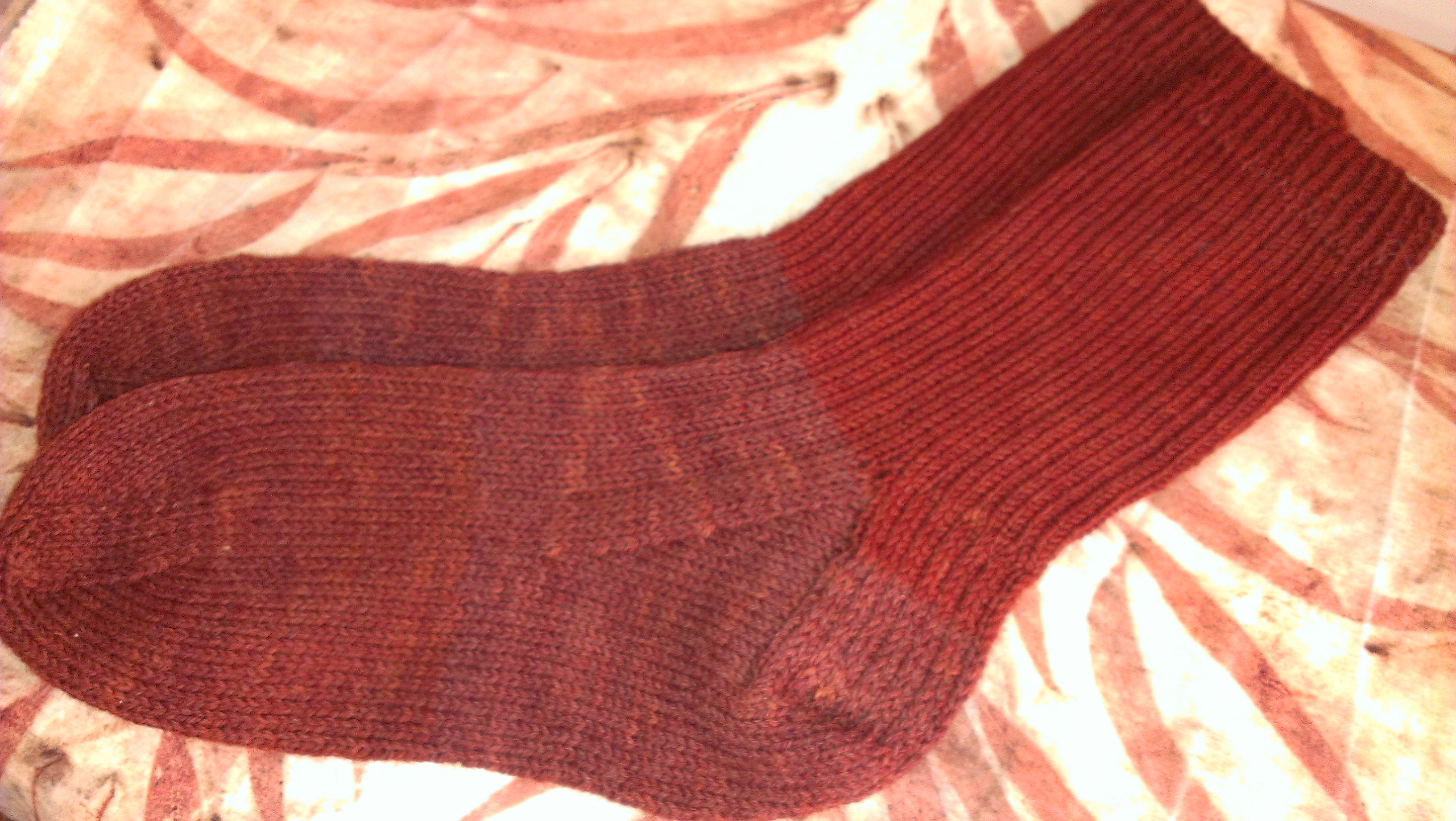
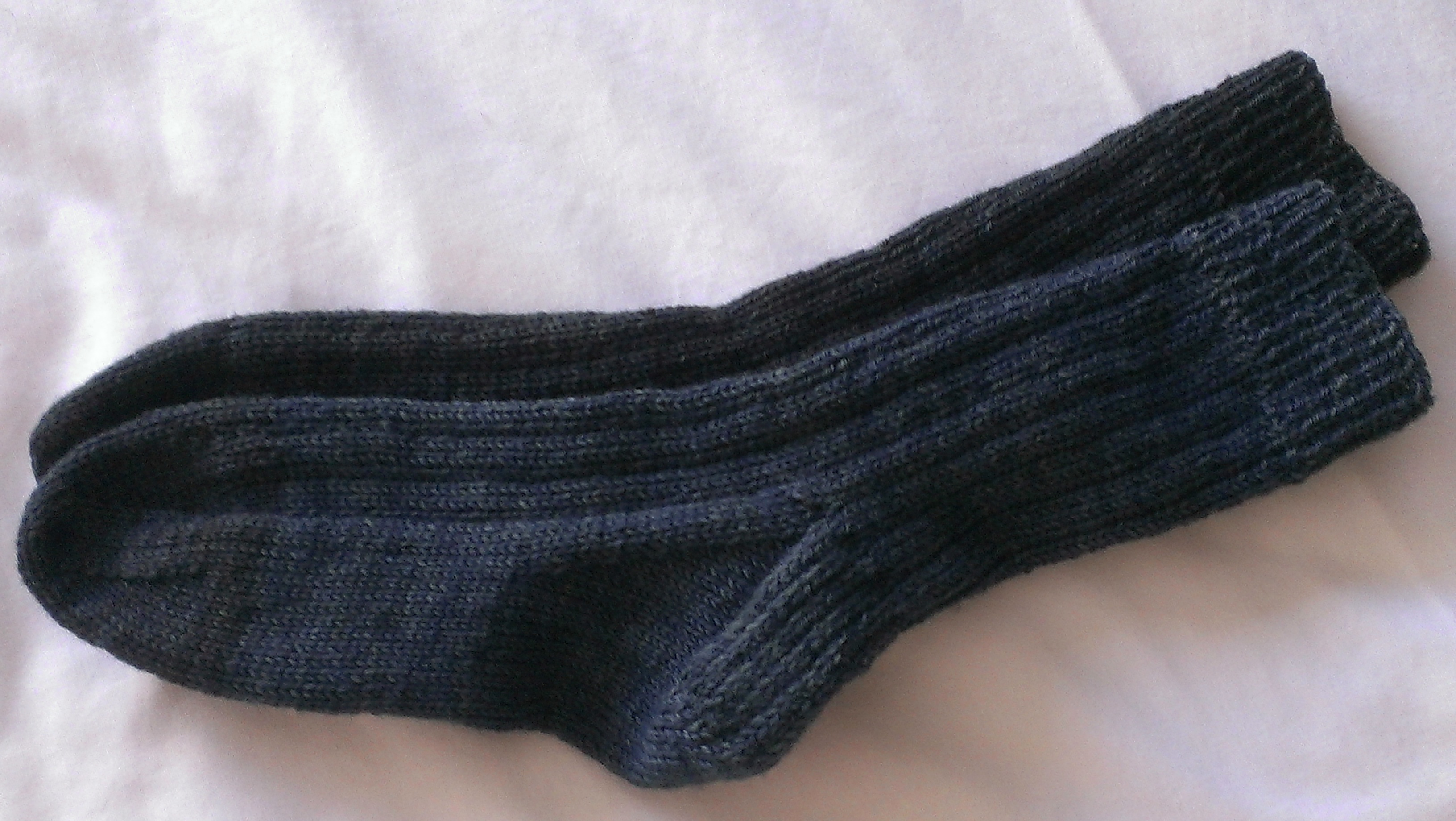
I made these socks on many bus trips and on a trip to a conference interstate where I had more knitting time than usual.  But they are for a small friend who loves very close by.  He pulled them on with glee within minutes of taking them out of their package, which made me feel pretty gleeful too!  They’ve been indigo dyed on patonyle superwash sock yarn.
2014-07-12 08.08.31

There were a lot of comments about my knitting at the conference. People who are surprised to find my hand made sock looks just like a sock from the shop!  People who aren’t sure if that is knitting or crochet.  People who think knitting is too complicated for them.  Seriously!  It’s not rocket science.  I do find it hilarious when people who have written books, can operate computers, can drive car or can raise children–think they may not be able to learn to knit.  Most don’t really want to, which is fine.  But I don’t readily accept that people don’t have the capacity.  Willingness, and for that matter, quiet time,  is a whole other thing.

2014-07-19 12.24.10

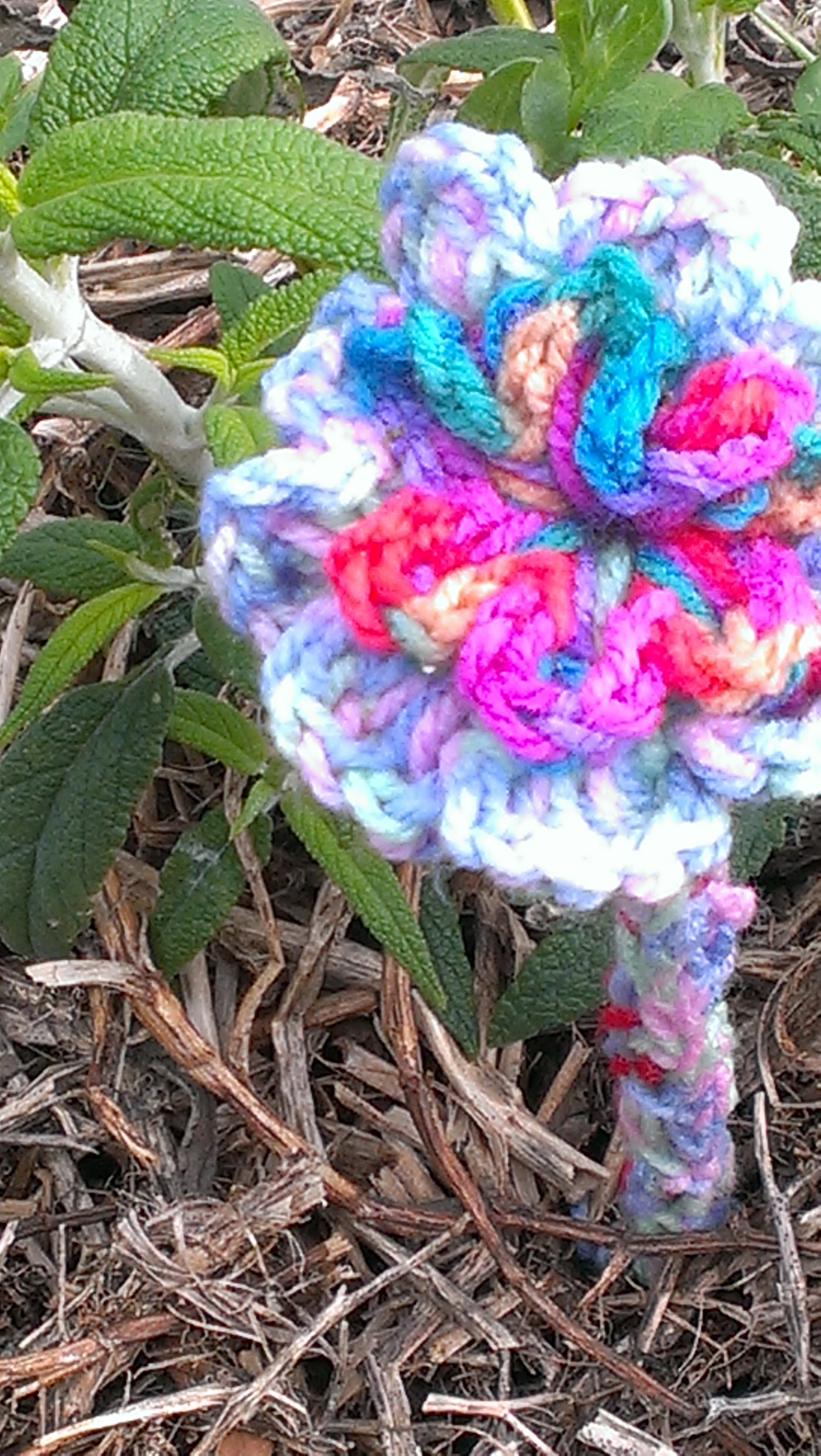
When we went to do the local shop this week, there was evidence of other people crafting locally.

2014-07-19 12.23.49

These were in the planters on the nearby main road.  So cute!
2014-07-19 12.24.00

I suspect the Viva La Broad Bean yarn bombers, who have a made a project of decorating our neighbourhood. One of them t0ld me a while back she had saved one of my yarn bombs when the pole it was stitched onto was removed and it was thrown to the ground and treated like rubbish.  She took it home and washed it ready to re-apply it.  What a woman!  So–shouting out to VLBB, who made me smile at the shops this week 🙂


4 Comments

Filed under Knitting, Neighbourhood pleasures

Things learned 4

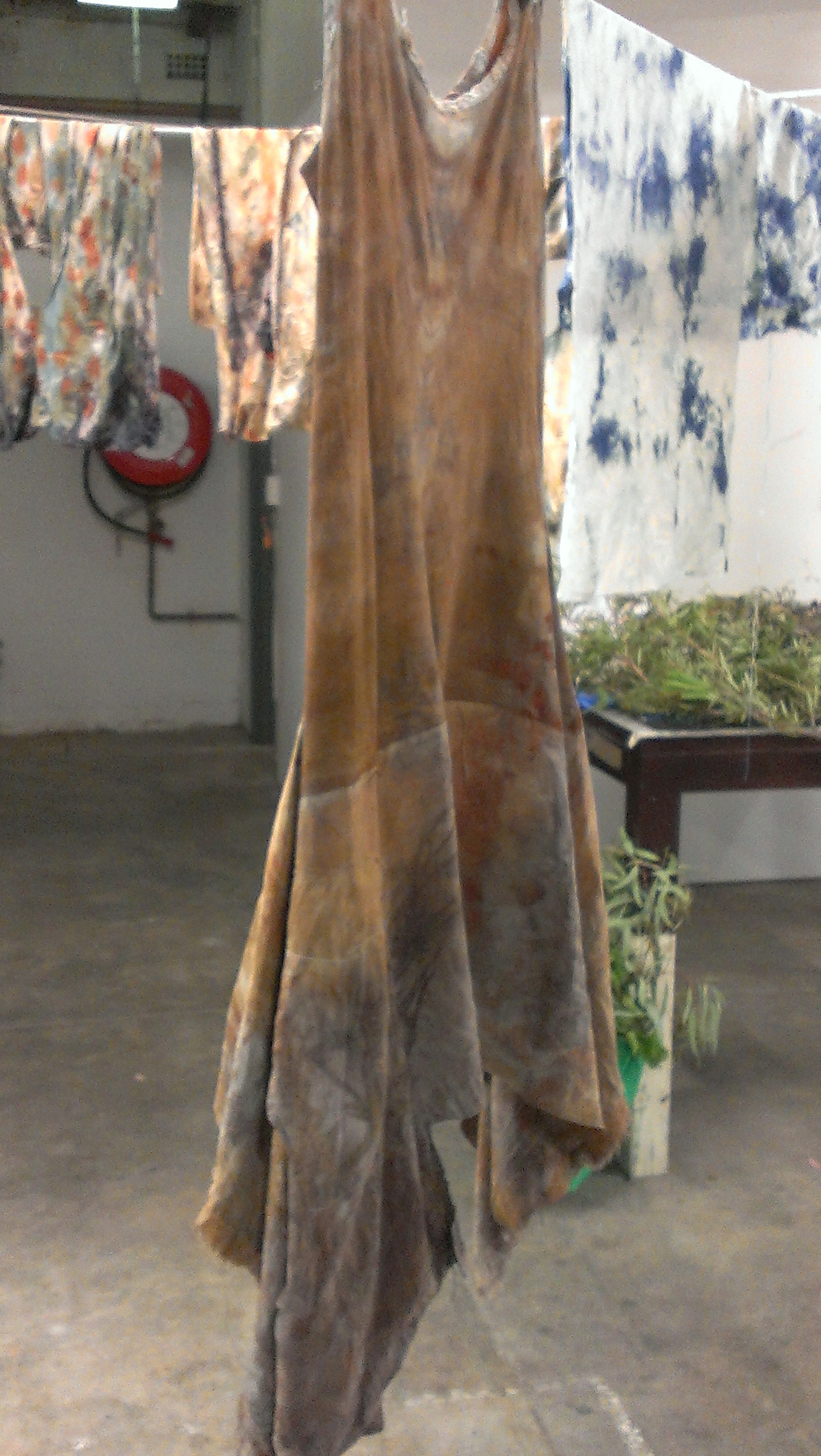
Second Skin offered lots of possibilities for learning-by-looking through the admiration of plant-dyed clothing.  India Flint was wearing her own creations every day and it was a delight to have that opportunity to see them in use and to think about their construction/reconstruction/dyeing. Other participants wore clothing they had dyed sometimes too–also a pleasure to admire.  And India brought along some garments to show. She gave permission for me to show images of this dress.   The upper part (bodice?) is a knit fabric–I am assuming it’s silky merino.  The neckline and armscyes have been bound with a different fabric: a sheeny silk that has taken up dye differently. There’s a lovely leafy detail heading toward one shoulder.

IMAG4311

The skirt of the dress is asymmetrical, and composed of a variety of fabrics, some repurposed.  There is a large pocket in the skirt that might once have been the neckline and part of the front of a shirt, replete with buttons.  I found that a delectable detail.

IMAG4310

This view shows how lush the skirt is.  I loved the generous, undulating hemline and skirt.  India gave a demonstration of how it had been created.  I loved the idea of using a variety of fabrics and textures in a single garment. I’m a plain sewer, as you may have detected, and my mind was abuzz with ideas for using some of the lovely pieces of fabric in my stash of eco-printed fabrics in this way.  Hand-stitching clearly has advantages in creating this kind of garment and coaxing all its component parts into a sweet relationship with one another.

IMAG4304

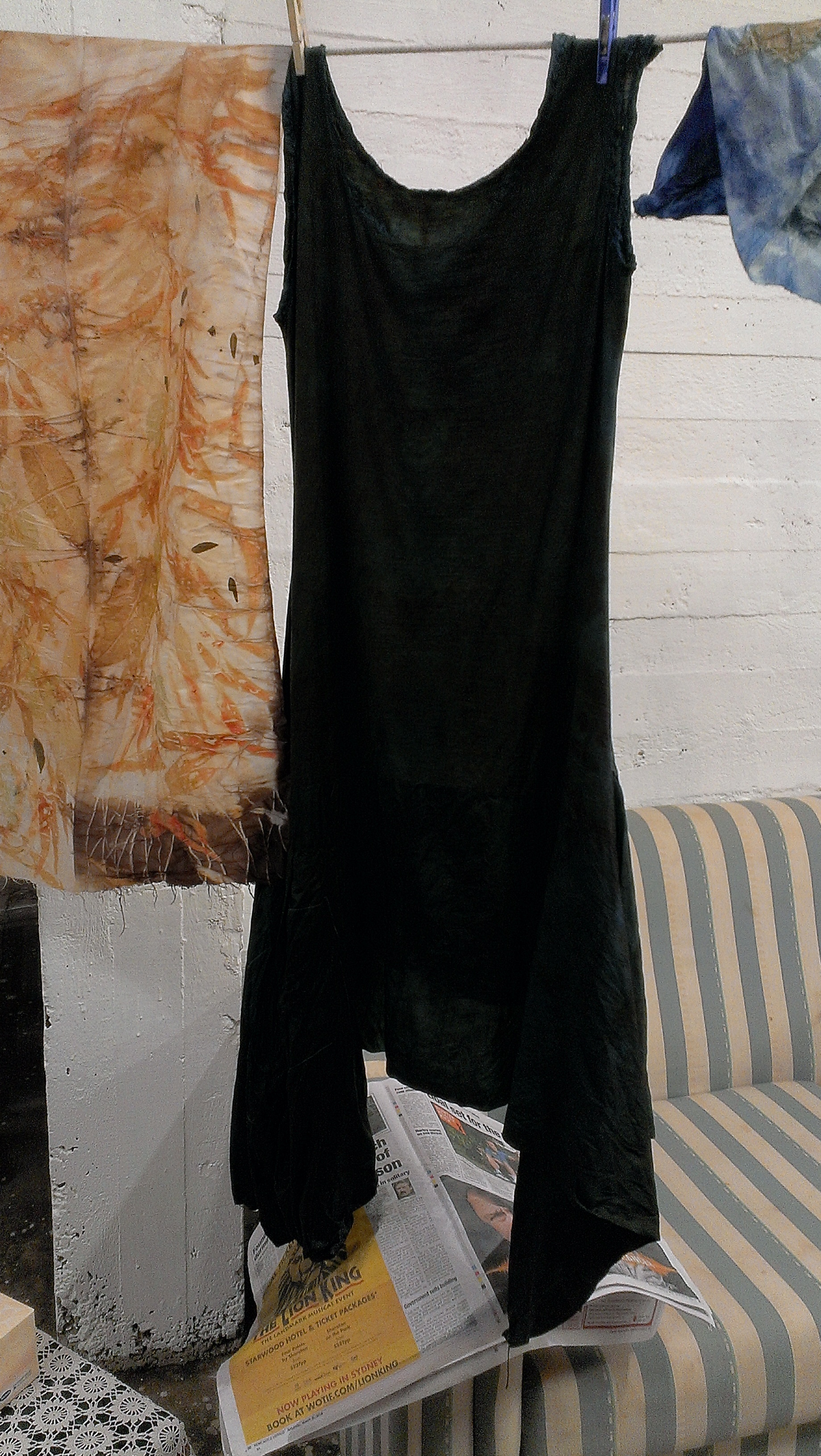
I found it really interesting to observe this use of eco-printing as a way of creating a series of colour and texture effects, rather than the way I tend to use it, in which I am aiming for images of leaves as a predominating motif.  Here is the same dress again, drying after a dip in indigo!

IMAG4359

5 Comments

Filed under Leaf prints, Sewing

Sock yarn overdyeing progress and an indigo update

Socks are one of my go-to projects.  I’m sure you’ve noticed.  They are portable and don’t require a pattern (for me, any more) and so they accompany me on public transport, to meetings and conferences, picnics and TV shows. Admittedly, I am not usually making fancy socks.

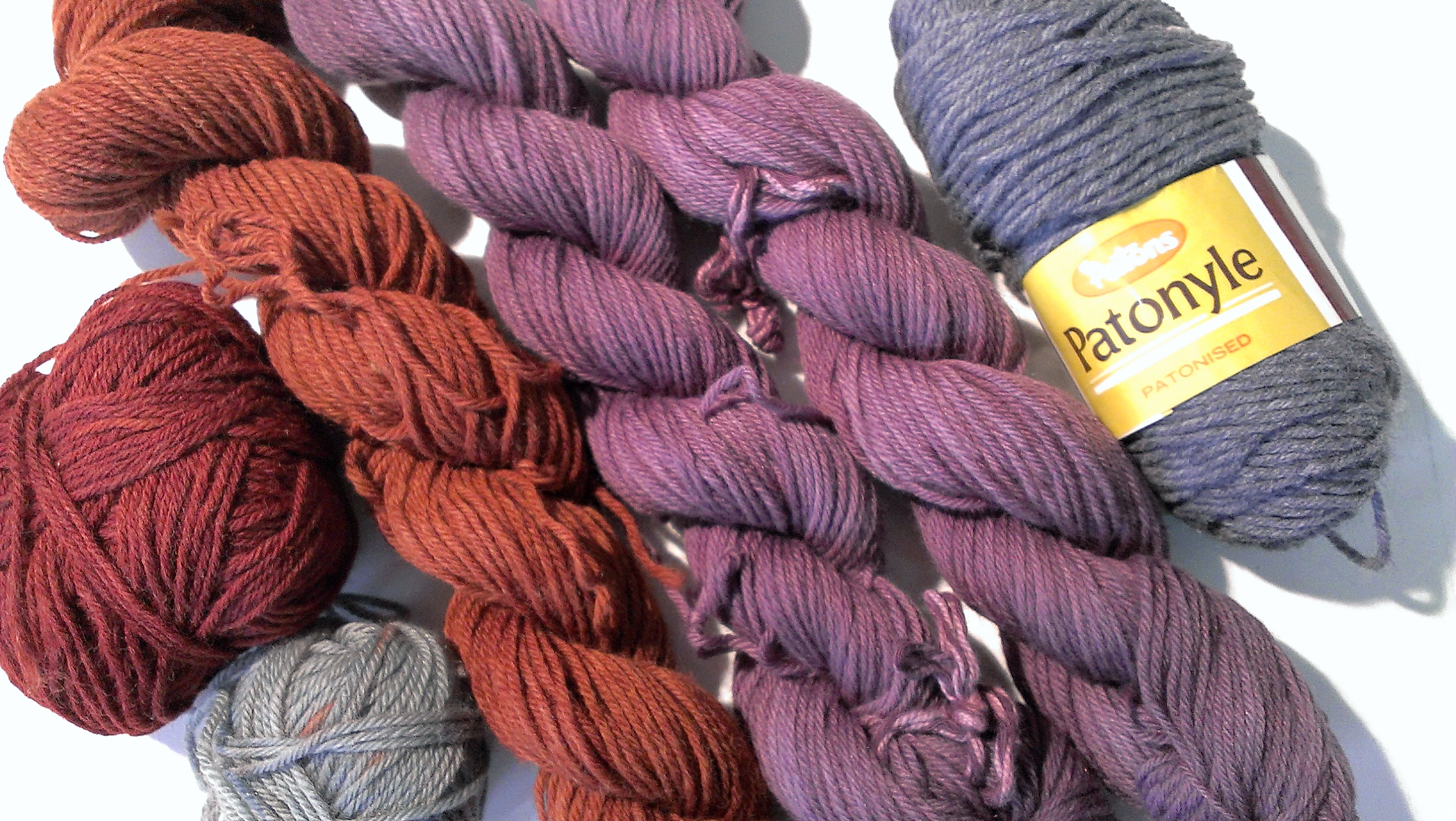
A couple of years back I acquired a lot of pre-loved patonyle (this is a wool/nylon blend and probably one of the best known Australian sock yarns).  Patonyle has been around a long time.  When I found this lot at a garage sale some of it was in 1 oz balls (Australia gave up imperial measures in 1970–to oversimplify).  I’ve been working my way through this haul for quite some time.  Today I pulled out all my ball bands.  Some have that souped up 19760s-70s styling (in lime green and purple–at top right), the pallid specimen in the top left corner is the current 100g format, the only ball I bought new–and those ochre coloured wrappers surely predate the 1970s.  And … there are quite a few of them!

IMAG3736

No wonder it has taken awhile to turn it all into socks.  I’ve used this wool with all manner of natural dyes, with greater and lesser success.  After the recent indigo saga began (update below), I looked at the remainder.  Some dyed with eucalypt, some with plum pine, which I now know won’t last long, a leftover black bean ball and some in the original grey.

IMAG3735

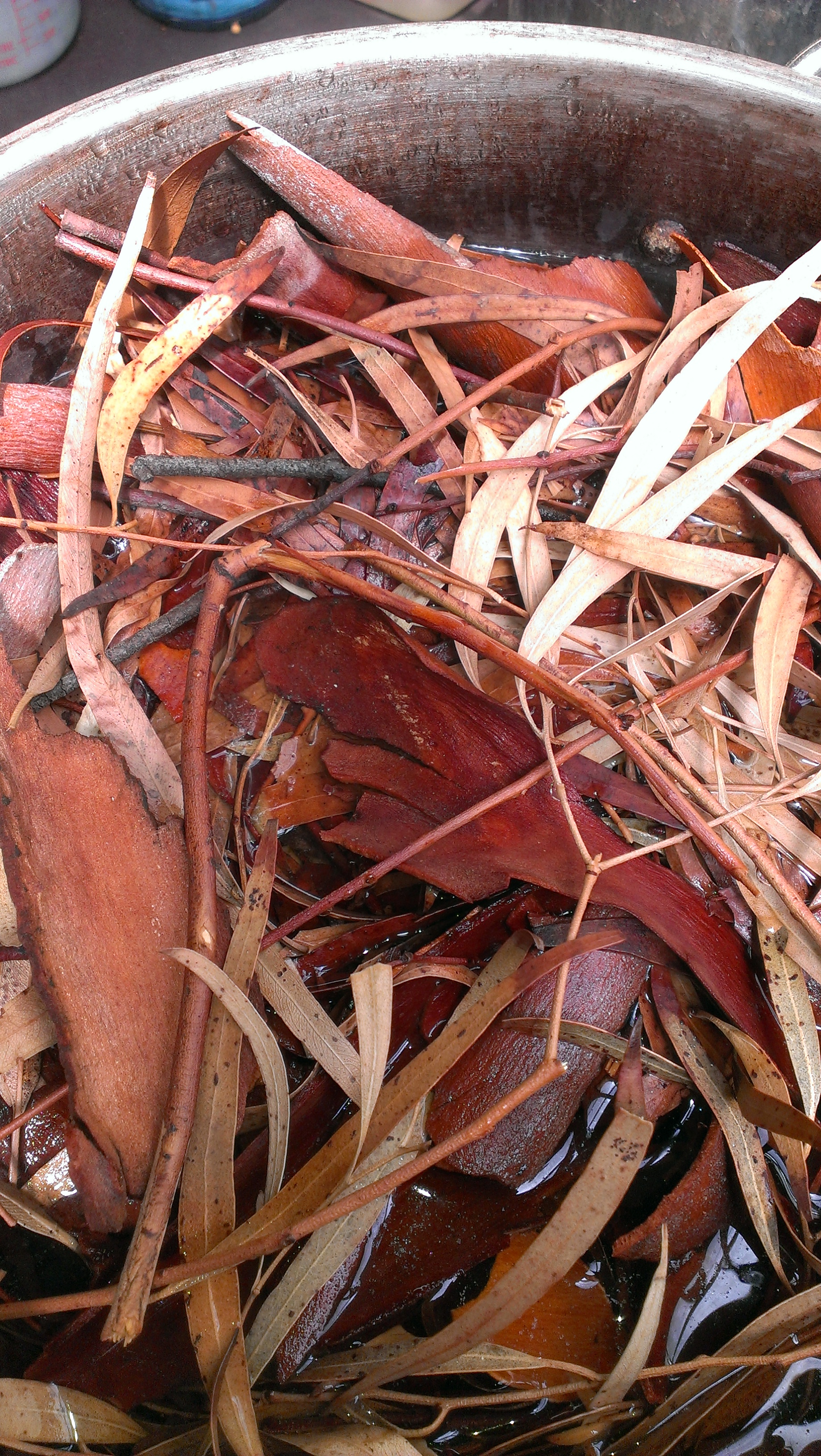
I decided to overdye the black bean, grey and plum pine yarn with eucalypt and made my way past one of my favourite E Scoparias, collecting fallen leaves and bark on my way back from the shops.  On went the pots. One contains the fruit of past harvests… mostly E Scoparia bark.

IMAG3742

The other contains what I collected the day I started writing this post: E Scoparia leaves and bark.  We have had sudden rain and wind after a prolonged hot spell, so there were leaves and a few pieces of bark from other trees in there and the smell of E Citriodora wafted up from this pot as soon as it came to a simmer, then died away.  The nearest lemon scented gum is only a few metres from where I was gathering.

IMAG3740

Meanwhile, I cast on with the yarn that is already in the classic eucalypt colours…

IMAG3738

And here are those blue, plum and grey yarns after their trip through my dye pots…

IMAG3868

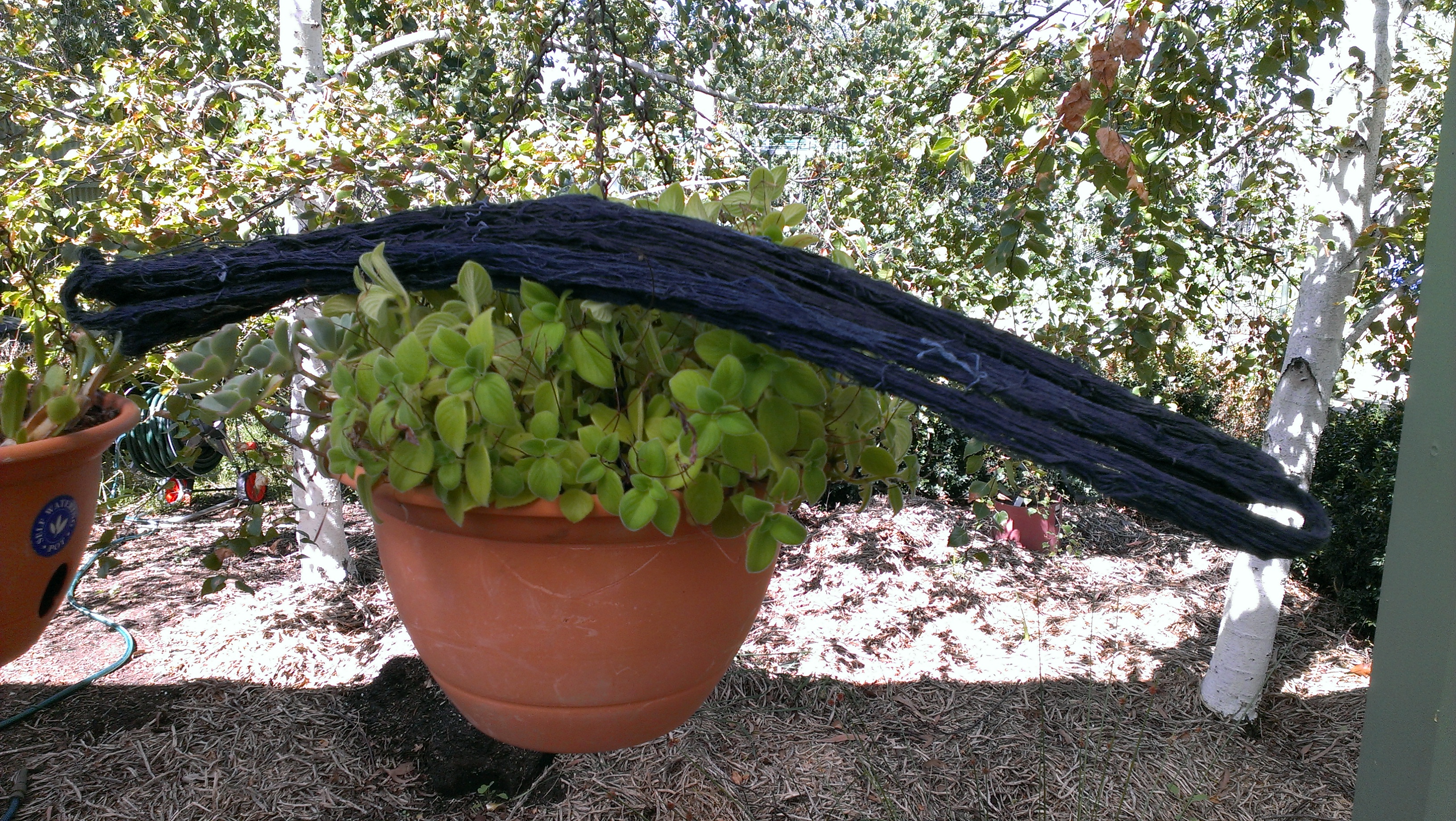
On the indigo front, here are the yarns after soaking in soy and drying.  They are lying across a nodding violet in a hanging pot so you can get some sense of how stiff they are!

IMAG3878

I let them dry out really well and have since been soaking and rinsing.  The soy milk soak has meant that more indigo is washing out of the sock yarn, which is what I had hoped for.  I am reasoning that the soy has bonded with some of the loose particles of indigo, rendering them capable of being washed out (rather than coming off on my hands, since I couldn’t rinse any more of the indigo out previously).  I am going to keep soaking and rinsing until that stops… and then try knitting again!

2 Comments

Filed under Eucalypts, Natural dyeing

Cool spectrum gradient yarn

There has been some plain Jane spinning.  Three ply natural Polwarth, finaly plied after a long wait. Not my best work, unfortunately.  One of the singles is plumper and fluffier than the other two.  Just the same, it’s yarn and it’s a true three ply made from three singles.

IMAG3856

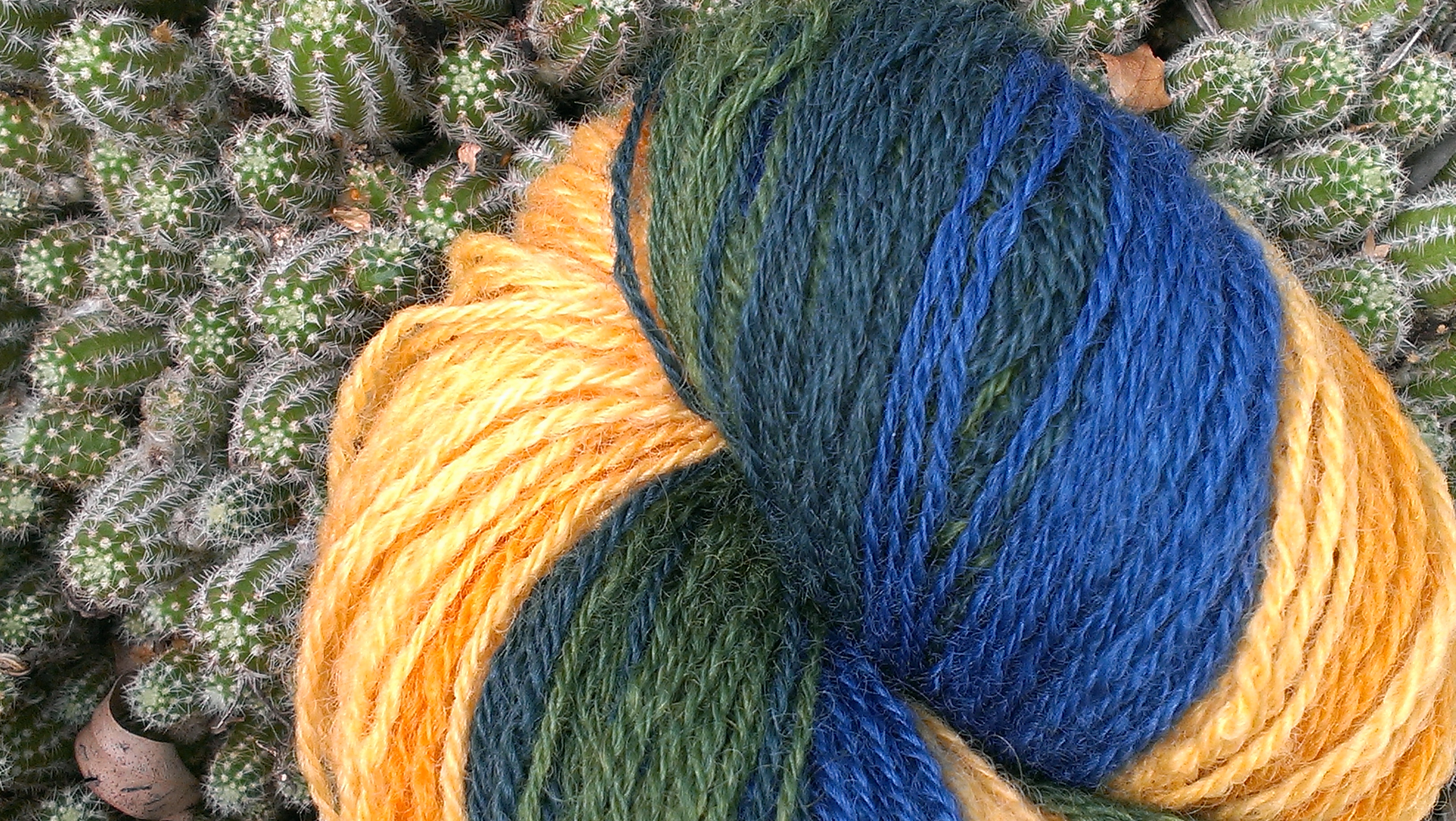
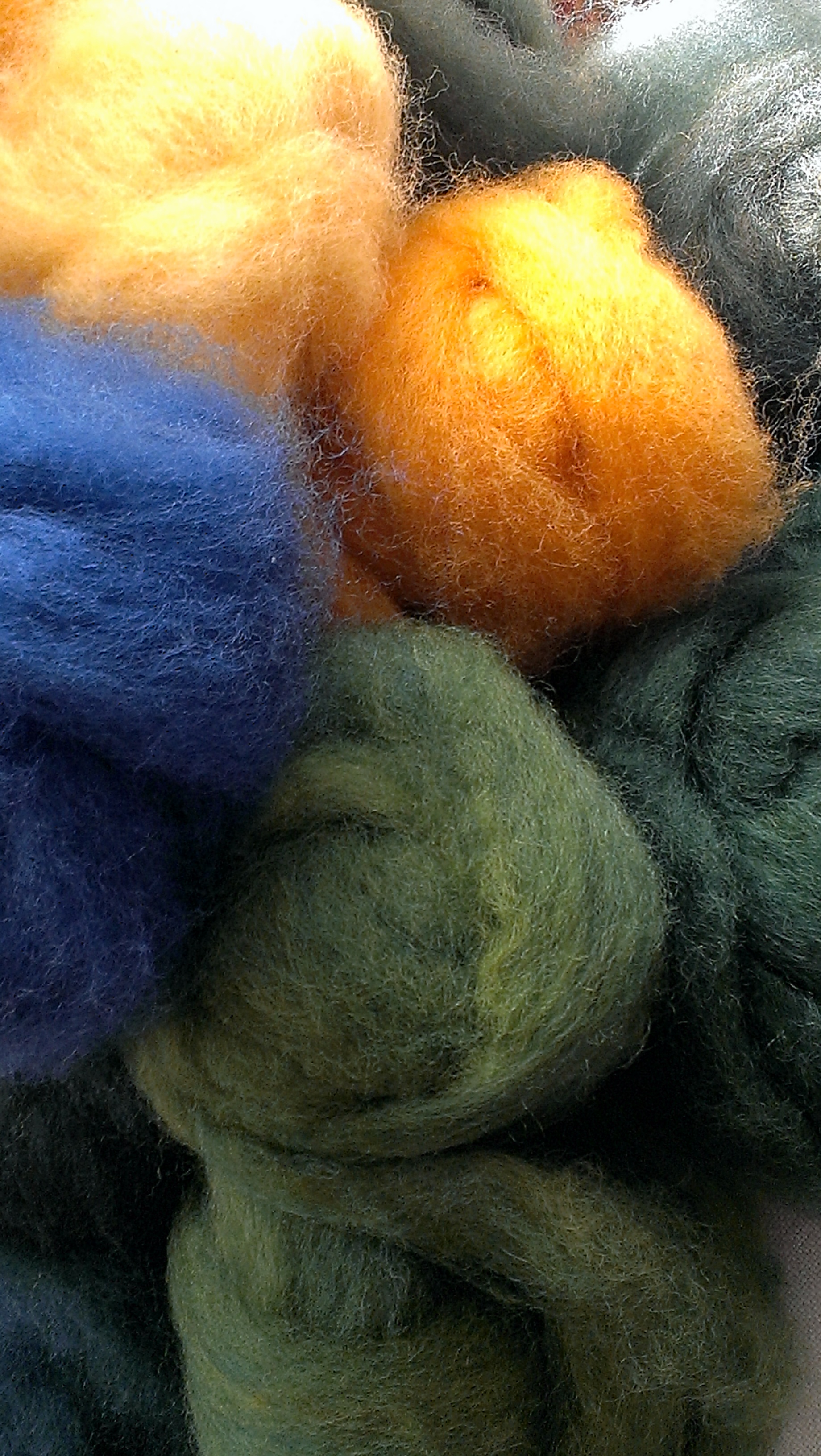
In the not-so-plain stakes, there has also been plying of some of the holiday spinning.  This one is Malcolm the Corriedale, dyed yellow with osange orange and my mother’s coreopsis flowers (she is generous enough to collect her dead flowers for me and such a committed gardener that she deadheads her coreopsis).  I overdyed with indigo to create greens and, of course, blue.

IMAG3870


No sign of crocking, just in case you’re wondering!  I have several more flour sacks of this fibre carded, pulled into roving through a diz and ready to spin.  Mmmm!

IMAG2939

The yarn is three ply and I’ve chain plied it so it will stripe… and just for the sheer pleasure of it.  Because I met internet spinners before I met many in real life, chain plying never seemed to me to be an unusual skill.  I took it up quite early in my spinning career and expected it to be challenging, because I was beginner and most things were challenging.  While I was plying this yarn at my regular Guild group, women who have been spinning for decades were commenting about how easy I made it look.  Ah, the warm glow of competence…  I admire all the things they can do that I find difficult, and there they are, doing just the same thing in reverse.

IMAG3858

6 Comments

Filed under Fibre preparation, Natural dyeing, Spinning

Let’s try that again!

IMAG3709

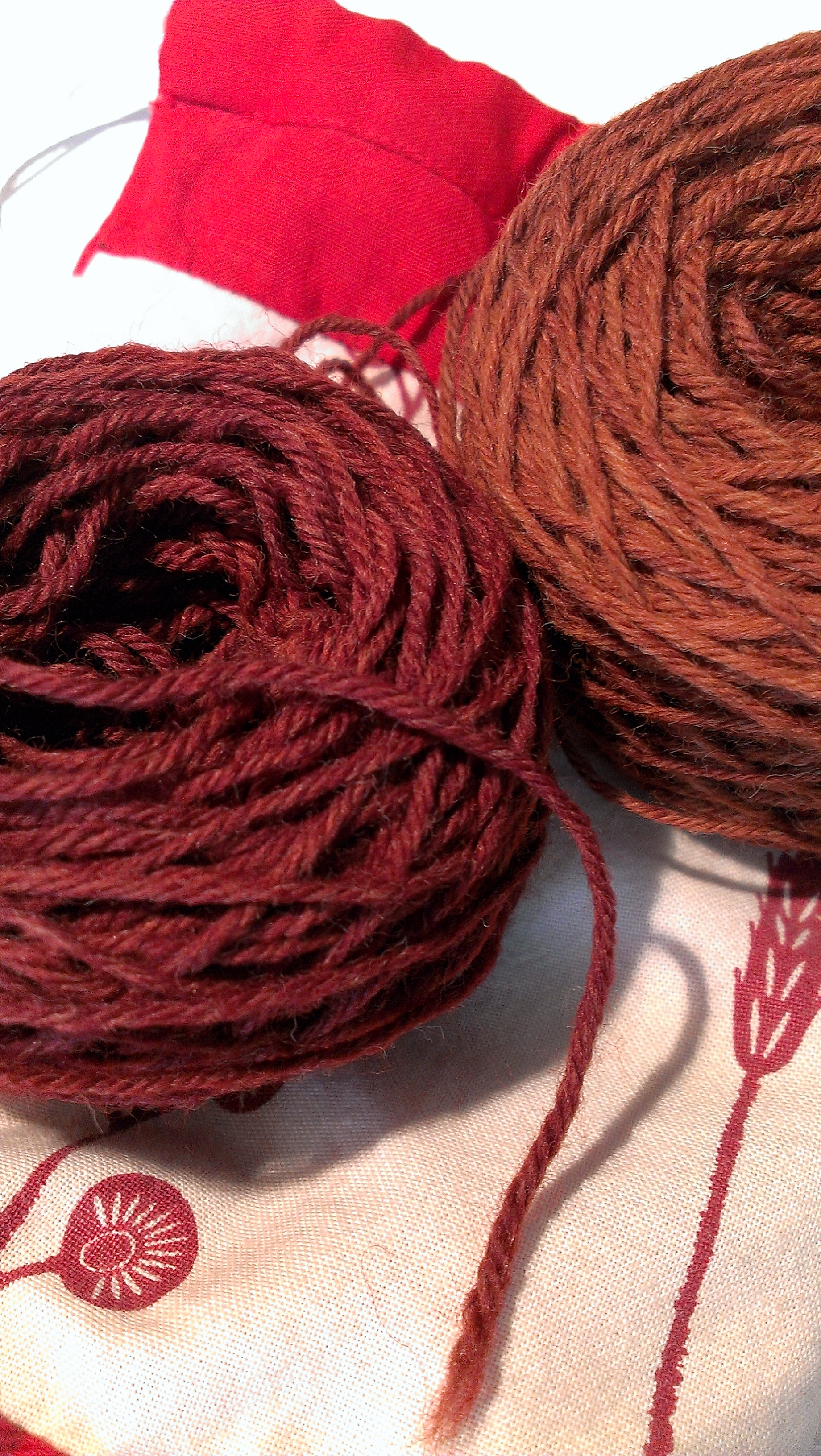
My indigo dyed sock yarn emerged from its vinegar and water soak a little improved.  Instead of being able to see blue on my fingers after just twisting the skeins and then being sble to see the track yarn takes around my fingers when I knit in blue detail after only a row or two… it took winding the skein into a ball to produce this effect…

IMAG3722

I decided to try casting on.  After casting on 64 stitches…

IMAG3723

(That would be the long tail cast on for knitters who need to know!)  Well, it’s an option to knit and get blue fingers: people who seem to know on Ravelry say the resulting garment will not lose dye onto the wearer.  Why not, I wonder–as a sock will clearly be in friction with the feet it is on and crocking is all about dye loss through friction rather than washing.  Still, a little slower rate of dye loss would be my preference!  I’ve checked with the redoubtable J N Liles The Art and Craft of Natural Dyeing (1990), and he would appear to be the source of my belief that if indigo crocks it will keep doing so.  He offers a method for addressing the problem that seems entirely logical but does involve some effort.  There is another simple solution suggested on Ravelry–a soymilk soak.  Since finding it mentioned on Ravelry, I’ve found John Marshall offering soymilk as a solution to crocking here.

IMAG3724

On the premise of doing the simple things first, I’ll try that before proceeding to take Mr Liles’ advice, which would have to wait for a day with some relaxed hours.  As it happens, there were two part-used boxes of soymilk in the tearoom fridge at work… they have been there a long while and no one is claiming knowledge (one of them is mine but I’m not sure which one!)  They smell fine but I think they’re past the point of safe human consumption. What an opportunity!  Now we wait.

IMAG3716_1

I made a little hat to match the big one.  Same basic hat, smaller, and top-down so I could use all the yarn.  I am sure it will fit a little person or perhaps a doll or a bear…

IMAG3720

And… I had a score at the op shop (thrift store) on my way home from work.  I could not resist all that thread for A$2 and there were so many examples of lovely embroidery I had to bring one home…

6 Comments

Filed under Dyefastness, Knitting, Natural dyeing, Sewing

Leaf print of the week

IMG_0020_1

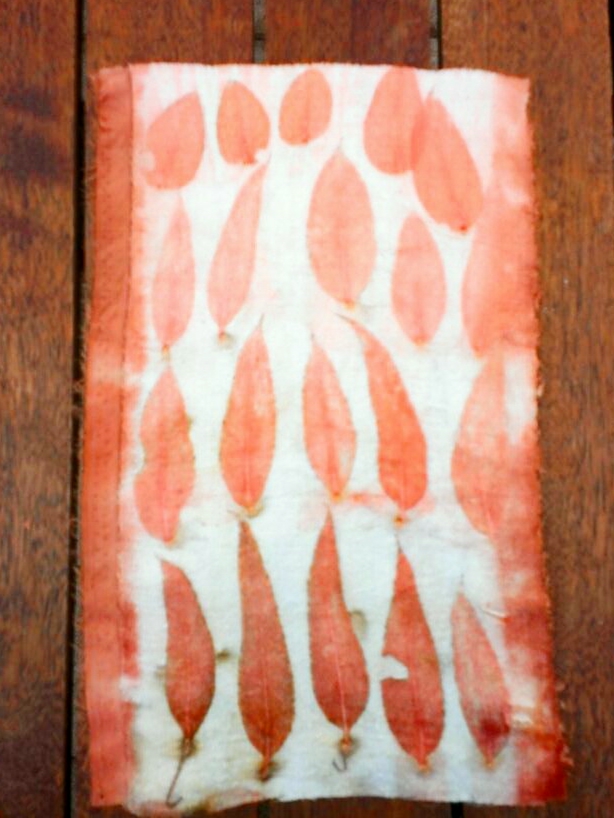
These are Eucalyptus Cinerea leaves on silk velvet. The velvet came from Beautiful Silks.  Just four small squares in a couple of scrap packs I bought along with whatever I was ordering at the time.  From my point of view this was lucky dip by post, and more fun than most lucky dips I remember as a child.  I would never have expected to enjoy velvet so much!  Here are both squares fresh from unbundling.

IMAG3229

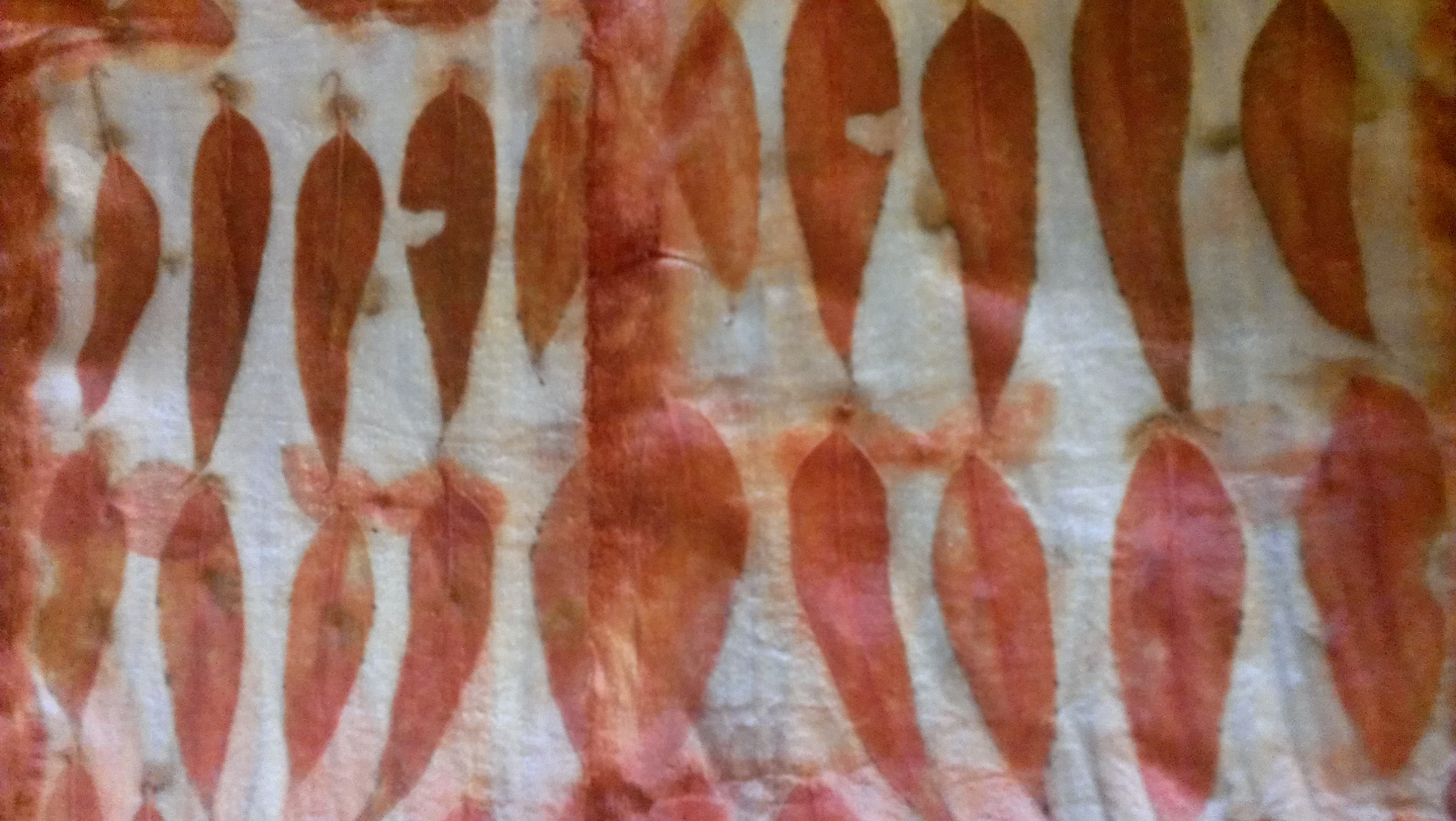
Perhaps I’ll have to make a cushion cover… as proposed in the comments.  Finally, a little close-up.  E Cinerea famously has heart-shaped leaves, but this tree had been pruned (mostly by me) and the new growth has come out in quite different shapes, which suits me just fine.  For some reason, I love the leaves that have provided food to caterpillars at least as much as the intact leaves, if not more.

IMAG3264 (1)

Meanwhile, I still have at least 80g of indigo dyed sock yarn (enough for a pair of socks), so after all the cheering on from readers recently, I have tried the least difficult solution to crocking I found (start with simple!) and soaked it overnight in a vinegar solution.  No bleeding into the rinse water… and I’ve left the yarn out to dry.  Fingers crossed!

10 Comments

Filed under Eucalypts, Leaf prints

Travel Knitting

I have been travelling for work… and then my oldest friend invited me to his birthday… so I have been extending my carbon footprint by going to Perth for work, then to my friend’s birthday on my way home (for those who don’t know, Sydney is not on the way home to Adelaide, when you start out in Perth).

Anyway… in the hurry to leave home I managed to remember to pack travel knitting.  I started out with a sock in progress.  Eucalyptus dyed patonyle, destined for the feet of my Blue Mountains friends.  The weather where they live calls for handknit socks.

Image

These colours are the result of overdyes, where I didn’t like the initial colour and decided to try again.  By the time I left for Perth, I had one sock knit and another underway and caused quite a bit of fascination among the project team by knitting in breaks and grafting a toe over lunch.

IMAG3702

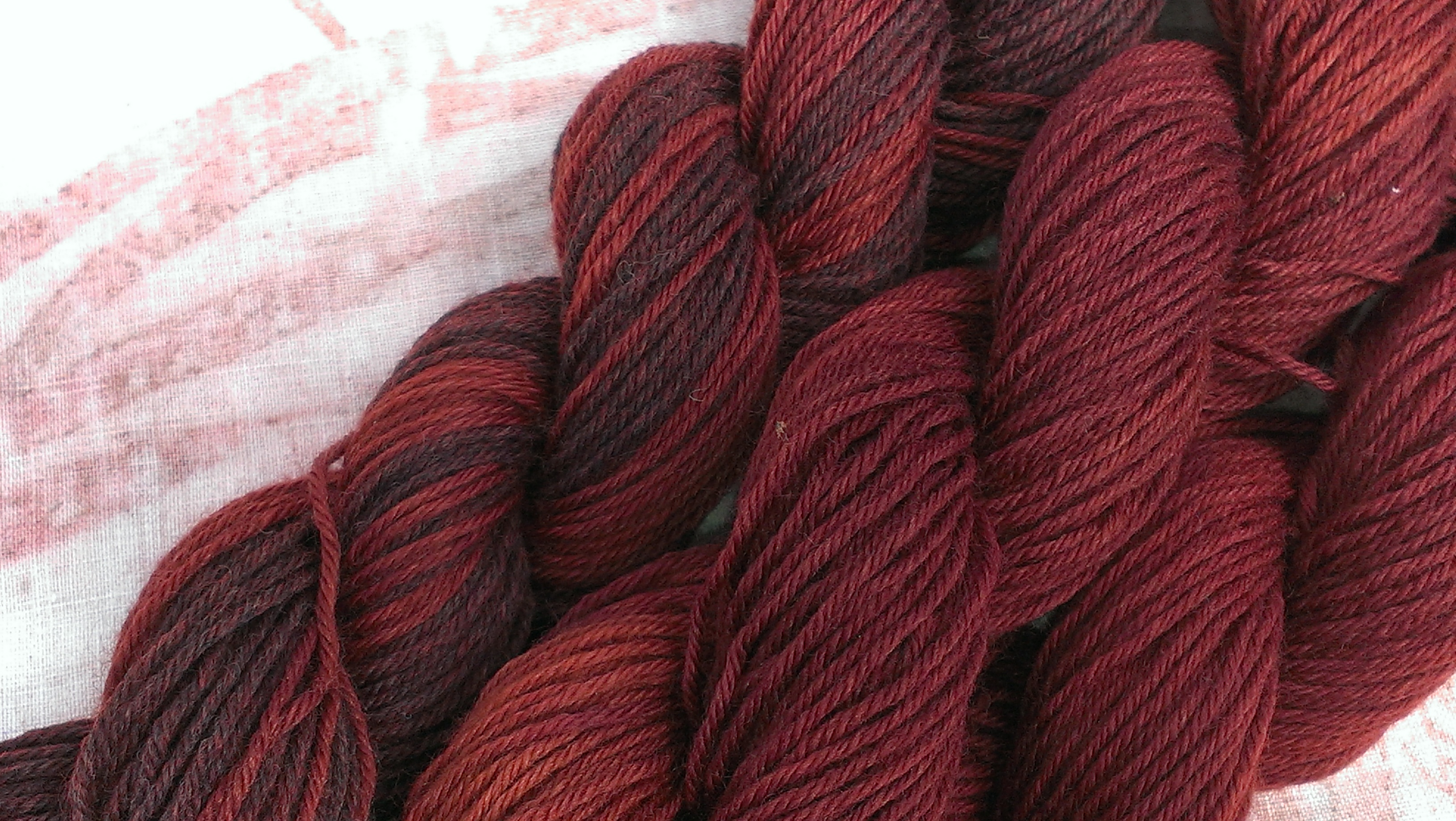
I had overdyed the rest of my patonyle more recently.  It started out dyed with black beans (not as colourfast as I’d like) and plum pine (not at all colourfast).

Image

These yarns went into my first attempt at the Michel Garcia organic indigo vat.  I had reservations about my vat as I went… the Ph test strips I had bought turned out not to measure the part of the Ph spectrum I needed and in the end I ran out of time and should have left the vat to the next day.  On the up side, the preparation of the vat all made sense and most of it went really well.   I think my judgment about it was basically right, I just didn’t go with my judgment as I should have done.  My friend dyed a doily:

Image

I re-dyed the sock yarn, originally bought second hand at a garage sale.

Image

Although I was happy with the finished colours, it turned out that I had hurried the indigo too much and I was left with crocking… the blue rubbed of on my hands a lot as I was knitting in Perth.  This made it certain the finished socks would leave the wearer with blue feet and I finally decided to abandon them after a few centimetres, frogged and left the yarn in a bin in Perth.  Sigh!  That must be the fiirst dyeing fail I have pronounced irretrievable.

I had an alternative plan.  I pulled out yarn I intended for a hat and chose one of the two patterns in my bag, Jared Flood’s Turn a Square.  I wound the ball in my motel room and cast on. Here it is as I wait for the taxi to the airport in Perth.

Image

The time difference between Western Australia (Perth) and the rest of the country is considerable, so even though the flight was four and a half hours, I left Perth at 10 am and arrived in Sydney at 5 pm, and here is the hat in the Sydney airport:

Image

Here it is in Sydney about to depart for Adelaide next day…

IMAG3701

I finished it on the way and started a second hat with the rest of the skein, top down. I’d call that a productive trip on many fronts!

IMAG3707_1

12 Comments

Filed under Dyefastness, Knitting, Natural dyeing

Alas, poor Malcolm the Corriedale

We had a glorious visit to our friends in the hills on the weekend. There were recently shorn alpacas.  In black…

IMAG2929

In white…

IMAG2926

And in cinnamon.  But like the sheep, the brown alpacas were too shy for photos.  There was a woodlot of blackwood trees, and some stumps with very impressive fungi growing on them:

IMAG2932

There was a wealth of eucalypts and a knowledgeable community member who knew what many of them were. I brought home E Nicholii leaves (I have not had the chance to greet a fully grown specimen before, let alone a row of them), E Cinerea leaves and some massive juvenile E Globulus leaves.

IMAG2935

There was fine company, cake and scones and home grown cherries.  Not only that, but koala sightings and visits with rescue joeys (baby kangaroos whose mothers have been killed on the road, being raised by hand with tender loving care).  Such awesomeness!  I took lots of handspun yarn and left quite a bit behind where creative minds were whirling with plans and fingers were itching to get knitting… but there was bad news too.  I got to meet with the people who hand raised the corriedale whose fleece I have been working with most recently, from a lamb.  And sadly, poor Malcolm had recently and unexpectedly died, just before the shearer was due to visit.  We paused on Malcolm’s grave.  So it was special to have taken yarns made from Malcolm’s fleece to share… and I still have some, plus fleece that I dyed with eucalypts last week (it is E Scoparia bark peeling season) …

IMAG2936


And fleece that is prepared and ready to spin, from my recent coreopsis–osage orange–indigo dyeing season.  So… although I never did get to meet Malcolm, it’s conceivable I’ve spent more hours with my hands in his fleece than anyone…

IMAG2939

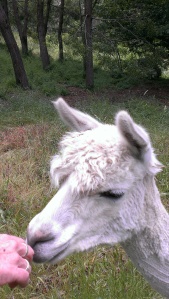
And I now have 5 alpaca fleeces and one from Lentil the sheep to think about and share around, such is the generosity of our friends!

7 Comments

Filed under Dye Plants, Eucalypts, Fibre preparation, Natural dyeing, Spinning

Drawstring bags

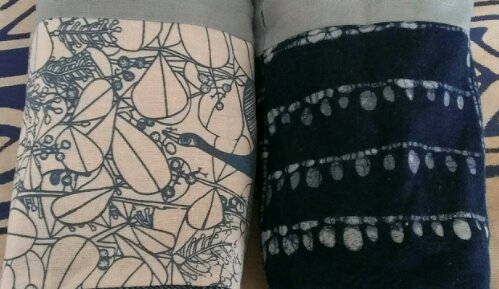
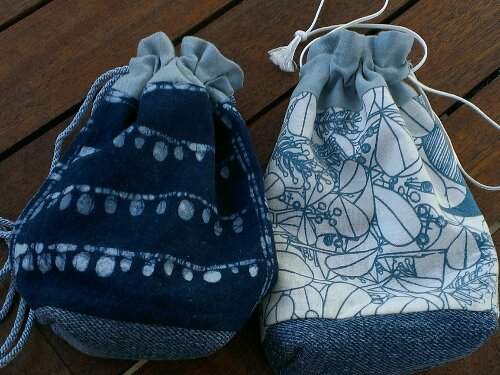
I have been using up smaller scraps of indigo dyed fabric. I decided on lined drawstring bags. The kind I like to use when carrying small knitting projects around. The linings allow the use of all kinds of little scraps.

wpid-IMAG2294.jpg

These outers use some of the hemp I dyed with indigofera australis as well as the last of my wax resist indigo dyed fabric, and some with a delectable Australian designed print.

wpid-IMAG2298_1.jpg

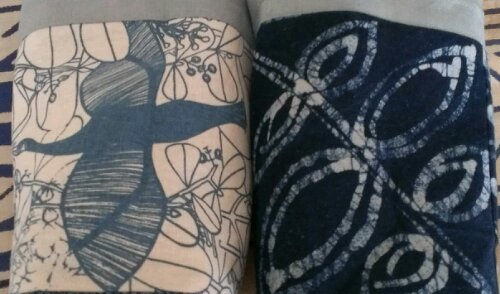
Here is the other side:

wpid-IMAG2299_1.jpg

And here they are with cords drawn through their casings:

wpid-IMAG2366_1.jpg

I also made some larger bags with small pieces of leaf printed recycled linen and another Australian print.

wpid-IMAG2362_1.jpg

Surely this is the last of the famous brown ramie shirt and those hemp jeans! And I have found use for some pre-loved cord as well.

6 Comments

Filed under Eucalypts, Leaf prints, Sewing

Indigo vat with colour run remover

I am a bit intimidated by indigo.  Perhaps I have just made it a major performance each time I have attempted it so far–overreach is a superpower I have in spades.  But the temperature maintenance, chemistry, my lack of experience and (in the case of the hydrosulphite vat) my aversion to the chemicals involved, all make me wary.  Anyway, I overcame my reluctance and ran a vat last weekend.  I made an assessment of the fleece I might dye –in varying states of yellowness and natural whiteness (with a little tan), corriedale and polwarth.

IMAG2474

The quiescent vat has been dormant since January, since I failed to make a successful fermentation vat using ambient summer temperatures. It has only been waiting 10 months for resurrection!  It contained madder and bran as well as indigo due to its first life as a potential fermentation vat, so the night before,  I sieved out all the larger particles remaining rather than have them distributed throughout my already less than pristine fleece.

IMAG2475

I wetted out my fleece and some brown polwarth slippers in readiness.

IMAG2476

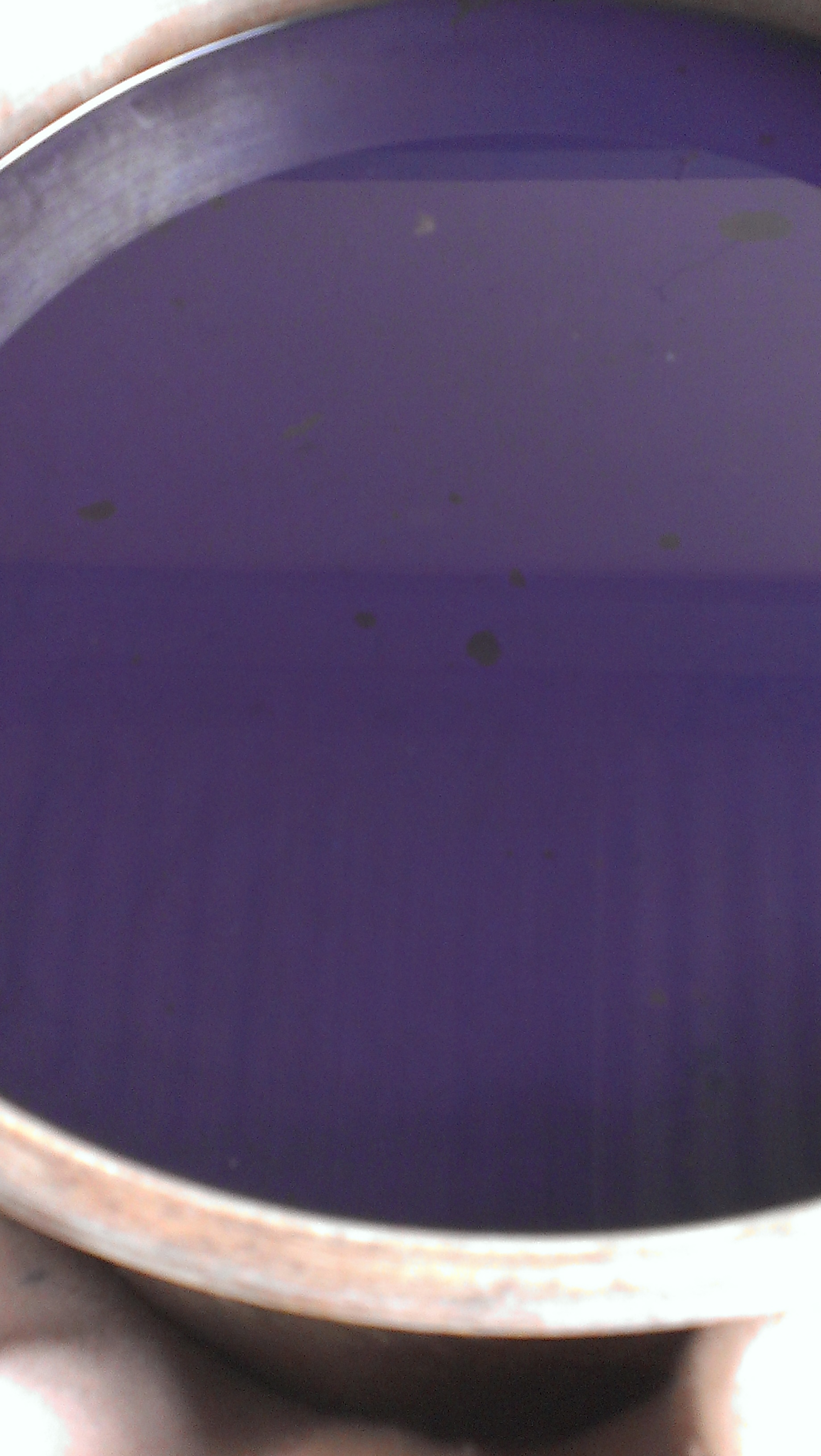
The vat was a far more exciting colour after warming and the addition of colour run remover.

IMAG2489

I had read Vivien Prideaux and Jenny Dean in preparation and realised some guesswork would be required. How much colour run remover?  How much could I hope to dye? Just the same, this is the second half of this vat I have managed to render useable by this method, another reason to think I should give up being intimidated and get on to practising fermentation methods.  Perhaps, just like sourdough bread, it isn’t as delicate as you might think at first–even if time needs to be on your side. It was very reassuring to see that telltale yellow-green colour appear under the surface on my silk embroidery thread.

IMAG2491

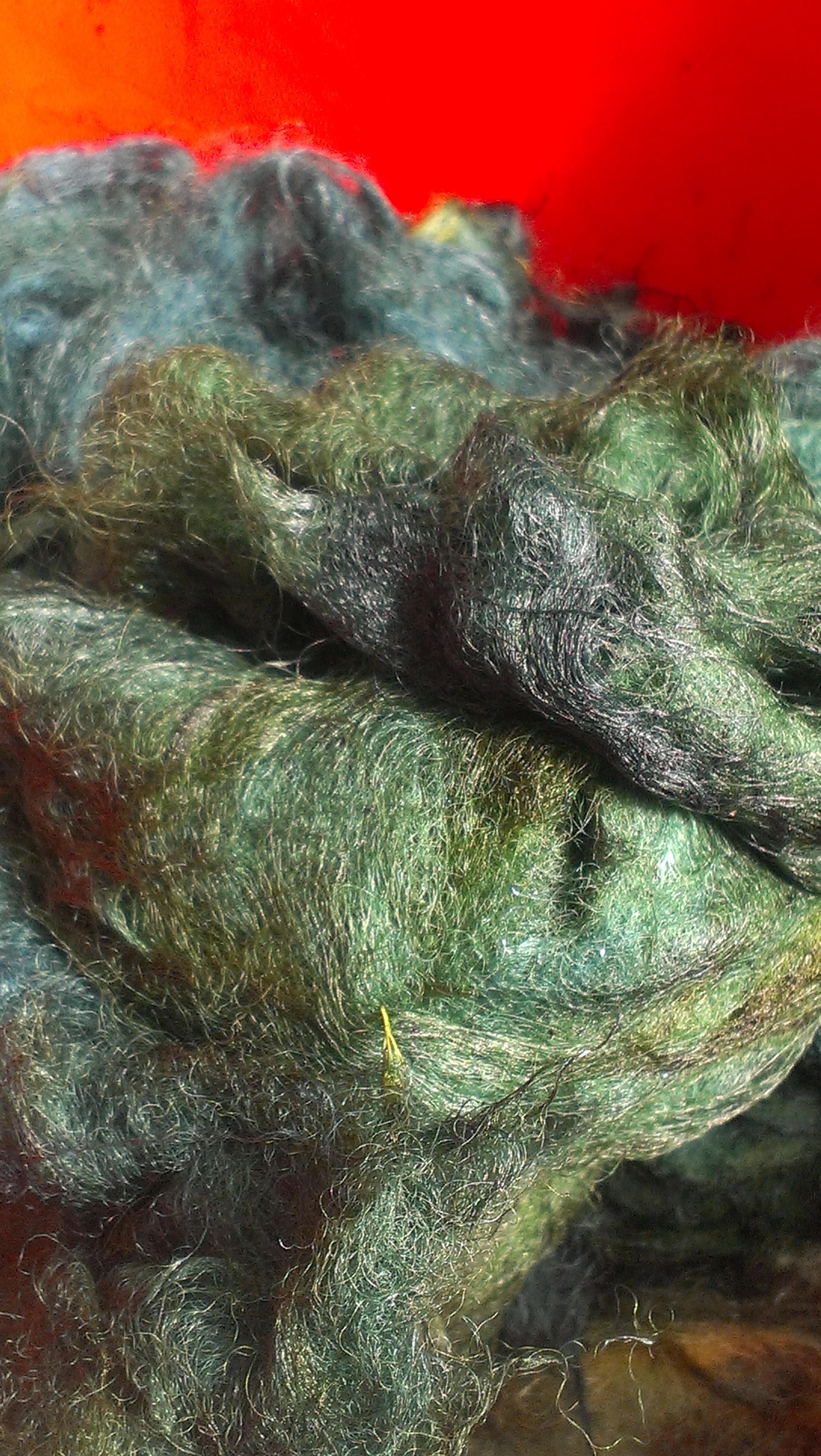
Some of the yellow fibre going into the indigo:

IMAG2499

And afterward, while still wet. Some of the greens will be quite emerald when they are dry, I think, but the paler yellows became blue rather than green.

IMAG2509

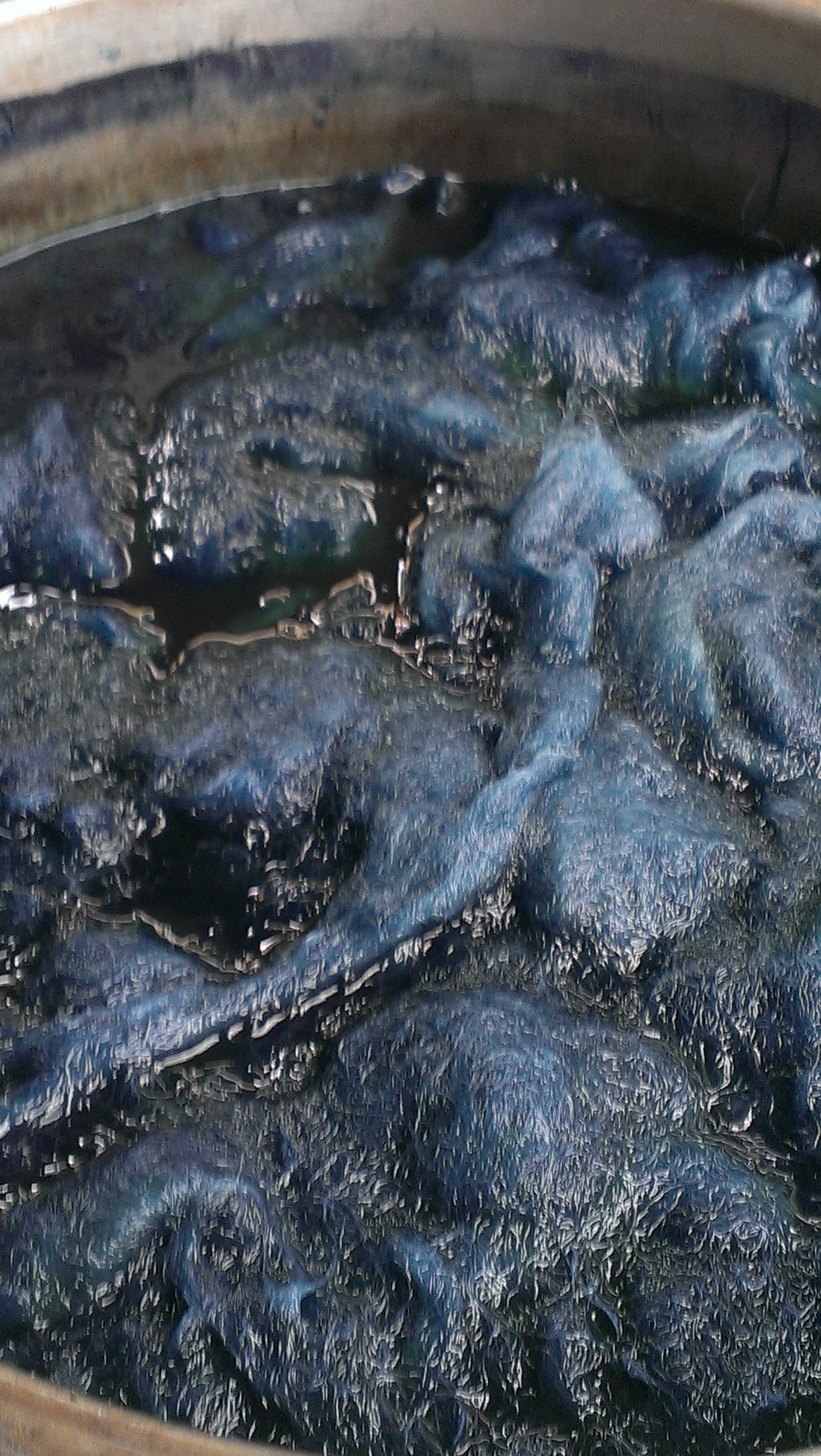
The white fleece became many shades of blue in a very satisfying way that will let me create graduated yarns.  Here it is, going into the vat:

IMAG2512

Here it is still wet but rather gloriously blue…

IMAG2524

The slippers took up blue where they were white or pale purple from the tail end of a logwood exhaust bath, but took virtually no colour on the brown parts, which is to say, most parts.  It may be that the vat was exhausted–not completely, or the pale parts would not have taken up colour–but sufficiently that no colour change showed up on the brown.  It may also be that they were greasy enough to repel the dye somewhat and that so much wet fleece having entered it, the vat was diluted.  So I have kept the vat aside for another day or a new thought on the matter.

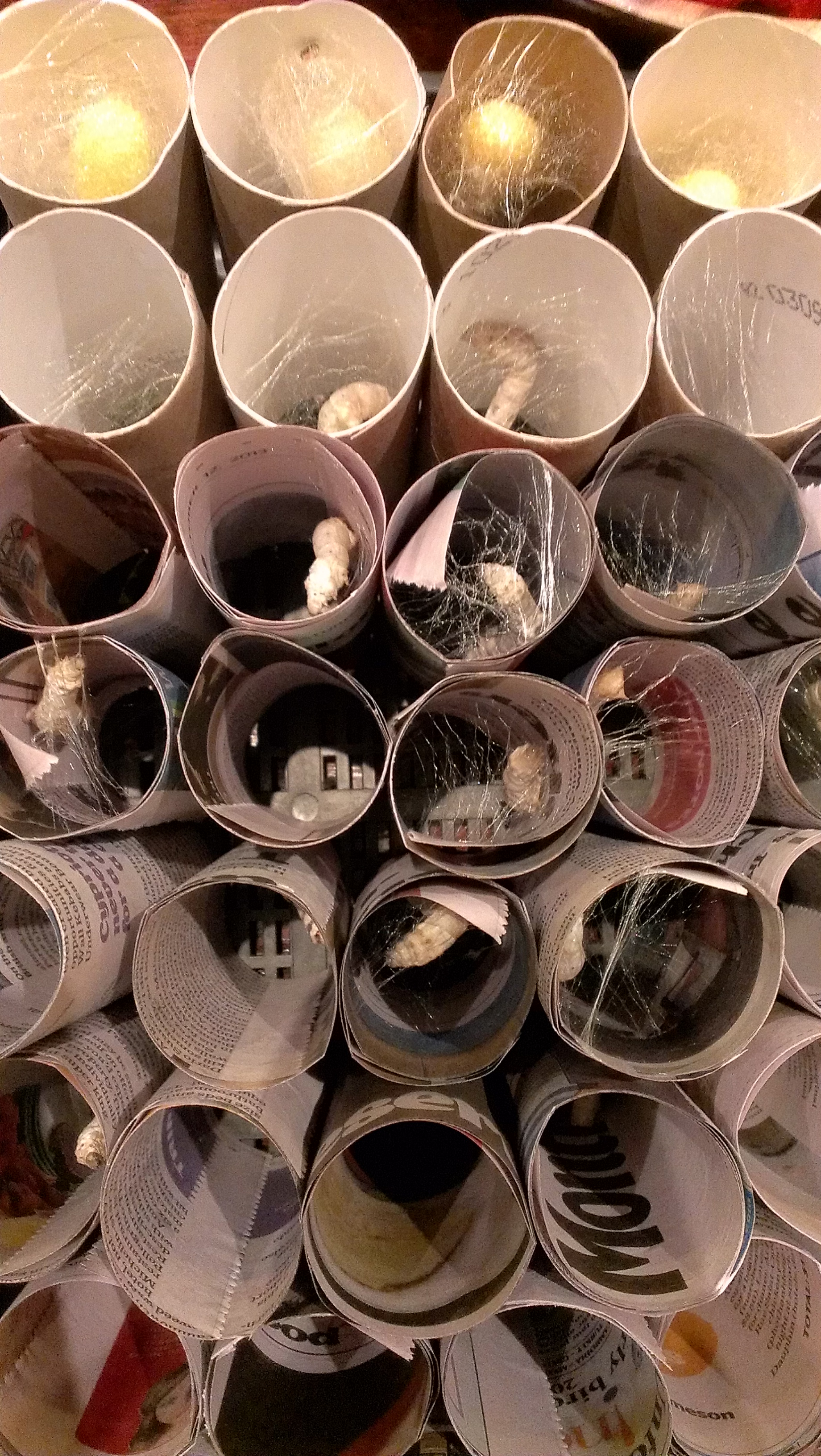
Meanwhile, there has been a breakout of the urge to spin silk and enter the cocoon…  But not for every single silkworm, and the ones that remain are SO HUNGRY!  So now I am off to look for a mulberry tree in the parklands I heard about on the weekend…

IMAG2526

12 Comments

Filed under Fibre preparation, Natural dyeing