Tag Archives: silk

Silkworms: 6 week update

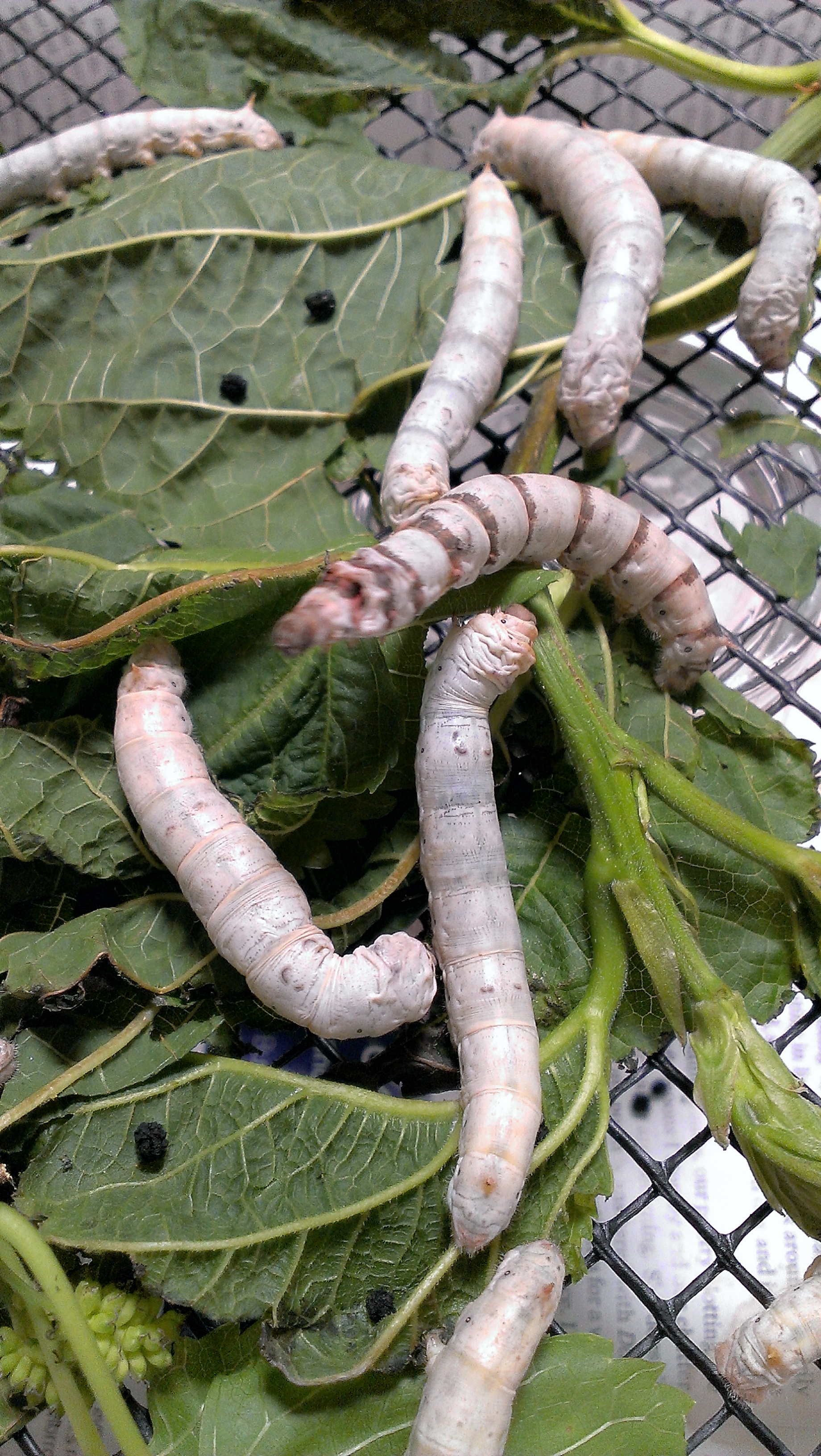
We still have a few silkworms.  28, to be exact.  The largest are now 7 cm or about 2 3/4 inches long. It’s hard to make photos of silkworms exciting, but here they are:

IMAG2586

Here is a picture of one silkworm starting its cocoon, or to put it the way we’ve been putting it around here, ‘becoming silk’.

IMAG2591

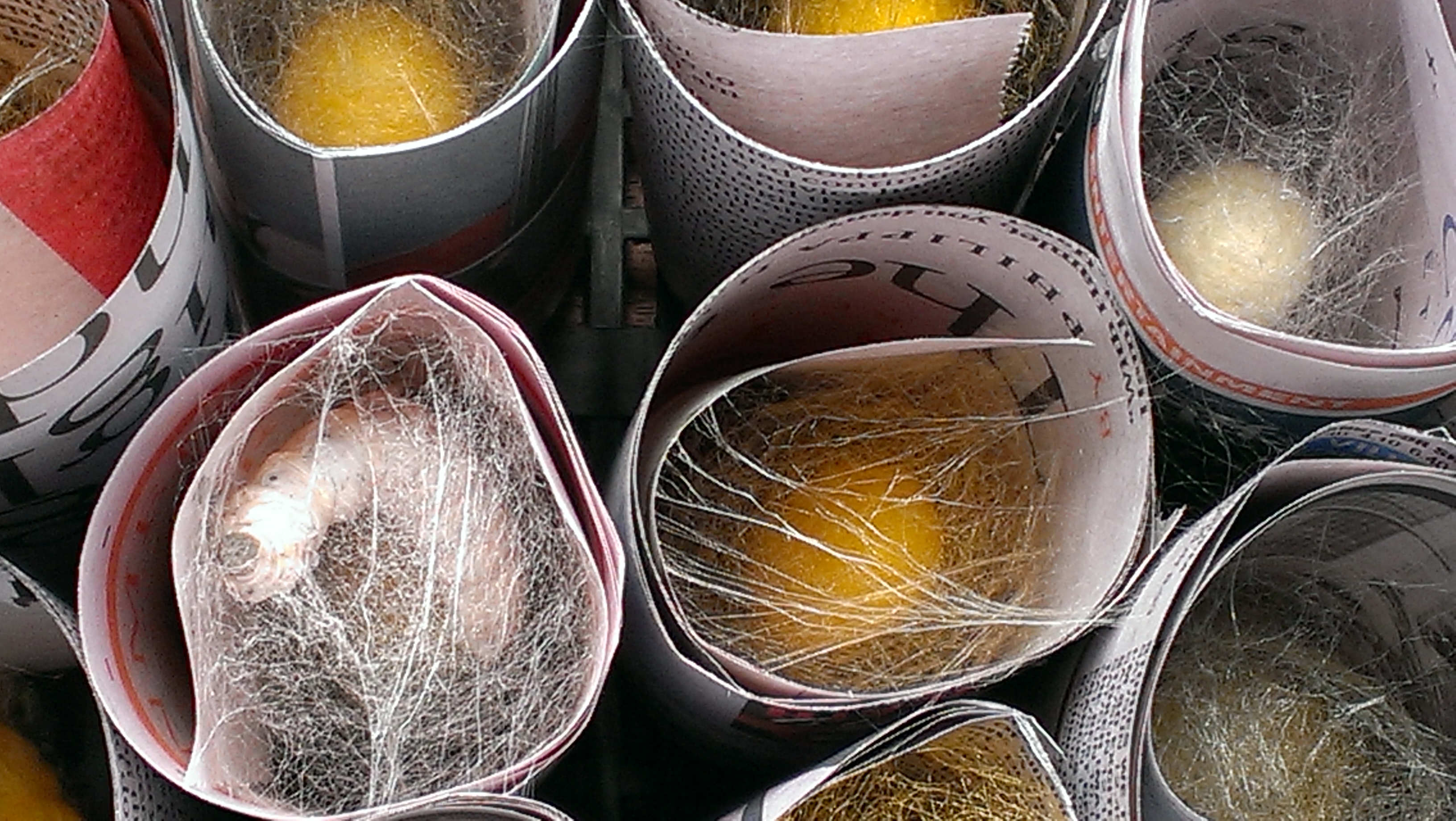
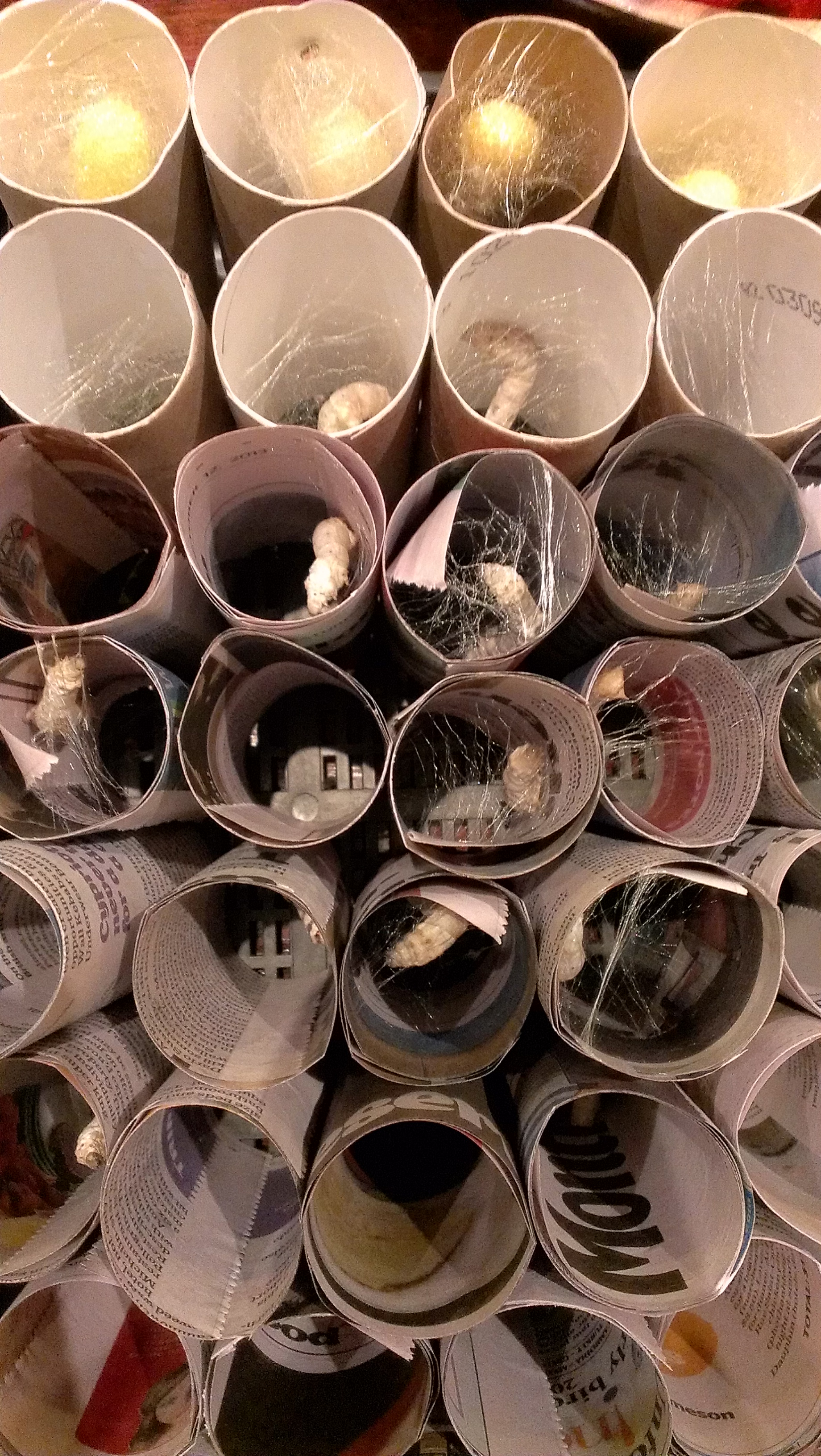
We have cocoons in two very distinct colours.  Mysterious.  All of the cocoons last year began pale and became golden very quickly–within the first 24 hours.  Not these.  Some are pale silver-white, with a slightly green hue in some cases. This is the view from above, looking down on a tray of paper and cardboard tubes.

IMAG2588

We have quite a few.  And about 28 still to add!  Luckily, I gave away about 70.  Some of which have been delighting schoolchildren, apparently.

IMAG2589

I am feeling deeply grateful to the friend who told me there was a mulberry tree behind the Japanese garden in the parklands.  It turned out there were three trees, two varieties of mulberry, and one of them was trailing leaves on the ground and down at head height across a path.  Begging to be pruned when I happened to pass with secateurs and a big bag, I tell you! I even ate a couple of mulberries that were almost ripe.

Leave a comment

Filed under Fibre preparation, Neighbourhood pleasures, Uncategorized

Indigo vat with colour run remover

I am a bit intimidated by indigo.  Perhaps I have just made it a major performance each time I have attempted it so far–overreach is a superpower I have in spades.  But the temperature maintenance, chemistry, my lack of experience and (in the case of the hydrosulphite vat) my aversion to the chemicals involved, all make me wary.  Anyway, I overcame my reluctance and ran a vat last weekend.  I made an assessment of the fleece I might dye –in varying states of yellowness and natural whiteness (with a little tan), corriedale and polwarth.

IMAG2474

The quiescent vat has been dormant since January, since I failed to make a successful fermentation vat using ambient summer temperatures. It has only been waiting 10 months for resurrection!  It contained madder and bran as well as indigo due to its first life as a potential fermentation vat, so the night before,  I sieved out all the larger particles remaining rather than have them distributed throughout my already less than pristine fleece.

IMAG2475

I wetted out my fleece and some brown polwarth slippers in readiness.

IMAG2476

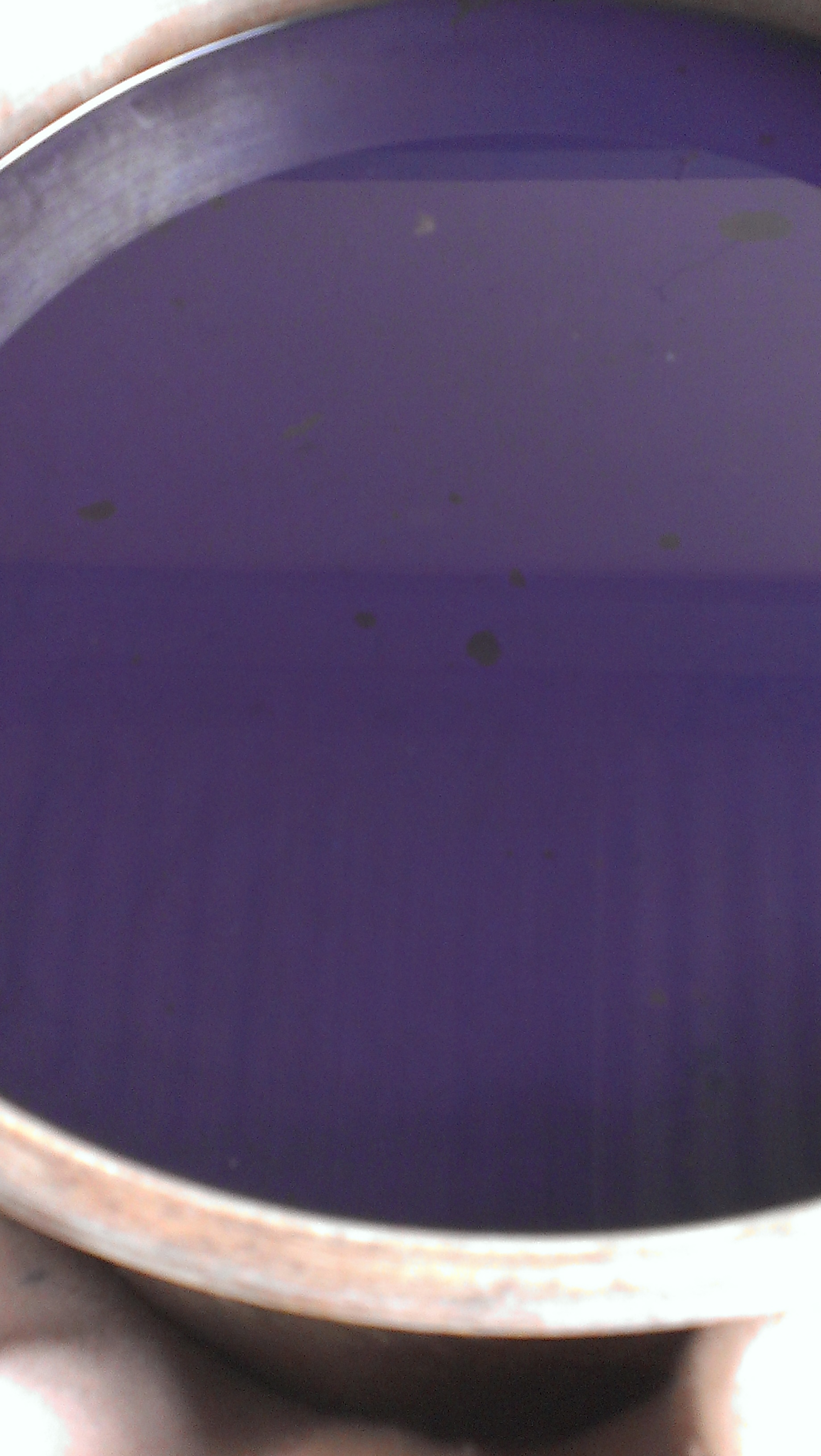
The vat was a far more exciting colour after warming and the addition of colour run remover.

IMAG2489

I had read Vivien Prideaux and Jenny Dean in preparation and realised some guesswork would be required. How much colour run remover?  How much could I hope to dye? Just the same, this is the second half of this vat I have managed to render useable by this method, another reason to think I should give up being intimidated and get on to practising fermentation methods.  Perhaps, just like sourdough bread, it isn’t as delicate as you might think at first–even if time needs to be on your side. It was very reassuring to see that telltale yellow-green colour appear under the surface on my silk embroidery thread.

IMAG2491

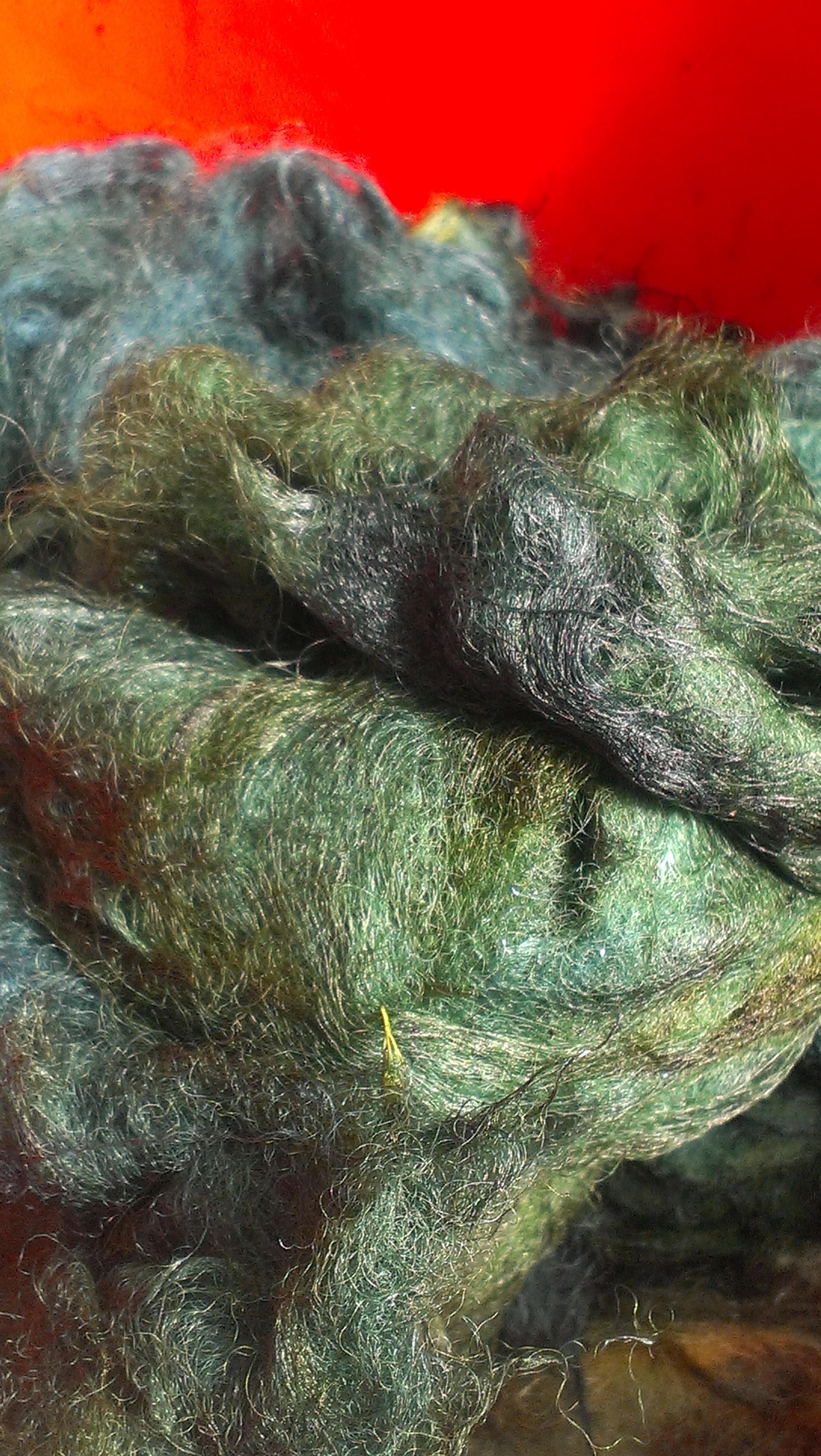
Some of the yellow fibre going into the indigo:

IMAG2499

And afterward, while still wet. Some of the greens will be quite emerald when they are dry, I think, but the paler yellows became blue rather than green.

IMAG2509

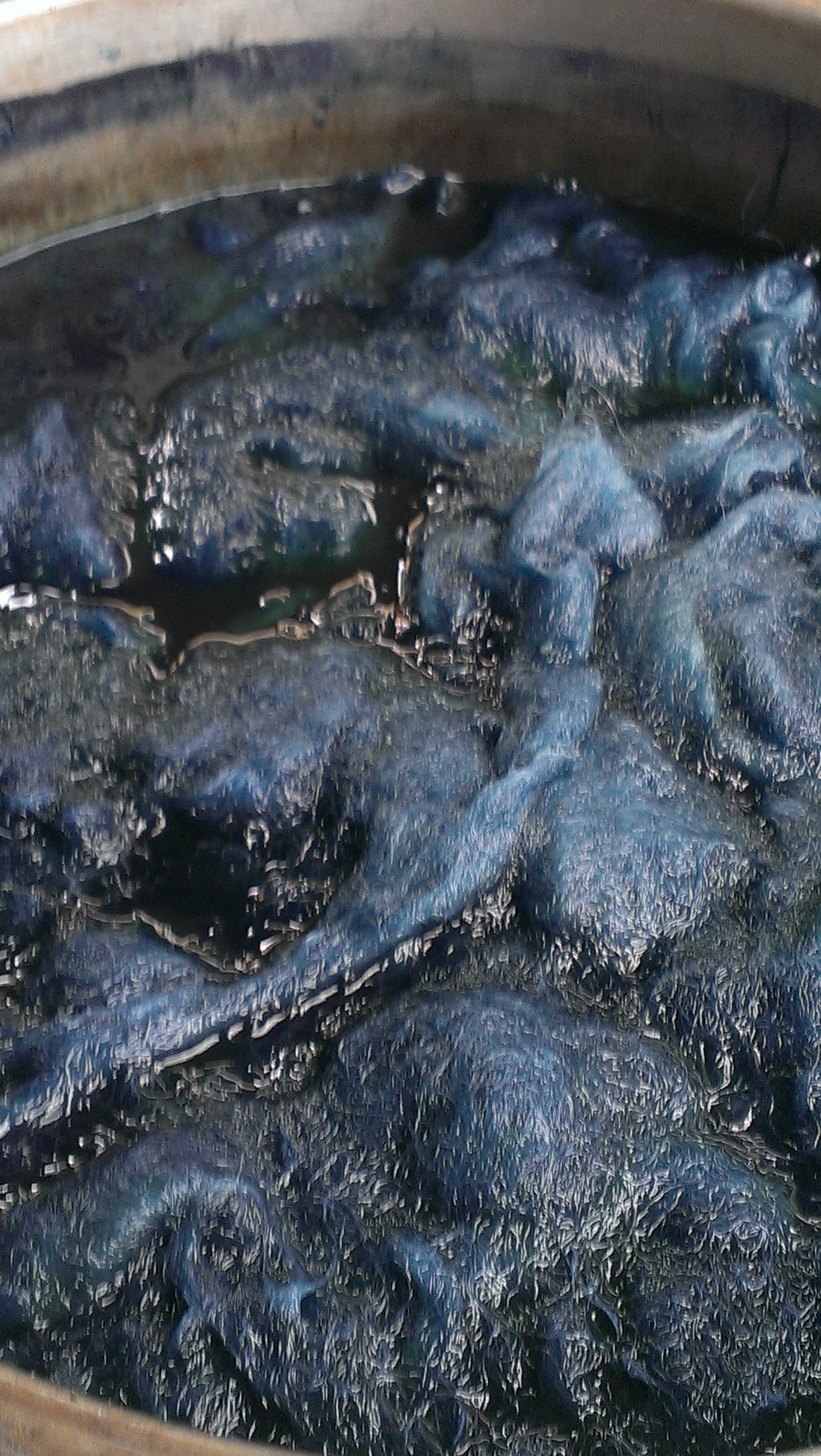
The white fleece became many shades of blue in a very satisfying way that will let me create graduated yarns.  Here it is, going into the vat:

IMAG2512

Here it is still wet but rather gloriously blue…

IMAG2524

The slippers took up blue where they were white or pale purple from the tail end of a logwood exhaust bath, but took virtually no colour on the brown parts, which is to say, most parts.  It may be that the vat was exhausted–not completely, or the pale parts would not have taken up colour–but sufficiently that no colour change showed up on the brown.  It may also be that they were greasy enough to repel the dye somewhat and that so much wet fleece having entered it, the vat was diluted.  So I have kept the vat aside for another day or a new thought on the matter.

Meanwhile, there has been a breakout of the urge to spin silk and enter the cocoon…  But not for every single silkworm, and the ones that remain are SO HUNGRY!  So now I am off to look for a mulberry tree in the parklands I heard about on the weekend…

IMAG2526

12 Comments

Filed under Fibre preparation, Natural dyeing

Leaf print bags

IMAG2211

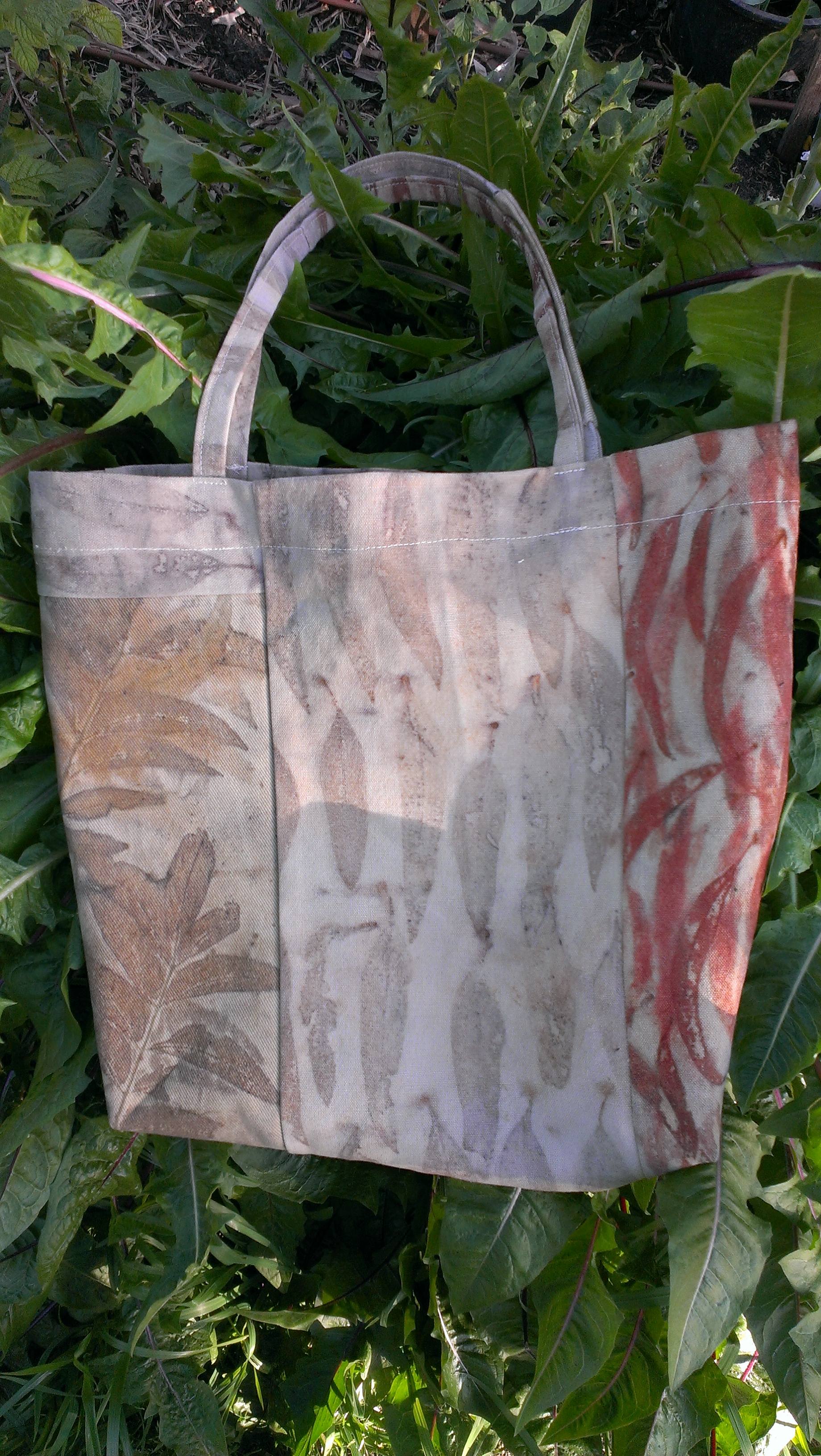
The bag making has been continuing.  This is a simple, unlined bag made from recycled heavyweight garment fabrics–parts of an old pair of hemp shorts and some recycled men’s cotton twill trousers.  Last year I went to a huge Red Cross sale where entire secondhand garments were $1 or $2.  I acquired all kinds of stained and/or worn pale coloured garments which I have been transforming.

IMAG2202

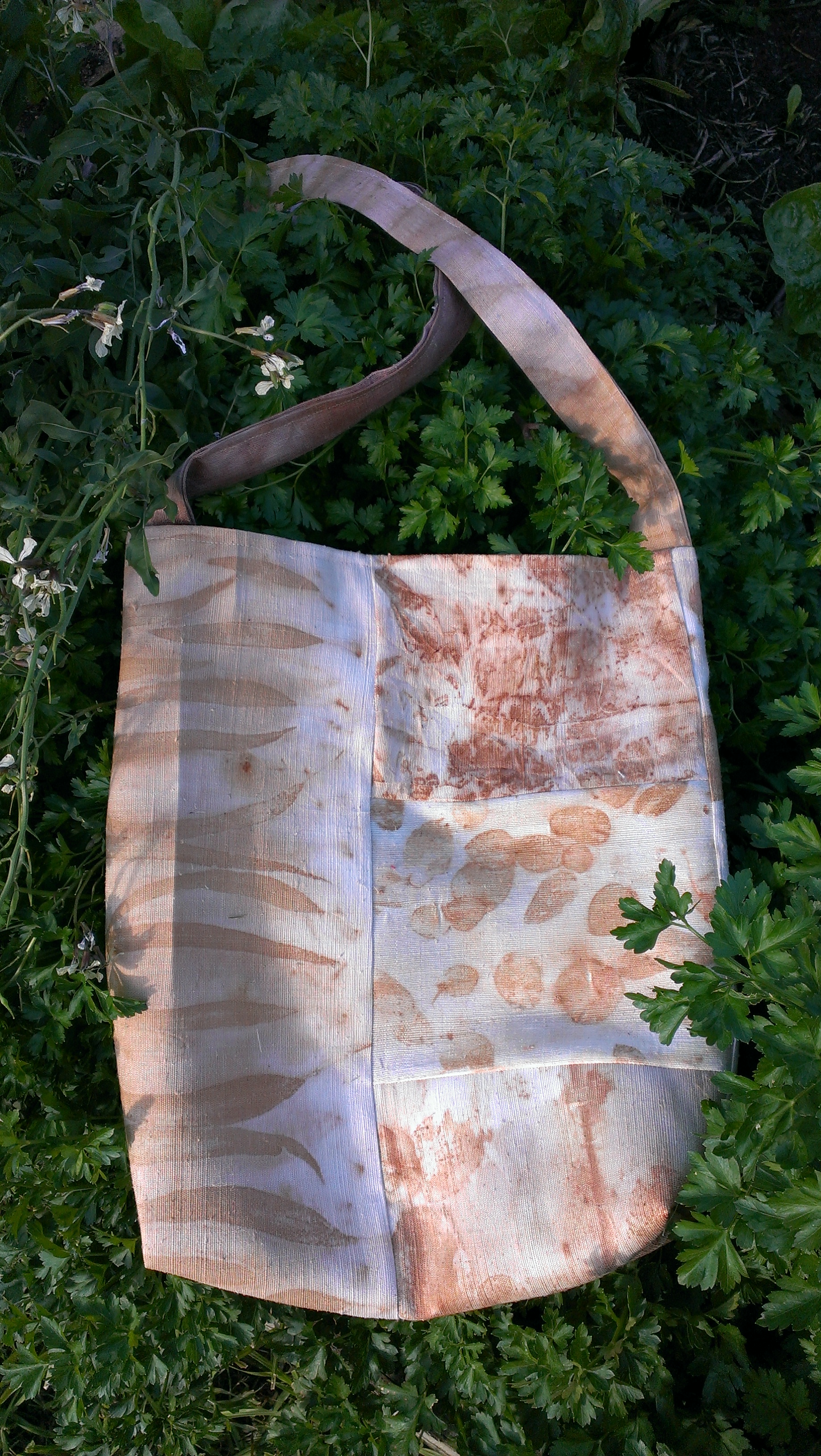
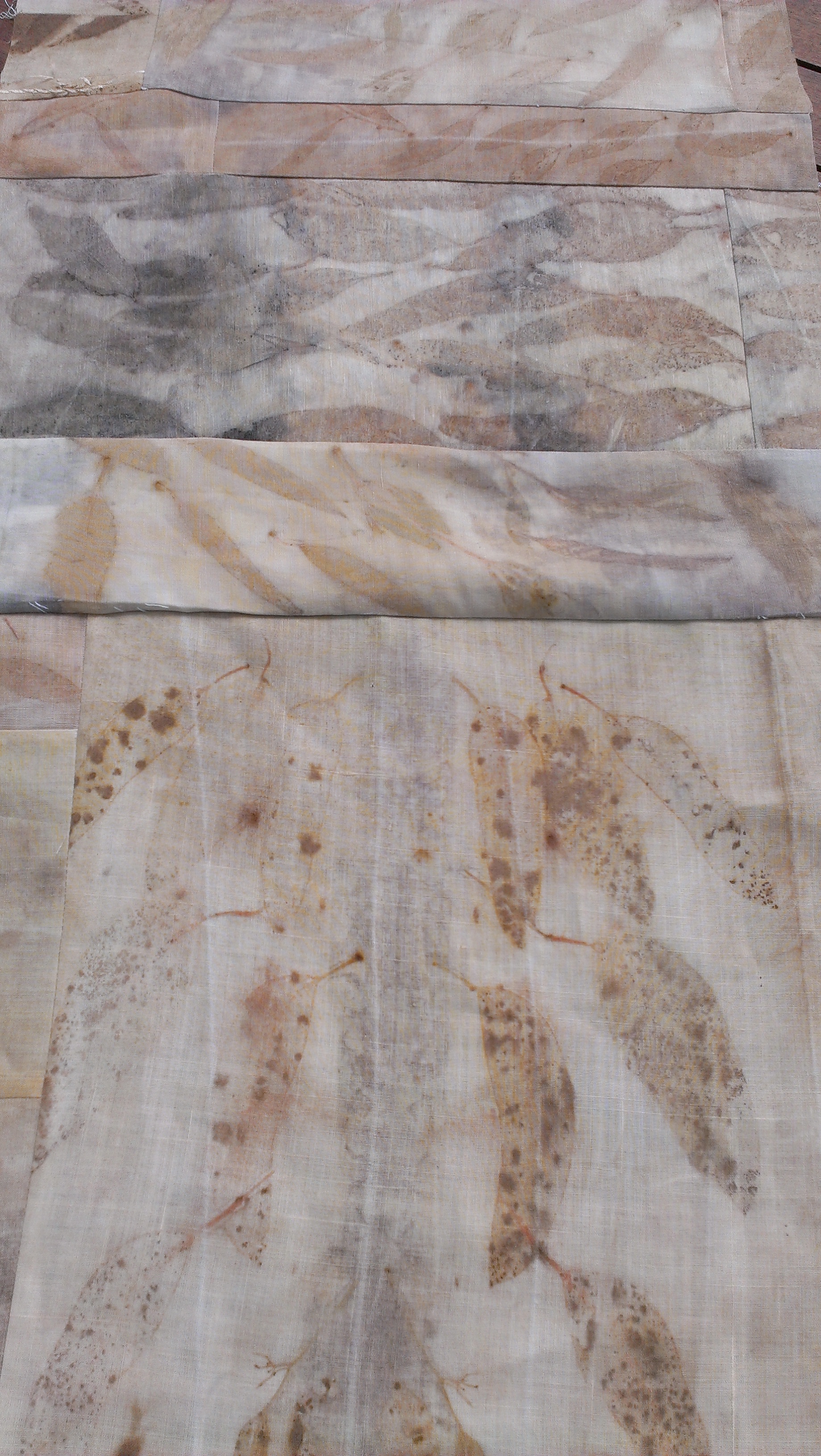
This, on the other hand, is a lined bag made of silk.  When I first bought and read India Flint’s Eco-Colour, I was immediately inspired and keen to try out her ideas and techniques, but finding silk and wool fabrics was quite a challenge.  I had been dyeing sheep fleece and woolen yarns.  I started out eco-printing with some fine gauzy silk and that was exciting enough to keep me going, though I was less than clear about how I could use it.  Then I found a length of Thai silk clearly purchased in Thailand and brought home to Australia which had somehow found its way to an op shop I like to comb through.  Many experiments followed, and they have been sitting rolled up in the sewing room for years now.

IMAG2201

The darker colour on some sections is red wine.  The splotchy random pattern–clearly not a leaf–on one piece really had me puzzled until I ironed it.  The smell was a giveaway.  Ah!  Onion skins!  That is what you can see on the top right of this bag.

IMAG2199

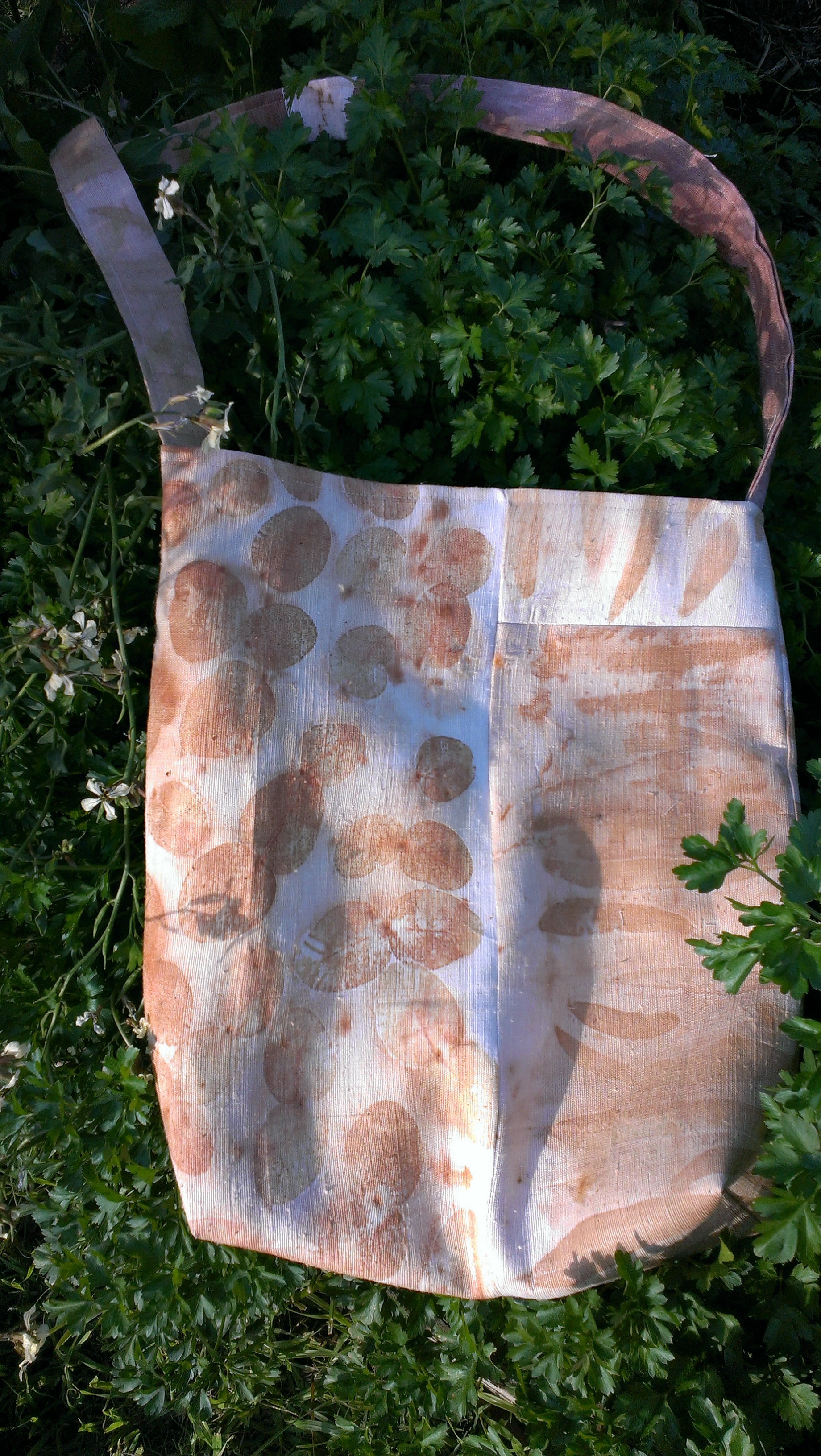
And the other side (with red wine on the strap)…

IMAG2198

I have constructed the linings from samples and less successful printing efforts on cottons…

IMAG2204

It’s very satisfying finally to put these samples to use.

4 Comments

Filed under Eucalypts, Leaf prints, Sewing

How diverting!

Experiments in diverting textile waste from the rubbish bin or compost continue… The lavender wool and the entirely waste batt are all spun up.  In the end, I plied the trash batt with a single of the lavender wool.  I can’t say I expected loveliness, and to my mind this is not lovely. As for the spinning experience: it was fine to spin though my lack of foresight about a plying strategy wasn’t ideal and I didn’t think a chain 3 ply would work.  I also have to say that even with a  generous apron under my drafting zone, this yarn shed loads of pieces of chopped thread at every stage, which didn’t make me popular with my beloved.

IMAG2278

These yarns are destoned for yarnbomb glory.  I knit then into K2P2 ribbing and will apply them when I’ve chosen a suitable spot and the rain and wind abate!

IMAG2353

On the other hand, here is a corespun yarn made from the batt composed of white polwarth locks, eucalyptus dyed corriedale carding waste and overlocker waste (much of it from leaf printed fabrics).  I like this very much. I think the ratio of polwarth to other inclusions is part of what works, but so is the texture of the polwarth–it helps hold everything together.  The happy combination of colours doesn’t go astray either…

IMAG2281

6 Comments

Filed under Knitting, Spinning

Further experiments in converting textile waste

I have been wondering about trying some more spinning experiments with waste from the overlocker and the carding process.  There is nothing like yarn bombing to make me consider any kind of yarn useable!  Yarn bombing is even more forgiving than teapots when it comes to the texture and qualities of the fibre concerned… and there is an argument for only using fibres that can’t be made into clothing or blankets for yarn bombing, I think.  So in a  burst of carding enthusiasm, I’ve been preparing batts.

First up, carding waste (corriedale dyed with eucalypt), overlocker waste (from bag making, mostly–silk, cotton, linen and some polyester blend) and some polwarth locks to hold it all together.  Here it is going into the drum carder:

IMAG2241

Carded and ready to spin.

IMAG2249

More fabric scraps and overlocker thread in some parts than others…

IMAG2256

While I was on the job, I carded some rough lavender wool of unknown origin.  It was discarded by the felting group at the Guild: say no more!   I re-washed it, which improved its texture and cleanliness somewhat…

IMAG2262

The felters also passed on this green fibre of unknown origin, which was improved very much by re-washing and carded out beautifully.  I have added dyed mohair locks and silk noil, and we’ll see if it can become a repectable art yarn.

IMAG2261

Carding waste from those two batts and some more overlocker waste…

IMAG2264

I’ll report back when I’ve tried turning these away from the waste stream and into something of use!

12 Comments

Filed under Fibre preparation

Hatchling silkworms and other thrills

Last year, I bought five silk worms at a school fair and raised them into moths. Later, when I was wondering what to expect next, I had quite a conversation with a delightful woman in the Button Bar in the Adelaide Arcade, as you do.  I can’t remember how we got from the tea cosy she was knitting to silk worms, but somehow we did.  She told me to expect the eggs that resulted from a dalliance between a couple of my moths to hatch in September.  I remember thinking about this on 1 September.  Then on Friday 13 September I realised I had taken no action and sprinted down the hall to check on them and lo!  There were tiny black creatures wiggling around!  I made an immediate mercy dash to the nearest mulberry tree.  Can you make the hatchlings out?

IMAG2179

The hatchlings are the tiny black lines.  Those spots on the cardboard are eggs.  Today I conservatively estimate I have 50 silkworm hatchlings, and I have started working on finding some of them new homes.

Meanwhile, I have been on a bag jag… sewing loads more bags and taming [some of] my scrap collection.  I decided to photograph a lining in progress on the weekend, because what is more thrilling than a lining?


IMAG2182

Well, one of our chooks seemed to think so.  She could tell whatever was happening on the table was worth looking into, so she flew up immediately to check into it.  Regrettably, this was not an edible thrill from her point of view.

IMAG2184

Thrills come in very disparate packages, all depending on perspective… or so it seems to me!  Audrey finds earwigs a lot more thrilling than I do.

Meanwhile, I have taken the nettle stems back out of the retting bath (which this time certainly did go to the garden–) and set them out in the rain to rinse.  Since so much of my crafting takes place in crevices of time and is ordered by whim rather than a linear plan, I hope you’re managing to follow all these emerging themes …

10 Comments

Filed under Fibre preparation, Leaf prints, Sewing

Waste not, want not, with a side serving of the election

I live in a society so wealthy and so wasteful, in global context, that any selection of actions I make about waste reduction can feel a bit arbitrary.  I see so many missed opportunities every day!  But still the principle that waste should be avoided is beyond criticism, and the principle that I should do what I can, is likewise sound.  So this election night, I took the eucalyptus-printed silk/hemp scraps from my previous foray into shirtmaking (I was piecing them together back in this post) and the scraps of my skirt adventure, and created bags from them. I love bags.  I love making them, giving them and carrying them around.  I seldom leave home with less than three, a curious fact I’ve decided to relax about.

Skirt bag 1: has already gone to an enthusiastic new owner who cooked a fabulous dinner for us last night:
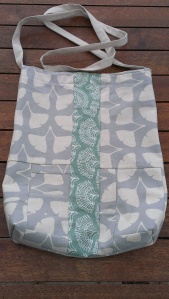
IMAG2172

Skirt bag 2 is with me now and soon to be introduced to someone I am confident will like it:
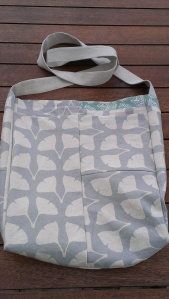
IMAG2174

I decided to line the hemp/silk bags on account of the method of piecing I had chosen and being unsure of the fabric’s propensity to wear.  I had leftover silk noil from various workshops and from making pillowcases.  Apologies for the dodgy pictures taken after dark, indoors, with a flash.  Some bloggers are so impatient!
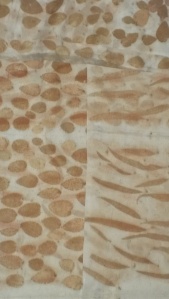
IMAG2164

There were some small sample pieces that had indigo australis and local eucalyptus leaves printed onto them and then an iron afterbath in the Blue Mountains.  I took these pictures just before they vanished into the interior of the bags to be seen only by the new owners, whom I hope will enjoy having this treat inside their bags!  I personally am the kind of person who revels in pocket linings made of treasured fabrics, whether they are organic flour bags or were formerly part of my late Grandmother’s extensive scarf collection.  Needless to say, I love a bag lining with a story.
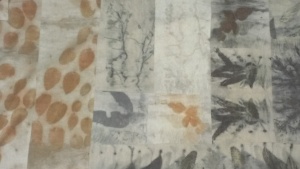
IMAG2166

I like these bags a lot. The weight of the fabric with the lining works well, to my way of thinking.  I could feel the urge to give these away before they were off the sewing machine, so here are pictures on an overcast morning!
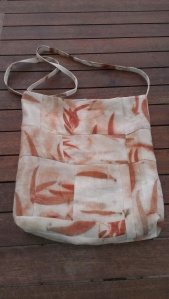
IMAG2170 (1)

This next one has been rated suitable as a gift for my mother-out-law, who is apparently generous enough in her assessment of my skills to talk to her friends about my crafting sometimes.  She has friends who have been weavers and dyers for years.  She herself has been a wonderful garment creator for decades and keeps thinking she has given it up and then changing her mind, so her judgment may not be unbiased but I am flattered by it nonetheless.  Her bag has been finished with a strip from a heavy weight ramie shirt found at an op shop (thrift store)–beautiful fabric and sewing skill but an appalling garment I felt no compunction about cutting up and redeploying.  Most of it became another bag complete with interior welt/flap pockets which had been a beautifully crafted feature of the front of the shirt.  Sadly they were an offence against fashion even to me, and I don’t hold with fashion much!

IMAG2168

And for gratuitous images, I have these of our hens.  They don’t stand around waiting for their photos to be taken when there are earwigs to be found.
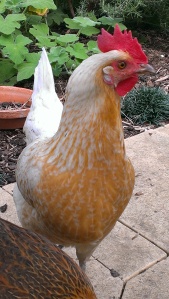
IMAG2157

However, they are glorious, and they are also blissfully ignorant of the election that was taking place the day I snapped their pictures.  We were planting and pruning and mowing and they were seeking insects and seeds.

I feel deeply sad that the people of my country have elected a government that thinks we need to pay less international aid to fund infrastructure here; that expresses routine contempt rather than compassion for refugees taking desperate measures to escape their mostly war torn homelands and get to our shores; that thinks roads are a higher priority than public transport; that cares little for renewable energy and plans to fund it less; and that has expressed little interest in participating in global efforts to halt or turn back environmental devastation or climate change.  Here’s India Flint on the subject, should you wish for more.  I haven’t made a habit of commenting on the state of our nation here, but I felt the need to mark the day.  There will be some serious further consideration given to the forms of action that might be needed in the coming period at our house and in our community of friends.  Thinking about the state of the world and our impact upon it, in all their complexity, will continue to be crucial.

11 Comments

Filed under Eucalypts, Leaf prints, Natural dyeing, Sewing

Small things…

They say ‘small things amuse small minds’. I think that if you can be amused by small things, you can be amused and delighted on a regular basis.  And that small things are often delightful.  Moss, for instance.

IMAG1909

This is such a small thing. I loved Cossack Design’s needle safe, and what with all the embroidery going on round here, I decided to make my own needle case.  I think the last one I made was created in my primary school years–both long gone. 
IMAG1919 (1)

I decided on golden stitching for the edges, so dyed some silk with Silky Oak (Grevillea Robusta) leaves.  A nod to Ida Grae of Nature’s Colors fame for the recipe, wherever she may now be.  Hopefully hale and hearty and dyeing away though apparently no longer publishing.  How wonderful that she figured out this dye plant–which is native to Australia–from California!

IMAG1882

Here is the thread…

IMAG1914

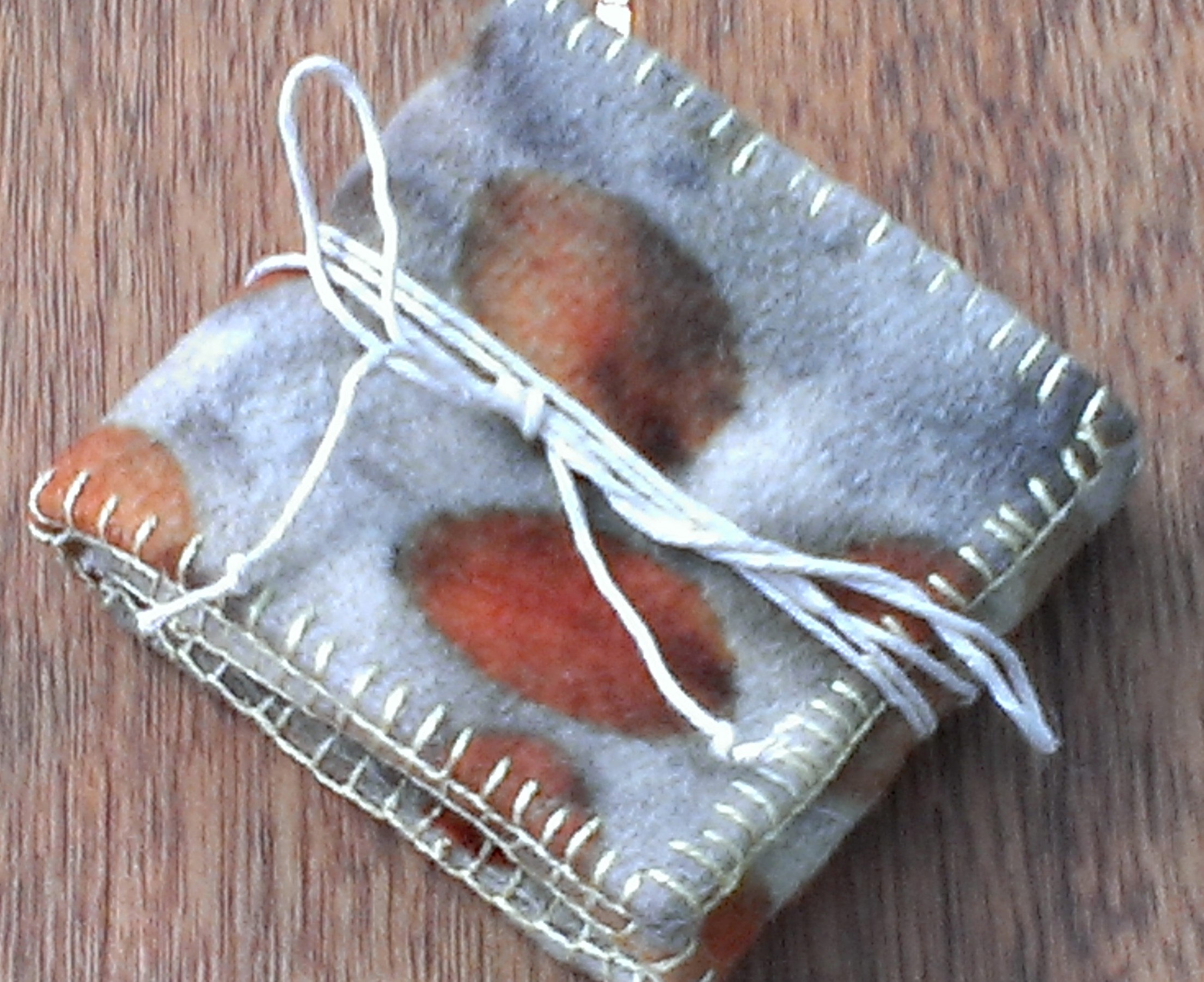
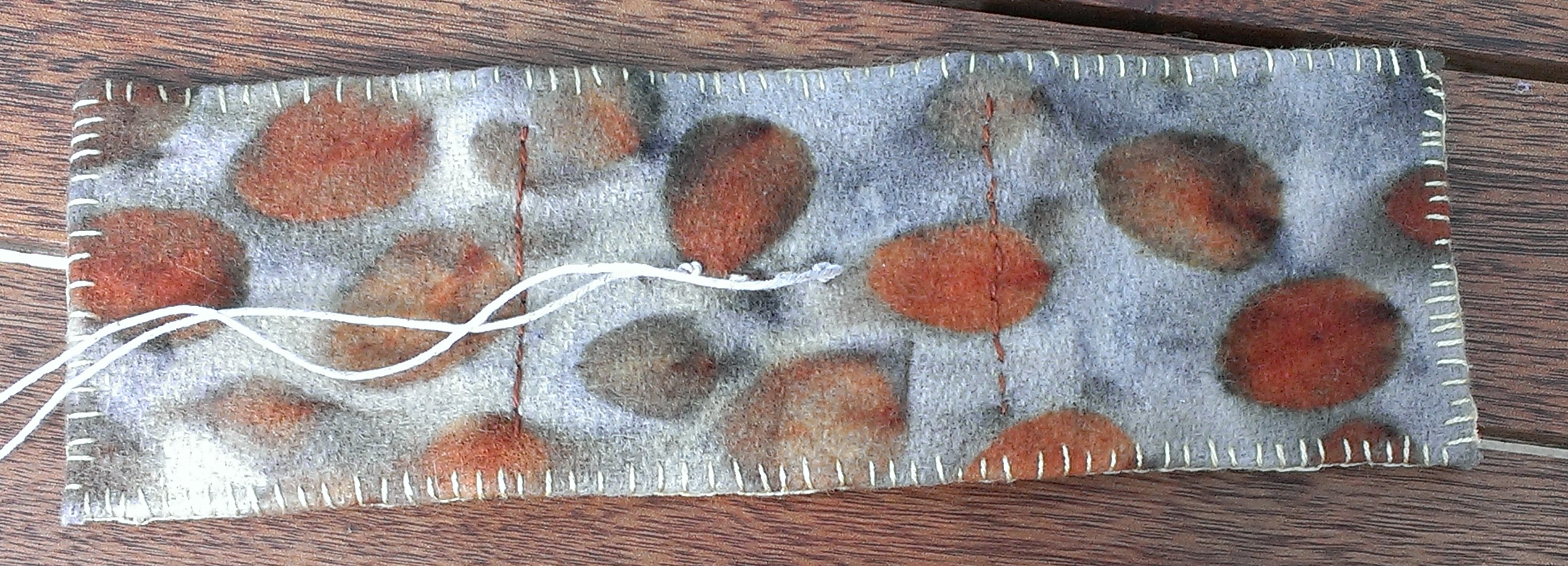
And the inside of the needle case. These two fine scraps of recycled woolen blanket and that lovely piece of cotton string saved for just such a special occasion have found happy homes at last.

IMAG1917

7 Comments

Filed under Dye Plants, Eucalypts, Leaf prints, Sewing

Plum Pine 5: Lightfastness

Having discovered that plum pine had so much potential for colour, I felt obliged to test for lightfastness and washfastness. This is my lightfastness testing apparatus on the day I set it up: it is a none too sophisticated set of threads wrapped around card, inside a heavy card envelope with a window cut out of it, which has been sitting in the front window since 23 June 2013.

IMAG1602

At the top, 3 silk thread samples, handspun Wensleydale, handspun Polwarth, two shades dyed on BWM alpaca rich and finally, two shades dyed on Patonyle (superwash woool+nylon blend).

After over a month in the (winter) sun, fading is quite evident.  I realise now that I could have made a lightfastness test which made the results clearer, but you’re stuck with my limitations on this learning curve. If you squint, you can see the original colour at the sides.  The fibre that performed best was the handspun wensleydale with alum.  It was also the winner on the washfastness test.

IMAG1890

I have to say that I think I have chosen well in using the bulk of the yarn I dyed for some slippers (they are Fibertrends Clogs), which might spend their lives tucked under a bed and come out only at night!  Here they are awaiting felting…

IMAG1889

And here they are after a wash at 40C, with some commercially dyed companions.

IMAG1906

5 Comments

Filed under Dye Plants, Dyefastness, Natural dyeing

Plum Pine 4: Washfastness

I decided the obvious way to test for washfastness was to wash.  So I embroidered with the plum pine fruit–no mordant–silk thread, and with the plum pine fruit-with alum and cream of tartar on a piece of cotton… and added a little eucalyptus dyed silk thread for good measure.  Not the best example of embroidery ever seen, but it will do the job.  The two upper examples were purple (like the thread on the cards) when they went into a normal wash–30C with eco-detergent.  One wash later, the no-alum sample is grey and the with-alum sample is green-grey.  Eucalyptus shows its true colours yet again.

IMAG1655

Yesterday I tried washing my sample cards at 40C with eco-balls (we have laundry variety here, as you will shortly understand) and they were still purple when they came out of the wash.  Interesting… this made me wonder if part of what is going on here about Ph.  Detergent would be more alkaline than eco-balls.

After 4 more washes:

IMAG1892

You might remember that I did some darning with my early silk samples.  They have not fared well either–but the mending is still doing the job!  The pink is still pink, but much faded after what I would guess as being about 8-10 washes.  The purple is blue, and paler.

IMAG1894

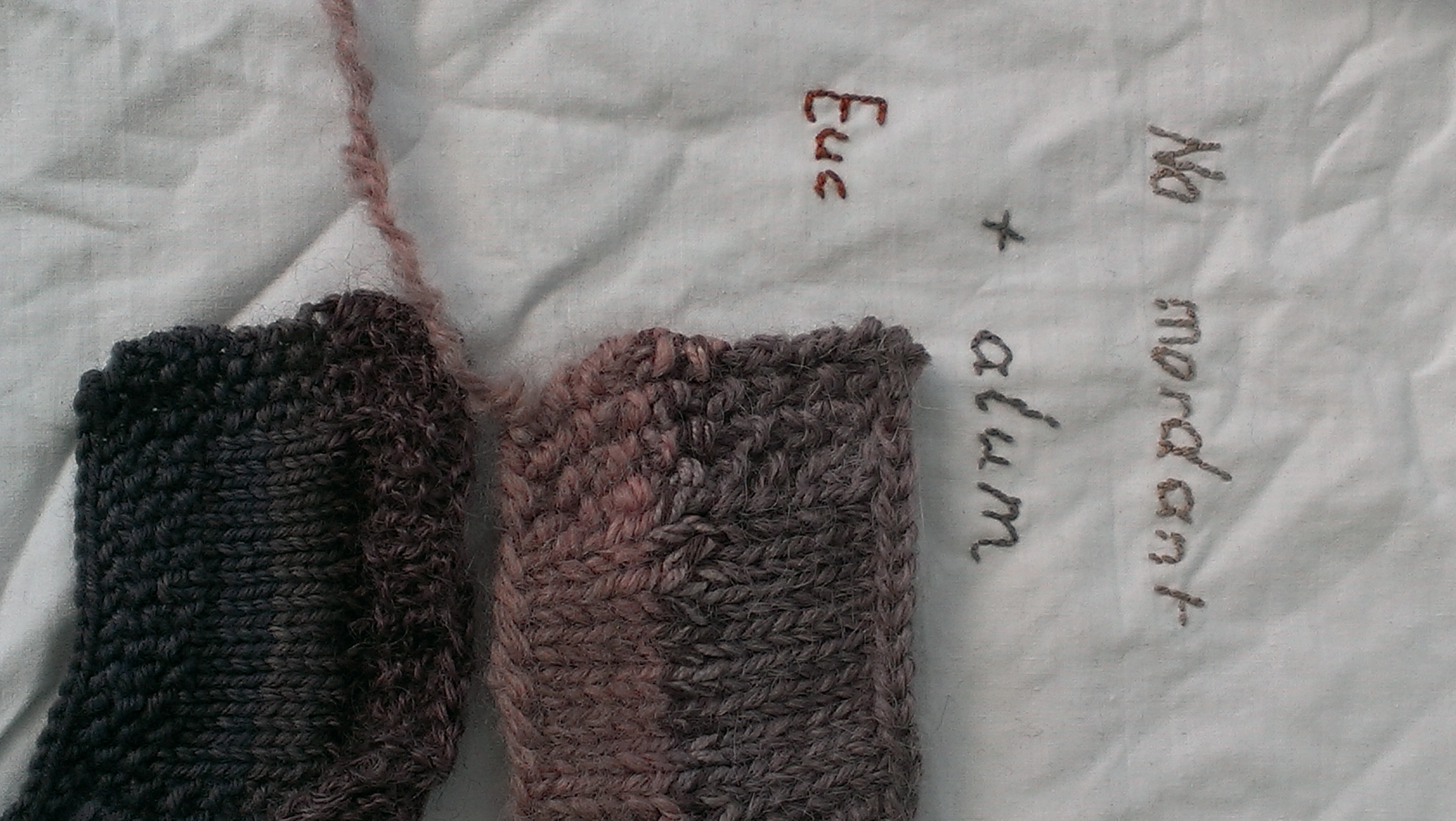
I knit some test samples from my yarns.  They fared better, washed with other woollens, cold with soapnuts rather than detergent (if anything, a slightly acidic wash).  The sample on the right has two shades of plum pine with alum and CoT on BWM alpaca rich, with a band of cotton used to tie the skeins in between because this yarn took so much colour during the dyeing I was curious.  The sample on the left has two shades of plum pine on patonyle (wool and nylon superwash sock yarn and a sample of handspun Wensleydale).  One has gone from purple to grey and the other from purple to blue.  Blue?  Before:

IMAG1661

After, with unwashed BWM Alpaca Rich in the background for comparison.

IMAG1893

Well then.  Not what you’d call really excellent washfastness. And some new mysteries to ponder, as usual.

3 Comments

Filed under Dye Plants, Dyefastness, Natural dyeing