Tag Archives: silk

Of Aprons and Alchemy

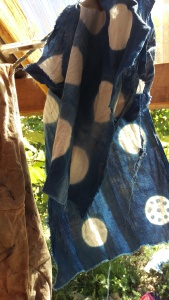
Some years ago, I made an apron at an India Flint workshop.  It’s an ingenious design India has created which starts with a shirt with a collar and ends with a coverall with straps that cross over at the back.  This model also has some stitched-on panels creating a generous length at the back.

IMAG6331

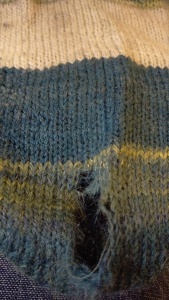
I brought this garment home to dye it, and it would be fair to say that I never loved the outcome (friends who were consulted recently liked it more than I did).  And, it had some large holes for which I was responsible and which I had a lot of [bad] feelings about having created.  In short, this garment has been in the naughty corner (the place garments go to wait when I have been naughty) for some extended time.  But then, India put up an online course called The Alchemist’s Apron.   It is further supported by an online community of eager stitchers and dyers from all round the world on facebook.  I was lucky enough to be gifted an enrolment (Thank you India!)–and this turned out to be the trigger for getting the apron out of the naughty corner and into my hands again.

IMAG6322

First step, give it a wash and soften it up a bit (soy mordant no doubt was responsible for starching it a little).  Second step, mending. Mending is an evening occupation for me, thus the mood lighting… I have learned some things about mending since these holes appeared and decided to use several different strategies.

Some mends went over the hem (they were the most discouraging). These round-ish mends I especially like.

Once that was done, a second pass through the soy mordanting process, a wander around my neighbourhood by bicycle collecting leaves, and a bundle up with home made string (hems and seams left from cutting up and recycling clothing, in this case).

IMAG6359

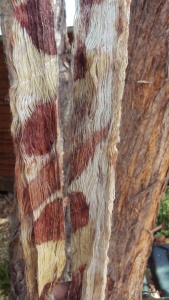
I do love eucalyptus.

IMAG6361

The mends still stand out but I think that is OK, because #visiblemending!  I had chosen linen patching and cotton thread, which did rather guarantee they would stand out as the patches are mostly in the added border at the back of the apron which is cut from a recycled op shop raw silk pant suit a friend gave me.

IMAG6389

I like the new apron much more!

IMAG6385

And here is the back view… with the button placket still sporting buttons.  It’s a bit glorious now, I think. Do you have things waiting in the naughty corner?  How do they get there, and more importantly, what motivates you to get them out again?

IMAG6386

14 Comments

Filed under Natural dyeing, Sewing

Summer Dye Camp at Beautiful Silks

It seems so long since I went to Beautiful Silks in Allansford for Summer Dye Camp and yet–no post.  The tutor once again was Jenai Hooke, full of expertise and inspiration, and dye camp was wonderful!

IMAG5994

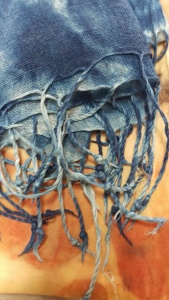
We dyed with fresh woad from the garden and ice.

2018-01-23 12.08.55

My fellow dyers did all kinds of amazing things with indigo and leaves. The crowd at Beautiful Silks never fails to be full of inspiring and interesting humans.

2018-01-23 14.43.49

Critters dropped in!

IMAG5997

This is a strategy for dyeing yarn that would never have occurred to me.  Stunning in the skein (and all multi coloured skeins have their challenges).

IMAG6017

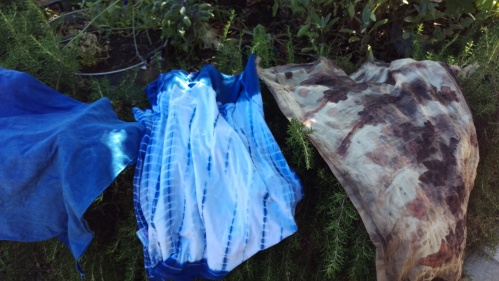
I dyed with indigo and with eucalypts.

IMAG6009

I learned a new-to-me and very effective way of mordanting with soy, and was re-educated about the importance of scouring.

IMAG6006

I made indigo circles for later use, inspired by Jude Hill’s indigo moons on Spirit Cloth.

There was so much more!  Madder, cochineal, walnut, tannins, mud, indigo painting… what a fabulous way to spend a holiday, plus the glorious time spent in Warrnambool and surrounds.  Highly recommended.

4 Comments

Filed under Natural dyeing

Finnish tough socks naturally?

IMG_20171217_144559_169

It all began when I finally managed to pick up a parcel that a friend who now lives in Denmark had left for me when she had passed through our town while we were away.  The contents were truly astonishing. Better than Christmas.  She had chosen some lovely wool, a book and a chocolate treat, all wrapped up in a bag! She delivered another Danish knitting kit as well. The yarn is Finnish wool dyed with plants and cochineal.  I couldn’t wait. I’d just finished a rather plain coloured sock and I wasn’t finished preparing my next Suffolk sock yarn.  I cast on!
IMAG5849

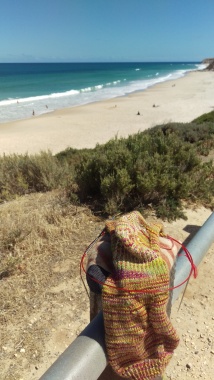
Here, a sock poses above Port Willunga beach on a summer outing. Is it just my imagination, or was this shot so peculiar my beloved took a snap of me taking it to preserve for posterity?

IMAG5736

Here, it graces a completed summer holiday puzzle.  My daughter brought Christmas gifts that were all second hand, wrapped in newspaper and tied with binder twine, designed to entertain us while in Melbourne.  One of the puzzles was unpacked immediately!
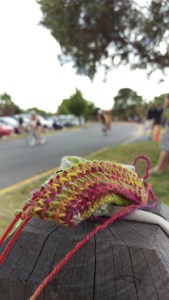
 

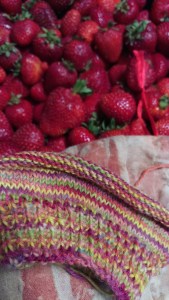
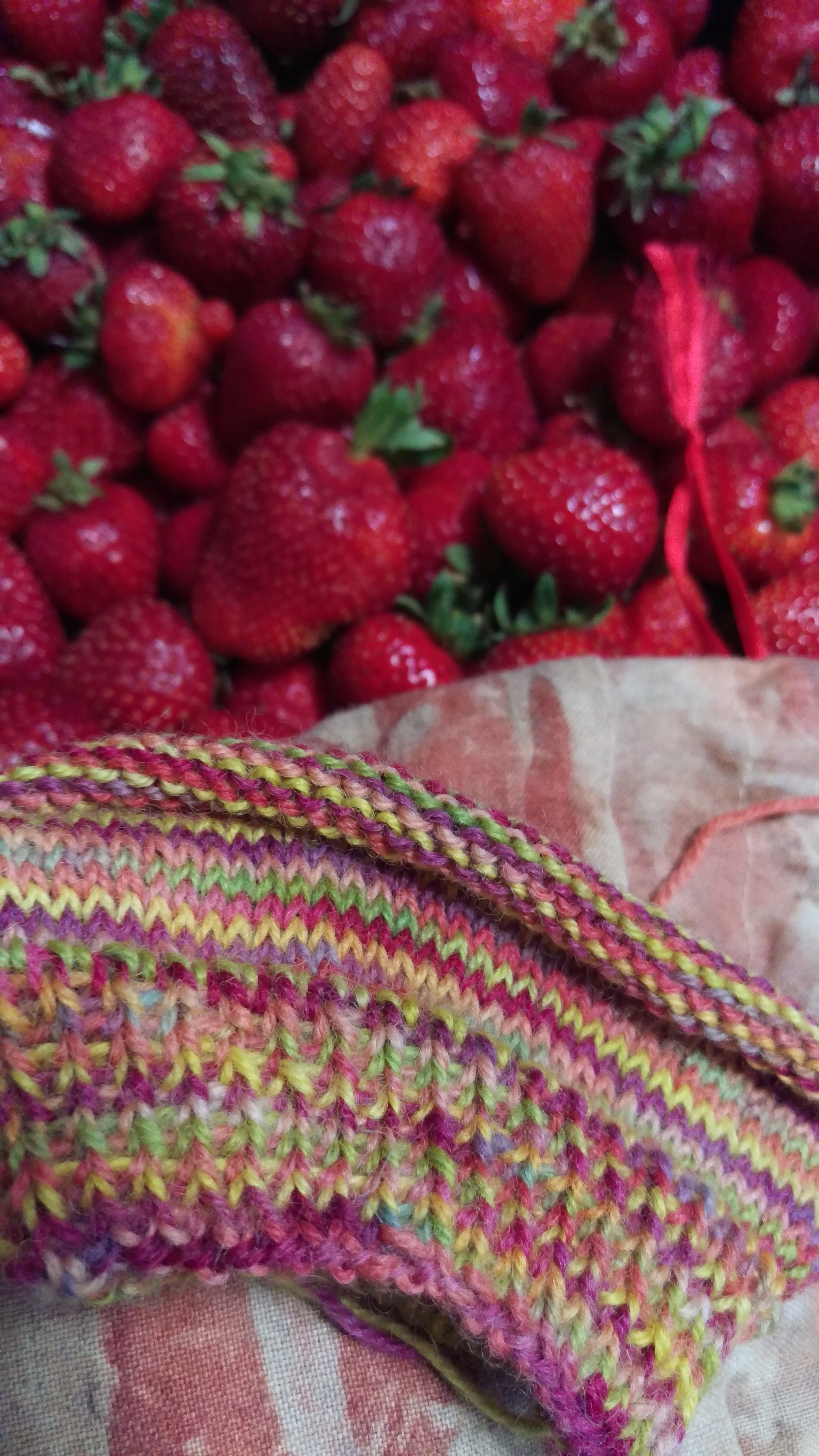
Here we have the second sock with many extremely ripe strawberries after a heat wave visit to the Farmer’s market.  And, on the side of a triathlon where I was cheering on my very fit beloved.  And now we have the frivolous images out of the way, here”s the lowdown.  I loved this yarn so much I wanted to knit it right away.  It’s the right weight for socks (4 ply/fingering) but I have no reason to think it is especially sock-worthy in terms of the breed or construction of the yarn.  On the other hand, my experience is increasingly telling me that adding silk into sock yarn is not an especially winning strategy.  As a beginner spinner I was so surprised to be told that silk was strong.  I had always thought of it as a rather fragile fibre.  But here’s the thing.  It’s both.  Silk has a high tensile strength.  If you try to snap a silk thread, it is really strong.  But I don’t think that tensile strength is matched by its capacity for abrasion resistance.  I’ve tested this by mending high abrasion areas of clothing with silk thread sashiko style–with lots of running stitches across the area of the patch.  The silk thread rubbed right off, and quite quickly.  I think that the high wear areas of a sock require a lot of abrasion resistance, and perhaps silk is not the best choice.  This was an experiment with doing all the engineering I know about to strengthen this pure wool sock.

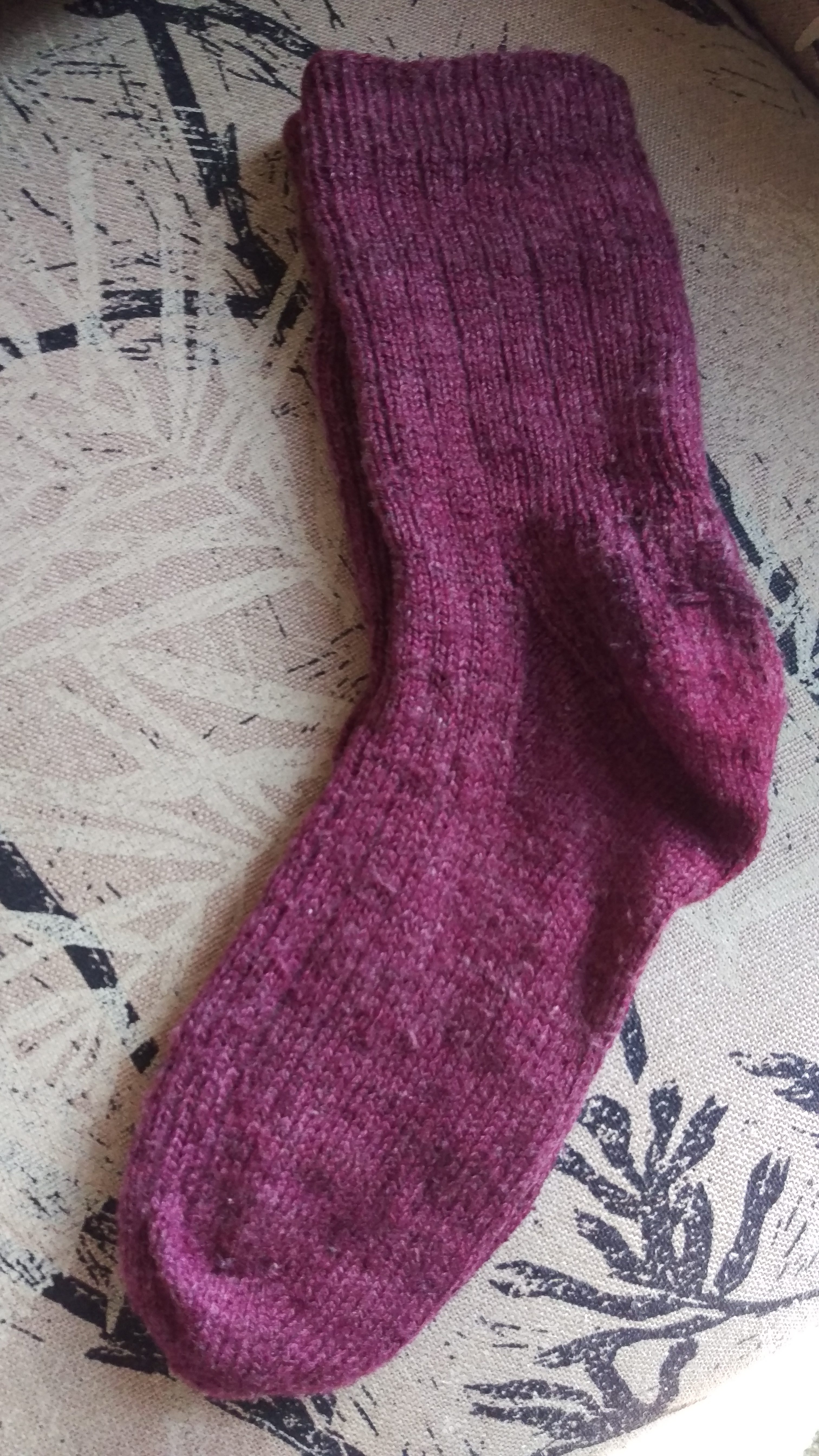
I knit these socks cuff down, and I decided not to rib the leg.  I am not sure whether this wool will be a good match with the wearer’s skin.  It isn’t merino soft or silk soft, so I decided not to add any texture that might create unwanted friction.  Instead, I created a shaped calf.  These socks are for a woman who walks a lot.  So, since I made them quite long, some room for walking muscle.  As I reached the end of the leg, I started heel reinforcing stitch above the heel.  I notice this is a place where socks can wear through and there is nothing technically difficult about reinforcing the section of the leg immediately above the heel proper, where some boots and shoes rub.

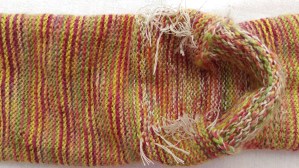
When I reached the heel, I used heel reinforcing stitch as I usually would, and added some (ecru–offwhite) cotton/silk stitching thread in for reinforcement.  You can see the stitch and colour changes in the image above. The last time I received feedback on a pair of socks for this specific person, I saw she’d worn through the sole under her heel first.  So when I got to the heel turn and began the sole, I continued the reinforcing thread, through the heel turn and then running it across the sole and snipping it off when I came to knitting across the gusset and top of the foot.

I think the idea for treating reinforcing thread in this way came from something the wonderful Elizabeth Zimmermann (wise and ingenious fairy godmother of English speaking knitters) wrote, though I think she was using woolly nylon.  She wrote in a period when nylon blend sock yarn was not available or widespread as it is today, and she was needless to say, interested in a hard wearing sock.  I think she wrote a pattern for a re-footable sock, which I read once and found beyond me.  It might be time to look it up, because perhaps by now my knitting skills will meet it.  Here is how this strategy looks on the inside of the sock. Lots oof loose ends.  But they will be barely detectable to the wearer’s heel and will not work their way out of the knitting.
I changed down a needle size for the sole to give it more durability without impinging on the wearer.  That might be one of EZ’s ideas too.  The toe also received reinforcement.

And there we are.  I purled the recipient’s initials into the back of the calf for my own amusement and hopefully hers!
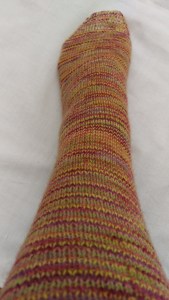
And there you have it.  A sock of unknown toughness, engineered for better wear, gloriously coloured and gleefully received.  When I am listening to the former knitters I meet on public transport, in cafes, at bus stops, in meetings, I am often saddened that they know no one who would welcome a hand knit and especially not a hand knit requiring hand washing.  That is the most common reason I hear for their abandoning knitting (followed by arthritis, scourge of knitters).  My goodness!  I am blessed by many lovers of hand knits, and while for me, knitting is its own reward in some respects… it is also like cooking someone a delicious dinner.  People who enjoy and appreciate are those for whom I’d cheerfully cook or knit again given the chance.  There is nothing like being really confident that someone loves that meal or sock or slipper or jumper so much that if you made another, they’d love that too… and I am especially blessed to know folk who will happily wear experimental garments.

 

7 Comments

Filed under Knitting

Handspun socks in use 3

We visited a friend recently and of course, I was knitting away as we chatted.  I explained about the tuff socks naturally project and she brought out her entire sock drawer in which there were quite a few pairs knit by my own hands, some of which I don’t remember knitting!  There was just one hand spun pair, and they were quite recent.  Here they are finished in mid 2017.  They look very lightly worn indeed though she assures me she has been wearing them.  No signs of wear at all on this as-yet-young pair of tough knits.  Hopefully that speaks to the qualities of a suffolk/mohair/silk blend…

6 Comments

Filed under Knitting, Natural dyeing

Spinning in the background

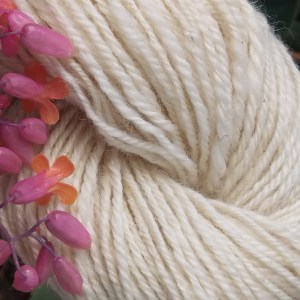
I keep forgetting, or simply not finding the time to post.  Apologies, gentle readers.  I’ve needed the making more than I’ve been inclined to post about it this last while.  But I’ve been spinning Malcolm’s Kangaroo Island “black” Merino cross (left), and leftover batts of local Finn cross (right) and clearly there was a day when they posed with leaves and flowers…

When we were at Marion Bay (cough) I carded a lot of wool, and did some blending.

But I’ve also spun up all manner of wool dyed previously, including the last of the earth palette dyed wool.  There was a request for bulky yarn from one friend in particular.  She’s managing the state of the world by knitting a lot of beanies and gauntlets.  So I sent more yarn. And there was some very pale woad dyed wool that went into a vat with soursobs I weeded at someone else’s house.

But the big excitement is the Suffolk/Silk/Kid Mohair blend for #tuffsocksnaturally. The last of which is in the dyepot with some leaves on the day I am drafting this post.  To be continued…

IMG_20170911_174957_237

9 Comments

Filed under Fibre preparation, Natural dyeing, Spinning

Leafy patchwork

The leafy log cabin workshop went ahead recently, and it was a lovely day of stitching, dyeing, company and cake. So much cake!  I took one photo near the start…

IMAG5564

And one photo of a silk bag at the end.

IMAG5568

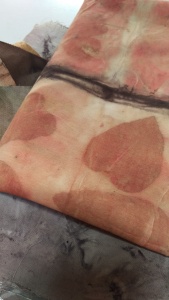
Evidently, I didn’t take any in between!  I dyed a lot of fabric in advance of this workshop, so I’ve had a lot of fun with it already.  I had a surprise success in getting green from maple leaves. Kangaroo Paw prints was another happy surprise outcome. And I have what are sure to be the first of many more leafy log cabin blocks.  It was great fun watching what other people made with some of the fabric I’d dyed (and in some cases, fabric they had dyed), and their own big imaginations. I was very struck by how many others expressed what I often feel: reluctance to use beautiful materials.  Wanting to start with whatever is leftover or unwanted.  Patchwork is a bit of a happy place for people who have this orientation toward using things up, I think.

And as well as the pleasure of spending time with lovely women, sewing and sharing and exploring, I had the pleasure of Susan’s home and hospitality, and since we spent the night before the workshop nearby, the joy of Aldinga beach at sunset too.

IMAG5563

2 Comments

Filed under Leaf prints, Natural dyeing

BFL/Texel/Silk socks


IMAG5267

Some considerable time ago, I bought a blue faced leicester/texel/silk blend roving designed for socks, and spun it into three-ply yarn.  A very fine yarn!  I seriously overachieved on spinning sock weight.  I finally decided to buy finer needles in order to knit it, and now it has become my first pair of no-nylon, no-superwash socks for the #tuffsocksnaturally project.

IMG_20171105_140152_499

Here it is at a coffee shop where I believe I was knitting while reading (some of the) hundreds of pages of papers for a meeting.

IMAG5358

Here it is at the Park-n-Ride (that’s a car park servicing a train station, basically) where I get off the train and wait for the bus. There is just no way to know what the other passengers think of all the sock shenanigans.  A few offer me shy grins and one bus passenger recently told me she used to knit a lot but no one wants her knitting anymore.  I feel blessed for my friends, all over again!

IMAG5374

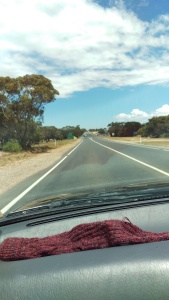
Here it is on the wide open road headed for a long weekend at Marion Bay. The photographer may have leaned over a bit.

IMAG5386

Marion Bay was glorious.  Here, I’ll show you a little bit. But also there were dolphins, lots of dolphins, emus, lots of emus, kangaroos, and ladybirds, lots of ladybirds, and very many, very shy birds indeed.

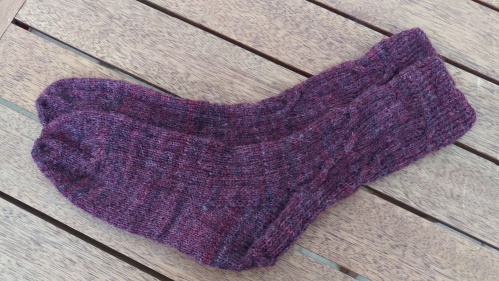
And here the socks are, finished, in all their whimsically cabled glory.

IMAG5572

7 Comments

Filed under Knitting, Spinning

Leafy Log Cabin

I’ve been busily dyeing fabric, making plans and piecing examples for the leafy log cabin workshop coming up in only a very few weeks’ time.

IMAG5381

There are still places for anyone able to join us.  We’ll be exploring using eco prints in patchwork as well as doing a little dyeing and making a bag featuring a leafy log cabin design.  All in a lovely, friendly setting at the Aldinga Eco-Village.  For details or to sign up… click here. 

2 Comments

Filed under Natural dyeing, Sewing

Handspun socks in use 1 & 2 PLUS Knitting in a patch

I thought one thing I could do to complete the feedback loop on the toughness or otherwise of my sock spinning would be to ask people I’ve given handspun socks to whether they could return them for inspection.  One of the hard things about the fact that I–gasp–can no longer wear handknit socks, is that I don’t have the capacity to see and feel for myself how my handspinning fares in daily wear inside a shoe or boot.  In return for people showing me how their socks have worn, I’m offering to mend socks that come back to me to close the feedback loop.  So if you happen to be reading this and you think you have a pair of handspun, handknit socks I gave you, bring them in and if they need darning, I’ll do the honours!

IMAG5273

I think it is worth considering the question of wear.   It is a striking feature of most conversations I have with people about how hand knit items are wearing, that they feel they need to apologise if something I knit has worn out or worn through.  I don’t think so.  Sometimes it is obvious enough that the fault was with the spinning or knitting or fibre choice (so if anyone should apologise it should be me; or perhaps there could be shared acknowledgement of how wonderful the alpaca socks felt, but that they were never destined to last decades).  On the whole, though, I tend to think that it is rather flattering that people like things I made enough to wear them until they fall apart.  And unless I know what happened to them, sometimes I am not in a position to learn what might make me a better sock spinner (for example).  Nylon is permanent, it will never biodegrade, and therefore we should think seriously before we use it.  But the flip side of this recognition is awareness that socks without nylon will not wear as well as those with nylon.  There is a reason it came into use in the context of socks.  And–now that I have lived long enough to understand how a plastic bag will “degrade” into squillions of little bits of plastic, I think it may be time for a thoroughgoing recognition that when your #tuffsocksnaturally wear out they will biodegrade, so the compost or the worms can take them, especially if you dyed thoughtfully too.

But I digress.  This sock came home recently with only one hole!  I made these socks a little over a year ago (follow the link for details),  so they have not had a huge amount of wear.  But the hole was quite big, and clearly resulted from the fabric wearing right through in a large area. Given the fact that the other sock had not worn through in the same place, I’d say there was a weak patch in the fabric, likely caused in this case by the blending of the fibres (Suffolk, mohair and silk) being uneven, or by the spinning being on the thin side, or underplied.  I decided on a knit-in patch rather than a darn.  So I picked up stitches at the base of the heel flap (above) and began to knit, joining on by picking up a stitch on each side of the patch each row, and knitting it together with the edge stitch of the patched section.  The under-heel section will be thicker than the surrounding fabric, and the patch is generous, but I think under the heel is about the least sensitive place to put a patch and clearly reinforcement is needed!

IMAG5275

To finish the patch, I picked up the same number of stitches , knit right up to them, and grafted them together (kitchener stitch, if you prefer).  If you’d like to see that mending strategy again, I’ve blogged it before here and here (on cardigans) and here (another pair of socks!)

Another pair of handspun and handknit socks came home the same day.  These had two tiny, neat darns in red thread, a lovely application of visible mending (and I think I found the remainder of the skein in my stash subsequently, which may explain the yarn choice another way).  One darn was up by the cuff, where it may have been a breach in the spinning or perhaps a munch from a m*th.  The other is here on the toe, where wear is to be expected, in my view.  All our feet (and shoes) are different, of course!


I found the post about knitting these socks here.  They were knit in 2014 and have gone from son to mother in their lifetimes thus far.  And yest so little obvious wear??

I spun them from… Superwash Merino/Bamboo/Nylon blend.  I bought it at a spinning workshop as the recommended blend for sock spinning, and did a class on spinning for socks.  the other thing I note with interest is that I knit them on 2.75 mm needles.  I think that was partly because the yarn was finer than I anticipated, but it dies also suggest a  finer gauge than my usual, and that is another long-wearing-sock-strategy handed down through the ages. So–the combination of nylon content, tight gauge, machine prepared fibre and handspinning produced a higher wear sock–but not a nylon-free sock, and let’s not pretend that industrially produced bamboo fibre is kind to the environment–though I do assume it would biodegrade at least.  So there you have it!  My first two worked examples of handspun handknit socks in wear for review.  What are you learning from reviewing your spinning and knitting?


14 Comments

Filed under Knitting, Spinning

Kangaroo paw prints

IMAG5141

For my birthday this year, my beloved bought me some kangaroo paws.  They started blooming about a week after they went into the ground in march, and they are still flowering.

2017-10-07 09.56.15

As I started dyeing fabrics for the Leafy Log Cabin workshop (details here), I decided to try some of the oldest blooms in the dye pot.  Too exciting!

IMAG5174

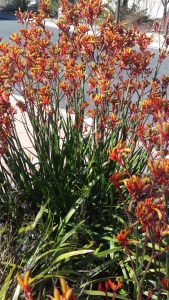
Decidedly overexcited by this experience, I wandered out on my bike the next day to deadhead the kangaroo paws at a nearby intersection (there are so many).  They were not red–and they did not give a print.

IMAG5167

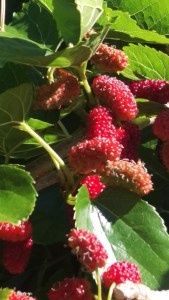
But I did find a couple of mulberry trees in fruit, and I had a lovely ride and collected E Cinerea leaves… so a lovely afternoon just the same. How’s your dyeing and foraging going?

IMAG5171

14 Comments

Filed under Leaf prints, Natural dyeing